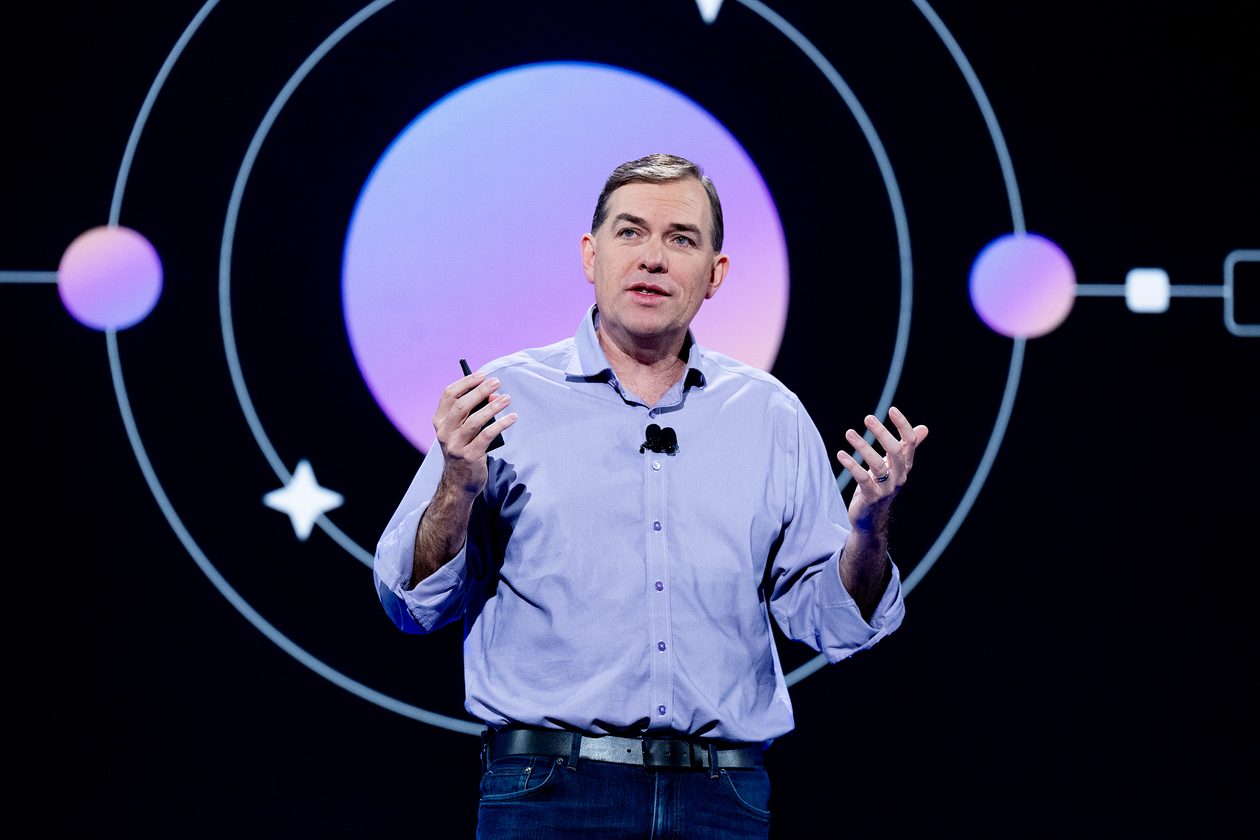
Andy Jassy says Amazon “could invest a lot more” in AI infrastructure “and it wouldn’t be a bad use of capital.” (GeekWire File Photo / Todd Bishop)
Amazon reports third-quarter earnings Thursday afternoon with more demand for its cloud services than it can serve, driven by AI labs such as Anthropic and OpenAI along with growth in its traditional cloud business.
One big question for Wall Street going into the report is what Amazon might signal about next year’s spending as it tries to keep up with that demand.
CEO Andy Jassy said on an Andreessen Horowitz podcast last week that AWS capacity is largely booked for this year and next, along with “a good chunk of ’28.”
Amazon has said it expects to spend about $220 billion on capital expenditures this year, largely on AI and cloud infrastructure, up from its earlier plan of $200 billion. Even at that level, Jassy said, Amazon is “leaving a meaningful amount of demand on the table.”
Past spending pushed Amazon’s free cash flow to negative $7.6 billion for the 12 months ending in June, as the cost to add data centers, chips and other equipment exceeded the cash its operations brought in. Jassy gave no indication of slowing down, saying the company “could invest a lot more and it wouldn’t be a bad use of capital.”
Core numbers: Analysts expect revenue of about $202 billion, up 12% from a year ago, according to Yahoo Finance. That’s at the top of Amazon’s own forecast of $197 billion to $202 billion.
Analysts expect earnings of $1.96 per share, about the same as a year ago.
Amazon’s sales growth will likely look slower this time, about 12%, down from 20% last quarter. A big reason is timing. Prime Day, the company’s biggest sales event of the year, fell in the second quarter this year, rather than the third quarter as it did last year, so this quarter is up against a tougher comparison.
Amazon estimated in July that the shift would take nearly 4 percentage points off its growth rate this quarter. It hits online store sales hardest: analysts expect them to grow only about 3%, according to Zacks.
AWS: Amazon Web Services, the company’s cloud business, generates the majority of its operating profit. AWS revenue grew 37% to $42.2 billion in the second quarter, its fastest pace since 2021 and the fifth straight quarter of faster growth.
Analysts expect AWS revenue of about $45.4 billion this time, up 37.5%, according to Zacks. Wedbush is more optimistic, projecting growth of about 41%.
AWS had $496 billion in signed contracts it hadn’t yet delivered as of June, more than double the year before. That means its growth depends largely on how quickly Amazon can bring new data centers online.
“Capacity, not demand, is the constraint,” Yorkville Ives analyst Dan Ives wrote of the industry in a note Sunday.
Jassy said on the a16z podcast that running AI models is still “an order of magnitude too expensive” for businesses to use them widely, and that Amazon’s custom chips, including its Trainium AI processors, are a big piece of bringing that cost down. Amazon said in July that its chip business was on pace for more than $25 billion in annual revenue.
Anthropic stake: Amazon’s reported earnings could look very different. That’s because its profit fluctuates significantly depending on the value of its stake in Anthropic.
Last quarter, $53.4 billion in pre-tax gains, mostly on Anthropic, pushed Amazon’s earnings to $5.75 per share, against expectations of $1.82.
Anthropic filed paperwork Monday for a planned IPO on the Nasdaq. Amazon’s stake in the AI company was valued at about $190 billion as of June 30, according to Amazon’s latest quarterly filing. That includes about $92 billion in gains on convertible notes, a form of loan that turns into stock, which haven’t yet been counted in Amazon’s profit. Those notes would convert to Anthropic stock when it goes public.
Anthropic is also one of Amazon’s biggest cloud customers. Its IPO filing shows commitments to spend at least $110 billion on Amazon’s computing capacity into the 2030s, behind the $114.5 billion it committed to Google, as GeekWire reported Tuesday. Anthropic also said in the filing that it has asked its cloud providers for more computing power than they were willing to supply.
Shopping agents: Amazon blocked Meta’s new Muse AI agent from its store last month, escalating a fight over who controls the customer relationship when software does the buying. Amazon said Muse broke its rule requiring agents to identify themselves.
Agents that shop on a customer’s behalf could bypass Amazon’s advertising business, which depends on people browsing its pages. Ad revenue grew 26% to $19.8 billion last quarter, and analysts expect about $20.8 billion this time, up 18%, according to Zacks.
“Investor questions remain on agentic commerce risk, particularly to advertising, but we see limited risk,” Wedbush analyst Ygal Arounian wrote in an Oct. 16 note, citing Amazon’s logistics advantage and its role connecting shoppers with sellers.
Amazon is trying to give shoppers fewer reasons to look elsewhere. It now lists 250 million products sold on other retailers’ sites, about 2.5 times as many as in March, The Information reported Wednesday. On the seller side, Amazon opened its tools to outside AI agents in September, starting with Anthropic’s Claude.
Cloud rivals: Microsoft and Alphabet report quarterly results Wednesday afternoon, a day before Amazon. Microsoft’s report is its first under a new structure that breaks out Azure cloud revenue every quarter.
Check back with GeekWire on Thursday afternoon for coverage.
The U.S. Army has picked Amazon Web Services and World Wide Technology to help build an autonomous cyber defense system that can find and stop network threats with little human involvement, choosing the two companies on Oct. 23, 2026, for a Project Griffin pilot worth a combined $2.6 million. The U.S. Army said it wants […]
In his opinion Wednesday, US district court judge Francis J. Mathew said there was no “bright line rule” for determining the appropriate penalty for Meta's repeated and willful deception of users since 2010 about their “control of data, third-party data misuse, misinformation, hate speech, and equal enforcement.”
Amazon wants to break Nvidia’s hold on PyTorch, the free toolkit used to build most AI apps, so that more developers run their apps on alternative chips like its own.
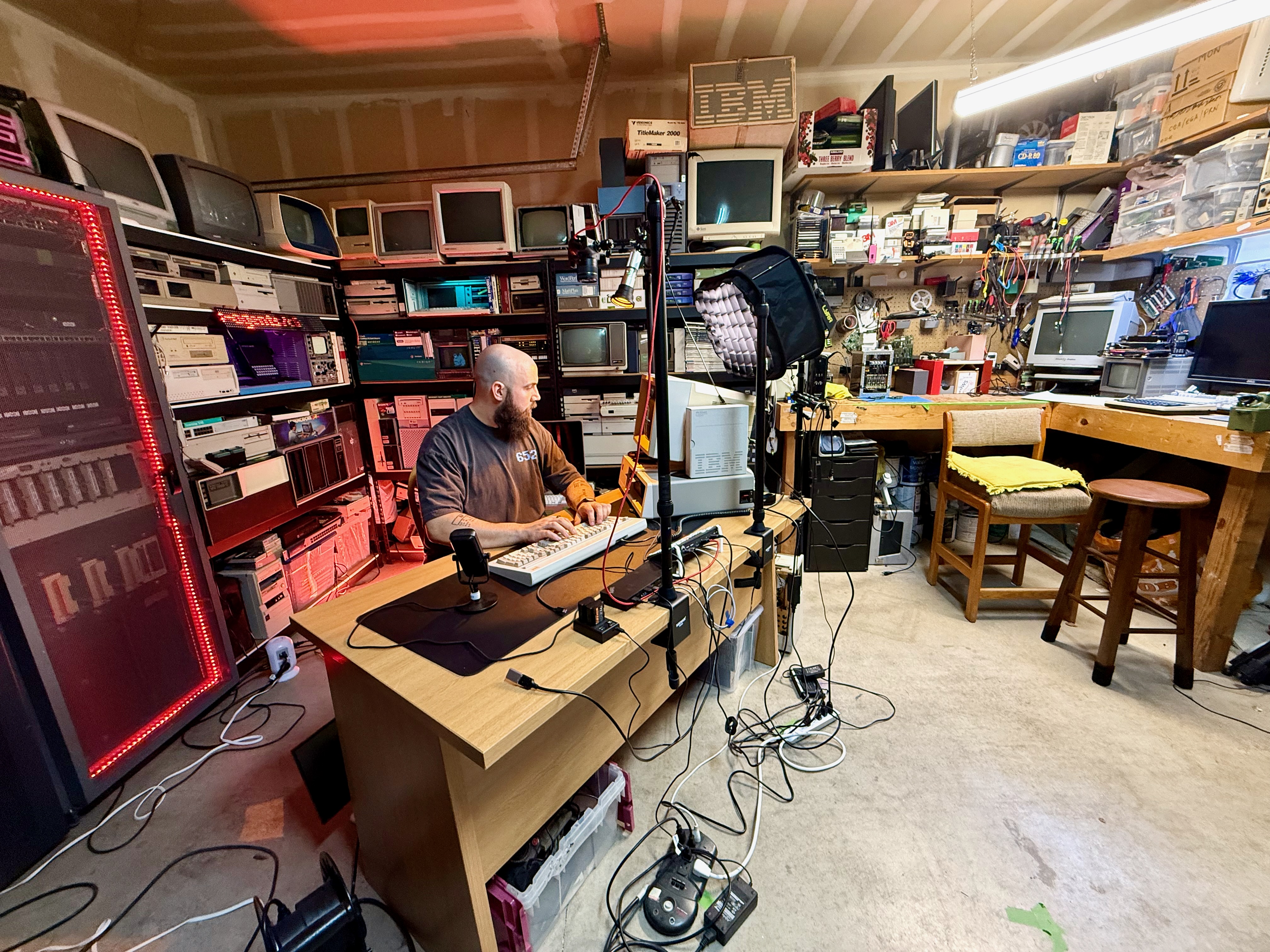
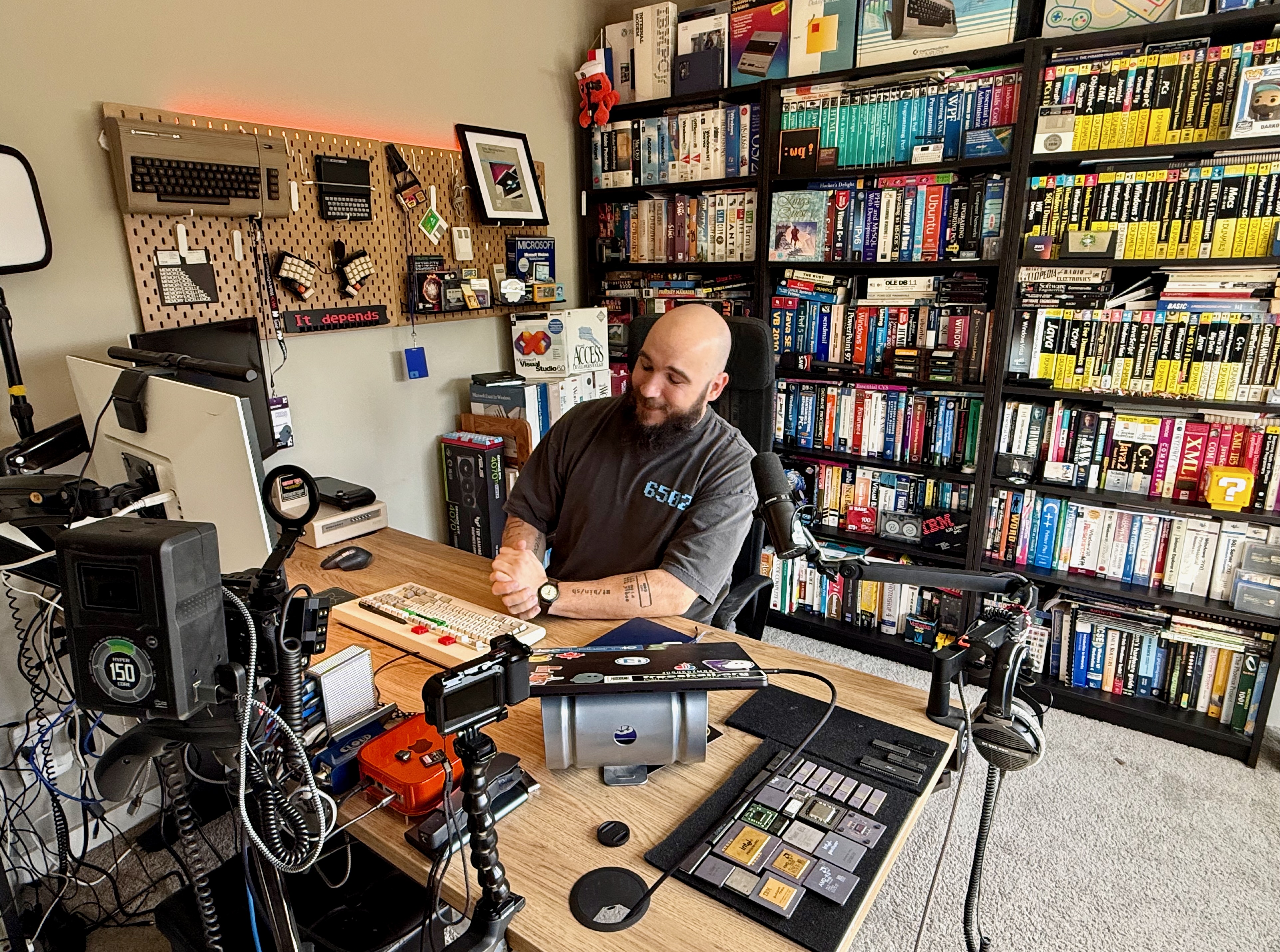
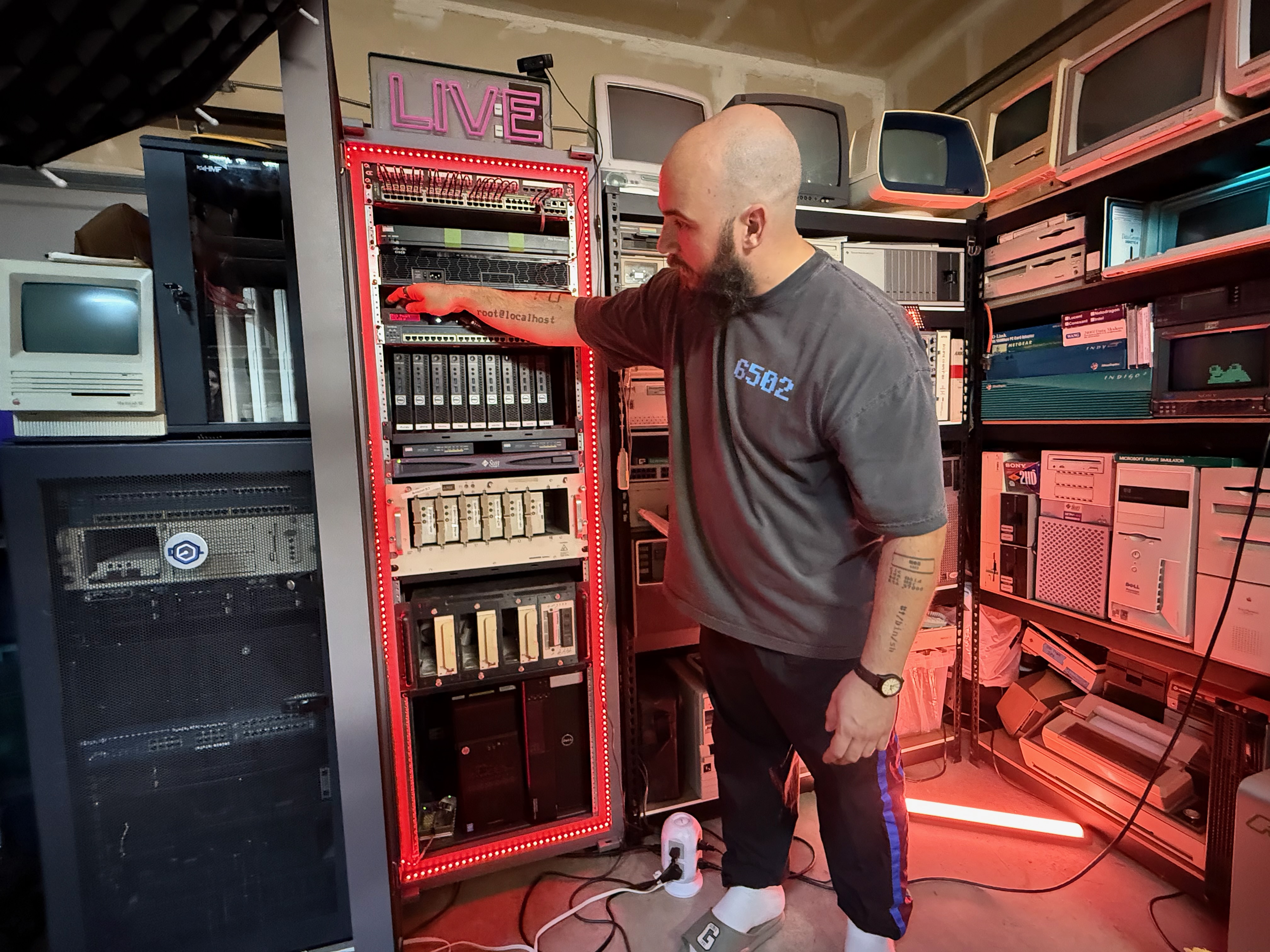
Darko Mesaros, a distinguished developer advocate for Amazon Web Services, is surrounded by vintage computer equipment in the garage of his Maple Valley, Wash., home. (GeekWire Photo / Kurt Schlosser)
Darko Mesaros used to park a car in the garage of his Maple Valley, Wash., home. These days, it’s wall-to-wall computers.
A towering server rack glows with red LEDs. CRT monitors are stacked beside vintage workstations, and a workbench overflows with tools, cables, and half-repaired components.
“I started getting stuff, and then … it just kind of snowballed to a point I actually had to slow down because I legitimately don’t have space for it anymore,” Mesaros told GeekWire during a recent tour of his retro hardware labyrinth.
The lore of tech innovation is full of suburban garages where visionary founders tinkered their way to world-changing companies. Mesaros, a distinguished developer advocate at Amazon Web Services, isn’t launching a startup out of his. Instead, he’s using it as a living museum to rescue, repair, and resurrect the discarded digital ghosts of computing history — and then daring them to run modern artificial intelligence.
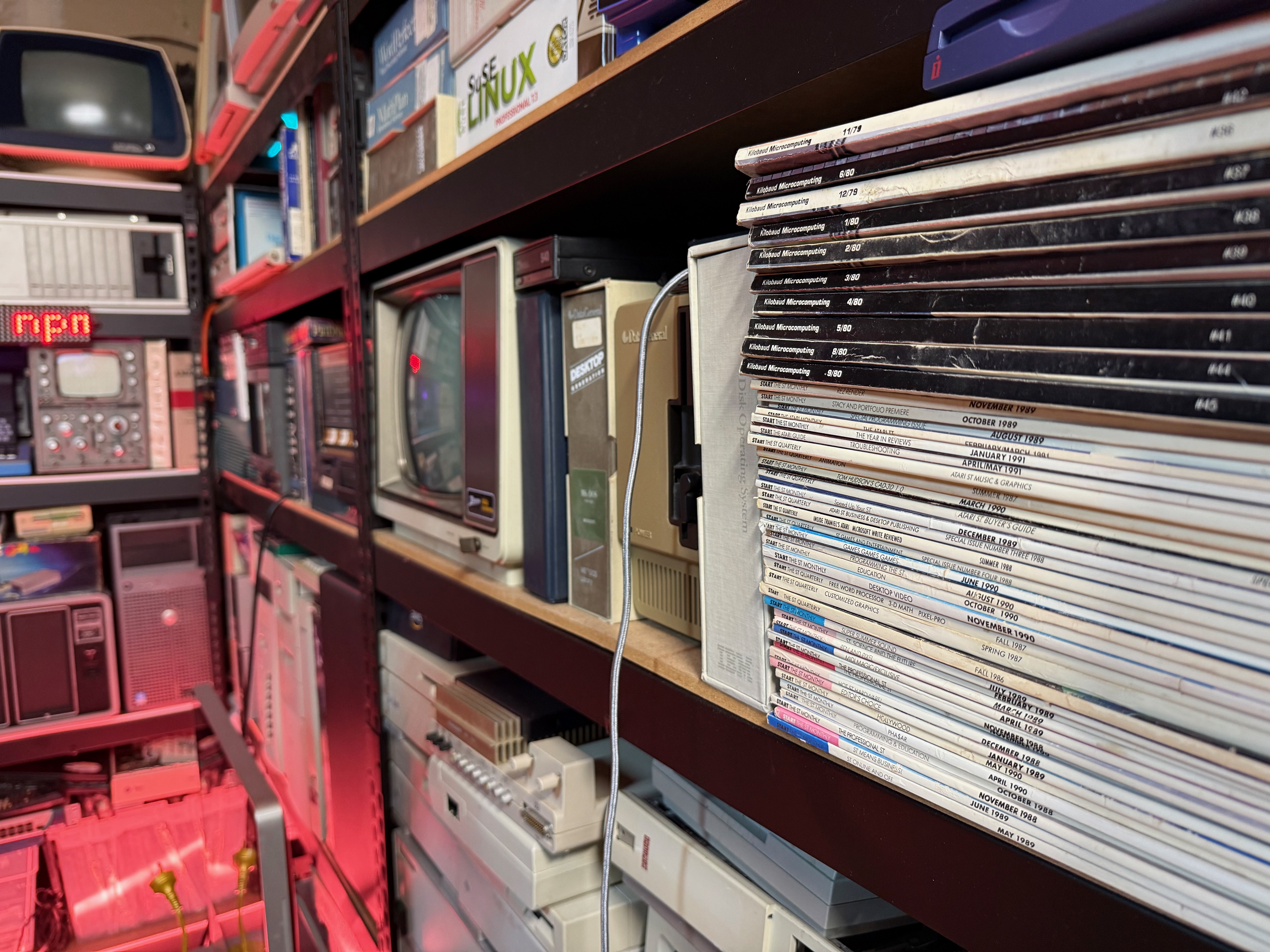
The collection has spilled into an upstairs office and now spans more than 100 full computers, from an early-1970s minicomputer to Silicon Graphics workstations from the ’90s and HP workstations from the 2000s. Add roughly 25 vintage video game consoles, rescued software, peripherals, a leather-bound TRS-80 owner’s manual, and nearly a decade of 1980s Byte magazines, and the total tops 1,000 items.
Most of it arrives broken, and that’s the point.
“Buying a mint old system is not fun,” he said. “Buying something that’s broken and then having that excitement of fixing it is just fantastic.”
He finds gear at Goodwill, through local Facebook Marketplace groups, and through Seattle’s large retro computing community. Sometimes it takes a rescue mission: when a man in Washington, D.C., was about to throw away a pallet of 1980s computers, Mesaros had a friend there grab it, then paid to ship the whole load to Seattle.
At one point, he had seven Commodore 64s. He gives extras to other collectors, and he’s never sold a single piece.
“That’s been my little pride,” he said.
From a Commodore 64 in Serbia to the AWS cloud
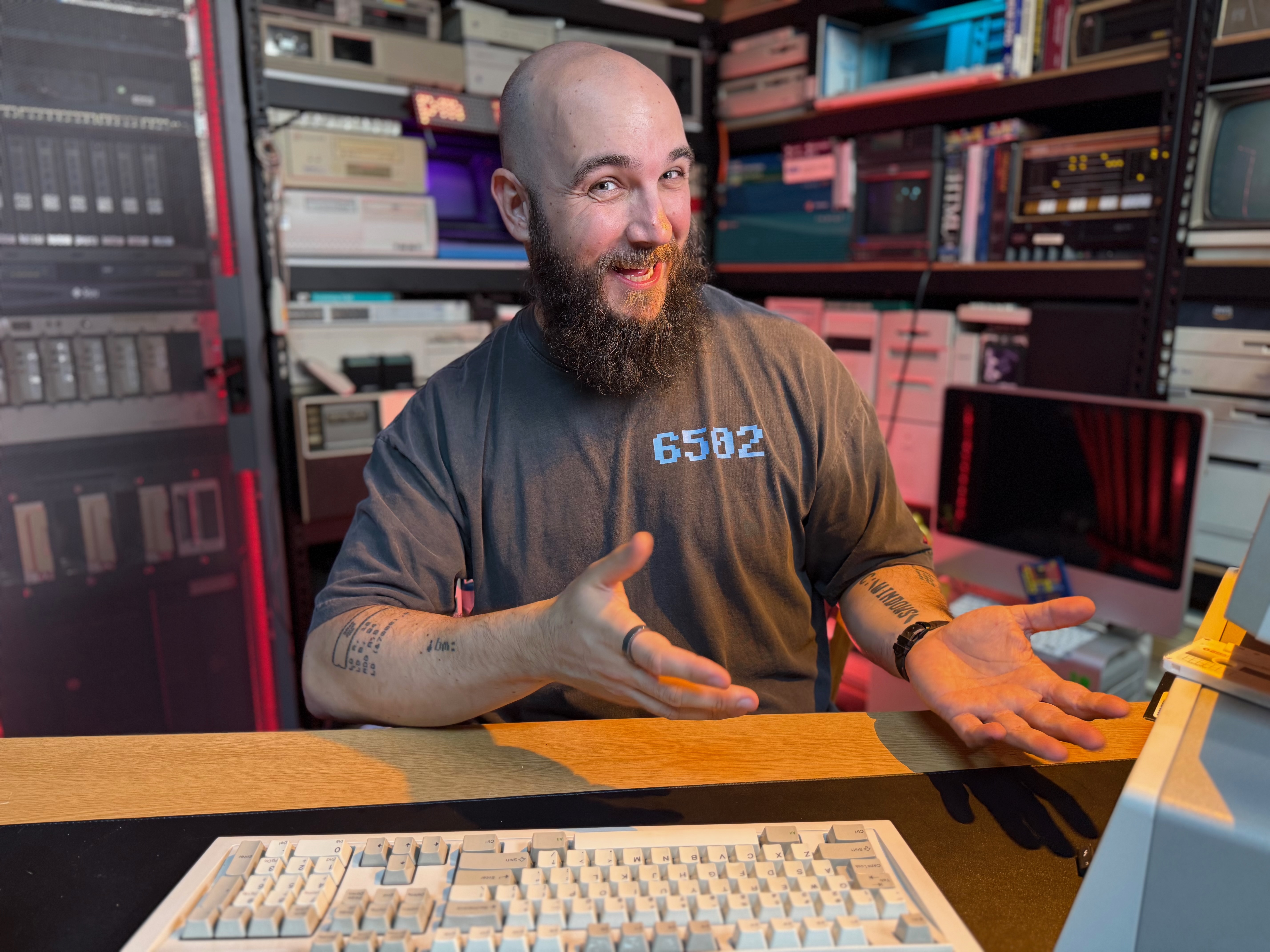
Darko Mesaros wears a shirt that is a nod to the MOS 6502, the iconic 8-bit microprocessor that powered classic computers like the Commodore 64 and Apple II. (GeekWire Photo / Kurt Schlosser)
Mesaros’ fascination with vintage hardware goes beyond nostalgia; it’s the foundation of a lifelong obsession with how things work under the hood.
Growing up in Serbia, he faced an economic reality where cutting-edge tech was out of reach. From 1991 to 2003, his only computer was a Commodore 64 — a machine released in 1982. While the rest of the computing world sped through the 1990s and early 2000s, Mesaros skipped straight to modern PCs.
“I feel like I missed that whole thing,” he said. “I missed the whole, you know, Sun workstation, Silicon Graphics, HP 9000, all of those things … and I just wanted to explore how that was.”
So he bought a couple of Sun workstations to see what he’d missed. Then he kept going.
“It’s a hobby, but it’s also a problem,” he said with a laugh.
If the garage caught fire, the one machine he’d grab? A bright blue Silicon Graphics Indy, the 1990s workstation from the very era he missed growing up. It was the first SGI he bought.
“It showed me how this amazing workstation worked!” he said. He still fires it up from time to time just to enjoy its IRIX operating system.
Still on his wish list: a DEC VT520 terminal with an amber screen. Working units only seem to turn up on the East Coast, and he won’t risk shipping a fragile CRT across the country.
Before joining Amazon nearly a decade ago, he held system administration and engineering roles at companies including AT&T and Tipico. Now at AWS, his day job involves leveraging his experience to help developers and customers adopt and use AWS services via blogs, webinars, code, and technical advocacy. The garage doubles as his set: he records AWS videos and live streams there.
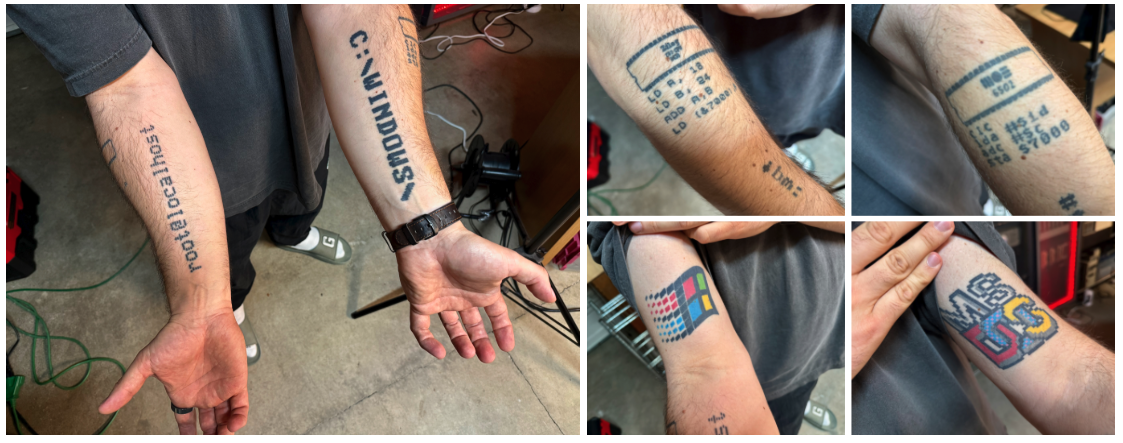
Tattoos on Darko Mesaros’ arms trace his appreciation for vintage tech. (GeekWire Photo / Kurt Schlosser)
Mesaros moved to the Seattle area around the start of the pandemic, arriving with a couple of workstations, a monitor, and a handful of laptops before his collection expanded. He soon realized gear was far cheaper here than in Europe.
“Most of these things are older than me. Especially older than my tech career,” the 38-year-old noted. “Actually, all of these things are older than my career. However, again, I find it fascinating how computer history has evolved.”
His arrival timing meant he narrowly missed the chance to visit Seattle’s beloved Living Computers: Museum + Labs before it permanently closed its doors. But in his own home, he’s essentially built a private version of the late Microsoft co-founder Paul Allen’s former institution.
Beyond the vintage hardware, Mesaros’ appreciation for computing history is permanently etched onto his body.
He sports a collection of retro tech tattoos on his arms, including symmetrical DOS and Linux terminal prompts (C:\WINDOWS> and root@localhost), a classic Windows 95 logo, MS-DOS branding, a shebang and a quit command that mark the start and end of a script, and detailed microprocessors like the Zilog Z80 and MOS 6502 paired with assembly code — a setup he jokingly calls his literal “ARM CPUs.” He’s still waiting, he said, on his check from Microsoft.
“I only tattoo ancient technology on myself,” Mesaros said, noting that people frequently stop him at airports to take pictures. “Old technology will stay with me … I feel like this is an investment in my career.”
He has plans for more ink during his next trip home to Serbia.
Wiring vintage hardware to modern AI
For Mesaros, collecting vintage computers is about more than admiring silent plastic shells on a shelf; it’s about making them talk across the digital chasm. In his garage and upstairs office, he routinely bends ancient hardware to modern purposes — proving that an 8-bit machine or a mechanical teletype can still interface with the cutting-edge cloud.
Mesaros has chatted with an AI coding agent from a Commodore 64 and deployed Kubernetes via a 1986 Tandy 102 portable computer. He wired a 1984 DEC DECwriter IV teletype to Amazon’s Kiro coding agent, explaining in a blog post how he talks to Kiro through the clacking machine — and he’s even deployed AWS infrastructure from it.
“Should this be done? Probably not,” he said. “But is it fun? Absolutely.”
In a demo for GeekWire, we watched the teletype clatter out the agent’s answer to his query, “What is GeekWire?” After a few seconds of hammering, it printed: “Seattle-based tech news site covering Pacific Northwest startups, Amazon, Microsoft and the broader tech industry.”
Not bad for a machine older than its operator.
Mesaros also spent a weekend trying to get stuck in 1999, using a Windows 98 machine as his only computer and documenting it on a VHS camcorder.
“The only window into the future was Kiro,” he said.
While these stunts might sound like elaborate practical jokes, Mesaros believes they serve a vital purpose in the age of AI. In a modern development landscape where tools let programmers “build a to-do app and walk away,” he argues that developers are losing the art of paying attention.
He likes to point out that a 2017 Google paper titled “Attention Is All You Need” helped kick off today’s LLM boom. “Now in 2026, to be a really successful developer,” he said, “attention is all you need.”
“I think being curious and paying attention are the two most important skills for a developer these days because it is so easy not to do those things,” Mesaros said. “And if you want to be relevant, if you want to be good at your job, especially with AI, I think those are the two important things that are critical.”
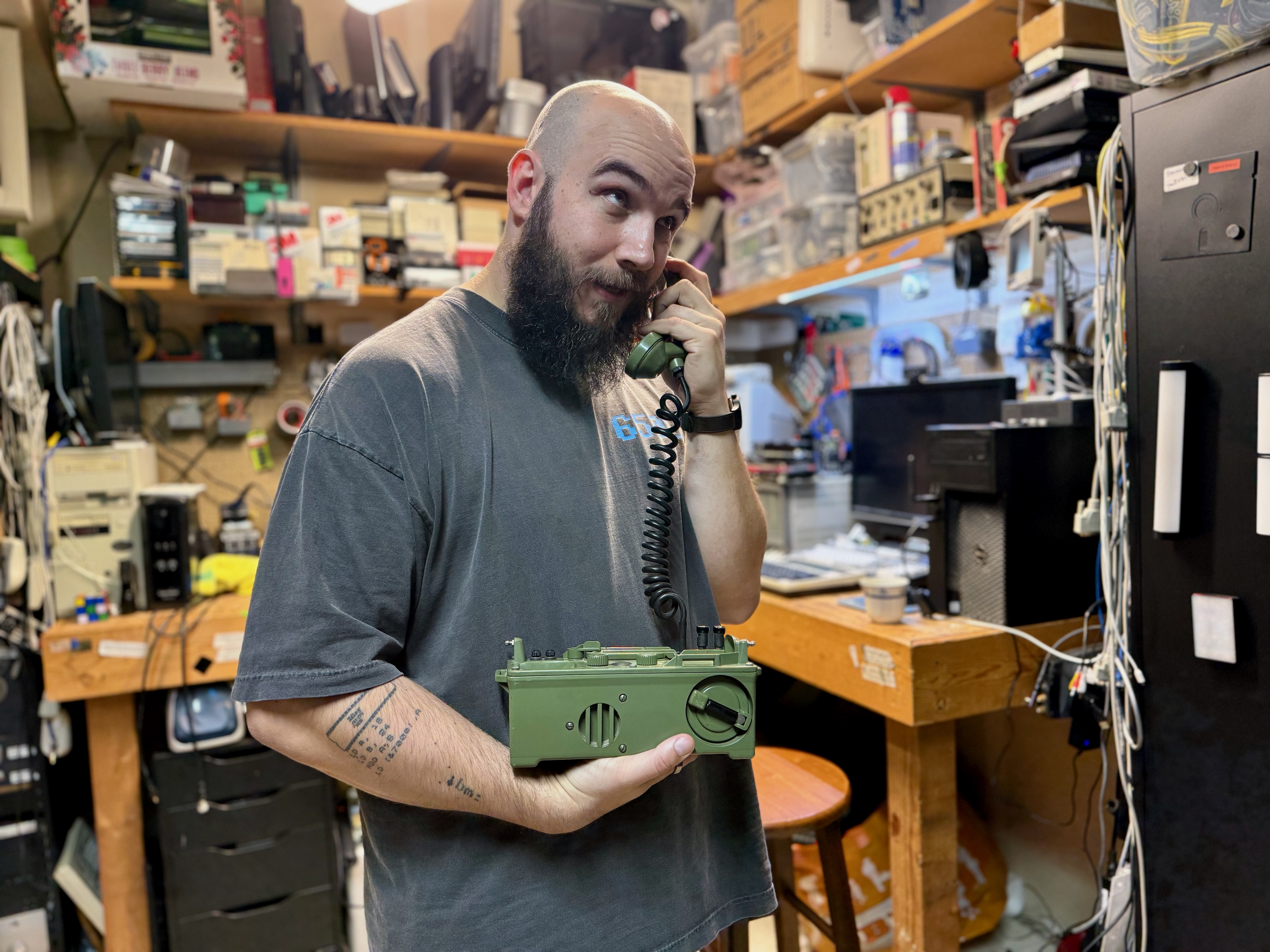
Calling the cloud: Darko Mesaros holds a vintage military field phone, another of his experimental hardware projects aimed at bridging analog gear with modern AI. (GeekWire Photo / Kurt Schlosser)
When he isn’t troubleshooting an obscure serial card data-ready pin or attempting to hook up a military field phone from his native Serbia to an LLM, he balances his digital obsession with analog pursuits. He wrenches on an old Jeep TJ — parked in the driveway because there’s no room in the garage.
He’s not the only tinkerer in the house. His wife is a fashion designer who 3D prints clothing and purses on a farm of printers in one of the upstairs rooms.
“She’s more creative than I am,” he said. “I get to tinker with old things that don’t want to work, and she uses technology to actually make new things.”
When it comes to the tech he lets into his own life, Mesaros is choosy. He wears a classic analog Timex and bought Meta’s smart glasses when they came out — then sold them within a month. “I don’t like the camera on my face,” he said. (He does use a camera-free pair that can display real-time translated subtitles when he travels abroad.)
That same instinct is why he doesn’t see screens going away, even as AI agents take on more work. “We still have the need for control,” he said. “Being able to observe and see, visualize what’s happening is still important.”
Old tech offers something else modern tech rarely does: a slower pace. Computer manuals once took months to produce because they’d stay accurate for years. “Today, if you create a manual that’s printed, it’s going to be valid for a week,” he said.
That’s what makes his garage an antidote to the endless scroll, a place anchored to the glowing screens and clacking keys of computing’s past. The hobby is his “computer away from a computer.”
“I spend my days in the email factory … and then in the afternoon, I just come here and tinker with something ancient that shouldn’t work anymore,” Mesaros said.
Keep scrolling for more GeekWire photos:
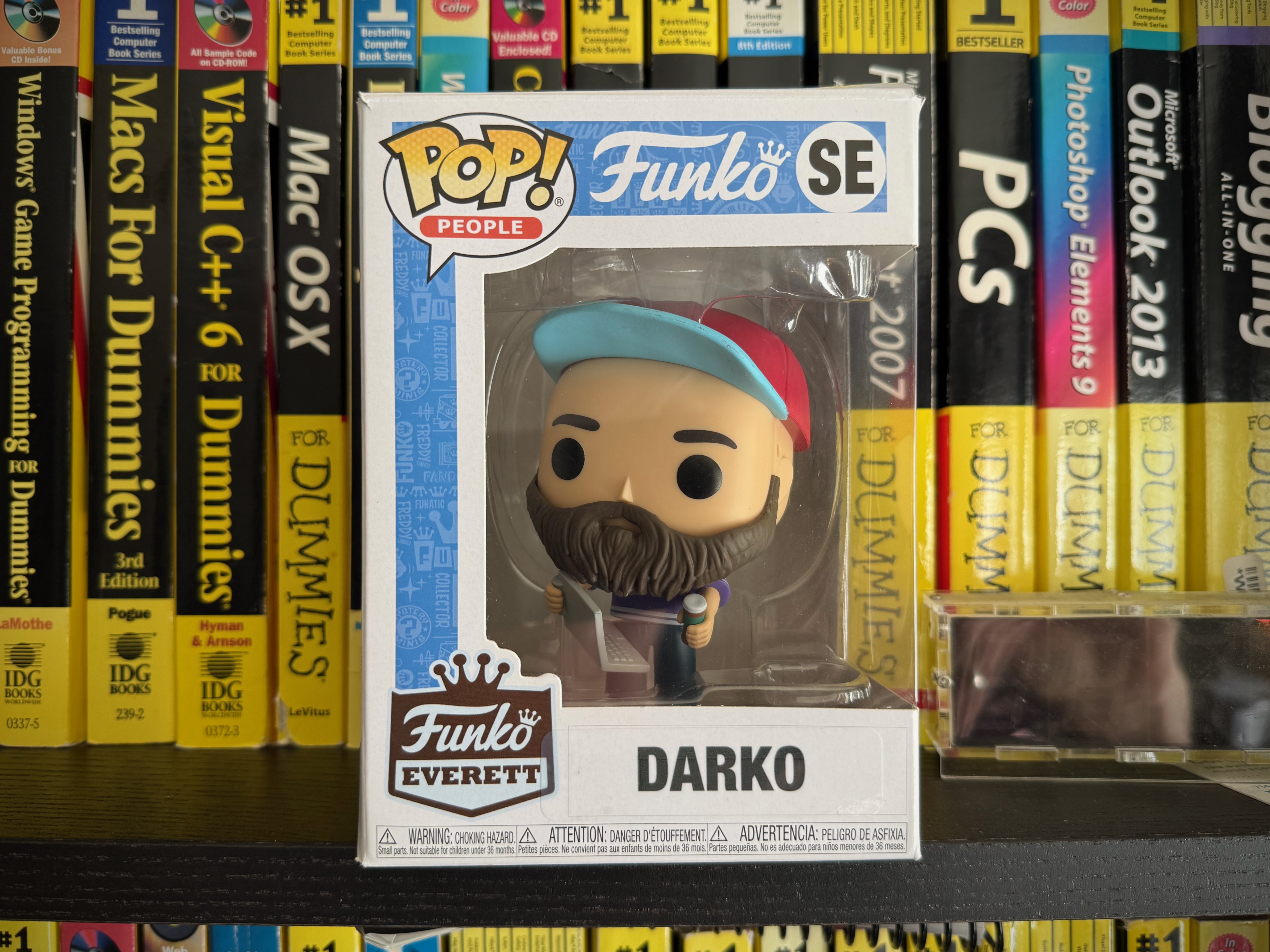
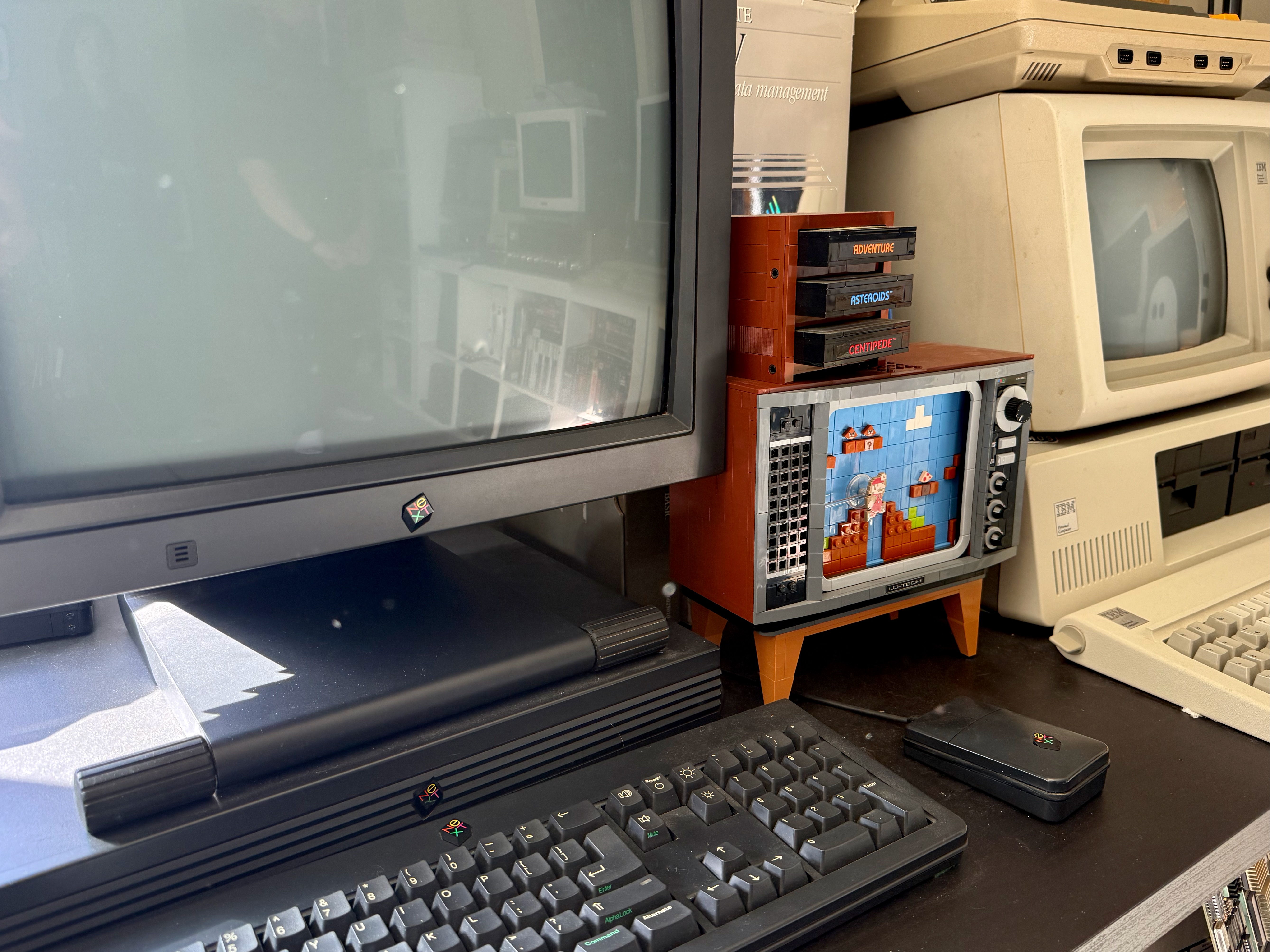
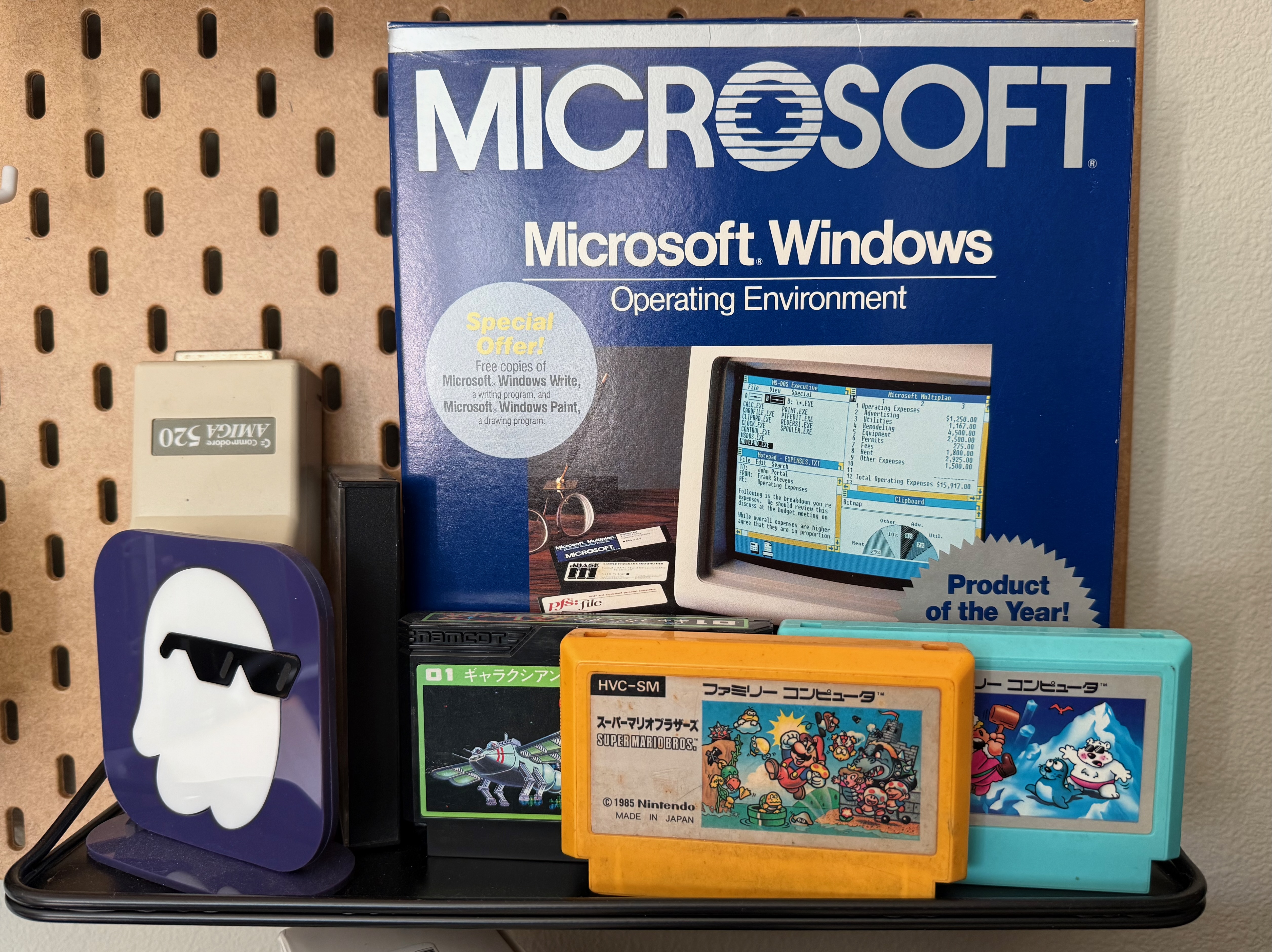
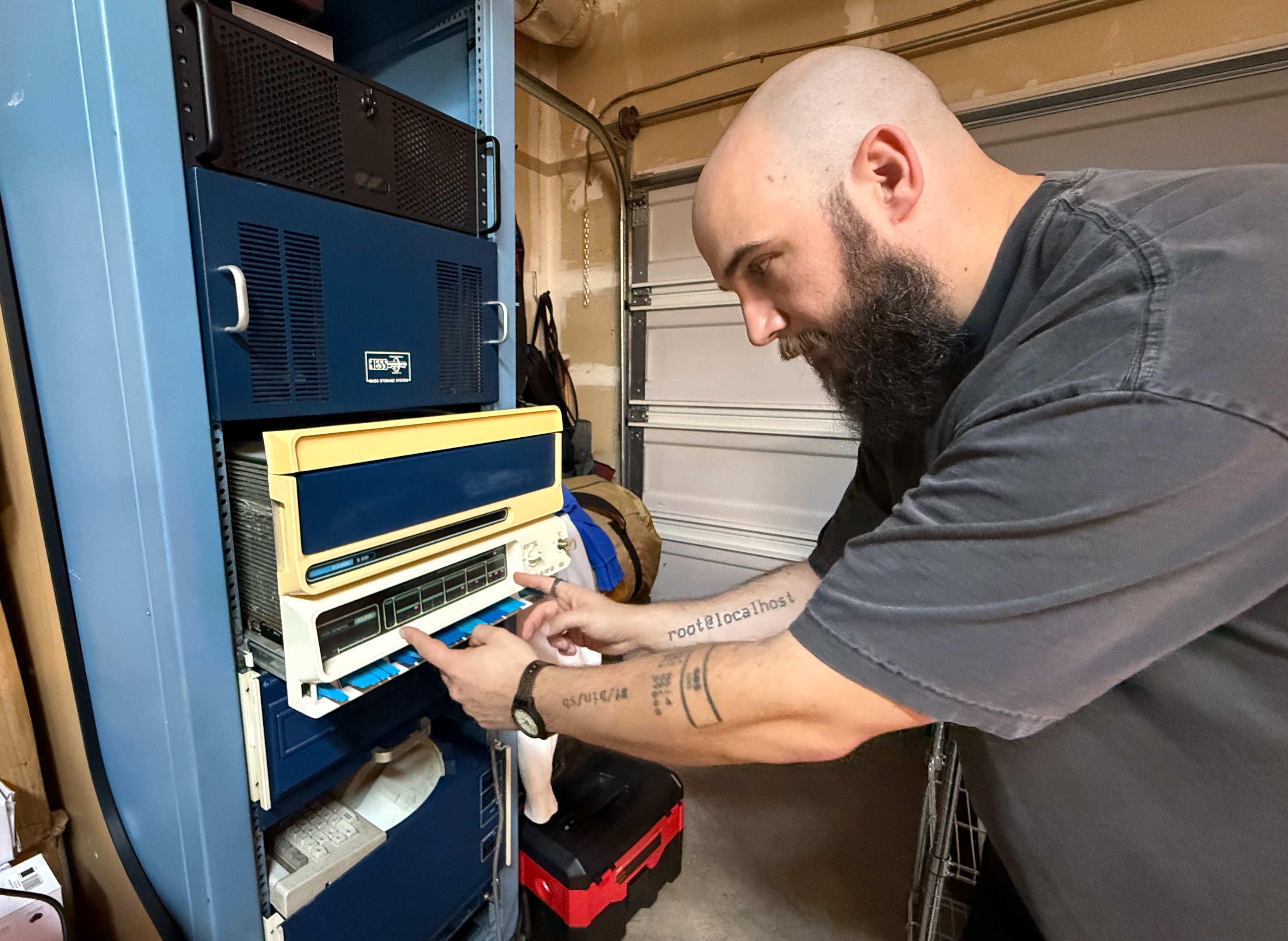
In his upstairs home office, Dark Mesaros is surrounded by more vintage computing materials, including books, software, manuals, games and more. (GeekWire Photo / Kurt Schlosser)A Funko Pop! figurine of Dark Mesaros, gifted to him by a friend. (GeekWire Photo / Kurt Schlosser)Among the hundreds of machines in Darko Mesaros’ collection sits a black NeXTstation workstation — designed by Steve Jobs’ post-Apple — displayed alongside a Lego NES set, right, with a retro brick TV showing “Super Mario Bros.” (GeekWire Photo / Kurt Schlosser)Vintage software and gaming artifacts on display, featuring a boxed copy of original 1980s Microsoft Windows 1.0, classic Japanese Nintendo Famicom cartridges, and a Commodore Amiga component. (GeekWire Photo / Kurt Schlosser)Darko Mesaros toggles the switches on a vintage Data General Eclipse S/230 minicomputer in his garage. (GeekWire Photo / Kurt Schlosser)At about $1,000, a server rack is the most expensive piece in Darko Mesaros’ garage collection. (GeekWire Photo / Kurt Schlosser)Vintage computer magazines and machinery on the shelves in Darko Mesaros’ garage. (GeekWire Photo / Kurt Schlosser)
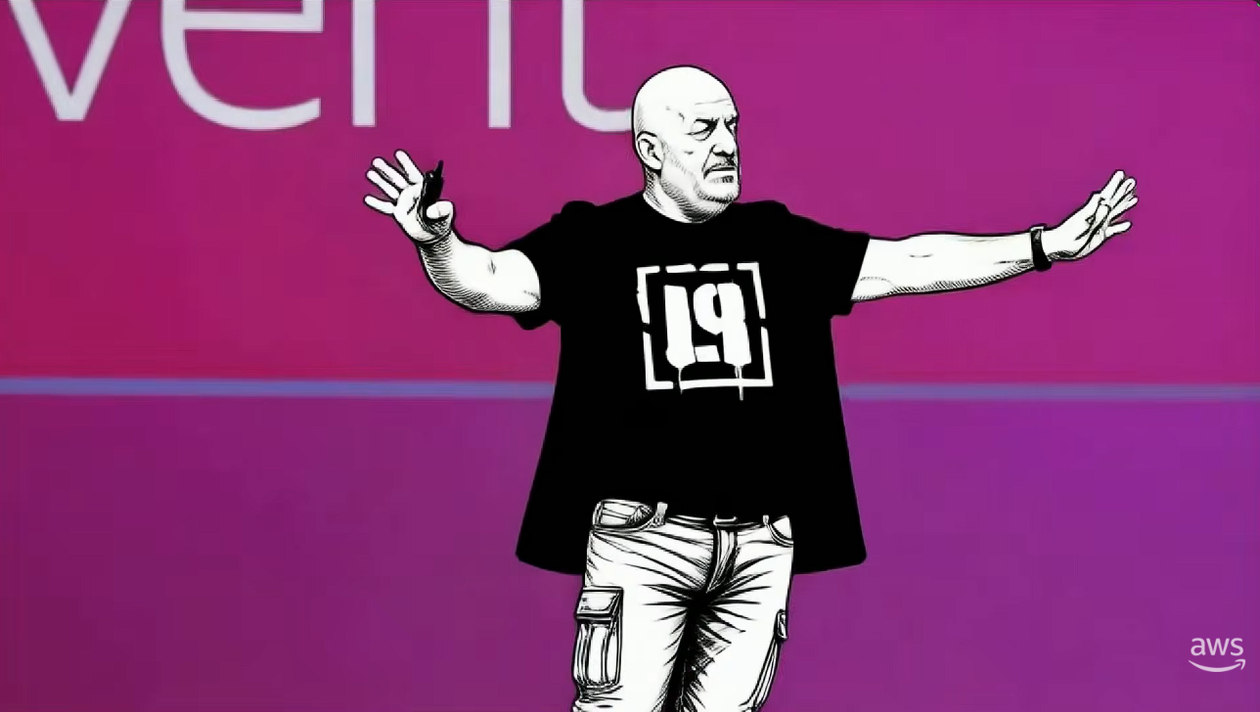
Not Werner: Decart’s real-time video model turns AWS Senior Vice President Peter DeSantis into a cartoon of Amazon CTO Werner Vogels, live on stage, at the start of DeSantis’ re:Invent keynote in Las Vegas last December. (AWS Video Screenshot)
A deal for Decart, a startup that makes software to help AI models run faster on different kinds of chips, would give Amazon new ways of getting more AI developers to use its custom chips instead of Nvidia hardware.
The Wall Street Journal reported Sunday that the companies are in talks for an acquisition that could value Decart around $7 billion, citing people familiar with the matter. Amazon and Decart haven’t confirmed the talks. Amazon hasn’t responded to GeekWire’s request for comment.
It would also be far larger than the deal that started Amazon’s chip business. Amazon bought Israeli chipmaker Annapurna Labs in 2015 for a reported $350 million. That team went on to design Trainium and Amazon’s other custom chips, now linchpins of its cloud business.
Nvidia dominates the AI chip market in large part because of CUDA, the software that developers have used for years to build and run AI models. Moving that work to other chips, including Amazon’s Trainium, normally takes extra engineering work.
What Decart does: Decart sells software that makes AI models run faster on chips from Nvidia, Google and Amazon, and makes it easier for developers to switch between them, according to the Journal. It licenses that technology to cloud providers and AI labs.
The company also builds its own AI models, including Lucy, which edits live video in real time, and Oasis, which generates interactive virtual worlds. Brothers Dean and Orian Leitersdorf founded Decart in 2023 with Moshe Shalev. The company is based in San Francisco, with a development center in Tel Aviv.
For Amazon, owning Decart could make Trainium an easier sell. Customers with AI models built for Nvidia chips could run them on Trainium with fewer changes, and Amazon would get the engineers behind the technology.
Decart’s software could also help Amazon get more out of the chips it already has. That was Anthropic’s goal in pursuing the startup, according to Bloomberg.
The company’s video models could fit other Amazon businesses, too. Streamers use its technology on Twitch, which Amazon owns. Its Lucy model can show online shoppers how clothes look on them.
Existing ties to AWS: Decart has already moved its own models to Trainium.
At AWS re:Invent in Las Vegas last December, Decart’s real-time video model turned AWS Senior Vice President Peter DeSantis into a live cartoon of Amazon CTO Werner Vogels on the side screens as he opened his keynote. It was a joke about taking over a morning slot that attendees expected Vogels to fill.
When Decart CEO Dean Leitersdorf took the stage later, the model animated him, too, mimicking his movements. The animations were generated live on Trainium3, Amazon’s newest AI chip.
Leitersdorf said the startup worked with AWS to move its models and infrastructure to Trainium. Amazon said that week that Decart was running real-time video four times faster on Trainium at half the cost of GPUs.
Nvidia also invested in Decart’s $300 million funding round in May, which valued the startup at about $4 billion.
Anthropic walked away in September after due diligence, Bloomberg reported, adding that the companies may still work together in other ways. Globes, citing sources close to Decart, reported that the founders had refused Anthropic’s push to move much of the company’s team from Tel Aviv to San Francisco.
Anthropic is one of Amazon’s closest AI partners. Amazon has invested about $18 billion in Anthropic and could invest up to $15 billion more as certain milestones are met. Anthropic uses Amazon’s Trainium chips to train and run its Claude models.
Larger industry moves: Amazon isn’t alone in trying to reduce its reliance on Nvidia. Microsoft on Monday unveiled Maia 300, the third generation of its custom AI chip, and said it plans to make Maia the main hardware for running AI in its own products starting in 2027.
Google has its TPU chips, and OpenAI has developed a chip with Broadcom.
A deal for Decart could come together soon, according to the Journal, unless talks fall apart or another suitor emerges. One open question is whether Decart’s software would keep supporting Nvidia and Google chips under Amazon ownership.
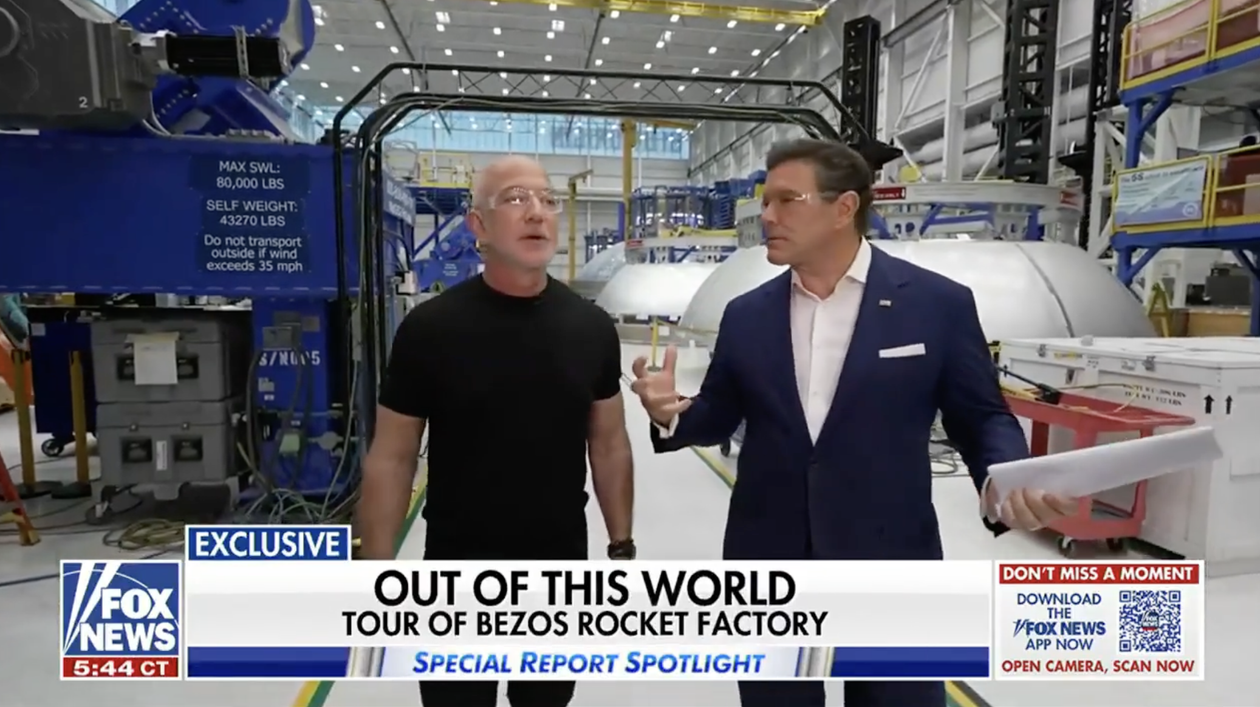
Amazon founder Jeff Bezos is interviewed by Bret Baier of Fox News in Florida. (Screen grab via Fox News)
When Jeff Bezos sat down on Blue Origin’s Cape Canaveral factory floor for an interview with Fox News’ Bret Baier earlier this week, he laid out an unapologetic defense of free enterprise and wealth creation.
“Success is not villainy,” Bezos said.
The Amazon founder’s point was simple: building a massively successful enterprise isn’t something society should apologize for or view with suspicion, it’s the natural result of creating something people actually want.
“There’s nothing wrong with making unbelievably good chicken that people love,” Bezos said, referencing the growth of Raising Cane’s and why restaurant entrepreneurs deserve their wealth. “And it doesn’t make him a bad person.”
Bezos, who stepped down as CEO of Amazon in 2021 and left Seattle for Miami in 2023, is currently the second richest person in the world with an estimated net worth of $380 billion, according to Forbes.
Bezos and Amazon transformed the Seattle region. The company now employs roughly 50,000 corporate and tech workers in the Puget Sound region, divided between its primary headquarters in Seattle and its growing operational footprint in Bellevue.
And his recent comments come at a key moment for Washington state, where voters will decide on Initiative 645 — a high-profile ballot measure aimed at repealing the state’s recently enacted high-earner tax and prohibiting future income taxes.
Bezos, along with other business leaders like former Starbucks CEO Howard Schultz, have claimed that scapegoating wealthy entrepreneurs risks driving away innovation. Bezos argued that politicians targeting business leaders are misdiagnosing the problem, noting that while affordability and social challenges are real, heavy-handed government interventions often fail to solve them.
“If there’s a politician who’s picking villains and pointing fingers, that probably means they don’t have a solution,” Bezos said. He noted that executives who relied on blame-shifting inside his own companies “wouldn’t be in our company for long.”
Watch the full interview below where Bezos also discusses the impact of AI on jobs, the need to beat China in the race to the moon and orbital data centers in space. The portion of the interview where Bezos notes that “success is not villainy” starts in minute 16.
— Ravi Vedula, a corporate vice president at Microsoft, is leaving the company after 26 years. Vedula, who is based in the Seattle area, led an organization of more than 1,000 people that runs the data and analytics platform behind Microsoft 365 and Copilot.
“26 years. It’s time,” he wrote on LinkedIn. “Goodbye and thank you, Microsoft. It’s been a privilege. I gave it my all.”
Vedula joined Microsoft in 2000 and was the first engineering manager for Exchange Online.
“I leave with gratitude for the people and experiences that shaped those years,” Vedula told GeekWire.
He said he is leaving room for “another professional chapter if the right opportunity comes along,” but for now plans to focus on travel, ways to contribute and writing, including a possible book based on his experiences receiving a heart transplant in 2017.
Rohit Prasad. (Boston Dynamics Photo)
— AI and robotics company Boston Dynamics announced Rohit Prasad as its new CEO, effective Oct. 7. Prasad, who is based in the Boston area, was Amazon’s senior vice president and head scientist for artificial general intelligence until he left the company at the end of 2025.
He takes over from interim CEO Amanda McMaster, the company’s chief financial officer, after Robert Playter retired in February following more than 30 years at Boston Dynamics. Hyundai Motor Group holds a controlling stake in the company.
Prasad joined Amazon in 2013, during the early days of Alexa, and oversaw the creation of its Nova AI models. Boston Dynamics makes the Spot and Stretch robots and is developing the Atlas humanoid. Prasad is also expected to join the company’s board, subject to approval.
“Boston Dynamics is uniquely positioned to advance Physical AI through its world-class robotics expertise,” Prasad said in the announcement.
Mike Potter. (Qualtrics Photo)
— Qualtrics has appointed Mike Potter chief technology officer of the experience management company. He joins from Petal, an Ontario healthcare company, and has worked in leadership at Qlik, IBM and Cognos.
“I have spent the better part of my career building platforms at scale, the kind of work that requires deep technical conviction, strong collaboration, and a relentless focus on what customers actually need. That is what drew me to Qualtrics,” Potter said.
Qualtrics has dual headquarters in Seattle and Provo, Utah. It recently cut 117 jobs connected to its Seattle operations, largely affecting engineering and product teams. Last year, the company spent $6.75 billion to acquire Press Ganey Forsta.
Shawn Stapleton. (Fred Hutch Photo)
— Shawn Stapleton has been named vice president and chief AI and innovation officer, a newly created role at Fred Hutch Cancer Center. He joins the Seattle nonprofit from MD Anderson Cancer Center, where he led AI lifecycle management for more than three years. Before that, he was the Seattle-based head of data science for Philips.
Stapleton helped scale MD Anderson’s AI initiatives across clinical, research and administrative settings, Fred Hutch said, adding, “His experience at the intersection of strategy, governance and implementation will be instrumental as we continue building the foundation for AI-enabled medicine and discovery.”
Jon Abramovic. (Overland AI Photo)
— Seattle-based defense tech startup Overland AIhas named Jon Abramovic as vice president of international growth. Abramovic has held sales leadership roles in Taiwan, Prague and Beijing. He was most recently director of global defense sales at SIG Sauer and spent eight years at Oshkosh Defense leading business development across Europe and Asia.
“Having spent years operating overseas, I’ve seen firsthand what our allies face against near-peer adversaries and what it takes to stay ahead. Overland AI’s technology represents a generational leap in the ground domain,” Abramovic said.
Overland AI is No. 7 in the GeekWire 200, a ranking of the region’s top privately held tech startups.
— Noosphere Labs, a Seattle-area AI startup first covered by GeekWire in August, has announced its leadership team. The company, launched by former Meta AI research director Kevin Carlberg, is pursuing “human-centered physical intelligence” — AI designed to help people interact with and make sense of the physical world, beyond text and images on screens.
Its team includes:
Tyler Simpson, co-founder and chief operating officer, who left Meta to start Noosphere Labs. He previously was co-founder and CTO of Luum by HealthEquity and spent more than 11 years at Microsoft.
Andrew Ma, engineering leader, has more than 20 years’ experience across Google, Meta, Amazon and Microsoft, most recently leading Google Cloud’s Apache Spark teams.
Joshua Walton, founding design partner, was a director at Meta Reality Labs Research and worked on Microsoft’s HoloLens.
Louis Barinaga, founding hardware partner, spent the bulk of his career at HP and more recently held leadership roles at Meta’s augmented reality program, Valve and Microsoft.
Andrew Smith, founding AI engineer, led Zillow’s first agentic AI system and previously worked for Amazon and Sandia National Laboratories.
Michael Iuzzolino, founding AI engineer, joined from Meta, where he worked on large language models, and previously held roles at Google Brain and Microsoft Research.
Mikhail Shashkov, founding architect, was at Amazon Lab126 for more than seven years and previously at Sandia.
Liz Pearce. (LinkedIn Photo)
— Liz Pearce has been named Earth Finance‘s first chief commercial officer. She joined from Ever.green, where she was chief revenue officer. Past roles include CEO of LiquidPlanner, co-founder and CEO of Fresh Chalk, and vice president of marketing for GoDaddy.
Earth Finance, a Seattle-based startup helping businesses reduce their climate impacts, recently launched a platform called SpatiaFi that enables customers to make location-based capital decisions.
“Earth Finance is already delivering game-changing results for customers,” Pearce said. “I can’t wait to get to work with this team to scale that impact.”
— Charlie Bell, the longtime Amazon Web Services executive who left to run security, compliance and identity at Microsoft, has been appointed to the board of directors at the cybersecurity firm Tenable. The appointment was disclosed in an SEC filing and framed as “reinforcement for Tenable’s AI-driven exposure management push.”
— Two notable Amazon moves:
Fırat Güder, a professor and chief engineer of Güder Research Group at Imperial College London, has joined Amazon as a scholar in the tech giant’s special projects organization. “Here, we are building the next generation of cutting-edge technologies that define the future of humanity. It is an incredible honor to join a small, elite group of innovators and researchers pushing the boundaries of what is possible,” Güder said.
Leonardo de Mourahas been promoted to vice president and distinguished scientist with AWS in Seattle. He joined the company in 2023.
Amelia Marckworth. (LinkedIn Photo)
— Washington Technology Industry Association (WTIA) has named Amelia Marckworth director of programs, innovation and entrepreneurship. She joins from Seattle University, where she has held leadership roles for more than a decade and also served as an adjunct professor of entrepreneurship in the Albers School of Business and Economics.
“Amelia has a proven track record of launching and growing startup programs, coaching founders directly, and being part of WTIA as a committee member and mentor. We’re excited to bring that experience and talent onto our startups team,” Randa Minkarah, WTIA’s executive director and CEO, said in a statement.
Hernan Alvarez. (LinkedIn Photo)
— Hernan Alvarez has taken a role at Seattle-based Hyperparamto lead product and go-to-market at the startup, which is building tools for collecting, storing and analyzing the data that AI systems produce. The company recently launched a product called HypAware to improve oversight of AI agents and catch their errors.
Alvarez joins from Great Expectations, where he was CEO. He earlier worked with Hyperparam founder Kenny Daniel at Algorithmia, a machine learning company co-founded by Daniel and acquired by DataRobot.
Philip Jensen. (Zap Photo)
— Philip Jensen has joined Zap Energy as vice president of fuel programs and operations. Zap, an Everett, Wash.-based fusion startup, announced in April that it was expanding its focus to include nuclear fission. Jensen was previously at First American Nuclear and spent more than seven years at Pacific Northwest National Laboratory.
Zap said Jensen “brings deep expertise in nuclear fuel design, testing, and manufacturing, and a track record of launching new fuel programs and partnerships.”
— Christie Johansen-Pinney has joined Noble Studiosas its Seattle-based vice president of client experience. She has held VP roles at firms including Rooster Punk, DEPT and The Marketing Practice.
— Anders Mortensen, formerly CRO at The Trade Desk, has been appointed to the advisory board of Scowtt, a Seattle startup helping advertisers optimize their ad spending. Mortensen spent more than 13 years at Google, leaving as vice president of U.S. mid-market sales lead generation.
Pedram Rezaei, a 20-year Microsoft veteran, is joining Amazon Web Services as a distinguished engineer. (Amazon Photo)
A longtime Microsoft engineering leader who was previously a Copilot chief technology officer is joining Amazon Web Services to work on its competing AI tools for coding and workplace productivity.
Pedram Rezaei, a nearly 20-year Microsoft veteran who was most recently a corporate vice president on the Microsoft Superintelligence team, starts Monday as a distinguished engineer in the AWS Agentic AI and Emerging Technologies organization, led by Swami Sivasubramanian.
Rezaei will work initially on Kiro, the AWS coding tool, and Quick, Amazon’s AI assistant for workplace tasks, Sivasubramanian wrote in a memo to his team Monday. “He is a hands-on engineer who is still in the code every day, and he plans to keep it that way here,” he added.
Kiro’s user count doubled from the first quarter to the second, and monthly AI users for Quick grew fourfold, according to the memo. Rezaei’s plan for his first few months is to “meet people, learn how things work here, and ship something real,” Sivasubramanian wrote.
Sivasubramanian’s organization was expanded in July to include emerging technologies, part of a broader reshuffling of Amazon’s AI teams.
The hire comes as Amazon and Microsoft compete more directly in AI tools for work. Microsoft last month unveiled an all-in-one Copilot app that combines chat, coding and agents, its answer to OpenAI and Anthropic. Amazon made its Quick desktop app generally available in September and brought its main features to mobile.
Rezaei joined Microsoft in 2006 and held senior technical roles on Power BI, Dynamics 365, Cortana, Bing and Azure Maps before moving to Copilot, according to his LinkedIn profile. He became Copilot’s CTO in February and moved to the Microsoft Superintelligence team in June, according to the profile. Sivasubramanian’s memo said Rezaei was most recently working on training foundation models.
We’ve contacted Microsoft for comment on his departure.
Rezaei is the latest Microsoft executive to move to AWS this year. Shawn Bice returned to AWS in May from a security role at Microsoft to lead its Automated Reasoning Group.
In his memo Monday, Sivasubramanian also told his team that two longtime AWS engineers, Marvin Theimer and Reto Kramer, have returned to work on neurosymbolic AI and automated reasoning, which he called “one of our biggest bets for the future.” Both came back from Microsoft, according to their LinkedIn profiles.
Neurosymbolic AI pairs large language models with rule-based systems that can check whether an AI agent is following a company’s policies and procedures.
Speaking at Madrona’s IA40 Summit in Seattle last week, Sivasubramanian said nearly every CIO and CEO raises the same question about AI agents. “How do I know it is always going to obey all my rules and regulations?” he said. “This is a real concern.”
Solving that problem “actually unlocks so many use cases for all these enterprises,” he added.
Theimer, an AWS distinguished engineer for nine years before leaving in 2022, joined Microsoft in July 2024 as a corporate vice president and technical architect and stayed until March. It was his second stint at the company, where he worked from 1998 to 2006. He rejoined AWS in July as a vice president and distinguished engineer.
Kramer, who led an automated reasoning team at AWS before leaving in 2023, joined Microsoft in September 2025 as vice president of Security Platform & AI and stayed until May. He rejoined AWS in September as vice president of applied science.
Sivasubramanian hinted at more hires to come, writing that Rezaei joins “as we continue to build out our technical leadership team to help take on the ambitious work we have planned.”
Amazon Web Services CEO Matt Garman, shown at AWS re:Invent in 2025, says local opposition to data centers threatens the U.S. position in the AI race. (Amazon Photo / Noah Berger)
Amazon says it will spend more than $1 billion over five years in the U.S. communities where it builds and operates data centers, responding to a growing backlash across the country against the tech industry’s massive AI infrastructure buildout.
The company’s new program, which it calls “Built Together,” will fund free community college, job training, energy upgrades for homes and schools, and other local projects identified by data center communities. It comes on top of more than $1 billion that Amazon says it has given to communities over the past three years.
Amazon also says it will stop using NDAs with government agencies on data center projects, install lower-emission backup generators at new sites, publish its energy and water use each year, and pay enough for power to keep local electricity bills from rising.
Announcing the commitments in a post Friday morning, Amazon Web Services CEO Matt Garman said local opposition to data centers — which he asserted is stoked by “misinformation and outright lies” — threatens the country’s position in the global race for AI leadership.
“Right now there are over 100 data center moratoriums being considered across the country,” Garman wrote. “If these measures are enacted, the U.S. could be writing its own losing ticket to this race, and the consequences would last generations.”
The business stakes: Amazon is making an unprecedented bet on AI, projecting about $220 billion in capital expenses this year, largely on data centers and chips. That’s more than the cash its business generates on an annual basis.
By comparison, the additional $1 billion in community funding over five years works out to about $200 million a year, or about one-tenth of 1% of this year’s projected capital spending.
Amazon’s AI strategy depends on finding communities willing to host its data centers. Microsoft, Google and other tech giants are spending on a similar scale, to meet current and anticipated AI demand, and they face the same problem.
Local opposition has become a real limit on the AI buildout. At least 75 data center projects worth about $130 billion were blocked or delayed in the first three months of the year alone, according to Data Center Watch, a group that tracks these disputes. An Economist/YouGov poll in late August found that 63% of Americans would oppose a data center in their community.
Pushing back on the narrative: Much of Garman’s post is a point-by-point rebuttal of what he calls myths about data centers.
He called it “false” that data centers are sucking up all the water in communities, “misleading and convenient scapegoating” to blame them for driving up all electricity rates, “untrue” that their backup generators emit huge amounts of pollution, and “false” that communities get nothing in return.
Amazon’s average data center uses less than 13,000 gallons of water a day, he wrote, and backup generators sit idle 99.9% of the time. Where electricity rates are rising, he attributed it primarily to an aging grid.
Garman pointed to “widespread reports of various countries intentionally seeding misinformation in the U.S. about data centers to trick us into slowing down.” OpenAI and X have each reported China-linked accounts posting about data centers.
However, PolitiFact reported last month that the role of foreign influence in the opposition to data centers has been exaggerated, with little sign the accounts reached a wide audience.
“We understand why there is apprehension in some communities where data centers are being built,” Garman wrote. At the same time, he said Amazon and other data center operators have already taken many steps to address those concerns.
The new commitments, he wrote, are a way to codify the company’s existing practices.
Where Amazon and Microsoft differ: Microsoft promised in January not to seek local tax breaks for its data centers. Asked by GeekWire whether it would do the same, Amazon did not make that commitment. The company said it is the largest taxpayer in almost every community where it operates, and that local governments offer incentives to attract its projects.
In his post, Garman pointed to St. Joseph County, Ind., where he wrote that Amazon is expected to pay more than $3 billion in taxes on land that would have generated $1.2 million under its prior use. In Madison County, Miss., he cited more than 2,300 construction workers now on the job and more than 1,700 operations jobs to come.
In 2023, Good Jobs First, a watchdog group that tracks corporate subsidies, reported that five Amazon data centers in Morrow County, Ore., would receive about $1 billion in property tax breaks over 15 years, which the group called the largest known subsidy in the company’s history at the time.
Microsoft also went further on NDAs, saying in March that it would terminate its existing nondisclosure agreements with local governments. Amazon said its change applies going forward, and that it doesn’t plan to revisit past agreements, most of which no longer apply once a project becomes public.
Power costs: Amazon was among seven companies that signed a White House pledge in March to pay for the power and grid upgrades their data centers require.
The new commitment repeats that pledge, which the company said reflects what it was already doing. Amazon has long structured its power agreements to cover the full cost of serving its data centers, it said, with rates approved by state utility regulators.
In his post, Garman disputed that data centers are to blame for rising electricity rates. Among states with large numbers of data centers, he wrote, rates have risen in some, including Illinois and New York, and fallen in others, including Indiana and Mississippi. He wrote that new grid capacity, funded by the private sector, should lead to flat or lower rates for nearby residents.
However, according to U.S. government data reported by CNBC, residential electricity prices in three states with high concentrations of data centers were up sharply in August 2025 from a year earlier: 13% in Virginia, 16% in Illinois and 12% in Ohio, compared with 6% nationally.
Climate goals: Amazon’s carbon emissions rose 16% last year as the company expanded its data center capacity. Kara Hurst, Amazon’s chief sustainability officer, said at Climate Week NYC last week that the company remains committed to reaching net-zero emissions by 2040.
Garman wrote that Amazon has been the largest corporate buyer of carbon-free energy since 2019. Under the new commitment, the company each year will publish the share of its energy that comes from carbon-free sources.
On water, Amazon says it is committed to returning more water to communities than its data centers use by 2030, and was 75% of the way to that goal as of 2025. Microsoft made a similar pledge in January.
Where the money goes: Amazon’s Built Together program is organized around three areas: education and job training, energy and water, and flexible funding for local priorities.
Addressing questions from GeekWire, Amazon didn’t provide a full breakdown of the $1 billion, but said it expects to put more than $100 million up front into community college endowments and roughly another $100 million into expanding its training centers.
Under the program, Amazon says it will:
Cover out-of-pocket community college costs for an estimated 300,000 students in data center communities over five years. The company says agreements with 26 colleges are already in the works.
Build 16 more training centers on or near data center sites, offering free certification programs in skilled trades. Amazon operates three of the centers now and has six more in development.
Fund energy-efficiency upgrades at more than 300 schools and community buildings and more than 30,000 homes.
Provide annual funding through local nonprofits and community foundations for projects such as roads, parks and fire equipment, with priorities set by each community.
“Every community is different,” Garman wrote. “What matters most in rural Oregon is not the same as what matters in suburban Virginia or a mid-size city in Ohio.”
The local funding will reflect those differences, he wrote, saying that Amazon is not deciding what communities need but rather “providing resources and letting communities decide.”
GeekWire reporter Lisa Stiffler contributed to this story.
A researcher found that anyone with physical access to one Shark robot vacuum can extract its AWS IoT certificate and use it to take over other Shark vacuums region-wide, with no patch yet available.
What does the cloud actually cost this month? Ask finance, ask the DevOps lead, ask the admin who provisioned half the instances two years ago – chances are good all three give a different number. That gap is not a rounding error. It is, according to Flexera's 2026 State of the Cloud Report, roughly 29 percent of total cloud spend disappearing into overprovisioned resources, idle compute, and services nobody remembers switching on.

 Login

 The U.S. Army has picked Amazon Web Services and World Wide Technology to help build an autonomous cyber defense system that can find and stop network threats with little human involvement, choosing the two companies on Oct. 23, 2026, for a Project Griffin pilot worth a combined $2.6 million. The U.S. Army said it wants […]