❌

Reading view

There are new articles available, click to refresh the page.

APOD: 29 October 2026 – The Horns of Venus

APOD

Astronomy Picture of the Day

Discover the cosmos! Each day a different image or photograph of our fascinating universe is featured, along with a brief explanation written by a professional astronomer.

The Horns of Venus

Explanation: That’s no moon. But you could be forgiven for thinking it was a crescent Moon in the sky. It is a lesser known fact that Venus also has phases. (What about other planets?) The featured image shows Venus seen almost directly between the Sun and the Earth. This happens once every year and a half, and it is like the alignment that happens every month during a new Moon. But the new Moon is dark, while Venus’ backlit atmosphere refracts and scatters the sunlight, creating a glowing crescent arc that extends beyond 180 degrees: the tips of this arc are called the “horns”. The crescent can be seen with a small telescope or binoculars during twilight, but those with exceptionally acute eyesight may be able to see it with the unaided eye. Ancient Babylonian astronomers may have been the first to study Venus’ brightness changes, which are related to its phases. Many other cultures have similar astronomical records, including the oldest surviving Maya book.

Tomorrow’s picture: What’s next?

Date October 29, 2026
Credit & Copyright Thierry Legault
Authors & editors: Cecilia Chirenti, Robert Nemiroff, Jerry Bonnell, Keighley Rockcliffe
A service of: ASD at NASA / GSFC,
NASA Science Activation & Michigan Tech. U.

APOD: 2026 October 28 – The Mutual Occultation of Ganymede and Io

APOD

Astronomy Picture of the Day

Discover the cosmos! Each day a different image or photograph of our fascinating universe is featured, along with a brief explanation written by a professional astronomer.

Michael Wong

The Mutual Occultation of Ganymede and Io

Explanation: Jupiter is one of the least lonely planets in the Solar System, at least when it comes to natural satellites. 115 moons have been discovered orbiting Jupiter so far! (Saturn has the most with 293, but who’s counting.) Ganymede and Io, two of Jupiter’s Galilean moons, met in the sky on October 20th, 2026. Today’s video captures the meeting, with Ganymede briefly blocking Io from view. This event, when an astronomical object passes in front of another and either completely or partially blocks it, is called a mutual occultation. The mutual occultations of Galilean moons are rare to witness because they require Earth’s edge-on view of their orbits. This occurs once every 6 years when Jupiter reaches its equinox and appears less “tilted”. Ganymede is also casting its shadow on Jupiter’s right side. Any fictional Jovian species within the shadow would experience a solar eclipse!

Tomorrow’s picture: a planet grows horns

Date: October 28, 2026
Credit & Copyright: Michael Wong
Authors & editors: Keighley Rockcliffe, Robert Nemiroff, Jerry Bonnell, Cecilia Chirenti
A service of: ASD at NASA / GSFC,
NASA Science Activation & Michigan Tech. U.

APOD: 2026 October 27 – Noctilucent Clouds over Sweden

APOD

Astronomy Picture of the Day

Discover the cosmos! Each day a different image or photograph of our fascinating universe is featured, along with a brief explanation written by a professional astronomer.

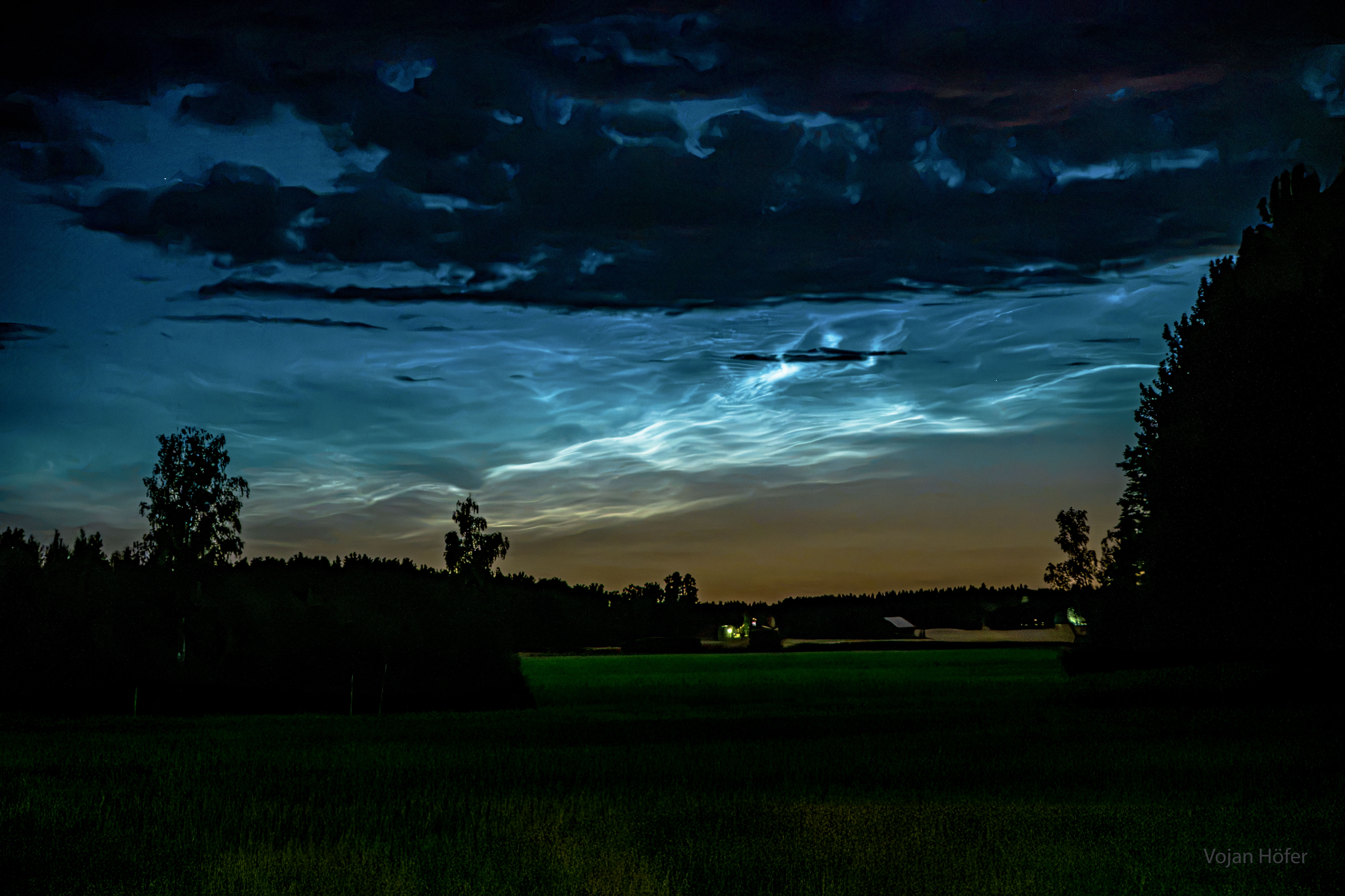
A dark night sky is pictured over a green field bounded by trees in silhouette. Across the image middle are blue filamentary glows -- noctilucent clouds. Dark clouds are seen across the top of the image.  Please see the explanation for more detailed information.

Noctilucent Clouds over Sweden

Explanation: Sometimes it’s night on the ground but day in the air. As the Earth rotates to eclipse the Sun, sunset rises up from the ground. Therefore, at sunset on the ground, sunlight still shines on clouds above. Under usual circumstances, a pretty sunset might be visible, but unusual noctilucent clouds float so high up they can be seen well after dark. Normally too dim to be seen, they may become visible just after sunset during the summer when illuminated by sunlight from below the horizon. Noctilucent clouds are the highest clouds and are known more technically as polar mesospheric clouds. Featured here as they appeared in early August 2026, a network of blue noctilucent clouds was captured in the distant sky above a field of green grass near Linköping, Sweden, with trees in stark silhouette across the horizon. Much about noctilucent clouds has been discovered only in the past two decades, and how they form and evolve remains a topic of active research.

Tomorrow’s picture: round and round

Date October 27, 2026
Credit & Copyright V. Höfer, D. Večerník & B. Večerníková
Authors & editors: Robert Nemiroff, Jerry Bonnell, Cecilia Chirenti, Keighley Rockcliffe
A service of: ASD at NASA / GSFC,
NASA Science Activation & Michigan Tech. U.

APOD: 2026 October 26 – M42: The Great Nebula in Orion

APOD

Astronomy Picture of the Day

Discover the cosmos! Each day a different image or photograph of our fascinating universe is featured, along with a brief explanation written by a professional astronomer.

A starfield features a large and colorful nebula in its center, filled with dark dust and glowing gas in red and blue.

M42: The Great Nebula in Orion

Explanation: The Great Nebula in Orion, an immense, nearby starbirth region, is one of the most famous of all astronomical nebulas. Here, glowing gas surrounds hot young stars at the edge of an immense interstellar molecular cloud only 1500 light-years away. In the featured deep image in assigned colors highlighted by emission in hydrogen, wisps and sheets of dust and gas are particularly evident. The Great Nebula in Orion can be found with the unaided eye near the easily identifiable belt of three stars in the popular constellation Orion. In addition to housing a bright open cluster of stars known as the Trapezium, the Orion Nebula contains many stellar nurseries. These nurseries contain much hydrogen gas, hot young stars, proplyds, and stellar jets spewing material at high speeds. Also known as M42, the Orion Nebula spans about 40 light years and is located in the same spiral arm of our Galaxy as the Sun.

Tomorrow’s picture: open space

Date: October 26, 2026
Credit & Copyright: Roberto Palaia
Authors & editors: Robert Nemiroff, Jerry Bonnell, Cecilia Chirenti, Keighley Rockcliffe
A service of: ASD at NASA / GSFC,
NASA Science Activation & Michigan Tech. U.

APOD: 2026 October 25 – Dark Matter in a Simulated Universe

APOD

Astronomy Picture of the Day

Discover the cosmos! Each day a different image or photograph of our fascinating universe is featured, along with a brief explanation written by a professional astronomer.

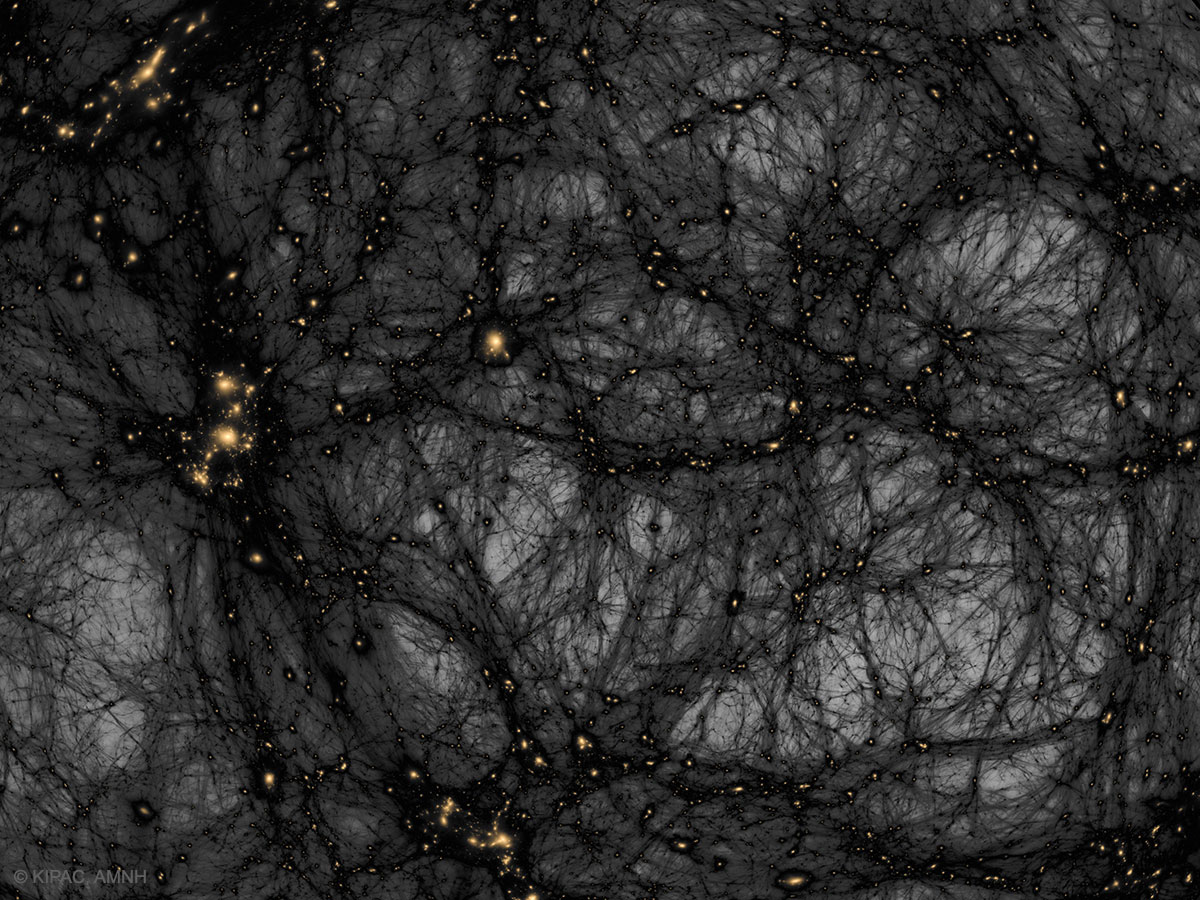
The picture shows a computer simulation of the matter distribution in our universe with dark matter shown in a dark color on a light background. Please see the explanation for more detailed information.

Dark Matter in a Simulated Universe

Explanation: Is our universe haunted? It might look that way on this dark matter map. The gravity of unseen dark matter is the leading explanation for why galaxies rotate so fast, why galaxies orbit clusters so fast, why gravitational lenses so strongly deflect light, and how visible matter is distributed. The featured image from the American Museum of Natural History‘s Hayden Planetarium Space Show, Dark Universe, highlights one example of how pervasive dark matter might haunt our universe. In this frame from a detailed computer simulation, complex filaments of dark matter, shown in black, are strewn about the universe like spider webs, while the relatively rare clumps of familiar baryonic matter are colored orange. These simulations are good statistical matches to astronomical observations. In what is perhaps a scarier turn of events, dark matter — although quite strange and in an unknown form — is no longer thought to be the strangest source of gravity in the universe. That honor now falls to dark energy, a more uniform source of repulsive gravity that seems to now dominate the expansion of the entire universe.

Tomorrow’s picture: Orion the Great

Date: October 25, 2026
Credit & Copyright: Tom Abel & Ralf Kaehler (KIPAC , SLAC), AMNH
Authors & editors: Robert Nemiroff, Jerry Bonnell, Cecilia Chirenti, Keighley Rockcliffe
A service of: ASD at NASA / GSFC,
NASA Science Activation & Michigan Tech. U.

APOD: 2026 October 24 – Rosetta’s Selfie

APOD

Astronomy Picture of the Day

Discover the cosmos! Each day a different image or photograph of our fascinating universe is featured, along with a brief explanation written by a professional astronomer.

Image of a Rosetta spacecraft solar array in foreground and the nucleus of comet 67P in background.

Rosetta’s Selfie

Explanation: This Rosetta spacecraft selfie was snapped on October 7th, 2014. At the time the comet-chasing spacecraft was about 472 million kilometers from planet Earth, but only 16 kilometers from the surface of comet 67P/Churyumov-Gerasimenko. Looming beyond the spacecraft near the top of the frame, dust and gas stream away from the comet’s curious double-lobed nucleus. Bright sunlight glints off one of Rosetta’s 14 meter long solar arrays. In fact, two exposures, one short and one long, were combined to record the dramatic high contrast scene using the CIVA camera system on Rosetta’s still-attached Philae lander. Its chosen primary landing site was on the visible hemisphere of the smaller lobe of the nucleus. This was the last image from Philae’s camera before the lander separated from Rosetta on November 12. Shortly after separation Philae took another image looking back toward the orbiter and began its descent to the nucleus of the comet.

Tomorrow’s picture: dark matters

Date October 24, 2026
Credit: ESA/Rosetta/Philae/CIVA
Authors & editors: Jerry Bonnell, Cecilia Chirenti, Robert Nemiroff, Keighley Rockcliffe
A service of: ASD at NASA / GSFC,
NASA Science Activation & Michigan Tech. U.

APOD: 2026 October 23 – Andromeda in Southern Spring

APOD

Astronomy Picture of the Day

Discover the cosmos! Each day a different image or photograph of our fascinating universe is featured, along with a brief explanation written by a professional astronomer.

The Andromeda galaxy above rolling hills.

Andromeda in Southern Spring

Explanation: Looking toward the north from Mullion, New South Wales, Australia, the Andromeda Galaxy never gets more than a few degrees above the horizon. During the southern hemisphere spring, Andromeda is highest in the sky around midnight though. And in this telephoto scene from October 10/11, multiple exposures were used to reveal the spiral galaxy in tantalizing detail as it climbed above rolling Australian hills. Also known as M31, the Andromeda Galaxy is one of the brightest objects in the Messier catalog, but is only visible to the unaided eye as a small, faint, fuzzy patch. Digitally tracked and stacked frames were combined with a foreground shot in the deep astro-image composite to reveal the galaxy’s greater extent in planet Earth’s night. In the springtime night skyscape,the closest large spiral galaxy spans nearly 6 full moons.

Tomorrow’s picture: pixels in space

Date October 23, 2026
Credit & Copyright: Lucy Yunxi Hu
Authors & editors: Jerry Bonnell, Cecilia Chirenti, Robert Nemiroff, Keighley Rockcliffe
A service of: ASD at NASA / GSFC,
NASA Science Activation & Michigan Tech. U.

APOD: 2026 October 22 – The First Green Star, WD J1330+6435

APOD

Astronomy Picture of the Day

Discover the cosmos! Each day a different image or photograph of our fascinating universe is featured, along with a brief explanation written by a professional astronomer.

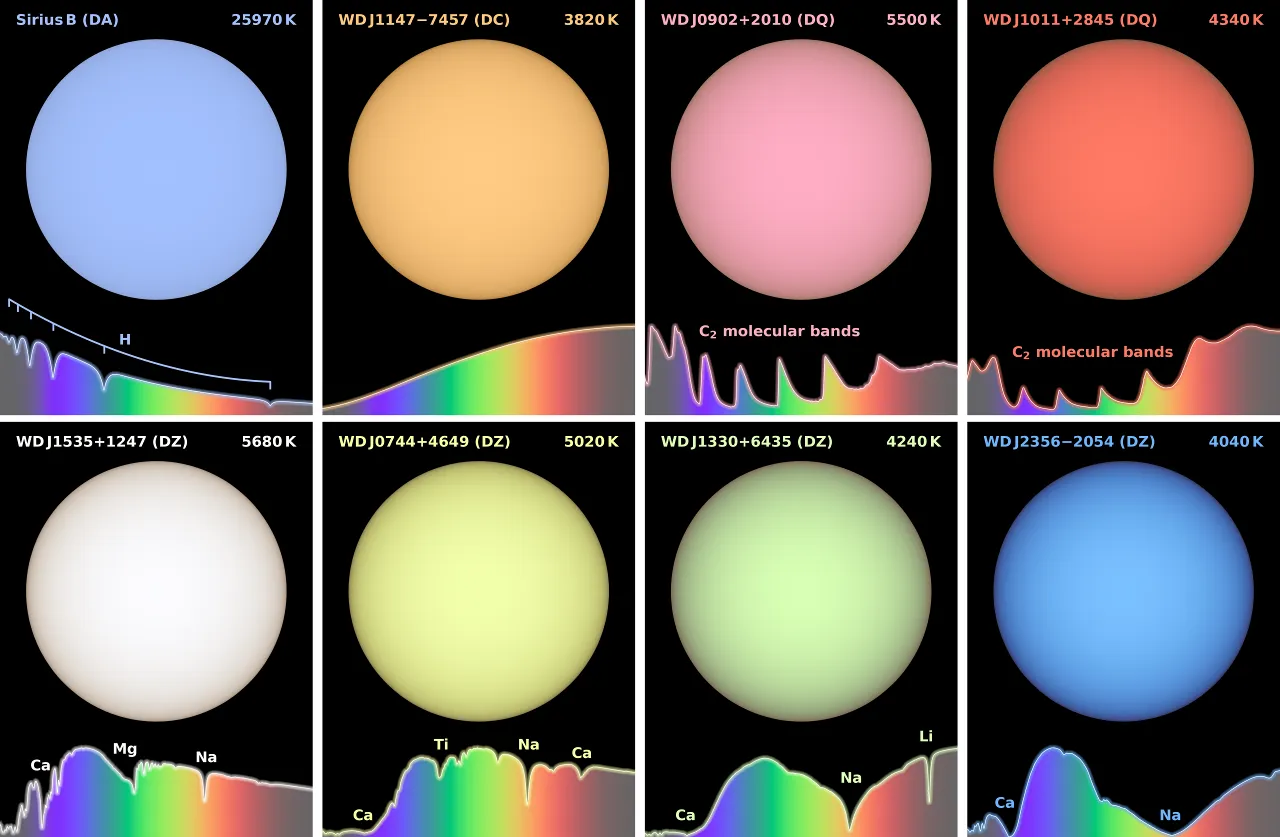
A star shines with a greenish hue in front of a dark field with more distant stars, surrounded by a greenish disk with debris.

The First Green Star, WD J1330+6435

Explanation: Star light, star bright: is there a green star out tonight? Other than the Sun, all stars are so far from Earth that they appear as points in the sky. They are mostly white, but sometimes noticeably red or blue. This color typically relates to the temperature: blue stars are hotter than red stars. What about other colors? The featured image is an illustration showing WD J1330+6435, a white dwarf star, surrounded by an accretion disk with gas and rocks orbiting the star. White dwarfs are small, faint stars that are left over when a star like the Sun exhausts its nuclear fuel. Astronomers recently found that some white dwarf stars, despite their name, would appear yellow, green, cyan, pink, or purple. In these cases, trace elements that were accreted to these stars interact with the stellar atmosphere and shift its normally white color. But, alas! I wish I may, I wish I might, but they are too faint to see tonight…

Tomorrow’s picture: eye in the sky

Date October 22, 2026
Credit & Copyright Mark A. Garlick/University of Warwick
Authors & editors: Cecilia Chirenti, Robert Nemiroff, Jerry Bonnell, Keighley Rockcliffe
A service of: ASD at NASA / GSFC,
NASA Science Activation & Michigan Tech. U.

APOD: 2026 October 21 – New Ghosts Revealed in Cassiopeia

APOD

Astronomy Picture of the Day

Discover the cosmos! Each day a different image or photograph of our fascinating universe is featured, along with a brief explanation written by a professional astronomer.

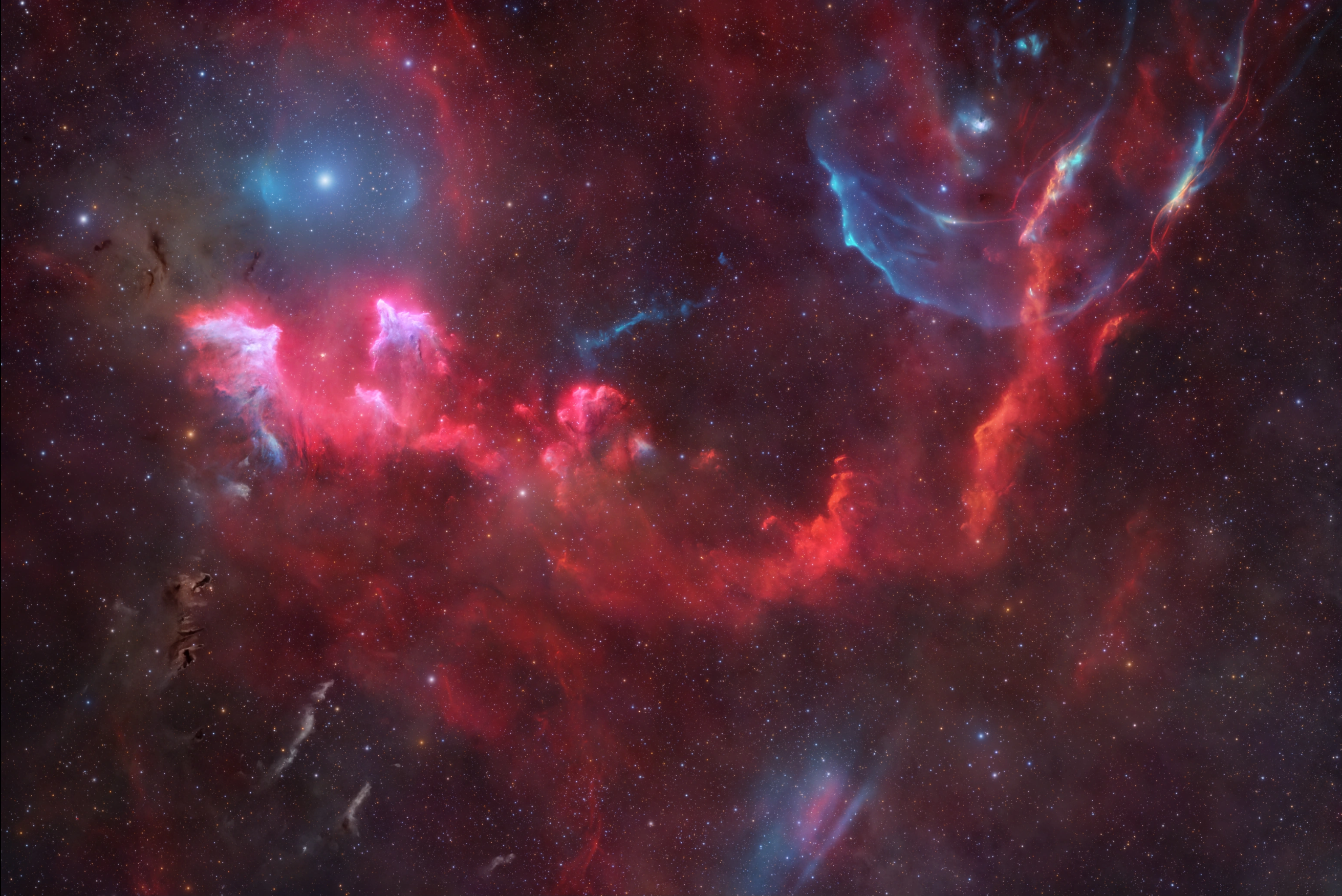
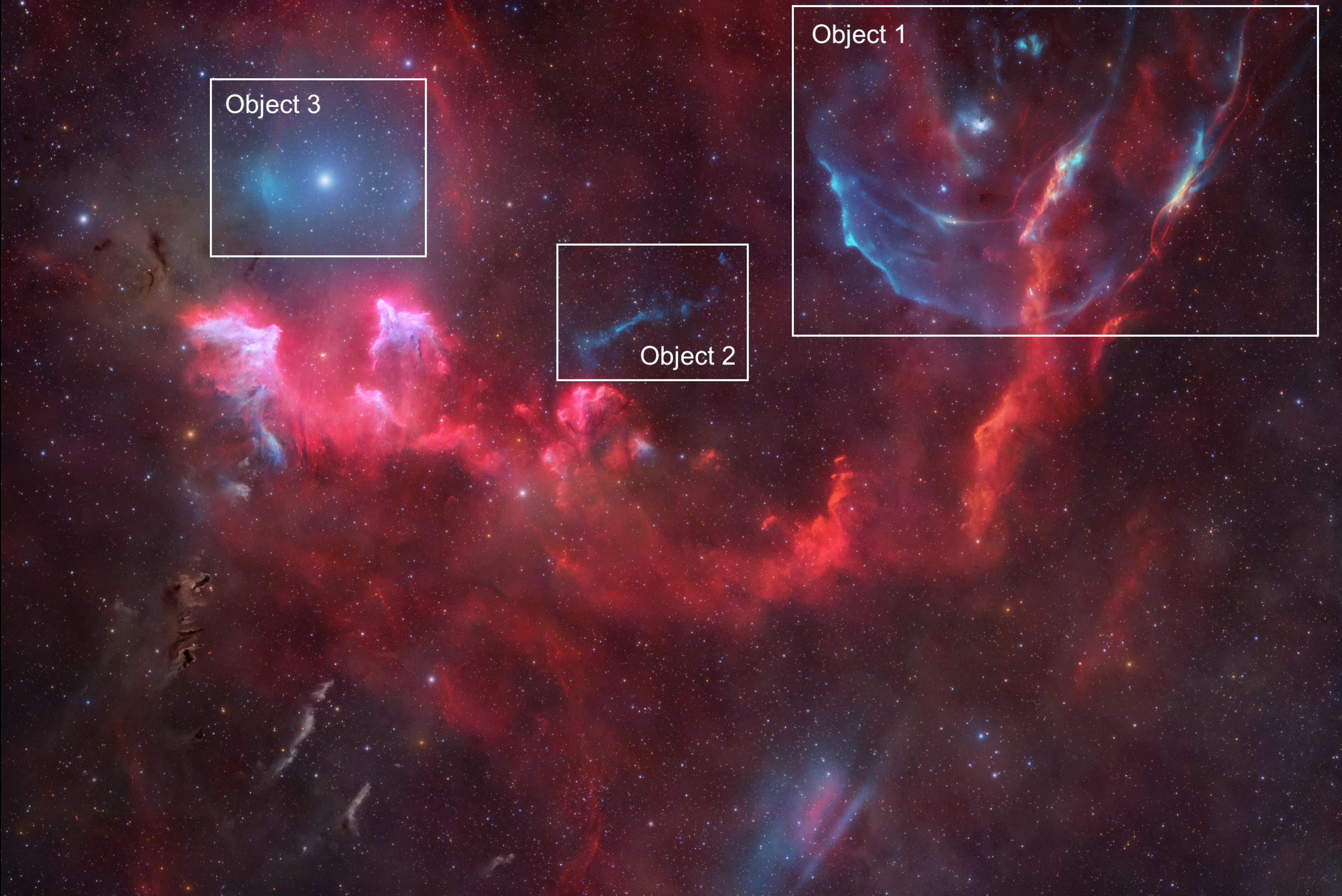
The sky is speckled with stars. Bright tufts of emission nebulae trace across the image's equator. Arcs and smudges of ionized oxygen emission also included.The sky is speckled with stars. Bright tufts of emission nebulae trace across the image's equator. Arcs and smudges of ionized oxygen emission also included. The three new objects visible in oxygen are labeled.

New Ghosts Revealed in Cassiopeia

Explanation: Jinkies, look at all those ghosts! It took 100 hours of observation and a special oxygen filter for today’s image to capture three faint nebulas hidden in the Cassiopeia constellation. IC 59 and IC 63, the original Ghosts of Cassiopeia, haunt the region near multi-star system γ Cassiopeia. Energetic light from γ Cassiopeia causes the hydrogen gas in IC 59 and 63 to glow red. Their dust reflects and scatters some blue-ish white starlight. Newly discovered Objects 1, 2, and 3 appear as blue phantoms, revealing the presence of ionized oxygen. But ionized by what? Like at the bow of a speeding boat, γ Cassiopeia may be piling up material as the system moves through interstellar gas and dust. It follows that Object 3 may be the compressed and heated oxygen of that bow shock. Object 1 could be a planetary nebula if a central white dwarf is identified. The origins of these astronomical apparitions remain a mystery to be solved.

Read here for more information on how you can help the observing team behind today’s APOD.

Tomorrow’s picture: it’s not easy being green

Date: October 21, 2026
Credit & Copyright: Louis Leroux-Géré, Thibault Rouillée, Vincent Martin, Cédric de Decker (Starfront Observatories)
Authors & editors: Keighley Rockcliffe, Robert Nemiroff, Jerry Bonnell, Cecilia Chirenti
A service of: ASD at NASA / GSFC,
NASA Science Activation & Michigan Tech. U.

APOD: 2026 October 20 – An Anticrepuscular Rainbow Fan

APOD

Astronomy Picture of the Day

Discover the cosmos! Each day a different image or photograph of our fascinating universe is featured, along with a brief explanation written by a professional astronomer.

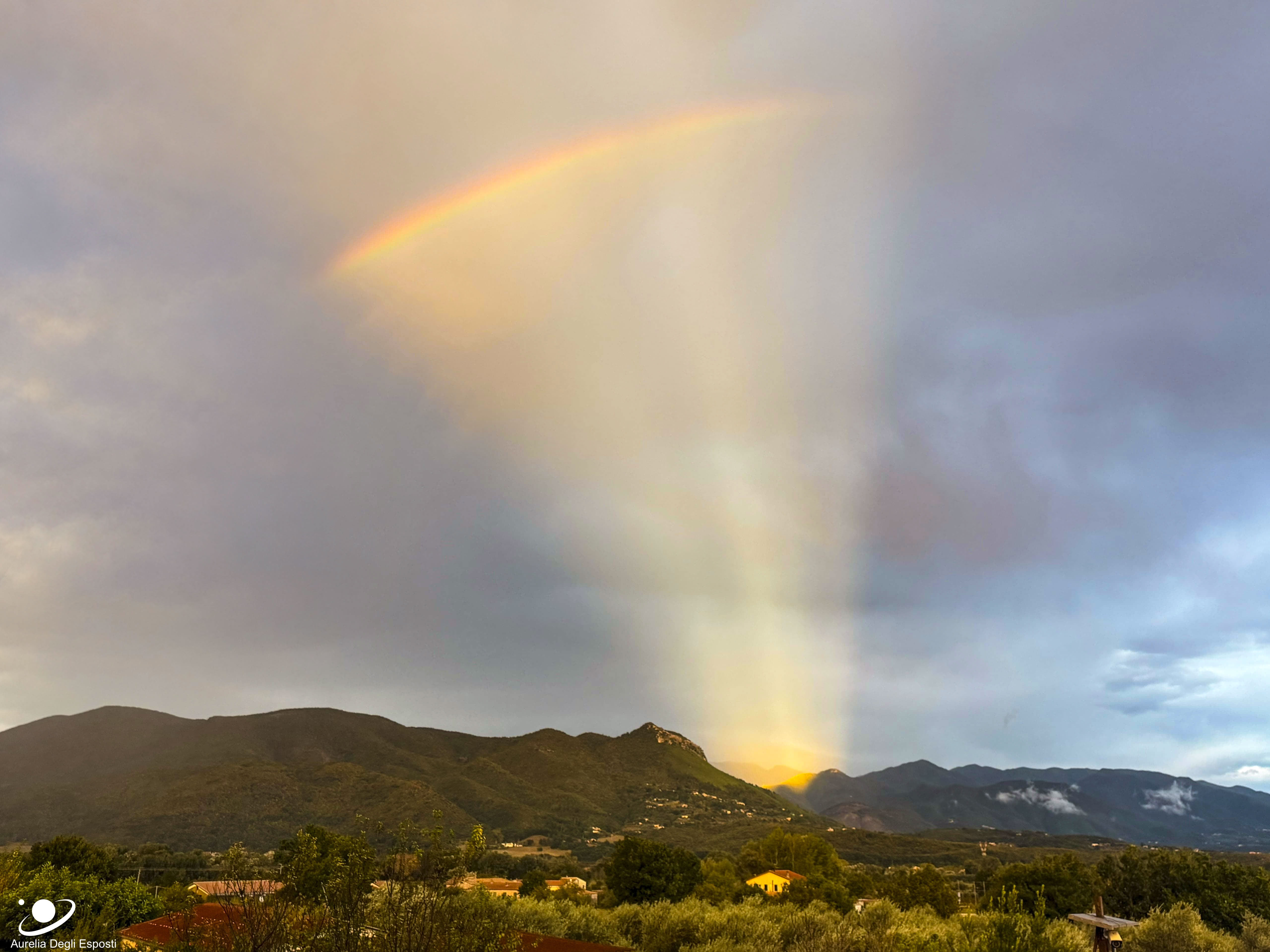
Hills are seen in the distance below a partly cloudy sky. A group of orange rays appears to eminate from one area behind the hills. Across this fan of rays, near the top of the image, a short rainbow can be seen.  Please see the explanation for more detailed information.

An Anticrepuscular Rainbow Fan

Explanation: This is an unusual rainbow. For one thing, the rainbow is not complete, appearing only in a sunlit fan — but that by itself is not very unusual. What is most unusual is the fake location of the Sun. The Sun appears to be toward the front, just below those hills — but it is not. That is not how rainbows work. Rainbows involve a backward reflection from falling rain, so that the Sun must really be behind you. In this case, gaps between clouds near the setting Sun allowed rays to cross the entire sky and appear to converge in front, an unusual phenomenon called anticrepuscular rays. The photo was taken with a phone last week at sunset in Presenzano, Italy. The seemingly reverse rainbow was noticed when hanging up laundry.

Tomorrow’s picture: open space

Date October 20, 2026
Credit & Copyright Aurelia Degli Esposti
Authors & editors: Robert Nemiroff, Jerry Bonnell, Cecilia Chirenti, Keighley Rockcliffe
A service of: ASD at NASA / GSFC,
NASA Science Activation & Michigan Tech. U.

APOD: 2026 October 19 – Treble Clef: Unusual X-ray Hot Radio Source

APOD

Astronomy Picture of the Day

Discover the cosmos! Each day a different image or photograph of our fascinating universe is featured, along with a brief explanation written by a professional astronomer.

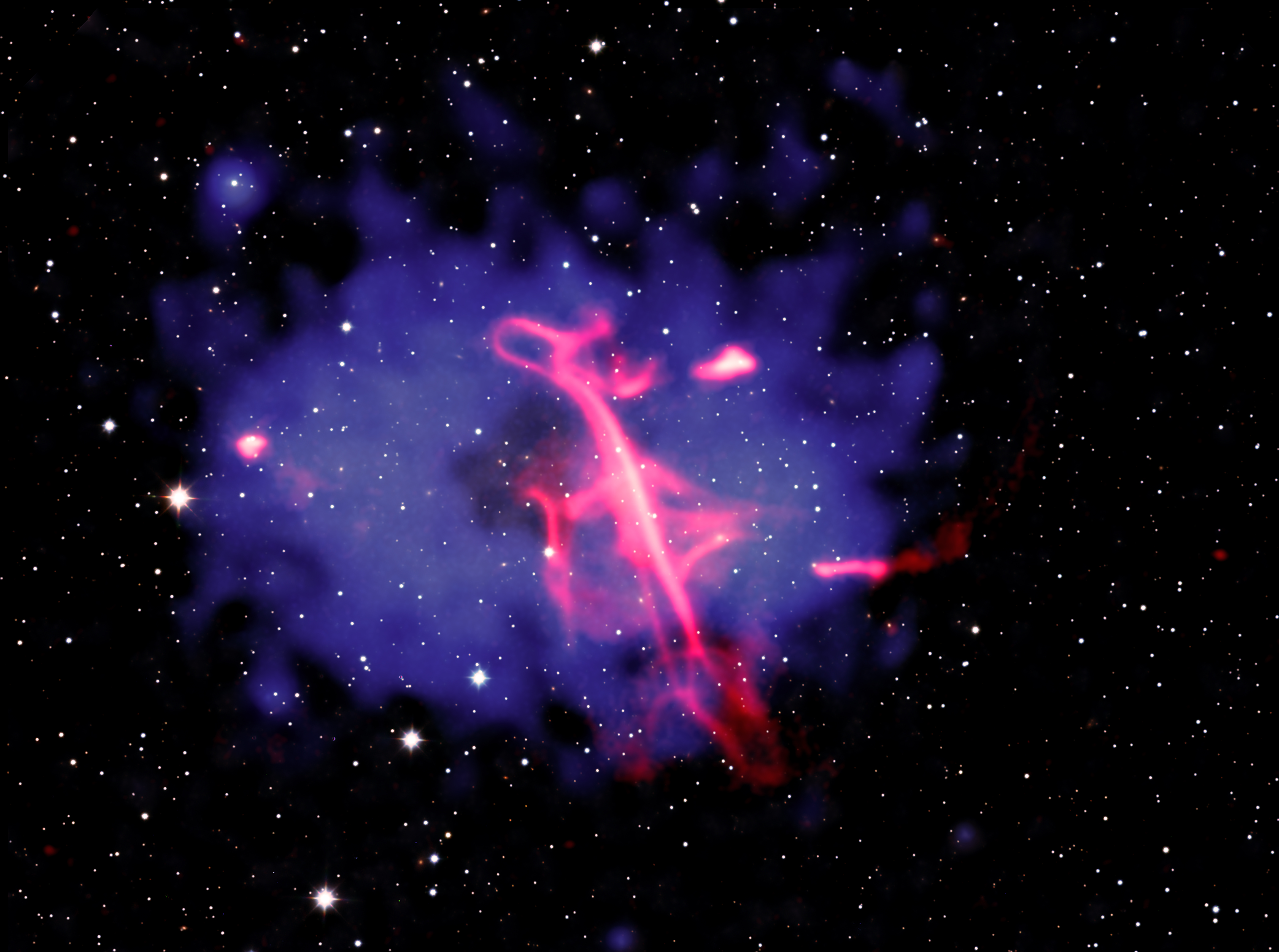
Treble Clef: Unusual X-ray Hot Radio Source

Explanation: Explanation : What is Treble Clef? This unusual radio structure extends over 2 million light-years and resembles a common musical symbol — but has its visible light hidden by our own Milky Way Galaxy. Examined in 2004, the nature of VLSS J0318.9+5755, dubbed Treble Clef, remained unknown. Recent observations by the Chandra X-ray Observatory and eROSITA, however, have led to the hypothesis that the Treble Clef central cloud of charged particles was originally expelled by a supermassive black hole at the center of a galaxy. After the radio emission from those particles faded, they may have been reinvigorated by a shock wave from the collision of two clusters of galaxies. The featured composite image shows radio emission in red, while recently discovered X-rays are shown in blue. Unusual objects like Treble Clef give humanity unexpected clues about how whole clusters of galaxies interact as well as the general evolution of our universe.

Tomorrow’s picture: backwards rainbow

Date: October 19, 2026
Credit: X-ray: NASA/CXC/INAF-IRA/A. Botteon et al.; Infrared: UKIDSS–GPS; Radio: ASTRONLOFAR; Image processing: NASA/CXC/SAO/N. Wolk
Authors & editors: Robert Nemiroff, Jerry Bonnell, Cecilia Chirenti, Keighley Rockcliffe
A service of: ASD at NASA / GSFC,
NASA Science Activation & Michigan Tech. U.

APOD: 2026 October 18 – Sonified: Eagle Nebula Pillars

APOD

Astronomy Picture of the Day

Discover the cosmos! Each day a different image or photograph of our fascinating universe is featured, along with a brief explanation written by a professional astronomer.

Sonified: Eagle Nebula Pillars

Explanation: Yes, but have you ever experienced the Eagle Nebula with your ears? The famous nebula M16 is best known for the feast it gives your eyes, highlighting bright young stars forming deep inside dark towering structures. These light-years long columns of cold gas and dust are some 6,500 light-years distant toward the constellation of the Serpent (Serpens). Sculpted and eroded by the energetic ultraviolet light and powerful winds from M16‘s cluster of massive stars, the cosmic pillars themselves are destined for destruction. But the turbulent environment of star formation within M16, whose spectacular details are captured in this combined Hubble (visible) and Chandra (X-ray) image, is likely similar to the environment that formed our own Sun. In the featured video, listen for stars and dust sounding off as the line of sonification moves left to right, with vertical position determining pitch.

Tomorrow’s picture: what could it be?

Date: October 18, 2026
Credit: Image Credit: NASA, ESA, & The Hubble Heritage Project (STScI/AURA);
Sonification: NASA, CXC, SAO, K. Arcand, M. Russo & A. Santaguida
Authors & editors: Robert Nemiroff, Jerry Bonnell, Cecilia Chirenti, Keighley Rockcliffe
A service of: ASD at NASA / GSFC,
NASA Science Activation & Michigan Tech. U.

APOD: 2026 October 17 – 3D 67P

APOD

Astronomy Picture of the Day

Discover the cosmos! Each day a different image or photograph of our fascinating universe is featured, along with a brief explanation written by a professional astronomer.

Red/blue stereo anaglyph of comet 67P.

3D 67P

Explanation: Put on your red/blue glasses and float next to the jagged and double-lobed nucleus of Churyumov-Gerasimenko, also known as Comet 67P . The stereo anaglyph was created by combining two images from the Rosetta spacecraft’s narrow angle OSIRIS camera taken on July 25, 2015 from a distance of 184 kilometers. Numerous jets are emanating from the small solar system world’s active surface near its closest approach to the Sun. The larger lobe is around 4 kilometers in diameter, joined to a smaller, 2.5 kilometer diameter lobe by a narrow neck. Rosetta’s mission to the comet ended in September 2016 when the spacecraft was commanded to a controlled impact with the comet’s surface . Keep those 3D glasses on though. You can check out a catalog of nearly 1400 stereo anaglyphs created from Rosetta image data on this website.

Tomorrow’s picture: open space

Date October 17, 2026
Credit: ESA , Rosetta , MPS , OSIRIS – Stereo Anaglyph: Philippe Lamy and The Team
Authors & editors: Jerry Bonnell, Cecilia Chirenti, Robert Nemiroff, Keighley Rockcliffe
A service of: ASD at NASA / GSFC,
NASA Science Activation & Michigan Tech. U.

APOD: 2026 October 16 – Chasing the International Space Station

APOD

Astronomy Picture of the Day

Discover the cosmos! Each day a different image or photograph of our fascinating universe is featured, along with a brief explanation written by a professional astronomer.

Chasing the International Space Station

Explanation: Blasting into the predawn sky on Tuesday, October 13, a Falcon 9 rocket and Dragon spacecraft are headed for low Earth orbit in this stunning timelapse video captured from Indian Harbour Beach, Florida. Starting with a launch from Space Launch Complex 40 at Cape Canaveral Space Force Station, Falcon and Dragon are chasing the International Space Station on NASA’s 35th Commercial Resupply Services mission. On cue, the space station itself enters the frame from the top. Almost 8 seconds into the 30 second timelapse. the bright streak of the ISS appears heading “down” toward the horizon. The first and second stages of the Falcon 9 are separating as the spectacular exhaust plume jellyfish grows, already catching the light of the rising Sun. The visible sequence of first stage boost back, re-entry, and landing burns begins around 20 seconds into the video. With the second stage following the ISS toward the distant horizon, the jellyfish plume continues to drift in the predawn sky, even after the successful first stage landing at planet Earth’s Landing Zone 40.

Tomorrow’s picture: pixels in space

Date October 16, 2026
Video Credit: Eric Holland
Authors & editors: Jerry Bonnell, Cecilia Chirenti, Robert Nemiroff, Keighley Rockcliffe
A service of: ASD at NASA / GSFC,
NASA Science Activation & Michigan Tech. U.

APOD: 2026 October 15 – The Milky Way over Manhattan

APOD

Astronomy Picture of the Day

Discover the cosmos! Each day a different image or photograph of our fascinating universe is featured, along with a brief explanation written by a professional astronomer.

A black and white view of the Manhattan skyline merges into a night sky with stars and a visible, though faint, Milky Way. Please see explanation for more details.

The Milky Way over Manhattan

Explanation: The city lights outshine the stars in the City That Never Sleeps. Who would have thought that the Milky Way could be visible in this sky? This image was taken with a filter that blocks most visible light, capturing instead only light in the near-infrared region of the electromagnetic spectrum (with lower energy than visible light). The astrophotographer’s clever setup blocks most of the light pollution from the city: old incandescent light bulbs and some neon lights are still bright in the near-infrared, but fluorescent and LED light bulbs are not. Of course, stars are also bright in the near-infrared! This image is a reminder that we all live under the same sky, and astronomy allows all of us to learn more about humanity’s place in the Cosmos.

Tomorrow’s picture: Chasing the ISS

Date October 15, 2026
Credit & Copyright Jason Kurth, Ty Buckley
Authors & editors: Cecilia Chirenti, Robert Nemiroff, Jerry Bonnell, Keighley Rockcliffe
A service of: ASD at NASA / GSFC,
NASA Science Activation & Michigan Tech. U.

APOD: 2026 October 14 – Mars and the Beehive Under an Aurora

APOD

Astronomy Picture of the Day

Discover the cosmos! Each day a different image or photograph of our fascinating universe is featured, along with a brief explanation written by a professional astronomer.

The bright Mars is near the center of the Beehive cluster (M44) in the sky's horizon. A colorful aurora sits above in the sky, looking like a curtain of light. Dark trees and a river line the foreground.

Mars and the Beehive Under an Aurora

Explanation: What a cosmic coincidence! In today’s image, Mars joins the Beehive cluster (M44 or Praesepe) below an auroral curtain and above a horizon of happy little trees near Lansjärv, Sweden. An eruption off the Sun reached Earth on October 10th, 2026 causing strong disturbances in Earth’s magnetic field. Energetic particles from the eruption collide with and energize the molecules in Earth’s atmosphere, which release that extra energy as the colorful aurora captured here. Auroras, or guovssahasat in North Sámi, is traditionally viewed with respect by the Sámi people indigenous to Sweden and other Arctic regions. Coincidentally, Mars appeared closest to the center of the Beehive cluster in the sky at the time. Although bees have been to space, the Beehive cluster is actually a swarm of young stars. Their rotation periods have helped humanity learn about how stars spin slower over time as they lose mass through their stellar winds.

Tomorrow’s picture: open space

Date: October 14, 2026
Credit: Petr Horálek (Institute of Physics in Opava), Josef Kujal, Vojan Höfer
Authors & editors: Keighley Rockcliffe, Robert Nemiroff, Jerry Bonnell, Cecilia Chirenti
A service of: ASD at NASA / GSFC,
NASA Science Activation & Michigan Tech. U.

APOD: 2026 October 13 – Desert Stairway to Heaven

APOD

Astronomy Picture of the Day

Discover the cosmos! Each day a different image or photograph of our fascinating universe is featured, along with a brief explanation written by a professional astronomer.

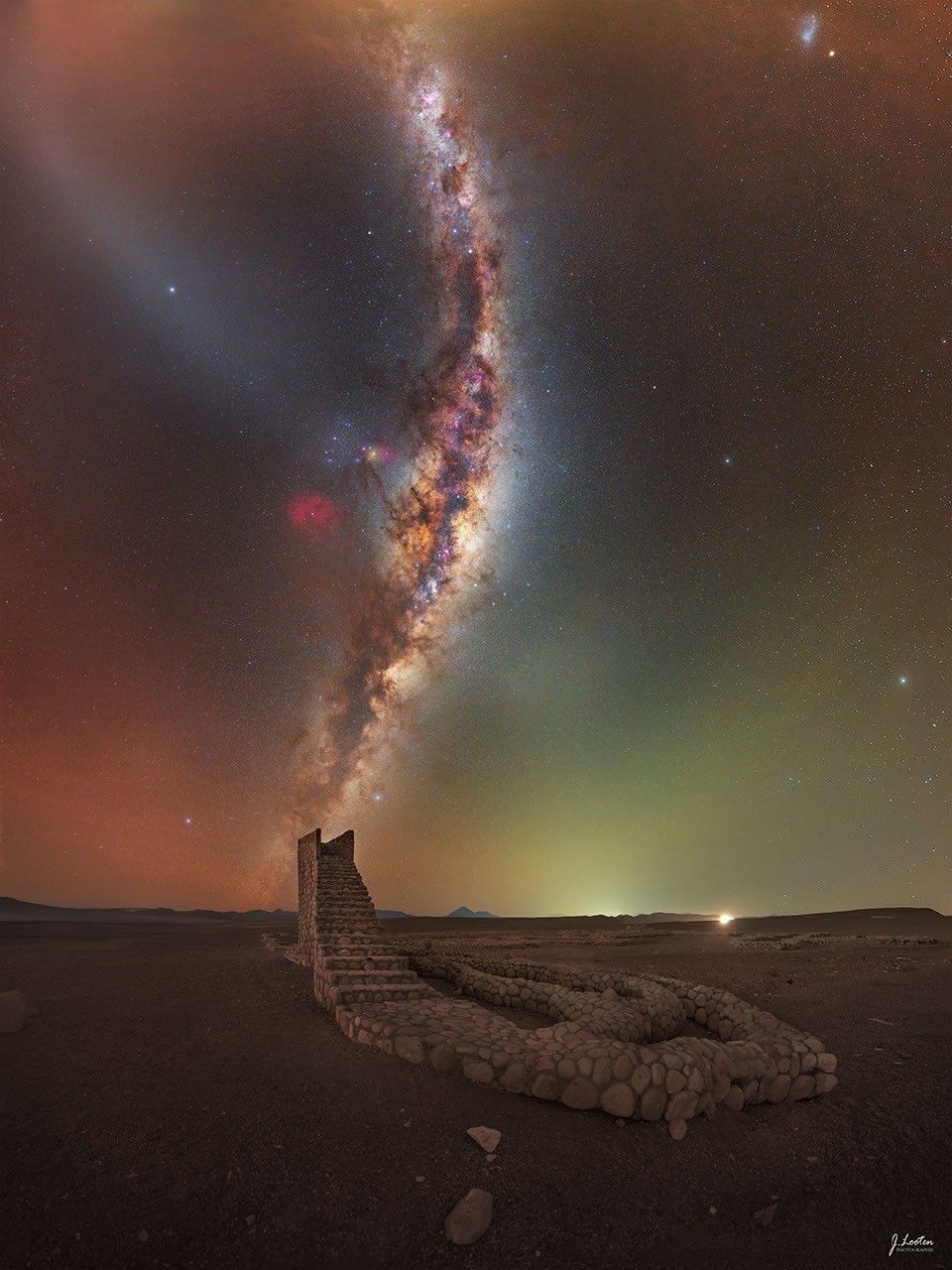
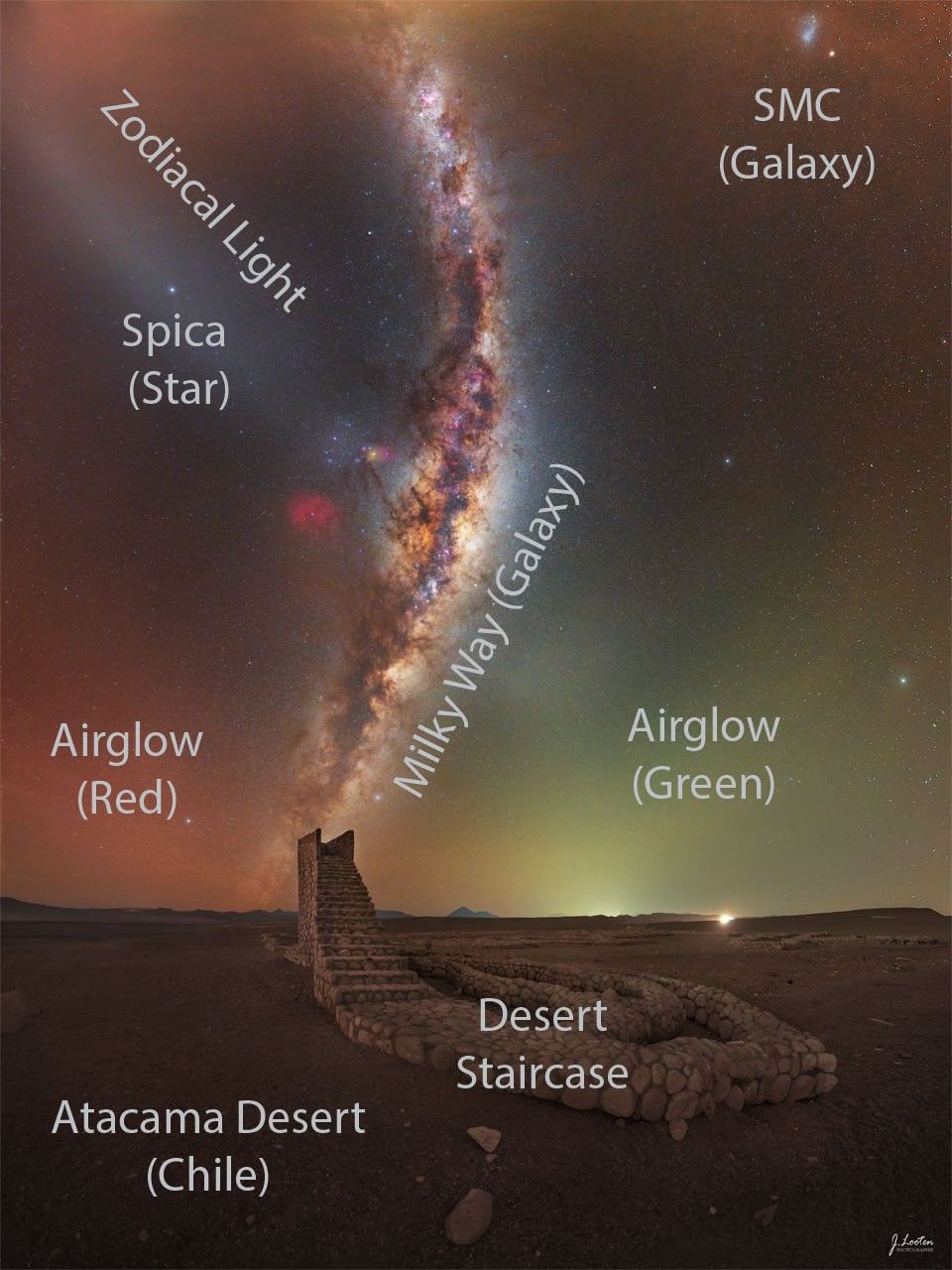
The Milky Way galaxy rises from the horizon and curves upward in the sky. In the foreground, a rock pathway is seen that culminates in a staircase that ends abruptly. The Milky Way band appears to be a continuation of the staircase. Please see the explanation for more detailed information.The Milky Way galaxy rises from the horizon and curves upward in the sky. In the foreground, a rock pathway is seen that culminates in a staircase that ends abruptly. The Milky Way band appears to be a continuation of the staircase. Please see the explanation for more detailed information.

Desert Stairway to Heaven

Explanation: This stairway in Chile brings you only a little bit closer to heaven. But ooh, the sky above it makes you wonder. For example, you may wonder about the dark lane of our own Milky Way galaxy rising behind the expansive Atacama Desert in Chile, the band of zodiacal light on the upper left, the green and red airglow just above the horizon, the star Spica in the zodiacal light stripe, and, at the very top on the right, the Small Magellanic Cloud galaxy. The Desert Staircase sculpture is in the foreground, and this image was timed to catch the picturesque peering perch just in front of the near-vertical Milky Way band. Upon close inspection of the horizon you can find, left to right, some Andes Mountains, the Licancabur volcano, and the town lights of San Pedro de Atacama. The featured wide-angle composite was captured in July 2025.

Tomorrow’s picture: space bees

Date October 13, 2026
Credit & Copyright Julien Looten
Authors & editors: Robert Nemiroff, Jerry Bonnell, Cecilia Chirenti, Keighley Rockcliffe
A service of: ASD at NASA / GSFC,
NASA Science Activation & Michigan Tech. U.

The Hexa-Bouncer May Be The Most Overengineered Thing You See This Week

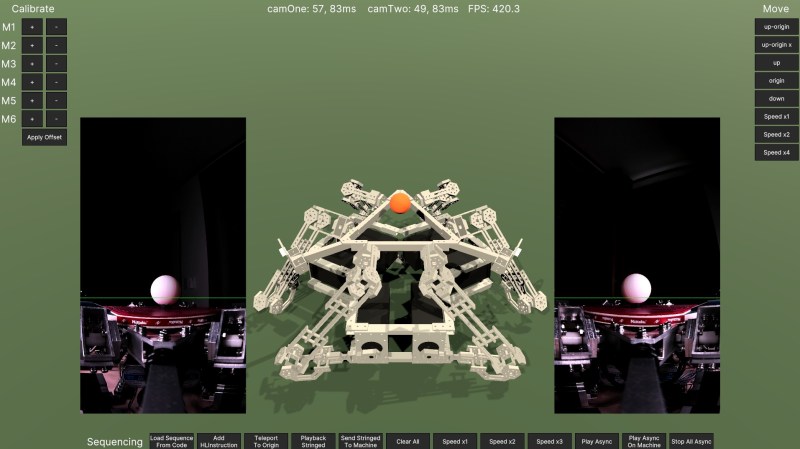
Sometimes, you want to build a simple project– the minimum viable product that solves your problem and nothing else. Other times you might be feeling a little extra, and want to use oodles of machined aluminum, six steppers, two cameras, a Teensy and a PC with a GPU just to bounce a ball. That’s the mood behind [T-Kuhn]’s hexa-bouncer, a Stewart Platform on steroids.  You can read all about it on his blog or witness it in action in the video below.  Trust us, really have to see it in action.

The six stepper motors connected to planetary gearboxes each drive an arm. Ingenious linkages allow the steppers to control a ping-pong paddle in every axis of rotation and translation. A Teensy 4.0 coordinates those steppers, but the marching orders are coming from a PC where a Unity application — available on GitHub — is performing Inverse Kinematics using the two cameras to track the ball in 3D. You might imagine a GPU comes in handy there. Both the article and the video get into more detail on the IK.

As for the physical build, as stated, it’s mostly aluminum milled out on [T-Kuhn]’s CNC machine, and while the pieces aren’t actually innumerable, he has to carve out 27 chunks of aluminum for each arm– plus all the bits in the base. The total count is over 300. It’s a very impressive robot to do the very mundane job of ball bouncing, which makes it probably the most overengineered thing we’ve seen this week. Kudos to [Tobias] for that!

Most of the other hexapods we’ve seen have been upside down in comparison, but since the last metal one was a horrifying man-carrying walker, we’ll forgive their misalignment. The computer vision workflow [T-Kuhn] is using for ball tracking is one he pioneered on his octo-bounce robot, which we also covered.

Thanks to [Tobias] for the tip! If you’ve built something so amazingly over-the-top that friends and family question your sanity, bounce it into our tips line! We understand.


APOD: 2026 October 12 – Jupiter and the Moons

APOD

Astronomy Picture of the Day

Discover the cosmos! Each day a different image or photograph of our fascinating universe is featured, along with a brief explanation written by a professional astronomer.

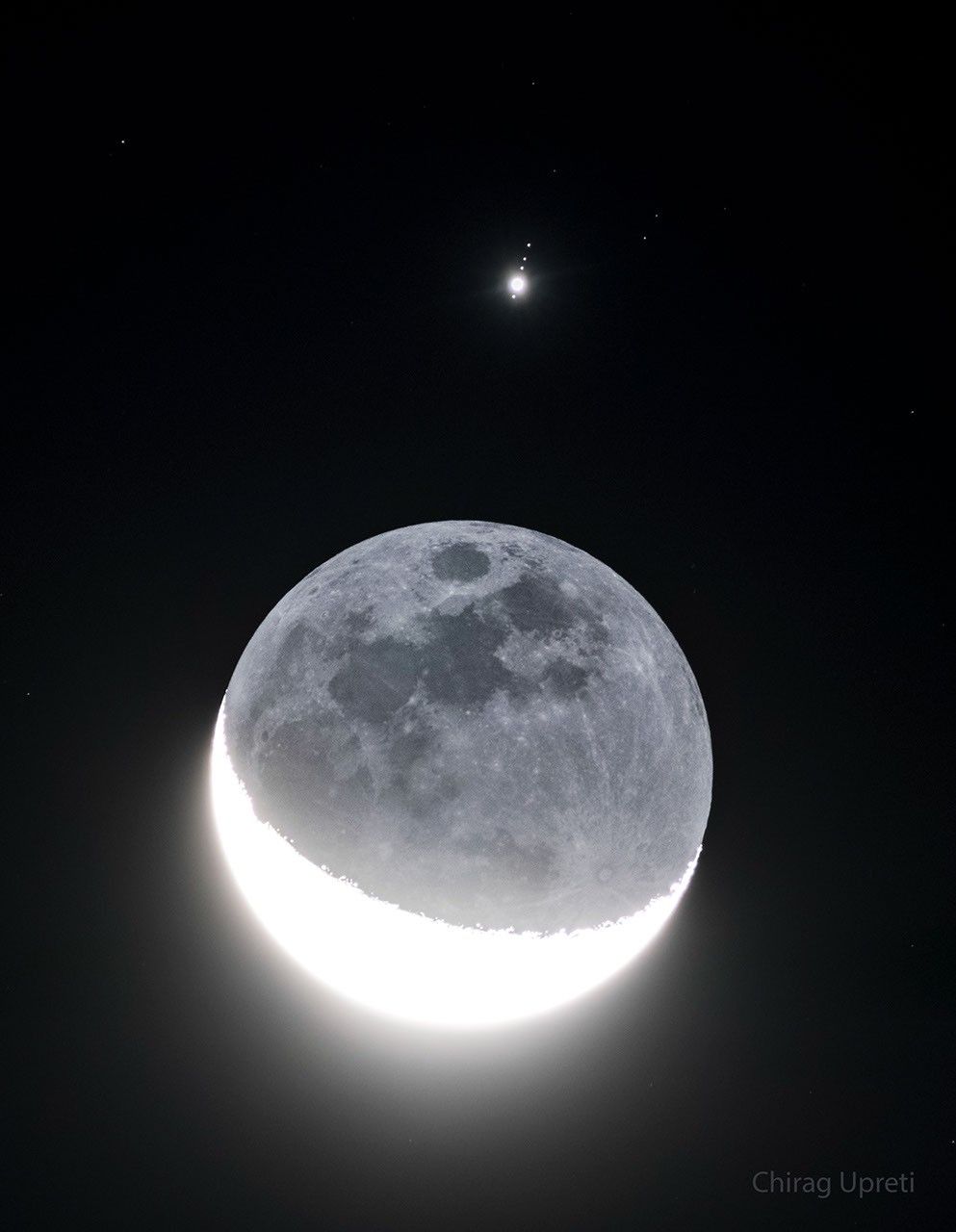
In front of a dark background an image of Earth's Moon  appears with a lower crescent brightly lit. The rest of the Moon is also faintly visible. Above the Moon is a bright point of  light surrounded by four fainter points of light in row. Please see the explanation for more detailed information.

Jupiter and the Moons

Explanation: How many moons can you see? The best answer is five: four orbiting Jupiter and Luna orbiting Earth. This multi-moon picture was possible because Earth’s Moon moved directly in front of Jupiter last week. The featured image is a series of exposures near alignment taken from Westchester, New York, USA. The sunlit crescent of Earth’s Moon, on the lower left, is overexposed, while the Moon’s night side, on the upper right, is faintly illuminated by Earthshine. Lined up nearly vertically above our Moon, listed from bottom to top, are Jupiter’s bright Galilean satellites: Ganymede, Io, Callisto, and Europa. Callisto, Ganymede, and Io are larger than Earth’s Moon, while Europa is only slightly smaller. NASA’s robotic spacecraft Juno is currently orbiting Jupiter and has made close passes near three of these moons.

Tomorrow’s picture: stairway to heaven

Date: October 12, 2026
Credit & Copyright: Chirag Upreti
Authors & editors: Robert Nemiroff, Jerry Bonnell, Cecilia Chirenti, Keighley Rockcliffe
A service of: ASD at NASA / GSFC,
NASA Science Activation & Michigan Tech. U.

APOD: 2026 October 11 – Ice Fishing for Cosmic Neutrinos

APOD

Astronomy Picture of the Day

Discover the cosmos! Each day a different image or photograph of our fascinating universe is featured, along with a brief explanation written by a professional astronomer.

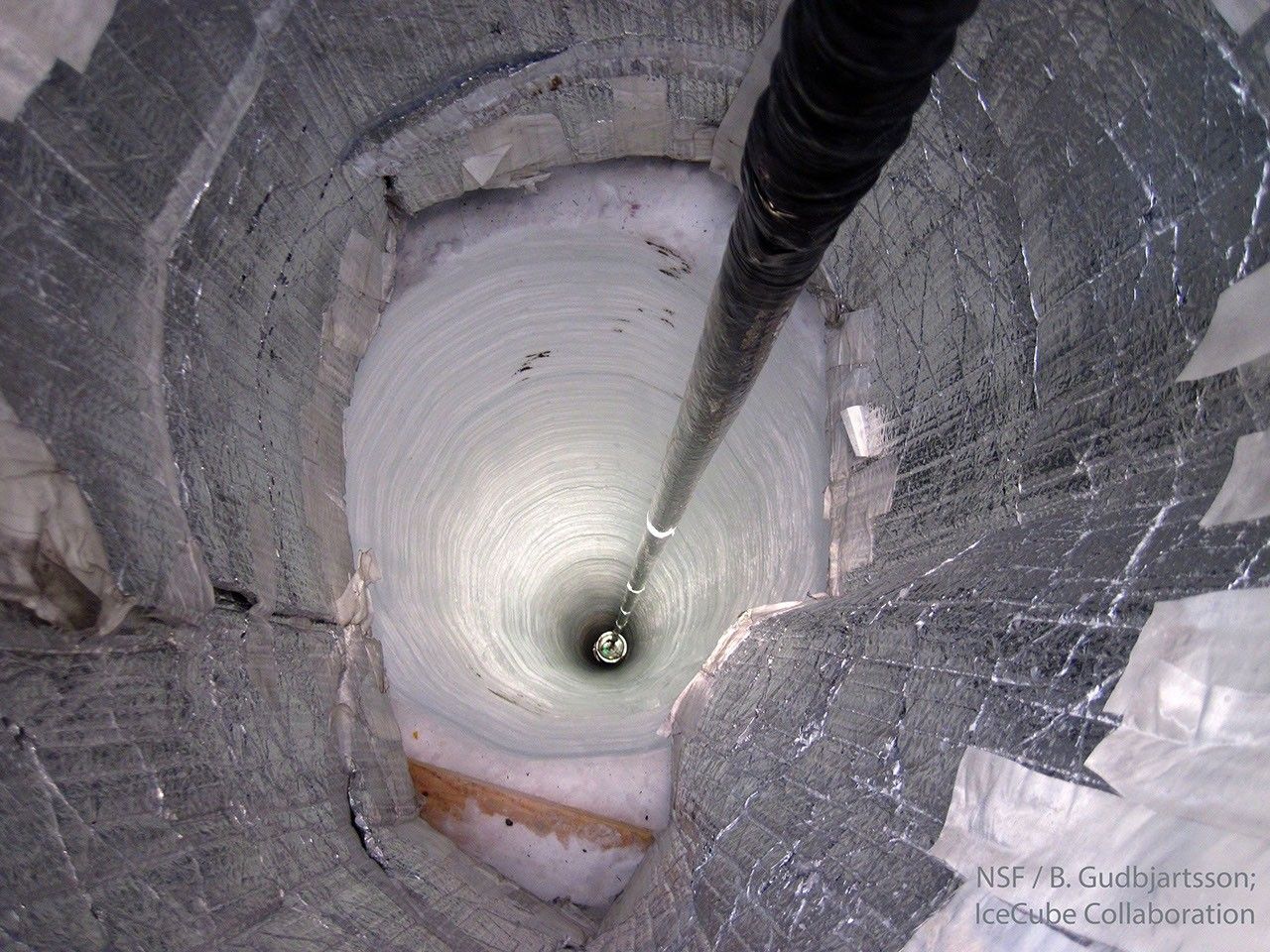
A dark cable descends into a deep carved hole of ice.  The hole is so deep that it disappears into darkness. Please see the explanation for more detailed information.

Ice Fishing for Cosmic Neutrinos

Explanation: Scientists are melting holes in the bottom of the world. In fact, almost 100 holes melted near the South Pole are now being used as an astronomical observatory. Astronomers with the IceCube Neutrino Observatory lowered a long string knotted with basketball-sized light detectors into each vertical lake. The water in each hole soon refreezes. The detectors attached to the strings are sensitive to blue light emitted in the surrounding clear ice. Such light results from fast-moving secondary particles liberated when high-energy neutrinos emitted by powerful processes out in the universe collide with ice molecules. IceCube has now detected many illuminating neutrinos. Pictured in 2010, one of the last of IceCube’s detector strings is lowered into the freezing abyss, making IceCube the largest neutrino detector ever created. In recognition of unprecedented discoveries, it was announced earlier this week that a founding leader of the IceCube Collaboration will be awarded the Nobel Prize in Physics.

Tomorrow’s picture: Moons Planet

Date: October 11, 2026
Credit: NSF, B. Gudbjartsson, IceCube Collaboration
Authors & editors: Robert Nemiroff, Jerry Bonnell, Cecilia Chirenti, Keighley Rockcliffe
A service of: ASD at NASA / GSFC,
NASA Science Activation & Michigan Tech. U.
❌