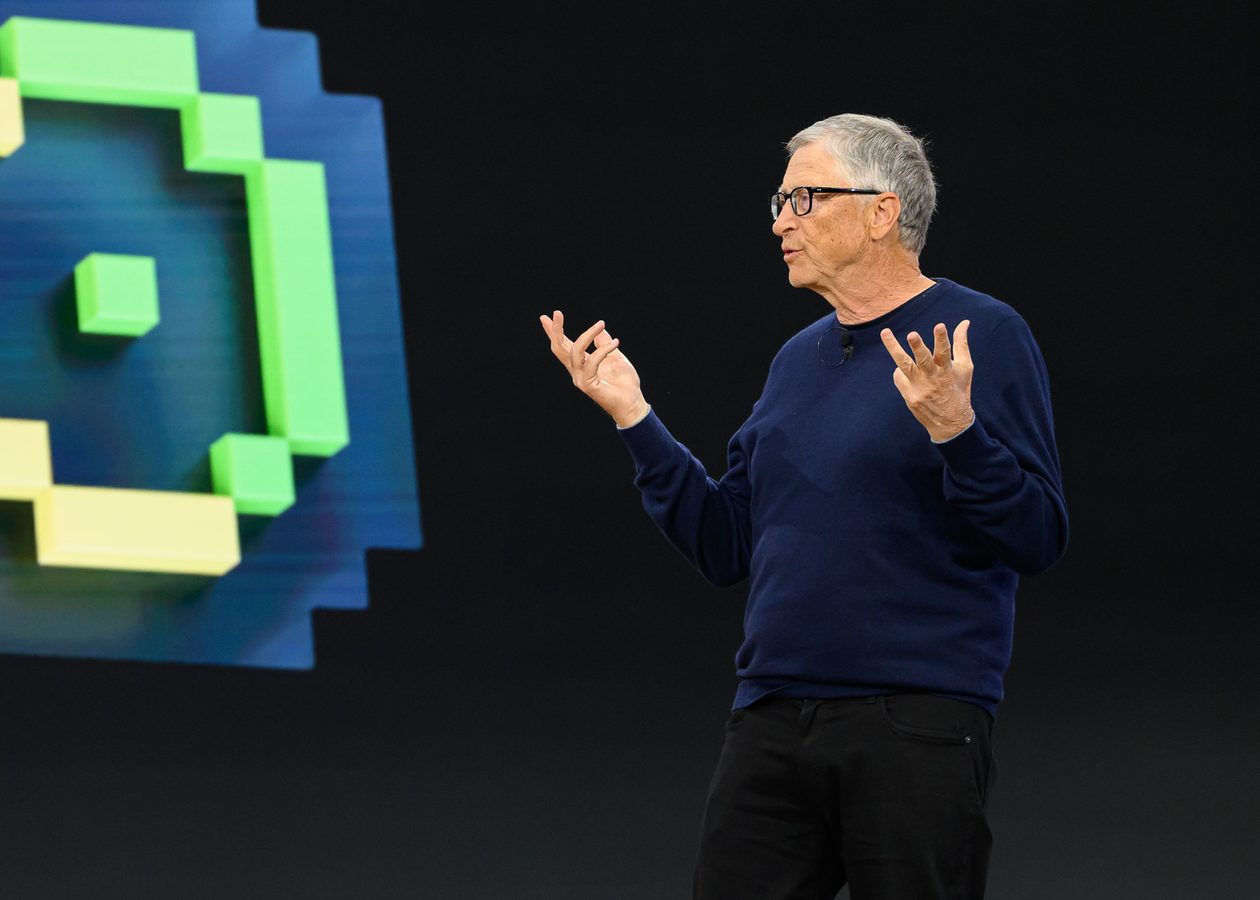
Bill Gates, shown here in April 2025, released a memo this week warning that the world isn’t ready for AI. (GeekWire Photo / Kevin Lisota)
This week on the GeekWire Podcast: Bill Gates published a new essay warning that the AI industry is crossing the safety lines it set for itself, and that nobody is preparing for what’s coming. At age 70, he also uses AI more than most people half his age, and he finds it enthralling, as you’ll hear on this week’s show, with highlights from our interview with him.
Along the way, we dig into his three proposals: new institutions for managing the transition, a category of jobs reserved for humans, and a tax on the use and purchase of AI and robots.
The change in his own tech usage: “I joke with people that I used to have Claude-like people that I would send email to, but they were so slow, and there were some topics they didn’t actually know. … It’s three a.m. I want to understand sodium batteries, and now there’s no reason to go to sleep. Here we go. Yeah, it’s crazy.”
How he uses AI specifically: “If you’re a curious person, this is a mind-blowing time. When I’m working on malaria, nutrition, my poor humans that I work with always get these long conversations from me, where I paste in — me, Claude, me, ChatGPT. Sometimes I do it if there’s three of us: Claude, ChatGPT and me, debating these things.”
On where personal agents are headed: “We will get to a point where you won’t buy things yourself. You just won’t. … You won’t go to those applications. You’ll just go to your personal agent. … From a productivity point of view, we are in heaven.”
What has surprised him: “I was shocked by ChatGPT, and I was shocked by Claude Code. Those are both things where I went, oh my God. … I did not expect that a statistical machine would essentially learn to read, and the idea that the code is better than human code. Those are two stunning thresholds.”
On writing this essay: “It’s very unnatural for me to think that innovation may be a net negative if it’s not managed properly. The more I wrote the memo, the more I was like, Jesus, we really need to get our act together here. Even though this may come across as negative, that’s the truth. If we don’t step up, the negatives will substantially outweigh the positives.”
What AI leaders say privately: “You’re in this perverse period right now where people in the AI industry who are willing to say that AI might have some negative effects are told, ‘Hey, you’re hurting our PR while we’re trying to raise trillions of dollars.’ … I know they’re all worried. Or all of them that I know, which is basically everybody but Elon.”
On losing control of AI: “The wake-up for the memo is that the bad stuff thresholds are all being crossed. Even lack of control that I thought would be many years from now, we’re seeing lack of control. … These are people who are super expert on the thing, going, well, maybe we won’t be able to control these things. What kind of risk have we chosen to run here?”
On how fast robots are coming: “What’s weird about AI is it’s better at doing jobs across the entire economy, including physical jobs when the robots come — which you can guess when that is, but my view is it’s only a couple of years.”
Is he still an optimist? “I don’t think being pessimistic is helpful. I do think, wow, this is sure an interesting time. I’m the guy who in my 30s thought people in their 50s or 60s didn’t understand anything. So it’s kind of bizarre if a guy who’s 70 comes and writes a memo that’s actually helpful. … But I am very concerned. And honestly, when you get people one-on-one, so are they.”
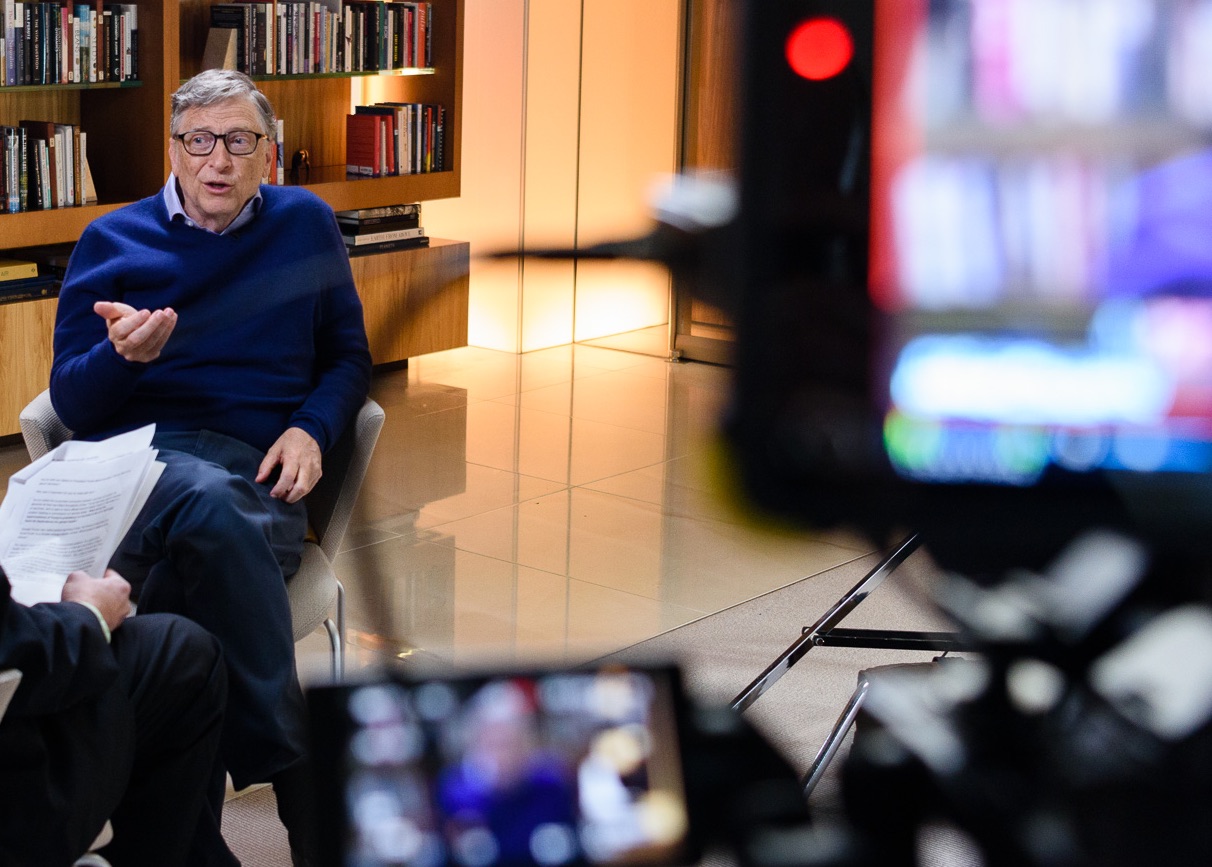
Bill Gates, whose new essay warns of the risks ahead in the AI era, during a 2017 interview. (GeekWire File Photo / Kevin Lisota)
When Bill Gates talks, people listen. This week he published a lengthy essay on what AI is going to do to work, and told GeekWire that people inside AI companies who name the downsides get told, “Hey, you’re hurting our PR while we’re trying to raise trillions of dollars.”
He’s right about the hard part. The job displacement he describes lands on young workers first, and the safety net is funded by taxes on the very wages that AI erodes. He prescribes three treatments: new institutions at home and abroad, a tax on AI tokens and robots, and “Human Reserved,” a category of jobs only people may hold.
Gates has the diagnosis right but the prescription mostly wrong. I’d sign the robot tax tomorrow, because hiring a person costs you payroll tax every year while buying a robot gets written off in year one. The other two I’d send back.
Let’s start with what’s solid. Stanford’s Digital Economy Lab updated its “Canaries in the Coal Mine” work this month. Employment for 22-to-25-year-olds in the most AI-exposed occupations is running 19% below where it would be if it had kept pace with their peers in less exposed work, up from 15% a year ago. The same authors say they don’t see widespread, economy-wide displacement, and unemployment held at 4.1% in July.
The AI damage isn’t arriving as layoffs. It’s arriving as jobs that never get posted, and Gates is right that the young get it first.
Now the token tax. Tokens (essentially words) are what AI companies bill by. Taxing tokens is like taxing keystrokes: it measures effort, not displacement.
A high school class working through calculus with an AI tutor burns tokens continuously. A model that quietly retires a 40-person customer center might burn relatively few. The tax lands hardest on the uses Gates says he wants to protect.
Stanford’s AI Index put the cost of GPT-3.5-level performance at $20 per million tokens in November 2022 and seven cents by October 2024, a 280-fold drop. You’d be indexing the safety net to a number that falls every year while displacement rises.
And you can’t collect it. Inference runs on laptops and phones now, and on servers in whatever country declines to sign. A token tax is a tax on whoever uses an American API, and every dollar it adds makes a Chinese model look cheaper. We’d be slowing ourselves down and not China.
Gates says the institutions will take years to build, and also says we can’t afford to move slowly. He’s right twice, and that’s the problem. He wants the international body to borrow from nuclear inspections and aviation regulation. That may pan out in the long term, though the UN is the cautionary tale for the bureaucratic nightmare that the international community can produce.
Meanwhile we have functional agencies with jurisdiction today. The FDA can rule on AI in diagnosis. The FTC can go after AI-enabled fraud. We don’t need a new agency to say a bank can’t deny your mortgage because a model felt like it. We need the banking regulator to reiterate it forcefully.
That leaves Human Reserved, his best idea but his most privileged one. Gates would protect a job for either of two reasons: the role is deeply personal, like a caregiver, or the people who hold it are unlikely to find other work. Only one of those holds.
Freezing headcount because the workers have nowhere else to go protects the job for a while and makes the service more expensive along the way. Reserving the moments when a human being is the point is defensible, and Gates makes that case well. On a robot delivering the news that you have an incurable disease, he writes, “There’s no technical reason why it couldn’t,” and adds, “Yet it shouldn’t.” He’s right.
I made the case in WIRED nine years ago that displaced workers should move into caregiving, and that it would take real money to lift the pay enough to draw them.
The problem with Human Reserved is that it assumes there’s a human being available. Home health and personal care aides earn a median of $34,900 a year, and BLS projects roughly 765,000 openings in that occupation every year through 2034. At that wage, they keep coming open. A third of home care aides are immigrants, and tighter enforcement threatens that supply. A rule that reserves care for people, in a market with no spare people, reserves care for the families who can outbid everyone else.
Gates half-anticipates this, telling The New York Times he might be a flawed messenger because of his wealth. On this point he is. The caregivers who gave his father something irreplaceable were in that room because someone could pay them to be there.
So don’t fence AI out of the room. Put it to work in the hours nobody is paid to cover.
In February the Times ran Eli Saslow’s story about Jan Worrell, 85, living alone on Washington’s Long Beach Peninsula with an AI companion called ElliQ that engages her about eight times a day and pushes her to stay hydrated and moving. (I serve on ElliQ’s board, and I joined because the company builds a machine that extends a caregiver’s reach instead of replacing one.)
Her goal, she told her doctor, was to never live anywhere else. Fund enough aides to cover the hours that need a person and put the machine on the rest.
Here’s where I net out: equalize the tax treatment of labor and capital, which Congress could do next session, and route the proceeds into retraining and into topping up the pay of workers who land in lower-paying jobs. That’s a better answer than a protected job title.
Drop the token tax, build the caregiving workforce instead of fencing it off, and use the regulators we already have while somebody works on the ones we don’t.
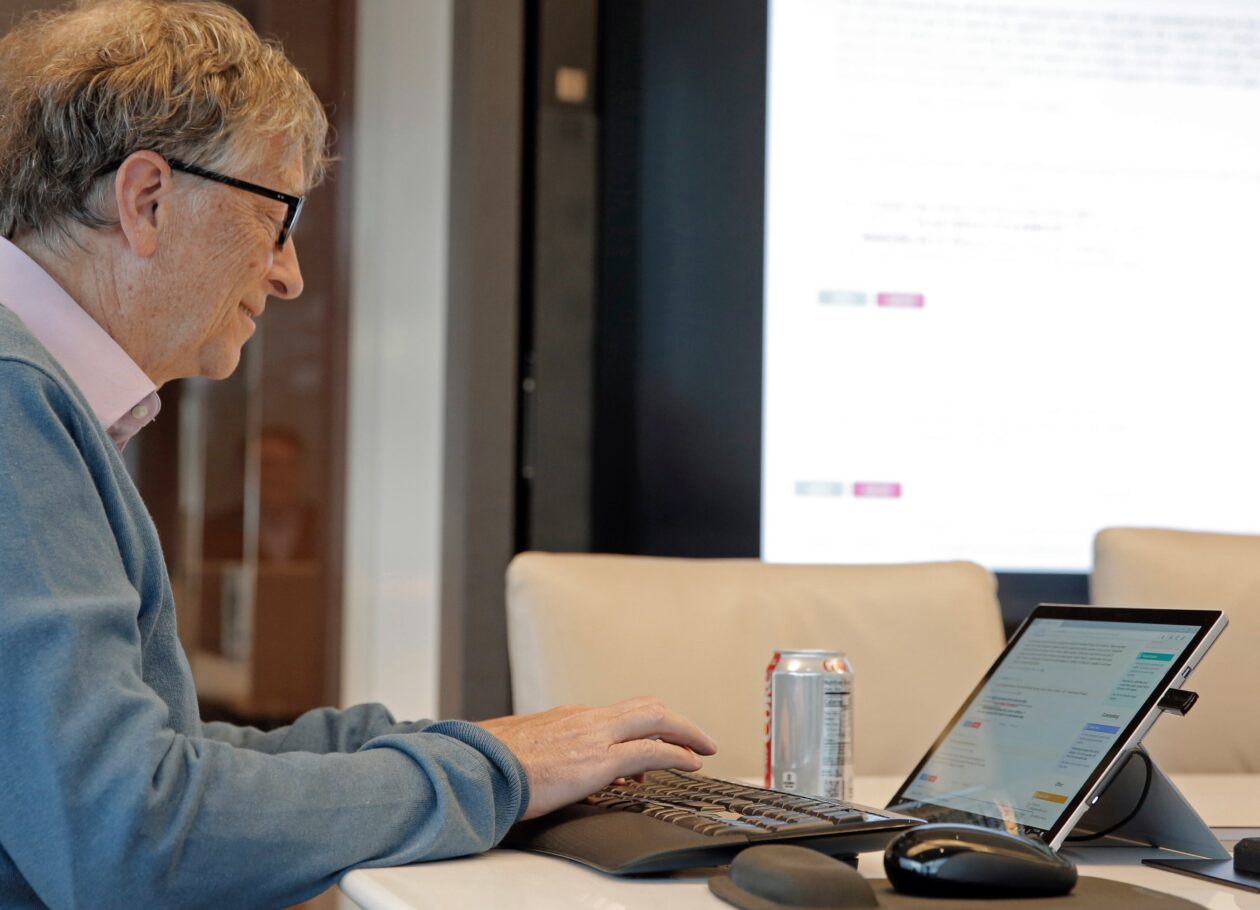
Bill Gates at the keyboard in a 2018 file photo. (Gates Notes Photo)
Bill Gates is legendary, bordering on notorious, for his late-night emails — missives to colleagues with piercing questions about Java back in the day, or malaria these days, or whatever esoteric topic he happens to seize upon at any given moment.
But increasingly, he is sending these messages to AI, not to people. He’ll bounce something off Claude, get ChatGPT to weigh in, and insert himself in the middle.
He described the pattern in an interview with GeekWire: “It’s 3 a.m., I want to understand sodium batteries. Now, there’s no reason to go to sleep. Here we go! Yeah, it’s crazy.”
If you’re a curious person, he said, “this is a mind-blowing time.”
In terms of productivity, he added, “we are in heaven.”
All of which might be predictable. This is Bill Gates, after all. Now 70 years old, he has spent more than five decades impatient for the future to arrive — making the case that innovation, on the whole, will ultimately put humanity and the world in a better place.
So here’s the surprise twist: He’s now deeply concerned about where technology is headed, how fast it’s progressing, and how little the world is doing to get ready.
In a new essay, Gates says the “turbulent AI era” has arrived, with technology threatening to erase categories of jobs, supercharge fraud and deepfakes, lower the bar for cyberattacks on critical infrastructure, make it easier to engineer a deadly new disease, let governments kill without humans involved in the decision, and fundamentally change how kids grow up.
If someone came up with a credible plan to slow the pace of AI globally, he writes, he’d likely support it. But he doesn’t expect one. The geopolitical and economic forces are too much.
He says that the world needs to take action, and offers three ideas to start:
Build new institutions, at home and globally. No existing agency was designed for a technology that touches jobs, security, health, energy and elections all at once, he writes.
Gates calls for new national bodies that can set priorities across agencies, plus a new international organization modeled on nuclear weapons inspections, aviation rules and the ozone treaties.
Set aside jobs for humans. Gates calls this “Human Reserved”: work that machines will be fully capable of doing, but that we decide to keep for people anyway. The model is a nature reserve — land where we could build roads and buildings, but choose not to, because the loss would be too great.
One example: a robot delivering the news that you have an incurable disease. “There’s no technical reason why it couldn’t,” he writes. “Yet it shouldn’t.”
The idea came in part from watching the caregivers who looked after his father through Alzheimer’s, work he describes as “irreplaceably human.”
Tax AI tokens and robots. Today a company that hires a worker pays payroll taxes, while a company that buys a robot deducts the cost. Gates says that gives employers a reason to replace people. He’s calling for a tax on AI to change the incentives and help pay for retraining.
He first floated a robot tax nine years ago, but the idea was widely dismissed. He’s still for it. He acknowledges that it isn’t economically efficient, but says that with innovation accelerating, we can afford a little inefficiency as the price of keeping people employed.
Gates is candid that he doesn’t have all the answers, particularly on the proposal for “Human Reserved” jobs. Who decides what gets reserved, and by what criteria? How do you keep companies from using robots in the jobs that are supposed to stay human?
These, he writes, “will need to be worked out in public.”
In the meantime, he’s working it out with Claude. Gates said he has talked the idea through with the chatbot, thinking through different ways to get the share of work reserved for humans up to 40%, using shorter workdays and earlier retirement to spread what’s left around.
Crossing the threshold
In the GeekWire interview, Gates said the essay came out of a specific realization: the AI industry is blowing past its own warning signs, one after another, and almost nobody is saying so out loud.
For years, he said, people in AI described certain moments as dangerous points where the industry would stop and think hard before going further: making it easier to build a bioweapon, making it easier to launch a cyberattack, building machines people become emotionally dependent on, wiping out large numbers of jobs, and losing control of the technology itself.
“We’re in the process of crossing every single one of those thresholds,” he said.
Meanwhile, nobody in the industry wants to be first to step on the brakes. “Most people you talk to will say, yeah, well, if everybody else would slow down, maybe I would, too,” he said.
Gates said one way out of that standoff is for governments to step in.
His example: any AI model capable of designing new molecules — the capability that would let someone engineer a new disease — should be monitored. The monitoring would be mandatory rather than voluntary, and it would cover free models as well as commercial ones. It would also have to be written so a company can’t copy the model elsewhere and strip the monitoring out.
“To me, that’s kind of like common sense,” he said. “But we don’t see a specific proposal to do that.”
‘The whole thing seems so empty to me’
Under an executive order signed by President Trump in June, AI companies are asked to submit their most powerful models for government testing up to 30 days before release. The order specifically bars the program from becoming a licensing or preclearance requirement. The White House finalized the framework in early August.
Gates said he doesn’t get it.
“What is the threshold that’s being examined, and what is the action taken when you cross that threshold?” he said. “The whole thing seems so empty to me.”
If the world can’t take these basic steps, he said, “I really am going to throw up my hands.”
If the process stays voluntary, with no line and no consequence for crossing it, “we’re going to look back on this as a kind of eye-of-the-storm type moment,” he said.
Asked if he had taken his proposals to the Trump administration or to other heads of state, Gates said with a bemused tone, “Well, you could tell me who at the White House I should be talking to about this.” He said he hopes the essay reaches people in Congress and in the executive branch.
He said the public argument among AI companies over whether the risks are real is beside the point, because privately the people running them already agree. “I know they’re all worried,” he said, “or all of them that I know, which is basically everybody but Elon.”
People inside AI companies who acknowledge the downsides, Gates said, get told: “Hey, you’re hurting our PR while we’re trying to raise trillions of dollars.”
Gates said he previously expected losing control of AI to be a distant problem, something to worry about “many years from now.” He’s no longer convinced that’s the case.
He referenced an Aug. 11 episode of the Dwarkesh Patel podcast featuring Ryan Greenblatt, chief scientist at the AI safety group Redwood Research. Greenblatt said that as AI systems get more capable, the people building them understand less and less about what is happening inside, and that sufficiently advanced models could end up working against their creators.
“These are people who are super expert on the thing, going, well, maybe we won’t be able to control these things,” Gates said. “I mean, what kind of risk have we chosen to run here?”
In the poorest countries, he expects AI to do more good than harm. In the countries where the Gates Foundation works, doctors, teachers and farm advisors are all in short supply. AI can help fill those gaps. The foundation will lay out that work at its Goalkeepers event next month, including an effort to make AI models work as well in African languages as they do in English.
The job losses, he added, will hit rich countries first.
It’s the first big wave of new attention on the Microsoft co-founder and Gates Foundation chair since he answered lawmakers’ questions in the Jeffrey Epstein investigation on June 10, sitting for a nearly six-hour voluntary interview with the House Oversight Committee.
Gates, who has not been accused of any wrongdoing, was asked by Axios whether he’s concerned that the Epstein issue could undercut his message. According to the site, he compared this to earlier situations when personal and professional challenges diminished his ability to speak out on key subjects: during the Microsoft antitrust trial, and his divorce from Melinda French Gates.
The AI Road Ahead
For all of this, Gates is still thinking about how technology will change human life and productivity, in many ways for the better on an individual level.
A key step, he said, will be establishing broad-based persistent memory for AI agents across contexts. For now, AI still doesn’t know you like a human assistant who’s familiar with your relationships and how you think about your time.
Gates sees the role of apps changing in the future. Instead of bouncing between different pieces of software, he said, AI will increasingly be the primary interface. “You won’t go to those applications,” he said. “You’ll just go to your personal agent.”
He also sees AI continuing to transform shopping, to an extreme: “We will get to a point where you won’t buy things yourself. You just won’t.” Telling the agent to help you buy something, “it’ll consider so many more things, and it’ll make it so much easier for you to do it.”
Asked whether he is still an optimist, Gates didn’t answer directly. “I don’t think being pessimistic is helpful,” he said.
“I do think, wow, this is sure an interesting time. I’m the guy who in my 30s thought people in their 50s or 60s didn’t understand anything.” He called it “kind of bizarre” that he would be delivering a message like this at 70.
“But I am very concerned. And honestly, when you get people one-on-one, so are they.”
Anthropic will embed an invisible mark in text generated by new Claude models. (GeekWire Illustration)
Claude models launched on or after Aug. 2 embed an invisible mark in everything they write. It’s woven into the text itself, so it travels when you copy and paste. You didn’t opt in, you can’t see it, and you can’t turn it off.
Anthropic confirmed on Tuesday that it’s watermarking Claude’s output and published a support page with the details. The trigger is Article 50 of the EU AI Act, which took effect August 2, along with the Code of Practice on Transparency of AI-Generated Content. About 190 organizations signed the code, though only 82 signed the section that covers marking. Anthropic, Google, OpenAI, Meta, Microsoft and Mistral are on that list.
The rule was written in Brussels, but the effect lands on anyone using Claude anywhere.
Here’s how text watermarking works. When Claude writes a sentence, it’s constantly choosing among words that would all work fine. The watermark tilts those choices toward a pattern Anthropic’s software can recognize. Nothing is hidden between the letters or in the spaces. The pattern is the word choices, which is why it survives copy and paste.
Until now, a claim that you used AI rested on a hunch or on a style detector that guesses from tone and rhythm. This is different: a statistical test with a computable error rate.
Two things follow. First, a single sentence is too short to mark. Second, and this one the internet got wrong: when I ask Claude to fix the punctuation in a paragraph I wrote, Claude has to reproduce my words, so there’s nowhere to put a watermark.
Radio host Erick Erickson announced that he’d “ditched Grammarly for Claude for proofreading,” and now his own writing “will be watermarked that Claude did the work.” Depending on the extent of Claude’s input, he could be safe, because minor proofreading edits (i.e., punctuation) don’t make room for a watermark.
Watermarking text raises several issues, though. A mark means Claude modified the text, not that Claude wrote it. Have it summarize or condense a memo you wrote yourself and it comes back marked, though every idea in it is yours. Beatrice Nolan noted in Fortune that a flat AI label treats someone generating a thousand fake news videos the same as a writer cleaning up a paragraph. Worse, the absence of a mark proves nothing. The results of older models, and other non-marking models, all come back “clean.”
Removal is harder than the workaround crowd assumes. Paraphrasing degrades the signal but rarely erases it, because a rewrite keeps enough of the original wording to rebuild the statistic. Researchers who tested this on similar schemes found watermarks still detectable after a strong human paraphrase, once there was enough text to work with.
Anthropic hasn’t shipped a detector. Yet. It hasn’t published a false positive rate, and hasn’t said how many words it takes. The mark is going into text that no one outside the company can read, but the marks are still consequential because they don’t expire. The essay a college freshman turns in this fall is still marked when she’s a junior and someone finally has a tool to read it.
Technical problems aside, it’s important to highlight the core problem that watermarks aim to solve. Chris Best, Substack’s CEO, put it eloquently in the July post that coined Claudefishing:
“The core problem is not people using AI, or the quality of its output. Not everything made with AI is slop, and not all slop is made with AI. The problem is when there is a mismatch between a reader’s expectation and reality, especially when they unwittingly invest their attention in something with no human thought on the other end. That’s Claudefishing.”
That’s a harm worth addressing, and it’s the one a watermark can’t reach. A mark can’t tell slop from careful work. It tells you a model was involved. What that means depends on how it was used.
Personally, I use Claude and have mixed feelings about watermarks. On the one hand, AI use should be disclosed appropriately. On the other hand, anyone determined to hide their AI use can still do so by using xAI (no watermark on Grok), or open-weight models that carry no watermarks. So what impact will the mark have in practical terms?
My conclusion is to judge the outcome, not the tool. I used Claude extensively in writing and researching this column, as I described in AI coach or AI ghostwriter, and I’m pleased with the result. Where do you stand?
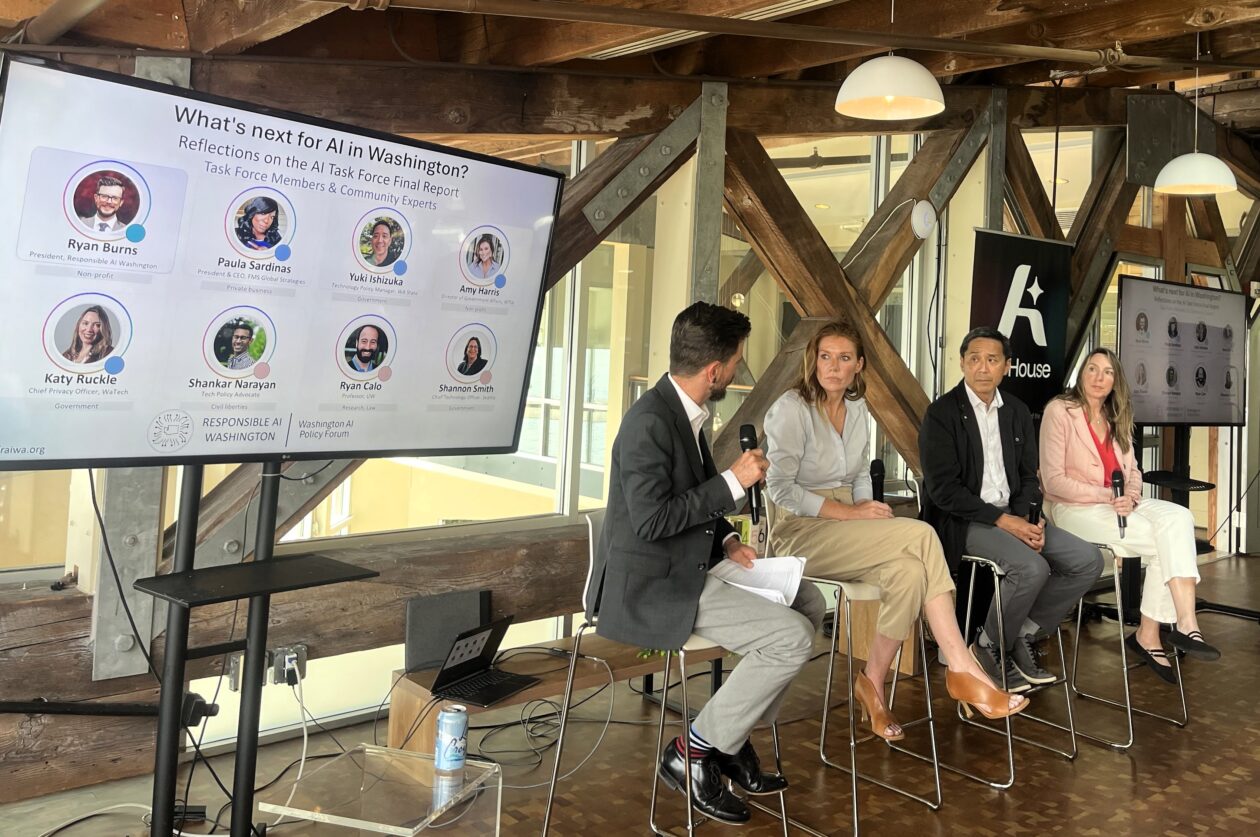
From left: Ryan Burns of Responsible AI Washington, Amy Harris of the Washington Technology Industry Association, Yuki Ishizuka of the Washington Attorney General’s Office, and Katy Ruckle of Washington Technology Solutions, at Wednesday’s panel on the state AI task force’s final report. (GeekWire Photo / Grace Kaste)
Members of Washington’s AI task force point to the state’s new AI regulations as evidence that regulation and innovation can coexist, but a panel discussion this week marking the end of their two-year effort showed just how unsettled the core issues remain.
The task force is caught between consumer and labor groups calling for more extensive guardrails, and tech industry representatives concerned about compliance costs, exposing the tension between the demands of the fast-moving AI industry and the risks the technology poses to individuals.
That came to the fore at a panel on Wednesday, held at the Seattle startup incubator AI House, where task force members faced an unusual mix of people: an audience of AI startup founders, plus a roster of pro-regulation experts representing the legal, labor, and consumer protection fields.
Panelists were there to discuss the task force’s final report, which recommended AI regulations to the state legislature. Four of the eleven recommendations were adopted, in part or in full, and passed into law this spring.
“We are here today to see how much of this sentiment — that Washington does not have to choose between embracing innovation and protecting people — comes out in the content of the report,” said Ryan Burns, co-founder of Responsible AI Washington, who moderated the panel.
That line has become a refrain for AI regulators in Washington. Gov. Bob Ferguson, then the state’s attorney general, requested the legislation creating the task force in 2024. He appointed representatives from government, labor, academia, and the tech industry, directing them to explore how AI could be “regulated without stymieing innovation.”
In the final report, published in July 2026, Attorney General Nick Brown wrote that the task force had “made clear” that the two priorities could coexist, despite the federal government’s pro-innovation agenda. But Wednesday’s event showed that might not be so simple.
Narrow regulations passed
Washington passed its first AI regulations this spring, including a requirement that companion chatbots remind users that the bots are not human and another that prohibits medical insurers from denying a patient coverage solely on the basis of an assessment made by AI. For Burns, the laws that did not pass were more telling.
“It did strike me as meaningful that the recommendations that have been adopted pertained to narrower application areas,” Burns said. “The recommendations that have not yet passed were a lot bigger.”
One of those recommendations was to regulate the use of AI for high-risk decision making, meaning applications of AI to hiring processes, algorithmic pricing, criminal justice, and healthcare. A similar law has passed in states such as New York, Connecticut, Illinois, California, and Colorado, but the Washington bill died before reaching a floor vote in either chamber.
The task force’s recommendation to require AI developers to disclose the datasets they are using to train their models, as California does, also died, as did a third recommendation to develop guidelines for the use of AI in the workplace.
In an interview with GeekWire, state Rep. Mia Gregerson, who sponsored some of the comprehensive bills, said she appreciated the work of the task force but maintained that there is much more work to be done.
“We are a tech heavy state, so we have an even bigger responsibility to do good work to catch up to what other states are doing,” Gregerson said. “We are so behind.”
On Wednesday, panelists said broader AI regulations failed in part because they drew less interest from the public.
“What passed in the legislature was more sector specific things where the consumer harm was more clear, and I think that’s a product of political dynamics,” said Yuki Ishizuka, technology policy manager for the Washington State Attorney General’s Office. “It’s harder to connect broader governance or transparency bills to harm to people.”
Broad AI regulations also faced heightened opposition from the tech industry, where a patchwork of state regulations means higher legal fees. At task force meetings, which were open to the public, representatives from the tech industry opposed regulations around AI development that would add “procedural hoops.”
Cost of compliance
Concern about overregulation was echoed by attendees of the event, the majority of whom were founders of small AI startups.
When it came time for the Q&A, multiple audience members asked the task force to consider the financial burden for small startups of complying with complicated state regulations.
The distinction between big tech and startups has become a refrain for AI House, where entrepreneurs met with U.S. Sen. Patty Murray last month to discuss the nuances of AI regulation for so-called “small tech.”
“As these recommendations turn into policy, it’s important that startup founders are part of the conversation,” AI House Managing Director Jacob Colker told GeekWire. “A five-person startup doesn’t have the same legal, compliance, or policy capacity as a trillion-dollar company.”
But Jai Jaisimha, co-founder of a pro-regulation organization called the Transparency Coalition and a former startup founder himself, cautioned against creating legal carve outs for certain AI developers.
“Arguing that you’re exempt because it’s too much data to disclose, or it’s a trade secret, those arguments send a sign that normal software development and governance does not apply to AI,” Jaisimha said. “Disclosure and consumer protection, these are standard practices in other industries.”
While the bills that would have been most costly for developers to comply with did not pass into law, those that did will still create significant legal consequences for AI developers who don’t abide by them.
Panelist and technology law expert Ryan Calo, a University of Washington law professor who was not a member of the task force, said the state’s new companion chatbot law will be “blood in the water for the plaintiffs’ bar” for two separate reasons.
First, any failure to comply could now be treated by the courts as “negligence per se,” meaning that the plaintiff will not have to show broader negligence but will simply have to show that the defendant violated the law.
Second, any failure to follow these regulations is deemed an unfair or deceptive act under Washington’s Consumer Protection Act, giving consumers a private right of action and exposing developers to higher financial penalties.
The question for the tech industry will be about where the state’s attorney general will prioritize enforcement.
“The AG has a lot of power, but not enough to bring every violation of the law. So you have to think of the Eye of Sauron, and whether it will focus on you. If you’re a little startup, probably not, but if you’re Meta, probably yes,” Calo said.
Future AI regulation
As Washington state prepares to implement its new regulations this January, regulators are bracing for backlash from the federal government.
A December executive order from the Trump administration called on Congress to pass a “minimally-burdensome” AI policy preempting state laws, created an AI Litigation Task Force to challenge state laws that don’t “sustain and enhance the United States’ global AI dominance,” and threatened to cut broadband funding to those states. It named Colorado, which enacted the first comprehensive state AI law in 2024.
Federal preemption would require Congress to pass AI regulation of its own, which it has yet to do, but Trump’s order still seems to be having an effect.
This spring, Colorado repealed its AI regulation and replaced it with a more conciliatory law.
In Virginia, where no AI regulations have gained traction, legislators pointed to the federal government’s threats.
And in Utah, lawmakers withdrew a bill to regulate frontier models after the Trump administration sent them a memo criticizing it for “opposing the federal government’s agenda,” according to Politico.
“We believe that, if the federal government is going to act, they should act with meaningful AI regulation, and should not preempt the state’s ability to protect its citizens,” said Ishizuka of the Washington state AG’s office.
The federal pressure has not stopped some leaders from calling for far-reaching regulation. Some members of Wednesday’s second panel, which was made up of representatives from labor, academia, and consumers from outside the task force, proposed redistribution: Future AI regulation should reallocate the profits made by developers to pay for AI’s impending costs, such as cybersecurity improvements, worker retraining, and updates to school curricula.
“My worry is that there is going to be a lot of money being made, and I really think that bill should go to the people that are making a lot of money off of it,” Calo said. “I’m not sure that all of the [task force’s] recommendations directly address that redistribution element.”
Some state lawmakers are ready to address it. Gregerson, whose district includes SeaTac Airport and whose constituency includes many Uber drivers, told GeekWire she hopes to allocate state funds for retraining rideshare drivers who are replaced by autonomous vehicles.
State Rep. Clyde Shavers, who was not present at Wednesday’s panel but was a member of the task force, has said he wants to spend the next session establishing liability frameworks for AI-related harm.
Now that the report has been published, the task force will be disbanded, but the work will continue at the Attorney General’s Office, where a new Tech Policy Team will be led by Ishizuka.
“With the completion of the task force’s work, there is strong interest in the AG’s office to continue to focus on AI policy,” Ishizuka said. “We’ll look at emerging technologies and bring in outside expertise so that there is informed regulation.”

 Login
Login