Trump wants data center companies to pay host communities as opposition to AI infrastructure grows. Here's what the proposal could mean for future projects.
Trump wants data center companies to pay host communities as opposition to AI infrastructure grows. Here's what the proposal could mean for future projects.
Southeast Asia's digital economy is set to reach $368 billion in 2026 as AI investment grows, but fragmented data rules complicate regional operations.
Southeast Asia's digital economy is set to reach $368 billion in 2026 as AI investment grows, but fragmented data rules complicate regional operations.
At the 2026 OCP Global Summit, Nvidia opened up its Vera Rubin rack designs, released open-source AI factory software, and announced plans with Cisco for a new pluggable-optics specification. Here's why openness has become a scaling requirement, and what IT pros should do about it.
At the 2026 OCP Global Summit, Nvidia opened up its Vera Rubin rack designs, released open-source AI factory software, and announced plans with Cisco for a new pluggable-optics specification. Here's why openness has become a scaling requirement, and what IT pros should do about it.
Nvidia has made its complete Run:ai GPU orchestration platform open source. Here's what's free, which support options cost money, and what IT teams still need to operate.
Nvidia has made its complete Run:ai GPU orchestration platform open source. Here's what's free, which support options cost money, and what IT teams still need to operate.
AI infrastructure startup Nscale is doubling down on its new Seattle-area presence before even opening the doors.
After initially leasing a single floor at The Eighttower in downtown Bellevue earlier this year, the London-based company has expanded by an additional floor, bringing its total footprint in the new development to approximately 46,000 rentable square feet, according to a report from The Broderick Group.
The expansion signals an aggressive ramp-up for Nscale’s primary U.S. engineering hub, slated to open in January 2027. While the initial 24,000-square-foot lease was pegged to accommodate up to 250 employees, the added space gives the fast-growing cloud provider room to scale its local team even further beyond its current 50 Seattle-area workers.
Founded in 2024, Nscale is riding a massive wave of capital and growth.
It raised a $2 billion Series C round at a $14.6 billion valuation earlier this year, backed by Nvidia, Dell, Citadel, Jane Street, and Point72, alongside a $900 million credit line.
The company also earlier this year hired Nidhi Chappell, the former Microsoft corporate vice president who led Azure AI and high-performance computing infrastructure, including the supercomputers that power ChatGPT. As Nscale’s new president of AI infrastructure, based in the Seattle area, Chappell will oversee the company’s global engineering and data center operations.
“I’ve had a front-row seat to some of the biggest moments in AI over the past several years, but one thing has always stood out: the world remembers the breakthroughs, but it’s the people building the infrastructure behind the scenes who make them possible,” Chappell wrote in a LinkedIn post earlier this year announcing the company’s first “onboarding” event in Seattle.
Nscale’s new office is set to open in January, with the second floor slated to open in June, reports The Puget Sound Business Journal.
The company’s growth underscores Bellevue’s growing magnetism for out-of-town AI players. The company joins a dense ecosystem of AI infrastructure and application hubs establishing outposts on the Eastside, including xAI, OpenAI, Databricks, CoreWeave, Armada, and Anduril.
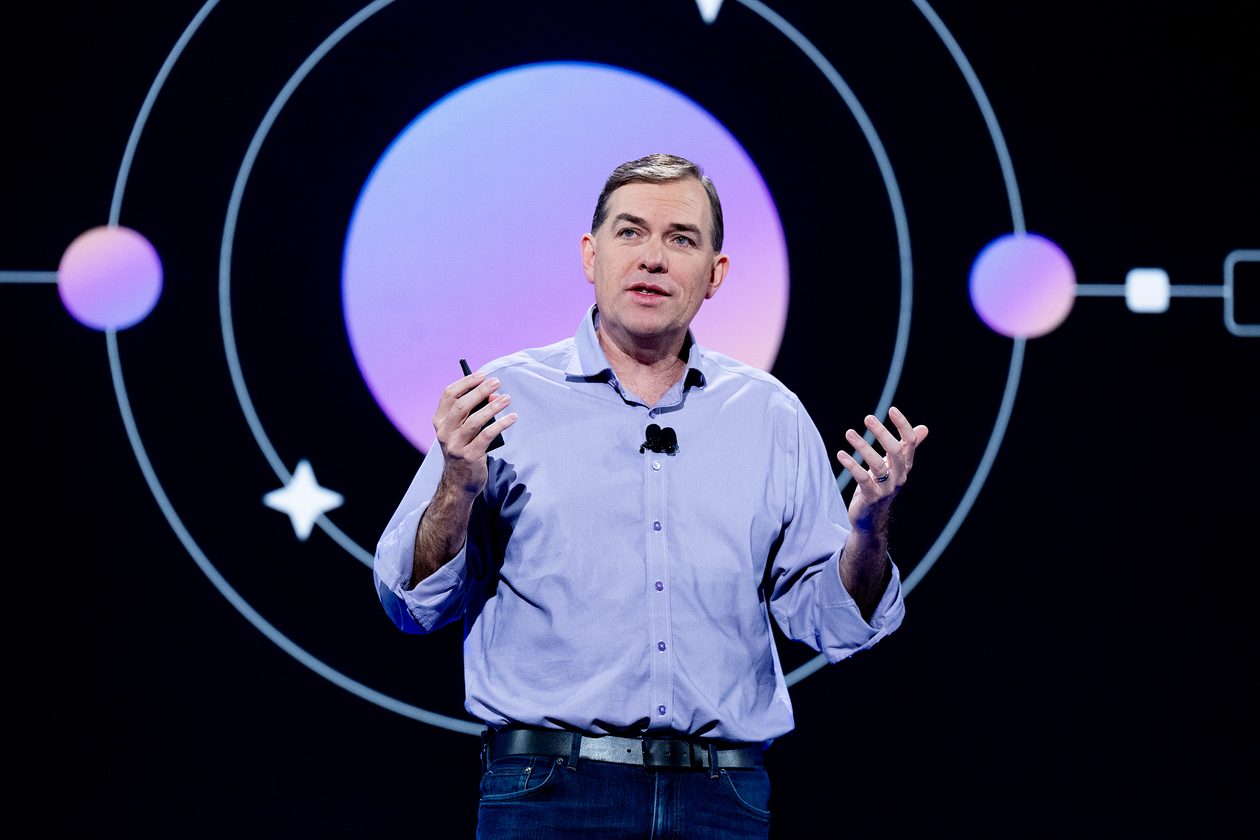
Amazon Web Services CEO Matt Garman, shown at AWS re:Invent in 2025, says local opposition to data centers threatens the U.S. position in the AI race. (Amazon Photo / Noah Berger)
Amazon says it will spend more than $1 billion over five years in the U.S. communities where it builds and operates data centers, responding to a growing backlash across the country against the tech industry’s massive AI infrastructure buildout.
The company’s new program, which it calls “Built Together,” will fund free community college, job training, energy upgrades for homes and schools, and other local projects identified by data center communities. It comes on top of more than $1 billion that Amazon says it has given to communities over the past three years.
Amazon also says it will stop using NDAs with government agencies on data center projects, install lower-emission backup generators at new sites, publish its energy and water use each year, and pay enough for power to keep local electricity bills from rising.
Announcing the commitments in a post Friday morning, Amazon Web Services CEO Matt Garman said local opposition to data centers — which he asserted is stoked by “misinformation and outright lies” — threatens the country’s position in the global race for AI leadership.
“Right now there are over 100 data center moratoriums being considered across the country,” Garman wrote. “If these measures are enacted, the U.S. could be writing its own losing ticket to this race, and the consequences would last generations.”
The business stakes: Amazon is making an unprecedented bet on AI, projecting about $220 billion in capital expenses this year, largely on data centers and chips. That’s more than the cash its business generates on an annual basis.
By comparison, the additional $1 billion in community funding over five years works out to about $200 million a year, or about one-tenth of 1% of this year’s projected capital spending.
Amazon’s AI strategy depends on finding communities willing to host its data centers. Microsoft, Google and other tech giants are spending on a similar scale, to meet current and anticipated AI demand, and they face the same problem.
Local opposition has become a real limit on the AI buildout. At least 75 data center projects worth about $130 billion were blocked or delayed in the first three months of the year alone, according to Data Center Watch, a group that tracks these disputes. An Economist/YouGov poll in late August found that 63% of Americans would oppose a data center in their community.
Pushing back on the narrative: Much of Garman’s post is a point-by-point rebuttal of what he calls myths about data centers.
He called it “false” that data centers are sucking up all the water in communities, “misleading and convenient scapegoating” to blame them for driving up all electricity rates, “untrue” that their backup generators emit huge amounts of pollution, and “false” that communities get nothing in return.
Amazon’s average data center uses less than 13,000 gallons of water a day, he wrote, and backup generators sit idle 99.9% of the time. Where electricity rates are rising, he attributed it primarily to an aging grid.
Garman pointed to “widespread reports of various countries intentionally seeding misinformation in the U.S. about data centers to trick us into slowing down.” OpenAI and X have each reported China-linked accounts posting about data centers.
However, PolitiFact reported last month that the role of foreign influence in the opposition to data centers has been exaggerated, with little sign the accounts reached a wide audience.
“We understand why there is apprehension in some communities where data centers are being built,” Garman wrote. At the same time, he said Amazon and other data center operators have already taken many steps to address those concerns.
The new commitments, he wrote, are a way to codify the company’s existing practices.
Where Amazon and Microsoft differ: Microsoft promised in January not to seek local tax breaks for its data centers. Asked by GeekWire whether it would do the same, Amazon did not make that commitment. The company said it is the largest taxpayer in almost every community where it operates, and that local governments offer incentives to attract its projects.
In his post, Garman pointed to St. Joseph County, Ind., where he wrote that Amazon is expected to pay more than $3 billion in taxes on land that would have generated $1.2 million under its prior use. In Madison County, Miss., he cited more than 2,300 construction workers now on the job and more than 1,700 operations jobs to come.
In 2023, Good Jobs First, a watchdog group that tracks corporate subsidies, reported that five Amazon data centers in Morrow County, Ore., would receive about $1 billion in property tax breaks over 15 years, which the group called the largest known subsidy in the company’s history at the time.
Microsoft also went further on NDAs, saying in March that it would terminate its existing nondisclosure agreements with local governments. Amazon said its change applies going forward, and that it doesn’t plan to revisit past agreements, most of which no longer apply once a project becomes public.
Power costs: Amazon was among seven companies that signed a White House pledge in March to pay for the power and grid upgrades their data centers require.
The new commitment repeats that pledge, which the company said reflects what it was already doing. Amazon has long structured its power agreements to cover the full cost of serving its data centers, it said, with rates approved by state utility regulators.
In his post, Garman disputed that data centers are to blame for rising electricity rates. Among states with large numbers of data centers, he wrote, rates have risen in some, including Illinois and New York, and fallen in others, including Indiana and Mississippi. He wrote that new grid capacity, funded by the private sector, should lead to flat or lower rates for nearby residents.
However, according to U.S. government data reported by CNBC, residential electricity prices in three states with high concentrations of data centers were up sharply in August 2025 from a year earlier: 13% in Virginia, 16% in Illinois and 12% in Ohio, compared with 6% nationally.
Climate goals: Amazon’s carbon emissions rose 16% last year as the company expanded its data center capacity. Kara Hurst, Amazon’s chief sustainability officer, said at Climate Week NYC last week that the company remains committed to reaching net-zero emissions by 2040.
Garman wrote that Amazon has been the largest corporate buyer of carbon-free energy since 2019. Under the new commitment, the company each year will publish the share of its energy that comes from carbon-free sources.
On water, Amazon says it is committed to returning more water to communities than its data centers use by 2030, and was 75% of the way to that goal as of 2025. Microsoft made a similar pledge in January.
Where the money goes: Amazon’s Built Together program is organized around three areas: education and job training, energy and water, and flexible funding for local priorities.
Addressing questions from GeekWire, Amazon didn’t provide a full breakdown of the $1 billion, but said it expects to put more than $100 million up front into community college endowments and roughly another $100 million into expanding its training centers.
Under the program, Amazon says it will:
Cover out-of-pocket community college costs for an estimated 300,000 students in data center communities over five years. The company says agreements with 26 colleges are already in the works.
Build 16 more training centers on or near data center sites, offering free certification programs in skilled trades. Amazon operates three of the centers now and has six more in development.
Fund energy-efficiency upgrades at more than 300 schools and community buildings and more than 30,000 homes.
Provide annual funding through local nonprofits and community foundations for projects such as roads, parks and fire equipment, with priorities set by each community.
“Every community is different,” Garman wrote. “What matters most in rural Oregon is not the same as what matters in suburban Virginia or a mid-size city in Ohio.”
The local funding will reflect those differences, he wrote, saying that Amazon is not deciding what communities need but rather “providing resources and letting communities decide.”
GeekWire reporter Lisa Stiffler contributed to this story.
In one of our previous articles, Aircorridor showed you how to do recon on exposed Ollama servers. There are a surprising number of them scattered across countries all over the world, and unfortunately, most of them are left completely unprotected. That means hackers can use the CPU and GPU power of those servers to run their own tools. It’s not just that they can generate answers to random questions using your exposed models. These models can also be pushed into generating malware, rewriting scripts and exploits to slip past antivirus software, and helping someone hack into other systems entirely. All of it running on your hardware, at your expense, while you have no idea it’s happening. Our goal here is to raise awareness about this problem so you understand what can happen when a model gets left exposed.
Ollama
It all starts with a simple Shodan query, and right now that query turns up 4,222 exposed hosts. That number keeps shifting as more people jump into the AI space, and most of these hosts are sitting there vulnerable to the kinds of attacks we’re about to walk through.
Following Aircorridor’s example, you can list the models running on one of these servers. As you’ll quickly notice, there’s often a long list, sometimes more than 40 models on a single host.
The ones that matter most here are the local models, not the cloud. They don’t require an API key to reach. Of course, not every listed model is actually active, so a quick curl request is usually enough to check whether one is really responding.
When a model does respond, that confirms it’s live and usable, which means it can be put to work for all sorts of purposes, good or bad. Let’s walk through a few of the ways that tend to play out.
Coding
Because these exposed models have no guardrails, they’re an attractive resource for coding tasks, including rewriting malware or generating backdoors. To pull this off, hackers often bring the model straight into VS Code using a plugin called Continue, which lets them integrate an external model directly into their coding workflow.
Once installed, they’ll edit the config file to point at the exposed server’s IP address along with the model’s name. This config can hold multiple models at once, so a hacker can switch between them right there in the chat window.
With that setup in place, the model shows up ready to work and it often has no issue generating malicious code that could cause real damage to systems out on the internet.
The same pattern shows up with exploit development and antivirus evasion, where a model can take old exploits and rewrite them so they slip past AV detection.
Hacking
Once an exploit has been generated, the next step for a hacker is putting it to use against real systems. We covered a tool called PentestCode in an earlier article, and while it normally relies on free AI models through OpenCode Zen, it can just as easily be pointed at someone else’s exposed local model instead. This is just one example among many. Plenty of other tools work the exact same way, running on borrowed compute that belongs to somebody who has no idea it’s being used.
To connect PentestCode to an exposed model, a config file gets created at ~/.config/pentestcode/pentestcode.json.
Once that’s in place, the tool automatically lists the available models. It’s worth noting that not every model supports tool use. DeepSeek R1, for example, doesn’t support it, and neither do a handful of others. So if a given exposed model doesn’t support tools, it’s simply not useful to a hacker in this particular scenario.
Chat Assistant
Finally, exposed local models can also be accessed through a full chat interface using Open WebUI, which looks a lot cleaner than working from the command line. It has the kind of layout people are used to by now, with folders, chat history, channels, and separate workspaces. It takes a bit of disk space and a little patience to install, but once it’s running, it’s a solid and polished experience.
Summary
Running Ollama is not inherently dangerous. Simply exposing a model doesn’t automatically put you at risk of a data breach or account compromise. What it does do is hand hackers free access to your CPU and GPU, letting them run their own workloads on your dime without your knowledge or consent. That alone is a real cost, even if nothing else goes wrong.
The bigger danger shows up with older, outdated Ollama instances. Older versions are more likely to carry known vulnerabilities, and there are documented CVEs out there that can lead to full API exposure. When that happens, hackers aren’t just borrowing your compute anymore. They can steal your API keys outright and use them for whatever purpose they like. Keeping Ollama updated and making sure it isn’t sitting exposed to the open internet goes a long way toward avoiding both problems entirely.
We also invite you to join our AI for Cybersecurity training, available to our Subscriber Pro members. During the training, we’ll cover practical ways to use AI in cybersecurity, show you how to install and run local models, and much more. The field is evolving rapidly, and the sooner you learn to use these tools, the greater your advantage will be.

 Login