Reading view

There are new articles available, click to refresh the page.

NASA Astronaut Chris Williams Closes Out Space Station Mission

5 Min Read

NASA Astronaut Chris Williams Closes Out Space Station Mission

After eight months aboard the International Space Station for his first mission, NASA astronaut Chris Williams is preparing to return to Earth. During his assignment, Williams contributed to research for new cancer treatments, advanced the production of materials to improve computers and electronics, ventured into the vacuum of space to complete two spacewalks, and much more. Williams’ work aboard the space station helped to improve life on Earth and prepare for future missions to the Moon and Mars.

Here are some of the research highlights from his mission:

Cancer-fighting constructs

NASA astronaut Chris Williams and ESA (European Space Agency) astronaut Sophie Adenot work together at the International Space Station's Life Sciences Glovebox. Sophie reaches into the illuminated glovebox while Chris floats beside her, smiling toward the camera. Blue cables, scientific equipment, and white station walls surround the workstation.
NASA

NASA astronaut Chris Williams and ESA (European Space Agency) astronaut Sophie Adenot work to process DNA-inspired materials that could advance new cancer treatments for people on Earth. In space, these rod-shaped materials form more evenly and consistently, which may improve their performance and readiness for treatments on Earth. While there have been major advancements in cancer therapies, many treatments can affect the whole body and cause side effects without fully treating solid tumors. This research aims to enable targeted cancer therapies that reach deep into tumors, stay in the body longer, and release medicine in a more controlled way.

Learn more about DNA Nano Therapeutics-3.

Superior semiconductors

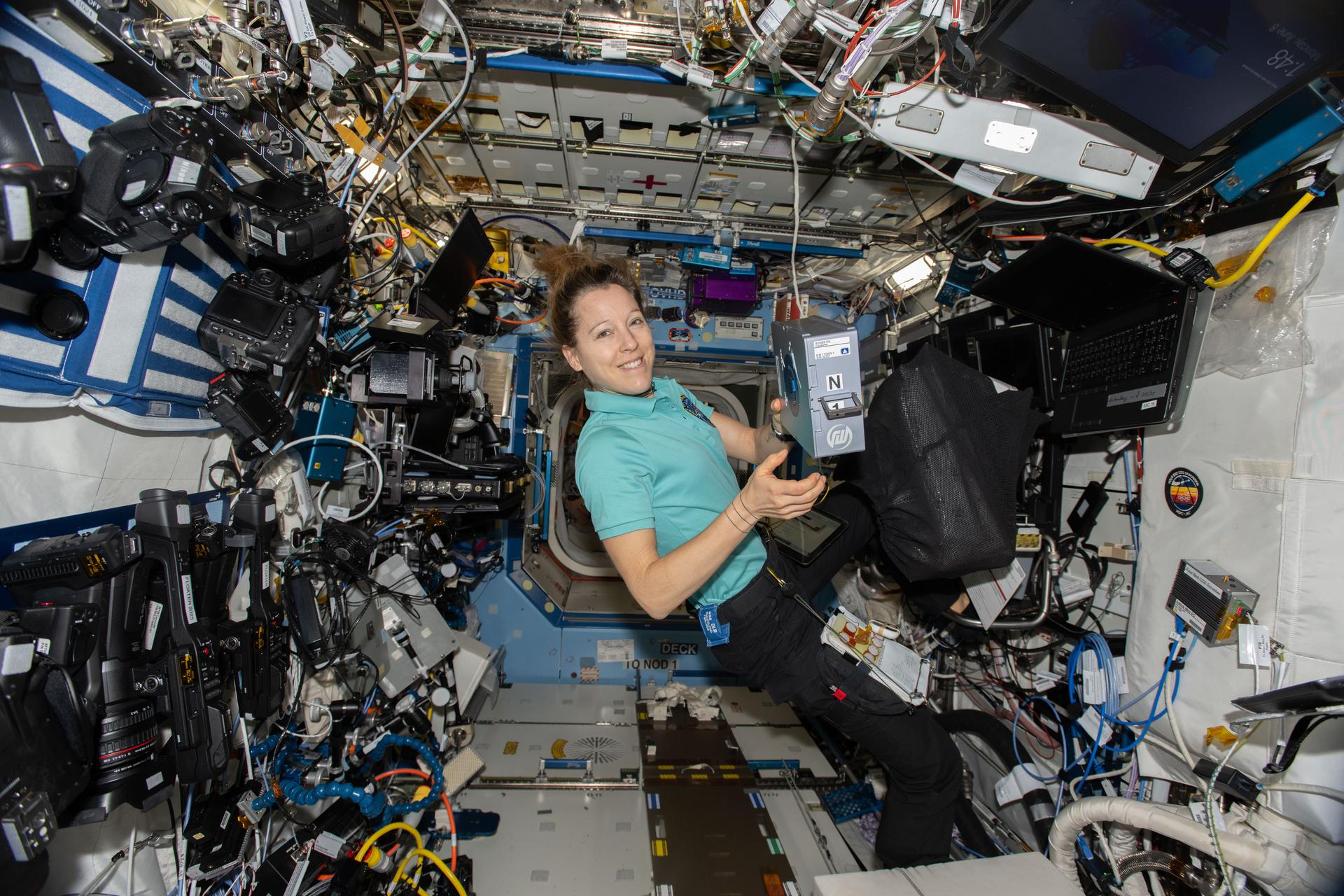
NASA astronaut Chris Williams smiles while reaching into the Microgravity Science Glovebox. The inside of the rectangular workspace is illuminated by white light. There is a plastic bag floating inside the upper left side of the glovebox, and Chris holds a small black and silver object in his hands.
NASA

NASA astronaut Chris Williams conducts research to grow semiconductor crystals in space. In microgravity, researchers can grow more crystals of the desired size than can be produced on Earth. Previous research shows that space-grown crystals can offer increased performance to help advance technologies like high-performance computers, artificial intelligence, and medical devices. This research lays the groundwork for commercial semiconductor manufacturing in space and advances the semiconductor industry.

Learn more about In-Space Production of Semimetal-Semiconductor Composite Bulk Crystals in Microgravity (SUBSA-InSPA-SSCug).

Eyeing Earth

NASA astronaut Chris Williams gazes out of a trapezoid-shaped window at a glowing red aurora above the Earth. The curvature of the Earth is visible through a bright green curve. It is dark aboard the International Space Station in the photo, and the glow from the aurora softly illuminates Williams' face.
Roscosmos

NASA astronaut Chris Williams looks out of a cupola window at a red aurora glowing above the Earth. Since the 1960s, astronauts have photographed Earth from space to help scientists monitor the planet’s changing landscapes, natural disasters, and other features over time. Along the way, astronauts also have captured images of celestial objects such as comets, auroras, and the Milky Way.

Sub-zero medical samples

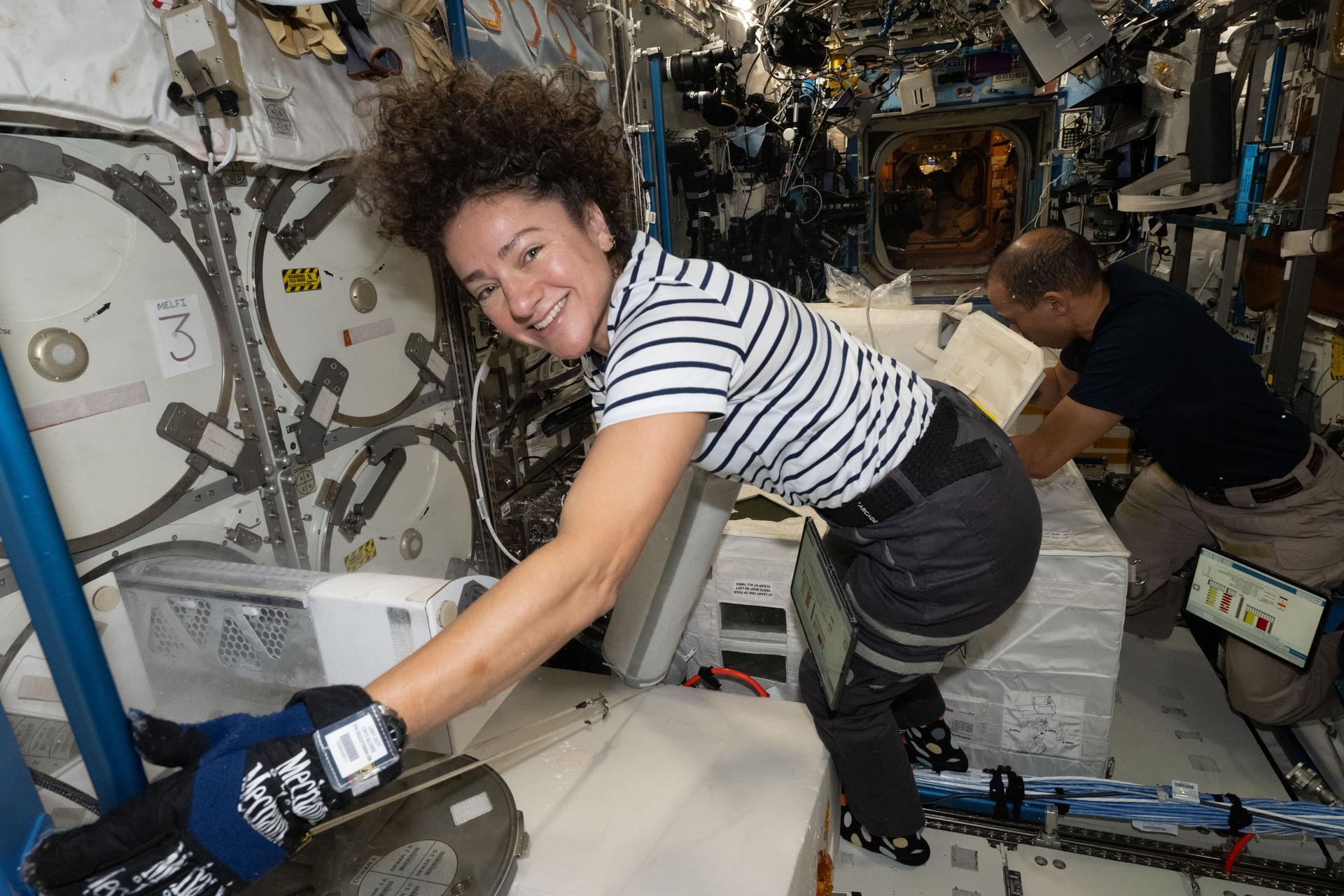
NASA astronaut Chris Williams inserts a cryogenic storage unit into the space station's science freezer. The wedge-shaped unit resembles a slice of pie, and Williams wears thick insulated gloves to protect his hands from the extremely cold temperatures. There are many blue cables beneath him.
NASA

NASA astronaut Chris Williams works with a special freezer aboard the International Space Station that keeps research samples at ultra-cold temperatures until they can return to Earth. Throughout each mission, astronauts collect biological samples like blood and urine to help scientists understand how long-duration spaceflight affects the human body. Observing crew members during their space missions and studying these frozen samples back on Earth helps NASA protect astronaut health during future missions to the Moon, Mars, and beyond.

Learn more about the Minus Eighty-Degree Laboratory Freezer for the International Space Station (MELFI) and Human Research.

Capturing cargo

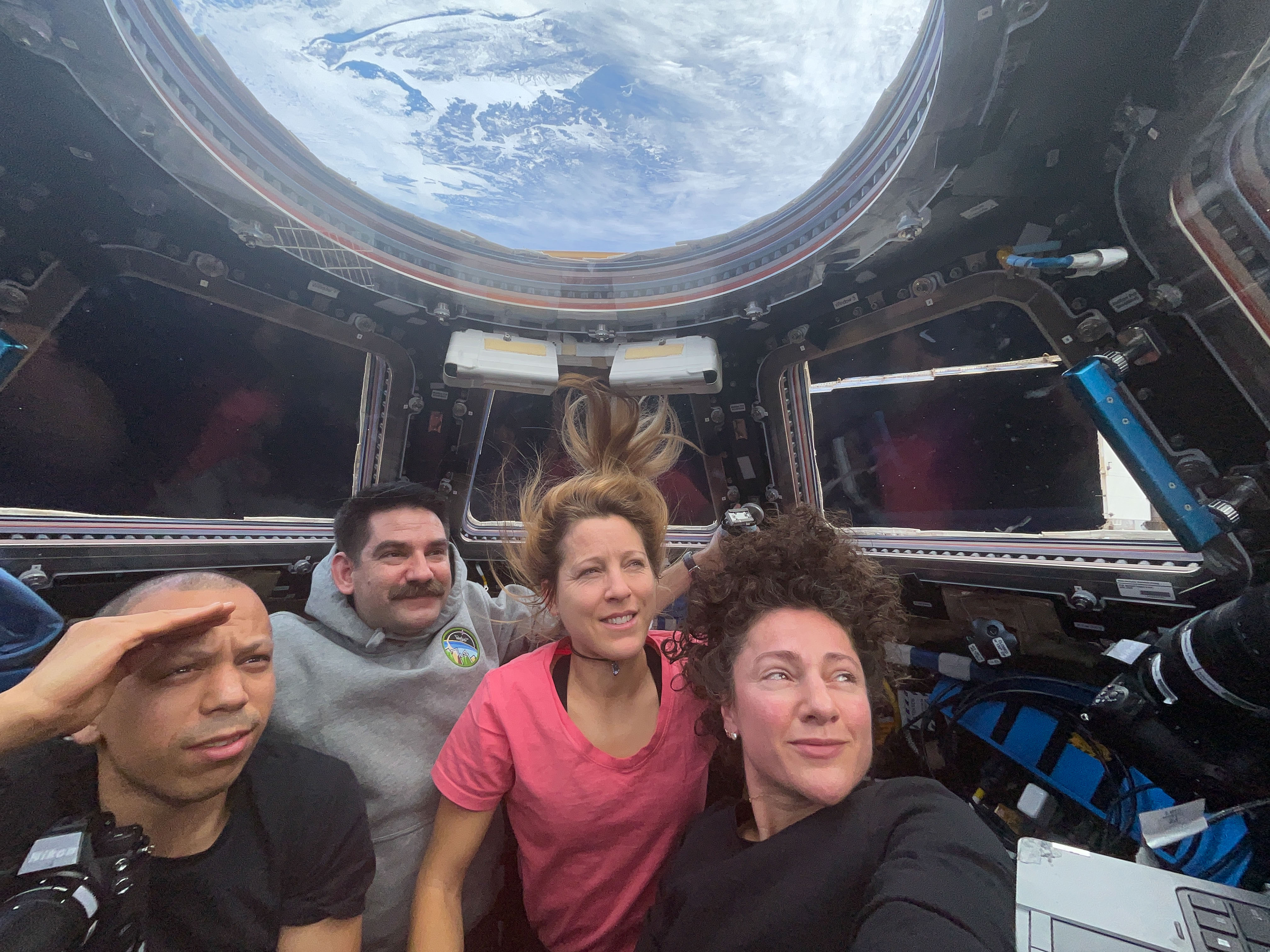
NASA astronauts Jack Hathaway (left) and Chris Williams (right) look through a circular window in the International Space Station's cupola as Northrop Grumman’s Cygnus XL spacecraft approaches. The spacecraft is a silver cylinder with two hexagonal solar arrays extending from either side of the top end of the cylinder. Behind the spacecraft, white clouds cover the Earth.
NASA

NASA astronauts Jack Hathaway and Chris Williams watch from the cupola windows as Northrop Grumman’s Cygnus XL cargo spacecraft approaches the International Space Station. The two played key roles in the capture of the spacecraft, which delivered approximately 11,000 pounds of supplies, including fresh food, life support equipment, and scientific research as part of NASA’s Northrop Grumman Commercial Resupply Services 24 mission. Cargo missions help keep the space station operating and provide astronauts with the supplies they need to live, work, and conduct research in orbit.

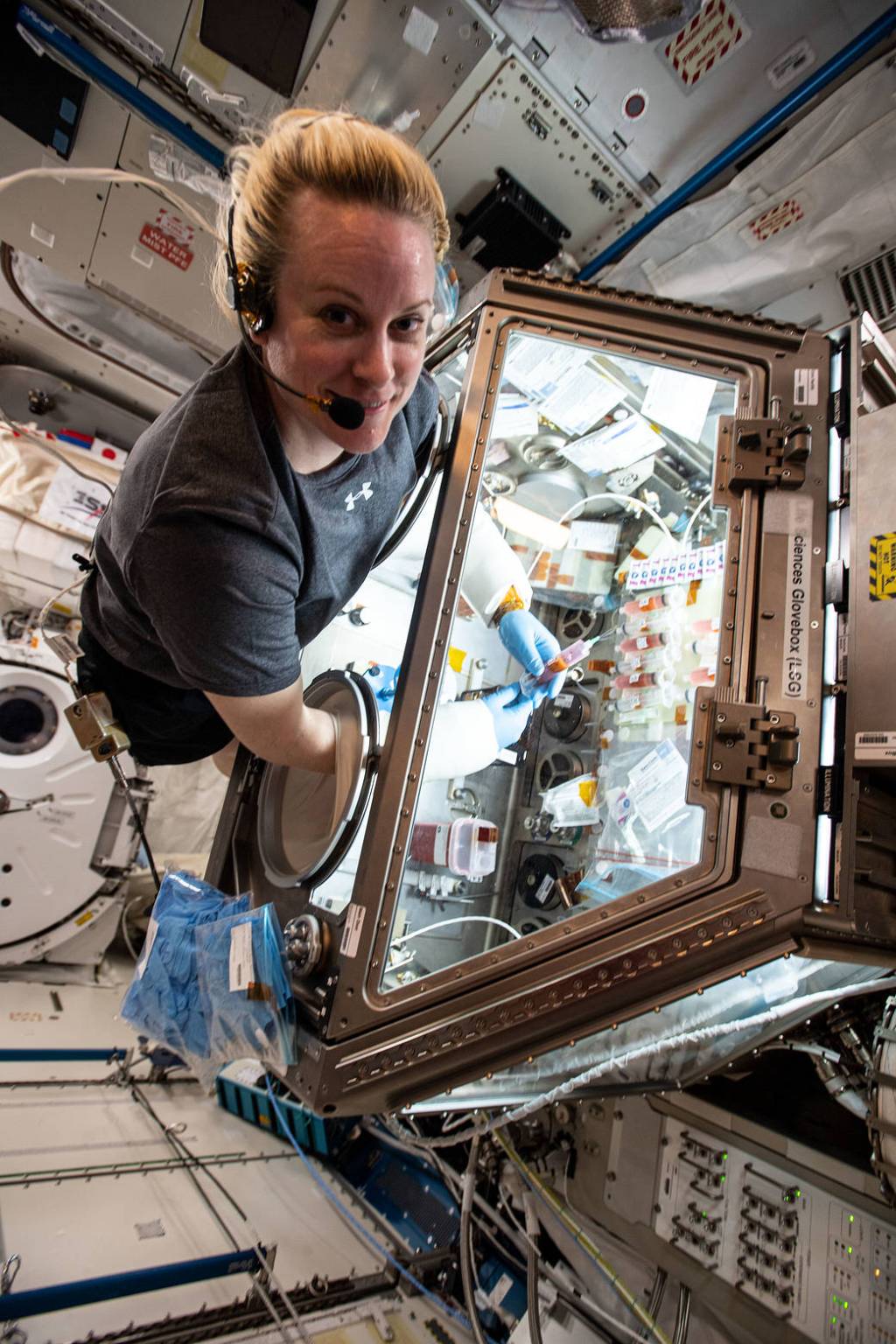
Blocking biofilms

NASA astronaut Chris Williams smiles at the camera as he reaches into the clear, sealed Life Sciences Glovebox and holds a transparent orange package. The illuminated workspace contains plastic bags, scientific equipment, and a pair of scissors.
NASA

NASA astronaut Chris Williams works on an investigation that tests the use of ultraviolet light to help prevent the formation of microbial colonies, called biofilms. Biofilms can clog and contaminate water systems, damage equipment, and pose health risks to astronauts. This research aims to keep surfaces cleaner and safeguard systems during long-duration space missions. Using UV light for sanitation also could reduce the need for chemical disinfectants in space, decreasing the risk of chemical exposure and eliminating difficulties in transporting or storing supplies.

Learn more about Germicidal Ultraviolet Light Biofilm Inhibition (GULBI).

Strengthening solar power

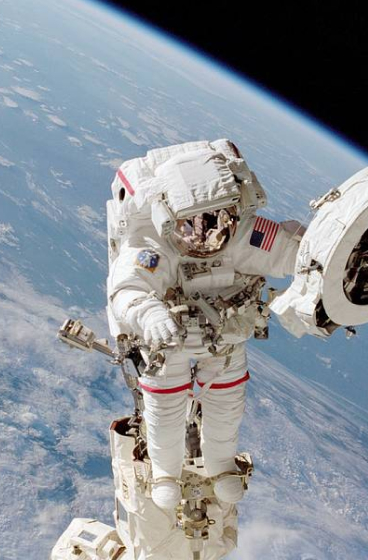
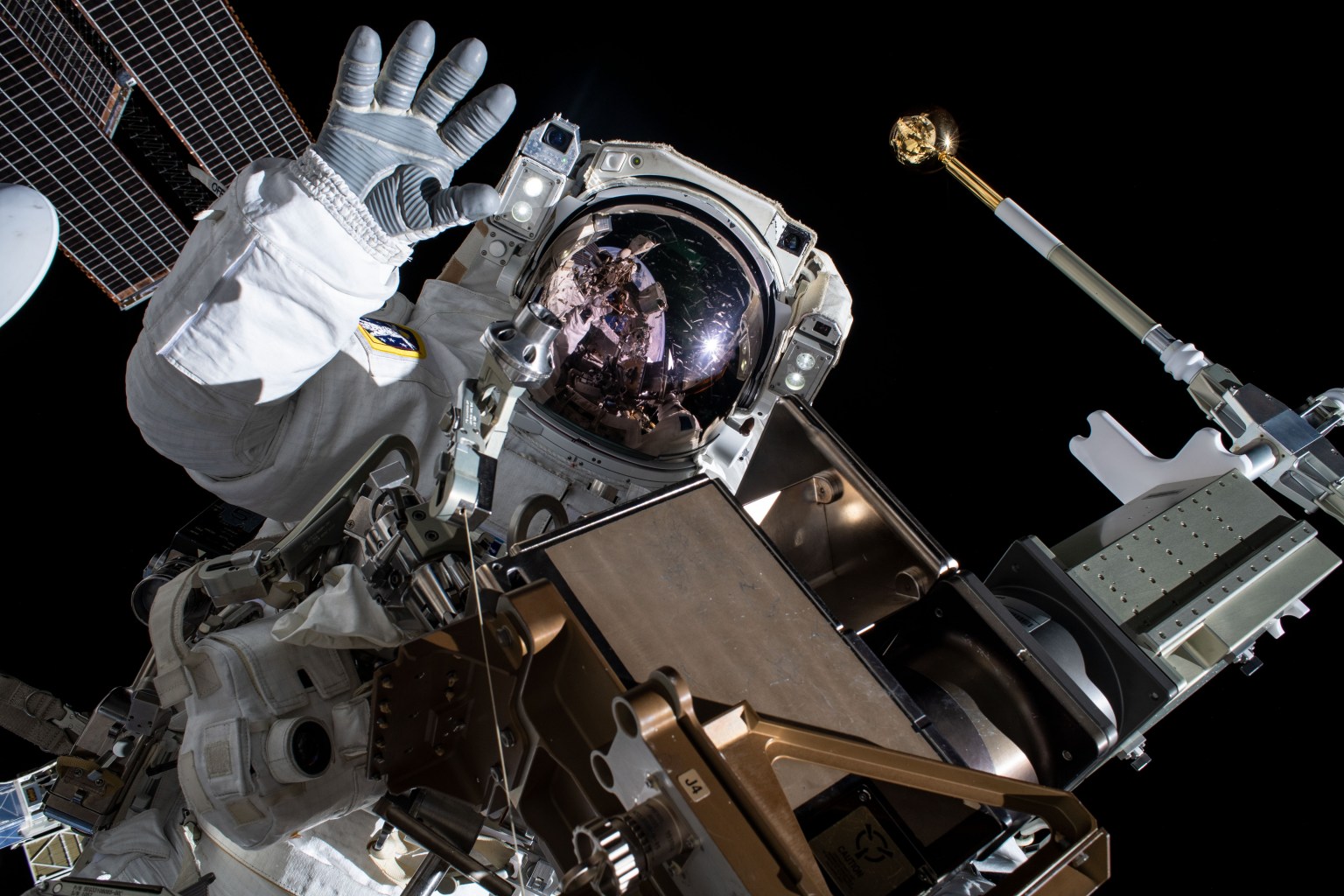
NASA astronaut Chris Williams is seen smiling through his spacesuit helmet outside of the International Space Station. Williams is anchored next to several white structures and surrounded by space station equipment. Behind him there is a SpaceX Dragon spacecraft docked to the space station. Earth's blue curvature and scattered white clouds stretch across the background.
NASA

NASA astronaut Chris Williams ventured outside the International Space Station for two spacewalks during his mission. In June, he helped make repairs to Canadarm2, a robotic arm that captures cargo spacecraft and deploys external research. In March, Williams prepared the orbiting laboratory for new solar arrays to be added to the station in a future spacewalk. Once installed, the final set of International Space Station Roll Out Solar Arrays (IROSA) will complete the full suite of additional solar power, increasing the station’s power generation by about 30% and enhancing support for scientific research and daily operations. The same solar array technology also powered NASA’s Double Asteroid Redirection Test and could support future missions to the Moon and Mars.

Learn more about the space station’s IROSAs.

Microgravity medicine

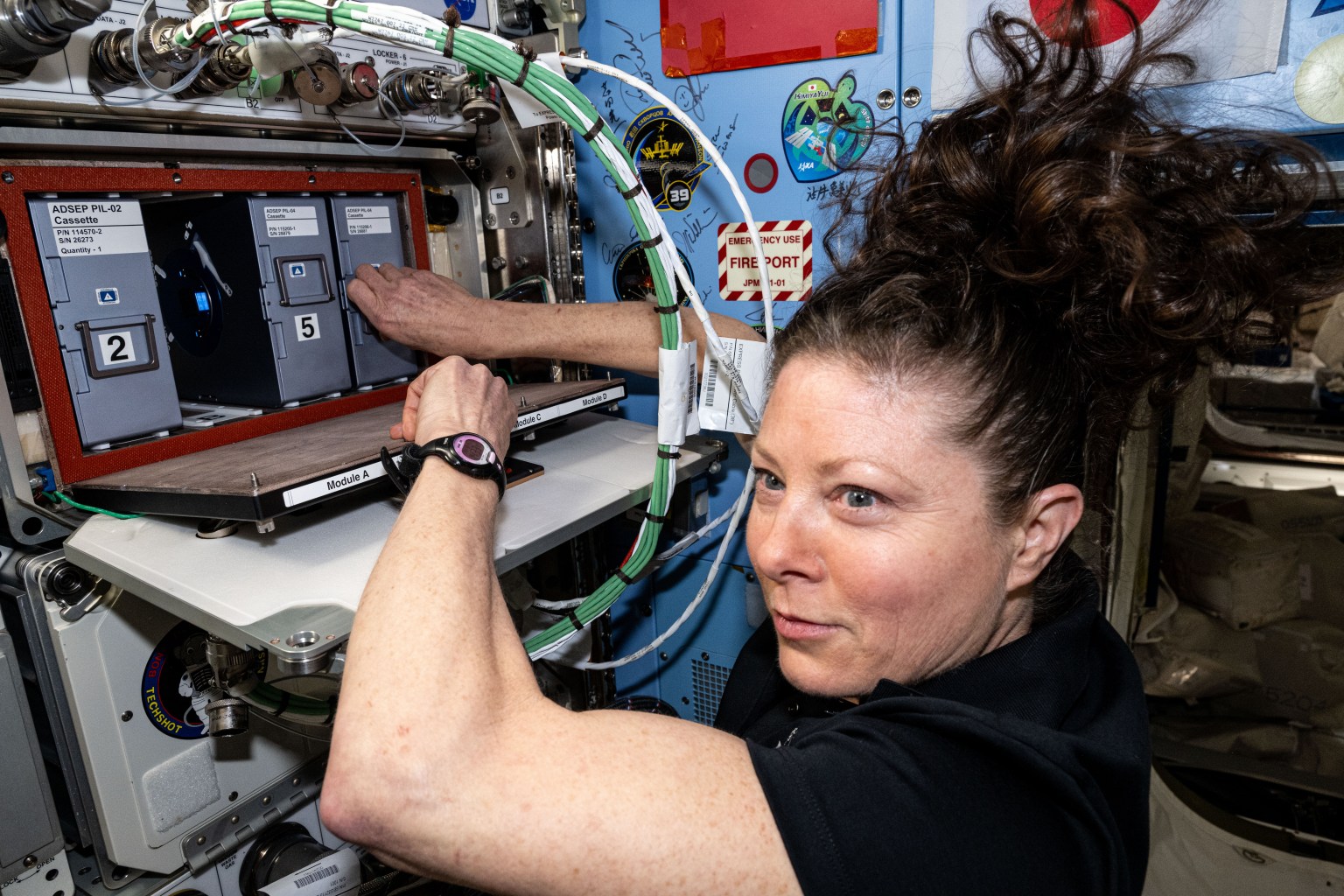
NASA astronaut Chris Williams holds a small, rectangular hard drive as he works to swap computer components for a protein crystal growth investigation. A tablet is secured to one of his legs, while two plastic bags are attached to the other. Bundles of cables float next to him and a circular hatch is visible in the background.
NASA

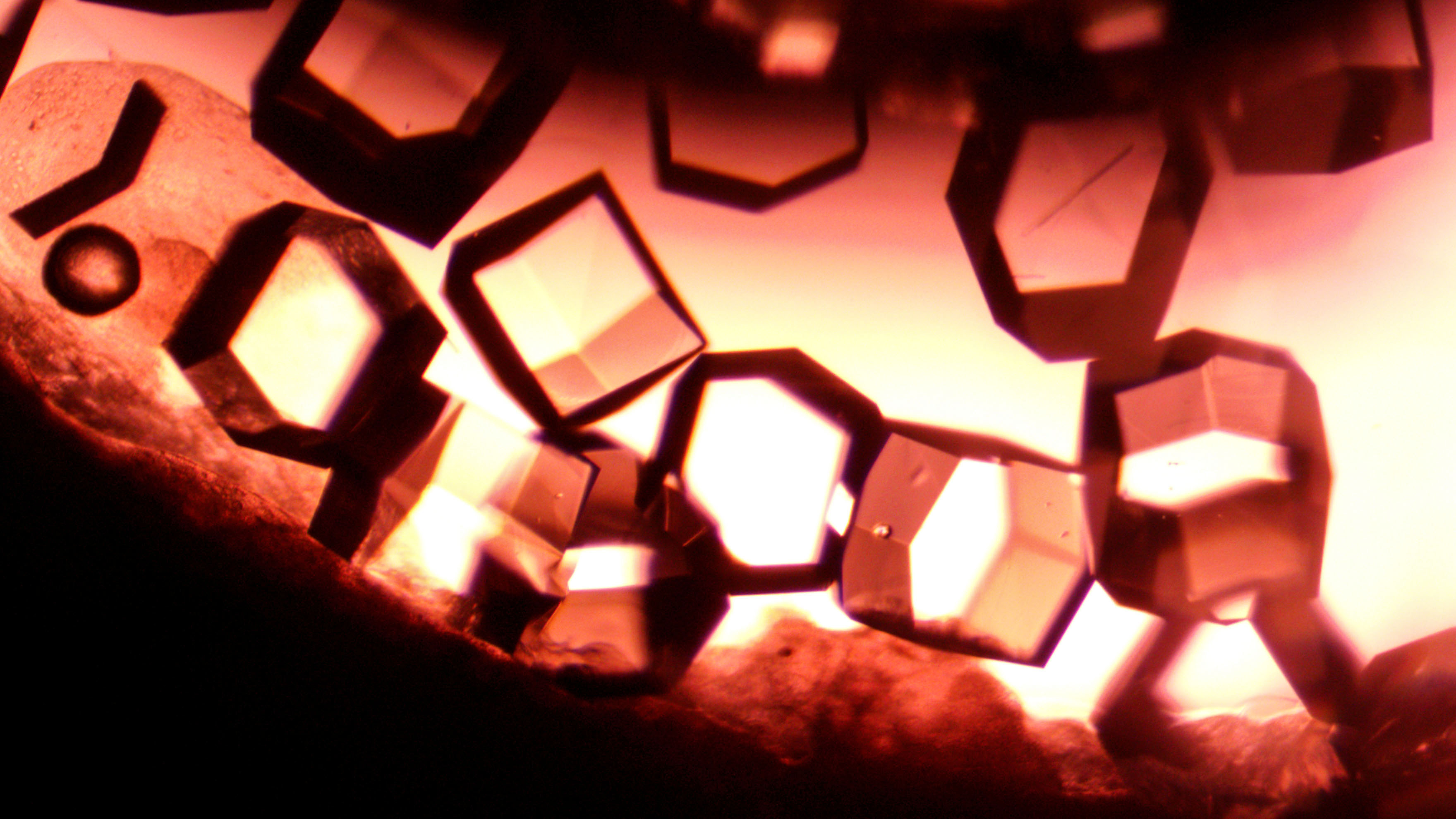
NASA astronaut Chris Williams works with hardware to support the development of new cancer and disease treatments by studying the growth of protein crystals for pharmaceuticals. In space, protein crystals form higher-quality structures than they do on Earth, allowing researchers to better understand how to target and treat disease. Here, Williams works with a project that aims to develop a new formula for a cancer treatment that could be taken orally. Growing protein crystals in space paves the way for more commercial companies to create new therapies that could improve patient outcomes on Earth.

Learn more about the Pharmaceutical In-space Laboratory (ADSEP-PIL-10).

Robotic refinement

A video shows NASA astronaut Chris Williams working on hardware inside a rectangular space. Facing away from the camera, Williams makes small adjustments to the experiment, which consists of two white robotic arms. There are many white cables on the inside of the compartment.
NASA

NASA astronaut Chris Williams works with equipment that tests the performance of small robotic arms in space. Some experiments and operations require very precise movements, where tiny errors can significantly impact results. Understanding how microgravity affects delicate robotic operations helps researchers improve designs for future automated systems that can perform operations while astronauts focus on the most critical tasks.

Learn more about the Test facility for lab-aUtomation System in Kibo (TUSK).

Share

Details

Last Updated
Jul 23, 2026

💾

NASA astronaut Chris Williams is set to return to Earth after an eight-month mission aboard the International Space Station. During his assignment, Williams ...

NASA Sets Briefings for SpaceX Crew-13 Mission to Space Station

The SpaceX Crew-13 members are pictured in their pressure suits seated inside a mockup Dragon spacecraft during a preflight training session at the company's headquarters in Hawthorne, California. From left are, Roscosmos Sergey Teteryatnikov, NASA astronauts Luke Delaney and Jessica Watkins, and CSA (Canadian Space Agency) astronaut Joshua Kutryk.
NASA’s SpaceX Crew-13 members are pictured in their pressure suits seated inside a mockup Dragon spacecraft during a preflight training session at the company’s headquarters in Hawthorne, California. From left are Roscosmos Sergey Teteryatnikov, NASA astronauts Luke Delaney and Jessica Watkins, and CSA (Canadian Space Agency) astronaut Joshua Kutryk.
Credit: SpaceX

NASA and its partners will discuss the upcoming crew rotation mission to the International Space Station during a pair of news conferences on Monday, Aug. 3, from the agency’s Johnson Space Center in Houston.

Mission leadership will provide an overview of NASA’s SpaceX Crew‑13 mission at 12 p.m. EDT. Next, crew members will discuss their training and mission preparations at 2 p.m. This is Crew-13’s final media availability prior to traveling to the agency’s Kennedy Space Center in Florida for launch.

NASA will stream these events live. Learn where to watch online:

https://www.nasa.gov/live

The Crew-13 mission will carry NASA astronauts Jessica Watkins and Luke Delaney, CSA (Canadian Space Agency) astronaut Joshua Kutryk, and Roscosmos cosmonaut Sergey Teteryatnikov to the orbiting laboratory. The crew will launch aboard a SpaceX Dragon spacecraft on the company’s Falcon 9 rocket from Space Launch Complex 40 at Cape Canaveral Space Force Station in Florida no earlier than mid-September.

International media attending in person must email the NASA Johnson newsroom at jsccommu@mail.nasa.gov by 5 p.m., Tuesday, July 21. United States-based media attending in person must respond by 5 p.m., Thursday, July 30. Media joining virtually must respond by 10 a.m. the day of the event. NASA’s media accreditation policy is available online.

Briefing participants are as follows (all times Eastern and subject to change based on real-time operations):

12 p.m.: Mission Overview News Conference

  • Joel Montalbano, deputy associate administrator, Human Spaceflight Mission Directorate, NASA Headquarters
  • Dana Weigel, manager, Low Earth Orbit Program, NASA Johnson
  • Mathieu Caron, director, Astronauts, Life Sciences, and Space Medicine, CSA
  • Julianna Scheiman, director, NASA Science and Dragon Programs, SpaceX

2 p.m.: Crew-13 News Conference

  • Jessica Watkins, commander, NASA
  • Luke Delaney, pilot, NASA
  • Joshua Kutryk, mission specialist, CSA
  • Sergey Teteryatnikov, mission specialist, Roscosmos

Following the news conference, crew members will be available for limited media interviews. All interview requests must be submitted by 5 p.m. on July 30, to the NASA Johnson newsroom at: jsccommu@mail.nasa.gov.

This will be the second flight to the space station for Watkins, who was selected as a NASA astronaut in 2017. Watkins grew up in Lafayette, Colorado, and earned an undergraduate degree in geological and environmental sciences from Stanford University, as well as a doctorate in geology from the University of California, Los Angeles. As a geologist, she studied the Martian surface and was a member of the Curiosity rover science team at NASA’s Jet Propulsion Laboratory in Southern California. Watkins first launched to the space station as a crew member aboard NASA’s SpaceX Crew-4 mission, spending a total of 170 days in space across space station Expeditions 67/68 in 2022. She will be the first NASA astronaut to launch aboard a SpaceX Dragon spacecraft twice.

Selected as a NASA astronaut in 2021, Delaney earned a bachelor’s degree in mechanical engineering at the University of North Florida and a master’s degree in aerospace engineering at the Naval Postgraduate School. The Florida native is a distinguished naval aviator who participated in exercises throughout the Asia Pacific region and conducted missions in support of Operation Enduring Freedom. As a test pilot, Delaney evaluated developmental aircraft systems and served as a test pilot instructor. He also worked as a research pilot at NASA’s Langley Research Center in Hampton, Virginia, where he supported airborne science missions. This is the first spaceflight for Delaney.

The Crew-13 mission also is the first spaceflight for Kutryk. Prior to his selection as a CSA astronaut in 2017, he served as a CF-18 fighter pilot, flying missions in support of Canada’s NATO, U.N., and North American Aerospace Defense Command commitments. A native of Fort Saskatchewan, Alberta, Kutryk also worked as an experimental and operational test pilot at the Aerospace Engineering Test Establishment in Cold Lake, Alberta. Kutryk received a bachelor’s degree in mechanical engineering from the Royal Military College of Canada in Kingston, Ontario, and he is a distinguished graduate of the United States Air Force Test Pilot school in Edwards, California. He has master’s degrees in space studies, flight test engineering, and defense studies.

This mission will be Teteryatnikov’s first trip to the orbiting laboratory. He graduated from the Naval Academy, St. Petersburg, Russia, in 2011 as an engineer specializing in ship power plant operations. Before his selection as a test cosmonaut, Teteryatnikov served in various naval engineering roles, including undersea vessels and specialized engine room operations. He was selected for the Gagarin Research and Test Cosmonaut Training Center Cosmonaut Corps in 2021 and has served as a test cosmonaut since 2023.

For more information about the mission, visit:

https://www.nasa.gov/mission/nasas-spacex-crew-13

-end-

Joshua Finch / Jimi Russell
Headquarters, Washington
202-358-1100
joshua.a.finch@nasa.gov / james.j.russell@nasa.gov

Leah Cheshier / Anna Schneider
Johnson Space Center, Houston
281-483-5111
leah.d.cheshier@nasa.gov / anna.c.schneider@nasa.gov

Share

Details

Last Updated
Jul 20, 2026
Editor
Jessica Taveau

NASA’s Webb Discovers Hidden Planet in Famous Star System

 
6 Min Read

NASA’s Webb Discovers Hidden Planet in Famous Star System

Artist's concept of the Beta Pictoris planetary system. One edge of a smooth, dusty disk that looks like cloud wisps extends across the upper third of the image at an angle from 9 o’clock to 2 o’clock. Just below that, in the left third of the image, the star glows white and is small. Just to the left of the star there is a tiny white dot, planet Beta Pictoris c. To the right of the star, about twice the distance between Beta Pictoris c and the star is another bright dot, representing planet Beta Pictoris b. A third planet, Beta Pictoris d is larger than the other two, and appears in the right third of the illustration. The planet has subtle orange cloud bands, and the side facing the star is illuminated. Below this planet, the other wispy edge of the dusty disk that circles the star crosses the bottom right corner of the illustration below Beta Pictoris d from 4 o’clock to 7 o’clock. The black background of space is speckled with distant stars. The words
This artist’s concept shows the Beta Pictoris system with the discovered giant exoplanet Beta Pictoris d at the right. It has the widest orbit of the known three exoplanets within the system.
Credits: Illustration: NASA, ESA, CSA, STScI, Ralf Crawford (STScI)

Astronomers using NASA’s James Webb Space Telescope have discovered a giant planet outside our solar system, called an exoplanet, hiding within one of the most intensely studied planetary systems in our Milky Way galaxy.

The young, nearby star Beta Pictoris was already known to host two giant planets: Beta Pictoris b, one of the first exoplanets ever directly imaged, and Beta Pictoris c. The newly identified Beta Pictoris d makes it only the second planetary system known to contain at least three imaged planets. Unlike Beta Pictoris b and c, however, Beta Pictoris d was discovered not by identifying a bright point of light, but by detecting the unique chemical fingerprint of its atmosphere, a technique that could transform the search for worlds around other stars.

“This discovery adds another piece to an already fascinating planetary system,” said Aidan Gibbs, lead author of a new study published Wednesday in the Astrophysical Journal Letters and a postdoctoral researcher at the University of California, San Diego. “Beta Pictoris has long served as a laboratory for understanding how planetary systems form and evolve, and now we have another planet helping us tell that story.”

Image: Beta Pictoris System (Artist’s Concept)

Artist's concept of the Beta Pictoris planetary system. One edge of a smooth, dusty disk that looks like cloud wisps extends across the upper third of the image at an angle from 9 ou2019clock to 2 ou2019clock. Just below that, in the left third of the image, the star glows white and is small. Just to the left of the star there is a tiny white dot, planet Beta Pictoris c. To the right of the star, about twice the distance between Beta Pictoris c and the star is another bright dot, representing planet Beta Pictoris b. A third planet, Beta Pictoris d is larger than the other two, and appears in the right third of the illustration. The planet has subtle orange cloud bands, and the side facing the star is illuminated. Below this planet, the other wispy edge of the dusty disk that circles the star crosses the bottom right corner of the illustration below Beta Pictoris d from 4 ou2019clock to 7 ou2019clock. The black background of space is speckled with distant stars. The words
This artist’s concept shows the Beta Pictoris system with the discovered giant exoplanet Beta Pictoris d at the right. It has the widest orbit of the known three exoplanets within the system.
Illustration: NASA, ESA, CSA, STScI, Ralf Crawford (STScI)

Familiar system, new surprise

Located 63 light-years from Earth and about 23 million years old, Beta Pictoris is a nearby system in the Milky Way offering a rare glimpse of the interactions between newborn planets and the disk of dust and debris left behind from their formation. 

The team estimates that the newfound Beta Pictoris d is likely at least two times the mass of Jupiter, making it the smallest of the three known giant planets in the system. Modeling suggests it likely circles around its star at about 30 astronomical units, comparable to the region occupied by Neptune in our own solar system. It’s the widest orbit of the known three planets, but still located inside the inner edge of the debris disk.

Although astronomers were not searching for another planet with Webb, Beta Pictoris d emerged while the team was using the telescope’s NIRSpec (Near-Infrared Spectrograph) to study the atmosphere of Beta Pictoris b. Specifically, they used NIRSpec’s Integral Field Unit, which obtains both an image and a spectrum from each pixel in an image.

“We weren’t looking for a new planet,” said Gibbs. “We were trying to understand one we already knew existed. Then, this telltale signal appeared in the data where we didn’t expect it.”

This signal was a series of peaks and troughs within the spectroscopic data where the team expected to see a smooth spectrum from light bouncing off dust. It was a distinctive pattern of carbon monoxide absorption lines, spread out like a barcode, an expected feature in giant planet atmospheres.

Because spectroscopy not only reveals chemical composition, but the motion of an object, the team was able to also extract radial velocity from the data. The team determined the planet’s speed, position, and alignment with the debris disk were all consistent with something orbiting Beta Pictoris rather than a background star or brown dwarf with carbon monoxide in its atmosphere.

“There was an unexpected bright source of light within the Integral Field Unit imaging, but we’ve learned not to trust bright blobs in images,” said Jean-Baptiste Ruffio, a research scientist at University of California, San Diego and principal investigator of the first Webb observations where the discovery was made. “They can be instrumental artifacts or other structures in the debris disk. By obtaining a spectrum at the same time as the image, we were able to quickly confirm our suspicions.”

Follow-up observations with Webb’s MIRI (Mid-Infrared Instrument) through a Director’s Discretionary Time request detected water vapor and methane, further confirming the planet’s identity while providing a richer look at the atmosphere of the planet.

Unlike traditional imaging, the spectroscopic approach allowed researchers to identify the planet and begin studying its atmosphere from the very first observation. 

“A spectrum contains an incredible amount of information,” Ruffio said. “You don’t just learn that something is a planet; you immediately begin learning about its temperature, chemistry, and motion.”

A separate imaging study led by Ben Sutlieff of the University of Edinburgh and Markus Bonse of the European Southern Observatory complements the team’s findings with data from the European Southern Observatory’s Very Large Telescope and Webb’s NIRCam (Near-Infrared Camera) and independently confirmed the existence of Beta Pictoris d.

Image: Beta Pictoris System (NIRSpec IFU Image and Spectrum)

Infographic titled “Gas Giant Exoplanet Beta Pictoris d; Atmospheric Composition.” The image at the left shows two exoplanets of the Beta Pictoris system. At the center, there is a white star symbol, which represents light blocked from the host star. Immediately to the left of the star symbol, there is a bright orange-whitesh smudge, labeled b. To the right of the star symbol is a blurry orange smudge labeled d. There is a white circle around this smudge with lines drawn to the spectrum at the right. The x-axis is labeled “Wavelength of Light” and extends from 4.2 to 5.2 microns. The y-axis is labeled “Brightness.” An up arrow is labeled “brighter,” a down arrow “dimmer.” There are two jagged horizontal lines across the graph. One is white, then other is maroon (the former labeled “Webb data”, the latter labeled “Best fit model” in the bottom left corner). A blue vertical column spanning from about 4.3 microns to 5 microns is labeled Carbon Monoxide, CO.
Researchers used the NIRSpec (Near-Infrared Spectrograph) Integral Field Unit on NASA’s James Webb Space Telescope to map chemical contents of the Beta Pictoris system. As a result, they discovered a third planet, Beta Pictoris d, orbiting the young star.
Image: NASA, ESA, CSA, STScI, Leah Hustak (STScI); Science: Aidan Gibbs (UC San Diego), Jean-Baptiste Ruffio (UC San Diego), Alexis Bidot (STScI); Image Processing: Alyssa Pagan (STScI)

Image: Beta Pictoris System (NIRSpec IFU Image Annotated)

An image of the Beta Pictoris system, with two exoplanets shown. The view is black. At the center of the image, there is a white star symbol, which represents light blocked from the host star. Immediately to the left of the star symbol, there is a bright orange-whitesh smudge, labeled b. To the right of the star symbol, further away, is a blurry orange smudge labeled d. There is a blue dashed circle around the entire system, labeled “size of Neptune’s orbit.”
The newly discovered third planet orbiting Beta Pictoris, Beta Pictoris d, is seen in reconstructed imagery from NASA’s James Webb Space Telescope’s NIRSpec (Near-Infrared Spectrograph).
Image: NASA, ESA, CSA, STScI; Science: Aidan Gibbs (UC San Diego), Jean-Baptiste Ruffio (UC San Diego); Image Processing: Alyssa Pagan (STScI)

Seeing through cosmic fog

Beta Pictoris d remained hidden for years because it lies within one of the brightest debris disks known.

The dusty disk acts like fog, scattering light from the star, making it difficult for conventional imaging techniques to distinguish planets from surrounding structures. The team’s spectroscopic method with Webb effectively ignored that dust, isolating only the narrow molecular signatures unique to a planetary atmosphere.

Scientists say the planet’s presence may help explain why the famous debris disk has such a sharply defined inner edge and other puzzling structures. In fact, astronomers had already predicted the existence of a planet like Beta Pictoris d to account for the disk’s unusual structure.

Beyond expanding our understanding of Beta Pictoris, the discovery demonstrates a powerful new way to find exoplanets.

This is the first directly imaged planet discovered primarily through moderate-resolution spectroscopy, showing that astronomers can identify worlds in complex environments through their atmospheric fingerprints rather than relying solely on traditional coronagraphic imaging.

The researchers plan to continue analyzing Webb’s observations to better determine the planet’s temperature, atmospheric composition, and orbit, providing an even more detailed view of one of astronomy’s most iconic planetary systems.

The James Webb Space Telescope is the world’s premier space science observatory. Webb is solving mysteries in our solar system, looking beyond to distant worlds around other stars, and probing the mysterious structures and origins of our universe and our place in it. Webb is an international program led by NASA with its partners, ESA (European Space Agency) and CSA (Canadian Space Agency).

To learn more about Webb, visit:

https://science.nasa.gov/webb

Downloads & Related Information

The following sections contain links to download this article’s images and videos in all available resolutions followed by related information links, media contacts, and if available, research paper and Spanish translation links.

Related Images & Videos

Artist's concept of the Beta Pictoris planetary system. One edge of a smooth, dusty disk that looks like cloud wisps extends across the upper third of the image at an angle from 9 ou2019clock to 2 ou2019clock. Just below that, in the left third of the image, the star glows white and is small. Just to the left of the star there is a tiny white dot, planet Beta Pictoris c. To the right of the star, about twice the distance between Beta Pictoris c and the star is another bright dot, representing planet Beta Pictoris b. A third planet, Beta Pictoris d is larger than the other two, and appears in the right third of the illustration. The planet has subtle orange cloud bands, and the side facing the star is illuminated. Below this planet, the other wispy edge of the dusty disk that circles the star crosses the bottom right corner of the illustration below Beta Pictoris d from 4 ou2019clock to 7 ou2019clock. The black background of space is speckled with distant stars. The words

Beta Pictoris System (Artist’s Concept)

This artist’s concept shows the Beta Pictoris system with the discovered giant exoplanet Beta Pictoris d at the right. It has the widest orbit of the known three exoplanets within the system.

Infographic titled u201cGas Giant Exoplanet Beta Pictoris d; Atmospheric Composition.u201d The image at the left shows two exoplanets of the Beta Pictoris system. At the center, there is a white star symbol, which represents light blocked from the host star. Immediately to the left of the star symbol, there is a bright orange-whitesh smudge, labeled b. To the right of the star symbol is a blurry orange smudge labeled d. There is a white circle around this smudge with lines drawn to the spectrum at the right. The x-axis is labeled u201cWavelength of Lightu201d and extends from 4.2 to 5.2 microns. The y-axis is labeled u201cBrightness.u201d An up arrow is labeled u201cbrighter,u201d a down arrow u201cdimmer.u201d There are two jagged horizontal lines across the graph. One is white, then other is maroon (the former labeled u201cWebb datau201d, the latter labeled u201cBest fit modelu201d in the bottom left corner). A blue vertical column spanning from about 4.3 microns to 5 microns is labeled Carbon Monoxide, CO.

Beta Pictoris System (NIRSpec IFU Image and Spectrum)

Researchers used the NIRSpec (Near-Infrared Spectrograph) Integral Field Unit on NASA’s James Webb Space Telescope to map chemical contents of the Beta Pictoris system. As a result, they discovered a third planet, Beta Pictoris d, orbiting the young star.

An image of the Beta Pictoris system, with two exoplanets shown. The view is black. At the center of the image, there is a white star symbol, which represents light blocked from the host star. Immediately to the left of the star symbol, there is a bright orange-whitesh smudge, labeled b. To the right of the star symbol, further away, is a blurry orange smudge labeled d. There is a blue dashed circle around the entire system, labeled u201csize of Neptuneu2019s orbit.u201d

Beta Pictoris System (NIRSpec IFU Image Annotated)

The newly discovered third planet orbiting Beta Pictoris, Beta Pictoris d, is seen in reconstructed imagery from NASA’s James Webb Space Telescope’s NIRSpec (Near-Infrared Spectrograph).

Related Links

Read more: Webb’s Impact on Exoplanet Research

Read more: NASA’s Webb Discovers Dusty ‘Cat’s Tail’ in Beta Pictoris System

Explore more: Beta Pictoris: Icy Debris Suggests ‘Shepherd’ Planet

Watch: How to Study Exoplanets: Webb and Challenges

Watch: How Do Space Telescopes Break Down Light?

More Webb: News | Images | Science | Home Page

Share

Details

Last Updated
Jul 15, 2026
Contact
Media

Laura Betz
NASA’s Goddard Space Flight Center
Greenbelt, Maryland
laura.e.betz@nasa.gov

NASA Astronaut Anil Menon, Crewmates Arrive at Space Station

The Soyuz rocket launches to the International Space Station with NASA astronaut Anil Menon and Roscosmos cosmonauts Pyotr Dubrov and Anna Kikina onboard, Tuesday, July 14, 2026, at the Baikonur Cosmodrome in Kazakhstan.
Credit: NASA/Bill Ingalls

NASA astronaut Anil Menon, along with Roscosmos cosmonauts Pyotr Dubrov and Anna Kikina, arrived safely at the International Space Station Tuesday, bringing the orbiting laboratory’s crew to 10 for about the next two weeks.

The trio launched aboard the Soyuz MS-29 spacecraft at 10:47 a.m. EDT (7:47 p.m. local time) from the Baikonur Cosmodrome in Kazakhstan. After a three-hour, two-orbit journey, the spacecraft docked at 1:52 p.m. with the station’s Prichal module.

Following hatch opening, expected about 4 p.m., the new arrivals will be welcomed by the space station Expedition 74 crew: NASA astronauts Jessica Meir, Jack Hathaway, and Chris Williams; ESA (European Space Agency) astronaut Sophie Adenot; and Roscosmos cosmonauts Sergey Kud-Sverchkov, Sergei Mikaev, and Andrey Fedyaev.

NASA’s live coverage of hatch opening begins at 3:30 p.m. on NASA+, Amazon Prime, and YouTube. Learn how to watch NASA content through a variety of online platforms, including social media.

During his stay aboard the station, Menon will conduct scientific research and technology demonstrations aimed at advancing human space exploration and benefiting life on Earth. He will continue research to refine in-space production of semiconductor crystals to enable the large-scale manufacturing of components needed for high-performance computers, artificial intelligence, and improved medical devices. Menon also will perform ultrasound using augmented reality and artificial intelligence methods that could eliminate the need for medical support from Earth on future space missions. He will be a test subject helping researchers understand how blood flow is affected in space to protect future astronauts. He also will test bioprinting vascular constructs in microgravity to improve understanding of the aging process to advance therapeutic developments.

Expedition 75 is scheduled to begin on Sunday, July 26, following the departure of Williams, Kud-Sverchkov, and Mikaev, as they conclude an eight-month science mission aboard the orbital outpost.

Watch the change of command ceremony at 9:40 a.m. on Saturday, July 25, as station command transfers from Kud-Sverchkov to Meir, live on NASA+.

Learn more about International Space Station, crews, research, and operations at:

https://www.nasa.gov/station

-end-

Joshua Finch / Jimi Russell
Headquarters, Washington
202-358-1100
joshua.a.finch@nasa.gov / james.j.russell@nasa.gov

Sandra Jones
Johnson Space Center, Houston
281-483-5111
sandra.p.jones@nasa.gov

Share

Details

Last Updated
Jul 14, 2026
Editor
Jessica Taveau

NASA’s Roman Telescope Will Spot Distant Black Holes That Shred Stars

Lee esta nota de prensa en español aquí.

How do black holes at the center of galaxies form and grow over time? To answer this question, scientists need to detect and study supermassive black holes at great distances, which existed much earlier in the universe’s history. New research suggests NASA’s Nancy Grace Roman Space Telescope, which is on track to launch Aug. 30, 2026, will be able to detect these distant, ancient black holes that existed up to 11 billion years ago.

Artist's concept of a tidal disruption event
This artist’s concept portrays a Sun-like star being shredded by a supermassive black hole — a phenomenon known as a tidal disruption event. During these events, the region around a black hole can brighten and become visible across great distances. NASA’s Nancy Grace Roman Space Telescope will be able to spot and study tidal disruption events that occurred early in the universe’s history. By characterizing an earlier population of supermassive black holes, astronomers can learn about their origins.
NASA, Ralf Crawford (STScI)

Black holes are best studied by looking for the light emitted from their accretion disk — the matter that swirls around them before being consumed. Lighter supermassive black holes are challenging to observe because they tend to be less luminous due to less accretion. But occasionally, they shred and consume an entire star, brightening to outshine their entire host galaxy — known as a tidal disruption event (TDE). By characterizing that population of early supermassive black holes and how they evolve and grow for billions of years, Roman will provide clues to the ultimate origin of these behemoths.

“The Roman Space Telescope is going to be transformative for transient science,” said lead author Mitchell Karmen of the Johns Hopkins University, a graduate student and National Science Foundation Graduate Research Fellow. “Thanks to Roman’s high sensitivity, we can find multiple tidal disruption events out to greater distances and earlier cosmic times than ever before.”

A paper about this research published Tuesday in The Astrophysical Journal.

Shredding Stars

Roman’s High-Latitude Time-Doman Survey, one of three core community surveys, is particularly well suited to find and study TDEs in the early universe. This survey will cover about 18 square degrees on the sky, an area equivalent to 90 full moons, at a regular cadence. By revisiting the same regions repeatedly, astronomers can find large numbers of transient events like TDEs.

Tidal disruption events are phenomena unique to lighter supermassive black holes. Heftier black holes weighing more than 1 billion Suns will swallow incoming stars whole. But lighter black holes of about 100,000 to 100 million Suns can shred a star before consuming it, creating a beacon that brightens over a couple of weeks before gradually fading away.

The rate of TDEs fluctuates over cosmic time. Previous work predicted that the rate of TDEs would decrease with increasing distance because most young black holes were too light to generate a TDE. However, this new research takes into account numerous factors that evolve over time, like the frequency of galaxy (and hence black hole) mergers as well as the number of stars within the core of each galaxy and how closely packed they are.

Karmen and his colleagues modeled these and other effects to predict how many tidal disruption events Roman could observe, as well as other observatories like the ground-based National Science Foundation-Department of Energy Vera C. Rubin Observatory and NASA’s James Webb Space Telescope. The team forecasts that astronomers will see the rate of TDEs increase as Roman probes greater distances and earlier times until “cosmic noon,” about 11 to 12 billion years ago when star formation peaked throughout the universe, before decreasing again.

This visualization shows the average number of tidal disruption events NASA’s Nancy Grace Roman Space Telescope is predicted to detect in a year, based on simulations. Roman is expected to record about 100 such events in a year.
Video: NASA, STScI. Visualization: Christian Nieves (STScI). Sound: Christian Nieves (STScI). Designer: Dani Player (STScI). Animation: Greg Bacon (STScI)

Complementary Observations

Roman will observe near-infrared wavelengths of light. Light from distant TDEs becomes stretched to longer wavelengths by the expansion of the universe, a phenomenon known as cosmological redshift. As a result, Roman is inherently optimized to detect TDEs whose light traveled anywhere from 8 billion to 11 billion years to reach us.

The Rubin Observatory also will scan large swaths of the sky and pick up many new TDEs. However, it will observe visible light, which limits it to closer TDEs than Roman.

The research by Karmen’s team finds that Rubin will detect thousands to tens of thousands of TDEs per year. While Roman is expected to find up to 100 TDEs per year, those black holes will be much more distant, within the realm of cosmic history that is most important for distinguishing among black hole origin scenarios.

“Just by counting the number of TDEs as a function of redshift, you can put meaningful constraints on the population of million-solar-mass black holes,” said co-author Suvi Gezari, an associate professor of astronomy at the University of Maryland. “Roman will be transformative in that it can probe tidal disruption events out to greater distances, so you can look at how the rate of TDEs evolves over time.”

Origins of supermassive black holes

Astronomers have observed truly gargantuan black holes very early in the history of the universe — so early that theories struggle to explain how they could have become so large, so quickly. They must have started smaller and grown over time, but how much smaller?

One theory, known as “light seeds,” begins with black holes that are created from the deaths of massive stars. Such black holes might weigh up to a few hundred times our Sun. These black holes then would merge over time, as well as consume surrounding gas at an astonishing rate. In this scenario, every young galaxy would be expected to have a massive black hole at its center.

A second theory, known as “heavy seeds,” suggests that a black hole could be born with a much higher mass, up to a million times our Sun, through a process such as the direct collapse of a gas cloud. This process should be less common, though, which would result in supermassive black holes being much rarer in early galaxies.

“Tidal disruption events help us probe the population of light supermassive black holes, which can help us discriminate between these models,” Karmen said.

Ultimately, Roman’s tally of tidal disruption events will help researchers trace global effects that impact the black hole population over time.

Once Roman and Rubin begin regular science operations, the team looks forward to comparing their forecasts to the actual detections those observatories make.

“Just like Webb has transformed our understanding of distant, high-redshift galaxies, Roman is poised to transform our understanding of high-redshift transients,” Gezari said.

The Nancy Grace Roman Space Telescope is managed at NASA’s Goddard Space Flight Center in Greenbelt, Maryland, with participation by NASA’s Jet Propulsion Laboratory in Southern California; Caltech/IPAC in Pasadena, California; the Space Telescope Science Institute in Baltimore; and a science team comprising scientists from various research institutions. The primary industrial partners are BAE Systems, Inc. in Boulder, Colorado; L3Harris Technologies in Melbourne, Florida; and Teledyne Scientific & Imaging in Thousand Oaks, California.

By Christine Pulliam
Space Telescope Science Institute, Baltimore, Md.

Media Contact:

Claire Andreoli
NASA’s Goddard Space Flight Center, Greenbelt, Md.
301-286-1940

NASA Sets Coverage for Astronaut Anil Menon Launch to Space Station

NASA astronaut Anil Menon and Roscosmos cosmonauts Pyotr Dubrov and Anna Kikina, Soyuz MS-29 prime crew members, pose for a portrait at the Gagarin Cosmonaut Training Center in Russia. 
Credit: GCTC

NASA astronaut Anil Menon will launch aboard the Roscosmos Soyuz MS-29 spacecraft to the International Space Station on Tuesday, July 14, accompanied by cosmonauts Pyotr Dubrov and Anna Kikina, where they will join the Expedition 74 crew advancing scientific research.

Menon, Dubrov, and Kikina will lift off at 10:47 a.m. EDT (7:47 p.m. Baikonur time) from the Baikonur Cosmodrome in Kazakhstan. Live launch and docking coverage is available on NASA+, Amazon Prime, and the agency’s YouTube channel. Learn how to watch NASA content through a variety of online platforms, including social media.

After a two-orbit, three-hour trip to the station, the spacecraft will automatically dock at 1:56 p.m. to the Prichal module. Shortly afterward, hatches will open between the Soyuz and the orbiting laboratory.

Once aboard, the trio will join NASA astronauts Jessica Meir, Jack Hathaway, and Chris Williams, ESA (European Space Agency) astronaut Sophie Adenot, and Roscosmos cosmonauts Sergey Kud-Sverchkov, Sergei Mikaev, and Andrey Fedyaev.

NASA’s coverage schedule is as follows (all times Eastern and subject to change based on real-time operations):

Tuesday, July 14

9:45 a.m. – Launch coverage begins on NASA+, Amazon Prime, and YouTube.

10:47 a.m. – Launch

1:10 p.m. – Rendezvous and docking coverage begins on NASA+, Amazon Prime, and YouTube.

1:56 p.m. – Docking

3:30 p.m. – Hatch opening and welcome coverage begins on NASA+, Amazon Prime, and YouTube.

3:55 p.m. – Hatch opening

Menon, Dubrov, and Kikina will spend about eight months aboard the orbital complex as International Space Station Expedition 74/75 crew members before returning to Earth in April 2027. This will be Menon’s first spaceflight and the second for both Dubrov and Kikina.

During his stay on the station, Menon will conduct scientific research and technology demonstrations aimed at advancing human space exploration and benefiting life on Earth. He will continue research to refine in-space production of semiconductor crystals to enable the large-scale manufacturing of components needed for high-performance computers, artificial intelligence, and improved medical devices. Menon also will perform ultrasound using augmented reality and artificial intelligence methods that could eliminate the need for medical support from Earth on future space missions. He will be a test subject helping researchers understand how blood flow is affected in space to protect future astronauts. He also will test bioprinting vascular constructs in microgravity to improve understanding of the aging process to advance therapeutic developments.   

For more than 25 years, people have lived and worked continuously aboard the International Space Station, advancing scientific knowledge and making research breakthroughs not possible on Earth. The space station helps NASA understand and overcome the challenges of human spaceflight, expand commercial opportunities in low Earth orbit, and build on the foundation for long-duration missions to the Moon, as part of the Artemis program, and to Mars.

To learn more about International Space Station research, operations, and its crews, visit:

www.nasa.gov/station

-end-

Joshua Finch / Jimi Russell
Headquarters, Washington
202-358-1100
joshua.a.finch@nasa.gov / james.j.russell@nasa.gov

Sandra Jones
Johnson Space Center, Houston
281-483-5111
sandra.p.jones@nasa.gov

Share

Details

Last Updated
Jul 09, 2026
Editor
Jessica Taveau

NASA Webb Uncovers Unusual Galaxy Shaped by Cosmic Collision


6 min read

NASA Webb Uncovers Unusual Galaxy Shaped by Cosmic Collision

6 Min Read

NASA Webb Uncovers Unusual Galaxy Shaped by Cosmic Collision

A horizontal image of the galaxy Centaurus A stretches across a black background filled with thousands of tiny purple, pink, and white points of light. The galaxy is brightest at its center, where a brilliant white and pale pink glow radiates outward. Eight diffraction spikes extend from the central glow. Delicate loops and wispy ribbons of pink and lavender arc above and below the center of the image in the shape of an ‘S’. A band of gray and white dust in the shape of a parallelogram cuts across the middle of the galaxy. Mottled patches and bright knots are scattered throughout the dusty band. The galaxy’s outer edges fade into soft, cloud-like plumes with feathery textures that stretch toward the left and right sides of the image. Against the surrounding darkness, a few bright foreground stars shine with Webb’s distinctive diffraction spikes, while countless fainter stars create a speckled backdrop.
The mid-infrared view of Centaurus A from NASA’s James Webb Space Telescope reveals dusty structures and hidden activity within the nearby, active galaxy.
Credits:
Image: NASA, ESA, CSA, STScI; Image Processing: Alyssa Pagan (STScI), Joseph DePasquale (STScI), Macarena Garcia Marin (ESA Office at STScI)

In new images from NASA’s James Webb Space Telescope to celebrate its fourth science anniversary, a familiar galaxy transforms into something far richer, and far more complex, than ever seen before. Webb’s unprecedented sensitivity across near- and mid-infrared wavelengths cuts through the thick lanes of dust that obscure Centaurus A’s center in visible light, showing a densely packed tapestry of individual stars and an active, everchanging galaxy. These images mark four years of better-than-anticipated performance and successful science operations for the most powerful space telescope in history.

Centaurus A is 11 million light-years away from Earth, relatively close in cosmic terms. Yet, unlike most nearby galaxies, it is very active, making it a powerful laboratory for understanding how galaxies and black holes grow and evolve together.

Image: Centaurus A (MIRI Image)

The mid-infrared view of Centaurus A from NASA’s James Webb Space Telescope reveals dusty structures and hidden activity within the nearby, active galaxy.
Image: NASA, ESA, CSA, STScI; Image Processing: Alyssa Pagan (STScI), Joseph DePasquale (STScI), Macarena Garcia Marin (ESA Office at STScI)

At its core sits a supermassive black hole actively feeding on surrounding material. As it does, the black hole launches powerful jets and releases enormous amounts of energy, shaping the galaxy around it. At the same time, Centaurus A bears the scars of a dramatic past: a major collision with another galaxy roughly two billion years ago. The aftermath of that merger is still visible today in its unusual structure and ongoing star formation.

Visible light observations from NASA’s Hubble Space Telescope could not reveal the central region where dust blocked the view, while NASA’s retired Spitzer Space Telescope revealed large scale structures in the infrared without resolving individual stars. Now, Webb brings both clarity and depth, exposing the galaxy’s inner workings star by star.

Interactive: Journey into Centaurus A

Use this interactive tool to journey into NASA’s James Webb Space Telescope’s mid-infrared view of Centaurus A, where dust gives way to a rich landscape of stars and hidden features.
NASA / STScI

“No single telescope tells the whole story,” said Shawn Domagal-Goldman, division director, Astrophysics, NASA Headquarters in Washington. “Discoveries build over time and new observatories expand on the foundations laid by earlier missions. Webb represents the most powerful step forward yet, opening a window into wavelengths and details never before accessible. This allows astronomers to examine structures and processes that other telescopes could not see.” 

Dust, awe

Webb’s mid-infrared vision highlights the galaxy’s rich dust structures, which glow in intricate shapes that surprise and even perplex astronomers. A warped, parallelogram-like band cuts across the galaxy’s center, while wisps of material stretch outward like cosmic clouds. 

An “S” shaped feature, most notable in the image from Webb’s MIRI (Mid-Infrared Instrument), is also unusual and invites questions that need further study to answer. What created this shape? How does the black hole influence it? Is it influenced by merger-induced star formation?

Many of the glowing red points in the MIRI image are dust-rich stars or stellar nurseries, where aging stars are shedding material back into space or new stars are forming. This dust is the raw ingredient for future generations of stars and planets, making it central to the ongoing life cycle of the galaxy.

Image: Centaurus A Crop (NIRCam & MIRI)

In the combined mid- and near-infrared view of Centaurus A, the NIRCam (Near-Infrared Camera) on NASA’s James Webb Space Telescope brings out the galaxy’s dense field of millions of stars.
Image: NASA, ESA, CSA, STScI; Image Processing: Alyssa Pagan (STScI), Joseph DePasquale (STScI), Macarena Garcia Marin (ESA Office at STScI)

Written in its stars

With Webb’s high resolution, astronomers can now study Centaurus A star by star, even in its long-obscured central region. What looks “grainy” in the image from Webb, most obvious in the combined MIRI and NIRCam (Near-Infrared Camera) view, is actually a densely packed field of individual stars, together carrying information about the galaxy’s past.

With Webb’s view of Centaurus A, it becomes a case of galactic archaeology. Each star revealed helps to reconstruct when different events happened: when older stars first formed, when activity slowed down, a burst of star formation during the collision, and stars born from gas stirred in its aftermath. Together, they form a timeline of the galaxy’s evolution.

Dynamic black hole

Webb’s capabilities go beyond imaging. By analyzing light with spectroscopy, astronomers can measure how gas moves within the galaxy.

Early findings from Webb show fast-moving ionized gas flowing outward, likely driven by the black hole’s activity, and warmer molecular hydrogen in a warped rotating disk near the center. These observations help explore one of astronomy’s biggest questions: How does a black hole influence an entire galaxy?

The answer appears to be complex. The black hole can trigger star formation by compressing gas, but also limit it by pushing material away. Centaurus A offers a rare, nearby view of this cosmic interplay.

By tracing dust in never-before-seen detail, resolving millions of stars, and revealing the motion of gas near a supermassive black hole, Webb transforms Centaurus A into a vivid record of cosmic history.

The James Webb Space Telescope is the world’s premier space science observatory. Webb is solving mysteries in our solar system, looking beyond to distant worlds around other stars, and probing the mysterious structures and origins of our universe and our place in it. Webb is an international program led by NASA with its partners, ESA (European Space Agency) and CSA (Canadian Space Agency).

To learn more about Webb, visit:

https://science.nasa.gov/webb

Downloads & Related Information

The following sections contain links to download this article’s images and videos in all available resolutions followed by related information links, media contacts, and if available, research paper and Spanish translation links.

Related Images & Videos

A horizontal image of the galaxy Centaurus A stretches across a black background filled with thousands of tiny purple, pink, and white points of light. The galaxy is brightest at its center, where a brilliant white and pale pink glow radiates outward. Eight diffraction spikes extend from the central glow. Delicate loops and wispy ribbons of pink and lavender arc above and below the center of the image in the shape of an u2018Su2019. A band of gray and white dust in the shape of a parallelogram cuts across the middle of the galaxy. Mottled patches and bright knots are scattered throughout the dusty band. The galaxyu2019s outer edges fade into soft, cloud-like plumes with feathery textures that stretch toward the left and right sides of the image. Against the surrounding darkness, a few bright foreground stars shine with Webbu2019s distinctive diffraction spikes, while countless fainter stars create a speckled backdrop.

Centaurus A (MIRI Image)

The mid-infrared view of Centaurus A from NASA’s James Webb Space Telescope reveals dusty structures and hidden activity within the nearby, active galaxy.

A diagonal image of the galaxy Centaurus A stretches from the upper left to the lower right against a deep black background filled with countless tiny orange, blue, and white points of light. The galaxy is brightest at its center with a white glowing core. A broad band of golden-orange dust cuts across the middle of the galaxy, forming a distinctive parallelogram shape. The dust in this feature is richly textured, with mottled patches, bright knots, and intricate filaments throughout. Just above the center, delicate peach-colored ribbons trace an S-shaped structure. Rather than appearing smooth, the galaxy has a finely speckled texture created by millions of individually resolved stars, which fill the central regions and extend into the surrounding glow. The galaxyu2019s outer edges are reddish-orange and dissolve into diffuse, cloud-like plumes with feathery textures that stretch beyond the dust lane. Against the surrounding darkness, several bright foreground stars display Webbu2019s distinctive diffraction spikes.

Centaurus A Crop (NIRCam and MIRI Image)

In the combined mid- and near-infrared view of Centaurus A, the NIRCam (Near-Infrared Camera) on NASA’s James Webb Space Telescope brings out the galaxy’s dense field of millions of stars.

A three-panel comparison shows different views of galaxy Centaurus A. The upper left panel is a visible-light image of the full galaxy surrounded by a black sky filled with white, blue, and yellow stars. Centaurus A has a dark dust lane crossing a bright center. A white outlined box marks the region observed by Webb. The upper right panel zooms into that outlined region with a combined near- and mid-infrared view from Webb. The galaxy is oriented diagonally, with a bright white core surrounded by an orange glow. A broad band of golden-orange dust forms a parallelogram across the center, countless tiny stars create a fine speckled texture throughout the image. A dashed outline indicates the smaller region shown below, Webbu2019s mid-infrared view. The galaxy stretches horizontally across a black background scattered with purple and white stars, the parallelogram glows white. Wispy clouds and looping pink structures surround the center. The galaxyu2019s edges fade into soft, feathery plumes.

Centaurus A Context Image (ESO and Webb Images)

A ground-based image of nearby galaxy Centaurus A from the European Southern Observatory (top left) puts the near-infrared and mid-infrared views from NASA’s James Webb Space Telescope image into context.

Annotated image of galaxy Centaurus A captured by Webbu2019s MIRI (Mid-Infrared Instrument), with compass arrows, a scale bar, and color key for reference. Title text at top left reads u201cJames Webb Space Telescope, Centaurus A, NGC 5128.u201d A horizontal image of the galaxy stretches across a black background filled with thousands of tiny purple, pink, and white points of light. The galaxy is brightest at its center. Delicate loops and ribbons of pink and lavender arc above and below the center of the image in the shape of an u2018Su2019. A band of gray and white dust in the shape of a parallelogram cuts across the middle of the galaxy. The galaxyu2019s outer edges fade into soft plumes with feathery textures that stretch toward the left and right sides of the image. Below the image is a color key showing which of Webbu2019s MIRI filters were used to create the image and which visible-light color is assigned to each filter. From left to right: F560W is blue; F770W is green; and F1000W is red.

Centaurus A (MIRI Compass Image)

Annotated image of the active galaxy Centaurus A captured by the James Webb Space Telescope’s MIRI (Mid-Infrared Instrument), with compass arrows, a scale bar, and color key for reference. The north and east compass arrows show the orientation of the image on the sky. Note …

Annotated image of galaxy Centaurus A captured by Webbu2019s NIRCam (Near-Infrared Camera) and MIRI (Mid-Infrared Instrument), with compass arrows, a scale bar, and color key for reference. Title text at top left reads u201cJames Webb Space Telescope, Centaurus A, NGC 5128.u201d A diagonal image of the galaxy stretches from the upper left to the lower right against a deep black background filled with tiny orange, blue, and white points of light. A band of golden-orange dust cuts across the middle of the galaxy, forming a distinctive parallelogram shape. Just above the center, peach-colored ribbons trace an S-shaped structure. The galaxyu2019s outer edges are reddish-orange. Below the image is a color key showing which of Webbu2019s filters were used to create the image and the visible-light color assigned. NIRCam filters, from left to right: F090W is blue, F187N is blue, F200W is cyan, F277W is yellow, F335M is orange, F444W is red. MIRI filters, from left to right: F560 is yellow, F770W is orange, F1000W is red.

Centaurus A Crop (NIRCam and MIRI Compass Image)

Annotated image of the active galaxy Centaurus A captured by the James Webb Space Telescope’s NIRCam (Near-Infrared Camera) and MIRI (Mid-Infrared Instrument), with compass arrows, a scale bar, and color key for reference. The north and east compass arrows show the orientat…

Related Links

Read more:  What Are Active Galactic Nuclei?

WatchBlack Hole Snapshot

Explore more: ViewSpace: Black Holes: Centaurus A

InfographicDissecting Supermassive Black Holes

WatchGalaxy collisions: Simulation vs Observations

More Webb: News | Images | Science | Home Page


Share

Details

Last Updated
Jul 06, 2026

Contact
Media

Laura Betz
NASA’s Goddard Space Flight Center
Greenbelt, Maryland
laura.e.betz@nasa.gov

Hannah Braun
Space Telescope Science Institute
Baltimore, Maryland

Christine Pulliam
Space Telescope Science Institute
Baltimore, Maryland

NASA’s Webb Reveals Stars Sparking to Life in Cosmic Celebration

 
4 Min Read

NASA’s Webb Reveals Stars Sparking to Life in Cosmic Celebration

FS Tau, a star-forming nebula. Clouds of transparent blue and purple gas and dust stretch from the center to the right. Several yellow and white protostars, some showing Webb’s eight-pronged diffraction pattern, are dispersed throughout the clouds. Orange wisps and filaments of gas extend from one of the protostars at the center toward the top left and bottom right corners. There are numerous, distant yellow and white galaxies strewn about the black background of space.
In infrared light, NASA’s James Webb Space Telescope reveals bright protostars in star system FS Tau and a tapestry of background galaxies. FS Tau B, the orange protostar slightly right of center, is thought to be responsible for the orange outflows amid the dusty region.
Credits:
Image: NASA, ESA, CSA, STScI; Image Processing: Alyssa Pagan (STScI)

NASA’s James Webb Space Telescope has captured the infrared light of numerous features that previously were impossible to see beyond the thick dust of the FS Tau star system. In addition to myriad background galaxies that burst into view like fireworks for the United States’ 250th anniversary celebrations, this image flickers with a number of protostars, or baby stars that are formed from dense pockets of gas and dust. These hot, clumpy, and low-mass objects eventually will become full-fledged stars capable of burning hydrogen in their cores, like our Sun. The protostars of FS Tau are about 1 to 3 million years old, which is relatively young in cosmic scales. Our Sun, by contrast, is 4.6 billion years old.

Low-mass stars emit less radiation and have less energetic stellar winds than those with larger masses, which means they disrupt their environment at a much lower level. This makes the FS Tau region incredibly useful for studying low-mass star evolution without the same level of environmental interference seen near higher-mass stars. A pair of protostars that creates the largest diffraction pattern seen slightly to the left of center in the image, called FS Tau A, is about half the mass of our Sun.

Image: FS Tau (Webb Image)

FS Tau, a star-forming nebula. Clouds of transparent blue and purple gas and dust stretch from the center to the right. Several yellow and white protostars, some showing Webbu2019s eight-pronged diffraction pattern, are dispersed throughout the clouds. Orange wisps and filaments of gas extend from one of the protostars at the center toward the top left and bottom right corners. There are numerous, distant yellow and white galaxies strewn about the black background of space.
In infrared light, NASA’s James Webb Space Telescope reveals bright protostars in star system FS Tau and a tapestry of background galaxies. FS Tau B, the orange protostar slightly right of center, is thought to be responsible for the orange outflows amid the dusty region.
Image: NASA, ESA, CSA, STScI; Image Processing: Alyssa Pagan (STScI)

Even though these objects are young and low-mass, they still can impact their surroundings, partially due to the outflows they emit. These outflows, seen as orange and red wisps and wide sheets, are theorized to come from FS Tau B, the protostar slightly to the right of center that has an orange diffraction pattern. As FS Tau B feeds on the surrounding dust and gas to grow, it ejects some of that matter outward. The wider outflows are thought to come from the interaction between the protostar’s magnetic field and superheated matter closest to the protostar within its accretion disk. The disk is seen as a dark band that cuts across at a 30-degree angle.

The gaps between the outflows, newly discovered in this Webb observation, add to growing evidence that protostars accrete matter in discrete episodes. In the periods where protostars gather material and increase in mass, they also eject superheated matter in different directions. In between these episodes, they are relatively quiet. 

Image: FS Tau Side-by-Side (Webb and Hubble Image)

Side-by-side images of FS Tau, a star-forming nebula. The left, labeled Webb, shows clouds of transparent blue and purple gas and dust extending from the center to the right. Several yellow and white protostars, some showing Webb’s eight-pronged diffraction pattern, are within the clouds. Orange wisps of gas extend from one of the protostars at the center toward the top left and bottom right corners. The right, labeled Hubble, shows a bright white point made up of two orbiting stars with a four-pronged diffraction pattern to the right of center. At 2 o’clock from this star, there is another, smaller protostar, surrounded by a dark disk of matter. In the center of the image is a cavity where the clouds are thinner and background stars shine through. The stars and protostar are on the edges of this cavity and are surrounded by dark clouds that appear like thick smoke in the light. A thin, short blue jet of material extends horizontally, emerging from both sides of the disk.
A comparison between the observations of FS Tau by NASA’s Hubble and James Webb space telescopes. Hubble’s visible-light view shows the star-forming region mostly obscured by thick dust. Webb sees through the dust, revealing how the protostars are shaping their surroundings.
Image: NASA, ESA, CSA, STScI; Image Processing: Alyssa Pagan (STScI)

As protostars eject these outflows, they shape their surroundings. This is best shown by the prominent light-blue ridges of dust and gas near FS Tau B. These thicker regions were likely created as outflows struck and compressed matter together. The brightness of these light-blue ridges shows that the nearby protostar’s light is reflected. Moreover, Webb’s sensitivity reveals the varying textures of dust and gas across the entire region. 

The range of colors seen in this observation also provides a wealth of information, specifically about where dust is and how much of it obscures the region. Light with bluer wavelengths is absorbed and scattered by dust, while redder-wavelength light is able to slip through. Therefore, background galaxies behind thicker foreground dust appear redder. Alternatively, yellow galaxies have much less dust obscuring them. The few white stars visible in this image are likely in the foreground.

The James Webb Space Telescope is the world’s premier space science observatory. Webb is solving mysteries in our solar system, looking beyond to distant worlds around other stars, and probing the mysterious structures and origins of our universe and our place in it. Webb is an international program led by NASA with its partners, ESA (European Space Agency) and CSA (Canadian Space Agency). 

To learn more about Webb, visit:

https://science.nasa.gov/webb

Downloads & Related Information

The following sections contain links to download this article’s images and videos in all available resolutions followed by related information links, media contacts, and if available, research paper and Spanish translation links.

Related Images & Videos

FS Tau, a star-forming nebula. Clouds of transparent blue and purple gas and dust stretch from the center to the right. Several yellow and white protostars, some showing Webbu2019s eight-pronged diffraction pattern, are dispersed throughout the clouds. Orange wisps and filaments of gas extend from one of the protostars at the center toward the top left and bottom right corners. There are numerous, distant yellow and white galaxies strewn about the black background of space.

FS Tau (Webb Image)

In infrared light, NASA’s James Webb Space Telescope reveals bright protostars in star system FS Tau and a tapestry of background galaxies. FS Tau B, the orange protostar slightly right of center, is thought to be responsible for the orange outflows amid the dusty region.

Side-by-side images of FS Tau, a star-forming nebula. The left, labeled Webb, shows clouds of transparent blue and purple gas and dust extending from the center to the right. Several yellow and white protostars, some showing Webbu2019s eight-pronged diffraction pattern, are within the clouds. Orange wisps of gas extend from one of the protostars at the center toward the top left and bottom right corners. The right, labeled Hubble, shows a bright white point made up of two orbiting stars with a four-pronged diffraction pattern to the right of center. At 2 ou2019clock from this star, there is another, smaller protostar, surrounded by a dark disk of matter. In the center of the image is a cavity where the clouds are thinner and background stars shine through. The stars and protostar are on the edges of this cavity and are surrounded by dark clouds that appear like thick smoke in the light. A thin, short blue jet of material extends horizontally, emerging from both sides of the disk.

FS Tau Side-by-Side (Webb and Hubble Image)

A comparison between the observations of FS Tau by NASA’s Hubble and James Webb space telescopes. Hubble’s visible-light view shows the star-forming region mostly obscured by thick dust. Webb sees through the dust, revealing how the protostars are shaping their surroundings.

FS Tau, a star-forming nebula. Clouds of blue and purple gas and dust stretch from the center to the right. Several yellow and white protostars, some showing Webbu2019s eight-pronged diffraction pattern, are dispersed throughout the clouds. Orange wisps and filaments of gas extend from one of the protostars at the center toward the top left and bottom right. There are numerous, distant yellow and white galaxies against the black background of space. At the bottom left are compass arrows indicating the orientation of the image on the sky. The north arrow points toward 4 ou2019clock. The east arrow points toward 1 ou2019clock. At the lower right is a scale bar labeled 2 light-years. The length of the scale bar is one-sixth the total width of the image. Below the image is a color key showing which NIRCam filters were used to create the image and which visible-light color is assigned to each filter. From left to right, NIRCam filters are: F090W is blue; F187N is cyan; F212N is green; F277W and F335M are orange; F470N is red.

FS Tau (Webb Compass Image)

An image of FS Tau captured by Webb’s NIRCam (Near-Infrared Camera), with compass arrows, scale bar, and color key for reference.

Related Links

Read more: Webb’s Star Formation Discoveries

Explore more: ViewSpace | Image Tour: Herbig-Haro 46/47

Watch: Herbig-Haro 49/50 Stellar Jets Visualization

Explore more: ViewSpace | Star formation in the Eagle Nebula

Watch: Celestial Lightsabers: Stellar Jets in HH24

More Webb: News | Images | Science | Home Page


Share

Details

Last Updated
Jul 02, 2026

Contact
Media

Laura Betz
NASA’s Goddard Space Flight Center
Greenbelt, Maryland
laura.e.betz@nasa.gov

Matthew Brown
Space Telescope Science Institute
Baltimore, Maryland

Abigail Major
Space Telescope Science Institute
Baltimore, Maryland

NASA’s Webb Studies How Planet Survived Death of its Star

 
6 Min Read

NASA’s Webb Studies How Planet Survived Death of its Star

An orange gas giant planet at left, taking up about one-third of the frame, facing a star, which appears at top right as a far smaller bright dot. The planet has subtle orange cloud bands. The star illuminates the right side of the planet like the crescent of a waxing moon. Both are on the black background of space. The words “artist’s concept” are in the bottom right corner.
Exoplanet WD 1856 b, shown in this artist’s concept, is a gas giant that orbits its star at a distance 50 times closer than Earth orbits the Sun. Observations by NASA’s James Webb Space Telescope determined the planet’s temperature and detected molecules in its atmosphere.
Credits:
Artwork: NASA, ESA, CSA, Ralf Crawford (STScI)

NASA’s James Webb Space Telescope is giving us new insight into the far-future of solar systems like our own, as the agency continues to reveal the secrets of the universe and our place in it. Billions of years ago, a Sun-like star nearing the end of its life swelled tremendously in size to become a red giant before ejecting its outer layers, leaving a hot, remnant core known as a white dwarf. As a red giant, the star should have engulfed and destroyed any nearby planets. Yet astronomers have found a Jupiter-sized exoplanet orbiting the white dwarf every 34 hours at a separation of less than 2 million miles (3 million kilometers).

To solve the mystery of how this exoplanet survived, an international team of astronomers used NASA’s James Webb Space Telescope to watch the Jupiter-sized exoplanet WD 1856 b transit its host star, measuring the planet’s temperature and detecting molecules in its atmosphere. They found the planet is significantly warmer than expected and determined how it most likely reached its very tight orbit around the white dwarf star. The results are a window into the future of planets like Jupiter after the death of the Sun, billions of years into the future.

The results published Wednesday in the journal Nature.

WD 1856 b was discovered in 2020 by scientists using NASA’s TESS (Transiting Exoplanet Survey Satellite) and the retired Spitzer Space Telescope. It orbits the white dwarf WD 1856+534, which is located about 80 light-years from Earth. “The planet is about the size of Jupiter, but the white dwarf it orbits is the size of Earth, so the planet is seven times larger than its star,” said lead author Ryan MacDonald of the University of St. Andrews in the United Kingdom.
WD 1856 b orbits extremely close to its host star, a distance 50 times closer than Earth orbits the Sun. If WD 1856 b had originally been orbiting at that distance, it would have been obliterated while the star was a red giant. How did it survive the death of its host star and end up in its current position?

Image: Exoplanet WD 1856 b (Artist’s Concept)

An orange gas giant planet at left, taking up about one-third of the frame, facing a star, which appears at top right as a far smaller bright dot. The planet has subtle orange cloud bands. The star illuminates the right side of the planet like the crescent of a waxing moon. Both are on the black background of space. The words u201cartistu2019s conceptu201d are in the bottom right corner.
Exoplanet WD 1856 b, shown in this artist’s concept, is a gas giant that orbits its star at a distance 50 times closer than Earth orbits the Sun. Observations by NASA’s James Webb Space Telescope determined the planet’s temperature and detected molecules in its atmosphere.
Artwork: NASA, ESA, CSA, Ralf Crawford (STScI)

How big, how hot

The new study used Webb to watch the planet passing in front of its star. This transit yielded unique information about the planet’s mass, which is between four and eleven times the mass of Jupiter.

The team also was able to determine the planet’s temperature. During the transit, light from the star was partly blocked, but infrared light was reduced less than other wavelengths. The difference was infrared light emitted by the planet from its own heat. The data indicated that the planet has a temperature of about 260 degrees Fahrenheit (126 degrees Celsius) — significantly hotter than it would be if its only source of heat was the light from the white dwarf. This puzzling discovery turned out to be the key fact that proved how the planet must have reached its current orbit.

Christopher O’Connor of Northwestern University in Illinois, a co-author on the paper, was responsible for tracing the temperature of the planet back in time. O’Connor said, “The big question is how WD 1856 b ended up where it is today, and there are two theories. One is that the planet was swallowed by the host star as it was dying, and managed to survive on the inside. The other is that migration took place due to the gravitational effect of other objects in the system. The white dwarf is part of a triple star system, and the companion stars could have influenced WD 1856 b’s orbit.”

The researchers realized that there was no source of energy present to generate that heat today, so it must be residual energy from an earlier time when the planet was heated. Using models of how sub-stellar objects like WD 1856 b cool down over time, coupled with the new data from Webb, the team was able to project its temperature back in time and deduce how long ago the heating must have happened. The timing is key to determining whether the heating was from being engulfed by the red giant or occurred during an inward migration

They concluded that the heating most likely happened between 3 and 5.5 billion years after the star became a white dwarf. In this scenario, the planet was on a wide orbit that kept it safe from the star during its destructive red giant phase, and only migrated to its present location later on. “As the planet moved inward, its interactions with the strong gravity of the white dwarf will have caused it to warm up considerably, and it has been cooling ever since,” said O’Connor.

Light from the star passing through the planet’s atmosphere also picked up information about its chemical composition. “We saw the telltale signatures of small cloud particles and hydrocarbons, most likely methane, which is the first time we have seen an atmosphere on a planet transiting a dead star,” said co-author Victoria Boehm of Cornell University. “We recently observed four more transits of WD 1856 b with Webb to take a deeper look into its atmospheric chemistry and can’t wait to see the results.”

Image: Exoplanet WD 1856 b (Transmission Spectrum)

Graphic titled “Gas giant exoplanet WD 1856 b, transmission spectrum, NIRSpec PRISM” shows a graph of amount of light blocked by percent on the y-axis and wavelength of light in microns on the x-axis. The y-axis ranges from 55.2% to 56.5% with tick marks every 0.1% and labels at 55.5 and 56.0. The x-axis ranges from 0.5 to 4.0 microns with tick marks every 0.5 microns. A thick purple line outlined with two semi-translucent bands has an inner line that’s darker and an outer line that’s lighter. The purple line is wavy and runs higher, in the top third, until about 3.5 microns, where it drops to 55.2 on the y-axis and 4.0 on the x-axis. Five humps are highlighted by vertical red bars, indicating the presence of methane. White circles representing data points are scattered above and below the purple line. A key shows that the purple line is the best fit model, red highlights methane, and white circles represent data.
NASA’s James Webb Space Telescope measured the constituents of exoplanet WD 1856 b as it passed in front of its star, finding signs of methane. WD 1856 b orbits a white dwarf star the size of Earth. As a result, the planet blocks more than half of the star’s light.
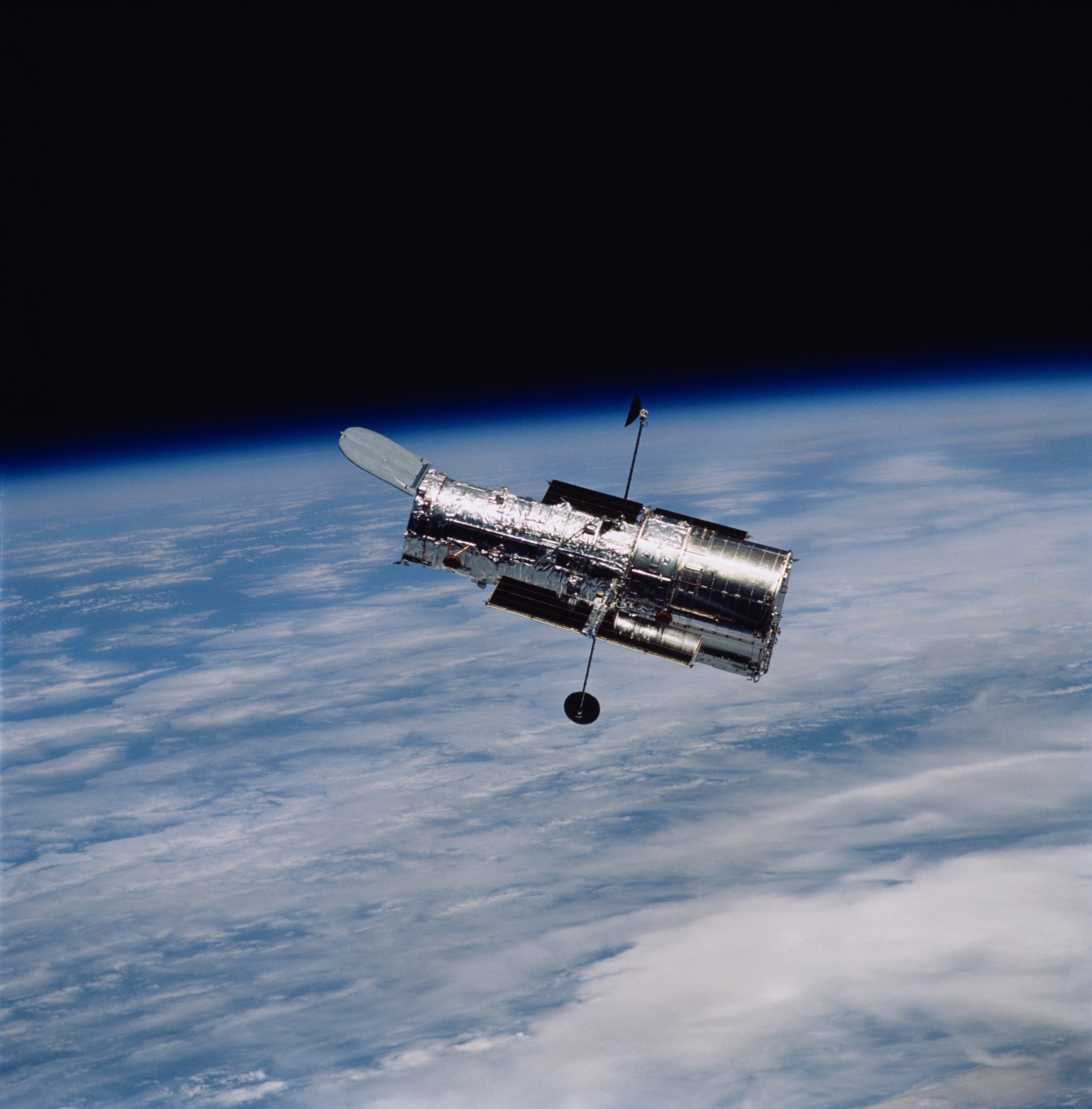
Illustration: NASA, ESA, CSA, Joseph Olmsted (STScI)

Solar system’s possible future

In approximately five billion years, the Sun will run out of hydrogen fuel in its core and swell up more than 100 times larger than it is now into a red giant star. It will then shed its outer layers and end its life as a white dwarf star. Mercury, Venus, and possibly the Earth will be destroyed by the red giant. However, the fate of the more distant planets, particularly the gas giants, is unclear. Finding and studying planets in orbit around the remnants of Sun-like stars after their death is a means of learning what might happen in our own solar system in the far future.

“We’re used to looking back in time when we use telescopes, but this is the first time we have been able to look forward to what might happen to the outer planets around the remnant of a Sun-like star,” said MacDonald. “It’s like using a time machine to peer into the distant future of our solar system.”

The James Webb Space Telescope is the world’s premier space science observatory. Webb is solving mysteries in our solar system, looking beyond to distant worlds around other stars, and probing the mysterious structures and origins of our universe and our place in it. Webb is an international program led by NASA with its partners, ESA (European Space Agency) and CSA (Canadian Space Agency).

To learn more about Webb, visit:

https://science.nasa.gov/webb

Downloads & Related Information

The following sections contain links to download this article’s images and videos in all available resolutions followed by related information links, media contacts, and if available, research paper and Spanish translation links.

Related Images & Videos

An orange gas giant planet at left, taking up about one-third of the frame, facing a star, which appears at top right as a far smaller bright dot. The planet has subtle orange cloud bands. The star illuminates the right side of the planet like the crescent of a waxing moon. Both are on the black background of space. The words u201cartistu2019s conceptu201d are in the bottom right corner.

Exoplanet WD 1856 b (Artist’s Concept)

Exoplanet WD 1856 b, shown in this artist’s concept, is a gas giant that orbits its star at a distance 50 times closer than Earth orbits the Sun. Observations by NASA’s James Webb Space Telescope determined the planet’s temperature and detected molecules in its atmosphere.

Graphic titled u201cGas giant exoplanet WD 1856 b, transmission spectrum, NIRSpec PRISMu201d shows a graph of amount of light blocked by percent on the y-axis and wavelength of light in microns on the x-axis. The y-axis ranges from 55.2% to 56.5% with tick marks every 0.1% and labels at 55.5 and 56.0. The x-axis ranges from 0.5 to 4.0 microns with tick marks every 0.5 microns. A thick purple line outlined with two semi-translucent bands has an inner line thatu2019s darker and an outer line thatu2019s lighter. The purple line is wavy and runs higher, in the top third, until about 3.5 microns, where it drops to 55.2 on the y-axis and 4.0 on the x-axis. Five humps are highlighted by vertical red bars, indicating the presence of methane. White circles representing data points are scattered above and below the purple line. A key shows that the purple line is the best fit model, red highlights methane, and white circles represent data.

Exoplanet WD 1856 b (Transmission Spectrum)

NASA’s James Webb Space Telescope measured the constituents of exoplanet WD 1856 b as it passed in front of its star, finding signs of methane. WD 1856 b orbits a white dwarf star the size of Earth. As a result, the planet blocks more than half of the star’s light.
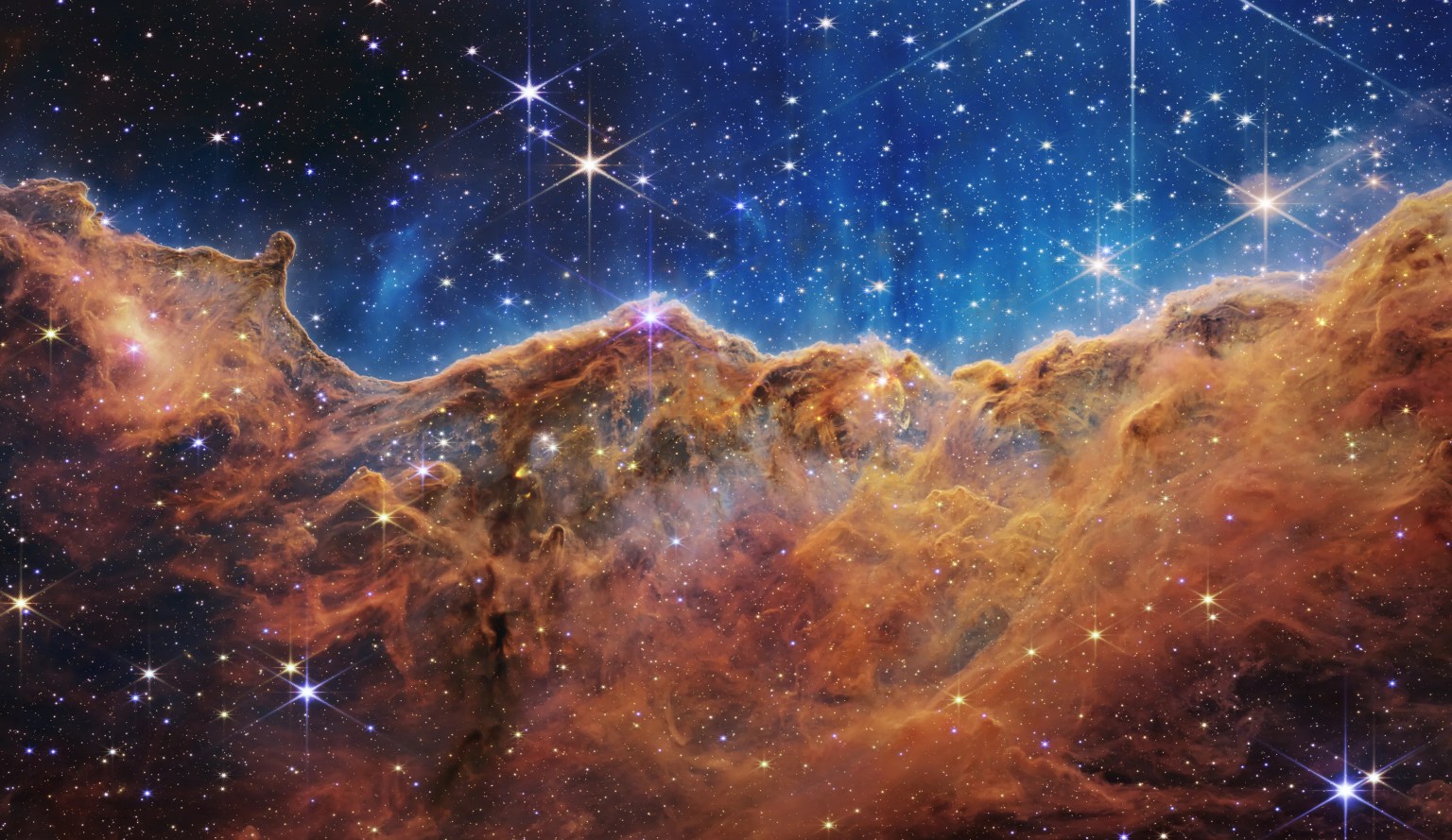

Related Links

Read more: Webb’s Impact on Exoplanet Research

Explore more: ViewSpace | Exoplanet Variety: Atmosphere

Explore more: How to Study Exoplanets: Webb and Challenges

Watch: Giant World Circles a Tiny Star

Explore more: ViewSpace | Star Death: Helix Nebula

More Webb: News | Images | Science | Home Page


Share

Details

Last Updated
Jul 01, 2026
Contact
Media

Laura Betz
NASA’s Goddard Space Flight Center
Greenbelt, Maryland
laura.e.betz@nasa.gov

Bethany Downer
ESA/Webb
Baltimore, Maryland

Christine Pulliam
Space Telescope Science Institute
Baltimore, Maryland

NASA’s Chandra Reveals ‘Red, White, Blue’ Universe for US 250th

7 Min Read

NASA’s Chandra Reveals ‘Red, White, Blue’ Universe for US 250th

This image shows the galaxy NGC 4736, also known as Messier 94 or M94. X-rays of different wavelengths from Chandra are included along with a striking visible light image from astrophotographers Brian Brennan and Remi Lacasse using their telescopes on the ground. M94 is a spiral galaxy with a bright inner ring around it where new stars are forming called a starburst ring, perhaps fueled by gas driven in from its unique bar-like oval structure. It also has a remarkable outer ring of spiral arms.

In celebration of the 250th birthday of the United States, NASA has unveiled four cosmic images from its Chandra X-ray Observatory rendered in red, white, and blue that represent the wonders of the universe the agency explores. The images are accompanied by a trio of new sonifications – a technique that translates astronomical data into sounds.

In celebration of the 250th birthday of the United States, NASA’s Chandra X-ray Observatory has unveiled four cosmic images rendered in red, white, and blue that represent the wonders of the universe that NASA explores.
NASA/CXC/SAO

The image set begins with Cassiopeia A in the top panel, where X-rays from Chandra (represented in blue and purple) have been combined with an infrared image from NASA’s James Webb Space Telescope (red and white). Chandra’s X-ray vision reveals the blast wave that tore through the star, as well as elements in the debris field like iron, calcium, and oxygen. Webb’s infrared data also shows the expanding shell of material from the explosion and cosmic dust throughout the remnant.

 In the bottom row, the first image on the left is the nebula NGC 3603, which contains a massive cluster of stars and is located in the Milky Way Galaxy. This new composite image contains Chandra’s X-ray data (red and white) and shows diffuse emissions near the galaxy’s center along with point-like X-ray sources throughout the middle of the image. Optical, infrared, and ultraviolet light from NASA’s Hubble Space Telescope (red-orange, green, blue, and yellow) reveal stars in the center of the image and dust and gas toward the bottom. The combined layering of the colors makes this nebula and the stars forming within it appear primarily red, white, and blue, with X-rays showing the sparkling lights of young stars.

The middle panel of the bottom row is a new look at the galaxy NGC 4736, also known as Messier 94. In this image, X-rays of different wavelengths from Chandra (red, orange, and blue) are layered with a visible light image from astrophotographers using their telescopes on the ground (red, green, and blue). Messier 94 is a spiral galaxy with a bright inner ring around it, called a starburst ring, where new stars are forming, perhaps fueled by gas driven in the unique oval-shaped structure seen here.

The final image in this red, white, and blue quartet features ZwCl 0024+1652. This is a distant galaxy cluster in which astronomers have found evidence for dark matter by using specially processed data from Hubble (blue). Another image from Hubble reveals the individual galaxies in the cluster (appearing as yellow and white). X-ray data from Chandra shows the enormous reservoir of superheated gas that pervades this galaxy cluster (red) with much more mass than all the galaxies taken together.

New sonifications of the three images along the bottom row of this mosaic are also available, allowing listeners to experience data through sound.

The translation of NGC 3603 into sound begins with a left to right scan, where the brightnesses of the sources once again dictate volume. Chandra’s observations of compact sources sprinkled throughout the galaxy are heard as piano notes, while the diffuse X-ray emission is mapped to a range of audio frequencies. The Hubble optical data is played as sustained tones and acoustic guitar harmonics.

In the sonification of NGC 4736, the radar-like scan moves clockwise, and the brightness of the sources dictates the volume of the sounds. X-rays from Chandra have been turned into wind-like sounds that follow the shape of the X-ray emission. Neutron stars and stellar-mass black holes (known as “compact sources”) detected by Chandra are mapped to pitched tones on a glass marimba. Optical data from ground-based observations is mapped to musically pitched tones, creating a low drone, while stars and background galaxies are heard as a soft piano.

For ZwCl 0024+1652, the sonification begins as a circle on the outside of the image and moves inward. The volume is linked to the brightness of the data, reaching one peak as the circle passes over the dark matter detected by inference from Hubble optical observations and another as it reaches the core. The background stars are heard as a swelling glockenspiel-like sound, and the galaxies are played on a piano. Chandra’s X-rays, which dominate the center of the galaxy cluster and reveal superheated gas, are represented by airy synthesizer notes.

The sonification program is led by the Chandra X-ray Center (CXC) and included as part of NASA’s Universe of Learning program. The collaboration was driven by visualization scientist Kimberly Arcand, (CXC), Matt Russo, astrophysicist; and Andrew Santaguida, musician, SYSTEM Sounds project; along with Christine Malec, consultant. Previously released sonifications of data from Cassiopeia A can be found at chandra.si.edu/sound.

NASA’s Marshall Space Flight Center in Huntsville, Alabama, manages the Chandra program. The Smithsonian Astrophysical Observatory’s Chandra X-ray Center controls science operations from Cambridge, Massachusetts, and flight operations from Burlington, Massachusetts.

To learn more about NASA’s Chandra mission, visit:

https://nasa.gov/chandra

Visual Description

In celebration of the 250th birthday of the United States, this release includes a series of images featuring four wonders of the universe, rendered in red, white, and blue. The images contain X-ray data from the Chandra X-ray Observatory, optical and infrared data from the Hubble Space Telescope and the James Webb Space Telescope, as well as ground-based telescopes.

The main image set features composite images of the four individual objects; Cassiopeia A, NGC 3603, M94/NGC 4736, and ZwCl 0024+1652.

Cassiopeia A occupies the top panel of the frame, significantly larger than the other images in the set. The cloudy blast-wave of the supernova remnant is ring-like in shape, streaked with veins of iron, calcium, and oxygen. Here, presented in red, white, and blue, the remnant resembles an electrified donut, crackling with marbled veins of strawberry and blueberry icing.

At our lower left of the image set is the nebula NCG 3603, which contains a massive cluster of stars on the other side of the Milky Way galaxy. Here, a tight cluster of neon red and white stars packs the center of the image, dissipating as it reaches the outer edges of the panel. Sweeping in at the lower corners of the image are hazy blue clouds resembling sheets of gauze.

Centered at the bottom of the image set is the galaxy NGC 4736, also known as Messier 94 (M94). Here, the spiral galaxy is seen face on, with concentric pale violet cloud rings flecked with scores of stars in white, pale blue, soft red, and golden yellow. The inner ring of the galaxy is bright, and rosy yellow in color. This is a starburst ring, where new stars are forming.

At our bottom right of the image set is the distant galaxy cluster ZwCl 0024+1652. The image is packed with streaks and specks in golden yellow and brilliant white. Upon close inspection, each streak and speck is revealed to be an individual galaxy, some with discernible spiral shapes. At the center of the image is a round pool of bright red light, surrounded by royal blue haze. The red light represents X-ray observations by Chandra, which reveal an enormous reservoir of superheated gas pervading the cluster. The blue haze represents specially-processed data from Hubble, suggesting evidence of dark matter.

This release also includes new sonifications of the three images presented in the bottom row of this data set, allowing listeners to experience the data through sound.

Read more from NASA’s Chandra X-ray Observatory

News Media Contact

Megan Watzke
Chandra X-ray Center
Cambridge, Mass.
617-496-7998
mwatzke@cfa.harvard.edu

Joel Wallace
Marshall Space Flight Center, Huntsville, Alabama
256-544-0034
joel.w.wallace@nasa.gov

Share

Details

Last Updated
Jun 30, 2026
Editor
Lee Mohon
Contact
Joel Wallace
Location
Marshall Space Flight Center
❌