❌

Reading view

There are new articles available, click to refresh the page.

Turning a solar power system into its own backup

Rather than directly converting photons into electricity, concentrated solar energy uses mirrors to turn sunlight into heat, which can then be used to drive traditional generating turbines. Up to about a decade ago, there was a case to be made that concentrated solar energy had a bright future, as improvements in heat storage had turned it into a way to generate power around the clock.

It wasn't to be. While concentrated solar costs fell enough to compete with nuclear power, the price of photovoltaics plunged, making solar panels the cheapest source of power in most locations. Currently, if you have a good site to generate solar power, then the economics of PV panels are hard to beat.

That has left us needing to build a mixture of other facilitiesβ€”typically batteries and natural gas facilitiesβ€”to handle overnight needs or weather-driven shortfalls. But a small company is promising that it can help avoid the need to build a separate facility. Its version of concentrated solar is designed so that a fossil-fueled backup system shares most of the generating hardware with the solar side.


Read full article

Comments

Β© 247Solar

Vibe genes? Natural(ish) language comes to protein, genome design software

Protein design tools may be getting increasingly sophisticated, but you still need a sophisticated understanding of protein structure for them to work. This can include knowing enzyme mechanisms down to the positions of specific amino acids, as well as the water molecules that also occupy the area where catalysis takes place. Once you specify these, the tools can build the rest of a protein around this target.

A large collaboration of researchers based in China, however, decided to bring protein design to the masses, making a tool that can take natural language prompts and use them to produce proteins with the function you specify. If your measure for success is a working protein, then the success rate may not be great. But they still manage to get the job done. And, in a separate announcement, Hugging Face shared that it's now hosting a tool that does similar things on the DNA level.

The equivalent of vibe coding may have come to protein designβ€”at least if you have access to a lab where you can sort the good designs from the dozens of failed ones.

Read full article

Comments

Β© Historical / Contributor

UN says we're going to blow past 1.5ΒΊ warming, offers a "now what?" answer

In 2015, all but two countries agreed to make an effort to keep global temperatures from reaching 1.5Β° C above pre-industrial readings. Since then, most of the world has largely treated what they signed on to as aspirational, and one of the largest emitters (the US) has alternately withdrawn and recommitted to the agreement. Meanwhile, the planet has responded as expected to steadily rising carbon emissions and appears to be practically at the 1.5Β° limit.

On Wednesday, for the first time, the United Nations Environmental Programme (UNEP) acknowledged that realityΒ and conceded that the goal of keeping warming below 1.5Β° was no longer a viable one. Instead, its new goalposts focus on keeping both how long we exceed that limit and how much we exceed it by, at a minimum. Doing that will require both dramatic emissions cuts now and the removal of hundreds of gigatonnes of carbon dioxide from the atmosphere before the century is out.

Bowing to the inevitable

Depending on which baseline you use to establish pre-industrial temperatures, as well as which reconstruction of global temperatures you rely on, the world has either gotten very close to, or already exceeded, the 1.5Β° milestone. The current El NiΓ±o event, which appears exceptionally strong, will almost certainly mean that we've gone over it no matter which records you choose.

Read full article

Comments

Β© Abstract Aerial Art

Quantum error correction goes well beyond breakeven

Running complicated algorithms on quantum computing hardware is going to require the use of logical qubits, where collections of hardware qubits are linked together in ways that allow errors to be detected and corrected. In general, the more hardware qubits you dedicate to each logical qubit, the better the chances are of identifying errors. But, given that the hardware qubits are prone to errors, adding more of them also increases the probability that errors will occur. If the hardware error rate is too high, then growing the logical qubit will only make matters worse.

Fortunately, several companies have demonstrated hardware where the error rate is not too high. Several demonstrations show logical qubits are beyond the breakeven point, where adding more qubits improves performance. The problem is that the improvement isn't very dramatic. To lower error rates to levels we'll need to run complex algorithms, we'd have to add a completely impractical number of qubits to each logical qubit.

On Monday, Quantinuum announced that its current generation of hardware is capable of scaling well beyond the breakeven point. Each step up in the size of logical qubits improved some measures of their performance by a factor of over 10.

Read full article

Comments

Β© Quantinuum

Researchers use AI to design proteins that cut up other proteins

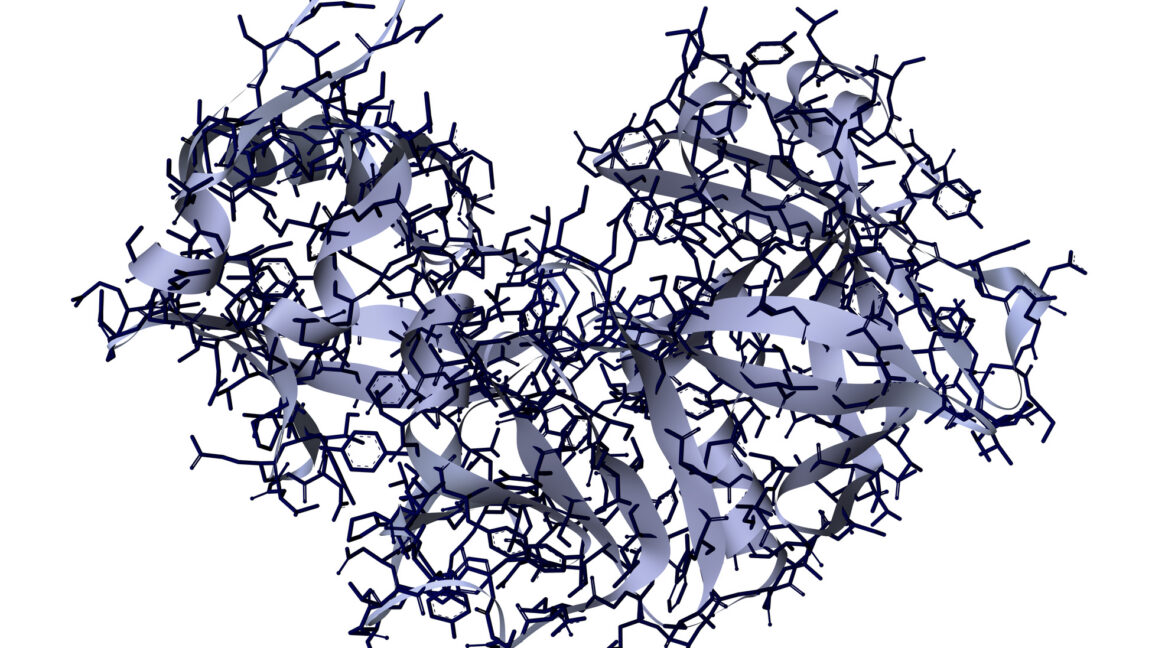
A protein is a chain of amino acids held together by what are called peptide bonds. On their own, those bonds are extremely stable; they're estimated to have a half-life of several hundred years. But in Earth's environment, most proteins don't last nearly that long. That's because organisms have evolved a handful of ways to catalyze the break-up of peptide bonds, which have diversified into countless specialized protein-digesting enzymes. Proteases are everywhere and generally make short work of any proteins that find their way into the environment.

Now, researchers have basically short-circuited the diversification process, using AI-based protein design tools to take the catalytic core of two types of protease and replace the entire rest of the protein. The resulting enzymes could be tuned to cut specific proteins in half, and the researchers demonstrated their effectiveness by using them to cut proteins associated with neurological diseases.

Cutting proteins

The basic peptide bond isn't especially interesting-lookingβ€”it's what you get when you link an amino group to an acid, releasing a water molecule in the process. As their name implies, amino acids have both an amino and an acid group, allowing them to form peptide bonds on two sides of the amino acid. This is critical for building up the long chains found in proteins. (The amino acids also have side chains with distinctive chemistry, which gives a backbone specific properties.)

Read full article

Comments

Β© Basic

❌