❌

Reading view

There are new articles available, click to refresh the page.

Trump ignored intel on China’s Nvidia spy to protect company’s stock, report says

Donald Trump apparently is so aligned with Nvidia CEO Jensen Huang—who has become the president’s key advisor on AI—that he ignored intelligence indicating that Huang was the target of a “Chinese spy plot,” and did so partly to protect Nvidia’s stock.

The New York Times spoke with people briefed on US intelligence agencies’ surveillance and granted them anonymity to discuss findings drawn from “classified intelligence.” According to sources, about a year ago, Trump was briefed that “Beijing was getting reports from someone with direct access” to Huang. That “someone” was Alice Huang, or Huang Le, a Chinese citizen and former top executive at a Singapore cloud company called Megaspeed.

According to sources, the US had already suspected that Alice Huang—who is not related to Jensen Huang—was helping China evade export controls to gain access to high-end Nvidia chips through Megaspeed. But it alarmed investigators to discover that she may have used her role at Megaspeed to gain direct access to Jensen Huang. It’s now believed she may have leveraged that closeness to feed China intel not only on one of America’s leading AI companies, but also to influence Trump’s thinking on AI. As Treasury Secretary Scott Bessent noted last month ahead of Trump’s AI talks with China President Xi Jinping, “the president is completely aligned with Jensen Huang, the CEO of Nvidia.”


Read full article

Comments

© KENT NISHIMURA / Contributor | AFP
Google admits AI search makes less money, but it's fixing that with more ads

Google parent Alphabet reported its Q3 financial results on Wednesday afternoon, showing a healthy rise in revenue for the months of July to September. But the company's stock price has taken a beating, marking one of the largest post-earnings drops in its history. It comes down to several troubling aspects of the new report, including an admission by the company that AI search isn't earning as much as organic search, and despite that, Google expects to spend even more on AI next year.

The company took in almost $128 billion in Q3 2026, earning more than $26 billion in net income. These may sound like good numbers, but financial markets are not impressed. While revenue is up 25 percent versus last year, net income is almost $9 billion lower. As of this story's publication, the stock price is down almost 12 percent, and it was down about 13 percent earlier in the day.

While revenue was up 25 percent year over year, analysts expected more. Google reported earnings per share of $2.12, but the consensus projection ahead of Wednesday was $3.02. Google's Cloud products actually beat expectations, crossing $30 billion in revenue. That's about a billion more than analyst guesses.

Read full article

Comments

© Ryan Whitwam

Google announces Gemini 4 Carbon, its latest frontier AI model that you can't use

It's almost like Google's got something to prove after taking a break from releasing new frontier AI models earlier this year. Just two weeks after rolling out Gemini 4 Argon, Google has announced Gemini 4 Carbon. This isn't the Flash model equivalent we've been waiting for but, rather, is an improvement on Argon, and like that model, Google is working on a staged release that could take a while.

Stop me if you've heard this one before: Google says its latest AI model reaches a new threshold in coding, agentic tasks, and scientific analysis. It's so capable, in fact, that Google can't let you use it just yet.

Gemini 4 Carbon reportedly makes big gains in cybersecurity applications. Google says the model shows a "significant leap" in vulnerability detection, validation, and remediation. Carbon is also apparently twice as likely to generate code that is free of vulnerabilities versus Argon. Meanwhile, the Chrome team claims that Carbon is 10 times better at generating "high-quality" patches compared to non-Google models. Google also notes that Carbon has increased its score by 89 points on WebDev Arena, now ranking at number four on the leaderboard.

Read full article

Comments

© Aurich Lawson

DeepMind unveils Genie 4 world model promising more realistic physics and humans

Last year, Google DeepMind sent gaming stocks tumbling with the reveal of its Genie 3 world model. Since then, world models have become a major focus of AI labs around the world, but Google isn't resting on its laurels. Researchers have been hard at work on an updated model that improves on Genie 3 in almost every way. And if you pay Google enough money, you might actually get to use Genie 4 before too long.

It's easy to look at the output of Genie 4 and see a video game, which is why Genie 3 caused so much consternation in the gaming industry. DeepMind doesn't think about it that way, though. According to Google, world models are a key element in the march toward artificial general intelligence (AGI). A world model creates a virtual world, but it doesn't require pre-rendering environments or programming interactive elements. You simply tell the model what you want, and it generates the experience frame by frame in real time as you explore it.

DeepMind says this technology could create infinite training environments for physical robots or unlock new avenues of rapid prototyping for creative fields. Of course, that requires the model to accurately simulate what you want. Genie 4 has several improvements that make its simulations more useful, and that's thanks in part to Google's updated Gemini models.

Read full article

Comments

© Google

Updated Google privacy policy says your Gmail might be used for advertising

Using Google's products and services has always been fundamentally precarious—doing so gives the world's largest advertising company a lot of juicy personal data. Google has long said it won't use the sensitive data from products like Gmail, Drive, and Photos for ad personalization, but a change to the company's privacy policy appears to dismantle that firewall.

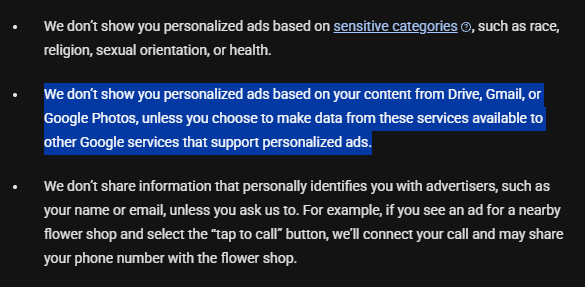
On October 16, Google issued an update to its privacy policy, spotted by Android Authority. The ad personalization section used to include a clear limit on data from certain apps. "We don’t show you personalized ads based on your content from Drive, Gmail, or Photos," the document said. Now, Google has updated it with the following language.

Updated language on when your sensitive data might inform ads. Credit: Google
This equivocation opens the door to using data from apps like Gmail and Photos in ads when it's shared with other Google services, and it just so happens Google has a mechanism for doing that, with Personal Intelligence. The company released Personal Intelligence in early 2026, allowing users to hand data from multiple apps to Google AI products. The idea is that the added context from your existing data will lead to better AI answers, but it's also proving to be a privacy minefield.

Read full article

Comments

© Aurich Lawson

OpenAI's latest AI models are coming to Google Cloud and Antigravity

Google would certainly prefer that everyone used its Gemini models with Google Cloud services, but soon, you'll have more options. OpenAI and Google have come to an arrangement that will see the former's frontier models arrive in Google Cloud services. Perhaps more importantly, GPT models will soon appear in Antigravity, Google's agent-powered coding tool.

For enterprise customers and AI enthusiasts, OpenAI's latest model will appear in Google's "Model Garden" in the coming weeks, adding to its 200-plus options. The garden already offers access to Google's Gemini models, as well as an assortment of open models like Mistral, Llama, and Gemma. Anthropic's Claude AI has also been available for some time. Google says it's now the only large cloud provider offering access to all three leading closed LLMs.

While OpenAI notes that Microsoft continues to be its primary cloud partner, the full suite of current GPT 6 and 6.1 models—Astra, Sol, and Luna—will launch on Google Cloud. Astra will naturally cost the most to run, but Google's system supports dynamically moving workloads between LLMs based on performance, latency, and efficiency.

Read full article

Comments

© Ryan Whitwam

Accused OpenAI spy had folder called “Saudi Gov Docs,” FBI says

On Monday, a court granted the US government's request to deny release of a former OpenAI engineer accused of bugging a top-secret conference room to steal the frontier lab’s secrets.

In a court filing Sunday, US attorney Craig Missakian argued that Abdulrahman Alfozan must continue to be detained while the US makes its case that Alfozan brazenly spied on OpenAI, either for his own personal business gain or to benefit the Kingdom of Saudi Arabia.

Evidence showed that Alfozan had been chatting with a member of the KSA royal family on WhatsApp, while pursuing opportunities to permanently move back to Saudi Arabia during the country's biggest AI push yet, the government argued. Shortly before his arrest, the FBI found he accessed a folder called "Saudi Gov Docs" on his iPhone, where he also allegedly stored photos of a second bug he planted in the offices.

Read full article

Comments

© BRENDAN SMIALOWSKI / Contributor | AFP

“thegentlemanpervert” producing AI CSAM is a NJ prosecutor, say cops

New Jersey’s deputy attorney general, Brian Richard Fitzgerald, was arrested on “felony charges related to AI-generated child sexual abuse material (CSAM),” Bucks County Detectives said in a press release Thursday.

In the US, cops have vowed to crack down on AI CSAM since at least 2024, when the Department of Justice made one of the earliest arrests. After charging a Wisconsin man with spreading “thousands of realistic images of prepubescent minors” across Telegram and Instagram, the DOJ clarified to law enforcement that “CSAM generated by AI is still CSAM.”

New Jersey’s deputy attorney general, Brian Richard Fitzgerald, was arrested at his home Thursday. Credit: via Bucks County Detectives

On Thursday, New Jersey officials accused 51-year-old Fitzgerald of using AI to make photos from social media of real minors into sexualized images that he then distributed on social media.

Read full article

Comments

© Yurii Karvatskyi | iStock / Getty Images Plus

Report: FTC probes Anthropic, OpenAI after Trump dismissed AI fears as “hoax”

Following a string of incidents where AI models hacked websites and breached government systems during testing phases, the Federal Trade Commission is officially probing Anthropic and OpenAI over consumer harms, an insider told Axios.

On Wednesday, the FTC sent out civil investigative demands seeking a wide range of information from the AI firms on recent safety incidents.

The FTC did not respond to Ars’ request to review the subpoena demands. However, Axios’ source said the requests spanned more than 50 pages of questions and sought documents related to the incidents, internal security measures taken, and marketing materials that may suggest consumers were misled.

Read full article

Comments

© Tom Williams / Contributor | CQ-Roll Call, Inc.

Recording device hidden in toilet paper found in top-secret OpenAI meeting room

It took OpenAI two days to notice that a recording device was hidden in a restricted executive conference room where leadership met to discuss highly confidential information, including technical progress, government engagements, and commercial partnerships.

Only those with special clearance are supposed to access that room. But the FBI believes the recording device was planted by Abdulrahman Alfozan, a 35-year-old engineer from Saudi Arabia, who became a permanent US legal resident in 2020. In a press release Tuesday announcing his arrest, the FBI alleged that chatbot logs and CCTV footage suggested that Alfozan—who worked as an OpenAI engineer for more than a year—sought to use the device to spy on OpenAI and risked leaking trade secrets in a way that threatened national security.

To conceal the USB device, Alfozan allegedly wrapped it in toilet paper, then plugged it into the back of a conference room television. The device was likely planted on September 28, and OpenAI found it on September 30 and quickly determined that its contents were encrypted, the FBI said. Days later, on October 5, OpenAI installed a camera in that conference room, and the CCTV footage allegedly showed Alfozan attempting to retrieve the recording device that same day.

Read full article

Comments

© U.S. v. Abdulrahman Alfozan | Aurich Lawson

Gemini 4 Argon begins rolling out in Gemini app and Antigravity, but only if you pay

Google revealed Gemini 4 Argon a few weeks ago, saying that it needed to move cautiously toward a full release because of the potential for nefarious use. Google seems to have worked all that out pretty quickly, though. Argon is beginning its wide rollout today, but it's only coming to paying users at this time, and even those on lower-tier plans won't have full access.

Nothing about Gemini 4 Argon's capabilities has changed. Google still points to the benchmarks it published late last month as evidence of the model's advanced reasoning and agentic coding capabilities. The model is supposedly trained to refuse malicious instructions, and an automated misalignment monitor can stop processing if it detects an unintended workflow. Google claims Argon needs that because it's so capable.

The company has a few new examples of how Argon has helped inside Google, where it has been used by thousands of Googlers. Argon has reportedly been instrumental in making YouTube's comment system more efficient. Argon identified redundant emoji rendering that, when eliminated, dropped server load by 45 percent. Engineers also turned Gemini 4 loose on the proprietary drone physics simulator used in Project Wing, and the AI found critical bugs that had been in the codebase since 2018. Google also notes that Argon has advanced its robotics program, showing a measurable step increase in embodied reasoning.

Read full article

Comments

© Google

❌