
Reading view

There are new articles available, click to refresh the page.

Governance of Risk and Compliance: Overview


Governance of Risk and Compliance


Governance of Risk and Compliance: Overview


In today's complex business landscape, organisations face a myriad of risks that can impact their operations, reputation, and bottom line. Effective governance of risk and compliance is crucial to mitigate these risks and ensure that organizations operate ethically and within the bounds of the law. This article provides a comprehensive overview of the governance of risk and compliance in a thousand words, highlighting its importance, key principles, and best practices.


1. Understanding Risk and Compliance:


Risk refers to the possibility of an event occurring that could have an adverse effect on the achievement of an organization's objectives. These risks can be categorized into various types, including financial, operational, strategic, and reputational. Compliance, on the other hand, involves adhering to laws, regulations, industry standards, and internal policies and procedures.


2. The Importance of Governance:


Governance in the context of risk and compliance refers to the processes, structures, and leadership in place to oversee and manage these aspects of business operations. Effective governance is crucial for several reasons:


a. Legal and Ethical Obligations: Organizations have a legal and ethical responsibility to operate within the boundaries of the law and to conduct business ethically. Failure to do so can result in legal penalties, fines, and damage to reputation.


b. Protecting Stakeholder Interests: Governance ensures that an organization's actions align with the interests of its stakeholders, including shareholders, employees, customers, and the broader community.


c. Risk Mitigation: Governance processes help identify, assess, and mitigate risks, reducing the likelihood and impact of adverse events.


d. Enhancing Decision-Making: Effective governance provides a framework for informed decision-making, considering risks and compliance requirements in strategic planning.


3. Key Principles of Governance of Risk and Compliance:


To establish robust governance of risk and compliance, organizations should adhere to the following key principles:


a. Leadership and Culture: Top leadership must set the tone for risk awareness and compliance. A culture of integrity and accountability should be fostered throughout the organization.


b. Risk Assessment: Regularly assess and prioritize risks to the organization. This involves identifying potential threats, evaluating their impact, and determining the likelihood of occurrence.


c. Policies and Procedures: Develop and implement clear policies and procedures that address compliance requirements and risk management strategies.


d. Training and Awareness: Ensure that employees are educated about compliance requirements and risk management practices. Ongoing training programs are essential.


e. Monitoring and Reporting: Establish mechanisms to monitor compliance with policies and procedures. Implement reporting systems that allow for the timely identification and resolution of compliance issues.


f. Continuous Improvement: Regularly review and update governance processes to adapt to changing risks and compliance requirements. Continuous improvement is key to staying ahead of emerging threats.


4. Best Practices in Governance of Risk and Compliance:


To effectively implement the principles of governance, organizations can adopt best practices:


a. Board Oversight: The board of directors should provide oversight and guidance on risk and compliance matters. Establish risk and compliance committees to focus on these specific areas.


b. Risk Appetite: Define the organization's risk appetite – the level of risk it is willing to accept to achieve its objectives. This helps guide decision-making.


c. Risk Management Framework: Develop a comprehensive risk management framework that includes risk identification, assessment, mitigation, monitoring, and reporting.


d. Compliance Programs: Implement robust compliance programs that incorporate regulatory requirements, industry standards, and internal policies. Regularly audit and assess compliance.


e. Technology and Data Analytics: Leverage technology and data analytics tools to enhance risk assessment and compliance monitoring. These tools can provide real-time insights into potential issues.


f. Whistleblower Mechanism: Establish a confidential whistleblower mechanism that allows employees and stakeholders to report potential compliance violations without fear of retaliation.


g. External Partnerships: Collaborate with industry associations, regulatory bodies, and external experts to stay updated on evolving risks and compliance standards.


h. Crisis Management: Develop a crisis management plan to respond effectively to unexpected events, such as data breaches or regulatory investigations.


5. Case Studies:


Examining real-world examples of governance of risk and compliance can provide valuable insights. For instance, the Enron scandal in the early 2000s highlights the devastating consequences of poor governance, including financial fraud and bankruptcy. In contrast, companies like Johnson & Johnson are often praised for their proactive approach to product recalls, demonstrating a commitment to compliance and consumer safety.


6. Conclusion:


In conclusion, the governance of risk and compliance is an essential aspect of modern business operations. It ensures that organizations adhere to legal and ethical standards, manage risks effectively, and protect stakeholder interests. By following key principles and best practices, organizations can build a robust governance framework that enhances their resilience and sustainability in an ever-changing business environment. Ultimately, governance of risk and compliance is not just a regulatory requirement; it's a fundamental element of responsible and successful business management.
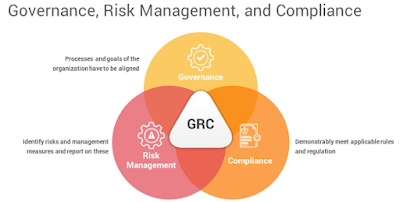

Governance of Risk and Compliance


IT security Audit Guide for SMB


IT Audit


👉With reference to the COVID-19 pandemic, where in one hand staying healthy is a big issue and on the other hand  the abnormal becomes our new normal, Business houses and especially the SMBs need to approach remote work by using a combination of cloud-based services, e.g GCS, AWS, MS Azure and on-premises solutions to keep employees and systems safe and ensure business productivity.


SMBs are proactively putting tools in place to combat attacks and limit their vulnerabilities even though they continue grappling with limited security budgets and resource constraints. SMBs are coordinating with vendors and engaging in-house experts to incorporate multi-layered network security tools and a hybrid network infrastructure, such as SD-WAN, to avoid large-scale network vulnerabilities, regardless of budget and resource size.


SD-WAN allows opportunity to small businesses who are operating in multiple physical locations and using bandwidth intensive applications, such as Voice over IP tools, Zoom, or Salesforce, to take advantage of this technology. SMBs can increase branch office network security, increase Internet efficiency, and decrease IT spending. 


 However, dealing with these challenges during a work-from-home shift has created gaping vulnerabilities within an organization's networks and adds another challenge to an already overburdened IT department to maintain the deliverables on time.


If you go through the forum and articles related to IT security, you will notice that many companies/SMBs haven't had the time or resources to ensure an adequate security policy for their workforce. They are, continuing business operations against lower levels of protection due to lack of IT security framework, policies and guidelines.


In addition to framing a general security check policy, SMB leaders should remind employees of security best practices for end users, review and update disaster recovery plans, and establish strong lines of communication among all remote teams.


Security and IT professionals also suggests the same for the SMB leaders to strengthen their overall business continuity strategy


There’s enough room of opportunities for small- and medium-sized businesses (SMBs) to tighten their IT security infrastructure — and no lack of reasons they should.


We’ve prepared list of an IT security checklist for small businesses — the core practices moving IT teams off the hamster wheel and into proactive, not reactive, IT enterprise security.


Business IT security checklists should be potent enough to address these top malicious cybersecurity incidents and attacks before they become mission-critical, non-recoverable breaches.


Here is a simple guide on how to perform a basic IT security audit for a small to medium business.


IT Audit

👉Identify the Business Assets

The first and foremost task for an organization is to identify the various assets a business maintains and owns. During the audit this makes it easier to map out the scope of the audit and ensure that nothing is overlooked.

Asset details creation

The IT auditor or the person conducting the audit should list down all the valuable assets by taking help of asset and inventory management team of the company that requires protection. Items to be included in the master list are framed below:

·  Hardware and Equipment including but not limited to computers, laptops, servers, hard drives, modems, printers, phone systems, mobile devices, etc.

·  Software, online tools, and apps including email servers, cloud storage, data management systems, financial accounting systems, payment gateways, websites, social media accounts, etc.

· Files and data storage systems including company finance details, customer databases, product information, confidential documents, intellectual property, etc.

·  Existing IT Security Software and Procedures


Asset classification based on importance

Once the asset master list is created, the next step should be to prioritize the assets based on how essential they are to the business. One of the criteria to decide what should be on top of the list is to consider how big an impact the business could experience should a problem occur to these assets.


Schedule the audit


Based on the asset classification based on the importance list, the audit should be scheduled accordingly. Managers and employees should be informed of the scheduled dates in case access and operations would need to be interrupted.

Customers and clients who use certain assets such as websites or apps should also be informed in advance for any downtime during the audit window.


Recognize Risks and Threats

After generating the list of assets and identifying the scope of the review, the IT auditor should pre-identify the potential risk and threats the business could face. These risks and threats are the factors the audit should be testing against to ensure that security measures are well-implemented.

These risks and threats can include:

·         Hardware and equipment failure

·         PC viruses, malware, phishing, ransomware and hacking attacks

·         Natural disasters such as fire, flood, and earthquake

·         Theft of physical property or equipment

·         Theft of data whether external and internal

·         Loss of Data

·         Unofficial access

Audit Techniques

Before performing the on-site evaluation, the IT auditor should set audit techniques that will be utilised to do the review. These techniques can include:

·  Technical examinations including physical performance testing, monitoring and scanning through software

·  Visual inspection of location, placement, and physical condition of the hardware

·   Observation and analysis of assets in relation to threats and risks

·  Questionnaires and in-person interviews to determine compliance to security protocols, password practises, and access control to data and accounts

IT Audit


Perform On-site Evaluation

This is when the actual audit takes place. All the previous steps that were taken into account should prepare the IT auditor to effectively conduct the  review of the assets. It is important to also assess existing security procedures, if any, during this time.

The IT auditor should use a uniform evaluation scheme during his appraisal. This does not need to be complicated and should be easy for the business managers and stakeholders  to understand.

An example of an evaluation scheme is below:

·  Highly Secure, no further actions needed

·  IT Security Deficiency Identified, actions implemented

·  IT Security Deficiency Identified, with recommended actions for further implementation.


 More to Read- CLICK HERE


While the audit is ongoing, the IT auditor should use his preferred evaluation scheme to note down the results of the tests, all the actions taken during the audit, as well as what further actions need to be implemented after the audit.

There are times when straightforward resolutions can be executed immediately such as re-installing an outdated antivirus software or limiting access controls. However, there are also solutions that may be more time-consuming such as data backup or may involve purchase of new assets to be implemented.

Diligently noting down his findings will make it easier for him to remember these details when creating the post-audit report. This is the next step of the process.

Observations, Reports and Recommendations


The final yet most important part of the IT security audit is the preparation of the audit report. This will include the details of the testing, findings as well as the recommended action plans to be taken. This report must conclude what needs to be resolved, revised and upgraded to meet industry IT security standards.

In creating the report, the IT auditor should note down the security gaps that were identified during the system checks, with probable cause and state clear recommendations on how to resolve the issue. It should also indicate the potential impacts the problem will further create if not immediately rectified.

For example, if a business is suffering from no AV updates and windows security patch updates  his recommendation report should specify this issue as the problem.

Potential causes can be unexpected electric surges or out-of-date equipment not compatible with the existing office network. He should then list down the business consequences caused by this IT issue such as loss of productivity and project delays.

Lastly, he should research and specify an actionable recommendation such as employing remote diagnostics as an immediate troubleshooting method to prevent long downtime periods or maybe purchasing new equipment altogether.


Better Secure than Sorry

Any Business house , big or small, is vulnerable to the hazardous threats and cyber-attacks that can disrupt the  business operations. The survival of SMB’s will depend on how fast they can adapt to the digital landscape that is constantly transforming the face of business.

Having a security-first mentality through the performance of regular audits is a smart way to establish a secure IT environment and will keep SMB’s equipped and ready to meet the challenges head-on.

Please click here-   More to Read

Please feel free to connect with us to know more on IT security audit for SMBs.


ISO compliance


ISO compliance means following the ISO principals and guidelines  without the formalized certification and re-certification process.
While ISO certification provides independent validation of a company’s conformity to a set of standards  created by the International Organization for Standardization (ISO), the certification process can be long and extended. Thus, many organizations wants to get the ISO compliant document instead of ISO certification.
ISO compliance guidelines helps  on using the standards as a way to make decisions regarding policies, procedures, and processes so that they align with the specifications.A company can obtain a certificate of compliance that provides customers and business partners with assurance but lacks the time-consuming and costliness of the certification audit. For example, organizations can meet the requirements of the ISO 9000 management standard and obtain the certificate of compliance. This certificate can be used to prove that the appropriate organizational structures exist to promote improvement.

Internal Compliance

 ISO guidelines  are adopted  in many industries. Furthermore, ISO certification creates reputation  that the business adheres to certain quality measures when developing and producing products and delivering services. Still, the decision to comply lies solely with the organization. Internal compliance indicates that the company's workforce and stakeholders are   trained and encouraged   to follow the rules and regulations set out by ISO. While non-compliance may not be legally penalized, actions may be taken internally for any breach in compliance. Internal compliance is not a proof of compliance with the ISO and is not legally recognized.

Certification
To be recognized as an ISO-compliant business, the company must undergo an audit by an accreditation firm which is ISO certified.  The audit helps the business to do gap analysis and correct them if certification is denied because of the shortcomings. Companies can use the ISO certification as a public relations tool  and branding as well . It ensures suppliers and customers that the procedures used by the business are at par  with international standards.

Ongoing Compliance

Once the certificate of compliance is achieved by a business house , the work does not stop. To maintain its status, the business will need to submit to regular audits at regular sets of intervals. The company must also continuously monitor its activities and document all operations so that it can maintain proper records. ISO auditors will review these records for accuracy and to ensure that the company is eligible to maintain its ISO-compliant status. 
❌