
Reading view

There are new articles available, click to refresh the page.

The Bells are Ringing Again, and This Time Sweden is Inside the Alliance

On August 25, CIA Director John Ratcliffe landed in Moscow. He met Russian officials, warned them against attacking NATO, raised Moscow’s support for Iran, and flew home. Allies and Kyiv were briefed before and after. It was the first trip of its kind since the former CIA Director William Burns made the same flight in November 2021, fifteen weeks before Russia crossed into Ukraine. As one former CIA operations officer put it, the fact that a director gets on a plane at all suggests the threat behind the trip was judged credible.

The warning had gone public three weeks earlier. US intelligence assessed that Putin could order a limited attack on a NATO member, most likely against the Baltics or Poland, at some point between this autumn and 2029. The assessed purpose is to test Article 5’s, and to fragment the alliance by proving it lacks a response.

The location for that scenario is Sweden’s front yard. Gotland sits in the middle of the Baltic Sea. Sweden’s air and naval reach covers the sea lines that would carry reinforcements to the Baltic states in the first week of a crisis, and Swedish territory is key for air superiority.

In 2022, Sweden’s intelligence failures were Sweden’s. The country was outside NATO, and a wrong Swedish assessment was not changed after American influence. But Sweden joined NATO in March 2024. Swedish capability will now feed an alliance and Swedish blind spots will become an alliance wide liability.

Sweden is rebuilding its intelligence architecture directly into this warning. A new civilian foreign intelligence service, Sveriges utrikesunderrattelsetjanst (UND), opens January 1, 2027.

Not the First Warning to Go Unheeded

The winter of 2021 into 2022 was not a case of intelligence that wasn’t shared in time. In fact, Washington and London put detailed intelligence assessments on the table publicly, repeatedly, and with a specificity that made professionals uncomfortable.

The influence operation was also conducted privately. Burns flew to Moscow in November 2021 to deliver warnings to the Kremlin, then made repeated trips to Kyiv and allied capitals.

These efforts unfortunately were partly in vain. The French and German services judged a full invasion too irrational and too costly for Putin to attempt. Several capitals read the American warnings through the memory of Iraq weapons of mass destruction and discounted them accordingly. The gap between what US intelligence believed and what European governments were willing to act on became one of the more consequential intelligence failures of the post-Cold War era. It was not a failure of collection; it was a failure of influence.

The analytic error underneath this failure is known as mirror-imaging; the assumption that your adversary weighs cost the same way that you do. European intelligence services were good at counting tanks, tracking movement and mapping order of battle. They were far less equipped to model what was happening inside the Kremlin, and when they tried, they substituted their own arithmetic for Putin’s.

Sweden’s record is part of that story. In the month before the attack, MUST assessed that a major assault was unlikely. Foreign Minister Add Linde questioned American intelligence directly to Secretary of State Anthony Blinken, leaning on her own service’s skepticism.

FOI, the Swedish civilian defense research agency, did not forecast a full-scale war either, but its Russia and Eurasia analysts raised the alarm publicly and privately. But the warnings sat outside MUST’s military remit and had no route into the warning chain.

Wilhelm Agrell, professor of intelligence analysis, called MUST’s miss a textbook error: analysts reasoned that invasion was unlikely because the consequences would be too severe. That was an assessment of what a rational Swedish planner would do in Putin’s position, not of Putin himself.

Why Military Intelligence Could Not Have Gotten this Right

The standard account of Russian deception before February 2022 is that Moscow hid its intentions from the West by dressing the buildup as an exercise. That is true and it is the less interesting half.

The more consequential fact is that Moscow hid its intentions from its own army. Captured Russian soldiers told interviewers they believed they were on a routine exercise until hours before they crossed the border. Their officers reportedly withheld the truth because they doubted the men would fight if they knew. The deception was not aimed outward alone, but at the force that was executing Putin’s orders.

The same held on the other side. The former commander of Ukraine’s Joint Forces has said he received no official written warning on the eve of the invasion and acted on an informal tip.

A military intelligence service collects against a military. It reads order of battle, logistics, movement, readiness, signals traffic, and where it can, human sources inside the structure. Every one of those disciplines was pointed at Russian forces in the winter of 2021, and every one of them was working.

They were also, on the question that mattered, reporting accurately. The units were postured for an exercise because the units believed they were on an exercise. The logistics looked thin for an invasion because the supply staff had not been told they were invading. A colonel asked in early February what his regiment was doing would have given an honest answer, and the honest answer was wrong.

The buildup was visible; but what was not visible was the decision. Putin realized his opponents intelligence weakness, and made the decision in a room that his wider military had no access to. Thus, collection against an army cannot retrieve a judgment that the army has not been told.

MUST did not miss the invasion because its analysts were incompetent or because collection was thin. It missed because it was asked a political question and had been built, staffed, tasked, and funded to answer a military one. Working harder inside that structure would have produced more detail about an exercise.

A design problem does not yield to effort. It yields to design. If intent lives in the politics of a regime rather than in its order of battle, then somebody has to be built to read the politics, and that somebody cannot report up a military chain to a military customer asking military questions.

The American Half of the Ledger

Washington read Russian intent correctly, but got the second question wrong.

Almost every Western service, American ones included, assessed that Kyiv would fall in days. The Chairman of the Joint Chiefs told members of Congress that the capital could be taken in seventy-two-hours. The day after the invasion began, US officials were still assessing that Kyiv could fall within days. The intelligence community later reviewed what went wrong, and the answer was not the Russian side of the equation.

Examine how that assessment was built. Analysts counted Russian formations and Ukrainian formations, compared readiness and equipment, ran the correlation of forces, and derived an outcome. It was rigorous, and every input was real. What it failed to weigh was whether Ukrainians would fight for their country, and misjudged the national will of resistance.

That is mirror-imaging pointed at a friend instead of an adversary. In the European case, services assumed Putin would calculate cost the way a Western government would and concluded he would not invade. In the American case, services assumed Ukrainians would calculate survival the way a defeated army could and concluded they would not hold. Both times, the arithmetic was correct and the human judgment underneath was imported from somewhere else.

Within two weeks of the invasion, the United States and its allies were quietly planning for a Ukrainian government in exile and an insurgency, which is the posture you adopt when you have concluded that the state will stop existing. Zelensky was reportedly offered evacuation and answered that he needed ammunition rather than a ride. The pessimism shaped what was planned, what was offered, and how fast it moved, in the weeks when speed mattered.

In the other direction, Zelensky spent the run-up publicly disputing American warnings, arguing that the alarm was doing more damage to his economy than the threat. Biden later said Zelensky simply “didn’t want to hear” it.

Washington was right about Russia and could not get Kyiv, Berlin, Paris or Stockholm to act. Kyiv was right about Ukraine and could not get Washington to believe it. The problem caused both an unprepared Europe and delayed American aid.

What Sweden is Actually Building

Former Prime Minister Carl Bildt led the review of Sweden’s Intelligence Failure, “En reformerad underrattelseverksamhet”. The report stated that Sweden was unusual among comparable allies in having no foreign intelligence service outside of the military chain of command reporting to the elected government. The country had excellent military intelligence, a capable security service (Sapo), and one of Europe’s better signals organizations (FRA), but no institution capable of reading political intent. The report recommended a civilian agency directly under the Foreign Minister, which was later approved.

Sveriges utrikesunderrattesetjanst, UND, will sit alongside MUST, Sapo and FRA rather than replacing any of them, and is meant to be a senior shop rather than a second MUST, growing over several years.

UND takes over KSI, the Office for Special Collection, which is Sweden’s clandestine human collection and which operates in other countries under cover employment and false identity. It also takes over the production and management of qualified protected identities, previously run by the Armed Forces. The legal architecture moves with it: the Defense Intelligence Court is renamed and the oversight body redesignated, moving Sweden closer to the structures of MI6 or Estonia’s Valisluureamet: a small, civilian, politically literate foreign service.

The government named Andreas von Beckerath director-general and Annika Brandstrom his deputy, both running from January 1, 2027 for six years. Von Becherath is a diplomat: with ambassadorships in Ukraine and Poland, deputy director-general and head of the Foreign Ministry’s Eastern Europe and Central Asia department, with earlier postings in Moscow, Bucharest, London, Berlin, and New York. He is currently serving as the European Union’s ambassador in Belgrade, head of the EU delegation to Serbia, a post he has held for a year.

Brandstrom ran the inquiry that stood the agency up and served as deputy national security advisor. She has a long history of working in crisis management, preparedness and security, working directly for the Prime Ministers office.

The diagnosis was that Sweden could count Russian tanks but not read Russian politics. The team hired to fix it spent their careers reading politics and managing crises. Sweden did not appoint a general, nor an intelligence officer. It appointed a diplomat and a bureaucrat, showing that the government took the review seriously.

Frictions and Objections

Thomas Nilsson, who runs MUST, said that in the current security situation Sweden cannot afford to let anything fall through the cracks. Supreme Commander Michael Claesson has noted that UND’s civilian funding may not count toward NATO spending targets. Analysts have pointed to the seam that any civil-military split creates, which a capable adversary will probe.

All of Sweden's eight parties on the foreign affairs committee backed the legal changes. Four of them, the Social Democrats, the Left, the Greens and the Center, filed seven reservations and three separate statements. The Social Democrats called four months an extremely brief period for a reorganization of this size. The Left said the process may create more problems than it solves. The Center Party called it democratically flawed.

Underneath the procedural language is a specific operational worry: KSI leaves MUST. The Social Democrats’ objection is that the military loses a capability and is not compensated for the loss. Clandestine human collection is not a function that transfers on an effective date. Cover takes years to build and one administrative error to destroy. Officers working abroad under false identity are being re-subordinated to an agency that does not exist yet, whose director arrives on the day it opens, in the same window in which US intelligence says Russia may test the alliance.

Recruitment began before parliament formally approved the agency. The Social Democrats' complaint was tied to former hiring flaws for the National Security Advisor. Naming a year leadership team weeks before a national election, after declining to seek cross-party agreement, was provocative. They have a point; the decision was taken hastily in a political setting that often favors alignment across the aisle.

As a result the opposition signaled it may revisit elements of the reform, and the Swedish reporting has been blunt that if an incoming government shelves the service, three years of work goes with it. While the diagnosis is correct and the institutional design is sound, the infrastructure has to survive the people who built it, and whoever wins the next election. Sweden’s diagnosis was that its intelligence architecture was wrong for the threat. The risk now is that the new institution is not properly aligned across the aisle.

What Washington Should Do, and What Stockholm Should Ask For

Sweden is fixing the half of 2022 that was Sweden’s. Nothing in the American half has been fixed, and standing up a new allied service is a rare occasion when that half becomes cheap. None of what follows requires an appropriation.

Engage the institution, not the government. The appointed leaders will outlast the government that named them. American engagement pitched at the service and its career leadership must survive a change in Stockholm. Engagement pitched at the ministers who created UND does not, and given how the reform was legislated, engagement that looks like an endorsement of the current coalition would actively damage the agency’s standing with the parties most likely to inherit it. The correct posture toward a new foreign intelligence service in an election year is professional and studiously boring.

Establish liaison at the founding. A service’s analytic culture and its foreign relationships set early and then harden. What UND treats as a finished intelligence product, how it handles dissent, what it considers sufficient evidence to warn a prime minister, and whose reporting it trusts will all be settled in 2027 and 2028 by people who are being hired. Washington should be in the room while the habits are forming, and the subject of that liaison should be intent rather than order of battle, because reading intent is the entire reason the agency exists.

Make the 2022 improvisation permanent. The declassify-to-persuade campaign that Washington and London ran that winter was invented under pressure, with skill, and then set aside. A standing mechanism for releasing intent-grade material to allies at speed, with the handling rules and the release authorities agreed in advance would mean the next warning arrives in a form that an ally can act on. The lesson of 2022 was that being right in February is worth little if the ally does not move until April.

Settle the accounting question now. Claesson’s concern that UND’s civilian budget may not count toward NATO spending targets is an alliance question. The Hague summit’s target splits into 3.5 percent for core defense and 1.5 percent for defense-related spending, and the substance of that 1.5 percent has not been well-defined. Washington has more influence over that definition than any other member. A civilian foreign intelligence service whose product feeds alliance warning belongs in the basket. If it does not, the alliance will have told every member that the safe answer is to keep intelligence in uniform, maintaining the structure that failed in 2022.

Clarify Expectations. Sweden should ask for written handling and onward-sharing terms at the foundation, when it has maximum leverage and when the terms can be built into the agency rather than bolted onto it. It should ask for reciprocal analytic exchanges, including joint red-teaming aimed specifically at mirror-imaging, which is the failure both services can share and neither can audit alone.

Assign UND a responsibility in NATO. A small service does not compete across the whole target set, but Sweden has geography, language, history, and now a reputable and capable director. UND should come to the table as the alliance’s lead on a defined portion of the Russian problem rather than as a recipient of American products. Partners who bring something are listened to.

A Warning is Not a Decision

Sweden has looked hard at their failure and built an institution in response, which is more than most European governments have done with the same four years. The review named the problem, the legislation moved clandestine collection out of uniform and under civilian control, and the government hired a team with experience reading exactly the kind of politics that can accurately foresee an invasion.

The failure of influencing has no institution behind it in Washington or elsewhere. It was solved once, improvised under pressure in the winter of 2022, and allowed to lapse. That is the part of 2022 that is genuinely fixable, but it needs to be assigned. The American task is to build a relationship durable enough that whoever party runs Sweden does not matter.

Burns flew to Moscow in November 2021 and came home with a warning that proved correct, and it moved nobody in time. Ratcliffe made the same flight in August. The question worth asking is not whether the assessment behind it was accurate. The question is what happens after he lands, and whether four years, a war, and a new agency in Stockholm have changed the answer at all.

The Cipher Brief is committed to publishing a range of perspectives on national security issues submitted by deeply experienced national security professionals. Opinions expressed are those of the author and do not represent the views or opinions of The Cipher Brief.

Have a perspective to share based on your experience in the national security field? Send it to Editor@thecipherbrief.com for publication consideration.

Read more expert-driven national security insights, perspective and analysis in The Cipher Brief
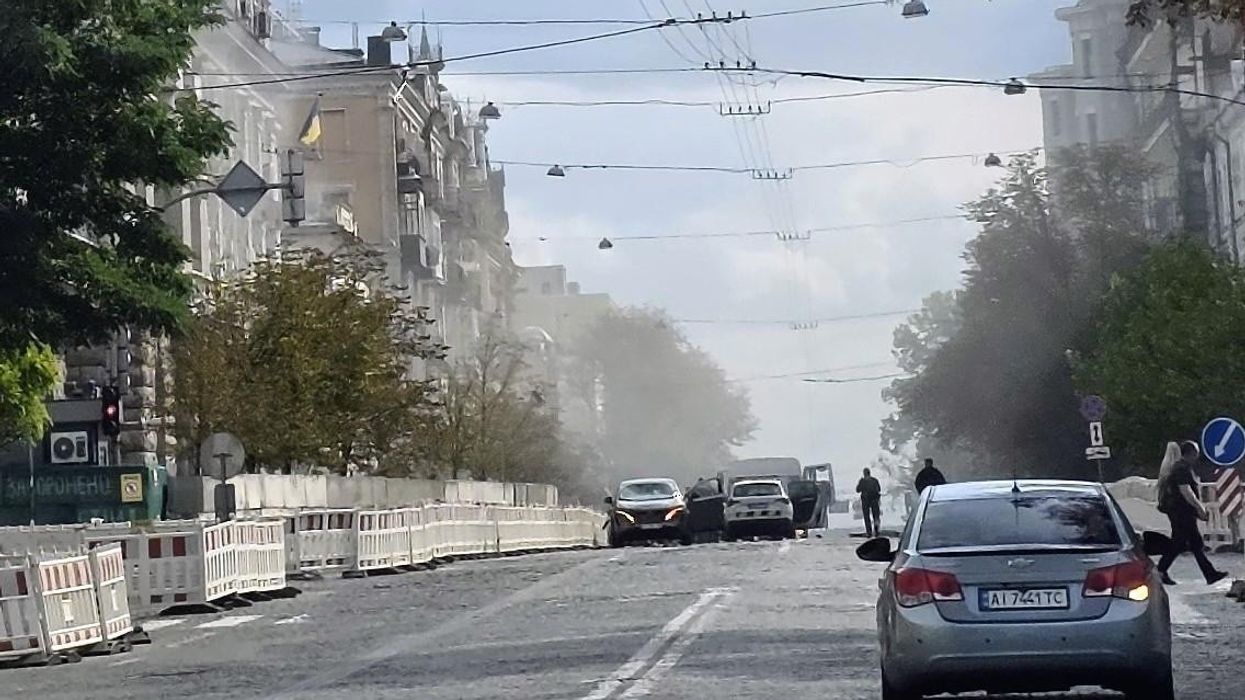
We Are In An Unpredictable War Of Attrition

We are squarely in the target sights of ‘Unintended Consequences.’

What do I mean by this? Think of it as a broad spectrum of possible consequences when missiles and drones are being slung back and forth between Iran and U.S. Navy vessels and bases, and the energy and commercial facilities and ships of its Gulf allies. On one end of the spectrum, accidents happen: think the inadvertent U.S. airstrike on the girls’ school at the beginning of the war, and the more recent ‘wedding party’ casualties when a U.S. missile struck a nearby communications tower. These are tragedies for all involved. On the other side, an Iranian missile made its way through U.S. air defenses to strike a U.S. military facility in Jordan, resulting in the deaths of three U.S. troops. The latter resulted in a robust U.S. military response that targeted a variety of Iranian military facilities. This was a success for Iran and a tragedy for America.

On the other end of the spectrum, what if one of Iran’s ballistic missiles successfully navigates to its target - a U.S. base or navy vessel, for example - and significant U.S. casualties, dead and/or wounded, result? The U.S. administration is likely to come under tremendous political pressure to respond with overwhelming force. This could elevate the stakes even higher, cutting off any chance of a negotiated settlement, remote as it currently is. And with the regime already having been severely degraded militarily, and its leadership ranks diminished, what does that leave in terms of targets? More of the same?

It could also result in calls to withdraw U.S. forces, given the antipathy of a majority of the U.S. population to a war they view as unnecessary, ill-advised, and ill-managed. This would leave Iran in a weakened yet still dangerous posture, with the ability to pressure the world economy at will going forward. Neither option is appealing.

Oh, and by the way, notwithstanding the administration’s verbal gymnastics, this is very much a war.

D-Day Sanctions Regime

On the surface, this appears to be a pretty solid strategy, or at least better than what has been tried to date: Simply squeeze the Iranian economy until the regime cries uncle. It is already having an impact and will likely continue to compound the pain. But it is neither simple nor clear-cut. Who will it actually impact, how badly, and when? A total blockade means not just money or arms. It means no food. It means no medicine. And a host of other basic necessitates. The Iranian people will feel it first, particularly the young, the old, and the sick. Regime insiders, including the leadership and their loyal (for now) security forces, will be the last to see the effects.

And we have already seen Russia and China reject complying with the secondary sanctions that comprise the heart of this enhanced effort. So, no one knows what will happen if they choose to challenge the blockade; It is highly unlikely that U.S. forces will use force against Chinese vessels attempting to access Iranian ports. And that does not take into account less overt (read clandestine) interactions - intelligence sharing, weapons system development, sabotage efforts against Gulf country facilities, including pipelines, etc. - that would further evade and/or erode the U.S. advantage.

So, while there will be pain, and lots of it, as I said in a recent BBC interview, there remain many unknowns. Informal smuggling networks have abounded in the region for Millenia. The regime will utilize every trick they have learned since the ‘79 revolution while building a ‘resistance economy’ to get around the blockade/sanctions. And potentially with the implicit, if not explicit, support of two major world powers. In the end, this does not presage the near-term submission of a regime that values survival above all else. This remains very much a test of wills.

Furthermore, what happens when the world sees the Iranian people starving before their eyes? I’m not sure they will countenance this for long.

So, Who Has More at Stake?

The U.S. people are seeing higher gas prices at the pump, rising food costs, overall inflation, and more. This is painful, but certainly not existential, at least not yet. The increasingly negative impact on the world economy stands to worsen things considerably if the status quo continues for too long, so Americans are watching closely. And the mid-terms are fast approaching.

The Iranian people are seeing the destruction of their economy, their country, and potentially their very way of life. It is very much existential. The specter of a thundering locomotive of new sanctions bearing down on them must certainly be terrifying. I have no doubt many Iranians blame the Islamic regime for bringing this down upon them. But as things worsen, they may turn against the U.S. and its allies for abandoning them to the depredations of the regime.

The Iranian regime most certainly views this as an existential threat, notwithstanding its rhetoric. They would be fools not to. But Netanyahu’s 2 September statement that the Israeli government is, “working to bring down this regime and defeat it,” accompanied by Trump’s 2 September statement publicly questioning, “when the Iranian people would rise up and fight,” is unlikely to motivate them to negotiate. They will need to be forced to submit. My experience with Iranians tells me that the harder you press, the more resistant they become. Uncharted territory indeed. We will see.

China and Russia both have an adversarial relationship with the U.S. and important interests vis-à-vis Iran: military for Russia (drones) and commercial for China (oil). Why would either go out of their way to assist the United States in removing itself from a self-imposed disaster that is distracting it from issues they care about while diminishing its military capabilities, all with minimal effort? That is a question that remains to be answered.

Speaking of Regime Change

U.S. political leadership answers to the American people at the ballot box. The system is a bit creaky at the moment, but (for now) it remains intact.

The Islamic regime, by design, does not answer to the Iranian people. Iran’s elections are truly rigged, primarily by the Guardian Council’s ability to reject candidates for office, but also with an increasing willingness to falsify election results. And in the end, the Supreme Leader is able to reject any initiative or law he disagrees with. We have seen the results when the Iranian people see no recourse for accountability by the regime: people in the streets, followed by blood in the streets.

Without substantial outside support, of which we have so far seen little evidence, the populace will be hesitant to go back to the streets, knowing that if they do, they are on their own. It could happen if things get bad enough, and it is possible it might even ultimately be successful, but it is almost certain to be a massacre, followed by chaos and a very uncertain end. Yet another example of unintended consequences.

Where Are We Now?

For the moment - and this may already have changed as I write this - we are back in what I refer to as a Hyperbolating phase, where we are seeing threats/counterthreats being tossed back and forth with abandon. Most of these statements are utterly meaningless and can be ignored. It appears both sides are waiting to see who blinks first.

U.S. messaging appears to be somewhat disjointed, contradictory, and lacking an overall strategy, with the President, the only real decision-maker, continually wandering on and off the path of others in his administration: Trump - I don’t care/where are the Iranians?; Hegseth - continued confrontation; Bessent - economic asphyxiation; Rubio - no nuclear weapon/economic pressure; Vance - not a war/intermittent containment. You could claim this is purposeful to keep Iran uncertain and off balance, but it should not be doing the same to Americans. President Trump failed to bring the American people on board beforehand with a coherent (and honest) case for war and an actual strategy for winning it. The continued shuffling of various justifications we have seen from the administration serves simply to stir the mix of confusion.

I get the distinct feeling that, given the fast approaching mid-terms and the deep hole they have dug for themselves, the administration just hopes that something/anything works so they can walk away from what is clearly a foreign policy disaster.

Iran messaging, on the other hand, appears, at least to me, to be a bit more coordinated if not strategic. While most Iranian government leaders are defiantly threatening massive retaliation for continued U.S. strikes (hyperbole), including the military (both Artesh - regular military and IRGC - Revolutionary Guards), the Parliament and its Speaker Ghalibaf (“U.S. actions will not go unanswered”), and the Foreign Affairs Ministry (claiming “war crimes” by the U.S.), the lone man on an island is the Iranian President, Pezeshkian; “we do not seek war but will respond,” and, “Iran remains open to negotiations, under the June MOU”. It is important to realize that the Iranian President has virtually no policymaking role in Foreign affairs, so his statements should be given less weight than others. But he would never make this offer without the approval of the IRGC, the Supreme National Security Council and, most likely, the Supreme Leader (or whoever is speaking for him). As I have written previously, I believe that the vagueness of the original June MOU was oddly advantageous to Iran and served to lead us directly back to where we currently are. So… this would seem to indicate negotiations are at least still on the table, just not under conditions particularly favorable to the U.S.

Where Are We Going?

Military escalation? A slow grinding pressure on the regime, testing their willingness to allow their people to suffer? Or a return to the negotiating table?

Who knows? There is no simple or painless way out of this.

Unintended consequences, after all.

The Cipher Brief is committed to publishing a range of perspectives on national security issues submitted by deeply experienced national security professionals. Opinions expressed are those of the author and do not represent the views or opinions of The Cipher Brief.

Have a perspective to share based on your experience in the national security field? Send it to Editor@thecipherbrief.com for publication consideration.

Read more expert-driven national security insights, perspective and analysis in The Cipher Brief
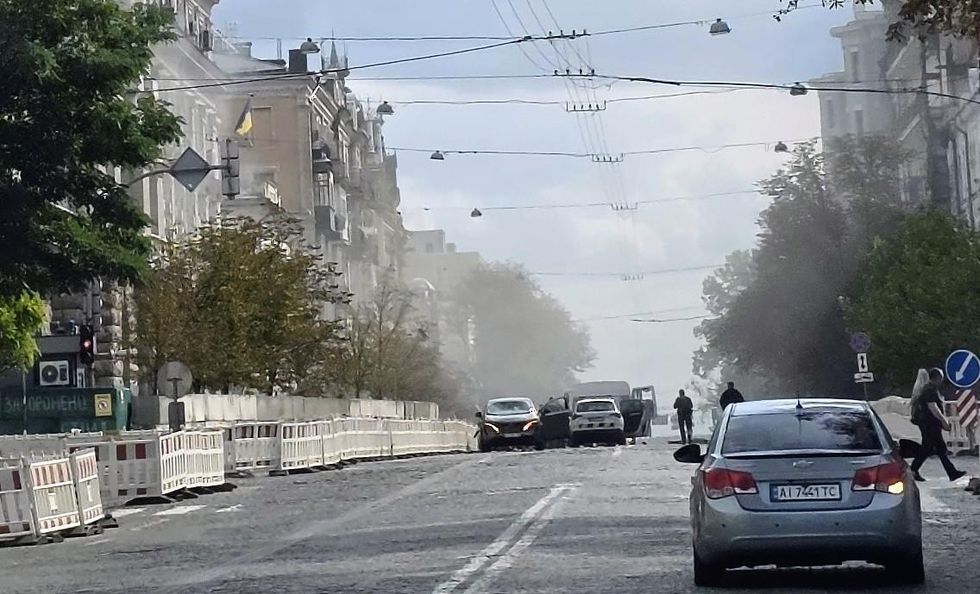
Russia’s AI Blueprint Exposes an Authoritarian Playbook

Russia, China, and Iran are all sharing the same playbook for corrupting Western elections. The United States is on track to be the next target this November.

A troveof Russian documents leaked in May outlines Moscow’s plans to use AI to warp foreign decision-making and sway elections. The Kremlin’s “Projects 2026” strategy reveals Russia’s plot to influence upcoming elections in Europe and Israel. Their tactics are similar to those used by China and Iran for years, and what emerges isn’t a Russian innovation — it’s a shared authoritarian playbook.

Projects 2026 calls for the creation of an opinion leader database to monitor the social media profiles of 10,000 influential individuals across Europe, including the 100 most prominent opposition figures in France alone. This is precisely the model Chinese state-aligned company GoLaxy piloted against the United States in 2025. The firm reportedly built constantly evolving psychological profiles of 117 members of Congress and roughly 2,000 additional American opinion leaders.

Researchers at Vanderbilt University warned that GoLaxy appeared prepared to target these individuals with messaging aligned with Beijing’s priorities. By monitoring the social media profiles of Western leaders, China and Russia are able to map the target’s values, beliefs, emotional tendencies, and vulnerabilities, making their influence operations more tailored and impactful.

In addition to using AI to build psychological profiles, the authoritarian playbook calls for countries like Russia and Iran to flood their targets with tailored generative AI content. Projects 2026’s “AI News” initiative calls for producing more than 500 short videos to target French audiences across six social media platforms. This tactic mirrors Iranian information operations during the 2025 and 2026 wars with Israel and the United States, when pro-Iranian networks pushed AI-generated and AI-assisted videos tailored to different audiences across X and TikTok, which racked up millions of views. These countries are running highly productive propaganda engines.

The most durable piece of Projects 2026 isn’t the content at all — it’s the plan to create fictitious think tanks and research institutes that can hand Russian narratives a “legitimate information source,” making them more likely to be cited by real news outlets and large language models. The leak shows this already underway: A site called the “World Center for Strategic Studies,” registered in March 2026, published unsigned analysis aimed at Western think tank audiences, with versions planned in German, French, and Spanish. The fake think tank doesn’t need to fool a discerning reader. It needs to get quoted, indexed permanently, and cited by the next AI model that goes looking for sources on the topic.

Iran ran a cruder version of this same play: Iranian state-sponsored cyber espionage groups have repeatedly impersonated real institutions — such as the Royal United Services Institute, the Aspen Institute, and the Washington Institute — to steal credentials and plant material under a trusted name. Projects 2026 proposes something more sustainable: Don’t just hijack existing credibility but manufacture new institutions and let them accrue it over time.

Projects 2026 also proposes building a real Israel-based research institute staffed by Israeli citizens with genuine academic credentials. This approach is reminiscent of the 2014 “Iran Expert Initiative,” where Iranian Foreign Ministry officials attempted to court and influence Western think tank researchers to promote their perspectives and give them legitimacy. Emails leaked in 2023 showed that Iranian diplomats had worked with Western experts across 10 think tanks to aggressively tout the merits of the 2015 nuclear deal between Tehran and major world powers, formally known as the Joint Comprehensive Plan of Action.

In the age of AI, influencing think tanks is narrative laundering at its most dangerous. Once a fabricated or state-aligned source gets cited by a legitimate outlet or indexed by a search engine, it can become part of the training and retrieval corpus that AI systems draw upon.

While the plays are reusable, the targets are new, and for Russia, the target is European elections.

The leaked documents outline a plan to swing Armenia’s parliamentary vote through a Russian-diaspora outlet and a “Mitteleuropa” initiative aimed at reshaping alignments in Hungary and Slovakia. This is where the surveillance, flooding, and laundering modules converge. To counter it, policy solutions must be swift and targeted.

First, allied governments should require disclosure of foreign funding and foreign state links for any media outlet, think tank, or “research institute” operating ahead of an election in an at-risk state — closing exactly the gap that lets a “World Center for Strategic Studies” pass as domestic and independent. Research by the Foundation for Defense of Democracies (FDD) into Qatari money in American higher education shows what a real transparency regimen requires: disclosures reaching individual researchers, not just institutions; low reporting thresholds with real penalties; registration in the style of the Foreign Agents Registration Act for state-directed “institutes” masquerading as independent organizations; and provisions against the kind of obstruction Qatar used to block Texas A&M’s funding records in court. Russia is proposing to build the same laundering vehicle in Europe that Gulf money has already normalized in American academia. The fix already exists — it just needs to be strengthened.

Second, platforms should both demonetize and remove unlabeled AI-generated political content during designated pre-election windows in at-risk states. X’s own emergency policy during the Iran war, which suspended digital influencers’ ability to monetize their content for 90 days on undisclosed AI-generated war footage, shows platforms already have the infrastructure to act fast when the stakes are high enough. But demonetization alone left the content up and circulating; independent researchers found AI-generated war footage kept flooding feeds regardless of the policy. Elections warrant a harder line: If posts feature undisclosed AI-generated content during an active election period, they shouldn’t just lose ad revenue. They should come down.

Third, Washington should prepare for future attempts at election influence by boosting the protection mechanisms it already has in place. Currently, 31 states have passed election deepfake laws, but they are under legal scrutiny because they touch on domestic speech. Federal action targeting foreign actors rests on firm ground. The 2002 McCain-Feingold Act prevents electioneering communications by foreign actors, but this only applies to broadcast, cable, and satellite communications. It must be updated to explicitly include paid internet and digital advertisements. It should also close the gap on AI-generated political content and require labeling so that foreign deepfakes can’t hide behind current ambiguities.

Projects 2026 is not evidence that Russia has cracked something new. It’s evidence that Moscow, Beijing, and Tehran are now running the same AI playbook against the same democracies, taking turns testing which module works best. The future outlined in Projects 2026 may not be here yet, but objects in the mirror are closer than they appear.

Leah Siskind is director of impact and an AI research fellow for the Center on Cyber and Technology Innovation (CCTI) at the Foundation for Defense of Democracies (FDD). For more analysis from Leah and FDD, please subscribe HERE. Follow FDD on X @FDD and @FDD_CCTI. FDD is a Washington, DC-based, nonpartisan research institute focusing on national security and foreign policy.

The Cipher Brief is committed to publishing a range of perspectives on national security issues submitted by deeply experienced national security professionals. Opinions expressed are those of the author and do not represent the views or opinions of The Cipher Brief.

Have a perspective to share based on your experience in the national security field? Send it to Editor@thecipherbrief.com for publication consideration.

Read more expert-driven national security insights, perspective and analysis in The Cipher Brief
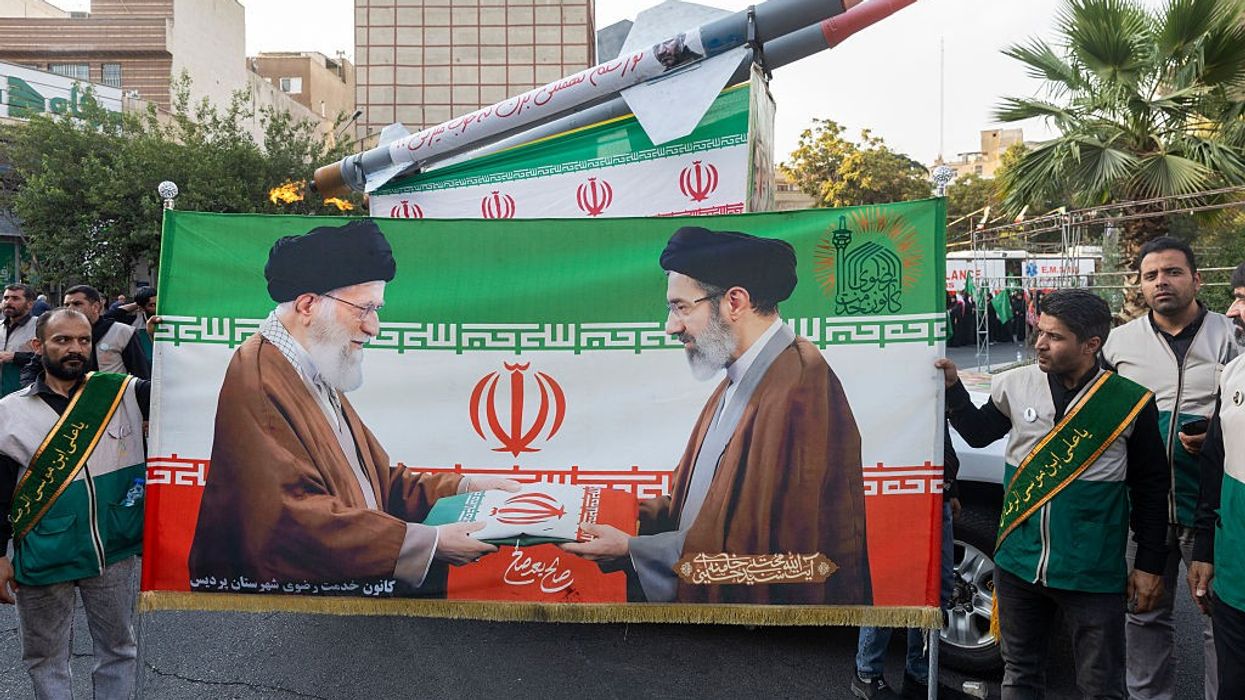
The Gulf Bought Its Air Defense From Kyiv. We Sold Them The Radar.

Chief Warrant Officer 5 (Ret.) Joey Gagnard concluded nearly three decades of service in the U.S. military, retiring from the special operations community in early 2025. He serves as CEO of Atlas Special Projects and Director of Field Operations at Swarmer.

Disclosure: Atlas Special Projects leads investor delegations to Ukraine and maintains working relationships with Ukrainian drone manufacturers, some of which would benefit from the arrangements argued for below. The argument is my own.

Welcome to The Iron Triangle, the Cipher Brief column serving Procurement Officers tasked with buying the future, Investors funding the next generation of defense technology, and the Policy Wonks analyzing its impact on the global order.

Riyadh, spring 2026. Between February 28 and the April 8 ceasefire, Iran put roughly 6,400 missiles and drones into the Gulf states and Jordan, more than eighty percent of everything it fired at anyone. Six countries fought six separate wars against one coordinated adversary, with no shared early warning and interceptor stockpiles that ran thin in days. An Iranian drone struck a tactical operations center in Kuwait and killed six Americans.

Three suppliers answered the same incoming fire. Here is the ledger.

The United States answered with paper. Over $36.6 billion in Foreign Military Sales notifications to the Middle East in a single quarter, headlined by 730 PAC-3 MSE missiles to Saudi Arabia for $9 billion. That is a little over $12 million per round, aimed at a Shahed that costs about as much as a used pickup, on a delivery schedule measured in years.

Ukraine answered with people. Washington asked Kyiv on a Thursday to send interceptor teams to protect American bases in Jordan, and Kyiv said yes the same day. Within weeks about two hundred Ukrainian advisors were on the ground in Saudi Arabia, Qatar, and the UAE with interceptors that Ukraine sells for between $800 and $3,000 and builds at two thousand a day. Days after the Jordan request, the President went on Fox News Radio and said, “We don’t need their help in drone defense. We know more about drones than anybody.”

Turkey answered with a delivery date. Kuwait signed a government-to-government protocol with Aselsan, Havelsan, and Baykar for Hisar and Korkut air defense, and Riyadh, Doha, and Abu Dhabi opened their own talks with Ankara, because Turkey could put hardware on a ramp this decade and the American backlog for Patriot and THAAD runs to several years.

Then, on March 27, Saudi Arabia signed a ten-year defense partnership with Ukraine built around counter-drone technology and co-production facilities on Saudi soil. Qatar signed two days later. The UAS followed in April. Ten years each, minimum.

So the outcome of America’s largest arms-sales quarter in memory is that our closest Gulf partners now buy their sensors from us and their answer to the actual threat from Kyiv and Ankara. We sold them the radar. Somebody else sold them the thing that shoots.

Expensive Confetti

The arithmetic is not subtle, and the Gulf did it faster than we did. Iran can turn out hundreds of Shaheds a week. The U.S. builds roughly six hundred Patriot interceptors a year, for the whole world, with a waiting list. A Patriot battery is a good answer to a question Iran stopped asking in about 2019.

The Ukrainian answer is a different species. The Wild Hornets Sting costs about $2,500, flies at 195 miles an hour, fits in a duffel bag, and has killed nearly 4,000 Russian drones since may 2025. The SkyFall P1-SUN costs about $1,000, flies at 280 miles per hour, and took down 1,500 Shaheds in its first four months. One Ukrainian firm sold a thousand of them for $3.5 million, total, which is less than a third of one PAC-3 round. More than twenty Ukrainian companies now build interceptors and the Octopus alone is licensed to fifteen of them.

None of this makes the Patriot obsolete. Interceptor drones do not touch ballistic missiles ,and the 6,400 included plenty. But the Gulf learned in six weeks what Ukraine learned in three years: you defend against a thousand cheap things with two thousand cheaper things, and you save the twelve-million-dollar round for what it was built to hit.

Built in Munich

Here is the detail that turns the Gulf story into an Iron Triangle story. The Pentagon has bought exactly one interceptor with a Ukrainian combat record. In May, Joint Interagency Task Force 401 gave Perennial Autonomy, Eric Schmidt’s company, a three-year, $500 million ceiling for the Merops interceptor, a fifteen-thousand-dollar fixed-wing that has downed more than 4,000 Russian drones over Ukraine. It is the right buy. It is also built in Germany, through a partnership with Munich’s Twentyfour Industries.

The American flag interceptor, proven in Ukraine, bought by the Pentagon for the homeland, is made in Bavaria. This is not a scandal. It is a symptom. The design talent is in Kyiv, the production tooling is in Europe, and the one thing that has to be in the United States, the contract, is the only part we have managed to put here.

Meanwhile the July agreement that lets Ukraine sell to the Pentagon for the first time since 2022 approves six Ukrainian companies to ship about one hundred drones for testing under Drone DOminance, and contemplates, someday, Ukrainian production on American soil. One hundred drones. Kyiv ships that many to Riyadh before the coffee is brewed.

What an American Flag Would Actually Mean

Not an American airframe. That race is over; twenty Ukrainian firms iterate faster than any American line will for years, and pretending otherwise is how we ended up with a hundred test articles and a factory in Munich. The American contribution is the three things nobody else at the table can bring.

The first is the kill chain. An interceptor without a sensor network is expensive confetti with a propeller. Ukraine’s cheap drones work because they fly under a national acoustic and radar mesh that took three years to build. The Gulf has no such thing; the after-action reports say so. Turkey cannot integrate Korkut with Patriot and THAAD. The United States owns IBCS, the LTAMDS radars Kuwait just bought eight of for $8 billion, and the $4.5 billion discrimination radar the UAE is buying for THAAD. The offer writes itself: your thousand-dollar Ukrainian interceptor gets cued by our eight-billion-dollar sensor layer. That is the flag.

The second is the paper. Licensed co-production under FMS is a forty-year-old tool. Abrams in Egypt. F-16 in Turkey. Patriot itself in Japan. The structure is a trilateral: Ukrainian design and Ukrainian intellectual property, Gulf capital and final assembly to satisfy Vision 2030 localization, American components, integration, and the FMS wrapper that turns a purchase into a security relationship. The UK has already proven the licensing half, building Octopus interceptors in Britain at a thousand a month and sending them back to Ukraine.

The third is reciprocity. Kyiv’s own ask was one sentence: “We can help you fight against Shaheds. Help us fight against ballistic missiles.” Gulf money buys the interceptor line. A slice of the PAC-3 allocation that the Gulf money is already funding flows to Ukraine. Stings for Patriots. Three countries get what they cannot build, and the United States is the reason it happens.

What It Has Not Happened

Every obstacle is one I have written about before, which is the depressing part.

Start with ITAR. The moment a Ukrainian design is produced by an American licensee with American controlled content, it becomes ITAR-controlled, its re-export to Riyadh needs a DDTC license, and Kyiv loses the freedom to sell the same design to Oslo. Ukrainian founders already decline to domicile intellectual property here for exactly this reason. The fix is the one I argued for in July: a trusted-trader tier, or an AUKUS-style exemption scoped to the trilateral, with the IP staying in Kyiv and the United States as licensee rather than owner.

Then the parts bin. A thousand-dollar P1-SUN is a thousand-dollar P1-SUN because of Chinese motors, cells, and cameras. Under an American flag it must clear NDAA Section 848 and, if the Department of War is the buyer of record, the Blue UAS list. The cost of making the interceptor American is not the airframe. It is the audit and the re-sourcing, and nobody in the building has priced how much of the thousand dollars survives that. Turkey does not have this problem. That is the entire reason Turkey is winning the Gulf.

Then tempo. Ukraine signed three Gulf deals in about three weeks. FMS notification to first delivery is measured in Congressional recesses. Either the trilateral runs on Direct Commercial Sales with expedited licensing, or it is a press release.

And then the politics, which I will state once and then be finished. The Commander in Chief said we do not need their help days after his own government asked for it, and the Pentagon spent the spring resisting broader cooperation. The Gulf hosts Russian diplomacy. Kyiv keeps state control over exports, with its own forces first in line. None of these are fatal. All of them are real.

For the Procurement Officer. Your requirement is not an interceptor. It is a kill chain that accepts an interceptor you did not design. Write the sensor and command-and-control interface as the requirement and let the airframe compete, or you will spend the next POM cycle buying an American drone that arrives in 2029.

The Investment Thesis. The value in this market is not in the airframe and it never was. It is in the integration layer, the domestic component that lets a Ukrainian design survive Section 848. And the licensing paper. The company that can take a thousand-dollar Kyiv design and hand the Pentagon an American-compliant unit at two thousand, on a line this side of the Atlantic, is worth more than the company that designs the next one.

The Policy Wonk’s Warning. The security guarantee is being unbundled from the hardware. For seventy years those were the same product. Our partners are learning they can buy the guarantee from us and the shooting from someone else, and the day they discover they can buy the sensors elsewhere too, the guarantee is just a speech.

My Take. I have been in the room in Kyiv when founders explain, patiently, why they will not bring their IP to America. It is not ingratitude. It is that our export regime treats an ally’s design as a hostage the moment it touches our supply chain. We asked those same founders for help defending our bases in Jordan, and they sent people the same day, and then we told the world we did not need them. I have watched a lot of good capability lose to bad processes. I have not often watched it lose to bad manners.

The Risk. A co-production line in the Gulf is a leakage path to whoever the Gulf talks to next, and that list includes Beijing and Moscow, which is precisely why the British license sends its output home to Ukraine rather than into a third market. Iran is already fielding jet-powered Shaheds that outrun a Sting. And anyone who reads this as an argument to cancel the Patriot order has misread it; the 730 rounds to Riyadh are for the thing the drones cannot touch. The argument is not fewer Patriots. It is that a thousand-dollar problem should not be the one part of Gulf air defense that American has nothing to do with.

We spent the spring selling our partners the most sophisticated radar on earth. Kyiv and Ankara sold them what the radar is for. When the next 6.400 comes over the horizon and the Saudi interceptor that meets them has a Ukrainian design, Turkish neighbors, Chinese motors, and an American radar track, whose air defense is that?

The Cipher Brief is committed to publishing a range of perspectives on national security issues submitted by deeply experienced national security professionals. Opinions expressed are those of the author and do not represent the views or opinions of The Cipher Brief.

Have a perspective to share based on your experience in the national security field? Send it to Editor@thecipherbrief.com for publication consideration.

Read more expert-driven national security insights, perspective and analysis in The Cipher Brief
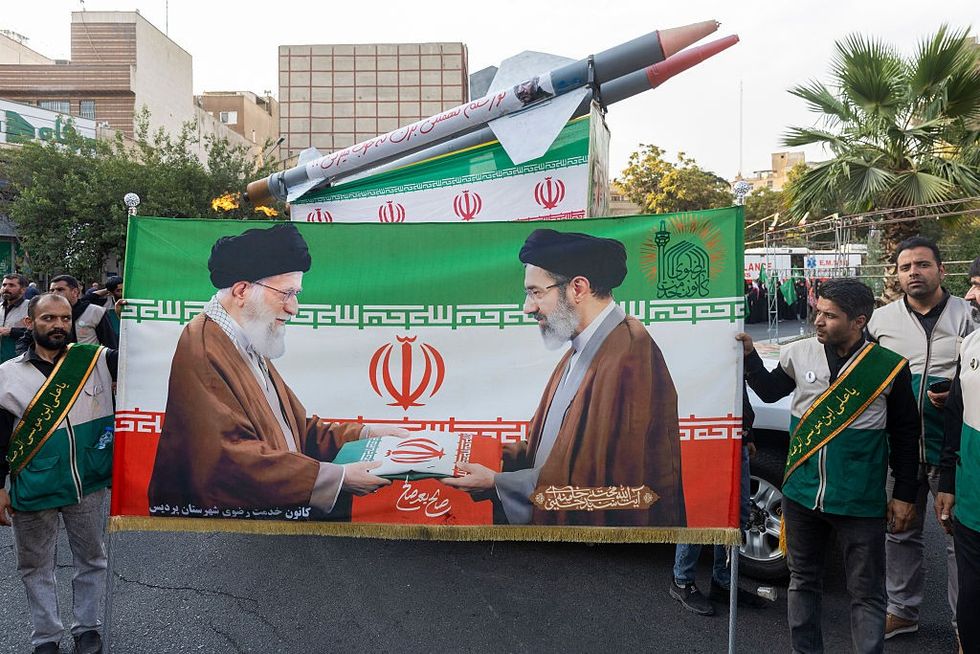
A Former CIA Station Chief on Kyiv Under Drone Siege


Reporting live from Kyiv, Cipher Brief expert and former senior CIA officer Ralph Goff walks CEO and Publisher Suzanne Kelly through a drone strike that hit the SBU headquarters in the heart of the city today.

Ukraine’s SBU — the Security Service of Ukraine (Sluzhba bezpeky Ukrainy) — is best described as Ukraine’s principal domestic security and counterintelligence service, although its wartime role has become substantially broader and more operational.

The closest U.S. analogy would be a combination of responsibilities that are divided between the FBI, the CIA and specialized military/intelligence capabilities, here in the U.S. The SBU is responsible for counterintelligence, counterespionage, counterterrorism, protecting state secrets and investigating threats to Ukrainian national security. Since Russia’s full-scale invasion, it has also become a significant wartime intelligence and covert-action organization.

Kelly talked with Goff about the impact of a Russian drone attack on the organization's headquarters and the surprising resilience of Kyiv residents in the strike's aftermath.

Kelly: You've been on the ground in Kyiv for a couple of days, but there was quite an incident this morning amid near-nonstop air raids that have lasted for more than a week now. Tell us about where you were and what you heard this morning near SBU Headquarters.

Goff: Today in Kyiv we had some air raid alerts overnight, then some in the morning, and a couple more during the day. But today was followed up with a couple of drone strikes right in the middle of Kyiv. Early this afternoon, one struck the headquarters of the Internal Security Service, the SBU, which seems like a very deliberate, targeted attack by the Russians. Unfortunately, there were some casualties, I don't think anyone was killed, but there were wounded, and some damage to the building. It was a very clear sign from the Russians that their jet-powered Geran drones are not only hard to intercept, but very accurate.

Kelly: The Cipher Brief has been in that area of Kyiv with you several times in the past, Ralph. That's essentially the inner circle, where the government operates. We've been wondering how long it would be before some of these significant targets got hit, given Ukraine's shortage of anti-missile systems. What's it been like on the ground since you arrived three or four days ago? Is there a heightened sense of anxiety?

Goff: There is, among parts of the population, but I'd say for most people it's more a heightened sense of annoyance. Here we had a drone strike right in the heart of Kyiv, at the SBU building, and most people's biggest concern afterward was how it messed up traffic downtown, it's a major artery, so there were traffic jams all around. History is replete with examples where so-called strategic bombing of civilian targets or major cities to break the will of an enemy has never worked, and I don't see that working here either.

I do think it's a clear sign that Ukraine has to find a way to close the gap and counter these new high-speed, high-performance drones. We hear reports of an 85 to 90 percent interception rate on conventional, piston-engine drones, the regular Shahed-type drones. But with the jet-powered drones, we've heard the interception rate drops to much lower figures, which I won't get into because I don't want to give the enemy that kind of data. And when it comes to missiles, the press has already reported that the Ukrainians are so low on counter-missile capabilities that they rarely intercept any ballistic missiles launched into Ukraine.

Kelly: When you're watching this war from afar, it's hard to get a clear sense of how much time is left before Kyiv, Lviv, and other major cities are in real trouble. Kyiv has always had the strongest air defenses. Is Kyiv running out of time?

Goff: I don't think they're running out of time so much as, I think they will close the gap, they will solve the technical issues and improve their defenses, but it will take time, and they'll suffer in the meantime. I'll say it's going to be a bad winter; I'm fairly certain of that. But the Russians didn't break the Ukrainian spirit last winter, and they won't break it this year either.

On the other hand, there's an interesting dichotomy of feelings and morale. At the front, I was talking to a friend who's been deeply involved in providing intelligence assistance to frontline units, a non-governmental source, and he said that for the first time since he's been here, every unit he visited had high morale. We're looking at a battlefield now where the casualty ratio is probably eight to one in favor of the Ukrainians. Eight to one, that's an astounding number. So you have this high morale at the front, where soldiers are saying, “we think we can pull this off.” And then in the cities, you have people increasingly concerned about the welfare of their families and children because of these blatantly terroristic attacks on civilian targets. There's a real dichotomy emerging in the middle of this war.

Kelly: On that eight-to-one figure, is that because so much of the fighting on the front lines now is essentially robot-on-robot, drone-on-drone combat? Or is something else driving that number?

Goff: That's a large part of it, but at the end of the day you still need soldiers fighting soldiers. What it comes down to is who has better mastery of the battlefield, and the Ukrainians have information dominance. On top of that, they're the defenders, they can dig in and weather the storm, whereas the Russians are still relying on high-cost, high-attrition tactics, sending soldiers out literally in ones and twos to try to infiltrate Ukrainian positions. But they're very vulnerable, because the battlefield has become so saturated with drone coverage and surveillance, what we call ISR, intelligence, surveillance and reconnaissance. The Ukrainians have really mastered that, and it's given them a huge advantage. That could change, the Russians aren't sitting back, they're innovating too, but for now the Ukrainians have an edge, and they're going to keep innovating to maintain it.

Kelly: There have been a lot of headlines about domestic issues that President Zelensky is dealing with this week in Kyiv, even as he wages this war, including the departure of Minister Fedorov, who's been pushing forward on defense technology and made some announcements this week here in the U.S. about that. What's different now in terms of the strength, stability, and unity of the government? We know the unity of the people is hard to break, but how are you looking at this through the government lens?

Goff: The big difference now is that the innovation and technical advances made by the Ukrainians don't depend on one person. This isn't some technological breakthrough that depends on one minister or one ministry, it's government-wide, across the various ministries and different commands. It's a multi-echelon effort where technological innovation isn't just pushed down to the lowest levels, it's driven by the lowest levels. It runs from top to bottom and bottom to top. So whether you change a minister or change a commander, like the change from Syrskyi to Drapatyi, that doesn't change. The innovation has reached all levels, and it's here to stay.

Kelly: I'm jealous The Cipher Brief isn't there with you right now, we usually are, and we like being there because you're attending a number of interesting and enlightening meetings while in Kyiv. Has anything surprised you this time, or really stuck with you, from this round of meetings?

Goff: Nothing ever really surprises me here. I think one of the reasons I come is for my own benefit, I always leave more inspired than when I arrived. A good example: we had this horrendous drone strike in the middle of the city, and within minutes people were just going about their daily lives. The emergency response was there, I watched ambulances flowing to the scene, first responders arriving. I actually marveled at that, because my initial instinct was to stay away, given the Russian penchant for the “double tap”, hit the target, wait a few minutes until first responders arrive, then hit it again. Even knowing that's a Russian tactic, the first responders were there within minutes.

As I continued on to my next meeting, people were going about their lives, doing their shopping, going to work, going to the grocery store. They weren't deterred by the event. And while that doesn't surprise me, it does inspire me.

Kelly: What about the significance of the SBU? A lot of people may not understand exactly what it does, it's similar to our own intelligence gathering but with other functions too, almost a combination of the CIA and FBI if we're relating it to the U.S. Tell us about some of its operations and why it's an important organization in Ukraine.

Goff: It's an important organization because, yes, they have the primary mandate for internal security in Ukraine, but they're also involved in long-range strikes into Russia. If you see press reporting on some sort of assassination attempt, like the Russian air force general who was shot the other day, that's pretty much the SBU, showing they have a long reach into Russia. So they're playing on multiple levels, and they're an important player. This is a sign that Russia knows who they are and where they are.

But taking out the SBU headquarters is probably inconvenient for some time, and there will be losses. The Ukrainians have decentralized much the same way they've decentralized the structure of their military intelligence community, they've decentralized command and control. So if you take out the SBU headquarters, I'm sure within minutes there's a backup headquarters and contingency plans in place. The Ukrainians are well aware of Russia's capability to strike their headquarters.

Kelly: It's been a little while since you were working as a CIA station chief, you held six different postings in that role. If you were filing something back to the United States today, what's the most important thing you'd want people to understand about what you're seeing there?

Goff: That the war is entering a different phase. And if the war is entering a different phase, it means the Ukrainians are going to have to react differently, which means their allies are going to have to react differently, which means those of us in the intelligence community are also going to have to change our game and adjust. We're going to have to be prepared to support the Ukrainian effort to defend themselves, and if that means an active defense against the Russians, that would be my recommendation.


The Cipher Brief is committed to publishing a range of perspectives on national security issues submitted by deeply experienced national security professionals. Opinions expressed are those of the author and do not represent the views or opinions of The Cipher Brief.

Have a perspective to share based on your experience in the national security field? Send it to Editor@thecipherbrief.com for publication consideration.

Read more expert-driven national security insights, perspective and analysis in The Cipher Brief
The Cultural Roots of Strategic Surprise and Resilience: the Israeli case of October 2023

October 7th, 2023, 06:29 AM. Probably the most tragic day in Israel’s history. A surprise attack conducted by Hamas from the Gaza Strip caught Israel completely off guard. Hamas terrorists infiltrated Israel, killing more than 1200 Israelis and abducting more than 250 individuals into the Gaza Strip. They exercised mass murder and rape, effectively conquering parts of Israel’s Western Negev for several hours. This was a colossal military and intelligence failure, more dramatic than that of the Yom Kippur War in 1973. It was also, of course, a policy failure. The core foundations of Israel’s security doctrine – defense, early warning, and deterrence – completely shattered.

How could this happen to the Israeli Defense Forces (IDF), one of the best militaries in the world, and to one of the best intelligence communities in the world? For me, as a brigadier general in the Israeli Defense Intelligence (IDI) reserves with decades of practical experience, and as a scholar of Israeli strategic culture and intelligence culture, this was a puzzle. Almost inconceivable. I was surprised by the magnitude of Israel’s surprise. How could Israel’s security establishments reach October 7th with their “eyes wide shut” about Hamas intentions and capabilities?

But as the regional war which followed October 2023 commenced, I recognized another interesting puzzle. Israeli security establishments have, writ large, recovered from the failure of October 2023, with Israel fighting for almost three years in several fronts, from the Gaza Strip to Iran. Although not gaining “total victory”, these establishments reached impressive operational achievements. They dismantled most of Hamas’ military and civilian infrastructure in the Gaza Strip and eliminated most of Hamas leadership in the Middle East; dismantled most of Hizballah assets in Lebanon, while also eliminating Hizballah leader Nasrallah, and demoralizing Hizballah in the famous pagers operation; destroyed many of the Houthi assets in Yemen; and in June 2025 and March 2026, conducted unprecedented attacks in Iran, including the elimination of Iran’s Supreme Leader and most of Iran’s military leadership, and degrading Iran’s nuclear and military capabilities.

How could the same establishments, which colossally failed to prevent the Hamas attack in October 2023, reach such achievements during 2024 and 2025? How could an intelligence system completely surprised by Hamas allow Israel to completely surprise Iran, the regional super-power? How could Israel “turn the tides” of the war after October 2023, and then, like the Phoenix from Greek mythology, “rise from the ashes” and conduct phenomenal strikes in Iran?

These are the topics I discuss in my new book, which reveals the cultural roots of Israel’s strategic surprise in October 2023, and of Israeli resilience following October 2023. The book knowingly focuses on Israel’s security establishments, and not on Israeli policy makers. Its scope is limited, and its conclusions will naturally be debated.

I open the book by acknowledging that some of my previous insights, which characterized Israeli intelligence culture prior to October 2023, were wrong. For instance, I assessed that this culture relies on professional norms and values of critical thinking, a sense of individual responsibility, and moral courage in the face of hierarchy. October 7th, unfortunately, showed that some of these remained aspirational norms rather than realized behavior in Israel’s security establishments.

Several typical facets of Israeli strategic and intelligence cultures account for both failure and success. For instance, the Israeli typical focus on operational, tactical, and targeting intelligence prior to October 7th resulted in an under-appreciation for strategic analysis, military analysis, and strategic early warning from war. The low quality of these disciplines was one of the factors for the October 7th failure. But the inclination towards targeting intelligence, and the close integration of intelligence into decision-making and operations, also enabled Israel to conduct ground-breaking overt and covert operations across the Middle East, relying on high-resolution and real-time targeting intelligence. Many more examples are discussed in the book.

However, the book stresses that strategic culture and intelligence culture are not unitary in essence, nor are they fixed in time. Changes in these cultures can be caused by trauma, or by competition for dominance between sub-cultures. For instance, in the years prior to October 7th, hubris evolved in Israeli security establishments, which not just underestimated Hamas, but also overestimated their own military and intelligence capabilities. October 7th, naturally, created a post-traumatic effect. Israeli deterrence-oriented security doctrine, which was dominant prior to October 7th, became heavily oriented towards prevention after October 7th, not just regarding adversary nuclear projects. This “move between extremes”, or “over-adaptation”, is for itself typical of Israeli strategic culture.

In conclusion, the book applies the frameworks of strategic culture and intelligence culture to a real-world case of security performance. This perspective does not only apply to Israel. In the US, for instance, it can allow critical introspection of the recent conflict with Iran, including the repeated experienced surprise the US seems to be experiencing. Furthermore, understanding partners’ and allies’ cultures, and not just adversary ones, is an imperative. Especially for American scholars and practitioners. The book makes an important contribution to this perspective. At the end of the day, national security is all about people. Society and culture play a major role.

The Cipher Brief is committed to publishing a range of perspectives on national security issues submitted by deeply experienced national security professionals. Opinions expressed are those of the author and do not represent the views or opinions of The Cipher Brief.

Have a perspective to share based on your experience in the national security field? Send it to Editor@thecipherbrief.com for publication consideration.

Read more expert-driven national security insights, perspective and analysis in The Cipher Brief

Ukraine Is No Longer the Country Russia Thought It Was

Understanding a country's strategic culture helps assess how it will react to crisis, negotiation, and national security events. Strategic culture generally is static and when it evolves, it happens slowly, as history, events, and culture accumulate over generations. In 2021, the prevailing view of Ukraine’s strategic culture was that it was a country focused on securing its national identity and sovereignty apart from Russia and it was a country prone to rely on negotiations and diplomacy. The balance between these two themes was about even with Ukraine leaning toward diplomacy and multilaterism over sovereignty when pushed by the international community. Most students of strategic culture did not assess that Ukraine would react to a Russian invasion with the military force that it has. Now students of strategic culture see the theme of independence and sovereignty as the key aspect of Ukraine’s strategic culture with a growing theme of being modern day military experts. The rapid transformation of the assessment of Ukrainian strategic culture is astounding. Either strategic culture academics got Ukraine wrong, or the Russian invasion changed Ukraine cataclysmically. I suspect it is a bit of both.

Strategic Culture

Strategic culture refers to a nation's shared beliefs, assumptions, and habitual behaviors regarding the use of force and the pursuit of security objectives. Jack L. Snyder introduced the term in 1977, arguing that a state's behavior cannot be explained by material capabilities or geography alone, but by those factors combined with history, cultural norms, and shared societal beliefs. Strategic culture is generally resistant to change. While it is often invoked to explain Russia's decision to invade Ukraine — its relevance to Ukraine's response has been comparatively overlooked.

Ukraine's Early Strategic Culture

Ukraine's strategic culture has been shaped by centuries of foreign domination and by its Soviet legacy. Early studies of strategic culture in independent Ukraine identified securing a national identity separate from Russia as the paramount objective. Those same early studies concluded that Ukraine favored diplomatic engagement, multilateral cooperation, and alliance-building over military action — pointing to Ukraine's surrender of its nuclear arsenal after the Soviet collapse and its acquiescence to Russia's 2014 seizure of Crimea as evidence. But this reading likely mistook constraint for preference. Ukraine was a newly independent state with a fledgling security establishment and military; it lacked the structure and capacity to stand up to either the United States or Russia, both of which pressed it toward disarmament and restraint. And, while significant events, neither of those two events were an immediate threat to Ukrainian independence. What looked like a cultural preference for negotiation may have been the best available option available for a young, under-resourced state. This misreading of Ukrainian resolve and strategic culture set Russia up for a catastrophic miscalculation that has cost over a million lives and will take decades for both countries to recover from.

The first principle of Ukraine’s strategic culture — safeguarding a distinct national identity — endures today. But the second focus on diplomacy and multinationalism-- has changed. If successful, the Russian invasion would have meant that this first principle would have to be abrogated and Ukrainian identity would once again have been subsumed by Moscow. Ukraine could not tolerate that: fighting for independence and Ukrainian identity outweighs alliance-building and negotiations as the organizing goal of its strategic culture. Today, Kyiv increasingly foot stomps aspects of Ukrainian identity that were suppressed under Soviet rule, and its foreign policy has grown more assertive, favoring offensive posture over purely defensive behavior. What has emerged is a culture that balances patience for international negotiation with adaptability and a hardened determination not to be conquered again, at any cost.

Two Defining Characteristics

Two characteristics of Ukrainian strategic culture stand out as key to explaining Ukrainian resistance to Russia:

Ukraine's growing emphasis on its Cossack heritage appears designed to construct a new state myth and reshape national self-perception from one of victimhood to one of warrior. Invoking the Cossacks — a self-governing, democratic, and militarily capable community prone to raids and revolt — underscores both Ukraine's independence and its capacity for military action. Domestically, images of the great hetmans now appear more prominently on currency and in textbooks.

Ukrainian strategic culture rests on the primacy of sovereignty, independence, and territorial integrity — values Russia has threatened or dismissed both historically and in the present. Language has become a central tool of this identity claim: early post-independence legislation established the primacy of Ukrainian language to rebuild a cohesive national identity, and that legislative push accelerated around the outbreak of armed conflict in 2014, alongside a marked cooling toward proposals to formalize Russian as a second official language. For Ukrainians, language is intrinsic to national identity. I recall being tutored in Ukrainian by an émigré in the late 1980s; he was a tough teacher, and he would grow angry whenever I mistakenly lapsed into Russian even though it was our common language and at times the only language in which we could communicate.

Ukrainian Strategic Culture Today

Ukraine's strategic culture now manifests as an asymmetrical, creative approach to security — one that offsets comparatively limited military resources with international partnerships, novel approaches to warfare, and disciplined strategic messaging. It emphasizes flexibility, resilience, gray-zone tactics, and pragmatic decision-making. Increasingly, we are seeing Ukraine promoting its tactics and military resources internationally.

Ukraine's strategic norms are still evolving, but the trajectory since independence is clear: independence and ingenuity have become the paramount, defining components of Ukrainian strategic culture, expressed through firm state priorities. A lasting orientation toward the West, paired with renewed emphasis on Slavic and Cossack roots, matters too, if somewhat less centrally. Above all, a study of modern day Ukrainian strategic culture tells us that Ukraine will do what it must to preserve its hard-won independence — while still maintaining its position as a respected leader within the global community.

Recently, the new Ukrainian Minister of Defense, Yevhenii Khmara, said

”Ukraine has always seen tragedy. Its history is a long inventory of it. What separates this generation from all the ones before is that it has a real chance to defeat the enemy.”

This tells you a lot about the mindset of senior Ukrainian decision makers and how they are messaging their people and the international community.

Why it Matters

Understanding Ukrainian strategic culture helps us to determine what approach to take to help end the war in Ukraine. Paramount for the country is ensuring Ukraine’s sovereignty and independence. For Ukraine, that is nonnegotiable. Any negotiating concepts that leave room for other nations to impose themselves on Ukrainian decision making is a nonstarter for Kyiv. Recognizing Ukraine’s sacrifices not only in the last four years but the tragic historical road they have been on with pre Soviet Russia and the Soviets will go far in any negotiations. Finally, acknowledging and highlighting how well Ukraine has out played Russia would also go a long way. Next, I will present Russian strategic culture and then discuss where the two clash.

The Cipher Brief is committed to publishing a range of perspectives on national security issues submitted by deeply experienced national security professionals. Opinions expressed are those of the author and do not represent the views or opinions of The Cipher Brief.

Have a perspective to share based on your experience in the national security field? Send it to Editor@thecipherbrief.com for publication consideration.

Read more expert-driven national security insights, perspective and analysis in The Cipher Brief
Beyond Military Interoperability: The Coalition Challenge of Limited War

In our last two articles for The Cipher Brief, Sami Omari and I explained why modern limited wars are so challenging for democracies.

We argued that military superiority is necessary but not sufficient for strategic victory: Afghanistan and Iraq showed that battlefield success does not guarantee lasting political outcomes, and Iran may yet prove the same point.

We also examined why democracies struggle to translate tactical success into strategic achievement: fragmented institutions, electoral cycles, public opinion and media scrutiny complicate the political resolve required for prolonged wars of choice.

The challenge becomes greater when democracies fight as coalitions.

Alliances combine military power, share costs and draw on capabilities few states could sustain independently.

But military integration does not produce political unity.

Each member remains accountable to its own electorate, parliament and national interests. A coalition may therefore be highly integrated on the battlefield while remaining politically and strategically decentralised.

In prolonged limited wars, military interoperability is not enough if allies cannot sustain the political will, industrial capacity and common strategic purpose required to endure.

II. Why Democracies Fight in Coalitions

The nuclear age made direct great-power war prohibitively dangerous, shifting competition towards limited wars, insurgencies and proxy conflicts.

Western militaries increasingly moved towards smaller professional forces equipped with more advanced weapons, shaped by technological progress and new strategic realities.

After 1991, the Gulf War and subsequent operations against weaker adversaries appeared to vindicate the effectiveness of Western expeditionary forces.

But smaller professional militaries and increasingly expensive weapons also made allies progressively dependent upon one another. Coalitions allowed democracies to aggregate military power, intelligence, logistics and specialised capabilities without each maintaining the forces and industrial capacity required for large-scale national mobilisation.

For thirty years, that system seemed to work.

Russia’s war against Ukraine has exposed these vulnerabilities over several years; the US-Israeli war with Iran is now testing many of the same assumptions.

Both demonstrate that limited wars can become contests of manpower, industrial capacity and political will.

Of these pressures, political endurance is perhaps the most difficult for democracies to sustain.

III. The Political Endurance Problem

For democracies, fighting a long, limited war depends as much on political legitimacy at home as on military capability.

In wars of choice, where national survival is not at stake, governments must continually justify why the costs of war remain necessary.

Initial public support may create space for intervention, but it erodes as casualties rise, costs accumulate, and the prospect of a clear strategic outcome grows uncertain.

Casualties alone do not determine support.

Democratic societies have accepted heavy losses when citizens believed a war was legitimate, necessary and winnable.

The deeper problem emerges when the link between sacrifice and strategic purpose becomes unclear. As confidence in success fades, losses that once seemed tolerable turn politically damaging. Elections, parliamentary opposition, media scrutiny and changes of government then allow declining public confidence to reshape national strategy. Afghanistan illustrated this over two decades.

Western military superiority was never in doubt, but political will steadily weakened. The longer the war continued without a convincing political end state, the harder it became for democratic leaders to explain what more time, money and lives would achieve.

Authoritarian states face similar pressures but, without competitive elections and independent media, can better insulate strategic decisions from public opinion.

Against democratic opponents, this creates a critical asymmetry: a weaker adversary may not need to win militarily, only survive long enough for democratic political will to erode.

IV. The Industrial Endurance Problem

Political endurance is only one side of the problem. The other is material.

Since the Cold War, Western militaries have increasingly relied on technology instead of mass.

Smaller professional forces employ sophisticated aircraft, ships, missiles and networked systems aimed at achieving decisive results while minimising casualties. But each generation of weapons is more expensive and complex, production runs shrink, and replacing battlefield losses becomes harder as war drags on.

The United States can absorb these pressures better than smaller allies because of its defence budget, technological base and industrial scale.

Even so, American forces became smaller, while defence-industry consolidation reduced the number of manufacturers capable of producing specialised weapons. For smaller allies, limited budgets forced difficult choices between personnel, platforms and munitions, while dependence on American weapons, software, supply chains and sustainment deepened.

Quick wars against weaker opponents long obscured these problems.

Ukraine has brought them sharply to the surface, while the Iran conflict is testing them anew. Advanced weapons can be consumed faster than peacetime factories replace them, while cheap drones and missiles allow weaker states to impose continuing costs on advanced rivals.

This creates an uncomfortable paradox.

Military interoperability strengthens coalitions on the battlefield but also creates industrial dependencies that are difficult to escape. In long, limited wars, technological superiority matters only as long as the coalition can afford, produce and replace what it consumes.

V. A Coalition of Decentralised Systems

Coalitions do not solve the political endurance problem; if anything, they make it worse.

Integrating militaries does not erase national sovereignty. Allied forces can share command structures, intelligence and interoperable systems, but each government still answers to its own voters, parliament and interests.

Afghanistan made that painfully obvious. NATO operated under one mission on paper, but contributing states imposed their own caveats and restrictions on where and how their troops could operate.

Those caveats were not bureaucratic quirks; they reflected different domestic political pressures and appetites for risk. They made burden-sharing and coalition cohesion harder than the unified-command narrative suggested.

Of the contemporary great powers, the US above all can supply the backbone of an international military coalition: intelligence, logistics and advanced capabilities.

What it cannot do is fuse the sovereign political systems behind every other contributor.

Middle and smaller powers like Australia and Canada still matter because they bring niche capabilities, diplomatic weight and political legitimacy while operating inside their own domestic constraints.

Coalitions may fight as one integrated military network, but the statecraft holding that network together stays stubbornly decentralised.

VI. From Military Interoperability to Strategic Interoperability

This gap between integrated military networks and decentralised statecraft is the central weakness of contemporary coalition warfare.

Modern limited wars therefore require more than military interoperability. They require strategic interoperability.

Sovereign allies must be able to coordinate military, political, economic and industrial power to pursue and sustain a common strategic objective.

This does not mean supranational government or surrendered sovereignty, but unity of strategic effect even when national policies differ.

In practice, this could involve standing allied mechanisms that integrate political planning, defence production, economic measures, strategic communications and military operations around an agreed political end state before a crisis becomes a prolonged war.

Conclusion

Across these three articles, we have argued that military superiority alone cannot guarantee strategic victory; that democratic institutions often struggle to turn battlefield success into sustainable political outcomes; and that these difficulties multiply when democracies fight as coalitions.

The endurance of democratic alliances will depend on more than their ability to fight together.

Sovereign governments must sustain public support, share political and military burdens, and remain committed to common strategic purpose when conflicts become longer and more costly than expected.

Democratic accountability need not become a strategic weakness, but preserving sovereignty while sustaining collective action will require greater political cohesion.

The ultimate obstacle is not technology or concepts, but political will: overcoming domestic divisions and institutional rivalries to sustain common purpose.

As the era of AI unfolds, technology will keep changing warfare, but it cannot repair the organisational weaknesses of those who use it.

Strategic interoperability ultimately depends on whether democracies can find the will to build it.

The Cipher Brief is committed to publishing a range of perspectives on national security issues submitted by deeply experienced national security professionals. Opinions expressed are those of the author and do not represent the views or opinions of The Cipher Brief.

Have a perspective to share based on your experience in the national security field? Send it to Editor@thecipherbrief.com for publication consideration.

Read more expert-driven national security insights, perspective and analysis in The Cipher Brief

Open-Source Intel Makes U.S. Troops an Easier Target for Iran

Iran is reading American service members’ social media feeds to deadly effect. The fact is that not all intelligence must be gleaned from secret, closed sources for it to be effective, and Tehran has made use of public and open-source data to target U.S. forces with psychological and kinetic attacks. Until the Pentagon updates and enforces its policies on social media posting and personal device security, American servicemembers will be sitting ducks.

Admiral Brad Cooper, the commander of CENTCOM, warned in a letter last month to U.S. forces that Iran is using social media posts from personnel, such as footage of U.S. bases, to improve its lethality. For example, a video of soldiers running for shelter during Iranian strikes helped Iran perform a battle damage assessment of their strikes, including their precision, and understand base layout for future attacks.

Iran has long exploited open-source data to target U.S. forces and allies. Two years ago, Iran doxxed 2,200 Israel Defense Forces personnel relying exclusively on open-source data. In April 2026, the Department of the Navy warned service members that unnamed cyber adversaries (obviously referring to Iran) are reaching out on social media and conducting phishing attacks, urging sailors to turn on privacy settings and refrain from posting on social media. The same month, Iranian hacker group Handala sent threatening WhatsApp messages to U.S. troops and published the supposed personal information of 2,300 U.S. service members stationed in the Persian Gulf.

Open-source data is broader than just Instagram and Facebook. Iran exploits data breaches to collect information and identify and send text messages to former Israeli defense personnel to threaten them and to attempt to recruit them for espionage purposes.

Iran is exploiting Signaling System 7 (SS7), an older telecom protocol for roaming, to identify devices with U.S. SIM cards, according to threat intelligence platform Mobile Surveillance Monitor. Using SS7, Iran was reportedly able to pinpoint hotels that housed U.S. personnel and contractors.

Iran can also simply buy data for its malicious campaigns. CENTCOM stated in a letter to Sen. Ron Wyden (D-OR) that it has been warned that Iran may have used commercially available location data used by digital advertisers to “target and surveil” U.S. personnel. While the phone numbers behind advertising IDs are anonymized, Iran could use them to track devices in specific areas such as military bases. The Pentagon conceded that these IDs are not yet disabled by default on government-issued phones.

None of these vulnerabilities should be a surprise to defense officials. A U.S. Government Accountability Office report from October 2025 found that social media posts from service members and their families or friends provide adversaries with names, ranks, and locations that can be pieced together to reveal information about U.S. force formations and operations. Wyden and his Democratic and Republican colleagues in the House and Senate sent a letter to the Pentagon’s chief information officer in May 2026 urging more secure personal data practices and blaming current vulnerabilities on the department’s “failure to prioritize this threat and implement common sense cyber defenses recommended by federal cybersecurity experts.” The House version of the annual defense bill, meanwhile, calls for the department to better understand and train personnel about how adversaries can exploit commercial technologies to identify and monitor U.S. personnel.

To curb adversarial intelligence collection opportunities, the Department of Defense (DoD) should expand operational security requirements across the force.

First, the DoD should harden government and personal devices by requiring removal of all Mobile Advertising IDs (MAIDs) on personal and DoD-distributed devices for personnel in sensitive areas. Without IDs, the locations and metadata cannot be tracked or associated with individual users and sold to adversaries posing as commercial buyers.

Next, the DoD should create and enforce stringent policies for social media posting. Personnel should be prohibited from uploading unofficial photos and videos of military facilities or that otherwise relate to their roles and should limit the amount of information they post about their roles on platforms like LinkedIn. Government devices should have their cameras disabled or removed unless required for specific purposes, and GPS should be disabled by default. DoD should also consider providing troops with alternative devices for personal use with GPS disabled and the cameras removed.

Additionally, the DoD should monitor breached data to understand what is publicly available about all its personnel. Knowing when data is exposed will allow the DoD to identify potential threats before Iran acts and begin fixing the issue as soon as it occurs. The department can also use this information to enable mandatory password and credential rotation when information is exposed. The Pentagon should also consider encouraging or requiring additional methods of authentication, such as passkeys and biometrics, for all devices and accounts

Finally, Congress should pass regulatory reforms to transition from SS7 to new signaling technology. SS7 is an outdated system and cannot guarantee secure communications, even if new updates were to be completed. Changing the system will allow service members abroad to communicate with loved ones without leading adversaries to their location.

These measures will limit the open-source data that, at present, is readily available to Iran and other adversaries. If the DoD continues to permit unrestricted use of personal devices abroad, Iran and other adversaries will continue exploiting their vulnerabilities to locate, study, and threaten American forces.

The Cipher Brief is committed to publishing a range of perspectives on national security issues submitted by deeply experienced national security professionals. Opinions expressed are those of the author and do not represent the views or opinions of The Cipher Brief.

Have a perspective to share based on your experience in the national security field? Send it to Editor@thecipherbrief.com for publication consideration.

Read more expert-driven national security insights, perspective and analysis in The Cipher Brief

Inside Iran’s New Wartime Leadership


Tehran’s new power brokers

A wave of assassinations rebuilt Iran’s leadership from the top down, leaving a severely wounded supreme leader and a security establishment now calling the shots. Tehran, however, isn’t saying who is actually in charge. The silence is part of the narrative; who are the country’s power players?

Earlier this month, Iranian state media did something it had never done before.

Mehr News, an outlet controlled by the country’s Islamic Development Organization, released a video titled “First Images of the Leader,” showing Supreme Leader Mojtaba Khamenei addressing a small group of students. The footage was undated. It came, however, days after Israeli outlets reported the 56-year-old cleric was in “extremely critical condition,” and it appears to have done little to settle the question consuming Iran’s political class: is anyone actually running the country right now.

The clip echoed a similar undated video IRIB released in March, showing Khamenei teaching religious sciences. President Masoud Pezeshkian acknowledged this week that reaching him has been “very difficult,” though he described their last exchange as constructive.

Multiple sources close to Pezeshkian’s administration told IranWire that no cabinet minister has met with Khamenei since the February 28 strike that killed his father, Ali Khamenei, and that officials “would not be surprised” to hear news of his death.

Iranian authorities have repeatedly denied he’s incapacitated. But the man now holding life-tenure authority over Iran’s armed forces, judiciary and clerical establishment hasn’t spoken publicly, delivered a sermon, or appeared unedited on camera since taking the post in March.

“The main issue for U.S. policymakers — especially any president — is whether the new leadership in Iran, or any leadership we can currently anticipate, is likely to depart materially from the strategic policies of the previous leadership,” Norman Roule, a former CIA officer who spent 34 years managing programs related to Iran and the Middle East, tells The Cipher Brief. “The evidence to date suggests no fundamental break.”

The vacuum at the top didn’t stay empty for long.

A Leadership Rebuilt Through Killings

The cascade began on February 28, when a joint U.S.-Israeli strike killed longstanding leader Ali Khamenei along with Mohammad Pakpour, the Islamic Revolutionary Guard Corps’ commander-in-chief, and a string of other senior officials. An interim leadership council, made up of Pezeshkian, judiciary chief Gholamhossein Mohseni-Ejei and cleric Alireza Arafi, held the state together for less than a week before the Assembly of Experts named Mojtaba Khamenei as Iran’s third Supreme Leader on March 8.

The choice was unusual on its face. The Islamic Republic was founded on the overthrow of hereditary monarchy, yet its clerical establishment had just installed the son of the man he replaced. Mojtaba lacked the religious credentials typically required of a Supreme Leader. He was widely regarded as a hojatoleslam, a mid-ranking cleric, rather than an ayatollah — yet he had spent nearly two decades as his father’s gatekeeper and enjoyed deep loyalty inside the Revolutionary Guard.

President Trump, who had labeled him “unacceptable” during the war, later told Fox News that the succession was not one his own father had wanted, adding, “their leadership is gone, their second leadership is gone, now their third leadership is in trouble.”

Roule, however, cautions against reading the new bench as a break from what came before it. Most of Iran’s current leaders, he notes, “rose within institutions shaped by Ali Khamenei and were trusted, promoted, or shaped within, and by the system he developed over years of rule.”

Roule points to the generational math: Pezeshkian, Mohsen Rezaee and Ali Reza Zolghadr were about 25 years old at the time of the 1979 revolution; Ahmad Vahidi was 21; Mohammad Bagher Ghalibaf and Sadeq Amoli Larijani around 18; Mojtaba Khamenei just 10.

“For this group, the 1979 Revolution remained the ideological foundation of the system, but the Iran-Iraq War and the post-2003 campaign for regional influence were more important professional experiences,” Roule explains. “Most are veterans of the Iran-Iraq War or were directly shaped by it.”

The current command of the Islamic Revolutionary Guard Corps has followed the same brutal pattern.

Amir Ali Hajizadeh, head of the Guard’s aerospace force, was killed in a strike in June 2025. Pakpour, who had succeeded Hajizadeh’s predecessor Hossein Salami, was killed at the outset of the U.S.-Israeli campaign in February. His successor, Ahmad Vahidi, a Quds Force founder and former interior minister with an Interpol red notice tied to the 1994 AMIA bombing in Buenos Aires, was formally installed as commander-in-chief on March 1.

Unverified reports of Vahidi’s own death circulated in Tehran in late May and again in early June; Iranian, Israeli or American officials have confirmed none, and Vahidi continues to be listed as the IRGC’s active chief.

A Crackdown That Fits the Moment

The uncertainty at the top has coincided with a sharp rise in executions and threatened executions, months after the January protests that shook the regime.

Austin Sarat, a professor of jurisprudence and political science, says the war and the unrest have compounded each other rather than one driving the other alone.

“The protests and the war have fueled — it’s like putting a little bit of an accelerant into something that’s already pretty flammable,” Sarat tells The Cipher Brief. “The protests were, I think, much more trigger than the war itself. The war has just provided yet another excuse, because it’s jacked up nationalist fervor.”

Sarat is skeptical that outside pressure, including past White House rhetoric threatening consequences over executions, has had much bearing on Tehran’s calculus.

“The administration has said nothing about human rights abuses, let alone execution practices around the world,” he says, underscoring that any outside leverage is more likely to come from Europe than Washington. He views the surge itself as a familiar survival tactic for a leadership still finding its footing.

“It’s not a kind of unfamiliar tactic for a regime new to power to want to flex its muscle and terrorize the population,” he observes. “This is a survival moment, and they are going to do what they are going to do to preserve the essential character of their regime.”

The Guard Consolidates Around the Vacuum

With the younger Khamenei largely unseen, the Revolutionary Guard didn’t sit on its hands. It moved fast, filling top posts through official decrees.

Along with Vahidi, the Supreme Leader’s office named Mostafa Izadi as deputy IRGC commander, Ali Azmaei to head the IRGC Navy and Hossein Taeb to lead the Basij paramilitary force, filling six senior military posts vacated by wartime deaths.

Mohsen Rezaee, who commanded the IRGC from 1981 to 1997, was separately appointed as the Supreme Leader’s representative on the Supreme National Security Council. This post opened up, according to Rose Kelanic, director of the Middle East Program at Defense Priorities, after Zolghadr was pushed out.

Kelanic argues the reshuffle amounts to more than a personnel change.

“Mojtaba Khamenei’s role appears to be that of a figurehead and potential scapegoat, enjoying far less authority than his father, whom he replaced,” Kelanic tells The Cipher Brief. “The real power rests with Ghalibaf, Vahidi and Rezaee, who are all career IRGC officers, which functionally means that Iranian government authority has shifted even further from civilian control to military control.”

That shift, she continues, carries its own risk for any settlement with Washington.

“When military leaders assume control as heads of state in wartime, they tend to make worst-case assumptions about adversaries’ intentions, view compromise as weakness, and favor offensive military strategies over defensive ones,” Kelanic points out.

Roule, meanwhile, frames the Guard’s rise in institutional rather than personal terms, and says the war has widened rather than preserved its reach. Estimates of how much of Iran’s economy the IRGC touches “vary widely — roughly from a fifth to a third,” he says, depending on whether one counts only directly controlled firms or also affiliated holding companies, pension funds and sanctions-evasion networks.

“A better way to think about the IRGC is not simply as a military organization with commercial interests, but as a central actor in a state-security-economic network,” Roule notes.

Ghalibaf’s Quiet Climb to the Center

The other figure benefiting from the uncertainty at the top is Ghalibaf, the parliament speaker and former IRGC commander who has spent the war years turning what is traditionally a legislative post into something closer to a shadow foreign ministry.

Ghalibaf, a two-time presidential also-ran who trailed Pezeshkian in the first round of the 2024 election, has emerged as Tehran’s principal interlocutor in the indirect talks with Washington, serving simultaneously as Iran’s special envoy to China and as a bridge between the political and military-security establishments that Pezeshkian, a physician by training with no roots in the security services, has struggled to command.

Parliament re-elected Ghalibaf to a seventh consecutive term as speaker in late May, with 235 of 271 votes cast, as reports circulated of friction between Pezeshkian and the new Supreme Leader’s office. Judiciary chief Mohseni-Ejei congratulated Ghalibaf on the vote by calling him a “tireless and battle-hardened jihadist leader” who had waged jihad “both in the field and in diplomacy” during the war.

Roule warns against reading Ghalibaf’s prominence as a formal power grab.

“His current prominence should not be confused with general supremacy over Pezeshkian,” he says. “Pezeshkian nonetheless remains president, heads the executive branch, and formally chairs the Supreme National Security Council. There is no evidence that Ghalibaf has assumed any of the presidency’s general constitutional authorities.”

His influence, Roule highlights, “is best understood as issue-specific power produced by circumstances, his political standing, longstanding IRGC relationships, and wartime delegation.”

Who Actually Holds the Reins

What emerges from the past five months of conflict, however, is a regime governed less by the clerical hierarchy that has defined the Islamic Republic since 1979 than by an overlapping wartime trio.

A Supreme Leader whose authority is formally absolute but whose physical capacity to exercise it remains unverified. An IRGC command structure rebuilt twice over through assassination and now operating with wide latitude, alongside a parliament speaker who has converted legislative standing into genuine diplomatic weight.

Still, Roule sees continuity as the most likely outcome even if Mojtaba’s health worsens further.

“If Mojtaba Khamenei becomes seriously incapacitated or dies, the most likely outcome absent a successful mass uprising or a major elite fracture is continuity rather than reversal on the issues of greatest concern to the United States,” he says. “The IRGC would remain a central power center, and the system has constitutional procedures for interim leadership and selection of a successor.”

He also points out that if Mojtaba’s death were tied to the war, “the state would almost certainly use a martyrdom narrative to reinforce regime legitimacy and resistance.”

Kelanic is less sanguine about what that continuity means for diplomacy. Iran, she stresses, will also grow harder to negotiate with simply because power is now split among rivals rather than concentrated in one office, leaving Washington without a clear address for any deal.

“The IRGC’s strengthened rule over a weaker civilian leadership makes reaching a peace deal harder,” Kelanic adds, “which is one of many ways the Iran War has backfired.”

The Cipher Brief is committed to publishing a range of perspectives on national security issues submitted by deeply experienced national security professionals. Opinions expressed are those of the author and do not represent the views or opinions of The Cipher Brief.

Have a perspective to share based on your experience in the national security field? Send it to Editor@thecipherbrief.com for publication consideration.

Read more expert-driven national security insights, perspective and analysis in The Cipher Brief

There Will be Unseen Costs to be Paid over the War in Iran. Who is Weighing Them?


EXPERT INTERVIEW – With an interim agreement expected as early as today between the U.S. and Iran aimed at reopening the Strait of Hormuz to shipping traffic, experts are assessing the short and long-term costs of any deal.

As negotiators work on an agreement to re-implement a ceasefire and restart negotiations aimed at curbing Iran’s nuclear ambitions, there are questions about whether Iran will end up with more control over the strait than it enjoyed prior to the war and about the hidden costs that could include impacts on the sanctions packages that the U.S. has been using as a diplomacy tool to try and keep Iran’s malicious activities in check.

Cipher Brief Executive Editor Brad Christian spoke in-depth with former National Intelligence Manager for Iran at ODNI Norm Roule about the current “operational pause” and about the unseen costs of any deal. Their conversation has been lightly edited for length and clarity. You can also watch the interview on The Cipher Brief’s YouTube Channel.

THE INTERVIEW

Norman T. Roule

Norman Roule is a geopolitical and energy consultant who served for 34 years in the Central Intelligence Agency, managing numerous programs relating to Iran and the Middle East. He also served as the National Intelligence Manager for Iran (NIM-I)\n at ODNI, where he was responsible for all aspects of national intelligence policy related to Iran.

Christian: The situation with Iran has continued to progress in ways that maybe people didn't expect or anticipate when this war started. How do you describe where we are right now in terms of progress toward ending this war?

Roule: Where we are right now is in a lull. This is an operational pause. We're not approaching a significant core agreement. This is instead a period of coercive restraint. It's not a ceasefire. And Iran has continued to attack ships, but you're seeing the U.S. restrain its response again here to give diplomacy a chance. The president is showing considerable restraint. At the same time, the assets we have in the region are immensely powerful, immensely capable, and very well led. So, they have everything they need to do to undertake the dramatic operations the president has discussed. The diplomacy itself that's underway is a challenge. Each side is describing it dramatically differently.

If you look at the position of each side, there has been a consistent trend. The U.S. will announce negotiations, and the Iranians will deny negotiations are taking place. A few days later, there will be indirect negotiations through regional parties, still accomplishing the same things, but we're not at the table to talk about nuclear issues, missile issues, or militia issues as originally discussed.

The Iran-Oman mechanism that's being talked about right now in the press is likely being overstated by the Iranians and by some who would believe that concessions to Iran are the appropriate outcome from this crisis. Here's why it's being overstated: If tolls of any sort are charged, what happens to a shipper who refuses to pay? How does work in association with sanctions that have been imposed by the United States? Are American ships and American-related ships, allowed to pay Iran money? Through what mechanisms, what channels? Will we sanction other countries for paying Iran money through these channels? Iran has dictated which countries can enter the Persian Gulf and the bulk of this channel is through Iranian waters, but according to press reports, the Omanis must tell the Iranians who is transiting south. Iran's parliament has said no enemy countries can transit. Are Israeli or Israeli-related ships then banned from the Gulf? These are these are hugely consequential questions that are being glossed over by those who would say, ‘well, a deal is being worked out’. But this situation does show that while the U.S. absolutely has the military edge, it is restraining itself, and that has given Iran an ability to influence some would say, ‘control the pace’ of shipping in the Gulf. That shipping continues, and I've seen reports that as many as five million barrels of oil a day are now moving through the strait, which is going to reduce the pressure on oil markets, but this remains an unreliable waterway. Insurance rates remain very high and will remain high. And the blockade, of course, remains in place. This is a very delicate situation.

We also have to consider what happens if the Houthis look at the Iranian Oman deal and say, we want the same deal regarding the Bab el-Mandeb. What is the premise to refuse that? What would we do if the Houthis responded in their own way to attacking ships in the Red Sea?

So, we're in a very consequential period. And this is a period consequential for Iran because they're also in dire need of economic assistance. Their inflation is about 70%. Unemployment is horrific in many locations. I've seen figures as high as forty to forty-five percent in some areas. And the Iranians of course are showing defiance and claiming this isn't a problem, but this has got to be touching their decision making. And I think that's something the White House is considering.

Christian: President Trump has been very clear on where he stands on the issue of paying fees for passing through the Strait of Hormuz. Why is Iran pushing this issue when there were no fees in place before the war started? Is this one of Iran's most powerful points of leverage that they have over the strait? How are you thinking about their position on these fees?

Roule: It's a good question and I'm not putting a value judgment on it. I've tried to remain neutral on these issues. But those who advocate for making a deal with Iran, you know, diplomacy comes with severe consequences. If Iran is able to acquire control over the strait, will that collapse the international sanctions regime? For example, if Iran is able to control the strait in this regard, can it dictate which food shippers can come into Kuwait? If Iran controls the strait, it now has a permanent foot on the throat of the international community. And the idea that if we just do this, we can then build on trust with an IRGC government has no evidence in reality. Now that doesn't mean that it may not happen, but those who say you can build on this are not producing an argument that makes sense. Iran would be able to inject considerable power projection into the region in an unprecedented way, gaining billions of dollars, and that money would inevitably go to its missile program and proxies. And those who talk diplomacy with Iran, and you can see this when you look at social media statements or foreign affairs articles. The authors who speak most passionately and eloquently about engagement with Iran can't seem to acknowledge that people will die as a consequence. Now, that makes me sound like I'm opposed to this but I'm just giving you all the reasons why this is a problem.

The region, of course, has no desire for Iran to have this capability. But they also have no desire for a missile and drone war. That you either have a drone war, missile war, or give in to Iran, those are usually statements made by people who aren't professional diplomats, professional policymakers or have little understanding of the regional issues. There's going to be some sort of path in the middle that works if we're to protect and preserve sanctions as our tool against Iran's terrorism and other activities and if we’re to protect and preserve the national sovereignty and security of these countries who are our partners.

Also in the details of this deal are questions over whether the U.S. military would be banned from the Persian Gulf. The Iranians would have to approve the passage of U.S. military ships, which of course we wouldn't agree to, but the Iranians could claim that as a violation and things could unravel. We're going to land in a gray area on this if diplomacy is to succeed and it may not succeed.

Christian: In public statements, President Trump seems to be losing patience with the process. The president has said before that if Iran doesn't make this deal, that's it and we've witnessed similar red line crescendo moments before. You mentioned the IRGC led government. It's clear that they are running the country now. It's not clear how the diplomatic process is working, certainly by historical standards. What are your potential measures of success or indicators that the diplomatic process has run its course and what are you watching as potential next steps?

Roule: Throughout the last twenty years, various administrations, Democratic and Republican, have each said the same thing that we will try every possible diplomatic option for as long as possible and that all responses remain on the table. But once we've shown the world that we have tried every diplomatic option and the Iranians won't take yes for an answer, won't take diplomacy for an answer, then we'll be justified in using force.

I've been in congressional testimony where I've had Republicans and Democratic State Department officials insist that was U.S. policy. And that is congruent with the President's statements. He's basically saying, ‘Look, I'm going to give them every opportunity to negotiate’ because the consequences of a much broader conflict for the region, for the Iranian people, for civilians, for the U.S. war fighters who are risking their lives in the region, all of this will come into play.

We do have the assets in the region and our leadership in the military force there is exceptional and highly experienced. And based on the nature of the attacks conducted by the U.S. military in recent weeks, one can deduce a couple of points.

The first is that we know a lot about Iran's military architecture. And second, Iran has very little defense against our attacks because we've seen very little air defense or port defense as a result. Iran only has an offensive capacity. And it's attacking civilian architecture as well as U.S. military bases, not being used by the U.S. military, but nonetheless, they're bases where we have that presence. But at some point, if you believe in international values, we we've got to stand with our partners to protect them in a way that is congruent with their national interest and leadership approaches.

Christian: Over the weekend, news reports indicated that the Gulf states were the ones that convinced President Trump to not escalate this war right now. Do you have a sense of where the Gulf states are right now in terms of their approach to President Trump, their approach to Iran?

Roule: I think you need to have several different pillars in mind. First, let's talk about what the Gulf States have done that has been quite successful. Their defense against Iran has been very, very successful as a result of years of engagement with the United States and with the U.S. private sector, which is playing a large role in their successes and will play a role in their future successes in terms of defending against cyberattacks and drone and missile attacks. No air defense is perfect, but the performance by the GCC has been exceptional. And they have protected three things that we should applaud.

First, they've protected their own nationals and their own infrastructure, which is the duty of every state. They're protecting millions of other citizens to include hundreds of thousands of Americans who live in the region. They're keeping American lives safe with their air defense. And last, they've protected the international economy, preserving through their energy flows and their handling of the situation, the ability to maintain stable energy prices and distillate impact on subsidiary industries. All of that is exceptional.

At the same time, we've seen the Saudi military crisply respond to Houthi aggression with surgical strikes, and the Saudi military joining with the United States on strikes on Iraq, which is a first. And it's also a demonstration of the quality of Saudi Air Forces in general. So, there's a sense of extremely close partnership between our militaries. But how they move forward, you know, it is their neighborhood, so how they move forward in a world where there could be a major attack on Iran is likely going to mean that they're going to face more missile and drone attacks. They're going to want a voice in this.

They know their region better than we do. We should respect that. And I think that's what you saw last week in the reports of phone calls to the president, where he gave diplomacy a chance and was about to move, and I believe he was serious, based on my understanding. But he also took into consideration partners, people who have lives on the line and are trying to defend the world's economy and know their neighborhood very well. So, I'm not unhappy with what's happened. I don't think you can criticize that. That's a natural, organic and appropriate process.

Christian: Let's talk gray zone just for a moment. We've seen reports recently that the hacks against the water infrastructure in Minnesota could have involved Iran. We've seen reports that China, although not confirmed, was planning to deliver air defense systems to Iran. There's no doubt about the cooperation continuing between Russia and Iran. What are you looking at that some of us may be missing?

Roule: Press reports confirm what many observers have cited, and that is that Iran's cyber activities have continued unabated since this conflict began. Indeed, before the conflict, against multiple actors in the United States and largely that's been successfully defended against by our national cyber architecture, as well as the architecture of our Gulf partners. The president has disagreed with the assessment on Minnesota and other places, but that does fit with the past pattern of Iranian cyber activity against SCADA and other systems in the United States. and has been a longtime target of Iran itself. It is an attack on our national infrastructure, if it's proven. And if proven and we don't respond to it, the people in Tehran are going to say, ‘Well, there's no reason we shouldn't continue to do this’. So, I think that issue itself is pushing the White House towards alternative actions besides diplomacy. And in fairness, it has been a traditional standpoint of multiple administrations to say how we respond. Is it at a time and way of our choosing? We don't respond symmetrically, you know, we don't do the exact same thing back. So, if the United States were to respond with airstrikes against Iran’s cyber architecture, which would probably be a good thing in a conflict, that is an appropriate proportional response just done differently. And it would be congruent with multiple administrations' views and statements as to how they will treat Iranian aggression.

Christian: What are you looking for next? What are you paying the most attention to?

Roule: As I mentioned, if you give Iran control of the Strait of Hormuz, you're going to have consequences, not only in terms of whether they will ever negotiate seriously with us, but what does it mean for the Red Sea, and all sorts of other things? And those who say, well, we can work past that usually aren't in the Gulf, usually don't have children fighting right now and usually won't pay the price of those decisions. Not to say they won't be made, but we need to be upfront on those costs, and some of the issues aren't being discussed.

What I'm looking for is the conversation about those costs. And if it doesn't happen, that's a bad thing for everybody. The other issue is I think we need to look at is how the U.S. is going to respond to continued Iranian aggression. When does the U.S. restrain itself? Right now, the president is clearly, as he's announced, looking at de-escalation. But if the Iranians continue to probe with cyberattacks and missile and drone strikes, they've got to be addressed in a way that says to Iran, that there is a material price to be paid for that.

In the negotiating channels, I would look for any evidence that the U.S. is now directly dealing with the Iranians. That's unlikely to happen in the near term. That doesn't mean that diplomacy isn't occurring robustly through our partners, but any evidence of direct negotiations with the U.S. would be a very significant uptick.

And last, I would look for someone to address the issue of how any payments to Iran, involuntarily or otherwise, will impact the sanctions regime. Failure to address that is irresponsible in a policy world and indicates that maybe that's not being taken seriously.

And maybe one more point, and that is we should expect rhetoric on each side, but we should focus on what happens on the ground via the effervescent statements that are so often in the media.

Read more national security insights from experienced experts exclusively in The Cipher Brief.

Why the Iran War Remains Strategically Adrift

“I do think there's a lot of evidence to believe that we're accomplishing the military objectives [of the Iran War], which is destroying the Iranian Navy, the Iranian Air Force, their air defenses, the missile production capabilities, drone production capabilities. That's going well. But how that translates into strategic success has been, I think, the weakness in this entire operation and continues to be today. And I think that if we were to take a step back to February [when the Iran War started], and think about where we are today, I don't know that this would be in our theory of success. It would probably be a branch plan that would not be going so well. And I'm worried about that.”

That was retired-Air Force Lt. Gen. S. Clinton Hinote, former Deputy Chief of Staff for Strategy, Integration, and Requirements, now a professor of policy analysis at the RAND School of Public Policy and a non-resident adviser to the Center for Strategic and International Studies (CSIS) Aerospace Security Project.

He was speaking on July 23, at a CSIS event, The Air Campaign Returns: From Epic Fury to Midnight Hammer, along with retired-Air Force Gen. James Slife, former Vice Chief of Staff of the Air Force, former Commander of Air Force Special Operations Command, and also a non-resident adviser to CSIS’ Aerospace Security Project.

The two former senior Air Force officers not only gave their frank views of the Iran War, but also discussed the future of warfare and its impact on the Air Force and other U.S. military forces. I will start with their views on Iran and the war and then move on to other subjects they dealt with.

Since the Strait of Hormuz is central right now, let’s begin with their views on the Strait which I found inciteful.

Ret.-Gen. Slife began by pointing out, “Military planners have struggled with the Strait of Hormuz challenge for years and years. I mean I don't think it's any surprise to anybody that's paying attention to how this has played out, because geography favors Iran in the Strait.”

Slife continued, “I mean they [Iranians] have three sides of the Strait of Hormuz, right? It's a very narrow waterway. It's very shallow. The ability to maneuver inside the Strait is very limited. It's crowded. I mean there aren't a lot of great options.”

Then, as a former Air Force commander he offered the following views: “I mean, frankly, if there was a great option for how air power could unblock the Strait of Hormuz, it would probably be unblocked at this point. There are things that I think the air component is doing in conjunction with the naval component to target the means that Iran uses to exercise control over the Strait. But it is a very difficult problem. Geography just doesn't favor us in this regard.”

Ret.-Lt. Gen. Hinote added, “I think we're dealing with the problem of small numbers,” and then explained, “The [U.S.] joint force can be exceptionally good at preventing the majority of attacks on shipping [in the Strait]. That could even get into the 90% plus range. You could even call it 98%. But it's that last 2% that the joint force just has the most difficulty stopping [Iran from hitting a transiting ship] because you just can't stop everything when there are these mountainous rugged shores that Iran controls and they can use that as [protective] cover to attack shipping.”

Hinote went on, “So the problem is not necessarily that we're not militarily successful. I call 98% pretty militarily successful, but it's that last 2% that the [ship] insurance companies cannot accept. And so that's, I believe, the true dilemma that is facing the world economy today -- that as long as Iran has the will to try and negate shipping through the Strait, it's going to have some level of capability to do so. And that just creates a conundrum that we just haven't solved and [are] unlikely to solve.”

The two former Air Force generals also raised the issue of Israeli and U.S. forces having different missions for their military involved in attacking Iran.

Ret.-Gen. Slife put it this way: “I wonder to what extent the difference in [U.S. and Israeli] targeting reflects different national aims between Israel and the United States. I don't have any way of knowing that, but I do think it's noteworthy that we are actually, we have pursued very different target sets which may tell us something about what our respective national aims are.”

Ret.-Lt. Gen. Hinote picked up that idea saying, “To me, the Israeli theory of success is pretty straightforward. They [the Israelis] believe the Iranian regime will always be hostile to them and they believe that they have to go back and back and back to re-strike things and to re-strike the regime targets. And you might think of that as a strategy that we've heard called mowing the grass…meaning that the grass is going to grow back and we're going to go back and they are resigned to some way of mowing the grass again for years.”

That means, according to Hinote, “The more [Iranian] regime leaders we [meaning the Israelis] can kill, the better, because that means it takes more time for the new regime leaders to be dangerous to us.”

As for the U.S., according to Hinote, “We're at a stage now where we're fighting a coercion campaign…Hey, we want the Strait [of Hormuz] open. Hey, we want you to give up your nuclear aspirations.”

But now, as he adds, “There's nobody left in Iran who really can make that decision and enforce it up and down what is left of the government and military apparatus. So we're in a state now where what you might have thought of as the strategic aims and the military means, not only were they not necessarily totally aligned, they may have in certain circumstances worked against each other -- and that's a really difficult place to be.”

That is because, as Hinote points out, “We [the Israelis and U.S.] did one of the most successful, maybe the most successful decapitation operation [of Iranian leadership] in history. And so given that, I think you expect that there's going to be a high degree of paralysis and inaction at the

highest levels of the Iranian government. So you're almost thinking like, okay, well, what at that point, how do you take advantage of that strategic paralysis?”

However, there was no “strategic paralysis” in the Tehran regime, nor was there an internal uprising, as President Trump called for that night last February when he announced the first Iran attacks were underway. “When we are finished,” Trump said to the Iranian people, “take over your government. It will be yours to take. This will probably be your only chance for generations." Trump also called on the Islamic Revolutionary Guard Corps (IRGC), the armed forces and police to "lay down your weapons and have complete immunity" otherwise "face certain death."

As Hinote put it last week, “We're in a state now where what you might have thought of as the strategic aims and the military means not only were not necessarily totally aligned, they may

have in certain circumstances worked against each other -- and that's a really difficult place to be. And I think one of the reasons why it feels intractable right now is because you have that disparity.”

In fact, Hinote added, “The United States would like to be done with the Middle East, so that we could finally execute some sort of pivot to Asia. And we'd like to get out of all of these very expensive bases in the Middle East. And so we have a theory that is we want to put the [Iranian] regime into some sort of state where we don't have to go back anytime soon -- and we get to a steady state that is better than what was in existence on February 28th [when the U.S. and Israel first attacked Iran].”

Slife also mentioned an effect on U.S military readiness from the Iran War that need further attention when he said, “You know that all our readiness is built around how we generate and deploy forces, particularly for the Air Force and the Navy. We've seen heavy deployments beyond what the [military] services feel like they can routinely support from a readiness perspective and so those things always have a delayed effect.”

Slife added, “I think just the pace of operations over the last year has probably exceeded the Air Force and the Navy's ability to maintain levels of readiness going forward. So, I think we were going to have to pay close attention to that over the next three-to-five years, because there is always a delayed impact to these kinds of heavy operations.”

Hinote spoke about “the mission to rescue the [U.S.] back-seater of the F-15E [that was shot down over Iran]. We've only heard a little bit about that. My sense is that it was a huge operation that required tremendous integration across multiple types of forces in a very difficult time frame.”

He pointed out the difference from the troubled April 1980 Iran rescue attempt that was, he said, “so bad that it led to reforms for the next decade in the United States military. We may see that [the April 5, F-15E back-seater] rescue operation, in contrast, stands as being one of the best we've ever seen.”

Hinote then explained why saving the back-seater was so important.

“What if that weapon-system officer would have been captured and paraded in Iran on TV with the entire world seeing it real time,” Hinote said, “You could see that any political objectives that we were trying to achieve would be all the more difficult to achieve with one single pilot being paraded around in Iran…So, not only was the true political nature of the whole operation in jeopardy, but you [the U.S.] were willing to send what I think is going to end up being scores of airplanes into harm's way, multiple units, helicopters and such to go rescue this one pilot so that the political objectives could be preserved.”

While public concentration currently is on what’s not yet worked to end the Iran War, that rescue operation was one element that did succeed.

The Cipher Brief is committed to publishing a range of perspectives on national security issues submitted by deeply experienced national security professionals. Opinions expressed are those of the author and do not represent the views or opinions of The Cipher Brief.

Have a perspective to share based on your experience in the national security field? Send it to Editor@thecipherbrief.com for publication consideration.

Read more expert-driven national security insights, perspective and analysis in The Cipher Brief

Is Iran Controlling the Gulf Conflict?

Recent statements from President Trump indicate he is prepared to continue, or escalate, U.S. military strikes while simultaneously signaling he is open to continued negotiations. Some would see this as a reasonable offer of carrot or stick. But, having lost scores of ships, missiles, and military production facilities, U.S. actions still depend on what Iran does. This is allowing the regime leadership to control the pace of the conflict. How is this possible?

By his own words, President Trump is admitting the United States is in full-blown reaction-mode, granting Iran effective control over the tempo of both military operations and peace negotiations. This is a mistake, born of the obvious desperation of the White House to extricate itself from the black hole that is the Iran War, and that is increasingly proving to be a drag on Republican chances in the approaching midterms.

Iran is clearly playing the provocateur, poking the bear with selective strikes on shipping daring to test their illegal claim of administrating the Strait. They are paying the price by suffering increasingly focused destruction of their offensive coastal capabilities.

This is as it should be. Iran simply cannot be allowed to impose itself on the movement of shipping through an international waterway. But… the President’s quickly aborted claim that the U.S. military should receive a 20% gratuity for its efforts to keep the Strait open has predictably only muddied the issue further.

Who’s Really in Charge in Iran and What Do They Want?

The regime clearly sees itself in the dominant position. Or, at least, in a position to bear more pain, for now, than their adversary. I believe this likely reflects their own internal political dynamics, not unlike U.S. domestic politics driving much of Trump’s actions. But with Iran, this is a more factional disunity of opinion over the best course of action vice the overly unitary decision-making process the U.S. side is suffering from. I’ve written about this before in my 25 April post; ‘The Iranian Power Struggle’: “In my years at CIA dealing with Iran and Iranians, I observed many instances of such backroom political maneuvering, including a willingness to sabotage efforts by others engaged in back-channel deals. This was particularly the case when the counterpart was America. Publicly scorned as the “Great Satan”, but secretly coveted as the superpower of choice, individuals and factions knew that whoever secured a special relationship with America would be in the pole position going forward. The attitude was “if not me, then no one!”, essentially the grownup version of ‘King of the Hill.’

This may account for the regime’s inexplicable willingness to reject any compromise while continuing to absorb punishment; perhaps more to put pressure on their internal political rivals than to gain external military advantage. In the end, it is likely they will eventually call a halt to this by reengaging on negotiations when they determine they risk losing too much capability.

Exacerbating this, I would posit that the newly ascended Supreme Leader, Mojtaba Khamenei, may in fact be a phantom leader. Alive in some fashion, perhaps largely incapacitated, but not actually in charge. And even if able to coherently express his views, in no way nearly as powerful or influential as his father. The seemingly reckless actions of the regime in courting U.S. retaliation may in actuality reflect a lack of a coherent decision-making process as opposed to a unified one. I think it is quite possible that competing factions within the regime are using Mojtaba as an avatar while they maneuver for decisive advantage.

Regardless of which faction ultimately dominates, the implications for the United States remain how to break through to the regime’s decision-makers in the near term.

Hyperbole Weakens the U.S. Position

In the meantime, Trump’s regular stream of alternating obsequious and insulting, but always hyperbolic, ‘Truths’, the result of his obvious frustration over the regime’s unwillingness to accept what he is offering – whatever that might be at that moment - serves only to inflame and/or simply confuse an already chaotic situation. All resulting from the vaguely written and amateurish MOU that Trump himself signed.

As I wrote previously in a 12 April post, Hyperbole is Donald Trump’s love language. He continues to employ it almost daily, usually in reaction to a disappointment with the Iranian regime’s actions. And almost always to the detriment of his stated desire for peace. Unfortunately, the Iranian regime has been practicing this same language of hyperbole on an industrial scale for a generation. They understand both how to use it and counter it.

But the practice of diplomacy is a quiet profession. One that requires patience. One that requires expertise. One that requires steadiness and focus. None of which characteristics the President or his negotiators appear capable of exhibiting.

If I were to give the President a piece of advice, I would echo the words of David Ignatius in his most recent Washington Post column: “Just stop talking,” although more directly and less politely, “Just shut up and let the professionals do their job!”

What now?

I wrote about what may come next, after the permanent cessation of hostilities, in my 15 May post, Groundhog Day: “The issues facing Iran prior to the War were serious, in fact existential – a collapsing economy, hyper-inflation, severe water shortages, lack of electricity, and growing widespread popular anger and unrest – and are ongoing and only getting worse. Whatever the Iranian leadership looks like, it will have to address these issues. And it is not clear that they will be capable of doing this without outside help. This is where the U.S. and hopefully our Western allies come in: sanctions relief, and extensive economic and other assistance in exchange for real changes in policy and a pullback on objectionable activities and programs. The potential for this may, and I say may, have increased with the removal of Ali Khamenei from the Supreme Leader’s seat. But it will depend on whether his son and successor, Mojtaba, is less rigidly ideological than his father. We will see if he is willing to put the Iranian people ahead of the regime.”

Next steps

First, we need to significantly blunt the regime’s ongoing ability to project power and control the Strait of Hormuz. It needs to reopen and stay open. And it will. Both sides need it to, but not on the regime’s terms. The focused effort on degrading Iran’s coastal offensive capabilities should continue apace.

We need the regime to be forced to address the internal existential threats listed above. This is sure to absorb much of their time and money and may eventually consume them. And it may even bring them back to the negotiating table. Escalating military strikes on energy facilities and civilian infrastructure would serve only to alienate the Iranian population and distract from the Iranian leadership’s appalling incompetence, strengthening the regime. As part of this, the current MOU must be abandoned and recast in a more evenhanded manner, leading to permanent peace. Adhering to it as currently written will only ensure we will be forced to return in the future. As we are already seeing.

The current dynamic from the U.S. side is emotionally driven and self-defeating. The Iranians appear riven by paralyzing factionalism, with a hefty dose of hubris regarding their temporary advantage. Neither is a recipe for success. The question is not whether Iran can win a military confrontation with the United States. It cannot. The question is whether it can continue forcing Washington to react rather than act. For now, that answer appears to be yes.

For more reads like this, and to follow Mark on Substack, click here.

The Cipher Brief is committed to publishing a range of perspectives on national security issues submitted by deeply experienced national security professionals. Opinions expressed are those of the author and do not represent the views or opinions of The Cipher Brief.

Have a perspective to share based on your experience in the national security field? Send it to Editor@thecipherbrief.com for publication consideration.

Read more expert-driven national security insights, perspective and analysis in The Cipher Brief

The $1.5 Trillion Defense Budget Without a Strategy

“This is not at all a strategy-driven [FY 2027 defense] budget. This is a budget-driven budget. If you look at the Truth Social posts by the President [Trump] and the statements of the people around him, he [President Trump] makes very clear that this budget was driven by a budget number, a budget target, an arbitrary level that was set based on five percent of last year's GDP…They set this arbitrary level and then at relatively the last minute in the budget development process the [Defense] Department was told come up with a request that gets you to this number, this $1.5 trillion number. And so they did.”

That was Todd Harrison of the American Enterprise Institute and one of the nation's top experts on defense strategy and the defense budget, speaking last Tuesday at the Brookings Institution as part of a panel on The FY 2027 defense budget: How much is enough?

Remember, as I wrote last week, the Trump FY 2027 defense request is for $1.15 trillion with another $350 billion request to be placed in a FY 2026 reconciliation package; and there now also is the new FY 2026 supplemental request, which has another $67 billion for the Defense Department.

House members have been weighing all the defense numbers and this week may be voting on a FY 2026 reconciliation package of $95 billion with only $73 billion for defense – far less than what was being sought.

Last Tuesday, Harrison went on to explain what may have been going on: “I say it is absolutely not a strategy-driven [FY 2027 defense] budget because they didn't have to make hard choices. They made some easy choices.”

As an example, Harrison said, “Do you want, you know, a fourth generation fighter jet? Buy some new fourth generation [F-15s]; or do we want to continue buying the fifth-generation fighters like the F-35 we have in production; or do we want to invest in sixth generation fighters? Do all of them, right? You can do all three at once, if you have a virtually unlimited budget, you don't have to make those hard tradeoffs.”

And, in fact, all three are included in the proposed FY2027 defense budget.

But Harrison goes on to suggest another way to view this Trump defense budget giant increase saying, “There's still a limit to how much the department can consume in terms of this funding…because I don't think they [the Trump budgeteers] actually intend this to be like a one-year budget authority number, especially with the reconciliation [set at $350 billion]. I think it is actually more like a five-year budget number that they're trying to get pre-funded up front, but they actually plan to spend it at a slower pace over the next five years.”

Harrison also looked at “the parts that I think absolutely don't belong in here are these big pots of money they created in defense-wide accounts that have very little description with them.”

For example, he picked out “$54 billion in the Defense Autonomous Warfare Group (DAWG) line item. That is a single program element that's got $54 billion in it,” Harrison said. “That's unprecedented. If you read the budget description with it, it gives very little detail. You know, it's [clears throat] supposed to be investments in drones and things like that, but like tell us

quantities, tell us specific types of drones, like tell us what you're going to be using it for, and that detail is not there.”

Harrison went on, “It appears they haven't figured that out yet, so I think $54 billion is quite a reach, trying to ask for that much money for something that has not yet been well defined. So, I think that there are areas here where they've really overshot and they've tried to just throw everything in there and ask for a super high number. And I wonder if they almost expect that they're not going to get that full number -- that Congress will cut them back down quite a bit. But they were just trying to reach that overall $1.5 trillion level.”

As Yahoo Finance pointed out earlier this month, the $54 billion for DAWG sought for FY 2027 is 243 times greater than what DAWG got this year, and “now exceeds the entire Marine Corps budget request of $52.8 billion and represents nearly 15% of the entire $350 billion reconciliation package.”

Harrison’s view: “You get to the endgame, Congress is going to have to sort through this and say, ‘Okay, what are the what things in here are serious things that really do need to get funded one way or the other, and we'll have to figure out how to make that happen, and what are the other things that were just budget gimmicks or just filler?’"

Harrison was not the only expert on last Tuesday’s Brookings panel.

Joining him were David Wessel, who runs Brookings’ tax and fiscal policy in the economic studies program; and Mara Karlin, professor at John's Hopkins University’s School of Advanced International Studies, who has worked for six Defense Secretaries over her career.

Wessel took a broader financial view saying, “The President is proposing a big defense budget at a time when we have unsustainable fiscal trajectory, and so I think that raises an important question and that question is…budgeting is about tradeoffs and the President and Congress at the moment seem to be avoiding trade-offs. There are ways we could offset if defense spending is really important. We should think about ways to pay for some of it either by cutting some other places in defense or raising taxes. And there's some ideas floating around on that, but none of them are politically popular.”

Wessel also raised two other issues: “I think it also requires some trust on the part of the public that the money is being well spent and that relies on Congress doing oversight. And secondly, that we are sticking with a military that is nonpartisan and follows the leadership of the President and the Congress, but is not totally politicized. And I'm afraid that the trust in the military is being eroded by some of the personnel decisions that Secretary of Defense Pete Hegseth is making. And I think that's a problem.”

As for Karlin, she referred to the Trump national strategy and focused on what she called “a break with the bipartisanship that has characterized how folks have thought about these threats for a long time.”

Karlin noted, “The real emphasis of this [Trump national] strategy is on the Western Hemisphere, right? The real threat is seen in this strategy as these alleged narco-terrorists as they're so named…So, that's the priority.”

But, she adds, “You then see China mentioned, but in a pretty circumscribed way, just the first island chain. And in general, the language reads a lot softer than almost any recent defense strategy. You see a desire to downgrade involvement in European affairs, a little bit of mention of the Middle East, but in no way signaling that we would be starting this massive [Iran] conflict. And so here's where I think, there's some confusion worth highlighting because traditionally a national defense strategy is a decoder ring. It's going to tell you where the Secretary of Defense will put their energy and attention.”

“When we look at this budget, this very large budget, that's really at kind of World War levels,” Karlin said, “and frankly, the number [$1.5 trillion] isn't really merited by the strategy.”

She explained, “If one were really to just prioritize the Western Hemisphere and this quite circumcised focus on China as a major threat, and not be involved in most other regions of the world, in fact, the Trump administration could have put out a quite tiny defense budget request. So I leave you with a bit of perplexity.”

Two more things Harrison mentioned need recording.

“I forgot to address the [Trump] battleship issue,” Harrison said at one point, “because you know that's in here and far from defending it, I think that's one of those examples of things that got thrown in because they didn't have to make tough choices.”

Then he explained, “No one in the Navy can say with a straight face that we're going to go from starting a brand-new, clean-ship design in FY 2027, to procuring the lead-class [battle]ship in FY 2028, to going to all the way by FY 2031 being at full rate production, ready to buy them at one per year. That doesn't pass the laugh test…And so are we just setting ourselves up to spend a few billion dollars chasing, you know, this weird idea before we eventually have to cancel it and then things go back to the way they were before.”

Finally, Harrison said, “I think there needs to be some fundamental look on the congressional side at just how do we reform the budget process to get it working again; open the aperture to things like changing the start date of the fiscal year [which now begins October 1], re-jiggering the committee structure.”

I believe Harrison is questioning why each year the Armed Services Committees in both the House and Senate each authorize spending programs, and then the House and Senate Appropriations Committees set the actual dollar-level of funds made available for that year.

“You know,” Harrison said, “I'm talking a lot of third rails here, but I think we're at that kind of point like we were in the early 1970s where Congress realized it [the budgeting process] just wasn't working. I think that they need to do some serious inward-looking reform like that.”

I agree, having twice worked on the Senate Foreign Relations Committee in the 1960s, and followed defense spending over the past 60 years. Harrison is right – the Legislative Branch system for passing Executive Branch funding needs to be repaired.

The Cipher Brief is committed to publishing a range of perspectives on national security issues submitted by deeply experienced national security professionals. Opinions expressed are those of the author and do not represent the views or opinions of The Cipher Brief.

Have a perspective to share based on your experience in the national security field? Send it to Editor@thecipherbrief.com for publication consideration.

Read more expert-driven national security insights, perspective and analysis in The Cipher Brief

Winning Battles, Losing Strategy: Why Military Superiority No Longer Guarantees Victory

America’s battlefield dominance remains unmatched, but Iraq, Afghanistan and now Iran shows that tactical success increasingly fails when military power is not matched by a coherent political strategy.

No military in modern history has possessed the technological reach, global mobility and combat capability of the United States. Yet, its greatest battlefield victories have increasingly produced some of its most difficult strategic dilemmas.

This contradiction lies at the heart of American military intervention over the past several decades. Washington has repeatedly demonstrated its capacity to defeat formidable opponents, overthrow governments and deploy troops across vast distances. But military supremacy has not always produced the stability, legitimacy or political order American policymakers sought.

Afghanistan revealed the limits of occupation and state-building, ending not in lasting transformation but in the return of the Taliban in 2021 after their initial ouster by American forces twenty years earlier. Iraq showed how removing a hostile regime could unintentionally strengthen Iran’s strategic position and deepen regional instability. Iran itself has proven resilient, with external pressure often hardening rather than weakening its strategic posture. Meanwhile, the Arabian Gulf has become an unpredictable region, where security, energy and great-power rivalry intersect with global consequences.

These cases raise a central question: why do tactical victories so often produce strategic setbacks?

The answer lies in the changing character of ‘limited war,’ in which military superiority remains decisive on the battlefield, but political endurance increasingly determines strategic outcomes.

The Post-War Pattern: Tactical Success, Strategic Frustration

The paradox at the heart of American military intervention is neither new nor uniquely American.

Since the end of the Second World War, the United States has repeatedly demonstrated an unparalleled ability to project power globally. From Korea and Vietnam to the Gulf War, Afghanistan, and Iraq, no nation has matched America’s technological sophistication, logistical reach, intelligence capabilities, or ability to sustain expeditionary operations over long distances. This record is well documented in studies published by the RAND Corporation and the U.S. Army War College Press.

Yet history demonstrates that battlefield dominance alone does not guarantee political success.

The Korean War (1950-53) ended in containment rather than reunification, while Vietnam (1965-75) exposed the limitations of overwhelming firepower against an adversary willing to absorb enormous losses in pursuit of political objectives. The Coalition victory in the 1991 Gulf War reinforced the belief that precision-guided weapons, advanced command-and-control systems, and overwhelming technological superiority had fundamentally transformed warfare.

Following the collapse of the Soviet Union (1991), many policymakers concluded that American military superiority could reshape political realities well beyond the battlefield. Historical assessments by the U.S. Department of State Office of the Historian and the U.S. Army Center of Military History trace the evolution of these campaigns and their strategic consequences.

While military force remains highly effective at defeating conventional armies, destroying infrastructure, and removing governments. It has proven considerably less effective at building legitimate political institutions that can endure after foreign forces depart. As Carl von Clausewitz argued in his classic work, On War, war is an extension of politics by other means. Military victory therefore achieves little if political objectives remain undefined, unrealistic, or ultimately unattainable.

The challenge confronting modern intervention is not one of military capability but of strategic translation. Tactical victories increasingly fail to produce durable political outcomes because the post-intervention political environment is often more complex than the military campaign itself. As scholars of strategy, such as Lawrence Freedman, and the research communities at the Center for Strategic and International Studies (CSIS) and Royal United Services Institute (RUSI) have argued, the decisive challenge for modern military power is no longer winning the battle but securing a sustainable political end state.

Iraq: Breaking the Anti-Iran Bulwark

The invasion of Iraq in 2003 removed Saddam Hussein from power but also eliminated Iran’s principal regional counterweight.

What Washington saw as a decisive blow against a hostile regime became, in strategic terms, a gift to Tehran.

The collapse of Iraqi state institutions created a vacuum filled by sectarian competition, militia politics, and external influence. As Iraqi institutions weakened and political fragmentation deepened, sectarian identities grew more powerful, armed groups gained legitimacy, and the state’s monopoly on force eroded.

Iranian influence expanded through political allies, security networks, and Shia militias that embedded themselves in Iraq’s evolving political, post-Saddam order.

In an ironic twist, the U.S. intervention in Iraq was meant to reduce internal danger and violence; instead, it fostered a more favourable environment for Iran and the country’s political influence.

The United States spent enormous blood and treasure removing a regime that had contained Iran for decades. In seeking to eliminate one threat, Washington disrupted the regional balance and inadvertently strengthened another. Historically, Iraq stands not only as an example of a military campaign governed by ‘shock and awe,’ but remains a stark warning about the unintended consequences of overthrowing a state without understanding what will replace it.

The occupation of Iraq damaged U.S. credibility in the Middle East by disrupting power balances without a clear post-war strategy.

It increased uncertainty among allies, created opportunities for rivals, and enabled Iran to expand its influence, reshaping the strategic landscape and contributing to greater instability.

Afghanistan: The Limits of Military Occupation

Nowhere is this paradox of modern limited war intervention more apparent than in Afghanistan.

The United States and its allies rapidly dismantled Taliban rule following the attacks of 11 September 2001. Within months, al-Qaeda’s sanctuary had been destroyed, Taliban formations dispersed, and a new Afghan government established under international protection. Militarily, the campaign was remarkably successful. Contemporary assessments of the campaign and its objectives are documented by the U.S. Department of State Office of the Historian and the CFR.

The challenge emerged only after the battlefield had been won.

Over the next two decades, Coalition forces invested enormous resources attempting to build functioning political institutions, professional security forces, and a democratic state capable of sustaining itself. Yet legitimacy proved far more difficult to establish and sustain than military capability. Extensive investigations by the Special Inspector General for Afghanistan Reconstruction (SIGAR) repeatedly highlighted the disconnect between military achievements, governance reform, corruption, and institutional resilience.

Corruption, weak governance, factional politics, and ongoing insurgent pressure steadily eroded public confidence in Kabul’s authority. The human, financial and strategic costs of the intervention have been comprehensively documented by the Brown University Costs of War Project.

The Taliban understood a fundamental principle of limited war: they did not need to defeat NATO militarily, only to outlast the West’s commitment to supporting Kabul.

As domestic political support in Coalition capitals diminished, strategic patience shifted in favour of the Taliban-led insurgency. The collapse of the Afghan government in 2021 demonstrated that two decades of military success could not compensate for the absence of enduring political legitimacy. Subsequent analyses by the CFR and the SIGAR conclude that institutional fragility ultimately proved more decisive than Coalition military capability.

Afghanistan, therefore, offers a broader lesson. In modern limited wars, technologically superior powers often discover that destroying hostile forces is considerably easier than replacing the political order those forces once sustained.

The lesson from Afghanistan is not unique.

In modern conflicts, technologically advanced militaries increasingly find that battlefield success is becoming decoupled from political outcomes. This reflects a broader evolution in limited war, where endurance, legitimacy and the capacity to impose continuing costs frequently outweigh conventional military superiority.

Recent assessments by the RUSI, the CSIS and the Modern War Institute at West Point (MWI) increasingly argue that political resilience and strategic endurance have become as important as battlefield dominance in determining the outcomes of contemporary conflicts.

Conclusion: Rethinking Military Success

There is an old regional saying that, rather than killing the snake, repeated attempts to strike it often make it more dangerous.

The 2026 Iran War is the starkest test of that proposition in a generation.

The US-Israeli military campaign that began on 28 February inflicted severe damage on Iran’s nuclear and missile infrastructure and, according to multiple reports, killed Supreme Leader Ali Khamenei. Judged by the metrics Washington and Jerusalem set—degrading capability and decapitating leadership—the campaign appeared to succeed.

Yet strategic outcomes are far less straightforward.

Reporting from Reuters, the BBC, and other outlets indicated that despite the shock of the strikes, the Iranian system moved quickly to preserve continuity. The Revolutionary Guard and other coercive institutions positioned themselves as defenders of a nation under attack. This pattern aligns with longstanding scholarship on external pressure and authoritarian resilience, which shows that coercion may consolidate regimes as easily as it weakens them. Iran’s economy was battered, its proxies pressured, and its deterrent credibility damaged, but the outcome Washington most wanted to prevent—regime survival—persisted.

This is not a defence of the regime, nor an argument that the strikes were unjustified.

Rather, it is an argument that force applied without a coherent theory of political aftermath can entrench the very resilience it seeks to break.

Iran has been hit hard, but it has also adapted, hardened, and become more difficult to read strategically. That unpredictability does not stop at Iran's borders; it radiates outward, especially across the waterway connecting Iran to global markets.

The lesson from Iraq, Afghanistan, and Iran is not that military intervention should never occur, nor that the United States should retreat from its global responsibilities.

Instead, the character of limited war is evolving in ways that increasingly favour politically resilient adversaries over technologically superior expeditionary powers.

This shift has become a recurring theme in contemporary strategic analysis published by the RUSI, the CSIS, and the MWI.

Cheap autonomous systems have fundamentally altered the economics of military power.

During the Cold War, technological superiority rested upon expensive platforms fielded by a handful of industrialised states. Today, relatively inexpensive drones, AI-enabled targeting systems and commercial technologies have dramatically lowered the barriers to resistance, enabling weaker actors to impose disproportionate costs upon militarily superior opponents.

Recent assessments by the Center for Strategic and Budgetary Assessments (CSBA), CSIS, and RUSI suggest that the strategic premium once attached to technological superiority is steadily being eroded.

Meanwhile, democratic powers continue to operate under political constraints imposed by public opinion, electoral cycles, international law, alliance commitments, and coalition management.

Their adversaries often face far fewer such limitations.

Victory is therefore no longer determined solely by military technology, but increasingly by which political system can sustain the contest for longer.

This observation reflects the enduring insights of Carl von Clausewitz and later strategic thinkers such as Robert Endicott Osgood, whose work Limited War: The Challenge to American Strategy (1957) emphasised the intimate relationship between military operations and political objectives.

The United States remains the world’s most capable military power.

Nothing in Iraq, Afghanistan, and now Iran diminishes that reality. These conflicts, however, reveal that military superiority alone no longer guarantees strategic success.

The ability to destroy an adversary’s military capability is no longer synonymous with the ability to shape the political environment that follows. As recent analyses by the International Institute for Strategic Studies (IISS) and RUSI continue to argue, the decisive challenge for modern armed forces increasingly lies in translating battlefield success into enduring political outcomes.

The challenge for American policymakers is therefore not simply how to strike harder or faster, but how to ensure that military action serves coherent political objectives capable of enduring long after the shooting stops.

Great powers rarely decline because they lose battles.

More often, they decline because they mistake military victory for strategic success.

Military technology can destroy armies. It cannot, by itself, create political legitimacy.

Until strategy gives equal weight to what happens after the battlefield falls silent, even the most technologically advanced militaries will continue to confuse tactical victory with strategic success.

The Cipher Brief is committed to publishing a range of perspectives on national security issues submitted by deeply experienced national security professionals. Opinions expressed are those of the author and do not represent the views or opinions of The Cipher Brief.

Have a perspective to share based on your experience in the national security field? Send it to Editor@thecipherbrief.com for publication consideration.

Read more expert-driven national security insights, perspective and analysis in The Cipher Brief

The Pentagon Built a Faster Engine, Nobody Built the Steering

The Department of War has just executed the most ambitious acquisition reform in six decades. It scrapped JCIDS — the requirements process that ossified innovation for a generation; replaced program offices with portfolio executives, and built a Warfighting Acquisition System designed for speed.

The changes deliver on years of reform proposals. They also risk repeating a costly mistake of the post-9/11 wars: chasing evolving threats with rapid fixes while no one is responsible for understanding them. Industry will help determine which path prevails.

Counter-drone fight as test case. We’ve seen this movie before

Consider the counter-drone fight, the clearest test of the new system. Washington treats it as an engineering puzzle: build a better jammer, field a cheaper interceptor. The technology shelf is full — directed-energy weapons at $12 a shot, drone-on-drone interceptors with more than a thousand kills in Ukraine.

While the technology works, the process for getting it to the warfighter does not.

Soldiers today engage FPV drones that cost a few hundred dollars with $400,000 Stinger missiles, because the cheap interceptors proven in Ukraine still have no fast path into U.S. formations. A new drone variant appears on the battlefield every week, built from commercial parts and open-source software. A firmware update that defeats a jammer costs nothing and takes hours. Our counter, even through the reformed system, takes months.

This is not a technology gap. It is a cycle-time gap. And I have seen it before. From 2010 to 2013, I led the Army’s Rapid Equipping Force at the height of the counter-IED campaign in Afghanistan. The structural parallels are exact: cheap dual-use components, knowledge that spreads faster than countermeasures, adaptation at near-zero cost, tactical variation that defeats one-size-fits-all solutions, and an institutional reflex to throw technology at a systems problem. We spent $75 billion on counter-IED and lost that fight anyway. Drones are IEDs that fly.

The part nobody owns

Here is what the reforms miss: Successful innovation runs in six phases — detect, define, develop, deploy, assess, distribute. The reforms invested almost entirely in the middle two, develop and deploy. Nobody persistently monitors how the threat evolves at the tactical edge. Nobody scopes each unit’s problem with enough precision to drive useful solutions. Nobody measures whether fielded systems actually work against an adversary who adapts after every engagement. And nobody moves what one unit learns to every other unit facing the same threat at operational speed. Three of the six phases have no organizational owner.

The department built a faster engine. Nobody built the steering — the mechanism that decides which problems the engine should be pointed at, whether the solutions worked, and who else needs to know.

Industry’s new role

That gap is the industry's opportunity — and its obligation. The DoW can’t solve this problem by itself. Companies that want to matter in this market need to do their part. They should start by doing three things differently.

First, invest in problem discovery, not product pitches. Requirements still originate in headquarters, not from soldiers watching the problem in context. The companies that win the next decade will be the ones that put engineers and business developers forward with operational units to understand problems before proposing solutions. The quality of your solution is determined by the quality of the problem you choose to solve. Einstein’s formula applies: 55 minutes on the problem, five on the solution. Most of industry has that ratio inverted.

Second, build for adaptation, not for the requirement. If your product cannot change in weeks — modular hardware, software-defined behavior, upgrades at firmware speed — it is obsolete on delivery. The adversary’s development cycle runs in days. A requirement frozen at contract award is a snapshot of a threat that no longer exists.

Third, plug into the new portfolio structure as a sensor, not just a supplier. Industry keeps asking the department for a clearer demand signal, and fairly so. But the demand signal has to come from somewhere, and the fusion cells that Portfolio Acquisition Executives need — nodes that merge ground truth from the field with what industry and the labs know is possible — cannot function without industry feeding data in and absorbing assessment data out. Companies that operate at that tempo will define the portfolios. Companies that wait for RFPs will trail them.

Doing these three things means stopping three others. Stop building to frozen requirements and calling it responsiveness. Stop treating a prototype contract or a demo-day win as the finish line — it is the starting line of the assessment the department never runs. And stop spending capture budgets decoding what headquarters wants instead of discovering what the warfighter needs. The hours are the same; the direction is not.

New authorities need new operators

None of this works without people, and people are where the reform agenda is thinnest. The department is converting the Defense Acquisition University into a Warfighting Acquisition University, trading compliance training for scenario-based judgment. That is the right instinct. But this year’s defense authorization offered little else on workforce, which means the authorities changed faster than the people who must wield them.

We know what works: experiential, problem-first education. Hacking for Defense has spent a decade putting university students to work on real national security problems alongside the people who own them. It has produced a generation of founders and public servants who know how to interrogate a problem before building a solution. That model needs to scale — into the department’s schoolhouses, into two-way exchanges between government and industry, and into industry’s own training pipelines, which today produce engineers who have never seen the field and capture teams fluent in the FAR but not in the mission.

The department has reformed how it acquires. It has not yet reformed what it acquires, whether it worked, or who else needs to know. Industry can wait – and hope – the government will close that gap, or it can help close it — by discovering problems & opportunities at the edge, building for adaptation, and educating a workforce trained to out-cycle an adversary rather than out-comply a regulation.

In this fight, the adversary does not need to out-technology us. He only needs to out-cycle us. We have already paid $75 billion to learn where that leads.

Pete Newell is a retired U.S. Army colonel, former director of the Army’s Rapid Equipping Force, and CEO of BMNT. He co-created Hacking for Defense with Steve Blank and is the author of “The Innovation Targeting Cycle.”

The Cipher Brief is committed to publishing a range of perspectives on national security issues submitted by deeply experienced national security professionals. Opinions expressed are those of the author and do not represent the views or opinions of The Cipher Brief.

Have a perspective to share based on your experience in the national security field? Send it to Editor@thecipherbrief.com for publication consideration.

Read more expert-driven national security insights, perspective and analysis in The Cipher Brief

The West Must Tell Russians the Truth About the War

Tell the Russian people about the carnage in Russia’s war with Ukraine. Tell them about the Russian lives lost and the crushing financial cost of a five-year invasion of a sovereign nation. Former President Ronald Reagan ensured that he got information into the former Soviet Union to truthfully speak to the people about their government’s lies about the cost – in lives and money – of their war in Afghanistan. After ten years, in 1989, the Soviets withdrew from Afghanistan, the final chapter in the Cold War.

Russia’s Vladimi Putin seemingly doesn’t care about the Russian lives lost or the crushing financial cost of a five-year invasion of Ukraine. Over 1.4 million Russian casualties (killed, wounded, missing, or captured), and over 500,000 killed at a cost of over $500 billion. Are the people in Russia aware of the magnitude of this tragedy? Are they aware of Mr. Putin’s view that Ukraine has no right to exist and he is justified in invading a sovereign Ukraine that gave up its nuclear weapons for security assurances?

Indeed, Ukraine’s casualties are over 600,000, with close to 140,000 killed, including 16,000 civilians. The cost so far is close to $600 billion, with a price tag of $U.S. 1 trillion to reconstruct a devastated Ukraine. This is the price Ukraine is paying because of the Russian invasion and Mr. Putin’s goal of attempting to recreate the Russian empire.

President Donald Trump has reached out to Mr. Putin numerous times to secure a cease fire and an eventual peace treaty. To date, those efforts have been unsuccessful, but Mr. Trump persists, fortunately. But until we secure a cease fire, Ukraine needs the support of the U.S. and the European Union, for the weapons and missile defense systems needed for its survival.

Fortunately, the recent NATO Summit of 32 allied countries reaffirmed their strong support to Ukraine, pledging 70 billion Euros to Ukraine and giving Ukraine a green light to produce PATRIOT missile interceptors.

But the U.S. – and our NATO allies -- can do more to get the truth to the Russian people. The truth about the hundreds of thousands of Russians killed in Ukraine and the bereaved families that are paying the ultimate price.

Although the United States Information Agency closed in October 1999, it transferred its important mission to the Department of State. And hopefully our colleagues at State are working hard to ensure that we are getting the message to the Russian people that the war must end; that they and the people in Ukraine have suffered enough. That Mr. Putin and his cronies need to explain why so many men and women died, in a war Mr. Putin created, as he enriches himself. A war that has made the Russian Federation a pariah state.

This should be a whole government mission: to disseminate primarily in Russia the truth about the hundreds of thousands of Russians (and Ukrainians) killed and maimed in a war created by an arrogant and inept Putin.

Although the audience for this important message is the Russian people, China should also be mindful of the tragedy of the war in Ukraine. Indeed, China is aligned with a Russian pariah state, heavily sanctioned by the international community. Is this the image China wants to share with the world?

The NATO Summit was clear in its support of Ukraine, the victim of a cruel and brutal Russian invasion. It’s time for the Russian government to listen to the Russian people and end this bloody war.

The author is the former associate director of national intelligence. All statement of fact, opinion or analysis expressed are those of the author and do not reflect the official positions or views of the U.S. government. Nothing in the contents should be construed as asserting or implying U.S. government authentication of information or endorsement of the author’s views.

The Cipher Brief is committed to publishing a range of perspectives on national security issues submitted by deeply experienced national security professionals. Opinions expressed are those of the author and do not represent the views or opinions of The Cipher Brief.

Have a perspective to share based on your experience in the national security field? Send it to Editor@thecipherbrief.com for publication consideration.

Read more expert-driven national security insights, perspective and analysis in The Cipher Brief

Inside the $87.6 Billion Iran War Supplemental

“In addition to supporting OEF (Operation Epic Fury, the Iran War) costs incurred by DOW (Department of War), the [$87.6 billion Fiscal Year FY 2026 Supplemental Trump administration] request provides $768 million to the Department of Energy to support nuclear and other energy security requirements, primarily for the National Nuclear Security Administration (NNSA) for OEF-related activities.”

I was intrigued by that segment, from a June 24 letter to House Speaker Rep. Mike Johnson (R-La.) from Trump’s Office of Management and Budget Director Russell T. Vought, because I could not imagine what costly “nuclear and other energy security requirements” NNSA – the U.S. nuclear weapons complex – could be playing in the Iran War.

However, a chart attached to Vought’s letter said that $672 million was for NNSA to fund “activities for complete and verifiable termination of Iran’s ability to develop or acquire a nuclear weapon, including the disposition of proliferation sensitive material, technology, equipment, and infrastructure.”

Another $95.5 million, destined for the Department of Energy’s Environmental and Other Defense Activities elements, was listed for “support of Operation Epic Fury and other classified purposes.”

Perhaps members of the Senate Armed Services Committee can find out about the plans behind this $782 million package for NNSA and Energy this morning [July 14], when they question Jules W. Hurst III, who is up for confirmation as Under Secretary of Defense (Comptroller).

By the way, when was the last time a U.S. President went to war and added a tax to help pay for it? As an old-timer I remember – it was 1968, when then-President Lyndon Johnson got Congress to pass a nine-month, 10 percent surcharge on individual and corporate taxpayers to help pay for the Vietnam War. Low-income individual taxpayers were entirely exempt from the surcharge.

Since then, both Republican and Democratic Presidents used deficit spending and borrowing to pay for military conflicts. So far this year, the nation’s total deficit has increased through May 2026 by $1.25 trillion, according to the Treasury Department, with Defense Department spending running $20 billion more through May 2026, than it was last year.

But I remind you, Congress now has three defense funding requests before it: a $1.1 trillion FY 2027 base budget request; an additional $350 billion request to be placed in a 2026 reconciliation package; and now the new FY 2026 supplemental request, which has $67 billion for the Defense Department.

No one can say for sure how Congress will deal with these requests that total over $1.5 trillion.

For comparison, I point out that according to a December 8, 2014, Congressional Research Service study, Congress, over the prior 13 years, approved total appropriations of $1.6 trillion for Afghan and Iraq “military operations, base support, weapons maintenance, training of Afghan and Iraq security forces, reconstruction, foreign aid, embassy costs, and veterans’ health care for the war operations initiated since the 9/11[2001] attacks.”

What the Vought chart also shows is that almost 23 percent of the funds in what has been described as the Iran War supplemental, went for different and, in some cases, totally unrelated purposes that I will describe below.

As for the NNSA money, a FoxNews story June 24, said, “The funding would support the removal and elimination of Iranian nuclear materials, including uranium hexafluoride (UF6), uranium in various forms and research reactor fuel, including highly-enriched uranium, according to details shared by a White House official.”

FoxNews also said, “The request also would fund U.S. verification activities inside Iran, support inspections by the International Atomic Energy Agency, strengthen nuclear-smuggling detection efforts and expand Nuclear Emergency Support Team operations across the Middle East.”

In short, Trump is asking for funds to deal with Iran’s enriched uranium before he has any agreement with Tehran that gives the U.S. access to that material.

Perhaps Trump thinks in the end he will have immediate success with Tehran as in he did in Venezuela. There, after the U.S. seized President Nicolas Maduro in January 2026, and four months later, in May, NNSA removed from Venezuela 13.54 kilograms – approximately 30 pounds – of highly-enriched uranium from a legacy research reactor in that country which had been shut down since the early 1990s.

The supplemental request also contains $1.5 billion for the State Department’s of which $850 million is for the Counter-Unmanned Aircraft Systems program at high-risk diplomatic posts overseas along with security upgrades and equipment replacement. Another $300 million for Embassy construction and maintenance would be used to address needs following the start of the Iran war in Bahrain, Dubai, Karachi, Lahore and Riyadh, according to the Vought chart.

The State request also includes $100 million for the Diplomatic and Consular Service account to meet unanticipated needs related to the Middle East situation including departure assistance to U.S. citizens seeking to leave the region with their families. Transfer authority and an increase in repatriation loan level is also being requested to meet the needs of destitute U.S. citizens.

Another $1.35 billion for the State Department is sought to deal with the Ebola Virus, or as Vought put it in his letter to Speaker Johnson, “These funds would be used to limit the spread of Ebola beyond the Democratic Republic of the Congo and Uganda to other vulnerable nations and ensure the virus does not reach U.S. shores.”

Some $800 million for State is proposed for the International Humanitarian Assistance account, formerly managed by USAID, and another $550 million for Global Health Security, which funds “would support contact tracing, personal protective equipment and commodity procurement, disease surveillance, laboratory capacity, and cross-border coordination,” according to the Vought chart.

There is another $2 billion for the U.S. Coast Guard to support OEF where Pentagon “assets are not available to support Western Hemisphere operations. This includes funding for operations at the Southern Border, ” according to the Vought chart.

Meanwhile, the largest amount, other than for OEF in the supplemental, is $11.1 billion for the Agriculture Department, the bulk of which, $10 billion, would be for American farmers as “temporary economic assistance for row and specialty crops planted in crop year 2026,” according to the Vought chart. An additional $1.1 billion is being requested specifically for farmers in Florida “to rebound from devastating losses that were the result of crippling storms this past winter.”

I believe that money has political implications because rural Americans are pulling away from the President. As Brookings Institution polling recently showed, “Only 24% of white rural voters think that the condition of the economy is excellent or good, while 77% rate it as fair or poor. Just 16% say their family’s financial situation is better than it was two years ago (near the end of the Biden administration), compared to 49% who say they are worse off.”

Then there is $1 billion in the war supplemental to assist in the final design and construction for renovation of New York City’s Penn Station. In a New York Times op-ed last Friday, Rep. Jerold Nadler (D-N.Y.) said that the White House last year took control of the $8 billion Penn Station project from the [New York] Metropolitan Transportation Authority.

Rep. Nadler wrote, “Behind closed doors, Mr. Trump has already attempted a quid-pro-quo, offering federal funding for New York’s transit needs only if Penn Station and [Virginia’s] Dulles Airport are renamed for him.”

However, Nadler also noted, “It’s still $7 billion short, and with top appropriators already opposing the supplemental funding request, it’s unlikely to be approved anyway.”

Another $1 billion in the war supplemental, according to the Vought chart, is for the Labor Department’s Pension Benefit Guaranty Corporation “to increase the benefit levels for participants of certain pension plans that were sponsored by Delphi Corporation and terminated as a result of General Motors ' bankruptcy in 2009.”

The money would reverse pension reductions for some 20,000 retirees that have spent years arguing their pensions were unfairly reduced after the Pension Benefit Guaranty Corporation assumed responsibility for the company’s pension plans during GM’s 2009 financial crisis.

According to the Detroit Free Press, “Various legislative efforts to restore the benefits have failed or stalled, despite bipartisan support. Perhaps knowing it's a potentially powerful issue in the Midwest, Trump (and President Joe Biden before him) has signaled his support of the workers in politically sensitive moments such as just before the 2020 election.”

Then there is $500 million for the National Park Service in Washington, D.C. for, as the Vought chart explains, improvements to the World War II Memorial on the Mall and restoration and construction for the Tidal Basin Seawall along West Potomac Park to include the planting of hundreds of new cherry trees and stabilizing the surrounding grounds.

Last Friday, the conservative group Americans for Prosperity pointed out that even the supplemental’s defense and Iran-related spending “deserve further scrutiny,” noting that $15.6 billion for the Pentagon are justified by Vought simply as “Administration priorities,” “Readiness,” and “Classified Programs.”

In fact, I think the whole package needs congressional oversight, and from the reactions of some key Senate and House leaders, that’s what it’s going to get.

The Cipher Brief is committed to publishing a range of perspectives on national security issues submitted by deeply experienced national security professionals. Opinions expressed are those of the author and do not represent the views or opinions of The Cipher Brief.

Have a perspective to share based on your experience in the national security field? Send it to Editor@thecipherbrief.com for publication consideration.

Read more expert-driven national security insights, perspective and analysis in The Cipher Brief

An Outlook for What’s Next in Iran War

With tensions rising all week, the U.S. has launched a new round of strikes against Iranian military targets and maritime assets. The strikes follow an announcement made by President Donald Trump just hours earlier, declaring the ceasefire agreement with Tehran as ‘over’. The fresh wave of strikes signals a U.S. shift back to a strategy of military pressure and economic coercion. The Cipher Brief reached out to Former National Intelligence Manager for Iran at ODNI Norm Roule for context.

"For now, the U.S.-Iran diplomatic track remains alive, but its ability to produce meaningful near-term progress is uncertain, and its long-term survival and utility are increasingly at risk. U.S. strikes in Iran over the past two days will degrade important elements of Tehran’s capabilities in the short term and may buy space for Pakistani and Qatari mediators to reduce tensions and bring about at least a temporary halt in the attacks. However, even if the latest U.S. retaliation deters Iranian attacks in the near term, Tehran is unlikely to abandon its claim of administrative control over the Strait of Hormuz or halt retaliatory attacks against Gulf states that host U.S. bases. Iran’s actions support its long-standing intention to be viewed as a regional hegemon with veto rights over Gulf security, using asymmetric weapons to offset U.S. and Gulf conventional advantages.

Specifically, Tehran is highly likely to continue periodic harassment of shipping to undermine confidence in the security of the Omani transit route. However, Iran is unlikely to try to close the Strait outright unless the United States reinstitutes a blockade against Iran. An effort by Tehran to close the Strait would alienate its customers, unify much of the world against it, and risk a wider war with the United States that the Iranian regime might survive but cannot win. Iran almost certainly believes that it does not need to close the Strait to weaponize it. It only needs to make passage so uncertain enough that insurers, shippers, energy firms, and Gulf governments begin pricing Iranian permission into the movement of commerce and eventually decide they have no choice but to accept a construct that gives Iran permanent influence over passage and Tehran the right to charge fees to those who use it.

The United States is determined to show Iran that these actions carry material costs and that Tehran will not be allowed to control an international waterway. The latest U.S. strikes against Iran, following Tehran’s missile and drone attacks against commercial shipping and Gulf targets, were significant and went well beyond the more limited retaliation that followed earlier Iranian provocations. U.S. forces struck more than 80 Iranian targets on July 7 and approximately 90 additional targets on July 8, including Iranian air defense, command-and-control, coastal surveillance, anti-ship missile, drone, naval, and logistics assets, as well as more than 60 IRGC small boats. Press reports claim U.S. strikes or explosions at key sites near Bandar Abbas, Chabahar, Qeshm, Sirik, Bushehr, and Kharg Island, Iran’s principal oil export terminal. President Trump has threatened further escalation, including attacks against Iranian infrastructure and Kharg Island, if Iranian attacks continue.

This was a significant attack package, but one that still avoided leadership targets and most major civilian infrastructure. The strikes show that the United States will defend its regional partners and the international status of the Strait of Hormuz, and that it has a good understanding of the military system and infrastructure it needs to target to degrade Iran’s attack capabilities in the near term.

Although it remains unclear whether Tehran will de-escalate to avoid further damage, doing so would be consistent with its past behavior and would fit its long-term strategy of episodic attacks that unsettle shipping and test, but do not cross, the line that would ignite a large-scale conflict with the United States. The nature of Iran’s attacks to date, however, shows that Tehran is willing to assume a greater risk of renewed large-scale conflict with the United States if that is the price of forcing others to treat Hormuz as a waterway subject to Iranian permission. The tenor of Iranian rhetoric toward the United States has also sharpened after the former Supreme Leader’s funeral, including public revenge threats against the President. Defiance rather than cooperation is likely to define Iran’s near-term approach.

The Gulf states seek to avoid escalation, but they continue to firmly reject Iran’s claim of control over the region’s central maritime artery. Bahrain, Kuwait, and reportedly even Qatar have now all been drawn directly into the latest Iranian response. This response shows that Tehran is not only threatening commercial shipping and Gulf energy exports, but also targeting Gulf states with the sensing, communications, and command architecture it believes supports U.S. deterrence in the region. These attacks also message that U.S. basing will not protect Gulf states from Iranian attack.

The Gulf states’ immediate focus has been to remove ambiguity regarding safe passage and Iran’s persistent threats by using Qatari, Omani, and Pakistani diplomatic channels, as well as by exploring alternative transit, pipeline, and international maritime arrangements to reduce Iran’s leverage over Hormuz. Iran’s strategy depends on undermining the perception that Omani waters offer protection from Iranian attacks. Tehran’s rejection of reported UAE-backed efforts to develop an International Maritime Organization role in managing the Strait underscores that Iran is fighting not just over shipping lanes, but over who has the authority to define safe passage. Qatar’s role in this regional dynamic is complicated: it is both a valued diplomatic channel and the region’s dominant LNG exporter. At the same time, the reported attacks on Qatari-linked vessels and Iranian pressure on Gulf basing infrastructure show that mediation won’t insulate Doha from Iranian missile and drone strikes.

Energy markets face increased pressure that is likely to vary in intensity over time. Gulf exports had been recovering since mid-June, but the security architecture underpinning that recovery is now visibly eroding. Treasury’s revocation of the oil license granted to Iran after the June deal strips Tehran of the principal early economic concession it gained from the reopening arrangement. Brent and WTI both rose sharply on the news, reflecting not only fear of lost barrels but fear that Hormuz is again becoming a contested operating environment. Nonetheless, the market is responding in a way that shows it sees this week’s flare-up as contained, and that robust production from Saudi Arabia, the UAE, and other producers, reduced Chinese imports from Iran, and the demonstrated resilience of energy markets will prevent a major price shock. In short, existing supply and demand conditions reinforce the prevailing belief that the regional strikes will not evolve into a broader conflict. Should this view be significantly challenged, however, oil prices could quickly move into the $80s or $90s. Longer-term, there is still a disconnect between current market sentiment, the heavy drawdown on global strategic reserves, and the fact that Gulf reliability has been damaged. Even if the Strait remains open, buyers, insurers, and refiners will now treat Gulf supply as politically contingent in a way they did not before the war."

The Cipher Brief is committed to publishing a range of perspectives on national security issues submitted by deeply experienced national security professionals. Opinions expressed are those of the author and do not represent the views or opinions of The Cipher Brief.

Have a perspective to share based on your experience in the national security field? Send it to Editor@thecipherbrief.com for publication consideration.

Read more expert-driven national security insights, perspective and analysis in The Cipher Brief

Putin’s Running Out of Scare Tactics and Options

Russian President Vladimir Putin can no longer conceal the cost of his Ukraine war from the Russian public. There are fuel shortages throughout the Russian Federation. Videos show hundreds of automobiles lining up to get a few liters of gasoline at gas stations around Moscow. Gasoline sales to civilian vehicles in occupied Crimea have been suspended as the Ukrainian blockade of the peninsula takes effect. Russia continues to make painfully slow progress in its efforts to capture territory in Ukraine and at a staggering cost in casualties.

“…sound out idols... by pos[ing] questions here with a hammer... scrutiny will reveal that they are actually hollow and meaningless—not the high, noble standards of conduct that their proponents claim them to be." Friedrich Nietzsche

Twilight of the Idols

Ukrainian Defense Minister Mykhailo Fedorov recently says that Ukraine has successfully regained the strategic initiative on the battlefield and Kyiv’s use of long-range weapons to hit targets deep inside of Russia is aiming to force Moscow to end the war through asymmetric attrition. Ukraine has recently intensified precision strikes 20-300 kms behind Russian lines to isolate Russian infantry, destroy high value air defense systems and disrupt the flow of supplies to the front line. The long-range drone campaign is systematically targeting Russia’s energy infrastructure with devastating economic and psychological effect.

Vehicles are lining up to cross the Kerch Strait bridge following successful Ukrainian drone strikes on the Tavriiska thermal power plant, major electrical substations and the Kerch and Dzhankoi oil depots. These strikes have caused blackouts in Sevastopol and Simferopol, the two largest cities in the peninsula. The panic caused by the energy shortages and the fear of total collapse has led many to flee, causing the massive backups at the bridge—with sometimes as many as 2,500-3,000 vehicles lining up to cross. The Crimean Peninsula is the crown jewel of Putin’s campaign against Ukraine which he re-ignited with its annexation in March of 2014.

But Crimea is just one of the many challenges facing Putin. Omsk is burning, having been struck on July 6 by Ukrainian forces in their deepest strategic strike of the war. The Omsk oil refinery is located approximately 2600 kms from Ukrainian territory and is Russia’s largest oil refinery and its top producer of gasoline. There are still lingering oily black clouds over Moscow from the June 18 Ukrainian strike on the Gazprom Neft refinery in southeast Moscow—just ten miles from the Kremlin. The refinery was struck by over 200 drones and sent thick greasy black clouds of burning petroleum directly over the high-rise and residential areas fthat are avored by Moscow’s elites. The clouds created “black rain” and forced disruptions at Moscow’s four airports.

A few weeks before, there were oily black clouds over St. Petersburg as Russia hosted its annual St. Petersburg International Economic Forum in early June. International visitors to the Forum (whose attendance has seen a significant drop since 2022) were re-routed to avoid risk of Ukrainian drone strikes and to avoid the clouds of burning petroleum. This read like quite the humiliation for the architect of Russia’s current economic disaster.

As devastating as Ukraine’s attacks have been, the situation on the front is even worse.

A recent thinktank study indicates that Russian forces have suffered 1.4 million total casualties including 450,000 deaths on the battlefield. Approximately 32% of Russian casualties result in death, a fatality ratio that is much higher than modern Western military standards would allow. Reports by analysts and Russian military bloggers indicate that once a Russian soldier is deployed directly into an active combat zone, their average life expectancy drops to just 20-25 minutes. The average survival time for a raw recruit measured from the moment they arrive at a regional training ground to their death in Ukraine, ranges from ten days to three weeks. Even by the Russian standards that were established for casualties in World War II, these losses are staggering and must be causing alarm bells to go off amongst Russia’s elite leadership. There is more visible criticism of how Putin is conducting this war than has even been seen before.

On the diplomatic front, challenges for the Russian president are rising. This week’s NATO summit is yielding results on Europe’s commitment to defense spending and re-armament, led by Germany which is considering incurring state debt to finance defense spending which would be unprecedented for a postwar German government. Putin’s confidence in his ability to count on President Trump to put pressure on Ukraine to end the war on terms that are favorable to Moscow may be eroding and Trump has recently acknowledged Ukraine’s success in the war.

Putin’s reliable ally in Belarus, Alexander Lukashenko, seems also to be reconsidering the state of play and his enthusiasm for allowing Moscow to drag Belarus deeper into the conflict with Ukraine. resident Zelensky recently demanded Belarus take offline four relay facilities in Belarus’s Brest and Gomel regions near the Ukrainian border. These relay stations acted as signal boosters for Russian drones used to attack Ukrainian cities. The relays have been taken offline.

President Zelensky has just authorized a forty-day intelligence and security operation to heavily amplify pressure on the Kremlin to end the war. He is arguing that Russia’s elites live in Moscow and St. Petersburg and therefore, the war must be brought to their doorsteps. He also predicted that “When not one hundred drones but a thousand start reaching Moscow…Putin will be advised to move somewhere beyond the Urals. Zelensky is right and Ukrainians know Russia better than anyone in the West.

Despite the pressure he is under, it is too early to count Putin out. He has largely and cleverly managed his tenure as Russia’s leader. He is still two years short of Stalin’s 29 year record at the helm, but he is getting close and in his 27 years of running Russia, he has dug his tentacles deep into every level of the country’s power structure and has certainly accumulated kompromat on any potential rival or replacement. Many have speculated that if Putin departs the scene, his replacement could be an even worse partner for the U.S. and the West. I won’t argue that any replacement or coalition that follows Putin will be less anti West than Putin, but whatever constellation follows, they will not have the benefit of having roots and leverage as deep in Russia as Putin does.

For the moment, Putin still has escalatory options he can use to respond to increasing pressure.

In recent weeks, Russia has taken steps to close or severely restrict seven critical railway border crossings and road traffic crossings into Finland, Estonia, and Latvia. Apparently, negotiations are under way to restrict crossings into Kazakhstan and other central Asian states. The motivations for the abrupt closures are unclear but they suggest that Putin may be considering a mass mobilization and is trying to stem the likely departure of military age males to avoid the departures that have occurred since February 2022.

Mobilization alone will not solve Russia’s problem of shortages of equipment and training for conscripts as well as Russia’s World War I-style battlefront tactics. President Zelensky spoke on the margins of the NATO summit this week and said Ukraine is causing over 30,000 Russian casualties a month.

Putin can also rattle the nuclear saber again, but that is likely to be largely ignored as has his previous saber rattling. Most experts are confident that Putin has received firm guidance from his only remaining reliable ally China that he should not open the nuclear Pandora’s box in Ukraine.

The intelligence and security services in the Baltic States, Sweden, and Poland have recently assessed that Putin may try a provocation against one of the bordering NATO states in order to force an Article V action—which he hopes Trump would reject. But few analysts think Putin would risk an all-out war against NATO. That would be a path that could only accelerate Ukraine’s path toward NATO membership and could lead to further disasters for the Russian military, which many experts considered to be the most powerful conventional military in Europe prior to February 2022.

Putin’s most likely response to his current challenges is to continue to take advantage of weaknesses in Ukraine’s air defenses, particularly against ballistic missile attacks and hope that at some point, Ukraine’s morale weakens and pressure increases on Zelensky to end the war on terms that are more favorable to Russia. Such a change in Zelensky or Ukraine is inconceivable to any rational analysis of the current state of the war, but Putin is clearly not rational.

The Cipher Brief is committed to publishing a range of perspectives on national security issues submitted by deeply experienced national security professionals. Opinions expressed are those of the author and do not represent the views or opinions of The Cipher Brief.

Have a perspective to share based on your experience in the national security field? Send it to Editor@thecipherbrief.com for publication consideration.

Read more expert-driven national security insights, perspective and analysis in The Cipher Brief

❌