Last week, I argued in these pages that the United States is buying an army it cannot command — writing procurement checks at a scale its adversaries cannot match, without writing the doctrine or arbitration to decide how the capability behind those checks gets used. Not everyone agreed. The sharpest pushback came from readers with institutional equity in the current procurement path — those with the most to lose if the diagnosis is right. Fair question they kept asking: what is at stake if we get this wrong?
The answer arrived this week, and it is not what most observers are watching.
Beijing is pursuing a two-pronged strategy against the American artificial-intelligence industry, and neither prong depends on beating American laboratories on model capability. The first prong attacks the market instrument that finances the industry: paid enterprise access to closed frontier models at premium margins. The weapon is state-backed open-source saturation of the global developer market. When Chinese laboratories release high-performing models at zero marginal cost, the price American laboratories can charge collapses — and with it, the revenue that funds tens of billions in specialized compute committed to their pipelines.
The second prong is architectural. American frontier laboratories run closed models in centralized data centers connected to their customers via fiber. The Pentagon has awarded contracts for missions that cannot use that architecture — drone swarms, autonomous undersea platforms, cognitive attack detection, and tactical multi-sensor fusion. Consider a drone swarm over the Taiwan Strait that must identify and engage a hostile target in seconds. It cannot query a compute cluster in Virginia and get an answer in time. The bandwidth needed in a denied, degraded, intermittent, or limited spectrum environment is unavailable. Chinese research has shifted toward Large Concept Models — smaller, edge-resident, multi-sensor — that run on the platform and fuse light-detection-and-ranging, radiofrequency, electro-optical and infrared, and acoustic inputs at the edge, without a network dependency an adversary can touch.
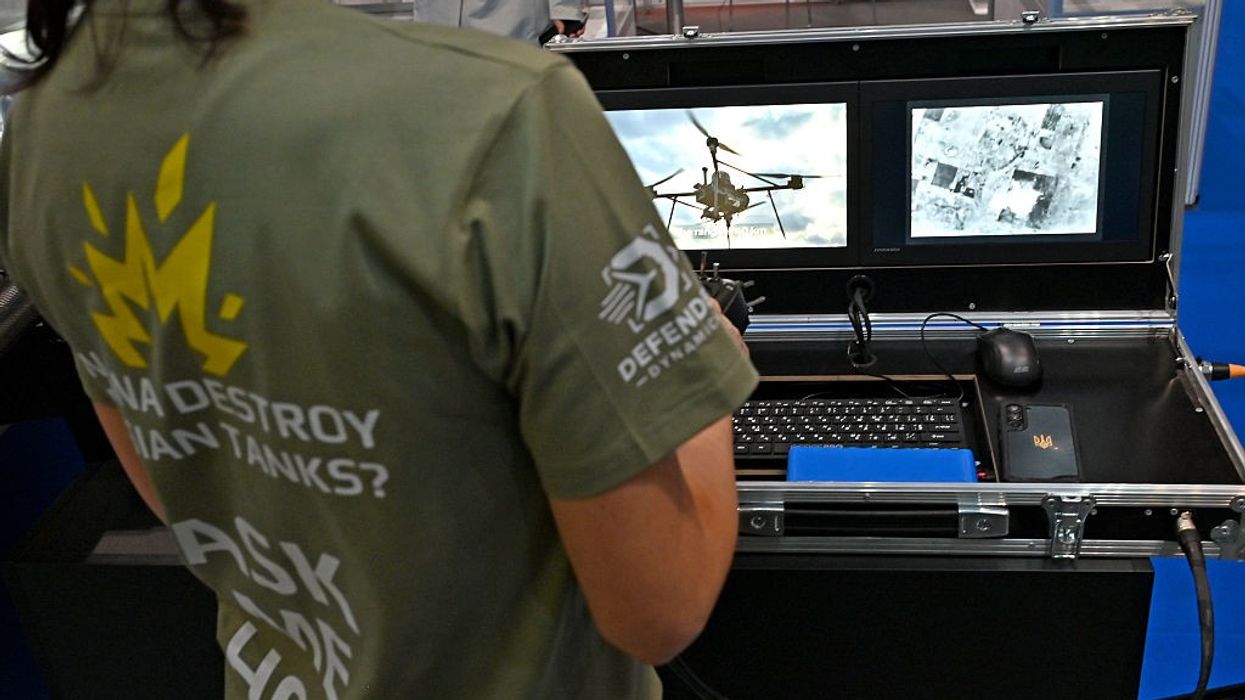
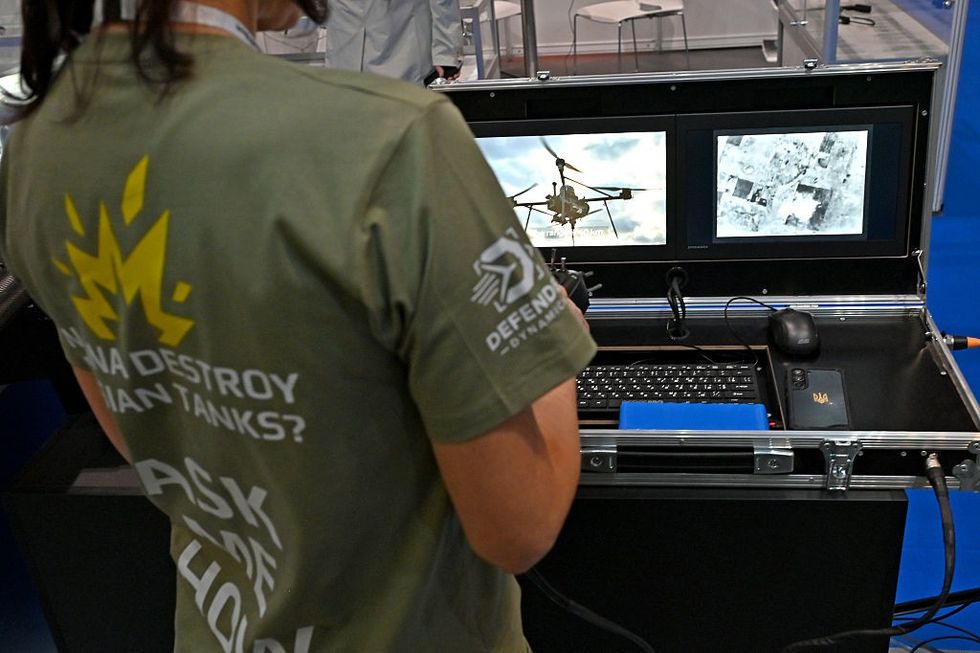
This is not a theoretical architecture. Ukraine is running it now. Ukrainian drone units operate with organic, edge-resident targeting within seconds of adversary contact, without a reliable network back to headquarters. Ukrainian schools graduate thousands of drone specialists each year. The country teaching NATO the most about the next fight is doing so in the register the American AI stack cannot yet operate in. The contracts are being placed. The integration doctrine has not yet been written.
Beijing has run this playbook before. Western economies depend on China for rare-earth and critical-minerals processing — the industry that supplies permanent magnets, batteries, and defense electronics. Every F-35 electric-actuation system, every Virginia-class submarine drivetrain, and every Patriot interceptor guidance package relies on rare-earth processing capacity the United States cannot reconstitute within a decade. That capacity was lost not because the deposits lie under Chinese soil but because Beijing sustained state-subsidized processing for twenty years at prices that broke the private-sector cost of capital in every alternative jurisdiction. Open-source artificial intelligence is the same instrument, aimed at a different substrate.
What is at stake?
First, America's most consequential capital-expenditure cycle. Roughly $400 billion a year in AI infrastructure is financed against a revenue model an opposing state has organized its economy to defeat. If that model breaks on Beijing's timeline, the compute pipelines carrying a meaningful share of American growth do not close.
Second, Pentagon operational readiness. Contracts placed today for missions the Pentagon needs to field in three to five years cannot be executed by an AI stack designed for centralized data centers. Platforms that cannot operate in a multidomain and joint-force environment at wartime tempo are not a deterrent. They are procurement projects.
Third, alliance credibility. Sovereign AI programs in Korea, Japan, and the Gulf price today against the American premium-margin model. If it breaks, those programs re-price against Chinese open-weight tooling, and the alliance's technological dependency structure shifts.
Fourth, deterrence. The Taiwan Strait scenario is not theoretical. The platforms that would decide it are being contracted for now, on an architecture that cannot execute the mission at wartime tempo.
What needs to happen requires an integration authority the American sovereign apparatus does not yet exercise. Two responses.
A state-capacity capital response to the first prong. Some form of federal instrument that bridges the compute-to-market pipeline so a Chinese-organized collapse in AI pricing does not take the compute build-out with it. Export-import financing, defense production authorities, and strategic stockpiles are the precedent. No current U.S. government office owns this problem.
A Pentagon-led investment in a distributed inference substrate — the shape of what the Joint Fires Network concept was originally designed to be. Edge-native, platform-resident, multi-sensor, doctrinally integrated. This is procurement of an integration architecture as much as procurement of a technology. The Pentagon has placed the contracts for the platforms. It has not placed the contract for the integration.
Last week I wrote that America is buying an army it cannot command. The diagnosis has evolved: America is also buying an artificial intelligence it cannot deploy. Ukraine is teaching the doctrine the American AI stack has not been designed to run. Beijing is engineering the collapse of the revenue model that stack is financed against.
Coordination assigns. Integration arbitrates. What is at stake is whether the American sovereign apparatus can find the integrator — for the capital response and the operational doctrine — before the platforms the Pentagon is buying arrive without an architecture capable of commanding them.
The Cipher Brief is committed to publishing a range of perspectives on national security issues submitted by deeply experienced national security professionals. Opinions expressed are those of the author and do not represent the views or opinions of The Cipher Brief.
Have a perspective to share based on your experience in the national security field? Send it to Editor@thecipherbrief.com for publication consideration.
Read more expert-driven national security insights, perspective and analysis in The Cipher Brief
The most important lesson emerging from the Iran conflict may not actually be about Iran. It is about the changing economics of warfare and what happens when autonomy, artificial intelligence, commercial technology and inexpensive mass begin eroding advantages once reserved almost exclusively for major powers.
In many ways, modern warfare is increasingly becoming a story of David versus Goliath. The difference is that today’s David is armed with drones, software, commercial sensors, open-source intelligence and rapidly adaptable technology. Goliath still has overwhelming advantages in scale, firepower and resources, but the sling has become far more sophisticated — and far cheaper.
For most of the modern era, advanced military power belonged overwhelmingly to countries capable of spending billions of dollars on sophisticated aircraft, warships, missiles, sensors and command-and-control infrastructure. That advantage is not disappearing. Aircraft carriers, submarines, advanced fighters, bombers and integrated missile defenses remain essential instruments of national power. But the economics beneath them are changing as autonomy, AI, inexpensive sensors, commercial communications, advanced manufacturing and widely available components lower the cost of creating meaningful military effects.
Ukraine provided the first large-scale demonstration of this shift. A materially weaker “David” used drones, software, commercial technology, open-source intelligence and rapid battlefield innovation to impose extraordinary costs on a much larger Russian “Goliath.” Ukraine did not eliminate Russia’s advantages in manpower, missiles, aircraft or industrial capacity. It showed that technology could narrow the gap without matching a stronger adversary platform for platform.
Iran is now demonstrating another version of the same problem. Tehran cannot compete with the United States carrier for carrier, fighter for fighter or missile-defense battery for missile-defense battery, but it does not need to. Iran has spent decades investing in missiles, drones, proxies, cyber capabilities, maritime harassment, information warfare and strategic geography precisely because those tools allow a materially weaker power to impose disproportionate costs on a stronger one.
That is the economic logic of asymmetric warfare. An inexpensive autonomous aircraft does not need to outperform an F-35, and a small unmanned surface vessel does not need to defeat a destroyer in a traditional naval engagement. It only needs to create enough risk that the defender is forced to respond. When one side can repeatedly spend thousands or tens of thousands of dollars and compel the other to spend hundreds of thousands or millions, the exchange ratio eventually becomes strategically significant.
The United States cannot build a sustainable long-term strategy around answering every inexpensive drone with a multimillion-dollar interceptor or every maritime threat with another billion-dollar warship. That does not mean exquisite platforms are obsolete. It means using exquisite platforms to solve every problem eventually becomes economically unsustainable.
The more useful debate is not whether a drone can replace a fighter or whether an autonomous vessel can replace a destroyer. They cannot. The better question is how many missions currently concentrated aboard expensive crewed platforms can migrate toward cheaper autonomous systems: surveillance, reconnaissance, communications relay, target detection, electronic sensing, mine detection, logistics, persistent maritime presence, decoys and distributed weapons carriage.
Technology disruption rarely begins by replacing an incumbent system outright. It begins by stripping away individual functions. Instead of asking whether one autonomous vessel can replace a destroyer, military planners should be asking what happens when dozens of autonomous vessels operate around that destroyer, extending its sensing range, complicating enemy targeting, absorbing risk, providing persistent presence and allowing the crewed combatant to operate farther from danger. The destroyer remains essential, but its role changes.
Artificial intelligence accelerates this transition because it changes the manpower economics of military mass. Traditional military power is extraordinarily manpower intensive. Every additional aircraft, ship or vehicle generally requires crews, training, maintenance and support personnel. Software scales differently. As autonomous systems become more capable of navigating, sensing, classifying targets and coordinating with one another, fewer operators may eventually supervise far larger numbers of assets.
The strategic value is therefore not simply removing a sailor or pilot from danger. It is changing the relationship between manpower, mass and military capability. Ukraine has also shown how quickly this cycle can evolve: operators identify a battlefield problem, engineers modify hardware or software, the adversary develops a countermeasure, and the system changes again. That cycle can occur in weeks while traditional acquisition processes often operate in years. The widening gap between those timelines is becoming a national-security vulnerability.
Iran also demonstrates why the economics of modern warfare extend far beyond the price of a missile or drone. Consider the Strait of Hormuz. Iran does not need to defeat the U.S. Navy in a traditional fleet engagement to create a strategic crisis. It needs only to generate enough uncertainty around one of the world’s most important maritime chokepoints to affect shipping behavior, insurance premiums, energy markets, naval deployments and political calculations thousands of miles from the battlefield.
A drone does not necessarily need to sink a tanker to be successful. If it forces commercial vessels to reroute, raises insurance premiums, pushes energy prices higher, requires additional naval escorts and generates political pressure in Washington or allied capitals, it may have produced a strategic return far beyond its acquisition cost. The Strait of Hormuz is therefore not merely geography; it is economic leverage.
The same logic applies to the Bab el-Mandeb, the Red Sea and other maritime chokepoints. Protecting those spaces exclusively with crewed ships and aircraft is extraordinarily expensive. Autonomous maritime systems offer another model by providing persistent surveillance, distributed sensing, electronic warfare, communications relay, logistics and eventually additional defensive or offensive capacity without the manpower burden of conventional warships.
The future fleet will almost certainly be hybrid. Submarines, destroyers, carriers and advanced aircraft will remain critical, but they will increasingly operate inside larger networks of autonomous systems. The same principle applies to the defense industrial base. The United States is not going to replace traditional primes with startups, nor should it. The engineering, manufacturing and systems-integration capabilities required to build submarines, bombers and complex weapons remain indispensable.
But the traditional model cannot remain the only model. Modern warfare increasingly rewards an ecosystem that combines established defense companies with emerging technology firms, commercial manufacturers, software companies, universities, private capital and government laboratories. The industrial challenge is no longer simply building the most sophisticated weapon. It is building sophisticated weapons while also producing enough affordable systems to create mass, replace losses and adapt faster than the adversary.
Quantity is not a substitute for quality, but quality alone is not enough if an adversary can manufacture threats faster and more cheaply than the defender can respond to them. A weapons system that performs extraordinarily well but cannot be produced in sufficient quantities or replaced during a prolonged conflict carries its own strategic vulnerability.
There is another cost curve collapsing alongside hardware: information. Artificial intelligence and social media are dramatically reducing the cost of conducting information and cognitive warfare. An inexpensive drone can force an expensive military response, while an AI-generated video, manipulated image or coordinated social-media campaign can create political effects at almost no marginal distribution cost.
Iran, Russia and China understand that these domains reinforce one another. A tanker is attacked, insurance rates rise, energy markets react, images spread across social media, and AI-enabled narratives amplify fear or confusion. Physical warfare, economic warfare and cognitive warfare increasingly operate as parts of the same system. A missile can therefore be intercepted and still produce strategic effect if it forces millions of dollars in defensive spending, disrupts commerce, dominates media coverage and creates the perception that an adversary controls the pace of escalation.
That is why modern warfare can no longer be measured exclusively through targets destroyed or territory captured. Costs can be military, but they can also be economic, political and psychological. The United States still possesses extraordinary technological and military advantages; the greater danger is economic rigidity.
America and its allies cannot allow adversaries to consistently dictate exchange ratios in which cheap systems consume expensive defenses, small attacks produce major commercial disruptions and rapidly evolving technologies are answered by procurement processes that take years. The answer is not abandoning exquisite weapons, but building a broader force architecture around them: autonomous mass, distributed sensors, AI-enabled command and control, resilient manufacturing, commercial intelligence, lower-cost interceptors, modular payloads and systems capable of evolving at something closer to software speed.
Cold War 2.0 will therefore not be determined solely by which country builds the best fighter, submarine, missile or autonomous system. It will also be determined by which side can manufacture capability faster, distribute it more broadly, replace it more cheaply, adapt it more quickly and impose greater costs on an adversary than it absorbs itself.
Ukraine demonstrated how a modern-day David can use technology to challenge a much larger conventional Goliath. Iran is showing how a materially weaker state can use technology, geography and irregular warfare to impose disproportionate costs on a superpower. China is watching both.
The competition underway is increasingly a competition between military-economic systems. Goliath still matters, but the battlefield is changing in ways that increasingly empower David. The side that prevails may not be the one that builds the most exquisite individual weapon, but the one that can keep adapting, producing and fighting after the other discovers that it cannot.
This keeps the David-versus-Goliath analogy as a recurring frame rather than a gimmick—once near the opening, concretely through Ukraine, and again in the conclusion.
The Cipher Brief is committed to publishing a range of perspectives on national security issues submitted by deeply experienced national security professionals. Opinions expressed are those of the author and do not represent the views or opinions of The Cipher Brief.
Have a perspective to share based on your experience in the national security field? Send it to Editor@thecipherbrief.com for publication consideration.
Read more expert-driven national security insights, perspective and analysis in The Cipher Brief
Jennifer Lind and Daryl Press make a compelling argument in a recent article about the future willingness of the United States to provide extended nuclear deterrence, sometimes referred to as the “nuclear umbrella” to over 30 allies. Since the early days of the Cold War, the U.S. made a commitment to defend Europe against Soviet aggression, and under extreme conditions, included the use of nuclear weapons. Similar assurances were made to Japan, South Korea and Australia. The protection provided by this nuclear umbrella has been a hallmark of international order for decades as allies trusted the U.S. would protect them and therefore had no reason to develop their own nuclear weapon capabilities. Lind and Press rightly point out the security environment has changed dramatically, and the “order” created by the United States during the Cold War no longer exists. With the dissolution of the Soviet Union, Lind and Press argue Russia’s nuclear threat on a global scale is much diminished with Russia focused on its boundaries with eastern Europe and less concerned with “the global balance of power”. Similarly, Lind and Press view North Korea’s nuclear weapons development as a regional security issue with Kim Jong Un more interested in regime survival than peninsular conquest. They further argue conflicts today are largely regional in nature and question the commitment of the United States to engage in a nuclear conflict on behalf of an ally thousands of miles away. Thus, they claim the “nuclear umbrella” is broken.
The Nuclear Umbrella Still Exists
On the surface, it’s easy to believe this argument. The first Trump administration clearly stated an intent to put “America First” in 2017 and the second Trump administration signaled skepticism toward alliance commitments and their associated costs. Abroad, there is potential that this signaling from Washington also includes the commitment to extended nuclear deterrence. President Trump’s new National Security Strategy (NSS) published in 2025 does not mention extended nuclear deterrence or the nonproliferation of nuclear weapons. Similarly, the 2026 National Defense Strategy (NDS) does not “explicitly mention extended deterrence” and instead places the “primary responsibility” for their own defense on them with limited support from the U.S. And lastly, the current Trump administration has not and most likely will not issue a Nuclear Posture Review (NPR). The first NPR was released in 1994 every subsequent administration has issued one until President Trump took office again in 2024. The NPR is a blueprint which describes the role of nuclear weapons in U.S. security strategy. This document contains critical messaging on the capabilities, numbers, and modernization efforts of nuclear weapons and under what conditions the U.S. potentially would or would not use nuclear weapons. To be sure, the absence of explicit language on extended nuclear deterrence in the NSS and NDS and the lack of an NPR are departures from the U.S.’s historical stance providing nuclear top cover and nonproliferation of nuclear weapons.
Allies and partners of the U.S. have obviously taken notice and started conversations on how to proceed especially given continued Russian aggression, Chinese and North Korean nuclear weapons development, and what they might perceive as uncertainty of the U.S. as a nuclear deterrent backstop.
The United Kingdom and France recently pledged increased cooperation with nuclear weapons with the signing of the Northwood Declaration in 2025. French President Macron also rolled out a policy of “advanced deterrence” aimed at potentially providing nuclear forces to various European allies. Additionally, Japan, South Korea and Australia are all deeply concerned about nuclear weapons development in both China and North Korea. As a result from the proximate threat, some Japanese and South Korean officials have publicly discussed nuclear weapons, a topic previously considered taboo.
However, there is also plenty of evidence to support the fact that while the nuclear umbrella is bent and tattered, it’s not broken.
Although the current NSS and NDS do not explicitly mention extended nuclear deterrence, they do not explicitly eschew the notion either. In fact, the NDS states Europe should take “primary responsibility for its own conventional defense…” making a clear distinction between conventional and nuclear forces. Despite much talk of NATO needing to pull more of its own weight regarding security, the U.S. remains committed to the alliance. Since 1954, the U.S. pledged to protect NATO members and currently has around 100 air-delivered nuclear weapons deployed to various bases in Europe. In addressing the NATO Defense Ministerial, Under Secretary of War for Policy, Elbridge Colby, stated, “Thus, for the United States, our responsibility is to be clear, candid and consistent. We will continue to provide the U.S. extended nuclear deterrent.” Additionally, the U.S. continues to be active in the NATO Nuclear Planning Group, the senior policy body for NATO nuclear issues. Despite U.S. signaling a “scaling back” of conventional support to NATO, there is no plan to remove any of these nuclear weapons from Europe.
There are similar extended nuclear deterrence concerns from Japan and South Korea, especially the suggestion that both should take on more of the financial burden for their defense, the U.S. commitment to both is bit clearer. In February of last year, the U.S. Secretary of State met with the Foreign Minister of Japan and the Foreign Minister of the Republic of Korea to “reaffirm the unshakable trilateral partnership” between the three countries. This meeting underscored the historical commitment of the U.S. to the defense Japan and South Korea to include extended nuclear deterrence.
Why Extended Nuclear Deterrence Matters
What’s missing in many of the arguments concerning U.S. extended nuclear deterrence is how it has underwritten the concept of nuclear nonproliferation for decades. In 1968, the U.S. pledged cooperation in limiting the spread of nuclear technology as one of the first signatories of the Nuclear Non-Proliferation Treaty (NPT). Though limited and certainly not perfect, the Nuclear Nonproliferation Treaty (NPT) is widely considered one of the most successful arms control treaties ever written by limiting the spread of nuclear weapons while aiding risk reduction of nuclear weapons use. As mentioned earlier, dozens of countries have chosen not to pursue development of nuclear weapons (and pledged not do so as signatories of the NPT) because they determined the extended nuclear deterrent guarantee provided by the U.S. to be reliable and most importantly, credible. Additionally, any country who may feel abandoned by the nuclear umbrella provided by the U.S. and may choose to pursue development of their own nuclear weapon faces myriad challenges. First, many are bound by the NPT and even if they were not, often lack the resources to develop nuclear weapons and delivery systems. Second, all states, even those with the technical know-how to proceed with a nuclear weapons program, would introduce into the nuclear “club” another independent launch authority, more command-and-control systems with varying levels of capability, unknown decision-making processes during crises, and more opportunities for proliferation, miscalculation, and accidents. Following the bombing of Hiroshima and Nagasaki, the one thing the international community could agree upon was developing a strong prohibition against the use of nuclear weapons. Many resolved crises throughout history where nuclear weapons loomed in the background reinforced the idea that the use of nuclear weapons was unthinkable. The spread of nuclear weapons to more independent states does not simply mean we live in a world with more of them, it substantially increases the number of situations where they become increasingly integrated into routine statecraft and thus, their potential use more thinkable.
The Strategic Consequences
Despite concerns about the credibility of U.S. extended nuclear deterrence that have emerged in some allied capitals, the United States should not become resigned to the prospect of allies leaving the nuclear umbrella. Doing so would weaken the nonproliferation regime, increase incentives for independent nuclear programs, and ultimately leave the United States confronting a more dangerous strategic environment. The U.S. should continue to signal that the credibility of extended nuclear deterrence rests upon strong conventional capabilities and even stronger, unmistakable political resolve with our allies while keeping nuclear use as the final safeguard. Increased proliferation of nuclear weapons does not achieve that objective.
The United States is unique among states that possess nuclear weapons because it has used the world’s most capable nuclear weapons arsenal to prevent nuclear proliferation rather than encourage it. Thus, extended nuclear deterrence and nuclear nonproliferation are inseparable. The enduring contribution to international security by the United States has been and should continue to be the guarantee of nuclear extended deterrence to uphold nonproliferation and preserve the longstanding objective of nuclear non-use.
In no uncertain terms should the U.S. become “comfortable” with more states acquiring their own nuclear weapons resulting from of a lack of confidence that Washington will continue to be the nuclear guarantor. Despite periodic political signals that make some allies nervous, Washington has been remarkably consistent, across multiple administrations, in its policy toward extended nuclear deterrence. States that question U.S. commitment should consider whether other alternatives would enhance their security. The answer is almost certainly no.
The views expressed here are those of the author alone and do not necessarily represent the views, policies, or positions of the U.S. Department of Defense or its components, to include the Department of the Navy or the U.S. Naval War College.
The Cipher Brief is committed to publishing a range of perspectives on national security issues submitted by deeply experienced national security professionals. Opinions expressed are those of the author and do not represent the views or opinions of The Cipher Brief.
Have a perspective to share based on your experience in the national security field? Send it to Editor@thecipherbrief.com for publication consideration.
Read more expert-driven national security insights, perspective and analysis in The Cipher Brief
Make no mistake: the United States is weaker today than it was yesterday, and the day before that.
Many of our closest allies have moved from fear to confused unease, to evasive dismissal and even defiance in their dealings with Washington. Regardless of how often President Trump claims that “the United States is more respected today than ever before,” the evidence points in the opposite direction.
We are seeing the steady and accelerating diminution of our reputation as “the shining city on the hill,” by an administration that clearly values what it can do over what it should do. When “we have the right” or “I can do whatever I want” supersedes “we have the responsibility to…,” something has gone terribly wrong. This applies both in domestic and foreign affairs.
A reputation is painstakingly difficult to build and very easy to lose, especially in foreign policy. This is particularly true for a superpower like the United States, which is involved in so many issues and hotspots worldwide: sometimes invited, sometimes not, and often at odds with the interests of local players. Even when we stumble – think Iraq – we have usually been able to draw upon a relatively deep reservoir of goodwill, a kind of accumulated equity, based on the understanding by many that our intentions, at least, were good. Or at least not bad. That reservoir has pulled us through several unpleasant situations. It appears the U.S. is no longer receiving this “benefit of the doubt.”
Let me be clear: any U.S. administration’s first duty is to protect and advance the interests of the American people.
But the current administration’s simple, albeit shortsighted, claim of promoting “America First” relies primarily on a toxic combination of instant gratification fortified by largely ego-driven, knee-jerk coercion. This reveals a stark misperception of how the United States came to be what it is today, fielding the most powerful military in history, with the largest, most vibrant, and influential economy in the world. This did not happen by accident, or through simply dominating and bullying others economically or militarily, either of which the U.S. can employ at any time; yes, there are exceptions, but they are exceptions considering the decades it took to get where we are. The United States’ unprecedented influence occurred through a carefully crafted and painstakingly curated long-term strategy of strategic cooperation and collaboration, and selective give and take.
Bottom line: The dirty little secret is that the policy of every U.S. administration has always been one of “America First.”
A Superpower in Transition
So how did we become the most powerful, wealthy nation on Earth? It’s simple. Well… not really all that simple. There are numerous factors beyond our military or our economy, some obvious, many nuanced. But we have an overriding advantage. One, as I point out, that the above strategy has consistently built upon for decades. It is real but also ephemeral: our reputation. This is not about anyone liking or following us on social media. Or simple, advantageous transactional dealings. It is about the raw strategic calculation that working with the U.S. is more likely to be in the overall interest of your country, its government, and people than not. A considerable amount of this is derived from the realization that, heretofore at least, the United States is not predatory or for sale. Not solely out for itself, and that under most circumstances, it will take into account the policies and interests of its partners, and sometimes even its enemies in its dealings.
This distinction matters because the issue is not whether America should pursue its own interests. It most certainly should and does. The question is whether it pursues those interests in a manner that preserves the hard-won trust, access, and cooperation that make American power truly effective, or in a way that burns through them for short-term advantage.
Our reputation has afforded the U.S. government and its representatives – of which I was one – a level of access, trust, and tacit consideration, among both friends and sometimes not-so-friends, that can be hard to quantify.
Reputation is not merely a sentimental asset. It is hard-nosed operational leverage. It determines whether allies will take political risks for us, whether partners move quickly when time matters, and whether adversaries believe our threats or assurances. Once that leverage erodes, or disappears altogether, every request becomes harder, slower, and more expensive.
I saw this firsthand. When I was the CIA Chief of Station (COS) in a certain Middle Eastern country, I received direction via a NIACT, or night action, cable from CIA headquarters in October 2001 to approach my local intelligence counterparts with an extremely urgent request. The U.S. needed a facility located in close proximity to Afghanistan from which it could operate armed and/or surveillance drones, a critical asset in the GWOT. With winter fast approaching, the location then being used would not allow for continued operations for much longer. My country’s leadership controlled a suitable facility. I was tasked with communicating the request and advising as soon as possible if permission was likely to be forthcoming, or if it would be necessary to look elsewhere.
I knew that this was a big ask. A Muslim country, the leadership was extremely sensitive to drawing the ire of Al Qaeda, and I knew this request would require consultation among multiple individuals at the very highest level. There was a process and protocol, and it was typically cumbersome. I immediately met with my primary intelligence liaison contact and laid out the details of the request to him, including its importance, asking that he bring this to the immediate attention of his superiors so it could be considered by the country’s leadership. I expected the process could take several days.
Later that same day, I received notification that the Director of the intelligence service would meet me that very evening (at the local horse racetrack).
When we met, I laid out the request in full. After a brief pause, he said, “Yes. You may use it for as long as you require.”
He asked for no payment or quid pro quo, simply that we “not publicize its use.”
Frankly, I was incredulous, expecting at best a hedge, or “we need time to consider this,” type of response. Common interest? Certainly. Common risk? Not so much. But then I realized that our reputation had tipped the balance, overriding any doubts or fears they might harbor, which they almost certainly did. It was the United States asking. And they were answering.
Iranian D-Day Sanctions
And now we have another big ask: Iran and the just announced D-Day sanctions regime. Washington is requiring that friends and allies endure considerable economic and potentially political pain, along with the not inconsiderable risk of military retaliation from the Iranian regime. And it is doing so after not bothering to consult with them before going to war with Iran, and then failing to protect them from Iranian counterstrikes.
But more important than asking our allies for help is expecting our strategic foes, China and Russia in particular, to ignore not only their own economic (Iranian oil for China) and military (Iranian cooperation against Ukraine) interests but to pass on an opportunity to diminish a strategic rival. For what? Promises of a great relationship with the President of the United States? Unlikely. This is a fallacy that President Trump has long touted: neither Putin nor Xi is a friend; rather, they are cynically leveraging the President’s legendary malleability for their own individual ends. Threats? Also, unlikely given the U.S.’s current weakness. In the end, what do we have to offer them? Little that I can discern. And what would they require in return? I shudder to think.
Lastly, the United States initiated hostilities against Iran without a clear understanding of its opponent or a coherent plan on how to win. Yet another significant blow to the reputation of the world’s preeminent superpower.
The success of economic sanctions on the scale Washington is proposing requires an impenetrable wall. Without active compliance from both China and Russia, it is virtually certain to fail.
The administration speaks about “quiet diplomacy”, but for its friends at least, it is clear they will not hesitate to employ coercion to convince those who hesitate to comply. This should not be necessary, but this is where our diminished reputation leaves us.
When Rhetoric Crashes on the Shores of Reality
The administration and Iran are once more engaged in the verbal back and forth of what I call hyperbolating. Claims by the U.S. of economic D-Day met with Iranian threats of defiance and retaliation. So far, mostly words. But concrete actions are sure to follow.
Given the U.S. Treasury Secretary’s claim that these so far undisclosed new sanctions will collapse Iran’s economy, they no doubt see this as a potential existential threat to the regime. And they should, given the United States’ economic reach. But Iran has built a ‘resistance economy’ for a reason: to absorb and deflect decades of sanctions aimed at cowing the Islamic regime. Previous efforts have met with occasional, partial success, but never enough to force genuine change inside Iran. Iran’s leadership no doubt realizes that the effectiveness of this latest U.S. sanctions regime will hinge on the active cooperation of Russia and China, and they have actual cards to play with each. The U.S., on the other hand, appears to have few, counting instead on goodwill mixed with threats, and a hefty dose of bravado.
In the end, it remains to be seen whether President Trump will stay the course in what is clearly a test of wills. If past is prologue, this is unlikely.
This article was originally published on Mark's Substack, you can find more of his writing here.
The Cipher Brief is committed to publishing a range of perspectives on national security issues submitted by deeply experienced national security professionals. Opinions expressed are those of the author and do not represent the views or opinions of The Cipher Brief.
Have a perspective to share based on your experience in the national security field? Send it to Editor@thecipherbrief.com for publication consideration.
Read more expert-driven national security insights, perspective and analysis in The Cipher Brief
Operation Southern Spear, the U.S. campaign against alleged drug trafficking small boats off the coast of several South American nations, continues unabated. But while both the public and politicians seem to have become numb to this campaign – or perhaps distracted by the seemingly endless Iran debacle - a few things have remained constant. First, U.S. military forces are killing boat crews without any effort to apprehend them. Second, this practice lacks, as it has from inception, any credible legal justification.
President Trump bragged that his administration has reduced by more than 90% illegal drug importation by sea. Like so many other bombastic or mendacious claims made by the President, there was no data or methodology provided to corroborate this alleged statistic, which is wildly exaggerated. What is more concrete is the human toll this ongoing campaign has inflicted to date. According to a recent report, at least 233 people have been killed in these strikes on 67 boats, all part of a campaign.
Even if the President’s exaggerated assertions of efficacy were accepted, and even assuming these attacks are coordinated with coastal countries like Ecuador, the inherent illegality is in no way altered. Why? Because interdicting the flow of illegal narcotics – even when the importation operation is controlled by criminal gangs – is not a war and does not justify invocation of wartime authority. It is, instead, a law enforcement problem. More specifically, the authority to attack ‘enemy’ personnel and resources with lethal combat power may be justifiably invoked only in situations of armed conflict. When the United States chose to address that problem through the lens of wartime attack authority, it forfeited any claim of legal justification.
The administration knows that, as a matter of international law, the United States may designate individuals as enemy belligerents and attack them with lethal combat power only in the context of an armed conflict. This is why from inception it has emphasized the gravity of harm to Americans resulting from illegal narcotics smuggled into the nation. Proponents of this campaign have emphasized that more Americans are killed every year by illegal drugs than were killed by the September 11th terrorist attacks. No one questions the tragic consequences of this problem. But every harm to the nation or its people does not ipso facto indicate the existence of an armed conflict. Instead, it is why and how that harm is inflicted that are decisive.
Thus, it is obvious why supporters of this campaign consistently claim the harm caused by illegal drugs means we are at war with drug traffickers: because they seek to justify invoking wartime authority to attack these boats and occupants. Doing so avoids the pesky challenge of apprehension and criminal prosecution – the normal and legally presumptive method for disabling criminal threats: the very modality used by the U.S. prior to this invalid assertion of armed conflict (and apparently one that was more effective). More fundamentally – and problematically – it seeks to validate what by any objective measure is the invalid campaign that is employs lethal force as a measure of first resort based not on the imminent threat posed by the target of attack, but instead on the assertion that target is a member of an enemy group.
The loss of 233 enemy combatants in a war – what international law calls an armed conflict – might be expected. Enemy casualties in the ongoing armed conflict with Iran are undoubtedly more substantial. But it is the context of armed conflict that makes such loss of life unremarkable. This is because in that context the customary international law principle of military necessity justifies targeting enemy personnel – members of the enemy organized armed group – with lethal force as a measure of first resort. And, unlike a law enforcement use of force, the objective of such attacks is not limited to eliminating an individual threat, but instead to bring about the submission of the enemy as a whole.
This is an exceptional use of force authority invoked by States precisely because armed conflict is considered an exceptional situation. Unlike peacetime, armed conflict involves a contest – hostilities – between the State and armed groups operating at the direction of enemy leadership. More fundamentally, the objective of that enemy group would have to be to inflict harm on the U.S. or its assets. It is that motive and conduct that distinguished the September 11th attacks from criminal gangs smuggling illegal drugs into the United States. Unlike al Qaeda, these groups do not operate with the objective of inflicting harm on the United States (it would be an odd drug dealer who wants to kill his customers) nor do they engage in hostile attacks against the U.S. or its interest abroad.
This is why State invocation of this exceptional power is supposed to be limited to situations of genuine threats to the nation from groups organized for that purpose. It is justified only when a state is challenged by the military forces of another state or by a non-state organized armed group capable of engaging in sustained combat operations. Absent such a situation, state security forces must respond to what is a criminal threat with law enforcement type rules for the use of force. Whether police, Coast Guard, or regular military forces are utilized, lethal force is justified only as a measure of last resort and only when reasonably assessed that the individual subjected to that use of force presents a threat of death or great bodily harm.
This binary use of force construct is reflected in ‘peacetime’ versus ‘wartime’ rules of engagement: use of force control measures utilized by U.S. commanders to align authority with mission requirements. During the many military operations outside the context of armed conflict – including military support to law enforcement – deadly force is authorized only in response to an actual or imminent deadly threat, the same use of force authority applicable to law enforcement officers. That means that it is the conduct of the ‘target’ offering a direct threat that triggers any use of deadly force in response. In contrast, wartime ROE authorize use of deadly force as a first resort against individuals identified as members of the enemy armed group (unless they have surrendered or been disabled by wounds or sickness). Unlike a conduct-based use of force decision, this authority is triggered by a determination of enemy status.
This shift in lethal force authority is perhaps the most significant consequence flowing from a situation of armed conflict. It is also why the existence of armed conflict is not left to arbitrary assertions but is based on widely accepted objective conditions – the so-called conflict classification test that looks at issues like the intensity of the violence, the degree of organization of the group and its ability to carry out sustained operations. That test is pragmatic and, as noted above, covers both state and non-state threats. But it is not so elastic as to allow a state to bypass the peacetime use of force constraints by simply characterizing a threat posed by criminals as an armed conflict.
Yet that is exactly what the U.S. has done to justify lethal targeting of small boats. These boats may indeed be trafficking in illegal narcotics, and the occupants may indeed be members of criminal syndicates or gangs (although there has been scant information provided to validate these claims). And those drugs may indeed be destined for the United States. But none of this indicates the existence of an armed conflict.
Sadly, the continuation of this campaign seems to have numbed the public and Member of Congress to the perpetuation of this illegality. Yet this is also a reminder of an historic legal maxim: the repetition of an illegal act shall not make it legal. When committed under the authority of the United States, it does, however, stain our national reputation and undermine our claim to stand for the rule of law.
The Cipher Brief is committed to publishing a range of perspectives on national security issues submitted by deeply experienced national security professionals. Opinions expressed are those of the author and do not represent the views or opinions of The Cipher Brief.
Have a perspective to share based on your experience in the national security field? Send it to Editor@thecipherbrief.com for publication consideration.
Read more expert-driven national security insights, perspective and analysis in The Cipher Brief
The U.S. Army has committed to a million small drones by 2028. The Department of Defense has not decided who will authorize how they fire.
That is not a materiel gap. The volume is on order; Nvidia’s latest earnings guidance says the compute to run it is on the way. It is a governance gap, and it is now the single largest exposure in the American national security posture entering the fourth quarter of 2026.
Consider what landed inside a seventy-two-hour window this week. On Tuesday, Nvidia posted $96.2 billion in second-quarter revenue, with $89 billion of it in the data-center segment and guided to $108 billion in the September quarter — an annualized run rate through American hyperscalers of more than $400 billion, the largest defense-adjacent capital cycle in modern history. The same day, Boeing, Lockheed Martin, and RTX filed their responses to the Deputy Defense Secretary’s twenty-one-day production ultimatum on accelerated interceptor delivery. Nine days earlier, the Pentagon had opened the vendor portal for the $185 billion Golden Dome missile-defense program.
The chips are being funded. The primes are being pushed. The perimeter is being paid for. None of it tells you who decides when a fielded drone force pushes beyond its vendor’s safety rails during a live engagement.
That is not a hypothetical. Since March, the Department of Defense has formally designated Anthropic — the American AI lab whose Claude model is in active use within U.S. Defense environments — a “supply chain risk.” The two sides opened arguments in DC court over the blacklisting on May 19. In May, the Department expanded its classified AI work to eight companies, explicitly excluding Anthropic. On February 28, OpenAI took the other side of the same question, signing a deal to run its models on a Pentagon classified network. The day before, more than 580 Google employees, including DeepMind researchers, signed an open letter urging Google’s CEO to refuse the same kind of arrangement.
The industrial base of American artificial intelligence is not aligned on whether it will perform the classified work the drone doctrine assumes. The Pentagon’s response has been to fund compute, sign one lab, blacklist a second, and litigate.
Picture April 2027. A deployed American drone force is airborne over a contested Indo-Pacific corridor. A vendor safety guardrail on the targeting AI refuses a strike within a sixty-second window. The commander needs an override. No office at the Department of Defense — including the Chief Digital and AI Officer — holds explicit arbitration authority between the vendor’s guardrail and the commander’s judgment at operational tempo. The decision will be made ad hoc, by whichever lawyer or flag officer picks up the phone.
That is the arbitration gap. It is not the debt-service bill. It is not the interceptor shortfall. It is not even the shipbuilding backlog. It is the fact that the United States is standing up the largest defense-adjacent capital cycle in modern history — Golden Dome’s $185 billion, a million-drone target by 2028, and $1 billion for 340,000 attritable systems by 2027 — with no institutional authority designated to arbitrate how any of it fires. It is a supervisory function no institution has yet been chartered to perform, and no doctrine has yet been written to describe it.
Beijing runs the inverse problem. Paul Scharre laid out the industrial-base half of this argument in “Losing the War of the Future,” published in Foreign Affairs on June 23. What his piece understates is the demand side: even if the United States builds the drones, the doctrine and civil-military arbitration required to employ them do not yet exist at scale. The People’s Liberation Army’s answer is on the record. Three PLA researchers — Lieutenant Colonels Li Hengrui and Wang Haiyuan and Senior Colonel Cheng Jinming — published “all-domain megacity incapacitation warfare” in Military Art, the Central Military Commission’s restricted journal, in March 2025. Nathan Beauchamp-Mustafaga and Andrew Wang brought the article into the English-language conversation this summer in “Total War on Taipei,” published in War on the Rocks. The concept identifies the operational meaning of Xi Jinping’s “national total war” as an integrated arbitration architecture that fuses military, civilian, media, and party assets under a single narrative apparatus.
The PLA may struggle to execute it. The Central Military Commission, which began this term with seven members, has been reduced to two, hollowed out by disciplinary investigations. But the design is on the page. The American design is not.
Three signals will indicate by year-end whether the gap is closing or widening.
First, does the CDAO’s office designate a named override authority for wartime AI lab guardrails? Second, is the Anthropic-DoD blacklisting resolved into a joint framework for classified use, or does the litigation calcify? Third, does the FY27 defense-authorization conference name a joint force to operate Golden Dome, or fund the program without operator language? As of this week, all three are moving the wrong way.
The next war will not be lost because America bought the wrong drone. It will be lost because America bought the right one and never decided who could tell it to fire.
The Cipher Brief is committed to publishing a range of perspectives on national security issues submitted by deeply experienced national security professionals. Opinions expressed are those of the author and do not represent the views or opinions of The Cipher Brief.
Have a perspective to share based on your experience in the national security field? Send it to Editor@thecipherbrief.com for publication consideration.
Read more expert-driven national security insights, perspective and analysis in The Cipher Brief
“Inactive idle time describes when a [U.S. Navy] attack submarine designated for decommissioning cannot be inducted into a dry dock in a shipyard. As a result, the submarine and its crew must remain pier-side until a shipyard has the capacity in a dry dock to defuel their nuclear reactor.”
That’s a quote from a Government Accountability Office (GAO) report released last Thursday titled, Actions Needed to Address Costly Attack Submarine Maintenance Challenges, which describes lost operational days for the Navy’s 44 nuclear attack submarines (20 Los Angeles class and 24 Virginia class), including those spent awaiting depot maintenance or what’s called active idle time.
The Navy, according to the GAO report, said that as of fiscal year 2025, its 44 attack submarines “provide the United States an asymmetric advantage to gather intelligence undetected and attack enemy targets, among other missions. These capabilities make attack submarines some of the most requested assets by the global combatant commanders.”
However, the GAO found, “Over the last 10 years, the U.S. Navy has lost more than 15,000 operational days due to maintenance delays and idle time on active attack submarines. These delays resulted in an estimated $3.4 billion in costs to sustain crews and submarines that provided no operational capability.”
Along with the inactive idle time illustrated earlier, active idle time is a period when an attack submarine and its crew must remain pier-side because they cannot be taken in by a shipyard for maintenance and are no longer certified to conduct normal underwater operations.
Attack submarines follow the Fleet Response Training Plan which calls for a 12-month training and then a complex certification process that leads to deployment. Deployments are normally six months, although one could be longer, but the result is generally an 18-month cycle.
Thereafter, a nuclear attack sub goes through three or four operational cycles – around six years of operations – before the next major overhaul.
“From fiscal years 2016 through 2025, “ the GAO report said, “the U.S. Navy incurred 8,906 days of active idle time for active attack submarines, hitting its peak in fiscal year 2022 with 1,518 days. Since this peak, the U.S. Navy reduced active idle time to 166 days in fiscal year 2025.”
From fiscal years 2021 through 2025, according to the GAO report, the average depot-level maintenance period was 809 days. “Further, the U.S. Navy only completed about 11 percent of attack submarine depot maintenance on time at the public shipyards, from fiscal years 2016 through 2025,” the GAO report added.
For Los Angeles-class subs, active idle time is costing almost $220,000 per day for the entire group. For the Virginia-class, that figure is more than $237,000 per day.
Los Angeles class attack submarines have an expected life of 30 to 33 years, while the planned life for the newer Virginia class is 33 years.
According to the GAO, only U.S. public naval shipyards -- Portsmouth Naval Shipyard, Norfolk Naval Shipyard, Puget Sound Naval Shipyard, and Pearl Harbor Naval Shipyard -- provide depot maintenance for attack submarines, along with two private shipyards -- General Dynamics Electric Boat at Groton, Connecticut and Huntington Ingalls Industries Newport News Shipbuilding at Newport News, Virginia.
Inactive idle time for older Los Angeles class attack submarines is a growing problem.
This period, when an attack submarine designated for decommissioning cannot be taken into a dry dock in a qualified shipyard, requires that its crew must remain pier-side, according to the GAO report. That’s because “those required to maintain and supervise the nuclear reactor…must wait until a shipyard has the capacity in a dry dock to defuel their nuclear reactor,” the report said.
The decommissioning attack submarines “take limited dry dock space away from the operational fleet,” the GAO said, but added, “For most fiscal years prior [to 2025], one or two attack submarines entered inactive idle time each year. However, without mitigation, the U.S. Navy projects a significant increase of inactive idle time through fiscal year 2030.”
In fact, over the past five fiscal years, the Navy has had seven attack submarines waiting to decommission and has “incurred 2,216 days of idle time resulting in more than $480 million in operating and support costs,” according to the GAO.
“As of January 2026,” the GAO report added, “without mitigation, the U.S. Navy projects that 15 more attack submarines and their crews will enter inactive idle time from fiscal years 2026 through 2030.” That could see the Navy incurring “more than 14,000 days of inactive idle time and $3.1 billion in operating and support costs, according to our [GAO] analysis.”
Perhaps the worst example of inactive idle time, according to the GAO report, is the Los Angeles-class submarine USS Pasadena, which became inactive in January 2025, but is not expected to enter Norfolk Naval Shipyard for decommissioning until November 2028.
During this inactive idle time, which could run nearly four years, the Pasadena remains fully crewed and is being utilized by the Navy as a training platform. The inactive Pasadena has also been used in videos – in November 2024 for a promotional video for the 2024 Army-Navy Game, and in February 2025 for the Netflix TV series The Recruit.
A small group from the Pasadena crew remains on the submarine at all times to monitor security, nuclear reactor status, and safety systems. These crew members sleep in the submarine's cramped quarters during their off-watch hours, while on duty. The remainder of off-duty crew members may live on a tender ship, a submarine base barracks, or at their own off-base homes rather than on the submarine.
According to the GAO, the Navy “has not fully evaluated or established plans for implementing…alternative options for decommissioning attack submarines more efficiently and optimizing shipyard capacity for the operational fleet.”
For example, what about pier-side nuclear reactor defueling of inactive attack submarines which would not require now-limited dry dock space?
According to the GAO, “Navy officials stated pier-side defueling of the Los Angeles-class attack submarine nuclear reactors is not cost effective,” but those “officials were unable to provide documentation of detailed analyses conducted on the feasibility and cost-effectiveness of this option.” However, pier-side defueling is under study when it comes to the new Ohio-class strategic nuclear submarines, according to the GAO.
Another defueling option would be using floating dry docks, which the Navy officials told the GAO “requires additional study.”
Also under study by the Navy is to release a portion of the inactive attack submarine crew back to the operational fleet “over three phases: (1) the first month during system turnover to the public shipyard; (2) the first 6 months when idle conditions begin; and (3) nuclear reactor defueling once a dry dock is available.”
This approach has been used for two out of 18 Los Angeles-class subs set for decommissioning between 2014 and 2025, and, according to Navy officials, only “a limited number of attack submarines are planned to use this construct in the next five years.”
Asked why, “Navy officials cited public shipyard pier capacity constraints,” but again “did not provide documentation on any analyses conducted to reach this conclusion,” according to the GAO.
The Navy is studying whether the service life of two of its attack submarines by shifting, shortening or removing idle times. “As of September 2025, the U.S. Navy projected that it can reduce inactive idle time by 1,715 days for fiscal years 2026 through 2029 for [these] two attack submarines. However, these service life extensions are still pending approval,” the GAO said.
The GAO after this study concluded in its report, “While the U.S. Navy has recently made some progress in reducing attack submarine active idle time, inactive idle time has grown and will continue to grow with the impending wave of Los Angeles-class inactivations over the next 5 years.”
It then recommended the obvious: “The Secretary of the Navy should ensure that the Chief of Naval Operations directs the Naval Sea Systems Command to fully evaluate alternative options for decommissioning attack submarines more efficiently to optimize shipyard capacity for the operational fleet. Such options may include, but are not limited to, defueling outside of dry docks and reducing crewing for attack submarines awaiting decommissioning.”
I agree.
The Cipher Brief is committed to publishing a range of perspectives on national security issues submitted by deeply experienced national security professionals. Opinions expressed are those of the author and do not represent the views or opinions of The Cipher Brief.
Have a perspective to share based on your experience in the national security field? Send it to Editor@thecipherbrief.com for publication consideration.
Read more expert-driven national security insights, perspective and analysis in The Cipher Brief
“During its 11-month deployment [mostly in the Middle East] which ended in May, and was the longest for a[n aircraft] carrier since the Vietnam War, the USS Gerald R. Ford conducted more than 11,000 aircraft carrier launches using electromagnetic catapults, more than carriers with steam [aircraft launching] systems could achieve…But perhaps the biggest benefit of the electromagnetic catapults are their lower cost and lighter personnel requirements. With the Navy running out of operating funds, and retention likely to plummet in the aftermath of the war with Iran, the fleet needs to make the most of every dollar and sailor.”
Writing that opinion piece in The Washington Post last Wednesday was Bryan Clark, a former Navy officer who at one time served as Special Assistant to the Chief of Naval Operations and Director of his Commander’s Action Group. Currently, Clark is a SeniorFellow and Director of the Center for Defense Concepts and Technology at the Hudson Institute.
I am using Clark’s article because it provides information that challenges a recent military step contained in an August 13, President Trump Presidential Memorandum which ordered “the Secretary of War, in consultation with the Secretary of the Navy, shall provide to the President… a plan on the required measures to replace the Electromagnetic Aircraft Launch System and Advanced Weapons Elevators with steam and hydraulic systems for the construction of [aircraft carrier] CVN-81[USS Doris Miller], including timelines and resourcing requirements.”
Electromagnetic catapult systems accelerate aircraft more smoothly and gradually, thus putting less stress on airframes. They also recharge faster than steam catapults which need to pressurize gases and they eliminate the need for boilers and other plumbing equipment needed to create steam.
Trump, who never served in the military, has been obsessed for years with the way that steam propels fighter jets off the decks of carriers and where a carrier’s tower structure or “island” is located.
I will point out, according to former Defense Department officials the Navy designers moved the island from the middle of the carriers to the back of the vessel to make more space for moving jet fighter aircraft around on the flight deck, in order to increase the number of flights or “sorties” that the carrier could generate.
These Trump aircraft carrier views apparently first came to him less than two months after he took office based on a March 2, 2017, tour he had on the then-under-construction USSGerald Ford being built at the Newport News shipyard in Virginia.
Two months later, in a May 8, 2017 wide-ranging, 100-minute interview over dinner with Time Magazine editors and reporters, Trump at one point apparently brought up his visit to the Gerald Ford at Newport News where he was shown the catapult system for launching aircraft from the deck.
According to TIME, the conversation went, “Sir, this is our digital catapult system…we’re going to this because we wanted to keep up with modern [technology]. I [Trump] said, ‘You don’t use steam anymore for catapult? No sir. I [Trump] said, Ah, how is it working? Sir, not good. Not good. Doesn’t have the power. You know the steam is just brutal. You see that sucker going and steam’s going all over the place, there’s planes thrown in the air.’”
The TIME transcript then has Trump saying, “It sounded bad to me. Digital. They have digital. What is digital? And it’s very complicated, you have to be Albert Einstein to figure it out. And I [Trump] said -- and now they want to buy more aircraft carriers. I [Trump] said what system are you going to buy -- Sir, we’re staying with digital. I [Trump] said no you’re not. You going to goddamned steam, the digital costs hundreds of millions of dollars more money and it’s no good.”
I should note, at the time Trump visited and for months thereafter, there were issues with ghe new electromagnetic catapults, but fixes were made, although not in Trump’s mind.
Before I continue with Trump, let’s turn back to Heritage’s Bryan Clark, a real Navy expert, who wrote, “The biggest benefit of the electromagnetic catapults are their lower cost and lighter personnel requirements.”
Clark also noted, “The Ford’s crew is about 500 sailors smaller than its predecessors, largely because it is an all-electric ship outside of the engine room. Because they needed steam for catapults, older carriers also used steam for a variety of other functions throughout the ship — such as cooking equipment and water purification…And the steam catapults have so many moving parts and failure modes that they require about 10 more sailors per catapult — there are four catapults on a modern carrier — than electromagnetic systems.”
A Navy February press release said preliminary reports from the Sortie Generation Rate test program for aircraft show that the flight deck design in conjunction with electromagnetic systems and arresting gear “have contributed to an increased sortie generation rate compared to that of a Nimitz-class carrier.”
However, Trump over the years has kept calling for a return to steam catapults and retelling the story of his 2017 visit to the Gerald Ford.
For example, at a November 2, 2023 campaign rally in Houston, Texas, Trump was talking about shipbuilding and veered off to tell about a ship that was “in trouble” because “it was $10 billion over budget, and I wanted to go and see this ship that was costing so much money.”
At that Houston rally, Trump went on, “And I landed with a helicopter on top of this massive, incredible ship [USS Gerald Ford] being made in Newport News. And I said to the people…I want to meet the catapult people, the people that have done the catapulting.”
Trump continued, “I want to find out what the hell happened because the catapults weren't working. So for 50 years, we used steam more. And that beautiful scene, that steam goes off, and that plane gets thrown the hell off, the power, beautiful, and it's cheap.”
Trump said he asked a catapulter “Which is better, steam or electric? ‘Steam, sir.’ I [Trump] said why did they design electric? ‘Because it can keep going like this all day long, but it takes us 59 seconds to reload a plane. And when we reload the plane, the steam builds up, and it's all set, sir. It's perfect. It works so well. And we can fix it with a blowtorch if something happens. And if a wave hits it, it actually cools us down, sir. We love the waves hitting us. If a wave hits the electric [catapult], we're out of business, sir. We might -- we'll die with this thing.’"
Last July 15, at the U.S. Army War College in Carlisle, Penn., Trump again was talking about shipbuilding and switched saying, “I went to the ship [USS Gerald Ford], because I came into office and the ship was way over budget, built in Newport News, unfortunately, was way over budget.”
Trump went on, “I said, I want to meet the ‘catapultier’ and a man came over, along with four of his assistants. And I said, what's better, electric catapult or steam? He's been there for 25 years. He said, ‘Steam is better, sir. We can fix it with a hammer and a blowtorch. When the electric [catapult] goes bad, I have to send to MIT to get geniuses over here’…But I [Trump] said, so you're saying we spend billions of dollars extra to build electric catapults instead of using steam.”
Bryan Clark concluded his Post article saying, “Steam power was cutting-edge technology in the 19th century. It is the wrong choice for a Pentagon that is leaning into artificial intelligence and autonomous systems. The Navy should stay the course with electromagnetic catapults to keep the carrier fleet strong and deliver more firepower. It could use the savings to help refill the fleet’s weapons magazines.”
Clark told CNN the cost of changing catapults on the USS Doris Miller, already under construction, “will probably be into the billions” and it could delay the carrier — which was expected to be in service around 2034 — “until the end of the next decade.”
Clark also Clark said, “Nobody builds them anymore. There’s no steam catapult manufacturers in the…U.S. anymore so they’d have to restart that production line, which would cost tens of millions of dollars to get going and that’ll be, it’ll take years to start that up again and build the first catapult.”
To add insult to injury, various recent news reports have said Navy senior staffers are reviewing the name USS Doris Miller for CV-81.
Named on January 20, 2020 -- during the Trump first administration -- by then-Acting Navy Secretary Thomas B. Modly during a Martin Luther King, Jr. Day ceremony, it honored African-American Mess Attendant Third Class Doris “Dorie” Miller, who received the Navy Cross for extraordinary heroism during the attack on Pearl Harbor on December 7, 1941, where he manned an anti-aircraft machine gun without prior training and aided wounded crewmates.
In giving the new aircraft carrier Miller’s name, acting-Navy Secretary Modly said, “In selecting this name, we honor the contributions of all our enlisted ranks, past and present, men and women, of every race, religion and background.”
One name said to be under study to replace Miller’s is that of President Trump.
The Cipher Brief is committed to publishing a range of perspectives on national security issues submitted by deeply experienced national security professionals. Opinions expressed are those of the author and do not represent the views or opinions of The Cipher Brief.
Have a perspective to share based on your experience in the national security field? Send it to Editor@thecipherbrief.com for publication consideration.
Read more expert-driven national security insights, perspective and analysis in The Cipher Brief
Iran is reading American service members’ social media feeds to deadly effect. The fact is that not all intelligence must be gleaned from secret, closed sources for it to be effective, and Tehran has made use of public and open-source data to target U.S. forces with psychological and kinetic attacks. Until the Pentagon updates and enforces its policies on social media posting and personal device security, American servicemembers will be sitting ducks.
Admiral Brad Cooper, the commander of CENTCOM, warned in a letter last month to U.S. forces that Iran is using social media posts from personnel, such as footage of U.S. bases, to improve its lethality. For example, a video of soldiers running for shelter during Iranian strikes helped Iran perform a battle damage assessment of their strikes, including their precision, and understand base layout for future attacks.
Iran has long exploited open-source data to target U.S. forces and allies. Two years ago, Iran doxxed 2,200 Israel Defense Forces personnel relying exclusively on open-source data. In April 2026, the Department of the Navy warned service members that unnamed cyber adversaries (obviously referring to Iran) are reaching out on social media and conducting phishing attacks, urging sailors to turn on privacy settings and refrain from posting on social media. The same month, Iranian hacker group Handala sent threatening WhatsApp messages to U.S. troops and published the supposed personal information of 2,300 U.S. service members stationed in the Persian Gulf.
Open-source data is broader than just Instagram and Facebook. Iran exploits data breaches to collect information and identify and send text messages to former Israeli defense personnel to threaten them and to attempt to recruit them for espionage purposes.
Iran is exploiting Signaling System 7 (SS7), an older telecom protocol for roaming, to identify devices with U.S. SIM cards, according to threat intelligence platform Mobile Surveillance Monitor. Using SS7, Iran was reportedly able to pinpoint hotels that housed U.S. personnel and contractors.
Iran can also simply buy data for its malicious campaigns. CENTCOM stated in a letter to Sen. Ron Wyden (D-OR) that it has been warned that Iran may have used commercially available location data used by digital advertisers to “target and surveil” U.S. personnel. While the phone numbers behind advertising IDs are anonymized, Iran could use them to track devices in specific areas such as military bases. The Pentagon conceded that these IDs are not yet disabled by default on government-issued phones.
None of these vulnerabilities should be a surprise to defense officials. A U.S. Government Accountability Office report from October 2025 found that social media posts from service members and their families or friends provide adversaries with names, ranks, and locations that can be pieced together to reveal information about U.S. force formations and operations. Wyden and his Democratic and Republican colleagues in the House and Senate sent a letter to the Pentagon’s chief information officer in May 2026 urging more secure personal data practices and blaming current vulnerabilities on the department’s “failure to prioritize this threat and implement common sense cyber defenses recommended by federal cybersecurity experts.” The House version of the annual defense bill, meanwhile, calls for the department to better understand and train personnel about how adversaries can exploit commercial technologies to identify and monitor U.S. personnel.
To curb adversarial intelligence collection opportunities, the Department of Defense (DoD) should expand operational security requirements across the force.
First, the DoD should harden government and personal devices by requiring removal of all Mobile Advertising IDs (MAIDs) on personal and DoD-distributed devices for personnel in sensitive areas. Without IDs, the locations and metadata cannot be tracked or associated with individual users and sold to adversaries posing as commercial buyers.
Next, the DoD should create and enforce stringent policies for social media posting. Personnel should be prohibited from uploading unofficial photos and videos of military facilities or that otherwise relate to their roles and should limit the amount of information they post about their roles on platforms like LinkedIn. Government devices should have their cameras disabled or removed unless required for specific purposes, and GPS should be disabled by default. DoD should also consider providing troops with alternative devices for personal use with GPS disabled and the cameras removed.
Additionally, the DoD should monitor breached data to understand what is publicly available about all its personnel. Knowing when data is exposed will allow the DoD to identify potential threats before Iran acts and begin fixing the issue as soon as it occurs. The department can also use this information to enable mandatory password and credential rotation when information is exposed. The Pentagon should also consider encouraging or requiring additional methods of authentication, such as passkeys and biometrics, for all devices and accounts
Finally, Congress should pass regulatory reforms to transition from SS7 to new signaling technology. SS7 is an outdated system and cannot guarantee secure communications, even if new updates were to be completed. Changing the system will allow service members abroad to communicate with loved ones without leading adversaries to their location.
These measures will limit the open-source data that, at present, is readily available to Iran and other adversaries. If the DoD continues to permit unrestricted use of personal devices abroad, Iran and other adversaries will continue exploiting their vulnerabilities to locate, study, and threaten American forces.
The Cipher Brief is committed to publishing a range of perspectives on national security issues submitted by deeply experienced national security professionals. Opinions expressed are those of the author and do not represent the views or opinions of The Cipher Brief.
Have a perspective to share based on your experience in the national security field? Send it to Editor@thecipherbrief.com for publication consideration.
Read more expert-driven national security insights, perspective and analysis in The Cipher Brief
The U.S. administration’s strategic expectations are increasingly colliding with a set of hard realities. While Iran has taken a considerable beating, it remains standing and does not appear on the verge of either submitting or collapsing. Its newfound control over a key commercial waterway, the Strait of Hormuz, provides it with a weapon of mass disruption (credit to the NYT’s Tom Friedman) that it previously did not enjoy, and it appears intent on exercising that authority. Despite the administration’s continued threats and claims of imminent victory, there is no clear military solution in sight. Bottom line: the administration miscalculated.
Another strategy is called for. The truth.
“The practice of espionage is a quiet act of war: A very human endeavor, sometimes born of lies and betrayal, of greed or revenge; but often of deep truths and trust.”
This is the banner of my Substack, drawn from the preface of my upcoming Iran espionage novel; “A Prince of Mirrors.” It attempts to encapsulate my feelings about my chosen profession: Intelligence Officer. But for now, let’s focus on the last phrase: “but often of deep truths and trust.”
Trust is in very short supply between the United States and Iran as they attempt to come to terms. First, to re-open the critical Strait of Hormuz – a shipping route that was open prior to the War – and, second, to end an increasingly fruitless War. All while failing, at least for now, to fully address the other key issues at play: Iran’s nuclear program, Iran’s ballistic missile program, and Iranian-supported proxies.
While the world looks breathlessly on, the U.S. awaits the results of negotiations between Iran and tiny, wonderful Oman (admission; I spent several years at the U.S. Embassy in Oman) – a country literally stuck between the rocky Musandam coast, and a hard place called Iran – over the future administration of the Strait.
Based on initial reports of the terms, either Iran is going to have to step back from its assertions of control, or the United States is going to have to agree to some level of Iranian control that was not present prior to the War. Given the utter lack of trust between the parties, is either likely?
So, let me lay out, as best I can, what I believe to be true.
This is a time for truth. Hard truths.
The Middle East has changed.
The Iranian regime has survived a series of devastating U.S. and Israeli strikes. Iranian military capacity, both the regular Artesh (Iran’s conventional army) and the IRGC (Iran’s Islamic Revolutionary Guard Corps), is significantly weakened; however, it retains the ability to strike targets outside Iran, including shipping transiting the Strait of Hormuz.
The Iranian regime has not fallen and appears to be consolidating power around… well, no one yet knows which individuals or factions will emerge triumphant in Tehran. But for now, an even more hardline, IRGC dominated leadership is in place.
The regime is attempting to assert its newfound control over the critical Strait of Hormuz, a right tacitly acknowledged, or at least not specifically prohibited, in the flawed June MOU (Memorandum of Understanding) signed by the President of the United States.
Barring something new, something we have yet to see, U.S. and/or Israeli military force is unlikely to significantly alter this equation.
Iran and the United States, and the world economy, remain trapped in a test of wills over who blinks first.
The truth is, the regime is bad in so many ways. And they are dangerous. But not existentially so to the United States. Disliking Iran is not a sufficient reason to go to war with them barring a truly compelling reason.
But neither can an IRGC dominated Iran be allowed to run roughshod over the region. The U.S. and its Western and Gulf allies need to develop a new deterrence strategy that includes both carrots and sticks.
The Impacts of failure
Any agreement needs to mitigate, to the extent possible, the damage that Iran can do going forward. First and foremost, the world economy cannot allow one country to exert control over such an important international shipping route as the Strait. Any agreement must minimize Iranian control over ships transiting the Strait, possibly by compensating in other areas. The most critical issue, Iran’s nuclear program, must be addressed in a manner that includes both dealing with the 60% enriched uranium (HEU) currently in their possession and strict verification of enrichment activities going forward.
The American people can handle the truth!
That for now, the only way out is a negotiated agreement that is certain to fall short of the ideal. Only for now. Simply a truce. This is not an admission of defeat, simply a pause to rethink, to recalibrate.
But also…
That the Islamic regime has significant internal weaknesses. That stepping away from the current tit-for-tat military action, a strategy that is not achieving its objectives, will force the regime to confront the serious problems, some existential, that the Iranian nation faces. This is Iran’s, and the regime’s, Achilles heel. One that could eventually force change that no outside military force could.
Just the truth.
This article was originally published on Substack and is republished here with permission.
During the week of March 9, drones came overBarksdale Air Force Base in waves. Barksdale is the home of the 2nd Bomb Wing, one of the places this country keeps its nuclear-capable bombers. The base issued a shelter-in-place order and stopped flight-line operations, and the Air Force has declined to say precisely how many aircraft were up there or who was flying them. NORTHCOM's counter-drone fly-away kit, the good one, the one that worked over a strategic installation in the opening hours of Operation Epic Fury on February 28, was somewhere else. There is only one of them.
Then General Gregory Guillottold Congress the number that should have ended the conversation about whether we have this handled. "About a quarter of the ones that we detect, we're able to defeat." He offered it as good news, and by the standard of the previous year he was right: in 2025, he said, "almost every one that was detected was not defeated."
Welcome to The Iron Triangle, a dedicated column serving the procurement officers who are asked with buying the future, Investors funding the next generation of defense technology, and the policy wonks analyzing impact on the global order.
Hold that in your head. The federal government with every authority Congress can write, the entire electromagnetic spectrum at its disposal, and a defense budget larger than the next nine countries combined, stops one drone in four over its own bomber bases.
Now we are handing the same problem to a sheriff's department in Talladega, and we have written them a rule that is worse.
A Rule That Anticipates Everything Except the Answer
On July 6, the Departments of Justice and Homeland Security published theinterim final rule implementing the SAFER SKIES Act, effective July 1, and for the first time extended real counter-drone authority to state, local, tribal, and territorial law enforcement, and, critically, to correctional agencies. This is overdue, it was built fast, and the people who wrote it deserve credit for standing up a certification and oversight architecture on a compressed timeline.
Then you get to the Authorized Technologies List, which is the part that decides what a certified agency may actually field. The Departments expect the initial list to contain three categories: radio-frequency detection with command-and-control signal interception, RF disruption (broadband and protocol-specific jamming), and RF protocol manipulation, meaning command injection and cyber takeover. All three are radio-frequency categories. There is no fourth.
This would be an unremarkable sequencing decision except that the rest of the rule plainly contemplates bringing an aircraft down by physical means. The statute authorizes certified agencies to use reasonable force to "disable, damage, or destroy" an unmanned aircraft. The rule requires air-traffic notification for mitigation that emits no radio frequency, and the preamble explains why in language that leaves nothing to interpretation: such an action can affect the airspace "for example by bringing an unmanned aircraft down or creating falling debris." The rule requires Mitigation Certification for personnel who physically intercept a drone in flight.
So the rule trains an agency to do it. Certifies the officer to do it. Writes the falling-debris notification procedure for when they do it. And then hands them a list with nothing on it they can do it with. Plainly spoken, the rule does not include kinetic interceptors, something that knocks a drone out of the sky.
That is what happens when a list gets populated by whatever already had the deepest federal deployment history, which is exactly what the Departments said they were doing. The RF categories had the paperwork. So the RF categories got the boxes. The list has nothing to do with what works. It is a fossil record of what has already been bought.
Three Categories, One Point of Failure
Here is why this is a safety problem and not a paperwork problem. The three listed categories are functionally distinct and they share a single dependency: every one of them requires the target aircraft to present an exploitable radio link. Where there is no link, interception has nothing to intercept, jamming has nothing to jam, and cyber takeover has no protocol to take over. They do not degrade independently. They fail together, at the same instant, against the same threats.
Three classes of aircraft now routinely present no such link. A drone flying a stored waypoint route with its control link severed emits nothing and listens to nothing; this is a checkbox on consumer airframes. A protocol-hardened or custom-built airframe falls outside the signature libraries that detection-and-takeover systems depend on. And then there is fiber optic, which is the one that should be keeping planners awake. They manage control and video via physical filament. There is no radio link at all. Fiber optic drones are immune to jamming as a matter of physics rather than engineering. Russia is turning out more than fifty thousand fiber-optic FPV drones a month at a single facility in Veliky Novgorod. The technique defeated RF countermeasures at Kharkiv. It defeated them over Victory Base Complex in Baghdad, where there was no visible intercept attempt at all.
None of this is exotic. It is three years old, it is cheap, and it is documented in open sources that any competent adversary reads on the same afternoon you do.
An agency limited to the three RF categories is superbly equipped against a careless hobbyist with a stock quadcopter and defenseless against anyone who has been paying attention. That is precisely the inverse of the risk profile the rule exists to address.
The Recent Events Are Not Ambiguous
On June 24, just twelve days before the rule was published, theJustice Department indicted twelve defendants in what it called the largest federal prosecution to date involving coordinated drone operations to smuggle contraband into prisons. Ten federal facilities across eight states. Thirty-eight documented drops using six aircraft, running from September 2023 through May 2026. Methamphetamine, K-2, Suboxone, cell phones, tobacco, and saw blades.
Two and a half years of flights. Thirty-eight of them are documented. That is not a hobbyist wandering into restricted airspace. That is a logistics operation with route planning, aircraft attrition, and a customer base. Organizations at that level of sophistication adapt to countermeasures. The adaptation most cheaply available to them is the one the initial Technologies List cannot answer.
Compare the coverage. Five days later a JetBlue crew reported striking a drone on approach to JFK, and it led the news for a week before a preliminary investigation found no physical evidence that it happened at all. The collision that may have been nothing got the cameras. The thirty-eight drops that certainly happened got a press release from the Middle District of Georgia.
The Part That Should Embarrass Us
Now for the contrast that makes this a column instead of a comment.
On January 28, Brigadier General Matt Ross, who directs Joint Inter-Agency Task Force 401, told reporters: "I see us using low-collateral kinetic interceptors at all installations in the homeland." The Deputy Secretary of Defense had directed JIATF-401 to ensure kinetic capability at every location. Two days later thetask force awarded $5.2 million for the Bumblebee V2, a kinetic interceptor, with deliveries beginning in March. Asked about squeamishness over kinetic engagement inside the United States, Ross said he "fundamentally disagrees."
Same airspace. Same threat. Same country, in the same calendar year. The Department of War calls low-collateral kinetic interception essential and is buying it for every installation in the homeland. The Departments of Justice and Homeland Security published a list on which that category does not exist.
What Each Corner of the Triangle Should Take From This
For the Procurement Officer, understand what you are budgeting against. You can be accredited, certified, trained, and funded, and still have nothing to buy, because the box your requirement lives in has not been created. The rule as published does not tell you plainly that kinetic capability is unavailable to you. State and local agencies are writing fiscal-year plans and grant subaward requests against it right now, and some of them are going to buy capability they are not authorized to employ.
For the Investor, this is the diligence question you are not asking. You have been asking whether the technology works and whether there is a customer. Start asking a third question: what category does this go in, and does that category exist yet? A company can be technically excellent, combat-proven, and commercially validated, and still be unsellable because a list has no line for it. Listing risk is not a footnote in the regulatory section of the deck. In this sector it is the whole thesis, and it is currently unpriced.
For the Policy Wonk, notice what just happened to the locus of policy. Congress debated the SAFER SKIES Act in public. The interim final rule went through interagency review and took comment. But the Authorized Technologies List, the instrument that actually determines what a certified American police department may deploy against a drone over a school, is an administrative artifact updated through a coordination portal. No one voted on it. Most people affected by it do not know it exists.
I have spent years watching good capability lose to bad process, and I thought I had seen the full catalogue. I had not. The Valley of Death I have been writing about is a money problem: you have the technology, you cannot get the contract. This is something else. This is a company that has the technology, the customer, the certification, the training pipeline, and the federal deployment history, and cannot sell, because the taxonomy has no word for what it built. Call them the Unlisted. They are the Forgotten Bench's stranger cousin, and they lose more quietly, because there is no rejection letter. There is just a list that does not mention them.
The fix is small and it is already scheduled. The Departments said they would run a sixty-day sprint to revise the list after publication. Add a fourth category, low-collateral kinetic interception, defined narrowly enough to exclude firearms, unguided ballistic means, directed energy, and anything heavy enough to be its own hazard. Write objective listing criteria the way the RF categories already have them: bounded interceptor mass, bounded terminal energy, demonstrated fail-safe behavior on loss of lock, a modeled and test-validated debris footprint, a declared engagement envelope. Then say plainly, in one sentence, that until such a category exists, kinetic mitigation is unavailable so that nobody spends a grant on a capability they cannot lawfully employ.
The Risk
I am not going to pretend this one is free, because it is not, and the people who will be nervous about it are right to be. Radio-frequency mitigation that fails harmlessly drops a link. Kinetic mitigation that fails drops an object, and it drops it over a stadium concourse, a prison yard at count time, an interstate at rush hour. The rule's own falling-debris notification requirement exists because somebody thought that through, and a two-kilogram interceptor over a crowd is not a spreadsheet exercise. Widening this list carelessly buys us a very bad Tuesday.
There is a second risk, and I have written this column before from the other direction. A category written narrowly enough becomes a moat for whoever helped write it, which is how well-intended technical criteria turn into incumbency by another name. That is the ITAR story wearing a domestic uniform, and anyone advocating for a new category, including me, should be watched for it.
And a third: certification is not proficiency. A deputy with forty hours of classroom time and a kinetic interceptor is a genuinely different risk than an operator who has done it a thousand times. Recurrency has to be tied to the effector an agency actually fields, not to one undifferentiated certificate, because competence with a jammer transfers to a kinetic interceptor exactly not at all.
None of that argues for keeping the category empty. It argues for writing it carefully, on a clock, with real criteria, which is a harder job than leaving the box blank, and the reason the box is blank.
We have built a system in which the most consequential procurement decision in American counter-drone policy is not made by a program office, a contracting officer, or a member of Congress. It is made by whoever maintains a list. Comments on the rule close on September 4. After that, the question stops being what we should have listed and becomes what we have to explain. The honest version of that question is this: when a drone that does not answer a radio comes over the wire at a federal prison, and the certified, trained, funded officer standing under it has nothing on the list to use, whose signature is on that?
Disclosure: Atlas Special Projects prepared a public comment on the rule discussed below on behalf of a counter-UAS manufacturer. The argument here is that of the author, and it applies to a category of technology rather than to any one company's product.
“To me, the biggest way that we're doing this is introducing technology into the [U.S. Army] formations that is not fully baked. And so all of us who were in the Army in the 90s, the 2000s, even the 2010s, you were issued a piece of equipment and that was it -- maybe a TM (technical manual) and you didn't have any say in how it was made or how it should be altered. And today in a number of different [Army] organizations, we're putting the tech in an immature state in front of the soldiers -- and industry is with them -- to be able to iterate and make things so much better, so much faster. So that to me is compelling to them and they can give very real feedback and everybody that's dealt with soldiers knows they're not going to pull any punches, right?”
That was Under Secretary of the Army Michael Obadal speaking July 30, on The Future of U.S. Land Powerat the Center for Strategic and International Studies (CSIS) along with former-Army Secretary Ryan McCarthy, who held that job during the first Trump administration.
Together, the two provided insightful looks at how the Army is dealing with the introduction of new technology.
Obadal, for example, described a personal experience from a day or two earlier when he got into an autonomous vehicle with a staff sergeant. “We're getting ready and he's showing me all this stuff, and I said, ‘This is incredible. What do you think?’ And he said, "Yeah, I don't like it.’ And I said, ‘Okay.’"
Obadal then recalled he and the sergeant had a 15minute conversation and he learned when the sergeant told him “I think this is really cool tech, but it's the integration of that tech” that bothered him. For Obadal that was something “that you don't get in a lab, you get it only by putting those things in the hands of soldiers.”
“We're introducing them [new Army enlistees] at the very onset of their Army career to technologies being pushed down in[to military] units.” Obadal said, adding, “There is additional skill-type, identifier-training that they can go to. We have a software factory in Austin, Texas [Army Software Factoryof the U.S. Army Transformation and Training Command] that's incredibly capable. It's a two-year program where they really are able to code and create new applications, all really software based.”
McCarthy recalled, “If you go back to 2017, there was nowhere near the emphasis on pushing autonomous systems into the formations. A lot of that's cultural. If you go even back to like 2008 and the Air Force's resistance to taking on more Predator [an unmanned reconnaissance aircraft] caps in the Middle East, my former boss, [Defense] Secretary [Robert] Gates, making it a priority with the department. So, culture is a big part of it. The good thing is it's 10 years later, we have younger people, much more technologically savvy than I ever was.”
As with most people, Obadal starts his discussion of change with Ukraine, which he described as an “incredible battle lab,” about which he said, “not just the Army, the entire [Defense] Department has gone to great lengths to understand what are the lessons that are coming out of there, because no one is iterating technology faster than the Ukrainians.”
He then described the initial Russian-Ukraine fighting as “positional warfare, because neither side possessed an actual maneuver, combined-arms, army.” Instead, Obadal said, “two uncoordinated armies really came together, got into positional warfare, and then we saw the innovation of the drones and a number of other things, but specific is the drones.”
Currently in the Russian-Ukraine war, Obadal said, “You have a dead zone of several kilometers between these two positions and it's very reminiscent of World War I,” where artillery was introduced, and “now the drone…is an enabler of soldiers. So how do you deny terrain with drones? How do you actually take terrain with drones?”
“We've taken all of those lessons and incorporated [them] in,” Obadal said, “so now at this point in basic training our soldiers are actually operating drones. Not something that was happening two or five years ago. But they get that familiarization as soon as they are coming into the Army in our training centers.”
At the Army National Training Center, Fort Irwin, California, Obadal said he watched U.S. operational forces conducting exercises “utilizing a number of different drones to have certain effects – electronic warfare, observation, calling-for-fire, and first-person, viewer-kinetic action. That's the ‘operationalization’ of it [drone warfare].”
But Obadal was most interesting to me when he expanded on how the Army had “spent billions on buying commercial off-the-shelf drones that are customized for military use,” and shipped them to “almost every [Army] division and even down in regiments.” There, he continued, “We have small groups of soldiers that have been pulled in by the leadership, given some budget, small budget, and given a facility and said, ‘Put together drones that we can go out on our training areas and utilize.’”
The result of this localized drone creation was, Obadal said, “They [the drones] are not exquisite. They cost very little to make. It's okay to crash them. But what it's doing is not just the technology, the other thing we're learning, [as] from the Ukraine, is you have an incredibly capable core [of Army personnel] that knows how to utilize drones in every aspect of it.”
Another purpose, Obadal explained, “It's not about flying an FPV [first-person view/controlled] drone that's part of it, it's about how do you team them together; how do you do all of the things that we're watching the Ukrainians do; so we we're baking that in into our organizations by letting them…mass-produce as many low-cost drones as they can so that they can get the repetitions…We have to go through hundreds of repetitions a day in our Army to build that repository of knowledge, turn that into doctrine, which is constantly evolving, and then spread it throughout our Army.”
Commenting on the Army drone system, McCarthy said, “They're allowing leaders at every level to be entrepreneurial in nature, to look at the capability, to learn the technology, and make recommendations to the changes in task organization. They're going to have to change the
business model of the Army. There might not be 40 people in a rifle platoon five or 10 years from now. There might be half as many. So we have the luxury where we can be a little deliberate. We may want to go faster. The world's complicated, but doing it the right way, the smart way, they're going to make better choices.”
For example, at a February 2026 exercise at Fort Stewart, Georgia, soldiers experimented with electronic warfare payloads on medium-range reconnaissance systems and tested various configurations on FPV drones to determine system limitations and capabilities, according to an
Army press release. “The ongoing innovation includes stressing equipment through rigorous training to understand what works best for operational units,” the release said.
The Army, Obadal said, is “trying to encourage small [drone making] companies, new entrants that have compelling technology. We're trying to leverage as much external capital, because there is a large amount of external capital that's invested in the defense technology industry, but we just haven't rewarded it at the right level.”
Army Assistant Secretary for Acquisitions, Logistics and Technology Brent Ingraham is changing acquisition processes that are intended to foster rapid prototyping, rapid fielding and rapid acquisition of new capabilities, Obadal said.
He continued, “What it's about is continuing to prototype and experiment at scale and then feed all of that into our Combined Arms Center (CAC).” There, he said, Lt. Gen. James P. Isenhower III, CAC Commanding General will determine “now how do we put our findings back into areas that will change force management or capability requirements.”
Summing up, Obadal said, “Today we have young men and women that I see out in the organizations with highly technical capabilities that allow them to do direction-finding, to do pinpoint locations of enemy emissions, and then utilizing other capabilities to visually confirm feeding all of that back into a data-centric C2 [communications] system. So it's that human machine teaming of giving the right capabilities to our soldiers allows them to be far more effective than they were just a couple years ago.”
Obadal added, “It's an important thing to remember right now we're not replacing soldiers with autonomous or unmanned weapons. What we're doing is we are unburdening the soldier from the mundane tasks or the most dangerous tasks so that they can take a step back and they can do the things that only humans -- whether it's soldiers, commanders -- can do.”
EXPERT INTERVIEW – With an interim agreement expected as early as today between the U.S. and Iran aimed at reopening the Strait of Hormuz to shipping traffic, experts are assessing the short and long-term costs of any deal.
As negotiators work on an agreement to re-implement a ceasefire and restart negotiations aimed at curbing Iran’s nuclear ambitions, there are questions about whether Iran will end up with more control over the strait than it enjoyed prior to the war and about the hidden costs that could include impacts on the sanctions packages that the U.S. has been using as a diplomacy tool to try and keep Iran’s malicious activities in check.
Cipher Brief Executive Editor Brad Christian spoke in-depth with former National Intelligence Manager for Iran at ODNI Norm Roule about the current “operational pause” and about the unseen costs of any deal. Their conversation has been lightly edited for length and clarity. You can also watch the interview on The Cipher Brief’s YouTube Channel.
Norman Roule is a geopolitical and energy consultant who served for 34 years in the Central Intelligence Agency, managing numerous programs relating to Iran and the Middle East. He also served as the National Intelligence Manager for Iran (NIM-I)\n at ODNI, where he was responsible for all aspects of national intelligence policy related to Iran.
Christian:The situation with Iran has continued to progress in ways that maybe people didn't expect or anticipate when this war started. How do you describe where we are right now in terms of progress toward ending this war?
Roule: Where we are right now is in a lull. This is an operational pause. We're not approaching a significant core agreement. This is instead a period of coercive restraint. It's not a ceasefire. And Iran has continued to attack ships, but you're seeing the U.S. restrain its response again here to give diplomacy a chance. The president is showing considerable restraint. At the same time, the assets we have in the region are immensely powerful, immensely capable, and very well led. So, they have everything they need to do to undertake the dramatic operations the president has discussed. The diplomacy itself that's underway is a challenge. Each side is describing it dramatically differently.
If you look at the position of each side, there has been a consistent trend. The U.S. will announce negotiations, and the Iranians will deny negotiations are taking place. A few days later, there will be indirect negotiations through regional parties, still accomplishing the same things, but we're not at the table to talk about nuclear issues, missile issues, or militia issues as originally discussed.
The Iran-Oman mechanism that's being talked about right now in the press is likely being overstated by the Iranians and by some who would believe that concessions to Iran are the appropriate outcome from this crisis. Here's why it's being overstated: If tolls of any sort are charged, what happens to a shipper who refuses to pay? How does work in association with sanctions that have been imposed by the United States? Are American ships and American-related ships, allowed to pay Iran money? Through what mechanisms, what channels? Will we sanction other countries for paying Iran money through these channels? Iran has dictated which countries can enter the Persian Gulf and the bulk of this channel is through Iranian waters, but according to press reports, the Omanis must tell the Iranians who is transiting south. Iran's parliament has said no enemy countries can transit. Are Israeli or Israeli-related ships then banned from the Gulf? These are these are hugely consequential questions that are being glossed over by those who would say, ‘well, a deal is being worked out’. But this situation does show that while the U.S. absolutely has the military edge, it is restraining itself, and that has given Iran an ability to influence some would say, ‘control the pace’ of shipping in the Gulf. That shipping continues, and I've seen reports that as many as five million barrels of oil a day are now moving through the strait, which is going to reduce the pressure on oil markets, but this remains an unreliable waterway. Insurance rates remain very high and will remain high. And the blockade, of course, remains in place. This is a very delicate situation.
We also have to consider what happens if the Houthis look at the Iranian Oman deal and say, we want the same deal regarding the Bab el-Mandeb. What is the premise to refuse that? What would we do if the Houthis responded in their own way to attacking ships in the Red Sea?
So, we're in a very consequential period. And this is a period consequential for Iran because they're also in dire need of economic assistance. Their inflation is about 70%. Unemployment is horrific in many locations. I've seen figures as high as forty to forty-five percent in some areas. And the Iranians of course are showing defiance and claiming this isn't a problem, but this has got to be touching their decision making. And I think that's something the White House is considering.
Christian:President Trump has been very clear on where he stands on the issue of paying fees for passing through the Strait of Hormuz. Why is Iran pushing this issue when there were no fees in place before the war started? Is this one of Iran's most powerful points of leverage that they have over the strait? How are you thinking about their position on these fees?
Roule: It's a good question and I'm not putting a value judgment on it. I've tried to remain neutral on these issues. But those who advocate for making a deal with Iran, you know, diplomacy comes with severe consequences. If Iran is able to acquire control over the strait, will that collapse the international sanctions regime? For example, if Iran is able to control the strait in this regard, can it dictate which food shippers can come into Kuwait? If Iran controls the strait, it now has a permanent foot on the throat of the international community. And the idea that if we just do this, we can then build on trust with an IRGC government has no evidence in reality. Now that doesn't mean that it may not happen, but those who say you can build on this are not producing an argument that makes sense. Iran would be able to inject considerable power projection into the region in an unprecedented way, gaining billions of dollars, and that money would inevitably go to its missile program and proxies. And those who talk diplomacy with Iran, and you can see this when you look at social media statements or foreign affairs articles. The authors who speak most passionately and eloquently about engagement with Iran can't seem to acknowledge that people will die as a consequence. Now, that makes me sound like I'm opposed to this but I'm just giving you all the reasons why this is a problem.
The region, of course, has no desire for Iran to have this capability. But they also have no desire for a missile and drone war. That you either have a drone war, missile war, or give in to Iran, those are usually statements made by people who aren't professional diplomats, professional policymakers or have little understanding of the regional issues. There's going to be some sort of path in the middle that works if we're to protect and preserve sanctions as our tool against Iran's terrorism and other activities and if we’re to protect and preserve the national sovereignty and security of these countries who are our partners.
Also in the details of this deal are questions over whether the U.S. military would be banned from the Persian Gulf. The Iranians would have to approve the passage of U.S. military ships, which of course we wouldn't agree to, but the Iranians could claim that as a violation and things could unravel. We're going to land in a gray area on this if diplomacy is to succeed and it may not succeed.
Christian: In public statements, President Trump seems to be losing patience with the process. The president has said before that if Iran doesn't make this deal, that's it and we've witnessed similar red line crescendo moments before. You mentioned the IRGC led government. It's clear that they are running the country now. It's not clear how the diplomatic process is working, certainly by historical standards. What are your potential measures of success or indicators that the diplomatic process has run its course and what are you watching as potential next steps?
Roule: Throughout the last twenty years, various administrations, Democratic and Republican, have each said the same thing that we will try every possible diplomatic option for as long as possible and that all responses remain on the table. But once we've shown the world that we have tried every diplomatic option and the Iranians won't take yes for an answer, won't take diplomacy for an answer, then we'll be justified in using force.
I've been in congressional testimony where I've had Republicans and Democratic State Department officials insist that was U.S. policy. And that is congruent with the President's statements. He's basically saying, ‘Look, I'm going to give them every opportunity to negotiate’ because the consequences of a much broader conflict for the region, for the Iranian people, for civilians, for the U.S. war fighters who are risking their lives in the region, all of this will come into play.
We do have the assets in the region and our leadership in the military force there is exceptional and highly experienced. And based on the nature of the attacks conducted by the U.S. military in recent weeks, one can deduce a couple of points.
The first is that we know a lot about Iran's military architecture. And second, Iran has very little defense against our attacks because we've seen very little air defense or port defense as a result. Iran only has an offensive capacity. And it's attacking civilian architecture as well as U.S. military bases, not being used by the U.S. military, but nonetheless, they're bases where we have that presence. But at some point, if you believe in international values, we we've got to stand with our partners to protect them in a way that is congruent with their national interest and leadership approaches.
Christian: Over the weekend, news reports indicated that the Gulf states were the ones that convinced President Trump to not escalate this war right now. Do you have a sense of where the Gulf states are right now in terms of their approach to President Trump, their approach to Iran?
Roule: I think you need to have several different pillars in mind. First, let's talk about what the Gulf States have done that has been quite successful. Their defense against Iran has been very, very successful as a result of years of engagement with the United States and with the U.S. private sector, which is playing a large role in their successes and will play a role in their future successes in terms of defending against cyberattacks and drone and missile attacks. No air defense is perfect, but the performance by the GCC has been exceptional. And they have protected three things that we should applaud.
First, they've protected their own nationals and their own infrastructure, which is the duty of every state. They're protecting millions of other citizens to include hundreds of thousands of Americans who live in the region. They're keeping American lives safe with their air defense. And last, they've protected the international economy, preserving through their energy flows and their handling of the situation, the ability to maintain stable energy prices and distillate impact on subsidiary industries. All of that is exceptional.
At the same time, we've seen the Saudi military crisply respond to Houthi aggression with surgical strikes, and the Saudi military joining with the United States on strikes on Iraq, which is a first. And it's also a demonstration of the quality of Saudi Air Forces in general. So, there's a sense of extremely close partnership between our militaries. But how they move forward, you know, it is their neighborhood, so how they move forward in a world where there could be a major attack on Iran is likely going to mean that they're going to face more missile and drone attacks. They're going to want a voice in this.
They know their region better than we do. We should respect that. And I think that's what you saw last week in the reports of phone calls to the president, where he gave diplomacy a chance and was about to move, and I believe he was serious, based on my understanding. But he also took into consideration partners, people who have lives on the line and are trying to defend the world's economy and know their neighborhood very well. So, I'm not unhappy with what's happened. I don't think you can criticize that. That's a natural, organic and appropriate process.
Christian: Let's talk gray zone just for a moment. We've seen reports recently that the hacks against the water infrastructure in Minnesota could have involved Iran. We've seen reports that China, although not confirmed, was planning to deliver air defense systems to Iran. There's no doubt about the cooperation continuing between Russia and Iran. What are you looking at that some of us may be missing?
Roule: Press reports confirm what many observers have cited, and that is that Iran's cyber activities have continued unabated since this conflict began. Indeed, before the conflict, against multiple actors in the United States and largely that's been successfully defended against by our national cyber architecture, as well as the architecture of our Gulf partners. The president has disagreed with the assessment on Minnesota and other places, but that does fit with the past pattern of Iranian cyber activity against SCADA and other systems in the United States. and has been a longtime target of Iran itself. It is an attack on our national infrastructure, if it's proven. And if proven and we don't respond to it, the people in Tehran are going to say, ‘Well, there's no reason we shouldn't continue to do this’. So, I think that issue itself is pushing the White House towards alternative actions besides diplomacy. And in fairness, it has been a traditional standpoint of multiple administrations to say how we respond. Is it at a time and way of our choosing? We don't respond symmetrically, you know, we don't do the exact same thing back. So, if the United States were to respond with airstrikes against Iran’s cyber architecture, which would probably be a good thing in a conflict, that is an appropriate proportional response just done differently. And it would be congruent with multiple administrations' views and statements as to how they will treat Iranian aggression.
Christian: What are you looking for next? What are you paying the most attention to?
Roule: As I mentioned, if you give Iran control of the Strait of Hormuz, you're going to have consequences, not only in terms of whether they will ever negotiate seriously with us, but what does it mean for the Red Sea, and all sorts of other things? And those who say, well, we can work past that usually aren't in the Gulf, usually don't have children fighting right now and usually won't pay the price of those decisions. Not to say they won't be made, but we need to be upfront on those costs, and some of the issues aren't being discussed.
What I'm looking for is the conversation about those costs. And if it doesn't happen, that's a bad thing for everybody. The other issue is I think we need to look at is how the U.S. is going to respond to continued Iranian aggression. When does the U.S. restrain itself? Right now, the president is clearly, as he's announced, looking at de-escalation. But if the Iranians continue to probe with cyberattacks and missile and drone strikes, they've got to be addressed in a way that says to Iran, that there is a material price to be paid for that.
In the negotiating channels, I would look for any evidence that the U.S. is now directly dealing with the Iranians. That's unlikely to happen in the near term. That doesn't mean that diplomacy isn't occurring robustly through our partners, but any evidence of direct negotiations with the U.S. would be a very significant uptick.
And last, I would look for someone to address the issue of how any payments to Iran, involuntarily or otherwise, will impact the sanctions regime. Failure to address that is irresponsible in a policy world and indicates that maybe that's not being taken seriously.
And maybe one more point, and that is we should expect rhetoric on each side, but we should focus on what happens on the ground via the effervescent statements that are so often in the media.
Read more national security insights from experienced experts exclusively in The Cipher Brief.
“I do think there's a lot of evidence to believe that we're accomplishing the military objectives [of the Iran War], which is destroying the Iranian Navy, the Iranian Air Force, their air defenses, the missile production capabilities, drone production capabilities. That's going well. But how that translates into strategic success has been, I think, the weakness in this entire operation and continues to be today. And I think that if we were to take a step back to February [when the Iran War started], and think about where we are today, I don't know that this would be in our theory of success. It would probably be a branch plan that would not be going so well. And I'm worried about that.”
That was retired-Air Force Lt. Gen. S. Clinton Hinote, former Deputy Chief of Staff for Strategy, Integration, and Requirements, now a professor of policy analysis at the RAND School of Public Policy and a non-resident adviser to the Center for Strategic and International Studies (CSIS) Aerospace Security Project.
He was speaking on July 23, at a CSIS event, The Air Campaign Returns: From Epic Fury to Midnight Hammer, along with retired-Air Force Gen. James Slife, former Vice Chief of Staff of the Air Force, former Commander of Air Force Special Operations Command, and also a non-resident adviser to CSIS’ Aerospace Security Project.
The two former senior Air Force officers not only gave their frank views of the Iran War, but also discussed the future of warfare and its impact on the Air Force and other U.S. military forces. I will start with their views on Iran and the war and then move on to other subjects they dealt with.
Since the Strait of Hormuz is central right now, let’s begin with their views on the Strait which I found inciteful.
Ret.-Gen. Slife began by pointing out, “Military planners have struggled with the Strait of Hormuz challenge for years and years. I mean I don't think it's any surprise to anybody that's paying attention to how this has played out, because geography favors Iran in the Strait.”
Slife continued, “I mean they [Iranians] have three sides of the Strait of Hormuz, right? It's a very narrow waterway. It's very shallow. The ability to maneuver inside the Strait is very limited. It's crowded. I mean there aren't a lot of great options.”
Then, as a former Air Force commander he offered the following views: “I mean, frankly, if there was a great option for how air power could unblock the Strait of Hormuz, it would probably be unblocked at this point. There are things that I think the air component is doing in conjunction with the naval component to target the means that Iran uses to exercise control over the Strait. But it is a very difficult problem. Geography just doesn't favor us in this regard.”
Ret.-Lt. Gen. Hinote added, “I think we're dealing with the problem of small numbers,” and then explained, “The [U.S.] joint force can be exceptionally good at preventing the majority of attacks on shipping [in the Strait]. That could even get into the 90% plus range. You could even call it 98%. But it's that last 2% that the joint force just has the most difficulty stopping [Iran from hitting a transiting ship] because you just can't stop everything when there are these mountainous rugged shores that Iran controls and they can use that as [protective] cover to attack shipping.”
Hinote went on, “So the problem is not necessarily that we're not militarily successful. I call 98% pretty militarily successful, but it's that last 2% that the [ship] insurance companies cannot accept. And so that's, I believe, the true dilemma that is facing the world economy today -- that as long as Iran has the will to try and negate shipping through the Strait, it's going to have some level of capability to do so. And that just creates a conundrum that we just haven't solved and [are] unlikely to solve.”
The two former Air Force generals also raised the issue of Israeli and U.S. forces having different missions for their military involved in attacking Iran.
Ret.-Gen. Slife put it this way: “I wonder to what extent the difference in [U.S. and Israeli] targeting reflects different national aims between Israel and the United States. I don't have any way of knowing that, but I do think it's noteworthy that we are actually, we have pursued very different target sets which may tell us something about what our respective national aims are.”
Ret.-Lt. Gen. Hinote picked up that idea saying, “To me, the Israeli theory of success is pretty straightforward. They [the Israelis] believe the Iranian regime will always be hostile to them and they believe that they have to go back and back and back to re-strike things and to re-strike the regime targets. And you might think of that as a strategy that we've heard called mowing the grass…meaning that the grass is going to grow back and we're going to go back and they are resigned to some way of mowing the grass again for years.”
That means, according to Hinote, “The more [Iranian] regime leaders we [meaning the Israelis] can kill, the better, because that means it takes more time for the new regime leaders to be dangerous to us.”
As for the U.S., according to Hinote, “We're at a stage now where we're fighting a coercion campaign…Hey, we want the Strait [of Hormuz] open. Hey, we want you to give up your nuclear aspirations.”
But now, as he adds, “There's nobody left in Iran who really can make that decision and enforce it up and down what is left of the government and military apparatus. So we're in a state now where what you might have thought of as the strategic aims and the military means, not only were they not necessarily totally aligned, they may have in certain circumstances worked against each other -- and that's a really difficult place to be.”
That is because, as Hinote points out, “We [the Israelis and U.S.] did one of the most successful, maybe the most successful decapitation operation [of Iranian leadership] in history. And so given that, I think you expect that there's going to be a high degree of paralysis and inaction at the
highest levels of the Iranian government. So you're almost thinking like, okay, well, what at that point, how do you take advantage of that strategic paralysis?”
However, there was no “strategic paralysis” in the Tehran regime, nor was there an internal uprising, as President Trump called for that night last February when he announced the first Iran attacks were underway. “When we are finished,” Trump said to the Iranian people, “take over your government. It will be yours to take. This will probably be your only chance for generations." Trump also called on the Islamic Revolutionary Guard Corps (IRGC), the armed forces and police to "lay down your weapons and have complete immunity" otherwise "face certain death."
As Hinote put it last week, “We're in a state now where what you might have thought of as the strategic aims and the military means not only were not necessarily totally aligned, they may
have in certain circumstances worked against each other -- and that's a really difficult place to be. And I think one of the reasons why it feels intractable right now is because you have that disparity.”
In fact, Hinote added, “The United States would like to be done with the Middle East, so that we could finally execute some sort of pivot to Asia. And we'd like to get out of all of these very expensive bases in the Middle East. And so we have a theory that is we want to put the [Iranian] regime into some sort of state where we don't have to go back anytime soon -- and we get to a steady state that is better than what was in existence on February 28th [when the U.S. and Israel first attacked Iran].”
Slife also mentioned an effect on U.S military readiness from the Iran War that need further attention when he said, “You know that all our readiness is built around how we generate and deploy forces, particularly for the Air Force and the Navy. We've seen heavy deployments beyond what the [military] services feel like they can routinely support from a readiness perspective and so those things always have a delayed effect.”
Slife added, “I think just the pace of operations over the last year has probably exceeded the Air Force and the Navy's ability to maintain levels of readiness going forward. So, I think we were going to have to pay close attention to that over the next three-to-five years, because there is always a delayed impact to these kinds of heavy operations.”
Hinote spoke about “the mission to rescue the [U.S.] back-seater of the F-15E [that was shot down over Iran]. We've only heard a little bit about that. My sense is that it was a huge operation that required tremendous integration across multiple types of forces in a very difficult time frame.”
He pointed out the difference from the troubled April 1980 Iran rescue attempt that was, he said, “so bad that it led to reforms for the next decade in the United States military. We may see that [the April 5, F-15E back-seater] rescue operation, in contrast, stands as being one of the best we've ever seen.”
Hinote then explained why saving the back-seater was so important.
“What if that weapon-system officer would have been captured and paraded in Iran on TV with the entire world seeing it real time,” Hinote said, “You could see that any political objectives that we were trying to achieve would be all the more difficult to achieve with one single pilot being paraded around in Iran…So, not only was the true political nature of the whole operation in jeopardy, but you [the U.S.] were willing to send what I think is going to end up being scores of airplanes into harm's way, multiple units, helicopters and such to go rescue this one pilot so that the political objectives could be preserved.”
While public concentration currently is on what’s not yet worked to end the Iran War, that rescue operation was one element that did succeed.
The Cipher Brief is committed to publishing a range of perspectives on national security issues submitted by deeply experienced national security professionals. Opinions expressed are those of the author and do not represent the views or opinions of The Cipher Brief.
Have a perspective to share based on your experience in the national security field? Send it to Editor@thecipherbrief.com for publication consideration.
The Iranian leadership appears to be intent on demonstrating its defiance and courage in the face of American force while also humiliating the “most powerful man in the world.”
“Counting Coup, or striking an enemy, was the highest honor earned by warriors participating in the intertribal wars of the Great Plains. Key to a man’s success in Plains combat was demonstrating his own courage by proving superiority over his opponent and, in a competitive sense, over his own comrades.
Killing was a part of war, but showing courage in the process was more important for individual status. This was best accomplished by risking one’s life in charging the enemy on foot or horseback to get close enough to touch or strike him with the hand, a weapon, or a “coupstick.”
Humiliating the enemy also played a part in this fighting…
Counting Coup, then, was the epitome of a type of warfare that pitted skill and daring of one man against another.”
Walking the Line
Iran is playing a very dangerous game. In the face of the awesome military power of the United States, in between desultory negotiating sessions, they continue to touch the enemy by launching attacks against U.S. and allied Gulf facilities. Recently, they have reached farther afield, striking U.S. assets in an Egyptian port. This would seem to be inexplicable behavior, given the U.S.’s obvious desire for a deal, inviting as it has strong retaliatory strikes against Iran’s increasingly beleaguered military, and potentially civilian, infrastructure. Most recently, we are seeing reports of possible Iranian cyberattacks on the water supplies of U.S. cities; such activities are certain to continue and likely to escalate, plausibly deniable and effective in sowing fear as they are. The question is why?
It may be simple hubris. It may be a misread of the desperation of their opponent. Or simply overconfidence in the strength of their position. It most certainly is part and parcel of a purposeful negotiating strategy, a reminder to all involved that Iranian forces can reach out and touch you whenever they wish.
Regardless, they are walking a fine line, and they have placed this conflict squarely in the crosshairs of unintended consequences.
As they so often do, they risk overreaching. Should one of these missile or drone strikes make it through, whether by luck or skill, and inflict truly significant casualties on U.S. personnel, either in a land-based facility or on a naval vessel for example, this could surge American support for a massive response, possibly including – however unlikely – ground troops, radically altering and escalating the course of this conflict.
Internal Factions at Play
The Iranian leadership’s actions, however, are likely aimed not only at the United States but may be the result of continued factional maneuvering in Tehran, as groups jockey for advantage for what comes next. Now that it appears likely the regime will survive, they are no doubt looking ahead to where they will land in a new regime. As both factions and individuals.
As I wrote in ‘Is Iran Controlling the Gulf Conflict?’: “I would posit that the newly ascended Supreme Leader, Mojtaba Khamenei, may in fact be a phantom leader. Alive in some fashion, perhaps largely incapacitated, but not actually in charge. And even if able to coherently express his views, in no way nearly as powerful or influential as his father. The seemingly reckless actions of the regime in courting U.S. retaliation may in actuality reflect a lack of a coherent decision-making process as opposed to a unified one. I think it is quite possible that competing factions within the regime are using Mojtaba as an avatar while they maneuver for decisive advantage.”
Get Out!
On 15 May, I laid out in “Ground Hog Day”, a recommended way forward for the U.S. that I think largely still applies. It is a measure of how fruitless continued military action is that these remain relevant today:
“Make a deal with Iran. One that they will accept. This will require painful concessions and is certain to include provisions that many will find objectionable, including significant sanctions relief. And it will leave the Iranian regime in place and in control of Iran. For now.”
“As much as I would prefer to see regime change in Iran, I believe a deal may be the only realistic way out of the Groundhog Day-like doom loop in which we find ourselves. Simply put, the administration squandered the initial opportunity presented by a unique confluence of events by its lack of strategic planning and a fundamental misunderstanding of Iran and the Iranian regime.”
“As a result, we are going to have to step back and take a longer view. I pity the people of Iran, at least in the near term. They are certain to suffer the brunt of the regime’s immediate ire. That is a hard truth.”
“This is not, however, the end of the story. Iran’s internal weaknesses still matter–and may shape what comes next more than battlefield successes. I am cautiously, very cautiously optimistic that even barring regime change, Iran’s leadership will be forced to change direction.”
“The issues facing Iran prior to the War were serious, in fact existential – a collapsing economy, hyper-inflation, severe water shortages, lack of electricity, and growing widespread popular anger and unrest – and are ongoing and only getting worse. Whatever the Iranian leadership looks like, it will have to address these issues. And it is not clear that they will be capable of doing this without outside help. This is where the U.S. and hopefully our Western allies come in: sanctions relief, and extensive economic and other assistance in exchange for real changes in policy and a pullback on objectionable activities and programs. The potential for this may, and I say may, have increased with the removal of Ali Khamenei from the Supreme Leader’s seat. But it will depend on whether his son and successor, Mojtaba, is less rigidly ideological than his father. We will see if he is willing to put the Iranian people ahead of the regime.”
What Awaits!
It is becoming more obvious by the day that the U.S. needs to come to a negotiated settlement with Iran. And the terms of this settlement are certain to be painful and unsatisfactory from the perspective of the West. But continuing tit-for-tat airstrikes simply prolongs the pain and risks horrific unintended consequences without solving the problem, as well as providing the regime with a distraction from its appalling management of Iran’s economy, natural resources, and foreign policy.
The Cipher Brief is committed to publishing a range of perspectives on national security issues submitted by deeply experienced national security professionals. Opinions expressed are those of the author and do not represent the views or opinions of The Cipher Brief.
Have a perspective to share based on your experience in the national security field? Send it to Editor@thecipherbrief.com for publication consideration.
Read more expert-driven national security insights, perspective and analysis in The Cipher Brief
America’s critical technology, maritime, infrastructure, and advanced manufacturing base is one of the clearest places where tax incentives, private capital, and national security should meet. We already know this model can work. Opportunity Zones helped drive billions of dollars into real estate, community development, and designated investment areas by giving investors a reason to move capital into places that policy makers wanted to support.
Now we should apply that same logic to the sectors that will determine America’s ability to compete, defend itself, and rebuild its industrial strength.
Recent proposals around Maritime Investment Zones point in the right direction. The basic concept is simple: use the tax code to pull private capital into shipyards, ports, vessel construction, ship repair, marine navigation, workforce development, advanced manufacturing, and the broader maritime supply chain. If tax incentives helped attract capital into real estate and community development, a similar model could help rebuild the industrial base that underpins American sea power and national resilience.
But this should not stop with physical shipyards or port infrastructure.
The next generation of American industrial power will be built across a broader ecosystem of investment funds, operating companies, manufacturing platforms, critical infrastructure projects, and technologies that strengthen national security and economic security. That means sectors like autonomy, advanced manufacturing, aerospace, maritime systems, secure communications, cybersecurity, energy resilience, critical minerals, space infrastructure, drones, counter-drone systems, AI-enabled defense tools, logistics, and domestic supply chain resilience.
Qualified investment funds focused on these sectors should be considered for Opportunity Zone-style designation. These funds can aggregate private capital, diligence complex technologies, support hard-tech companies, and bridge the gap between emerging innovation, government demand, commercial scale, and mission relevance. Many individual investors cannot properly underwrite a defense technology company, an advanced manufacturing platform, a shipyard modernization project, or a critical infrastructure asset on their own. Qualified managers can help channel capital into these areas with discipline, experience, and a better understanding of both market risk and mission need.
The same logic should apply directly to qualifying platform companies and infrastructure projects. Businesses building autonomous maritime systems, advanced airframes, resilient logistics platforms, drone manufacturing capacity, shipbuilding technologies, next-generation materials, critical infrastructure tools, and domestic production capabilities should be eligible for special designation if they are strengthening the defense industrial base, expanding U.S. production, modernizing infrastructure, or reducing dependence on adversarial supply chains.
This matters because the future of defense manufacturing and industrial power is changing.
The next phase will not only be about large legacy platforms built through traditional procurement channels. It will also be about faster, lower-cost, more scalable, more autonomous systems that can be produced domestically and integrated across a broader defense technology ecosystem.
In maritime, for example, the future will not only be larger crewed vessels. It will include autonomous naval platforms, distributed maritime nodes, unmanned surface vessels, undersea systems, AI-enabled ISR, electronic warfare, logistics support, secure communications, and integrated sensor networks. The autonomous ship is not just a vessel. It becomes a node in a distributed maritime network.
That same principle applies across the broader industrial base. The future battlefield and the future economy will demand more mass, more resilience, more autonomy, more secure infrastructure, and more ways to complicate an adversary’s targeting problem. The United States cannot afford to rely only on slow, expensive, exquisite systems while adversaries are scaling ships, drones, missiles, cyber tools, industrial capacity, and supply chains at speed.
A Maritime Prosperity Zone, Critical Technology Opportunity Zone, or National Security Investment Zone framework could help solve part of this problem by giving investors, fund sponsors, founders, manufacturers, and infrastructure operators a reason to back the companies, factories, shipyards, platforms, and projects needed to rebuild American industrial strength.
This would likely create some of the same market behavior we saw during the real estate Opportunity Zone boom of the early 2020s. Once the incentive was created, capital moved. Sponsors formed funds. Allocators searched for qualified opportunities. Developers shaped projects around the designation. Billions of dollars followed.
The same could happen in defense technology, critical infrastructure, autonomous systems, maritime manufacturing, space, energy resilience, advanced materials, and critical manufacturing.
That is the power of incentives. Investors are not charities. They respond to opportunity, yield, tax efficiency, liquidity, policy clarity, and the chance for outsized returns. That is not a weakness of capitalism. That is how capital markets work. If policy makers want private capital to help solve national problems, they need to make those problems investable.
Critics will say this gives investors generous tax treatment. That is true. But that is also the point. The government routinely uses the tax code to shape behavior. We incentivize home ownership, retirement savings, energy development, municipal finance, real estate development, and other areas deemed important to the public interest. The question is not whether investors benefit. The question is whether the country benefits enough to justify the incentive.
In this case, the answer should be yes.
A targeted national security investment incentive could drive domestic job growth, create new industries, expand the tax base, strengthen supply chains, rebuild manufacturing capacity, and reduce reliance on government-led solutions. Instead of expecting Washington to fund and manage every critical industrial requirement, the government can use tax policy to unleash private capital and let the private sector help build the capacity the country needs.
That is a better model than simply growing government. Government should identify priorities, set standards, create incentives, and provide clear demand signals. Private capital should help take risk, scale companies, build factories, support founders, finance infrastructure, and commercialize technologies. Done correctly, this becomes a force multiplier. It allows the country to pursue national security and economic security objectives without relying solely on appropriations, grants, subsidies, or bloated federal programs.
It also helps create a broader base of economic growth. A new factory, shipyard, drone production line, secure data center, advanced materials facility, or critical infrastructure project does not just create investor returns. It creates construction jobs, engineering jobs, manufacturing jobs, supplier ecosystems, logistics demand, local tax revenue, and long-term industrial capacity. These are the kinds of investments that can rebuild regional economies while strengthening national resilience.
But there is an important caution.
During the real estate Opportunity Zone boom, disciplined allocators still had to underwrite the real estate first. The asset had to make sense. The location had to make sense. The sponsor had to make sense. The tax advantage was an added benefit, not the entire investment thesis.
The same discipline must apply here.
In the current hype around defense technology and national security investing, not every company with “AI,” “autonomy,” “defense,” “resilience,” or “critical infrastructure” in its pitch deck deserves capital. The manager, deal, technology, platform, or project has to stand on its own. The tax benefit should improve the risk-reward profile, not rescue a weak investment.
Return on mission matters. But it should not replace return on capital. The best version of this policy would align both. Investors get an incentive to take risk in strategically important sectors, while the country gets more domestic production, stronger supply chains, better infrastructure, more jobs, and a deeper industrial base.
The United States does not have a shortage of capital. It has a capital alignment problem. Too much money flows into financial engineering, speculative assets, and incremental technology. Too little flows into the difficult, physical, industrial, and security-related sectors that determine whether the country can compete in a more dangerous world.
Opportunity Zones showed that tax policy can move capital. The next step is to aim that capital at the future of American power.
If we can incentivize capital to rebuild neighborhoods, we can incentivize capital to rebuild shipbuilding, critical infrastructure, advanced manufacturing, and the national security industrial base.
The goal is not to give investors a gift. The goal is to give the country a tool.
The next Opportunity Zone should be built around American resilience.
The Cipher Brief is committed to publishing a range of perspectives on national security issues submitted by deeply experienced national security professionals. Opinions expressed are those of the author and do not represent the views or opinions of The Cipher Brief.
Have a perspective to share based on your experience in the national security field? Send it to Editor@thecipherbrief.com for publication consideration.
In our previous article, we argued that overwhelming military superiority no longer guarantees strategic success.
Today, military and political outcomes have become increasingly disconnected.
As Carl von Clausewitz observed, war is fought to achieve political objectives, with military force only one instrument among many in statecraft.
Modern professional militaries are exceptionally proficient at identifying and destroying adversary military capabilities. Yet, they remain far less able to reshape the political, ideological, and social foundations that sustain an adversary's resilience.
The challenge confronting modern democracies is therefore not simply winning wars, but achieving what might be termed strategic translation—the successful conversion of military success into enduring political outcomes.
This predicament of strategic translation has intensified in recent years.
Operations involving Iran, Ukraine, and Gaza have once again raised questions about whether military success alone can produce durable political outcomes, echoing debates that followed the conflicts in Iraq and Afghanistan.
Strategic rivals such as Russia and China have closely monitored these outcomes, adjusting their own strategies to exploit the gap between military supremacy and political consolidation discussed in this article.
The inability to translate military victory into a long-term political settlement has evolved from a tactical issue to a defining test of democratic strategic competency as information flows quicken and domestic audiences examine protracted wars in real time.
Democratic Institutions: Competing Cultures
The principal obstacle facing democratic societies is not a lack of military capability but the complexity of democratic governance itself.
Political authority is intentionally dispersed among elected governments, legislatures and independent public institutions, each possessing different responsibilities and professional cultures. While this diffusion safeguards liberty and accountability, it complicates the integration of national strategy.
Military power achieves its greatest strategic effect only when synchronised with diplomacy, intelligence, economic statecraft and political engagement.
Yet democratic institutions frequently develop these capabilities in parallel rather than as a unified enterprise. Foreign affairs, defence, treasury and justice each define success differently, compete for resources and optimise their own organisational objectives.
Ironically, modern armed forces have become increasingly network-centric, integrating intelligence, logistics, cyber, space and operational planning within a single command framework. Governments, however, largely remain vertically organised.
Democracies have therefore become highly proficient at conducting limited tactical military campaigns while remaining less effective at integrating the broader instruments of national power necessary to convert battlefield success into enduring strategic advantage.
Selling Grand Strategy to Democratic Societies
Developing grand strategy is only half the challenge.
Democratic governments must also sustain public support over time. Unlike authoritarian systems, they must continually justify long-term strategic investment to electorates whose immediate concerns are economic security, healthcare, education and the cost of living.
Electoral competition naturally encourages governments to emphasise visible achievements—military operations, defence acquisitions, and capability announcements—rather than articulating the long-term political objectives these activities are meant to achieve.
Public debate therefore becomes centred on operations rather than strategy.
Without a compelling strategic narrative, public confidence gradually becomes tied to individual events rather than broader national objectives.
Procurement controversies, budget debates, and political disagreements increasingly dominate public discourse, making defence appear as a collection of expensive projects rather than as one component of an integrated national strategy.
Grand strategy that cannot be communicated to democratic societies cannot be sustained by democratic societies.
Democratic Time versus Strategic Time
Winning in combat requires strategic focus, but democratic politics inherently operates on short attention spans as highlighted by researchers in RAND Corporation. Electoral cycles, typically lasting two to five years, create strong incentives for governments to prioritise immediate, visible achievements over the sustained political, diplomatic, and institutional investments required to build long-term national power, as the UK Parliament's House of Commons Public Administration Committee has provided detailed structural barrier on this.
In coalition governments, differing party priorities and narrow parliamentary majorities can further complicate strategic continuity, encouraging short-term political compromise over long-term policy consistency.
The twenty-four-hour news cycle and social media amplify these pressures by encouraging governments to respond rapidly to headlines and shifts in public opinion, often elevating short-term tactical developments over long-term strategic objectives.
A single controversy, whether involving procurement, diplomacy or battlefield casualties, can dominate public debate and increase pressure for policy adjustments that disrupt strategic continuity.
This tension between political urgency and strategic reality was perhaps most evident in Afghanistan.
Throughout that conflict, successive US administrations increasingly balanced military objectives against domestic political pressures, with troop deployments and withdrawal decisions becoming closely linked to electoral cycles and public opinion.
President Obama's 2009 troop surge, while designed to reverse Taliban momentum, was accompanied by a July 2011 timetable for the start of withdrawal, signalling that the United States' commitment was not open-ended.
More than a decade later, the 2020 Doha Agreement established a fixed timeline for withdrawal despite persistent concerns over the readiness of Afghan security forces and the absence of a comprehensive political settlement.
In both cases, strategic decisions became increasingly shaped by political timelines, illustrating how democratic governments can struggle to align long-term national objectives with short-term domestic pressures.
Among NATO allies, these pressures were further compounded by divergent domestic political calendars and national priorities. France, for example, withdrew its combat forces in 2012 following President Hollande's election pledge, while Canada and several allies imposed national caveats that restricted how and where their troops could operate. NATO summits in Riga (2006) and Lisbon (2010) exposed persistent disagreements over troop contributions, burden-sharing and operational commitments, reflecting domestic political constraints as much as collective strategic planning.
As political priorities shifted across allied capitals, long-term strategic coherence became increasingly difficult to sustain.
Without stronger institutional continuity and bipartisan commitment, democratic grand strategy risks becoming reactive, fragmented and ultimately unable to translate military success into enduring political outcomes.
Winning the Peace Requires Political Campaign Design
If democracies are to prevail in limited wars, they must plan for peace before the first military operation begins.
Military campaigns should never exist independently of political campaigns. Governance, justice, policing, economic recovery, institution-building, and strategic communications must be integrated from the outset, rather than improvised after battlefield success.
Repeated strategic frustration also carries risks for democracy itself.
Failure to improve strategic integration may encourage growing calls for more centralised executive authority, expanded emergency powers and greater restrictions on civil liberties in the name of national security.
Democracies should resist this temptation.
Instead, democracies should strengthen institutions capable of ensuring long-term strategic continuity while remaining firmly accountable to constitutional government.
One possibility would be an independent National Strategy Commission, bringing together diplomatic, military, economic and informational expertise to preserve institutional memory and support integrated strategic planning across successive governments.
Conclusion
Democracies do not need to lose their democratic character in order to become more strategically effective.
Authoritarian systems maintain continuity through control, whereas democracies must maintain it through design.
Instead, the task is to create long-lasting institutions, such as an independent National Strategy Commission, that can sustain strategic memory across changing governments without consolidating authority or undermining accountability.
This requires achieving cross-party consensus on essential national goals and integrating diplomatic, military, economic, and informational tools from the outset, rather than improvising after victory.
Failure results in continued frustration and increasing demands for concentrated power.
In a period of limited conflict, success will be defined not just by battlefield successes, but also by long-term political effects.
The Cipher Brief is committed to publishing a range of perspectives on national security issues submitted by deeply experienced national security professionals. Opinions expressed are those of the author and do not represent the views or opinions of The Cipher Brief.
Have a perspective to share based on your experience in the national security field? Send it to Editor@thecipherbrief.com for publication consideration.
Editor’s note- Russia's war in Ukraine has fundamentally changed the character of warfare, proving that autonomous and attritable drones are no longer supporting tools but have become a decisive instrument of combat. In this provocative essay, co-authors Xen & Matthew Creedican argue that the United States must abandon legacy assumptions and adopt an entirely new military doctrine, force structure, and industrial strategy built for the age of autonomous warfare. (Xen is a former US Special Operations veteran with experience fighting alongside Ukrainian forces. We have granted his request for anonymity).
This paper is written expressly for the policy and decision makers across the military and public and private sectors who are bound to translate national strategy into reality. We will withhold for another day the arguments for convincing those who have yet to concede that the rifleman’s day is over or that drone warfare in Ukraine generalizes. Instead, we are making a series of recommendations to those already on board with direction from the Department of War (DoW) that “we are pivoting the Pentagon and industrial base to awartime footing”, as manifested in a$50B+ modernization program to ensure that “every warfighter must have access to low-cost/attritable sUAS [small drones] to conduct missions.” To help leaders meet such a steep challenge, we will describe how the force should be structured, how doctrine should be written, and how the industrial base must be re-engineered to match present scaling by our adversaries.
What a Modern Drone Force Should Look Like, For Now
If we could snap our fingers now and summon an army well-trained and well-equipped according to the latest understanding of modern drone warfare, it might be composed of battalions fielding approximately fifty to a hundred mixed-role unmanned systems deployable simultaneously, with stocks of thousands more unmanned vehicles and spare parts (antennas, ground stations) ready to replace those attrited. The force tailoring would have to include both rotary and fixed-wing drones performing reconnaissance, mothership, electronic warfare, one-way attack (OWA), bomber, and multi-role tasks. Such a battalion should be able to organically find, fix, and finish targets at ranges up to300km.
Presently in Ukraine, formations tend to specialize by range. Tactical or “infantry” battalions deploy quadcopters controlled by direct radio link or fiber optic from positions 3-10km from the absolute front, flirting with the danger zone, with the better teams now fielding glide-kit quads reaching out to 50+km, doubling their effective range from last year. Ground drone units are increasingly critical as well, performing the vast majority of evacuation and logistics within the 9-15km+ “gray zone” where manned vehicles are not worth the risk to employ. Dedicated drone battalions overwatch these units from 10-20km from no man’s land, operating typically out to 80km but at times out to 300km thanks to proliferating autonomy and redundant communications (direct, meshing, repeating, satellite, LTE, etc.). This upper end for the “mid-range” or “operational” level of warfare has also at least doubled since last year. Finally, specialized deep strike teams are now conducting strikes out tobeyond 1500km against strategic targets, with high-volume, low-cost, independent, adaptable platforms quite different from expensive legacy US drones.
At every level of the above structure, it is understood that even the non-OWA platforms must be attritable, since they rarely accomplish more than several missions without being rendered inoperable. Particularly cheap systems are evendeliberately used as decoys. And of course, seeping down into these echelons is autonomy enabled by AI, and the beginnings ofswarming protocols. It must be understood that what the aircraft carrier once did to naval gunnery is what the drone is doing to the rifleman. The fundamental unit of combat power is now the small drone team, and it is an over-the-horizon asset.
Saving Combined Arms Maneuver
Drones employed properly in such formations could execute combined arms maneuver warfare rather than the attrition warfare we currently see. After reconnoitering the enemy and making contact, unmanned battalions could use air platforms in both expendable and regenerative loitering waves to degrade air defenses, electronic warfare systems, logistics, and command structures, after which successive waves could suppress and attrite ground forces in preparation for ground drones to take, hold, and shape ground. Only then would humans move forward to effectively deepen the range of their systems. All this implies an in-depth rewriting and reapplication to unmanned warfare of manuals and doctrine guides such as FM 3-0 Operations, FM 3-90 Tactics, and FM 3-96 Brigade Combat Team. Current revisions have relegated the drone to asupporting role at best. Another example: given that a legacy US Army Corps of tens of thousands of personnel has multiple days to make decisions across approximately the same operational striking depth as that of one of the aforementioned Ukrainian drone battalions of a few hundred personnel, clearly we must revise our echeloned depths of responsibility . The existing disparity has practical consequences, as Ukrainians not only handily defeat NATO forces in joint exercises, but they do it with comparatively tiny forces, striking larger formations and assets in areas thought to be “safe”.
As such, it should be clear to those familiar with the actual contestants in programs likeDrone Dominance that we are staging to mostly procure platforms that are too expensive for the requested operational ranges. Although the DoW has set a target of roughly half a million drones per year for procurement, it will actually need at least fifty million to meet the lofty goal of training and equipping a ~500,000-1,000,000 man force with attritable systems. If we look to the rest of the world, we will see that Ukraine and Russia this year are each likely to utilize aroundtwenty million drones, while China, as the manufacturer of most of the world’s drone components, will likely build the equivalent of a hundred million drones.
Predictive Doctrine for a Moving Target
But even this, unfortunately, is not the real crux of the issue with respect to the development of future requirements. Doctrine must not only be prescriptive of the present, but also of the near future. The fact is, we cannot just snap our fingers to summon a drone army. It will take years to build it out, and by then things will look even more “sci-fi”. That is, we are chasing a moving target three to ten years out, and so we had best engage in some imagination to meet that challenge.
We are conscious of how radical this is going to sound, but our goal with such provocation is indeed to shift the Overton window, so, we believe that the future will look like something out of Ender’s Game, and it’s going to happen well before those now entering the military reach retirement eligibility.
Man, Train, and Equip for the Sci-Fi Near Future
Individual drone controllers will become tactical commanders (so let’s call them “tacticians”) remotely running squadrons of individually autonomous drones,point-and-clicking their way through a 3D interactive, AI-mediated, sensor-fusion digital twin of the battlefield. The base layer is already here in the digital panopticon emerging from cloud-native Common Operating Picture (COP) software like Ukraine’sDelta merging with military AI suites. Palantir’s Maven already suggests courses of action at the command level, and there’s no reason this couldn’t be extended down to the lowest tactical levels, controllable by voice, touch, or text. In a few more years the tacticians themselves will be inside somethingNeuralink-shaped, performing at the speed of AI-enhanced thought and striking at the links in the chain that enable adversarial tacticians. Under those conditions the adaptation cycle, too, will move at a speed that cognitively unenhanced humans cannot keep up with, and intelligence becomes the runaway comparative advantage at every level. There is no telling where such cognitive selection pressure combined with the ability to remotely control drone swarms will end. Will individual soldiers control dozens of drones simultaneously – or thousands? How many drones should a “battalion” have?
Decentralization is a factor too. Everything we are seeing develop now is scaling in Ukraine down to the individual operator, as it must. The over-the-horizon warrior needs personal access tolivestreamed tactical radar to check if the skies are clear before he exposes himself by making movement. He needs edge compute not just onboard his drones, but for local offline AI to analyze the battlefield and make decisions even in a communications blackout. Already we see backpack portable drone interceptor systems for personal defense; I’m aware of contracts under consideration for such systems to miniaturize to automated shoulder-launch, like a personal version of the tank-mounted Trophy system. The current estimate is that a soldier has one to four seconds to defend himself against a visual drone contact vectoring on him, and soon that timeline will compress enough to exceed human reaction times.
Asking what exactly the mass of conventional soldiers will do under such a radical restructuring is much like asking whether or not Large Language Models (LLMs) are going to have the net effect of creating or destroying jobs in the civilian workforce. We may see the formation of a tiny military class, or perhaps warfare will become even more industrial in human scale. Certainly, humans will be pushed farther and farther back in the logistical chain that ultimately delivers kinetic effects upon an adversary. Currently, there is a need for people to physically emplace, operate, and recover antennas, ground stations, and drones. Once robots are more commonly executing these tasks (already, some aerial drones are launched viamulti-domain mothership drones), people will work on those robots, and so forth. Eventually, it’s hard to see what anyone will need to do physically, as robots will be building, repairing, improving, and employing each other. The only real foreseeable tasks left at the tactical echelon will be those of the tactician and the true engineer, who innovates and integrates locally. Whoever best automates tasks end-to-end will win the tempo fight. The transportation of weapons and sensors has to be contemplated as one mass-manufactured logistical animal.
Going further, the tactician need not position himself relative to any front at all, because he can fly remotely and because he would be sensible to reduce his threat profile from direct action threats to intelligence-driven threats only. That is, he should position himself to strike with impunity. Already in Ukraine, Sting pilots have flown their interceptors remotely500km away from where they were launched. Midrange teams outside the gray zone already drive to position in unmarked civilian vehicles, wear their uniforms only for the minimal time needed to deploy their systems, and then fade back into the population. And the naval drones striking the Russian fleet are not generally controlled from the sea, but ultimatelyfrom bases on land. If trends hold, the smallest independent tactical elements may be able to cheaply strike anywhere on Earth within a decade.
Branching Futures: eVTOLs, Smart Dust, and Beyond
But this is merely one vision of the future. There are branching pathways, perhaps some of which may coexist. Weaponized human-optional eVTOLs like the Chinese prototypeZR-300 could become a new air cavalry paradigm unto themselves if employed en masse in shock fashion, sweeping aside whole nations in a day the way Central Asian hordes did in the Medieval period, or the way Islamist insurgents swept across the Sahel inToyotas. Microscopic drone “clouds” also known as smart dust could penetrate any conventional barrier, performing reconnaissance or even coalescing explosively or penetrating air ducts and lungs. Does this seem one step too far, straining credulity? Remember that “any sufficiently advanced technology is indistinguishable from magic” from the perspective of the old guard, and that all these technologies are already real, just not fully scaled and integrated. In fact, micro drones were feasible decades ago, technically if not economically – timing is everything. We already have a leading indicator in the German army’s very real purchase of cyborg insect swarms fromSwarm Biotactics. Against such dizzying possibilities, we will advocate further on below for a rapidly adapting structure that ingrains real-world feedback and extrapolates from it.
Economies of Scale for Drone Production
First, let’s deal with how we produce enough useful drones to simply match our adversaries. The necessary industrial base to deliver manufacturing on the required scale simply does not exist anywhere in the West currently, whereas China has quietly captured the drone market and the sub-component supply chains over decades and is integrating such technology down to their lowest tactical echelons at a hundred times our volume. Much has already been written about the need to innovate and iterate on a scale of weeks rather than decades, and while true such a need potentially comes with the steep requirement of continuous retooling of factories and endless R&D. Ironically, funding this effort at the scale needed will require a vision across a much longer (generational) timeline, in opposition to the quarterly results that drive Western business strategy. Currently, the US buys primarily the end-product rather than engendering the component markets directly. From a cost-savings standpoint, we would do well to preemptively build adaptable systems, and also to stop trying to update legacy programs (we will never need a new sniper rifle). The DoW budget has to fund the domestic mass production of production itself, with an eye towards dual-use sub-components and machine tools, since commercial R&D and production can fund itself to an extent. Vehicles, phones, and drones sold into civilian markets pay for their own scaled production, and volume buys down cost. As it stands now with our current component outsourcing, we are paying our enemies to equip us, tying the rope with which they intend to hang us.
Pillars of a Sovereign Drone Industry
The pillars of industry to be funded include locomotion, actuation, energy, storage, compute, sensing, and communications. The component-level specifics, meaning motor sizes, magnet chemistries, cell formats, and the rest, belong in a technical paper. What’s important here is that the government has to guarantee the market for base components as much as scale requirements dictate and raw materials allow, while simultaneously finding the alternatives that bypass adversarial chains entirely.
Shallow or single-sourced chains halt on the first disruption, so volume has to be distributed across multiple domestic entities in order to create redundant paths. That means accounting for the physical bottleneck of factory siting, the legal bottleneck of restrictive radio frequency and flight-test regimes, and the social bottleneck of technical workforce recruitment, which in practice means a nationwide push for engineers with the education pipelines to match. We should fixate less on the static stockpile and more on the velocity at which the economy can replace a lost or outdated asset. Eventually, this may look like self-assembling factories, but for now we should see a dramatic increase in industrial jobs, not a reduction.
Guaranteed Requirements and Manufacturer Caps
The Departments of War and Commerce must jointly establish requirements and guarantee purchase of components at massive volumes, over multi-year timescales, according to stringent standards for minimum viable products meeting or exceeding foreign equivalents, with caps set on what portion of the total any one manufacturer can source. Subcontracting and manufacturer caps will encourage competition inside our own secure ecosystem rather than across national borders, where we are frequently undercut by adversaries. As needed, the government can resell unused inventory back to industry at or below the cost of subsidized foreign imports, letting American companies build with cheap secure inputs.
We have a realistic precedent for all this, as described in the book Freedom’s Forge: In anticipation of US entry into WW2, President Roosevelt brought together former of heads of industry in order to align military requirements, government funding, and civilian production capacity so that goals could be revised upward continuously, and the resulting volume forced a dynamic of subcontracting to keep up with demand. American industry responded, not only producing hundreds of thousands of complex war machines, but also rapidly retrofitting them as needed based on frontline feedback, on much the same timescales that we today see in Ukraine.
Innovation on the Machine Timescale
In the near future, however, we will have to go even further, with innovation necessarily occurring on the machine timescale. The same digital twin in which soldiers will virtually train and fight will also let us simulate hardware, factories, and logistics before steel is ever cut. The panopticon in which the end product’s edge sensors feed data into will be the same in which an arbitrary number of tests under variable conditions may be run before the more refined next generation of product is built. Supply chains from base-component assembly through fuel and battery pathways can be estimated and stressed the same way. Data streams from around the globe and from local instrumentation can all compartmentalize or cohere as needed for efficiency or breadth of understanding, all of it parseable by ever-increasing machine intelligence, at worst bounded in growth only by Moore’s Law. As an aside regarding encouraging a martial culture amongst the youth who will one day fill the tactician ranks, our military should release realtime strategy wargames involving drone swarming, initially as standalone games but eventually living inside the kind of digital twin explained above. And as earlier mentioned, all of this will eventually be experienced in breathtaking detail in virtual reality and via brain-machine interface. This is not so distasteful a task on a wartime footing, especially considering even in peacetime the military has releasedfirst-person shooter games and simulations.
Massive integrated training areas, in which units, contractors, and manufacturers co-locate to live-fire and iterate together, belong on the near-term build list. The mandate inside such an area should be inverted from current practice, so that the burden shifts from justifying permission for a given action to justifying why any given action cannot happen. The FAA, the FCC, and the rest of the regulatory apparatus should be effectively kicked out of the perimeter, and legislation should extend a good-faith liability shield covering crashes and honest mistakes. Dedicated integration units, which can be thought of asTransition in Contact supercharged, should be created. The core skill of these new units would not be warfighting but rather adapting to and assembling whatever technology is available. Every unit, not just dedicated ones, should additionally have at least some innovation budget and personnel, so that they are not merely customers but also integrators. Specifically, this means the military needs to be mass recruiting engineers to fill out dedicated innovation units and also sprinkle across the wider force. And lastly, the soldiers who will become the drone tacticians must be allowed to train for that role full-time, studying meteorology, radio theory, and other topics and skills currently regarded as arcane among warfighters.
A Permanent Feedback Loop from the Front
None of the above works without a permanent structured feedback loop that connects requirements to what is actually happening in a live conflict. Local units cannot generate requirements for now let alone five years out if there is no frontline feedback, no rotating instructor cycle, and no living link to platforms that do not yet exist in Western inventories. A peacetime force generating peacetime requirements will buy peacetime equipment no matter how decentralized the process is. Instead, we need a much greater scale of personnel who are aggressively forward deployed to conflict zones, visiting tactical operations centers and doing ridealongs on relatively low-risk mid- and deep-strike operations. Our partners will gladly place them there if they provide as much as they take. Directly in this role we can put our incredible all-volunteer special operators, who want nothing more than to get close to the fire. Adjacent to it, in lower intensity areas, we can forward deploy conventional troops as well to learn from partners, including by attending their own schoolhouses.
What we are suggesting here is deploying thousands of troops, not merely small cells of elite military and intelligence agency operators whose reporting does not reach the wider military. Much like the technical innovation measures described in the previous paragraph, these warriors should be distributed both into new dedicated units for the express purpose of doctrine, tactics, techniques, and procedures innovation, as well as across the wider force, to supercharge change and acquire what Clausewitz called a “fingertip feel” for the present state of war. If there is really no political appetite for this, then the only other option is to accomplish the same via other methods, such as by inviting large numbers of military instructors from partner nations currently involved in active conflict or by rotating civilian contractors more discreetly through conflict areas, as suggested by former Green BeretBryan Pickens.
Piping Frontline Signal Directly to Doctrine Writers
Regardless of how it is done, the core part of whatever structure is created should report directly to the senior military leadership responsible for the development of force-wide doctrine and requirements, so that they cannot ignore reality and hide in dead paradigms. Various new offices are being created, such asDRPM-UxS, and our hope is that with direct signal they can utilize sweeping - even disruptive - authorities to continually remake the military; for, as Napoleon said, “unhappy the general who comes on the field of battle with a system”. Given the enemy’s endless adaptation, the best meta-doctrine is to accept no particular doctrine as certain or permanent, and even to assume that it is likely wrong if it has not been overhauled lately. Official doctrine documents would be better written and accessed as living Google docs rather than year-dated static PDFs.
This applies down to the nitty-gritty of institutional knowledge as well. The train-the-trainer model informed by forward-deployed reporting must fuel change in our own programs of instruction and battle drills, so that we actually know how to employ the unmanned weapon systems we are scaling, a capability which further feeds into local units understanding the requirements for the next round of equipment purchases.
A sharedrive with compartmentalized access is not enough; we need our whole force separated at most by just one degree from someone who has seen modern war up close. And if the military is that close to the combat demand signal, then by extension the manufacturers who visit the units they are equipping will be that much closer.
The Transition Engine and Treating Ukraine as a Peer
Joseph Gagnard of Atlas Special Projects calls the sum total of all these joint efforts the “transition engine”, meaning operators, builders, contracting specialists, and investors institutionalized together, because no single one of them fields capability alone. That transition engine has to be paired with a treatment of Ukraine that most of the current western defense industry still resists. Treat the Ukrainians peer to peer, at least as well as Taiwan or South Korea, and better than either, because they are in an existential fight we cannot afford for them to lose. I suggest bringing thousands of Ukrainian engineers, managers, and operators into the United States to help build the drone industry. Regarding AI, America holds the architecture, the compute capacity, the models, and the global reach. But Ukraine holds the live-fire scaffolding for how that data actually gets generated, labeled, fused, and fed back into the iteration cycle; they have the premier Common Operating Picture software,Delta, to facilitate collection; and they are best positioned to evaluate the battlefield effectiveness of each successive generation of combat AI.
Furthermore, Ukraine is waging a global hybrid war on the West’s behalf, which we hardly engage in except via the most deniable means. China, Russia, and their proxies and allies ruthlessly exploit neutral ground with a vast array of tools, strangling us of resources, allies, and positioning. As political will allows, we suggest unleashing our special operators and intelligence officers in nearly-overt ways, in partnership with Ukrainians, who willingly perform more risky action and have a history of cooperation with our intel services, to operate across the globe responding in kind to theAxis arrayed against us. Drones, of course, are the perfect semi-deniable weapon for this. And the signal we receive back by more heavily involving our forces in low-intensity conflicts will feed back into the plan regarding getting a “fingertip feel” back for war.
The Vulnerable Homefront
The homefront, meanwhile, is ripe for a crippling preemptive strike against us. Our infrastructure is vulnerable, and drones as stated are a perfect scalable weapon that can be employed by deniable proxies. A strike could produce economically disastrous effects, and in response to such an attack of ostensibly deniable origin and limited death toll we would certainly not seek to launch, say, a nuclear retaliatory strike. Containerized long-range drones could be lurking on civilian ships off our coast right now. DHS testified to the Senate that in 2025 there were an average of 10,000 foreign drone flights per month near the southern border. Particularly at risk to such a looming threat is our AI infrastructure. Whatever one’s thoughts on the supposed “AI bubble” (the dot-com bubble didn’t stop the triumphant march of internet adoption, did it?), it is undeniable that both the previous and current administrations have regarded the AI race as existential, and our enemies clearly feel the same way.
We saw from arecent strike by Iran on data centers in the UAE providing Amazon Web Services that such centers are vulnerable, going down for several months at a minimum due to spreading fires and long lead time for repair parts. A few hundred drones striking data centers or upstream links in the chain could easily set us back in the AI race which could provide our adversary an opportunity to surge permanently ahead, a situation which, again, our bipartisan leadership regards as an existential threat.
A Decentralized, Always-On CONUS Defense
The right posture for CONUS defense is one that is always on and autonomous-capable, able to intercept without waiting for the chain of command. In addition, such efforts must take the form of a whole-nation decentralized effort. In Ukraine, a nationwide cheap network of mobile phones acoustically tracks hostile long-range drones swarming their country, and recent legislation approved the use of electronic warfare and interceptor drones by businesses to protect their own assets. New manufacturing and power facilities tend to be built in a distributed, resilient, redundant manner, with cheap hardening available for obvious targets (like anti-drone “cages”). Our recommendation, like elsewhere, is to empower everything local. We would even go so far as to suggest that the Second Amendment needs to extend to counter-drone equipment, and any U.S. person or institution should be able to engage perceived threats up to certain altitudes above their own land.
AI as Sovereign Terrain
We can extend the Second Amendment and drones argument to the First Amendment and AI; that is, to digital and not just physical terrain. Across the information domain, China steals from us and undercuts us, releasing open LLMs to erase Western software margins. Intellectual property in this context is a burden more than a benefit by now, perhaps functioning somewhat to promote internal competition but leaving us wide open for external exploitation. The best way to stay ahead of our enemy in the face of their undermining of our brittle centralized systems is to fight fire with fire. We need policy and funding to shy away from the current big LLM players and instead encourage open models, local compute, and data sovereignty, which offer numerous long-term advantages across the board that mirror the kind of resiliency and initiative-encouraging effects we will get by distributing compute and AI models down to the lowest levels of our military.
Encryption code, for example, was previously ruled to fall under free speech protections. There is an argument against allowing centralizing and censorship of digital spaces as well, regarding them as a kind of common space since there is a barrier to entry in networking at the level of Internet Service Provider infrastructure. We need a diverse market of competing open AI models, local compute, social networks, etc. A centralized internet and centralized AI have severe risks within the domains of psychological and information warfare, which play out across the public digital arena, but to go further in that discussion we would have to depart from the scope of the kinetic warfare focus of this article. Suffice to say, the most dystopian and existentially risky outcomes are plausible if centralized AI should win, whether by our own hand or the hand of the enemy, who will surely centralize control over their models as soon as they gain an advantage.
Deterrence via Force Projection
Another point worth addressing when discussing CONUS defense is the idea that“the bomber always gets through”, which is probably true regarding drone swarms. However, regarding the homefront, Ukraine has shown first that the effects of long-range drone attacks can at least be mitigated significantly, and that it is economically optimal to do so. Furthermore, the striking arm we are also building alongside the defenses will serve as a deterrent, since nuclear doctrine of Mutually Assured Destruction is insufficient for the aforementioned reasons. If we can threaten to do unto our enemies as they wish to do unto us, and indeed if we actually regularly exercise this capacity in the global low-intensity ongoing war, then we will make them think twice before hitting us.
The Core Principle: Endless Distributed Adaptation Capacity
The single principle of this piece is this- Stop buying end products and start buying the ability to produce them, at scale, sovereignly, and forever – doctrine here being one of those end products. The victor that emerges from the next several years will have built the meaningfully decentralized version of what we have described here, meaning distributed compute, sensors, swarms, command, cognition, industry, and authority, with the standards and alliances to match. The rallying cry, in the end, is the architecture. In the last great war, we firebombed cities, preemptively invaded neutral countries, and of course ultimately resorted to nuclear weapons. The political license for a national revitalization as a form of deterrence seems, by comparison, an easy pill to swallow.
Note from author (Xen)- For those who wish to understand not merely the how but the why, or who have comments, or who desire greater breadth or depth of understanding: Over the coming weeks I will be sharing additional information to my personalSubstack andwebsite. As for my co-author, Matthew A. Creedican, you can find him onLinkedIn.
The Cipher Brief is committed to publishing a range of perspectives on national security issues submitted by deeply experienced national security professionals. Opinions expressed are those of the author and do not represent the views or opinions of The Cipher Brief.
Have a perspective to share based on your experience in the national security field? Send it to Editor@thecipherbrief.com for publication consideration.
Recent statements from President Trump indicate he is prepared to continue, or escalate, U.S. military strikes while simultaneously signaling he is open to continued negotiations. Some would see this as a reasonable offer of carrot or stick. But, having lost scores of ships, missiles, and military production facilities, U.S. actions still depend on what Iran does. This is allowing the regime leadership to control the pace of the conflict. How is this possible?
By his own words, President Trump is admitting the United States is in full-blown reaction-mode, granting Iran effective control over the tempo of both military operations and peace negotiations. This is a mistake, born of the obvious desperation of the White House to extricate itself from the black hole that is the Iran War, and that is increasingly proving to be a drag on Republican chances in the approaching midterms.
Iran is clearly playing the provocateur, poking the bear with selective strikes on shipping daring to test their illegal claim of administrating the Strait. They are paying the price by suffering increasingly focused destruction of their offensive coastal capabilities.
This is as it should be. Iran simply cannot be allowed to impose itself on the movement of shipping through an international waterway. But… the President’s quickly aborted claim that the U.S. military should receive a 20% gratuity for its efforts to keep the Strait open has predictably only muddied the issue further.
Who’s Really in Charge in Iran and What Do They Want?
The regime clearly sees itself in the dominant position. Or, at least, in a position to bear more pain, for now, than their adversary. I believe this likely reflects their own internal political dynamics, not unlike U.S. domestic politics driving much of Trump’s actions. But with Iran, this is a more factional disunity of opinion over the best course of action vice the overly unitary decision-making process the U.S. side is suffering from. I’ve written about this before in my 25 April post; ‘The Iranian Power Struggle’: “In my years at CIA dealing with Iran and Iranians, I observed many instances of such backroom political maneuvering, including a willingness to sabotage efforts by others engaged in back-channel deals. This was particularly the case when the counterpart was America. Publicly scorned as the “Great Satan”, but secretly coveted as the superpower of choice, individuals and factions knew that whoever secured a special relationship with America would be in the pole position going forward. The attitude was “if not me, then no one!”, essentially the grownup version of ‘King of the Hill.’”
This may account for the regime’s inexplicable willingness to reject any compromise while continuing to absorb punishment; perhaps more to put pressure on their internal political rivals than to gain external military advantage. In the end, it is likely they will eventually call a halt to this by reengaging on negotiations when they determine they risk losing too much capability.
Exacerbating this, I would posit that the newly ascended Supreme Leader, Mojtaba Khamenei, may in fact be a phantom leader. Alive in some fashion, perhaps largely incapacitated, but not actually in charge. And even if able to coherently express his views, in no way nearly as powerful or influential as his father. The seemingly reckless actions of the regime in courting U.S. retaliation may in actuality reflect a lack of a coherent decision-making process as opposed to a unified one. I think it is quite possible that competing factions within the regime are using Mojtaba as an avatar while they maneuver for decisive advantage.
Regardless of which faction ultimately dominates, the implications for the United States remain how to break through to the regime’s decision-makers in the near term.
Hyperbole Weakens the U.S. Position
In the meantime, Trump’s regular stream of alternating obsequious and insulting, but always hyperbolic, ‘Truths’, the result of his obvious frustration over the regime’s unwillingness to accept what he is offering – whatever that might be at that moment - serves only to inflame and/or simply confuse an already chaotic situation. All resulting from the vaguely written and amateurish MOU that Trump himself signed.
As I wrote previously in a 12 April post, Hyperbole is Donald Trump’s love language. He continues to employ it almost daily, usually in reaction to a disappointment with the Iranian regime’s actions. And almost always to the detriment of his stated desire for peace. Unfortunately, the Iranian regime has been practicing this same language of hyperbole on an industrial scale for a generation. They understand both how to use it and counter it.
But the practice of diplomacy is a quiet profession. One that requires patience. One that requires expertise. One that requires steadiness and focus. None of which characteristics the President or his negotiators appear capable of exhibiting.
If I were to give the President a piece of advice, I would echo the words of David Ignatius in his most recent Washington Post column: “Just stop talking,” although more directly and less politely, “Just shut up and let the professionals do their job!”
What now?
I wrote about what may come next, after the permanent cessation of hostilities, in my 15 May post, Groundhog Day: “The issues facing Iran prior to the War were serious, in fact existential – a collapsing economy, hyper-inflation, severe water shortages, lack of electricity, and growing widespread popular anger and unrest – and are ongoing and only getting worse. Whatever the Iranian leadership looks like, it will have to address these issues. And it is not clear that they will be capable of doing this without outside help. This is where the U.S. and hopefully our Western allies come in: sanctions relief, and extensive economic and other assistance in exchange for real changes in policy and a pullback on objectionable activities and programs. The potential for this may, and I say may, have increased with the removal of Ali Khamenei from the Supreme Leader’s seat. But it will depend on whether his son and successor, Mojtaba, is less rigidly ideological than his father. We will see if he is willing to put the Iranian people ahead of the regime.”
Next steps
First, we need to significantly blunt the regime’s ongoing ability to project power and control the Strait of Hormuz. It needs to reopen and stay open. And it will. Both sides need it to, but not on the regime’s terms. The focused effort on degrading Iran’s coastal offensive capabilities should continue apace.
We need the regime to be forced to address the internal existential threats listed above. This is sure to absorb much of their time and money and may eventually consume them. And it may even bring them back to the negotiating table. Escalating military strikes on energy facilities and civilian infrastructure would serve only to alienate the Iranian population and distract from the Iranian leadership’s appalling incompetence, strengthening the regime. As part of this, the current MOU must be abandoned and recast in a more evenhanded manner, leading to permanent peace. Adhering to it as currently written will only ensure we will be forced to return in the future. As we are already seeing.
The current dynamic from the U.S. side is emotionally driven and self-defeating. The Iranians appear riven by paralyzing factionalism, with a hefty dose of hubris regarding their temporary advantage. Neither is a recipe for success. The question is not whether Iran can win a military confrontation with the United States. It cannot. The question is whether it can continue forcing Washington to react rather than act. For now, that answer appears to be yes.
For more reads like this, and to follow Mark on Substack, click here.
The Cipher Brief is committed to publishing a range of perspectives on national security issues submitted by deeply experienced national security professionals. Opinions expressed are those of the author and do not represent the views or opinions of The Cipher Brief.
Have a perspective to share based on your experience in the national security field? Send it to Editor@thecipherbrief.com for publication consideration.
Editor’s note- Russia's war in Ukraine has fundamentally changed the character of warfare, proving that autonomous and attritable drones are no longer supporting tools but have become a decisive instrument of combat. In this provocative essay, co-authors Xen & Matthew Creedican argue that the United States must abandon legacy assumptions and adopt an entirely new military doctrine, force structure, and industrial strategy built for the age of autonomous warfare. (Xen is a former US Special Operations veteran with experience fighting alongside Ukrainian forces. We have granted his request for anonymity).
This paper is written expressly for the policy and decision makers across the military and public and private sectors who are bound to translate national strategy into reality. We will withhold for another day the arguments for convincing those who have yet to concede that the rifleman’s day is over or that drone warfare in Ukraine generalizes. Instead, we are making a series of recommendations to those already on board with direction from the Department of War (DoW) that “we are pivoting the Pentagon and industrial base to awartime footing”, as manifested in a$50B+ modernization program to ensure that “every warfighter must have access to low-cost/attritable sUAS [small drones] to conduct missions.” To help leaders meet such a steep challenge, we will describe how the force should be structured, how doctrine should be written, and how the industrial base must be re-engineered to match present scaling by our adversaries.
What a Modern Drone Force Should Look Like, For Now
If we could snap our fingers now and summon an army well-trained and well-equipped according to the latest understanding of modern drone warfare, it might be composed of battalions fielding approximately fifty to a hundred mixed-role unmanned systems deployable simultaneously, with stocks of thousands more unmanned vehicles and spare parts (antennas, ground stations) ready to replace those attrited. The force tailoring would have to include both rotary and fixed-wing drones performing reconnaissance, mothership, electronic warfare, one-way attack (OWA), bomber, and multi-role tasks. Such a battalion should be able to organically find, fix, and finish targets at ranges up to300km.
Presently in Ukraine, formations tend to specialize by range. Tactical or “infantry” battalions deploy quadcopters controlled by direct radio link or fiber optic from positions 3-10km from the absolute front, flirting with the danger zone, with the better teams now fielding glide-kit quads reaching out to 50+km, doubling their effective range from last year. Ground drone units are increasingly critical as well, performing the vast majority of evacuation and logistics within the 9-15km+ “gray zone” where manned vehicles are not worth the risk to employ. Dedicated drone battalions overwatch these units from 10-20km from no man’s land, operating typically out to 80km but at times out to 300km thanks to proliferating autonomy and redundant communications (direct, meshing, repeating, satellite, LTE, etc.). This upper end for the “mid-range” or “operational” level of warfare has also at least doubled since last year. Finally, specialized deep strike teams are now conducting strikes out tobeyond 1500km against strategic targets, with high-volume, low-cost, independent, adaptable platforms quite different from expensive legacy US drones.
At every level of the above structure, it is understood that even the non-OWA platforms must be attritable, since they rarely accomplish more than several missions without being rendered inoperable. Particularly cheap systems are evendeliberately used as decoys. And of course, seeping down into these echelons is autonomy enabled by AI, and the beginnings ofswarming protocols. It must be understood that what the aircraft carrier once did to naval gunnery is what the drone is doing to the rifleman. The fundamental unit of combat power is now the small drone team, and it is an over-the-horizon asset.
Saving Combined Arms Maneuver
Drones employed properly in such formations could execute combined arms maneuver warfare rather than the attrition warfare we currently see. After reconnoitering the enemy and making contact, unmanned battalions could use air platforms in both expendable and regenerative loitering waves to degrade air defenses, electronic warfare systems, logistics, and command structures, after which successive waves could suppress and attrite ground forces in preparation for ground drones to take, hold, and shape ground. Only then would humans move forward to effectively deepen the range of their systems. All this implies an in-depth rewriting and reapplication to unmanned warfare of manuals and doctrine guides such as FM 3-0 Operations, FM 3-90 Tactics, and FM 3-96 Brigade Combat Team. Current revisions have relegated the drone to asupporting role at best. Another example: given that a legacy US Army Corps of tens of thousands of personnel has multiple days to make decisions across approximately the same operational striking depth as that of one of the aforementioned Ukrainian drone battalions of a few hundred personnel, clearly we must revise our echeloned depths of responsibility . The existing disparity has practical consequences, as Ukrainians not only handily defeat NATO forces in joint exercises, but they do it with comparatively tiny forces, striking larger formations and assets in areas thought to be “safe”.
As such, it should be clear to those familiar with the actual contestants in programs likeDrone Dominance that we are staging to mostly procure platforms that are too expensive for the requested operational ranges. Although the DoW has set a target of roughly half a million drones per year for procurement, it will actually need at least fifty million to meet the lofty goal of training and equipping a ~500,000-1,000,000 man force with attritable systems. If we look to the rest of the world, we will see that Ukraine and Russia this year are each likely to utilize aroundtwenty million drones, while China, as the manufacturer of most of the world’s drone components, will likely build the equivalent of a hundred million drones.
Predictive Doctrine for a Moving Target
But even this, unfortunately, is not the real crux of the issue with respect to the development of future requirements. Doctrine must not only be prescriptive of the present, but also of the near future. The fact is, we cannot just snap our fingers to summon a drone army. It will take years to build it out, and by then things will look even more “sci-fi”. That is, we are chasing a moving target three to ten years out, and so we had best engage in some imagination to meet that challenge.
We are conscious of how radical this is going to sound, but our goal with such provocation is indeed to shift the Overton window, so, we believe that the future will look like something out of Ender’s Game, and it’s going to happen well before those now entering the military reach retirement eligibility.
Man, Train, and Equip for the Sci-Fi Near Future
Individual drone controllers will become tactical commanders (so let’s call them “tacticians”) remotely running squadrons of individually autonomous drones,point-and-clicking their way through a 3D interactive, AI-mediated, sensor-fusion digital twin of the battlefield. The base layer is already here in the digital panopticon emerging from cloud-native Common Operating Picture (COP) software like Ukraine’sDelta merging with military AI suites. Palantir’s Maven already suggests courses of action at the command level, and there’s no reason this couldn’t be extended down to the lowest tactical levels, controllable by voice, touch, or text. In a few more years the tacticians themselves will be inside somethingNeuralink-shaped, performing at the speed of AI-enhanced thought and striking at the links in the chain that enable adversarial tacticians. Under those conditions the adaptation cycle, too, will move at a speed that cognitively unenhanced humans cannot keep up with, and intelligence becomes the runaway comparative advantage at every level. There is no telling where such cognitive selection pressure combined with the ability to remotely control drone swarms will end. Will individual soldiers control dozens of drones simultaneously – or thousands? How many drones should a “battalion” have?
Decentralization is a factor too. Everything we are seeing develop now is scaling in Ukraine down to the individual operator, as it must. The over-the-horizon warrior needs personal access tolivestreamed tactical radar to check if the skies are clear before he exposes himself by making movement. He needs edge compute not just onboard his drones, but for local offline AI to analyze the battlefield and make decisions even in a communications blackout. Already we see backpack portable drone interceptor systems for personal defense; I’m aware of contracts under consideration for such systems to miniaturize to automated shoulder-launch, like a personal version of the tank-mounted Trophy system. The current estimate is that a soldier has one to four seconds to defend himself against a visual drone contact vectoring on him, and soon that timeline will compress enough to exceed human reaction times.
Asking what exactly the mass of conventional soldiers will do under such a radical restructuring is much like asking whether or not Large Language Models (LLMs) are going to have the net effect of creating or destroying jobs in the civilian workforce. We may see the formation of a tiny military class, or perhaps warfare will become even more industrial in human scale. Certainly, humans will be pushed farther and farther back in the logistical chain that ultimately delivers kinetic effects upon an adversary. Currently, there is a need for people to physically emplace, operate, and recover antennas, ground stations, and drones. Once robots are more commonly executing these tasks (already, some aerial drones are launched viamulti-domain mothership drones), people will work on those robots, and so forth. Eventually, it’s hard to see what anyone will need to do physically, as robots will be building, repairing, improving, and employing each other. The only real foreseeable tasks left at the tactical echelon will be those of the tactician and the true engineer, who innovates and integrates locally. Whoever best automates tasks end-to-end will win the tempo fight. The transportation of weapons and sensors has to be contemplated as one mass-manufactured logistical animal.
Going further, the tactician need not position himself relative to any front at all, because he can fly remotely and because he would be sensible to reduce his threat profile from direct action threats to intelligence-driven threats only. That is, he should position himself to strike with impunity. Already in Ukraine, Sting pilots have flown their interceptors remotely500km away from where they were launched. Midrange teams outside the gray zone already drive to position in unmarked civilian vehicles, wear their uniforms only for the minimal time needed to deploy their systems, and then fade back into the population. And the naval drones striking the Russian fleet are not generally controlled from the sea, but ultimatelyfrom bases on land. If trends hold, the smallest independent tactical elements may be able to cheaply strike anywhere on Earth within a decade.
Branching Futures: eVTOLs, Smart Dust, and Beyond
But this is merely one vision of the future. There are branching pathways, perhaps some of which may coexist. Weaponized human-optional eVTOLs like the Chinese prototypeZR-300 could become a new air cavalry paradigm unto themselves if employed en masse in shock fashion, sweeping aside whole nations in a day the way Central Asian hordes did in the Medieval period, or the way Islamist insurgents swept across the Sahel inToyotas. Microscopic drone “clouds” also known as smart dust could penetrate any conventional barrier, performing reconnaissance or even coalescing explosively or penetrating air ducts and lungs. Does this seem one step too far, straining credulity? Remember that “any sufficiently advanced technology is indistinguishable from magic” from the perspective of the old guard, and that all these technologies are already real, just not fully scaled and integrated. In fact, micro drones were feasible decades ago, technically if not economically – timing is everything. We already have a leading indicator in the German army’s very real purchase of cyborg insect swarms fromSwarm Biotactics. Against such dizzying possibilities, we will advocate further on below for a rapidly adapting structure that ingrains real-world feedback and extrapolates from it.
Economies of Scale for Drone Production
First, let’s deal with how we produce enough useful drones to simply match our adversaries. The necessary industrial base to deliver manufacturing on the required scale simply does not exist anywhere in the West currently, whereas China has quietly captured the drone market and the sub-component supply chains over decades and is integrating such technology down to their lowest tactical echelons at a hundred times our volume. Much has already been written about the need to innovate and iterate on a scale of weeks rather than decades, and while true such a need potentially comes with the steep requirement of continuous retooling of factories and endless R&D. Ironically, funding this effort at the scale needed will require a vision across a much longer (generational) timeline, in opposition to the quarterly results that drive Western business strategy. Currently, the US buys primarily the end-product rather than engendering the component markets directly. From a cost-savings standpoint, we would do well to preemptively build adaptable systems, and also to stop trying to update legacy programs (we will never need a new sniper rifle). The DoW budget has to fund the domestic mass production of production itself, with an eye towards dual-use sub-components and machine tools, since commercial R&D and production can fund itself to an extent. Vehicles, phones, and drones sold into civilian markets pay for their own scaled production, and volume buys down cost. As it stands now with our current component outsourcing, we are paying our enemies to equip us, tying the rope with which they intend to hang us.
Pillars of a Sovereign Drone Industry
The pillars of industry to be funded include locomotion, actuation, energy, storage, compute, sensing, and communications. The component-level specifics, meaning motor sizes, magnet chemistries, cell formats, and the rest, belong in a technical paper. What’s important here is that the government has to guarantee the market for base components as much as scale requirements dictate and raw materials allow, while simultaneously finding the alternatives that bypass adversarial chains entirely.
Shallow or single-sourced chains halt on the first disruption, so volume has to be distributed across multiple domestic entities in order to create redundant paths. That means accounting for the physical bottleneck of factory siting, the legal bottleneck of restrictive radio frequency and flight-test regimes, and the social bottleneck of technical workforce recruitment, which in practice means a nationwide push for engineers with the education pipelines to match. We should fixate less on the static stockpile and more on the velocity at which the economy can replace a lost or outdated asset. Eventually, this may look like self-assembling factories, but for now we should see a dramatic increase in industrial jobs, not a reduction.
Guaranteed Requirements and Manufacturer Caps
The Departments of War and Commerce must jointly establish requirements and guarantee purchase of components at massive volumes, over multi-year timescales, according to stringent standards for minimum viable products meeting or exceeding foreign equivalents, with caps set on what portion of the total any one manufacturer can source. Subcontracting and manufacturer caps will encourage competition inside our own secure ecosystem rather than across national borders, where we are frequently undercut by adversaries. As needed, the government can resell unused inventory back to industry at or below the cost of subsidized foreign imports, letting American companies build with cheap secure inputs.
We have a realistic precedent for all this, as described in the book Freedom’s Forge: In anticipation of US entry into WW2, President Roosevelt brought together former of heads of industry in order to align military requirements, government funding, and civilian production capacity so that goals could be revised upward continuously, and the resulting volume forced a dynamic of subcontracting to keep up with demand. American industry responded, not only producing hundreds of thousands of complex war machines, but also rapidly retrofitting them as needed based on frontline feedback, on much the same timescales that we today see in Ukraine.
Innovation on the Machine Timescale
In the near future, however, we will have to go even further, with innovation necessarily occurring on the machine timescale. The same digital twin in which soldiers will virtually train and fight will also let us simulate hardware, factories, and logistics before steel is ever cut. The panopticon in which the end product’s edge sensors feed data into will be the same in which an arbitrary number of tests under variable conditions may be run before the more refined next generation of product is built. Supply chains from base-component assembly through fuel and battery pathways can be estimated and stressed the same way. Data streams from around the globe and from local instrumentation can all compartmentalize or cohere as needed for efficiency or breadth of understanding, all of it parseable by ever-increasing machine intelligence, at worst bounded in growth only by Moore’s Law. As an aside regarding encouraging a martial culture amongst the youth who will one day fill the tactician ranks, our military should release realtime strategy wargames involving drone swarming, initially as standalone games but eventually living inside the kind of digital twin explained above. And as earlier mentioned, all of this will eventually be experienced in breathtaking detail in virtual reality and via brain-machine interface. This is not so distasteful a task on a wartime footing, especially considering even in peacetime the military has releasedfirst-person shooter games and simulations.
Massive integrated training areas, in which units, contractors, and manufacturers co-locate to live-fire and iterate together, belong on the near-term build list. The mandate inside such an area should be inverted from current practice, so that the burden shifts from justifying permission for a given action to justifying why any given action cannot happen. The FAA, the FCC, and the rest of the regulatory apparatus should be effectively kicked out of the perimeter, and legislation should extend a good-faith liability shield covering crashes and honest mistakes. Dedicated integration units, which can be thought of asTransition in Contact supercharged, should be created. The core skill of these new units would not be warfighting but rather adapting to and assembling whatever technology is available. Every unit, not just dedicated ones, should additionally have at least some innovation budget and personnel, so that they are not merely customers but also integrators. Specifically, this means the military needs to be mass recruiting engineers to fill out dedicated innovation units and also sprinkle across the wider force. And lastly, the soldiers who will become the drone tacticians must be allowed to train for that role full-time, studying meteorology, radio theory, and other topics and skills currently regarded as arcane among warfighters.
A Permanent Feedback Loop from the Front
None of the above works without a permanent structured feedback loop that connects requirements to what is actually happening in a live conflict. Local units cannot generate requirements for now let alone five years out if there is no frontline feedback, no rotating instructor cycle, and no living link to platforms that do not yet exist in Western inventories. A peacetime force generating peacetime requirements will buy peacetime equipment no matter how decentralized the process is. Instead, we need a much greater scale of personnel who are aggressively forward deployed to conflict zones, visiting tactical operations centers and doing ridealongs on relatively low-risk mid- and deep-strike operations. Our partners will gladly place them there if they provide as much as they take. Directly in this role we can put our incredible all-volunteer special operators, who want nothing more than to get close to the fire. Adjacent to it, in lower intensity areas, we can forward deploy conventional troops as well to learn from partners, including by attending their own schoolhouses.
What we are suggesting here is deploying thousands of troops, not merely small cells of elite military and intelligence agency operators whose reporting does not reach the wider military. Much like the technical innovation measures described in the previous paragraph, these warriors should be distributed both into new dedicated units for the express purpose of doctrine, tactics, techniques, and procedures innovation, as well as across the wider force, to supercharge change and acquire what Clausewitz called a “fingertip feel” for the present state of war. If there is really no political appetite for this, then the only other option is to accomplish the same via other methods, such as by inviting large numbers of military instructors from partner nations currently involved in active conflict or by rotating civilian contractors more discreetly through conflict areas, as suggested by former Green BeretBryan Pickens.
Piping Frontline Signal Directly to Doctrine Writers
Regardless of how it is done, the core part of whatever structure is created should report directly to the senior military leadership responsible for the development of force-wide doctrine and requirements, so that they cannot ignore reality and hide in dead paradigms. Various new offices are being created, such asDRPM-UxS, and our hope is that with direct signal they can utilize sweeping - even disruptive - authorities to continually remake the military; for, as Napoleon said, “unhappy the general who comes on the field of battle with a system”. Given the enemy’s endless adaptation, the best meta-doctrine is to accept no particular doctrine as certain or permanent, and even to assume that it is likely wrong if it has not been overhauled lately. Official doctrine documents would be better written and accessed as living Google docs rather than year-dated static PDFs.
This applies down to the nitty-gritty of institutional knowledge as well. The train-the-trainer model informed by forward-deployed reporting must fuel change in our own programs of instruction and battle drills, so that we actually know how to employ the unmanned weapon systems we are scaling, a capability which further feeds into local units understanding the requirements for the next round of equipment purchases.
A sharedrive with compartmentalized access is not enough; we need our whole force separated at most by just one degree from someone who has seen modern war up close. And if the military is that close to the combat demand signal, then by extension the manufacturers who visit the units they are equipping will be that much closer.
The Transition Engine and Treating Ukraine as a Peer
Joseph Gagnard of Atlas Special Projects calls the sum total of all these joint efforts the “transition engine”, meaning operators, builders, contracting specialists, and investors institutionalized together, because no single one of them fields capability alone. That transition engine has to be paired with a treatment of Ukraine that most of the current western defense industry still resists. Treat the Ukrainians peer to peer, at least as well as Taiwan or South Korea, and better than either, because they are in an existential fight we cannot afford for them to lose. I suggest bringing thousands of Ukrainian engineers, managers, and operators into the United States to help build the drone industry. Regarding AI, America holds the architecture, the compute capacity, the models, and the global reach. But Ukraine holds the live-fire scaffolding for how that data actually gets generated, labeled, fused, and fed back into the iteration cycle; they have the premier Common Operating Picture software,Delta, to facilitate collection; and they are best positioned to evaluate the battlefield effectiveness of each successive generation of combat AI.
Furthermore, Ukraine is waging a global hybrid war on the West’s behalf, which we hardly engage in except via the most deniable means. China, Russia, and their proxies and allies ruthlessly exploit neutral ground with a vast array of tools, strangling us of resources, allies, and positioning. As political will allows, we suggest unleashing our special operators and intelligence officers in nearly-overt ways, in partnership with Ukrainians, who willingly perform more risky action and have a history of cooperation with our intel services, to operate across the globe responding in kind to theAxis arrayed against us. Drones, of course, are the perfect semi-deniable weapon for this. And the signal we receive back by more heavily involving our forces in low-intensity conflicts will feed back into the plan regarding getting a “fingertip feel” back for war.
The Vulnerable Homefront
The homefront, meanwhile, is ripe for a crippling preemptive strike against us. Our infrastructure is vulnerable, and drones as stated are a perfect scalable weapon that can be employed by deniable proxies. A strike could produce economically disastrous effects, and in response to such an attack of ostensibly deniable origin and limited death toll we would certainly not seek to launch, say, a nuclear retaliatory strike. Containerized long-range drones could be lurking on civilian ships off our coast right now. DHS testified to the Senate that in 2025 there were an average of 10,000 foreign drone flights per month near the southern border. Particularly at risk to such a looming threat is our AI infrastructure. Whatever one’s thoughts on the supposed “AI bubble” (the dot-com bubble didn’t stop the triumphant march of internet adoption, did it?), it is undeniable that both the previous and current administrations have regarded the AI race as existential, and our enemies clearly feel the same way.
We saw from arecent strike by Iran on data centers in the UAE providing Amazon Web Services that such centers are vulnerable, going down for several months at a minimum due to spreading fires and long lead time for repair parts. A few hundred drones striking data centers or upstream links in the chain could easily set us back in the AI race which could provide our adversary an opportunity to surge permanently ahead, a situation which, again, our bipartisan leadership regards as an existential threat.
A Decentralized, Always-On CONUS Defense
The right posture for CONUS defense is one that is always on and autonomous-capable, able to intercept without waiting for the chain of command. In addition, such efforts must take the form of a whole-nation decentralized effort. In Ukraine, a nationwide cheap network of mobile phones acoustically tracks hostile long-range drones swarming their country, and recent legislation approved the use of electronic warfare and interceptor drones by businesses to protect their own assets. New manufacturing and power facilities tend to be built in a distributed, resilient, redundant manner, with cheap hardening available for obvious targets (like anti-drone “cages”). Our recommendation, like elsewhere, is to empower everything local. We would even go so far as to suggest that the Second Amendment needs to extend to counter-drone equipment, and any U.S. person or institution should be able to engage perceived threats up to certain altitudes above their own land.
AI as Sovereign Terrain
We can extend the Second Amendment and drones argument to the First Amendment and AI; that is, to digital and not just physical terrain. Across the information domain, China steals from us and undercuts us, releasing open LLMs to erase Western software margins. Intellectual property in this context is a burden more than a benefit by now, perhaps functioning somewhat to promote internal competition but leaving us wide open for external exploitation. The best way to stay ahead of our enemy in the face of their undermining of our brittle centralized systems is to fight fire with fire. We need policy and funding to shy away from the current big LLM players and instead encourage open models, local compute, and data sovereignty, which offer numerous long-term advantages across the board that mirror the kind of resiliency and initiative-encouraging effects we will get by distributing compute and AI models down to the lowest levels of our military.
Encryption code, for example, was previously ruled to fall under free speech protections. There is an argument against allowing centralizing and censorship of digital spaces as well, regarding them as a kind of common space since there is a barrier to entry in networking at the level of Internet Service Provider infrastructure. We need a diverse market of competing open AI models, local compute, social networks, etc. A centralized internet and centralized AI have severe risks within the domains of psychological and information warfare, which play out across the public digital arena, but to go further in that discussion we would have to depart from the scope of the kinetic warfare focus of this article. Suffice to say, the most dystopian and existentially risky outcomes are plausible if centralized AI should win, whether by our own hand or the hand of the enemy, who will surely centralize control over their models as soon as they gain an advantage.
Deterrence via Force Projection
Another point worth addressing when discussing CONUS defense is the idea that“the bomber always gets through”, which is probably true regarding drone swarms. However, regarding the homefront, Ukraine has shown first that the effects of long-range drone attacks can at least be mitigated significantly, and that it is economically optimal to do so. Furthermore, the striking arm we are also building alongside the defenses will serve as a deterrent, since nuclear doctrine of Mutually Assured Destruction is insufficient for the aforementioned reasons. If we can threaten to do unto our enemies as they wish to do unto us, and indeed if we actually regularly exercise this capacity in the global low-intensity ongoing war, then we will make them think twice before hitting us.
The Core Principle: Endless Distributed Adaptation Capacity
The single principle of this piece is this- Stop buying end products and start buying the ability to produce them, at scale, sovereignly, and forever – doctrine here being one of those end products. The victor that emerges from the next several years will have built the meaningfully decentralized version of what we have described here, meaning distributed compute, sensors, swarms, command, cognition, industry, and authority, with the standards and alliances to match. The rallying cry, in the end, is the architecture. In the last great war, we firebombed cities, preemptively invaded neutral countries, and of course ultimately resorted to nuclear weapons. The political license for a national revitalization as a form of deterrence seems, by comparison, an easy pill to swallow.
Note from author (Xen)- For those who wish to understand not merely the how but the why, or who have comments, or who desire greater breadth or depth of understanding: Over the coming weeks I will be sharing additional information to my personalSubstack andwebsite. As for my co-author, Matthew A. Creedican, you can find him onLinkedIn.
The Cipher Brief is committed to publishing a range of perspectives on national security issues submitted by deeply experienced national security professionals. Opinions expressed are those of the author and do not represent the views or opinions of The Cipher Brief.
Have a perspective to share based on your experience in the national security field? Send it to Editor@thecipherbrief.com for publication consideration.

 Login
Login