A for-sale sign on a home sold through Zillow Offers, the company’s home-flipping business, which Zillow shut down in 2021. The company has agreed to pay $212.5 million to settle an investor lawsuit over its statements about the business. (Zillow Photo)
Zillow will pay $212.5 million to settle a shareholder class action lawsuit over its handling of Zillow Offers, the home-flipping business it shut down in 2021.
The lawsuit alleged that Zillow executives painted an overly positive picture of Zillow Offers in the months before the shutdown, without disclosing how poorly the company was able to predict home prices. That kept the stock artificially high until Zillow revealed the problems and announced the shutdown in November 2021, according to the complaint.
The Seattle-based company disclosed the settlement Wednesday in an SEC filing. About $48 million of the payment is expected to come from insurance. The deal requires court approval and includes no admission of wrongdoing.
In a statement, a Zillow spokesperson said, “We are pleased that the parties have reached a resolution on the matter.”
The settlement comes about three weeks after the U.S. Supreme Court declined to hear Zillow’s challenge to the case’s class status. The U.S. Chamber of Commerce and other business groups backed Zillow’s petition.
Steve Berman, managing partner of Seattle law firm Hagens Berman, the court-appointed class counsel, told Real Estate News he believes it’s the largest single securities settlement in the history of the Western District of Washington, the federal court district that includes Seattle.
Separate shareholder lawsuits filed on the company’s behalf against its leaders, known as derivative suits, remain pending, according to the filing.
Zillow bet its future on buying and selling homes in 2019, when co-founder Rich Barton returned as CEO and projected the business would reach $20 billion in annual revenue within three to five years. The company used its pricing algorithms to buy houses, fix them up and resell them.
The effort unraveled in the fall of 2021. An analyst report found that two-thirds of 650 homes it sampled from Zillow’s inventory were listed for less than the company paid.
Days later, Zillow shut down the business, cut about 2,000 jobs and took a $304 million inventory writedown, with Barton citing the unpredictability of its home-price forecasts. Zillow’s stock fell 32% over two days, according to Reuters.
The original lawsuit, filed that month in federal court in Seattle, cited upbeat statements executives made in the months before the shutdown.
They included a September 2021 remark by Jeremy Wacksman, then Zillow’s chief operating officer and now its CEO, that “the strength and the appeal for Zillow Offers just continues to grow.” Investor Jeremy Jaeger later became the lead plaintiff.
The class covers investors who bought Zillow Class A or Class C shares between Aug. 5 and Nov. 2, 2021. If the judge grants preliminary approval, Zillow will pay the money into a settlement fund within 20 business days.
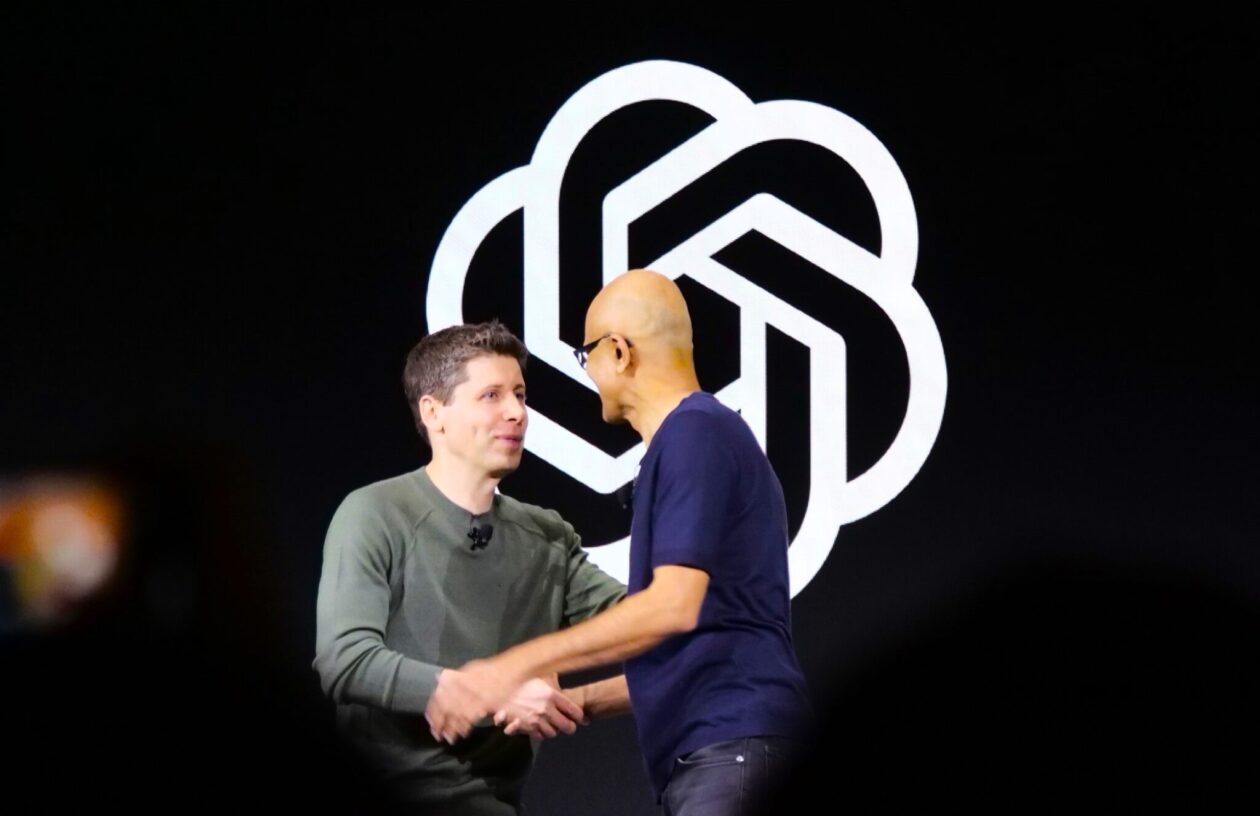
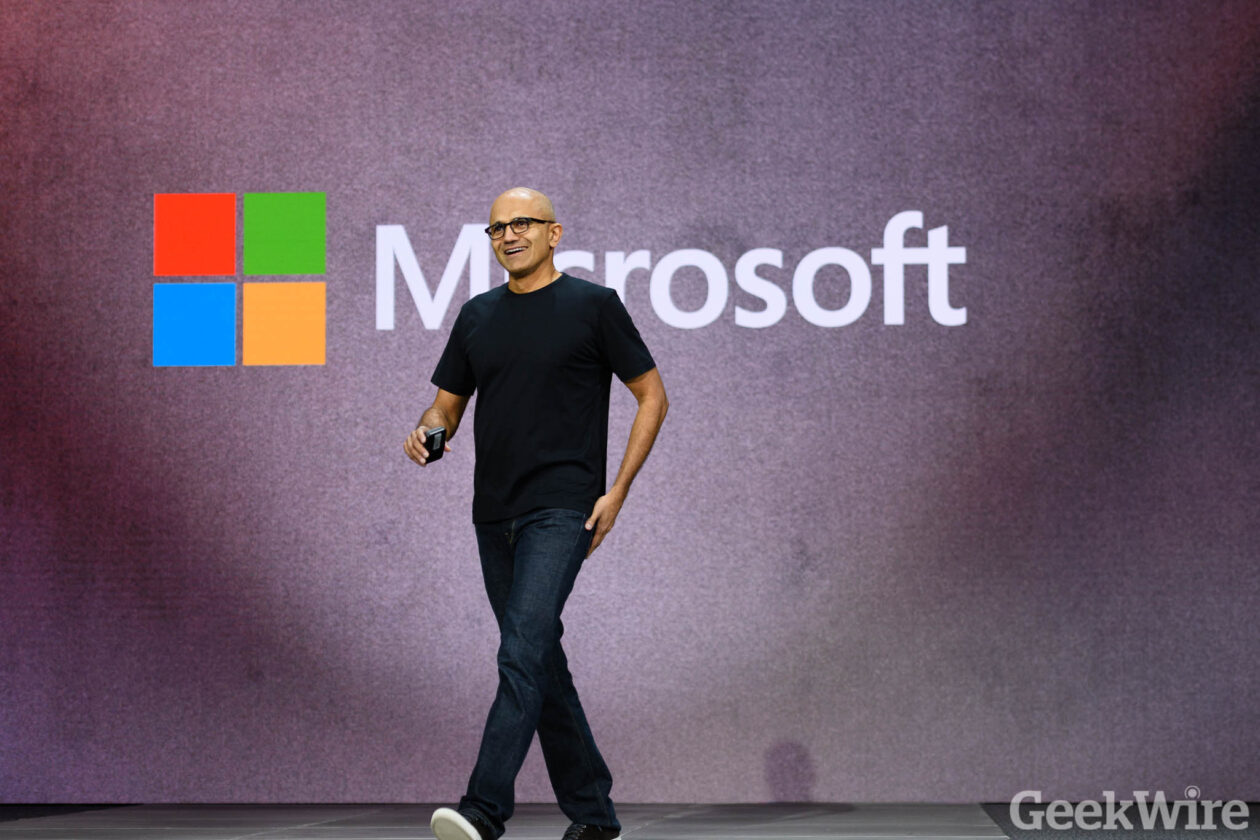
OpenAI CEO Sam Altman and Microsoft CEO Satya Nadella at OpenAI’s DevDay in November 2023. (GeekWire File Photo / Todd Bishop)
OpenAI generated $10 billion in revenue for Microsoft in the quarter ended Sept. 30, about 11% of the Redmond company’s total revenue, according to its quarterly filing Wednesday.
The amount is up sharply. In the fiscal year that ended in June, Microsoft recorded $24.1 billion in revenue from its business with OpenAI, or about $6 billion a quarter on average.
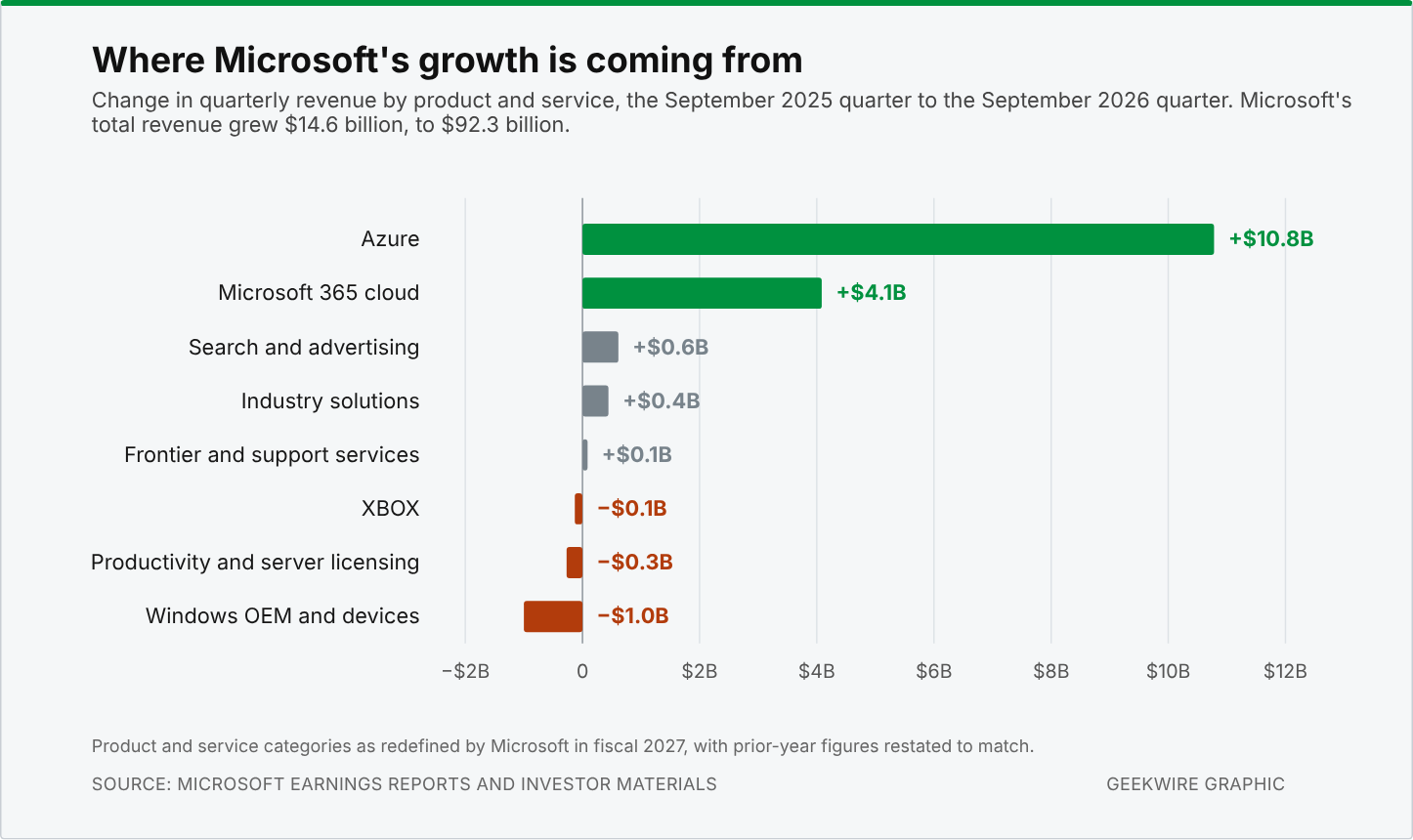
That $10 billion surpasses some of Microsoft’s longest-running businesses. Xbox brought in $5.4 billion in the quarter. Search and advertising, which includes its Bing search engine, generated $6.6 billion. Windows licenses sold through PC makers, along with Surface and other Microsoft devices, brought in $3.6 billion.
The total covers revenue-sharing payments from OpenAI, as well as other business between the companies, such as OpenAI’s use of Azure to train and run its AI models. Microsoft didn’t say how much came from each, or how much of Azure’s growth came from OpenAI.
Microsoft has begun disclosing its revenue from OpenAI because its stake of about 24% makes OpenAI a “related party” under accounting rules, requiring it to report the business they do with each other.
Microsoft first reported the number in its annual report in July, as a full-year total. This is the first time it has given a quarterly figure.
The original AI alliance: Microsoft first invested in OpenAI in 2019, eventually committing $13 billion, and became its exclusive cloud provider. ChatGPT ran on Azure when it launched in late 2022.
The companies have loosened their ties since then. OpenAI restructured as a public benefit corporation in October 2025, and Microsoft gave up its right of first refusal to supply OpenAI’s computing capacity. OpenAI committed to buy an additional $250 billion in Azure services. An April 2026 agreement gave OpenAI broader freedom to use other cloud providers.
OpenAI has also agreed to keep sharing revenue with Microsoft through 2030.
In addition, Microsoft sells access to OpenAI’s models to business customers through its Azure OpenAI Service, and the models became the foundation for its Copilot products, putting Microsoft at the front of the generative AI boom. That revenue comes from Microsoft’s own customers, so it isn’t part of the $10 billion.
Many customers, not a few: Asked by Bernstein Research analyst Mark Moerdler whether AI growth on Azure was coming from big businesses or AI-native companies, Microsoft CEO Satya Nadella didn’t mention OpenAI.
He said he doesn’t want Azure’s AI business to depend on a few big customers, and that broad adoption by businesses is just getting started.
Nadella described it as “a decade-long thing,” and contrasted it with relying on “four customers who buy a lot of capacity from you” to show a few quarters of growth. That, he said, is “not a business as far as I’m concerned.”
He added that Microsoft has large customers who want to buy capacity, “and as long as the pricing is right, we may sell them some. If not, we will be patient.”
Later in the call, Goldman Sachs analyst Gabriela Borges brought up the fact that OpenAI made up 11% of revenue. Nadella didn’t address the number but praised OpenAI’s latest models and said customers are increasingly mixing models from different companies, or training their own.
He cited Microsoft’s tools for routing each task to whichever AI model handles it best. If you use AI coding agents, Nadella said, you want Anthropic and OpenAI “to compete for your workload, not like once a quarter, but for every task.”
New risk language: Microsoft also expanded a warning in its quarterly filing about the risks of depending on outside AI providers. The company builds products such as Copilot on AI models from outside companies, including OpenAI and Anthropic. It now says it has “limited visibility into or control over” how those models are designed, trained, secured and tested.
Without naming OpenAI or Anthropic, the same section notes that some of these AI partners are also “significant customers of Azure,” and that the benefits Microsoft expects from those relationships “may not be realized or sustained.” It says those partners could change how much they buy, and that Microsoft itself may change how it allocates scarce data center capacity or prices it.
Microsoft is an investor in both companies. According to its latest filing, it owns about 24% of OpenAI, down from about 25% in June and about 27% after OpenAI’s restructuring a year ago, and has put $12.0 billion of a promised $13.0 billion into the company.
Microsoft broke out Azure’s quarterly revenue for the first time in its new financial structure. (GeekWire File Photo / Todd Bishop)
Microsoft’s Azure cloud business brought in $33.2 billion in revenue in the September quarter, up 48% from a year earlier, blowing past the company’s own forecast and beating Wall Street’s expectations.
The growth suggests that Microsoft is selling cloud and AI computing about as fast as it can install it. Azure revenue rose $10.8 billion from a year earlier, driven by demand for services across the platform, Microsoft said in its quarterly filing. That came even as some new data center capacity arrived late.
For investors worried about Microsoft’s record capital spending, it’s a sign that the company’s massive AI and cloud infrastructure buildout is turning into sales. Microsoft’s shares rose nearly 4% in after-hours trading following the earnings report.
Overall, Microsoft reported revenue of $92.3 billion for the first quarter of its 2027 fiscal year, up 19% and above the $90.75 billion analysts expected, according to Yahoo Finance. Earnings were $4.89 per share excluding the impact of its OpenAI investment, compared with expectations of $4.72.
It’s the first time Microsoft has reported Azure’s quarterly revenue figure, not just its growth. The disclosure is part of a new financial structure that took effect this quarter, splitting the company into two segments: Agents and Infra, and Devices and Consumer.
Agents and Infra (Azure, Microsoft 365, Dynamics, LinkedIn’s recruiting and sales tools, and server and productivity licensing): Revenue rose 25% to $76.8 billion, above Microsoft’s forecast of $75.15 billion to $75.75 billion. Operating income rose 24% to $40.6 billion.
Devices and Consumer (Windows, Xbox, and search and advertising): Revenue fell 3% to $15.5 billion, above Microsoft’s forecast of $14.7 billion to $15.2 billion. Operating income rose 2% to $5.4 billion.
Capital spending came in below Microsoft’s forecast. The company spent $45.2 billion, including finance leases, short of the more than $50 billion it expected. Some data center capacity that third parties were supposed to deliver in the quarter was delayed, the company said.
Google Cloud, which includes Google’s Workspace productivity apps, brought in $30.7 billion in revenue in the quarter, up 103% from a year earlier, Alphabet reported Wednesday afternoon.
Update, 3:05 p.m.:Microsoft expects Azure growth to accelerate again this quarter, to 49% to 50% excluding currency changes, CFO Amy Hood said on the earnings call. “Customer demand continues to exceed available supply,” she said.
Hood said Azure’s growth came from Foundry, Microsoft’s service for building AI apps and agents, and from engineering work that let Microsoft sell unused capacity on its existing servers. That helped make up for delays in new data center capacity that outside providers were supposed to deliver.
Those delays pushed some spending later into the fiscal year. Microsoft now expects to spend about $170 billion on capital expenditures in calendar 2026, down from about $175 billion. It expects to spend more than $50 billion this quarter, and Hood said spending will accelerate in the first half of calendar 2027.
Hood also said Microsoft may tap additional sources of financing to help pay for the buildout, “when we believe it is attractive to do so.” The company still expects to bring in more cash than it spends this fiscal year.
Microsoft’s expense forecast for the December quarter includes an estimate for the buyout offer it announced Monday, Hood said, though she didn’t give the amount.
The company expects total revenue of $96 billion to $97.1 billion for the December quarter, above the $95.7 billion analysts expected, according to Yahoo Finance.
F5’s logo at the entrance to F5 Tower in downtown Seattle. The company’s stock fell about 20% Wednesday after it forecast slower growth and lower margins, along with more spending on AI security. (GeekWire Photo / Todd Bishop)
Shares of F5 fell about 20% on Wednesday, a day after the Seattle-based company beat Wall Street’s estimates and said it would boost spending to capitalize on expected growth in the AI security market.
The application security and delivery company’s stock was trading around $368 late Wednesday morning, down from $459 at Tuesday’s close, wiping out about $5 billion in market value. That put F5 on pace for its biggest one-day drop in more than 13 years, according to Barron’s. Before the drop, F5’s shares had climbed nearly 80% this year.
F5’s revenue for its fiscal fourth quarter rose 13% to $917 million, and product revenue jumped 23%. Adjusted earnings of $4.42 a share beat estimates of about $4.30.
Slower growth ahead: Investors seem to be focused on the outlook. F5 expects revenue to grow 8% to 9% in fiscal 2027, down from 11% this year, and adjusted earnings per share to grow 3% to 5%. It’s also projecting lower margins as memory and storage components get more expensive, and as it doubles its team of AI security sellers.
F5’s hardware business is also cooling off. Systems revenue jumped 29% in the quarter as customers replaced aging equipment, but F5 Chief Financial Officer Cooper Werner said on the earnings call that those replacements will taper off in the second half of fiscal 2027.
The AI bet: F5 is spending more to go after AI security. CEO François Locoh-Donou said on the call that the company will double its team of specialist AI security sellers in fiscal 2027 and more than double its marketing in that area. It’s also adding compensation incentives for all of its field sellers to discuss AI security with customers.
F5’s adjusted operating margin fell to 33.7% in the quarter, from 37% a year earlier.
Locoh-Donou said F5’s AI-related bookings topped $100 million in fiscal 2026, up about 300%. Most of that came from AI data delivery, which moves data to and from AI systems, rather than security. More than 300 customers are using an AI-powered web application firewall that F5 launched in March.
The company estimates the AI market it sells into will grow from about $1 billion this year to $11 billion by 2030.
Wall Street reaction: Piper Sandler downgraded the stock to neutral, according to The Motley Fool. Analysts at William Blair, which rates F5 “market perform,” wrote in a research note that “the AI opportunity has yet to contribute meaningfully to the top line.”
We’ve contacted F5 for comment on the stock decline.
F5 has been building out its AI security business, including its acquisition of SurePath AI. Locoh-Donou talked about the company’s path from the early web to AI security on a GeekWire Podcast episode marking F5’s 30th anniversary. He said companies adopting AI are losing track of what those systems can access, and that juggling separate tools to manage it is a burden, which is why F5 is building a single AI security platform.
This week, F5’s board authorized an additional $1.5 billion in stock buybacks, on top of $322 million remaining in its existing program.
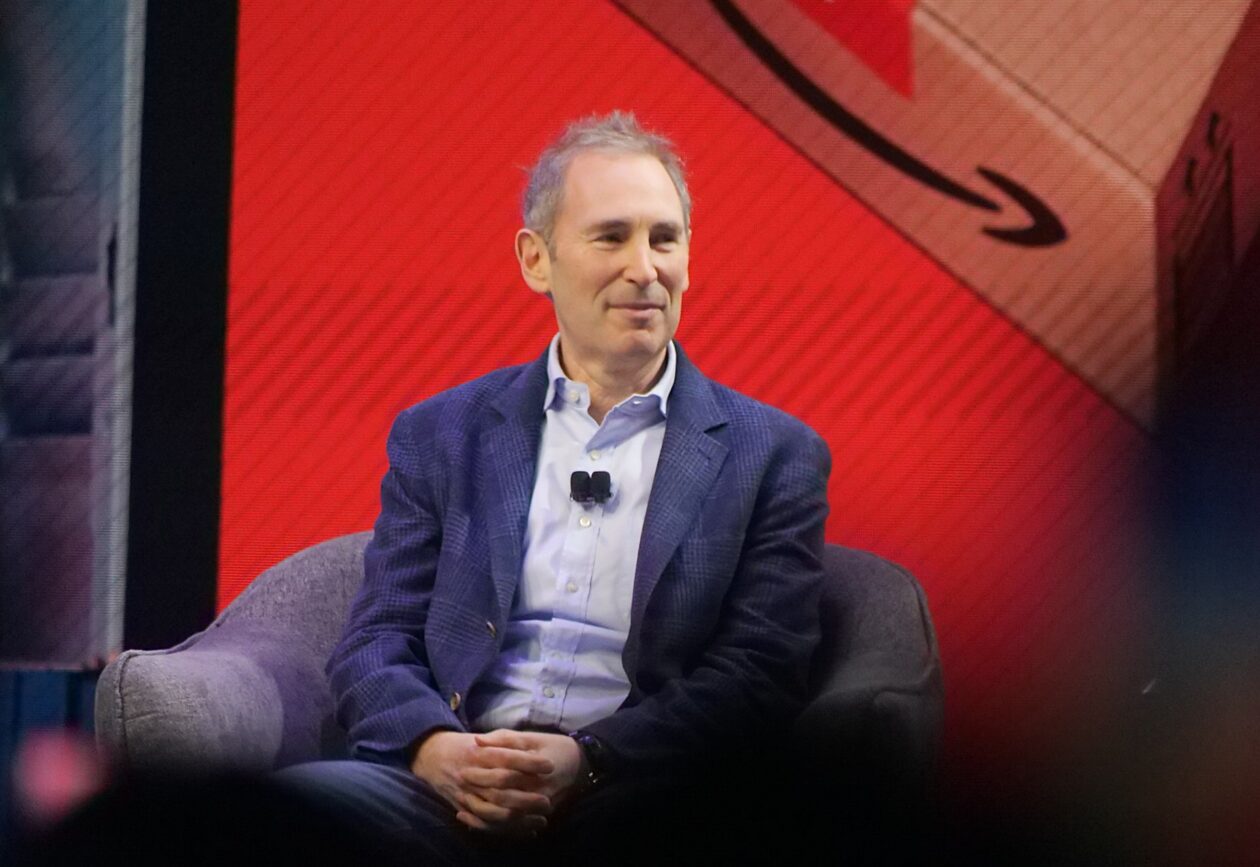
Andy Jassy says Amazon “could invest a lot more” in AI infrastructure “and it wouldn’t be a bad use of capital.” (GeekWire File Photo / Todd Bishop)
Amazon reports third-quarter earnings Thursday afternoon with more demand for its cloud services than it can serve, driven by AI labs such as Anthropic and OpenAI along with growth in its traditional cloud business.
One big question for Wall Street going into the report is what Amazon might signal about next year’s spending as it tries to keep up with that demand.
CEO Andy Jassy said on an Andreessen Horowitz podcast last week that AWS capacity is largely booked for this year and next, along with “a good chunk of ’28.”
Amazon has said it expects to spend about $220 billion on capital expenditures this year, largely on AI and cloud infrastructure, up from its earlier plan of $200 billion. Even at that level, Jassy said, Amazon is “leaving a meaningful amount of demand on the table.”
Past spending pushed Amazon’s free cash flow to negative $7.6 billion for the 12 months ending in June, as the cost to add data centers, chips and other equipment exceeded the cash its operations brought in. Jassy gave no indication of slowing down, saying the company “could invest a lot more and it wouldn’t be a bad use of capital.”
Core numbers: Analysts expect revenue of about $202 billion, up 12% from a year ago, according to Yahoo Finance. That’s at the top of Amazon’s own forecast of $197 billion to $202 billion.
Analysts expect earnings of $1.96 per share, about the same as a year ago.
Amazon’s sales growth will likely look slower this time, about 12%, down from 20% last quarter. A big reason is timing. Prime Day, the company’s biggest sales event of the year, fell in the second quarter this year, rather than the third quarter as it did last year, so this quarter is up against a tougher comparison.
Amazon estimated in July that the shift would take nearly 4 percentage points off its growth rate this quarter. It hits online store sales hardest: analysts expect them to grow only about 3%, according to Zacks.
AWS: Amazon Web Services, the company’s cloud business, generates the majority of its operating profit. AWS revenue grew 37% to $42.2 billion in the second quarter, its fastest pace since 2021 and the fifth straight quarter of faster growth.
Analysts expect AWS revenue of about $45.4 billion this time, up 37.5%, according to Zacks. Wedbush is more optimistic, projecting growth of about 41%.
AWS had $496 billion in signed contracts it hadn’t yet delivered as of June, more than double the year before. That means its growth depends largely on how quickly Amazon can bring new data centers online.
“Capacity, not demand, is the constraint,” Yorkville Ives analyst Dan Ives wrote of the industry in a note Sunday.
Jassy said on the a16z podcast that running AI models is still “an order of magnitude too expensive” for businesses to use them widely, and that Amazon’s custom chips, including its Trainium AI processors, are a big piece of bringing that cost down. Amazon said in July that its chip business was on pace for more than $25 billion in annual revenue.
Anthropic stake: Amazon’s reported earnings could look very different. That’s because its profit fluctuates significantly depending on the value of its stake in Anthropic.
Last quarter, $53.4 billion in pre-tax gains, mostly on Anthropic, pushed Amazon’s earnings to $5.75 per share, against expectations of $1.82.
Anthropic filed paperwork Monday for a planned IPO on the Nasdaq. Amazon’s stake in the AI company was valued at about $190 billion as of June 30, according to Amazon’s latest quarterly filing. That includes about $92 billion in gains on convertible notes, a form of loan that turns into stock, which haven’t yet been counted in Amazon’s profit. Those notes would convert to Anthropic stock when it goes public.
Anthropic is also one of Amazon’s biggest cloud customers. Its IPO filing shows commitments to spend at least $110 billion on Amazon’s computing capacity into the 2030s, behind the $114.5 billion it committed to Google, as GeekWire reported Tuesday. Anthropic also said in the filing that it has asked its cloud providers for more computing power than they were willing to supply.
Shopping agents: Amazon blocked Meta’s new Muse AI agent from its store last month, escalating a fight over who controls the customer relationship when software does the buying. Amazon said Muse broke its rule requiring agents to identify themselves.
Agents that shop on a customer’s behalf could bypass Amazon’s advertising business, which depends on people browsing its pages. Ad revenue grew 26% to $19.8 billion last quarter, and analysts expect about $20.8 billion this time, up 18%, according to Zacks.
“Investor questions remain on agentic commerce risk, particularly to advertising, but we see limited risk,” Wedbush analyst Ygal Arounian wrote in an Oct. 16 note, citing Amazon’s logistics advantage and its role connecting shoppers with sellers.
Amazon is trying to give shoppers fewer reasons to look elsewhere. It now lists 250 million products sold on other retailers’ sites, about 2.5 times as many as in March, The Information reported Wednesday. On the seller side, Amazon opened its tools to outside AI agents in September, starting with Anthropic’s Claude.
Cloud rivals: Microsoft and Alphabet report quarterly results Wednesday afternoon, a day before Amazon. Microsoft’s report is its first under a new structure that breaks out Azure cloud revenue every quarter.
Check back with GeekWire on Thursday afternoon for coverage.
Satya Nadella & Co. report quarterly earnings under a new financial structure Wednesday. (GeekWire File Photo / Kevin Lisota)
Update, 10/28: Microsoft’s Azure cloud business brought in $33.2 billion in revenue in the September quarter, up 48% from a year earlier, blowing past the company’s own forecast and beating Wall Street’s expectations. Read the full story.
Microsoft’s earnings report Wednesday will come two days after the company offered buyouts to about 60,000 people, roughly a quarter of its employees. The call gives executives their first chance to say what the offer will cost, and to explain how it fits with the company’s long-term view of its workforce.
Whether or not they go into those details, it’s one of several issues to watch in Wednesday’s report, the first under Microsoft’s new reporting structure. Anthropic’s IPO filing on Monday adds another storyline, showing how much the Claude maker has agreed to spend on Microsoft’s cloud.
Coming into the report, Microsoft’s stock is near its high. Microsoft closed Monday at $532.60, about 2% below its record close of $543.45 on Oct. 13, after gaining roughly $1.4 trillion in market value since late June.
Here are the key numbers and issues heading into Microsoft’s results for the first quarter of its 2027 fiscal year, ended Sept. 30.
Core numbers: Analysts expect revenue of $90.75 billion, up nearly 17% from a year ago, and earnings of $4.72 per share, up 14%, according to Yahoo Finance. Microsoft’s own forecast was $89.85 billion to $90.95 billion, so Wall Street is looking for a result near the top of that range.
In July, Microsoft reported $90 billion in revenue for the June quarter, well above the $87.7 billion analysts expected.
A new scorecard: Microsoft announced in September that it would sort its business into two groups instead of the three it had used since 2015. This is the first quarter under the new setup.
The first, dubbed Agents and Infra, includes Azure, Microsoft 365, Dynamics, LinkedIn’s recruiting and sales tools, and server and productivity licensing. It brought in 81% of Microsoft’s revenue and 88% of its operating income in fiscal 2026, based on figures Microsoft recast under the new structure.
Microsoft expects Agents and Infra revenue of $75.15 billion to $75.75 billion this quarter, which would be growth of about 22% to 23%, by GeekWire’s calculation.
The other group, Devices and Consumer, includes Windows, Xbox and search advertising. Microsoft expects it to bring in $14.7 billion to $15.2 billion, down 5% to 8% from a year earlier.
Azure, in dollars: Microsoft started disclosing Azure’s annual revenue last year, when it passed $75 billion, and topped $100 billion in fiscal 2026. Starting this quarter, it reports the figure every quarter. It also changed what counts as Azure: GitHub’s cloud business and Security Copilot now fall under Microsoft 365, and its healthcare cloud moved to a new industry unit.
Counted that way, Azure brought in $29.4 billion in the June quarter, up 42%. Microsoft expects growth of 44% to 45% this quarter, not counting currency fluctuations, which would put Azure at roughly $32 billion, by GeekWire’s calculation. That compares with the roughly 45% Microsoft projected in July, under the old definition.
Hitting that forecast may not be enough. Investors are looking for about 46%, BNP Paribas analyst Stefan Slowinski wrote in a note Monday. In January, Azure beat Microsoft’s own forecast and the stock still fell 10%, because investors had privately expected more.
“Azure moves the stock, but the read that matters is whether capacity is absorbed as fast as it lands,” wrote Dan Ives of Yorkville Ives in a note last week.
Capital spending: Microsoft expects capital expenditures of more than $50 billion for the quarter, which would be a record. That’s up from $41 billion in the June quarter and $34.9 billion a year earlier.
An accounting change reduces what Microsoft reports as capital spending, without reducing its planned investment. Microsoft now assumes its data center buildings will last 25 years instead of 15. As a result, more of its data center leases will be classified in a way that doesn’t count as capital spending, CFO Amy Hood said on the July earnings call.
That change alone lowered Microsoft’s capital spending estimate for calendar 2026 to about $175 billion, from the roughly $190 billion it projected in April. Hood said the company’s actual spending plans hadn’t changed.
Cloud margins: Microsoft Cloud gross margin came in at 65% last quarter, better than expected but down from a year earlier. Microsoft said it expects the figure to be relatively stable this quarter. It also expects operating margins to be roughly flat with a year ago.
Workforce: The new “voluntary exit” offer, announced Monday by Chief People Officer Amy Coleman, covers participating teams in the U.S., Canada, the U.K. and India. It has no age or tenure requirement and extends to some vice presidents. Employees have until the first week of December to decide, and Microsoft hasn’t said how much the offer will cost or when it will record the charge.
For the spring retirement program, Hood disclosed the cost on the April earnings call: about $900 million, with roughly $350 million in cost of revenue and $550 million in operating expenses. The charge showed up in the following quarter. About 30% of the 8,750 eligible employees accepted.
The new offer is less generous. It matches Microsoft’s standard severance, without the extended healthcare of the spring program, and the company expects a much smaller share of people to take it. But the pool of eligible employees is nearly seven times larger.
Microsoft says the offer doesn’t mean it needs fewer people. Coleman said in July that the company was studying whether to make voluntary exits a regular part of managing its workforce. It has told investors to expect operating margins roughly flat this quarter and down less than a point for the full fiscal year, even with record capital spending.
Nadella has addressed this before. In a July 2025 memo to employees, after Microsoft laid off about 15,000 people, he acknowledged the “uncertainty and seeming incongruence” of thriving financially while cutting jobs. “This is the enigma of success in an industry that has no franchise value,” he wrote.
In his annual shareholder letter last week, he focused on Microsoft’s spending on AI infrastructure. “Based on the demand we see and the efficiencies we are driving, I am confident in the long-term returns on our investments,” Nadella wrote. “We are building against a growing book of business tied to this secular shift.”
Copilot: Microsoft said in July that businesses were paying for more than 30 million Microsoft 365 Copilot seats, up from 20 million in April. That’s still only about 7% of the more than 450 million commercial Microsoft 365 seats.
The bigger change is in how Microsoft charges for Copilot and its other AI tools. In July it added usage-based billing alongside per-seat pricing. It’s also pushing customers toward E7, a new premium bundle that includes Copilot. Microsoft expects Microsoft 365 commercial cloud revenue to grow about 17% this quarter, not counting currency swings, a number that now includes GitHub.
The BNP Paribas analyst Slowinski, who attended Microsoft’s Frontier Tour event in London last week, wrote that partners are seeing more customers roll out Copilot company-wide. Partners also told him that Microsoft now ties 35% of E7 sales incentives to how much customers use features like Cowork.
Anthropic and OpenAI: Anthropic’s S-1 filing shows the company has committed to spend at least $44.9 billion with Microsoft from November 2026 to May 2033, up from the $30 billion Azure commitment announced last November. That’s well below its minimum commitments to Amazon ($110 billion) and Google ($114.5 billion).
Microsoft agreed last year to invest up to $5 billion in Anthropic. Its results for the June quarter included a $3.2 billion gain on that investment.
OpenAI remains the bigger factor. Microsoft’s commercial remaining performance obligation (RPO), the measure of signed contracts it hasn’t yet delivered on, reached $678 billion last quarter, up 84% from a year earlier. Without OpenAI, the backlog grew 25%. OpenAI told investors its annualized revenue approached $50 billion at the end of September, The Information reported, lower than earlier reports of about $70 billion.
Windows: Microsoft expects revenue from Windows licenses sold to PC makers, along with its own devices, to fall a little more than 20%. Higher memory prices are making PCs more expensive, and PC makers are still working through extra inventory.
What’s next: Alphabet also reports Wednesday afternoon, and Amazon reports Thursday, setting up a side-by-side look at Azure, Google Cloud and AWS.
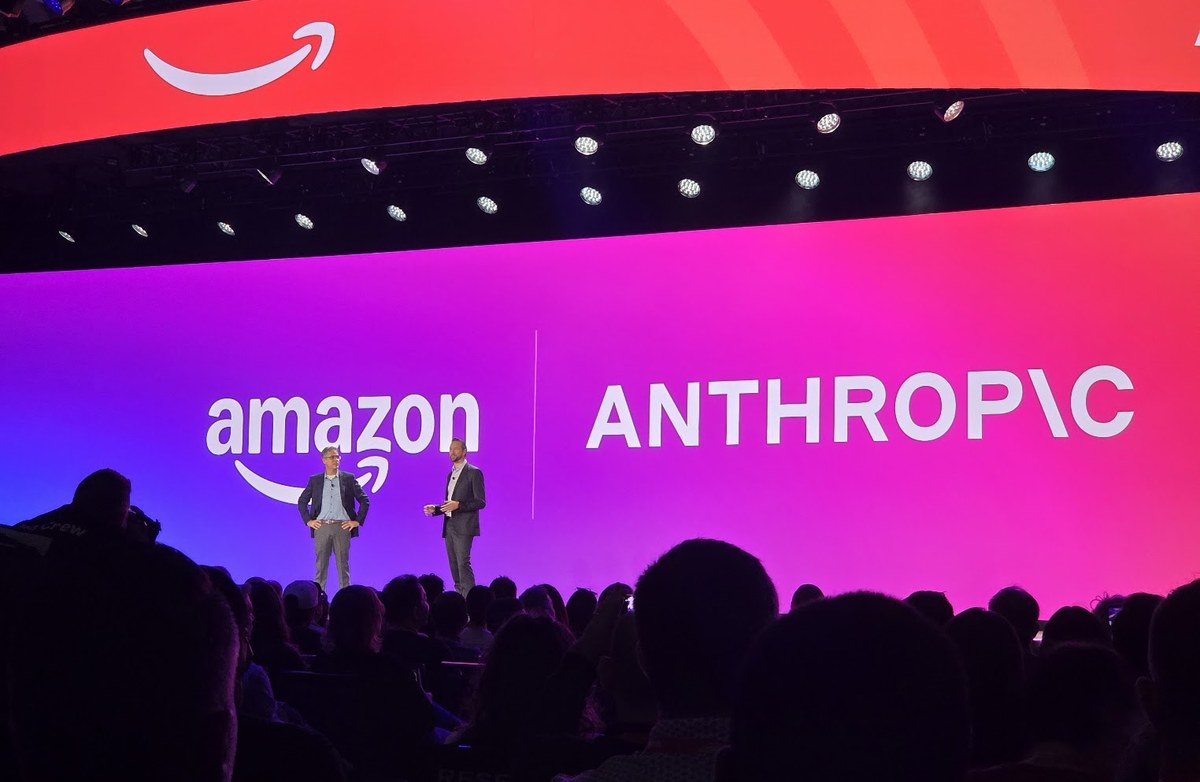
Chris Jones, director of Seller Assistant at Amazon, left, and Eric Burns of Anthropic’s Applied AI team on stage at Amazon Accelerate in Seattle in September. Anthropic’s IPO filing shows Google getting a bigger share of the AI company’s computing spending than Amazon, one of its largest investors. (GeekWire Photo / Todd Bishop)
Anthropic’s IPO filing reads like a ledger of who’s getting paid in the AI boom. The Seattle region’s tech giants are on the list, but they aren’t at the top.
The prospectus, filed Monday with the Securities and Exchange Commission, details more than $750 billion in computing deals, including firm commitments and estimated future spending, and offers clues about what its founders and biggest investors stand to gain ahead of the company’s planned Nasdaq listing under the ticker ANT.
Amazon and Microsoft have invested billions in Anthropic and won high-profile spending commitments from the Claude maker. But both trail Google, chipmaker Broadcom and Elon Musk’s SpaceX in their shares of Anthropic’s planned spending on computing power, the filing shows.
Following the compute money: Google’s chips are the biggest winner. Anthropic has lined up roughly $400 billion in computing capacity, mostly over the next seven years, based on Google-designed AI chips, known as tensor processing units or TPUs.
That total includes $114.5 billion to Google directly through July 2033, $161.2 billion in equipment leases with chipmaker Broadcom, and an estimated $125 billion to $150 billion in additional TPU capacity from 2028 to 2031.
Broadcom’s leases are the largest single arrangement in the filing. The five-year leases provide TPU-based hardware for data centers operated by other companies on Anthropic’s behalf.
Elon Musk’s SpaceX is next. Anthropic agreed to spend up to $120.5 billion through 2029 for computing capacity from SpaceX’s AI subsidiary, formerly known as xAI, which runs a rival AI lab.
The filing says payments will reach about $3.1 billion a month once all the capacity is delivered, which Anthropic expects in December. The agreements run into 2029, though either side can cancel on 90 days’ notice after early 2027.
Amazon is still a big winner. Anthropic committed in April to spend at least $110 billion with Amazon Web Services over 10 years, through April 2036, and AWS Trainium is one of four chip families that Anthropic uses to train and run its models.
Anthropic has committed to spend at least $44.9 billion on Microsoft’s Azure cloud from November 2026 through May 2033, the filing shows. That’s up from the $30 billion Azure deal announced in November 2025. The deal has been amended twice since, most recently this month.
Claude is built into Microsoft 365, and former Microsoft CFO Chris Liddell joined Anthropic’s board in February.
Two smaller providers have deals in the same range as Microsoft’s. Anthropic agreed to spend up to about $44.6 billion with Nscale, a U.K.-based AI infrastructure company, and about $41.3 billion with GPU cloud provider Lambda, both for capacity powered by Nvidia chips, according to the filing.
Will Anthropic need it all? Most of the commitments can’t be canceled, and the deals with Microsoft, Google and Amazon require Anthropic to pay “regardless of actual usage,” according to the filing.
So far, the demand is there. Anthropic’s revenue hit $11.6 billion in the second quarter, up from $787 million a year earlier, and the company posted its first operating profit, $974 million. It still had a $66.3 billion net loss, mostly from accounting charges tied to its soaring valuation.
The company says it has “consistently operated in a compute-constrained environment where customer demand exceeds available compute.”
Its compute commitments assume that demand keeps growing. Anthropic spent less than $2 billion a month on compute and infrastructure in the second quarter. The SpaceX deal alone is expected to cost about $3.1 billion a month at full capacity.
Paper fortunes: Amazon’s biggest payoff is its stake, which it valued at $190.4 billion as of June 30 in its quarterly SEC filing. That includes convertible notes with $6.2 billion in principal that Amazon valued at $97.9 billion. The notes would convert into stock, subject to a 12% ownership cap that Amazon can waive.
Amazon is scheduled to report third-quarter results Thursday, its first earnings report since Anthropic’s filing. The Seattle-based company has updated the value of its Anthropic holdings in each of its quarterly filings this year, so a new number could come this week.
Google put $10 billion into Anthropic’s latest funding round and can invest up to $20 billion more under a March financing deal. The filing doesn’t give ownership percentages for Amazon, Google or Microsoft. It says only that the three companies have each made “significant equity investments” in Anthropic.
Anthropic’s seven co-founders hold roughly 230 million to 245 million shares each, worth about $14 billion apiece at the latest private funding price. The company also gave its own Public Benefit Fund about 847 million shares, or 5% of its fully diluted stock as of June 30, worth about $50 billion at that price.
Anthropic could begin formally marketing its IPO to investors as soon as the week of Nov. 9, Bloomberg reported, citing people familiar with the matter. It is aiming to go public the following week, according to the Wall Street Journal. The company expects the offering to match or beat the size of SpaceX’s IPO, according to Bloomberg. SpaceX raised $75 billion in June, the largest IPO on record.
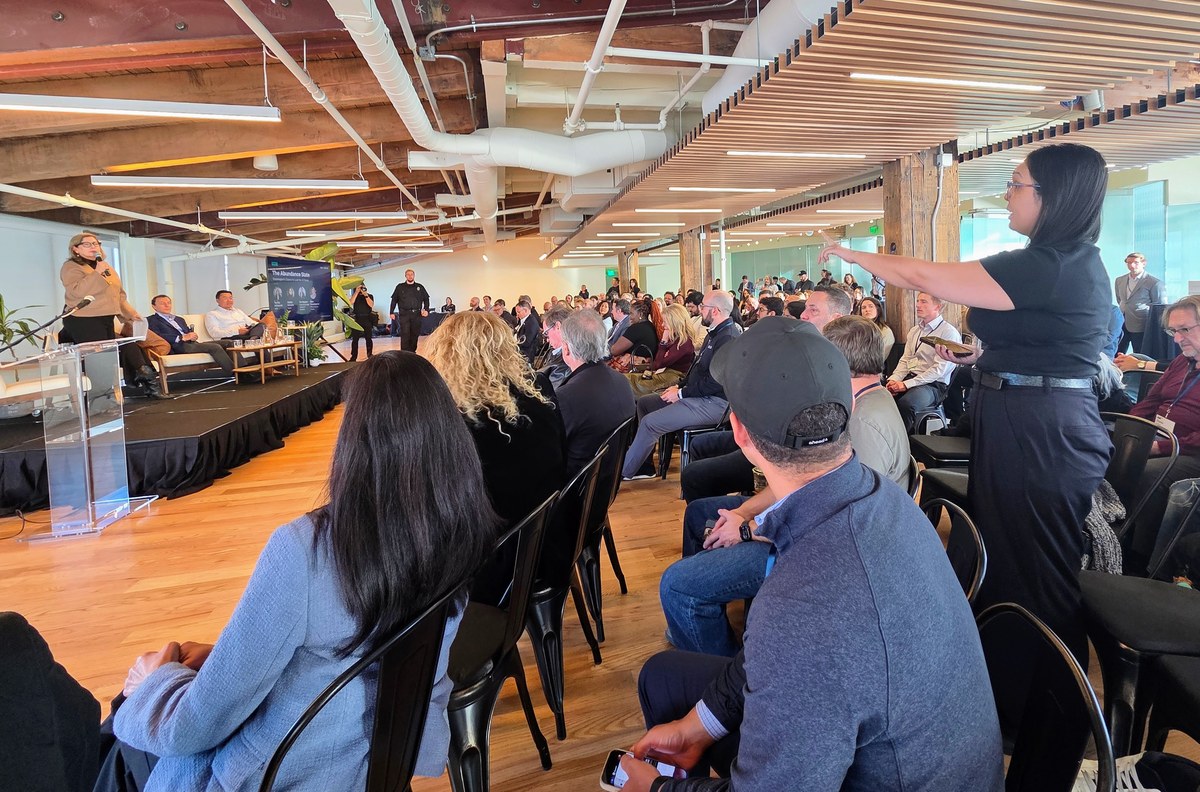
A protester interrupts a panel on AI and economic growth at Seattle AI Week at AI House on Monday, as a security guard approaches from across the room, and moderator Randa Minkarah of WTIA tries to regain control of the session. (GeekWire Photo / Todd Bishop)
The Washington Technology Industry Association kicked off the third annual Seattle AI Week on Monday with a reminder that AI affects everyone, from engineers and artists to “someone who learned about ChatGPT today,” as WTIA’s Nick Ellingson put it.
“All of us should be a part of that conversation,” he added.
A few people in the audience took that statement literally.
Members of Troublemakers, a Seattle climate activism group, interrupted the week’s opening panel on AI and economic growth several times before they were led out by security. Outside on Elliott Bay, others floated in kayaks with a banner: “Power for People, Not for Tech.”
“These are not your constituents — we are,” one protester told Beau Perschbacher, Gov. Bob Ferguson’s senior policy advisor, as he addressed the large crowd of tech and startup leaders at Seattle’s AI House. Perschbacher was on a panel with Joe Nguyen of the Seattle Metropolitan Chamber of Commerce and Mattie Zazueta of OpenAI, the event’s presenting sponsor.
The group’s main message, according to members who spoke with GeekWire: the rush to build data centers and roll out AI is putting the state’s communities, jobs and environment at risk, and Washington should be investing in green jobs and clean energy instead.
Protesters in kayaks on Elliott Bay near the Seattle AI Week kickoff event on Monday. (GeekWire Photo / Todd Bishop)
The protest comes amid a broader backlash against data centers in Washington state and across the country. The Seattle City Council voted unanimously in June to pause new large data centers in the city for a year, and Washington AI Resistance organized at least 19 protests around the state this month calling for a statewide moratorium.
The event also came the same day Microsoft offered voluntary buyouts to about 60,000 employees, roughly a quarter of its workforce, as it spends tens of billions of dollars on data centers and AI infrastructure.
The backlash contrasts with a push from the business and tech community for Washington state and the Seattle region to do more to stay competitive in the AI era.
“Washington helped build the technology economy of the last generation. We have an extraordinary opportunity to lead the AI economy of the next,” said former Gov. Chris Gregoire, now CEO of the business group Challenge Seattle, in her opening remarks at the AI Week event.
Gregoire cited efforts to put AI to work on the region’s own problems, including an AI permitting pilot in Everett that she said could cut the median wait for an accessory dwelling unit permit from 252 days to 90. She highlighted the AI-driven protein design work of Nobel laureate David Baker of the University of Washington, with applications in areas including the environment, agriculture and health care.
Former Washington Gov. Chris Gregoire, now CEO of Challenge Seattle, says the state needs to do more to stay competitive in AI. (GeekWire Photo / Todd Bishop)
She also warned that Washington is close to the bottom for its business climate, even though it ranks second in North America for tech talent, as other states court its companies and jobs.
On the panel, Perschbacher said Ferguson’s administration has been focused on data centers since taking office, setting up a work group early last year to study their impact. The group looked for a Washington community that had been harmed by a data center and couldn’t find one, he said.
He added that the state won’t permit data centers to run diesel generators around the clock, and that their water use turned out to be “not out of line with a typical industrial user.”
From left: WTIA’s Randa Minkarah moderates the Seattle AI Week panel with Mattie Zazueta of OpenAI, Beau Perschbacher of Gov. Bob Ferguson’s office and Joe Nguyen of the Seattle Metropolitan Chamber of Commerce. (GeekWire Photo / Todd Bishop)
Electricity is a different story. Data centers “use a really significant amount of electricity,” he said, and with demand also rising from EVs and heat pumps, getting enough power “is a major challenge.”
Perschbacher addressed the protesters directly, saying Washington has some of the strictest environmental laws in the country and that the state’s data center work group reinforced those rules rather than weakening them. Bills on ratepayer protections and transparency for data centers are likely to come back in the next legislative session, he said.
The issue also came up in the event’s second panel, on AI policy. State Sen. Marko Liias, who sponsored a bill this year on high-risk uses of AI, said data centers that want to locate in Washington need to meet “stringent expectations,” including adding clean energy to the grid, recycling water and dropping nondisclosure agreements that keep communities in the dark. Washington’s goal “has never been to be the cheapest or easiest place,” he said.
“When energy becomes scarce, I do think we need to be clear that our communities deserve access to that energy before the data centers do,” Liias said.
Joe Braidwood, founder of AI governance startup Glacis, which works out of AI House, said on the same panel that it was the first event he’d attended there with a public protest. “I think that’s actually kind of promising that people care enough to want to come together and talk and disagree and figure this out,” he said.
Zazueta, OpenAI’s global head of community programs, said in the opening panel that the industry needs to do a better job showing people the benefits of AI. Many people “read about these scary headlines,” she said, but don’t see how the technology applies to their daily lives.
OpenAI runs AI literacy workshops and trains libraries and community groups to lead their own, she said. The company opened an expanded office in Bellevue in March, its largest engineering center outside San Francisco.
Speaking with GeekWire outside the event on Monday afternoon, one of the protesters who had interrupted the panel singled out that remark. She said it dismissed public concerns about AI as the product of bad headlines, and she objected to the idea of using community groups to win people over to the benefits of artificial intelligence.
“They want to infiltrate our communities,” she said.
The opening panel with Zazueta, Perschbacher and Nguyen was titled “The Abundance State: Washington’s Chance to Lead the AI Future.” The protester objected to that framing, saying the panelists’ idea of abundance came down to easing permits for data centers.
It wasn’t the first time the group has protested the tech industry’s energy use. In 2024, it blocked entrances at Amazon’s Seattle headquarters to protest the company’s plans to power data centers in Oregon with natural gas.
Inside the event on Monday, as the interruptions continued, Nguyen, a former state senator who now leads the Seattle chamber, had responded to the protesters directly. “If you want to have your own event, have your own event,” he told them.
After they were led out, Nguyen said he agreed with the protesters, calling their passion “very warranted.” Those concerns are one reason Washington created some of the most stringent energy policies in the country, he said, adding that everyone would be better off if data centers elsewhere were held to the same standards.
“I think we’re very unique in Washington state to be able to actually do this in a way that really is mindful of our values, of the environment, and also pushing for innovation as well,” he said.
At the same time, Nguyen said demand for AI and data centers is market-driven, and it isn’t fair to criticize data centers while using them every day.
“For anybody who’s upset with data centers, I hope that when you email me, don’t email me,” he said. “Print it off and walk it to my office.”
Update, Oct. 27: Protesters interrupted the opening session of WTIA’s Seattle AI Summit six times Tuesday morning, during an on-stage interview of OpenAI’s Vijaye Raji by GeekWire’s Todd Bishop. They objected to AI-related job losses, the climate impact of data centers, OpenAI’s ties to the Trump administration and the leadership of OpenAI CEO Sam Altman.
Entire CEO Thomas Dohmke, speaking last month at Madrona’s IA40 Summit in Seattle, says AI agents have made code review a much bigger bottleneck for developers. (GeekWire Photo / Todd Bishop)
A startup led by former GitHub CEO Thomas Dohmke is introducing its own platform for storing, reviewing and shipping code written by AI agents, competing with the company he used to run.
The startup, Entire, on Monday unveiled what it calls a Git forge — a service for hosting code, reviewing changes and running builds, the core of what GitHub does — designed for teams whose AI agents write code faster than people can review it. The company is pitching it as an alternative to GitHub.
The news comes two days before GitHub’s annual Universe conference in San Francisco. Microsoft acquired GitHub for $7.5 billion in 2018 and has since folded it into its CoreAI division.
The biggest change is Trails, Entire’s replacement for the pull request, the standard way developers propose and review code changes. The pull request “has become an audit log that only the agent reads,” Dohmke wrote in a blog post Monday. Instead of reading through every changed line, developers see a dashboard of scores from AI agents evaluating the code on each update.
According to Entire, multiple AI agents check the quality of each change, so developers can merge code without reading every line. Teams can also require a person’s sign-off, or passing automated tests, before any code goes in, the company said.
The launch comes as GitHub strains under the load from AI agents. The platform has had several significant outages in recent months, including one in August that lasted nearly eight hours. GitHub is moving from its own data centers to Microsoft’s Azure cloud to add capacity. GitHub said developers and agents made 7.38 billion commits, or saved code changes, on the platform in September alone.
Dohmke, who is based in Bellevue, Wash., left GitHub last year after nearly four years as CEO. Entire says it now has 50 employees. The company is fully remote.
Entire isn’t alone in rethinking code hosting for AI agents. AI coding company Cursor launched its own code-hosting service, Origin, in August. And Anthropic recently described building its own source control system as the number of code changes it merged each day grew from about 2,500 in May to more than 30,000 in September.
With the latest updates, Entire now lets developers host private code repositories directly on its service in the U.S., Europe, India and Australia, and says its service can handle up to 89 times as many code pushes per second as GitHub, based on its own benchmarks. It’s partnering with Buildkite and Depot on build and test pipelines, giving developers a way to move off GitHub Actions. Public repositories and self-hosting are on the roadmap.
Entire is also adding what it calls Continuous Memory, which lets AI agents search past coding sessions for the context behind earlier changes. The company says one part of it, a map of the codebase, cut token use by up to 71% in its testing.
That goes beyond the startup’s July launch, which mirrored existing GitHub repositories on a faster network rather than replacing them. Developers can still mirror from GitHub, or now move their code to Entire instead.
Microsoft’s venture arm M12 was among the backers of Entire’s $60 million seed round in February. Felicis led the round, with participation from Seattle-based Madrona and Basis Set Ventures, along with individual investors such as Yahoo co-founder Jerry Yang and Y Combinator CEO Garry Tan.
“Code review was always a bottleneck,” Dohmke said at a Madrona event last month. “I’ve never worked in a software company where I didn’t wait for somebody else to review my pull request, and you have to ping people in Slack three times. And there was this one guy that had to review everything because he knew what to look for. And now that bottleneck is 10 times bigger.”
Microsoft’s new buyout offer comes six months after its first-ever voluntary retirement program. (Photo by Dasharath Sunar on Unsplash)
Microsoft is making a new buyout offer to a much broader group of employees, this time including some executives — signaling that it’s not done shrinking its workforce despite thousands of layoffs and retirements this year.
The Voluntary Exit Offer, announced Monday in a memo to employees, is open to about 60,000 people in participating teams in the U.S., Canada, the U.K. and India, the company told GeekWire. That’s about a quarter of its workforce, which numbered 223,000 people at last count.
Microsoft didn’t provide a projection for how many employees will accept, but the company told GeekWire it anticipates a much smaller share than the roughly 30% who took its earlier voluntary retirement offer, which went to longtime employees more likely to take the deal.
“This offer gives eligible employees who may be considering a future outside the company a new choice to make that transition now with support,” wrote Amy Coleman, Microsoft’s chief people officer, in the memo to employees.
It also gives participating organizations within the company “another way to adapt their workforce to changing needs,” she added.
Microsoft’s count of 223,000 full-time employees as of June 30 was down from 228,000 a year earlier, according to its annual filings. That latest number came before its July layoffs.
However, Microsoft says the offer isn’t a sign that it needs fewer employees. Instead, a company spokesperson described it as one of several ways it’s adjusting to changing business needs.
The Voluntary Exit Offer includes financial support and career planning resources, according to the memo. It says eligible employees will receive the details by email.
The package is equivalent to Microsoft’s standard severance, according to the company, including base pay based on tenure and level, continued stock vesting, healthcare coverage for a fixed period and career transition services. It doesn’t include the extended healthcare that was a major draw of the retirement program. Employees have until the first week of December to decide.
The new offer does not come with any age or tenure requirement, and performance isn’t a factor, the company said. It goes up to level 70 on Microsoft’s internal scale, which includes general managers and some employees with vice president titles, but not corporate vice presidents.
That’s a big change from the voluntary retirement program that Microsoft offered this spring, which was the first in its history. That program was limited to U.S. employees at the senior director level (level 67) and below whose age plus years at the company reached a minimum threshold. The company described that as a one-time initiative.
Buyouts are still relatively rare among the largest tech companies, which have generally relied on layoffs, stricter performance reviews and return-to-office mandates to thin their ranks.
Like its peers, Microsoft is under pressure from Wall Street to hold down operating expenses as it pours tens of billions of dollars into data centers and AI infrastructure.
The company said the new offer is not a replacement for layoffs, which will remain part of the company’s approach depending on business conditions.
When Microsoft offered the retirement program this spring, about 30% of the roughly 8,750 eligible U.S. employees took the deal. Coleman told GeekWire in July that the results reduced the size of the layoffs Microsoft announced that month.
At the time, Coleman said Microsoft was studying how to make voluntary exits a more regular part of how it manages its workforce, possibly on an annual or ongoing basis.
Among the other changes this time, Microsoft is leaving it to business leaders to decide whether their groups participate, the company said. The company’s sales organization is not participating, nor are some engineering groups and corporate functions.
“There is no one-size-fits-all approach for every team or every employee,” Coleman wrote in the memo, explaining that participation by different groups “varies based on each business’s priorities, customer commitments, and workforce needs.”
She said Microsoft will keep helping employees build new skills and, where it makes sense, move into other jobs inside the company. Microsoft said in July that it had redeployed more than 4,000 employees into new roles over the previous year.
Microsoft reports quarterly earnings Wednesday afternoon, which could include projections for the cost of the new buyout offer. The company disclosed a $900 million charge for the retirement program in its April earnings report.
T-Mobile’s new T-Mix plans let customers spend “Picks” on perks or a new phone. (Photo by appshunter.io on Unsplash)
T-Mobile is introducing new wireless plans that change how customers get perks and phone deals, giving them a set number of “Picks” to spend on a new phone or an expanded menu of extras that they can swap out every 90 days.
The company says it will be the only carrier that lets customers choose which benefits come with their plan. Instead of fixed bundles of extras plus a discount on a new phone for each line, customers get a single allowance to spend on options ranging from Netflix and ESPN to Xbox Game Pass, Google’s Gemini AI and Delta SkyMiles.
One catch is that phones and perks come out of the same pool of Picks, so a family that wants a new phone on every line may have little left to put toward extras.
Allan Samson, T-Mobile’s chief marketing officer, says Picks are “essentially a form of currency.” (T-Mobile Photo)
The plans, called T-Mix, will be available in November. Existing customers can switch or keep their current plans, said Allan Samson, T-Mobile’s chief marketing officer.
The move comes as T-Mobile’s customer growth slows and new rivals emerge, including SpaceX, a current T-Mobile partner that is reportedly planning a wireless service of its own. T-Mobile’s stock is down about 26% this year, including a drop of nearly 8% on Friday after a report on SpaceX’s wireless plans.
The Bellevue, Wash.-based company has relied for years on “Un-carrier” moves — splashy changes that defy industry conventions — to capture consumer attention.
Samson described T-Mix as the latest of those moves, aimed at what the company’s research identified as a top customer complaint: paying for extras they don’t use. Picks are “essentially a form of currency,” he said. “You can use them for anything you want.”
A subscription hub: With the new plans, T-Mobile is adding a much larger menu of subscriptions in an attempt to turn its plans into a hub for streaming, music, gaming and AI services.
Along with longtime perks such as Netflix, Hulu and Apple TV, the new options include ESPN’s Unlimited streaming service, Xbox Game Pass, YouTube Premium, Apple Music and Google’s Gemini AI subscriptions.
The company says people spend far more on subscriptions than they realize. In T-Mobile’s research, customers estimated spending about $90 a month, Samson said. A separate study by C+R Research puts average spending at $219.
A big part of the idea is to consolidate that spending and let customers move among services more freely, picking up a streaming service for a new show, for example, or adding satellite coverage for a summer trip, then dropping it afterward.
Customers can make those changes every 90 days in the T-Life app. T-Mobile texts them when a 10-day change window opens, and their choices roll over if they do nothing. T-Mobile handles the switch between services in its plans, although the fine print notes that customers may need to initially cancel existing subscriptions on their own to avoid paying twice.
T-Mobile buys subscriptions below retail prices through deals it negotiates with streaming services and other partners. That lets T-Mobile include the services in its plans for less than it would cost customers to subscribe on their own.
Phones vs. perks: For consumers, one trade-off for the newfound flexibility is that phones and perks now draw from the same finite supply.
Customers who hold on to their phones or choose less-expensive models can put that value toward streaming and other extras, but a family that wants a new phone on every line may not have enough Picks to cover them.
Whether consumers end up getting more or less for their money depends largely on how many lines they have and how often they buy new phones. Smaller accounts that keep their phones are likely to come out ahead. Larger families that upgrade every line may pay more and get less, because T-Mobile is also dropping its long-standing free third line.
Samson estimated that accounts with one or two lines will pay $5 to $10 a month less than on T-Mobile’s current plans, while a five-line account might pay $10 to $15 more. Across all of its customers, he said, pricing is roughly the same.
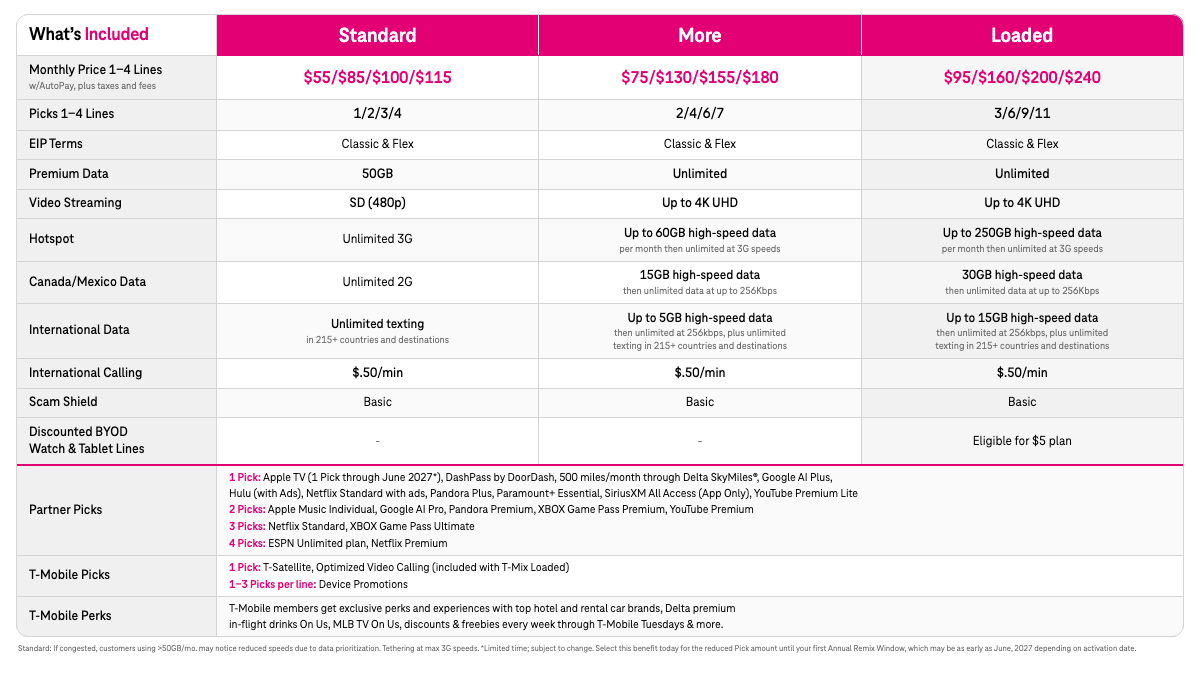
T-Mobile says a family of three on its Loaded plan, which costs $200 a month ($2,400 a year) with AutoPay before taxes and fees, gets more than $4,320 a year in plan features and benefits, based on its own valuation.
The math behind the Picks: Customers choose from three plans, with base prices for customers on AutoPay, before taxes and fees:
Standard: $55 a month for one line, with one Pick. It’s the basic plan, with limits on high-priority data and video quality.
More: $75 a month, with two Picks, unlimited high-priority data and 4K video.
Loaded: $95 a month, with three Picks and the largest allowances for hotspot use and international data.
Adding lines adds Picks, and Picks apply to the whole account, so one Netflix subscription covers the family. Unused Picks don’t accumulate from one quarter to the next.
Most extras cost one or two Picks. Ad-free Netflix costs three, and ESPN Unlimited costs four. Phones cost Picks, too: two for an iPhone and three for an iPhone Pro, Samson said, tied up for the three-year payment plan. A four-line account on the More plan gets seven Picks, not enough for a new iPhone on every line.
T-Mobile’s three T-Mix plans, with prices, data allowances and what each perk costs in Picks. Click to enlarge. (T-Mobile Graphic)
No price guarantee: The terms say T-Mobile may change the benefits and the number of Picks each one requires at any time, with changes taking effect the following quarter. Customers who change a partner benefit outside a change window may have to pay a fee. Once a year, customers will also be asked to reselect their benefits.
The launch comes less than a week after New York Attorney General Letitia James announced a settlement with T-Mobile over its 2017 “Price Guarantee” plans, which promised customers the carrier would “never change the price you pay.”
T-Mobile raised prices on those plans by about $5 a line in 2024. It agreed to offer refunds and other options that the attorney general’s office expects to provide more than $38 million in value, and to freeze prices for affected customers until at least 2029.
Asked about price protections, Samson said T-Mix plans don’t come with a guarantee. T-Mobile can control its network costs, he said, but not what partners such as Apple and Xbox charge, although it has multiyear deals in place.
“We didn’t want to be disingenuous,” he said, adding that partner prices are set for the next couple of years but “I can’t tell you what’s going to happen in 2030.”
The Un-carrier playbook: T-Mobile launched its Un-carrier campaign in 2013 by dropping two-year contracts. Samson said the company makes an Un-carrier move only when it sees a big customer pain point and believes it has something unique to offer.
T-Mobile has been testing T-Mix since Oct. 1 in 37 stores in Kansas City. Only about 70% of Picks were chosen in the store at the time of purchase, Samson said, in part because families wanted to go home and decide together, and some customers were saving Picks for phones coming out later.
Verizon lets customers add discounted streaming bundles to its plans for an extra monthly charge. Samson said the difference with T-Mix is that the benefits are included in the plan price.
Upholding the company’s tradition of jabbing at rivals, he described one competitor’s approach as “naked connectivity.” The other, he said, will “throw you a nice phone and then leave you alone. And every now and then, there’s a rate increase.”
The plans are also one of the first major consumer moves under CEO Srini Gopalan, who succeeded Mike Sievert in the role last November.
T-Mobile’s account growth has slowed this year. In the second quarter, it added a net 277,000 postpaid accounts (households and businesses that pay a monthly bill rather than prepaying for service). That was down 13% from 318,000 a year earlier.
The company reports third-quarter results Wednesday, two days after Verizon.
Samson, who joined Sprint in 2016 and stayed on after its 2020 merger with T-Mobile, became CMO earlier this year. He previously ran the company’s broadband business and was CMO of T-Mobile for Business. He said T-Mix has been his pet project since taking his current role, starting with interviews with hundreds of consumers.
Samson said it’s too early to say how T-Mix will affect the business. “Ask me in six months once I have about six months under my wings nationwide,” he said, “and then we’ll have some actuals to report.”
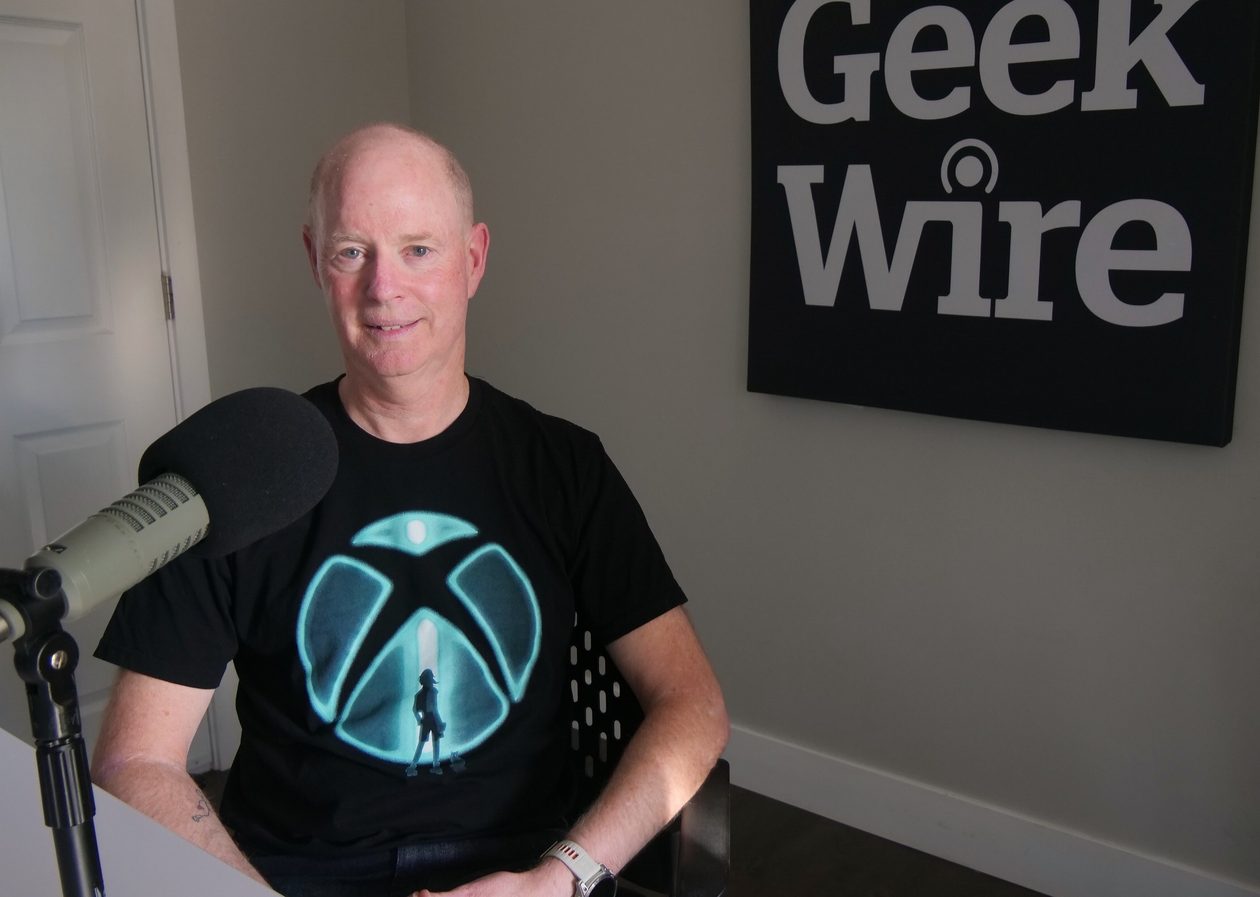
Frank X. Shaw, Microsoft’s longtime communications chief, in the GeekWire studio. (GeekWire Photo / Todd Bishop)
The name Frank X. Shaw isn’t as well known outside the company as those of Microsoft’s other senior leaders, and that’s the nature of the job. But behind the scenes, the company’s longtime communications chief has shaped its public image for nearly three decades, working for all three of its CEOs and handling its biggest stories along the way, from antitrust to AI.
Shaw announced in September that he’s leaving Microsoft at the end of the year. On this week’s GeekWire Podcast, he sits down for what amounts to an exit interview. We’re joined in the conversation by longtime Microsoft beat reporter Mary Jo Foley, editor in chief of Directions on Microsoft and a GeekWire contributing writer.
Shaw talks candidly about working for Bill Gates, Steve Ballmer and Satya Nadella, and about the situations he’d handle differently. He describes his behind-the-scenes dealings with some of the top reporters in tech, from an executive’s objection to a single word to the heated argument that changed how he saw his job.
He also reflects on how communications and media are changing in the AI era, and explains why trust still comes down to a belief in the person telling the story.
Listen below, and continue reading for highlights.
On Microsoft’s three CEOs: Shaw says intensity is what the three have in common, expressed differently: “Steve was outwardly intense. Satya is quietly intense, and Bill is cuttingly intense.”
Ballmer was the hardest to explain to the public, he says, because the loud-salesman caricature hid a thoughtful, detail-oriented leader who often played the boisterous public role because Microsoft’s sales force needed it.
On the clarity of hindsight: Big decisions look obvious once they work out, Shaw says. His example is the board’s choice of Satya Nadella as CEO. It’s seen as a no-brainer now, but at the time there was a lot of debate, there were other candidates, and it was a hard, complicated decision.
“When you get a decision right, it always looks easy afterwards,” he says. “If you get it wrong, you were just an idiot all along.”
On speaking up: A communications leader should weigh in when a decision could damage the brand, Shaw says, and he learned that the hard way.
When Mary Jo asks how he decides when to push back on executives, she raises the Kin as an example. Shaw says he thought the phone would fail. It was late to market, and it would cost more than people expected because it required a data plan. Engineers he talked to had their doubts, too.
But when Ballmer went around the table asking whether to launch it, Shaw stayed quiet, unsure a communications executive had standing to weigh in. Microsoft pulled it within weeks.
In hindsight, he says, framing it as a brand risk would have given him standing to speak: if the Kin failed, it would cause significant brand damage and hurt Microsoft with the younger audience it was trying to reach. He doubts speaking up would have changed the decision, but says he would have felt better about it.
On underestimating a story: A story that doesn’t get much initial attention can still define a company for years. Shaw’s example: Vanity Fair’s 2012 “lost decade” story.
As he recounts it, reporter Kurt Eichenwald told him, “If you don’t give me Steve and Bill, I’m just going to write a hit piece,” and then did. Shaw says he should have escalated to Vanity Fair sooner, and he underestimated how a story that got little immediate pickup would shape how reporters described Microsoft for the next four years.
On narratives: Continuing on that theme, Shaw says facts can be disputed but “narratives are sticky,” and a company can only change one by changing its own behavior. In the 2000s, he says, every story described Microsoft as “a convicted monopolist,” and ending stack ranking was part of how the company moved past the lost-decade image.
On what makes a good story: Shaw recalls having a shouting match with Rob Guth, then a Wall Street Journal reporter, over an article Shaw no longer remembers. It got heated enough that Shaw pulled his car over in Madison Park to keep arguing. (Guth now works as a writer and researcher for Bill Gates.)
Guth told him he was bad at his job because he thought the job was getting positive stories. What Shaw should want, Guth said, were interesting stories that showed something real about the company. Some would be less flattering, but they would be more memorable.
Shaw told him he was wrong. But after thinking it over, he concluded Guth was exactly right. A story about a product built perfectly that everyone loves is boring, he says. “That’s like the plane landed safely. Nobody cares.” The coverage worth hoping for illuminates part of the company in a memorable way, and that always comes with tension.
On taking risks with reporters: Cooperating on a story you can’t control is a risk worth taking when the result shows something real about the company, Shaw says. Asked by Mary Jo for an example, he points to The New Yorker’s long piece on Microsoft’s relationship with OpenAI, featuring Kevin Scott, the Microsoft chief technology officer.
Microsoft agreed to it knowing that the writer, Charles Duhigg, would talk to many people and test a thesis along the way, so there was no telling what would come out. Then Sam Altman’s brief ouster from OpenAI happened right before the story went to press. It was a risky story, Shaw says, but it captured the company at a revealing moment.
On corrections: Shaw’s test is whether something is “irritating” or “damaging.” Only factual errors that matter are worth pursuing, he says.
His example is a Bloomberg story by Dina Bass that described an executive as having “wooed” customers. The executive hated the word and wanted it changed, so Shaw made what he calls the run up the hill, pressing Bass on the exec’s behalf and asking her to check with her editors.
She pointed out that she hadn’t quoted the executive using the word, and the editors left it alone. The executive didn’t like it, Shaw says, but it wasn’t wrong.
On speaking with one voice: Shaw says a big part of his job was trying to ensure that a company of Microsoft’s size made sense to the world.
He recalls a Seattle Times reporter who got 26 pitches from Microsoft in one week and asked him which ones Microsoft thought were important. Sending pitches indiscriminately was a mistake, he says. The company needed to decide what three or four things mattered most and focus its messaging on those.
On building in public: Asked about recent internal memos pointing Microsoft toward more voices and less central messaging as he departs, Shaw says the company already has many employees talking about its products on LinkedIn, X and Reddit, and that’s a good thing.
Someone from Microsoft answering questions in a Reddit Excel thread doesn’t need to be babysat by the communications team, he says. He sees it as a continuation of what Microsoft did with Channel 9 and thousands of MSDN blogs.
At the same time, he says, there are moments, such as a big event or a major launch, when the company needs to break through.
“Every once in a while you want the world to know Microsoft had something to say today,” he says. That’s hard, it takes real effort, and it can’t happen every week or even every month, so the company has to pick those moments and do them right.
On AI and the media: AI can help spokespeople prepare, Shaw says, but asking it what Mary Jo will ask, for example, produces “generic Mary Jo questions.” The best interviewers, he says, deliberately avoid the predictable question.
On reporters’ styles: Preparing a spokesperson means knowing how a particular reporter works, Shaw says, and that comes from people who have sat through many of their interviews. His example is Steven Levy, the veteran tech journalist and Wired editor at large, who Shaw says can lull you with 10 minutes of easygoing conversation, then hit you with one sharp question after another.
Other reporters always sound negative in interviews but write straightforward stories, he says, and an executive who reads too much into the tone risks getting knocked off their game.
Asked to name the toughest reporter he has dealt with, Shaw pushes back on the label. Good reporters are tricky to work with because their job is to find things out and surprise you with what they know, he says. That doesn’t make them tough. What makes a situation difficult is usually a story with real conflict and tension, not the reporter.
On Microsoft in the AI era: Shaw sees AI in a transitional moment, moving away from a constant focus on the models themselves. Right now, he says, every new model release or manifesto makes everyone stop and look.
He hopes the attention will shift from new models to whether AI is actually useful, and he says that’s where Microsoft has historically been strongest.
Acknowledging that he’s still on the payroll and rooting for the company, he offers an analogy that will resonate with anyone who learned to drive a stick shift. The AI model companies want to drop a bigger, more powerful engine into businesses, and the result is often a lot of grinding of gears.
“We’re the clutch,” he says. Microsoft’s infrastructure, in his telling, lets companies absorb that power and get moving without the disruption of a new engine and a demand to go 110 miles per hour.
On journalism: “People trust what they hear because they trust the people,” Shaw says. Deep knowledge of a beat becomes more valuable as the world gets more transactional, he says, even as the business behind it becomes less sustainable.
On what’s next: Shaw plans to take some time off and isn’t making any big decisions. People have suggested consulting, another big communications job or board seats, he says, but he doesn’t want to rush into anything.
Mary Jo has a suggestion: run PR for OpenAI, “because man, they need somebody to help.” Shaw’s characteristically dry reply: “That would be such a low-stress job.”
Two former Amazon real estate managers acknowledged receiving personal payments tied to data center deals they handled for the company, under a settlement that resolves the company’s claims against them in a six-year lawsuit.
Carl Nelson and Casey Kirschner “regret their actions, apologize for failing to meet Amazon’s high ethical standards, and are glad this matter has been resolved,” according to a joint statement that the parties agreed to as part of the settlement.
The payments “violated Amazon’s Code of Conduct & Ethics, broke the trust Amazon places in its employees, and put Amazon’s reputation at risk in the communities it serves,” says the statement, which Amazon provided Friday evening in response to GeekWire’s inquiry.
The statement doesn’t call the payments kickbacks or say they were illegal. Nelson was investigated by the FBI but never charged, and a federal judge ruled in 2023 that Amazon’s Code of Conduct wasn’t a legally enforceable contract. The other terms of the settlement are confidential, including whether any money changed hands.
Before the settlement, Nelson had maintained that he abided by the terms of his Amazon employment agreement, which his attorneys said gave him broad leeway to do outside business.
Rodney Atherton, a Colorado attorney who set up business entities for the two men, also settled and “regrets the role he played in the conduct at issue in this case,” according to the statement.
The settlement closes a long legal ordeal for Nelson’s family. His wife, Amy Nelson, the former Seattle entrepreneur who founded The Riveter, a network of co-working spaces for women, has been his most outspoken advocate, defending him for years on social media and in interviews and criticizing Amazon and the Justice Department for pursuing him.
“All disputes with my husband’s former employer have been resolved,” she said in a short video posted Friday on social media.
The case upended the family’s life. The FBI seized $892,135 from the Nelsons’ bank accounts in 2020, including hundreds of thousands of dollars Amy Nelson earned as CEO of The Riveter.
The government returned most of it in a 2022 settlement. By then, the Nelsons had sold their West Seattle home and emptied their retirement accounts to pay lawyers, and they had moved with their four daughters to Hawaii and then Ohio, where Amy’s parents live. The family had spent more than $3 million on legal fees, she told KIRO 7 in 2023.
“Many of the things that we lost over the past four years, we can never get back. We can never get our home back. We can never get our jobs back. We can never get our reputation back,” she told The Seattle Times in 2024, after federal prosecutors moved to drop the related criminal cases.
Amazon told the judge on Oct. 20 that it had reached the settlement, less than two weeks before the case was set to go to trial in U.S. District Court in Alexandria, Va., according to court filings.
The case continues against the remaining defendants, Brian Watson and his Denver-based real estate firm, Northstar Commercial Partners, which Amazon hired for nine data center development projects in Northern Virginia between 2018 and 2020. Amazon alleges that Northstar won that business by paying kickbacks to Nelson and Kirschner, which Watson denies.
Watson and Northstar are headed to trial Nov. 2. In a filing Friday, they asked the judge to make Amazon hand over the settlement agreement so they can see its terms.
The settlement follows years of rulings that went both ways. In April 2023, a federal judge dismissed most of Amazon’s claims, including its breach of contract claims against Nelson and Kirschner. In September 2025, a federal appeals court revived several of the claims, including racketeering and fraud, and sent the case back for trial.
In January 2024, federal prosecutors moved to vacate the guilty pleas of two other men in the case, Kirschner’s brother, Christian Kirschner, and former Northstar account manager Kyle Ramstetter, calling prosecution “not in the best interests of justice.”
Prosecutors added that they had declined to prosecute the other alleged co-conspirators, including Nelson.
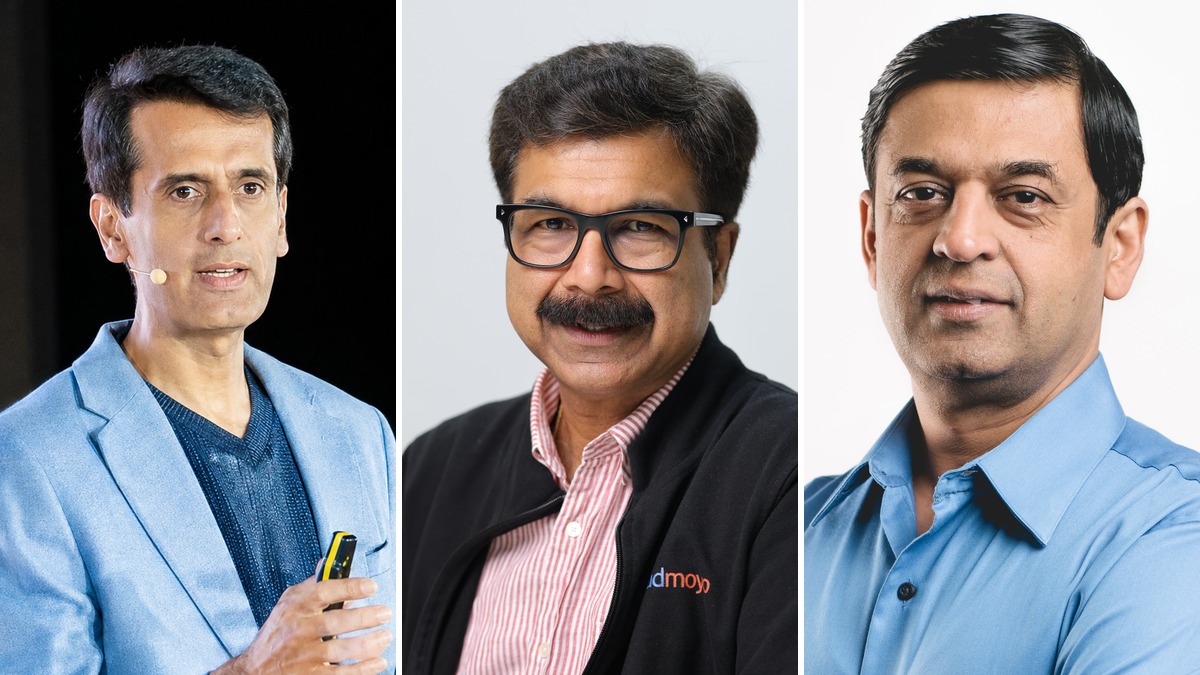
From left: HumanTronik co-founder Kabir Narang, CloudMoyo co-founder and CEO Manish Kedia and fellow HumanTronik co-founder Monish Darda.
HumanTronik, an AI startup co-founded by Icertis co-founder Monish Darda, has acquired CloudMoyo, the Bellevue tech services firm that Darda helped spin out of Icertis in 2015.
The deal keeps two of CloudMoyo’s co-founders in charge: Darda, who co-founded its new parent company, and Manish Kedia, who continues to run CloudMoyo day to day as CEO. The family of the late Samir Bodas, CloudMoyo’s other co-founder and the longtime CEO of Icertis, sold its stake in CloudMoyo as part of the transaction, Kedia said.
Darda co-founded HumanTronik earlier this year with Singapore-based investor and early Icertis backer Kabir Narang. The company is developing what it calls “human language models,” its phrase for AI that learns how specific executives make decisions and work with others. Those models power AI agents inside Microsoft Outlook, Teams and other workplace software.
Financial terms of the deal weren’t disclosed. CloudMoyo, as part of HumanTronik, will keep its name and existing customer contracts, and will sell and implement HumanTronik’s technology in addition to its existing lines of business.
The business model: Kedia calls the approach “Service as Software.” Customers pay for software, he said, with ongoing support from CloudMoyo built into the subscription. Pricing is shifting from per-user fees toward fees based on results.
It’s part of a broader blurring of the lines between software and services across the industry, including the rise of forward-deployed engineers who work inside customers’ businesses to put AI to use.
Sequoia Capital’s Julien Bek argued in a March essay that the next $1 trillion company will be “a software company masquerading as a services firm,” noting that companies spend $6 on services for every $1 on software.
OpenAI launched its Deployment Company the same month with more than $4 billion in initial investment, embedding its engineers inside businesses.
CloudMoyo has more than 300 consultants. Over the past two years, its work has expanded from mostly implementing Icertis contract software to building AI tools on Microsoft’s Fabric data platform, for customers including Seattle-based Expeditors and Mexican railroad Ferromex. That AI business is growing at about 100%, outpacing the company’s more traditional work, Kedia said.
Kedia gave the example of a procurement director trying to cut spending by two points this year. HumanTronik’s agents would draw on conversations with suppliers and internal discussions, along with the company’s business data, to help the director and their team reach that goal.
How the deal came together: The acquisition moved quickly, Kedia said. He and Darda met in the Bay Area three to four months ago to talk about CloudMoyo’s AI work, and Darda showed him what HumanTronik was building. Negotiations took about two months.
Because Darda was a major shareholder in both companies and on the CloudMoyo board, he was not directly involved in the negotiations, according to Kedia, who noted that each side had its own legal counsel.
The founders have known one another for years, which made the talks easier, Kedia said. “We are staying within the families,” he said.
The Icertis connection: Darda co-founded Icertis with Bodas in 2009 and served as its CTO for about 17 years before stepping back in April to start HumanTronik. His title at Icertis is now chief mentor.
Kedia, who at one point led business development for Microsoft’s SQL Server database software, was president of Icertis for several months before leading the CloudMoyo spinout in 2015.
Icertis has no financial stake in HumanTronik or CloudMoyo, Kedia said, though the companies continue to work together. Icertis has been led by interim co-CEOs Rajat Bahri and Jim Moffatt since Anand Subbaraman departed in July, less than a year after succeeding Bodas. Bloomberg reported in February that Icertis was working with Goldman Sachs to explore a potential sale.
Narang led Icertis’s Series A funding round in 2015 while at Fidelity’s venture arm, Eight Roads, and later became a founding partner at B Capital.
Headquarters and headcount: HumanTronik is headquartered in San Francisco, where it plans to open an engineering center. Darda is based in Pune, India, where CloudMoyo has an engineering center, and HumanTronik is setting up a subsidiary in Singapore.
Nearly all of CloudMoyo’s employees are becoming HumanTronik employees, joining a few HumanTronik engineering leaders in the Bay Area, Kedia said. The combined company has about 20 people in the Seattle area, where CloudMoyo has had an office in Bellevue for the past decade. Kedia, who lives in the region, said the company plans to hire engineering, product and sales staff here.
That’s up from about 15 in 2016, when GeekWire last wrote about CloudMoyo. At the time, most of its roughly 200 employees were in Pune.
The name CloudMoyo came from a word the founders picked up while traveling: “moyo” means heart or spirit in Swahili. After the HumanTronik deal, Kedia said, the company’s new motto is “human with a heart.”
Stripe co-founder and President John Collison has been nominated to join Microsoft’s board of directors. (Stripe Photo)
When Stripe co-founder John Collison interviewed Satya Nadella on his company’s podcast last fall, he asked the Microsoft CEO for advice on building a platform business. Collison will soon get to see how Microsoft does it up close.
Collison, 36, the co-founder and president of the Bay Area-based payments platform, has been nominated to Microsoft’s board, the tech giant disclosed Wednesday in its annual proxy statement.
He would fill one of two board seats opening up at Microsoft’s Dec. 8 annual meeting. LinkedIn co-founder Reid Hoffman said in June that he would leave, and the proxy reveals that Disney CFO Hugh Johnston, who chairs the board’s audit committee, is not seeking re-election either. Both have served on the board since 2017.
The proxy also notes that former EY CEO Carmine Di Sibio, appointed to the board in May, will stand for election by shareholders for the first time.
Microsoft’s board currently has 13 members, including Di Sibio. With Hoffman and Johnston leaving and Collison joining, it will go back to 12, the same number it had before Di Sibio joined in May.
Microsoft says Collison “brings extensive entrepreneurial and operational experience, along with deep expertise in technology.” He started Stripe with his brother, Patrick, in 2010, and businesses using Stripe processed $1.9 trillion in payments in 2025. Collison does not sit on any other public company board.
The board determined that he is independent, after considering ordinary business dealings between Microsoft and companies tied to its directors. The proxy doesn’t mention any business between Microsoft and Stripe, but the two companies already work together.
Stripe helps power Copilot Checkout, which Microsoft launched in January to let U.S. users of its AI assistant buy from Etsy sellers and other retailers without leaving the chat. In 2023, the companies teamed up to let businesses take card payments for paid events in Microsoft Teams.
The companies’ work together came up in the November episode of Stripe’s “Cheeky Pint” podcast. Collison said Stripe was building a platform business in agentic commerce, in which AI agents shop and pay on behalf of people, and asked Nadella what advice he had for a company building in such an early market.
Nadella said the key would be making it simple for small merchants to sell through AI agents, without asking them to set up servers or adopt a string of new technical protocols themselves.
The relationship goes back years. Nadella said he first visited Stripe’s San Francisco office when he was running Microsoft’s cloud business, before he became CEO.
He said Stripe reminded Microsoft of something it had once been good at, “following the developer, being where the startups are,” and said that thinking “led me even to GitHub,” the code-sharing platform Microsoft acquired in 2018 for $7.5 billion.
The Paul G. Allen Center on the University of Washington’s Seattle campus, home to the Allen School of Computer Science & Engineering, which a university task force has recommended separating from the College of Engineering. (GeekWire Photo / Kurt Schlosser)
University of Washington leaders are weighing whether to separate the Allen School of Computer Science & Engineering from the broader College of Engineering, after a task force recommended the move as part of proposed changes to UW’s computing and AI programs.
The split would give new independence to what has become one of the world’s leading schools for computer science and AI, and a major source of talent for the Seattle region’s tech industry.
As an independent, college-level school, the Allen School would gain greater control over its finances and a seat at the table with UW’s other deans. It could also put more of its own revenue toward teaching, as student demand for computing courses continues to outstrip its capacity.
The task force’s report, released this week, concluded that UW’s successes in computing, data science and AI have come “not because of the organizational structures we have in place but in spite of them.” The nine-member group included UW faculty leaders from across campus, two outside academics and an Amazon executive.
The report also described a “difficult relationship” between the Allen School and the College of Engineering, and “significant distrust” across campus over resources and priorities.
Nancy Allbritton, dean of the UW College of Engineering, said the college supports the university’s decision to “carefully evaluate” the task force recommendations. (UW Photo)
UW Engineering Dean Nancy Allbritton, in a statement to GeekWire on Tuesday, called the relationship “complex rather than difficult.”
The College of Engineering supports the university’s decision to “carefully evaluate” the task force’s recommendations, Allbritton said. She praised the Allen School and said the school and college share a long history of working together, with a commitment to students, research and service to Washington state.
The stakes extend well beyond university politics: The Allen School’s graduates are in high demand across the tech industry. Nearly 100 graduates from the 2025-26 class went to work full time at Amazon, and more than 70 went to Google, Microsoft or Meta, according to a survey of recent graduates by the school. In all, graduates went to more than 150 different companies.
No decision yet: UW President Robert J. Jones and Provost Tricia Serio said Monday that they aren’t making a decision yet. In a letter to the UW community, they announced two implementation committees.
One committee will plan for a possible independent Allen School, including its finances. The letter calls the continued strength and growth of the College of Engineering “a central consideration.”
The other will develop plans for a new campus-wide “Federation of Information, Computing and Society,” which would coordinate computing, data science and AI work across UW, including fundraising, and hold its own funding for hiring across departments.
Both committees are due to report by the end of winter quarter 2027, and UW leaders plan to announce next steps in spring 2027. Any changes would still need approval through the university’s usual processes, including the Faculty Senate and Board of Regents, with a goal of putting them in place by the end of the 2027-28 academic year.
The task force was co-chaired by Andy Connolly of UW’s eScience Institute and Kathy Yelick of Lawrence Berkeley National Laboratory. Its other members were Dan Grossman, now the Allen School’s interim director; Remzi Arpaci-Dusseau of the University of Wisconsin; UW’s Elizabeth Nance (chemical engineering), Abel Rodriguez (statistics), Emma Spiro (Information School) and Peter Tarczy-Hornoch (UW Medicine); and Anne Szeto of Amazon.
Allen School faculty voted 83-0 in late September in support of “moving forward with a process to determine how the Allen School would become an independent school,” with 13 not voting because they were absent or on leave, according to the school. A formal decision and vote would follow that process, the school said.
Budget and a seat at the table: The issue comes down to money and influence. UW’s budget model sends tuition and a share of research grant funding to the college where the courses are taught and the research is based.
For the Allen School, that’s the College of Engineering. As an independent school, the Allen School would control those funds directly, and its leader would sit with UW’s other deans when the university sets strategy on AI and other priorities, a voice the task force says computing has largely lacked.
UW’s Information School already operates as an independent, college-level unit. But the report says its focus on the human, societal and organizational side of computing and information is different from the Allen School’s focus on computing as a discipline.
Dan Grossman, interim director of the Allen School, has been invited to participate in UW’s Board of Deans and Chancellors. (UW Photo)
As an initial step, Jones and Serio invited Grossman to participate in the Board of Deans and Chancellors. The letter says the move is “independent of any future decision about administrative structure.”
In a message to the Allen School community, Grossman called the invitation “a reflection of the Allen School’s scale and reach,” adding, “I’m pleased to have this opportunity to make meaningful contributions to discussions among UW’s leaders.”
He described the task force’s proposals as “exciting recommendations that will be great for the whole of UW and its impact on Washington state and beyond.”
Grossman also said there are “no planned changes to the Allen School’s structure, staffing, budget, policies and procedures, or degree programs” while the committees do their work.
A longtime Allen School professor and its former vice director, Grossman was named interim director this summer when Magdalena Balazinska’s nearly seven-year term as director ended. At the time, UW said it was opting for an interim leader for about a year while it weighed the task force’s recommendations, which hadn’t yet been made public.
The board seat was one of several early steps the task force recommended to show that UW was committed to the process. The task force also suggested having the Allen School’s director report jointly to the provost and giving the school more control over its budget, but UW hasn’t taken those steps for now.
Microsoft co-founder Paul Allen speaks at UW in March 2017, when his $40 million gift turned the university’s computer science department into the Allen School. Allen died in 2018. (GeekWire Photo / Kevin Lisota)
Rooted in Paul Allen’s gift: The prospect of independence goes back to the Allen School’s creation in 2017.
When a $40 million gift from Microsoft co-founder Paul Allen turned UW’s longtime computer science department into the Allen School, the gift agreement said the school would “remain a unit of the College of Engineering, at least for the time being,” according to a copy obtained by GeekWire.
The agreement called for the school to receive the same prominence, visibility, support and privileges as UW’s other schools and colleges “to the greatest extent possible,” and anticipated that it could someday become “a free-standing School or College.”
The agreement also spelled out what would happen to the name if the school were ever “elevated to a College of the University”: it would change to reflect the new structure, but would “always prominently include” Allen’s name.
Impact on Engineering: The College of Engineering would lose its largest unit. The Allen School, which awarded 894 of the college’s 3,132 degrees in 2025-26, accounts for a little more than a quarter of the college by degrees, enrollment and faculty, according to figures from the college.
The report acknowledges “significant short- and long-term financial implications” from a separation and suggests options such as permanent financial support for Engineering to offset the loss.
Allbritton said the college is committed to helping shape an outcome that “strengthens the College of Engineering, strengthens computer science as an independent discipline, and advances the University of Washington’s broader mission of innovation, discovery, economic opportunity and public impact.”
The Allen School “is an extraordinary unit that has experienced remarkable growth and operates at a scale unlike any other department in the College,” she said. “As both organizations have evolved, there have naturally been questions about structure, governance, and how best to support future growth.”
She also noted that the College of Engineering has nearly doubled in size over the past decade “amid increasingly constrained public resources,” and said the college’s focus is on ensuring that students, faculty, staff, research partnerships and industry relationships “continue to thrive.”
“What has remained constant is a shared commitment to student success, research excellence and service to Washington state,” Allbritton said.
The report doesn’t detail the friction between the Allen School and Engineering. It says independence “does not directly address concerns voiced about collegiality” but could remove “a structural asymmetry that has complicated those relationships.” Opinion across campus on Allen’s independence was “genuinely divided,” the report says.
The federation’s role: The proposed federation is partly a way to keep the rest of campus on board. Other units worried that the Allen School would win independence while the federation never got real resources, according to the report, which recommends that the split not be finalized until the federation is up and running.
Much of the “distrust” cited in the report centers on whether one recommendation would advance at the expense of the other.
If the Allen School’s separation is finalized first, the report says, “other stakeholders are unlikely to trust that the federation will ever achieve the size and stature it needs.”
If the federation moves ahead without a clear commitment to independence, the Allen School and its supporters “are unlikely to trust that their important contributions toward the federation’s success will achieve meaningful change.”
The Allen School is already helping lead cross-campus efforts, including a new AI minor for students in all majors, developed with 18 academic units and set to launch in spring 2027.
Toward a college of computing: Other top universities have taken similar paths. Carnegie Mellon and Georgia Tech run computer science as standalone, college-level schools, while MIT, UC Berkeley and Cornell have created broader colleges of computing, according to the report.
Peer institutions’ computing colleges were “frequently propelled by a transformational naming gift,” the report notes, as with MIT’s Schwarzman College of Computing and Cornell’s Bowers College of Computing and Information Science.
The report describes the federation as a possible “transitional phase” toward a full College of Computing at UW, which would house the Allen School alongside other units, and recommends revisiting that idea in about five years.
Correction: An earlier version of this story overstated the Allen School’s size relative to the rest of the College of Engineering. The story has been updated with figures from the college.
Employees work on a soldering project during a workshop in a Microsoft Garage space. Microsoft is winding down The Garage as a companywide program, and some spaces could be restricted as early as this week. (Microsoft Photo)
Microsoft is winding down The Garage as a companywide program, ending a 17-year run for the effort that gave employees space and tools for side projects and ran the company’s Global Hackathon, according to an internal FAQ viewed by GeekWire.
The program, with a flagship location on Microsoft’s Redmond campus and more than a dozen other sites from Vancouver, B.C., to Beijing, became part of the company’s push for a more experimental culture under Satya Nadella, who took over as CEO in 2014.
In the FAQ, Microsoft says the experimentation that started in dedicated programs and spaces like The Garage now happens “every day within each of our teams,” as employees build new skills and adopt new tools in their regular work. The FAQ says the company is “reinventing how we foster innovation, learning, and experimentation” across Microsoft.
The move comes as Microsoft spends heavily on AI, much of it for data centers and other infrastructure, while cutting costs and jobs in other parts of the business.
“We regularly evaluate how we use our physical spaces to best support our employees, customers and partners,” a Microsoft spokesperson said in a statement. “As part of that ongoing work, we’re making changes to some Garage spaces. Innovation and a builder mindset remain central to how we work every day.”
The company declined to comment further, including on the effect on Garage employees.
The Garage will no longer operate “as a centralized function,” according to the FAQ, and the impact on each physical space “will vary by location.” Some Garage spaces could be restricted as early as Friday, Oct. 23. Neither the FAQ nor Microsoft’s statement says which spaces are affected, including the flagship location in Redmond. Employees can’t take equipment, tools or materials with them.
The future of the Global Hackathon is also unsettled. The FAQ says the hackathon team is “reimagining the program” and that Microsoft will have more to share later.
Microsoft’s public Garage website, which showcased hackathon projects and experimental apps, was redirecting to the Microsoft homepage as of Tuesday morning.
Other longtime fixtures of Microsoft’s campus have closed this year. The company shut down its campus libraries in Redmond, Hyderabad, Beijing and Dublin in January, describing the move as a shift to a “modern, AI-powered learning experience,” and closed its Visitor Center in Redmond’s Building 92 a month later.
A Microsoft map shows The Garage’s 15 locations as of 2026. Microsoft hasn’t said which of them will be affected as it winds down the program. (Microsoft Graphic)
From Office Labs to companywide: The Garage started in 2009 inside Microsoft’s Office Labs group in Redmond, with the slogan “Doers. Not Talkers.” The idea was to support employees who were already building their own projects, rather than collecting ideas and funding the most popular ones.
The program took on a bigger role under Nadella. In July 2014, The Garage ran Microsoft’s first companywide hackathon, which drew more than 11,000 registrants from 80 countries. The event became an annual fixture of Microsoft’s culture.
The Garage also released experimental apps to the public, including Mouse without Borders, a tool for controlling multiple PCs with one keyboard and mouse, and Arrow Launcher, which became Microsoft Launcher for Android.
As of this year, Microsoft listed Garage locations in 15 regions, including Redmond, Vancouver, B.C., the Bay Area, New York City, Ireland, Israel, India and Beijing.
Employee reaction: On Blind, the anonymous workplace app that verifies users’ employers, a post titled “Amy kills the Garage” drew more than 70 comments. The poster attributed the move to cost-cutting by Microsoft CFO Amy Hood.
Another employee wrote that The Garage was where they met their friends on campus and made connections that advanced their career.
“The Garage offices were one of the last few cool things about Microsoft,” one commenter wrote.
Amazon’s holiday hiring plans for its operations network are the biggest in its history. (GeekWire File Photo / Todd Bishop)
Amazon says it plans to hire more than 300,000 people for seasonal, part-time and full-time roles across its U.S. operations this holiday season, an increase of 20% from last year and its largest holiday hiring target on record.
The increase reflects a mix of factors, including new sites opening across the country as Amazon expands its operations network, a spokesperson said in response to questions.
Amazon is moving in the opposite direction from the rest of retail. Retailers added the fewest seasonal workers since 2008 last holiday season, and outplacement firm Challenger, Gray & Christmas expects even fewer this year, citing automation and uncertain holiday spending as tariffs keep prices high.
Amazon’s sales volume has picked up this year. Worldwide paid units, a measure of items sold on Amazon, grew 17% year-over-year in the second quarter, up from 12% a year earlier, according to its second-quarter earnings release.
CEO Andy Jassy said in the earnings release that Amazon set record delivery speeds for Prime members in the first half of the year, with “over 40% more items delivered same-day or overnight.”
Amazon also said Tuesday that seasonal employees who work at least 30 hours a week will be eligible for healthcare from their first day, starting Jan. 1. Seasonal workers previously had to wait 90 days for coverage, meaning that many holiday hires could finish their seasonal jobs before they became eligible.
The change doesn’t apply to the upcoming peak season, but workers hired over the holidays who are still in qualifying roles on Jan. 1 will gain coverage that day, the company said.
Seasonal workers earn an average of $20 an hour. Full-time operations employees start at a minimum of $20 an hour, and average pay across Amazon’s operations workforce is nearly $24, following a pay increase Amazon announced last month.
The hiring push for Amazon’s fulfillment centers and delivery stations comes as the company shrinks its corporate workforce. Amazon cut 16,000 corporate jobs in January, bringing its total reductions to about 30,000 since October 2025.
Amazon had about 1.6 million employees as of June 30, up 3% from a year earlier, excluding contractors and temporary workers. The company reports third-quarter results Oct. 29.
Rosie COO Karthika Shankar, left, and CEO Mitra Raman started out doing the work themselves — watching kids, folding laundry and organizing garages for the company’s first customers — learning and building the business as they went. (Rosie Photo)
Mitra Raman was making dinner one night, watching her young son play with the babysitter, when she realized she wanted to trade places. “I’m his parent,” she recalls thinking. “I want to play with him. I want to spend time with him.”
That moment was one of the sparks for Rosie, a Seattle startup that sends caregivers into homes to do a mix of childcare and household work, from folding laundry and resetting the kitchen to watching the kids. The name is an homage to the robot housekeeper on the classic TV cartoon show “The Jetsons.”
Raman, Rosie’s CEO and a former Amazon engineer, co-founded the company last year with Chief Operating Officer Karthika Shankar, who spent more than 12 years at Amazon, managing recruiting teams and leading hiring and onboarding programs.
The founders, both working moms, saw a gap in the market between dedicated childcare and housekeeping. By giving parents what some customers call a “mom body double,” they wanted to free up time for the things parents actually want to do, like playing with their kids.
Rosie serves nearly 300 families in the Seattle area with a full-time team of four plus a few part-time staff and more than 100 caregivers it calls Pros.
The news: The company announced Tuesday that it has raised $7 million across two rounds led by Bling Capital and Reach Capital. Rosie says it reached seven-figure annual recurring revenue within eight months. It plans to use the funding to fuel its growth and expansion, starting with a launch in Austin in early 2027, followed by San Francisco later in the year.
How it works: Families buy a monthly membership: $250 for eight hours, $500 for 16 hours or $750 for 24 hours, with extra hours billed at $32 each and no long-term contract. Most families set up a weekly schedule with the same Pro, according to Rosie’s website, and they can also book same-day help through the app or by text.
Families can add Pros they like to a “bench” of regulars and book them directly. “Who shows up actually matters,” Raman said. “It’s not interchangeable supply.”
Rosie matches families with Pros and handles scheduling and payments. It runs separate apps for families and Pros, both released earlier this year.
Rosie uses AI to help with the logistics, keeping track of each family’s routines, preferences and favorite Pros, and handling matching and scheduling behind the scenes. The underlying AI system is called Jetson, continuing the theme.
But the founders say they’re deliberate about where they use AI. Raman said the company applies it where it clearly saves time or where it can be about 99% sure it’s right, because parents and Pros don’t have time to wade through AI output they don’t need.
Learning the job: In the company’s early days, Raman and Shankar worked as Rosie’s first Pros, watching kids, folding laundry, wrapping gifts and organizing garages in customers’ homes.
They also did the intake visits themselves, sitting at kitchen tables and walking through homes, where parents often apologized for the mess. Shankar recalled reassuring them that this was normal: “You don’t need to show me some Pinterest-perfect house.”
The founders said the work showed them that every household runs differently, down to how a family wants its laundry folded or its dishes washed. That shaped how Rosie uses AI: to remember each home’s routines and pass them along to the Pros who work there.
GeekWire first took note of Rosie in July 2025, when it was still in a private beta.
What Pros do, and how they’re vetted: Pros will tidy up, but Rosie draws the line at deep cleaning. (Its FAQ says no scrubbing toilets.) Shankar said the company looked at what a house cleaner typically does and built its service around everything else: unloading the dishwasher, putting things away, taking out the trash, sorting outgrown kids’ clothes.
Rosie Pros handle a mix of tasks for member families, from watching kids to folding laundry and organizing garages. (Rosie Photo)
Driving children is handled case by case, with checks of a Pro’s driving record and insurance.
Vetting Pros draws in part on Shankar’s background at Amazon, where much of her recruiting work was high-volume hiring for Amazon’s field operations, rather than corporate or tech jobs.
Pros go through an online intake, identity verification, a background check and reference checks run by AI. Then comes an in-person assessment at Rosie’s office on Capitol Hill, where prospective Pros fold laundry, load a dishwasher and work through childcare scenarios, using a stash of laundry that includes Raman’s kids’ old onesies. The company is now testing virtual assessments as it scales.
A long line of attempts: The best-known name in the category is Care.com, which bills itself as the largest online marketplace for family care. Families search profiles of babysitters, nannies, housekeepers and other caregivers and make their own hires.
Startups that tried a more hands-on approach have had mixed results.
Homejoy, an on-demand cleaning startup that raised about $40 million, shut down in 2015, with its CEO citing lawsuits over whether its cleaners should have been classified as employees.
Hello Alfred, which sent weekly “home managers” to handle errands and chores, raised a $40 million Series B in 2018 and launched in Seattle the next year, selling its service through apartment buildings. Its home managers were full-time employees.
The founders say Rosie is built differently. Families pay a monthly membership up front, and the model depends on the same Pros returning to the same homes each week, not one-off jobs filled by whoever is available. “Rosie does not exist without our Pros,” Shankar said.
The workforce model: Rosie classifies its Pros as independent contractors, paid per session through the company’s app. Rosie sets what families pay and what Pros earn, matches Pros with families and clarifies the tasks for each session before it’s booked.
Asked why Rosie’s Pros aren’t classified as employees, Raman said they have “full flexibility to decide what they do, what session they take, when they take it.”
“We’re not going to tell you where and what to work,” she said. “You decide.”
Rosie’s Pros include college students and part-time professionals looking for flexible work. Pay is set by an algorithm that weighs factors including the length of a session, the number of children, the type of work and whether the Pro is returning to a family they’ve worked with before.
Shankar said part-time Pros might earn a couple hundred dollars a week, while those who work more can make $500 to $1,000 a week. Recent Rosie job listings in the Seattle area have advertised $22 to $24 an hour, plus bonuses.
From Seattle to Austin and S.F.: When the service launched in January, Rosie opened to anyone in the Seattle area to see where demand and supply would come from. Pros mostly want steady routines close to home, and many in Seattle rely on public transit, Raman said.
TR=hat open approach meant some families and Pros lived far apart. In new cities, the company plans to launch neighborhood by neighborhood, starting where it expects to find its first Pros.
Austin and San Francisco share Seattle’s mix of tech-friendly, dual-income families, plus nearby universities where Rosie can recruit Pros.
Raman said the company chose to launch next in Austin partly because it’s different from Seattle in other ways. One difference: People there drive more and rely less on public transit, which changes how Pros get to families.
Rosie is hiring an in-person city general manager in Austin, according to its job listings, along with a senior software engineer and a “forward deployed engineer” for operations. That posting describes a goal of “100% AI-managed matching and scheduling with a small, deliberate human-in-the-loop.”
The bigger idea: The founders see childcare as the entry point to a broader platform. Some families are already booking Pros through Rosie for pet care and companionship for older relatives, Shankar said, and others are asking for help with errands and driving.
Raman described the overall thesis: “If you trust us with your kids,” she said, “you’ll trust us then with everything else.”
Amazon’s TorchNeuron sits between PyTorch and the company’s Trainium chips, supporting developers’ existing code. (Amazon Image)
A new software tool from Amazon aims to make switching from Nvidia to the company’s own AI chips about as simple as changing a setting.
The software, dubbed TorchNeuron, runs code written in PyTorch, the open-source framework used by many AI developers, on Amazon’s Trainium chips. It has been in private beta since late last year, and Amazon said Monday that it’s opening the software to all developers as a public beta.
Until now, developers who wanted to run PyTorch code on Trainium had to modify it to call programming interfaces specific to Amazon’s chips, said Colin Brace, vice president of technology software at Annapurna Labs, Amazon’s chip-design unit. With TorchNeuron, the same code runs after a basic configuration change.
“If you know PyTorch, then you know Trainium,” Brace said in an interview.
Nvidia dominates the market for AI chips, partly because much of the industry’s AI software was built around its CUDA platform. Adapting that code to other hardware can take months of engineering work. That has made many companies reluctant to switch, even as Amazon, Google and others have developed their own chips.
TorchNeuron is part of a broader push by tech giants to loosen Nvidia’s grip on AI computing, even as they remain among its biggest customers.
Google, which has started selling its TPU chips directly to some outside customers, is working on TorchTPU, a similar project to run PyTorch natively on those chips. Google detailed the effort in April, saying the goal is to let developers move existing PyTorch code to TPUs with minimal changes.
Microsoft said last week that it plans to run most of its AI services on its homegrown Maia chips rather than Nvidia hardware.
Amazon is reportedly in talks to acquire Decart, a startup that makes software to help developers move AI models built for Nvidia chips to alternatives such as Trainium, in a deal that could value it at about $7 billion. Decart already runs its own AI models on Trainium, and Nvidia is an investor in the startup.
Asked about Amazon’s relationship with Nvidia, Brace said the company has “always been about choice,” pointing to another high-profile example: AWS offers Intel processors alongside its own Graviton chips.
Amazon plans to release TorchNeuron as open-source software on Tuesday in conjunction with the PyTorch Conference in San Jose, Calif.
Trainium’s biggest users so far are AI labs with close financial ties to Amazon. Anthropic, in which Amazon has invested billions, uses the chips to train and run its Claude models. OpenAI agreed in February to use 2 gigawatts of Trainium capacity as part of a deal in which Amazon is investing $50 billion in the company.
Brace said Amazon’s goal has always been wide use of the chips, calling TorchNeuron “an accelerant” along those lines.
Amazon’s chip business traces back to its 2015 acquisition of Annapurna Labs, an Israeli chipmaker, for a reported $350 million. The Annapurna team went on to design Trainium as well as Amazon’s Graviton processors.
In his annual shareholder letter in April, Amazon CEO Andy Jassy wrote that the company’s chip business, including Trainium and Graviton, had an annual revenue run rate of more than $20 billion. He estimated that figure would be about $50 billion if the chips were sold to AWS and other customers by a standalone chip business.
“There’s so much demand for our chips that it’s quite possible we’ll sell racks of them to third parties in the future,” he wrote.
More than 30 companies and internal Amazon teams have been using TorchNeuron during the private beta. Deepgram, a San Francisco startup that makes speech AI, says its benchmarks showed Trainium processing about 60% more audio per dollar than its existing GPU setup. The company now runs Trainium in production, Brace said.
Inside Amazon, the Prime Video team used TorchNeuron to build Prime 360, an AI system that reconstructs NBA plays in 3D so viewers can watch replays from angles a traditional camera can’t capture. The feature, which runs on Trainium, will appear on select Prime Video broadcasts this NBA season.
To make sure TorchNeuron works with the huge variety of AI models that developers build, Amazon tests it every night against more than 100,000 models from Hugging Face, the popular online hub for open-source AI, Brace said.
Brace said the timing of the project reflects changes in PyTorch itself. The framework has matured, and its maintainers have been working to make it less dependent on any one kind of hardware.
Amazon has contributed to that effort, removing code that tied PyTorch to specific chips. Newer versions of PyTorch can detect which hardware they’re running on, he said, so in some cases developers don’t need to change their code at all.

 Login