❌

Reading view

There are new articles available, click to refresh the page.

F5 stock suffers worst day in more than a decade as AI spending shakes investors
The red F5 logo displayed behind glass above the entrance to F5 Tower in Seattle
F5’s logo at the entrance to F5 Tower in downtown Seattle. The company’s stock fell about 20% Wednesday after it forecast slower growth and lower margins, along with more spending on AI security. (GeekWire Photo / Todd Bishop)

Shares of F5 fell about 20% on Wednesday, a day after the Seattle-based company beat Wall Street’s estimates and said it would boost spending to capitalize on expected growth in the AI security market.

The application security and delivery company’s stock was trading around $368 late Wednesday morning, down from $459 at Tuesday’s close, wiping out about $5 billion in market value. That put F5 on pace for its biggest one-day drop in more than 13 years, according to Barron’s. Before the drop, F5’s shares had climbed nearly 80% this year.

F5’s revenue for its fiscal fourth quarter rose 13% to $917 million, and product revenue jumped 23%. Adjusted earnings of $4.42 a share beat estimates of about $4.30.

Slower growth ahead: Investors seem to be focused on the outlook. F5 expects revenue to grow 8% to 9% in fiscal 2027, down from 11% this year, and adjusted earnings per share to grow 3% to 5%. It’s also projecting lower margins as memory and storage components get more expensive, and as it doubles its team of AI security sellers.

F5’s hardware business is also cooling off. Systems revenue jumped 29% in the quarter as customers replaced aging equipment, but F5 Chief Financial Officer Cooper Werner said on the earnings call that those replacements will taper off in the second half of fiscal 2027.

The AI bet: F5 is spending more to go after AI security. CEO François Locoh-Donou said on the call that the company will double its team of specialist AI security sellers in fiscal 2027 and more than double its marketing in that area. It’s also adding compensation incentives for all of its field sellers to discuss AI security with customers.

F5’s adjusted operating margin fell to 33.7% in the quarter, from 37% a year earlier.

Locoh-Donou said F5’s AI-related bookings topped $100 million in fiscal 2026, up about 300%. Most of that came from AI data delivery, which moves data to and from AI systems, rather than security. More than 300 customers are using an AI-powered web application firewall that F5 launched in March.

The company estimates the AI market it sells into will grow from about $1 billion this year to $11 billion by 2030.

Wall Street reaction: Piper Sandler downgraded the stock to neutral, according to The Motley Fool. Analysts at William Blair, which rates F5 “market perform,” wrote in a research note that “the AI opportunity has yet to contribute meaningfully to the top line.”

We’ve contacted F5 for comment on the stock decline.

F5 has been building out its AI security business, including its acquisition of SurePath AI. Locoh-Donou talked about the company’s path from the early web to AI security on a GeekWire Podcast episode marking F5’s 30th anniversary. He said companies adopting AI are losing track of what those systems can access, and that juggling separate tools to manage it is a burden, which is why F5 is building a single AI security platform.

This week, F5’s board authorized an additional $1.5 billion in stock buybacks, on top of $322 million remaining in its existing program.
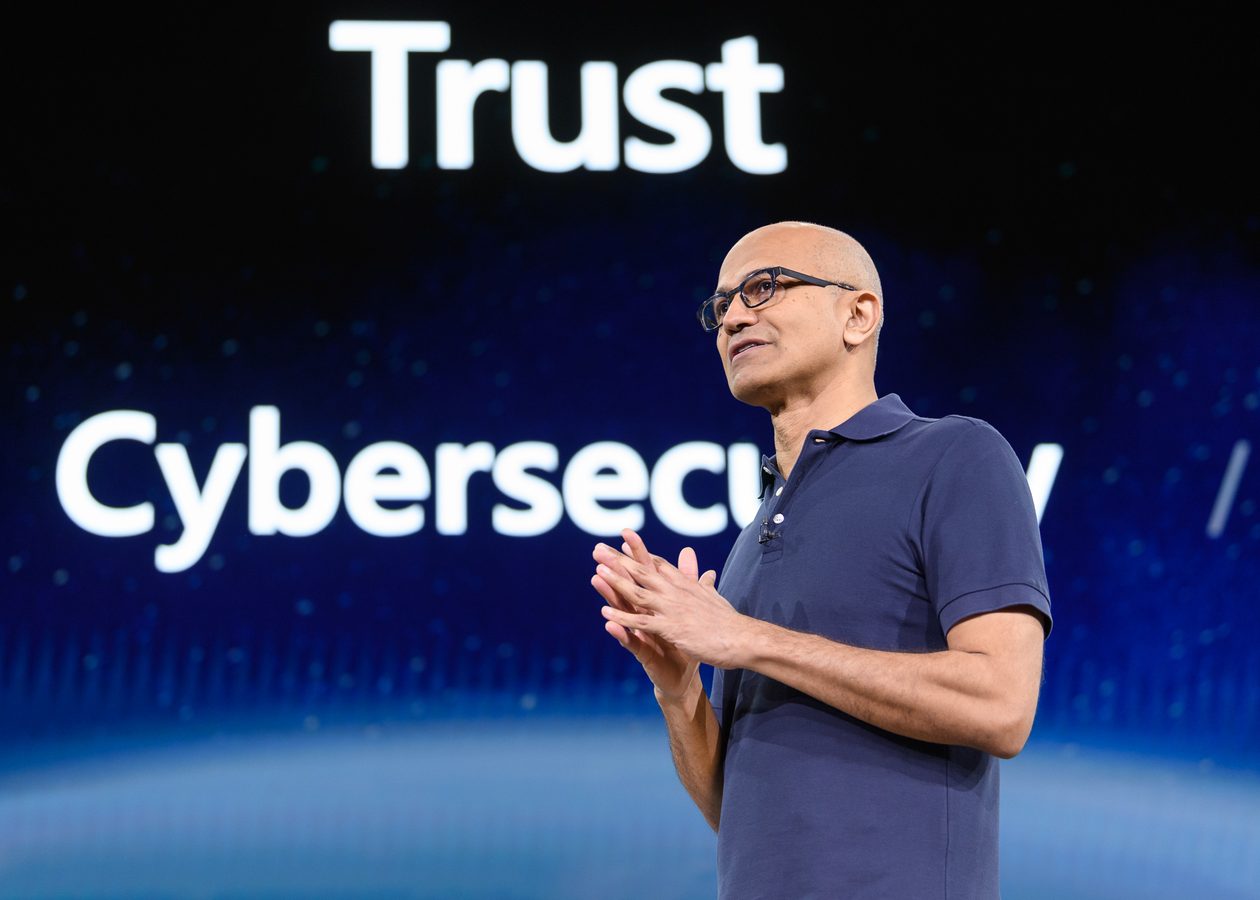

Microsoft unveils tools to monitor and corral rogue AI agents

Microsoft CEO Satya Nadella, shown speaking at a past Microsoft event, argued this month that companies should rely on outside controls rather than trusting AI models themselves. (GeekWire File Photo)

Microsoft is coming out with new security tools that treat AI agents as potential insider threats, continuously assessing their risk and restricting their access when something changes.

The features, announced Monday, are part of Microsoft 365 E7, the company’s top-tier bundle of workplace software and AI tools, and its Project Perception security system.

They escalate the company’s competition with rivals such as Google, Amazon Web Services, CrowdStrike and Okta to become the system businesses use to control their AI agents.

Microsoft’s new features come amid a steady stream of news about AI agents doing things they weren’t supposed to do, including high-profile reports from Anthropic about test agents taking unauthorized actions on government websites, and from OpenAI about agents escaping test environments and stealing credentials.

The move builds on Microsoft CEO Satya Nadella’s Oct. 10 blog post arguing that the controls on AI models need to come from outside the models themselves.

“The most trustworthy Super Intelligence system will not be the one with the model we trust most,” Nadella wrote. “It will be the one that enables us to trust the model the least.”

Microsoft’s tools include a continuously updated risk assessment for each agent, based on signals such as what data it can reach and whether its actions are starting to depart from the task it was given. When the risk level rises, the system can take away the agent’s ability to make changes while still letting it read data, require a person to approve a high-stakes step, or shut the agent down.

In addition, the company is expanding its ability to find AI agents running on employees’ computers, increasing the number of agent types it can detect to 60, up from 25. The list includes popular tools such as Anthropic’s Claude Code, OpenAI’s Codex and GitHub Copilot.

Microsoft is also adding “Guardian Agents” to Project Perception, an AI security system it unveiled in July that uses AI agents to find and fix security problems. The new agents can investigate why another agent’s risk changed and recommend or take steps to contain it.

The company’s new features are in private preview, with broader availability planned for Microsoft’s Ignite conference, Nov. 17-19 in San Francisco.

The E7 licensing level, which launched in May, costs $99 per user per month. It also includes the Microsoft 365 Copilot AI assistant, the company’s E5 suite of productivity and security tools, its Entra Suite identity tools and Agent 365, a service for managing AI agents.


Fast-growing Temporal hires team from NYC startup Oso to build AI agent security controls

Temporal co-founders Maxim Fateev, CTO (left), and Samar Abbas, CEO. (Temporal Photo)

Bellevue, Wash.-based Temporal is expanding its security capabilities for AI agents following a $550 million funding round last month that valued the enterprise infrastructure company at $12.55 billion.

In an announcement Tuesday, Temporal revealed that team members from Oso, a New York-based startup specializing in application authorization, are joining the company to integrate access controls directly into Temporal’s platform. Meanwhile, holding company Tiny acquired Oso’s software product and customer base.

The move addresses a growing challenge for enterprise tech teams: while generative AI models handle reasoning, autonomous agents must interact with internal databases, execute multi-step workflows, and call external application programming interfaces without breaching security boundaries.

“AI safety doesn’t stop at the model,” Temporal VP of product Preeti Somal said in the release. “It extends into the applications where agents act, which is where access to systems and crucial data comes into play.”

Temporal’s primary technology, known as “durable execution,” maintains application state and execution history across system failures and network timeouts. By adding Oso’s security frameworks to this underlying engine, Temporal aims to ensure an agent’s permissions and human approvals remain intact, preventing agents from bypassing controls or repeating rejected actions.

Temporal said the addition of the Oso team will accelerate security features currently in development, with existing platform operations remaining unchanged.

“Our goal is practical: to help developers put agents to work with appropriate access and with guardrails their companies control,” said Somal. “In practice, that means asking, for each action an agent takes, who it is acting for and what that person is allowed to do, and getting the same answer every time the work is retried.”

In a press release, Oso founder Graham Neray said:

“What makes agents valuable is the same thing that makes them dangerous – access to real systems and data. Temporal already powers agents in applications like Cursor and OpenAI Codex, and unlocking their full potential requires the right security controls. We’re joining Temporal to accelerate its work on agent authorization, giving developers more precise control over what agents can access and do.”

Co-founded in 2019 by Amazon and Microsoft veterans Samar Abbas and Maxim Fateev, Temporal provides open-source orchestration tools used by companies including OpenAI, NVIDIA, Netflix, Snap and JPMorgan Chase. The company recently surpassed $250 million in annualized revenue run rate, growing more than 200% year-over-year.


It employed about 570 people prior to the Oso deal, roughly double from a year ago, with 89 in the Seattle area. The company is fully remote. Its Bellevue office, previously occupied by OpenAI, is used mainly for meetings rather than daily work. The company recently rose to the #1 spot on the GeekWire 200, the list of the fast-growing privately-held tech startups in the Pacific Northwest.

❌