The International Remote Baggage Screening platform allows U.S. customs agents to analyze X-ray images of checked baggage during an inbound flight. (GeekWire File Photo / Kurt Schlosser)
While passengers are cruising at 35,000 feet, their checked luggage is already passing through a very different kind of cloud.
In a move designed to eliminate one of the more frustrating friction points of international travel, Richland, Wash.-based Pacific Northwest National Laboratory has co-developed a mid-flight luggage scanning system to streamline arrivals for inbound U.S. travelers.
PNNL has teamed up with federal security agencies and major airlines to launch the International Remote Baggage Screening (IRBS) platform. The cloud-based system screens and analyzes scans of checked luggage before a flight even touches down in the U.S..
Cleared bags are moved straight to a passenger’s connecting flight without the hassle of retrieving and rechecking them through security — unless Customs and Border Protection explicitly flags a bag for a manual check.
Over the past year, the system has rolled out on select international routes into major U.S. hubs—including Hartsfield-Jackson Atlanta, Minneapolis-St. Paul, and Detroit—on flights arriving from hubs like London-Heathrow and Seoul-Incheon. PNNL and federal agencies developed IRBS alongside key airline partners, including Delta Air Lines, Korean Air, and Virgin Atlantic.
This isn’t PNNL’s first time reshaping airport security — the Department of Energy lab also engineered the millimeter-wave body scanners used in airport checkpoints worldwide. For IRBS, PNNL managed the complex data engineering and privacy compliance needed to stream sensitive imaging between foreign security agencies, private airlines, and U.S. border officials.
The system feeds into the TSA’s “One Stop Security” push to streamline international arrivals. Additional international routes and airports are expected to join the network soon, according to PNNL.
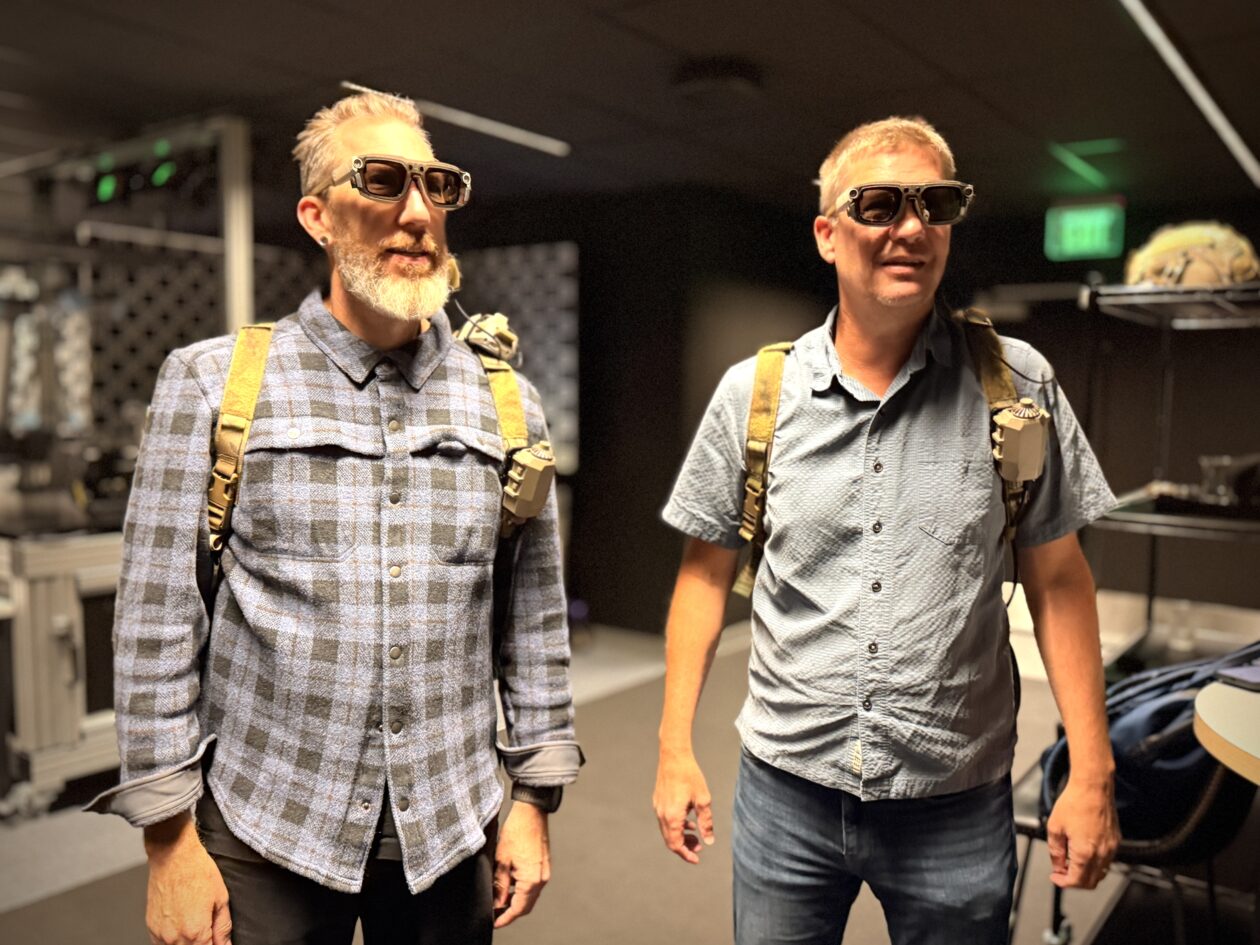
Chad Pfarr, principal design director at Anduril, at left shows GeekWire co-founder John Cook the company’s EagleEye augmented reality system at a testing lab at the company’s Bellevue offices. (Photo via Matt Mostad / Anduril)
BELLEVUE, Wash. — There is no prominent signage outside Anduril’s downtown Bellevue office. The name isn’t listed in the building directory, on the suite door, or in the lobby. That may be by design: Inside, Anduril engineers are quietly building AI-driven, autonomous technologies intended to keep the U.S. and its allies ahead in a rapidly changing military landscape.
Step through the front doors and it becomes clear that this is no ordinary tech company.
Scattered across desks, production tables, conference rooms and showroom labs are autonomous drones ranging in size from a microwave to a ping-pong table, alongside next-generation digital night-vision goggles and military-grade edge computers designed to keep soldiers connected in an increasingly data-rich battlefield.
The Costa Mesa, Calif.-based defense giant — which closed a $5 billion funding round at a $61 billion valuation earlier this year and is reportedly targeting a $100 billion valuation — is rapidly building a massive engineering footprint in the greater Seattle region. It includes modern offices in downtown Bellevue and Seattle, and a multi-acre military testing facility near Carnation, Wash.
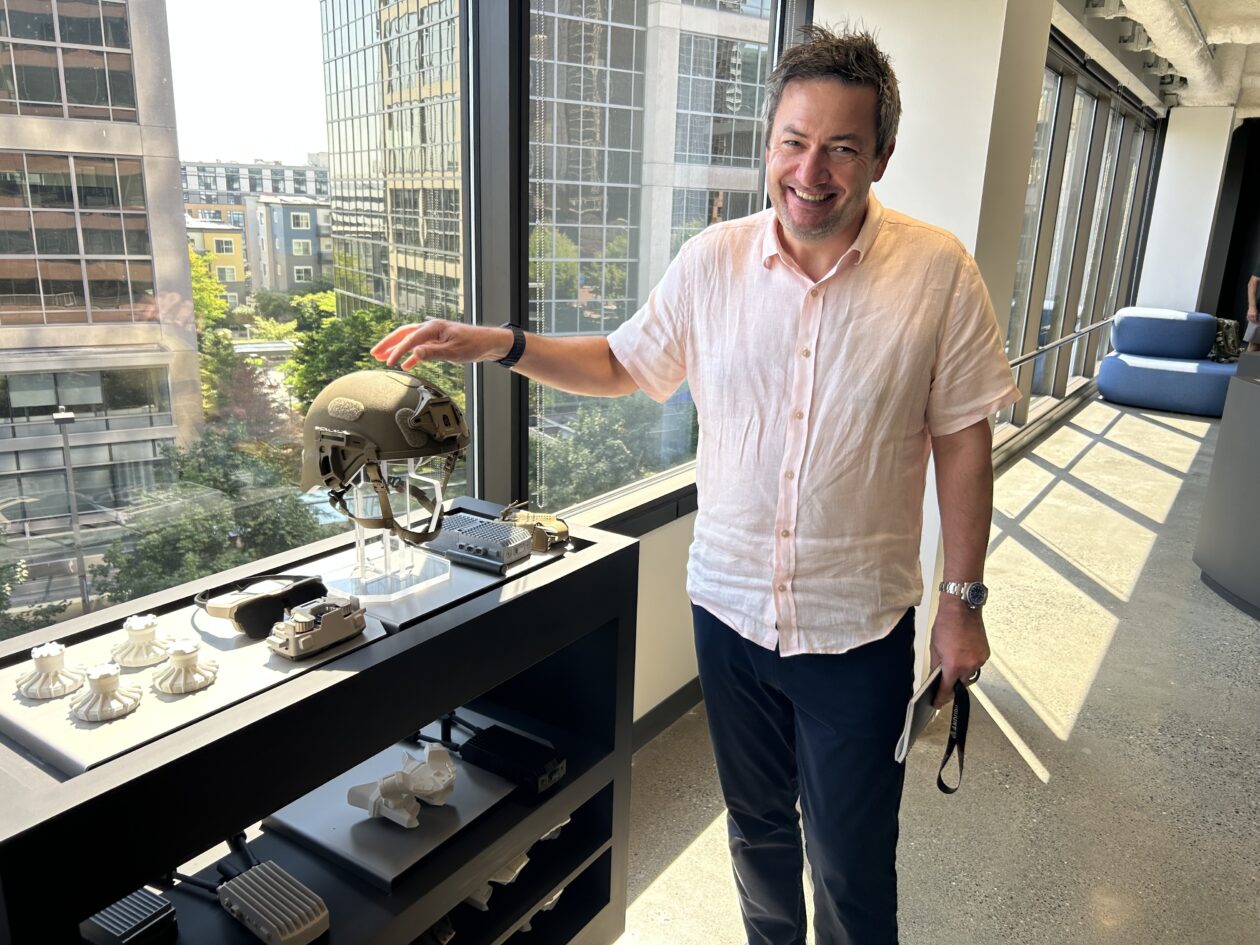
Tom Keane, who oversees Anduril’s connected warfare group, in front of prototypes at the Bellevue offices. (GeekWire photo / John Cook)
GeekWire got a peek inside the iconoclastic company’s Seattle-area operations this week. We toured the Bellevue offices, demoed products, and sat down with senior vice president Tom Keane. The former Microsoft cloud executive leads Anduril’s local presence and oversees its connected warfare division, including mixed reality, AI and edge computing technologies.
Keane was clear about the company’s growth ambitions in the Seattle region: “I could absolutely see a world where we get to 1,000 people here in terms of engineers,” he said.
Asked when that milestone could be reached, Keane said, “It’s sort of almost as fast as you can hire people.” Realistically, that will likely occur over the next two years.
Anduril currently employs 560 people in its Bellevue and downtown Seattle offices, up from about 30 four years ago. That’s when Keane, who had interviewed with 62 companies looking for a new challenge in edge computing, joined Anduril because of what he called “world-class teams in every discipline.”
With more than 110 open positions in Washington state and a newly leased third floor in downtown Seattle coming online, Keane said the regional expansion is only accelerating.
The regional workforce was until recently slated to include a maritime manufacturing hub along the Lake Washington Ship Canal in Seattle. However, as GeekWire reported this morning, Anduril has since vacated the former Foss Maritime shipyard space after the U.S. Navy canceled the autonomous warship program the company was pursuing.
But Anduril’s maritime ambitions haven’t gone away. Alongside its autonomous aircraft, low-cost cruise missiles and counter-drone interceptors, the company continues to develop a large subsea fleet, from modular survey vehicles to the extra-large, school-bus-sized Dive-XL.
The Big Tech pipeline meets ‘grit’
The company’s Seattle-area ramp-up is a play for the region’s engineering talent — a mix of disciplines well-suited to a next-generation defense hardware company, and one Keane says is hard to find in one place. That includes distributed systems engineers, AI and machine learning specialists, and advanced optics experts.
Another advantage: proximity to major military installations including Joint Base Lewis-McChord and Naval Base Kitsap.
Tech giants such as Microsoft, Amazon, Google and Meta have long dominated local engineering hiring. But Anduril is recruiting aggressively from those companies, pitching engineers who want to move fast and see their work in the field.
Deep pockets and close ties to the U.S. defense establishment don’t hurt, either.
Anduril got a large infusion of that talent 18 months ago, when it took over Microsoft’s IVAS (Integrated Visual Augmentation System) program along with about 100 local engineers who had spent years developing augmented reality hardware for the U.S. Army.
“If you take machine learning and AI… you can look out any of these windows and see places that we can recruit from,” Keane said from a conference room overlooking downtown Bellevue. “For a lot of software engineers, this is incredibly applied.”
Keane acknowledges the company’s culture isn’t for everyone. In fact, Anduril got plenty of buzz last year with its edgy recruiting campaign, “Don’t Work at Anduril.“
Rather than plush tech perks and work-from-home flexibility, Anduril pitches what Keane calls “grit” — a willingness to take ownership of hard engineering problems and test them in the field. It’s very much an in-office culture, in part because the company builds hardware.
The company’s “grit” translates directly into how Anduril tests its gear.
In rural Carnation, Wash., about 20 miles east of Bellevue, Anduril operates a testing range with a built-out “shoot house” for low-light tactical work. It gives engineers a place to iterate on code and hardware in the mud and rain alongside active-duty warfighters.
Among them: members of the Army’s 75th Ranger Regiment from nearby Joint Base Lewis-McChord, who recently put Anduril’s EagleEye mixed-reality system through its paces on the firing range and obstacle course.
Hands-On with ‘EagleEye’ and Lattice
During a walkthrough of the Bellevue facility, Anduril’s team showed us a wide range of hardware being designed, tested, and calibrated on site.
The centerpiece was EagleEye, the company’s heads-up hardware and software suite built for warfighters. Historically, soldiers have had to lug 3 to 5 pounds of glass and electronics on their helmets, paired with fragmented radios, specialized batteries and thick cables.
Anduril’s system strips that down to a 115-gram pair of augmented reality glasses — about four ounces — built in collaboration with Meta (for waveguides), Canon (for sensors), Qualcomm (for custom silicon) and Oakley (for ballistic protection).
I tried on the lightweight camouflage backpack and glasses — no helmet in this case — in a demo in the Bellevue testing lab. It ran through three operational “vignettes” driven by Anduril’s core Lattice software:
Tactical HUD: A heads-up display projecting friendly force markers, compass headings, and mini-maps into the user’s field of view so troops don’t have to look down at a handheld screen while moving.
Threat Detection: Real-time alerts from external AI sensors — such as a tower camera or an overhead drone — highlighting incoming aerial threats directly in the display.
Command & Control (C2): The ability to assign tasks to autonomous technology. Using a small handheld controller, an operator can send a virtual Ghost drone to a location, pull up a live video feed and execute a simulated strike.
In each case, the user controls the system — navigating between maps and text — with a click of a button on a small device connected to the front of the backpack.
The team also previewed its upcoming digital night vision system. Instead of the narrow “toilet paper roll” view of traditional analog goggles, Anduril’s VR-style digital displays offer an 84-degree field of view. That’s more than double the 40 degrees warfighters get in devices today.
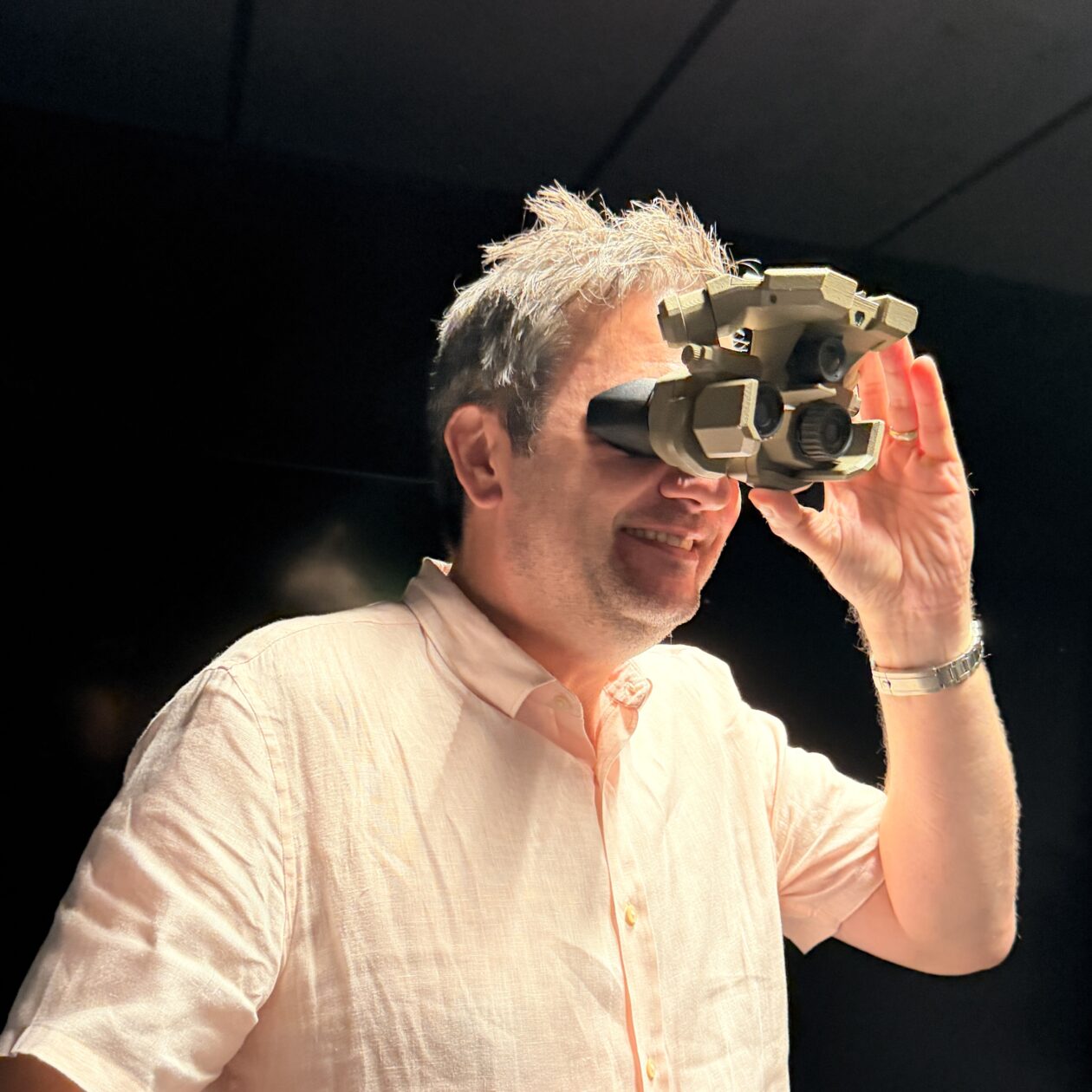
Anduril’s Tom Keane shows off the company’s light-weight night vision goggles, being developed at the company’s Bellevue office.
Using machine learning models, the system fuses thermal imagery and low-light camera feeds in real time, making heat signatures leap out in pitch-black environments.
To ensure every pixel lands accurately without causing motion sickness, Anduril’s engineers use custom robotic arms to run geometric calibration on each lens distortion map before it leaves the facility. An engineer running the testing equipment politely asked GeekWire not to photograph the system.
The night vision system has not yet been deployed but will be part of the Soldier Borne Mission Command prototype delivery to the U.S. Army next year, said Stephanie Davis, communications manager for Anduril’s connected warfare group.
Protests, hiring and hardware
Operating a high-profile defense company in the Seattle area doesn’t come without friction. Activist groups recently staged protests outside Anduril’s downtown Seattle offices, targeting the company’s autonomous weapons development and military contracts.
At the time, Anduril issued a statement to GeekWire saying that it respects the right to free speech. “That said, it is perplexing when people choose to protest a company dedicated to supporting the very military that safeguards those rights,” the company added.
When asked about the pushback, Keane said critics don’t affect Anduril’s hiring. “There’s protests at every company, frankly.”
Anduril’s hiring reaches well beyond Big Tech. Drew Swanson, a lead architect, spent 13 years in the military working in communications supporting special operations units in the field. He described an Anduril technology called Squad-A, which helps squad leaders pick the best network connections to stitch together incoming intelligence feeds.
Swanson said the draw of Anduril is the chance to escape corporate bureaucracy and tackle high-stakes physical problems, reflected in comments he gets from others in Seattle tech.
“One of the biggest things that I always hear is: ‘I want to come over there because you guys are going after really hard problems,'” Swanson said of conversations with tech colleagues around Seattle.
Solving those problems often comes down to fundamental hardware redesigns, like combining a soldier’s ballistic vest, battery and edge computing device into a single body plate. Keane showed off a prototype as the tour wrapped up — an example of Anduril’s broader approach.
“Batteries are such a huge thing,” he said, pointing to the body armor. “If you put the three of them together… you can start to get rid of stuff. You take what was historically three separate heavy things and turn it into one software-enabled platform.”
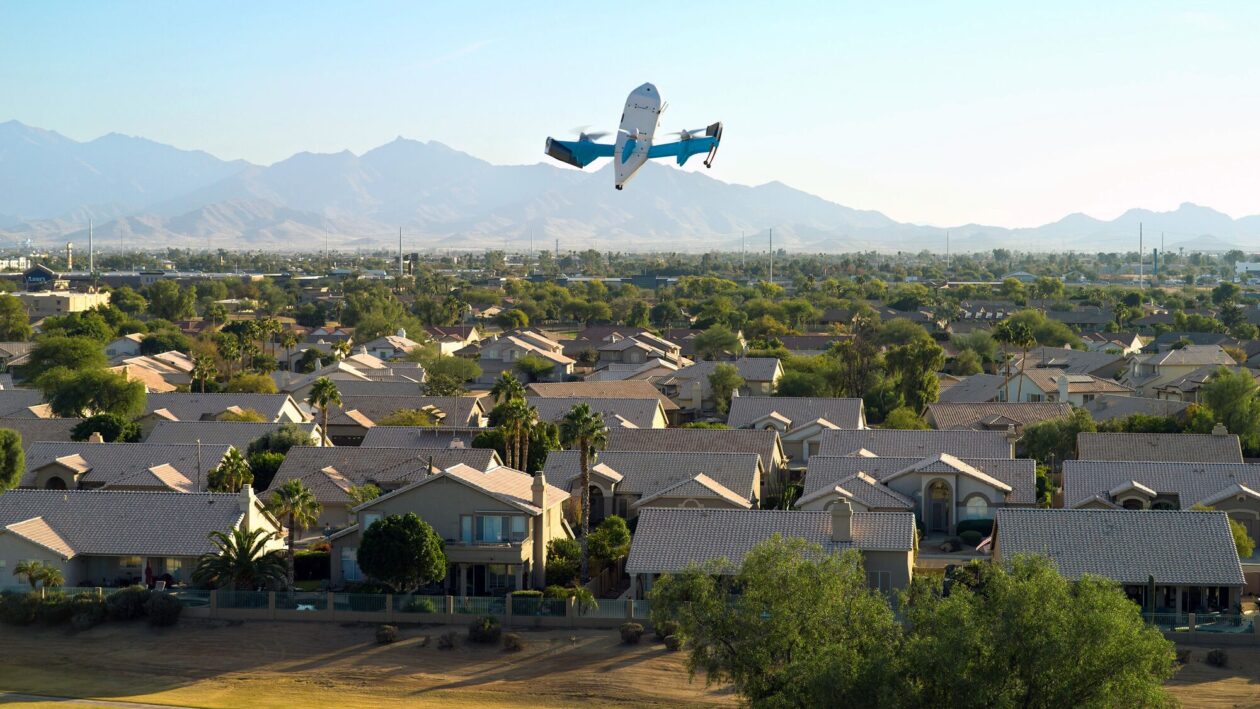
An Amazon Prime Air delivery drone flies over a suburban neighborhood in Arizona. (Amazon Photo)
Amazon’s drones are finally going national.
The company’s autonomous aerial vehicles are set to deliver packages to nearly 500 cities and towns across the country by the end of this year, zipping items through the air to drop them in backyards and driveways as quickly as 30 minutes after ordering.
Amazon announced the plan Wednesday, describing it as a sixfold increase in its Prime Air footprint, reaching communities collectively representing tens of millions of customers.
“I know this looks like science fiction — it’s not,” the Amazon founder said at the time.
Bezos acknowledged that it would take at least four or five years, optimistically, and that convincing the FAA the drones were safe would be one of the biggest hurdles. Amazon’s FAQ that night said it hoped the agency would have rules in place “as early as sometime in 2015.”
Both the technology and the regulations took far longer than the company expected.
Amazon said Wednesday morning that Prime Air will launch soon in the Chicago, Syracuse, Cleveland, Atlanta and Boise metro areas, with more communities to come later this year. The drones fly primarily over suburban areas, which allows them to avoid the tall buildings and crowded airspace that complicate flights over dense urban areas.
There’s no word yet on when or whether drone delivery will come to the Seattle area.
Amazon said the drones launch from two types of facilities: smaller same-day delivery sites and its larger robotic fulfillment centers. The mix is what lets Prime Air offer anywhere from tens of thousands to millions of items depending on the location, according to the company.
Nearly any item weighing 5 pounds or less and small enough to fit in a large shoebox is eligible for drone delivery. That translates into millions of products, as noted by Amazon CEO Andy Jassy in his annual letter to shareholders earlier this year. He wrote that Prime Air would carry “a much larger selection of items inside a half hour” than Amazon’s other fast-delivery options.
Drone delivery will be free for Prime members on orders of $50 or more. Prime orders below that carry a $2.99 fee, and customers without a membership pay $4.99.
Amazon’s reference to expanding to 500 cities and towns does not reflect the number of planned Amazon drone launch locations, but rather the number of municipalities that fall within delivery range of the planned hubs, each of which covers roughly 175 square miles.
The 30-minute delivery scenario is a best case. Most orders arrive around 60 minutes after checkout, Amazon said in its announcement.
Amazon isn’t the only company betting on drones. Amazon retail rival Walmart and Google parent Alphabet’s Wing have been building what they call the largest drone delivery network in the U.S., adding seven new markets in June including Phoenix, Philadelphia and the Bay Area. They plan to reach 270 stores and more than 40 million people by next year.
Local approvals remain a hurdle for delivery drones. Noise has been a recurring concern for residents near drone operations. Amazon says its drones are quieter than an idling delivery truck during drop-off and comparable to a window fan while in flight. A proposed federal rule that would more broadly allow flights beyond the pilot’s line of sight has not been finalized.
The Associated Press first reported on the expansion Tuesday afternoon in what appears to have been an inadvertent break of a news embargo, to which GeekWire had not agreed. Post updated Wednesday morning with details from the official announcement.
A painting of Jimothy, the viral raccoon, by Seattle artist Ryan Henry Ward. (@henry_beyond_museums via Instagram)
A friendly challenge sparked by a portrait of Jimothy, Seattle’s favorite short-spined raccoon, has now drawn in 11 regional heavyweights — and with a big new donation from Amazon, driven the total raised for the Ballard Food Bank past $270,000.
Amazon announced Friday that it is adding an additional $200,000 to a pot that already included $71,975.31 in matching contributions from coffee and software giants, airlines, pro sports teams, and others.
The corporate generosity started as a grassroots effort on Instagram in July, where prolific Seattle artist Ryan Henry Ward auctioned a 24-by-24-inch painting of the internet-famous raccoon to benefit the food bank. Buyer Angela Galdabini won the piece with an exact bid of $6,543.21 — prompting Amazon to match the amount and issue a public callout challenging other local brands to step up.
Ten companies stepped up to match the bid: Alaska Airlines, Brooks Running, Microsoft, the Seattle Mariners, the Seattle Kraken, Stanley 1913, Starbucks, T-Mobile, WaFd Bank, and Windermere Midtown.
It all sparked a Jimothy love-fest on social media with the brands responding to each other.
(Click to enlarge) Some of the Jimothy messages between Amazon and other brands on social media.
Jimothy’s path from Ballard backyards to corporate mascot of sorts began when photos and videos of the round raccoon started circulating online. Born with a rare condition that gives him a compressed, neckless posture, the creature quickly captured Seattle’s — and the internet’s — heart.
The flood of artwork, music, tattoos, food items, memes and more dedicated to Jimothy doesn’t appear to be slowing down, as this Reddit sub demonstrates.
The Mariners held a Jimothy night on Wednesday at T-Mobile Park, where the first 20,000 fans received trading cards with the raccoon’s “stats.” Ben Trammel, who shot video of Jimothy as a baby last year, threw out the first pitch. It all proved so popular that a second Jimothy night was added for Friday.
— Teri Hatfield was named chief revenue officer for Iterable, a customer engagement platform. The Seattle-area tech executive most recently served as executive vice president of sales and solutions at Salesforce and CRO of Tableau, which Salesforce acquired in 2019. She joined Tableau in 2012 and spent more than a decade in sales leadership roles at Verizon earlier in her career.
“I’ve come to believe that great customer relationships don’t start with technology. They start with understanding your customers,” Hatfield said on LinkedIn. “Iterable stood out because it’s built around that belief.”
Hatfield will work remotely for Iterable, which is based in San Francisco.
Ken Miller. (Arnold & Porter Photo)
— Seattle-area attorney Ken Miller has joined Arnold & Porter as a partner in the life sciences and technology transactions teams within the law firm’s corporate and finance group.
Miller began his legal career at Perkins Coie, where he spent 16 years focused on tech companies and nonprofit organizations.
In 2015, he moved to the Gates Foundation as associate general counsel, briefly serving as lead counsel for the Gates Medical Research Institute before returning to the foundation as director of legal. In that role, he led work tied to the Global Health Division, the research institute, and business development and licensing, privacy and AI.
Ben Reed. (LinkedIn Photo)
— Ben Reed is now chief marketing officer for AIM Intelligent Machines (AIM), a Seattle-area startup developing software that lets bulldozers and excavators operate on their own.
Reed previously ran a firm offering AI marketing and go-to-market advisory services. Other past roles include CMO for Sanctuary AI and a decade at Microsoft, where he departed as head of strategic storytelling for the company’s digital transformation platform.
“I’ve spent much of my career helping frontier technologies become understandable, credible, and consequential, from Microsoft Surface and HoloLens to physical AI, humanoids, and robotics. At AIM, the unusual opportunity is that the technology, customers, deployments, and proof already exist,” Reed said on LinkedIn.
Philip Wong. (Gravitics Photo)
— Aerospace startup Gravitics named Philip Wong chief financial officer. The Marysville, Wash.-based company designs and manufactures modular space infrastructure such as commercial space station modules, cargo-carrying spacecraft and orbital carriers. Its customers include U.S. Space Force and Axiom Space. On Tuesday, Gravitics announced a partnership with Lockheed Martin on a Department of War contract.
Wong joins Gravitics from Viasat, a communications company providing satellite internet services, where he led financial strategy and investment planning. He previously held leadership roles at Pure Storage and Seagate Technology and is based in California.
“Philip has spent 30 years deploying capital across satellite, network, and space infrastructure … He knows how to translate real engineering programs into the financial strategy that supports them,” said Colin Doughan, co-founder and CEO of Gravitics, in a statement.
— Ian Fliflet, former chief growth officer at Seattle online sales platform OfferUp, is sharing his insights on Intro, a service that provides video chats with experts from wide-ranging backgrounds.
— Katy Brown, president of Microsoft’s Americas Markets & Industries organization, was named to Avanade’s board of directors. Brown has been with the tech giant for nearly 30 years and is past president and board chair of the Professional Businesswomen of California. She also serves as executive sponsor of the Bay Area Women at Microsoft group.
— Ben Minicucci, CEO and president of Alaska Air Group, has joinedLyft’s board of directors. Minicucci has spent more than two decades with the airline, which is the parent company of Alaska Airlines, Hawaiian Airlines and Horizon Air.
— Seattle tech leader Ash Wahiwas appointed to MoPOP’s board of directors. Wahi is the founder and CEO of Revenaut, a startup building an AI marketing tool. His career includes leadership roles in product and advertising at Microsoft, Snap and Meta.
— TiE Seattle, a nonprofit supporting entrepreneurship, named five new members to its board of directors:
Joseph Sirosh, CEO of CreatorsAG and former executive at Amazon and Microsoft. He also serves on the board for the biotech company AbSci.
Monika Panpaliya, partner director of product management at Microsoft and former leader at JPMorgan Chase & Co., Boeing and T-Mobile.
Vamshi Reddy, CEO of Quadrant Technologies, founder of Seattle Venture Capital, and past leader at Lenora Systems and Microsoft.
Prasad Anguluri, co-founder of the social media platform Haply, which connects neighbors. Anguluri also serves as a Bothell City Council member, president of ANG Technologies, and co-founder of Innovative Investing Group.
Sanjay Puri, who was previously a vice president with Icertis and a former leader at Avalara, 9Mile Labs, Edifecs and others.
— JT McCrone, a Fred Hutch Cancer Center genomic epidemiologist, was named leader of Nextstrain, an open-source project that tracks the evolution and spread of viral and bacterial pathogens in real time.
The effort is primarily based in Seattle at Fred Hutch and two institutions in Basel, Switzerland. It has received $1.5 million from the Gates Foundation to support its next phase, which aims to make analyses of viral evolution more accessible and scalable.
— Graham Littlehaleis now an investing partner with venture firm Felicis. He previously served as vice president of Point72 Ventures.

 Login
Login