Reading view

There are new articles available, click to refresh the page.

Microsoft 2.5: A new series on the people shaping the company’s future

Nearly 20 years ago (!), in 2007, I published my first and only book: Microsoft 2.0. It focused on changes I expected at the company in the “Post-Gates” era. What would remain the same and what likely would be different once co-founder and CEO Bill Gates had left the building?

CEO Satya Nadella has not exited the company (yet). But there’s no question that Microsoft and its mission have morphed considerably in the past year or two. I’m not quite ready to christen this the Microsoft 3.0 era, even though Nadella handed the reins of Microsoft’s dominant commercial business to Judson Althoff nearly a year ago.

That decision resulted in Nadella moving into more of a “founder mode” role, allowing him to focus less on the day-to-day work of running the business. (Microsoft historians may recall that Gates made a somewhat similar move back in 2000 when he became Microsoft’s chief software architect.)

While it might not yet be time for Microsoft 3.0, we arguably could be in the “Microsoft 2.5” era. Windows and Office are still around and still play a big role. Microsoft still builds and sells developer tools and databases. But there’s no question that the cloud and all things AI are at the top of the pecking order now.

I’m embarking on a series here at GeekWire that will focus on what matters to Microsoft and, by extension, to its customers, partners, investors, and employees these days. Who are some of the people shaping and leading the company? What are their opportunities and challenges right now?

Over the next few weeks, I will be profiling various Microsoft execs working on plans for Microsoft’s ongoing evolution. Some are company veterans; some are newcomers. I’ll be talking with top execs from Microsoft’s Security, Copilot, Windows + Devices, Xbox, GitHub, and more.

I’m interested in their strategies for Microsoft’s key products and technologies and how they plan to try to turn Microsoft’s ambitious vision into reality. What are their teams building? What do they see as their biggest challenges and opportunities? And where do they see the technologies in their respective areas heading?

I feel like many of us who’ve been keeping track of the biggest tech companies (myself included) have fallen into the trap of blaming or attributing everything a company does to AI. Layoffs? AI is the culprit. Price increases? It’s all thanks to AI. Changing sales strategies? Chalk it up to AI …

But upon further reflection, I believe Microsoft’s strategy is more nuanced than “AI or bust.” There’s no question that Microsoft’s AI ambitions are shaping its goals and tactics. But Microsoft, as a heavily enterprise-focused entity, can’t simply stop supporting products that aren’t built from the ground up with AI (as much as it might like to do so). Nor can it just leave behind customers who aren’t 100% onboard with its AI moves.

Couple those enterprise hurdles with some not-so-popular consumer decisions, like axing 3,200 people in the gaming unit, and Microsoft’s approach to turning the ship looks a lot trickier.

Our Microsoft 2.5 series kicks off Thursday. Stay tuned.

Microsoft’s reset, a new era for Seattle startups, and how AI is changing everything for founders

Scenes from this week’s founder open house on the deck at GeekWire HQ in Seattle, where we also recorded this week’s podcast. Thanks to Delta Air Lines, Prime Team Partners, WTIA and ALLtech for sponsoring the event. (Photos by Kurt Schlosser and John Cook)

On this week’s show, we’re on the GeekWire deck for our annual founder open house, where we dig into Microsoft’s latest round of layoffs — including a major Xbox shakeup — and the surprising rise of hardware companies on the GeekWire 200.

Then we sit down with four guests to talk about how AI is reshaping how they build: 

Finally, this week’s GeekWire Trivia Challenge: how a longtime T-Mobile executive got his start in the wireless business, and the star-studded history of T-Mobile celebrity endorsers.

Stories mentioned:

Audio editing by Curt Milton.

The awkward timing of the Xbox CEO’s new Federal Reserve gig

Xbox CEO Asha Sharma. (File Photo)

Which is worse, sailing your superyacht through the city where your company just made mass job cuts, or getting named to a U.S. Federal Reserve panel on jobs and productivity three days after announcing thousands of layoffs?

It might not be a full Zuck, but Microsoft Xbox CEO Asha Sharma is getting lots of attention, and not in a good way, for the latter this week.

Sharma was named Thursday to co-lead a new Federal Reserve “Productivity and Jobs” task force, charged with assessing the economic impact of AI and other new technologies on the labor market. Her co-leaders: Marc Andreessen, the venture capitalist and vocal AI booster, and Stanford economist Charles I. Jones, who is currently on leave at Anthropic, maker of the Claude AI chatbot.

The gaming press, as you can imagine, is having a field day. The headline from Kotaku sums it up: “Xbox CEO Will Advise Federal Reserve On Jobs After Mass Layoffs.”

PC Gamer, for its part, noted that the task force is supposed to represent a “commitment to price stability and maximum employment.” However, that’s the Fed’s broad mandate, as described by Chairman Kevin Warsh. It’s actually not the specific mission of the Productivity and Jobs task force, which is narrower: assessing what AI and other new technologies are doing to the economy.

In a separate sign of the backlash, Microsoft communications chief Frank Shaw took to X on Friday to knock down claims that the Xbox cuts were made to replace employees with foreign workers, calling it “bad information” and noting that the H-1B visa figures being cited are company-wide renewals, not Xbox-specific. He also pointed out that Sharma is “an American born, raised, and educated CEO, from Wisconsin.”

Also lost in the coverage of the Fed appointment is the fact that Sharma is less than five months into the job, having taken over as Xbox CEO in February with a mandate to turn around and preserve a gaming division that spent more than $20 billion over five years while its core revenue shrank. The restructuring announced this week is a key part of that effort.

What’s more, it’s hard to imagine that this is the timing Microsoft or Sharma wanted. Announcements like this are often outside the control of the participants. The Federal Reserve sets its own schedule.

Still, it’s tough timing for an executive who announced plans this week to cut 3,200 gaming jobs — about 1,600 immediately, with the rest over the coming year — amounting to roughly 20% of Xbox’s workforce. Sharma herself called it the most significant restructuring in the division’s history.

Meta CEO Mark Zuckerberg’s superyacht Launchpad, for the record, is currently cruising the waters off Juneau, Alaska, a full 900 miles from Seattle.

Why the video game industry may be sliding toward its next big crash

4 generations of Xbox hardware. (GeekWire Photo / Thomas Wilde)

Commentary: The last couple of weeks have served as a capstone to what’s become a bad few years for the international video game industry. Now it appears the larger sector is headed directly into a significant crash, as several unsustainable practices all seem to be approaching a crisis point at once.

The first and most obvious issue is the ongoing component shortage. Due to the rush to build AI data centers, both RAM and solid-state drives have risen dramatically in price in 2026, with analysts forecasting that costs might not settle back down until at least 2028.

Both the PlayStation 5 and Xbox Series X|S are at the point in their life cycle when they’d ordinarily be declining in per-unit costs as the technology matured. Instead, both Sony and Microsoft have raised console prices multiple times this year due to the high demand for parts.

This would ordinarily be a great time to get into video games, as we’re almost six years into the current console generation. Instead, it’s one of the worst. The base PS5 and Series X are about as expensive as they were at launch in November 2020, and building a new gaming PC right now can be costly.

The component crunch also harmed the debut of Valve’s new Steam Machine, which officially launched late last month with a starting MSRP of $1,049. Valve, based in Bellevue, Wash., was forced to offer the new hardware at a significantly higher price than planned due to the difficulty in getting components.

That’s been reflected in its early reviews, with many outlets noting that the Steam Machine’s current price doesn’t match its power. At $700, the Machine would be a great gateway product for PC gaming, the way the Steam Deck was, and a genuine competitor in the console field, but a $1,049 price tag makes it an expensive curiosity for financially secure gadget-heads.

Another bad sign came from Sony’s recent announcement that it would sunset physical media for the PlayStation platform by 2028. This decision, which allegedly took many of Sony’s publishing partners by surprise, has serious knock-on effects for collectors, historians, developers, and most prominently consumers.

Sony has already caught one lawsuit over alleged market exploitation on the PlayStation Store, and that was a few days before it announced it wants to kill discs. An all-digital PlayStation library means that Sony would get to exercise full monopolistic control over pricing and access for every game it sells; licensing agreements mean that anything purchased on a digital storefront like the PlayStation Store is subject to deletion at any time without notice; and players wouldn’t be able to resort to any of the usual cost-cutting measures such as bargain bins, buying used copies, or even trading games with a friend.

That suggests that Sony has decided its best path forward is to continue to extract money from its established audience, rather than to have more options in place for gaming on a budget. There are free-to-play games on the PS5, of course, but most if not all are cross-platform and/or designed as money sinks. Ask any parent whose kids accidentally ran up a big tab in Fortnite.

Sony’s PlayStation 5. (Sony press image)

If Sony has decided to end physical media, then it’s likely Microsoft will follow suit. While Xbox hasn’t mentioned its next-generation console, codenamed Project Helix, for a hot minute, it has been eager to get rid of discs since at least 2013. Some sources, such as Windows Central, allege that Xbox is already planning to do so.

(Meanwhile, Nintendo is likely to do its own thing. While Nintendo has been forced to raise the price of the Switch 2 alongside its competitors, it has offered no sign that it plans to stop selling game cards or Switch cartridges. In an uncertain world, Nintendo can be relied upon to only ever follow its own peculiar instincts.)

This sets up an early look at the environment that surrounds the 10th generation of console hardware. If both Sony and Microsoft stick to traditional timelines, we’re likely to start hearing more about the PlayStation 6 and Project Helix over the course of 2027, with launch in holiday 2027 or 2028.

If they do launch along that timeline, then it’s difficult to see how either system will retail for less than $1,000, since the storage and RAM supplies will still be constrained by that point. That automatically prices most of the potential audience out of the market. Once the starting costs hit the four-digit range, a console stops being a hobby or a toy for children and becomes an expensive extravagance. (As a general rule, you probably don’t want your console to cost significantly more than the TV you’re attaching it to.)

Further, it’s arguable that neither the PlayStation 5 nor the Xbox Series X|S have really hit their potential. Sony has famously squandered much of this generation on a largely abortive pivot to games-as-a-service, while Xbox has often seemed more interested in laying off developers than actually making or marketing games. The 9th generation of consoles has had a few big hits, but it’s mostly despite itself.

Not only is there likely to be limited demand for the 10th-generation PlayStation or Xbox, but neither of them actually seem necessary. The only reason to make them is for a brand refresh, and that’s got nothing to do with consumers.

Microsoft, following its acquisition of Activision Blizzard in 2023, is currently the second largest game developer in the world, while Sony dominates today’s console market. These two companies influence much of what happens in the modern video game industry, and as of right now, both are apparently determined to do the most short-sighted thing possible at any given time.

Sony has decided that only part of its audience actually matters, while Microsoft seems to be saddling Xbox with unrealistic expectations, possibly to justify its eventual sale or shutdown, and is ignoring at least one organized boycott.

Reggie Fils-Aimé (center) leads a roundtable discussion of Xbox architects to celebrate the platform’s 20th anniversary in 2021. Left to right: Robbie Bach, Ed Fries, Fils-Aimé, Peter Moore, Bonnie Ross. (Microsoft Alumni Network)

Whenever the video game industry undergoes any kind of significant disruption, someone somewhere always asks if it’s the start of another “Crash of ‘83.” This is usually hyperbole, but it’s hard not to see the parallels between then and now: the video game market is flooded, there are few true exclusives left outside of Nintendo, many members of the gaming audience buy as few as 2 games a year, and the end of physical media will end both retail support and much of the casual audience.

This is unfolding as a slow, years-long plummet rather than the comparatively sudden shock of ‘83, but a crash is a crash. It’s avoidable, but it would require a massive, simultaneous course correction from several of the largest entertainment companies in the world.

That being said, it’s unlikely that video games as a medium are facing any kind of existential threat. Nintendo, as noted above, is well-positioned to ride out any potential problems with the larger market, PC gaming is hanging on, and the mobile sector is actually having a sort of quiet renaissance right now. There will still be video games to play in 2030, barring some larger disaster.

If there’s one big opportunity here, it’s that many of the major players in the games industry have either voluntarily abandoned the market for budget gaming or have been forced out by component costs. Some of the biggest hits of the 2020s to date, such as Vampire Survivors, Among Us, Lethal Company, and Balatro, are cheap, retro-styled games designed to run on almost any hardware, from a PlayStation 5 to your 4-year-old tablet.

The best step forward for mainstream gaming, then, might actually be to take a step back, in a similar way to projects such as Panic’s Playdate retro handheld (still going strong 5 years later) or Seattle’s Tin Can, seeing success with its land-line phones for kids and families. Chasing bigger games, higher frame-rates, and more realistic graphics for 30 years has gotten us here, up to the edge of a second major crash, while thousands of people log on every day to play games that could be run on a particularly big potato.

Instead of rushing into the 10th generation, the solution now might be to think simpler and cheaper, making smaller, more focused projects rather than the 5-year moonshot of a typical AAA game. Otherwise, mainstream video games may end up like Western comics: increasingly expensive options presented to a shrinking handful of fervent fans.

Tech Moves: Seattle tech exec named Dropbox CPO; Xbox VP among layoffs; C-suite changes at T-Mobile

Mike Torres. (LinkedIn Photo)

Mike Torres, a former executive at Amazon, Microsoft and Google, has joined Dropbox as the company’s first chief product officer.

“As a product leader, joining a company that helped pioneer product-led growth is energizing…” Torres said on LinkedIn. “In this role, my focus will be simple: help Dropbox ship the right things at the right time for our customers.”

Seattle-based Torres comes to Dropbox from Google, where he served as vice president of product for Chrome. Before that, he spent more than a decade at Amazon, most recently as VP of Kindle. At Microsoft, he led teams working on OneDrive, Windows Movie Maker and other products.

Chris Sambar. (LinkedIn Photo)

T-Mobile appointed Chris Sambar as chief enterprise officer, effective no later than Oct. 14. Sambar will lead the Bellevue, Wash.-based company’s small- and medium-sized business, enterprise and government units.

Sambar joins from Public Storage, where he serves as chief operating officer. He was previously at fellow communications giant AT&T for more than two decades, most recently as a president of the company’s global network organization overseeing architecture, engineering, construction, operations, tower strategy and program management.

“Chris is a seasoned wireless industry leader with proven experience including expanding high-growth businesses and seizing market opportunities,” said Srini Gopalan, CEO of T-Mobile.

T-Mobile made two additional C-suite changes:


Mike Katz. (LinkedIn Photo)

Chief Business & Product Officer Mike Katz has resigned to “pursue new professional interests,” according to a press release. Katz was with the company for more than 28 years and will remain in a strategic advisory role through the end of the year. Gopalan offered his “sincere gratitude to Mike for his incredible contributions to T‑Mobile.” Read more about his departure in this GeekWire story.

André Almeida‘s C-suite role has expanded and his title has been updated to chief marketing, brand and broadband officer. He previously served as chief broadband, enterprise and emerging business officer. In the new position, Almeida will help oversee the company’s consumer wireless and broadband businesses.

Kevin LaChapelle. (LinkedIn Photo)

— After 37 years with Microsoft, Xbox Vice President Kevin LaChapelle was among those laid off this week, with the cuts hitting the gaming division particularly hard as the company aims to overhaul the division.

LaChapelle was hired by the Redmond, Wash.-based tech giant in 1989 as a software design engineer and joined the Xbox team in 2012.

“I will say my fondest memories are of leading the team of very talented engineers who built the Xbox Backward Compatibility program,” LaChapelle said on LinkedIn. When Phil Spencer, then head of Xbox, announced the program at the Electronic Entertainment Expo in 2015, LaChapelle added, “The audience’s reaction was unbelievable.”

Adam Shoenfeld. (LinkedIn Photo)

Adam Schoenfeld has resigned as chief marketing officer for Inflection.io. In April, the B2B marketing automation company acquired Keyplay, a Seattle startup co-founded and previously led by Schoenfeld. The deal reunited Schoenfeld and Inflection CEO Aaron Bird, who have known each other for many years and have collaborated and invested in each other’s companies.

Schoenfeld said on LinkedIn that he “had the best of intentions” when he committed to the acquisition, but then burnout hit him. “I was embarrassed and disappointed in myself. I dreaded telling the team. I didn’t want to bail and let people down… I’m sure others have been in this place,” he added. “After facing the hard conversations, I’m excited to look ahead.”

Schoenfeld remains a part-time CMO advisor for the business and also produces Adam’s GTM Report, which provides data-backed research, maps and tools for leaders and builders in the space.

— Kent, Wash.-based Stoke Space Technologies named former OpenAI executive Kevin Weil to its board. Weil has held leadership roles at Planet, Meta, Instagram and Twitter and also serves on the boards of Cisco and The Nature Conservancy.

Stoke Space builds reusable rockets and raised $860 million from investors in its latest round. It’s No. 6 on the GeekWire 200, a ranked index of the Pacific Northwest’s top startups.

Skippy Shaw has joined fusion startup Helion Energy as director of Washington government affairs. The Everett, Wash.-based company is working to build what could be the world’s first commercial fusion facility in Central Washington. Shaw joins Helion from The Nature Conservancy, where she led state governmental relations for TNC’s Washington chapter.

David Langworthy announced that he has resigned from Microsoft after nearly 25 years, leaving the role of architect for Azure OpenAI. Langworthy, who worked as a founding member of Azure OpenAI, GitHub Copilot, GenAI, MAC, and Azure AI Services, is the founder and CTO of a stealth startup based in Bellevue.

Carissa Allen has also left Microsoft, departing as director of strategy for the company’s events, including Ignite and AI Tour. On LinkedIn, Allen called her resignation after nearly 30 years “my Valiant Reboot Project (no “retirement” here) because you know I’m not finished yet.”

— And in case you missed it:

  • Bill Colleran, a veteran technology executive who previously led Impinj, has joined Seattle-based AI coding startup Adronite as CEO. Edward Rothschild, who co-founded and previously led the company, is transitioning to chief technology officer. Read more in this GeekWire story.
  • Nick Parker, a 26-year Microsoft veteran who led the company’s worldwide commercial sales business, is leaving to become Nvidia’s new sales chief, effective Aug. 24. Read more here.

A ‘painful’ reset for Xbox: 3,200 job cuts, studio spinoffs, and a vow to return to growth in 2027

(Microsoft Image)

Xbox CEO Asha Sharma laid out a wide-ranging plan to overhaul Microsoft’s gaming division Monday, calling it the most significant restructuring in Xbox history and disclosing that the business has been losing 64 cents on every dollar invested in its game studios.

As detailed in a memo to employees, the changes include roughly 3,200 job cuts through the fiscal year — about 20% of the Xbox workforce — the spinoff of four game studios, a new COO, and a plan to flatten management from as many as 14 layers to no more than five.

“We will return to growth in 2027,” Sharma wrote. “History is full of companies that mistake longevity for inevitability. We will not be one of them.” 

Sharma, a startup veteran and former Microsoft AI leader, was named Xbox CEO in February

“I know this is painful,” she wrote. “These changes will directly affect people who have poured their creativity into building XBOX. Many joined us through acquisitions, while others were recruited here, or sought us out because they loved this industry and loved XBOX. Today’s decisions do not reflect their talent or dedication.”

But she also reiterated what she said in a memo last month: Xbox’s business is not healthy, operating at margins 3-10x lower than industry peers after years of heavy spending that failed to produce the expected growth. 

About 1,600 of the Xbox job cuts take effect Monday as part of a broader round of 4,800 layoffs across Microsoft. The remaining Xbox reductions will come in the months ahead. Sharma acknowledged that a year-long restructuring “creates additional challenges” but said “it is not possible to make all the necessary changes in a single day.” 

Sharma said the cuts reach across Activision, Bethesda/ZeniMax, Blizzard, King, Mojang, and Xbox Game Studios, though no publicly announced games are being cancelled.

Several game studios will be spun out as standalone ventures, removing the costs from Microsoft’s books while giving the studios a chance to survive on their own.

  • Compulsion Games (South of Midnight) and Double Fine Productions (Psychonauts) will return to their management teams as independent studios, keeping their intellectual property and current projects. 
  • Ninja Theory (Hellblade) and Undead Labs (State of Decay) will shift to new owners with funding to complete their current games. 
  • In France, Arkane (Dishonored, Deathloop) is beginning a legally required consultation with its employee works council to determine its future. 

Sharma will also take on direct oversight of game studios Mojang (Minecraft) and King (Candy Crush), Xbox’s two largest studios by monthly active players. 

In addition, she is establishing a new chief operating officer role with end-to-end financial responsibility across content, hardware, platform, and services. Helen Chiang, a nearly two-decade Xbox veteran who led Mojang and the Minecraft franchise, has been promoted to the role. Dave McCarthy, a 17-year Xbox veteran who helped build the platform, is retiring. 

Across the division, Sharma wrote in the memo, Xbox will cut vendor spending by 50% and reduce management layers from as many as 14 to no more than five.

The overhaul follows a 25-year period in which Microsoft largely subsidized Xbox as a strategic bet on the living room. Microsoft CEO Satya Nadella has said that era is over, noting that YouTube creators make more money from Xbox games than Microsoft does.

Microsoft cuts 4,800 jobs, about 2% globally, revamps salesforce and launches massive Xbox overhaul

Microsoft’s Redmond headquarters. (GeekWire File Photo)

Microsoft is cutting 4,800 jobs, just over 2% of its global workforce, citing a need to revamp its sales and consulting division to keep pace with a rapidly changing tech industry, while overhauling its Xbox business in a push for long-term growth and profitability from gaming. 

The cuts include about 600 jobs in Washington state, home to Microsoft’s Redmond headquarters. That’s down from 3,200 job reductions locally a year ago. Combined with ongoing hiring, Microsoft’s workforce in the state is expected to remain stable at around 52,000 people.

About 1,600 of the 4,800 job cuts being announced Monday are in the Xbox division. Additional Xbox layoffs in the months ahead are expected to bring total job reductions in the gaming division to roughly 3,200, or about 20% of the global Xbox workforce, this fiscal year. 

Microsoft is also spinning off four Xbox game studios to operate independently. 

In an internal memo, Xbox CEO Asha Sharma called it the biggest restructuring in Xbox history, saying the division has been “operating at margins that are 3-10x lower than comparable platform and publishing businesses” and that studios have been losing 64 cents for every dollar invested.

Overall, top executives sought to distinguish Microsoft from other tech giants, saying the cuts were minimized by the redeployment of more than 4,000 employees into new roles over the past year and a voluntary retirement program that let thousands more exit by their own choice.

By comparison, the company last year cut more than 15,000 jobs globally in two rounds of layoffs in spring and summer 2025 — the largest reductions in more than a decade.

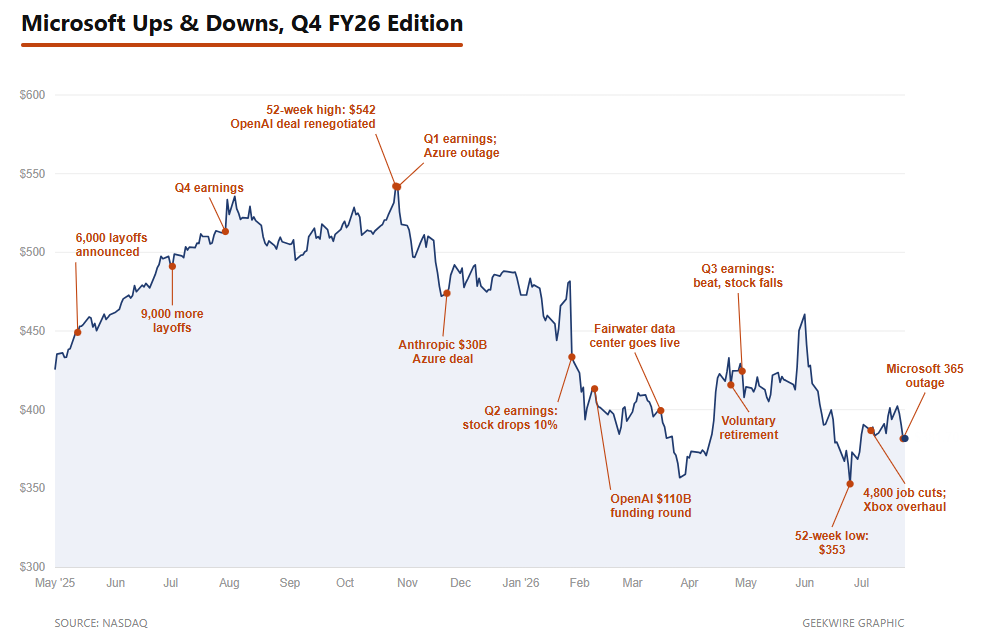
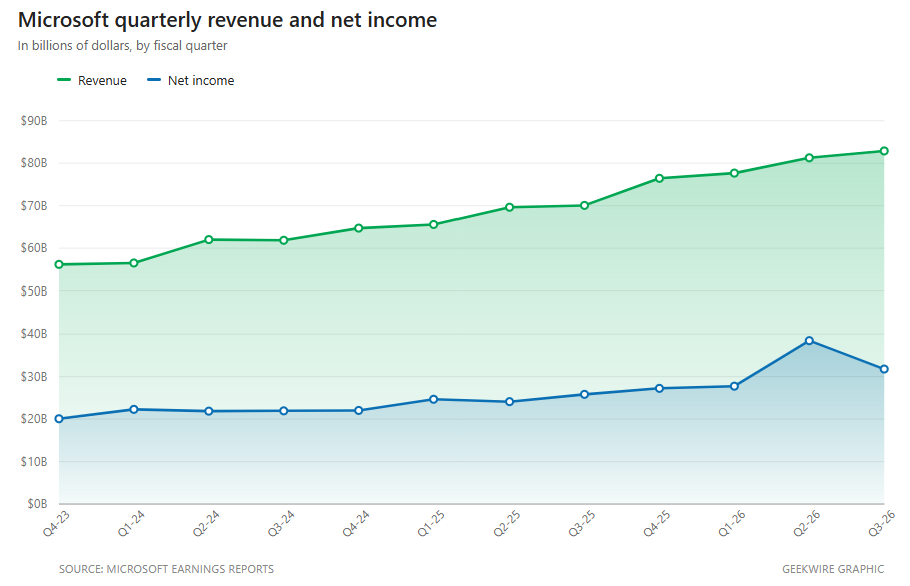
The latest cuts come amid record capital spending on the company’s AI infrastructure, pressure from Wall Street to keep operating expenses in check, and a 30% stock slide that has wiped out roughly $1.2 trillion in Microsoft’s market value over the past nine months.

“Microsoft can only be a strong employer if it has a successful business,” said Brad Smith, its president and vice chair, in an interview with GeekWire. “We have to adapt to change.”

Before the latest cuts, the company’s total workforce was about 220,000 people. Across the company, Microsoft expects worldwide headcount to decline year-over-year, CFO Amy Hood said on an April earnings call. 

Amy Coleman, Microsoft’s chief people officer, said in a memo to employees Monday morning that the roles the company is eliminating today are not being directly replaced by AI.

At the same time, she acknowledged, “AI is changing how work gets done.” She added, “Some of the tasks we do every day can now be automated, and that means we all need to keep learning, keep building new skills, and keep adapting as the work evolves.”

However, the line from Coleman’s memo that may get the most attention internally is this: “We are still early on this journey, and there will be more changes ahead; other parts of our business will need to make similar changes.”

In an interview, Coleman stopped short of signaling further layoffs across the company. Instead, she described a larger shift in how Microsoft manages its workforce. That includes reskilling engineers for customer-facing and AI-focused positions, and exploring how to make voluntary exit programs a regular part of the company’s operations — not just a one-time offer, but potentially something employees could opt into annually or on an ongoing basis.

Coleman confirmed that about 30% of roughly 8,750 eligible U.S. employees accepted Microsoft’s first-ever voluntary retirement program in recent weeks, in line with the company’s expectations, which reduced the size of the reduction in force announced Monday. 

The cutbacks and changes in the company’s sales and consulting teams build on last week’s launch of the Microsoft Frontier Company, a $2.5 billion initiative to embed 6,000 engineers inside customers to deploy AI. The shift is reducing some traditional sales and consulting roles and resulting in more technical positions working directly with customers. 

“We’re seeing that we need more engineering excellence in the customer space,” she said. 

Smith said software development is undergoing its biggest shift in the more than 50 years since Microsoft’s founding. The widespread use of AI is making code cheaper and faster to produce, but he said that’s also creating demand for new kinds of roles and work.

“Some things like coding require less time of software developers,” he said. “At the same time, there’s new parts that are growing, whether it’s the product management or software design, or perhaps most importantly, working directly with customers.”

Update: A filing by Microsoft on Monday under the Washington state Worker Adjustment and Retraining Notification Act listed 605 positions being eliminated in Washington state.

The roles span software engineering, product management, sales strategy, data science, business program management, marketing, and game design, among others — ranging from mid-level individual contributors to senior managers, consistent with cuts that reach across both the company’s technical ranks and its sales and consulting operations.

Xbox at a crossroads: 25 years later, Microsoft is done playing around

Xbox at a gamescom briefing in 2014. Microsoft is pressing its games division to turn a profit. (Microsoft Photo)

In 2007, Microsoft’s Xbox 360 consoles started dying — overheating until three lights on the front blinked red, a defect gamers came to call the “red ring of death.” Microsoft’s response was to extend the warranty on every machine and take a charge of more than $1 billion to fix the problem, making it one of the costliest product failures in the company’s history.

Microsoft could afford it financially, but the bigger factor was strategy. Xbox was a bet on the living room, and for a company minting money on Windows and Office at the time, losing a billion or so was a justifiable cost of staying in the game.

Nearly two decades later, that patience has run out.

“Going forward, this cannot continue,” the new Xbox CEO Asha Sharma wrote in a memo to employees last month, offering a blunt assessment of a business that has spent more than $20 billion over five years, only to see its core revenue fall by nearly half a billion dollars, running at a thin 3% profit margin, by Microsoft’s own internal measures.

With thousands of layoffs expected to be announced across Microsoft as soon as next week, the Xbox division is likely to be among the hardest hit.

The cuts reach across the company — including sales and consulting — part of a restructuring that has become routine around the close of Microsoft’s fiscal year. But for Xbox, they’re an early step in a broader effort to reset the business, rein in costs, and position the division for healthier profits.

Microsoft CEO Satya Nadella has been blunt about it: the company has spent years subsidizing Xbox rather than profiting from it, and that era is over. The videos and livestreams of people playing Xbox games that fill YouTube generate more money than Microsoft makes from the games themselves, he noted in an appearance on the Hard Fork podcast.

“No one can accuse Microsoft of not having invested for the last 25 years,” Nadella said. “And now we have to turn this into a sustainable business.”

Long-term strategic bet

Turning it around means breaking a pattern that runs through Xbox’s history.

Xbox launched in 2001 and lost money for most of its first decade. Microsoft absorbed the losses and stayed in — going up against Sony’s PlayStation and Nintendo — because it saw a strategic prize in owning a piece of the living room, and later mobile. Online gaming also gave the company early experience running services at scale, which fed its cloud ambitions.

Over time, the goal shifted from selling hardware to selling subscriptions.

Xbox Live, launched in 2002, turned online play into recurring revenue. Game Pass, which arrived in 2017, let players pay a monthly fee — the top tier is about $23 — for a library of games, including Microsoft’s own new releases the day they come out. The idea was to get people paying for Xbox everywhere: consoles, PCs, phones and the cloud.

And when growth stalled, Microsoft doubled down. It paid $7.5 billion in 2021 for Bethesda, the studio behind Fallout and The Elder Scrolls, then $69 billion in 2023 for Activision Blizzard (whose games include Call of Duty, World of Warcraft, Diablo and the mobile hit Candy Crush) the largest acquisition in Microsoft’s history.

A series of economic headwinds

In recent years, almost everything about the economics of gaming has turned against Xbox at the same time.

Hardware loses money, and AI is making it worse. Microsoft sells consoles at or below cost, banking on games and subscriptions to make up the difference. But AI data centers are consuming so much memory and storage that chip prices have spiked. That has forced Microsoft to raise Xbox console prices, most recently a $100-to-$150 hike this summer that it blamed directly on component costs.

Xbox lost the console war. By most estimates, Sony’s PlayStation 5 has outsold the Xbox Series X and S more than two to one. A smaller base means fewer game sales and subscriptions to offset the upfront hardware losses. That has left Xbox a distant second for the entire generation.

Revenue is shrinking. Even setting aside the games it gained from Activision, Xbox’s annual revenue has fallen nearly $500 million over five years — while the money going into the business keeps climbing. It has been investing more to earn less.

Microsoft’s most recent quarterly filing shows gaming revenue of $16.8 billion for the nine months through March, down about $1.1 billion, or 6%, from a year earlier.

Game Pass cuts into sales. Handing subscribers a new game the day it launches undercuts the roughly $70 they would have paid to buy it. The service delivers steady subscription income, but thinner economics on the games themselves.

Activision didn’t fix the margins. Even with one of gaming’s most profitable businesses folded in, Xbox earns only about 3 cents of profit on every dollar — well under the 17 to 22 cents typical in the industry. If the biggest acquisition in company history can’t move the margin, little will.

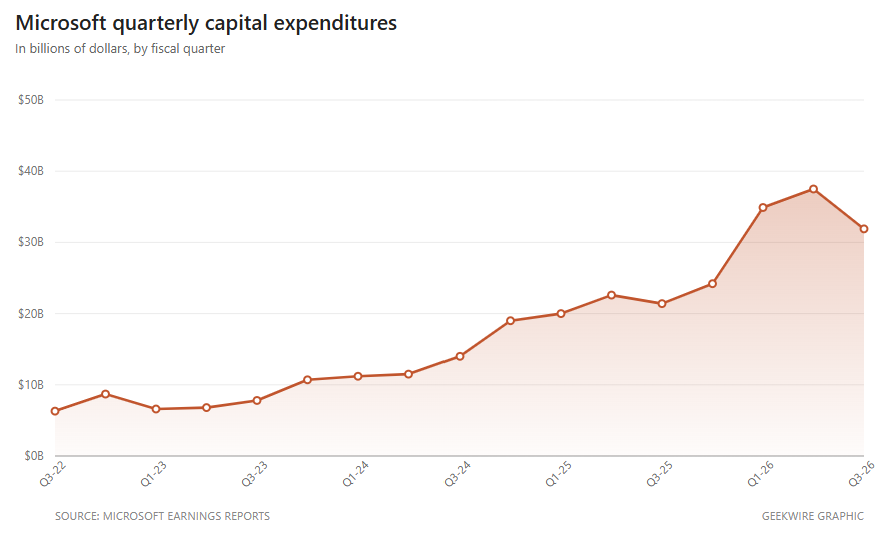
Every spare billion is flowing to AI. Microsoft is pouring more than $100 billion a year into the data centers and chips behind its AI push, trying to capitalize on the boom. Against a risk and payoff that big, a gaming business that barely breaks even feels like yesterday’s strategic bet.

What’s next for Xbox

The cuts have already started. In recent weeks, Microsoft has signaled plans to close or sell some studios, including Ninja Theory, maker of the acclaimed “Hellblade” series.

Shedding staff, studios and marketing will lift Xbox’s profit margins in the near term. What it won’t do is fix the underlying problem: a business can trim its way to a better number only so much before it has to generate more revenue.

Sharma’s plan, so far, is to concentrate on Xbox’s biggest franchises, funding blockbusters like Halo and Fallout while pulling back elsewhere. It’s leaning on Game Pass and releasing most of its games on PCs and rival consoles from Sony and Nintendo, reaching players well beyond Xbox’s shrinking base, even as it holds back a few new exclusives like Gears of War to give owners a reason to stay.

Microsoft is also rethinking the console itself. In her memo, Sharma described a “hardware component crisis” that has left the company unable to make as many consoles as players want, and called for “a new business model and partnerships” for its hardware.

How far the reset ultimately goes is an open question. The Information reported that Microsoft has weighed making Xbox a standalone subsidiary, a joint venture, or a spin-off, though nothing is imminent.

Microsoft’s response to the Xbox 360 “red ring of death,” July 6, 2007. (Seattle Post-Intelligencer / NewsBank)

Whatever happens next, it’s clear that times have changed. In 2007, as the red ring of death crisis emerged, Peter Moore, who ran the Xbox business at the time, and his boss Robbie Bach went to then-CEO Steve Ballmer to ask for the money to repair and replace the failing consoles.

Ballmer didn’t flinch. “What’s it going to cost?” he asked, as Moore later recalled.

Told it was $1.15 billion, Ballmer said, simply: “Do it.”

Moore credits that decision with saving Xbox. There would have been no Xbox One, he said, without Ballmer’s willingness to spend more than a billion dollars to protect the brand.

Nearly two decades later, Microsoft is done writing that kind of check.

No discs, more problems: What Sony’s all-digital PlayStation means for gamers and the industry

Sony’s PlayStation 5. (Sony press image)

Sony announced on Wednesday morning that it plans to phase out physical media for future PlayStation games, which is a massive market disruption for an already reeling games industry. It ends trade-ins and lending, raises the overall price of entry for the PlayStation ecosystem, and turns your shelf full of games into licenses that can potentially disappear.

The news came via a post on the official PlayStation blog by senior communications director Sid Shuman. As of January 2028, all games for PlayStation platforms will only be available in digital formats, such as direct downloads.

“This is a natural direction for Sony Interactive Entertainment to adapt to consumer trends as the general preference for digital media significantly outpaces physical discs,” Shuman writes. “This transition will enable us to align more closely with how most of our community prefers to access and play games today.”

Analysts have expected an announcement like this for some time. As per Circana senior director Mat Piscatella, physical media sales in gaming have been on a steady downward turn since their peak in 2009, hitting an all-time low in 2025. In fact, several companies have sprung up since then that treat physical games as an exclusive collectible, such as Limited Run, Lost in Cult, and Videogames New York.

US new physical video game software spending. 12 months ending May 2007-2026:

Mat Piscatella (@matpiscatella.bsky.social) 2026-06-25T11:30:56.827Z

It’s not hard to see why Sony would make this move. We’re approaching the point that would usually mark the end of the PlayStation 5’s life cycle. Were it not for the ongoing component shortage, we’d likely have heard more about the PlayStation 6 by now. An all-digital PS6 theoretically uses fewer parts and the games are cheaper to publish, which lowers the per-unit cost for Sony as it develops the new hardware.

However, Sony’s decision to sunset physical media in a year-and-a-half is faster than most analysts’ craziest predictions, most of whom figured it’d take at least another decade to fully phase discs out. Even at its lowest point, per Circana’s math, physical media in video games represents $1.9 billion in consumer sales. That’s not insignificant.

Sony’s competitors have yet to react in any significant way. Microsoft’s next-generation Xbox, currently known under the codename Project Helix, is rumored to be an all-digital system, and Microsoft has famously been trying to get out of the physical media business since at least 2013.

That year, Microsoft announced at E3 that the Xbox One would have significant measures in place to keep players from reselling their physical games, which led to widespread outcry online. The next day, Sony’s president went onstage and proclaimed the PS4 would do none of that — which gave it a big head of steam going into a console generation Sony went on to win.

Thirteen years later, Sony is making Microsoft’s old bet.

The irony is that Sony itself underscored one of the biggest issues with ditching physical media last Sunday. On June 26, Sony sent a number of users in the United Kingdom an email to notify them that due to the end of a license agreement, 551 shows and movies that were previously available on the PlayStation Network would be removed from the service. Consumers who’d previously thought they’d made a purchase were suddenly informed that it had actually been a multi-year rental.

That’s the central problem of the streaming era for end users: you only have anything in your digital library for as long as the library’s owner decides you do. An all-digital future means you own nothing. At best, you have limited viewership rights that can be revoked at short notice.

Most worryingly, however, the shift to an all-digital future effectively raises the cost of entry to the console market, at a point when the price of gaming is already rising. If there are no physical discs for the PlayStation 6, then you can’t swap discs with a buddy or defray a purchase by trading an old game back to a store.

This is a relatively sudden disruption to the console market, and through it, to the games industry as a whole. It’s likely to have a series of knock-on effects for the next few years, and sets an early tone for the upcoming 10th generation of console hardware.

While it’s still possible that consumer outcry could get Sony to reverse course here, or offer some intermediary solution like USB disc drives, the end of physical gaming media has analysts and players alike asking a lot of tough questions about costs, preservation, and consumer convenience. The games industry is changing faster than expected in 2026, and is likely to be nearly unrecognizable by this time next year.

Microsoft set for new round of job cuts next week, spanning Xbox, sales and consulting

GeekWire File Photo

Microsoft is preparing to cut thousands of jobs next week, continuing to rein in operating costs as the company pours unprecedented sums into AI infrastructure. 

Business Insider broke the news Tuesday afternoon, saying that the cuts will impact less than 2.5% of the company’s global workforce of about 220,000 people. It includes not just Xbox, where cuts have been signaled for weeks, but also layoffs in sales and consulting. 

GeekWire confirmed the details of the report with a person familiar with the company’s plan. Microsoft isn’t commenting on the report.

The timing follows a familiar pattern. Microsoft often restructures its operations around the close of its fiscal year on June 30, and the cuts would come just as the new year begins. 

The reductions were bigger last year. Microsoft laid off more than 15,000 people in two rounds of cuts a few weeks apart: about 6,000 in May 2025, then around 9,000 (roughly 4% of the company at the time) in early July 2025.

One difference this year: Microsoft’s first-ever voluntary retirement program. About a third of the approximately 8,750 eligible U.S. employees took the buyout, reportedly allowing the company to cut a smaller share of its workforce through layoffs than a year ago. 

The company is on pace to spend more than $100 billion building AI and cloud infrastructure in the fiscal year that just ended — up from $88.7 billion the year before — with about two-thirds going to the chips that power AI. 

Microsoft shares closed Tuesday at $373.02, down 19% over the past month and near a 52-week low, as Wall Street questions whether its heavy AI spending will pay off.

The layoffs come amid a broader wave of restructuring across the tech industry, which has shed more jobs than any other sector this year. U.S. tech companies have announced 123,653 cuts so far in 2026, up 66% from the same stretch of 2025, according to a report from outplacement firm Challenger, Gray & Christmas. 

Across all sectors, not just tech, AI was the most commonly cited reason for job cuts in May — the third straight month it has led the list. The 38,579 cuts attributed to AI were the most in any month since Challenger began tracking the cause in 2023. For the year, AI has been linked to 87,714 cuts, already surpassing the 54,836 attributed to it in all of 2025.

❌