Nearly 20 years ago (!), in 2007, I published my first and only book: Microsoft 2.0. It focused on changes I expected at the company in the “Post-Gates” era. What would remain the same and what likely would be different once co-founder and CEO Bill Gates had left the building?
CEO Satya Nadella has not exited the company (yet). But there’s no question that Microsoft and its mission have morphed considerably in the past year or two. I’m not quite ready to christen this the Microsoft 3.0 era, even though Nadella handed the reins of Microsoft’s dominant commercial business to Judson Althoff nearly a year ago.
That decision resulted in Nadella moving into more of a “founder mode” role, allowing him to focus less on the day-to-day work of running the business. (Microsoft historians may recall that Gates made a somewhat similar move back in 2000 when he became Microsoft’s chief software architect.)
While it might not yet be time for Microsoft 3.0, we arguably could be in the “Microsoft 2.5” era. Windows and Office are still around and still play a big role. Microsoft still builds and sells developer tools and databases. But there’s no question that the cloud and all things AI are at the top of the pecking order now.
I’m embarking on a series here at GeekWire that will focus on what matters to Microsoft and, by extension, to its customers, partners, investors, and employees these days. Who are some of the people shaping and leading the company? What are their opportunities and challenges right now?
Over the next few weeks, I will be profiling various Microsoft execs working on plans for Microsoft’s ongoing evolution. Some are company veterans; some are newcomers. I’ll be talking with top execs from Microsoft’s Security, Copilot, Windows + Devices, Xbox, GitHub, and more.
I’m interested in their strategies for Microsoft’s key products and technologies and how they plan to try to turn Microsoft’s ambitious vision into reality. What are their teams building? What do they see as their biggest challenges and opportunities? And where do they see the technologies in their respective areas heading?
I feel like many of us who’ve been keeping track of the biggest tech companies (myself included) have fallen into the trap of blaming or attributing everything a company does to AI. Layoffs? AI is the culprit. Price increases? It’s all thanks to AI. Changing sales strategies? Chalk it up to AI …
But upon further reflection, I believe Microsoft’s strategy is more nuanced than “AI or bust.” There’s no question that Microsoft’s AI ambitions are shaping its goals and tactics. But Microsoft, as a heavily enterprise-focused entity, can’t simply stop supporting products that aren’t built from the ground up with AI (as much as it might like to do so). Nor can it just leave behind customers who aren’t 100% onboard with its AI moves.
Couple those enterprise hurdles with some not-so-popular consumer decisions, like axing 3,200 people in the gaming unit, and Microsoft’s approach to turning the ship looks a lot trickier.
Read the first installment in the series,profiling new Microsoft Security EVP Hayete Gallot, who’s revamping the group’s leadership as the company pushes into the agentic security.
Maggie Hollinbeck and James Wagar are leading the charge on Month Offline Seattle, a move to get people off their smartphones.
Seattle helped create the modern smartphone era. Now, nearly 40 people in the heart of one of the world’s biggest technology hubs are voluntarily putting theirs away.
The inaugural Month Offline Seattle cohort challenges participants to swap their smartphones for flip phones — or other “dumb phones” — for 35 days, gathering weekly for what organizers describe as part happy hour, part support group.
What started as a niche experiment in Washington, D.C. and Brooklyn has found an enthusiastic audience in Seattle, where organizers expected 10 to 20 participants but have already attracted the largest cohort outside those two cities.
Weekly programs are scheduled during the month-long detox from July 28 to Sept. 1, with activities on Tuesday evenings like bocce ball, bowling and mini golf slated to connect people in real time. There are also themed programs during the week, starting in week one with orientation and goal setting, and followed by topics such as “communication and relationships,” and “attention and boredom.” You can register here.
For a region like Seattle that’s home to Microsoft, Amazon, T-Mobile and a booming AI industry, the idea might sound almost rebellious. But organizers say the goal isn’t to reject technology — it’s to rethink how much of our lives should revolve around our smartphones.
James Wagar, a former investment banker and self-described techno-optimist who has carried a flip phone alongside his smartphone for years, teamed up with therapist and coach Maggie Hollinbeck, who describes herself as a techno-skeptic, to get the Seattle cohort launched. Together, they’re leading the gatherings, serving as the guides to those ready to take a break from their always-connected lifestyles.
“We (finally) seem to be at the beginning of a cultural moment with more people seriously evaluating their relationships with technology,” Wagar tells GeekWire. “Those using flip phones and simpler devices may be the canaries in the coal mine. While I remain a techno-optimist, the attention economy is not sustainable.”
Pick your favorite flip phone and disengage next month with Month Offline Seattle. Photos via James Wagar and Maggie Hollinbeck
Hollinbeck said she remembers when smartphones felt like a convenience — a way to replace multiple devices with one. But over time, she felt that same “rectangle of glass” had become harder to put down, prompting her to rethink her relationship with technology. She’s already ditched her Facebook and Instagram accounts, and was ready for the next step.
“I’m here to reclaim my time and attention, and I’m doing it in this way because I’ve found that it’s actually pretty hard to disentangle myself from this pocket-sized dementor,” said Hollinbeck. “It’s gonna take a village, so we’re building one.”
The concept has been spreading nationally through the Month Offline movement, but Seattle’s response has surprised the organizers. Most participants found the group not through social media, but through flyers, word of mouth, and conversations at neighborhood pubs during the FIFA World Cup.
Cohort members can use their own flip phone or purchase one at a discounted price of $10, and a commitment to subscribe for four months of discounted wireless service from dumb.co. That’s a total commitment of $42.
Denver, Austin, Los Angeles and Philadelphia also are jumping on the “Month Offline” bandwagon — which is kind of best described as a dry January for the tech obsessed. The organization says it is united by a common mission — “our commitment to attention liberation.”
Wagar and Hollinbeck are also encouraging a GeekWire reporter to join the movement.
So far, no takers.
Note: I actually tried a digital detox for one day back in 2013. Not sure I am ready for 35 days, 13 years later.
Varun Chitre, CEO, left, and Tarun Vashisth, CTO, co-founders of logcat.ai. (logcat.ai Photos)
The past two years have transformed the world of software development, but there’s at least one area that remains largely untouched by artificial intelligence: the operating-system layer inside phones, vehicles, and other connected devices.
A Seattle startup called logcat.ai has raised $2.55 million to change that.
Co-founded by CEO Varun Chitre and CTO Tarun Vashisth, two engineers with years of experience building device software, logcat.ai is developing a system of AI agents that autonomously hunt down bugs across the kernel, modem, and firmware of devices running Android or Linux.
The pre-seed round was led by Founders’ Co-op, with participation from Act One Ventures, TheFounderVC, Shorewind Capital, Clayoquot Capital, and Alumni Ventures.
“It’s one of the toughest areas of software engineering, and it doesn’t get a lot of exposure. Operating-system engineering is virtually hidden today,” Chitre said in an interview.
It’s also a challenge for many companies given a shortage of engineers who specialize in the field, compared to the much larger population of developers who build apps and software that run on top of the operating system.
How it works: An engineer using logcat.ai uploads the log files a device generates when something goes wrong — such as bug reports and kernel logs — and logcat.ai’s software analyzes them together to find the root cause and point to where in the code to fix it. Each finding cites the exact log line it came from, so an engineer can check the work.
Currently, logcat.ai finds the root cause and recommends a fix. The larger plan is to have the AI write the fixes, test them, and eventually build new features on its own, with engineers approving the work before it’s deployed.
The long-term goal, Chitre said, is to become the standard tool for building and maintaining operating systems on new and existing hardware — from smartphones to cars to robots and other embedded systems — so a company can ship without a full-stack specialist on staff.
“We’re moving toward a world where software and intelligence extend far beyond our laptops and phones, yet the tooling to build high-quality products for that world is still missing,” said Aviel Ginzburg, general partner at Founders’ Co-op, in a statement.
He called Chitre and Vashisth “one of the only teams in the world truly up for the challenge.”
Traction: The company says it has served hundreds of engineering teams in a public beta, analyzed more than 10 billion lines of trace data, and run thousands of automated investigations. It’s generating revenue but isn’t ready to disclose numbers or customers.
Competitive landscape: Chitre said logcat.ai’s main competition isn’t another product but in-house scripts and the knowledge locked in a few senior engineers’ heads. App-level crash tools like Google’s Crashlytics and Sentry stop at the app layer and don’t do the deeper system debugging.
Specialist vendors and the contract manufacturers that build devices are potential partners more than rivals, Chitre said, since they face the same engineer shortage.
The team: Chitre and Vashisth met at Esper, the Bellevue, Wash.-based device-management company, where they worked together for more than seven years. They started logcat.ai because they had spent years doing debugging by hand and knew what was missing.
Chitre has spent more than 13 years in the field, getting operating systems to boot and run on new hardware and porting new Android releases and Linux kernels onto older devices. He was also a maintainer of LineageOS, a widely used open-source version of Android.
Vashisth has led engineering teams working across Android, Linux, and iOS, and brings a background in large-scale distributed systems. At Esper, he rose to senior software engineering manager. His prior experience includes platform-architecture engineering at Target.
For now, the company is just the two founders: Chitre in the Seattle area, Vashisth in Bengaluru, India. They plan to hire about 10 people over the next year, with a distributed team working remotely from wherever they can find the specialized talent.
They know those hires won’t be easy to find, given the scarcity of people in the field. “That’s the same shortage our product exists to address,” Chitre said, “and we’re not exempt from it.”
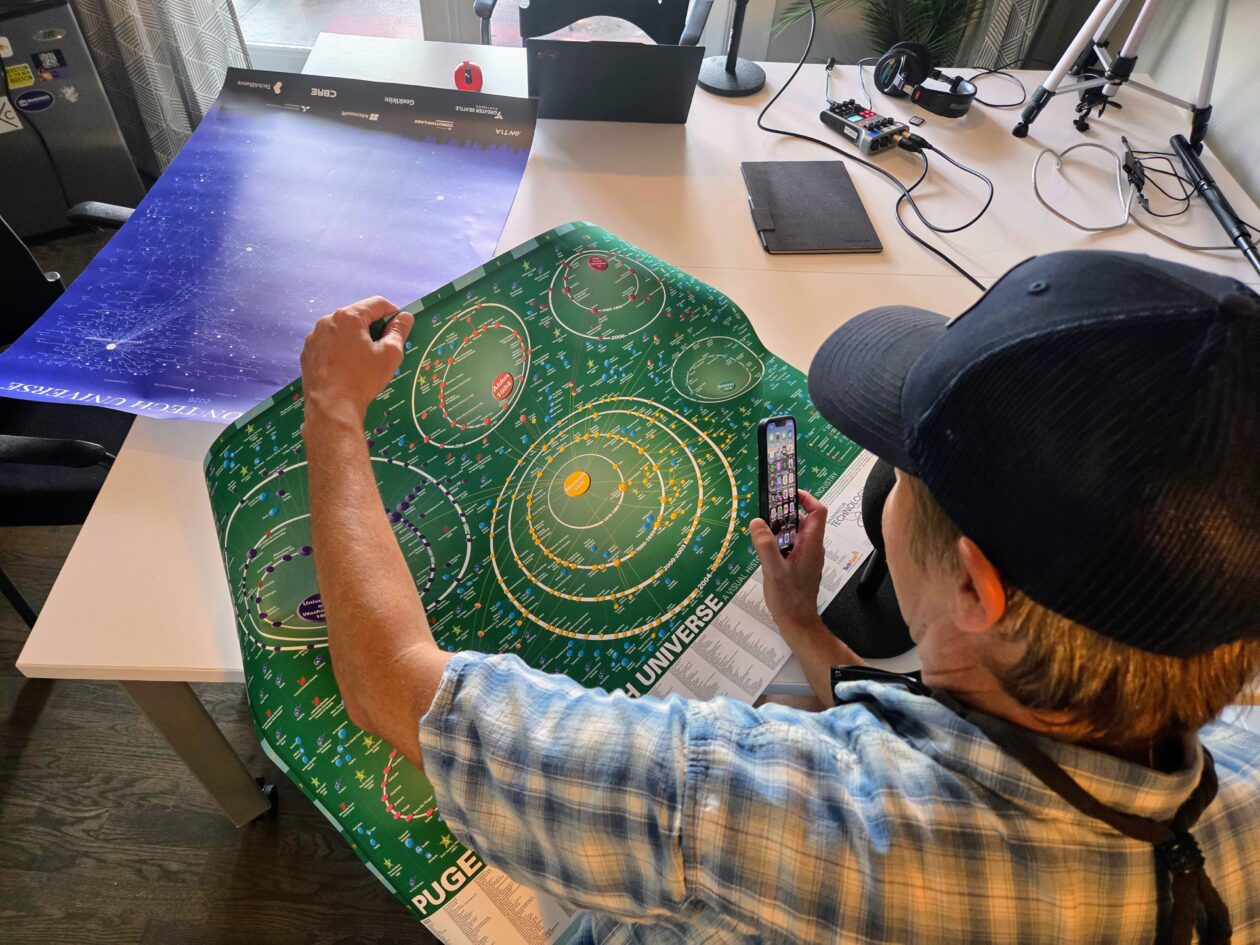
Scenes from this week’s founder open house on the deck at GeekWire HQ in Seattle, where we also recorded this week’s podcast. Thanks to Delta Air Lines, Prime Team Partners, WTIA and ALLtech for sponsoring the event. (Photos by Kurt Schlosser and John Cook)
On this week’s show, we’re on the GeekWire deck for our annual founder open house, where we dig into Microsoft’s latest round of layoffs — including a major Xbox shakeup — and the surprising rise of hardware companies on the GeekWire 200.
Then we sit down with four guests to talk about how AI is reshaping how they build:
Jana Schuster of StackIQ, whose AI-native platform helps companies find redundancy in their software spending — like Rocket Money, but for business — with a small team.
Boaz Ashkenazy of Shift AI, who’s setting up always-on agents and rethinking how we interact with AI tools.
Finally, this week’s GeekWire Trivia Challenge: how a longtime T-Mobile executive got his start in the wireless business, and the star-studded history of T-Mobile celebrity endorsers.
Elon Musk takes a bow at NASA’s Kennedy Space Center in May 2020 after the launch of SpaceX’s Crew Dragon Demo-2 mission, which carried two astronauts to the International Space Station, about 250 miles up, and a world away from Mars. (GeekWire Photo / Kevin Lisota)
Ever since its founding, SpaceX has fixed upon a single idea: Elon Musk’s vision of colonizing Mars. Everything the company does is geared to that foundational goal.
Two years ago, Musk posted on X that there could be a city on Mars within 20 years, “but for sure in 30.”
“Civilization secured,” he added, implying that even if our troubled lives here on Earth come to some catastrophic end in the coming decades, don’t worry, humans will endure on Mars.
Yet the work of scientists studying Mars suggests that it’s far-fetched, perhaps delusional, to think a human colony could be established there. You don’t need to be a billionaire or a rocket scientist to realize Musk’s timeframe is certainly a fantasy; there won’t be a city on Mars in his lifetime or that of his children or his grandchildren. Think many, many decades at best. But more likely, never.
Retail investors rushed to buy SpaceX stock after the IPO in June. Though the share price has already fallen back below where it was that day, many see it as a long-term investment. The reality is that the improbability of the Mars project shadows SpaceX’s long-term future.
SpaceX’s Starship, the rocket Musk is counting on to reach Mars, lifts off in a test flight in Texas in 2024. (Steve Jurvetson / CC BY 2.0)
While humans will at some point likely overcome the massively daunting engineering and logistics challenges of getting to Mars and even staying for some time, there’s no technology available to form a permanent settlement there.
Musk may be excused as being playful with his time scale.
“Oh, Elon is famously bad at giving time estimates,” said Erika DeBenedictis, a biological engineer and Mars scientist, founder of Pioneer Labs, which is researching how to grow plants on Mars. “Things always take longer than he says, but they do tend to happen.”
Musk has been quite specific. Last year, he said SpaceX had a 50:50 chance of sending its first uncrewed Starships toward Mars in 2026, with crewed landings to follow “as soon as 2029, although 2031 is more likely,” he posted on X.
Then, this February, he said SpaceX would build a city on the moon first and start building a Mars city “in about 5 to 7 years.”
While his targets and timing keep moving, the problems go deeper than that. The question is not when humanity will expand beyond Earth, but whether it ever will.
Establishing a city on Mars depends crucially on a concept called “terraforming,” which means physically transforming the planet’s surface environment into something resembling that of Earth, at least partially hospitable for humans.
To DeBenedictis, the sterile science fiction notion of people confined inside glass domes, looking out upon a forbiddingly bleak landscape and living off protein shakes and dried food, is deeply unappealing. “I wouldn’t want it and I wouldn’t want it for my daughter,” she said. “It just seems terrible.”
“It doesn’t have to be that way,” she adds. “I want the planet to be green.”
DeBenedictis concedes at the outset of an interview that this is “probably impossible,” though in the tone of someone who lives to chase the impossible.
In contrast, Musk glibly mentions terraforming as if it were within reach. In truth, science has only highly conjectural ideas about how it might be done. The hypothetical options scientists are researching now, if they work at all, will take many decades if not centuries to make Mars habitable. And they may never work.
A titanic ambition
Despite this, investment bankers and those with pre-IPO access were primed to ride the coattails of Musk’s colossal wealth for a big payout on SpaceX’s Wall Street launch day. Musk supercharged the June IPO by absorbing his xAI project into SpaceX. The IPO filing positioned xAI as a $26.5 trillion market opportunity, dwarfing all the other business segments of SpaceX, which the filing pegged at a mere $2 trillion. What’s an IPO without a transcendent AI promise these days?
Wall Street weighed only Musk’s entrepreneurial success and his ability to conjure the future and spin financial dreams. The Economist in May called Musk’s risk-taking and mobilizing of resources “capitalism at its most remarkable.”
For Wall Street, that made the SpaceX IPO a surefire winner. The share price duly rocketed up and made Musk briefly a trillionaire. Though he lost that status when the share price subsequently slid, he’s still by far the richest man in the world with a net worth into the $900 billions.
That fortune is built upon the market perception that Musk can turn dreams into reality. Mass-producing all-electric, virtually self-driving cars was once a pipedream. Rockets landing on their tails graced the covers of 1950s science fiction novels. By force of will, Musk made both a reality. Whatever pipe he’s smoking now, shouldn’t we give his Mars dream some healthy respect?
That dream is specified precisely on the SpaceX website: “A permanent human colony on Mars with at least one million inhabitants.”
A SpaceX facility in Redmond, Wash., where the company designs and builds its Starlink internet satellites. (GeekWire Photo / Alan Boyle)
Musk designed the huge Starship rocket to go to Mars. And when Musk first unveiled his plan for the internet satellite venture that became Starlink in Seattle more than a decade ago — the satellites are made in Redmond — he told Bloomberg Businessweek he saw it as “a long-term revenue source for SpaceX to be able to fund a city on Mars.”
Nearer term, SpaceX is to provide the lunar lander for NASA’s Artemis project that should return humans to the moon within a few years and lay the groundwork for a permanent moonbase; Musk sees it as a stepping stone to the true goal.
The problem is, Mars is not even remotely habitable. It’s deathly cold. There’s nothing on the surface but dust and rocks, in places some deeply frozen CO2. Regular dust storms whip the surface. The planet has zero vegetation; not a tree, not a leaf, not a blade of grass. The oxygen-free Martian air is unbreathable.
Venture outside without a space suit and you’ll die within a minute in the poisonous, low-pressure atmosphere. During unpredictable solar flares, cosmic radiation is a separate threat to life.
Martian gravity, one-third of Earth’s, may deform the human body over time. Astronauts on the zero-gravity International Space Station must work out constantly to retain muscle strength. Even then, if they spend too long in space they must be carried from the space capsule after splashdown.
“I don’t see any prospect for there to be permanent settlements,” said senior NASA astrogeophysicist Chris McKay, who for more than 40 years has studied the possibility of supporting human life beyond Earth, and on Mars specifically. “Why would anybody want to live there?”
Bruce Jakosky, professor emeritus at the Laboratory for Atmospheric and Space Physics at the University of Colorado, Boulder, who has studied Mars his entire career since he worked on the Mars rover Viking mission in the mid-1970s, says he thinks it will happen someday, but adds, “I have no idea when or how.”
“It’s far enough into the future that, once you get beyond, say, 30 years, you can’t tell the difference between that and infinity into the future,” Jakosky said.
That’s scientific realism. Buzz Lightyear talks about getting to infinity and beyond, but he’s a toy.
What’s really achievable on Mars
Despite the cold facts, Musk has so successfully sold the notion that if he put out a call for volunteers for the first Starship mission to Mars, hundreds of space scientists, enthusiasts, adventurers and Musk fanbros would eagerly sign up.
Indeed, he already has a Mars mission volunteer. On the launch webcast of SpaceX’s latest and largest Starship rocket in late May, a presenter introduced cryptocurrency billionaire and civilian astronaut Chun Wang, revealing that he’s been tapped to lead the first crewed flyby mission to Mars at some unspecified future date — a round trip of about two years, going there and back without landing on the surface.
And yes, it’s inevitable humans will get to Mars one day. Crewed spacecraft may land on Mars within a couple of decades.
The first astronauts to land will plan to explore the surface and hopefully return in triumph two years later, the next occasion when the Mars solar orbit again aligns with Earth. DeBenedictis dismissively describes this as the “expensive camping trip” phase of exploration, “mostly for the photo opp.”
Decades from now, humans may take a much harder, more substantive step: establishing a scientific base on Mars; we have such bases in Antarctica today. Researchers could rotate in and out every couple of years.
Creating a permanent colony on Mars is something far different. It implies lifetime commitments and subsequent generations growing up and building their lives there. As Elton John sang, “Mars ain’t the kind of place to raise your kids. In fact, it’s cold as hell. And there’s no one there to raise them if you did.”
A child born on Mars — a Martian! — would likely adapt to the low gravity as it developed. We have zero data on the physical consequences. Such a child could grow up so different in muscular and skeletal strength that he or she would be unable to walk on Earth.
“The first mothers that give birth will be guinea pigs,” said NASA’s McKay.
And yet, Musk has laid out a plan he insists can establish a human colony on Mars within his lifetime. After Optimus humanoid robots designed by Tesla do some advance exploring on the Martian surface, eventually “a few thousand” Starship rockets will head off together from Earth orbit to Mars, loaded with people and more than a million tons of equipment, dried food and supplies.
A SpaceX illustration imagines life at a future Mars colony, with a family watching a Starship from inside a glass dome. (SpaceX Image)
The SpaceX website offers a few images envisioning life in the early days of a Mars colony. A mom and two kids look out from inside a glass dome as a Starship lands nearby. The accompanying text on the website glances over some of the most glaring problems.
The extreme temperature fluctuations, from 70°F to -225°F, with an average of about -85°F? “It is a little cold, but we can warm it up.”
The atmosphere of mostly unbreathable CO2? That’s good for plants; those don’t need oxygen. “We can grow plants on Mars just by compressing the atmosphere.”
That one-third gravity compared to Earth? “You would be able to lift heavy things and bound around.”
In a speech a year ago to employees at the Texas rocket site — the video is on the SpaceX website — Musk conceded that Mars is inhospitable but said terraforming will provide the solution.
“You can’t really walk around on the surface of Mars, at least as yet until Mars is terraformed to be like Earth,” Musk told the employees. “You need to walk around with a Mars suit and be initially in kind of like glass domes.”
“But it would work,” he added. “And eventually we can make Mars into an Earthlike planet.”
Yes. Terraforming. How exactly could that be achieved? And how long would it take?
The science on terraforming
SpaceX did not respond to requests to grant an interview or to offer comment on the feasibility of Musk’s vision. But Mars scientists have studied the question. Edwin Kite, associate professor of planetary science at the University of Chicago, resident at the Berkeley-Calif.-based Astera Institute that funds futuristic science, is a leading researcher on terraforming Mars. In a paper published in April in collaboration with two dozen other Mars scientists, including DeBenedictis, he assessed the feasibility of the potential pathways currently being studied.
His paper begins with a bracing caveat: “It is unknown whether human civilization can thrive off-Earth.”
But if we want to try living on Mars, the paper says, the first requirement will be to warm the freezing planet or at least regions of the planet. It lays out three possible ways to do so.
A SpaceX illustration imagines a future Mars base, with a central habitat dome, and pressurized greenhouses. (SpaceX Image)
Some local regions on Mars could hypothetically be warmed by spreading a translucent, high-tech blanket that would block harmful UV radiation but otherwise allow sunlight through to warm the Martian soil. The solar warmth trapped beneath the blanket, made from a plastic-like biomaterial, would melt ice under the ground. The heat and water would then potentially support primitive life forms, starting with microbes, bacteria and algae and, in time, plants.
However, even warmed, wet Martian soil is salty and laden with bleach-like chemicals hostile to life. No known micro-organism on Earth can survive in such conditions.
That’s where DeBenedictis’s research comes in. Her team — funded in large part by crypto billionaire and space entrepreneur Jed McCaleb, who founded the Astera Institute — is trying through selective breeding and genome modification to engineer new, hardier biological organisms that could get life started in the Martian soil. She is looking to microbes that could digest the bleach and others that could produce more of the bioplastic, allowing extension of the soil-heating blanket to a larger area.
The idea: as the soil improves with this microbial organic matter, more complex organisms could take hold. Eventually, she says, “you could actually do things like grow potatoes in the dirt.”
DeBenedictis is super optimistic about biology turning Mars green. It could have a cover of basic plants “in my lifetime,” she says.
Pioneer Labs has been going for just two years. Its early-stage research is developing lab-grown microbes inside enclosed, stirred, heated, radiation-shielded vessels, like high-tech Instant Pots. It’s a long way from growing potatoes.
DeBenedictis notes that although the lack of oxygen means humans still couldn’t breathe outside, plants grown under these bioplastic blankets would produce oxygen through photosynthesis. That might eventually build up a breathable atmosphere on Mars at some point in the far future. Kite said the timeframe for that would be centuries, at least — “much longer than your civilization-relevant time scales.”
The second warming method outlined in Kite’s paper: large reflecting mirrors in orbit around Mars, beaming down sunlight to warm a contained scientific base and the region immediately around it. The first reflectors would launch from Earth as solar sails, unfurling in space and flying themselves to Mars, propelled by sunlight.
Kite projects that doubling the sunlight reaching an area of less than half a square mile on Mars would require a large constellation of reflectors in sun-synchronous orbit, with a combined surface of nearly 300 square miles.
That’s a huge armada of solar sails heading off to Mars, all of which would have to be managed and maintained from Earth.
The third and most extravagant pathway being studied: warm the entire planet by forcing artificial global warming.
At one time, it was hoped that local warming on Mars would release frozen CO2 in the ground as a greenhouse gas that would thicken the atmosphere and gradually warm the whole planet, the same process now warming Earth. But a 2018 paper by Jakosky dashed that plan. Analysis of sensor data and imagery from the latest satellites orbiting Mars showed there’s not enough frozen CO2 on the surface to provide significant greenhouse warming.
That paper concluded that “terraforming Mars is not possible using present-day technology.”
To overcome that setback, scientists developed a new idea: pumping a few million tons of aerosol particles into the atmosphere, artificial dust manufactured on Mars from material in the soil. These clouds of dust, which would very slowly settle and have to be continuously spewed out, would warm Mars by trapping the solar heat.
But the time scale for this is the longest under consideration. NASA’s McKay, in a 1991 paper, analyzed the timeframe for a greenhouse effect on Mars, based on how much of the solar energy reaching its surface might be realistically trapped. He calculated that it would take 100 years to warm the surface to an Earth-like temperature, and “perhaps 100,000 years” to eventually produce an oxygen-rich atmosphere from plant photosynthesis.
Kite, in an interview, said it would take “decades, at least” just to build the robotically-operated factories on the Martian surface that would manufacture and disperse the aerosols across the planet. His paper projects the cost of the aerosol project at $1 trillion.
DeBenedictis said this enormous investment and the extended time scale of planetwide warming make the more local methods the only practical options.
Yet even if any of these planet-warming methods work, that still leaves the other major problems. While machines can extract oxygen from the CO2 in the atmosphere and pump it into sealed indoor living spaces, the air remains unbreathable outside. The extremely low pressure and potentially deadly cosmic rays remain unaddressed. Inside and out, the low gravity will still, over time, exert its unpredictable physical impact on human bodies.
In short, even if these wildly speculative, generations-long projects succeed somewhat in warming Mars, the result will fall disappointingly short of Earth-like. Dreams of colonizing Mars could still reach a dead end.
Concluding his summary of the various possible paths toward terraforming Mars, Kite notes that “no approach has been shown to be simultaneously affordable, safe, scalable, and to enable extending life beyond Earth.”
As one might expect from a group of Mars researchers, Kite’s paper urges that terraforming research continue, arguing that “a finding that no approach is viable” would at least curtail the vast expense and bring more realism to plans for large numbers of people to self-sustain anywhere beyond Earth.
SpaceX woos investors
SpaceX’s IPO prospectus relegated such downer conclusions to the “risk factors” section that offers legal cover in any such financial filing. The Mars mission and similar space endeavors, the filing said, “involve significant technical complexity, unproven technologies, or technologies that do not exist or may require significant advancement.”
Outside that CYA boilerplate, the prospectus offered investors a Musk-style sprinkling of high-flown stardust. The SpaceX “mission is to build the systems and technologies necessary to make life multiplanetary, to understand the true nature of the universe, and to extend the light of consciousness to the stars.”
In case that was insufficiently inspiring, the prospectus added a dash of fear, stating that humanity needs to spread beyond Earth to survive a potential planetary catastrophe. “We do not want humans to have the same fate as dinosaurs,” it stated.
When Musk addressed employees in Texas as the IPO opened trading on June 12, he gushed enthusiasm for his vision: “There have to be things that make you excited about the future, that make you glad to wake up in the morning because you can’t wait to see what happens next.”
The risk to future funding
For Musk, maintaining such enthusiasm will be essential. For beyond the scientific and engineering challenges of the Mars enterprise, politics and economics could be showstoppers.
After the inspiration of the first human moon landing in 1969, the public quickly lost interest in subsequent Apollo missions. However scientifically interesting, the moon seemed to offer little but dust and rocks.

SpaceX’s stunning rocket launches and the recent Artemis mission that swung astronauts around the moon have reignited space travel enthusiasm in a new generation.
But interest could collapse again.
Kite’s paper notes that “If in the future crew were lost and there were no obvious short-term financial benefits to exploration, society might cease to pay the high costs of sending people to space.”
Orbiting space satellites — chiefly communications, navigation, imagery, surveillance, and missile detection — will continue to rake in cash for SpaceX, much of it from the government. And Musk is well-placed to grab lucrative Pentagon contracts to deploy weapons to kill enemy satellites and defenses to protect ours.

But crewed space missions beyond Earth orbit produce no immediate applications. An investment sinkhole, they demand clear-eyed purpose, not delusion.

In an interview, Jakosky — who like McKay, Kite and DeBenedictis fervently wants humans to be interplanetary one day — said he doesn’t buy Musk’s idea that if, say, climate change makes Earth less habitable, Mars can be a “back-up planet.”
Terraforming Mars is just too far out, he believes.
“It’s an incredible amount of money and resources that would be better spent understanding our own climate here,” Jakosky said. “It’s always going to be easier to terraform the Earth, bring it back to the current conditions, than it is going to be to terraform Mars.”
The realistic future
If the Mars project fades in the years ahead, Musk may try pivoting entirely to AI as the new vision — and investment draw — for SpaceX.
In the meantime, the next big technical milestone, one needed just to reach the moon, never mind Mars, will be refueling rockets in space. If this and other hard-to-pull-off engineering challenges can be met, what’s realistically ahead for Mars exploration?
It would be much easier to build a city in Antarctica than on Mars but we haven’t done so. (Why? Oh yes, no one wants to live there.) Instead, we have scientific bases there, where researchers rotate in and out after a few months. Tourists visit Antarctica in the summer to see the penguins. At the largest U.S. base, McMurdo Station, there’s even a bar and a chapel.
NASA’s McKay foresees such a base as the future human footprint on Mars — at least for a century. Beyond that, who knows?
The low sun over the ice near McMurdo Station, Antarctica, in September 2020. Scientists see a research outpost like it — not a colony — as the realistic model for any human foothold on Mars. (Neil Crawn / U.S. Antarctic Program / NSF)
He has traveled to Antarctica for nearly 40 years, typically staying no more than two months, specifically to study the effects of the cold, dry environment for his Mars research.
But in the long, dark Antarctic winter, those scientific and military research bases largely empty out. There are no nurseries, no elementary schools, and no full-time residents.
“I go there for a season and contribute to the research and then come home,” McKay said. “I don’t want to take my family there.”
McKay, who grew up watching Star Trek, still hopes that the “long, long, long-term vision” of humans on other planets will one day materialize.
“The problem with some of the current thinking is that it jumps from zero, right now, from one or two robotic missions to, OK, let’s set up a million people on Mars, with nurseries and kids and everything,” he said. “That’s crazy.”
“Humans moving into space, I think that is inevitable,” McKay said. “But it might be that it takes thousands of years.”
It might not be a full Zuck, but Microsoft Xbox CEO Asha Sharma is getting lots of attention, and not in a good way, for the latter this week.
Sharma was named Thursday to co-lead a new Federal Reserve “Productivity and Jobs” task force, charged with assessing the economic impact of AI and other new technologies on the labor market. Her co-leaders: Marc Andreessen, the venture capitalist and vocal AI booster, and Stanford economist Charles I. Jones, who is currently on leave at Anthropic, maker of the Claude AI chatbot.
The gaming press, as you can imagine, is having a field day. The headline from Kotaku sums it up: “Xbox CEO Will Advise Federal Reserve On Jobs After Mass Layoffs.”
PC Gamer, for its part, noted that the task force is supposed to represent a “commitment to price stability and maximum employment.” However, that’s the Fed’s broad mandate, as described by Chairman Kevin Warsh. It’s actually not the specific mission of the Productivity and Jobs task force, which is narrower: assessing what AI and other new technologies are doing to the economy.
In a separate sign of the backlash, Microsoft communications chief Frank Shaw took to X on Friday to knock down claims that the Xbox cuts were made to replace employees with foreign workers, calling it “bad information” and noting that the H-1B visa figures being cited are company-wide renewals, not Xbox-specific. He also pointed out that Sharma is “an American born, raised, and educated CEO, from Wisconsin.”
Also lost in the coverage of the Fed appointment is the fact that Sharma is less than five months into the job, having taken over as Xbox CEO in February with a mandate to turn around and preserve a gaming division that spent more than $20 billion over five years while its core revenue shrank. The restructuring announced this week is a key part of that effort.
What’s more, it’s hard to imagine that this is the timing Microsoft or Sharma wanted. Announcements like this are often outside the control of the participants. The Federal Reserve sets its own schedule.
Still, it’s tough timing for an executive who announced plans this week to cut 3,200 gaming jobs — about 1,600 immediately, with the rest over the coming year — amounting to roughly 20% of Xbox’s workforce. Sharma herself called it the most significant restructuring in the division’s history.
Meta CEO Mark Zuckerberg’s superyacht Launchpad, for the record, is currently cruising the waters off Juneau, Alaska, a full 900 miles from Seattle.
4 generations of Xbox hardware. (GeekWire Photo / Thomas Wilde)
Commentary: The last couple of weeks have served as a capstone to what’s become a bad few years for the international video game industry. Now it appears the larger sector is headed directly into a significant crash, as several unsustainable practices all seem to be approaching a crisis point at once.
The first and most obvious issue is the ongoing component shortage. Due to the rush to build AI data centers, both RAM and solid-state drives have risen dramatically in price in 2026, with analysts forecasting that costs might not settle back down until at least 2028.
Both the PlayStation 5 and Xbox Series X|S are at the point in their life cycle when they’d ordinarily be declining in per-unit costs as the technology matured. Instead, both Sony and Microsoft have raised console prices multiple times this year due to the high demand for parts.
This would ordinarily be a great time to get into video games, as we’re almost six years into the current console generation. Instead, it’s one of the worst. The base PS5 and Series X are about as expensive as they were at launch in November 2020, and building a new gaming PC right now can be costly.
The component crunch also harmed the debut of Valve’s new Steam Machine, which officially launched late last month with a starting MSRP of $1,049. Valve, based in Bellevue, Wash., was forced to offer the new hardware at a significantly higher price than planned due to the difficulty in getting components.
That’s been reflected in its early reviews, with manyoutletsnoting that the Steam Machine’s current price doesn’t match its power. At $700, the Machine would be a great gateway product for PC gaming, the way the Steam Deck was, and a genuine competitor in the console field, but a $1,049 price tag makes it an expensive curiosity for financially secure gadget-heads.
Another bad sign came from Sony’s recent announcement that it would sunset physical media for the PlayStation platform by 2028. This decision, which allegedly took many of Sony’s publishing partners by surprise, has serious knock-on effects for collectors, historians, developers, and most prominently consumers.
Sony has already caught one lawsuit over alleged market exploitation on the PlayStation Store, and that was a few days before it announced it wants to kill discs. An all-digital PlayStation library means that Sony would get to exercise full monopolistic control over pricing and access for every game it sells; licensing agreements mean that anything purchased on a digital storefront like the PlayStation Store is subject to deletion at any time without notice; and players wouldn’t be able to resort to any of the usual cost-cutting measures such as bargain bins, buying used copies, or even trading games with a friend.
That suggests that Sony has decided its best path forward is to continue to extract money from its established audience, rather than to have more options in place for gaming on a budget. There are free-to-play games on the PS5, of course, but most if not all are cross-platform and/or designed as money sinks. Ask any parent whose kids accidentally ran up a big tab in Fortnite.
Sony’s PlayStation 5. (Sony press image)
If Sony has decided to end physical media, then it’s likely Microsoft will follow suit. While Xbox hasn’t mentioned its next-generation console, codenamed Project Helix, for a hot minute, it has been eager to get rid of discs since at least 2013. Some sources, such as Windows Central, allege that Xbox is already planning to do so.
(Meanwhile, Nintendo is likely to do its own thing. While Nintendo has been forced to raise the price of the Switch 2 alongside its competitors, it has offered no sign that it plans to stop selling game cards or Switch cartridges. In an uncertain world, Nintendo can be relied upon to only ever follow its own peculiar instincts.)
This sets up an early look at the environment that surrounds the 10th generation of console hardware. If both Sony and Microsoft stick to traditional timelines, we’re likely to start hearing more about the PlayStation 6 and Project Helix over the course of 2027, with launch in holiday 2027 or 2028.
If they do launch along that timeline, then it’s difficult to see how either system will retail for less than $1,000, since the storage and RAM supplies will still be constrained by that point. That automatically prices most of the potential audience out of the market. Once the starting costs hit the four-digit range, a console stops being a hobby or a toy for children and becomes an expensive extravagance. (As a general rule, you probably don’t want your console to cost significantly more than the TV you’re attaching it to.)
Further, it’s arguable that neither the PlayStation 5 nor the Xbox Series X|S have really hit their potential. Sony has famously squandered much of this generation on a largely abortive pivot to games-as-a-service, while Xbox has often seemed more interested in laying off developers than actually making or marketing games. The 9th generation of consoles has had a few big hits, but it’s mostly despite itself.
Not only is there likely to be limited demand for the 10th-generation PlayStation or Xbox, but neither of them actually seem necessary. The only reason to make them is for a brand refresh, and that’s got nothing to do with consumers.
Microsoft, following its acquisition of Activision Blizzard in 2023, is currently the second largest game developer in the world, while Sony dominates today’s console market. These two companies influence much of what happens in the modern video game industry, and as of right now, both are apparently determined to do the most short-sighted thing possible at any given time.
Sony has decided that only part of its audience actually matters, while Microsoft seems to be saddling Xbox with unrealistic expectations, possibly to justify its eventual sale or shutdown, and is ignoring at least one organized boycott.
Reggie Fils-Aimé (center) leads a roundtable discussion of Xbox architects to celebrate the platform’s 20th anniversary in 2021. Left to right: Robbie Bach, Ed Fries, Fils-Aimé, Peter Moore, Bonnie Ross. (Microsoft Alumni Network)
Whenever the video game industry undergoes any kind of significant disruption, someone somewhere always asks if it’s the start of another “Crash of ‘83.” This is usually hyperbole, but it’s hard not to see the parallels between then and now: the video game market is flooded, there are few true exclusives left outside of Nintendo, many members of the gaming audience buy as few as 2 games a year, and the end of physical media will end both retail support and much of the casual audience.
This is unfolding as a slow, years-long plummet rather than the comparatively sudden shock of ‘83, but a crash is a crash. It’s avoidable, but it would require a massive, simultaneous course correction from several of the largest entertainment companies in the world.
That being said, it’s unlikely that video games as a medium are facing any kind of existential threat. Nintendo, as noted above, is well-positioned to ride out any potential problems with the larger market, PC gaming is hanging on, and the mobile sector is actually having a sort of quiet renaissance right now. There will still be video games to play in 2030, barring some larger disaster.
If there’s one big opportunity here, it’s that many of the major players in the games industry have either voluntarily abandoned the market for budget gaming or have been forced out by component costs. Some of the biggest hits of the 2020s to date, such as Vampire Survivors, Among Us, Lethal Company, and Balatro, are cheap, retro-styled games designed to run on almost any hardware, from a PlayStation 5 to your 4-year-old tablet.
The best step forward for mainstream gaming, then, might actually be to take a step back, in a similar way to projects such as Panic’s Playdate retro handheld (still going strong 5 years later) or Seattle’s Tin Can, seeing success with its land-line phones for kids and families. Chasing bigger games, higher frame-rates, and more realistic graphics for 30 years has gotten us here, up to the edge of a second major crash, while thousands of people log on every day to play games that could be run on a particularly big potato.
Instead of rushing into the 10th generation, the solution now might be to think simpler and cheaper, making smaller, more focused projects rather than the 5-year moonshot of a typical AAA game. Otherwise, mainstream video games may end up like Western comics: increasingly expensive options presented to a shrinking handful of fervent fans.
— Mike Torres, a former executive at Amazon, Microsoft and Google, has joined Dropbox as the company’s first chief product officer.
“As a product leader, joining a company that helped pioneer product-led growth is energizing…” Torres said on LinkedIn. “In this role, my focus will be simple: help Dropbox ship the right things at the right time for our customers.”
Seattle-based Torres comes to Dropbox from Google, where he served as vice president of product for Chrome. Before that, he spent more than a decade at Amazon, most recently as VP of Kindle. At Microsoft, he led teams working on OneDrive, Windows Movie Maker and other products.
Chris Sambar. (LinkedIn Photo)
— T-Mobile appointed Chris Sambar as chief enterprise officer, effective no later than Oct. 14. Sambar will lead the Bellevue, Wash.-based company’s small- and medium-sized business, enterprise and government units.
Sambar joins from Public Storage, where he serves as chief operating officer. He was previously at fellow communications giant AT&T for more than two decades, most recently as a president of the company’s global network organization overseeing architecture, engineering, construction, operations, tower strategy and program management.
“Chris is a seasoned wireless industry leader with proven experience including expanding high-growth businesses and seizing market opportunities,” said Srini Gopalan, CEO of T-Mobile.
T-Mobile made two additional C-suite changes:
Mike Katz. (LinkedIn Photo)
Chief Business & Product Officer Mike Katz has resigned to “pursue new professional interests,” according to a press release. Katz was with the company for more than 28 years and will remain in a strategic advisory role through the end of the year. Gopalan offered his “sincere gratitude to Mike for his incredible contributions to T‑Mobile.” Read more about his departure in this GeekWire story.
André Almeida‘s C-suite role has expanded and his title has been updated to chief marketing, brand and broadband officer. He previously served as chief broadband, enterprise and emerging business officer. In the new position, Almeida will help oversee the company’s consumer wireless and broadband businesses.
Kevin LaChapelle. (LinkedIn Photo)
— After 37 years with Microsoft, Xbox Vice President Kevin LaChapelle was among those laid off this week, with the cuts hitting the gaming division particularly hard as the company aims to overhaul the division.
LaChapelle was hired by the Redmond, Wash.-based tech giant in 1989 as a software design engineer and joined the Xbox team in 2012.
“I will say my fondest memories are of leading the team of very talented engineers who built the Xbox Backward Compatibility program,” LaChapelle said on LinkedIn. When Phil Spencer, then head of Xbox, announced the program at the Electronic Entertainment Expo in 2015, LaChapelle added, “The audience’s reaction was unbelievable.”
Adam Shoenfeld. (LinkedIn Photo)
— Adam Schoenfeld has resigned as chief marketing officer for Inflection.io. In April, the B2B marketing automation company acquired Keyplay, a Seattle startup co-founded and previously led by Schoenfeld. The deal reunited Schoenfeld and Inflection CEO Aaron Bird, who have known each other for many years and have collaborated and invested in each other’s companies.
Schoenfeld said on LinkedIn that he “had the best of intentions” when he committed to the acquisition, but then burnout hit him. “I was embarrassed and disappointed in myself. I dreaded telling the team. I didn’t want to bail and let people down… I’m sure others have been in this place,” he added. “After facing the hard conversations, I’m excited to look ahead.”
Schoenfeld remains a part-time CMO advisor for the business and also produces Adam’s GTM Report, which provides data-backed research, maps and tools for leaders and builders in the space.
— Kent, Wash.-based Stoke Space Technologies named former OpenAI executive Kevin Weil to its board. Weil has held leadership roles at Planet, Meta, Instagram and Twitter and also serves on the boards of Cisco and The Nature Conservancy.
Stoke Space builds reusable rockets and raised $860 million from investors in its latest round. It’s No. 6 on the GeekWire 200, a ranked index of the Pacific Northwest’s top startups.
— Skippy Shaw has joined fusion startup Helion Energy as director of Washington government affairs. The Everett, Wash.-based company is working to build what could be the world’s first commercial fusion facility in Central Washington. Shaw joins Helion from The Nature Conservancy, where she led state governmental relations for TNC’s Washington chapter.
— David Langworthy announced that he has resigned from Microsoft after nearly 25 years, leaving the role of architect for Azure OpenAI. Langworthy, who worked as a founding member of Azure OpenAI, GitHub Copilot, GenAI, MAC, and Azure AI Services, is the founder and CTO of a stealth startup based in Bellevue.
— Carissa Allen has also left Microsoft, departing as director of strategy for the company’s events, including Ignite and AI Tour. On LinkedIn, Allen called her resignation after nearly 30 years “my Valiant Reboot Project (no “retirement” here) because you know I’m not finished yet.”
— And in case you missed it:
Bill Colleran, a veteran technology executive who previously led Impinj, has joined Seattle-based AI coding startup Adronite as CEO. Edward Rothschild, who co-founded and previously led the company, is transitioning to chief technology officer. Read more in this GeekWire story.
Nick Parker, a 26-year Microsoft veteran who led the company’s worldwide commercial sales business, is leaving to become Nvidia’s new sales chief, effective Aug. 24. Read more here.
Leaders of startups recently spun out of the UW, top row, from left: Hilco Boerlage of Precision Cognition Labs; Jan Whittington of Climate Solutions International; Elena Cant of DetellaDx; Sura Alwan of PEAR-Net Society; and Min Sun of Colleague AI. Bottom row, from left: Jingcong Zhao of KeenSight Health; Vigneshwar (Viggy) Sakthivelpathi of Nanosync Labs; Chris Norn of Skape Bio; Joelle Tudor of CathConnect; and Conor Lanahan of Prosthetic Fit 360. (CoMotion Photos)
The University of Washington’s CoMotion program announced 10 startups that secured UW-licensed intellectual property over the past year. Eight are in healthcare, spanning diagnostic tools, medical devices and new therapeutics. The other two focus on K-12 education or climate change.
CoMotion, which operates as a collaborative innovation hub, reports that it and its predecessors have fostered 310 deep-tech companies over the past three decades, more than one-third of which are still active. Those businesses have raised $1.8 billion from investors in the past five years alone.
Here’s a look at the 10 startups:
CathConnect is a Seattle-based startup making urinary catheters that are easy to insert into a patient’s bladder and will safely disconnect if pulled out accidentally. The devices could help prevent the 450,000 traumatic catheter removals that occur in the U.S. each year, which lead to longer hospital stays, higher medical costs and increased infection risk.
CathConnect was launched by Joelle Tudor, a former UW undergraduate researcher and Michael Malone, a UW doctoral candidate.
Climate Solutions International offers a software platform that helps government employees analyze factors like climate resilience, cost and carbon emissions for proposed infrastructure projects. The startup is the brainchild ofJan Whittington, a UW urban planning professor who previously received funding from the World Bank to apply these strategies across 300 cities in 30 countries.
Climate Solutions International was selected for CoMotion’s second Climate Tech Incubator, a six-month program located at the Seattle Climate Innovation Hub, a public-private partnership in the city’s downtown.
Colleague AI created an AI tool and chatbots to assist K-12 teachers craft lesson plans and streamline other classroom operations. The technology was developed by Min Sun, a UW professor of education and Colleague AI co-founder, with substantial research and testing by educators.
The UW College of Education was selected two years ago as a national center for research and development on using generative AI as a teaching tool, a designation that included a $10 million grant to support Sun’s work.
DetellaDx is using AI and single-cell technology — a research tool that allows scientists to analyze genetic information in individual cells — to detect early stage cancers with a high degree of accuracy. The diagnostic approach is based on research by Scott Kennedy, an associate professor in the UW Department of Laboratory Medicine & Pathology. DetellaDx’s initial focus is on women with a genetic predisposition for ovarian cancer.
KeenSight Health aims to help clinicians communicate better with patients through its Clinical Intelligence Engine, a coaching software that reviews doctor-patient conversations and gives physicians practical feedback. The platform also incorporates patient history stored in electronic records and other resources.
Nanosync Labs has created wearable sensors that monitor brain health and sleep without invasive procedures. The devices and platform allow for continuous tracking of changes in brain pressure and deep sleep, a restorative stage essential for brain health. The sensors enable earlier detection of neurological conditions, benefiting patients with traumatic brain injury and sleep disorders.
The technology was developed in the UW lab of Jae-Hyun Chung, an associate professor of mechanical engineering. Viggy Sakthivelpathi, who earned a PhD from the UW, is Nanosync’s co-founder and CEO.
PEAR-Net Society provides resources to help medical and public-health experts understand whether medications, chemicals, infections, vaccines, or other exposures may harm a fetus during pregnancy.
The organization relies on two well-established databases documenting teratogens, factors that can cause birth defects. These include the Teratogen Information System, or TERIS, developed by Dr. Jan Friedman, a UW graduate, and Shepard’s Catalog of Teratogenic Agents.
Precision Cognition Labs has developed a tool for memory assessment that can detect mild dysfunction and track changes in cognitive performance. The assessment is faster and easier to use than tools that require in-person, clinical evaluations, allowing for more frequent checkups and longitudinal studies.
The startup is a joint venture between the UW and the University of Groningen in the Netherlands, where it is based. Andrea Stocco, a UW associate professor and expert in computational psychiatry, is a co-founder and scientific director.
Prosthetic Fit 360 is building sensors that improve outcomes for patients with lower-limb prosthetics. The devices use trilateration, a technology that measures an object’s precise location by calculating distances from multiple known reference points. The startup was founded by Conor Lanahan, who earned his bioengineering and biomedical engineering doctorate degree from the UW.
Skape Bio is using AI to create new therapeutics that target G protein-coupled receptors, or GPCRs. The receptors, which are located on cell membranes, detect hormones, neurotransmitters and other signals that trigger biological responses.
The Copenhagen-based startup was founded by Chris Norn in partnership with UW Nobel laureate David Baker and scientists from the UW’s Institute for Protein Design and the BioInnovation Institute in Copenhagen.
Xbox CEO Asha Sharma laid out a wide-ranging plan to overhaul Microsoft’s gaming division Monday, calling it the most significant restructuring in Xbox history and disclosing that the business has been losing 64 cents on every dollar invested in its game studios.
As detailed in a memo to employees, the changes include roughly 3,200 job cuts through the fiscal year — about 20% of the Xbox workforce — the spinoff of four game studios, a new COO, and a plan to flatten management from as many as 14 layers to no more than five.
“We will return to growth in 2027,” Sharma wrote. “History is full of companies that mistake longevity for inevitability. We will not be one of them.”
Sharma, a startup veteran and former Microsoft AI leader, was named Xbox CEO in February.
“I know this is painful,” she wrote. “These changes will directly affect people who have poured their creativity into building XBOX. Many joined us through acquisitions, while others were recruited here, or sought us out because they loved this industry and loved XBOX. Today’s decisions do not reflect their talent or dedication.”
But she also reiterated what she said in a memo last month: Xbox’s business is not healthy, operating at margins 3-10x lower than industry peers after years of heavy spending that failed to produce the expected growth.
About 1,600 of the Xbox job cuts take effect Monday as part of a broader round of 4,800 layoffs across Microsoft. The remaining Xbox reductions will come in the months ahead. Sharma acknowledged that a year-long restructuring “creates additional challenges” but said “it is not possible to make all the necessary changes in a single day.”
Sharma said the cuts reach across Activision, Bethesda/ZeniMax, Blizzard, King, Mojang, and Xbox Game Studios, though no publicly announced games are being cancelled.
Several game studios will be spun out as standalone ventures, removing the costs from Microsoft’s books while giving the studios a chance to survive on their own.
Compulsion Games (South of Midnight) and Double Fine Productions (Psychonauts) will return to their management teams as independent studios, keeping their intellectual property and current projects.
Ninja Theory (Hellblade) and Undead Labs (State of Decay) will shift to new owners with funding to complete their current games.
In France, Arkane (Dishonored, Deathloop) is beginning a legally required consultation with its employee works council to determine its future.
Sharma will also take on direct oversight of game studios Mojang (Minecraft) and King (Candy Crush), Xbox’s two largest studios by monthly active players.
In addition, she is establishing a new chief operating officer role with end-to-end financial responsibility across content, hardware, platform, and services. Helen Chiang, a nearly two-decade Xbox veteran who led Mojang and the Minecraft franchise, has been promoted to the role. Dave McCarthy, a 17-year Xbox veteran who helped build the platform, is retiring.
Across the division, Sharma wrote in the memo, Xbox will cut vendor spending by 50% and reduce management layers from as many as 14 to no more than five.
The overhaul follows a 25-year period in which Microsoft largely subsidized Xbox as a strategic bet on the living room. Microsoft CEO Satya Nadella has said that era is over, noting that YouTube creators make more money from Xbox games than Microsoft does.
Microsoft is cutting 4,800 jobs, just over 2% of its global workforce, citing a need to revamp its sales and consulting division to keep pace with a rapidly changing tech industry, while overhauling its Xbox business in a push for long-term growth and profitability from gaming.
The cuts include about 600 jobs in Washington state, home to Microsoft’s Redmond headquarters. That’s down from 3,200 job reductions locally a year ago. Combined with ongoing hiring, Microsoft’s workforce in the state is expected to remain stable at around 52,000 people.
About 1,600 of the 4,800 job cuts being announced Monday are in the Xbox division. Additional Xbox layoffs in the months ahead are expected to bring total job reductions in the gaming division to roughly 3,200, or about 20% of the global Xbox workforce, this fiscal year.
Microsoft is also spinning off four Xbox game studios to operate independently.
In an internal memo, Xbox CEO Asha Sharma called it the biggest restructuring in Xbox history, saying the division has been “operating at margins that are 3-10x lower than comparable platform and publishing businesses” and that studios have been losing 64 cents for every dollar invested.
Overall, top executives sought to distinguish Microsoft from other tech giants, saying the cuts were minimized by the redeployment of more than 4,000 employees into new roles over the past year and a voluntary retirement program that let thousands more exit by their own choice.
By comparison, the company last year cut more than 15,000 jobs globally in two rounds of layoffs in spring and summer 2025 — the largest reductions in more than a decade.
The latest cuts come amid record capital spending on the company’s AI infrastructure, pressure from Wall Street to keep operating expenses in check, and a 30% stock slide that has wiped out roughly $1.2 trillion in Microsoft’s market value over the past nine months.
“Microsoft can only be a strong employer if it has a successful business,” said Brad Smith, its president and vice chair, in an interview with GeekWire. “We have to adapt to change.”
Before the latest cuts, the company’s total workforce was about 220,000 people. Across the company, Microsoft expects worldwide headcount to decline year-over-year, CFO Amy Hood said on an April earnings call.
Amy Coleman, Microsoft’s chief people officer, said in a memo to employees Monday morning that the roles the company is eliminating today are not being directly replaced by AI.
At the same time, she acknowledged, “AI is changing how work gets done.” She added, “Some of the tasks we do every day can now be automated, and that means we all need to keep learning, keep building new skills, and keep adapting as the work evolves.”
However, the line from Coleman’s memo that may get the most attention internally is this: “We are still early on this journey, and there will be more changes ahead; other parts of our business will need to make similar changes.”
In an interview, Coleman stopped short of signaling further layoffs across the company. Instead, she described a larger shift in how Microsoft manages its workforce. That includes reskilling engineers for customer-facing and AI-focused positions, and exploring how to make voluntary exit programs a regular part of the company’s operations — not just a one-time offer, but potentially something employees could opt into annually or on an ongoing basis.
Coleman confirmed that about 30% of roughly 8,750 eligible U.S. employees accepted Microsoft’s first-ever voluntary retirement program in recent weeks, in line with the company’s expectations, which reduced the size of the reduction in force announced Monday.
The cutbacks and changes in the company’s sales and consulting teams build on last week’s launch of the Microsoft Frontier Company, a $2.5 billion initiative to embed 6,000 engineers inside customers to deploy AI. The shift is reducing some traditional sales and consulting roles and resulting in more technical positions working directly with customers.
“We’re seeing that we need more engineering excellence in the customer space,” she said.
Smith said software development is undergoing its biggest shift in the more than 50 years since Microsoft’s founding. The widespread use of AI is making code cheaper and faster to produce, but he said that’s also creating demand for new kinds of roles and work.
“Some things like coding require less time of software developers,” he said. “At the same time, there’s new parts that are growing, whether it’s the product management or software design, or perhaps most importantly, working directly with customers.”
Update: A filing by Microsoft on Monday under the Washington state Worker Adjustment and Retraining Notification Act listed 605 positions being eliminated in Washington state.
The roles span software engineering, product management, sales strategy, data science, business program management, marketing, and game design, among others — ranging from mid-level individual contributors to senior managers, consistent with cuts that reach across both the company’s technical ranks and its sales and consulting operations.
Xbox at a gamescom briefing in 2014. Microsoft is pressing its games division to turn a profit. (Microsoft Photo)
In 2007, Microsoft’s Xbox 360 consoles started dying — overheating until three lights on the front blinked red, a defect gamers came to call the “red ring of death.” Microsoft’s response was to extend the warranty on every machine and take a charge of more than $1 billion to fix the problem, making it one of the costliest product failures in the company’s history.
Microsoft could afford it financially, but the bigger factor was strategy. Xbox was a bet on the living room, and for a company minting money on Windows and Office at the time, losing a billion or so was a justifiable cost of staying in the game.
Nearly two decades later, that patience has run out.
“Going forward, this cannot continue,” the new Xbox CEO Asha Sharma wrote in a memo to employees last month, offering a blunt assessment of a business that has spent more than $20 billion over five years, only to see its core revenue fall by nearly half a billion dollars, running at a thin 3% profit margin, by Microsoft’s own internal measures.
With thousands of layoffs expected to be announced across Microsoft as soon as next week, the Xbox division is likely to be among the hardest hit.
The cuts reach across the company — including sales and consulting — part of a restructuring that has become routine around the close of Microsoft’s fiscal year. But for Xbox, they’re an early step in a broader effort to reset the business, rein in costs, and position the division for healthier profits.
Microsoft CEO Satya Nadella has been blunt about it: the company has spent years subsidizing Xbox rather than profiting from it, and that era is over. The videos and livestreams of people playing Xbox games that fill YouTube generate more money than Microsoft makes from the games themselves, he noted in an appearance on the Hard Fork podcast.
“No one can accuse Microsoft of not having invested for the last 25 years,” Nadella said. “And now we have to turn this into a sustainable business.”
Long-term strategic bet
Turning it around means breaking a pattern that runs through Xbox’s history.
Xbox launched in 2001 and lost money for most of its first decade. Microsoft absorbed the losses and stayed in — going up against Sony’s PlayStation and Nintendo — because it saw a strategic prize in owning a piece of the living room, and later mobile. Online gaming also gave the company early experience running services at scale, which fed its cloud ambitions.
Over time, the goal shifted from selling hardware to selling subscriptions.
Xbox Live, launched in 2002, turned online play into recurring revenue. Game Pass, which arrived in 2017, let players pay a monthly fee — the top tier is about $23 — for a library of games, including Microsoft’s own new releases the day they come out. The idea was to get people paying for Xbox everywhere: consoles, PCs, phones and the cloud.
And when growth stalled, Microsoft doubled down. It paid $7.5 billion in 2021 for Bethesda, the studio behind Fallout and The Elder Scrolls, then $69 billion in 2023 for Activision Blizzard (whose games include Call of Duty, World of Warcraft, Diablo and the mobile hit Candy Crush) the largest acquisition in Microsoft’s history.
A series of economic headwinds
In recent years, almost everything about the economics of gaming has turned against Xbox at the same time.
Hardware loses money, and AI is making it worse. Microsoft sells consoles at or below cost, banking on games and subscriptions to make up the difference. But AI data centers are consuming so much memory and storage that chip prices have spiked. That has forced Microsoft to raise Xbox console prices, most recently a $100-to-$150 hike this summer that it blamed directly on component costs.
Xbox lost the console war. By most estimates, Sony’s PlayStation 5 has outsold the Xbox Series X and S more than two to one. A smaller base means fewer game sales and subscriptions to offset the upfront hardware losses. That has left Xbox a distant second for the entire generation.
Revenue is shrinking. Even setting aside the games it gained from Activision, Xbox’s annual revenue has fallen nearly $500 million over five years — while the money going into the business keeps climbing. It has been investing more to earn less.
Microsoft’s most recent quarterly filing shows gaming revenue of $16.8 billion for the nine months through March, down about $1.1 billion, or 6%, from a year earlier.
Game Pass cuts into sales. Handing subscribers a new game the day it launches undercuts the roughly $70 they would have paid to buy it. The service delivers steady subscription income, but thinner economics on the games themselves.
Activision didn’t fix the margins. Even with one of gaming’s most profitable businesses folded in, Xbox earns only about 3 cents of profit on every dollar — well under the 17 to 22 cents typical in the industry. If the biggest acquisition in company history can’t move the margin, little will.
Every spare billion is flowing to AI. Microsoft is pouring more than $100 billion a year into the data centers and chips behind its AI push, trying to capitalize on the boom. Against a risk and payoff that big, a gaming business that barely breaks even feels like yesterday’s strategic bet.
What’s next for Xbox
The cuts have already started. In recent weeks, Microsoft has signaled plans to close or sell some studios, including Ninja Theory, maker of the acclaimed “Hellblade” series.
Shedding staff, studios and marketing will lift Xbox’s profit margins in the near term. What it won’t do is fix the underlying problem: a business can trim its way to a better number only so much before it has to generate more revenue.
Sharma’s plan, so far, is to concentrate on Xbox’s biggest franchises, funding blockbusters like Halo and Fallout while pulling back elsewhere. It’s leaning on Game Pass and releasing most of its games on PCs and rival consoles from Sony and Nintendo, reaching players well beyond Xbox’s shrinking base, even as it holds back a few new exclusives like Gears of War to give owners a reason to stay.
Microsoft is also rethinking the console itself. In her memo, Sharma described a “hardware component crisis” that has left the company unable to make as many consoles as players want, and called for “a new business model and partnerships” for its hardware.
How far the reset ultimately goes is an open question. The Informationreported that Microsoft has weighed making Xbox a standalone subsidiary, a joint venture, or a spin-off, though nothing is imminent.
Microsoft’s response to the Xbox 360 “red ring of death,” July 6, 2007. (Seattle Post-Intelligencer / NewsBank)
Whatever happens next, it’s clear that times have changed. In 2007, as the red ring of death crisis emerged, Peter Moore, who ran the Xbox business at the time, and his boss Robbie Bach went to then-CEO Steve Ballmer to ask for the money to repair and replace the failing consoles.
Told it was $1.15 billion, Ballmer said, simply: “Do it.”
Moore credits that decision with saving Xbox. There would have been no Xbox One, he said, without Ballmer’s willingness to spend more than a billion dollars to protect the brand.
Nearly two decades later, Microsoft is done writing that kind of check.
Sony announced on Wednesday morning that it plans to phase out physical media for future PlayStation games, which is a massive market disruption for an already reeling games industry. It ends trade-ins and lending, raises the overall price of entry for the PlayStation ecosystem, and turns your shelf full of games into licenses that can potentially disappear.
The news came via a post on the official PlayStation blog by senior communications director Sid Shuman. As of January 2028, all games for PlayStation platforms will only be available in digital formats, such as direct downloads.
“This is a natural direction for Sony Interactive Entertainment to adapt to consumer trends as the general preference for digital media significantly outpaces physical discs,” Shuman writes. “This transition will enable us to align more closely with how most of our community prefers to access and play games today.”
Analysts have expected an announcement like this for some time. As per Circana senior director Mat Piscatella, physical media sales in gaming have been on a steady downward turn since their peak in 2009, hitting an all-time low in 2025. In fact, several companies have sprung up since then that treat physical games as an exclusive collectible, such as Limited Run, Lost in Cult, and Videogames New York.
US new physical video game software spending. 12 months ending May 2007-2026:
It’s not hard to see why Sony would make this move. We’re approaching the point that would usually mark the end of the PlayStation 5’s life cycle. Were it not for the ongoing component shortage, we’d likely have heard more about the PlayStation 6 by now. An all-digital PS6 theoretically uses fewer parts and the games are cheaper to publish, which lowers the per-unit cost for Sony as it develops the new hardware.
However, Sony’s decision to sunset physical media in a year-and-a-half is faster than most analysts’ craziest predictions, most of whom figured it’d take at least another decade to fully phase discs out. Even at its lowest point, per Circana’s math, physical media in video games represents $1.9 billion in consumer sales. That’s not insignificant.
Sony’s competitors have yet to react in any significant way. Microsoft’s next-generation Xbox, currently known under the codename Project Helix, is rumored to be an all-digital system, and Microsoft has famously been trying to get out of the physical media business since at least 2013.
That year, Microsoft announced at E3 that the Xbox One would have significant measures in place to keep players from reselling their physical games, which led to widespread outcry online. The next day, Sony’s president went onstage and proclaimed the PS4 would do none of that — which gave it a big head of steam going into a console generation Sony went on to win.
Thirteen years later, Sony is making Microsoft’s old bet.
The irony is that Sony itself underscored one of the biggest issues with ditching physical media last Sunday. On June 26, Sony sent a number of users in the United Kingdom an email to notify them that due to the end of a license agreement, 551 shows and movies that were previously available on the PlayStation Network would be removed from the service. Consumers who’d previously thought they’d made a purchase were suddenly informed that it had actually been a multi-year rental.
That’s the central problem of the streaming era for end users: you only have anything in your digital library for as long as the library’s owner decides you do. An all-digital future means you own nothing. At best, you have limited viewership rights that can be revoked at short notice.
Most worryingly, however, the shift to an all-digital future effectively raises the cost of entry to the console market, at a point when the price of gaming is already rising. If there are no physical discs for the PlayStation 6, then you can’t swap discs with a buddy or defray a purchase by trading an old game back to a store.
This is a relatively sudden disruption to the console market, and through it, to the games industry as a whole. It’s likely to have a series of knock-on effects for the next few years, and sets an early tone for the upcoming 10th generation of console hardware.
While it’s still possible that consumer outcry could get Sony to reverse course here, or offer some intermediary solution like USB disc drives, the end of physical gaming media has analysts and players alike asking a lot of tough questions about costs, preservation, and consumer convenience. The games industry is changing faster than expected in 2026, and is likely to be nearly unrecognizable by this time next year.
The Venice.ai leadership team, from left: Austin Virts, VP of marketing; Jesse Proudman, president and CTO; Erik Voorhees, CEO; Jonathan Shapiro, head of strategy; Tim Shakarian, head of engineering; and Johanna Tseng, VP of business operations. (Venice Photo)
Venice.ai, a privacy-focused AI startup with strong Seattle ties, has raised $65 million in its first outside funding, valuing the 2-year-old company at $1 billion.
The company positions itself as a private and unrestricted alternative to mainstream AI services, offering access to a range of open-source and commercial AI models. Venice says it doesn’t log or store users’ prompts and responses on its servers, keeping conversations on people’s own devices. It also strips out many of the content filters built into competing tools.
The Series A round, announced Wednesday morning, was led by Dragonfly, a crypto-focused investment firm, with participation from North Island Ventures, Coinbase Ventures, Archetype, Morgan Creek, Liquid2 Ventures and Seattle-based Founders’ Co-op.
The company was founded in 2024 by crypto entrepreneur Erik Voorhees, its CEO. Voorhees founded the crypto exchange ShapeShift and has long argued against heavy government regulation of cryptocurrency.
Seattle tech veteran and serial entrepreneur Jesse Proudman is Venice’s president, CTO and co-founder. The two met as classmates at the University of Puget Sound in Tacoma.
“We want Venice to be thought of in the consumer landscape on the same terms as a ChatGPT or an Anthropic,” Proudman said in an interview. “We want people to open their phones and have our app sitting alongside those apps.”
The case for privacy comes from how people are starting to use AI. As chatbots become go-to tools for sensitive matters — medical questions, legal issues, job negotiations, relationship advice — users hand over intimate details that accumulate in the databases of companies like OpenAI and Anthropic.
That data, Proudman said, is only as safe as the company holding it.
“It only takes one breach, one disgruntled employee who is going through that data, a government subpoena, a change in government policy — and then all of that data no longer is private to you,” he said. “It can be health records, it can be legal questions, it can be job negotiations, it can be relationship advice.”
Venice’s answer is to create no central trove to breach or subpoena in the first place.
Marketing AI with fewer restrictions can make Venice more useful in some cases, but it also raises the misuse questions that lead mainstream services to build in guardrails in the first place. Proudman said Venice includes some safeguards to prevent abuse and illegal activity.
The company nonetheless bills itself as an “AI safety company,” casting the surveillance of users’ thoughts — rather than the content of their prompts — as the greater danger.
Proudman spent about three years as a VP at Betterment, where he started moonlighting on Venice in 2024 — building it nights and weekends before leaving to go full-time.
Venice says it reached 3 million users in April and turned profitable in the first quarter.
“That hockey stick that we always hear about, and that I’ve spent 25 years trying to build companies to find, finally manifested,” Proudman said.
Venice makes money through consumer subscriptions and paid access to its developer API. It also has its own cryptocurrency, the VVV token, which developers can buy and lock up to reserve a share of the company’s computing capacity instead of paying per use.
Proudman said Venice will use the funding to build its own data center infrastructure — owning the GPUs that power its service rather than renting computing capacity — and to invest in growth as it tries to establish itself as a mainstream consumer brand.
The company has grown to about 45 employees, up from roughly 15 people a year ago, with six in Seattle. It operates as a remote team and doesn’t currently have an office.
Whether Venice expands its Seattle footprint long-term may hinge on state politics. Proudman has publicly opposed Washington’s new 9.9% “millionaires tax” — a state income tax on household income above $1 million that was signed into law in March and takes effect in 2028 — and said he won’t stay in the state if it does.
He’s pinning his hopes on a repeal campaign that backers are trying to get on the November ballot.
“I love it here … Seattle is a unique and phenomenal place to build a company, and I’ve been building companies here my entire life,” Proudman said. “I want to see us continue to be competitive against the Bay Area.”
Microsoft is preparing to cut thousands of jobs next week, continuing to rein in operating costs as the company pours unprecedented sums into AI infrastructure.
Business Insider broke the news Tuesday afternoon, saying that the cuts will impact less than 2.5% of the company’s global workforce of about 220,000 people. It includes not just Xbox, where cuts have been signaled for weeks, but also layoffs in sales and consulting.
GeekWire confirmed the details of the report with a person familiar with the company’s plan. Microsoft isn’t commenting on the report.
The timing follows a familiar pattern. Microsoft often restructures its operations around the close of its fiscal year on June 30, and the cuts would come just as the new year begins.
The reductions were bigger last year. Microsoft laid off more than 15,000 people in two rounds of cuts a few weeks apart: about 6,000 in May 2025, then around 9,000 (roughly 4% of the company at the time) in early July 2025.
One difference this year: Microsoft’s first-ever voluntary retirement program. About a third of the approximately 8,750 eligible U.S. employees took the buyout, reportedly allowing the company to cut a smaller share of its workforce through layoffs than a year ago.
The company is on pace to spend more than $100 billion building AI and cloud infrastructure in the fiscal year that just ended — up from $88.7 billion the year before — with about two-thirds going to the chips that power AI.
Microsoft shares closed Tuesday at $373.02, down 19% over the past month and near a 52-week low, as Wall Street questions whether its heavy AI spending will pay off.
The layoffs come amid a broader wave of restructuring across the tech industry, which has shed more jobs than any other sector this year. U.S. tech companies have announced 123,653 cuts so far in 2026, up 66% from the same stretch of 2025, according to a report from outplacement firm Challenger, Gray & Christmas.
Across all sectors, not just tech, AI was the most commonly cited reason for job cuts in May — the third straight month it has led the list. The 38,579 cuts attributed to AI were the most in any month since Challenger began tracking the cause in 2023. For the year, AI has been linked to 87,714 cuts, already surpassing the 54,836 attributed to it in all of 2025.