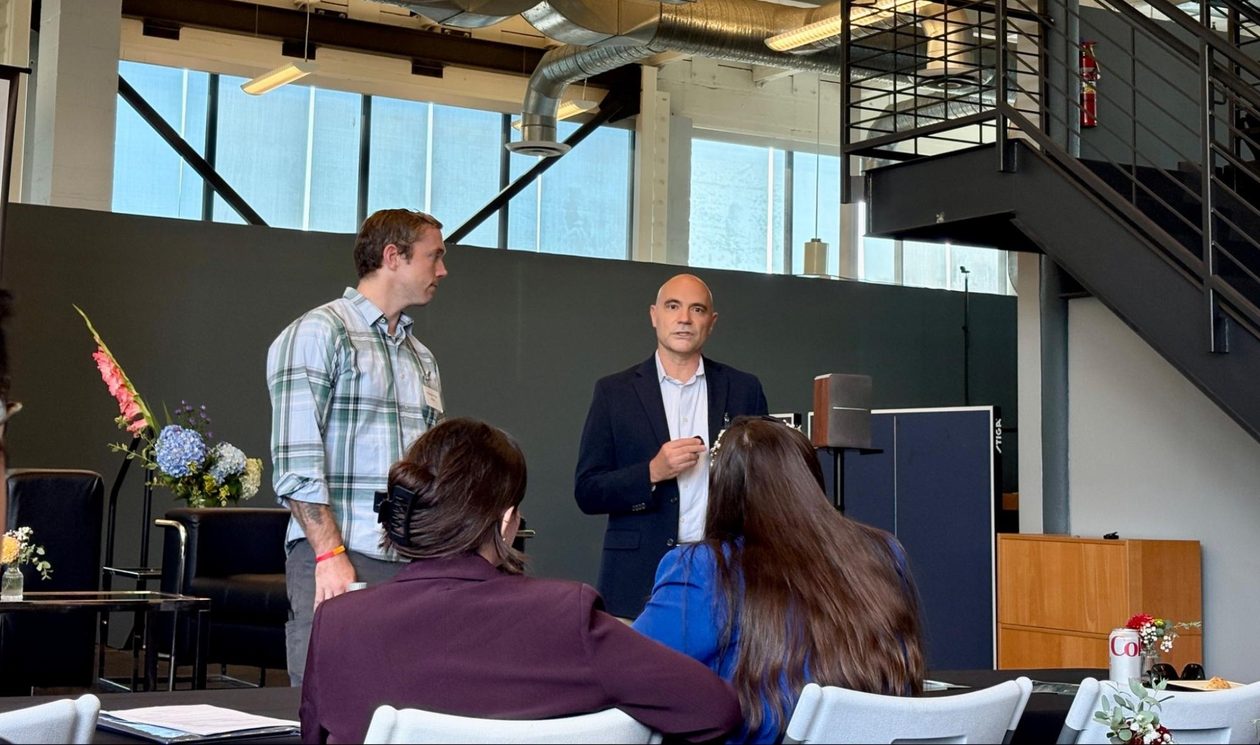
This week on the GeekWire Podcast: A study commissioned by the City of Seattle says the city is not in decline but is in danger — finding that 10 companies, nine of them in tech, pay three-quarters of the payroll tax on large employers, and that the tax structure uniquely penalizes the hiring of senior, high-compensation workers.
The report says Seattle should be most concerned about AI but most active in cleantech, the one industry the city can actually shape, since it owns the electric utility and controls permitting, building codes and land use.
Meanwhile, the Seattle Times and Newsday sue Microsoft and OpenAI, accusing them of copying hundreds of thousands of articles to train their AI models, putting Microsoft’s hometown paper against a company that helps fund some of its journalism.
Which leads us to a new GeekWire Trivia Challenge about the Microsoft products that Apple later turned into categories. Stick around to the final segment to see if you can figure it out.
Upcoming Event
AI meets real estate
GeekWire, in partnership with Real Estate at Work, is recording the GeekWire Podcast live at 4 p.m. Wednesday, Sept. 16, with Toby Roberts, SVP of Engineering at Zillow. John Cook and Todd Bishop host with Real Residential broker Leka Devatha at Atmosphere Seattle. Grab a ticket.
Las Vegas Raiders running back Ashton Jeanty, an investor in Nukleus and a spokesperson for the platform. (Nukleus Photo / Ben Miller)
Hector Rivas spent a decade building ThriftBooks into one of the country’s largest used-book sellers, before an unlikely second act: co-founding a sports agency representing NFL players.
That career change led him to the problem behind his newest startup, and to the Las Vegas Raiders running back who just invested in it.
Nukleus founder and CEO Hector Rivas. (LinkedIn Photo)
Nukleus, based in Issaquah, Wash., is building what Rivas calls an operating system for the business of sports. The idea is a single workspace for everyone in an athlete’s orbit: agent, lawyer, CPA, financial advisor, marketing team, and others. It lets them all work from the same contracts, deadlines and records, rather than each keeping a separate pile of emails and spreadsheets.
The idea came out of Rivas’s years at Disruptive Sports, the agency he co-founded in 2020 and left earlier this year.
Ashton Jeanty, who signed a four-year, $35.9 million rookie contract with the Raiders in 2025, has taken equity in the company and signed on to serve as its public face.
Nukleus has also named four strategic investors: Mat McBride, Microsoft’s executive vice president and CFO for commercial products and infrastructure; WaFd Bank President and CEO Brent Beardall; investor Skyler Nelson, previously of Vulcan Capital and its successor firm Cercano; and Dr. Brett Kindle of the Andrews Institute in Gulf Breeze, Fla.
The company has a team of 12 based out of its Issaquah office, plus a supporting engineering team in India. Most of the team is engineering.
Other executives include CTO Eric Ahlstrom, previously at Microsoft, Unity, Oracle and ESPN; chief creative officer Ben Miller, a former creative director at the University of Washington and CAA Sports; and CFO Matt Porter, who worked with Rivas at ThriftBooks, EcoGoodz and Disruptive.
Nukleus closed a pre-seed round from friends and family in 2025 and is raising again now. Rivas declined to disclose the amount raised by the company so far.
From books to football: Rivas was ThriftBooks’ first CEO, running the used-book seller for about a decade after it launched in 2003. Based in the Seattle area, the company grew during his tenure from a storage unit in Kirkland, Wash., to 10 distribution facilities in 10 states, by his account.
He went on to found EcoGoodz, a used-goods and overstock brokerage, and in 2020 co-founded Disruptive Sports Agency with agent Henry Organ.
Rivas, an NFLPA-certified contract advisor, worked the business side of the agency. He left earlier this year to build Nukleus full time.
The years inside the agency are what produced the idea.
Everyone in a player’s orbit was working off “their own version of the truth,” Rivas explained via email: the agent, the lawyer, the CPA, the financial advisor, the marketing team. The athlete, he said, “was the one absorbing the cost of that disconnect,” in slower decisions and deals that fell through the cracks.
The pitch in Las Vegas: Jeanty and Rivas knew each other from Rivas’s years at the sports agency, and Rivas said the running back had been tracking what he was building.
“Because Ashton and I already knew each other, and he’d been aware of what I was building, the conversation came together naturally,” Rivas said.
He flew to Las Vegas to walk Jeanty through the model, the team, and where the company was headed. Rivas said Jeanty’s equity reflects both money invested and his role promoting the platform.
In a statement, Jeanty described the job of running his own career.
“Coming into the NFL, you become a CEO, directing a team of agents, advisors, and marketers, whether you’re ready or not,” he said. “Nukleus is what finally gets them all on the same page, so I can actually run that team the way it should be run. That’s why I invested in it.”
Where things stand: The product is in a free beta with about 30 users, including athletes, agents, agencies, lawyers and marketing staff. Nukleus plans to charge $99 per user per month for a starter plan and $249 for a full-featured one, with custom enterprise pricing. Athletes join free.
Alongside contract storage, deadline tracking and a shared workspace, the company is building AI tools meant to answer questions about contract terms and league rules.
Others are working similar territory. Agent Live 360 sells software built specifically for sports agents, and Opendorse, which says it works with more than 1,000 sports agents, offers tools to negotiate, approve and track deals. Nukleus says it differs from narrower tools by serving everyone in an athlete’s orbit.
The bigger bet: The company is looking well past a single app.
“Long-term, I don’t see this as a tool athletes use, I see it as the infrastructure the entire business of sports runs on,” Rivas said. “Every athlete becomes the center of their own connected team, and every professional working with them, across every sport, at every level, operates on one shared system instead of a hundred disconnected ones.”
Michael Jensen, left, and Steven Brugger are leading BrainChild Bio. (Photos via BrainChild Bio)
Seattle biotech startup BrainChild Bio has raised $116 million to advance an experimental CAR T cell therapy for one of the deadliest forms of childhood brain cancer.
The Series A financing will primarily fund a pivotal Phase 2 clinical trial of an investigational therapy being developed for diffuse intrinsic pontine glioma, or DIPG. The rare brainstem tumor primarily affects children ages 5 to 10 and has few treatment options.
The financing was led by an undisclosed private family fund and foundation, with participation from BrainChild Bio’s initial investor, Seattle Children’s, and new investor WRF Capital.
BrainChild Bio is building on CAR T cell technology developed at Seattle Children’s and licensed exclusively to the company in 2023. The approach involves genetically engineering a patient’s own T cells to recognize and attack cancer cells.
The company says its new therapy has now entered its ILLUMINATE Phase 2 study, designed as a registration-stage trial that could eventually support an application to the U.S. Food and Drug Administration.
DIPG presents a particularly difficult challenge for cancer researchers because the tumors grow in the brainstem, an area critical to basic functions, and the blood-brain barrier can limit the ability of treatments to reach the tumor.
BrainChild Bio’s approach delivers the CAR T cells directly into cerebrospinal fluid through an implanted catheter, allowing the cells to reach the tumor locally and potentially be administered repeatedly.
About 300 children in the U.S. are diagnosed with DIPG each year, a devastating brain tumor with no cure and few treatment options. Radiation is the current standard of care, but children diagnosed with DIPG have a median overall survival of only about 11 months.
BrainChild Bio also plans to use proceeds from the new financing to advance a CAR T therapy designed to target three different cancer markers, toward initial clinical testing in glioblastoma.
The company was founded by Michael Jensen, who previously helped develop the underlying work at Seattle Children’s and was a co-founder of Umoja Biopharma and Juno Therapeutics. The CEO is Steven Brugger, who most recently served as founder and CEO of Affinivax, a biotech company which was acquired by GSK for $3.3 billion in 2022.
“This financing enables us to chart our path forward to serve the children and families afflicted with devastating brain tumors and represents a new paradigm for treating CNS brain tumors in children and adults,” Jensen said in a statement. “Our team at BrainChild Bio is steadfast in its commitment to harness CAR T cell technology in CNS tumors and we are uniquely positioned to do so.”
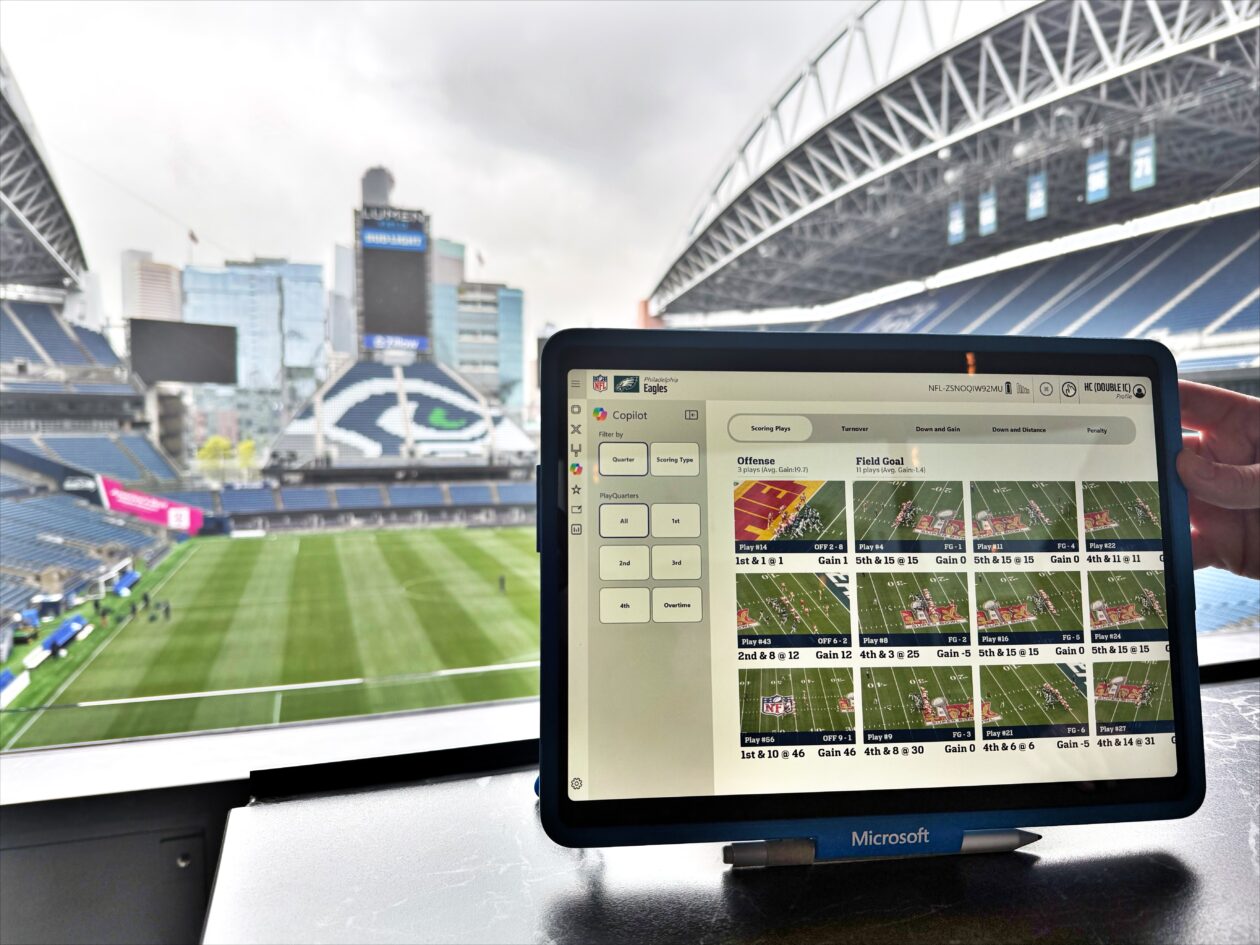
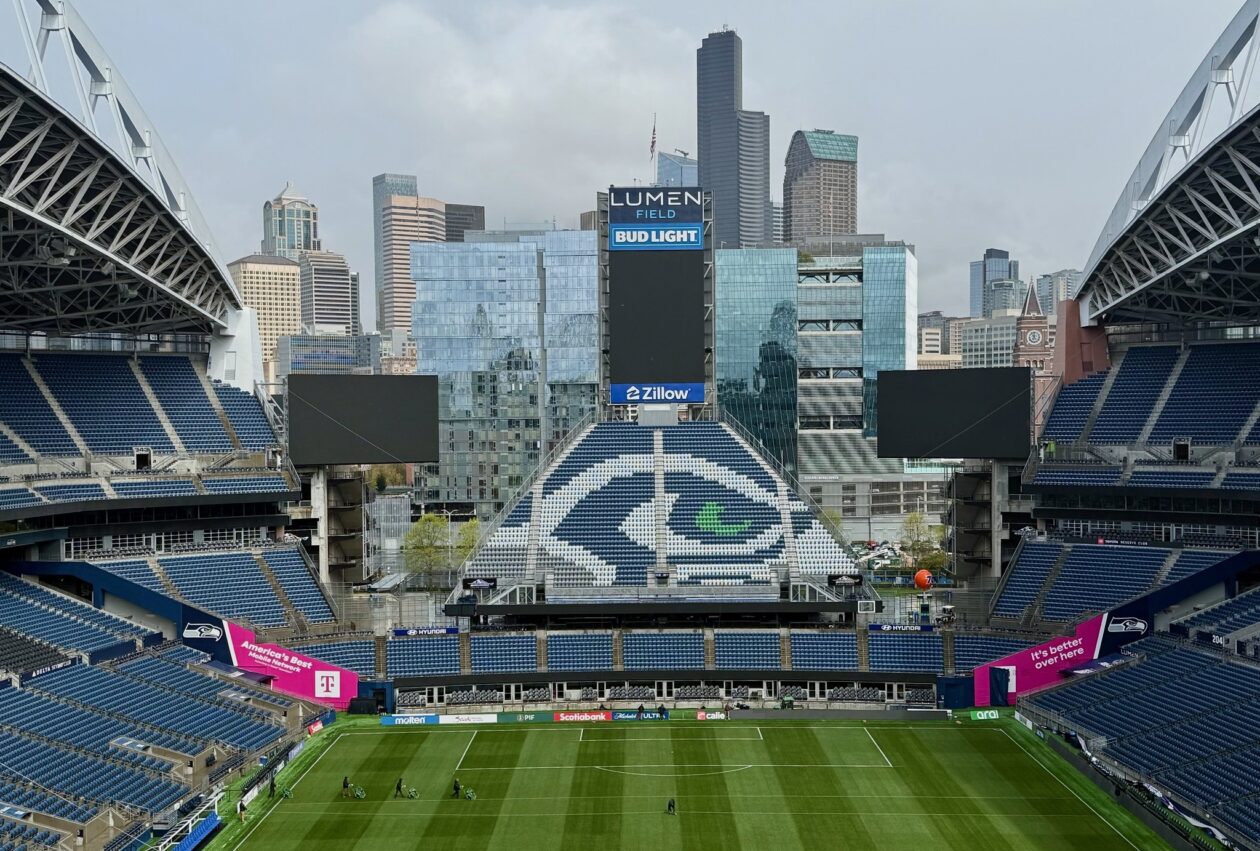
A Microsoft Surface tablet running Copilot at Lumen Field in Seattle. (GeekWire File Photo / Kurt Schlosser)
The Microsoft Surface tablets on NFL sidelines — a game-day fixture since 2014 — got a close-up on national television Wednesday night, with NBC highlighting new AI-powered workflows debuting in the Seattle Seahawks’ season opener.
During the broadcast, NBC play-by-play announcer Mike Tirico pointed out the new Surface devices — clad in Action Green cases, no less — in the Seattle coaches’ box above Lumen Field.
Tirico said Seattle head coach Mike Macdonald’s staff, including Brian Eayrs, the director of football analysis and special situations, now has direct access to Microsoft Copilot in real time. The broadcast showcased how the AI assistant is being layered onto sideline hardware to deliver instant data insights and help coaches make faster strategy adjustments.
“They can make sharper calls between series,” Tirico said. “So Copilot is going to give them a little bit more of an opportunity to do some real-time stuff on these tablets as the season goes on.”
It all amounted to a pretty good 40-second ad placement for Microsoft. Coupled with mentions of Next Gen Stats — powered by Amazon Web Services — it was a good night for Cloud City tech giants.
The technology and Eayrs are also featured in a video that Microsoft CEO Satya Nadella shared on X earlier in the day.
With the @NFL back tonight, love seeing @Seahawks analyst Brian Eayrs and coaches across the league using new Copilot and Excel tools to help with decision making in the booths and on the sidelines. pic.twitter.com/PbHugcbLIJ
GeekWire got an early look at Microsoft’s expanding tech suite back in April during a demonstration at Lumen Field. While the rugged Surface tablets on the sidelines remain the most visible hardware, Microsoft showed how Copilot is being integrated deeper into coaching workflows — from custom pre-game templates to running real-time analyses on formation tendencies, snap counts, and player load mid-game.
The core promise of the tech isn’t replacing human judgment — it’s raw speed. In a booth setup like Eayrs’, dedicated analysts use a real-time Excel dashboard that ingests live play-by-play data directly from the NFL. Using Copilot, they can instantly query formation tendencies or player usage metrics on the fly without building complex formulas by hand during the game.
The output from the booth can then be communicated down to the sideline, where coaches and players review still photos and quick situational data on their handheld tablets between drives.
To maintain competitive integrity, the NFL strictly regulates how and when these devices operate.
Under league rules, sideline and booth tablets run on a closed, league-controlled network with no internet access or custom third-party apps allowed. The hardware is locked away by league officials until right before kickoff, collected immediately after the game, and monitored under the NFL’s “Equity Rule.”
If one team’s tech setup fails, the opposing team’s access is restricted or paused to ensure neither side gets an unfair advantage.
The willingness to embrace real-time AI lines up directly with Macdonald’s overarching coaching philosophy.
Macdonald, who previously welcomed being called a “football nerd,” told GeekWire last year that his approach is all about “old school principles, new school methods,” emphasizing that earlier data delivery helps drive better decisions.
“I think it’s cool to be into stuff that is high-tech, data-driven,” Macdonald said at the time. “You’re telling me you’re smart and you’re trying to find edges and trying to find new frontier — that’s cool to me. It sounds like a winning formula.”
Macdonald, who has a Super Bowl ring to show for his coaching style, also called himself a “psycho data guy” who needs “numbers and tendencies” in another interview last year.
Did Copilot and AI provide an edge on Wednesday night?
Macdonald and his analytics team will have to answer to that, but the Seahawks defense certainly made the ultimate call when it mattered most — sealing a 13-10 victory over the New England Patriots with a last-second interception.
Seattle’s foundation as a hub of technology, science and innovation runs deep. Its confidence should, too. (GeekWire Photo / Kevin Lisota)
[Editor’s Note: Jacob Colker is co-founder and co-managing director of AI House.]
Seattle is one of the most talented, creative and inventive places in the world. But if we want the rest of the country to see us that way, we have to start acting like we believe it ourselves.
First, we need more pride around here.
Let’s talk about what it means to be proud.
My mother grew up in Tarnów, Poland. She escaped communism and came to the United States in 1978 looking for a better life. She found one, built a family, and has lived in America for nearly 50 years.
But my mom is still very, very Polish.
Several times a year, I get a message: “Jakub. Did you see this?”
I already know what’s coming.
Some Polish person did something. A Polish athlete won something. A Polish scientist discovered something. Some guy with a Polish grandmother finished third in a regional Nebraska chess tournament. Doesn’t matter. Poland.
“Jakub. Look at this person.”
Okay, Mom. Who is she?
“POLISH.”
That’s it. That’s the story.
And I love it, because Mom has this completely indestructible pride in where she comes from. Plenty of us know someone like this: a Greek mom, Vietnamese dad, Indian uncle or Nigerian aunt. Somebody from their corner of the world did something great, and you are going to hear about it.
There is power in that instinct. Not because your people are better, but because you believe your place matters.
Seattle could use more of that.
We are almost pathologically humble. Our response to notable achievements is often a polite nod before everybody gets back to our regularly scheduled Seattle freeze.
That humility is working against us.
Second, Seattle isawesomeand the evidence is everywhere.
I see Seattle’s potential every day working alongside dozens of entrepreneurs building startups. Some of the most ambitious and talented people in the world are already here.
We have many billion-dollar startups across the region and more than 200,000 people working across technology, science, space, health and startups. That is more than enough talent to build yet a dozen more unicorns.
Nearly 40% of the world flies every day on airplanes built here. Blue Origin and SpaceX build rockets here. Starbucks, Amazon, Costco, REI and Nordstrom reshaped how the world shops. Microsoft helped put computing into our homes. AWS and Azure helped make the cloud the infrastructure of modern life. The University of Washington ranks among the world’s best. Seattle medical breakthroughs have helped save tens of millions of lives. We are pushing forward fusion energy, aerospace and maritime innovation. And let’s not forget: we just won the darn Super Bowl.
And so, so much more.
So why, despite all the evidence, do we still seem to have a communal case of imposter syndrome?
This is not a city lacking accomplishments.
It is a city with a branding problem.
Third, we have let other people tell our story for far too long. This ends, today.
Cities have brands whether they intend to or not. Silicon Valley is where ambitious people build companies. Nashville is music. Los Angeles for film and television.
Seattle’s cultural humility mostly assumes our accomplishments speak for themselves.
They don’t.
Reputation gets built one story at a time. You hear one story and it is interesting. You hear 10 and you notice a pattern. You hear 50 and your beliefs begin to change: That’s where important science happens. That’s where talented people live. That’s where I should invest, build or work.
Those beliefs shape real decisions about where people move, where companies get built and where investors put their money.
So to fix Seattle’s branding problem, here’s what we need to do.
Step 1: Let’s tell one clear story — Seattle’s talent pool is ridiculous.
Seattle is where deep technical talent meets deep domain expertise to build consequential things: AI, aerospace, cloud computing, medicine, fusion, robotics, maritime technology and enterprise software.
We do not need 50 slogans. We do not need another consultant-led branding exercise. We need one simple idea that people outside this region can remember: Seattle’s talent pool is ridiculous.
There is a reason some of the world’s most important companies have built major engineering centers, research hubs and second headquarters here for decades. They come for the talent.
And that talent is why Seattle will not just participate in the future. We will lead in building it.
Step 2: Let’s use the megaphones we already have.
Seattle already has outlets (including this one) telling this story — publications, podcasts and social channels that document the region’s startups, breakthroughs and product launches.
Every day, startups are raising money, scientists are making breakthroughs, companies are launching products, engineers are building technology and institutions are pushing this region forward.
That is not just tech news. That is the raw material of Seattle’s reputation. So let’s use it.
When you read or hear about a Seattle startup doing something remarkable, share it. When you see a story about a breakthrough at Fred Hutch or the University of Washington, send it to someone outside the region. When a local company raises money, lands a major customer or gets acquired, don’t just scroll past it. Amplify it.
Step 3: Let’s treat every local win as Seattle’s win.
When a local robotics company ships something remarkable, that is Seattle’s story.
When a maritime startup reinvents how ports operate, that is Seattle’s story.
When our AI research labs, or hometown heroes in Amazon and Microsoft, create breakthroughs, that is Seattle’s story.
When a biotech company lands a major breakthrough, when a game studio creates a global hit, when a clean-energy company reaches a milestone, that is Seattle’s story.
Our companies, universities, hospitals, labs, investors, civic organizations and business leaders should act like an amplification network for one another. Stop treating somebody else’s success as somebody else’s news.
Their win is our collective proof.
Step 4: Let’s put Seattle on the label.
Founders need to say where they are building. “Made with ❤️in Seattle” should be on the bottom of every website. Put Seattle in the press release. Put it in the LinkedIn post. Mention it onstage. Say it in interviews. Tell investors. Tell customers.
Silicon Valley companies have spent decades attaching their success to their geography. We should do the same. If you build something extraordinary here, make sure the world knows it was built here.
Step 5: Let’s do a better job of selling Seattle.
Every venture capitalist, founder, executive and civic leader in this region should be able to explain in 60 seconds why somebody should build a company here.
Not defend Seattle. Not apologize for Seattle. Sell Seattle.
Reminder: It’s the talent.
(And also cream cheese on hot dogs.)
When investors and founders from New York, Boston or San Francisco come to town, show them the region. Introduce them to engineers, researchers and entrepreneurs. Bring them into the community. Let them see what is happening.
The best branding campaign is somebody getting on a plane home saying, I had no idea all of this was happening in Seattle.
If we’re going to succeed, we need tobelievefirst.
Insert all the Ted Lasso jokes you want, but this stuff matters.
There is no giant Seattle marketing department coming to save us. There is no national referee who will eventually review the evidence and declare that Seattle deserves more respect.
When somebody here does something extraordinary, act like it. Read the story. Share the post. Send the article to your team. Text it to your friend in New York. Put it in the group chat. Bring it up over dinner. Tell your kids.
Basically, become my Polish mother.
My mom doesn’t give a hoot that Kraków ranks No. 6 on some list or Warsaw is No. 8 on another. She doesn’t need a clickbait listicle to tell her Poland matters. She already believes it does.
We have to build our reputation ourselves. The good news is that we already have everything we need: extraordinary companies, world-class institutions, ambitious people, groundbreaking science and media documenting it all.
What we have been missing is the confidence to start being more loud. Stories become patterns, patterns become reputation, and reputation becomes gravity.
Gravity is what creates influence and respect.
Pride is not something somebody else gives you. You don’t wait until the rest of the country decides your home is important. YOU decide it is. Then you act like it.
The West8 office building in Seattle’s Denny Triangle neighborhood. (Image via West8Seattle.com)
General Motors is expanding its presence in the Seattle region with a new downtown office slated to open in early 2027.
The automotive giant signed a lease for a 43,000-square-foot space at West8 in the Denny Triangle neighborhood, with plans to bring together employees across digital products, autonomous vehicles, IT, HR, and marketing, the company announced Wednesday.
GM currently employs about 200 remote workers in the region. A spokesperson said the new office will bring those existing team members together while providing room to recruit additional talent. The layout will feature a mix of traditional workstations, flexible lounge seating, and collaborative huddle spaces.
When the office opens, it will follow GM’s hybrid work policy, requiring employees living within a 50-mile radius to work on-site three days a week.
GM said tapping into Seattle’s deep technology talent pool will help grow its concentration of technical staff and attract engineers specializing in artificial intelligence and machine learning. The company credits its Seattle-area software teams with building the technical foundation behind its on- and off-vehicle platforms.
Located at 2001 8th Ave., the West8 building sits two blocks from Amazon’s headquarters campus and the Spheres. Amenities available to GM staff will include a fitness center, bike storage with showers, an onsite café, outdoor spaces, and covered parking equipped with EV charging stations.
The Seattle footprint adds to GM’s network of major tech hubs outside Michigan, including locations in Austin and the Bay Area.
They joined as part of a funding round that totals $13 million, according to a Form D filed with the Securities and Exchange Commission. NLM has reported at least $26 million in funding since 2018, according to SEC filings.
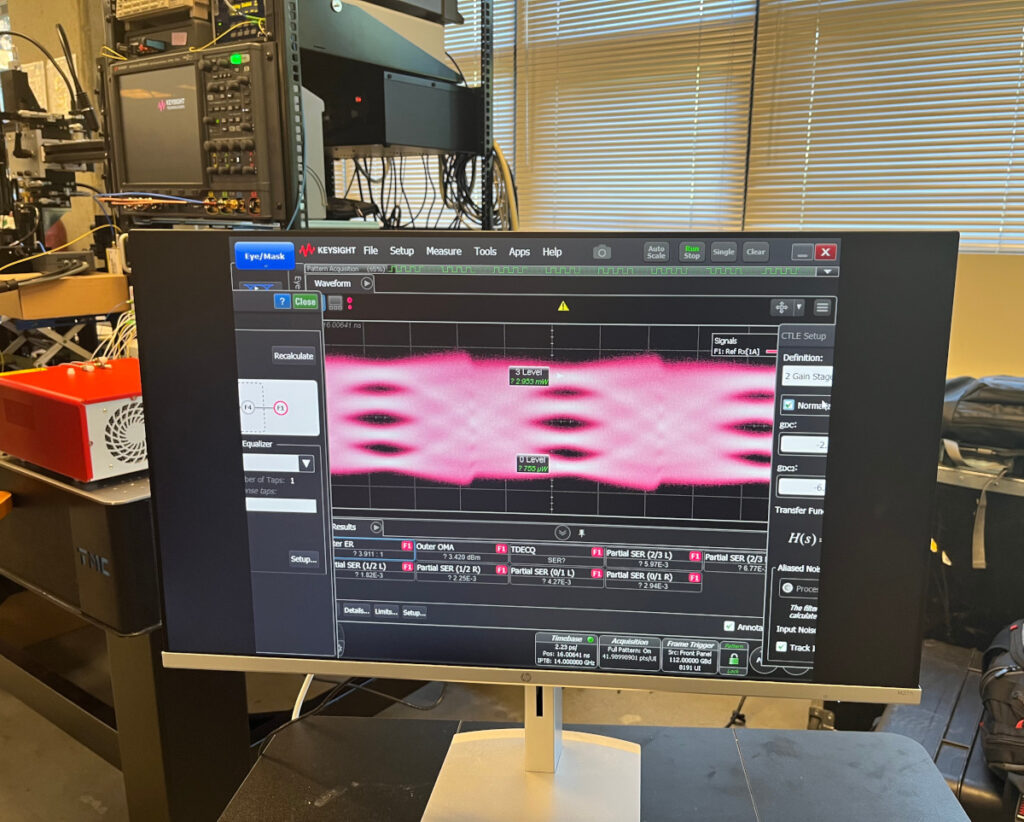
The company offers a way to move more data without burning more power. Inside a data center, information travels between chips and servers as pulses of light. The part that puts the data onto the light beam, called a modulator, is normally made of silicon. It limits how much data a link can carry, and how much power that takes.
NLM’s technology, sold under the name Selerion, is an organic electro-optic material that goes on as a liquid and hardens in place on the chip, taking over the modulator’s job from the silicon underneath. The company says it does the work 10 to 15 times more efficiently.
Applications for the technology include fiber-optic networking equipment and the links between servers in AI data centers. NLM says it could also be used in quantum computing.
Five existing investors participated in the round, which the company described as a Series A2: Emerald Technology Ventures, Oregon Venture Fund, Idemitsu, Tokyo Ohka Kogyo and StoryHouse Ventures. Private investors and company employees also took part.
Pangaea Ventures, which has offices in Canada, the United States and Japan, backs startups built on advances in materials, chemistry and biology. It says it has invested in more than 40 companies over more than 20 years. David Weekes of Pangaea is joining NLM’s board, which already includes Frank Balas of Emerald.
Diamond Edge Ventures, led by president Curtis Schickner, has $200 million to invest through 2030. It backs companies in Mitsubishi Chemical’s core markets, including advanced materials, polymers and electronics, and its portfolio includes Boston Materials, DigiLens and Eridan.
Hamamatsu Photonics, which invested previously, is not part of this round but is still a shareholder, according to the company.
The company was incorporated in 2018 as Nonlinear Materials Corp. It licensed its patents from the University of Washington, building on 25 years of research there in the labs of chemists Larry Dalton and Bruce Robinson. Robinson is one of the company’s co-founders, as is Lewis Johnson, a longtime UW researcher who is chief technology officer.
Pack Ventures, the UW-affiliated venture fund, is an investor in NLM and is also listed among the advisors to its board.
GeekWire covered NLM’s launch in 2019, when the company was raising a $1.25 million seed round and running a small production lab on campus.
NLM Photonics CEO Brad Booth. (NLM Photo)
Brad Booth, who spent nine years at Microsoft and joined NLM’s board in 2023, took over as CEO in 2024 from co-founder Gerard Zytnicki, who is now a corporate advisor to the company. The company raised $1 million from Tokyo Ohka Kogyo and Hamamatsu in 2023.
Last year NLM said outside testing confirmed that a 1.6-terabit chip combining silicon with its materials ran at 224 gigabits per second on each of eight channels. It started sending samples of 1.6- and 3.2-terabit chips to customers in March.
NLM is not alone in trying to build a better modulator. Lightwave Logic, a publicly traded Colorado company also working with organic materials, named NLM among its smaller competitors in its annual report for 2024.
Some of the company’s rivals have raised a significant amount of funding. HyperLight, a Harvard spinout that uses a crystal called lithium niobate instead of an organic material, has raised $117 million, including $80 million in June led by MediaTek.
NLM has worked to get its materials onto other companies’ production lines. In March the company said the chips going out to customers were made at GlobalFoundries, and that it had built modulators using Tower Semiconductor’s high-volume silicon photonics process.
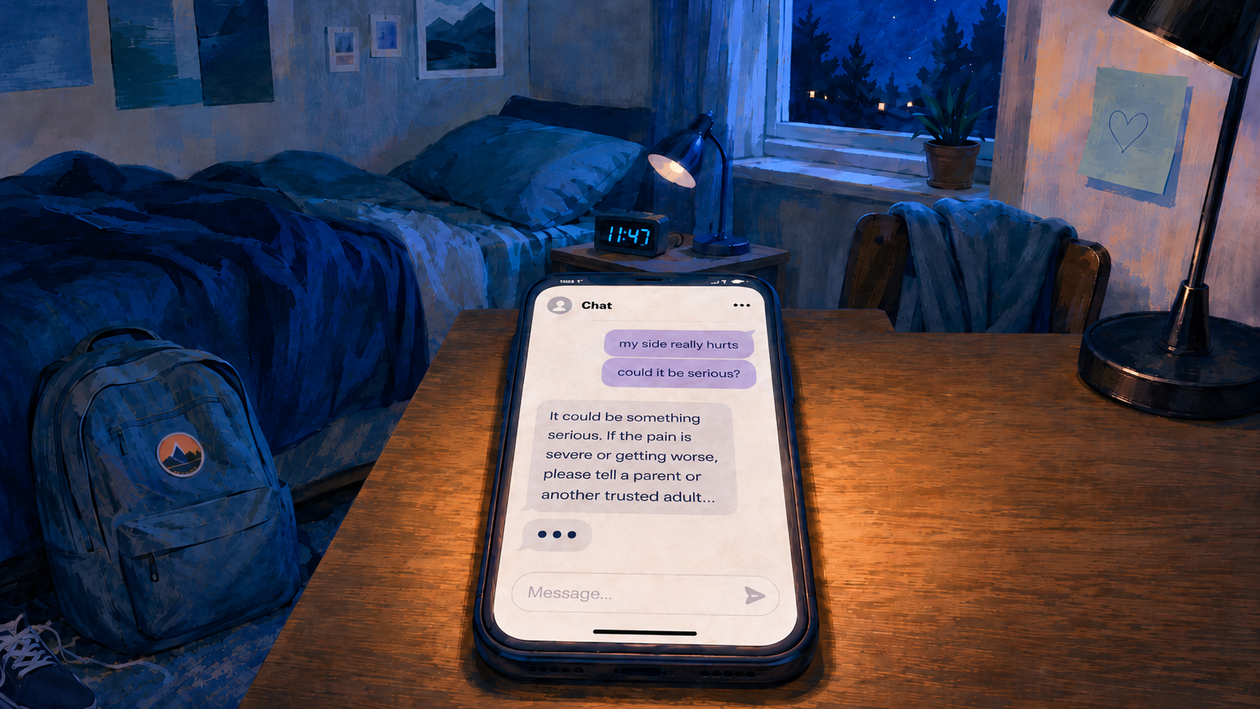
Teens are taking questions about their health, their moods and their friendships to chatbots — often without telling anyone. (GPT-5.6 Sol)
Kids are heading back to school across the country with a tool in their pocket that will do their homework, answer the questions they’re too embarrassed to ask an adult, and never tell anyone they asked.
MIT Technology Review asked kids aged 10 to 18 what they make of AI. Their answers had me plowing through every survey and interview with kids about AI I could find. Plenty of what kids do with it is ordinary: looking things up, homework, messing around.
This article is about the parts they keep to themselves.
1. Kids are taking their mental health to a chatbot, and telling nobody.
Nearly one in five Americans aged 12 to 21 has asked a chatbot for help when feeling sad, angry or nervous. RAND puts it at 8.2 million young people, and 63% of them told no one at all.
The silence is a calculation about what adults would do, as one teenager explained to YouGov’s researchers.
The most vulnerable kids use chatbots more.
Internet Matters found that British children with a health condition requiring professional help are nearly three times as likely to use companion bots like Character.AI or Replika.
A third of all child users say chatting with a bot feels like talking to a friend, and among the vulnerable that figure goes up to half.
One in eight of all child users says they talk to a chatbot because there’s no one else, and among the vulnerable it’s nearly one in four.
2. Kids see both sides of AI in school.
Some teenagers see AI as a shortcut past the hard parts of schoolwork.
Others describe using it the opposite way.
Between May and December 2025, RAND watched homework use among middle school, high school and college students climb from 48% to 62%. Over a slightly longer stretch, from February, the share saying AI harms critical thinking climbed from 54% to 67%. The same students can hold both thoughts at once.
The Concord Monitor interviewed eight New Hampshire high schoolers this spring. They weren’t outraged at their classmates, but they described losing motivation to do the work themselves. One in ten teens tells Pew they do all or most of their schoolwork with a chatbot’s help.
Caledonia Mahon, a Concord High senior, watched a classmate stand up and admit he’d had ChatGPT write a personal reflection, and started wondering why she was still writing her own.
Her classmate Andrew Pfitzenmayer supplied the detail I can’t get out of my head, about a boy in his advanced history class.
Yet, the same technology can be positive for kids who don’t have much else.
By May 2025, 84% of American high schoolers were using AI for schoolwork at least occasionally. The kids who lean on it hardest have the least support around them, which is why telling them to quit doesn’t work.
If quitting isn’t the option, what’s left is changing what the tool does when a kid opens it. Two Seattle startups are trying that.
Wild Zebra, started in 2024 by Edan Shahar and Erik Selberg, makes a math and reading tutor for grades 2 through 9 that answers a stuck student with a question instead of a solution. It’s gone from about 6,000 students in four pilot schools a year ago to tens of thousands now, and raised $6 million in August.
Maximal Learning, built by Microsoft veterans Eran Megiddo and Liviu Asnash, ships an app called Wick that coaches planning, time management and study habits rather than producing homework. Neither company pretends teenagers will stop bringing AI to their assignments. Both are built so the student still has to do the thinking.
3. Kids are writing the rules adults haven’t.
Suspicion of AI runs strongest among the kids furthest from it: 78% of students who don’t use AI say it harms critical thinking, against 60% of those who do.
In July, 98 high schoolers from all 50 states spent three days in a replica of the U.S. Senate chamber in Boston and passed what Congress hasn’t. Their STUDENTS FIRST Act requires AI literacy, bars teachers from letting AI decide a grade on its own, lets a teacher ask a student to defend suspected work out loud, and gives any student the right to an alternative to an AI assignment.
A majority of educators told Education Week’s Research Center last fall that their district has no AI policy, or that they don’t know whether it does. At least seven states have a comprehensive one, by Education Week’s count.
Ashley Kannan has taught social studies for almost 30 years in Oak Park, Ill. He planned to ignore AI, then noticed that every conversation about it in his building was about catching students. He recruited nine eighth graders to spend a year working out what AI was actually good for. In April they briefed 60+ teachers and parents on the rules they thought were needed.
Hazel is 17, a rock climber in New York who wants to be an ecologist. She won’t touch AI, and her reason is specific: what data centers do to the water supplies of the towns they’re built in. Asked what advice she’d give other kids, she gave four words.
Hazel can afford that advice. Most kids can’t.
So the practical alternative is narrower than just telling them to quit: ask them what they use AI for, ask what they’ve decided not to use it for, and don’t make an honest answer cost them the tool. Right now 61% of young people say their parents rarely or never talk to them about AI, and 53% say the same of their teachers.
Hazel may walk away from AI. But Amira, describing a pain in her side to a chatbot, may not, and the odds are nobody in her house knows she’s doing it.
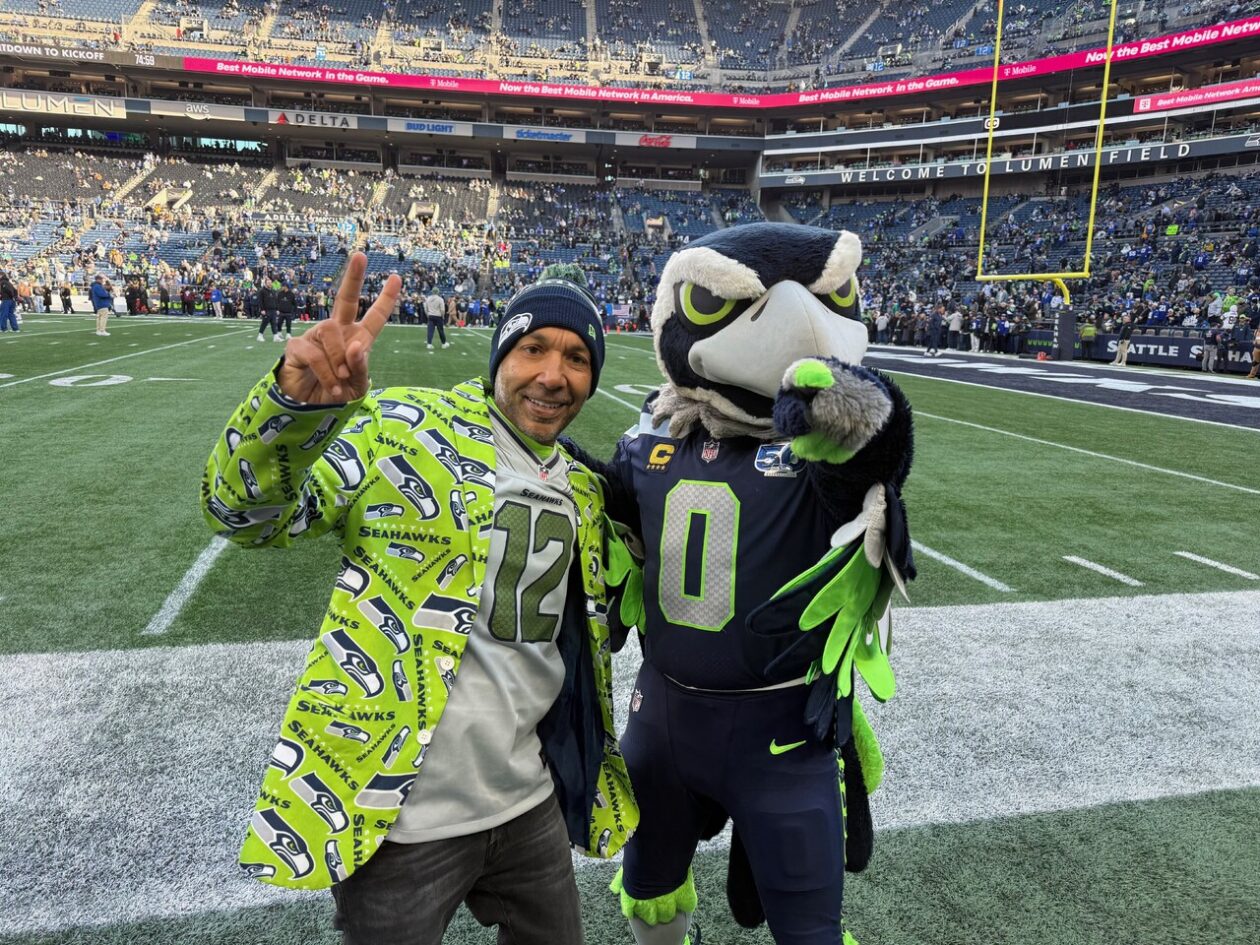
Sunny Gupta and the Seattle Seahawks mascot Blitz during a game at Lumen Field. (Photo courtesy of Sunny Gupta)
Sunny Gupta has been a diehard Seattle Seahawks fan for almost 20 years, hosting tailgates and sitting in the exact same club-level seats with his family and friends since 2007. Now, the longtime Seattle tech entrepreneur is taking his place in the franchise’s new ownership group as a self-described “fan No. 1.”
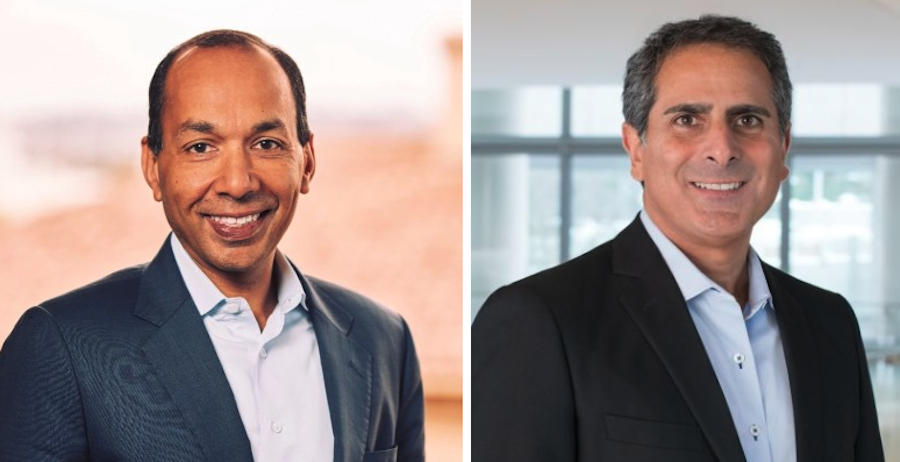
With the sale of the team to the family of Silicon Valley billionaire investor Vinod Khosla finalized on Thursday, Gupta’s name appeared on a newly revealed list of co-owners. Nader Naini, managing partner at Seattle-based healthcare private equity firm Frazier Healthcare Partners, is also among the group.
For Gupta, it was an opportunity he couldn’t pass up — and a dream come true.
“I would have never considered investing or being in ownership in sports other than the Seahawks,” Gupta told GeekWire in an interview following Thursday’s announcement. “This is a dream come true of something I love so much. The city I love so much, fan base, the team.
“I’m the 12th man,” he added. “I want to represent that as a part of the ownership group.”
Gupta is best known in Pacific Northwest tech circles as the co-founder and former CEO of Bellevue-based enterprise software maker Apptio, which he guided through an IPO, a private equity buyout, and an eventual $4.6 billion sale to IBM in 2023. He recently served as executive chair at Smartsheet during its $8.4 billion acquisition, and earlier this summer launched his fourth venture-backed startup, an enterprise AI company called Thira, with $21 million in seed funding.
But fall Sundays are strictly about football for Gupta, who describes himself and his family as “complete supporters, rabid fans” since 2007. He estimates he’s missed two games in that time.
Together with his wife, son, and daughter, the family holds five season tickets. They’ve sat in the same seats alongside a tight-knit crew of friends for nearly two decades — and don’t plan to change things with the perks of ownership.
“When we were going through this, this was like the biggest debate in our family,” Gupta said. “We’ve never been suite owners. We like being in our club section behind the Seahawks sideline, and that’s where we love watching the game. All our friends are there … that’s our community.”
Sunny Gupta at GeekWire’s Cloud Tech Summit in 2017. (GeekWire File Photo)
While Gupta hasn’t directly partnered on a startup with Vinod Khosla, their paths have frequently crossed in venture capital circles. Over a career raising funds for four separate startups, Gupta noted Khosla Ventures was always on the “short list” of firms entrepreneurs hope to align with. Joining forces on the Seahawks deal presented an ideal way to combine those two worlds.
“Seattle is mostly a tech story and it’s a Seahawks story,” Gupta said. “The ability to have these two worlds combine is like a dream.”
Beyond his personal fandom, Gupta expressed strong confidence in the team’s current leadership. He noted that he caught up this week on the final episode of HBO’s Hard Knocks in anticipation of Thursday’s sale completion, coming away energized by the culture built by general manager John Schneider and second-year head coach Mike Macdonald.
“I was fired up last night on just what a great organization it is and the amazing job Mike and John do,” Gupta said. “The ability to continue the winning culture and just continue to win and support our fan base and community — that’s what it’s all about.”
The Seahawks open the 2026 season at Lumen Field on Sept. 9 against the New England Patriots. (GeekWire File Photo / Kurt Schlosser)
The sale of the Seattle Seahawks to the Khosla family officially closed on Thursday, completing a historic ownership transition for the NFL franchise. But a small surprise emerged in the final paperwork.
Nestled among a newly revealed co-owner lineup were a couple familiar names for the Pacific Northwest tech community: former Apptio CEO and longtime Seattle entrepreneur Sunny Gupta, and Nader Naini, managing partner at Seattle-based healthcare private equity firm Frazier Healthcare Partners.
Under the final transaction terms announced by the team, Vinod Khosla — the billionaire Silicon Valley venture capitalist who founded Sun Microsystems and Khosla Ventures — will serve as chair, while his wife Neeru Khosla steps in as controlling owner and president of the Seahawks Charitable Foundation. Their son Neal Khosla takes on the role of vice chair.
The conclusion of the sale brings to an end an era of ownership under the estate of late Microsoft co-founder Paul Allen, while keeping the franchise’s deep ties to the technology sector intact.
Gupta and Naini appear on a list of co-owners that spans prominent Silicon Valley venture capitalists, global private equity firms, institutional sports investors, and international business dynasties. They include:
Sunny Gupta, left, and Nader Naini. (LinkedIn, Frazier Healthcare Photos)
Mark Stevens, former Sequoia Capital partner and longtime Silicon Valley venture capitalist who was an early investor in Nvidia, Google, and PayPal.
Samir Kaul, founding partner and managing director at Khosla Ventures, leading investments across deep tech, sustainability, and health.
Penny Pritzker, former U.S. Commerce Secretary, founder of PSP Partners, and former Hyatt Hotels executive.
Sixth Street, global investment firm with extensive growth equity and tech investment practices.
Carlyle and Dynasty Equity, major private equity firms, including sports-focused investor Dynasty Equity.
Aramburuzabala Family, prominent Mexican investment family behind Tresalia Capital.
Gonzalo Hevia Baillères, Mexican business leader who is currently the CEO and founder of HBeyond.
Val Blavatnik, investor associated with global holding company Access Industries.
Sheryl Sokoloff and Jesse van der Werf, private investors with backgrounds across industry and machinery services.
When news of the Allen estate’s decision to sell the team first broke, speculation ran rampant — including on GeekWire — about which deep-pocketed tech titan with Seattle ties might step up with almost $10 billion.
Jeff Bezos, Bill Gates, Steve Ballmer, MacKenzie Scott, Satya Nadella, Rich Barton, Melinda French Gates — the list of mostly Seattle billionaires who took a pass was lengthy. The Khosla family emerged victorious, but at least brought along a couple heavyweights to keep the local tech flag flying.
Gupta brings deep roots in the region’s software ecosystem. He co-founded Bellevue-based enterprise software maker Apptio, guiding it through a public listing, a private equity buyout, and an eventual $4.6 billion sale to IBM in 2023. Gupta served as executive chair at Bellevue-based Smartsheet through its recent $8.4 billion private equity acquisition and launched enterprise AI startup Thira earlier this summer with $21 million in seed funding led by Madrona.
Naini grounds the group in local healthcare private equity and regional sports governance. He joined Seattle-based Frazier Healthcare Partners in 1991 and has led the firm since 1995, helping scale it to manage more than $11 billion in institutional capital globally. Based in Seattle, Naini serves on the board of the Triple-A Tacoma Rainiers baseball team and is active with regional community organizations, including Bellevue-based senior living developer Aegis Living.
The Seahawks will formally introduce the Khosla family via press conference next Wednesday at 11 a.m. PT at Lumen Field. The team opens the 2026 season and defense of its Super Bowl title that night against the New England Patriots.
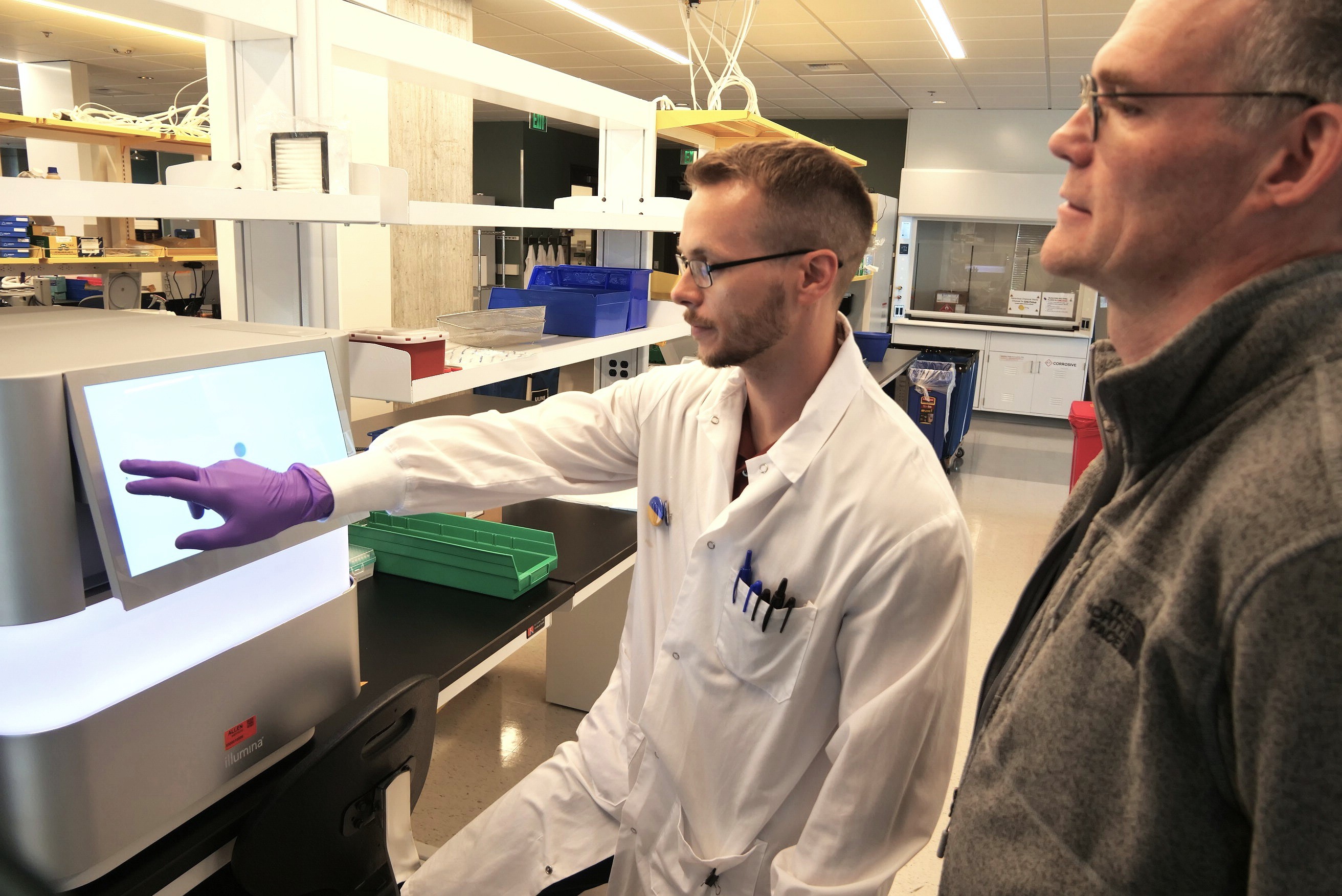
Jack Boylan, left, Allen Institute research associate, and Jesse Gray, AI BioDesign executive director of strategy and platform, at the DNA sequencer inside the initiative’s new lab. It reads millions of designed DNA sequences at once, revealing which ones worked. (GeekWire Photo / Todd Bishop)
Three of Seattle’s top scientific institutions are launching a nearly $95 million research initiative that will generate data and train AI models to design proteins and genes that don’t exist in nature — sharing the results freely to help others develop new medicines and materials.
AI BioDesign is led by David Baker, the UW biochemist who won the 2024 Nobel Prize in Chemistry for using computers to design new proteins, and Jay Shendure, a leading genome scientist at the UW and the Allen Institute.
The plan is to “hijack a lot of the machinery that evolution provided us” — the cellular assembly line that turns DNA into proteins — to design and measure millions of novel biological molecules, Shendure said in an interview in advance of the announcement.
That will help AI models learn the rules of biological design from a huge set of examples, instead of inferring them from the relatively limited number that nature has produced.
The field, Shendure said, is “putting too much emphasis on taking the cranks that we have and just running with them, as opposed to building the right cranks.”
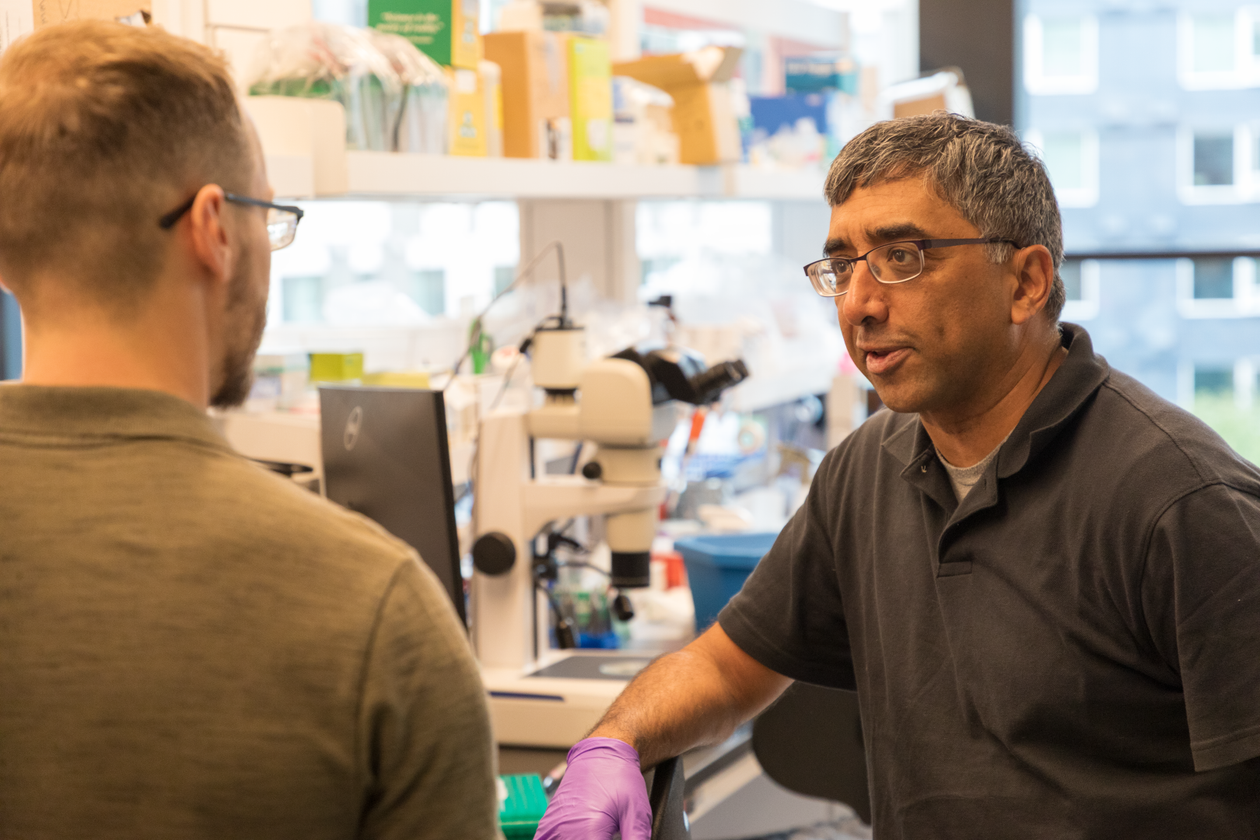
Jay Shendure, right, lead scientific director of AI BioDesign, with research associate Jack Boylan in the lab at Dexter Yard in Seattle’s South Lake Union. (Allen Institute Photo / Jerry Petersen)
The goal is to make designing biology more like ordering a part: a molecule that latches onto a cancer cell, for example, or a genetic switch that fires only inside brain cells and nowhere else.
Potential outcomes could include everything from new therapies for disease, to proteins that dissolve plastic in the environment, to cells that travel through the body in a programmed way, said Sanjay Srivatsan, a Fred Hutch assistant professor who leads the cancer center’s work on the initiative, in a video released with the announcement.
“For the first time, the speed of AI is beginning to match the experimental power of synthetic biology,” Baker said in a statement. “That changes the question from ‘what has nature already made?’ to ‘what else is possible, and how can we test it?'”
Where the money goes
The Fund for Science and Technology is providing $94.6 million for AI BioDesign over five years. The foundation launched publicly last year with a mandate to direct a large share of Allen’s fortune into bioscience, environmental and AI research.
The funding from FFST is allocated as $46.1 million to the Allen Institute, $43.8 million to the UW and $4.7 million to Fred Hutch, according to an Allen Institute spokesperson.
The initiative had 62 people as of mid-August, including some new hires and others redirected from existing projects at the three institutions. The UW accounts for 41 of them, the Allen Institute 13, and Fred Hutch eight. AI BioDesign is expected to continue growing over time.
“AI BioDesign is exactly the kind of ambitious, collaborative science FFST was created to support,” said Marc Malandro, the foundation’s chief programs officer and co-lead, in a statement. He joined FFST in May after nearly a decade at the Chan Zuckerberg Initiative, most recently as chief operating officer of CZI and the Chan Zuckerberg Biohub Network.
Malandro and Chief Financial and Operations Officer Liz Carey have been leading FFST on an interim basis since founding CEO Lynda Stuart stepped down in May.
Inside the lab
On a recent tour of the AI BioDesign lab, research associate Jack Boylan pulled up results from a run he’d done on their new DNA sequencer that morning — on free kits donated by a neighboring biotech company, a year past their expiration date.
“We decided, let’s give it a roll,” he said. It worked fine.
The sequencer is what makes the whole approach possible. It reads all of the millions of DNA sequences in a single tube at once and reports which ones performed. One recent experiment ran 6 million distinct sequences through it at once.
“The scale comes not from robotics, but from parallelizing inside the test tube,” said Jesse Gray, executive director of strategy and platform for AI BioDesign and the Seattle Hub for Synthetic Biology, and a former Harvard Medical School geneticist.
The lab, at Dexter Yard in Seattle’s South Lake Union neighborhood, a short walk from the Allen Institute’s headquarters, is organized into teams of five or six people, each working on a different design problem.
A separate four-person team of machine-learning specialists takes the incoming results and works with the bench teams to decide which experiments come next — the ones that will teach the models the most. Each round is judged on how much the models improved.
Rui Costa, president and CEO of the Allen Institute. (Allen Institute Photo)
The Allen Institute calls projects like this “accelerators,” a term Rui Costa, the institute’s president and CEO, traced back to Paul Allen himself. The word came up in early planning sessions, Costa said. Allen wanted to “exponentially accelerate the field.”
Other accelerators at Dexter Yard include the Seattle Hub for Synthetic Biology, the Allen Institute’s collaboration with the Chan Zuckerberg Initiative and the UW, which Shendure also leads; and Cell Science, which works on engineering cells to assemble themselves into tissues.
The Allen Institute for AI (Ai2), the separate Seattle research organization also founded by Paul Allen, is involved informally rather than as a funded partner, Costa said.
Its robotics team has been talking with AI BioDesign about scaling up the protein work, and the two expect to collaborate on models and on tools that generate research hypotheses.
Why give it away
The decision to focus on open science also came from Allen, Costa said in an interview this week. “He was so visionary in the early 2000s: radically open science to exponentially impact and change fields, not to compete.”
That raises a question the initiative will face as soon as it produces anything valuable: what happens if a company builds a lucrative drug on data given away free? In traditional science, Costa said, being beaten to a discovery counts as a loss. Here it’s the goal.
“We would be so lucky if many companies would be taking this data and changing the world for good,” he said.
At the same time, Costa left open the possibility of the three principal institutions spinning out their own startups, nonprofits, or other initiatives from the work done by AI BioDesign.
Betting against the field
AI BioDesign’s approach runs against much of the current thinking in the field. Costa said most efforts to apply AI to biology are chasing a single general model that could answer questions about how any cell works. AI BioDesign is betting on the opposite: narrow models built for specific design problems, trained on data generated for that purpose.
“This project is a clear bet on a different way of doing things,” Costa said.
The people running the initiative are careful not to oversell. Gray said it remains an open question as to whether their approach beats the alternatives. “The jury’s still out,” he said.
Shendure put it plainly: “It’s never as easy as you think it’s going to be,” he said.
Costa said AI BioDesign needs to show real progress within 18 to 24 months — ideally even sooner — and expand to researchers around the world within five years.
Qualtrics Tower in downtown Seattle. (GeekWire File Photo)
Qualtrics is cutting 117 jobs connected to its Seattle headquarters, according to a state filing that provides new details of the layoffs that the experience management technology company made two weeks ago.
Engineering and product teams were hit hard. The filing lists software roles from entry-level through principal engineers, plus testing, machine learning, network and information security positions; engineering managers and directors; and product and product marketing managers.
The employees work at or report into Qualtrics Tower at 1201 Second Ave., the filing says.
The company, which has dual headquarters in Seattle and Provo, Utah, made cuts globally on Aug. 19, so the Seattle number reflects only a portion of the overall positions impacted. The company has not disclosed the total. We followed up again Wednesday to ask for an overall number.
Qualtrics employed about 900 people in Seattle as of 2023 and has not disclosed a figure since.
It’s part of a steady stream of tech layoffs in the Seattle region. Amazon disclosed 121 job cuts in Washington state on Aug. 31, T-Mobile 77 on Aug. 26, and TikTok 75 in Bellevue on Aug. 19. Zillow cut more than 500 Seattle jobs in early August.
Earlier this year, Meta cut nearly 1,400 jobs in the state, about 20% of its local workforce; Microsoft cut 605; and Oracle 491.
Qualtrics makes software that companies use to collect and analyze feedback from customers, employees, partners and others — a category that Qualtrics calls experience management. It was founded in Provo in 2002 and later added a Seattle headquarters.
The layoffs followed the company’s $6.75 billion acquisition of Press Ganey Forsta, an Indiana-based healthcare data company, which closed in May.
In a memo to employees on Aug. 19, CEO Jason Maynard said the deal brought together “two organizations, two sets of teams, two structures built independently,” and that the company had gone “function by function, team by team, to understand where we have overlap.”
Qualtrics has been owned by Silver Lake and Canada Pension Plan Investment Board since they took it private for $12.5 billion in 2023. The company cut about 780 jobs, roughly 14% of its workforce, in October 2023, and about 270 earlier the same year.
Teachally founder Daniel Bernstein is also known in Seattle tech as the founder of Sandlot Games.
Daniel Bernstein spent much of the past decade as an M&A advisor, selling other people’s software companies. This time the company was his own, and he found a buyer in McGraw Hill.
The education publishing giant on Wednesday announced the acquisition of Teachally, a small startup led by Bernstein in Bothell, Wash., that uses AI to help teachers build and customize lessons, assignments and assessments aligned to state standards.
Financial terms weren’t disclosed. The deal has closed, and all five employees have joined McGraw Hill, with Bernstein taking the title of senior advisor for Teachally integration and growth. He declined to say what the company sold for or how much it had raised, but said the outcome was good for him and his investors.
“We didn’t take in a pile of money,” Bernstein said, explaining that the company brought in a small group of angels and was able to stay focused and effective.
The five-person team is spread across three continents: Bernstein and a colleague in the Seattle area, co-founder and CTO Rushil Makkar in Melbourne, Australia, a customer success lead in Arizona and a developer in Ethiopia.
Bernstein is best known in Seattle tech circles for Sandlot Games, the game studio he started in a spare bedroom in Bothell in 2002 and sold to Digital Chocolate in 2011, after developing casual gaming hits including “Cake Mania” and “Tradewinds.” He later founded the mobile game startup UpTap.
Bernstein spent the following decade on the other side of deals, as a software M&A advisor at Corum Group and then at his own firm, Hemisphere Partners, which ran Teachally’s sale.
Teachally raised a small round from local angels about nine months ago, and later opted to try an M&A process. An edtech M&A specialist representing the company approached a small group of potential buyers, and Bernstein said he hit it off immediately with McGraw Hill over a shared view of what curriculum and instruction should look like in the age of AI.
Teachally focuses on teachers rather than students, developing technology for what the industry calls high-quality instructional materials, or HQIM, which is the standards-aligned curriculum that many states and districts have pushed schools to adopt.
The startup was working with about eight school districts at the time of the sale — fully commercialized, Bernstein said, but “still very much an early stage company.” It was named a top edtech product for curriculum and instruction by District Administration magazine in January.
Bernstein said he had to learn an entirely new industry after two decades in games. The M&A work helped: he’d taken other edtech companies to market before building one.
Teachally itself started as something else. The company was founded as EZ Reward, maker of EZ Stickerbook, a digital sticker chart teachers used to reward students and message parents. Bernstein pivoted the company about three years ago to focus on AI for teachers.
McGraw Hill, which went public last year and reported $2.1 billion in revenue in its most recent fiscal year, said the deal will let it develop and localize K-12 curriculum faster and put AI tools in front of teachers already using its content.
“This acquisition provides a great opportunity to accelerate our AI strategy in ways that directly support educators and strengthen how we develop and deliver our K–12 products globally,” said Jana Thompson, interim president of the company’s School group, in the announcement.
Teachally is now live as a McGraw Hill product, with its own page on the company’s site.
Bernstein said it’s a second exit both for him and for some of the angels who have backed him along the way. “It’s a good Seattle story once again,” he said.
Los Angeles Clippers owner Steve Ballmer, center, at a game inside Staples Center in 2018. (GeekWire File Photo / Kevin Lisota)
The NBA dropped the hammer on Los Angeles Clippers owner Steve Ballmer on Wednesday, suspending the former Microsoft CEO from all league and team activities for one year and fining the franchise $30 million following a year-long investigation into illegal salary-cap circumvention involving star forward Kawhi Leonard.
The sweeping sanctions mark one of the most severe punitive actions taken against an owner in modern sports history. Beyond Ballmer’s ban and the team fine, the Clippers were stripped of five consecutive first-round draft picks (2029 through 2033), several team executives were suspended, and Leonard was ordered to pay $700,000 in restitution. Leonard’s uncle and advisor, Dennis Robertson, was also banned from league activity for five years.
The league’s findings center on allegations that first surfaced in late 2025: that Ballmer and team management illegally funneled off-court income to Leonard to bypass the NBA’s strict salary cap limits.
Central to what the NBA identified as a salary-cap evasion scheme was Aspiration, a green-banking tech startup that filed for bankruptcy after its co-founder pleaded guilty to a $248 million fraud. Shortly after signing Leonard to a $176 million contract extension in 2021, Ballmer personally poured $50 million into Aspiration, while the team landed a $300 million sponsorship deal and Leonard secured a multimillion-dollar endorsement contract with the firm.
The NBA’s findings directly refute Ballmer’s aggressive defense. When allegations first surfaced last year, Ballmer strongly rejected the claims, labeling the idea that he used tech investments to pay Leonard under the table as “absurd” and framing the transaction as a standard startup investment gone wrong. However, league investigators concluded that Ballmer knowingly facilitated off-court financial opportunities to secure Leonard’s commitment.
The disciplinary action echoes the aggressive corporate posture that defined Ballmer’s era at Microsoft, where the company repeatedly pushed legal and regulatory boundaries to maintain market dominance. As Microsoft’s president and later CEO during its contentious antitrust battles with the U.S. Department of Justice and European regulators in the late 1990s and 2000s, Ballmer oversaw a corporate culture famous for playing hardball to secure competitive advantages.
The suspension marks a rare personal and organizational blow for Ballmer. He bought the Clippers in 2014 for a then-record $2 billion shortly after stepping down from Microsoft, leveraging his immense tech fortune — currently valued around $150 billion — to transform the franchise, including the opening of its state-of-the-art, tech-laden Intuit Dome.
NBA Commissioner Adam Silver called the circumvention “flagrant” in a statement, emphasizing that the salary cap system serves as “the bedrock of competitive balance in the NBA.”
Following the ruling, Leonard — whose trade to Toronto had been paused during the probe — said that he accepts “full responsibility for lapses in judgment by people within my inner circle,” adding he is focused on “closing this chapter and moving forward with a clean slate.”
Seismic CEO Rob Tarkoff inside Highspot’s longtime offices in Seattle. (GeekWire Photo / Todd Bishop)
Highspot’s branding is still everywhere inside its longtime headquarters at World Trade Center East, overlooking the Seattle waterfront. But outside the corner office that once belonged to the sales software company’s co-founder and CEO, “Seismic” is scribbled on the whiteboard.
That’s how fresh the merger is. Two weeks after San Diego-based Seismic took over its Seattle-based rival, Seismic CEO Rob Tarkoff is in town this week for the first board meeting since the combination was completed, and the inaugural gathering of the combined company’s senior leadership team.
Highspot and Seismic sell sales enablement software: systems that manage the pitch decks, case studies and training materials salespeople use, and track which ones help close deals.
Founded in 2011 by Robert Wahbe and two former Microsoft colleagues, Highspot raised $650 million and held the top spot on the GeekWire 200, our ranking of the region’s privately held tech companies, prior to the merger. Wahbe, its CEO until the deal closed, is now on Seismic’s board.
Highspot co-founder Robert Wahbe, who led the company until the merger closed and now serves on Seismic’s board. (Highspot Photo)
Tarkoff, a lawyer by training who spent much of his career in corporate development and M&A, became Seismic’s CEO in October 2025, succeeding co-founder Doug Winter. He had previously spent seven years running Oracle’s customer experience business.
Tarkoff addressed a wide range of questions from GeekWire in an interview Monday afternoon in Wahbe’s former office, which now serves as an ad hoc meeting room.
Here are the main takeaways from the interview:
A $600 million company: Tarkoff disclosed the combined company’s annual recurring revenue for the first time, putting it at about $600 million, with about $200 million of that coming from Highspot.
That makes the combined business three times the size Highspot was on its own and 50% bigger than Seismic. Tarkoff said the larger size will be an adjustment for people across both companies as they come together. “We’re getting closer to being a billion dollar company,” he said.
The companies did not disclose the financial terms of the deal, and Tarkoff declined to say whether the transaction put Highspot above or below the $3.5 billion valuation it reached in 2022.
Tim Porter, managing director at Madrona, which led Highspot’s Series A in 2014, called it a “multi-billion-dollar merger” in a post after the deal closed. Porter, who serves as a board observer at Seismic following the combination, wrote that Madrona hopes to help build the combined company into “a truly iconic AI software company, through a potential IPO and beyond.”
Permira, the private equity firm that has backed Seismic since 2020, remains the controlling shareholder of the combined company.
Impact on jobs: Seismic said when the deal closed that Highspot had more than 700 employees and that the combined company would have about 1,700 total. Tarkoff said in a statement at the time that the companies were “carefully evaluating our organizations to identify areas of overlap,” and that “any decisions will be communicated directly and proactively to employees.”
Since then, word of initial job cuts has started to emerge on LinkedIn and other online forums, but the company has not provided specifics or disclosed any numbers.
Asked for an update on job reductions this week, Tarkoff said, “We did our best to try to find roles for everybody that we could, but there’s always some level of overlap where you don’t need two people doing a task that requires one.”
Tarkoff did not provide numbers or address the question of whether more job cuts are coming. He said the company feels “really good about where we are from a go-forward staff perspective,” while adding: “We will continue to push performance and push growth and acceleration.”
Seismic’s future in Seattle: Tarkoff said Seismic will keep Highspot’s Seattle offices at World Trade Center East, where the company has a long-term lease. He called Seattle “one of the top centers of excellence for tech talent,” citing the ability to recruit from Amazon, Microsoft and others.
There will be no designated Seattle site leader, he said, describing the office as one of the company’s major centers rather than a headquarters.
However, several senior leaders of the combined company are based in Seattle, including Kurt Berglund, who led engineering at Highspot and is now Seismic’s senior vice president of AI.
Others include chief human resources officer Kimberly Schultz, who joined Seismic in June after 11 years at Amazon, where she led the team responsible for integrating acquisitions and divestitures, and Lucas Welch, VP of brand and communications, who spent nearly eight years at Highspot.
Tarkoff said a number of the company’s top engineers are based in Seattle as well.
Seismic’s other major locations include San Diego, Boston, Toronto, Vancouver, B.C., London and Hyderabad, India, where Tarkoff said the company has more than doubled its presence. Gurpreet Singh Pall, who was Highspot India’s chief operating officer, now leads Seismic’s India operations.
Product plans: The current Highspot and Seismic platforms both will continue to be sold and supported for the time being, Tarkoff said. He declined to set a timetable for eventually consolidating them, saying customers will move to a new platform when one is ready.
Now that the companies are able to work directly together, he said they’ve come to see that the two products are closer than he understood before the deal closed. Seismic has focused on complex enterprise workflows and regulated industries, financial services in particular, while Highspot built for a broader market of upper mid-market and lower enterprise customers.
With two teams no longer building the same things, he said, engineering can move to new work — more AI agents, additional content governance features, and deeper industry-specific workflows such as archiving and records retention.
Rivals are making the opposite case. Ali Akhtar, CEO of Letter AI, wrote in a LinkedIn post last week that mergers in the category turn companies inward for quarters or years, predicting “stalled innovation, layoffs, and distractions from delivering customer value,” and a period of reduced support for customers on legacy platforms. Akhtar is offering to buy out their contracts.
Pricing: Tarkoff said seat-based subscriptions aren’t going away, because enterprises want predictable costs. He said he’s skeptical of the usage-based pricing some AI vendors have adopted, pointing to high-profile examples of companies blowing past their budgets.
“Token-maxing is not really a good model long term, because it’s just going to force enterprises to use less,” he said.
He said Seismic is working toward pricing tied to outcomes rather than usage.
The Salesforce question: A week after the Seismic-Highspot merger closed, Salesforce and Anthropic announced Claudeforce, making Claude the default model across Slack and parts of Salesforce’s Agentforce platform.
Salesforce is both a channel and a rival for Seismic. Seismic’s software sells through the Salesforce AppExchange, and its Aura AI runs inside Agentforce, Salesforce’s agent platform. At the same time, Salesforce’s Sales Cloud includes its own sales enablement tools. And Agentforce agents increasingly do work that enablement platforms have owned.
Asked whether the partnership makes Salesforce a tougher competitor, Tarkoff said no.
As sellers start working inside Claude rather than inside individual applications, he said, the assistant will call each company separately — Salesforce for customer records, Seismic for approved content and sales materials. That makes Seismic a peer of Salesforce inside Claude, rather than an add-on inside Salesforce’s own product.
“It actually puts us more on an even playing field with Salesforce,” he said.
But Salesforce is considerably further along. Claudeforce launched with a Salesforce plugin carrying 37 prebuilt sales skills, in pilot now and due in open beta this month.
Much of the early analysis of the Salesforce-Anthropic partnership saw it as evidence that enterprise AI is consolidating around a few deep platform alliances rather than opening up.
Seismic’s next fiscal year begins Feb. 1. Tarkoff said he expects to spend much of the intervening months on the road with customers and employees. Seismic plans to give the first detailed look at its new product roadmap at its Shift conference, Oct. 12-15 in Carlsbad, Calif.
EIT Pharma said Monday that the oversubscribed round also drew participation from Good Ventures, Arrowtown and others. The company said the money will support FDA review of lonafarnib, an oral treatment candidate for chronic hepatitis D, along with manufacturing and commercial preparations, subject to regulatory approval.
The Food and Drug Administration accepted the company’s New Drug Application for review on Aug. 11.
Kawas, EIT Pharma’s CEO, said in a news release Monday that the oversubscribed round validates the company’s founding belief that “advancing important medicines is about recognizing unrealized potential.”
Chronic hepatitis D is a serious liver disease that affects people who are already infected with hepatitis B. The FDA approved the first U.S. treatment for chronic hepatitis D in May: Gilead’s injectable Hepcludex, or bulevirtide-gmod. EIT Pharma is positioning lonafarnib as a potential oral alternative, if approved.
Kawas resigned as CEO of Athira Pharma in 2021 after a board investigation found she had altered images in research she co-authored as a graduate student. She said at the time that the changes were enhancements that did not alter the underlying data.
Athira has since changed its name to LeonaBio and shifted its focus from Alzheimer’s disease to breast cancer.
Malek Itani, a Ph.D. student in the UW’s Paul G. Allen School of Computer Science & Engineering. (Photo courtesy of Malek Itani)
University of Washington Ph.D. student Malek Itani, who co-founded the AI-powered sound enhancement startup Hearvana, has been awarded the prestigious Marconi Society Paul Baran Young Scholar Award for his groundbreaking work in “superhuman” hearing technology.
Selected as one of just three global recipients from a record pool of nominees, Itani was recognized for developing on-device AI algorithms that enable real-time target speech extraction, “sound bubbles,” and semantic hearing on low-power hearables like earbuds and hearing aids.
Itani’s award comes less than a year after he and Paul G. Allen School of Computer Science & Engineering professor Shyam Gollakota co-founded Hearvana, a spinout aimed at commercializing their lab discoveries. The startup raised $6 million in pre-seed funding last fall to bring on-device acoustic intelligence to earbuds, hearing aids, and smart glasses.
By packing tiny, real-time neural networks onto low-power chips, the researchers hope to replace blunt noise cancellation with true semantic hearing — allowing users to filter out city traffic, amplify a single companion’s voice in a crowded room, or create a localized “sound bubble” on demand.
Itani’s work in the UW Mobile Intelligence Lab began with “acoustic swarms” — small, self-distributing robotic microphones that track and separate multiple speakers in a room. He and his collaborators then pivoted to personal audio devices, pioneering neural networks like IF-MLPNet and platforms like NeuralAids. These systems allow complex AI models to handle real-time sound separation directly on low-power wireless hearables without relying on heavy cloud compute or draining battery life.
“Malek has been a key part of every major contribution to the field of superhuman hearing in recent years,” Gollakota told the Allen School Blog. “He entered his Ph.D. with a background in RF and backscatter, but he rapidly mastered audio signal processing and deep learning, which is very impressive.”
“I feel like I’ve hit a niche that’s going to be so transformational, and it’s going to be in billions of devices,” Itani said. “It’s going to change the way we hear the world.”
Itani and his fellow Young Scholars will be formally recognized at the Marconi Awards Gala in San Francisco this November.
L-R: OnTrade co-founders Zachary Harl, chief investment officer; Raji Subramanian, CEO; and Matt Williams, president. (OnTrade Photos)
The co-founders of Pro.com, the Seattle-based home-improvement marketplace acquired by Opendoor in 2021, are back with a new company targeting what seems on the surface a very different kind of market: AI-powered software for the wealth management industry.
But Rajalakshmi “Raji” Subramanian and Matt Williams say the new challenge matches the same pattern: a huge industry held back not by a lack of customers, but by a shortage of professionals and tools.
Their Seattle startup, OnTrade, co-founded with former Bank of America chief investment officer Zachary Harl, has been operating under the radar since 2024, raising an undisclosed amount of funding from General Catalyst, Madrona and angel investors.
OnTrade’s chief technology officer is Jean Bredeche, who co-founded Quantopian, the algorithmic trading platform, and later served as a director of engineering at Robinhood.
How it works: OnTrade connects software that financial advisors already use — including CRM, portfolio accounting, trading, and compliance programs — into a single interface.
It then deploys AI agents to handle the type of work that advisors have traditionally done manually, such as scanning portfolios for tax-loss harvesting opportunities, flagging accounts that have drifted from their targets, or drafting proposals and reports for clients.
The humans approve everything before it reaches a client. The idea is to help them serve more clients without sacrificing the quality of their work, expanding access to wealth-management services that tend to be concentrated among more affluent households.
“Wealth management, if you look at the industry, does not have a demand problem; it has an access problem,” said Subramanian, the company’s CEO, in an interview. “Many people who’d like access to wealth management don’t have access to wealth management, and that’s what we’re here to solve.”
Harl, OnTrade’s chief investment officer, called raw foundation models the “brilliant PhDs” of the AI world — impressive on paper, but not as valuable to a specific industry such as wealth management until they understand its portfolios, policies, compliance rules, and client relationships. Vertical AI solutions like OnTrade, he said, are better positioned to connect that general-purpose intelligence to a specific firm’s data and workflows so the technology can do trusted work.
Industry shakeup: OnTrade is emerging at a pivotal moment, two days after investment giant Vanguard agreed to acquire wealth-management platform Altruist reportedly valued at $4 billion. OnTrade’s founders cite the deal as validation of the vertical AI opportunity they’re pursuing.
In a LinkedIn post Thursday, Subramanian wrote that the Vanguard-Altruist deal signals something bigger than a battle over where advisors park their clients’ assets: that capturing the opportunity “requires a new operating model rather than AI-enhanced versions of today’s applications.”
The wealth management industry’s unit of scale, she wrote, is shifting “from the number of people a firm employs to the intelligence and agency it can deploy.”
The founders: Subramanian joined Amazon in the late 1990s as an early engineer who helped build Amazon Marketplace and AWS, and later led the digitization of books for Kindle.
Amazon was where she met Williams, who had founded a startup called LiveBid that Amazon acquired in 1999. He spent 11 years there, including a stint as a technical advisor to Jeff Bezos, then left to run Digg as CEO and served as an entrepreneur in residence at Andreessen Horowitz.
Subramanian went on to run engineering at Yahoo Finance, where she helped open up market data that had previously been the province of institutional investors, giving her an early look at the problem that OnTrade is now aiming to solve.
In 2013, the two co-founded Pro.com, a tech-driven home improvement marketplace that raised early funding from investors including Madrona, Maveron, Bezos and Andreessen Horowitz.
Real estate tech company Opendoor acquired Pro.com in 2021, and brought both founders on as executives — Subramanian as chief technology officer, Williams as head of the Pro.com unit and senior vice president of retail.
Harl spent many years at Bank of America, rising to chief investment officer, where he managed the bank’s asset portfolios and large balance sheet risks across multiple market cycles. He is a chartered financial analyst (CFA), with a math and computer science degree from Indiana University, and a statistics degree from the London School of Economics.
He served on the U.S. Treasury Borrowing Advisory Committee under Secretaries Steven Mnuchin and Janet Yellen, advising on debt management, before joining Opendoor in 2023 as chief risk officer. That’s where he met Subramanian and Williams, before making the startup leap with them.
Traction and competition: The company’s technology is already in use at firms ranging in size from boutique advisories to large national practices, said Williams, the company’s president.
He said one client used the platform to win a billion-dollar family office account, and that another recouped the full annual cost of the platform in less than 30 days. He called that “a small window into what’s going to happen on a larger scale.”
The wealth management software market has many established players — such as Orion Advisor Solutions, Envestnet, and Addepar — but the OnTrade founders say they see them as partners, not rivals. OnTrade integrates with those systems rather than replacing them.
That distinguishes the company from Altruist, the Vanguard acquisition target, which built its own full stack, including its own custodian, the financial institution where client assets are held. That approach requires firms to move client assets onto its platform.
OnTrade doesn’t ask firms to replace their existing tools or move their clients’ money. Instead, it plugs into what’s already there.
The broader timing may work in their favor. As baby boomers age, an estimated $50 trillion or more in assets is expected to pass to younger generations in the coming decades — creating a wave of new clients who will need financial advisors, and new pressure on firms to serve them.
That’s where home improvement and wealth management have something in common.
“There aren’t many bigger places, other than health, wealth and real estate, where you can impact a population, especially an underserved population,” Williams said. “That was at the heart of the motivation.”
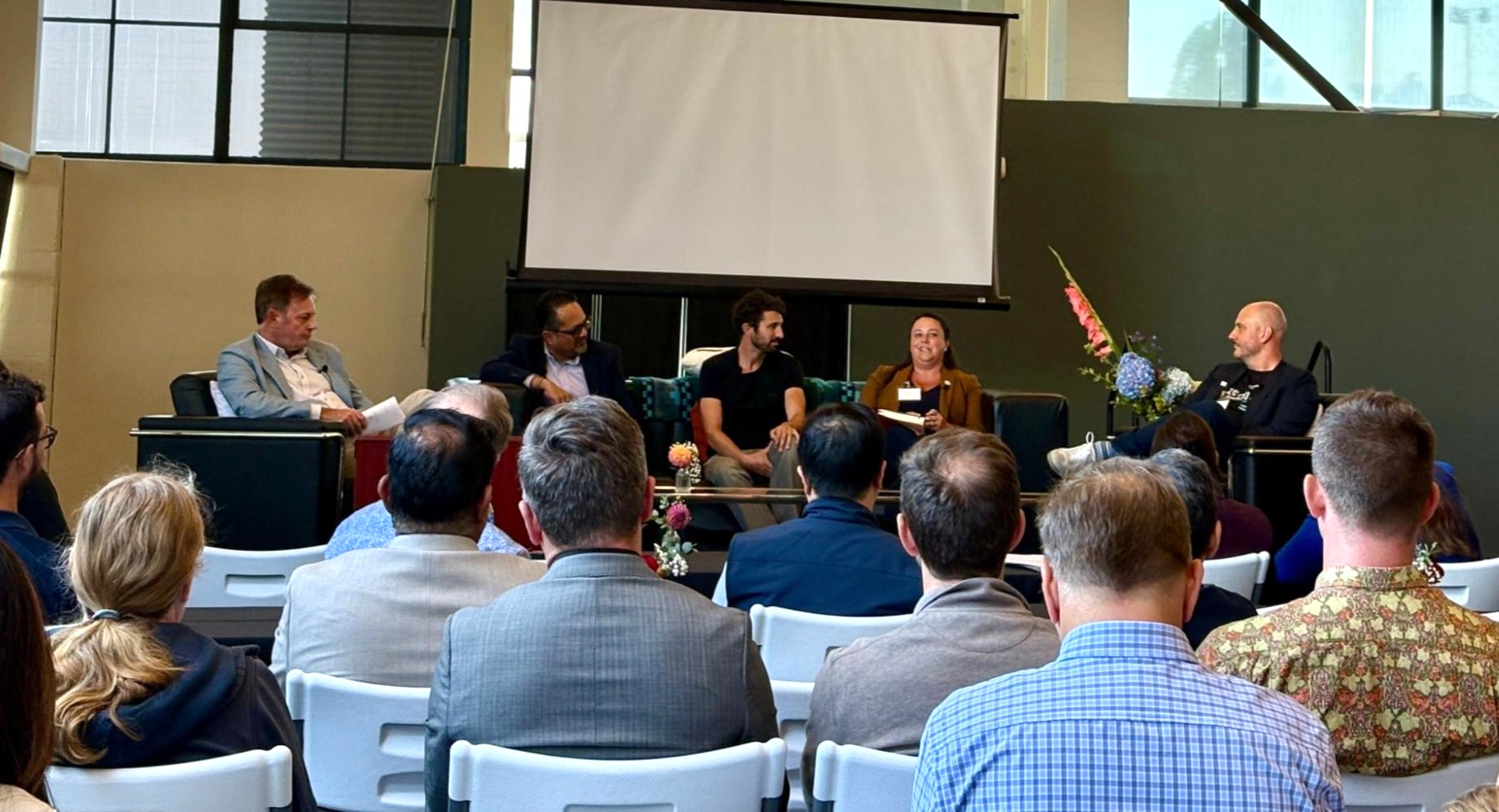
From left, Marc Cummings, Life Science Washington; Snehal Patel, Sana Biotechnology; Joe Horsman, Madrona Venture Group; Rebecca Bryant, Fred Hutch Cancer Center; and Alex Zanghellini, Arzeda, at a Seattle forum hosted by the National Security Commission on Emerging Biotechnology on Tuesday. (GeekWire Photo / Sydney Jackson)
Arzeda designs enzymes for products ranging from laundry detergent to stevia. But when it comes time to manufacture at commercial scale, the Seattle-based startup often has to look overseas.
That’s why, when a federal biotechnology commission visited Seattle on Tuesday, the industry came forward with a problem: They have the science, but lack the infrastructure and workforce pipeline to keep innovation on U.S. soil.
Arzeda’s designs reach an estimated 1.8 billion consumers worldwide, and the company has spent the better part of two decades building its technology. The company’s enzymes, sometimes designed in days rather than weeks thanks to AI, are largely manufactured in Western Europe and India — with one U.S. contract manufacturing partner in Wisconsin.
Finding domestic manufacturers with the expertise and capacity to make these specialized proteins has been difficult, CEO Alexandre Zanghellini said. And for a company trying to commercialize new biotechnology, he added, manufacturing delays can be “catastrophic.”
The federal group visiting Seattle — the National Security Commission on Emerging Biotechnology — was created by Congress to address these kinds of problems. Since 2022, the team of 11 bipartisan experts have examined how biotech intersects with national security, and what the U.S. needs to do to remain competitive with China.
Last year, the commission drafted a report to Congress with 49 recommendations spanning at least $15 billion in federal investment over five years, with policies to get more private capital into biotechnology, build domestic manufacturing capacity, strengthen the workforce and reduce vulnerabilities in the supply chain.
Now, with the commission sunsetting in December, its members are taking their case around the country.
The science is here, the infrastructure isn’t
In Seattle, the urgent matter is finding a way to keep biotechnology breakthroughs in the United States. Alexander Titus, a commission member who has headed AI-focused biotech initiatives in Seattle and nationwide, said Washington stands out for its early innovation and research.
National Security Commission on Emerging Biotechnology commissioners Alexander Titus, left, and Paul Arcangeli speak with attendees at a Seattle biotech forum on Tuesday. (GeekWire Photo / Sydney Jackson)
“Companies like Arzeda are having pretty serious leadership roles in the AI and bio space,” he told GeekWire. “A lot of the work we have done in the commission has revolved around helping the U.S. meet the moment when it comes to this nexus.”
Institutions like the University of Washington, Fred Hutchinson Cancer Center and the Allen Institute have helped build a deep life-sciences ecosystem in Washington. UW’s Institute for Protein Design, led by 2024 Nobel Prize winner David Baker, has spun out more than 20 companies.
One is Arzeda, which has an increasingly fast agentic workflow that can fine-tune a model, suggest the next experiment, and allow researchers to test thousands of sequences in a single round. The company’s first AI-designed commercial product was a stevia ingredient launched in 2024; it’s now negotiating a $44 million contract with the federal Defense Threat Reduction Agency related to biothreat response.
While technology is moving quickly, the infrastructure needed to commercialize it is not — creating what Seattle biotech leaders called a “valley of death” between research and manufacturing.
The U.S. has federal funding for basic research, as well as a venture-capital system that can finance early-stage discoveries. But once a company needs to build or access physical infrastructure for commercial-scale manufacturing, the financing becomes much harder. Venture capital investors don’t see the returns attractive enough, Zanghellini said. Banks aren’t eager to finance them, either.
The pull of overseas manufacturing
Meanwhile, China has spent two decades making biotechnology a strategic priority, and its 2026 Five-Year Plan doubles down on areas including biomedicine, biomanufacturing, pharmaceuticals and brain-computer interfaces. For U.S. companies in the race, that can create an uncomfortable incentive: If the infrastructure is cheaper and faster somewhere else, that’s where the work often goes.
Last year, Seattle-based Sana Biotechnology canceled plans for a manufacturing plant that was supposed to employ hundreds of workers in Bothell, Wash., instead opting for a contract manufacturer elsewhere to cut costs. Snehal Patel, the company’s executive vice president and chief technical officer, said on Tuesday he’s optimistic the Seattle area could compete on speed and cost with China’s fully integrated supply chain — with the right resources.
Ideally, manufacturing facilities in the U.S. would offer flexibility and knowledge in different products and processes, while ensuring trade secret protection.
The commissioners recognize this need; among their recommendations for Congress is a nationwide manufacturing network for precommercial, bioindustrial product scale-up. That could address the problem Seattle companies face: a startup shouldn’t have to choose between sending manufacturing overseas or trying to build an entire facility itself.
The commission has also recommended requiring companies to disclose points of supply-chain vulnerability in foreign countries of concern. If a geopolitical conflict disrupts the supply of medicines or other biological products, Titus said, the consequences can reach Americans far from any battlefield.
“Being able to keep and maintain our leadership in certain industries allows us to have the edge in any given situation,” he said. “We want our industries to be able to produce here…it’s truly national security in the broadest sense at this point.”
Building the workforce pipeline
To accomplish this, companies need a stronger industrial biomanufacturing workforce.
Rebecca Bryant, Fred Hutch’s director of government relations and a former staffer for Rep. Adam Smith, said while Washington trains well for research, there’s no equivalent pipeline into entry-level biomanufacturing jobs. Titus sees the issue as part of a broader problem of “bioliteracy” — that biology should be a basic problem-solving tool in the same way that engineering, chemistry and computing are, rather than a specialized field understood by few.
In Washington, the Hutch Advance partnership with Shoreline Community College trains and places lab technicians, while Sana Biotechnology has worked on a model for moving workers into biomanufacturing. Seattle industry leaders suggested a state or federally-supported workforce consortium to bolster the effort. Meanwhile, the commission has urged Congress for more biomanufacturing training support.
According to the commission, the next three years will determine whether the U.S. remains the global leader in biotechnology or cedes the future to China. Of the commission’s 49 recommendations, Titus said, 26 have been written into law in some capacity. The next step is in the hands of Congress, federal agencies, states and the industry itself.
T-Mobile is cutting 77 jobs across Washington state, trimming staff across its Bellevue headquarters, regional retail stores, and remote roles, according to a new state filing.
The workforce reductions span frontline, regional, and corporate roles, eliminating positions ranging from retail mobile experts and account care specialists to principal systems architects and senior directors at the wireless carrier.
In addition to 63 newly disclosed job cuts, the filing includes 14 workers whose previously announced departures were deferred to this fall.
Beyond corporate offices, the cuts will result in permanent store closures across Washington. Locations expected to close include retail sites in Seattle (45th & Stone Way), Bothell, Kennewick, Tacoma, Vancouver, and Yakima.
“Like all businesses, we’re constantly looking at where we allocate our resources so we can invest in the areas that matter the most to our customers,” a T-Mobile spokesperson said in an emailed statement. “That means making adjustments where needed while continuing to hire in areas that support our priorities, strengthen our momentum and help us keep changing the industry through innovation.”
The spokesperson pointed to a broader retail pivot aimed at concentrating its store footprint toward company-operated locations integrated with digital tools like its T-Life app, rather than third-party dealer operations.
“Changes to third-party dealer-operated locations do not affect T-Mobile employees,” the spokesperson added. “In most cases, T-Mobile retail employees can apply for positions in other locations or relocate if there is a change to their current store.”
A subset of the latest cuts stems from facility relocations, where some employees were offered transfer opportunities, according to the filing.
The company previously cut 393 workers in Washington in February.
Editor’s note:A previous version of this story incorrectly stated that a T-Mobile store in Bellingham would be closing. That information came from an error in the WARN filing.

 Login
Login