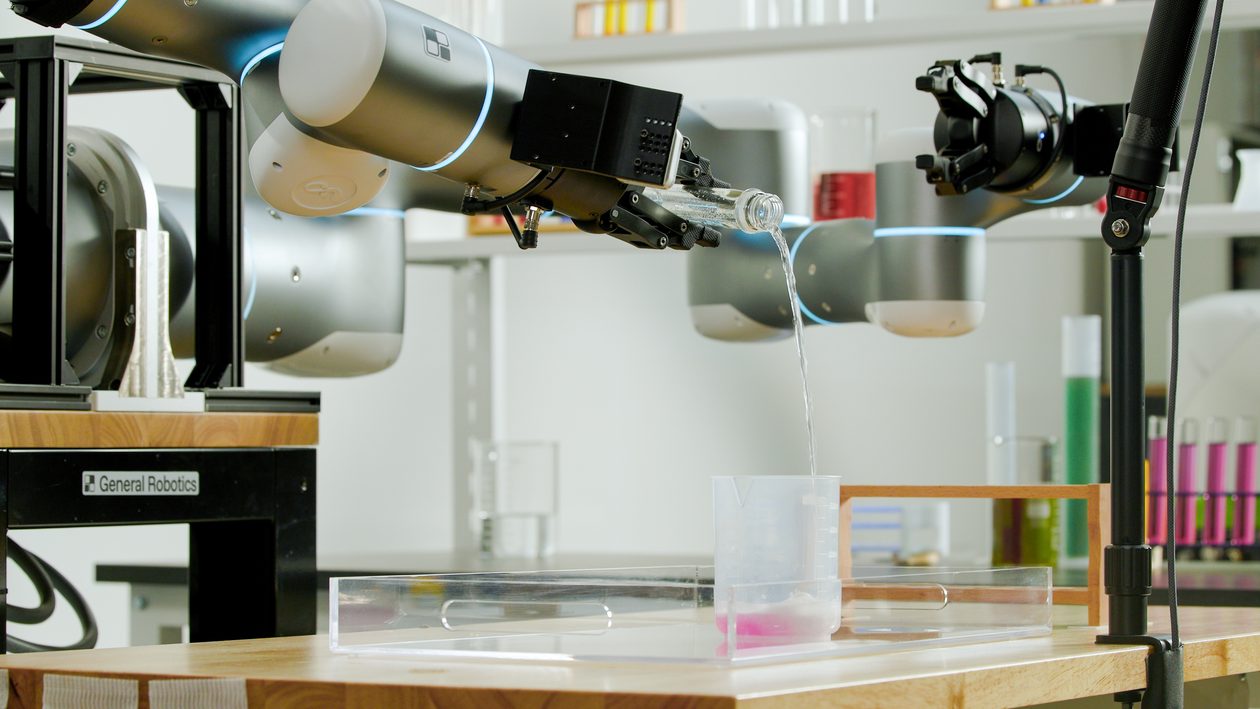
A robot arm pours from a test tube into a beaker in General Robotics’ lab. The company used the task, and progressively harder versions of it, to test its Auto Engineering system. (General Robotics Photo)
A Redmond, Wash., robotics software startup founded by former Microsoft researchers says its platform can now handle much of the work of getting a robot up and running in a factory, warehouse or other industrial setting, a job that used to take a team of engineers.
General Robotics said Wednesday that advances in GRID, its robot intelligence platform, have cut the process of onboarding a new robot from about a month to as little as two hours. The company calls the approach “Auto Engineering,” with each onboarded robot and diagnosed failure feeding back into the system and speeding up the next deployment.
General Robotics CEO Ashish Kapoor.
“Before this moment, it would take us a team of experts to go and execute on behalf of our customers,” said General Robotics CEO and co-founder Ashish Kapoor in an interview. “Clearly non-scalable, clearly very expensive, and clearly will take a long time.”
With Auto Engineering, he said, “we can magnify and accelerate each engineer’s capability.”
Founded in 2023, the company has grown to about 50 employees, primarily engineers. It has raised nearly $34 million, most recently in an April round led by Construct Capital, with participation from Khosla Ventures, Accenture Ventures, Nvidia and Valo Ventures. PitchBook put the size of the round at $25 million; the companies didn’t disclose terms at the time.
Kapoor said General Robotics has roughly a dozen customers — large enterprises across manufacturing, logistics, energy and defense — and revenue in the millions of dollars.
Customers include HTX, the science and technology agency of Singapore’s Ministry of Home Affairs, which Kapoor said has been working with General Robotics for about a year and a half.
The company’s platform works with robot types including industrial arms, humanoids, quadrupeds, wheeled robots and drones, according to the company.
General Robotics is operating in a competitive and well-funded sector. Physical Intelligence, which builds foundation models for robots, has raised more than $2 billion. Nvidia — an investor in General Robotics, and the maker of the Isaac Sim simulation software built into GRID — is developing its own robot models and deployment tools.
Robot makers build good hardware, Kapoor said, but often lack the expertise to put it to work in a specific setting like a shipping terminal. “That last layer is missing.”
Before co-founding the company, Kapoor spent 17 years at Microsoft, ultimately as general manager of its autonomous systems and robotics research group in Redmond, where he created the open-source drone simulator AirSim. General Robotics co-founders Sai Vemprala (CTO) and Shuhang Chen came from the same Microsoft team.
GeekWire covered the launch in 2023, when it was Scaled Foundations and billed itself as “ChatGPT for robots.” It had five employees at the time, focused on aerial robotics and drones, with backing from Khosla and E14 Fund. It later renamed itself General Robotics.
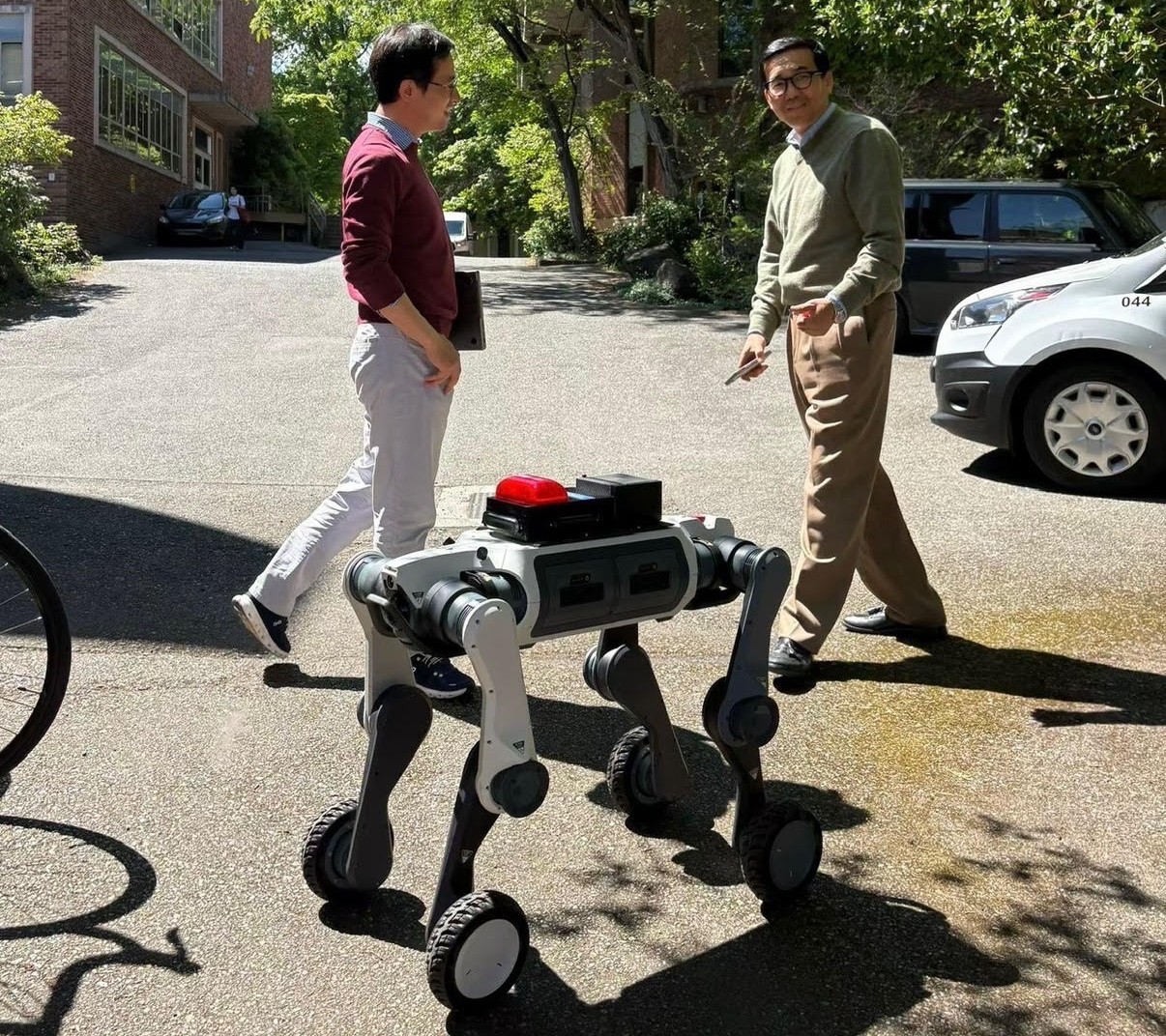
University of Washington College of Engineering Vice Dean Jihui Yang, right, and professor Xu Chen walk a robot dog on the UW campus. (Photo courtesy of Xu Chen)
Robotics jobs in the Pacific Northwest are multiplying faster than universities can train people to fill them. The University of Washington thinks it has an answer — or at least a start.
The university capped enrollment at 35 students for the inaugural cohort. More than 30 people had already signed up for an information session before applications even opened. It’s an early signal, engineering leaders say, of pent-up demand from regional powerhouses racing to hire engineers who can operate at the intersection of AI, software and hardware.
Program leaders say that skill set is rooted in a traditional, narrowly focused engineering degree that hasn’t kept pace with the rapid evolution of technology. UW is betting that the fix lies at the intersection of AI and hardware, echoing an industry buzzword called “physical AI.”
“Robotics is no longer confined to a single discipline,” said Xu Chen, a UW engineering professor and director of the Boeing Advanced Research Collaboration, who played a large role in the committee that designed the new programs. “The future will need a wide variety of robotics knowledge, and that’s what we built these programs to deliver.”
Applications opened Sept. 1 and will close Sept. 10, with UW aiming for a roughly one-week turnaround before notifying applicants. For its inaugural year, the university is intentionally keeping things small: 25 seats in the master’s program and 10 in the certificate track, which is designed for working professionals who want robotics training without leaving their jobs.
Chen said the small first cohort is by design, not a limitation. The goal, he emphasized, is to get the fundamentals right before scaling up. He expects the programs to roughly triple in size within three to five years.
“Companies are seeing newer potential in robotics as advanced computing and the wave of AI technology mature,” Chen said. “They see that their workforce will benefit from a modern robotics program, and that need is really what drove this.”
Getting there will take machines, and lots of them. UW is purchasing robots and computing hardware for its initial course offerings while also leaning on industry donations: robots, GPUs, and computing infrastructure among them, according to Chen.
Amazon and Microsoft anchored the effort early; the list of partners has since grown to include NVIDIA, Boeing, Dassault Systèmes — the French software company behind design tools like SolidWorks — and at least one smaller robotics manufacturer.
“The industry board was incredibly supportive from the start,” Chen said. “We’ve had almost a year of continuous meetings and collaboration with them and with representatives across our own engineering departments.”
The broader structure of the program is meant to make it easier for students from different corners of engineering, such as electrical, mechanical and computer science, to land in the same classroom and eventually choose their own path deeper into robotics through electives.
The program is also drawing on UW’s existing research muscle in the region. It taps directly into the Boeing Advanced Research Collaboration, which Chen directs, along with robotics labs inside the Paul G. Allen School of Computer Science & Engineering. That gives students a line into the same research infrastructure that already feeds Seattle’s aerospace and e-commerce giants.
The university’s ambitions extend well past this fall’s launch. Chen said UW has already mapped out longer-term plans for an undergraduate robotics degree and, eventually, a Ph.D. program, with the two new offerings serving as the foundation.
For now, the clearest sign of the program’s ambitions arrived this summer in an unlikely form: a pack of robot dogs let loose on UW’s campus.
“Seattle’s hills make it a uniquely difficult place for robots to move around, which is exactly why it’s a great place to study it,” Chen said.
Both students and faculty got a chance to operate the robots directly, Chen said. It was a hands-on moment that underscored how much more accessible robotics technology has become in just the last few years.
“It was exciting to see the students so happy to see the robots,” Chen said. “That’s the kind of energy we want to build this program around.”
Bill Gates, whose new essay warns of the risks ahead in the AI era, during a 2017 interview. (GeekWire File Photo / Kevin Lisota)
When Bill Gates talks, people listen. This week he published a lengthy essay on what AI is going to do to work, and told GeekWire that people inside AI companies who name the downsides get told, “Hey, you’re hurting our PR while we’re trying to raise trillions of dollars.”
He’s right about the hard part. The job displacement he describes lands on young workers first, and the safety net is funded by taxes on the very wages that AI erodes. He prescribes three treatments: new institutions at home and abroad, a tax on AI tokens and robots, and “Human Reserved,” a category of jobs only people may hold.
Gates has the diagnosis right but the prescription mostly wrong. I’d sign the robot tax tomorrow, because hiring a person costs you payroll tax every year while buying a robot gets written off in year one. The other two I’d send back.
Let’s start with what’s solid. Stanford’s Digital Economy Lab updated its “Canaries in the Coal Mine” work this month. Employment for 22-to-25-year-olds in the most AI-exposed occupations is running 19% below where it would be if it had kept pace with their peers in less exposed work, up from 15% a year ago. The same authors say they don’t see widespread, economy-wide displacement, and unemployment held at 4.1% in July.
The AI damage isn’t arriving as layoffs. It’s arriving as jobs that never get posted, and Gates is right that the young get it first.
Now the token tax. Tokens (essentially words) are what AI companies bill by. Taxing tokens is like taxing keystrokes: it measures effort, not displacement.
A high school class working through calculus with an AI tutor burns tokens continuously. A model that quietly retires a 40-person customer center might burn relatively few. The tax lands hardest on the uses Gates says he wants to protect.
Stanford’s AI Index put the cost of GPT-3.5-level performance at $20 per million tokens in November 2022 and seven cents by October 2024, a 280-fold drop. You’d be indexing the safety net to a number that falls every year while displacement rises.
And you can’t collect it. Inference runs on laptops and phones now, and on servers in whatever country declines to sign. A token tax is a tax on whoever uses an American API, and every dollar it adds makes a Chinese model look cheaper. We’d be slowing ourselves down and not China.
Gates says the institutions will take years to build, and also says we can’t afford to move slowly. He’s right twice, and that’s the problem. He wants the international body to borrow from nuclear inspections and aviation regulation. That may pan out in the long term, though the UN is the cautionary tale for the bureaucratic nightmare that the international community can produce.
Meanwhile we have functional agencies with jurisdiction today. The FDA can rule on AI in diagnosis. The FTC can go after AI-enabled fraud. We don’t need a new agency to say a bank can’t deny your mortgage because a model felt like it. We need the banking regulator to reiterate it forcefully.
That leaves Human Reserved, his best idea but his most privileged one. Gates would protect a job for either of two reasons: the role is deeply personal, like a caregiver, or the people who hold it are unlikely to find other work. Only one of those holds.
Freezing headcount because the workers have nowhere else to go protects the job for a while and makes the service more expensive along the way. Reserving the moments when a human being is the point is defensible, and Gates makes that case well. On a robot delivering the news that you have an incurable disease, he writes, “There’s no technical reason why it couldn’t,” and adds, “Yet it shouldn’t.” He’s right.
I made the case in WIRED nine years ago that displaced workers should move into caregiving, and that it would take real money to lift the pay enough to draw them.
The problem with Human Reserved is that it assumes there’s a human being available. Home health and personal care aides earn a median of $34,900 a year, and BLS projects roughly 765,000 openings in that occupation every year through 2034. At that wage, they keep coming open. A third of home care aides are immigrants, and tighter enforcement threatens that supply. A rule that reserves care for people, in a market with no spare people, reserves care for the families who can outbid everyone else.
Gates half-anticipates this, telling The New York Times he might be a flawed messenger because of his wealth. On this point he is. The caregivers who gave his father something irreplaceable were in that room because someone could pay them to be there.
So don’t fence AI out of the room. Put it to work in the hours nobody is paid to cover.
In February the Times ran Eli Saslow’s story about Jan Worrell, 85, living alone on Washington’s Long Beach Peninsula with an AI companion called ElliQ that engages her about eight times a day and pushes her to stay hydrated and moving. (I serve on ElliQ’s board, and I joined because the company builds a machine that extends a caregiver’s reach instead of replacing one.)
Her goal, she told her doctor, was to never live anywhere else. Fund enough aides to cover the hours that need a person and put the machine on the rest.
Here’s where I net out: equalize the tax treatment of labor and capital, which Congress could do next session, and route the proceeds into retraining and into topping up the pay of workers who land in lower-paying jobs. That’s a better answer than a protected job title.
Drop the token tax, build the caregiving workforce instead of fencing it off, and use the regulators we already have while somebody works on the ones we don’t.
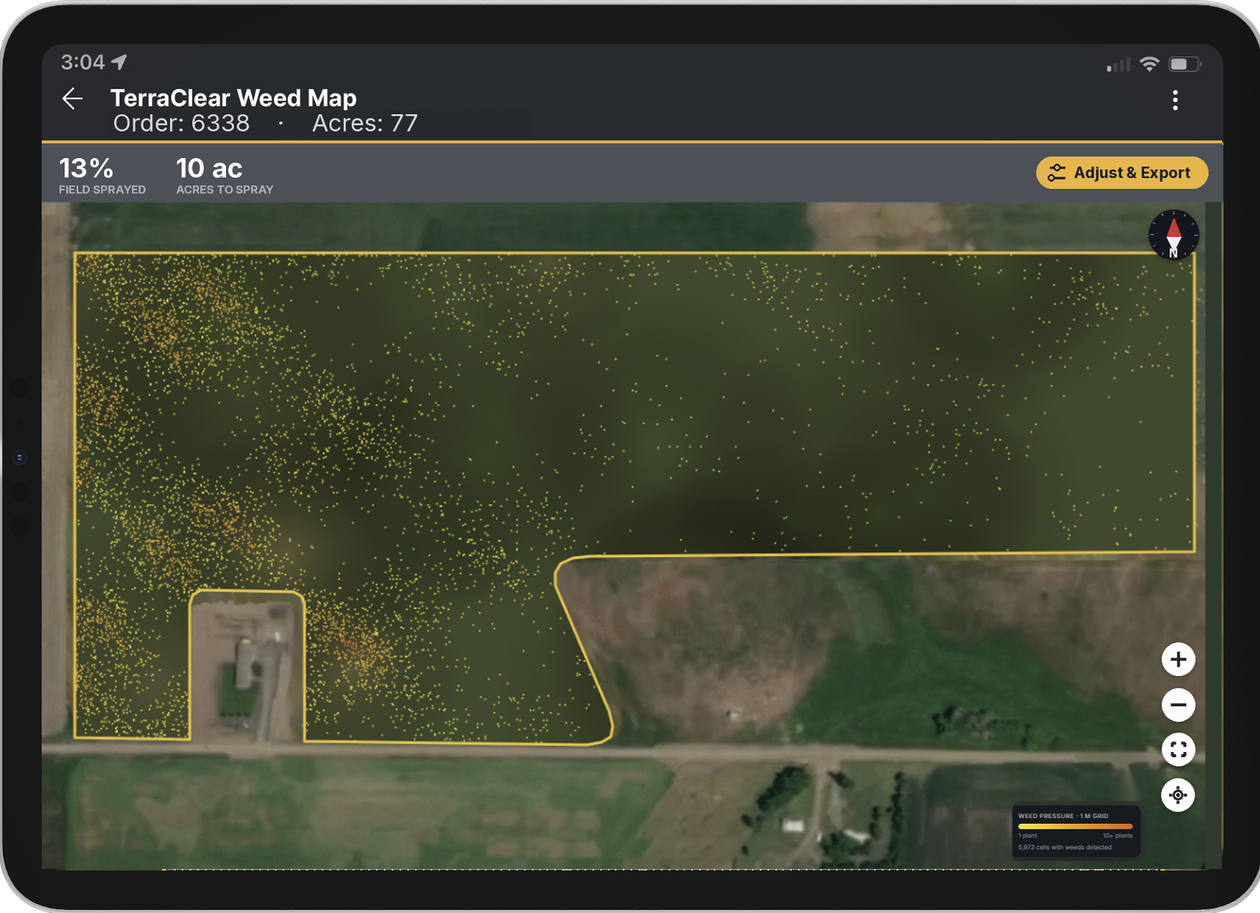
TerraClear’s new Weed Maps helps farmers identify individual weeds as small as a quarter inch. (TerraClear Photo)
The next big test for AI isn’t happening in a data center. It’s happening in the dirt.
Really, it’s in the weeds.
Two Seattle-area startups are betting that AI can transform how farmers find and eliminate unwanted plants — one by mapping every weed, the other by zapping them with lasers.
Issaquah, Wash.-based TerraClear is commercializing a new system that uses ultra-high-resolution imagery and machine learning to map individual weeds across entire fields of corn and soybeans, then turns those detections into digital prescriptions that can be sent directly to precision sprayers.
Meanwhile, Seattle-based Carbon Robotics is taking a different approach: Its autonomous LaserWeeder uses computer vision to identify weeds and then blasts them with lasers.
Now, the AI powering these systems is getting smarter, too — moving beyond simple weed detection toward models that can recognize and understand plants across different crops, fields and growing conditions.
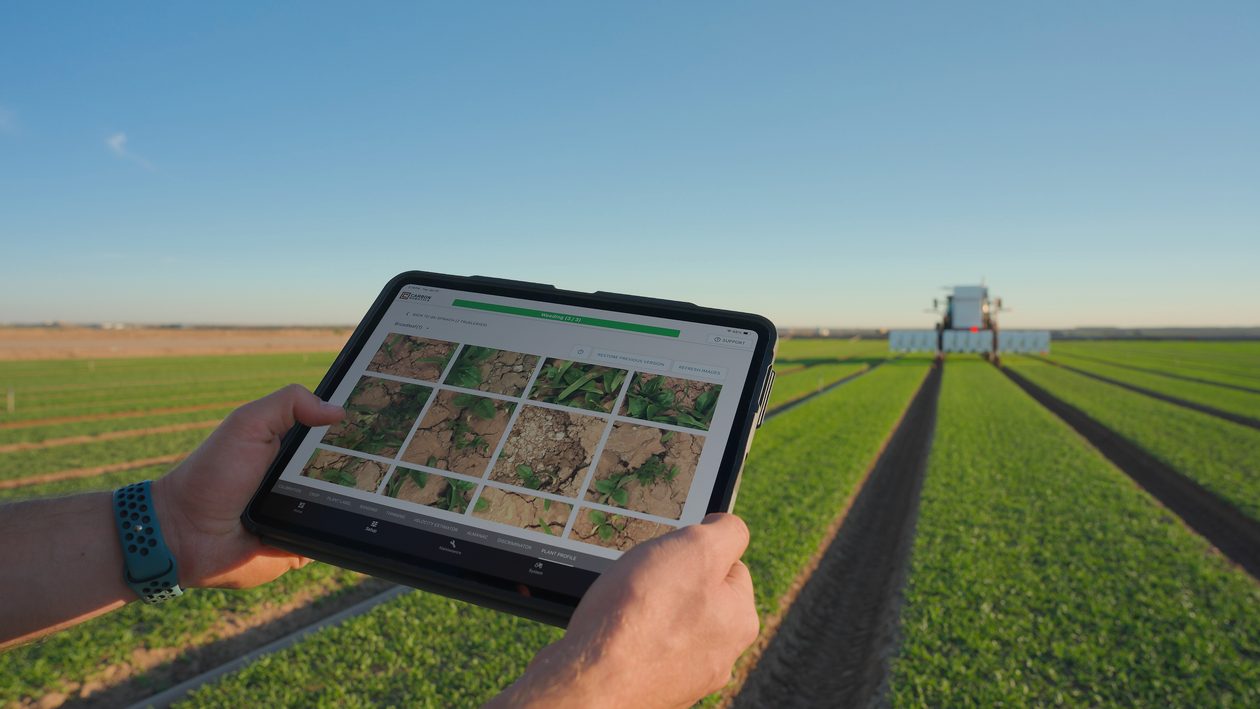
Carbon Robotics recently-released Plant Profiles, a feature added to all LaserWeeders, enables farmers to tailor the foundational LPM to their unique crops, weeds, and field conditions. (Carbon Robotics Photo)
TerraClear’s new Weed Maps, announced Tuesday, captures imagery at 1.5-millimeter resolution and identifies weeds as small as the eraser on a pencil. Rather than sampling portions of a field, the company says it collects images of every acre and produces a geo-referenced map that can be uploaded to section or nozzle-controlled sprayers used by farmers.
The goal is precision at a level that would be difficult for a human to achieve, allowing a farmer to know where the individual weeds are.
TerraClear says the maps can be delivered the next day, giving growers a chance to act while weeds are still small and easier to control.
Devin Lammers, the chief executive of TerraClear, tells GeekWire that its approach “sidesteps the capital problem entirely.” In other words, farmers need not buy a new piece of expensive equipment, instead using software to turn existing sprayers into precision instruments by telling them exactly where to spray.
He called Carbon Robotics laser-weeding system “impressive technology,” noting that it works well for specialty crops and organics.
But bigger farms producing commodity crops like corn and soybeans — the market TerraClear is going after — need a different approach, he said.
“Modern grain and oilseed sprayers already have individual nozzle control and RTK positioning — the actuation hardware is sitting in the shed,” Lammers said via email. “We just hand the sprayer a shapefile of individual weed locations and it turns the nozzle on only where a weed actually is.”
Given that large corn and soybean growers farm more acres at a lower revenue per acre, Lammers said it’s a “very different P&L” where expensive new equipment needs to pencil out.
With TerraClear’s new system, Lammers added that “the farmer buys a map, not a machine.”
RFK Jr. and new ways to farm
One of the benefits of both approaches is chemical use reduction in the field, a hot topic in political circles with President Trump earlier this year committing $1 billion to modernize farming and reduce chemicals in agriculture. That federal investment could help spark new innovations, like the ones TerraClear and Carbon Robotics are developing.
Robert F. Kennedy Jr., the U.S. secretary of health and human services, earlier this year touted Carbon Robotics’s machines on an episode of The Joe Rogan Experience as a possible solution in cutting pesticide use.
In the case of TerraClear, Lammers said the precision mapping technology alone could cut pesticide and herbicide use by up to 80% with no loss of efficacy.
Both startups are part of a broader Pacific Northwest ag-tech ecosystem that has been applying AI and robotics to agriculture, building on the regions farming and tech roots.
TerraClear founder Brent Frei represents that unique farming and tech DNA. He grew up on a family farm in Grangeville, Idaho, before studying at Dartmouth and then moving to the Seattle area where he co-founded Onyx Software and Smartsheet.
Founded in 2017, TerraClear originally attacked a much less glamorous agricultural problem: identifying and removing rocks from farmers’ fields. In 2024, the company raised $15 million, bringing its total funding to $53 million.
By February of this year, TerraClear had expanded to about 50 employees and was approaching 1,000 customers. At that time, it also launched an autonomous field robot called TerraScout, designed to collect high-resolution imagery across a field and convert that information into actionable maps for existing farm equipment.
The company says TerraScout can collect more than 4 billion image samples per acre and map more than 1,000 acres a day under favorable conditions.
In addition to TerraScout, Lammers said they are using aerial drones to ingest field-level data into its new Weed Maps product.
“That’s the part that compounds — the imagery we gather is field-level, repeated season over season, and specific to the commodity acre,” Lammers said. “Models get better, which makes the maps better, which brings more acres, which produces more data.”
TerraClear’s autonomous field robot the TerraScout. (TerraClear Photo)
Carbon Robotics is further down the road in making the machine the decision-maker, and eradicating weeds without the use of chemicals.
The Seattle startup’s LaserWeeder combines cameras, AI and high-powered lasers to identify weeds and destroy them without applying herbicides or pesticides. The company has deployed its machines on farms around the world and has built an enormous dataset in the process.
Announced in February, its so-called Large Plant Model was trained on 150 million labeled plants, which Carbon describes as the largest agricultural plant dataset of its kind. The company’s goal is to move beyond narrowly trained computer-vision systems that need to be retrained whenever a new weed or field condition appears.
With the Large Plant Model, farmers can use Carbon’s Plant Profiles feature to show the system a handful of images and customize what the machine should recognize and target.
Given the changing dynamics of a weed during various stages of its growth — and based on conditions such as soil, weather and crop varieties — Carbon wants to correctly identify the difference between a weed and a crop.
“When our robots can understand any plant in any field immediately and adapt behavior in real-time, farmers immediately get maximum value from the machines,” Carbon Robotics CEO Paul Mikesell said in a press release. “The Large Plant Model provides farmers with the most advanced AI technology to maximize the weeding quality of LaserWeeder in their unique environments.”
Founded in 2018, Carbon Robotics has raised $177 million to date and as of last year employed about 260 people at offices in Seattle and a manufacturing facility in Richland, Wash.
The farm becomes a giant AI dataset
TerraClear and Carbon Robotics are attacking one of agriculture’s thorniest problems — weed management — from different directions.
TerraClear wants to allow a farmer to keep using a conventional precision sprayer, while making it dramatically more selective via its Weed Maps.
Carbon, meanwhile, is developing autonomous laser-weeding equipment itself, identifying and eliminating the individual weeds in real time without chemical spray or tractor operators.
The bigger opportunity for both companies may ultimately be neither maps nor lasers, but the underlying data they gather.
Every time a camera passes over a field, it can collect information about plants, soil, crop health and growing conditions. That’s vital information to farmers, seed producers, agriculture researchers and equipment manufacturers.
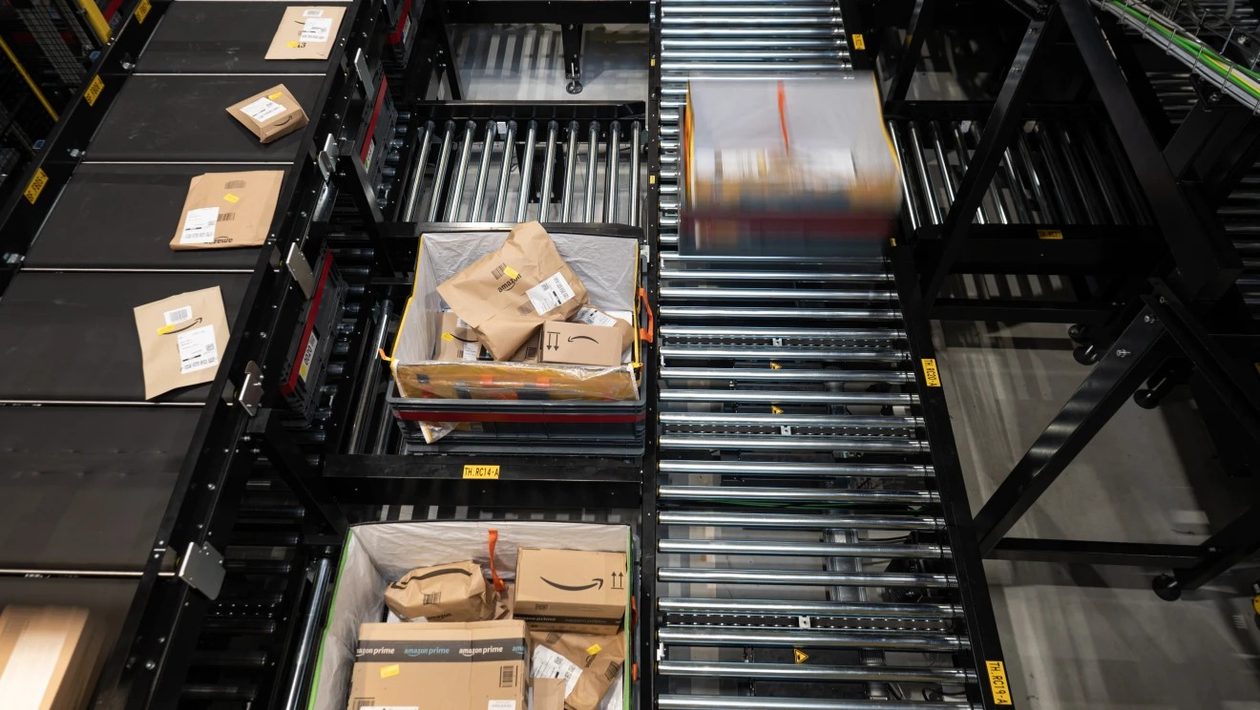
Amazon’s ZancaSort system brings packages to workers automatically at its Last Mile Innovation Center in Dortmund, Germany. A separate initiative, Project Tetromino, reportedly aims to bring full automation to delivery stations. (Amazon Photo)
Visiting an Amazon delivery station can feel like walking into the past.
While many of its massive fulfillment centers are equipped with the latest robots and automation, Amazon’s delivery stations — the final stop before packages reach the doorstep — remain mostly manual. Workers often sort parcels by hand, load them into bags, and stage them for drivers.
That could be changing. Business Insider reports that Amazon is developing an internal initiative called Project Tetromino to build “fully automated” delivery stations, citing an internal planning document that includes specific financial projections.
The name appears to be a nod to Tetris, reflecting the puzzle-like challenge of efficiently organizing packages for delivery vehicles.
“We’re always exploring and testing new technologies across our operations to improve safety and the delivery experience for customers,” Amazon spokesperson Brad Glasser said in a statement. He added, “The details cited here are inaccurate and don’t reflect our current plans. Like any early-stage concept, this is one of many initiatives we regularly evaluate, and plans evolve significantly as we learn.”
Business Insider reported that a key technology behind the effort could come from Boxbot, an Alameda, Calif.-based robotics startup that uses conveyors and AI-driven storage trays to automatically sequence packages for vehicle loading. The company says the process is up to 10 times faster than manual methods.
Responding to an inquiry from GeekWire, Boxbot CEO Austin Oehlerking said he could not comment on activities with any specific customer but said the company has “tested and deployed live systems within the parcel delivery, logistics, and automotive industries over the last several years.”
Oehlerking described Boxbot’s technology as filling a gap in warehouse automation. Automated storage and retrieval systems are typically designed for fulfillment operations, while Boxbot is building them for high-throughput package handling at other points in the supply chain.
“This type of storage system can be very useful at different points in the supply chain, depending on the customer,” he added.
Amazon said its delivery station initiatives are “designed to complement and empower our workforce.” The company has been ramping up automation across its operations, with more than a million robots now deployed in its fulfillment network and plans to more than double its fleet of robotic arms this year, citing goals to improve safety, ergonomics and efficiency.
The company has also opened a Last Mile Innovation Center inGermany, where it has been testing delivery station technologies including automated unloading, sorting, and scanning systems.
The new sorting facility in Renton, Wash., where materials from 50 libraries are routed to 186 delivery chutes. (Photo: Ken Yeung)
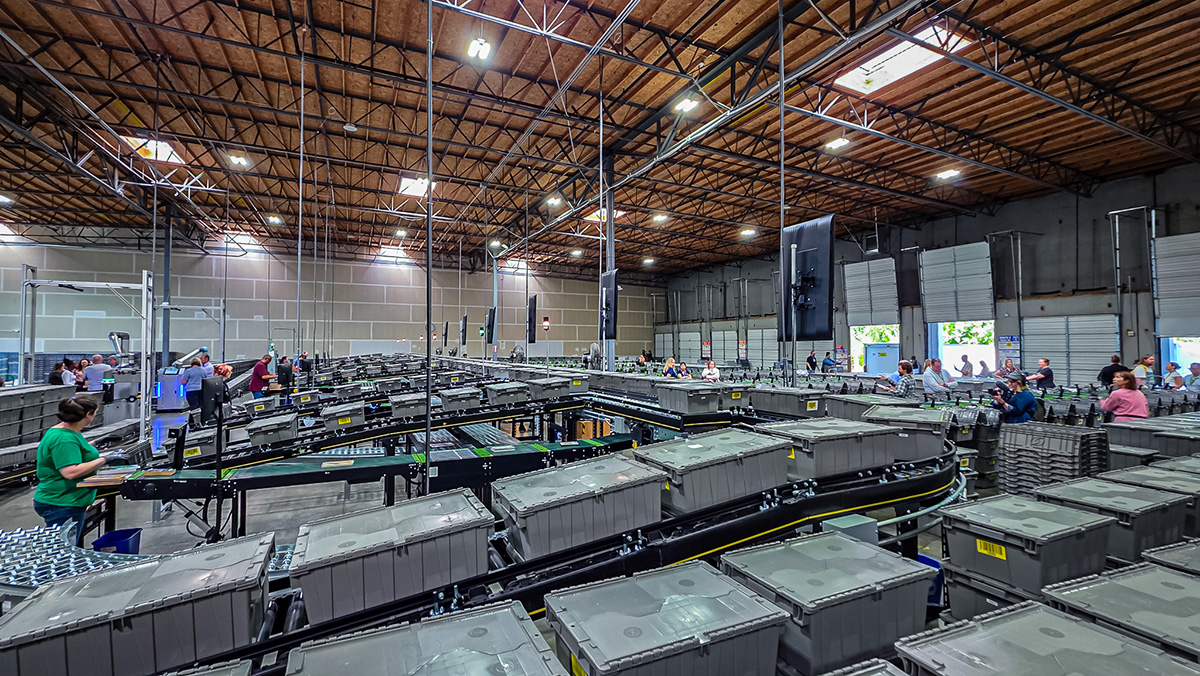
Washington is home to Mount Rainier, the Space Needle, and the Super Bowl champion Seattle Seahawks. It’s also now home to what the King County Library System says is North America’s largest library materials sorter — a $5.2 million installation in Renton that formally opened Wednesday to handle the 25,000 items circulating through KCLS’s 50 libraries every day.
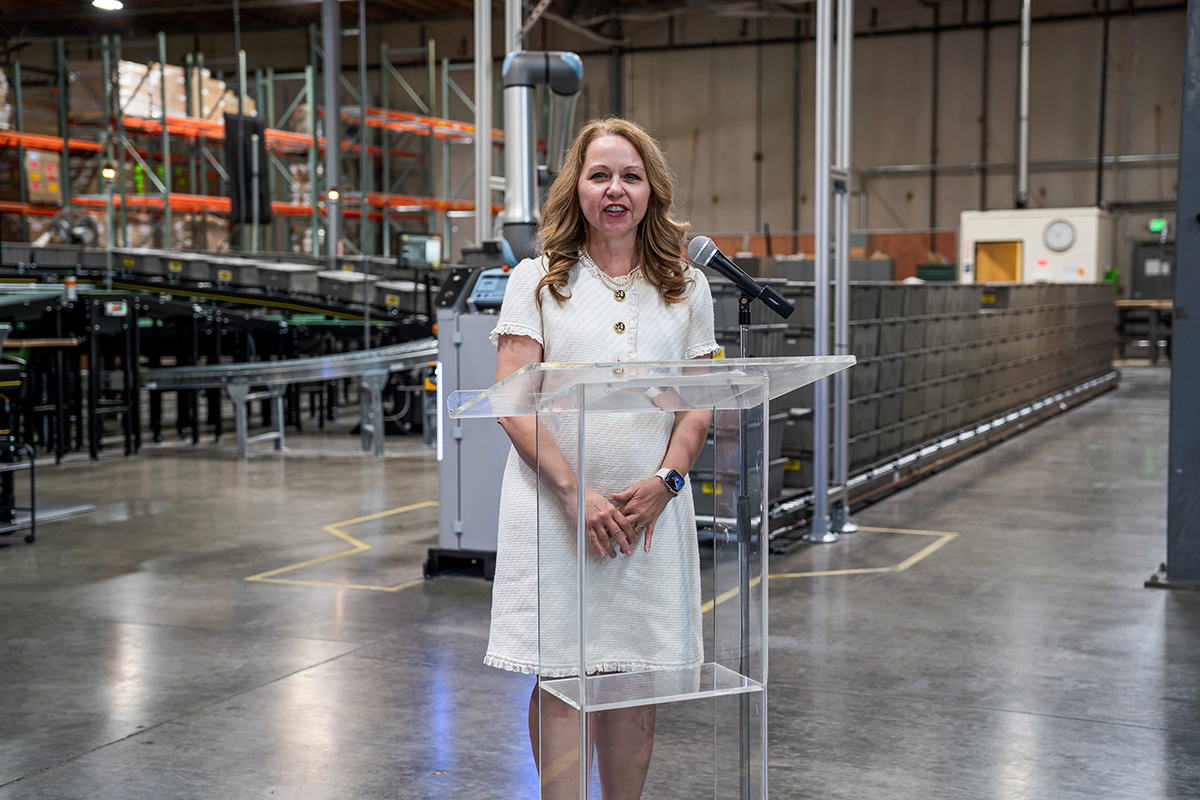
KCLS Executive Director Heidi Daniel. (Photo: Ken Yeung)
The new warehouse has been running since June 14. It’s the culmination of a more than three-year process. It replaces KCLS’s previous distribution center in Preston that operated for almost 25 years. Heidi Daniel, the organization’s executive director, said it was time to modernize: “It couldn’t keep pace with our growing community.”
In 2025, KCLS’s 700,000-plus active cardholders checked out more than 11 million physical items and 12 million digital items. And while the previous sorter “served KCLS faithfully,” it was plagued by mounting maintenance needs and frequent breakdowns. “We were literally ordering parts off of eBay,” Daniel said.
KCLS said the new sorter can handle up to 8,000 items per hour at full tilt.
Warehouse operations manager Charlie Mitchell walked through the sequence: drivers returning from branch pickups load totes onto one of two conveyor belts, and a pair of robotic arms at the far end destack them at a rate of one every 15 seconds.
On an average day, Mitchell estimated that 800 to 900 totes could be received. A human worker scans each item individually, and that scan tells the system where the material goes next: onto a second belt and into one of 186 chutes where it’s packaged into a new tote for the next delivery run.
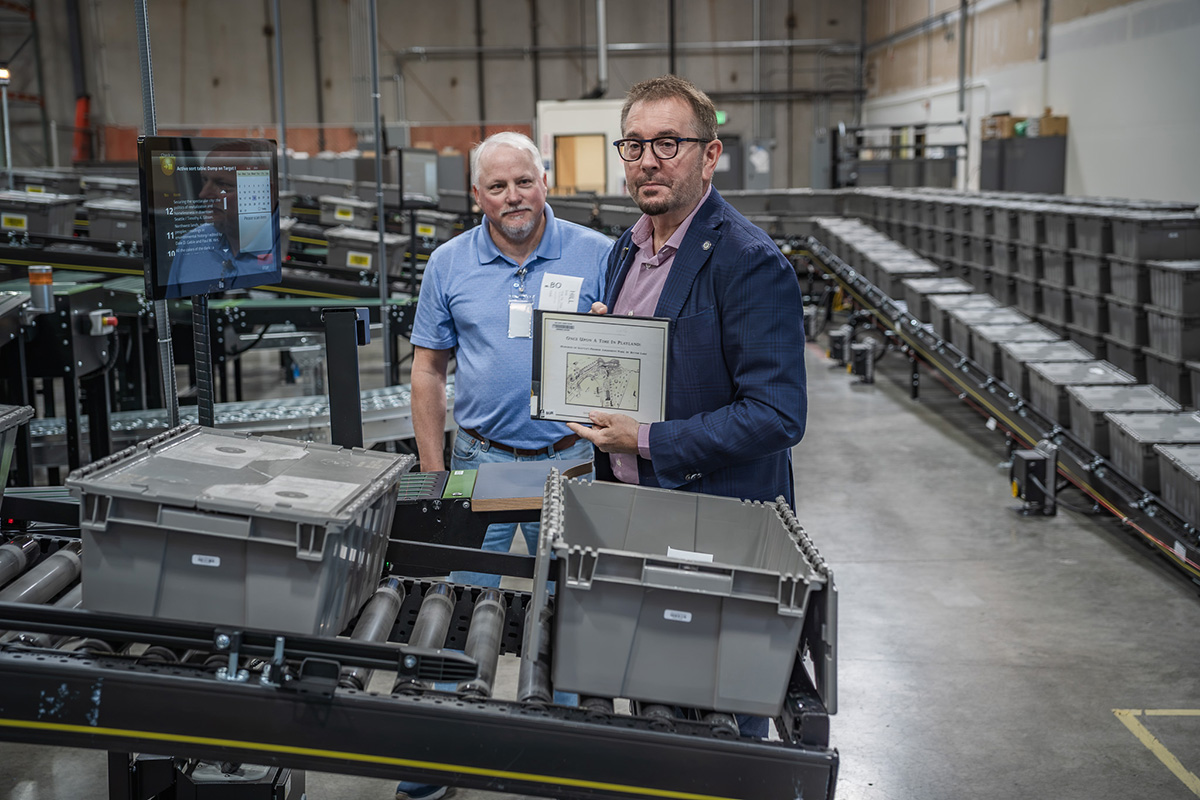
Renton Mayor Armondo Pavone tests out KCLS’s new material sorting machine, as warehouse operations manager Charlie Mitchell watches. (Photo: Ken Yeung)
It took KCLS nearly four months to set up and install everything. The facility is run by a team of 13 people — six tasked with scanning library materials and seven who manage the back end, ensuring the new totes are filled and then setting them aside while they await delivery.
When asked if it was challenging to train on the new equipment, Mitchell said no: “It’s a good job to pick up on.”
The clearest gains of this new setup, he said, are for the people working around the machine. Totes used to stack 14 levels high, sending workers up ladders to reach them; the new setup tops out at five, and instead of pushing totes down the line by hand, staff pulls them off onto a hand truck.
The noise level dropped too. “The old system ran at about 89 decibels,” Mitchell said. “This [new sorter] runs at 67 decibels. It’s about the same as a vacuum cleaner.”
One of the destacking robotic arms at KCLS’s new central sorting facility. (Photo credit: Ken Yeung)
The other payoff shows up at the branches. Mitchell explained that the old sorter ran at 2 to 3 mph and put books in the wrong bin 1% to 2% of the time. While a low percentage, it sparked uncomfortable conversations with patrons who received an email saying their book was available for pickup. The new machine features automated tracking and destination redundancy support, likely reducing the odds of any mis-sorting.
King County Councilmember Steffanie Fain said the new facility solves a “major flaw” in the library system — at least according to her two young children: It will enable books to move through the system faster so people won’t have to wait as long anymore for the material they want to read, listen, or watch.
“I’m not sure my kids have ever had an opinion about a distribution center before, but this one definitely has their full support,” she said.
Inside KCLS’s 25,000-square-foot warehouse, showing the books being sorted into one of 186 delivery chutes. (Photo: Ken Yeung)
“Today isn’t just about unveiling a remarkable piece of technology,” Daniel said. “It’s about investing in the future of KCLS, and most importantly, it makes a promise to the 1.6 million residents we are proud to serve: No matter where you live or which library you visit, you get the same selection, the same service, and the same speed.”
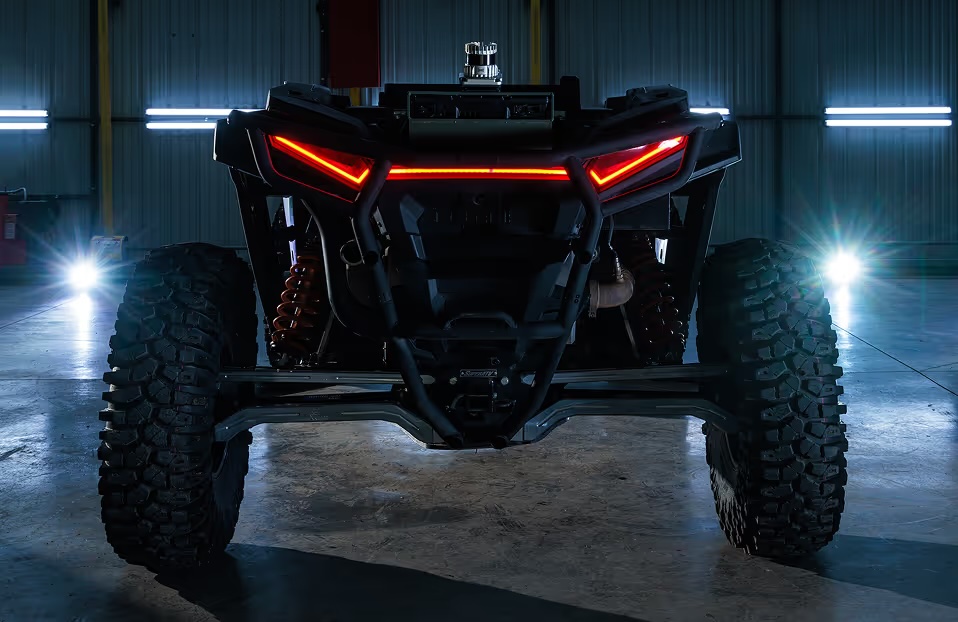
Overland AI develops autonomous ground vehicles and systems used by the U.S. military. (Overland AI Photo)
Silicon Valley companies have spent decades coming to Seattle for engineering talent. Now Seattle-based Overland AI is returning the favor.
The autonomous ground vehicle maker announced Wednesday that it’s opening an office in Burlingame, Calif., to tap into what it calls a world-leading AI and robotics talent pool in the Bay Area.
Located on the San Francisco Peninsula, the new facility will serve as a hub for software engineering and robot operations. The space includes a dedicated command center where operators can remotely task and control Overland’s autonomous ground vehicles across the globe.
The startup touted the location for its proximity to top universities and transit options and said it plans to double its Bay Area headcount over the next six months as it expands development of its off-road navigation software.
“Establishing a physical presence in the Bay gives us direct access to the deepest pool of AI talent in the world,” Jon Fink, CTO at Overland AI, said in a statement.
The move flips the long-standing dynamic between Silicon Valley and the Pacific Northwest. For years, Bay Area tech giants like Google, Meta, and Apple have built engineering outposts across Seattle to tap into the region’s cloud computing and systems talent. Just look at GeekWire’s list of such engineering centers.
But as autonomy and robotics race forward, Overland AI is reversing the talent migration, establishing its own Northern California beachhead to recruit engineers right in Silicon Valley’s backyard.
Founded in 2022 as a spinout from the University of Washington, Overland AI builds software and hardware for uncrewed military land vehicles designed to navigate complex, off-road terrain without GPS.

 Login
Login