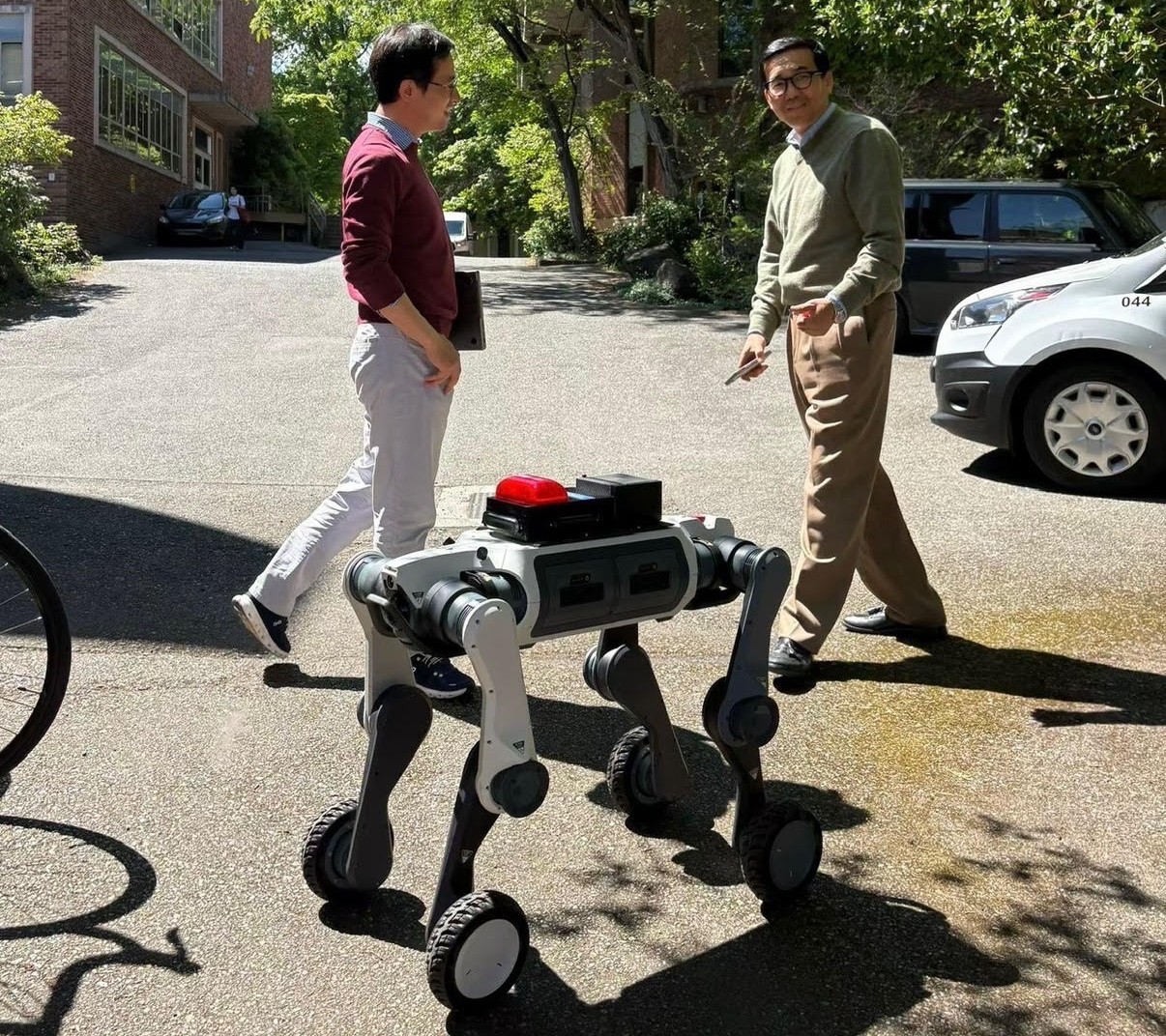
University of Washington College of Engineering Vice Dean Jihui Yang, right, and professor Xu Chen walk a robot dog on the UW campus. (Photo courtesy of Xu Chen)
Robotics jobs in the Pacific Northwest are multiplying faster than universities can train people to fill them. The University of Washington thinks it has an answer — or at least a start.
The university capped enrollment at 35 students for the inaugural cohort. More than 30 people had already signed up for an information session before applications even opened. It’s an early signal, engineering leaders say, of pent-up demand from regional powerhouses racing to hire engineers who can operate at the intersection of AI, software and hardware.
Program leaders say that skill set is rooted in a traditional, narrowly focused engineering degree that hasn’t kept pace with the rapid evolution of technology. UW is betting that the fix lies at the intersection of AI and hardware, echoing an industry buzzword called “physical AI.”
“Robotics is no longer confined to a single discipline,” said Xu Chen, a UW engineering professor and director of the Boeing Advanced Research Collaboration, who played a large role in the committee that designed the new programs. “The future will need a wide variety of robotics knowledge, and that’s what we built these programs to deliver.”
Applications opened Sept. 1 and will close Sept. 10, with UW aiming for a roughly one-week turnaround before notifying applicants. For its inaugural year, the university is intentionally keeping things small: 25 seats in the master’s program and 10 in the certificate track, which is designed for working professionals who want robotics training without leaving their jobs.
Chen said the small first cohort is by design, not a limitation. The goal, he emphasized, is to get the fundamentals right before scaling up. He expects the programs to roughly triple in size within three to five years.
“Companies are seeing newer potential in robotics as advanced computing and the wave of AI technology mature,” Chen said. “They see that their workforce will benefit from a modern robotics program, and that need is really what drove this.”
Getting there will take machines, and lots of them. UW is purchasing robots and computing hardware for its initial course offerings while also leaning on industry donations: robots, GPUs, and computing infrastructure among them, according to Chen.
Amazon and Microsoft anchored the effort early; the list of partners has since grown to include NVIDIA, Boeing, Dassault Systèmes — the French software company behind design tools like SolidWorks — and at least one smaller robotics manufacturer.
“The industry board was incredibly supportive from the start,” Chen said. “We’ve had almost a year of continuous meetings and collaboration with them and with representatives across our own engineering departments.”
The broader structure of the program is meant to make it easier for students from different corners of engineering, such as electrical, mechanical and computer science, to land in the same classroom and eventually choose their own path deeper into robotics through electives.
The program is also drawing on UW’s existing research muscle in the region. It taps directly into the Boeing Advanced Research Collaboration, which Chen directs, along with robotics labs inside the Paul G. Allen School of Computer Science & Engineering. That gives students a line into the same research infrastructure that already feeds Seattle’s aerospace and e-commerce giants.
The university’s ambitions extend well past this fall’s launch. Chen said UW has already mapped out longer-term plans for an undergraduate robotics degree and, eventually, a Ph.D. program, with the two new offerings serving as the foundation.
For now, the clearest sign of the program’s ambitions arrived this summer in an unlikely form: a pack of robot dogs let loose on UW’s campus.
“Seattle’s hills make it a uniquely difficult place for robots to move around, which is exactly why it’s a great place to study it,” Chen said.
Both students and faculty got a chance to operate the robots directly, Chen said. It was a hands-on moment that underscored how much more accessible robotics technology has become in just the last few years.
“It was exciting to see the students so happy to see the robots,” Chen said. “That’s the kind of energy we want to build this program around.”
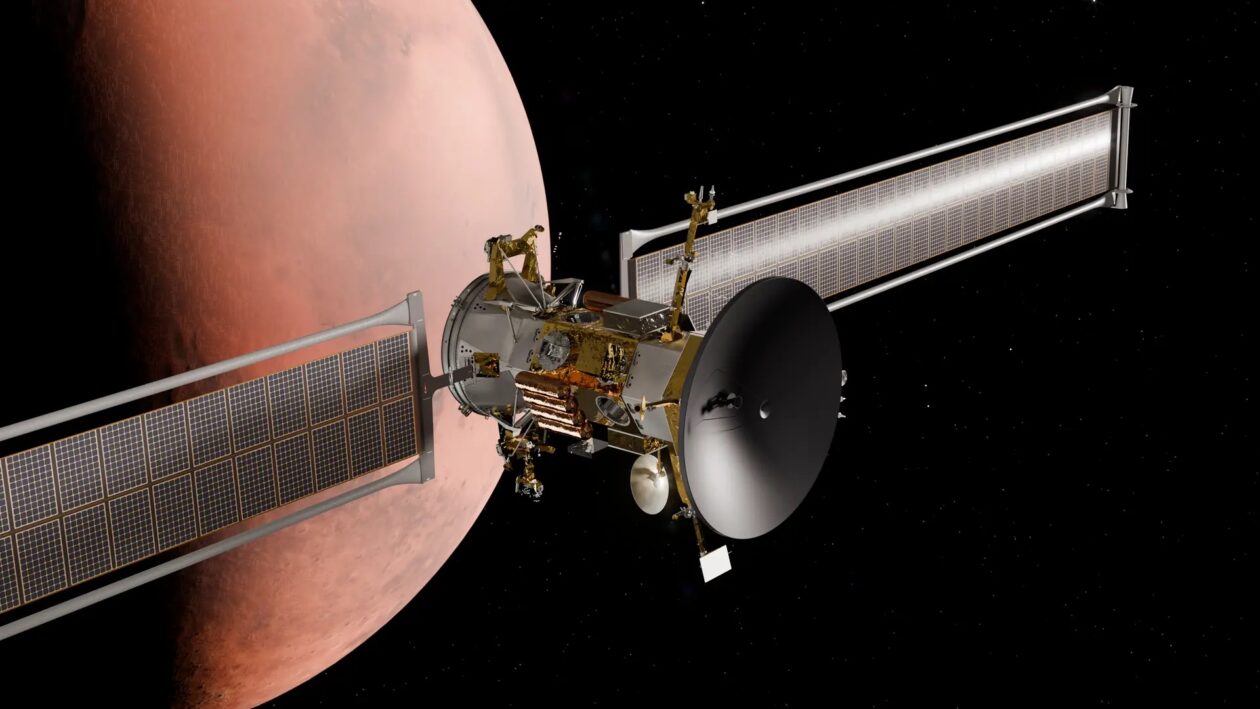
An artist’s conception shows the Mars Telecommunications Orbiter in Martian orbit. (Blue Origin Photo)
Jeff Bezos’ Blue Origin space venture has won a contract worth up to $700 million to boost NASA’s telecommunications capability in Martian orbit, using a version of the company’s Blue Ring multi-mission space platform.
The contract calls on Blue Origin to deliver a high-performance Mars telecommunications orbiter to NASA by the end of 2028, the space agency said in a news release. Blue Origin would also be charged with operating the Mars telecommunications network as part of NASA’s broader space communications and navigation infrastructure.
Blue Origin CEO Dave Limp said the Blue Ring spacecraft for the mission was already in production in Huntsville, Alabama. “Before the first human steps on Mars, we have to build the road. … MTO will enable science, carry payloads, and help lay the foundation for human exploration,” he said in a post to X.
“MTO is the backbone of America’s Mars exploration program for the next decade and beyond, and will provide the reliable communications capacity that will keep future robotic and human missions connected to each other and to Earth,” Tory Bruno, president of Blue Origin’s National Security Group, said in a news release. “This awarded contract is a testament to the Blue Origin team that has been building Blue Ring with exactly this kind of mission in mind. We’re ready, and so is the hardware.”
NASA’s current telecommunications links to Mars rely on an aging set of orbiters, including Mars Odyssey (launched in 2001) and Mars Reconnaissance Orbiter (launched in 2005). The multinational relay network also makes use of the European Space Agency’s Mars Express and ExoMars Trace Gas Orbiter. In addition to the orbiting relay satellites, NASA’s probes on the Martian surface can communicate directly with Earth to a limited degree.
Plans for a new Mars telecommunications orbiter have been under consideration for more than a decade and a half, but had been repeatedly put on hold due to budget concerns. This May, NASA issued a request for proposals relating to a commercial network for the Red Planet, drawing responses from Blue Origin as well as Rocket Lab.
NASA said the Mars Telecommunications Network would be managed by the space agency’s Space Communications and Navigation program. The network is expected to be operational at Mars by 2030 to support current and future missions to the Red Planet.
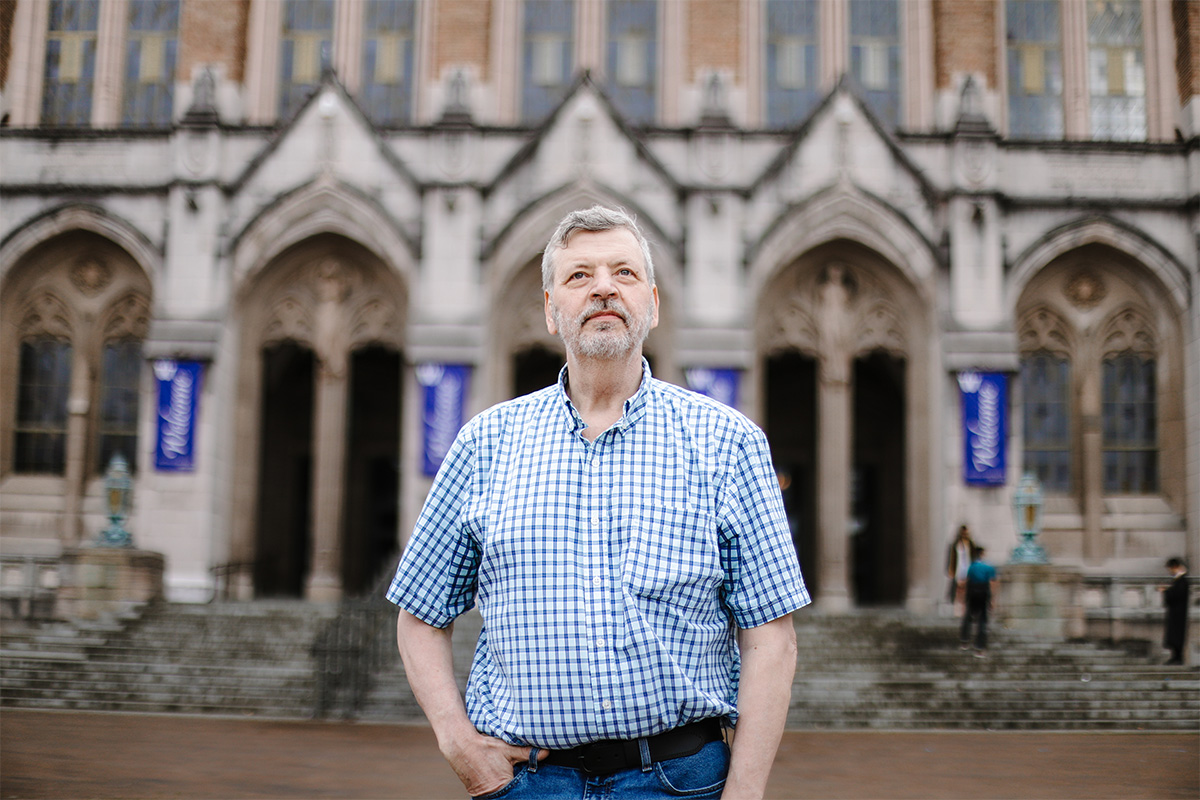
University of Washington computer science professor Stuart Reges. (Twinkle Don’t Blink Photo via Fire.org)
The University of Washington has agreed to pay $600,000 to resolve a high-profile First Amendment lawsuit brought by computer science professor Stuart Reges, who was disciplined after including a parody land acknowledgment in a course syllabus.
The settlement, announced Thursday by the Foundation for Individual Rights and Expression (FIRE), follows a December ruling by the U.S. Court of Appeals for the Ninth Circuit that found university officials violated Reges’ academic freedom rights by retaliating against his speech and engaging in viewpoint discrimination.
“I am deeply grateful to FIRE for this legal victory which will remind public universities that they are obligated to respect the First Amendment rights of their students, faculty, and staff,” Reges said in a statement Thursday. He added that he hopes his protest helps reverse “a decade-long trend towards ideological conformity in academia.”
Under the agreement, UW agreed to pay $600,000 to FIRE to cover damages, legal fees, and costs. The settlement prohibits the university from taking further adverse action against Reges or removing the parody statement from his syllabi in perpetuity. While the appeal was pending, UW also rescinded and replaced Executive Order 31, the anti-harassment policy used during the investigation.
The dispute began in January 2022 after the Paul G. Allen School of Computer Science & Engineering recommended that faculty include a statement acknowledging Coast Salish Indigenous lands in their syllabi.
Reges, a teaching professor who has been at the school since 2004, opposed the policy. Instead, he included a parody invoking philosopher John Locke’s labor theory of property to claim Indigenous groups held “almost none” of the land occupied by the university.
UW officials responded by censoring the parody from Reges’ course syllabus, opening a yearlong disciplinary investigation under an anti-harassment policy, and creating a competing “shadow” section of his course so students could opt out of taking his class.
Although the university ultimately declined to formally discipline Reges, officials warned him that repeating the statement could trigger further punishment. Reges sued the UW in 2022, and while a U.S. District Court initially sided with the university, a three-judge panel for the Ninth Circuit reversed that decision, ruling that student discomfort cannot justify retaliating against a professor’s speech on matters of public concern.
Reges’ lawsuit named top university leadership as defendants, including then-UW President Ana Mari Cauce, Allen School Director Magdalena Balazinska, Vice Director Dan Grossman, and College of Engineering Dean Nancy Allbritton. Current UW President Robert J. Jones is named in the final agreement.
The Ninth Circuit panel’s decision established that university teaching materials like course syllabi are protected academic speech, setting a binding First Amendment precedent across public higher education institutions in the Western U.S.
The University of Washington provided the following statement to GeekWire:
“The University of Washington maintains that we acted appropriately, and this settlement is in no way an admission of any wrongdoing. Given the Ninth Circuit’s 2-1 decision overturning the federal district court’s decision in favor of the University, a settlement agreement was the most reasonable option due to the attorney fees and costs that would have resulted from the Ninth’s Circuit’s decision. Prof. Reges has retained his faculty position and continued teaching throughout this process, and his status with the UW remains unchanged.”
Reges remains an active faculty member. Under the terms of the deal, he is free to include the Locke property statement on future course materials without administrative interference.
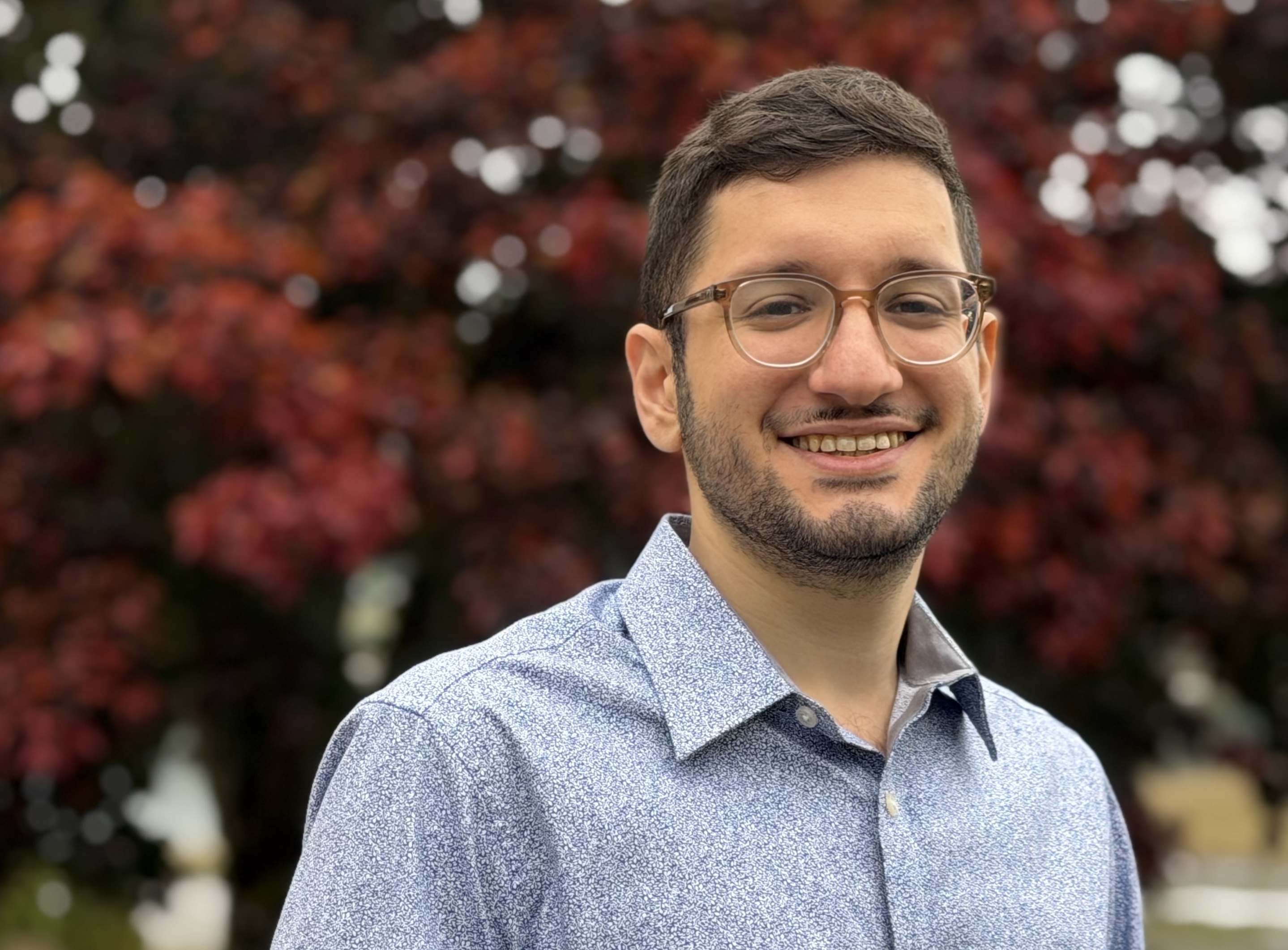
Malek Itani, a Ph.D. student in the UW’s Paul G. Allen School of Computer Science & Engineering. (Photo courtesy of Malek Itani)
University of Washington Ph.D. student Malek Itani, who co-founded the AI-powered sound enhancement startup Hearvana, has been awarded the prestigious Marconi Society Paul Baran Young Scholar Award for his groundbreaking work in “superhuman” hearing technology.
Selected as one of just three global recipients from a record pool of nominees, Itani was recognized for developing on-device AI algorithms that enable real-time target speech extraction, “sound bubbles,” and semantic hearing on low-power hearables like earbuds and hearing aids.
Itani’s award comes less than a year after he and Paul G. Allen School of Computer Science & Engineering professor Shyam Gollakota co-founded Hearvana, a spinout aimed at commercializing their lab discoveries. The startup raised $6 million in pre-seed funding last fall to bring on-device acoustic intelligence to earbuds, hearing aids, and smart glasses.
By packing tiny, real-time neural networks onto low-power chips, the researchers hope to replace blunt noise cancellation with true semantic hearing — allowing users to filter out city traffic, amplify a single companion’s voice in a crowded room, or create a localized “sound bubble” on demand.
Itani’s work in the UW Mobile Intelligence Lab began with “acoustic swarms” — small, self-distributing robotic microphones that track and separate multiple speakers in a room. He and his collaborators then pivoted to personal audio devices, pioneering neural networks like IF-MLPNet and platforms like NeuralAids. These systems allow complex AI models to handle real-time sound separation directly on low-power wireless hearables without relying on heavy cloud compute or draining battery life.
“Malek has been a key part of every major contribution to the field of superhuman hearing in recent years,” Gollakota told the Allen School Blog. “He entered his Ph.D. with a background in RF and backscatter, but he rapidly mastered audio signal processing and deep learning, which is very impressive.”
“I feel like I’ve hit a niche that’s going to be so transformational, and it’s going to be in billions of devices,” Itani said. “It’s going to change the way we hear the world.”
Itani and his fellow Young Scholars will be formally recognized at the Marconi Awards Gala in San Francisco this November.
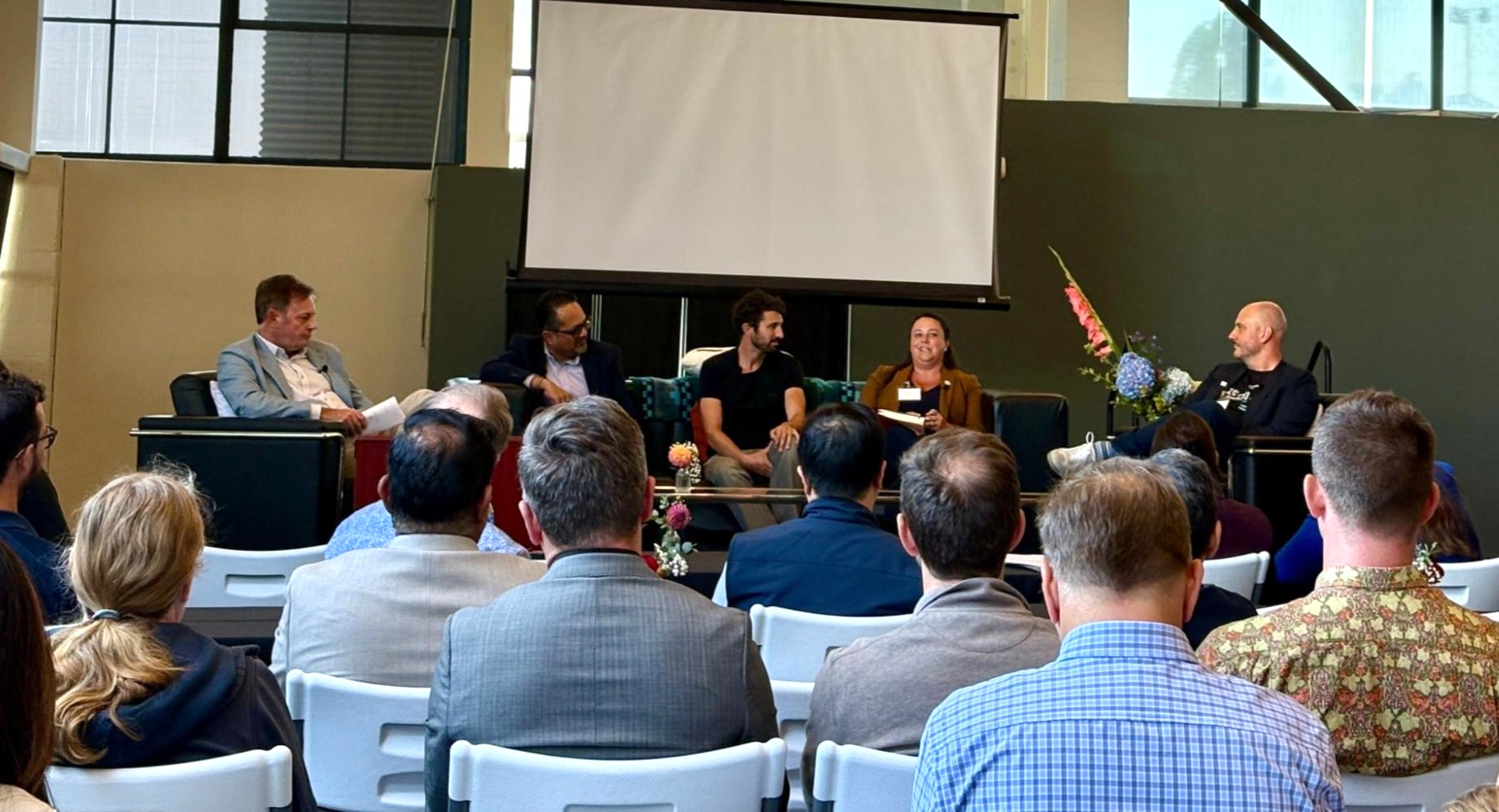
From left, Marc Cummings, Life Science Washington; Snehal Patel, Sana Biotechnology; Joe Horsman, Madrona Venture Group; Rebecca Bryant, Fred Hutch Cancer Center; and Alex Zanghellini, Arzeda, at a Seattle forum hosted by the National Security Commission on Emerging Biotechnology on Tuesday. (GeekWire Photo / Sydney Jackson)
Arzeda designs enzymes for products ranging from laundry detergent to stevia. But when it comes time to manufacture at commercial scale, the Seattle-based startup often has to look overseas.
That’s why, when a federal biotechnology commission visited Seattle on Tuesday, the industry came forward with a problem: They have the science, but lack the infrastructure and workforce pipeline to keep innovation on U.S. soil.
Arzeda’s designs reach an estimated 1.8 billion consumers worldwide, and the company has spent the better part of two decades building its technology. The company’s enzymes, sometimes designed in days rather than weeks thanks to AI, are largely manufactured in Western Europe and India — with one U.S. contract manufacturing partner in Wisconsin.
Finding domestic manufacturers with the expertise and capacity to make these specialized proteins has been difficult, CEO Alexandre Zanghellini said. And for a company trying to commercialize new biotechnology, he added, manufacturing delays can be “catastrophic.”
The federal group visiting Seattle — the National Security Commission on Emerging Biotechnology — was created by Congress to address these kinds of problems. Since 2022, the team of 11 bipartisan experts have examined how biotech intersects with national security, and what the U.S. needs to do to remain competitive with China.
Last year, the commission drafted a report to Congress with 49 recommendations spanning at least $15 billion in federal investment over five years, with policies to get more private capital into biotechnology, build domestic manufacturing capacity, strengthen the workforce and reduce vulnerabilities in the supply chain.
Now, with the commission sunsetting in December, its members are taking their case around the country.
The science is here, the infrastructure isn’t
In Seattle, the urgent matter is finding a way to keep biotechnology breakthroughs in the United States. Alexander Titus, a commission member who has headed AI-focused biotech initiatives in Seattle and nationwide, said Washington stands out for its early innovation and research.
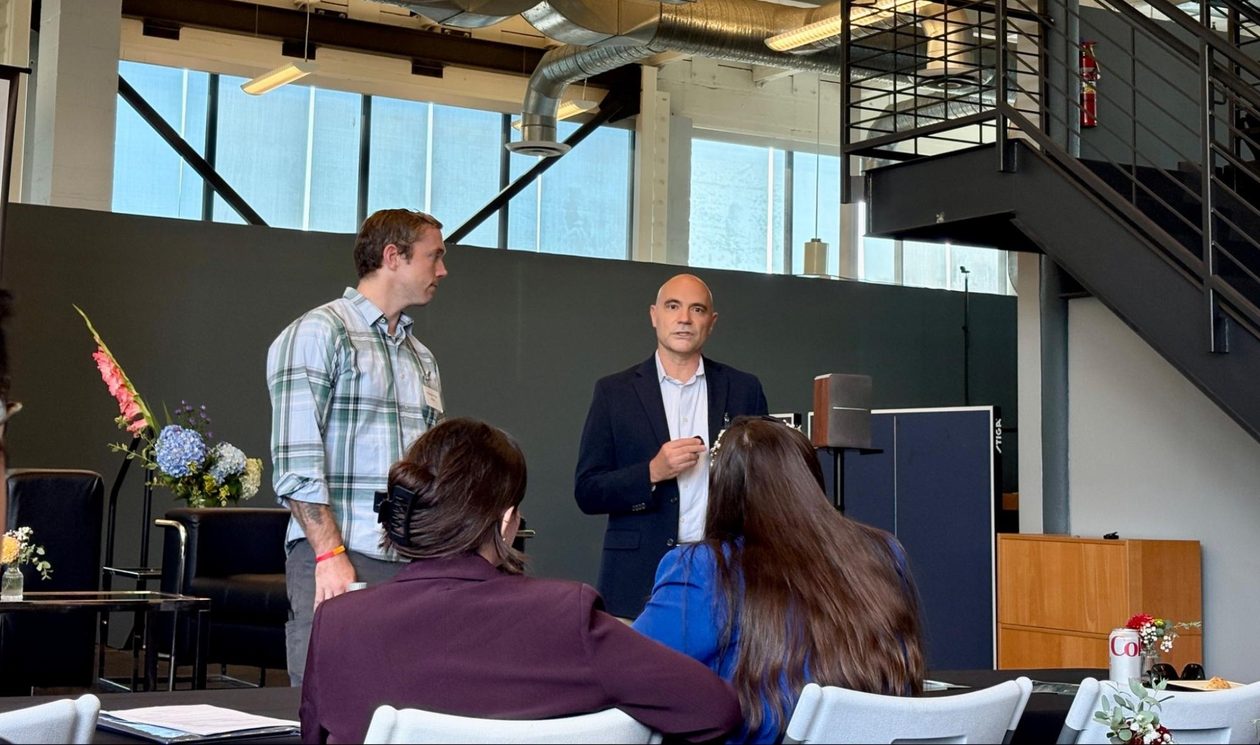
National Security Commission on Emerging Biotechnology commissioners Alexander Titus, left, and Paul Arcangeli speak with attendees at a Seattle biotech forum on Tuesday. (GeekWire Photo / Sydney Jackson)
“Companies like Arzeda are having pretty serious leadership roles in the AI and bio space,” he told GeekWire. “A lot of the work we have done in the commission has revolved around helping the U.S. meet the moment when it comes to this nexus.”
Institutions like the University of Washington, Fred Hutchinson Cancer Center and the Allen Institute have helped build a deep life-sciences ecosystem in Washington. UW’s Institute for Protein Design, led by 2024 Nobel Prize winner David Baker, has spun out more than 20 companies.
One is Arzeda, which has an increasingly fast agentic workflow that can fine-tune a model, suggest the next experiment, and allow researchers to test thousands of sequences in a single round. The company’s first AI-designed commercial product was a stevia ingredient launched in 2024; it’s now negotiating a $44 million contract with the federal Defense Threat Reduction Agency related to biothreat response.
While technology is moving quickly, the infrastructure needed to commercialize it is not — creating what Seattle biotech leaders called a “valley of death” between research and manufacturing.
The U.S. has federal funding for basic research, as well as a venture-capital system that can finance early-stage discoveries. But once a company needs to build or access physical infrastructure for commercial-scale manufacturing, the financing becomes much harder. Venture capital investors don’t see the returns attractive enough, Zanghellini said. Banks aren’t eager to finance them, either.
The pull of overseas manufacturing
Meanwhile, China has spent two decades making biotechnology a strategic priority, and its 2026 Five-Year Plan doubles down on areas including biomedicine, biomanufacturing, pharmaceuticals and brain-computer interfaces. For U.S. companies in the race, that can create an uncomfortable incentive: If the infrastructure is cheaper and faster somewhere else, that’s where the work often goes.
Last year, Seattle-based Sana Biotechnology canceled plans for a manufacturing plant that was supposed to employ hundreds of workers in Bothell, Wash., instead opting for a contract manufacturer elsewhere to cut costs. Snehal Patel, the company’s executive vice president and chief technical officer, said on Tuesday he’s optimistic the Seattle area could compete on speed and cost with China’s fully integrated supply chain — with the right resources.
Ideally, manufacturing facilities in the U.S. would offer flexibility and knowledge in different products and processes, while ensuring trade secret protection.
The commissioners recognize this need; among their recommendations for Congress is a nationwide manufacturing network for precommercial, bioindustrial product scale-up. That could address the problem Seattle companies face: a startup shouldn’t have to choose between sending manufacturing overseas or trying to build an entire facility itself.
The commission has also recommended requiring companies to disclose points of supply-chain vulnerability in foreign countries of concern. If a geopolitical conflict disrupts the supply of medicines or other biological products, Titus said, the consequences can reach Americans far from any battlefield.
“Being able to keep and maintain our leadership in certain industries allows us to have the edge in any given situation,” he said. “We want our industries to be able to produce here…it’s truly national security in the broadest sense at this point.”
Building the workforce pipeline
To accomplish this, companies need a stronger industrial biomanufacturing workforce.
Rebecca Bryant, Fred Hutch’s director of government relations and a former staffer for Rep. Adam Smith, said while Washington trains well for research, there’s no equivalent pipeline into entry-level biomanufacturing jobs. Titus sees the issue as part of a broader problem of “bioliteracy” — that biology should be a basic problem-solving tool in the same way that engineering, chemistry and computing are, rather than a specialized field understood by few.
In Washington, the Hutch Advance partnership with Shoreline Community College trains and places lab technicians, while Sana Biotechnology has worked on a model for moving workers into biomanufacturing. Seattle industry leaders suggested a state or federally-supported workforce consortium to bolster the effort. Meanwhile, the commission has urged Congress for more biomanufacturing training support.
According to the commission, the next three years will determine whether the U.S. remains the global leader in biotechnology or cedes the future to China. Of the commission’s 49 recommendations, Titus said, 26 have been written into law in some capacity. The next step is in the hands of Congress, federal agencies, states and the industry itself.
Cory Black is a former tech worker who left his career to focus on juggling, mostly of soccer balls. (Vitz Photography Photo)
Most tech workers are used to keeping multiple projects up in the air at once. Cory Black took the concept to a literal level.
A graduate of the Paul G. Allen School of Computer Science and Engineering at the University of Washington, and a former software engineer at Facebook, Black left his career behind to run away and join the circus.
Today, the work he’s juggling mostly involves soccer balls. Black, a 30-year-old from Bellevue, Wash., is one of the premier soccer freestylists in the world, doing things with his feet and hands that will leave you shaking your head.
Black is fresh off earning a bronze medal at the 2026 International Jugglers’ Association Championships in Fort Wayne, Ind., where he competed against top talent from Japan, Taiwan, and across the U.S.
His 5-minute routine (below) stood out by blending traditional hand-toss juggling with elite soccer freestyle — a rare combination he built over 16 years of kicking a soccer ball around and 11 years of hands-on juggling training.
It all started when he was 14 years old and playing youth soccer.
“My dad challenged me to juggle 100 times with my feet for $100,” Black told GeekWire. “Of course, that’s a ton of money when you’re a kid, so that’s all I did for a few weeks, and I got the money. Then I just started learning some tricks on YouTube and fell in love with learning the next one and next one, and figured out that it was a sport all to itself.”
Black quit traditional soccer in high school to focus entirely on freestyle, traveling to L.A. for his first U.S. Championships at age 16 and later heading to the World Championships in the Czech Republic. Unlike standard field play, soccer freestyle operates more like a breakdance battle, with competitors going head-to-head on stage to impress a panel of judges.
When it came time for college, Black followed his older brother to UW to study computer science at the Allen School. He spent his free time practicing tricks, but at the time, he didn’t view freestyle as a viable full-time career — most of his role models were just booking occasional corporate gigs for brands like Nike or Adidas.
After an internship in Silicon Valley, Black landed a full-time job as a software engineer at Facebook’s (now Meta’s) South Lake Union office in Seattle, where he spent three and a half years working on such things as content monetization tools for creators.
Juggling remained a constant backdrop to his engineering work; he kept juggling balls on his desk, tried teaching his teammates how to juggle, and practiced high tricks after hours in the office lounge. While training at a Seattle circus school, Black struck up a friendship with a former Cirque du Soleil choreographer who saw stage potential in his moves.
“After showing some of my tricks, he told me, ‘Hey, you can make this into a circus act,’ which I had never even imagined,” Black said. “I saw the opportunity … you can actually work with a circus and live with a circus and have a recurring way to support yourself.”
Cory Black is one of the world’s elite soccer freestylists, performing tricks with the ball that go far beyond what professional players pull off in games. (Philip Pavliger Photo)
Black took the leap, leaving Facebook to spend six to eight months building a full, stage-ready routine with his choreographer. To stretch his savings during the training period, he slept on his brother’s floor in Seattle for a year and a half before landing his first circus contract. That led to two years on the road with Flynn Creek Circus, living in a caravan and performing as a featured act.
After two seasons living on the road, Black transitioned into performing as a solo artist, booking corporate events, private shows, and local festivals. That solo pivot paid off big this past summer when Seattle hosted FIFA World Cup matches. Black stayed busy performing 28 separate shows across the city in six weeks, including fan events at Pacific Place Mall and outside the stadium for all six games. He made most of his money for the year during the stretch.
While moving from software engineering to stage performance brought a steep learning curve, Black sees surprising parallels between coding and juggling. He says engineers and jugglers are both drawn to complex patterns that have specific numbers associated with them. Managing five balls in the air fits that bill.
“If you go to local juggling clubs anywhere, there’s an unusually high amount of software people and engineers,” Black said. “Part of it is just being able to tackle hard, frustrating problems. If you haven’t gotten used to banging your head against a wall until you get something, you’re going to give up fairly easily.”
Black does occasionally lean on his engineering skills for side work. He broke his foot in December and took on what he calls “software adjacent” work. He’s also helped build websites for circus friends. But he has no interest in trading his soccer balls for a return to a tech desk job.
“Right now, I don’t plan on going back at all,” Black said. “Also, I don’t know what the landscape looks like after AI has kind of gone through everything.”
For now, he’s perfectly content sticking to debugging physical tricks on stage — where the only glitches in the code are the occasional dropped ball.
A former Starbucks cafe in Seattle. (GeekWire Photo / Kurt Schlosser)
Starbucks is laying off 224 more workers tied to its Seattle headquarters, according to a new state filing. The coffee giant says the layoffs don’t represent a new round of cutbacks, but rather the lingering effect of restructuring work announced earlier this year.
About 120 of the 224 are employees who were offered roles in Starbucks’ new Nashville office and declined to relocate, according to the filing. Those roles are expected to be filled in Tennessee.
The remaining 104 in the notice filed Thursday stem from the restructuring that Starbucks announced in May, and fall largely within the group that designs, sites and builds its coffeehouses.
Not all 224 are based in Seattle. The filing covers employees who work at or report to Starbucks’ headquarters at 2401 Utah Ave. S., so some are located elsewhere in the country while reporting to managers at the Seattle campus. Starbucks did not say how many are based in Washington state.
The reductions are part of the “Back to Starbucks” turnaround CEO Brian Niccol launched after taking over in September 2024 — an effort that has paired store-level technology upgrades and a simplified menu with a restructuring of the company’s corporate ranks.
Starbucks has now laid off 537 corporate workers tied to its Seattle headquarters this year, across three state filings: 61 in a tech reorganization in May, 252 at the support center later that month, and the 224 disclosed this week.
Starbucks is targeting $2 billion in cost reductions over two years under Niccol, and has shed more than 2,300 corporate jobs companywide since last year, according to Bloomberg.
At the same time, Starbucks is building out its Nashville office, a $100 million investment expected to house 2,000 support jobs within five years. The company has said the majority of its corporate teams will remain in Seattle.
The design and development cuts come later than the rest of the May restructuring because the executive who leads the group, Stephen Piacentini, joined Starbucks from Chipotle in April, and the organizational changes in his group weren’t finalized when the May restructuring was announced.
Editor’s note: This story has been updated to clarify that the 224 workers covered by the filing report to Starbucks’ Seattle headquarters but not all are based in Seattle.
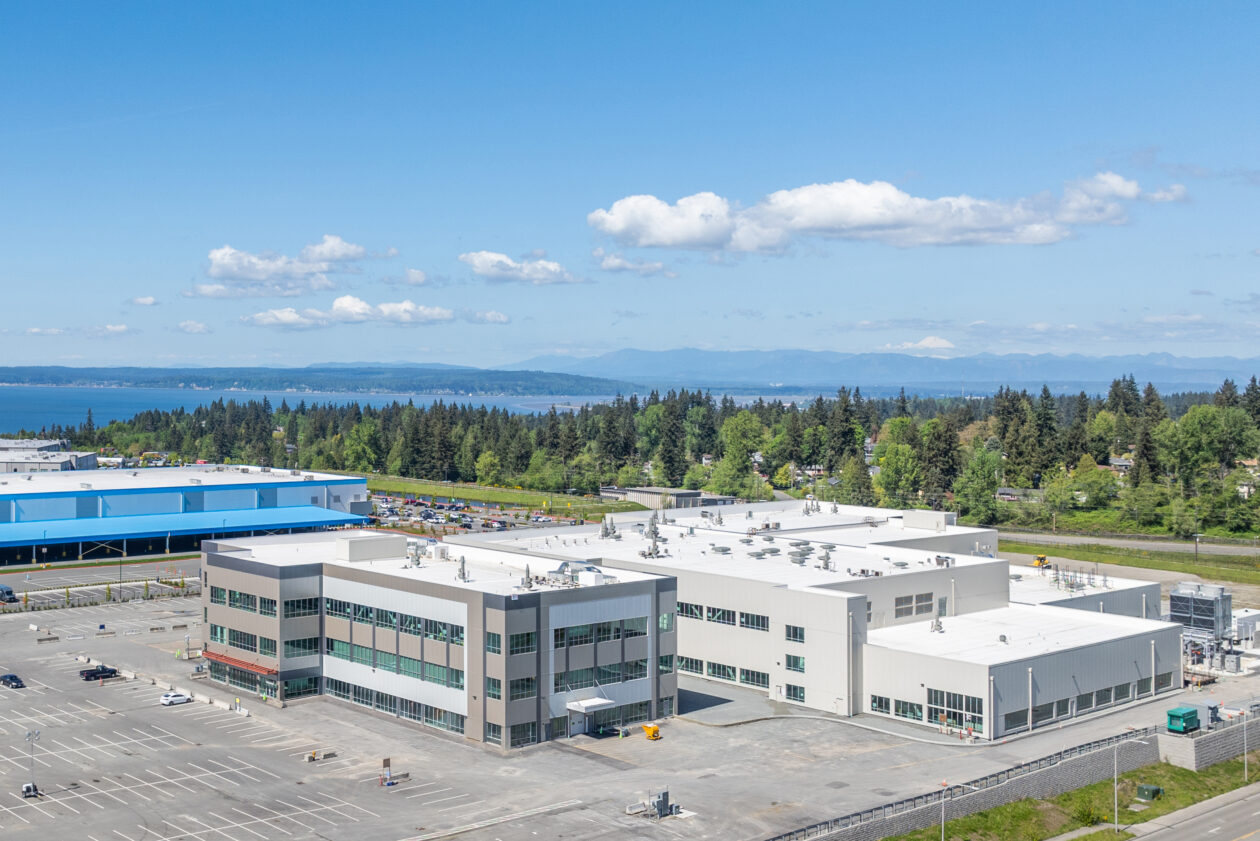
An undisclosed pharma company signed a 21-year lease for the former Seagen property in Everett. Photo via Breakthrough Properties.
A bio-manufacturing facility in Everett, Wash., which was built by Seattle biotech giant Seagen but never opened under its Pfizer ownership, is getting a new lease on life.
Breakthrough Properties, a life sciences real estate company, said Friday that it has acquired the 270,000-square-foot facility at 215 Shuksan Way for $78 million and leased the entire campus for 21 years to an unnamed global biopharmaceutical company.
Seagen invested approximately $350 million to build out the facility, which was designed for drug manufacturing, quality-control labs, warehousing and distribution. But the company never moved in after drug maker Pfizer acquired Seagen for $43 billion in 2023.
“Pfizer regularly evaluates our manufacturing network to ensure capacity is effectively utilized based on projected product demands,” the company said in a statement to GeekWire in 2024. “After careful evaluation, we have made the difficult decision to wind down construction of the site.”
The facility sits about 25 miles north of Seattle along the I-5 corridor and is Breakthrough Properties’ first investment in the Puget Sound region.
The deal comes as pharmaceutical companies increase investment in U.S. manufacturing capacity. Breakthrough said major drugmakers have announced more than $600 billion in recent commitments to expand domestic production and strengthen supply chains.
The Everett facility was part of Seagen’s broader manufacturing expansion before the company was acquired by Pfizer for $43 billion. GeekWire previously reported on Seagen’s plans for the 270,000-square-foot Everett facility.
Breakthrough Properties is a joint venture between global real estate company Tishman Speyer and biotech investment firm Bellco Capital. A spokesperson for the company, which owns and develops life sciences properties in the U.S. and Europe, declined to provide details on the new tenant or the move-in date.
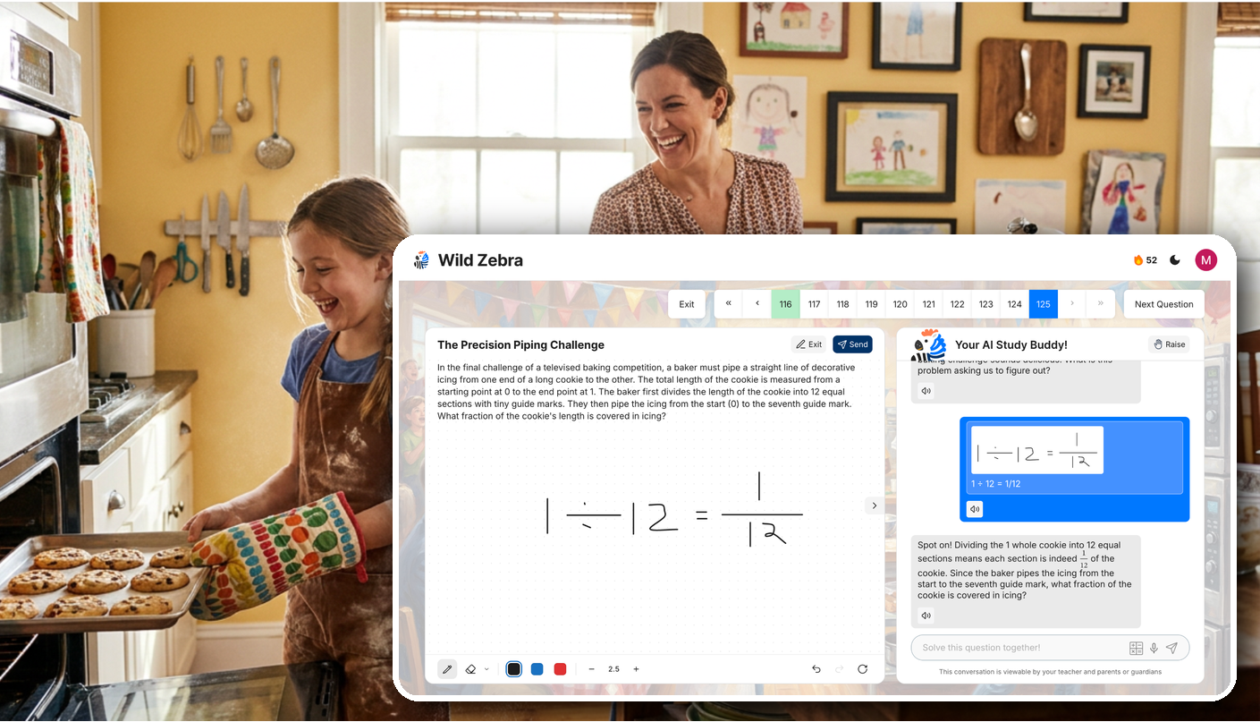
A Wild Zebra math problem framed around baking, one of the interests the student selected. After the student works out that each section is 1/12 of the cookie, the AI confirms the step and asks the next question rather than finishing the problem. (Wild Zebra images, click to enlarge)
Seattle-based edtech startup Wild Zebra has raised $6 million to expand its AI learning platform for math and reading, citing early signs that its specialized product can hold its own against the free study tools released over the past year by OpenAI, Google and Anthropic.
One of Wild Zebra’s secrets is its Socratic approach: rather than handing over the answer, the platform works students toward it with questions, drawing out the reasoning step by step.
Another key difference: the lessons are customized to be grounded in whatever topics or hobbies the student is already interested in, such as sports, cooking, music, or anything else.
The platform also analyzes the conversations themselves, looking not just for students who are distracted or getting answers elsewhere, but for those showing persistence or curiosity — flagging those positive moments in dashboards for teachers and parents.
The idea is “to catch kids being good, too,” said edtech veteran Edan Shahar, the company’s CEO and co-founder.
Latest funding: The oversubscribed seed round was led by Bellevue, Wash.-based Trilogy Equity Partners, with participation from Tetherpoint Capital and angel investors including Shrikesh Majithia. It brings the company’s total funding to $8 million.
Wild Zebra co-founders: CEO Edan Shahar, left, and CTO Erik Selberg. (Wild Zebra Photos)
Wild Zebra, co-founded in 2024 by Shahar and longtime AI technologist Erik Selberg, serves students in grades 2 through 9. The company, with a team of 10, plans to use the new funding for hiring, primarily engineers, along with sales and marketing initiatives.
Trilogy Managing Director Amy McCullough, who is joining the Wild Zebra board, said the VC firm backed the company for its potential to give parents and teachers a real-time view of what a student has actually learned, and a path to mastering the material from there.
She said she came to the deal as a customer first: her family had used Test Innovators, the private-school admissions test-prep company Shahar ran for nearly a decade, and she was struck by how well it delivered for parents and students at a high-stakes moment.
“When we were introduced to Wild Zebra, we knew very quickly that this was the team who could build the student-centric AI partner for the market,” McCullough said.
Competitive landscape: When GeekWire first covered Wild Zebra last year, OpenAI and Google had just launched study modes of their own. Anthropic launched a free version of Claude for K-12 teachers last month, and Khan Academy’s Khanmigo has been in the market for years.
Shahar said the general-purpose chatbots are good at answering a single question or explaining a concept, but don’t keep track of what a student knows over time.
Wild Zebra builds what the company calls a “learning tree” for each student — what they’ve mastered, where the gaps are, what comes next — and uses it to decide what they work on next, rather than just responding to whatever they happen to ask.
Shahar sees the big AI labs as suppliers more than rivals. Wild Zebra runs on their models, along with others.
Traction so far: Wild Zebra says it now reaches tens of thousands of students, up from about 6,000 a year ago, and has logged hundreds of thousands of tutoring conversations.
It opened the platform to families this year at $48 per month per child. The first consumer customers, Shahar said, were parents at pilot schools who wanted it for their other kids.
On the school side, Wild Zebra works through E3n, formed this year by the merger of the Educational Records Bureau and the Enrollment Management Association, which serve selective private schools. ERB invested in the company in 2024.
Many member schools test students using E3n’s exams, and Wild Zebra uses those results to set each student’s starting point, though some schools using the platform don’t.
Early results: E3n also conducted a 722-student pilot evaluation of math and reading, measuring results against ERB norm groups collectively built from hundreds of thousands of students. It found gains of four to eight percentage points among fifth and sixth graders.
Having started in private schools, Wild Zebra is now talking with charter and public schools.
Shahar said schools and students skeptical of AI mostly don’t become customers, and the ones who do tend to share his optimism while still taking the risks seriously.
The concern he hears most often from students is AI’s environmental impact — which, he acknowledged, is not something Wild Zebra is working to address.
“I’m not a Pollyanna. I think there are certainly potential downsides to AI in general,” he said. “There are people working on the downside mitigation. I’m working on upside opportunity.”
Zillow Group’s revenue rose 18% to $772 million in the second quarter, beating its own forecast, but a $36 million restructuring charge from severance and other costs stemming from this week’s layoffs pushed it to a $4 million net loss.
The Seattle-based online real estate company, which on Tuesday laid off more than 500 people, or 7% of its workforce, expects the restructuring to cost $59 million to $64 million in total, with the rest recorded in the third quarter, according to the company’s 10-Q regulatory filing.
Zillow also announced a series of executive changes, including expanding CFO Jeremy Hofmann‘s role to include chief operating officer. Jun Choo, who became COO in 2024, is stepping down to focus on his health, serving as an advisor through the end of the year.
The company created a chief legal and policy officer role and hired Cassandra “Sandi” Knight, a Google vice president of litigation and discovery, who was previously PayPal chief litigation counsel. Knight starts next week.
Zillow and Redfin are set to go to trial Aug. 24 as defendants in an antitrust case brought by the FTC and five state attorneys general over the $100 million rental listings deal between the two companies. Zillow has spent $26 million on the case so far this year, including $10 million in the second quarter.
In addition, Zillow promoted Kathleen Berroth to senior vice president of strategy and operations, and Eric Wilson to senior vice president and GM of mortgages.
For the second quarter, Zillow said the residential real estate industry grew 6%, while industry-wide lending for home purchases was roughly flat compared with a year ago. The number of people visiting real estate sites and apps declined overall as mortgage rates rose, the company said, citing Comscore. Zillow’s own traffic fell 2%, to an average of 239 million monthly users.
Most of the revenue growth came from Zillow’s newer businesses. Mortgage revenue rose 75% to $84 million as Zillow directed buyers on its site to its own lending arm, and rentals revenue rose 31% to $209 million. Residential revenue, from advertising sold to real estate agents, grew 7% to $465 million.
Magdalena Balazinska, left, outgoing director of the University of Washington’s Paul G. Allen School of Computer Science & Engineering, and Dan Grossman, the school’s vice director and newly named interim director. (UW Photos)
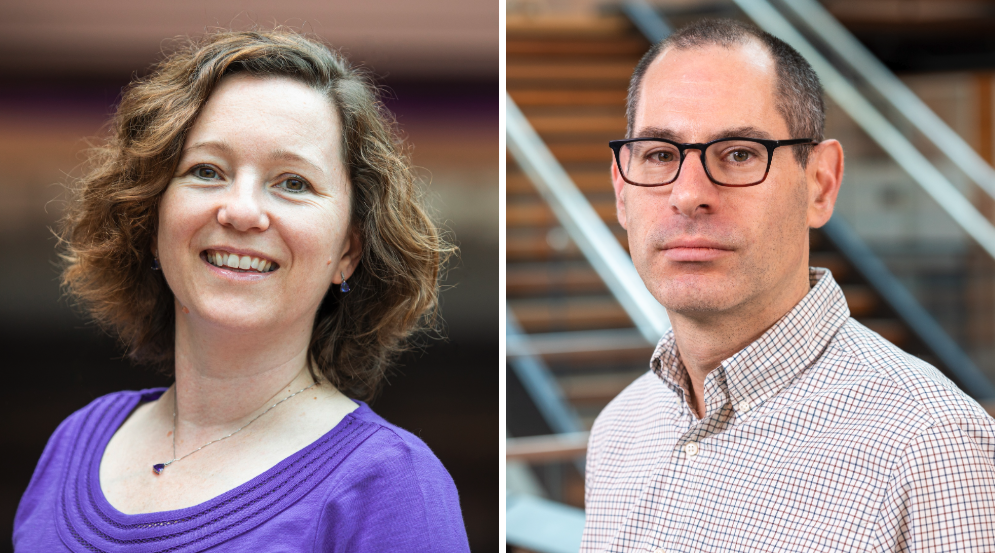
Top leadership is shifting at the University of Washington’s Paul G. Allen School of Computer Science & Engineering, as Director Magdalena Balazinska‘s term concludes after nearly seven years. Dan Grossman, the school’s vice director and a long-time faculty member, will take over as interim director.
The leadership transition officially takes effect Aug. 17.
The school and the UW College of Engineering announced the move Monday morning, following separate emails sent to Allen School faculty and staff by both professors (in full below).
Balazinska wrote that she will take a “long-awaited sabbatical” before returning to teaching, calling the transition something “we have been planning and discussing for a while.” Grossman sought to reassure the community that “the transition will be smooth and not the cause of any significant changes.”
According to the Allen School, Balazinska was initially appointed to a 5-year term, which is the norm. Extending the term of a director or chair is not considered unusual at the UW or in the Allen School, but Balazinska did not want to extend beyond an additional year or so.
The interim leadership structure with Grossman will remain in place for roughly a year while UW leadership considers recommendations from a Provost task force on how the institution should organize its broader computing, data science, and AI initiatives.
The Task Force on Computing and Data Science was established earlier this year to evaluate whether the university’s administrative and academic structures are properly built to support the rapid growth of computing, AI, and data science. A central focus of the mandate was assessing limitations in the current model — where computing resides within the College of Engineering — and identifying alternative organizational structures, including independent units or cross-university institutes, to enhance research leadership, external partnerships, and student pathways.
Grossman, who served on the task force, said that the group recently completed its report for Provost Tricia Serio and President Robert Jones to review. Balazinska said, “it will take time for the President and Provost to consider and act on recommendations related to task force findings.”
“UW is working seriously on how to best position itself to lead in computing in the decades ahead and the Allen School will, of course, be a key part of that,” Grossman wrote.
Major growth for Allen School
From left: Magdalena Balazinska, director of the Paul G. Allen School of Computer Science & Engineering; Andrew Connolly, director of the eScience Institute; Robert Jones, president of the University of Washington; and Sen. Patty Murray at the UW in January. (GeekWire File Photo / Taylor Soper)
Prior to leading the Allen School, she served as director of the UW eScience Institute and as the university’s first Associate Vice Provost for Data Science. In those roles, she spearheaded the creation of UW’s undergraduate and graduate data science degree tracks, pushing to integrate data-intensive discovery into fields ranging from astronomy to oceanography.
An expert in database management systems, Balazinska joined the UW faculty in 2006 after earning her Ph.D. in computer science from MIT.
Her research career has focused on scalable distributed data systems, cloud computing, big data processing, and image and video analytics. More recently, her work has expanded to multimodal data management and the intersection of AI and data systems.
Her work in the field earned her the inaugural Women in Database Research Award, as well as selection as an ACM Fellow.
Under Balazinska’s leadership, the Allen School saw a 50% surge in graduate degrees awarded since 2019 alongside the addition of 40 new faculty members.
The school awarded more than 800 degrees this year across its undergraduate, master’s and doctoral programs.
Balazinska, who is also the Bill & Melinda Gates Chair in Computer Science, oversaw a major modernization of the school’s core curriculum. Her tenure saw an overhaul of the introductory programming sequence, the launch of an undergraduate research program, a new Graduate Certificate in Modern AI Methods, and the creation of a Data Science minor, with an AI minor currently in development.
In her email, Balazinska expressed enthusiasm about returning to her core passion after taking time away during her sabbatical.
“I am looking forward to returning to research, advising, and teaching,” she wrote, noting that she plans to rejoin the Allen School faculty full-time following her break.
‘My dream job’
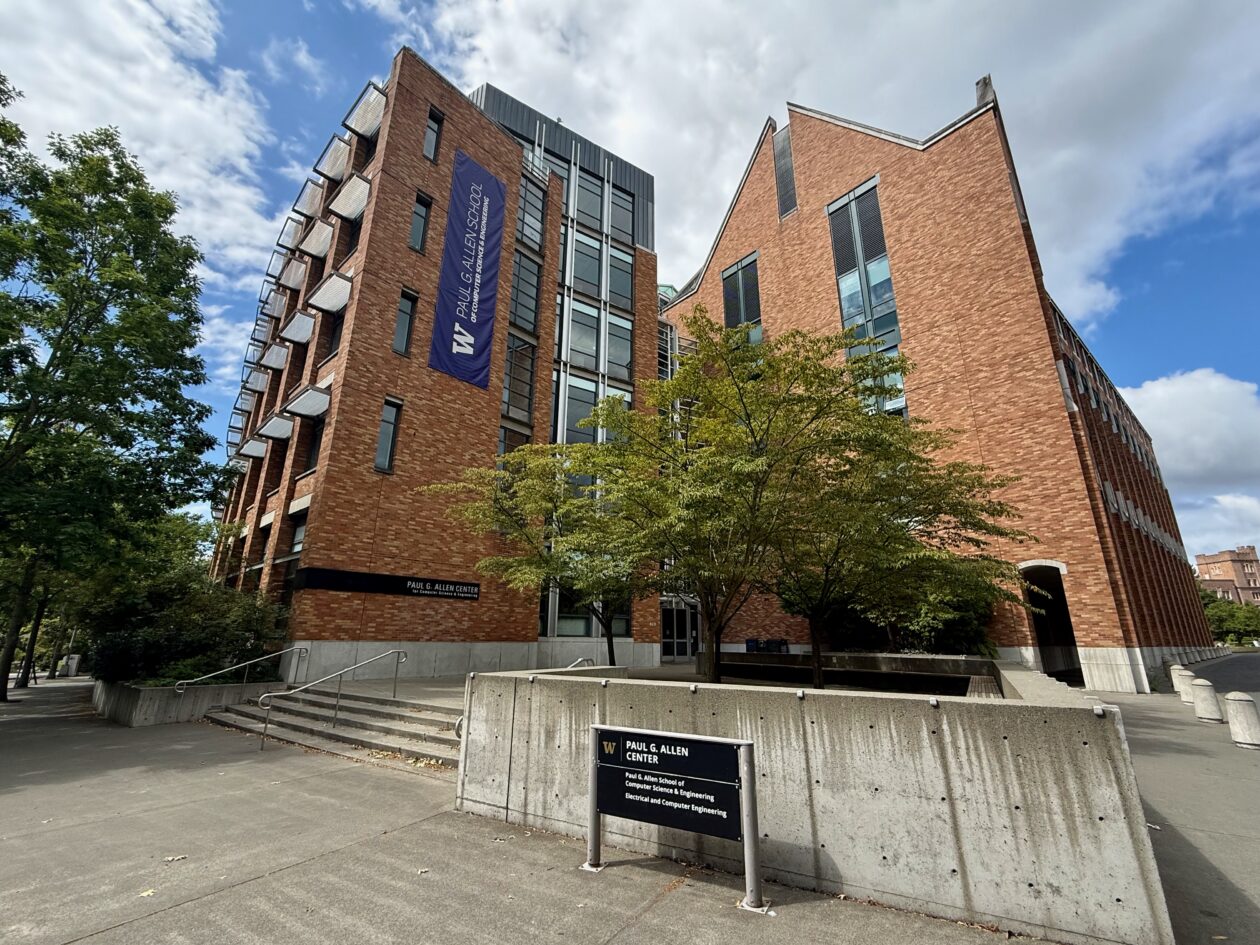
The Paul G. Allen School of Computer Science & Engineering — named for the late Microsoft co-founder — on the University of Washington campus in Seattle. (GeekWire Photo / Kurt Schlosser)
Grossman has served as vice director for nine years, and alongside Balazinska throughout her seven-year tenure, acting as her primary partner in managing the school’s academic programs, faculty affairs, and strategic planning.
“To me, the Allen School is much more than one of the leading computer science and engineering programs in the world,” Grossman said in a statement. “It has been my professional home since I completed my Ph.D. 23 years ago. It was my dream job then, and it’s my dream job now.”
A long-time UW faculty member and expert in programming languages and computing education, Grossman has frequently paired with Balazinska to navigate the department’s response to seismic industry shifts.
Most recently, the duo collaborated on public-facing efforts to address growing student anxiety surrounding AI’s impact on tech careers, advocating for curriculum updates that integrate AI tools while reinforcing core software engineering fundamentals.
Beyond administrative duties, Grossman has maintained a heavy presence in the classroom, teaching courses in programming languages, software design, and computer ethics. He also leads the school’s direct-admit seminar for first-year majors and created a popular online programming course on Coursera that reached thousands of students over the past decade.
“I could not be more grateful to Dan for stepping into the interim director role,” Balazinska noted in her email to staff. “He understands every corner of the Allen School, cares deeply about our students and faculty, and will provide outstanding leadership as the university navigates the next steps for computing.”
Nancy Allbritton, dean of the College of Engineering, said in a statement that Grossman’s appointment “will ensure strong leadership and continuity during a period of thoughtful planning for the future.”
Allbritton also expressed her gratitude to Balazinska for her “exceptional service and leadership” as the Allen School “strengthened its standing as one of the nation’s leading computing programs while advancing its impact in AI, data science, and emerging areas across research and education.”
Read Magdalina Balazinska’s email to Allen School faculty and staff:
Dear Faculty and Staff,
As we have been planning and discussing for a while, my term as Allen School director is coming to an end. Later today, the Dean will formally announce the appointment of Dan Grossman as Interim Director when my term officially ends on August 17th and I take a long-awaited sabbatical.
We will have an Interim Director for the next year or so because of the ongoing conversations on Computing, Data Science, and AI at UW, and how the University should organize itself and its efforts related to those important topics. Although the Provost Task Force is completing its work this summer, it will take time for the President and Provost to consider and act on the recommendations, and an interim appointment makes sense in that context.
My deep thanks to Dan for his willingness to assume this responsibility, and for the wonderful support he has provided to me in his role as Vice Director for the past 7 years. Dan and I have worked together ever since we joined UW as newly minted Assistant Professors over 20 years ago! Dan is a thoughtful leader who cares deeply about the success and well-being of our faculty, students and staff. I’m delighted that he agreed to take on this role at such a critical time for computer science education, for our University, and for higher education more generally.
As Director of the Allen School for nearly seven years, I’m incredibly proud of what we’ve accomplished — through some of the most turbulent times since we were founded as the “Computer Science Group” 60 years ago. We have not merely weathered those challenges — we’ve thrived.
Our accomplishments are too numerous to list in a short email, but a few highlights include:
We’ve grown substantially, graduating 50% more students today than in 2019, hiring 40 new faculty members (and also celebrating some retirements and other departures), and overhauling most of our processes to operate at this new, larger scale.
But we haven’t just grown, we’ve modernized our core educational programs, including our Ph.D. quals and undergraduate intro-to-programming sequence, while launching new ones: our Undergraduate Research Program, our Graduate Certificate in Modern AI Methods, the UW Data Science Minor (whose creation we co-led), and — now underway — a UW AI Minor. Along the way, we’ve introduced many new courses spanning quantum computing to AI-assisted software engineering.
Beyond the classroom, we’ve launched new research centers, initiatives, grand challenges, and research groups — including CREATE, Computing for the Environment, Globe.AI, and the Center for Learning, Computing, and Imagination, to name just a few among many others. We’ve also modernized our communications and website, expanded our research infrastructure, and raised very significant funds for new professorships, scholarships, fellowships, research projects, and other school activities.
We’ve also deepened our community support and activities — with new programming for undergraduates, graduate students, faculty, and staff.
While working on the above, we’ve celebrated everyone’s ideas, accomplishments, and impact including our students, researchers and staff winning some of the most prestigious honors on our campus and in our field. It has been wonderful to witness firsthand all that you have achieved and to cheer you on!
It has been a tremendous privilege to serve as director of the Allen School. I’m grateful to you — the members of our community — for giving your best every day to advance our educational and research missions and expand our impact, sharing your ideas for how we could improve, and giving me — and each other — grace as we navigated new and often unexpected challenges.
After a brief break in which I will see my daughter off to college(!), I’m looking forward to returning my attention full-time to advising my students and pursuing my research, while also supporting Dan in his new role together with the rest of the Allen School faculty and staff leadership.
Thank you for inspiring me, challenging me and supporting me over the past seven years. It has been a wonderful journey, and I learned so much about our community and myself along the way. And to my good friend and colleague Dan, congratulations!
magda
Read Dan Grossman’s email to faculty and staff:
Dear Allen School community,
Though you’ve already heard from Magda about the upcoming Allen School leadership transition, I wanted to send my own message as I work on transitioning into the Interim Director role.
First and foremost, I want to speak both for the full community and for myself personally in thanking Magda for her leadership over the last seven years. She has been truly extraordinary, managing both significant unexpected challenges (a pandemic is just one of several) and launching new initiatives across research, education, and how we organize ourselves that have set us up well for long-term success. Her steady, thoughtful, even-handed leadership is recognized throughout our community. Having worked closely with Magda, I want to add specifically, in case it isn’t as visible, two things: how she has sought out advice to reach consensus and develop new leaders, and how she has simply put in an enormous amount of time. Her sabbatical has been earned a thousand times over, but I’m also relieved that she isn’t going away and will be a key mentor and leader in the Allen School going forward. Thank you, Magda!
I want to assure everyone the transition will be smooth and not the cause of any significant changes – Magda has been planning to step down, and the staff and faculty leadership are ready. That’s not to say we won’t continue to change, in some ways rapidly, because that’s what we do as a leading school in a rapidly changing field and world. These are challenging times! The discussions I hear throughout the school on how we should adapt how we teach and learn, how we conduct research, and how we run the school’s operations are robust and exciting. They are also a lot of work by a lot of people, and I want to say that this work is not as ‘invisible’ as it may seem.
While these are challenging times in multiple ways, it is also a time of great opportunity. Technology continues to change all aspects of our lives and we are well positioned to create new technologies that make everyone’s lives better and that help our planet, while also influencing policies to ensure responsible use of new technologies. I see many opportunities for us to grow our partnerships with other units, with external collaborators, and within our School to accomplish those important goals while educating a highly skilled, knowledgeable, and ethical next generation of computer scientists and computer engineers.
Let me also emphasize that “the Allen School” needs your help in reaching our aspirations. No Director, interim or not, can alone do even a small fraction of everything we aim to do. To be honest, I find it a bit odd when I hear “the Allen School does X” or “the Allen School thinks Y.” “The Allen School” is us, nothing more and nothing less, a collection of hard-working people with diverse personalities, ideas, and preferred coffee/tea orders. (Strange fact about me: I don’t like tea.) I’m proud to be working alongside each of you, and I am excited for us to continue working together to set the future course of the Allen School.
As Magda mentioned, the rationale for not having done a Director search over the last year is that it is complicated by the ongoing university-level discussions and processes on Computing, Data Science, and AI at UW, and how the University should organize itself. I was on the relevant “Task Force” that recently completed its report, and now the Provost and President will need to make decisions and launch next steps. When we have information about these next steps and how they affect us, including the timing for a non-interim director search, I will be sure to let you know. We should be excited by this – UW is working seriously on how to best position itself to lead in computing in the decades ahead and the Allen School will, of course, be a key part of that.
Thank you in advance for everything we will accomplish in the year ahead. Please don’t hesitate to stop me in the hallway or send me an email with your ideas or even just to say hello.
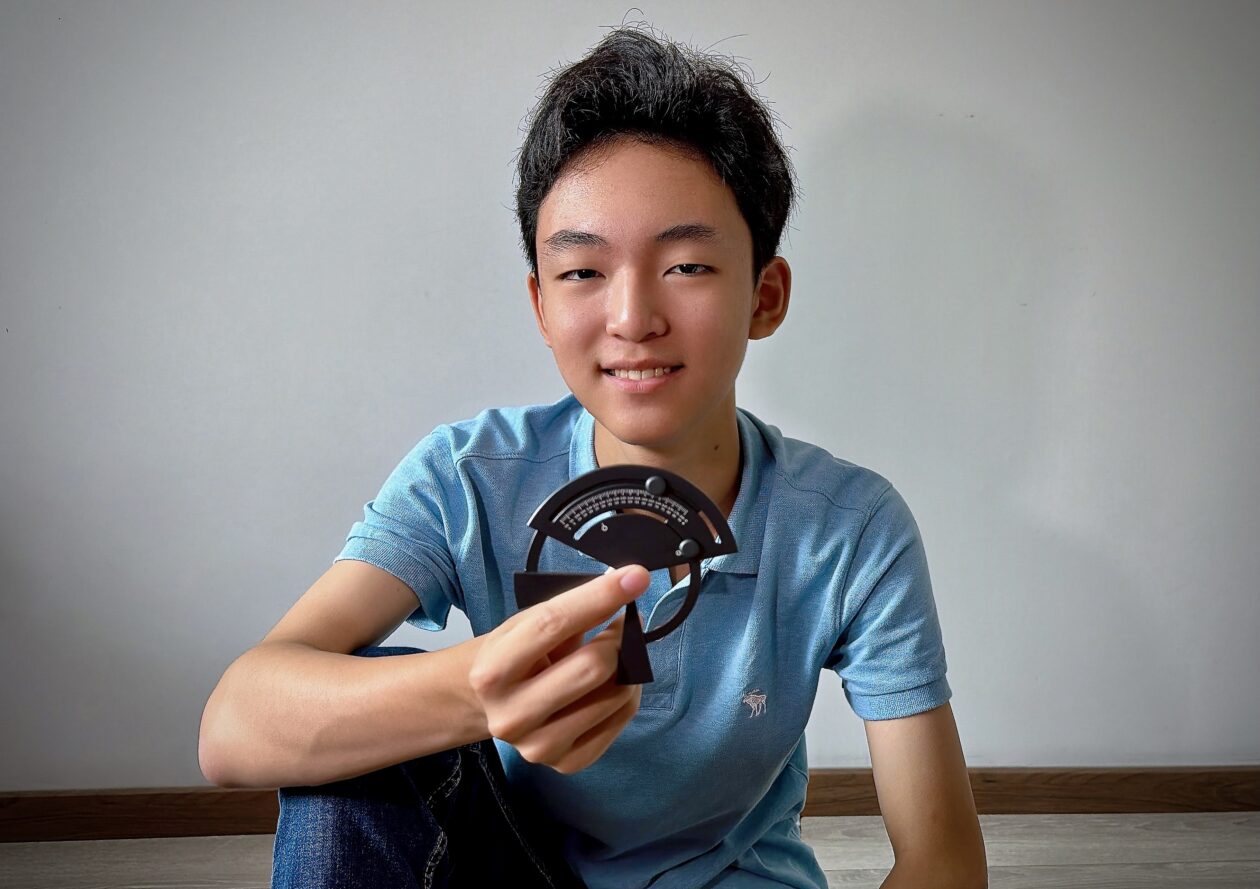
Wenxin Fang of Redmond, Wash., holds the ZeroPivot Protractor that he designed and is selling through a new Kickstarter campaign. (Photo courtesy of Wenxin Fang)
Wenxin Fang was 14 years old when he realized he was fed up with fighting with a flimsy piece of plastic in math class.
As an eighth grader at Evergreen Middle School in Redmond, Wash., Fang kept bumping into the limits of standard classroom protractors — the cheap, clear tools generations of students have used to measure and plot angles. Frustrated by how often he had to realign the plastic arc just to mark a single line, he started sketching an alternative in his notebook.
Two and a half years and seven design iterations later, the incoming Tesla STEM High School junior is launching the ZeroPivot Protractor, a sleek, precision-machined aluminum hardware project aiming to drag an overlooked classroom staple into the modern era.
“I shouldn’t be fighting with a piece of plastic to draw an angle,” said Fang, now 17, during a call from China this week where he was meeting with suppliers ahead of production of his tool.
Fang launched a Kickstarter campaign on July 26 to fund the initial production run of the ZeroPivot. The campaign hit its initial target within 48 hours and has raised more than $2,200 from dozens of early backers.
Priced at $19, the ZeroPivot is positioned as a durable, high-precision upgrade over standard $3 plastic models. The funding will cover tooling costs and help manufacture the custom-machined aluminum components through HKAA Industrial, a supplier Fang vetted and partnered with during a visit to Shenzhen.
To make the tool work, Fang abandoned the traditional semi-circular design in favor of a guide-rail system made from anodized aluminum — a material choice he insisted on despite the higher production costs.
Unlike a standard protractor, which requires users to mark an angle’s vertex and rays in separate steps, the ZeroPivot features an adjustable sliding mechanism that allows users to plot and draw precise angles in a single fluid sweep.
“I went down this path of product design, trying to come up with something that’s small, that’s almost simplistic … that is able to improve the lives of people in tiny ways through good design,” Fang said.
Fang didn’t just keep his ideas trapped in his notebook. After coming up with the initial sketches, he brought them to his middle school engineering teacher, who encouraged him to build an actual prototype rather than treat it as a fleeting thought.
The ZeroPivot Protractor. (Photo courtesy of Wenxin Fang)
When he transitioned to high school, that mentorship expanded into a full support structure. A trio of teachers helped him turn his hobby into a legitimate consumer hardware launch:
Steven Bonomo, an engineering and product design teacher with a background working on Microsoft’s Surface Laptop line, guided Fang through user testing, ergonomics, and physical product design.
Andrew Christensen, who has a background in law, walked him through the corporate, operational, and legal logistics of starting his company, Bonae Artis LLC.
Karen Schaeffer, a graphic design teacher, helped him refine the brand identity and the final visual aesthetics of the product and its packaging.
That guidance proved essential as Fang spent the past year user-testing prototypes in class on himself and his classmates, refining the tool’s feel and mechanics in real classroom conditions.
Balancing the demands of a hardware startup with high school homework requires an intense level of discipline — and plenty of late nights.
“It’s a ton of work, that’s just the reality of it,” Fang said. “If you’re pushing a project by yourself, there’s not an external deadline there. What you have to do is set deadlines for yourself and say, ‘Hey, this iteration needs to get out by Sunday.’ I do late nights pretty often just to get something in on time.”
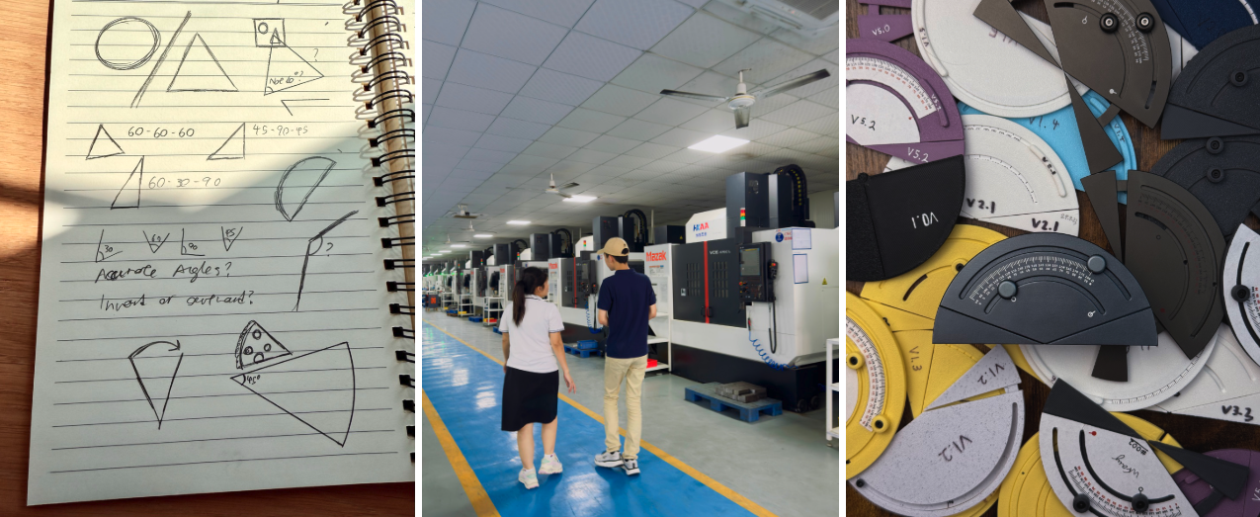
Diary of a protractor reinvention, from left: Wenxin Fang’s notebook sketches, touring a manufacturing facility in China, and various prototypes throughout the process. (Photos courtesy of Wenxin Fang)
For Fang, the ZeroPivot is just the starting point for a career he has been prepping for since childhood. His earliest memory of designing anything was at age 9 during Chinese Lunar New Year, when he used Lego bricks and superglue to create a custom ceiling hook to help his grandparents hang decorative lanterns.
Now aiming for a college degree and future career in product design and mechanical engineering, Fang sees the protractor project as proof of what simple, physical problem-solving can accomplish.
“That was kind of when I first realized, hey, I could make something so simple, and I could have somebody else use it, and it could be really nice for them,” Fang said.
With the Kickstarter campaign already funded, Fang is focused on executing the manufacturing run smoothly in China and delivering the finished ZeroPivot protractors to backers by his estimated February fulfillment target.
While he isn’t yet ready to reinvent the ruler or big pink eraser, Fang does envision creating more consumer hardware tools down the road. But his immediate motivation remains remarkably simple.
“I’m definitely focused on getting this through to fulfillment and getting this in people’s hands,” Fang said. “I think that is the most satisfying part of doing products — getting to see people using them.”

 Login
Login