Reading view

There are new articles available, click to refresh the page.

General Robotics, led by Microsoft vets, says its AI has cut robot setup from a month to hours
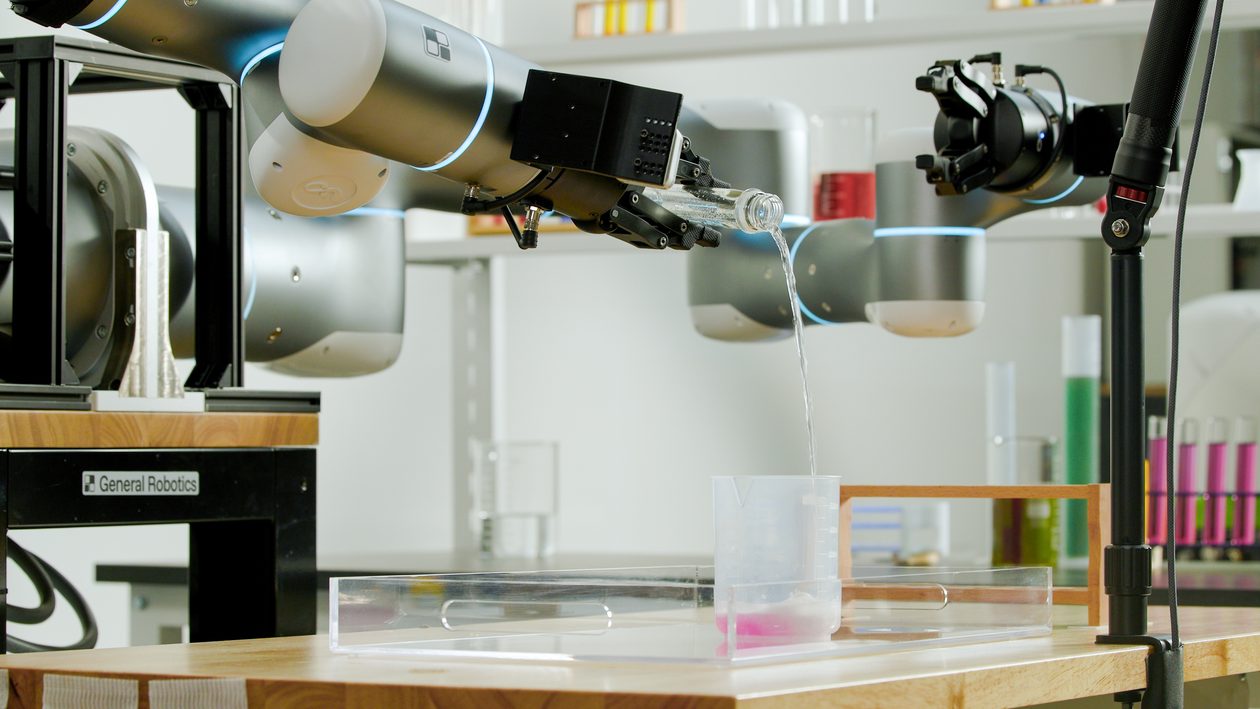
A robot arm pours from a test tube into a beaker in General Robotics’ lab. The company used the task, and progressively harder versions of it, to test its Auto Engineering system. (General Robotics Photo)

A Redmond, Wash., robotics software startup founded by former Microsoft researchers says its platform can now handle much of the work of getting a robot up and running in a factory, warehouse or other industrial setting, a job that used to take a team of engineers.

General Robotics said Wednesday that advances in GRID, its robot intelligence platform, have cut the process of onboarding a new robot from about a month to as little as two hours. The company calls the approach “Auto Engineering,” with each onboarded robot and diagnosed failure feeding back into the system and speeding up the next deployment.

General Robotics CEO Ashish Kapoor.

“Before this moment, it would take us a team of experts to go and execute on behalf of our customers,” said General Robotics CEO and co-founder Ashish Kapoor in an interview. “Clearly non-scalable, clearly very expensive, and clearly will take a long time.”

With Auto Engineering, he said, “we can magnify and accelerate each engineer’s capability.”

Founded in 2023, the company has grown to about 50 employees, primarily engineers. It has raised nearly $34 million, most recently in an April round led by Construct Capital, with participation from Khosla Ventures, Accenture Ventures, Nvidia and Valo Ventures. PitchBook put the size of the round at $25 million; the companies didn’t disclose terms at the time.

Kapoor said General Robotics has roughly a dozen customers — large enterprises across manufacturing, logistics, energy and defense — and revenue in the millions of dollars.

Customers include HTX, the science and technology agency of Singapore’s Ministry of Home Affairs, which Kapoor said has been working with General Robotics for about a year and a half.

The company’s platform works with robot types including industrial arms, humanoids, quadrupeds, wheeled robots and drones, according to the company.

General Robotics is operating in a competitive and well-funded sector. Physical Intelligence, which builds foundation models for robots, has raised more than $2 billion. Nvidia — an investor in General Robotics, and the maker of the Isaac Sim simulation software built into GRID — is developing its own robot models and deployment tools.

Robot makers build good hardware, Kapoor said, but often lack the expertise to put it to work in a specific setting like a shipping terminal. “That last layer is missing.”

Before co-founding the company, Kapoor spent 17 years at Microsoft, ultimately as general manager of its autonomous systems and robotics research group in Redmond, where he created the open-source drone simulator AirSim. General Robotics co-founders Sai Vemprala (CTO) and Shuhang Chen came from the same Microsoft team.

GeekWire covered the launch in 2023, when it was Scaled Foundations and billed itself as “ChatGPT for robots.” It had five employees at the time, focused on aerial robotics and drones, with backing from Khosla and E14 Fund. It later renamed itself General Robotics.
Tech industry’s robotics talent crunch has UW’s new grad program nearly full before day one

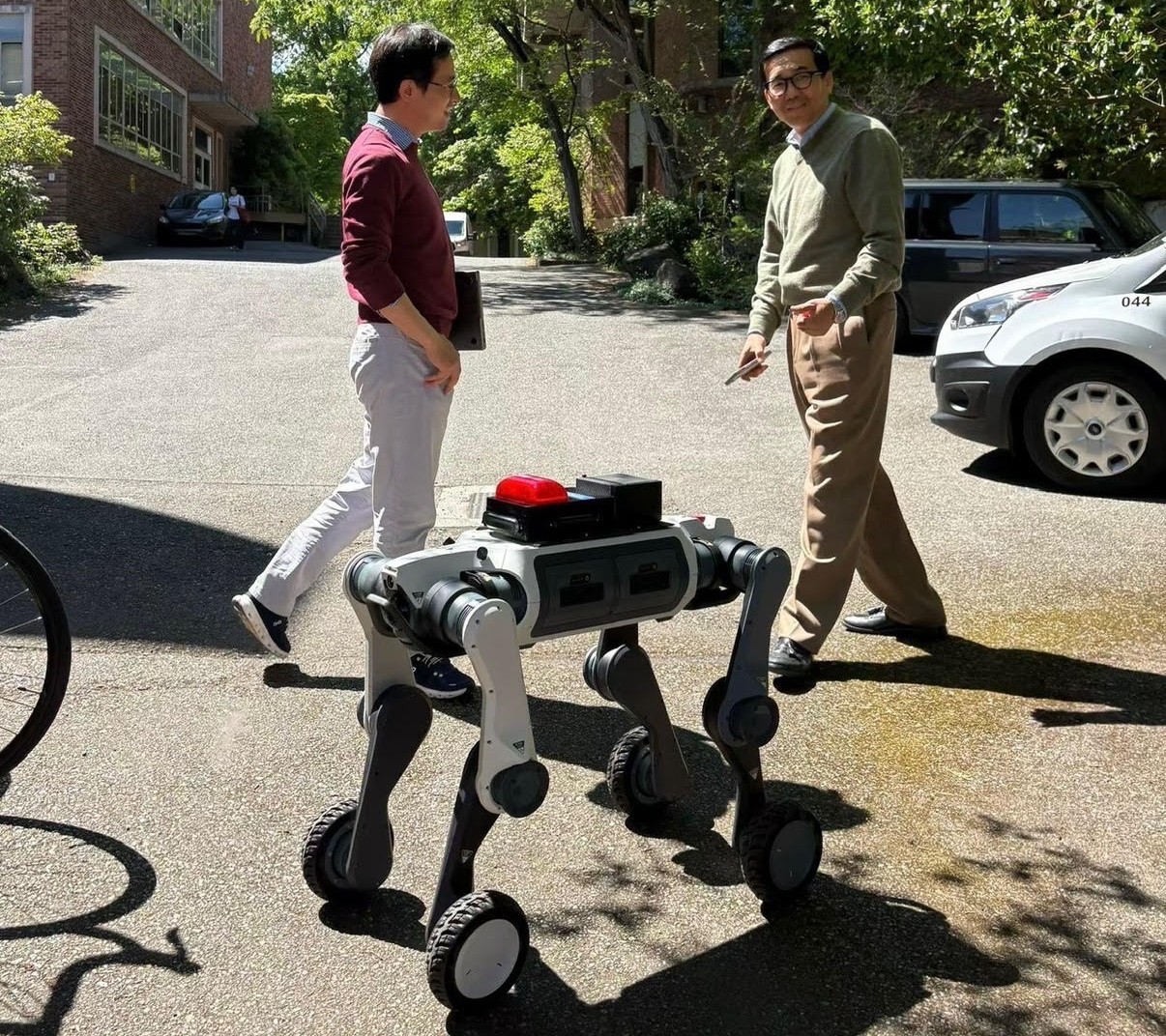
University of Washington College of Engineering Vice Dean Jihui Yang, right, and professor Xu Chen walk a robot dog on the UW campus. (Photo courtesy of Xu Chen)

Robotics jobs in the Pacific Northwest are multiplying faster than universities can train people to fill them. The University of Washington thinks it has an answer — or at least a start.

This fall, UW’s College of Engineering will launch its first robotics graduate programs: a Master of Science in Robotics and a Graduate Certificate in Applied Robotics

The university capped enrollment at 35 students for the inaugural cohort. More than 30 people had already signed up for an information session before applications even opened. It’s an  early signal, engineering leaders say, of pent-up demand from regional powerhouses racing to hire engineers who can operate at the intersection of AI, software and hardware.

Program leaders say that skill set is rooted in a traditional, narrowly focused engineering degree that hasn’t kept pace with the rapid evolution of technology. UW is betting that the fix lies at the intersection of AI and hardware, echoing an industry buzzword called “physical AI.”

“Robotics is no longer confined to a single discipline,” said Xu Chen, a UW engineering professor and director of the Boeing Advanced Research Collaboration, who played a large role in the committee that designed the new programs. “The future will need a wide variety of robotics knowledge, and that’s what we built these programs to deliver.”

Applications opened Sept. 1 and will close Sept. 10, with UW aiming for a roughly one-week turnaround before notifying applicants. For its inaugural year, the university is intentionally keeping things small: 25 seats in the master’s program and 10 in the certificate track, which is designed for working professionals who want robotics training without leaving their jobs.

Chen said the small first cohort is by design, not a limitation. The goal, he emphasized, is to get the fundamentals right before scaling up. He expects the programs to roughly triple in size within three to five years.

“Companies are seeing newer potential in robotics as advanced computing and the wave of AI technology mature,” Chen said. “They see that their workforce will benefit from a modern robotics program, and that need is really what drove this.”

Getting there will take machines, and lots of them. UW is purchasing robots and computing hardware for its initial course offerings while also leaning on industry donations: robots, GPUs, and computing infrastructure among them, according to Chen.

Amazon and Microsoft anchored the effort early; the list of partners has since grown to include NVIDIA, Boeing, Dassault Systèmes — the French software company behind design tools like SolidWorks — and at least one smaller robotics manufacturer.

“The industry board was incredibly supportive from the start,” Chen said. “We’ve had almost a year of continuous meetings and collaboration with them and with representatives across our own engineering departments.”

The broader structure of the program is meant to make it easier for students from different corners of engineering, such as electrical, mechanical and computer science, to land in the same classroom and eventually choose their own path deeper into robotics through electives.

The program is also drawing on UW’s existing research muscle in the region. It taps directly into the Boeing Advanced Research Collaboration, which Chen directs, along with robotics labs inside the Paul G. Allen School of Computer Science & Engineering. That gives students a line into the same research infrastructure that already feeds Seattle’s aerospace and e-commerce giants. 

The university’s ambitions extend well past this fall’s launch. Chen said UW has already mapped out longer-term plans for an undergraduate robotics degree and, eventually, a Ph.D. program, with the two new offerings serving as the foundation.

For now, the clearest sign of the program’s ambitions arrived this summer in an unlikely form: a pack of robot dogs let loose on UW’s campus.

“Seattle’s hills make it a uniquely difficult place for robots to move around, which is exactly why it’s a great place to study it,” Chen said.

Both students and faculty got a chance to operate the robots directly, Chen said. It was a hands-on moment that underscored how much more accessible robotics technology has become in just the last few years.

“It was exciting to see the students so happy to see the robots,” Chen said. “That’s the kind of energy we want to build this program around.”

Starcloud raises $250M to support the creation of data center satellite network in league with Nvidia

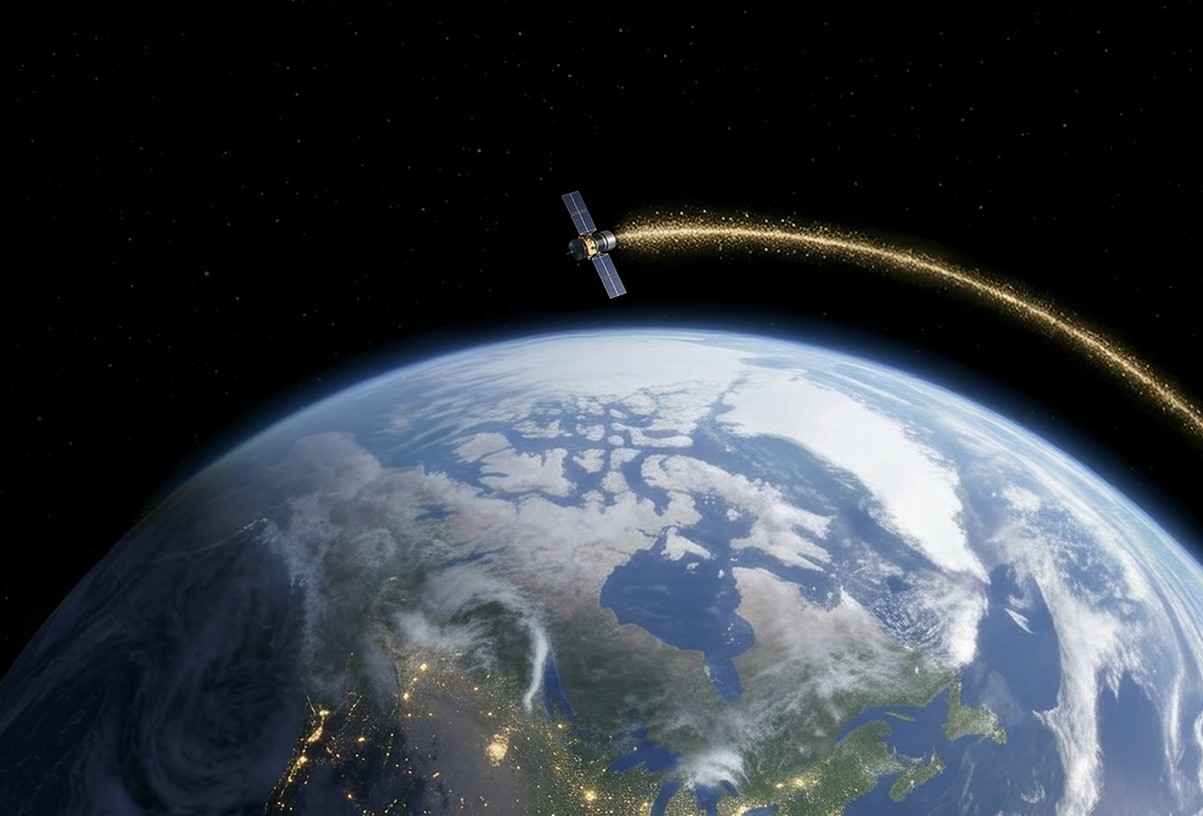
Illustration: Satellite swinging around Earth
Nvidia’s next-generation AI chip, the Space-1 Vera Rubin Module, is set to be used on Starcloud’s future satellites. (Nvidia Illustration)

Starcloud says it has raised $250 million in new funding to support the creation of a constellation of data center satellites powered by Nvidia’s next-generation AI chips.

The Series A extension funding round was led by Manhattan West, with participation from existing investors including Benchmark, EQT, Soma, NFX and 776. Among the new investors joining for this round are Nvidia, Cisco Investments, Cedar Capital, Goanna Capital and Standard Capital.

Founded in 2024, Starcloud is headquartered in Redmond, Wash., and is building production lines for its Starcloud-3 spacecraft at a new 100,000-square-foot manufacturing facility in Woodinville, Wash. The newly announced round brings the startup’s total capital raised to $450 million, with a post-money valuation of $2.3 billion.

Nvidia’s participation in the funding round brings Starcloud’s collaboration with the computer-chip titan to a new level. In November 2025, Starcloud flew Nvidia’s H100 GPU to orbit for the first time. It used the chip to train a large language model called NanoGPT — marking a milestone in space-based AI data processing.

Starcloud plans to equip future satellites with Nvidia’s Space-1 Vera Rubin Module, which Nvidia says will deliver 25 times as much in-space compute capability as the H100. Starcloud’s satellites will serve as an early flight platform for the space-rated chips.

“This fresh capital empowers us to build the infrastructure to launch many more of Nvidia’s most advanced GPUs into space,” Starcloud co-founder and CEO Philip Johnston said today in a news release.

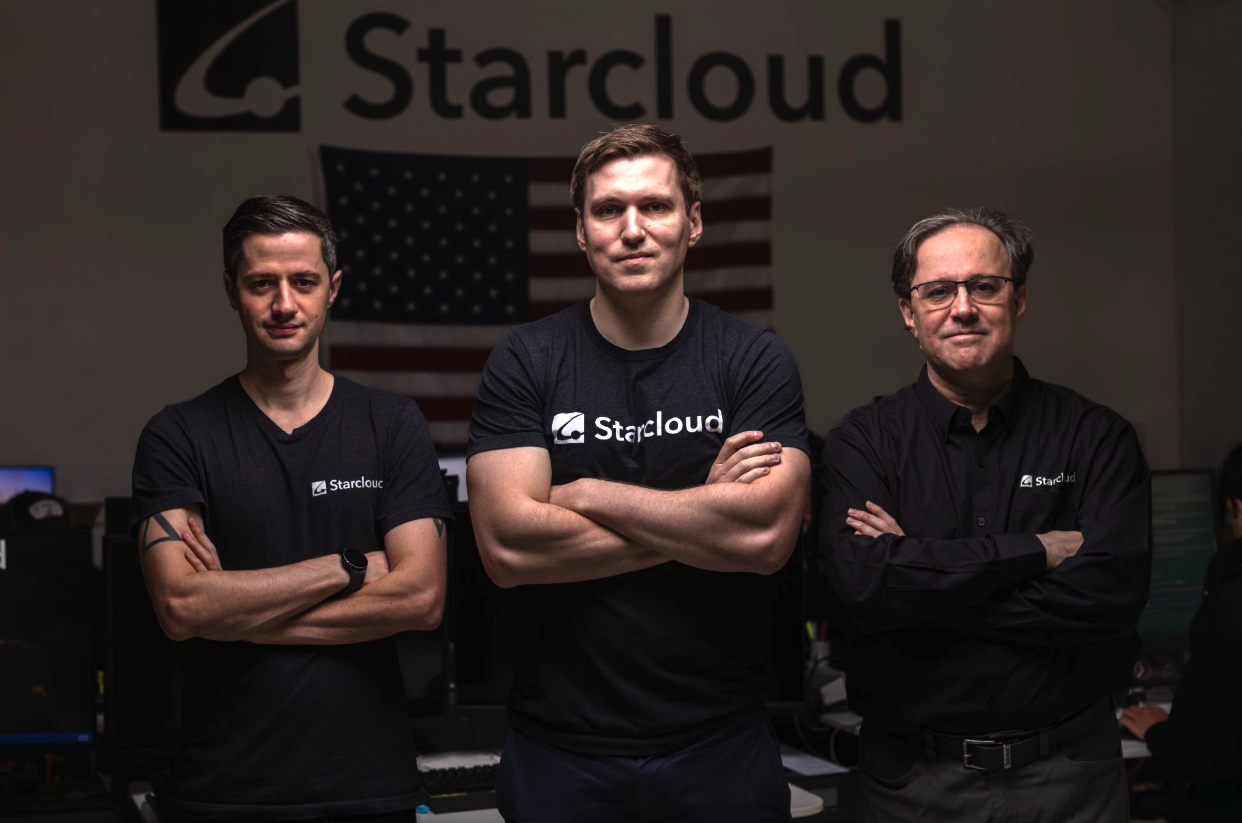
Portrait of Starcloud founders
Starcloud was founded by chief technology officer Ezra Feilden, CEO Philip Johnston and chief engineer Adi Oltean. (Starcloud Photo)

Starcloud says the new investment will fund the continued buildout of manufacturing capacity, engineering work in collaboration with Nvidia and the procurement of future launch slots. Manhattan West’s Lauren Selig will join Starcloud’s team as a board observer.

Starcloud has filed an application with the Federal Communications Commission to operate as many as 88,000 satellites as orbital data centers for AI and other applications. It’s not the only company targeting the market for orbital data centers. Most notably, SpaceX has filed its own plans to put up to a million data center satellites in space, for a project called Starmind.

The push to move AI infrastructure into space is driven by growing terrestrial bottlenecks surrounding land, power and water consumption — and by the political controversies those bottlenecks have sparked.

Amazon tops $3 trillion and Microsoft surges as Wall Street sets aside AI spending fears, for now

GeekWire Illustration

Microsoft and Amazon both saw their stocks surge again Monday, riding a post-earnings tech wave across the stock market that pushed Amazon past $3 trillion in value for the first time.

The gains follow earnings reports last week in which both companies’ cloud platforms exceeded expectations. Microsoft said Azure grew 43%, passing $100 billion in annual revenue for the first time. Amazon said AWS grew 37%, its fastest pace in 18 quarters.

Microsoft and Amazon are now the world’s fourth and fifth most valuable companies, respectively. The three ahead of them (Nvidia, Alphabet and Apple) are all headquartered in the Bay Area, although each has sizeable engineering centers in the Seattle region.

Amazon rose 4.6% in intraday trading to $284.15 as of publication time, after touching an all-time high of $287.20 earlier in the session, giving it a market value of $3.06 trillion.

Microsoft climbed 5.2% to $488.97, worth $3.63 trillion. Its rally began Thursday, when it added nearly $450 billion in market value, the largest one-day gain by any company on record.

The rallies came despite AI spending plans that have unsettled investors for much of the year. Microsoft went into earnings near a one-year low, after a $357 billion wipeout to start the year.

It’s all still coming at a huge cost. Microsoft spent a record $41 billion on capital projects last quarter and told investors to expect more than $50 billion in the current quarter. Amazon raised its 2026 forecast to about $220 billion from $200 billion, citing rising memory chip prices.

In one sign of the impact of the spending, Microsoft’s free cash flow fell 23% last quarter. Amazon’s free cash flow turned negative for the first time since 2023.

But cloud growth and other signs of demand for AI seem to have appeased investors for now.

Amazon CEO Andy Jassy told investors the spending reflects unmet demand: “Even at that amount, we will still not have enough capacity to meet all the demand we have in 2026, and I believe this dynamic will also be true in 2027 too. In fact, the demand we already have for 2028 is striking.”

The gains come as both companies operate with fewer people. Amazon confirmed 16,000 more corporate job cuts in January, bringing the total to 30,000 since October, along with more recent reductions in its robotics and artificial general intelligence groups.

Microsoft cut 4,800 jobs in July, revamping its salesforce and overhauling Xbox.

❌