
Reading view

There are new articles available, click to refresh the page.

Earth first, Mars later: Inside AIM’s grand vision for physical AI and autonomous bulldozers
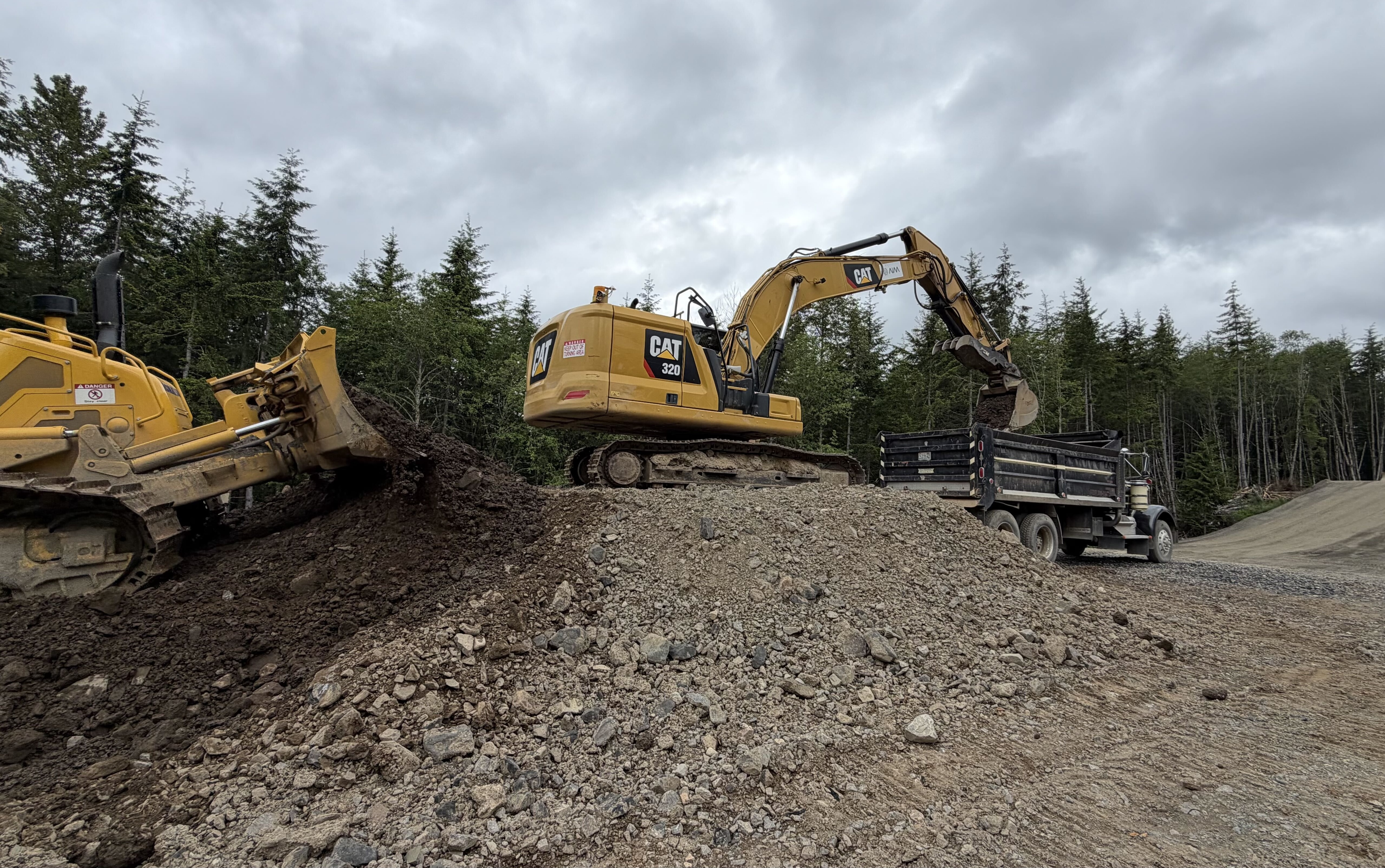
An excavator and bulldozer operating autonomously using AIM Intelligent Machines’ AI platform work at the company’s proving grounds near Monroe, Wash. (AIM Photo)

In a headquarters and lab space formerly occupied by SpaceX in Redmond, Wash., AIM Intelligent Machines (AIM) is focused on solving big problems on Earth. But the startup’s CEO envisions a day when autonomous bulldozers and excavators will dig, haul, and grade on the moon or Mars, and take AIM’s “terraforming mission” off planet.

For now, AIM’s 25,000-square-foot facility in a nondescript business park is a long way from Mars. Inside the sprawling space, there are glimpses of what the rapidly growing company is working on, including the apparatuses that attach to existing machines to make them self-driving.

Around the office, desk cubicles are decorated with tiny yellow excavator buckets, mirroring photos on the walls of heavy equipment operating on job sites worldwide.

AIM founder and CEO Adam Sadilek. (AIM Photo)

The toy excavators are a nod to a massive global market that AIM founder and CEO Adam Sadilek wants to continue to disrupt with modern technology.

Autonomous passenger vehicles have captured the public’s attention for decades, but construction, mining and hauling equipment attracts little fanfare, even as legacy companies including Komatsu and Caterpillar embrace new technology.

AIM’s goal is not to build new machinery, but retrofit existing earthmoving fleets with a physical AI platform — using advanced sensors and edge compute to let heavy iron operate entirely on its own.

Founded in 2021, the startup grew out of Sadilek’s background at Google where he spent nine years working on projects involving AI and autonomous vehicle systems.

Whether building anti-flood structures or wildfire breaks, managing nuclear waste, mining critical materials or clearing land for agriculture or the military, Sadilek views AIM’s work as immediate terraforming on Earth that is necessary to drive down costs for housing and commodities. But the long-term vision remains interplanetary.

“When humanity goes to Mars, the real question is not so much around what the rocket looks like as a vehicle to get us there, but what is going to happen after the rocket lands,” Sadilek said. “You cannot have human operators run there. That’s why this is a very long mission that we are on.”

Building autonomy for heavy equipment presents a paradox self-driving cars never have to face: the ground itself is constantly changing. While a Tesla or Waymo relies on pre-mapped roads and predictable lanes, a bulldozer or excavator’s entire job is to reshape its environment. AIM’s physical AI platform has to continuously build real-time 3D maps using onboard 360-degree LiDAR and edge compute, making split-second decisions without relying on persistent GPS or cloud connectivity on remote job sites.

Furthermore, taking human operators out of cab seats addresses one of the most perilous aspects of heavy industry. By creating “zero-entry” sites where machines operate autonomously, AIM’s platform effectively removes workers from harm’s way — transitioning traditional equipment operators into remote site supervisors who oversee entire fleets from a safe distance.

Beyond early deployments in mining and site preparation for data centers, AIM landed a $4.9 million U.S. Air Force contract earlier this year to deploy autonomous machines for airfield repair and base construction in remote or high-risk zones. The military work builds on the company’s growing momentum following a $50 million funding round backed by Khosla Ventures, General Catalyst, and Human Capital.

AIM has risen to No. 110 on the GeekWire 200 ranking on top Pacific Northwest startups.

To support its growth, AIM has rapidly expanded its headcount, doubling in size to about 80 employees in the last few months. Sadilek is attracted to the Seattle area’s intersection of hardware expertise from companies like Boeing and Amazon alongside top-tier software and AI talent.

But while AIM has managed to hire a couple former SpaceX engineers to build out its team, it isn’t the only startup mining that rocket-engineering pedigree. TerraFirma, an Austin-based company founded by two more SpaceX engineers, raised $115 million earlier this month in the burgeoning race to semi-automate physical construction.

For Sadilek, anchoring his team in Redmond rather than Silicon Valley was a deliberate decision to stay rooted in physical engineering. Having spent years in the Bay Area during his time at Google, Sadilek wanted to avoid the tech industry’s “echo chamber.”

“I wanted to be somewhat shielded from the Kool-Aid in Silicon Valley,” he said. “We wanted to build something that’s real and gets in the black really quickly… To do that, you need to do it in an environment that is more anchored in reality.”

That philosophy extends directly into their field testing. AIM’s regional proving grounds in the mountains near Monroe, Wash., expose the autonomous equipment to heavy snow and inclement weather early in development so the physical AI is built for harsh, real-world conditions from day one.

The poster that hangs in AIM’s lunchroom: “Building the plane while flying it” is a popular startup cliche, but it was close to real life during an April 1949 endurance flight in which the Sunkist Lady took on supplies while in the air. (Image via Orange County Public Libraries)

Amid the hard hats, safety vests and construction-related decor in AIM’s headquarters space, one piece of art offers a fun take on where AIM has been and where it’s headed.

The 1949 photograph, titled “Refueling the Sunkist Lady,” shows a Jeep driving beneath a low-flying plane and transferring supplies to aid the crew during an endurance flight.

Sadilek likes it as a reminder of getting started, and what it feels like to build a company from scratch, literally working on the airplane while it’s already rolling down the runway.

“The first years of AIM were exactly like that,” he said. “I think every tech startup is like that in the early days. The problem is that some of them never finish building it before the runway ends.”

8-bit ‘Jimothy’: Viral sensation raids trash cans, eludes paparazzi in Seattle creator’s video game

The “Jimothy” video game features Seattle’s beloved raccoon making his way through assorted challenges. (Image via Chris Pirillo)

Jimothy, the short-spined Seattle raccoon, has become a global sensation whose likeness has been immortalized in artwork, clothing, songs and tattoos — and now a video game created in the creature’s hometown.

Tech enthusiast and entrepreneur Chris Pirillo launched an 8-bit NES-style video game called “Jimothy” this weekend in which players can control the movements of the critter as he raids trash cans, crosses streets to the park, sneaks past the paparazzi, and climbs to the safety of a big tree.

Pirillo says the missions are pulled straight from Jimothy’s real life. No doubt the animal is busy these days trying to dodge curious onlookers who are hoping to capture the next photo or video that feeds the masses on social media.

The viral Jimothy sensation took off last week when Kiana Hall spotted the raccoon in Seattle’s Ballard neighborhood and posted a video on Instagram — viewed by millions since — asking the question heard around the world: “What am I looking at?”

An earlier video of Jimothy, captured by a home security camera and posted on Reddit, ignited further curiosity and adoration, and now Reddit is flooded with sightings, memes, artwork, food, crafts, poetry and more. The Mariners put a Jimothy mascot in the Salmon Run. There’s even a Lego Jimothy.

Pirillo told GeekWire the game idea came to him on Saturday afternoon after seeing so many creatives flood his feeds with their own Jimothy fan art. He started to build a not-so-live tracker and realized it was a not-so-great idea. He hopes internet creativity is enough of a fix for the Jimothy-curious.

“This game is as close as any of us should ever get to him,” the game site states. “If you find yourself in his neighborhood: don’t go looking for him, don’t feed him, don’t try to touch him, and don’t crowd him for a photo.”

The game is easy enough to play, with challenges that are reminiscent of classic 1980s games “Frogger” and “Donkey Kong.”

Pirillo’s “Vibe Arcade” is loaded with other games he’s created. Earlier this year he vibe-coded a Resume Analyzer app and a pre-rejection letter generator called Dear Applicant to channel his frustrations with searching for a job.

Pirillo credits AI with changing the speed and ease with which a moment can go viral and be captured in new and creative ways.

“I remember when every big moment had a video game. But by the time a studio could create a video game around a meme pre-AI, the meme’s energy would have dissipated,” he said. “We are now at a day and age (certainly with AI as a tool) where almost literally anybody of any age or tech experience level can bring full-fledged experiences to life in just a few hours. We can simply talk our solutions into existence. It’s astounding.”

Pirillo built the game as a single HTML page, pitting OpenAI GPT 5.6 against Anthropic’s Claude Fable 5. One of the bigger challenges was getting the look of Jimothy right, as multiple AI models kept returning regular-looking raccoons.

Pirillo said he looks forward to sharing more about it all during a free vibe-coding community workshop in Seattle this Saturday.

His final takeaway for anyone looking to get in on the Jimothy hype — or whatever creature emerges next — is to not wait for the moment to pass.

“While it’s never been easier to make something, it’s also never been more challenging to get attention,” he said.

Ditch your smartphone for a flip phone for a month? This group wants Seattleites to try

Maggie Hollinbeck and James Wagar are leading the charge on Month Offline Seattle, a move to get people off their smartphones.

Seattle helped create the modern smartphone era. Now, nearly 40 people in the heart of one of the world’s biggest technology hubs are voluntarily putting theirs away.

The inaugural Month Offline Seattle cohort challenges participants to swap their smartphones for flip phones — or other “dumb phones” — for 35 days, gathering weekly for what organizers describe as part happy hour, part support group.

What started as a niche experiment in Washington, D.C. and Brooklyn has found an enthusiastic audience in Seattle, where organizers expected 10 to 20 participants but have already attracted the largest cohort outside those two cities.

Weekly programs are scheduled during the month-long detox from July 28 to Sept. 1, with activities on Tuesday evenings like bocce ball, bowling and mini golf slated to connect people in real time. There are also themed programs during the week, starting in week one with orientation and goal setting, and followed by topics such as “communication and relationships,” and “attention and boredom.” You can register here.

For a region like Seattle that’s home to Microsoft, Amazon, T-Mobile and a booming AI industry, the idea might sound almost rebellious. But organizers say the goal isn’t to reject technology — it’s to rethink how much of our lives should revolve around our smartphones.

James Wagar, a former investment banker and self-described techno-optimist who has carried a flip phone alongside his smartphone for years, teamed up with therapist and coach Maggie Hollinbeck, who describes herself as a techno-skeptic, to get the Seattle cohort launched. Together, they’re leading the gatherings, serving as the guides to those ready to take a break from their always-connected lifestyles.

“We (finally) seem to be at the beginning of a cultural moment with more people seriously evaluating their relationships with technology,” Wagar tells GeekWire. “Those using flip phones and simpler devices may be the canaries in the coal mine. While I remain a techno-optimist, the attention economy is not sustainable.”

Pick your favorite flip phone and disengage next month with Month Offline Seattle. Photos via James Wagar and Maggie Hollinbeck

Hollinbeck said she remembers when smartphones felt like a convenience — a way to replace multiple devices with one. But over time, she felt that same “rectangle of glass” had become harder to put down, prompting her to rethink her relationship with technology. She’s already ditched her Facebook and Instagram accounts, and was ready for the next step.

“I’m here to reclaim my time and attention, and I’m doing it in this way because I’ve found that it’s actually pretty hard to disentangle myself from this pocket-sized dementor,” said Hollinbeck. “It’s gonna take a village, so we’re building one.”

The concept has been spreading nationally through the Month Offline movement, but Seattle’s response has surprised the organizers. Most participants found the group not through social media, but through flyers, word of mouth, and conversations at neighborhood pubs during the FIFA World Cup.

Cohort members can use their own flip phone or purchase one at a discounted price of $10, and a commitment to subscribe for four months of discounted wireless service from dumb.co. That’s a total commitment of $42.

Denver, Austin, Los Angeles and Philadelphia also are jumping on the “Month Offline” bandwagon — which is kind of best described as a dry January for the tech obsessed. The organization says it is united by a common mission — “our commitment to attention liberation.”

Wagar and Hollinbeck are also encouraging a GeekWire reporter to join the movement.

So far, no takers.

Note: I actually tried a digital detox for one day back in 2013. Not sure I am ready for 35 days, 13 years later.

Microsoft’s reset, a new era for Seattle startups, and how AI is changing everything for founders

Scenes from this week’s founder open house on the deck at GeekWire HQ in Seattle, where we also recorded this week’s podcast. Thanks to Delta Air Lines, Prime Team Partners, WTIA and ALLtech for sponsoring the event. (Photos by Kurt Schlosser and John Cook)

On this week’s show, we’re on the GeekWire deck for our annual founder open house, where we dig into Microsoft’s latest round of layoffs — including a major Xbox shakeup — and the surprising rise of hardware companies on the GeekWire 200.

Then we sit down with four guests to talk about how AI is reshaping how they build: 

Finally, this week’s GeekWire Trivia Challenge: how a longtime T-Mobile executive got his start in the wireless business, and the star-studded history of T-Mobile celebrity endorsers.

Stories mentioned:

Audio editing by Curt Milton.

Echodyne opens $40M radar factory near Seattle to meet booming demand for drone detection

Echodyne CEO Eben Frankenberg, left, gives a tour of the company’s new manufacturing facility in Woodinville, Wash., to U.S. Rep. Suzan DelBene, center, and Sen. Maria Cantwell on Wednesday. (Echodyne Photo)

Echodyne, the Seattle-area radar-platform company, cut the ribbon Wednesday on a new $40 million manufacturing facility designed to meet growing demand for its drone-detection and airspace-monitoring systems.

Headquartered in Kirkland, Wash., Echodyne is opening an 86,350-square-foot manufacturing and operations hub in nearby Woodinville, Wash., that it says will eventually be able to produce more than 2,500 radars each month — or roughly 30,000 radars annually.

Echodyne says the expansion is fueled by U.S. and global demand for safety and security radars that can detect and track drones, driven in part by their proliferation on the battlefield in the Russia-Ukraine War and the fast-growing “low altitude economy” of commercial drone operations that require airspace monitoring.

Echodyne currently employs 260 people, and the new facility will support more than 100 new jobs and up to 200 as the facility reaches full production capacity, according to the company.

“Our global customer base is demanding more radar to be delivered as fast as possible,” CEO Eben Frankenberg said in a news release, adding that the proliferation of drones requires reliable, at-scale production. “The only way to defend against mass is with mass.”

Echodyne plans to add 100 new jobs at its new manufacturing facility in Woodinville, Wash. (Echodyne Photo)

Echodyne was spun out of Bellevue-based Intellectual Ventures in 2014 and has drawn backing from Microsoft co-founder Bill Gates, along with NEA, Madrona Venture Group, Baillie Gifford and Northrop Grumman, among others. The company raised $135 million in a 2022 investment round and total funding is $200 million.

The company’s radar systems rely on patented “metamaterials” technology — a flat-panel antenna that can electronically steer its beam without any moving parts — which Echodyne says allows for smaller, cheaper radar than conventional designs.


Echodyne originally focused on using compact radar to help drones detect and avoid obstacles in flight, before pivoting toward counter-drone security as demand grew for systems that could track other drones — including cheap, mass-produced ones deployed on the battlefield in Ukraine.

Echodyne’s radar technology is integrated into systems from Anduril, Axon, Moog and Northrop Grumman, among other defense companies, the company said. Most recently, Echodyne was selected as the primary radar provider for Trust Automation’s drone-detection platform, which is being delivered to the U.S. Air Force under a $490 million contract.

Wednesday’s ribbon cutting was attended by Sen. Maria Cantwell, U.S. Rep. Suzan DelBene, Woodinville Mayor Sarah Arndt, and Michael Robbins, president and CEO of AUVSI, the trade association for the uncrewed systems, autonomy, and robotics industry.

The new hub allocates approximately 74,350 square feet to manufacturing space and 12,000 square feet to warehousing.

Cutting the ribbon on Echodyne’s new manufacturing facility, from left: Sen. Maria Cantwell, U.S. Rep. Suzan DelBene, Echodyne CEO Eben Frankenberg, and AUVSI President and CEO Michael Robbins. (Echodyne Photo)
❌