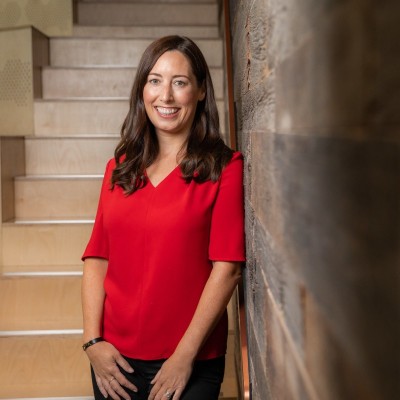
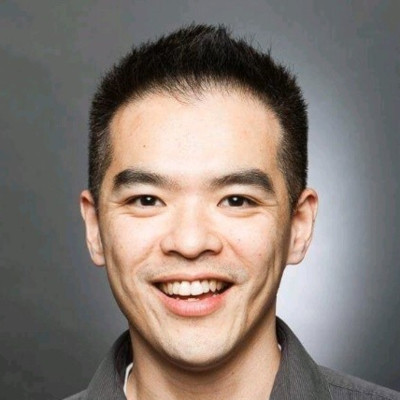
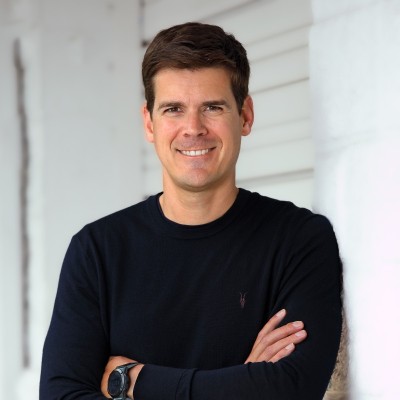
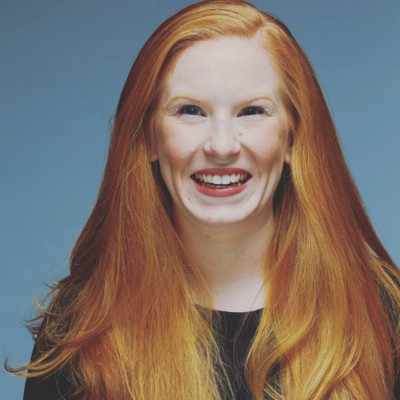
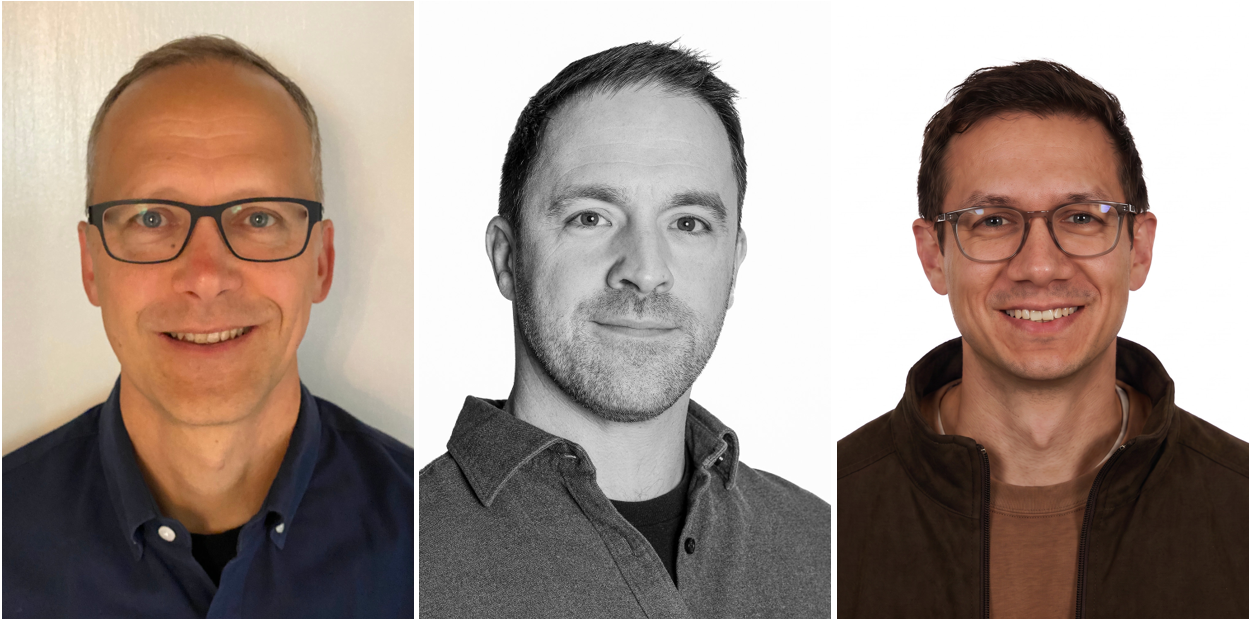
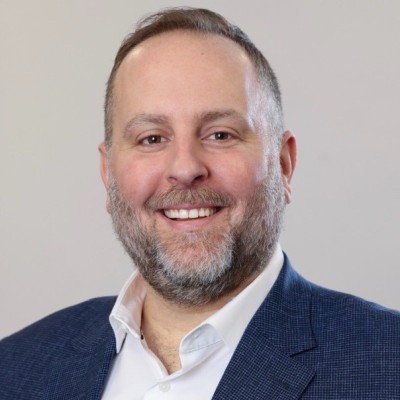
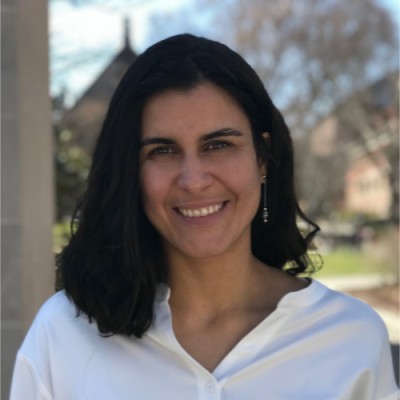
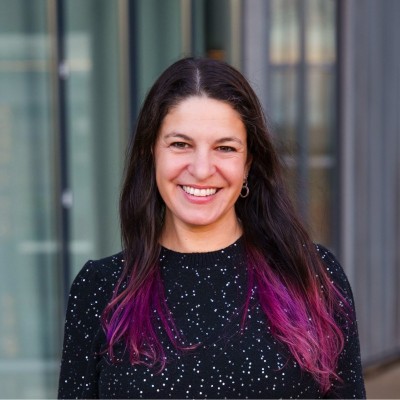
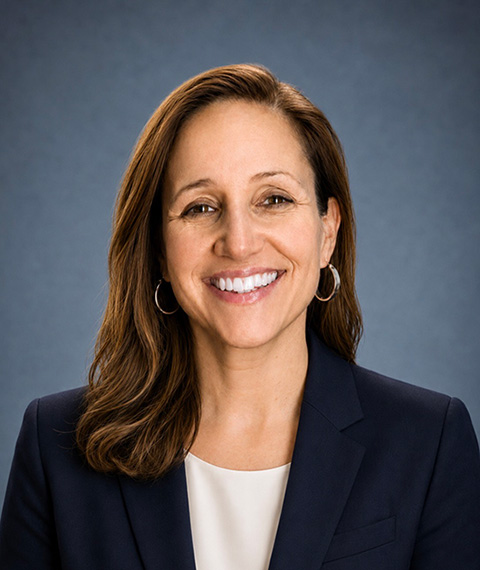
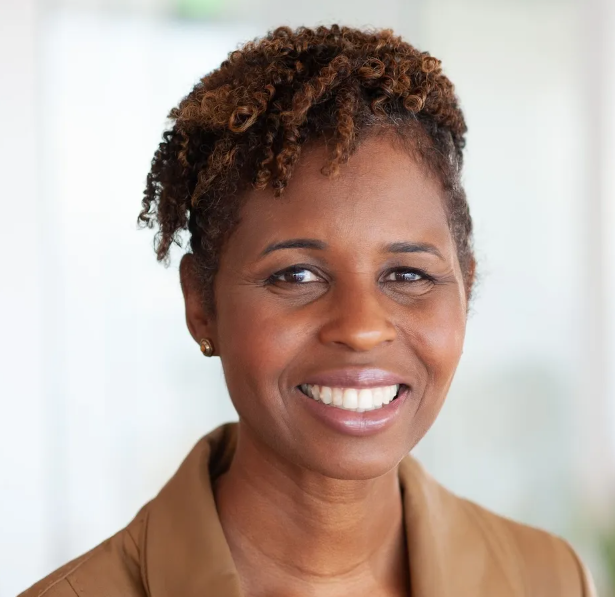
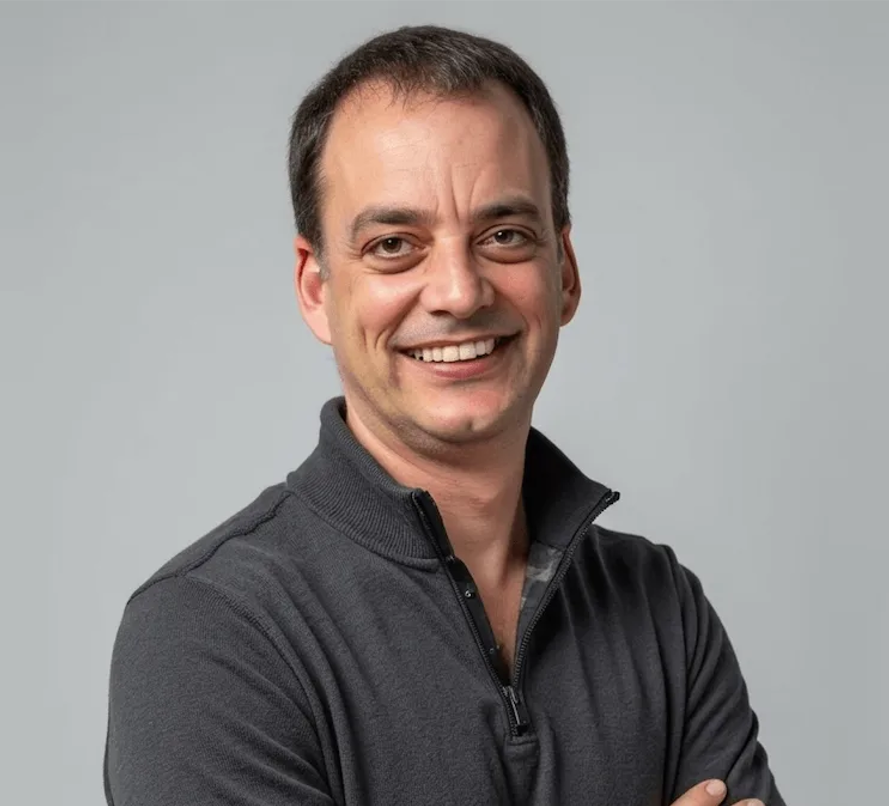
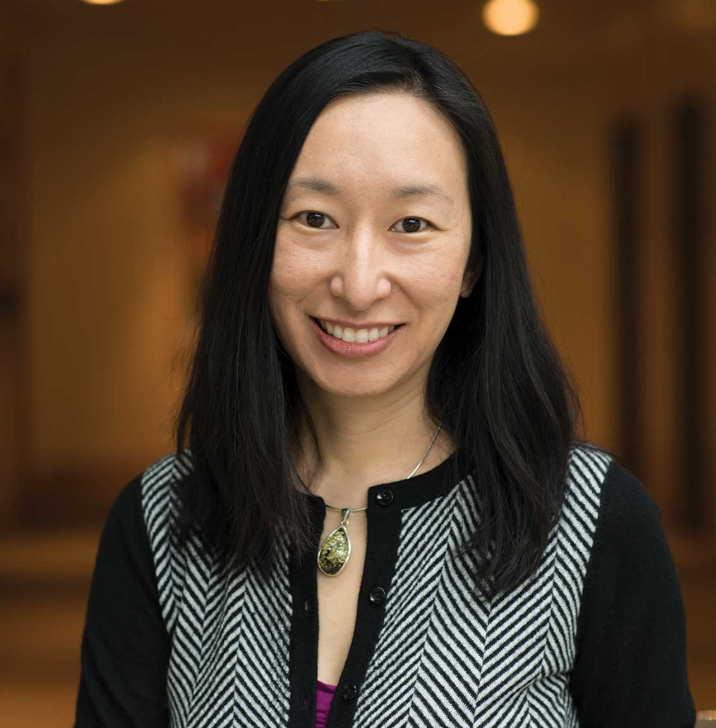
They joined as part of a funding round that totals $13 million, according to a Form D filed with the Securities and Exchange Commission. NLM has reported at least $26 million in funding since 2018, according to SEC filings.
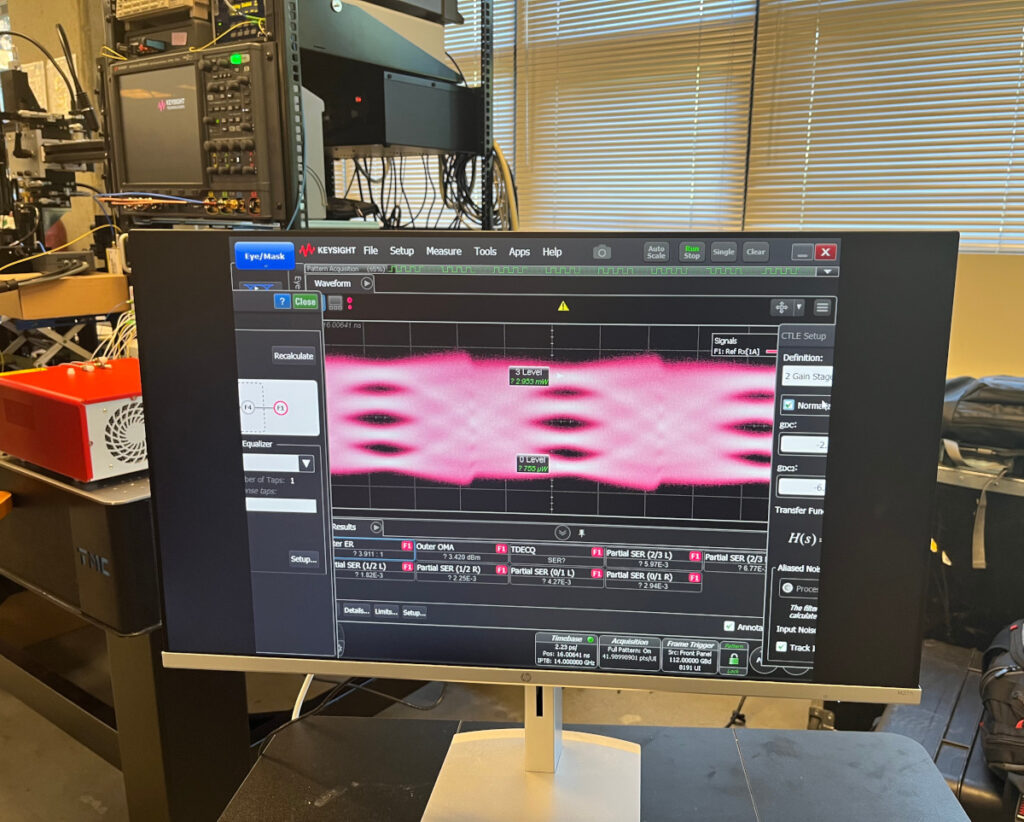
The company offers a way to move more data without burning more power. Inside a data center, information travels between chips and servers as pulses of light. The part that puts the data onto the light beam, called a modulator, is normally made of silicon. It limits how much data a link can carry, and how much power that takes.
NLM’s technology, sold under the name Selerion, is an organic electro-optic material that goes on as a liquid and hardens in place on the chip, taking over the modulator’s job from the silicon underneath. The company says it does the work 10 to 15 times more efficiently.
Applications for the technology include fiber-optic networking equipment and the links between servers in AI data centers. NLM says it could also be used in quantum computing.
Five existing investors participated in the round, which the company described as a Series A2: Emerald Technology Ventures, Oregon Venture Fund, Idemitsu, Tokyo Ohka Kogyo and StoryHouse Ventures. Private investors and company employees also took part.
Pangaea Ventures, which has offices in Canada, the United States and Japan, backs startups built on advances in materials, chemistry and biology. It says it has invested in more than 40 companies over more than 20 years. David Weekes of Pangaea is joining NLM’s board, which already includes Frank Balas of Emerald.
Diamond Edge Ventures, led by president Curtis Schickner, has $200 million to invest through 2030. It backs companies in Mitsubishi Chemical’s core markets, including advanced materials, polymers and electronics, and its portfolio includes Boston Materials, DigiLens and Eridan.
Hamamatsu Photonics, which invested previously, is not part of this round but is still a shareholder, according to the company.
The company was incorporated in 2018 as Nonlinear Materials Corp. It licensed its patents from the University of Washington, building on 25 years of research there in the labs of chemists Larry Dalton and Bruce Robinson. Robinson is one of the company’s co-founders, as is Lewis Johnson, a longtime UW researcher who is chief technology officer.
Pack Ventures, the UW-affiliated venture fund, is an investor in NLM and is also listed among the advisors to its board.
GeekWire covered NLM’s launch in 2019, when the company was raising a $1.25 million seed round and running a small production lab on campus.
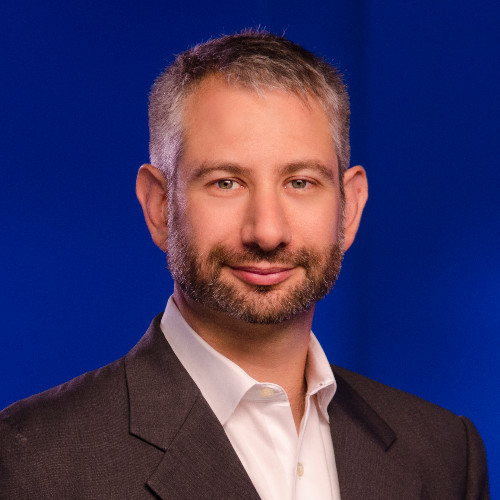
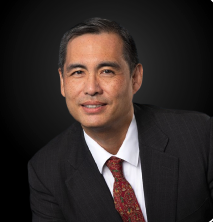
NLM Photonics CEO Brad Booth. (NLM Photo)
Brad Booth, who spent nine years at Microsoft and joined NLM’s board in 2023, took over as CEO in 2024 from co-founder Gerard Zytnicki, who is now a corporate advisor to the company. The company raised $1 million from Tokyo Ohka Kogyo and Hamamatsu in 2023.
Last year NLM said outside testing confirmed that a 1.6-terabit chip combining silicon with its materials ran at 224 gigabits per second on each of eight channels. It started sending samples of 1.6- and 3.2-terabit chips to customers in March.
NLM is not alone in trying to build a better modulator. Lightwave Logic, a publicly traded Colorado company also working with organic materials, named NLM among its smaller competitors in its annual report for 2024.
Some of the company’s rivals have raised a significant amount of funding. HyperLight, a Harvard spinout that uses a crystal called lithium niobate instead of an organic material, has raised $117 million, including $80 million in June led by MediaTek.
NLM has worked to get its materials onto other companies’ production lines. In March the company said the chips going out to customers were made at GlobalFoundries, and that it had built modulators using Tower Semiconductor’s high-volume silicon photonics process.
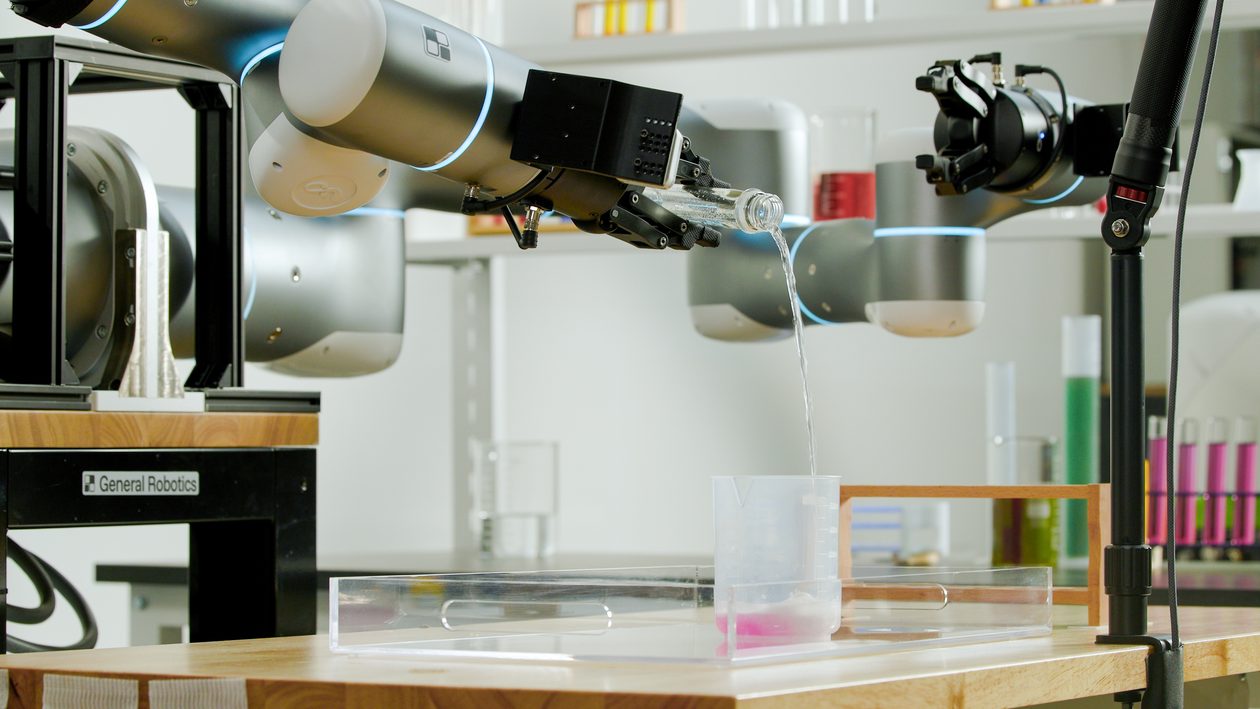
A robot arm pours from a test tube into a beaker in General Robotics’ lab. The company used the task, and progressively harder versions of it, to test its Auto Engineering system. (General Robotics Photo)
A Redmond, Wash., robotics software startup founded by former Microsoft researchers says its platform can now handle much of the work of getting a robot up and running in a factory, warehouse or other industrial setting, a job that used to take a team of engineers.
General Robotics said Wednesday that advances in GRID, its robot intelligence platform, have cut the process of onboarding a new robot from about a month to as little as two hours. The company calls the approach “Auto Engineering,” with each onboarded robot and diagnosed failure feeding back into the system and speeding up the next deployment.
General Robotics CEO Ashish Kapoor.
“Before this moment, it would take us a team of experts to go and execute on behalf of our customers,” said General Robotics CEO and co-founder Ashish Kapoor in an interview. “Clearly non-scalable, clearly very expensive, and clearly will take a long time.”
With Auto Engineering, he said, “we can magnify and accelerate each engineer’s capability.”
Founded in 2023, the company has grown to about 50 employees, primarily engineers. It has raised nearly $34 million, most recently in an April round led by Construct Capital, with participation from Khosla Ventures, Accenture Ventures, Nvidia and Valo Ventures. PitchBook put the size of the round at $25 million; the companies didn’t disclose terms at the time.
Kapoor said General Robotics has roughly a dozen customers — large enterprises across manufacturing, logistics, energy and defense — and revenue in the millions of dollars.
Customers include HTX, the science and technology agency of Singapore’s Ministry of Home Affairs, which Kapoor said has been working with General Robotics for about a year and a half.
The company’s platform works with robot types including industrial arms, humanoids, quadrupeds, wheeled robots and drones, according to the company.
General Robotics is operating in a competitive and well-funded sector. Physical Intelligence, which builds foundation models for robots, has raised more than $2 billion. Nvidia — an investor in General Robotics, and the maker of the Isaac Sim simulation software built into GRID — is developing its own robot models and deployment tools.
Robot makers build good hardware, Kapoor said, but often lack the expertise to put it to work in a specific setting like a shipping terminal. “That last layer is missing.”
Before co-founding the company, Kapoor spent 17 years at Microsoft, ultimately as general manager of its autonomous systems and robotics research group in Redmond, where he created the open-source drone simulator AirSim. General Robotics co-founders Sai Vemprala (CTO) and Shuhang Chen came from the same Microsoft team.
GeekWire covered the launch in 2023, when it was Scaled Foundations and billed itself as “ChatGPT for robots.” It had five employees at the time, focused on aerial robotics and drones, with backing from Khosla and E14 Fund. It later renamed itself General Robotics.
— Aneesh Raman has taken the role of chief economic opportunity officer at Microsoft. He previously held the same title at LinkedIn, a Microsoft subsidiary where he worked for five years.
The job is focused on “helping companies, including our own, build and deploy AI tools in ways that will unlock new levels of economic opportunity and human capability for workers and workforces alike,” Raman said.
Raman, who is based in San Francisco, began his career as a TV journalist and served as a speechwriter for President Obama and other political leaders. More recently he was an adviser to Gov. Gavin Newsom and led economic impact for Facebook.
Jenny Lay-Flurrie. (LinkedIn Photo)
— Jenny Lay-Flurrie was promoted to corporate vice president of Microsoft‘s Trusted Technology Group. In February, she had taken the role of vice president and head of Trusted Technology, which focuses on privacy, safety, regulatory compliance, responsible AI use and related topics.
Lay-Flurrie announced the change on LinkedIn, saying that she was “honoured, humbled and a little lost for words (yes,, it does occasionally happen ;)).”
The tech leader has been with Microsoft since 2005, and led the company’s efforts on accessibility and disability inclusion for more than a decade.
Brian Gill. (LinkedIn Photo)
— Brian Gillhas resigned as chief product and technology officer for DAT Freight & Analytics, a Beaverton, Ore.-based freight company. Gill was with DAT for more than three years and previously served as CPO for Nordstrom.
In a LinkedIn post, Gill did not give specifics on his next move but said he would be “rolling up my sleeves and building the many ideas that are suddenly so much easier to bring to life.”
Gill’s other past roles include executive positions at Hotwire and nearly a decade at Expedia. Last month DAT announced multiple promotions and hires to its leadership team.
Colin Newman. (LinkedIn Photo)
— Colin Newman has joined Zillow Group as head of public policy. He was previously director of U.S. public policy for Amazon, leading initiatives on employment, workforce transformation, AI, transportation and economic development. He first took a government affairs role with Amazon’s Audible business in 2015 and moved to Amazon five years ago.
“I look forward to leveraging my government, legal, and public policy experience to support our efforts to simplify and democratize the housing process for everyone,” Newman said. His background includes legal counsel for former New Jersey Gov. Chris Christie.
Lisa Finnegan. (LinkedIn Photo)
— Lisa Finnegan is returning to Microsoft as vice president and human resources business partner for the Europe, Middle East and Africa (EMEA) region. Finnegan, who is based in Dublin, was previously with LinkedIn for more than eight years, departing in March 2025. Her interim role was with Lumera HR Consulting.
“It’s a pretty incredible time to (re)join Microsoft and the opportunity to help shape the people and organisation agenda across EMEA at this critical moment is incredibly compelling,” she said.
James Lau. (LinkedIn Photo)
— James Lau, chief product officer at Hiya, announced this is his last week at the Seattle startup, which battles fraudulent calls and provides technology to protect voice identity. He’s been in the role for three years and previously worked at Microsoft over multiple stints.
Lau is launching a company called Entrovox, which he describes as an AI phone team that helps insurance agencies land new customers through state-of-the-art AI voice agents, branded caller ID and smart campaigns.
“There has never been a more exciting time for building, and I am deeply passionate about voice AI. Making AI sound genuinely human is a challenge I find irresistible,” Lau said.
Jason Wilbur. (LinkedIn Photo)
—Jason Wilbur has left Oracle to join OpenAI‘s Seattle office as a leader in cloud partnerships.
Wilbur was with Oracle over two stints spanning more than six years and leaves the role of senior director of product management. Past jobs include CEO at Aarno Labs, co-founder of Require Security, and senior product manager at Amazon.
— Julia Liuson was appointed to Elastic’s board of directors. Earlier this year, Liuson resigned from Microsoft after more than 34 years. She was most recently president of Microsoft’s Developer Division. San Francisco’s Elastic bills itself as the “search AI company.”
Dan Walter. (LinkedIn Photo)
— Dan Walter was promoted to vice president of fission technology for Everett, Wash.-based Zap Energy. Walter joined Zap earlier this year as the clean power startup announced it was expanding to pursue fission micro-reactors as well as fusion-based nuclear energy. Zap is No. 11 on the GeekWire 200, a ranked index of the Pacific Northwest’s top startups.
Walter was previously at TerraPower for nearly a decade, most recently in a director role for the nuclear power company.
Kelsey Wolf. (LinkedIn Photo)
— Kelsey Wolf has joined next-gen battery company Group14 Technologies as director of communications and marketing. Wolf was previously the communications lead for Rad Power Bikes, the Seattle-based e-bike startup that went bankrupt and was acquired this past spring. Group14 is No. 34 on the GeekWire 200.
“I’ve spent my career telling exciting stories about technology that changes how we work, how we find home, and how we move around the world. Up next, I will get to tell stories about the technology and materials powering our world,” she said.
New members of the Tin Can team, from left: Evan Jacobs, Quinn Hawkins and Masud Khan. (Tin Can Photos)
— Tin Can, a Seattle startup selling Wi-Fi-enabled landline phones for kids, announced three hires:
Evan Jacobs has joined as head of engineering, previously serving as a software development manager at Amazon Web Services. Jacobs is also a startup founder.
Quinn Hawkins was named head of communities, joining from First Street, where he was chief product officer. His background includes leadership at Redfin and Microsoft.
Masud Khan was named staff software engineer. Past employers include Apple, Databricks, Meta and Amazon.
Tin Can, which launched last year, is No. 153 on the GeekWire 200.
Alex Gamoran. (LinkedIn Photo)
— EchoMark, the Bellevue, Wash., startup using forensic watermarking to identify the source of information leaks, has named Alex Gamoran vice president of enterprise sales. Gamoran was previously at Smartsheet for nearly a decade, leaving as regional vice president of commercial sales for North America.
“It struck me that every security-conscious enterprise is going to need a solution to the types of information leaks that conventional security software is blind to — and that’s when I knew I wanted to be part of EchoMark,” Gamoran said via email.
Sara Dutta. (LinkedIn Photo)
— Sara Duttawas named director of AI innovation and partnerships for Seattle biopharmaceutical company Omeros. She previously founded the life sciences consultancy Ocilisni and was a director at Novo Nordisk, focused on external partnerships and emerging technologies.
Last year, Omeros struck a deal worth up to $2.1 billion with Novo Nordisk, giving the latter exclusive global rights to develop and commercialize a clinical-stage drug candidate that treats rare blood and kidney disorders. Omeros won Deal of the Year at this year’s GeekWire Awards.
Rebekah Bastian. (LinkedIn Photo)
— Rebekah Bastian announced that she is leaving mpathic as chief marketing officer. She joined the Bellevue, Wash., startup working to make AI safe in December. Bastian previously launched and was CEO of the life-and-career social platform OwnTrail. She was with Zillow Group for more than 14 years and also worked at GlowForge.
“I’m giving myself some intentional time to explore ideas and let them incubate before deciding where they lead,” she said. That could include new companies or initiatives within existing companies, and her areas of focus span “human agency, creative entrepreneurship, economic opportunity, and generally how humans find meaning and thrive in the age of AI.”
— Seattle-area wine recommendation startup Theodora has appointed Heather Stephens founding marketing lead. Stephens has worked for more than a decade in consumer and B2B marketing, demand generation, and go-to-market strategy development.
— Marc Brown, former global head of M&A and strategic investments at Microsoft and now managing director of venture capital coverage at JPMorgan, has joined the board of trustees of the Institute for Citizens & Scholars, an organization supporting civic engagement for young people.
— Adrienne Lopez, a Seattle-based marketing leader who has worked on initiatives with organizations including Meta, WhatsApp, the Gates Foundation and Microsoft, was named executive vice president of WH Inc.
— Washington Research Foundation announced its new cohort of venture analysts: Jessica Ayers, Ankit Azad, Nello Gu, Michael Malone and Elya Shamskhou. The program helps graduate students and postdoctoral fellows gain expertise in technology commercialization and entrepreneurship.
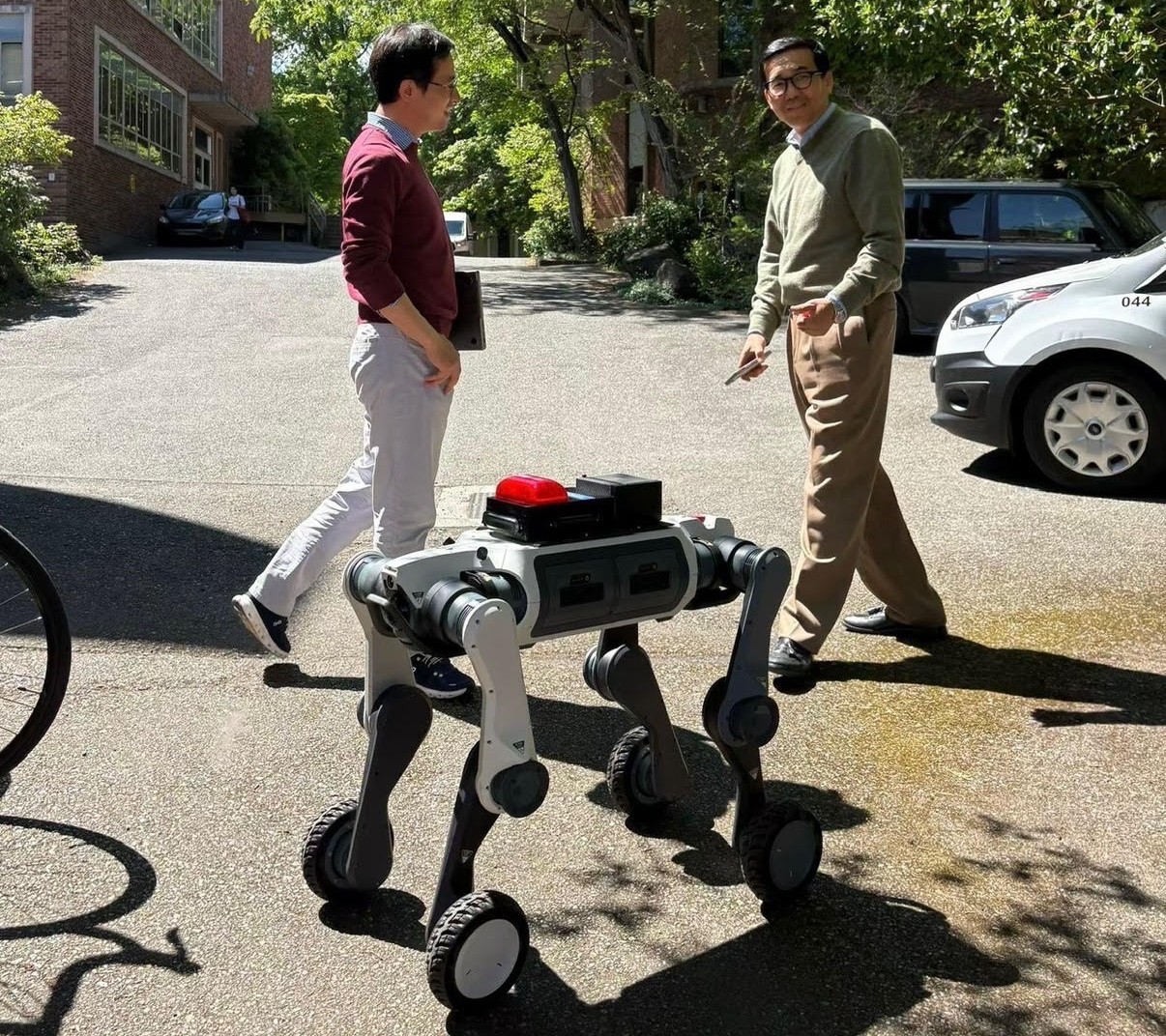
University of Washington College of Engineering Vice Dean Jihui Yang, right, and professor Xu Chen walk a robot dog on the UW campus. (Photo courtesy of Xu Chen)
Robotics jobs in the Pacific Northwest are multiplying faster than universities can train people to fill them. The University of Washington thinks it has an answer — or at least a start.
The university capped enrollment at 35 students for the inaugural cohort. More than 30 people had already signed up for an information session before applications even opened. It’s an early signal, engineering leaders say, of pent-up demand from regional powerhouses racing to hire engineers who can operate at the intersection of AI, software and hardware.
Program leaders say that skill set is rooted in a traditional, narrowly focused engineering degree that hasn’t kept pace with the rapid evolution of technology. UW is betting that the fix lies at the intersection of AI and hardware, echoing an industry buzzword called “physical AI.”
“Robotics is no longer confined to a single discipline,” said Xu Chen, a UW engineering professor and director of the Boeing Advanced Research Collaboration, who played a large role in the committee that designed the new programs. “The future will need a wide variety of robotics knowledge, and that’s what we built these programs to deliver.”
Applications opened Sept. 1 and will close Sept. 10, with UW aiming for a roughly one-week turnaround before notifying applicants. For its inaugural year, the university is intentionally keeping things small: 25 seats in the master’s program and 10 in the certificate track, which is designed for working professionals who want robotics training without leaving their jobs.
Chen said the small first cohort is by design, not a limitation. The goal, he emphasized, is to get the fundamentals right before scaling up. He expects the programs to roughly triple in size within three to five years.
“Companies are seeing newer potential in robotics as advanced computing and the wave of AI technology mature,” Chen said. “They see that their workforce will benefit from a modern robotics program, and that need is really what drove this.”
Getting there will take machines, and lots of them. UW is purchasing robots and computing hardware for its initial course offerings while also leaning on industry donations: robots, GPUs, and computing infrastructure among them, according to Chen.
Amazon and Microsoft anchored the effort early; the list of partners has since grown to include NVIDIA, Boeing, Dassault Systèmes — the French software company behind design tools like SolidWorks — and at least one smaller robotics manufacturer.
“The industry board was incredibly supportive from the start,” Chen said. “We’ve had almost a year of continuous meetings and collaboration with them and with representatives across our own engineering departments.”
The broader structure of the program is meant to make it easier for students from different corners of engineering, such as electrical, mechanical and computer science, to land in the same classroom and eventually choose their own path deeper into robotics through electives.
The program is also drawing on UW’s existing research muscle in the region. It taps directly into the Boeing Advanced Research Collaboration, which Chen directs, along with robotics labs inside the Paul G. Allen School of Computer Science & Engineering. That gives students a line into the same research infrastructure that already feeds Seattle’s aerospace and e-commerce giants.
The university’s ambitions extend well past this fall’s launch. Chen said UW has already mapped out longer-term plans for an undergraduate robotics degree and, eventually, a Ph.D. program, with the two new offerings serving as the foundation.
For now, the clearest sign of the program’s ambitions arrived this summer in an unlikely form: a pack of robot dogs let loose on UW’s campus.
“Seattle’s hills make it a uniquely difficult place for robots to move around, which is exactly why it’s a great place to study it,” Chen said.
Both students and faculty got a chance to operate the robots directly, Chen said. It was a hands-on moment that underscored how much more accessible robotics technology has become in just the last few years.
“It was exciting to see the students so happy to see the robots,” Chen said. “That’s the kind of energy we want to build this program around.”
Qualtrics Tower in downtown Seattle. (GeekWire File Photo)
Qualtrics is cutting 117 jobs connected to its Seattle headquarters, according to a state filing that provides new details of the layoffs that the experience management technology company made two weeks ago.
Engineering and product teams were hit hard. The filing lists software roles from entry-level through principal engineers, plus testing, machine learning, network and information security positions; engineering managers and directors; and product and product marketing managers.
The employees work at or report into Qualtrics Tower at 1201 Second Ave., the filing says.
The company, which has dual headquarters in Seattle and Provo, Utah, made cuts globally on Aug. 19, so the Seattle number reflects only a portion of the overall positions impacted. The company has not disclosed the total. We followed up again Wednesday to ask for an overall number.
Qualtrics employed about 900 people in Seattle as of 2023 and has not disclosed a figure since.
It’s part of a steady stream of tech layoffs in the Seattle region. Amazon disclosed 121 job cuts in Washington state on Aug. 31, T-Mobile 77 on Aug. 26, and TikTok 75 in Bellevue on Aug. 19. Zillow cut more than 500 Seattle jobs in early August.
Earlier this year, Meta cut nearly 1,400 jobs in the state, about 20% of its local workforce; Microsoft cut 605; and Oracle 491.
Qualtrics makes software that companies use to collect and analyze feedback from customers, employees, partners and others — a category that Qualtrics calls experience management. It was founded in Provo in 2002 and later added a Seattle headquarters.
The layoffs followed the company’s $6.75 billion acquisition of Press Ganey Forsta, an Indiana-based healthcare data company, which closed in May.
In a memo to employees on Aug. 19, CEO Jason Maynard said the deal brought together “two organizations, two sets of teams, two structures built independently,” and that the company had gone “function by function, team by team, to understand where we have overlap.”
Qualtrics has been owned by Silver Lake and Canada Pension Plan Investment Board since they took it private for $12.5 billion in 2023. The company cut about 780 jobs, roughly 14% of its workforce, in October 2023, and about 270 earlier the same year.
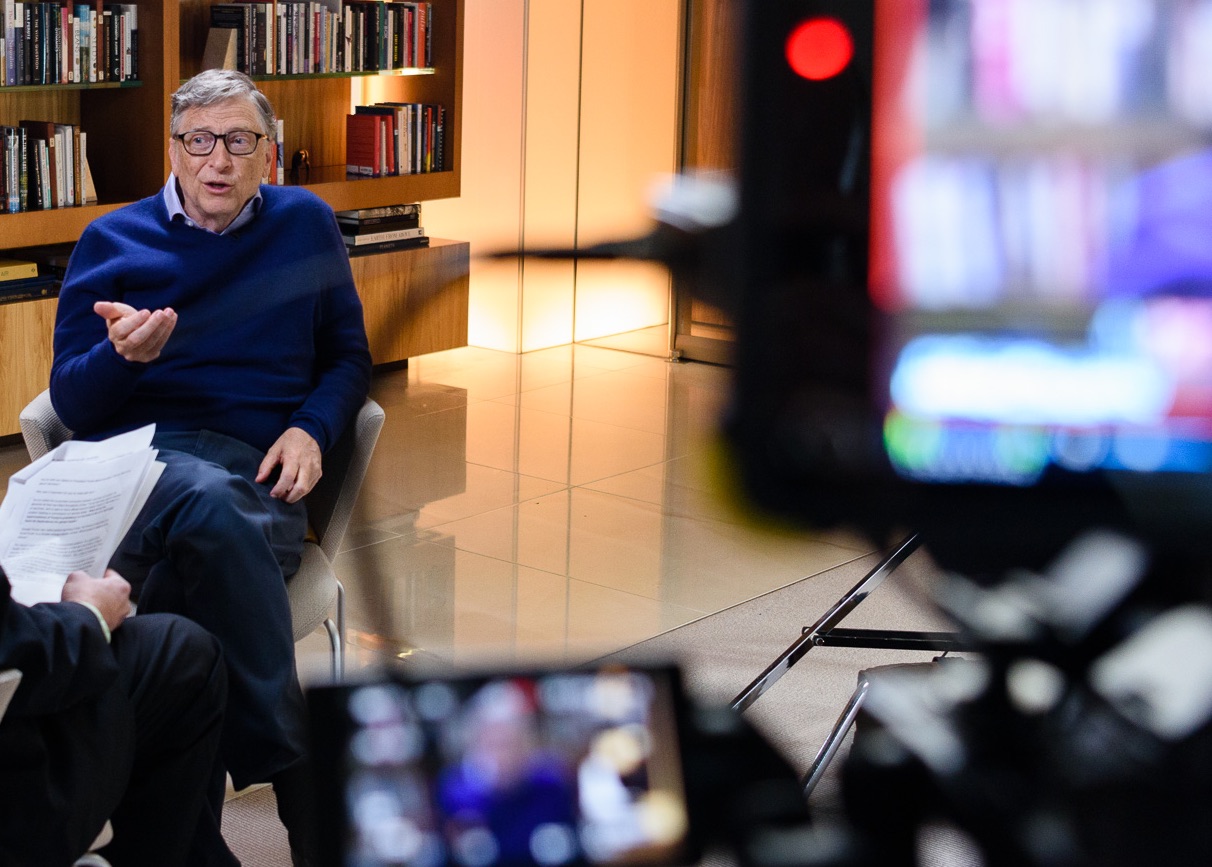
Bill Gates, whose new essay warns of the risks ahead in the AI era, during a 2017 interview. (GeekWire File Photo / Kevin Lisota)
When Bill Gates talks, people listen. This week he published a lengthy essay on what AI is going to do to work, and told GeekWire that people inside AI companies who name the downsides get told, “Hey, you’re hurting our PR while we’re trying to raise trillions of dollars.”
He’s right about the hard part. The job displacement he describes lands on young workers first, and the safety net is funded by taxes on the very wages that AI erodes. He prescribes three treatments: new institutions at home and abroad, a tax on AI tokens and robots, and “Human Reserved,” a category of jobs only people may hold.
Gates has the diagnosis right but the prescription mostly wrong. I’d sign the robot tax tomorrow, because hiring a person costs you payroll tax every year while buying a robot gets written off in year one. The other two I’d send back.
Let’s start with what’s solid. Stanford’s Digital Economy Lab updated its “Canaries in the Coal Mine” work this month. Employment for 22-to-25-year-olds in the most AI-exposed occupations is running 19% below where it would be if it had kept pace with their peers in less exposed work, up from 15% a year ago. The same authors say they don’t see widespread, economy-wide displacement, and unemployment held at 4.1% in July.
The AI damage isn’t arriving as layoffs. It’s arriving as jobs that never get posted, and Gates is right that the young get it first.
Now the token tax. Tokens (essentially words) are what AI companies bill by. Taxing tokens is like taxing keystrokes: it measures effort, not displacement.
A high school class working through calculus with an AI tutor burns tokens continuously. A model that quietly retires a 40-person customer center might burn relatively few. The tax lands hardest on the uses Gates says he wants to protect.
Stanford’s AI Index put the cost of GPT-3.5-level performance at $20 per million tokens in November 2022 and seven cents by October 2024, a 280-fold drop. You’d be indexing the safety net to a number that falls every year while displacement rises.
And you can’t collect it. Inference runs on laptops and phones now, and on servers in whatever country declines to sign. A token tax is a tax on whoever uses an American API, and every dollar it adds makes a Chinese model look cheaper. We’d be slowing ourselves down and not China.
Gates says the institutions will take years to build, and also says we can’t afford to move slowly. He’s right twice, and that’s the problem. He wants the international body to borrow from nuclear inspections and aviation regulation. That may pan out in the long term, though the UN is the cautionary tale for the bureaucratic nightmare that the international community can produce.
Meanwhile we have functional agencies with jurisdiction today. The FDA can rule on AI in diagnosis. The FTC can go after AI-enabled fraud. We don’t need a new agency to say a bank can’t deny your mortgage because a model felt like it. We need the banking regulator to reiterate it forcefully.
That leaves Human Reserved, his best idea but his most privileged one. Gates would protect a job for either of two reasons: the role is deeply personal, like a caregiver, or the people who hold it are unlikely to find other work. Only one of those holds.
Freezing headcount because the workers have nowhere else to go protects the job for a while and makes the service more expensive along the way. Reserving the moments when a human being is the point is defensible, and Gates makes that case well. On a robot delivering the news that you have an incurable disease, he writes, “There’s no technical reason why it couldn’t,” and adds, “Yet it shouldn’t.” He’s right.
I made the case in WIRED nine years ago that displaced workers should move into caregiving, and that it would take real money to lift the pay enough to draw them.
The problem with Human Reserved is that it assumes there’s a human being available. Home health and personal care aides earn a median of $34,900 a year, and BLS projects roughly 765,000 openings in that occupation every year through 2034. At that wage, they keep coming open. A third of home care aides are immigrants, and tighter enforcement threatens that supply. A rule that reserves care for people, in a market with no spare people, reserves care for the families who can outbid everyone else.
Gates half-anticipates this, telling The New York Times he might be a flawed messenger because of his wealth. On this point he is. The caregivers who gave his father something irreplaceable were in that room because someone could pay them to be there.
So don’t fence AI out of the room. Put it to work in the hours nobody is paid to cover.
In February the Times ran Eli Saslow’s story about Jan Worrell, 85, living alone on Washington’s Long Beach Peninsula with an AI companion called ElliQ that engages her about eight times a day and pushes her to stay hydrated and moving. (I serve on ElliQ’s board, and I joined because the company builds a machine that extends a caregiver’s reach instead of replacing one.)
Her goal, she told her doctor, was to never live anywhere else. Fund enough aides to cover the hours that need a person and put the machine on the rest.
Here’s where I net out: equalize the tax treatment of labor and capital, which Congress could do next session, and route the proceeds into retraining and into topping up the pay of workers who land in lower-paying jobs. That’s a better answer than a protected job title.
Drop the token tax, build the caregiving workforce instead of fencing it off, and use the regulators we already have while somebody works on the ones we don’t.
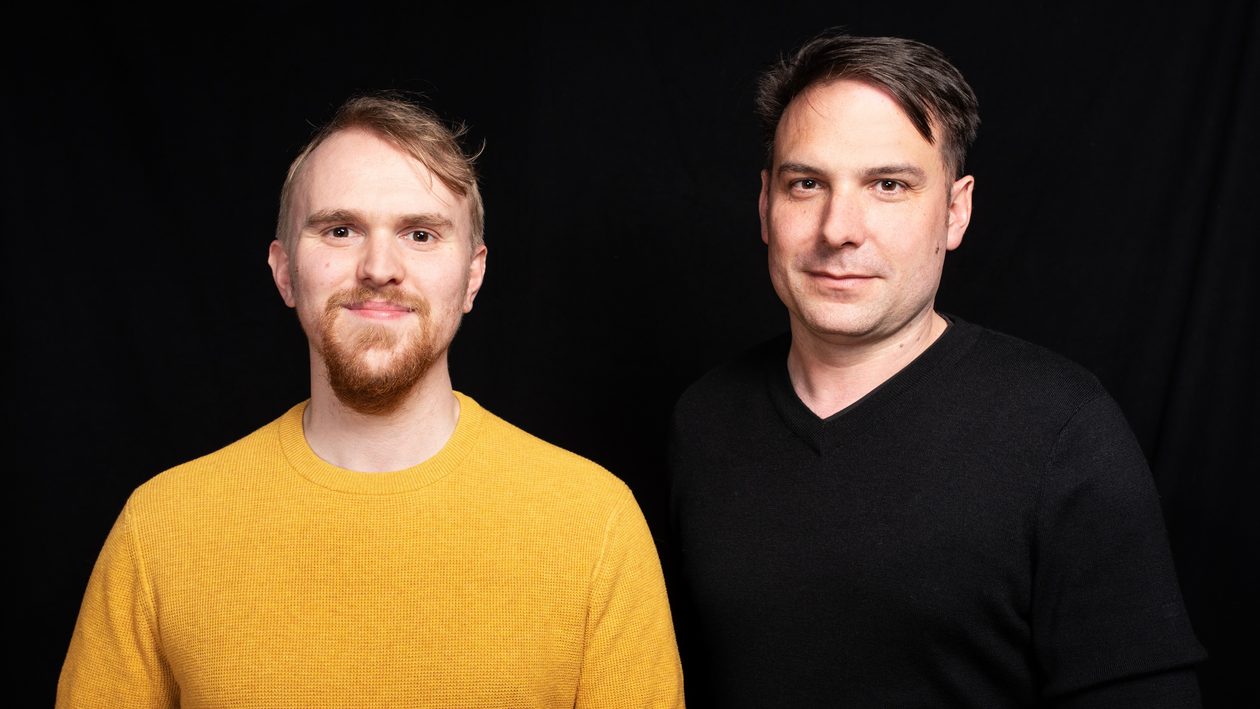
DuckDB creators Mark Raasveldt, left, and Hannes Mühleisen. (DuckLabs Photo)
Amazon has agreed to acquire DuckLabs, the company behind DuckDB, the fast-growing open-source database that has become a favorite of developers looking to analyze large amounts of data without the cost and setup of a cloud data warehouse.
Employees of DuckLabs will join Amazon Web Services, including co-founders and DuckDB creators Hannes Mühleisen and Mark Raasveldt, who will continue leading the team and setting the project’s technical direction. They will remain based in Amsterdam, where the team will continue developing DuckDB and related projects.
Amazon says it is not acquiring the DuckDB open-source project itself. DuckDB will remain free and open source under the MIT license, overseen by the nonprofit DuckDB Foundation, as will the related DuckLake and Quack projects, according to DuckLabs.
Financial terms were not disclosed. Amazon said it has signed a definitive agreement and expects the acquisition to close shortly. DuckLabs said it expects to become part of AWS in early September.
Larger shifts in cloud data
The deal fits Amazon’s broader push to turn S3, its flagship cloud storage service, into a place where customers analyze data rather than just store it. It gives Amazon a team experienced in building fast, lightweight analytics software that runs directly against data sitting in cloud storage.
The move comes as the data industry shifts toward keeping information in open formats in cloud storage, where it can be queried directly rather than loaded into a separate warehouse.
The shift puts pressure on companies like Snowflake and Databricks, which sell the compute and governance layer on top of stored data. Both are major AWS partners as well as competitors, with large numbers of customers running on Amazon’s cloud.
AI has raised the stakes, driving up both the volume of data companies keep in the cloud and the cost of analyzing it. Amazon says DuckDB is a natural fit for AI agents, which query data much the way people do, poking and experimenting with small sets before deciding what they want.
DuckLabs said it has worked closely with AWS in recent years, including on DuckDB support for Amazon’s S3 Tables and SageMaker Lakehouse.
“DuckDB is an incredible open source project with an amazing community; it is broadly used and very much loved by S3 customers today,” said Andy Warfield, an AWS vice president and distinguished engineer, in a press release announcing the deal.
‘That’s Amazon’s playbook’
One of the companies watching closely is in Seattle. MotherDuck, which sells a cloud service built on DuckDB, was founded in partnership with the DuckLabs team and has worked with it closely for four years. Three of its engineers are among the top 10 outside contributors to the DuckDB project.
MotherDuck CEO Jordan Tigani. (LinkedIn Photo)
In a blog post Wednesday, MotherDuck CEO Jordan Tigani said Amazon is following a familiar pattern. “That’s Amazon’s playbook, after all: wait until an open source project gets big enough, then launch it as a service,” wrote Tigani, who helped start Google’s BigQuery and spent a decade there before co-founding MotherDuck in 2022.
He expects Amazon to do exactly that with DuckDB: “After all, they’re not acquiring Duck Labs just because they love open source,” he wrote. “We welcome the competition.”
He said the deal is likely to be good for DuckDB, because Amazon has a financial reason to keep the project open and healthy. “If DuckDB becomes the standard, it is going to drive a lot more compute on their infrastructure, which is where they make their money,” he wrote.
Tigani said DuckLabs is being kept as a wholly owned subsidiary with its organization intact, and that the DuckDB Foundation has “iron clad control over the DuckDB IP.”
MotherDuck also said it is now offering enterprise support for DuckDB — which it had previously steered clear of to avoid competing with DuckLabs. Tigani said the company has Mühleisen and Raasveldt’s “explicit blessing” to take it on now that they are joining Amazon.
Five years, no venture capital
DuckLabs was founded a little more than five years ago as a long-term home for the DuckDB development team. The company turned down venture capital, stayed owned by its founders and employees, and grew to more than 30 people in Amsterdam, funding itself through support and feature-development contracts.
In a blog post, Mühleisen and Raasveldt wrote that they had come to worry DuckDB’s growth would outpace their ability to support it, and that their small company “could become a bottleneck for the project.” Building a larger sales and operations organization, they wrote, would have pulled the team away from the technical work that made DuckDB successful.
Nine days before the acquisition was announced, Mühleisen and Raasveldt published a preview of DuckDB 2.0, due this fall, declaring that the release “kicks off the year of DuckDB as a server.” It adds Quack, which lets one DuckDB instance serve data to others over a network, along with work aimed at speeding up queries against data held in object storage such as S3.
DuckLabs said the DuckDB Foundation will add a technical advisory board, giving leading community members input on the project’s technical direction. The company also plans to let DuckDB run extensions signed by outside developers and organizations.
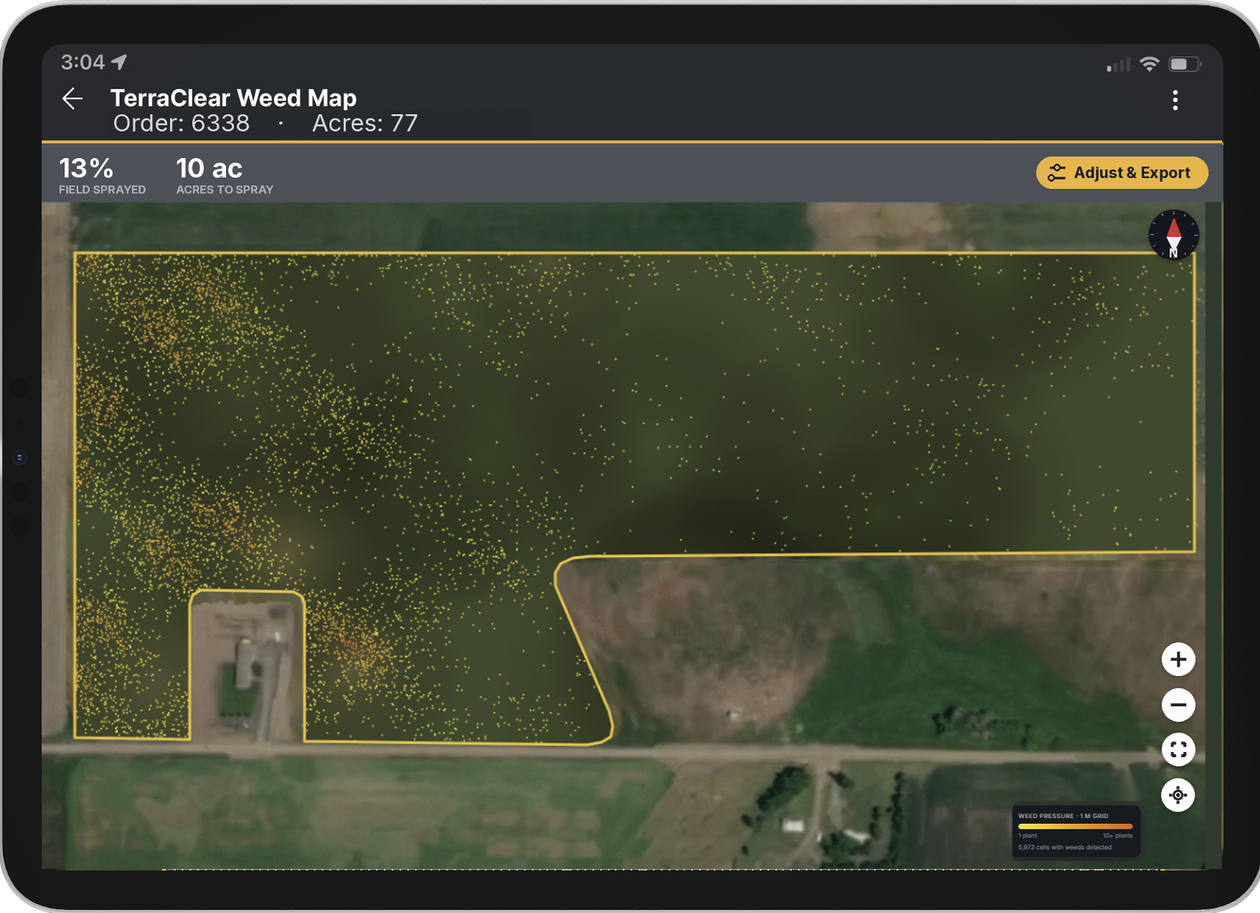
TerraClear’s new Weed Maps helps farmers identify individual weeds as small as a quarter inch. (TerraClear Photo)
The next big test for AI isn’t happening in a data center. It’s happening in the dirt.
Really, it’s in the weeds.
Two Seattle-area startups are betting that AI can transform how farmers find and eliminate unwanted plants — one by mapping every weed, the other by zapping them with lasers.
Issaquah, Wash.-based TerraClear is commercializing a new system that uses ultra-high-resolution imagery and machine learning to map individual weeds across entire fields of corn and soybeans, then turns those detections into digital prescriptions that can be sent directly to precision sprayers.
Meanwhile, Seattle-based Carbon Robotics is taking a different approach: Its autonomous LaserWeeder uses computer vision to identify weeds and then blasts them with lasers.
Now, the AI powering these systems is getting smarter, too — moving beyond simple weed detection toward models that can recognize and understand plants across different crops, fields and growing conditions.
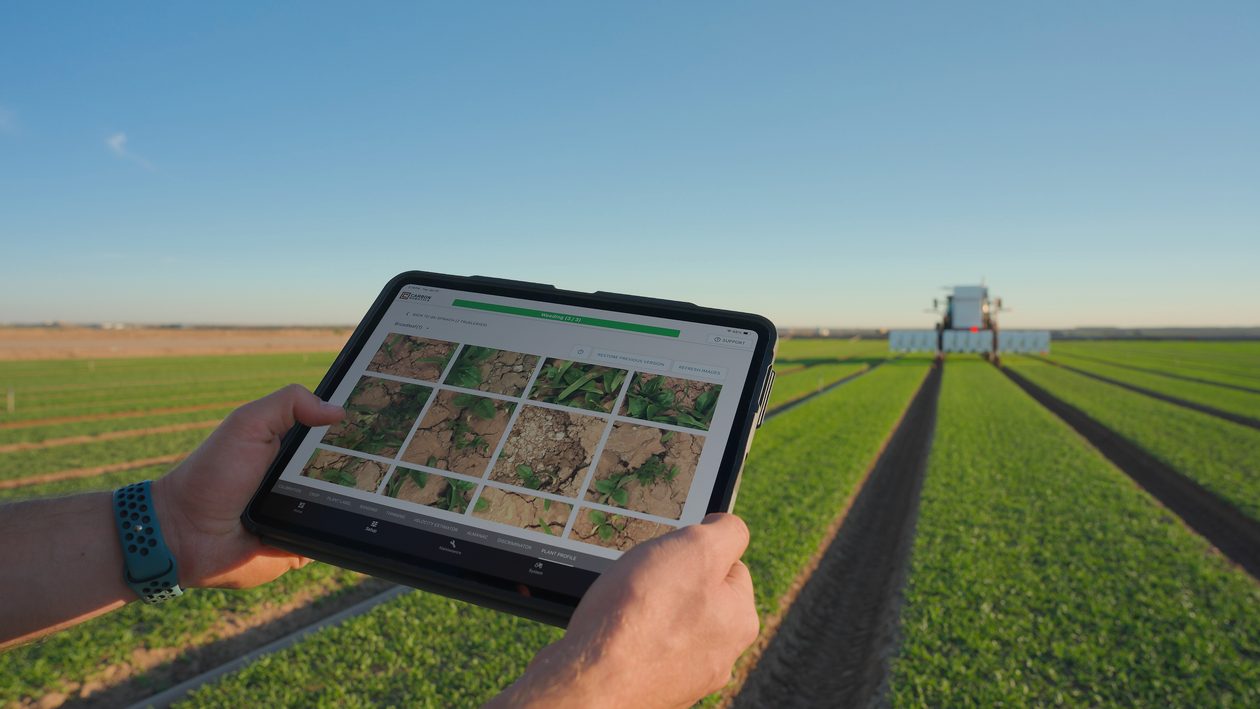
Carbon Robotics recently-released Plant Profiles, a feature added to all LaserWeeders, enables farmers to tailor the foundational LPM to their unique crops, weeds, and field conditions. (Carbon Robotics Photo)
TerraClear’s new Weed Maps, announced Tuesday, captures imagery at 1.5-millimeter resolution and identifies weeds as small as the eraser on a pencil. Rather than sampling portions of a field, the company says it collects images of every acre and produces a geo-referenced map that can be uploaded to section or nozzle-controlled sprayers used by farmers.
The goal is precision at a level that would be difficult for a human to achieve, allowing a farmer to know where the individual weeds are.
TerraClear says the maps can be delivered the next day, giving growers a chance to act while weeds are still small and easier to control.
Devin Lammers, the chief executive of TerraClear, tells GeekWire that its approach “sidesteps the capital problem entirely.” In other words, farmers need not buy a new piece of expensive equipment, instead using software to turn existing sprayers into precision instruments by telling them exactly where to spray.
He called Carbon Robotics laser-weeding system “impressive technology,” noting that it works well for specialty crops and organics.
But bigger farms producing commodity crops like corn and soybeans — the market TerraClear is going after — need a different approach, he said.
“Modern grain and oilseed sprayers already have individual nozzle control and RTK positioning — the actuation hardware is sitting in the shed,” Lammers said via email. “We just hand the sprayer a shapefile of individual weed locations and it turns the nozzle on only where a weed actually is.”
Given that large corn and soybean growers farm more acres at a lower revenue per acre, Lammers said it’s a “very different P&L” where expensive new equipment needs to pencil out.
With TerraClear’s new system, Lammers added that “the farmer buys a map, not a machine.”
RFK Jr. and new ways to farm
One of the benefits of both approaches is chemical use reduction in the field, a hot topic in political circles with President Trump earlier this year committing $1 billion to modernize farming and reduce chemicals in agriculture. That federal investment could help spark new innovations, like the ones TerraClear and Carbon Robotics are developing.
Robert F. Kennedy Jr., the U.S. secretary of health and human services, earlier this year touted Carbon Robotics’s machines on an episode of The Joe Rogan Experience as a possible solution in cutting pesticide use.
In the case of TerraClear, Lammers said the precision mapping technology alone could cut pesticide and herbicide use by up to 80% with no loss of efficacy.
Both startups are part of a broader Pacific Northwest ag-tech ecosystem that has been applying AI and robotics to agriculture, building on the regions farming and tech roots.
TerraClear founder Brent Frei represents that unique farming and tech DNA. He grew up on a family farm in Grangeville, Idaho, before studying at Dartmouth and then moving to the Seattle area where he co-founded Onyx Software and Smartsheet.
Founded in 2017, TerraClear originally attacked a much less glamorous agricultural problem: identifying and removing rocks from farmers’ fields. In 2024, the company raised $15 million, bringing its total funding to $53 million.
By February of this year, TerraClear had expanded to about 50 employees and was approaching 1,000 customers. At that time, it also launched an autonomous field robot called TerraScout, designed to collect high-resolution imagery across a field and convert that information into actionable maps for existing farm equipment.
The company says TerraScout can collect more than 4 billion image samples per acre and map more than 1,000 acres a day under favorable conditions.
In addition to TerraScout, Lammers said they are using aerial drones to ingest field-level data into its new Weed Maps product.
“That’s the part that compounds — the imagery we gather is field-level, repeated season over season, and specific to the commodity acre,” Lammers said. “Models get better, which makes the maps better, which brings more acres, which produces more data.”
TerraClear’s autonomous field robot the TerraScout. (TerraClear Photo)
Carbon Robotics is further down the road in making the machine the decision-maker, and eradicating weeds without the use of chemicals.
The Seattle startup’s LaserWeeder combines cameras, AI and high-powered lasers to identify weeds and destroy them without applying herbicides or pesticides. The company has deployed its machines on farms around the world and has built an enormous dataset in the process.
Announced in February, its so-called Large Plant Model was trained on 150 million labeled plants, which Carbon describes as the largest agricultural plant dataset of its kind. The company’s goal is to move beyond narrowly trained computer-vision systems that need to be retrained whenever a new weed or field condition appears.
With the Large Plant Model, farmers can use Carbon’s Plant Profiles feature to show the system a handful of images and customize what the machine should recognize and target.
Given the changing dynamics of a weed during various stages of its growth — and based on conditions such as soil, weather and crop varieties — Carbon wants to correctly identify the difference between a weed and a crop.
“When our robots can understand any plant in any field immediately and adapt behavior in real-time, farmers immediately get maximum value from the machines,” Carbon Robotics CEO Paul Mikesell said in a press release. “The Large Plant Model provides farmers with the most advanced AI technology to maximize the weeding quality of LaserWeeder in their unique environments.”
Founded in 2018, Carbon Robotics has raised $177 million to date and as of last year employed about 260 people at offices in Seattle and a manufacturing facility in Richland, Wash.
The farm becomes a giant AI dataset
TerraClear and Carbon Robotics are attacking one of agriculture’s thorniest problems — weed management — from different directions.
TerraClear wants to allow a farmer to keep using a conventional precision sprayer, while making it dramatically more selective via its Weed Maps.
Carbon, meanwhile, is developing autonomous laser-weeding equipment itself, identifying and eliminating the individual weeds in real time without chemical spray or tractor operators.
The bigger opportunity for both companies may ultimately be neither maps nor lasers, but the underlying data they gather.
Every time a camera passes over a field, it can collect information about plants, soil, crop health and growing conditions. That’s vital information to farmers, seed producers, agriculture researchers and equipment manufacturers.
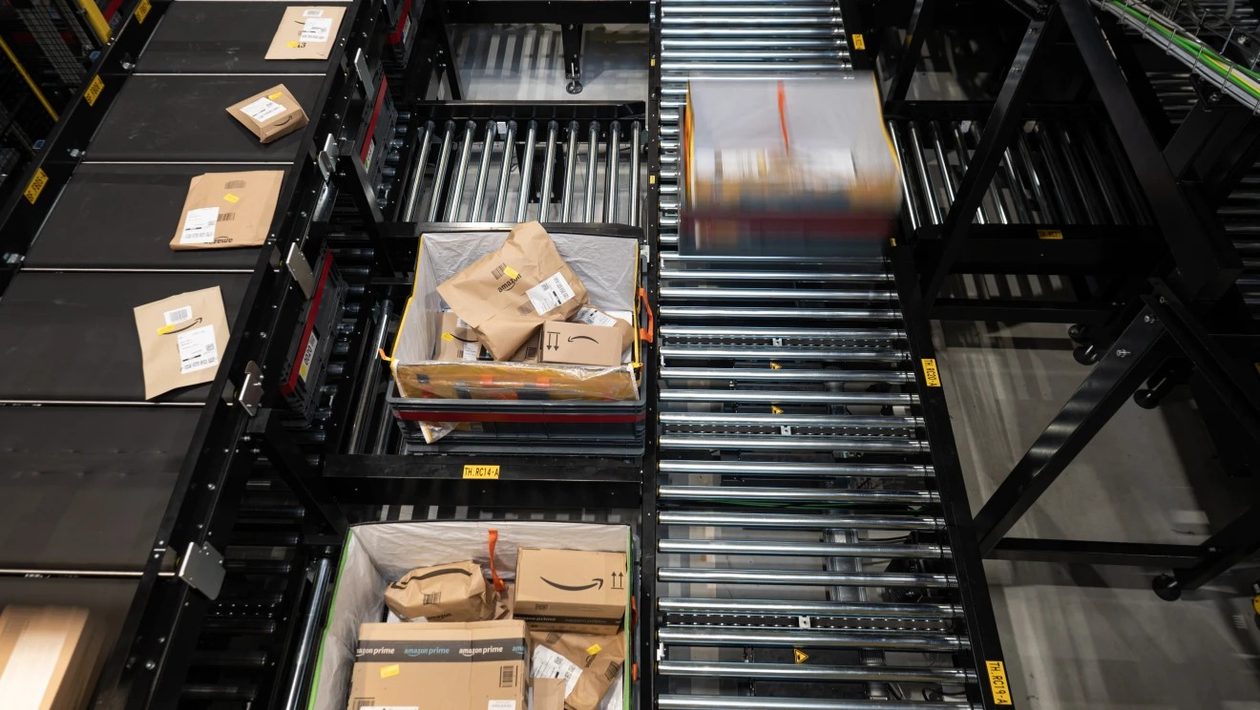
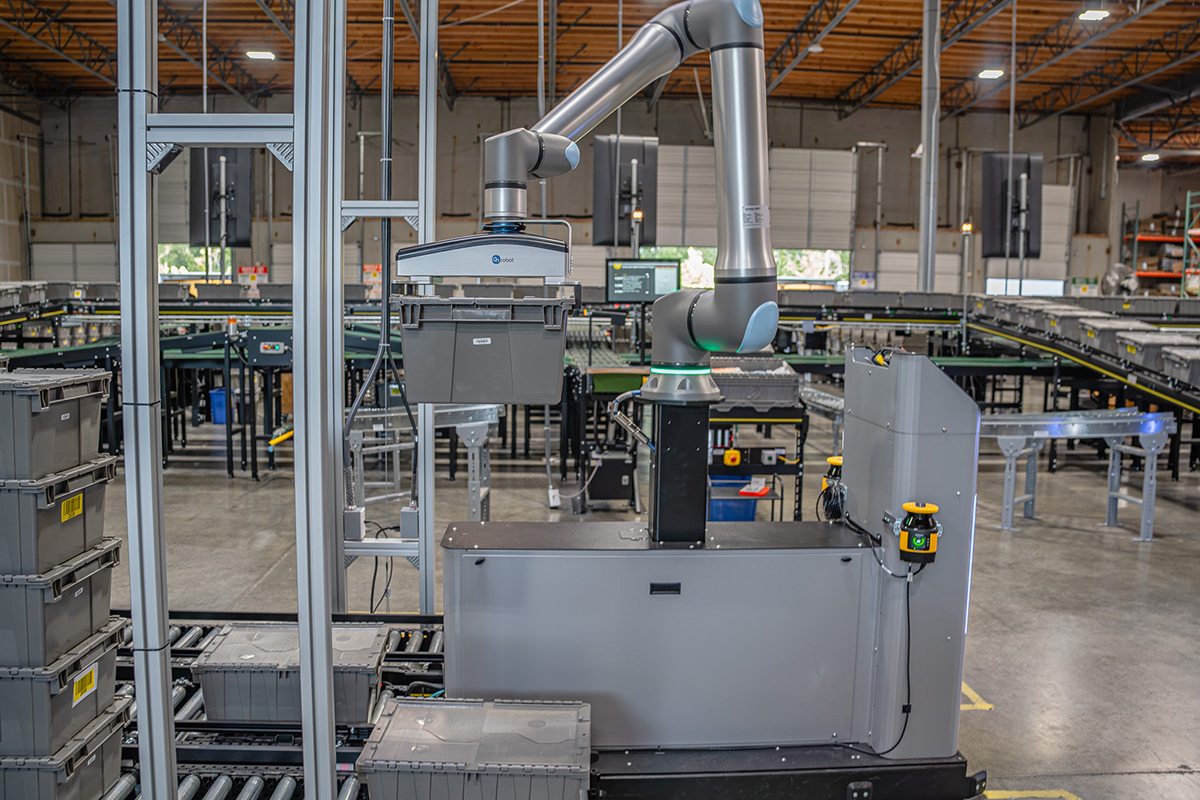
Amazon’s ZancaSort system brings packages to workers automatically at its Last Mile Innovation Center in Dortmund, Germany. A separate initiative, Project Tetromino, reportedly aims to bring full automation to delivery stations. (Amazon Photo)
Visiting an Amazon delivery station can feel like walking into the past.
While many of its massive fulfillment centers are equipped with the latest robots and automation, Amazon’s delivery stations — the final stop before packages reach the doorstep — remain mostly manual. Workers often sort parcels by hand, load them into bags, and stage them for drivers.
That could be changing. Business Insider reports that Amazon is developing an internal initiative called Project Tetromino to build “fully automated” delivery stations, citing an internal planning document that includes specific financial projections.
The name appears to be a nod to Tetris, reflecting the puzzle-like challenge of efficiently organizing packages for delivery vehicles.
“We’re always exploring and testing new technologies across our operations to improve safety and the delivery experience for customers,” Amazon spokesperson Brad Glasser said in a statement. He added, “The details cited here are inaccurate and don’t reflect our current plans. Like any early-stage concept, this is one of many initiatives we regularly evaluate, and plans evolve significantly as we learn.”
Business Insider reported that a key technology behind the effort could come from Boxbot, an Alameda, Calif.-based robotics startup that uses conveyors and AI-driven storage trays to automatically sequence packages for vehicle loading. The company says the process is up to 10 times faster than manual methods.
Responding to an inquiry from GeekWire, Boxbot CEO Austin Oehlerking said he could not comment on activities with any specific customer but said the company has “tested and deployed live systems within the parcel delivery, logistics, and automotive industries over the last several years.”
Oehlerking described Boxbot’s technology as filling a gap in warehouse automation. Automated storage and retrieval systems are typically designed for fulfillment operations, while Boxbot is building them for high-throughput package handling at other points in the supply chain.
“This type of storage system can be very useful at different points in the supply chain, depending on the customer,” he added.
Amazon said its delivery station initiatives are “designed to complement and empower our workforce.” The company has been ramping up automation across its operations, with more than a million robots now deployed in its fulfillment network and plans to more than double its fleet of robotic arms this year, citing goals to improve safety, ergonomics and efficiency.
The company has also opened a Last Mile Innovation Center inGermany, where it has been testing delivery station technologies including automated unloading, sorting, and scanning systems.
A federal judge has entered a final judgment requiring Guardant Health to pay more than $245 million to Seattle biotech TwinStrand Biosciences and the University of Washington over DNA sequencing technology developed at the university.
The judgment, entered Friday in U.S. District Court in Delaware, follows a 2023 jury verdict that found Guardant willfully infringed two patents covering TwinStrand’s Duplex Sequencing technology.
The case also establishes a continuing revenue stream for the university and TwinStrand from some of Guardant’s products.
Jesse Salk, co-founder of TwinStrand. (TwinStrand Photo)
The court’s final judgment includes $83.4 million in damages awarded by the jury for infringement through June 2023, plus $19.5 million in supplemental damages, $119.4 million in accrued royalties and $22.9 million in interest.
Going forward, Guardant is required under the judgment to pay a 6% royalty on covered sales through March 2033, when the patents expire.
The technology at the center of the case traces back to research at the University of Washington, where scientists, including co-founder Jesse Salk, developed Duplex Sequencing as a way to make DNA sequencing more accurate. Salk — who stepped down as CEO of TwinStrand in 2022 — now is the co-founder of cancer diagnostics startup CytoTerra.
The molecular biologist and clinical oncologist is the grandson of the late Jonas Salk, the scientist who discovered and developed the polio vaccine.
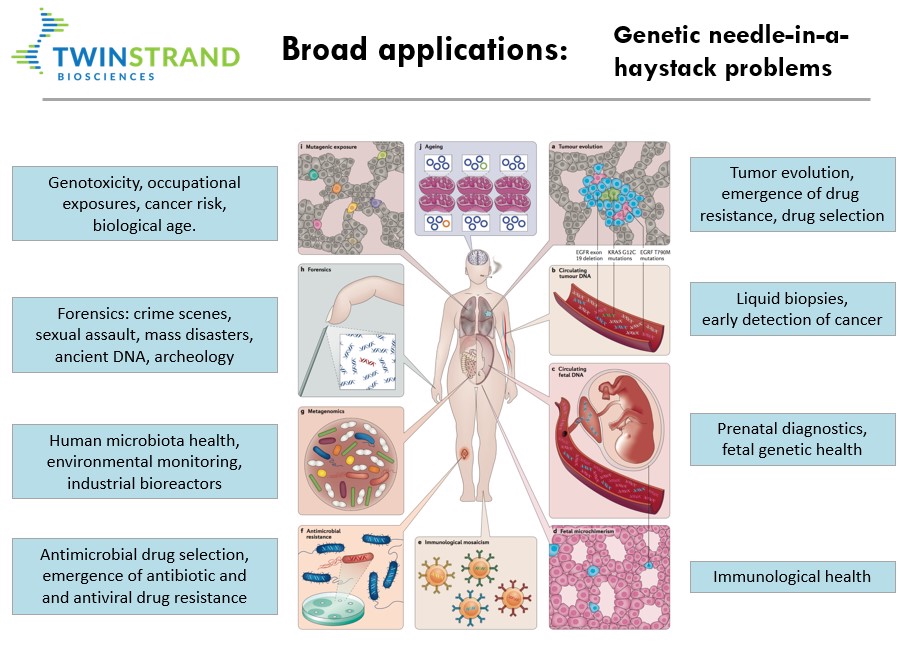
TwinStrand says its Duplex Sequencing technology can improve the accuracy of next-generation sequencing by more than 10,000-fold, allowing researchers to detect extremely rare genetic mutations that can be obscured by sequencing errors.
“Duplex Sequencing solved an accuracy problem the sequencing field had worked on for years, and this judgment affirms the jury’s finding that Guardant Health built products on that invention without a license,” said Chad Waite, chair of the TwinStrand board of directors, in a press release. “We remained steadfast in our conviction that the facts would prevail, and they have. We intend to see this through and stand firmly behind the intellectual property at the core of our technology.”
Salk and his colleagues from the University of Washington launched TwinStrand in 2015 to commercialize the technology. Based in Seattle, the startup raised funding from Madrona Venture Group, Soleus Capital, Janus Henderson Investors, Ridgeback Capital, Alexandria Venture Investments. Section 32 led a $50 million series B round in the company in 2021.
A jury found in November 2023 that Guardant willfully infringed the patents through 11 products and services. The products identified in the judgment include Guardant360, Guardant Reveal, Guardant Shield and other cancer-testing products.
The Delaware court subsequently rejected Guardant’s effort to overturn the verdict or obtain a new trial. In June, the court also awarded TwinStrand and UW ongoing royalties and supplemental damages. The final judgment now formalizes those awards.
Guardant is not accepting the ruling.
The California-based precision oncology company said Monday that it plans to appeal the judgment, arguing that the court’s order covers products that existed at the time of the 2023 trial and that many have since been discontinued or substantially upgraded. Guardant also said current versions of its Reveal and Shield products are excluded from the final district court order.
Guardant — founded in 2012 — said the judgment and collection of potential royalties will be stayed pending the appeal.
“We strongly disagree with this decision and will promptly be appealing for its overturn,” said John Saia, Guardant Health Chief Legal Officer, in a press release. “We have full faith in the strengths and merits of Guardant’s intellectual property and R&D and are confident we will ultimately prevail on appeal.”
— Mehul Shah joined Oracle as group vice president for OCI data and storage services, ending a 14-year run at Amazon and Amazon Web Services.
In his last role at AWS, Shah led engineering and product for Amazon RDS for SQL Server, Oracle and Db2, and ran the launch and expansion of Oracle Database@AWS, the partnership that put Oracle’s database inside Amazon’s cloud.
“Through that collaboration, I saw firsthand that OCI shares the same DNA that inspired me to join Amazon back in 2012,” Shah said on LinkedIn, citing “deep curiosity, a passion to innovate, the courage to make bold decisions, and relentless drive to excel.”
Shah, who is based in Seattle, spent more than eight years at AWS, earlier leading real-time data streaming services including Amazon Data Firehose and Kinesis Data Streams, and serving as director and general manager of Amazon EMR. He started at Oracle this month.
Dr. Natalie Pageler. (Seattle Children’s Photo)
— Seattle Children’snamedDr. Natalie Pageler senior vice president and chief information officer, putting her in charge of digital strategy and IT operations for the pediatric hospital system.
Pageler comes from Stanford Children’s Health and the Stanford University School of Medicine, where she was division chief of clinical informatics and earlier spent a decade as chief medical information officer. She is a pediatrician and clinical informaticist with more than 20 years of experience.
Seattle Children’s CEO Dr. Christopher Longhurst followed a similar path. He was chief medical information officer at Stanford Children’s Health, the same role Pageler held, before spending a decade at UC San Diego Health, most recently as chief clinical and innovation officer.
Cassandra “Sandi” Knight. (Zillow Photo)
— Zillow Group named Cassandra “Sandi” Knight its first-ever chief legal and policy officer, a role the Seattle company created this month as part of a broader leadership shuffle. Reporting to CEO Jeremy Wacksman, she oversees Zillow’s legal, compliance and government relations functions.
Knight joins from Google, where she spent four years as a vice president leading global civil litigation and discovery. She was previously vice president and chief litigation counsel at PayPal, and spent 11 years at Morgan Stanley in senior litigation and compliance roles.
She began her career as a trial lawyer at the San Diego Public Defender’s Office, the firm Keker & Van Nest and the San Francisco City Attorney’s office. She holds a law degree from Stanford and is based in the San Francisco Bay Area.
She arrives at a busy moment: Zillow and Redfin are set to go to trial Aug. 24 as defendants in an antitrust case brought by the FTC and five state attorneys general over the companies’ $100 million rental listings deal. Zillow has spent $26 million on the case so far this year.
Two longtime Zillow leaders are heading out:
Sara Bonert, vice president of industry engagement for Zillow Group and ShowingTime+, is leaving after nearly 20 years. One of Zillow’s earliest employees, she joined in the fall of 2006 as director of broker services, helped build Zillow’s first platform for taking in listing data, and signed the partner agreements that took the site from zero to a million listings in four months.
Jeff Tompkins, head of corporate real estate and operations, wrapped up almost five years with the company. Tompkins, who is based in Denver, ran Zillow’s workplace strategy across North America and beyond. He said he will share his next role soon.
Amir Pelleg. (Uber Freight Photo)
— Amir Pelleg, a veteran of companies including Amazon and Convoy, is the new chief product officer at Uber Freight. He is based in Seattle, working out of the shared Uber and Uber Freight office on Second Avenue.
At Amazon, Pelleg was principal product manager for Kindle Fire, launched the Dash Button and initiated Alexa’s smart home controls, then incubated and launched Amazon Shipping in India, the U.K. and the U.S. as a director and general manager in Amazon Transportation.
He was a vice president on Convoy’s executive team until the Seattle freight startup shut down in 2023, then spent two and a half years at dental tech company Dandy.
— Seattle’s Frazier Healthcare PartnersaddedWes Wheeler to its Growth Buyout team as an executive in residence, advising on diligence and on life science logistics and infrastructure.
Wheeler was most recently CEO of LabConnect, a central laboratory services company serving clinical trials, and before that president of UPS Healthcare, where he built a vertical of 10,000 employees across 35 countries. During Operation Warp Speed he was the primary industry interface to the U.S. government, overseeing distribution of more than 1.5 billion COVID-19 vaccine doses to over 100 countries.
Dr. Heather Cheng. (Fred Hutch Photo)
— Dr. Heather Cheng was announced as the inaugural recipient of the Marty Lazarus Weiden Family Endowed Chair at Fred Hutch Cancer Center, which will fund her work detecting, preventing and treating hereditary cancers.
Cheng is clinical director of cancer genetics programs at Fred Hutch and directs its prostate cancer genetics clinic. In 2016 she was part of a team that found more than 10% of men with advanced prostate cancer carry inherited mutations in DNA-repair genes such as BRCA1 and BRCA2.
The chair is named for Marty Lazarus Weiden, who was diagnosed with breast cancer in 1993 and died in 2001. The family learned only later that some of its members carry a BRCA mutation.
— Microsoft corporate vice president Darryl Willis was named to the board of ONE Nuclear Energy, a natural gas and advanced nuclear developer going public this quarter through a merger with Hennessy Capital Investment Corp.
Willis has led Microsoft’s energy and resources group since 2019. He was previously a Google Cloud vice president and a BP executive who ran the company’s Deepwater Horizon claims process and testified before Congress. He will officially join the board when the merger closes, and he is expected to chair its compensation committee.
Jake Milstein. (LinkedIn Photo)
— Jake Milstein was named head of healthcare solutions marketing at Zscaler, a return to healthcare cybersecurity. He joins from application security company Contrast Security and was earlier chief marketing and revenue officer at Critical Insight, the Bremerton, Wash.-based security firm acquired by Lumifi Cyber.
Before moving into technology, Milstein spent a decade at Seattle’s KIRO TV, including four years as news director.
— Michele Mehl left Amazon Web Services after nearly two and a half years to become senior public relations manager at ALSO, arriving the same week the electric vehicle company announced a $150 million Series D round led by Prysm Capital.
ALSO builds the TM-B consumer electric bike and the TM-Q commercial delivery quad, and counts Amazon and DoorDash among its commercial partners.
— Richard Van Bibber was named senior vice president of research and development at Verasonics, the Kirkland, Wash.-based maker of ultrasound research platforms used in fields including biomedical ultrasound, materials science and earth sciences.
Van Bibber has spent much of a 25-year medtech career in the Puget Sound region, including seven years as director of research at Kirkland’s Cardiac Dimensions and five years leading clinical affairs at Bellevue-based Aortica.
— Dave Cotter joined the board of Nickson, the apartment-furnishing startup led by Cameron Johnson, alongside MarcyPen Capital Partners and Larry Braithwaite. Cotter is CEO of Greenwood and has previously worked at Amazon, Nordstrom, zulily, RealNetworks and Leafly.
— PCC Community Markets president and CEO Krish Srinivasanwill retire effective Jan. 29, 2027. Srinivasan was chief financial officer at Remitly and vice president of finance at Lyft before joining the Seattle grocery co-op as CFO, and earlier held leadership roles at Amazon and Microsoft.
— Seattle FoundationnamedElizabeth Wong as chief philanthropy officer, reporting to President and CEO Alesha Washington. Wong spent more than a decade at Foundation Source and earlier worked directly with the Gates family at the Bill & Melinda Gates Foundation.
And in case you missed it:
— Jay Bartot, a co-founder of the airfare-prediction startup Farecast and former chief technology officer of Madrona Venture Labs, was named CTO of Lev, the Pioneer Square Labs spinout building an “AI co-founder” for entrepreneurs. Read more here.
— Expedia Group is parting ways with at least eight vice presidents and senior vice presidents, and promoted five other leaders, as it reorganizes its product and technology groups around AI. Read more in this GeekWire story.
The new sorting facility in Renton, Wash., where materials from 50 libraries are routed to 186 delivery chutes. (Photo: Ken Yeung)
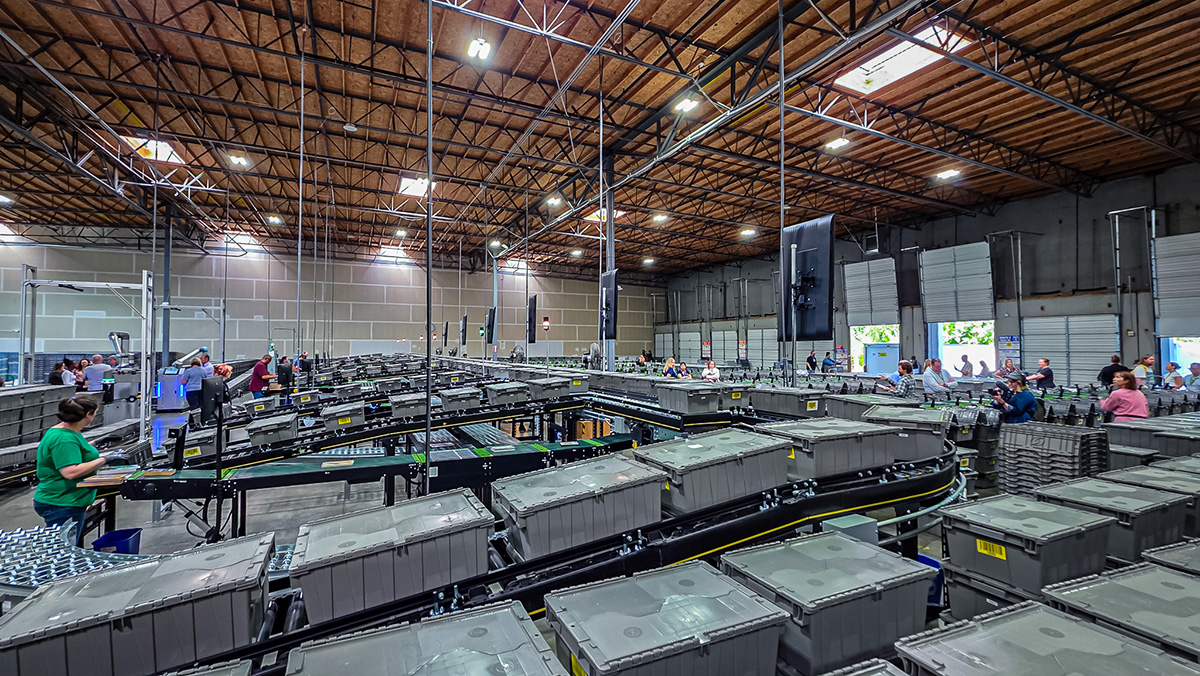
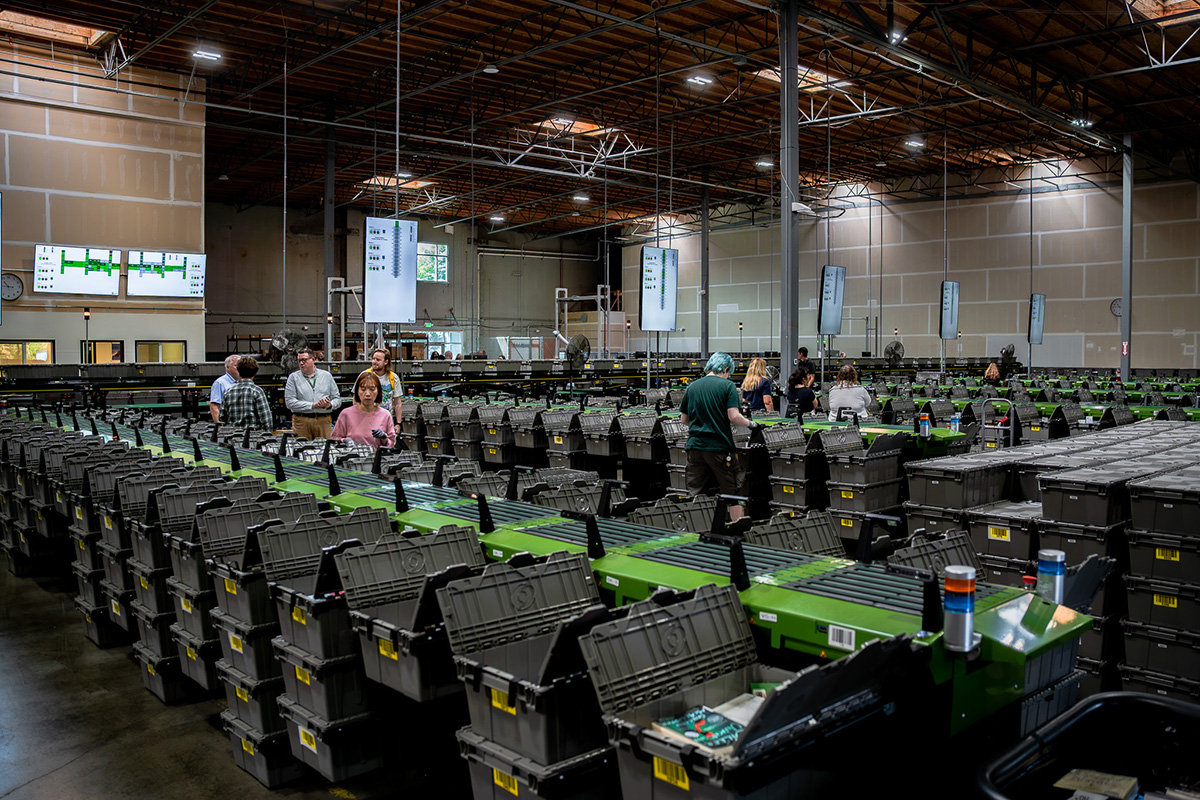
Washington is home to Mount Rainier, the Space Needle, and the Super Bowl champion Seattle Seahawks. It’s also now home to what the King County Library System says is North America’s largest library materials sorter — a $5.2 million installation in Renton that formally opened Wednesday to handle the 25,000 items circulating through KCLS’s 50 libraries every day.
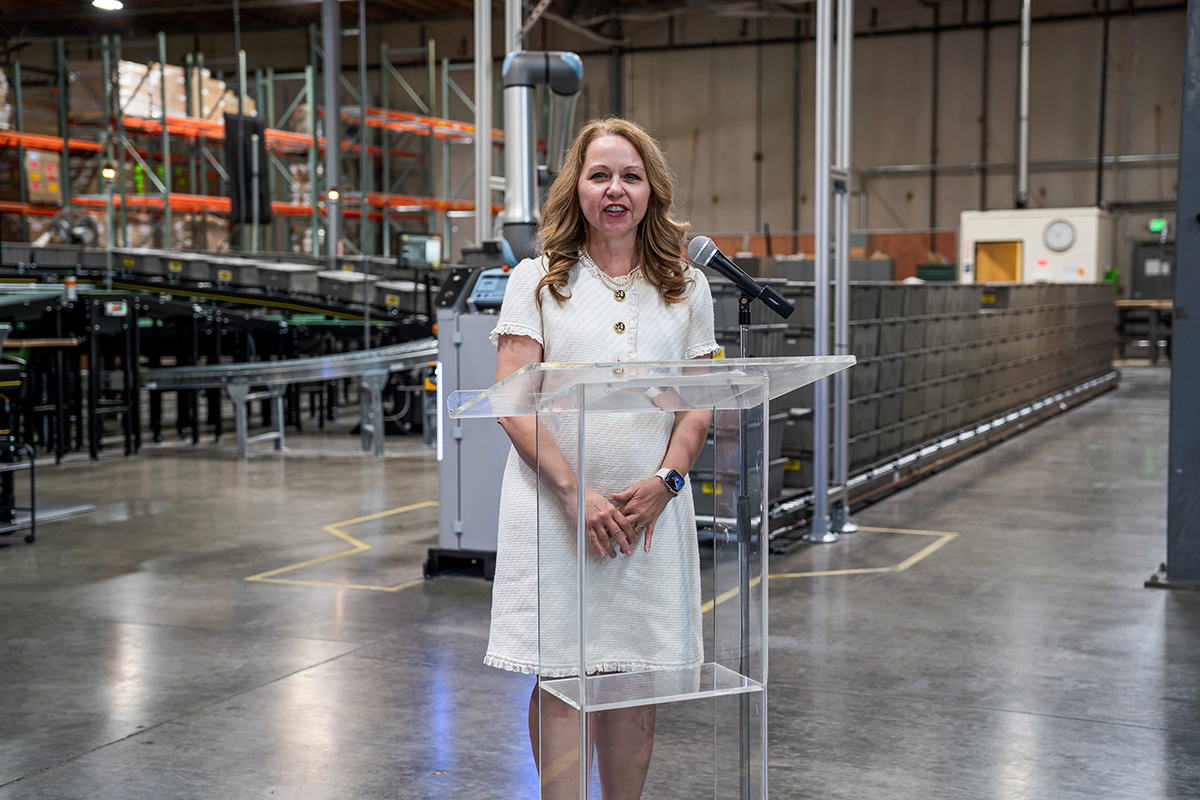
KCLS Executive Director Heidi Daniel. (Photo: Ken Yeung)
The new warehouse has been running since June 14. It’s the culmination of a more than three-year process. It replaces KCLS’s previous distribution center in Preston that operated for almost 25 years. Heidi Daniel, the organization’s executive director, said it was time to modernize: “It couldn’t keep pace with our growing community.”
In 2025, KCLS’s 700,000-plus active cardholders checked out more than 11 million physical items and 12 million digital items. And while the previous sorter “served KCLS faithfully,” it was plagued by mounting maintenance needs and frequent breakdowns. “We were literally ordering parts off of eBay,” Daniel said.
KCLS said the new sorter can handle up to 8,000 items per hour at full tilt.
Warehouse operations manager Charlie Mitchell walked through the sequence: drivers returning from branch pickups load totes onto one of two conveyor belts, and a pair of robotic arms at the far end destack them at a rate of one every 15 seconds.
On an average day, Mitchell estimated that 800 to 900 totes could be received. A human worker scans each item individually, and that scan tells the system where the material goes next: onto a second belt and into one of 186 chutes where it’s packaged into a new tote for the next delivery run.
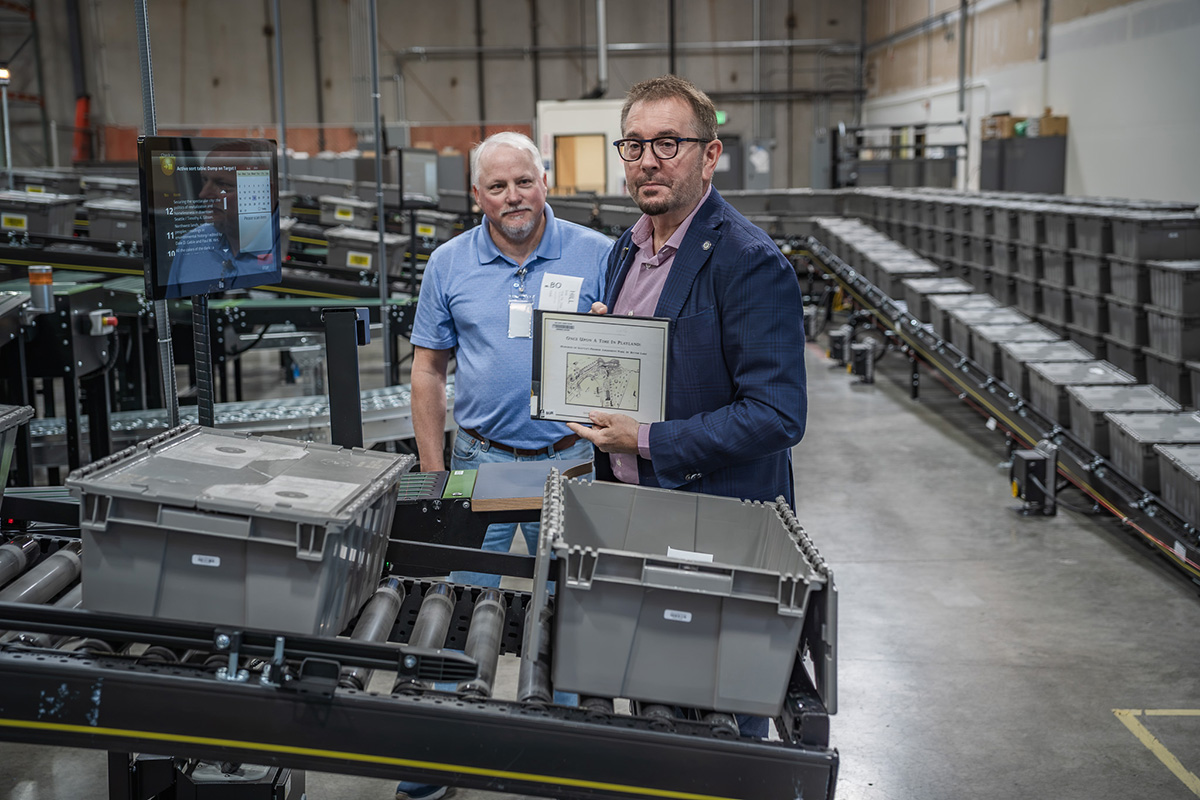
Renton Mayor Armondo Pavone tests out KCLS’s new material sorting machine, as warehouse operations manager Charlie Mitchell watches. (Photo: Ken Yeung)
It took KCLS nearly four months to set up and install everything. The facility is run by a team of 13 people — six tasked with scanning library materials and seven who manage the back end, ensuring the new totes are filled and then setting them aside while they await delivery.
When asked if it was challenging to train on the new equipment, Mitchell said no: “It’s a good job to pick up on.”
The clearest gains of this new setup, he said, are for the people working around the machine. Totes used to stack 14 levels high, sending workers up ladders to reach them; the new setup tops out at five, and instead of pushing totes down the line by hand, staff pulls them off onto a hand truck.
The noise level dropped too. “The old system ran at about 89 decibels,” Mitchell said. “This [new sorter] runs at 67 decibels. It’s about the same as a vacuum cleaner.”
One of the destacking robotic arms at KCLS’s new central sorting facility. (Photo credit: Ken Yeung)
The other payoff shows up at the branches. Mitchell explained that the old sorter ran at 2 to 3 mph and put books in the wrong bin 1% to 2% of the time. While a low percentage, it sparked uncomfortable conversations with patrons who received an email saying their book was available for pickup. The new machine features automated tracking and destination redundancy support, likely reducing the odds of any mis-sorting.
King County Councilmember Steffanie Fain said the new facility solves a “major flaw” in the library system — at least according to her two young children: It will enable books to move through the system faster so people won’t have to wait as long anymore for the material they want to read, listen, or watch.
“I’m not sure my kids have ever had an opinion about a distribution center before, but this one definitely has their full support,” she said.
Inside KCLS’s 25,000-square-foot warehouse, showing the books being sorted into one of 186 delivery chutes. (Photo: Ken Yeung)
“Today isn’t just about unveiling a remarkable piece of technology,” Daniel said. “It’s about investing in the future of KCLS, and most importantly, it makes a promise to the 1.6 million residents we are proud to serve: No matter where you live or which library you visit, you get the same selection, the same service, and the same speed.”
Three months after closing its $6.75 billion purchase of Press Ganey Forsta, Qualtrics is cutting jobs across the combined company — a reduction that the experience-management technology company says reflects duplication between two organizations that were built independently.
The cuts are global, including the company’s dual headquarters in Seattle and Provo, Utah, and its international offices. Qualtrics is not publicly disclosing how many jobs were cut, and did not break out numbers by office, region, or job function.
One clue: Qualtrics sent impacted Seattle employees layoff notices under the Worker Adjustment and Retraining Notification Act, or WARN, according to one copy reviewed by GeekWire. The notice covers workers at Qualtrics Tower, 1201 Second Ave., its Seattle headquarters.
The Washington law applies only to layoffs of 50 or more at one site — so at least that many jobs were cut at the Seattle HQ. As of publication time, Qualtrics had not appeared in the Washington or Utah state WARN databases, which can sometimes lag the notices to employees by a day or more.
Qualtrics CEO Jason Maynard
Individual employees learned their status by email Wednesday morning.
In a memo to employees, obtained by GeekWire, Qualtrics CEO Jason Maynard called the acquisition a “defining milestone” for the company but said it “meant making hard decisions about what the organization needed to operate and function as a single uniform team.”
“Since the acquisition closed, we’ve gone function by function, team by team, to understand where we have overlap and determine what we needed to do to move forward as one company,” he wrote, noting that the decisions were “made based on the structure of our combined organization: the roles we need, the capabilities we are building toward, and where we have duplication.”
Qualtrics makes software that companies use to collect, analyze, and adapt to feedback from customers and employees, a category of technology that it branded “experience management.”
Current and former employees posting publicly Wednesday on LinkedIn and other forums described cuts spanning departments and offices, including Seattle, Provo and international locations, and hitting both the legacy Qualtrics and Press Ganey Forsta sides of the business.
The Press Ganey Forsta acquisition, announced in October and completed in May, added what Qualtrics called the largest healthcare experience dataset in the industry. Press Ganey Forsta, based in Indiana, was itself the product of earlier mergers, and its Forsta products competed directly with Qualtrics.
The cuts follow a leadership shakeup in April, when Maynard removed five senior executives and outlined a broader reorganization spanning marketing, customer operations, IT and corporate development. Maynard, who joined from Oracle, became CEO in February.
It’s not the first round of cuts under private equity ownership. Qualtrics cut about 780 jobs, roughly 14% of its workforce, in October 2023 under then-CEO Zig Serafin, who cited complexity from years of rapid hiring. It had cut about 270 jobs earlier that year.
Qualtrics has been owned by private equity firm Silver Lake and Canada Pension Plan Investment Board since 2023, when they acquired it for $12.5 billion. It was the second time the company changed hands in under five years, following SAP’s $8 billion acquisition in 2019 and a 2021 IPO.
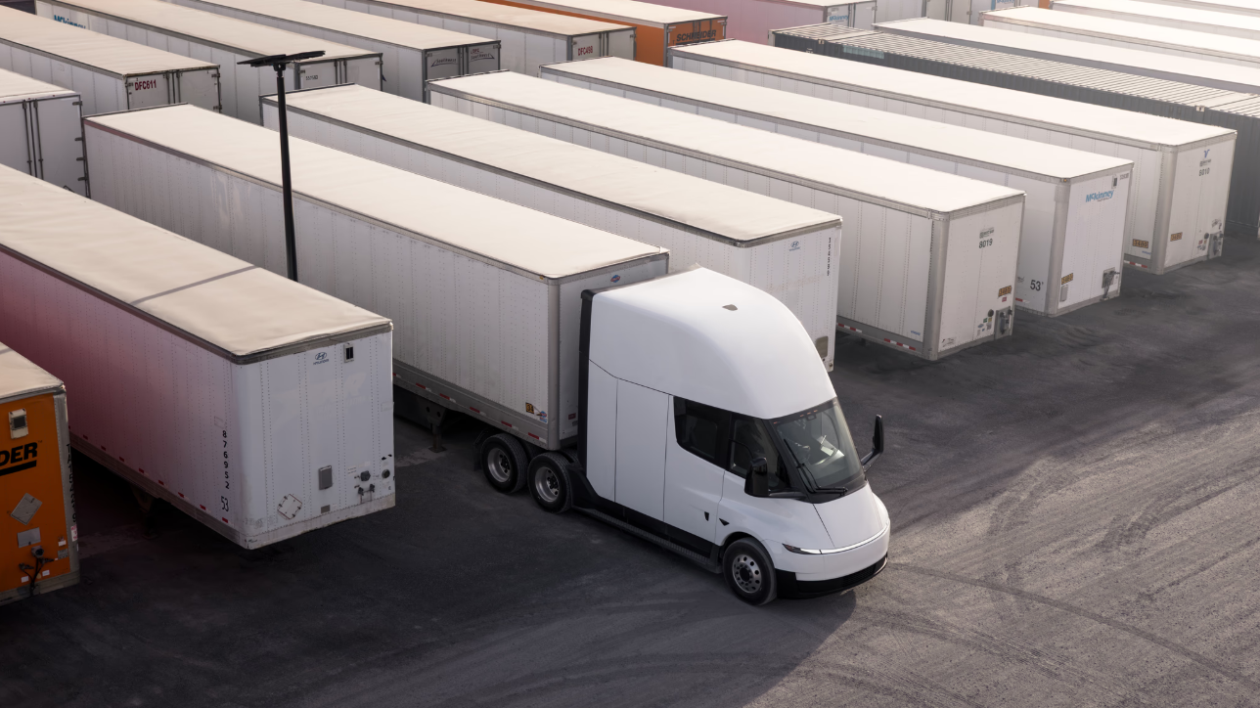
Einride plans to deploy 500 Tesla Semis for Amazon and other customers. (Tesla Photo)
Amazon is quietly accumulating a stake in Einride, the Swedish electric trucking company that said Tuesday it will deploy 500 Tesla Semis for Amazon and other customers.
Einride’s SEC filings show Amazon holding warrants for 25.2 million shares — about 12% of the company — that vest as Amazon buys freight services. The company’s financial report Tuesday, its first since going public in June, has the warrants on its books for the first time.
An Einride spokesperson confirmed that a “warrant contract asset” of 1.5 billion Swedish kronor (roughly $160 million) on the company’s balance sheet represents the Amazon warrants. It is the largest single asset on Einride’s books, worth more than its trucks and more than its cash.
At the same time, Einride is relying heavily on Amazon for growth, forecasting a 60% to 73% year-over-year revenue increase in the second half, “fueled by the Amazon ramp and other deployments in the U.S. and Europe,” as the company said in its earnings release.
Amazon announced in April that Einride would deploy 75 electric trucks with charging at five U.S. sites in its middle-mile network, the leg between warehouses and delivery stations.
Tesla Semi rollout: Einride also said Tuesday it will deploy 500 Tesla Semis across North America, calling it the largest deployment of Tesla’s electric big rigs in the world to date. The trucks will serve Amazon and other Einride customers on freight corridors in California, Texas, New Jersey, Illinois and Georgia, rolling out in phases over two years beginning in September, financed by third parties.
Tesla Semis are already hauling some Amazon freight. Nevoya, an all-electric trucking carrier based in Southern California, says it runs Amazon loads using Tesla Semis.
Amazon’s electric semis: Amazon has been turning to other manufacturers to electrify its freight network beyond the last-mile delivery vans it buys from Rivian. It deployed nearly 50 Volvo electric semis at Southern California ports and ordered more than 200 electric big rigs from Mercedes-Benz for Europe, part of a pledge to reach net-zero carbon across its operations by 2040.
Einride, for its part, doesn’t sell trucks. It buys and finances them, hires the drivers or contracts carriers, builds the charging infrastructure, and hauls a customer’s freight for a fee — using its own software, called Saga AI, to plan routes around charging windows and battery range.
The pitch to a shipper like Amazon is that it gets electric trucking capacity without purchasing vehicles itself or creating electric charging infrastructure.
Long-term autonomy: Einride is also one of a small group of companies running fully driverless trucks in commercial service in the U.S., with Level 4 autonomous vehicles operating in Ohio and more than 5,400 driverless hours logged for customers as of June 30.
The trucks hauling Amazon’s freight, however, have drivers, as will the Tesla Semis, for now. Tesla CEO Elon Musk said on the company’s July earnings call that self-driving capability for the Semi is about a year away. That timeline would fall inside Einride’s two-year rollout.
Einride’s Amazon deal: Roozbeh Charli, the Einride CEO, said on the earnings call Tuesday that the April announcement with Amazon brought a wave of new business.
The takeaway for customers about Einride was, “If these guys can handle the complexity of Amazon’s network, they can handle ours,” he said, explaining that there was “quite a lot of inbound” following the news.
Charli said customers rarely specify hardware, and that Einride selects truck platforms based on the routes and the data. That would suggest Einride chose the Tesla Semis, not Amazon.
The Amazon warrants did not come up on the call. The terms have been technically public since April, buried in an exhibit to Einride’s merger filings with the SEC, but haven’t been previously reported, in part because Einride’s prospectuses refer to Amazon as “the Specified Party.”
Amazon’s financial arrangement with Einride follows a pattern.
The company struck a similar deal with Plug Power in 2017, taking warrants for up to 55.3 million shares that vested as Amazon bought fuel-cell equipment for its warehouses.
Amazon invested in Rivian in early 2019, then ordered 100,000 electric delivery vans from the startup later that year. The company owns about 12% of Rivian today.
Amazon did not respond to questions about the arrangement.
Editor’s Note: This story has been updated with comment from Einride. It was also corrected to note that Tesla Semis already haul Amazon freight for Nevoya, an electric trucking carrier.
Medical researchers need cutting-edge tools to create new treatments, and Vancouver, BC startup ScopeSys wants to provide them.
Founded in 2017 and tracing its roots to research from University of British Columbia biophysicist Sabrina Leslie, ScopeSys uses physics to make testing new medicines quicker and cheaper.
The 7-person company, which recently closed a $1.1 million seed funding round, is developing tools that let drugmakers observe individual RNA and DNA molecules, giving researchers a more precise way to design new forms of medicines.
We caught up with ScopeSys CEO Padma Kodukula — a longtime biotech leader who most recently served as chief business officer at A-Alpha Bio — for this installment of GeekWire’s Startup Spotlight.
In 50 words or less, give us your startup’s elevator pitch.
ScopeSys is developing next-generation analytical instruments that reveal the size, payload, structure, and dynamic behavior of individual nanoparticles and biomolecules. Our proprietary Convex Lens-induced Confinement (CLiC) technology helps pharmaceutical and biotechnology companies design better genomic medicines, accelerate formulation development, improve scale-up, and strengthen manufacturing control.
What problem are you obsessed with solving?
I am obsessed with improving how genomic medicines are characterized. These therapies are complex and highly heterogeneous, yet many existing analytical methods report only population averages. We want to give scientists particle-by-particle and molecule-by-molecule insight so they can better understand what they are making, why it works, and how to manufacture it consistently.
What surprised you after talking to customers?
I was surprised by how actively customers seek technologies that can give them a meaningful competitive advantage. Pharmaceutical and biotechnology teams are highly sophisticated, but they still face major analytical gaps. They are willing to explore cutting-edge tools when technology can answer important questions that existing methods cannot and provide actionable data.
How has AI changed the way you build your company?
AI has multiplied our efficiency across nearly every part of the company. We use it to accelerate scientific research, analyze market and competitive information, refine product positioning, develop customer materials, support sales outreach, and improve internal decision-making. It allows a small team to operate with the speed and breadth of a much larger organization.
What is one thing people misunderstand about your startup?
Some people assume we are still an academic research project because our technology originated at the University of British Columbia. In reality, ScopeSys is a commercial, revenue-generating company. We are translating years of scientific innovation into robust instruments, consumables, AI datasets, and analytical services designed for pharmaceutical, biotechnology, and research laboratories.
What is the toughest decision you have made in the past year?
The toughest decision has been balancing near-term service revenue with the long-term investment required to commercialize our instrument platform. Services generate important customer validation and cash flow, but building a scalable product company requires disciplined choices about hiring, capital allocation, product development, and which opportunities to prioritize.
What is the one piece of advice you give to other entrepreneurs?
There will be many hurdles throughout the entrepreneurial journey, and some will feel overwhelming in the moment. Keep moving forward. Most challenges eventually pass, especially when you remain focused, adaptable, and persistent. Perseverance does not mean ignoring problems; it means continuing to solve them one at a time.
We will know our company has made it when…
Our technology and instruments are routinely used across pharmaceutical, biotechnology, and academic laboratories as a standard tool for developing genomic medicines—helping scientists build better formulations, accelerate process scale-up, understand product heterogeneity, and support manufacturing and quality control.
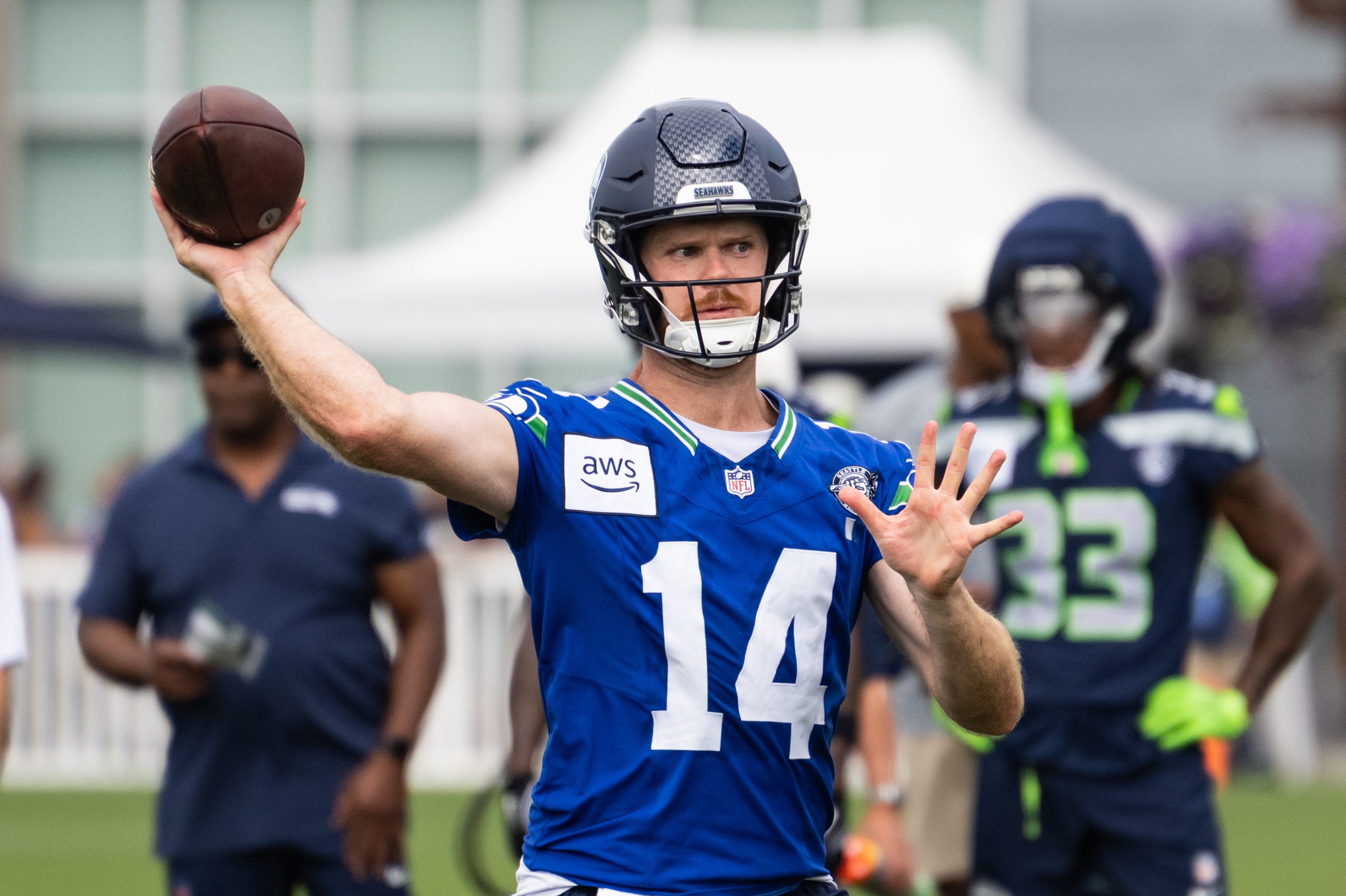
Seattle Seahawks quarterback Sam Darnold during the team’s training camp. (Seahawks Photo)
If your summer sports head is spinning about the current state of the Seattle Mariners, perhaps it’d be better served focusing on “spin rate,” particularly as it relates to Seahawks quarterback Sam Darnold.
The Seahawks are the subject of the latest season of HBO’s Hard Knocks, an inside look at training camp and how the team is preparing to defend its Super Bowl championship this season.
Episode 2 of the series premiered Tuesday night, and Darnold — in his second season with the team — was a highlight among an hour of TV that had many. The NFL was even compelled to post part of it on Instagram.
The Seahawks QB, along with the team’s passing game coordinator and one of Darnold’s primary receiving targets, all shared insight into why Darnold is an NFL leader when it comes to spin rate — and why it matters.
In a game increasingly loaded with analytics and Next Gen Stats, spin rate tracks the number of revolutions of the football while it’s in flight. The higher the rate, the tighter the spiral. The average NFL QB spin rate is 570. Darnold’s is “off the charts” at 639, according to Hard Knocks.
“From a young age, I’ve just been able to throw the football,” Darnold said on the show. “It was just something I always practiced. I’d be laying in bed with the football and just tossing it up to myself and trying to see how much I can spin it. And that’s just something I’ve always kind of been interested in and kind of a geek about.”
With a tight spiral on the football, the nose of the ball doesn’t tilt up or down, doesn’t wobble, and travels in a more effective manner to the receiver.
Veteran wide receiver Cooper Kupp knows there’s a science to throwing the ball, and he previously believed that spinning the ball too much made it harder to catch.
“I’ve now caught the ball from Sam for a year and a half, and now I’m not so sure,” Kupp said with a smile.
Darnold has been working on throwing a tight spiral since he was a kid tossing a football in the yard with his dad. Now when he generates a whip with his arm and the torque needed to throw the ball efficiently, he thinks about what’s ahead, particularly later in a season when weather can have a huge impact on the football.
HBO Sports is especially adept at capturing compelling footage on Hard Knocks. While Seattle, the Pacific Northwest and the Seahawks VMAC training facility on Lake Washington all make for a beautiful backdrop, it’s worth geeking out over Episode 2 for an extra-long shot of a Darnold pass in flight.
Set to a remix of the 1984 new wave hit “You Spin Me Round (Like a Record)” by the English pop band Dead or Alive, the shot is totally on target.
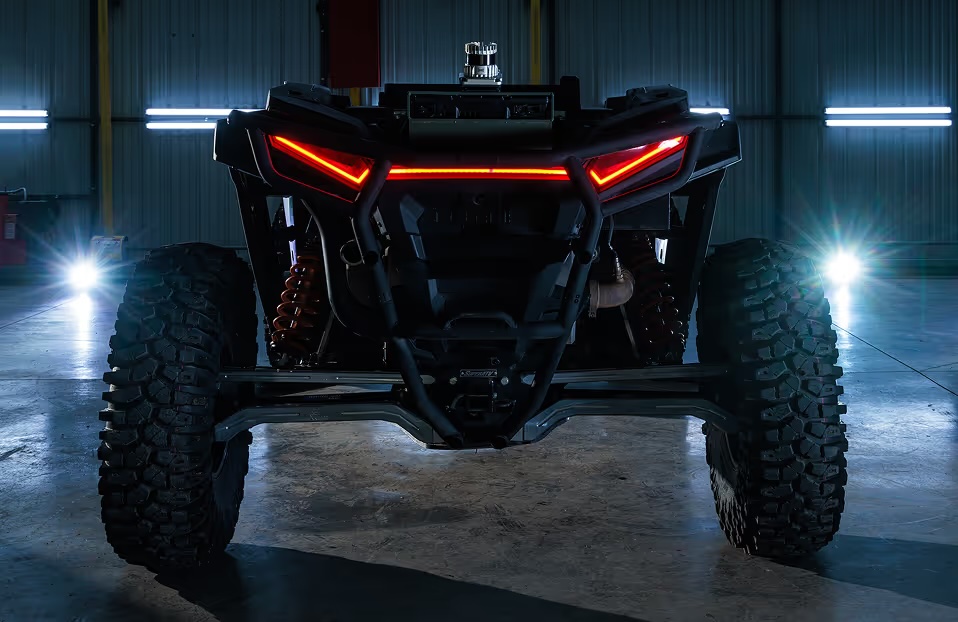
Overland AI develops autonomous ground vehicles and systems used by the U.S. military. (Overland AI Photo)
Silicon Valley companies have spent decades coming to Seattle for engineering talent. Now Seattle-based Overland AI is returning the favor.
The autonomous ground vehicle maker announced Wednesday that it’s opening an office in Burlingame, Calif., to tap into what it calls a world-leading AI and robotics talent pool in the Bay Area.
Located on the San Francisco Peninsula, the new facility will serve as a hub for software engineering and robot operations. The space includes a dedicated command center where operators can remotely task and control Overland’s autonomous ground vehicles across the globe.
The startup touted the location for its proximity to top universities and transit options and said it plans to double its Bay Area headcount over the next six months as it expands development of its off-road navigation software.
“Establishing a physical presence in the Bay gives us direct access to the deepest pool of AI talent in the world,” Jon Fink, CTO at Overland AI, said in a statement.
The move flips the long-standing dynamic between Silicon Valley and the Pacific Northwest. For years, Bay Area tech giants like Google, Meta, and Apple have built engineering outposts across Seattle to tap into the region’s cloud computing and systems talent. Just look at GeekWire’s list of such engineering centers.
But as autonomy and robotics race forward, Overland AI is reversing the talent migration, establishing its own Northern California beachhead to recruit engineers right in Silicon Valley’s backyard.
Founded in 2022 as a spinout from the University of Washington, Overland AI builds software and hardware for uncrewed military land vehicles designed to navigate complex, off-road terrain without GPS.
Auger co-founders Leigh Anne Clark and Dave Clark at the company’s Bellevue, Wash., office. (GeekWire File Photo / Todd Bishop)
One of the Seattle region’s most notable tech startups is moving its headquarters to Texas.
Supply chain technology startup Auger will maintain a major engineering office in Bellevue, Wash., where it got started. But the company’s co-founder and CEO, Dave Clark, the former Amazon operations chief, is officially back in Dallas, and he took the company’s HQ with him.
Founded in 2024, Auger has raised $150 million, including a $50 million Series B round led by Eclipse in July. Its software connects the systems that companies use to run their supply chains, integrating AI to help automate them. Its customers include Meta, Fanatics and Kimberly-Clark.
Clark, in an interview with GeekWire, said the move is about talent and family, not taxes. For one thing, Texas happens to better suit him and Auger co-founder Leigh Anne Clark, his wife. They’re running toward something rather than away, he said. They both grew up in the Southeast, and they had always intended to return to Texas at some point.
“I’d rather have a really hot month of August than a really gray month of February,” he said.
Dallas is also a place where you run into supply chain specialists at the coffee shop like you do software engineers in Seattle, he said. That’s a key talent pool for Auger at this stage in its evolution. Another bonus: Texas is more central to corporate customers across the country.
The magazine D CEO in Dallas, which first reported the news of Auger’s HQ relocation this week, noted that the company did not seek state or local incentives as part of the move.
Clark confirmed in the GeekWire interview Tuesday that taxes weren’t a factor, noting that he couldn’t even quantify what the tax advantages would be. However, he said, “There’s a lot I like about the way the state of Texas manages and works with business.”
When asked what he would say to people in Seattle who might see another warning sign in a startup like Auger moving its HQ somewhere else, he didn’t shoot down the premise.
“If you’re in that position, I think you’re right to be worried, in the sense that there’s a lot of discussion about things in the state of Washington and Seattle that are not particularly friendly to business,” he said.
Clark didn’t point to any particular policy or issue but said he has sensed an “anti-business” sentiment that concerns him since moving back to the Seattle area from Texas to launch Auger.
“Seattle should just be careful,” he said. “It’s not preordained that they win these things. It’s not preordained that these big companies stay in town.”
The Pacific Northwest has enormous resources to compete globally, he added, and there’s no reason it shouldn’t be “a phenomenal draw to anybody and everybody coming in.”
The region has “many, many strengths, and we should leverage them to the advantage of the community,” he said. “And sometimes I think the rhetoric gets in the way of it.”
Auger has about 115 people in Bellevue — engineers and supply chain data scientists — and Clark said he expects that office to grow 20% to 30% over the next year or two. He and Leigh Anne will both be back there regularly, he said, working alongside the team.
“Nothing’s changing there,” he said.
The company’s new HQ in North Dallas occupies part of the 15th floor of One Galleria Tower, centrally located between neighborhoods north and south of the city, with a quick run to DFW International Airport, as Clark pointed out in the D CEO article.
The office currently has about 15 people, most hired in recent months for sales, go-to-market and supply chain roles. Many of them had been traveling to Bellevue until the new space opened. Clark expects to add another 20 to 30 people in Dallas by the middle of next year.
As in Bellevue, where Auger subleased its space from Microsoft and bought the furniture for $1, the Dallas office came furnished. This time the furniture cost $10. (There goes Texas’ reputation for affordability.)
“It cost me 10 times more for the furniture in Dallas,” Clark joked. “I like nice things, cheap.”
Clark spent 23 years at Amazon, rising to lead its global operations and later its worldwide consumer business, and was one of the chief architects of the logistics network behind the company’s delivery operation. He left in 2022 to become CEO of Flexport, departing the freight startup the following year, before starting Auger.
Leigh Anne Clark is Auger’s president of fashion and beauty, leading the company’s work in an industry known for waste-prone supply chains. The couple, who met in Kentucky in 2000 while Dave Clark was at Amazon, have two sons, ages 14 and 11.
With its rapid hiring and significant early funding rounds, Auger rose quickly to No. 31 on the GeekWire 200, our ranking of Pacific Northwest tech startups. Because the GeekWire 200 is limited to companies based in the region, the headquarters move puts Auger’s standing in jeopardy.
Informed of this predicament, Clark made his pitch to stay on. “We still have a lot of dev there,” he said of the Bellevue office. “I think you get grandfathered into the list in some way, right?”
Meanwhile, the business keeps growing. Clark said Auger signed two major contracts Tuesday with customers he declined to name. The Bellevue office marked them with a bell-ringing, and the two offices celebrated together over a video call. A second bell is on order for Dallas.
“We’ll have dual bells that we’ll ring together,” Clark said.
Brad Younggren (left), president of Viome Pro, and Naveen Jain, co-founder and CEO of Viome. (Viome Photos)
Two Seattle-area health and longevity startups are joining forces through Viome Life Science‘s acquisition of Circulate Health. The two parties would not share specifics but said the deal was valued between $15 million and $50 million.
The acquisition will allow the companies to expand their reach and offerings of diagnostics, wellness supplements and a blood-cleaning service called therapeutic plasma exchange.
Here’s what each brings to the table:
Viome sells test kits for saliva, blood and stool samples for customers to use at home and send in for analysis. Based on the results, the company offers personalized supplements and oral care products.
Viome has also developed diagnostic tools that analyze RNA biomarkers to detect disease, including a test for early detection of oral and throat cancer that has received FDA breakthrough device designation but not formal FDA clearance.
Circulate operates machines providing therapeutic plasma exchange administered by its own specially trained nurses. The goal of the exchange is to provide a circulatory-system tune-up that removes inflammatory factors, microplastics and biological compounds associated with aging, returning clean blood cells with a replacement protein fluid.
Combining the services and expertise of the two companies could expand their reach and provide new insights into health and treatment, said Dr. Brad Younggren, Circulate’s co-founder and former CEO.
“We want to build the largest network in the world for plasma exchange to answer questions, to figure things out. We’re adding new diagnostics. We’re looking at different kinds of biomarkers and diagnostics in the chronic disease space,” Younggren said.
The merged company has 115 full-time employees, with an additional 10 consultants on staff. Most of Circulate’s workers retained their jobs following the acquisition. Younggren is now president of the newly formed clinical group, Viome Pro, which includes diagnostics, oral and throat cancer detection, and therapeutic plasma exchange. Naveen Jain is Viome’s CEO and co-founder.
Circulate operated in stealth mode for a couple of years and officially launched in January 2024. It raised $14 million prior to the acquisition. Viome was founded a decade ago and has received approximately $250 million from investors.
Circulate had previously operated in 40 health and longevity clinics, primarily in the U.S., with one each in the United Kingdom and the Bahamas, and had relationships with additional sites. Combined with Viome’s clinic partnerships, those connections could expand the company’s potential reach to 400 sites.
The expansion comes as both microbiome testing and plasma exchange face questions from the medical community about how well the evidence supports their claims of health benefits.
The microbiome health market is growing, though estimates of its size vary widely. Some researchers are wary of microbiome kit companies, criticizing a lack of scientific rigor and regulation.
Plasma exchange is considered medically effective for conditions including certain cases of multiple sclerosis and leukemia, Guillain-Barre syndrome, sickle cell disease, and organ transplants. The treatment has more recently been embraced by biohacking proponents who pursue cutting-edge and not necessarily scientifically verified strategies for improving mental performance and longevity.
In 2025, Circulate published a study of 42 adults in Aging Cell showing potential reductions in biological age following repeated treatments, though outside medical experts questioned the long-term significance of the findings. A separate 2026 study in the Journal of Clinical Apheresis showed its protocols helped reduce microplastics in the blood.
“We’ll continue to do research,” Younggren said. “We have new tools. We’re going to be doing a trial combining plasma exchange with all the technologies that already exist under the hood at Viome.”
— Teri Hatfield was named chief revenue officer for Iterable, a customer engagement platform. The Seattle-area tech executive most recently served as executive vice president of sales and solutions at Salesforce and CRO of Tableau, which Salesforce acquired in 2019. She joined Tableau in 2012 and spent more than a decade in sales leadership roles at Verizon earlier in her career.
“I’ve come to believe that great customer relationships don’t start with technology. They start with understanding your customers,” Hatfield said on LinkedIn. “Iterable stood out because it’s built around that belief.”
Hatfield will work remotely for Iterable, which is based in San Francisco.
Ken Miller. (Arnold & Porter Photo)
— Seattle-area attorney Ken Miller has joined Arnold & Porter as a partner in the life sciences and technology transactions teams within the law firm’s corporate and finance group.
Miller began his legal career at Perkins Coie, where he spent 16 years focused on tech companies and nonprofit organizations.
In 2015, he moved to the Gates Foundation as associate general counsel, briefly serving as lead counsel for the Gates Medical Research Institute before returning to the foundation as director of legal. In that role, he led work tied to the Global Health Division, the research institute, and business development and licensing, privacy and AI.
Ben Reed. (LinkedIn Photo)
— Ben Reed is now chief marketing officer for AIM Intelligent Machines (AIM), a Seattle-area startup developing software that lets bulldozers and excavators operate on their own.
Reed previously ran a firm offering AI marketing and go-to-market advisory services. Other past roles include CMO for Sanctuary AI and a decade at Microsoft, where he departed as head of strategic storytelling for the company’s digital transformation platform.
“I’ve spent much of my career helping frontier technologies become understandable, credible, and consequential, from Microsoft Surface and HoloLens to physical AI, humanoids, and robotics. At AIM, the unusual opportunity is that the technology, customers, deployments, and proof already exist,” Reed said on LinkedIn.
Philip Wong. (Gravitics Photo)
— Aerospace startup Gravitics named Philip Wong chief financial officer. The Marysville, Wash.-based company designs and manufactures modular space infrastructure such as commercial space station modules, cargo-carrying spacecraft and orbital carriers. Its customers include U.S. Space Force and Axiom Space. On Tuesday, Gravitics announced a partnership with Lockheed Martin on a Department of War contract.
Wong joins Gravitics from Viasat, a communications company providing satellite internet services, where he led financial strategy and investment planning. He previously held leadership roles at Pure Storage and Seagate Technology and is based in California.
“Philip has spent 30 years deploying capital across satellite, network, and space infrastructure … He knows how to translate real engineering programs into the financial strategy that supports them,” said Colin Doughan, co-founder and CEO of Gravitics, in a statement.
— Ian Fliflet, former chief growth officer at Seattle online sales platform OfferUp, is sharing his insights on Intro, a service that provides video chats with experts from wide-ranging backgrounds.
— Katy Brown, president of Microsoft’s Americas Markets & Industries organization, was named to Avanade’s board of directors. Brown has been with the tech giant for nearly 30 years and is past president and board chair of the Professional Businesswomen of California. She also serves as executive sponsor of the Bay Area Women at Microsoft group.
— Ben Minicucci, CEO and president of Alaska Air Group, has joinedLyft’s board of directors. Minicucci has spent more than two decades with the airline, which is the parent company of Alaska Airlines, Hawaiian Airlines and Horizon Air.
— Seattle tech leader Ash Wahiwas appointed to MoPOP’s board of directors. Wahi is the founder and CEO of Revenaut, a startup building an AI marketing tool. His career includes leadership roles in product and advertising at Microsoft, Snap and Meta.
— TiE Seattle, a nonprofit supporting entrepreneurship, named five new members to its board of directors:
Joseph Sirosh, CEO of CreatorsAG and former executive at Amazon and Microsoft. He also serves on the board for the biotech company AbSci.
Monika Panpaliya, partner director of product management at Microsoft and former leader at JPMorgan Chase & Co., Boeing and T-Mobile.
Vamshi Reddy, CEO of Quadrant Technologies, founder of Seattle Venture Capital, and past leader at Lenora Systems and Microsoft.
Prasad Anguluri, co-founder of the social media platform Haply, which connects neighbors. Anguluri also serves as a Bothell City Council member, president of ANG Technologies, and co-founder of Innovative Investing Group.
Sanjay Puri, who was previously a vice president with Icertis and a former leader at Avalara, 9Mile Labs, Edifecs and others.
— JT McCrone, a Fred Hutch Cancer Center genomic epidemiologist, was named leader of Nextstrain, an open-source project that tracks the evolution and spread of viral and bacterial pathogens in real time.
The effort is primarily based in Seattle at Fred Hutch and two institutions in Basel, Switzerland. It has received $1.5 million from the Gates Foundation to support its next phase, which aims to make analyses of viral evolution more accessible and scalable.
— Graham Littlehaleis now an investing partner with venture firm Felicis. He previously served as vice president of Point72 Ventures.

 Login
Login