❌

Reading view

There are new articles available, click to refresh the page.

Who’s getting Anthropic’s compute spending? IPO filing shows where the tech giants really stand
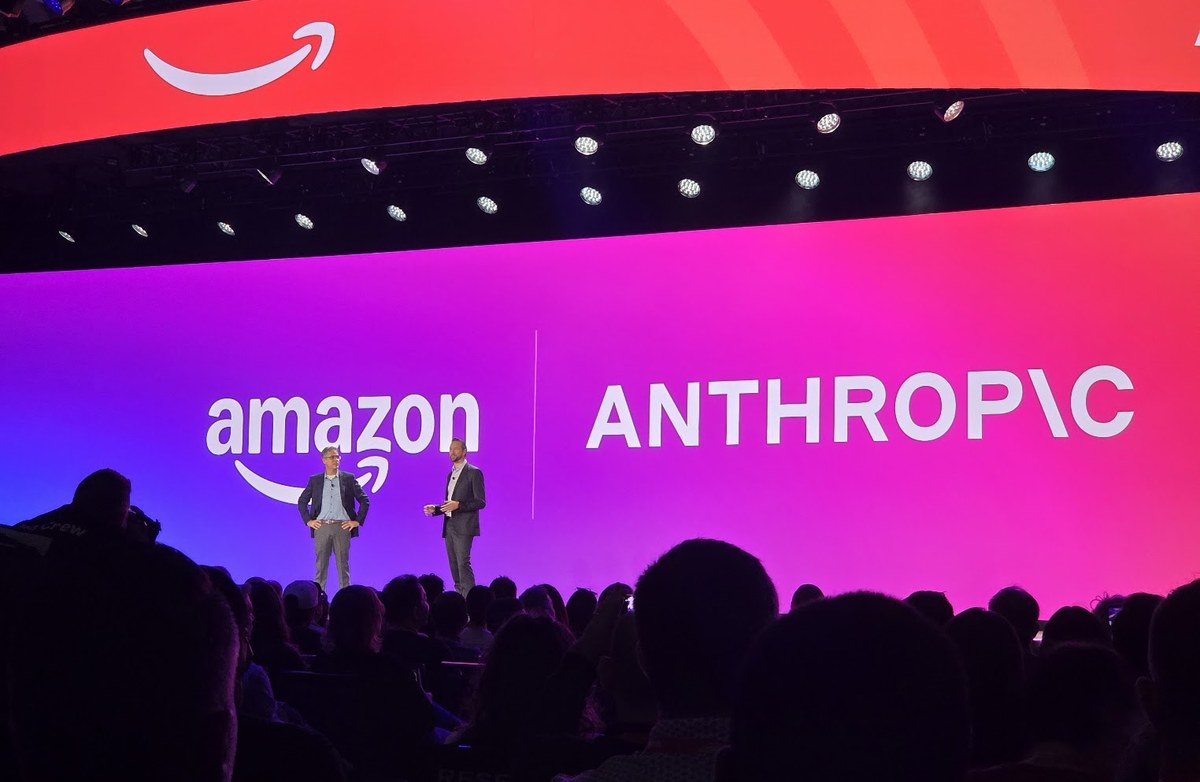
Two men stand on a stage in front of large screens showing the Amazon and Anthropic logos, with an audience in the foreground.
Chris Jones, director of Seller Assistant at Amazon, left, and Eric Burns of Anthropic’s Applied AI team on stage at Amazon Accelerate in Seattle in September. Anthropic’s IPO filing shows Google getting a bigger share of the AI company’s computing spending than Amazon, one of its largest investors. (GeekWire Photo / Todd Bishop)

Anthropic’s IPO filing reads like a ledger of who’s getting paid in the AI boom. The Seattle region’s tech giants are on the list, but they aren’t at the top.

The prospectus, filed Monday with the Securities and Exchange Commission, details more than $750 billion in computing deals, including firm commitments and estimated future spending, and offers clues about what its founders and biggest investors stand to gain ahead of the company’s planned Nasdaq listing under the ticker ANT.

Amazon and Microsoft have invested billions in Anthropic and won high-profile spending commitments from the Claude maker. But both trail Google, chipmaker Broadcom and Elon Musk’s SpaceX in their shares of Anthropic’s planned spending on computing power, the filing shows.

Following the compute money: Google’s chips are the biggest winner. Anthropic has lined up roughly $400 billion in computing capacity, mostly over the next seven years, based on Google-designed AI chips, known as tensor processing units or TPUs.

That total includes $114.5 billion to Google directly through July 2033, $161.2 billion in equipment leases with chipmaker Broadcom, and an estimated $125 billion to $150 billion in additional TPU capacity from 2028 to 2031.

Broadcom’s leases are the largest single arrangement in the filing. The five-year leases provide TPU-based hardware for data centers operated by other companies on Anthropic’s behalf.

Elon Musk’s SpaceX is next. Anthropic agreed to spend up to $120.5 billion through 2029 for computing capacity from SpaceX’s AI subsidiary, formerly known as xAI, which runs a rival AI lab.

The filing says payments will reach about $3.1 billion a month once all the capacity is delivered, which Anthropic expects in December. The agreements run into 2029, though either side can cancel on 90 days’ notice after early 2027.

Amazon is still a big winner. Anthropic committed in April to spend at least $110 billion with Amazon Web Services over 10 years, through April 2036, and AWS Trainium is one of four chip families that Anthropic uses to train and run its models.

Microsoft’s piece is smaller, which reflects its later start. The company was aligned closely with OpenAI for years before striking its own deal with Anthropic.

Anthropic has committed to spend at least $44.9 billion on Microsoft’s Azure cloud from November 2026 through May 2033, the filing shows. That’s up from the $30 billion Azure deal announced in November 2025. The deal has been amended twice since, most recently this month.

Claude is built into Microsoft 365, and former Microsoft CFO Chris Liddell joined Anthropic’s board in February.

Two smaller providers have deals in the same range as Microsoft’s. Anthropic agreed to spend up to about $44.6 billion with Nscale, a U.K.-based AI infrastructure company, and about $41.3 billion with GPU cloud provider Lambda, both for capacity powered by Nvidia chips, according to the filing.

Will Anthropic need it all? Most of the commitments can’t be canceled, and the deals with Microsoft, Google and Amazon require Anthropic to pay “regardless of actual usage,” according to the filing.

So far, the demand is there. Anthropic’s revenue hit $11.6 billion in the second quarter, up from $787 million a year earlier, and the company posted its first operating profit, $974 million. It still had a $66.3 billion net loss, mostly from accounting charges tied to its soaring valuation.

The company says it has “consistently operated in a compute-constrained environment where customer demand exceeds available compute.”

Its compute commitments assume that demand keeps growing. Anthropic spent less than $2 billion a month on compute and infrastructure in the second quarter. The SpaceX deal alone is expected to cost about $3.1 billion a month at full capacity.

Paper fortunes: Amazon’s biggest payoff is its stake, which it valued at $190.4 billion as of June 30 in its quarterly SEC filing. That includes convertible notes with $6.2 billion in principal that Amazon valued at $97.9 billion. The notes would convert into stock, subject to a 12% ownership cap that Amazon can waive.

Amazon is scheduled to report third-quarter results Thursday, its first earnings report since Anthropic’s filing. The Seattle-based company has updated the value of its Anthropic holdings in each of its quarterly filings this year, so a new number could come this week.

Google put $10 billion into Anthropic’s latest funding round and can invest up to $20 billion more under a March financing deal. The filing doesn’t give ownership percentages for Amazon, Google or Microsoft. It says only that the three companies have each made “significant equity investments” in Anthropic.

Anthropic’s seven co-founders hold roughly 230 million to 245 million shares each, worth about $14 billion apiece at the latest private funding price. The company also gave its own Public Benefit Fund about 847 million shares, or 5% of its fully diluted stock as of June 30, worth about $50 billion at that price.

Anthropic could begin formally marketing its IPO to investors as soon as the week of Nov. 9, Bloomberg reported, citing people familiar with the matter. It is aiming to go public the following week, according to the Wall Street Journal. The company expects the offering to match or beat the size of SpaceX’s IPO, according to Bloomberg. SpaceX raised $75 billion in June, the largest IPO on record.

This software engineer is taking Google to the U.S. Supreme Court to clarify patent law

Jeff Kohler is asking the U.S. Supreme Court to clarify patent law after courts sided with Google to invalidate his software patent. (Photo courtesy of Jeff Kohler)

Jeff Kohler was working as a software engineer in 2005 when he started spending his nights and weekends on a side project: a web conferencing system that could record and replay live sessions. He filed for a patent without the help of a patent attorney, stuffing two CDs full of C++ source code into the application to show his work.

The patent was issued in 2010, and years later, after Kohler had joined Microsoft, the Redmond company licensed his technology for its Teams video-conferencing platform.

When YouTube later added the ability for viewers to pause, rewind, and change the playback speed of live video, Kohler saw in the feature what he considered to be his own invention. Kohler, who lives in Bellevue, Wash., sued Google for patent infringement in U.S. District Court in Seattle in April 2023.

But rather than defending the feature’s originality, Google argued that Kohler’s patent was too abstract to be eligible for patent protection. The district court agreed and dismissed the case, and the U.S. Court of Appeals for the Federal Circuit affirmed that decision.

Both decisions cited Alice Corp. v. CLS Bank International, a 2014 U.S. Supreme Court ruling that raised the bar for software patent eligibility by holding that an inventor cannot patent an “abstract idea” implemented with generic technology.

Since then, Alice has been used to invalidate thousands of software patents, and the Supreme Court has repeatedly declined to revisit the standard. Now, Kohler is asking the Supreme Court to take up his case, not to overturn Alice, but to clarify how courts should apply it.

“The patent legal system has become hostile to inventors,” Kohler said. “Because of Alice, my case got stopped before it even started.”

How Alice changed patent law

When Alice was handed down, patent trolls were on the rise: shadowy entities that bought vague patents to sue tech companies on shaky claims of patent infringement. 

That changed under the 2014 ruling, which requires that a patent clear two hurdles: the idea cannot be “abstract,” and it must propose a sufficiently “inventive concept.” The standard has become “a crucial tool” for fighting patent trolls, in the words of the Electronic Frontier Foundation.

But critics say it’s ill-suited to software patents. Because software inventions often rely on pre-existing hardware to run the source code, courts tend to find many of these patents to be insufficiently inventive.

Jon McMichael, an IP litigation partner at Fenwick who has written about Kohler’s case, said this challenge is common in patents where inventors rely on general-purpose computers and off-the-shelf hardware to implement their ideas. 

“That’s where those patent holders run into more problems,” he said.

Experts say the courts’ application of Alice has broadened to invalidate the patents of real inventors in addition to those of patent trolls. Toshiko Takenaka, a University of Washington IP law professor who is working on an academic paper about Kohler’s case, said Alice’s ability to quickly defeat bad actors comes “at the expense of the best inventors.”

“Software patents are too frequently being invalidated without giving the owner the opportunity to defend it,” Takenaka said. “This inventor provided something ordinary computers could not do, right? So therefore, in my view, this is an eligible invention.”

Some judges have raised similar concerns, including Federal Circuit Chief Judge Kimberly Moore, who authored the opinion affirming the dismissal of Kohler’s case. In a 2020 concurrence in a separate case, Moore wrote that she and her fellow judges were “unanimous in our unprecedented plea for guidance” from the Supreme Court on how to interpret Alice, which she called a “patent-killing judicial exception of our own creation.”

A quest for legal clarity

After filing his patent, Kohler spent more than 15 years at Microsoft, where he helped launch HoloLens and rose to senior director of product management for the Surface line. He later served as a product leader at Meta for its Horizon platform.

Kohler says he’s hopeful the Supreme Court will agree to hear his case because his petition takes a new approach, asking the court to clarify how to apply the Alice test rather than disputing the test entirely. His new attorney, Kathryn Jean Miller, who does not have prior patent law experience, was admitted to practice before the Supreme Court bar for this case.

“It’s me and my lawyer against the world,” Kohler said. “I never thought I would be doing something like this.”

The Supreme Court has declined more than 89 petitions related to Alice, some of which had the Solicitor General’s endorsement. The justices will decide on Sept. 28 whether to hear Kohler’s case and likely announce their decision the following week.

Kohler is hoping that other inventors will file amicus briefs, which are due by Sept. 23, to illustrate to the court the need for clarification.

“There’s a broad coalition of people who would like some sanity brought back to patent law, from small inventors and startups to former judges,” Kohler said. “That’s what I’m trying to do with my petition.”

❌