This week on the GeekWire Podcast: A study commissioned by the City of Seattle says the city is not in decline but is in danger — finding that 10 companies, nine of them in tech, pay three-quarters of the payroll tax on large employers, and that the tax structure uniquely penalizes the hiring of senior, high-compensation workers.
The report says Seattle should be most concerned about AI but most active in cleantech, the one industry the city can actually shape, since it owns the electric utility and controls permitting, building codes and land use.
Meanwhile, the Seattle Times and Newsday sue Microsoft and OpenAI, accusing them of copying hundreds of thousands of articles to train their AI models, putting Microsoft’s hometown paper against a company that helps fund some of its journalism.
Which leads us to a new GeekWire Trivia Challenge about the Microsoft products that Apple later turned into categories. Stick around to the final segment to see if you can figure it out.
Upcoming Event
AI meets real estate
GeekWire, in partnership with Real Estate at Work, is recording the GeekWire Podcast live at 4 p.m. Wednesday, Sept. 16, with Toby Roberts, SVP of Engineering at Zillow. John Cook and Todd Bishop host with Real Residential broker Leka Devatha at Atmosphere Seattle. Grab a ticket.
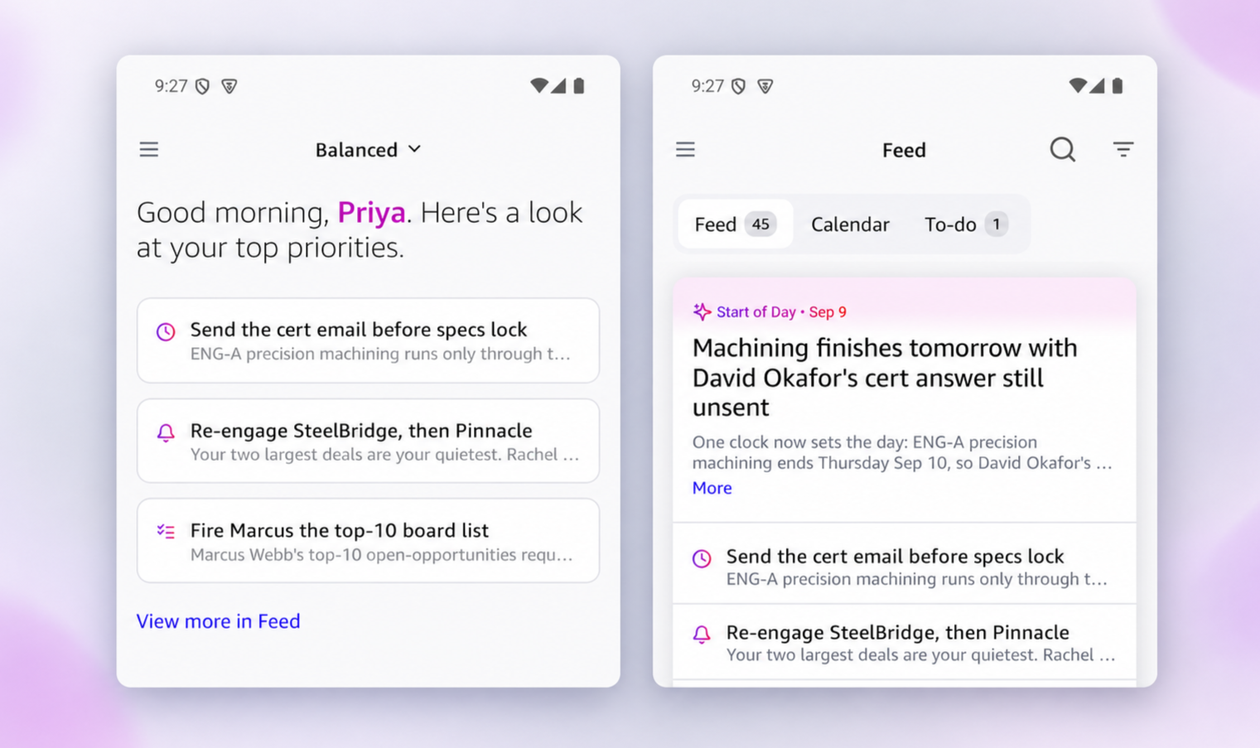
Amazon Quick’s new activity feed on mobile: the morning priority view, left, and the full feed. (Amazon Images)
Amazon is adding the Activity Feed and other features from its Quick desktop app to the AI assistant’s mobile apps for iOS and Android.
The Activity Feed is the signature feature of Amazon Quick. It combines email, Slack messages, calendar invites and CRM updates into one prioritized list, and lets people act on items (opening and responding to emails, for example) without switching apps.
Amazon said Wednesday that the Quick desktop app, released in preview in April, is now generally available on Windows and macOS. The company also said Quick’s agents now run in the cloud, so they keep working after a laptop is closed and deliver results to the feed.
The desktop and mobile apps now sync, as well, so a task started on a laptop can be picked up on a phone, for example.
Quick has a free tier, with paid individual plans starting at $20 per user per month billed annually, and business plans running $20 to $40 per user per month.
Quick is Amazon’s entry in a crowded market for AI assistants at work, competing with Microsoft Copilot, Google Gemini, OpenAI, Anthropic and others. Amazon’s announcements cited business customers for Quick including Southwest Airlines, LabCorp and the PGA Tour.
The desktop app came together fast, as part of a new effort inside Amazon to use small teams to move quickly: Swami Sivasubramanian, the AWS vice president of agentic AI, told GeekWire in June that a team of about six engineers started in late January and shipped April 28.
The September update for Amazon’s cloud-based gaming service Luna comes with multiple new features, the most prominent of which is one that will allow up to 7 other players to remotely participate in the same gaming session.
Since its aggressive relaunch earlier this summer, Amazon has pinned its hopes for Luna on multiplayer games and the casual market. Anyone with an active Amazon Prime subscription has access to Luna and can launch it directly from the Prime Video app, which allows them to stream an assortment of video games to their TV, browser, or tablet via Amazon’s cloud servers.
This includes around 60 casual-friendly multiplayer games, designed to be playable by just about anyone of any age as a group activity, and some of which are exclusive to Luna as a platform.
Its newest feature, Remote Play, changes how multiplayer titles work on the service. One player with a Prime subscription can now invite up to 7 other people to participate remotely in a multiplayer Luna game, as long as all 7 of those people have an account on Amazon and a compatible device. This reportedly works with every multiplayer game on Luna, including those that formerly required every player to physically be in the same room.
Two new games have been added to Luna’s library that specifically take advantage of Remote Play. This includes a Luna-exclusive mobile version of Magic: The Gathering creator Richard Garfield’s 2011 board game King of Tokyo, in which players take the role of giant monsters fighting one another in the ruins of Japan.
(Amazon press image)
Other additions to Luna this month include access to two relatively recent games from the French publisher Ubisoft: 2024’s Star Wars: Outlaws and 2023’s Avatar: Frontiers of Pandora, the latter of which is set in the universe of James Cameron’s film franchise.
Amazon has not shared user data for Luna since its recent relaunch, so it’s difficult to tell from outside the company how much of an audience it’s been able to build. Luna represents a bet by Amazon that, in the midst of the ongoing component crunch and the related rise in hardware costs, it can build an audience by offering access to popular video games via whatever devices people might already have in their homes.
A few years ago, cloud gaming as a whole was one of the major topics in the games industry, with some analysts going so far as to predict that it was the future of hardware. Instead of purchasing an Xbox or PlayStation in your own home, you’d simply dial into a remote server and stream games to your TV.
That gold rush has largely faded in recent years, as the furor over genAI has stolen some of its thunder, but cloud gaming is still a going concern and a surprisingly competitive market. Luna might be the most accessible option for would-be cloud gamers, as it’s bundled into a subscription that 200 million households already have, but it’s quietly up against giants like Nvidia, Microsoft, and Sony.
Some of the biggest names in the games industry have placed a quiet bet that the “RAMageddon” will quietly push audiences further towards the cloud. As yet, there’s no solid evidence whether or not it’s paid off. Still, if you’re looking to get into video games but missed your window to get a relatively inexpensive computer or console, the cloud might offer you some worthwhile options.
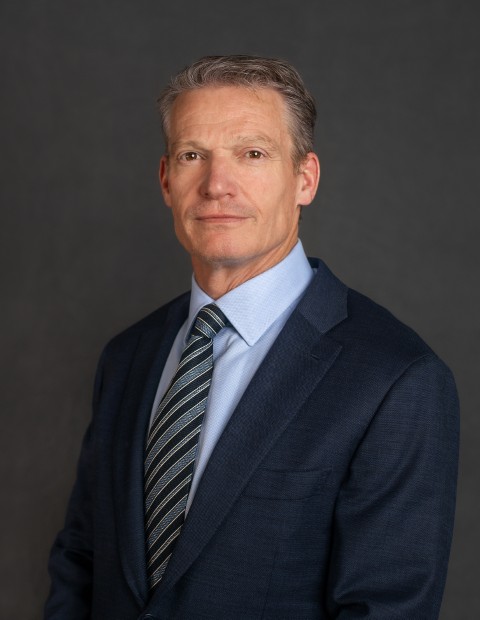
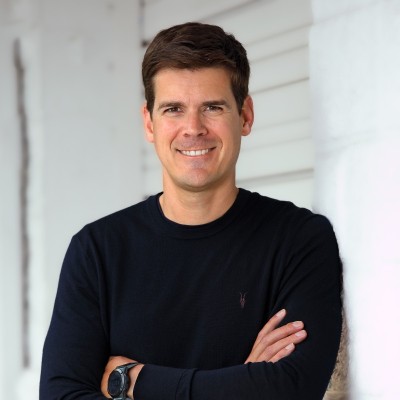
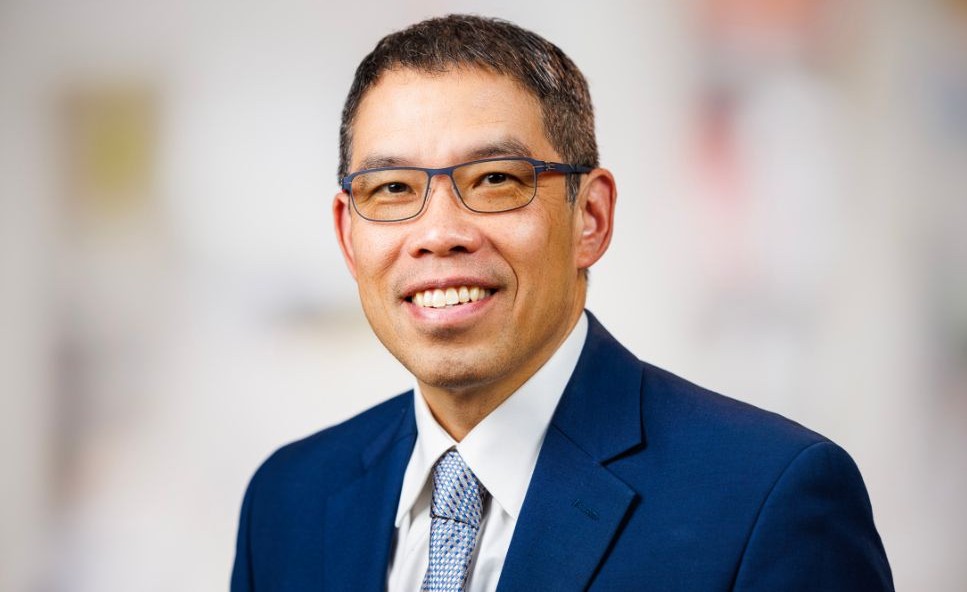
New Amazon board member Kevin Mandia is a cybersecurity veteran. (Photo via Amazon)
Amazon named cybersecurity veteran Kevin Mandia to its board of directors, adding new security expertise a few months after former NSA director Keith Alexander stepped down.
Mandia founded Mandiant, the breach-investigation firm Google acquired for $5.4 billion in 2022, and remained at the search giant as a strategic advisor through July 2025, according to his LinkedIn profile. He now leads Armadin, an AI security startup he started last year.
Amazon said in its announcement that “cybersecurity is one of the most consequential risks and responsibilities organizations face today, and the threat landscape continues to evolve rapidly alongside advances in AI.”
Amazon added a cybersecurity specialist to its board in 2020, when it elected Alexander, who also led U.S. Cyber Command. Mandia comes from the other side of the field, with two decades spent investigating corporate breaches rather than defending government networks.
His appointment also puts an AI security entrepreneur on the board of a company whose cloud infrastructure underpins much of the internet. Armadin, founded in September 2025, uses AI to run attacks against corporate networks, probing defenses the way an intruder would.
The board’s Security Committee, which oversees Amazon’s cybersecurity policies and its response to significant cyber incidents, is now chaired by Dan Huttenlocher, dean of the MIT Schwarzman College of Computing. Mandia joins as a member, along with former Bridgewater co-CEO Jon Rubinstein.
Amazon also named Mandia to the board’s Audit Committee, according to a securities filing.
Mandia received 4,086 restricted stock units in connection with his election to the board, vesting in three equal annual installments beginning Nov. 15, 2027, the filing shows. The shares were worth about $1.03 million at Amazon’s closing price Wednesday.
The filing disclosed that his sister-in-law, Kristin Mandia, is an Amazon employee with an annual salary of $185,000. The company said her compensation is consistent with that of other employees at her level with similar responsibilities.
Seattle’s foundation as a hub of technology, science and innovation runs deep. Its confidence should, too. (GeekWire Photo / Kevin Lisota)
[Editor’s Note: Jacob Colker is co-founder and co-managing director of AI House.]
Seattle is one of the most talented, creative and inventive places in the world. But if we want the rest of the country to see us that way, we have to start acting like we believe it ourselves.
First, we need more pride around here.
Let’s talk about what it means to be proud.
My mother grew up in Tarnów, Poland. She escaped communism and came to the United States in 1978 looking for a better life. She found one, built a family, and has lived in America for nearly 50 years.
But my mom is still very, very Polish.
Several times a year, I get a message: “Jakub. Did you see this?”
I already know what’s coming.
Some Polish person did something. A Polish athlete won something. A Polish scientist discovered something. Some guy with a Polish grandmother finished third in a regional Nebraska chess tournament. Doesn’t matter. Poland.
“Jakub. Look at this person.”
Okay, Mom. Who is she?
“POLISH.”
That’s it. That’s the story.
And I love it, because Mom has this completely indestructible pride in where she comes from. Plenty of us know someone like this: a Greek mom, Vietnamese dad, Indian uncle or Nigerian aunt. Somebody from their corner of the world did something great, and you are going to hear about it.
There is power in that instinct. Not because your people are better, but because you believe your place matters.
Seattle could use more of that.
We are almost pathologically humble. Our response to notable achievements is often a polite nod before everybody gets back to our regularly scheduled Seattle freeze.
That humility is working against us.
Second, Seattle isawesomeand the evidence is everywhere.
I see Seattle’s potential every day working alongside dozens of entrepreneurs building startups. Some of the most ambitious and talented people in the world are already here.
We have many billion-dollar startups across the region and more than 200,000 people working across technology, science, space, health and startups. That is more than enough talent to build yet a dozen more unicorns.
Nearly 40% of the world flies every day on airplanes built here. Blue Origin and SpaceX build rockets here. Starbucks, Amazon, Costco, REI and Nordstrom reshaped how the world shops. Microsoft helped put computing into our homes. AWS and Azure helped make the cloud the infrastructure of modern life. The University of Washington ranks among the world’s best. Seattle medical breakthroughs have helped save tens of millions of lives. We are pushing forward fusion energy, aerospace and maritime innovation. And let’s not forget: we just won the darn Super Bowl.
And so, so much more.
So why, despite all the evidence, do we still seem to have a communal case of imposter syndrome?
This is not a city lacking accomplishments.
It is a city with a branding problem.
Third, we have let other people tell our story for far too long. This ends, today.
Cities have brands whether they intend to or not. Silicon Valley is where ambitious people build companies. Nashville is music. Los Angeles for film and television.
Seattle’s cultural humility mostly assumes our accomplishments speak for themselves.
They don’t.
Reputation gets built one story at a time. You hear one story and it is interesting. You hear 10 and you notice a pattern. You hear 50 and your beliefs begin to change: That’s where important science happens. That’s where talented people live. That’s where I should invest, build or work.
Those beliefs shape real decisions about where people move, where companies get built and where investors put their money.
So to fix Seattle’s branding problem, here’s what we need to do.
Step 1: Let’s tell one clear story — Seattle’s talent pool is ridiculous.
Seattle is where deep technical talent meets deep domain expertise to build consequential things: AI, aerospace, cloud computing, medicine, fusion, robotics, maritime technology and enterprise software.
We do not need 50 slogans. We do not need another consultant-led branding exercise. We need one simple idea that people outside this region can remember: Seattle’s talent pool is ridiculous.
There is a reason some of the world’s most important companies have built major engineering centers, research hubs and second headquarters here for decades. They come for the talent.
And that talent is why Seattle will not just participate in the future. We will lead in building it.
Step 2: Let’s use the megaphones we already have.
Seattle already has outlets (including this one) telling this story — publications, podcasts and social channels that document the region’s startups, breakthroughs and product launches.
Every day, startups are raising money, scientists are making breakthroughs, companies are launching products, engineers are building technology and institutions are pushing this region forward.
That is not just tech news. That is the raw material of Seattle’s reputation. So let’s use it.
When you read or hear about a Seattle startup doing something remarkable, share it. When you see a story about a breakthrough at Fred Hutch or the University of Washington, send it to someone outside the region. When a local company raises money, lands a major customer or gets acquired, don’t just scroll past it. Amplify it.
Step 3: Let’s treat every local win as Seattle’s win.
When a local robotics company ships something remarkable, that is Seattle’s story.
When a maritime startup reinvents how ports operate, that is Seattle’s story.
When our AI research labs, or hometown heroes in Amazon and Microsoft, create breakthroughs, that is Seattle’s story.
When a biotech company lands a major breakthrough, when a game studio creates a global hit, when a clean-energy company reaches a milestone, that is Seattle’s story.
Our companies, universities, hospitals, labs, investors, civic organizations and business leaders should act like an amplification network for one another. Stop treating somebody else’s success as somebody else’s news.
Their win is our collective proof.
Step 4: Let’s put Seattle on the label.
Founders need to say where they are building. “Made with ❤️in Seattle” should be on the bottom of every website. Put Seattle in the press release. Put it in the LinkedIn post. Mention it onstage. Say it in interviews. Tell investors. Tell customers.
Silicon Valley companies have spent decades attaching their success to their geography. We should do the same. If you build something extraordinary here, make sure the world knows it was built here.
Step 5: Let’s do a better job of selling Seattle.
Every venture capitalist, founder, executive and civic leader in this region should be able to explain in 60 seconds why somebody should build a company here.
Not defend Seattle. Not apologize for Seattle. Sell Seattle.
Reminder: It’s the talent.
(And also cream cheese on hot dogs.)
When investors and founders from New York, Boston or San Francisco come to town, show them the region. Introduce them to engineers, researchers and entrepreneurs. Bring them into the community. Let them see what is happening.
The best branding campaign is somebody getting on a plane home saying, I had no idea all of this was happening in Seattle.
If we’re going to succeed, we need tobelievefirst.
Insert all the Ted Lasso jokes you want, but this stuff matters.
There is no giant Seattle marketing department coming to save us. There is no national referee who will eventually review the evidence and declare that Seattle deserves more respect.
When somebody here does something extraordinary, act like it. Read the story. Share the post. Send the article to your team. Text it to your friend in New York. Put it in the group chat. Bring it up over dinner. Tell your kids.
Basically, become my Polish mother.
My mom doesn’t give a hoot that Kraków ranks No. 6 on some list or Warsaw is No. 8 on another. She doesn’t need a clickbait listicle to tell her Poland matters. She already believes it does.
We have to build our reputation ourselves. The good news is that we already have everything we need: extraordinary companies, world-class institutions, ambitious people, groundbreaking science and media documenting it all.
What we have been missing is the confidence to start being more loud. Stories become patterns, patterns become reputation, and reputation becomes gravity.
Gravity is what creates influence and respect.
Pride is not something somebody else gives you. You don’t wait until the rest of the country decides your home is important. YOU decide it is. Then you act like it.
— Aneesh Raman has taken the role of chief economic opportunity officer at Microsoft. He previously held the same title at LinkedIn, a Microsoft subsidiary where he worked for five years.
The job is focused on “helping companies, including our own, build and deploy AI tools in ways that will unlock new levels of economic opportunity and human capability for workers and workforces alike,” Raman said.
Raman, who is based in San Francisco, began his career as a TV journalist and served as a speechwriter for President Obama and other political leaders. More recently he was an adviser to Gov. Gavin Newsom and led economic impact for Facebook.
Jenny Lay-Flurrie. (LinkedIn Photo)
— Jenny Lay-Flurrie was promoted to corporate vice president of Microsoft‘s Trusted Technology Group. In February, she had taken the role of vice president and head of Trusted Technology, which focuses on privacy, safety, regulatory compliance, responsible AI use and related topics.
Lay-Flurrie announced the change on LinkedIn, saying that she was “honoured, humbled and a little lost for words (yes,, it does occasionally happen ;)).”
The tech leader has been with Microsoft since 2005, and led the company’s efforts on accessibility and disability inclusion for more than a decade.
Brian Gill. (LinkedIn Photo)
— Brian Gillhas resigned as chief product and technology officer for DAT Freight & Analytics, a Beaverton, Ore.-based freight company. Gill was with DAT for more than three years and previously served as CPO for Nordstrom.
In a LinkedIn post, Gill did not give specifics on his next move but said he would be “rolling up my sleeves and building the many ideas that are suddenly so much easier to bring to life.”
Gill’s other past roles include executive positions at Hotwire and nearly a decade at Expedia. Last month DAT announced multiple promotions and hires to its leadership team.
Colin Newman. (LinkedIn Photo)
— Colin Newman has joined Zillow Group as head of public policy. He was previously director of U.S. public policy for Amazon, leading initiatives on employment, workforce transformation, AI, transportation and economic development. He first took a government affairs role with Amazon’s Audible business in 2015 and moved to Amazon five years ago.
“I look forward to leveraging my government, legal, and public policy experience to support our efforts to simplify and democratize the housing process for everyone,” Newman said. His background includes legal counsel for former New Jersey Gov. Chris Christie.
Lisa Finnegan. (LinkedIn Photo)
— Lisa Finnegan is returning to Microsoft as vice president and human resources business partner for the Europe, Middle East and Africa (EMEA) region. Finnegan, who is based in Dublin, was previously with LinkedIn for more than eight years, departing in March 2025. Her interim role was with Lumera HR Consulting.
“It’s a pretty incredible time to (re)join Microsoft and the opportunity to help shape the people and organisation agenda across EMEA at this critical moment is incredibly compelling,” she said.
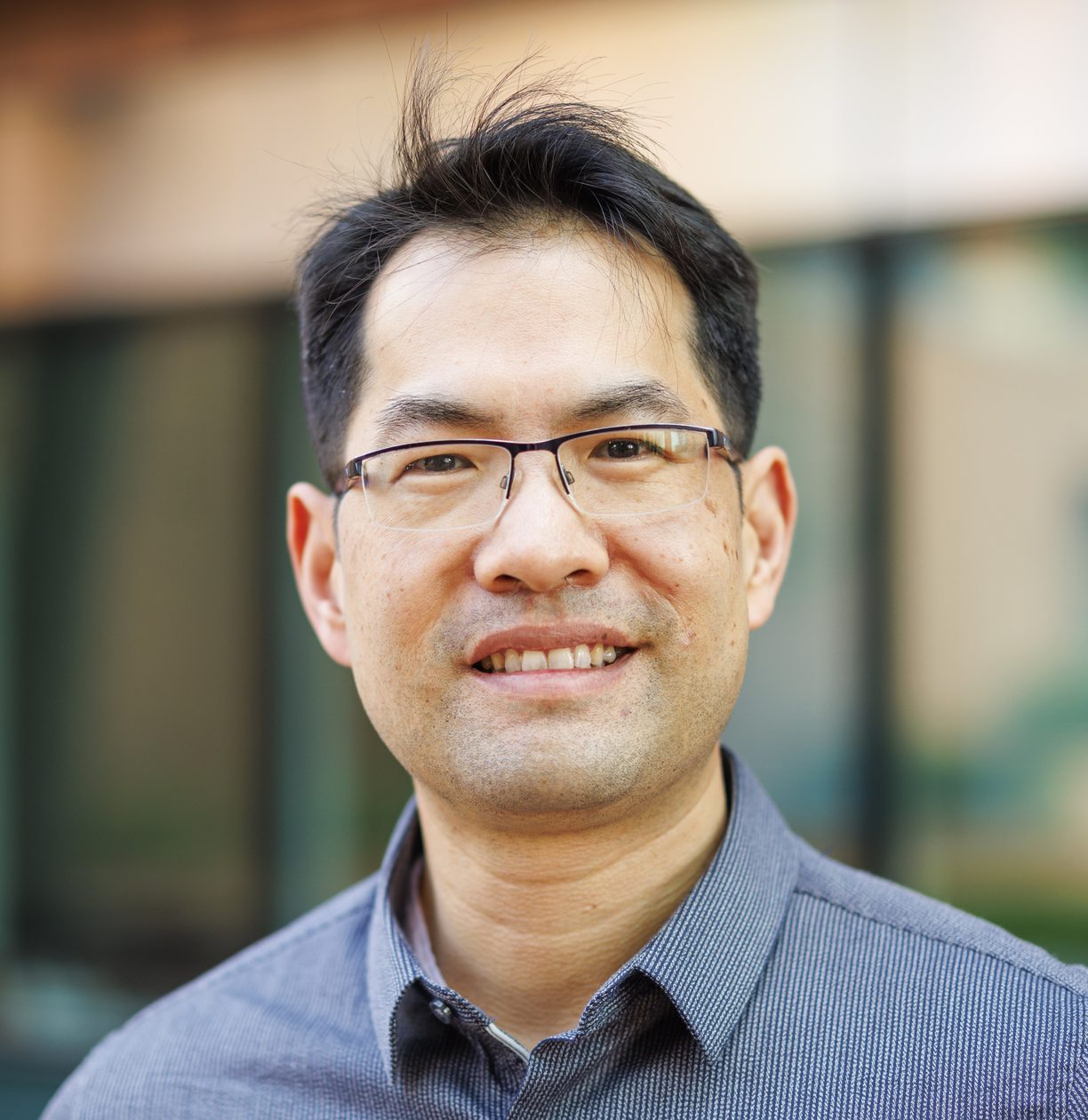
James Lau. (LinkedIn Photo)
— James Lau, chief product officer at Hiya, announced this is his last week at the Seattle startup, which battles fraudulent calls and provides technology to protect voice identity. He’s been in the role for three years and previously worked at Microsoft over multiple stints.
Lau is launching a company called Entrovox, which he describes as an AI phone team that helps insurance agencies land new customers through state-of-the-art AI voice agents, branded caller ID and smart campaigns.
“There has never been a more exciting time for building, and I am deeply passionate about voice AI. Making AI sound genuinely human is a challenge I find irresistible,” Lau said.
Jason Wilbur. (LinkedIn Photo)
—Jason Wilbur has left Oracle to join OpenAI‘s Seattle office as a leader in cloud partnerships.
Wilbur was with Oracle over two stints spanning more than six years and leaves the role of senior director of product management. Past jobs include CEO at Aarno Labs, co-founder of Require Security, and senior product manager at Amazon.
— Julia Liuson was appointed to Elastic’s board of directors. Earlier this year, Liuson resigned from Microsoft after more than 34 years. She was most recently president of Microsoft’s Developer Division. San Francisco’s Elastic bills itself as the “search AI company.”
Dan Walter. (LinkedIn Photo)
— Dan Walter was promoted to vice president of fission technology for Everett, Wash.-based Zap Energy. Walter joined Zap earlier this year as the clean power startup announced it was expanding to pursue fission micro-reactors as well as fusion-based nuclear energy. Zap is No. 11 on the GeekWire 200, a ranked index of the Pacific Northwest’s top startups.
Walter was previously at TerraPower for nearly a decade, most recently in a director role for the nuclear power company.
Kelsey Wolf. (LinkedIn Photo)
— Kelsey Wolf has joined next-gen battery company Group14 Technologies as director of communications and marketing. Wolf was previously the communications lead for Rad Power Bikes, the Seattle-based e-bike startup that went bankrupt and was acquired this past spring. Group14 is No. 34 on the GeekWire 200.
“I’ve spent my career telling exciting stories about technology that changes how we work, how we find home, and how we move around the world. Up next, I will get to tell stories about the technology and materials powering our world,” she said.
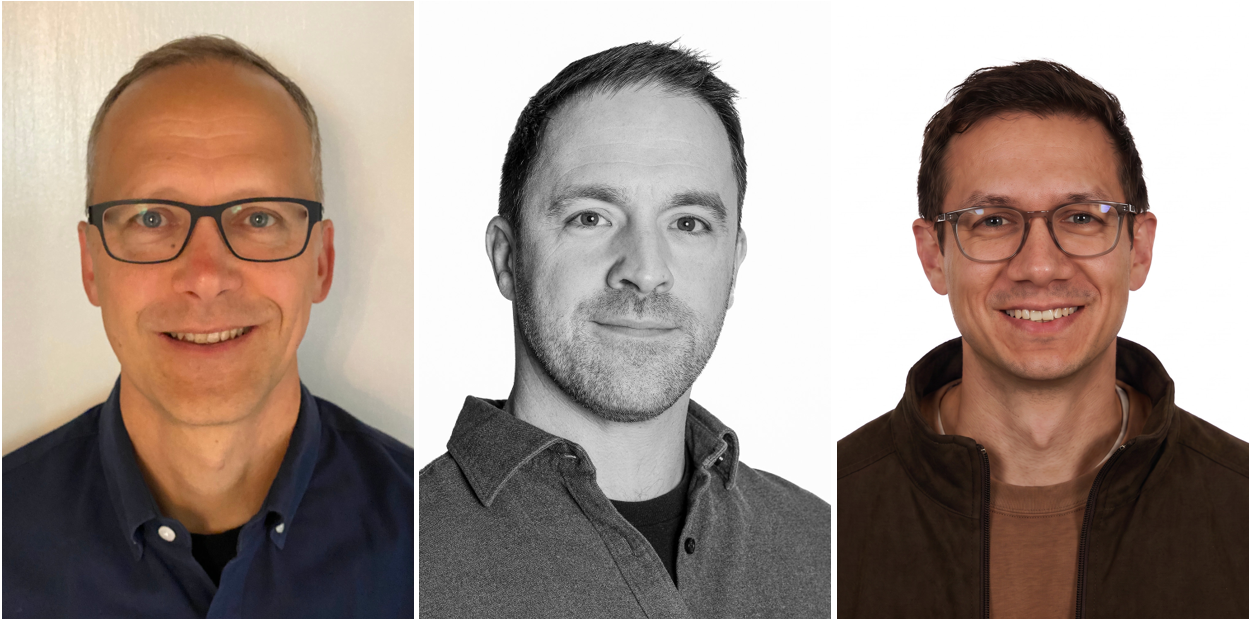
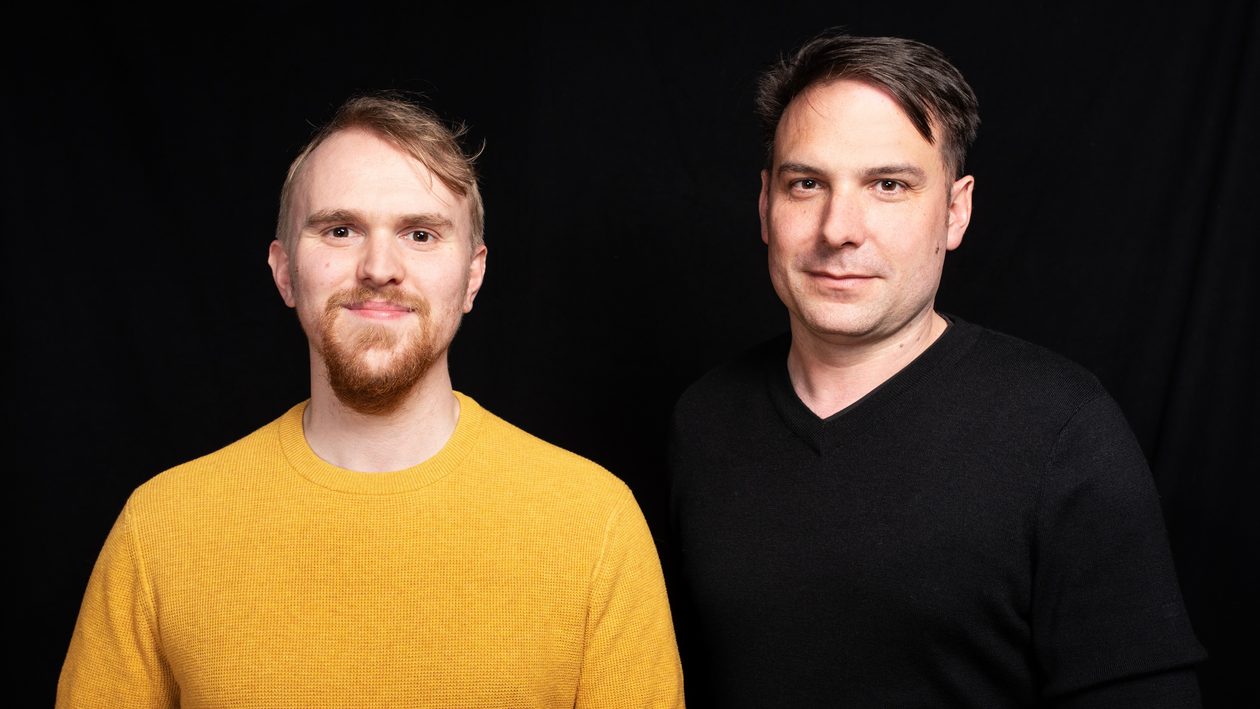
New members of the Tin Can team, from left: Evan Jacobs, Quinn Hawkins and Masud Khan. (Tin Can Photos)
— Tin Can, a Seattle startup selling Wi-Fi-enabled landline phones for kids, announced three hires:
Evan Jacobs has joined as head of engineering, previously serving as a software development manager at Amazon Web Services. Jacobs is also a startup founder.
Quinn Hawkins was named head of communities, joining from First Street, where he was chief product officer. His background includes leadership at Redfin and Microsoft.
Masud Khan was named staff software engineer. Past employers include Apple, Databricks, Meta and Amazon.
Tin Can, which launched last year, is No. 153 on the GeekWire 200.
Alex Gamoran. (LinkedIn Photo)
— EchoMark, the Bellevue, Wash., startup using forensic watermarking to identify the source of information leaks, has named Alex Gamoran vice president of enterprise sales. Gamoran was previously at Smartsheet for nearly a decade, leaving as regional vice president of commercial sales for North America.
“It struck me that every security-conscious enterprise is going to need a solution to the types of information leaks that conventional security software is blind to — and that’s when I knew I wanted to be part of EchoMark,” Gamoran said via email.
Sara Dutta. (LinkedIn Photo)
— Sara Duttawas named director of AI innovation and partnerships for Seattle biopharmaceutical company Omeros. She previously founded the life sciences consultancy Ocilisni and was a director at Novo Nordisk, focused on external partnerships and emerging technologies.
Last year, Omeros struck a deal worth up to $2.1 billion with Novo Nordisk, giving the latter exclusive global rights to develop and commercialize a clinical-stage drug candidate that treats rare blood and kidney disorders. Omeros won Deal of the Year at this year’s GeekWire Awards.
Rebekah Bastian. (LinkedIn Photo)
— Rebekah Bastian announced that she is leaving mpathic as chief marketing officer. She joined the Bellevue, Wash., startup working to make AI safe in December. Bastian previously launched and was CEO of the life-and-career social platform OwnTrail. She was with Zillow Group for more than 14 years and also worked at GlowForge.
“I’m giving myself some intentional time to explore ideas and let them incubate before deciding where they lead,” she said. That could include new companies or initiatives within existing companies, and her areas of focus span “human agency, creative entrepreneurship, economic opportunity, and generally how humans find meaning and thrive in the age of AI.”
— Seattle-area wine recommendation startup Theodora has appointed Heather Stephens founding marketing lead. Stephens has worked for more than a decade in consumer and B2B marketing, demand generation, and go-to-market strategy development.
— Marc Brown, former global head of M&A and strategic investments at Microsoft and now managing director of venture capital coverage at JPMorgan, has joined the board of trustees of the Institute for Citizens & Scholars, an organization supporting civic engagement for young people.
— Adrienne Lopez, a Seattle-based marketing leader who has worked on initiatives with organizations including Meta, WhatsApp, the Gates Foundation and Microsoft, was named executive vice president of WH Inc.
— Washington Research Foundation announced its new cohort of venture analysts: Jessica Ayers, Ankit Azad, Nello Gu, Michael Malone and Elya Shamskhou. The program helps graduate students and postdoctoral fellows gain expertise in technology commercialization and entrepreneurship.
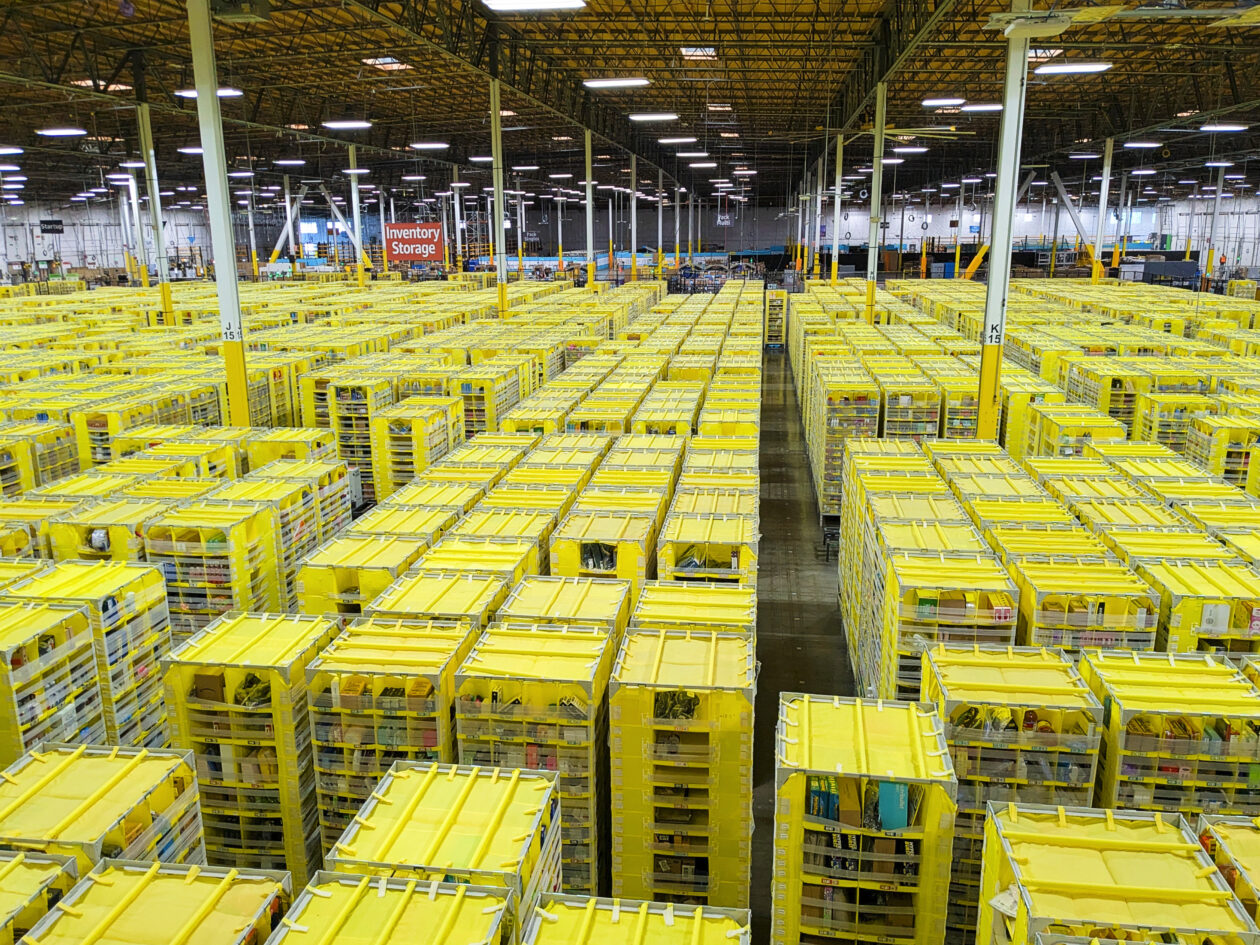
Movable shelving towers that hold items that are autonomously moved to Amazon employees who pack them for shipping. (GeekWire Photo / Lisa Stiffler)
Amazon is accused of artificially inflating the ad prices on its e-commerce site in a lawsuit filed Monday by Washington’s attorney general, the Federal Trade Commission (FTC) and 21 other states.
Amazon denies the allegations, saying its ad pricing has not harmed advertisers or shoppers and that the FTC’s claims mischaracterize how its system works.
Ads are sold on Amazon’s platform through so-called “second-price” auctions, in which businesses set a maximum price they’re willing to pay for an ad. If they’re the highest bidder, they pay only one cent more than the second-highest bid, and the auctions do not allow advertisers to see other bids.
Plaintiffs allege that beginning in late 2018, Amazon started adding surcharges to the prices, despite claims that it was still using a second-price system.
The lawsuit, filed in U.S. District Court for the Western District of Washington in Seattle, alleges the tech giant overcharged roughly 1.2 million ad customers by overriding and replacing auction results with “higher prices set by Amazon to increase its profits.” The amount collected through the allegedly deceptive pricing scheme totals $20 billion, according to the suit.
“Many small business owners in Washington rely on Amazon for their livelihoods, and our office is committed to making sure Amazon treats them fairly, transparently, and in accordance with the law,” said Nick Brown, Washington’s attorney general, in a statement.
Amazon posted an online response to the allegations. “The FTC’s claim fundamentally misunderstands how advertisers operate,” the company stated. “Advertisers adjust bids based on real-world performance, not descriptions of auction mechanics.”
The company said it prioritizes the relevance of an ad to the shoppers being targeted over bid price alone. As a result, Amazon said, 92% of winning ads in recent years were not given to the highest bidder, and ad performance has improved. Conversion rates — the percentage of shoppers who take a desired action after interacting with an ad — rose 24% from 2021 to 2025, according to Amazon.
The company also said that from 2019 to 2024, the average cost-per-click for sponsored product search ads was flat when adjusted for inflation.
Amazon acknowledged it has changed its ad pricing approach over time, saying that as the system prioritized ad relevance, winning bids increasingly fell below market value. As a result, the company now sets minimum prices, or “reserves,” for participating in an auction and for the minimum market value of the ad.
“Reserves like these,” it said, “are common across the industry.” The company said it does not charge advertisers more than their bid.
Amazon said it clearly explains its pricing process to advertisers. Plaintiffs dispute that, citing company employees who described creating fake auction participants.
The suit states that an Amazon senior scientist said that to increase auction prices, the company inserts “an invented auction participant representing how much Amazon thinks that particular ad slot is worth.”
The lawsuit is being led by the FTC and also includes the attorneys general of Alaska, Arizona, California, Colorado, Florida, Idaho, Illinois, Indiana, Iowa, Kentucky, Louisiana, Maryland, Nebraska, New Jersey, New York, North Carolina, Oklahoma, Pennsylvania, Rhode Island, South Carolina and Vermont.
The company is also in the FTC’s crosshairs in a separate, broader antitrust case accusing Amazon of maintaining an illegal monopoly in online retail, which is scheduled for trial next year.
Plaintiffs in the case announced Monday are asking the court to order Amazon to reform its practices, pay restitution and civil penalties for each violation, and cover attorneys’ fees.
Two of Amazon’s Seattle headquarters towers rise above the Spheres. (GeekWire File Photo / Kurt Schlosser)
Amazon is cutting 121 jobs in Washington state, according to a new state regulatory filing on Monday, hitting corporate tech teams in Bellevue and Seattle as well as fulfillment operations in Sumner.
The largest single concentration of cuts is at the SEA106 building in Bellevue, where 49 employees — ranging from entry-level software development engineers and applied scientists to a vice president of legal and senior software managers — were notified.
In Seattle, impacted positions span multiple downtown office buildings and include roles such as a director of human resources, product managers, and technical writers.
Beyond corporate offices, 32 positions were cut at the BFI1 fulfillment center in Sumner, affecting warehouse associates, service technicians, and safety specialists.
“Teams across the company regularly review their structures to ensure they’re best set up to deliver on their goals,” Brad Glasser, an Amazon spokesperson, told GeekWire via email. “As part of these reviews, teams sometimes determine that certain roles are no longer necessary. We don’t take these decisions lightly, and we’re always committed to supporting employees whose roles are impacted by them.”
The Worker Adjustment and Retraining Notification (WARN) filed with the state’s Employment Security Department says impacted employees were notified between July 1 and July 29 and terminations will be effective between Oct. 1 and Oct. 27.
Amazon says it provided 90 days of advance notice, during which affected workers can apply for open internal transfer positions before separations become final.
Amazon employs roughly 50,000 corporate and tech workers in the Puget Sound region, divided between its primary headquarters in Seattle and its growing operational footprint in Bellevue. Across Washington state, the company employs more than 80,000 total workers across corporate offices, data centers, and fulfillment hubs.
The previous larger cuts were part of an effort to “reduce layers, increase ownership, and remove bureaucracy,” according to a memo sent to employees.
A number of layoffs across the tech sector have impacted Washington employees in recent months, including at Microsoft, Zillow, Meta, Google, T-Mobile, Salesforce, Starbucks, TikTok, Qualtrics and elsewhere.
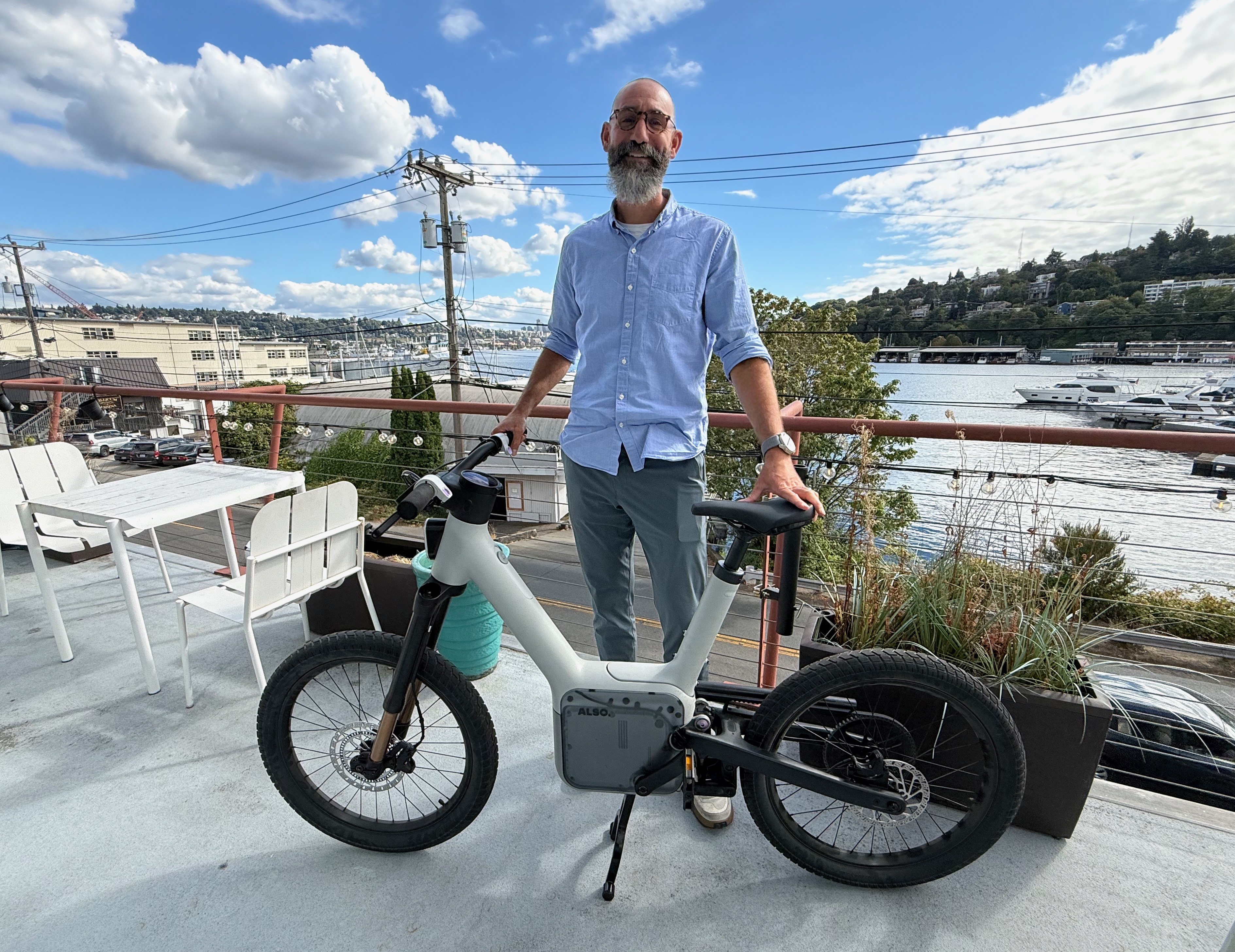
Ben Steele, chief commercial officer for Also, poses with the company’s TM-B e-bike on the deck of Also’s new offices in Seattle. (GeekWire Photo / Kurt Schlosser)
Also, a fast-growing electric micromobility startup born out of Rivian in Silicon Valley, has quietly pulled into Seattle and planted a flag at the epicenter of the city’s bike culture with an office on the north end of Lake Union.
The 17,459-square-foot space at 1300 N. Northlake Way — which previously housed military-grade autonomous vehicle startup Overland AI — is situated directly along the Burke-Gilman Trail at the busy intersection of the Fremont and Wallingford neighborhoods. The headquarters for Brooks Running and the flagship store for outdoor retailer Evo are right across the street.
Ben Steele, Also’s chief commercial officer, is heading up the office. A nine-year veteran of REI, he was attracted to Also’s mission-based vision for the future of micromobility. He’s been tasked with building out the startup’s business operations, marketing, and customer functions from scratch.
First he had to find a dynamic office space. He called the location the hottest spot in the No. 1 bike commuting city in America.
“If you do the heat map in Strava for bike commuting, that is the white-hot spot,” Steele told GeekWire during a tour of the office. “When we said where do we want to be, we want to be where our customers are, where they’re working, where they’re living, where they’re shopping. And we want to be where bike commuters are. And this is that hot spot.”
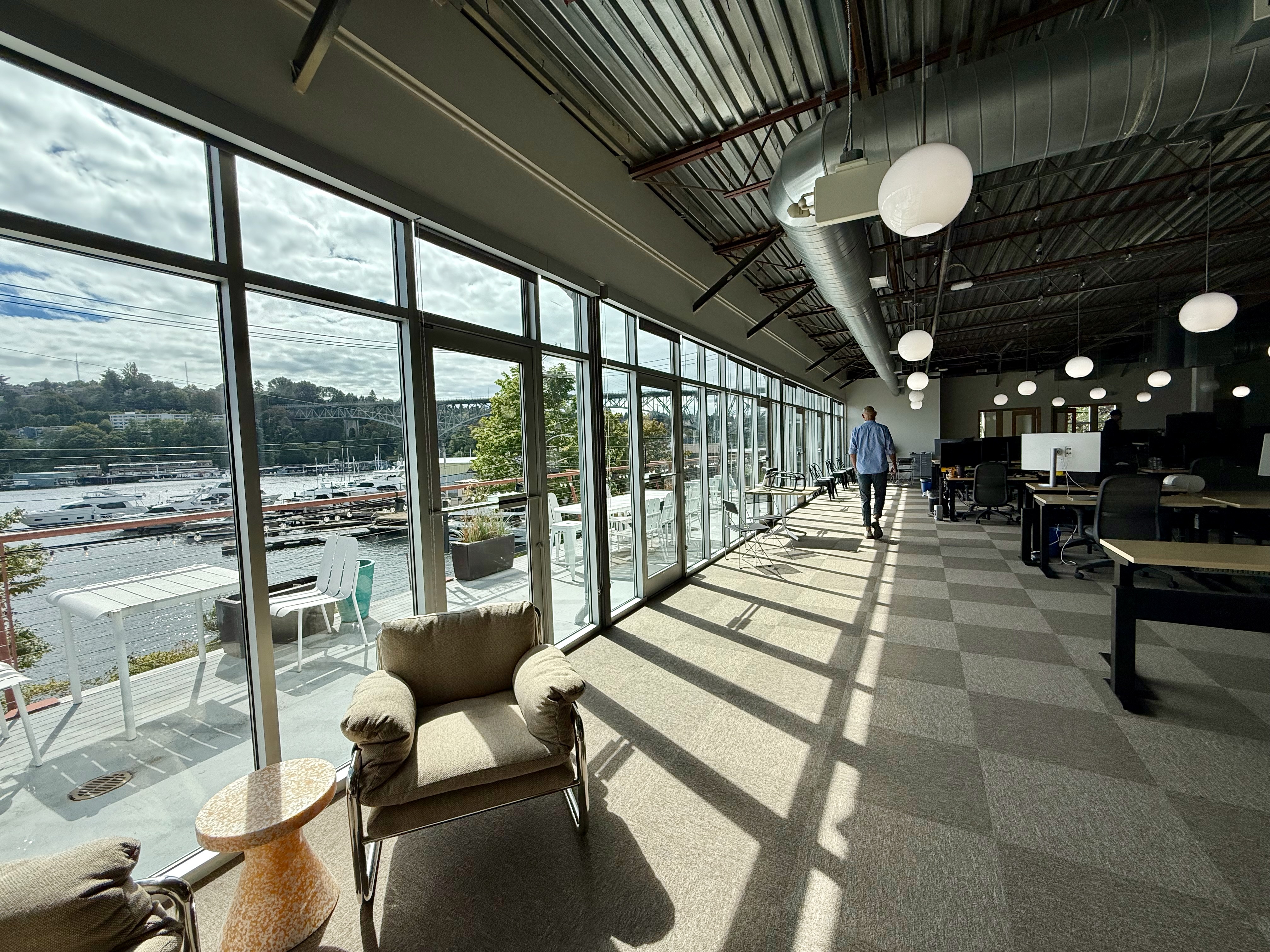
Also’s North Lake Union office space is home to 38 employees so far. (GeekWire Photo / Kurt Schlosser)
Founded inside electric vehicle maker Rivian more than three years ago as a special projects group, Palo Alto, Calif.-based Also officially spun out as an independent company in March 2025. The startup is focused on developing software-defined micromobility solutions designed to replace car trips and last-mile commercial delivery, backed by partnerships with Amazon and DoorDash.
Also was co-founded by Rivian founder and CEO RJ Scaringe alongside Chris Yu, Rivian’s former vice president of future programs, who serves as Also’s president. The startup has already commanded major investor backing, achieving a $1 billion unicorn valuation following its spinout to fund vehicle development and scale its commercial operations.
The Seattle space officially opened in April and is currently home to 38 employees, with capacity to grow to around 60 on a second floor featuring sweeping views of Lake Union and the downtown skyline.
Also employs roughly 350 people globally across Palo Alto, Seattle, and a new commercial team in Ghent, Belgium. The hybrid Seattle office requires employees in three days a week — though Steele notes cross-functional visits regularly push daily headcount past 50. The company has drawn talent from Seattle-area giants like REI, Brooks, Rad Power Bikes, Sonos, and Amazon.
Steele pointed to the city’s unique intersection of cycling culture, software technology, and deep consumer retail roots as the primary draw for building a major presence outside Silicon Valley.
“If you think about retail and commercial talent, innovative companies like Nordstrom and Amazon and Starbucks and yes, REI, the talent pool that we have to draw from for this part of the business, this is really the sweet spot to do it,” Steele said.
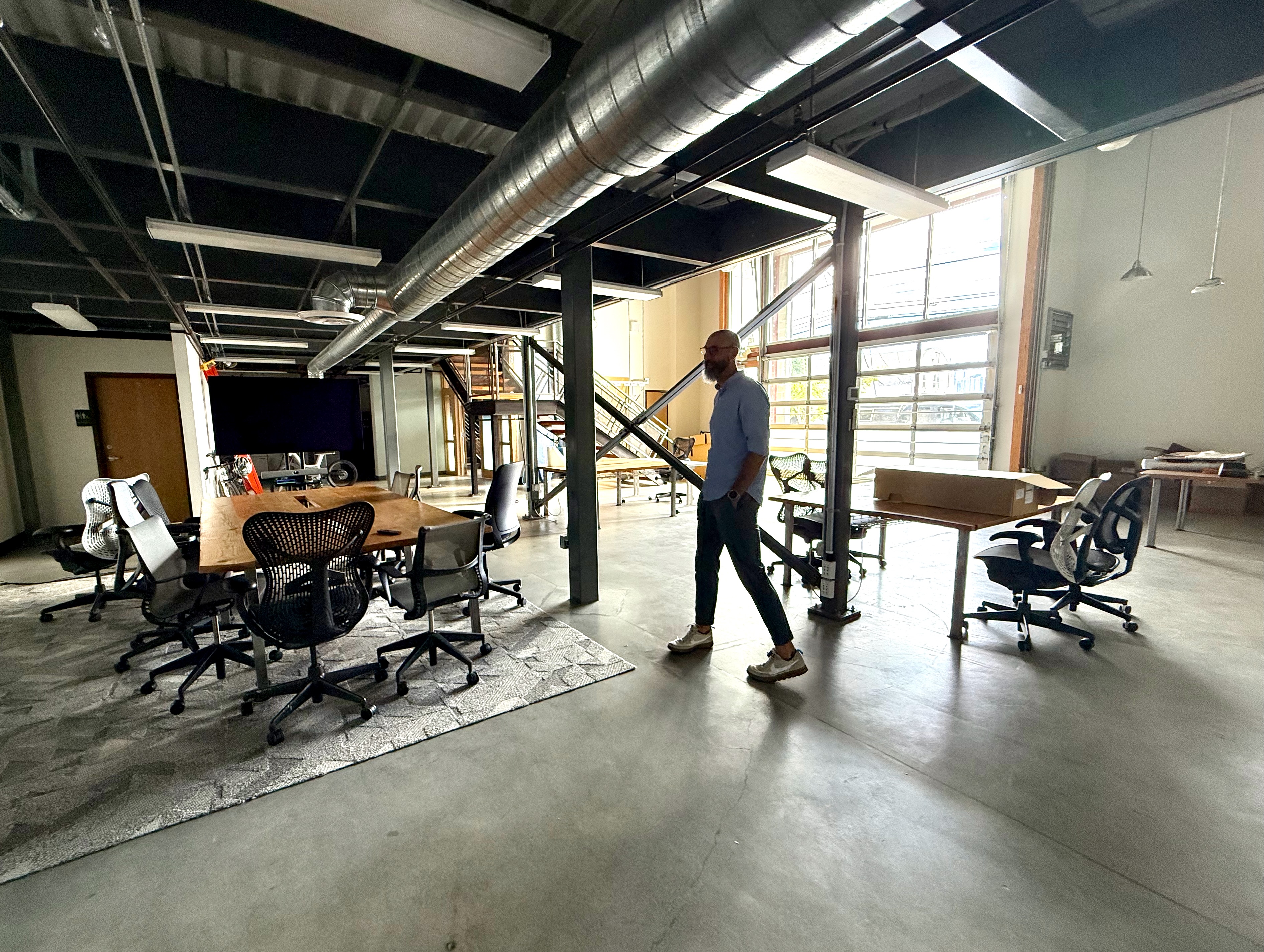
Also’s Ben Steel inside the ground-floor space that will become Also’s first retail store. (GeekWire Photo / Kurt Schlosser)
On the ground floor of the building, Also plans to build out its very first dedicated retail store and customer service bay, complete with space for a co-working or food and beverage partner. Steele called the layout a deliberate move to keep the commercial team grounded in real-world rider interactions.
“The theory is, we want our team really living that experience with our customers,” Steele said. “To have our retail and our office together really means we’re not theorizing about what does that experience look like with our customers. We’re living it every day.”
In the meantime, local riders can try Also’s flagship e-bike, the TM-B, across the street through a pop-up at Evo. Seattle is one of 10 initial U.S. markets where mobile sales teams are conducting test spins out of dedicated vans, coffee shops, and partner locations like Evo and Rivian spaces. Nationwide, the company has already surpassed 10,000 test rides for the high-tech bike, which starts at $3,500.
Beyond personal e-bikes, Also is setting its sights on transforming commercial delivery — a push anchored by a high-profile multi-year collaboration with Amazon, headquartered just across the lake in South Lake Union.
The partnership, announced last fall, centers on a customized pedal-assist e-cargo quad (the TM-Q) designed to navigate dense city centers and operate within dedicated bike lanes. Also plans to roll out prototype units with Amazon in two cities later this year before broader expansion in 2027.
“If you think about a city like Paris, where they’ve closed a lot of Paris down to cars, you can use a vehicle like that to get into the city,” Steele said, pointing out that the quad leverages automotive-grade technology to carry heavy delivery loads up steep hills without the high maintenance of traditional bike chains and derailleurs.
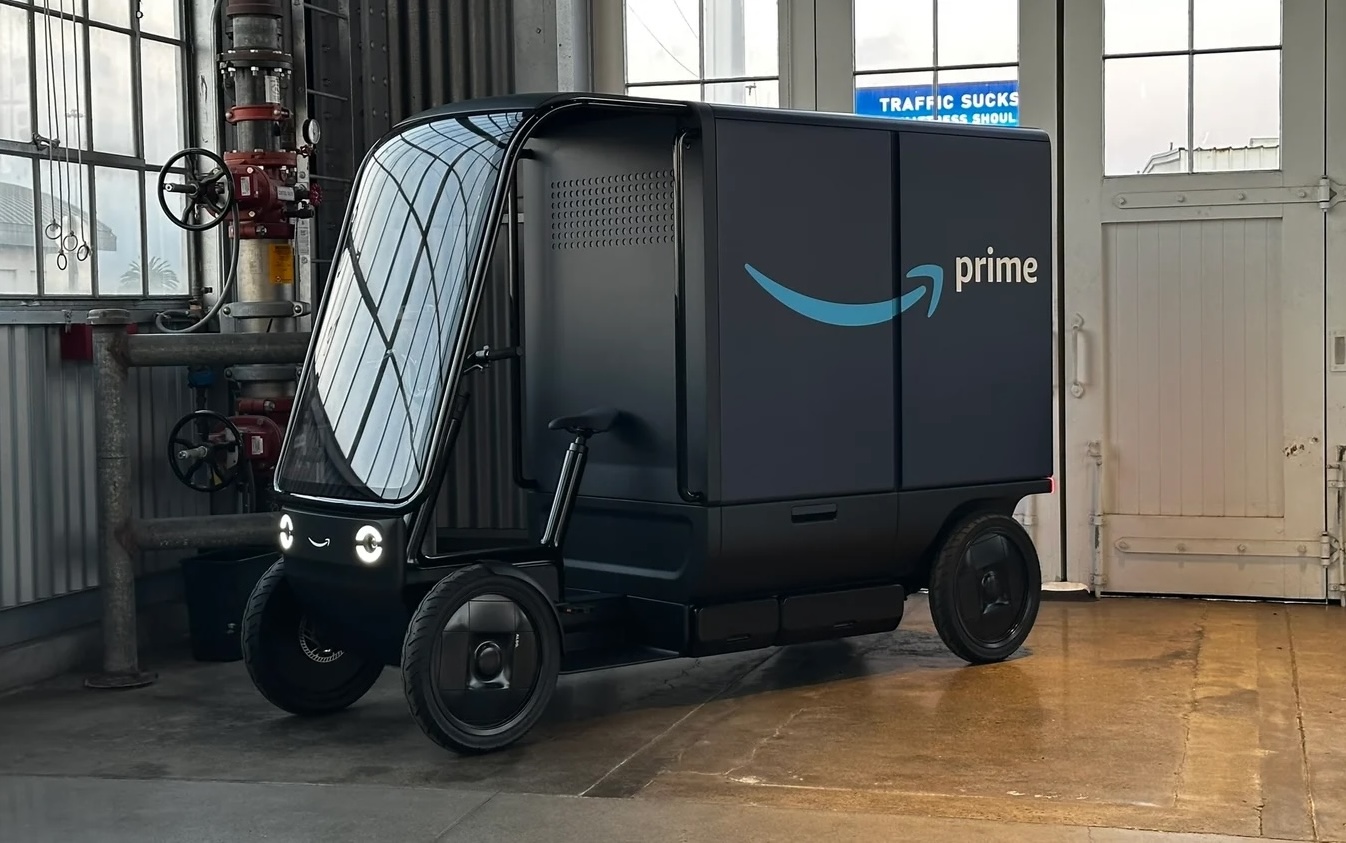
With the look of a mini Rivian electric delivery van, Also’s prototype for a customized Amazon Prime e-cargo quad (the TM-Q) is designed to navigate dense city centers. (Also Photo)
The company is also collaborating with DoorDash to test autonomous last-mile delivery using smaller form-factor vehicles capable of traveling up to 30 mph on streets, hopping curbs, and navigating sidewalks directly to a customer’s front door.
Also enters the market as Seattle’s e-bike landscape undergoes a major shift. The city was once ground zero for breakout success Rad Power Bikes, which helped pioneer consumer e-bikes before suffering a steep post-pandemic downturn that culminated in a Chapter 11 bankruptcy filing and an asset sale early this year.
Steele, who watched Rad’s trajectory from his time leading retail operations at REI, noted that Also is taking explicit notes from the broader e-bike industry’s past missteps. Rather than treating their machines like standard bicycles with added batteries, Also is focusing heavily on custom, automotive-grade hardware and software-defined integration — while staying intentionally lean on retail overhead.
“Building the best e-bike is not our mission,” Steele said. “Building the future of micromobility is our mission. And the first thing we’re building is the best e-bike.”
That philosophy directly shapes how Also plans to roll out its physical footprint. With customer orders now converting and initial Launch Edition bikes shipping over the coming weeks, Steele says the startup is taking an adaptable approach rather than rushing to sign leases on traditional retail store networks.
In addition to fixed hubs like the North Lake Union location, Also is launching a national “test spin tour” using mobile vans to bring 10 bikes and dedicated staff to 20 cities across six weeks.
“I don’t want to be beholden to a single model,” Steele said of the expansion plans. “The thing I wanted to not do is say let’s go build 10 stores and then see if that’s right. Long-term vision is to be really adaptable and really agile with how we do it, and to have what’s the right solution in each market versus a single model that we try to drop in everywhere.”
For Steele, bringing Also to Seattle isn’t just about opening an outpost or testing hardware — it’s about actively shaping the daily routine of local commuters along the lake.
“We want this to be a part of that vibrancy of the neighborhood, not just a place you go by,” Steele said.
That civic integration hits close to home for Steele, who lives near the University of Washington and instead of sitting in his car on Montlake, commutes down the Burke-Gilman Trail on an Also e-bike every morning.
“I arrive at work less stressed out on the Burke-Gilman Trail,” Steele said. “I’m living the product benefit every day. It’s pretty awesome.”
Marc Whitten, the new president and CEO of Dolby Laboratories. (Dolby Photo)
— Marc Whitten, a former Microsoft and Amazon executive, was named president and CEO of San Francisco-based Dolby Laboratories. He succeeds Kevin Yeaman, who is retiring after leading the entertainment technology company for nearly 20 years.
Whitten spent 17 years at Microsoft, rising to corporate vice president and chief product officer for Xbox. He went on to serve as chief product officer at Sonos before joining Amazon as vice president of entertainment devices and services, overseeing products including Alexa, Kindle and Fire TV.
He later served as president of Unity Create and CEO of Cruise. Most recently, he was vice president of robotics at Meta.
Dr. Lawrence Fong was named senior vice president and director of the Translational Science and Therapeutics Division, effective Dec. 1. He succeeds Dr. Geoff Hill, who is departing the organization in December.
Fong joined Fred Hutch in 2024 as scientific director of the Immunotherapy Integrated Research Center and Bezos Family Distinguished Scholar in Immunotherapy. He previously founded the Cancer Immunotherapy Program at the University of California, San Francisco.
Dr. Andrew Hsieh. (Fred Hutch Photo)
Dr. Andrew Hsieh, the associate director of the Fred Hutch Human Biology Division, was named the inaugural Larry and Virginia Gordon Endowed Chair in Prostate and Bladder Cancer Research. Hsieh is a physician-scientist at Fred Hutch specializing in genitourinary cancers.
— Two recent notable Microsoft AI-related exits:
Andréa Mallardis leaving her role as chief marketing officer of Microsoft AI after joining from Pinterest in January, according to Business Insider. She will stay on as an advisor until early next year. Mallard, who is based in the San Francisco Bay Area, previously served as global chief marketing officer at Pinterest for eight years.
Ece Kamar departed Microsoft Research after 16 years with the company. She was corporate vice president and managing director of the AI Frontiers Lab, where she worked on small language models and the company’s agentic AI stack. She has not announced her next role.
Poppy MacDonald. (File Photo)
— Poppy MacDonald was named president of NationSwell, a social impact membership organization. MacDonald previously served as president of USAFacts, the nonpartisan civic data initiative founded by former Microsoft CEO Steve Ballmer, for seven years. A past recipient of an Uncommon Thinkers award from GeekWire and Greater Seattle Partners, she is also the former president and COO of POLITICO.
— Jeff Buhrman joined Seattle startup Tin Canas head of finance. The company is building a screen-free, WiFi-enabled phone designed to let kids connect with friends and family. Buhrman previously served as CFO of Seattle-based Sleep Doctor for more than four years.
— Susan Loosmore was confirmed to the Major League Baseball Stadium Public Facilities District board, which oversees T-Mobile Park. The King County Council approved the appointment Aug. 25. Loosmore spent more than 17 years in executive leadership at T-Mobile and previously served as chair of the Seattle Metropolitan Chamber of Commerce.
Musierowicz, who is based in Atlanta, previously served as chief revenue officer at SmartBear and Keyfactor. Earlier, he led global channels and alliances at Atlassian through its IPO.
Packham, who is based in Salt Lake City, Utah, joins from Dragos, where he was CMO. He previously served as executive vice president of marketing at DigiCert.
— Vancouver, B.C.-based Integrated Quantum Technologies, an enterprise AI infrastructure company, appointedHusam Fezzani as CEO. He succeeds Alan Guibord, who moved to chairman. Fezzani spent nearly 30 years at HSBC, where he held senior technology and engineering leadership roles including global engineering head for the bank’s Commercial Technology Division.
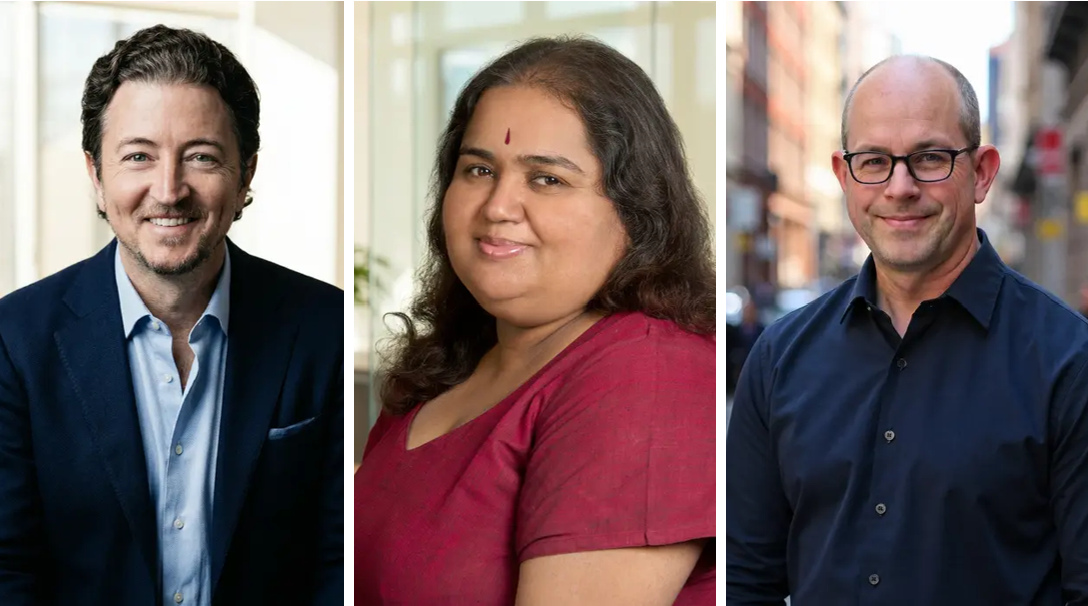
L-R: OnTrade co-founders Zachary Harl, chief investment officer; Raji Subramanian, CEO; and Matt Williams, president. (OnTrade Photos)
The co-founders of Pro.com, the Seattle-based home-improvement marketplace acquired by Opendoor in 2021, are back with a new company targeting what seems on the surface a very different kind of market: AI-powered software for the wealth management industry.
But Rajalakshmi “Raji” Subramanian and Matt Williams say the new challenge matches the same pattern: a huge industry held back not by a lack of customers, but by a shortage of professionals and tools.
Their Seattle startup, OnTrade, co-founded with former Bank of America chief investment officer Zachary Harl, has been operating under the radar since 2024, raising an undisclosed amount of funding from General Catalyst, Madrona and angel investors.
OnTrade’s chief technology officer is Jean Bredeche, who co-founded Quantopian, the algorithmic trading platform, and later served as a director of engineering at Robinhood.
How it works: OnTrade connects software that financial advisors already use — including CRM, portfolio accounting, trading, and compliance programs — into a single interface.
It then deploys AI agents to handle the type of work that advisors have traditionally done manually, such as scanning portfolios for tax-loss harvesting opportunities, flagging accounts that have drifted from their targets, or drafting proposals and reports for clients.
The humans approve everything before it reaches a client. The idea is to help them serve more clients without sacrificing the quality of their work, expanding access to wealth-management services that tend to be concentrated among more affluent households.
“Wealth management, if you look at the industry, does not have a demand problem; it has an access problem,” said Subramanian, the company’s CEO, in an interview. “Many people who’d like access to wealth management don’t have access to wealth management, and that’s what we’re here to solve.”
Harl, OnTrade’s chief investment officer, called raw foundation models the “brilliant PhDs” of the AI world — impressive on paper, but not as valuable to a specific industry such as wealth management until they understand its portfolios, policies, compliance rules, and client relationships. Vertical AI solutions like OnTrade, he said, are better positioned to connect that general-purpose intelligence to a specific firm’s data and workflows so the technology can do trusted work.
Industry shakeup: OnTrade is emerging at a pivotal moment, two days after investment giant Vanguard agreed to acquire wealth-management platform Altruist reportedly valued at $4 billion. OnTrade’s founders cite the deal as validation of the vertical AI opportunity they’re pursuing.
In a LinkedIn post Thursday, Subramanian wrote that the Vanguard-Altruist deal signals something bigger than a battle over where advisors park their clients’ assets: that capturing the opportunity “requires a new operating model rather than AI-enhanced versions of today’s applications.”
The wealth management industry’s unit of scale, she wrote, is shifting “from the number of people a firm employs to the intelligence and agency it can deploy.”
The founders: Subramanian joined Amazon in the late 1990s as an early engineer who helped build Amazon Marketplace and AWS, and later led the digitization of books for Kindle.
Amazon was where she met Williams, who had founded a startup called LiveBid that Amazon acquired in 1999. He spent 11 years there, including a stint as a technical advisor to Jeff Bezos, then left to run Digg as CEO and served as an entrepreneur in residence at Andreessen Horowitz.
Subramanian went on to run engineering at Yahoo Finance, where she helped open up market data that had previously been the province of institutional investors, giving her an early look at the problem that OnTrade is now aiming to solve.
In 2013, the two co-founded Pro.com, a tech-driven home improvement marketplace that raised early funding from investors including Madrona, Maveron, Bezos and Andreessen Horowitz.
Real estate tech company Opendoor acquired Pro.com in 2021, and brought both founders on as executives — Subramanian as chief technology officer, Williams as head of the Pro.com unit and senior vice president of retail.
Harl spent many years at Bank of America, rising to chief investment officer, where he managed the bank’s asset portfolios and large balance sheet risks across multiple market cycles. He is a chartered financial analyst (CFA), with a math and computer science degree from Indiana University, and a statistics degree from the London School of Economics.
He served on the U.S. Treasury Borrowing Advisory Committee under Secretaries Steven Mnuchin and Janet Yellen, advising on debt management, before joining Opendoor in 2023 as chief risk officer. That’s where he met Subramanian and Williams, before making the startup leap with them.
Traction and competition: The company’s technology is already in use at firms ranging in size from boutique advisories to large national practices, said Williams, the company’s president.
He said one client used the platform to win a billion-dollar family office account, and that another recouped the full annual cost of the platform in less than 30 days. He called that “a small window into what’s going to happen on a larger scale.”
The wealth management software market has many established players — such as Orion Advisor Solutions, Envestnet, and Addepar — but the OnTrade founders say they see them as partners, not rivals. OnTrade integrates with those systems rather than replacing them.
That distinguishes the company from Altruist, the Vanguard acquisition target, which built its own full stack, including its own custodian, the financial institution where client assets are held. That approach requires firms to move client assets onto its platform.
OnTrade doesn’t ask firms to replace their existing tools or move their clients’ money. Instead, it plugs into what’s already there.
The broader timing may work in their favor. As baby boomers age, an estimated $50 trillion or more in assets is expected to pass to younger generations in the coming decades — creating a wave of new clients who will need financial advisors, and new pressure on firms to serve them.
That’s where home improvement and wealth management have something in common.
“There aren’t many bigger places, other than health, wealth and real estate, where you can impact a population, especially an underserved population,” Williams said. “That was at the heart of the motivation.”
DuckDB creators Mark Raasveldt, left, and Hannes Mühleisen. (DuckLabs Photo)
Amazon has agreed to acquire DuckLabs, the company behind DuckDB, the fast-growing open-source database that has become a favorite of developers looking to analyze large amounts of data without the cost and setup of a cloud data warehouse.
Employees of DuckLabs will join Amazon Web Services, including co-founders and DuckDB creators Hannes Mühleisen and Mark Raasveldt, who will continue leading the team and setting the project’s technical direction. They will remain based in Amsterdam, where the team will continue developing DuckDB and related projects.
Amazon says it is not acquiring the DuckDB open-source project itself. DuckDB will remain free and open source under the MIT license, overseen by the nonprofit DuckDB Foundation, as will the related DuckLake and Quack projects, according to DuckLabs.
Financial terms were not disclosed. Amazon said it has signed a definitive agreement and expects the acquisition to close shortly. DuckLabs said it expects to become part of AWS in early September.
Larger shifts in cloud data
The deal fits Amazon’s broader push to turn S3, its flagship cloud storage service, into a place where customers analyze data rather than just store it. It gives Amazon a team experienced in building fast, lightweight analytics software that runs directly against data sitting in cloud storage.
The move comes as the data industry shifts toward keeping information in open formats in cloud storage, where it can be queried directly rather than loaded into a separate warehouse.
The shift puts pressure on companies like Snowflake and Databricks, which sell the compute and governance layer on top of stored data. Both are major AWS partners as well as competitors, with large numbers of customers running on Amazon’s cloud.
AI has raised the stakes, driving up both the volume of data companies keep in the cloud and the cost of analyzing it. Amazon says DuckDB is a natural fit for AI agents, which query data much the way people do, poking and experimenting with small sets before deciding what they want.
DuckLabs said it has worked closely with AWS in recent years, including on DuckDB support for Amazon’s S3 Tables and SageMaker Lakehouse.
“DuckDB is an incredible open source project with an amazing community; it is broadly used and very much loved by S3 customers today,” said Andy Warfield, an AWS vice president and distinguished engineer, in a press release announcing the deal.
‘That’s Amazon’s playbook’
One of the companies watching closely is in Seattle. MotherDuck, which sells a cloud service built on DuckDB, was founded in partnership with the DuckLabs team and has worked with it closely for four years. Three of its engineers are among the top 10 outside contributors to the DuckDB project.
MotherDuck CEO Jordan Tigani. (LinkedIn Photo)
In a blog post Wednesday, MotherDuck CEO Jordan Tigani said Amazon is following a familiar pattern. “That’s Amazon’s playbook, after all: wait until an open source project gets big enough, then launch it as a service,” wrote Tigani, who helped start Google’s BigQuery and spent a decade there before co-founding MotherDuck in 2022.
He expects Amazon to do exactly that with DuckDB: “After all, they’re not acquiring Duck Labs just because they love open source,” he wrote. “We welcome the competition.”
He said the deal is likely to be good for DuckDB, because Amazon has a financial reason to keep the project open and healthy. “If DuckDB becomes the standard, it is going to drive a lot more compute on their infrastructure, which is where they make their money,” he wrote.
Tigani said DuckLabs is being kept as a wholly owned subsidiary with its organization intact, and that the DuckDB Foundation has “iron clad control over the DuckDB IP.”
MotherDuck also said it is now offering enterprise support for DuckDB — which it had previously steered clear of to avoid competing with DuckLabs. Tigani said the company has Mühleisen and Raasveldt’s “explicit blessing” to take it on now that they are joining Amazon.
Five years, no venture capital
DuckLabs was founded a little more than five years ago as a long-term home for the DuckDB development team. The company turned down venture capital, stayed owned by its founders and employees, and grew to more than 30 people in Amsterdam, funding itself through support and feature-development contracts.
In a blog post, Mühleisen and Raasveldt wrote that they had come to worry DuckDB’s growth would outpace their ability to support it, and that their small company “could become a bottleneck for the project.” Building a larger sales and operations organization, they wrote, would have pulled the team away from the technical work that made DuckDB successful.
Nine days before the acquisition was announced, Mühleisen and Raasveldt published a preview of DuckDB 2.0, due this fall, declaring that the release “kicks off the year of DuckDB as a server.” It adds Quack, which lets one DuckDB instance serve data to others over a network, along with work aimed at speeding up queries against data held in object storage such as S3.
DuckLabs said the DuckDB Foundation will add a technical advisory board, giving leading community members input on the project’s technical direction. The company also plans to let DuckDB run extensions signed by outside developers and organizations.
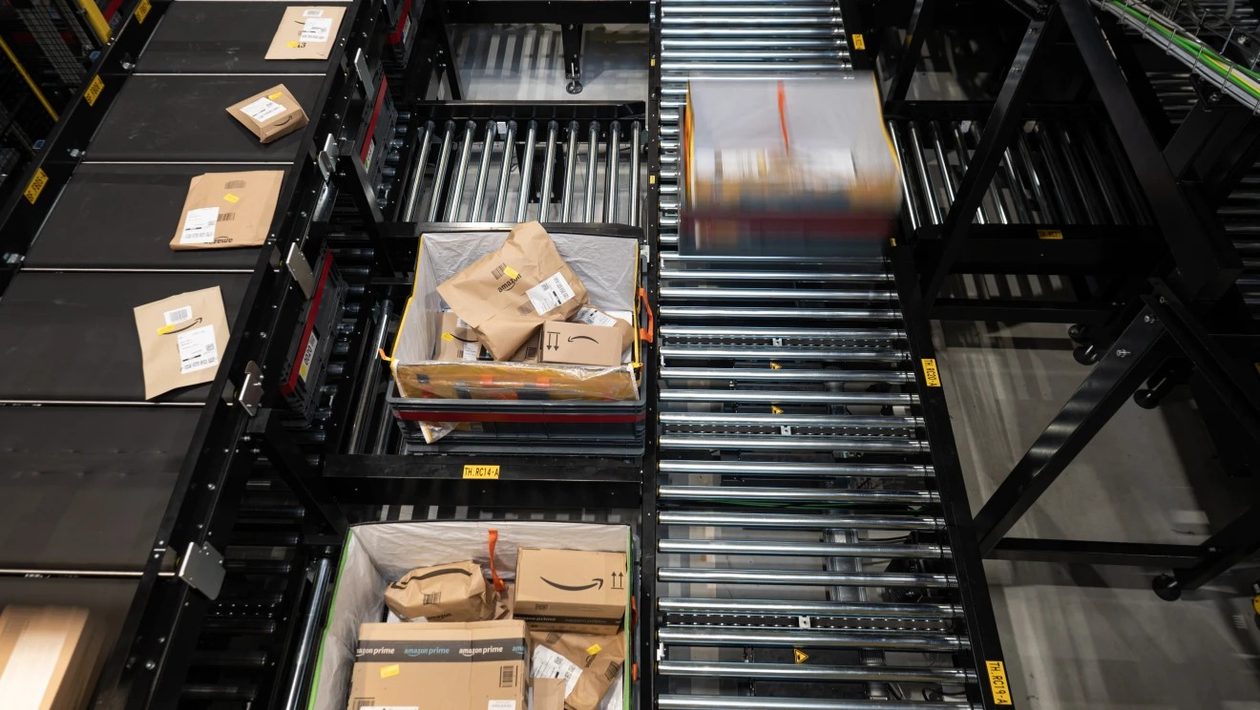
Amazon’s ZancaSort system brings packages to workers automatically at its Last Mile Innovation Center in Dortmund, Germany. A separate initiative, Project Tetromino, reportedly aims to bring full automation to delivery stations. (Amazon Photo)
Visiting an Amazon delivery station can feel like walking into the past.
While many of its massive fulfillment centers are equipped with the latest robots and automation, Amazon’s delivery stations — the final stop before packages reach the doorstep — remain mostly manual. Workers often sort parcels by hand, load them into bags, and stage them for drivers.
That could be changing. Business Insider reports that Amazon is developing an internal initiative called Project Tetromino to build “fully automated” delivery stations, citing an internal planning document that includes specific financial projections.
The name appears to be a nod to Tetris, reflecting the puzzle-like challenge of efficiently organizing packages for delivery vehicles.
“We’re always exploring and testing new technologies across our operations to improve safety and the delivery experience for customers,” Amazon spokesperson Brad Glasser said in a statement. He added, “The details cited here are inaccurate and don’t reflect our current plans. Like any early-stage concept, this is one of many initiatives we regularly evaluate, and plans evolve significantly as we learn.”
Business Insider reported that a key technology behind the effort could come from Boxbot, an Alameda, Calif.-based robotics startup that uses conveyors and AI-driven storage trays to automatically sequence packages for vehicle loading. The company says the process is up to 10 times faster than manual methods.
Responding to an inquiry from GeekWire, Boxbot CEO Austin Oehlerking said he could not comment on activities with any specific customer but said the company has “tested and deployed live systems within the parcel delivery, logistics, and automotive industries over the last several years.”
Oehlerking described Boxbot’s technology as filling a gap in warehouse automation. Automated storage and retrieval systems are typically designed for fulfillment operations, while Boxbot is building them for high-throughput package handling at other points in the supply chain.
“This type of storage system can be very useful at different points in the supply chain, depending on the customer,” he added.
Amazon said its delivery station initiatives are “designed to complement and empower our workforce.” The company has been ramping up automation across its operations, with more than a million robots now deployed in its fulfillment network and plans to more than double its fleet of robotic arms this year, citing goals to improve safety, ergonomics and efficiency.
The company has also opened a Last Mile Innovation Center inGermany, where it has been testing delivery station technologies including automated unloading, sorting, and scanning systems.
— Mehul Shah joined Oracle as group vice president for OCI data and storage services, ending a 14-year run at Amazon and Amazon Web Services.
In his last role at AWS, Shah led engineering and product for Amazon RDS for SQL Server, Oracle and Db2, and ran the launch and expansion of Oracle Database@AWS, the partnership that put Oracle’s database inside Amazon’s cloud.
“Through that collaboration, I saw firsthand that OCI shares the same DNA that inspired me to join Amazon back in 2012,” Shah said on LinkedIn, citing “deep curiosity, a passion to innovate, the courage to make bold decisions, and relentless drive to excel.”
Shah, who is based in Seattle, spent more than eight years at AWS, earlier leading real-time data streaming services including Amazon Data Firehose and Kinesis Data Streams, and serving as director and general manager of Amazon EMR. He started at Oracle this month.
Dr. Natalie Pageler. (Seattle Children’s Photo)
— Seattle Children’snamedDr. Natalie Pageler senior vice president and chief information officer, putting her in charge of digital strategy and IT operations for the pediatric hospital system.
Pageler comes from Stanford Children’s Health and the Stanford University School of Medicine, where she was division chief of clinical informatics and earlier spent a decade as chief medical information officer. She is a pediatrician and clinical informaticist with more than 20 years of experience.
Seattle Children’s CEO Dr. Christopher Longhurst followed a similar path. He was chief medical information officer at Stanford Children’s Health, the same role Pageler held, before spending a decade at UC San Diego Health, most recently as chief clinical and innovation officer.
Cassandra “Sandi” Knight. (Zillow Photo)
— Zillow Group named Cassandra “Sandi” Knight its first-ever chief legal and policy officer, a role the Seattle company created this month as part of a broader leadership shuffle. Reporting to CEO Jeremy Wacksman, she oversees Zillow’s legal, compliance and government relations functions.
Knight joins from Google, where she spent four years as a vice president leading global civil litigation and discovery. She was previously vice president and chief litigation counsel at PayPal, and spent 11 years at Morgan Stanley in senior litigation and compliance roles.
She began her career as a trial lawyer at the San Diego Public Defender’s Office, the firm Keker & Van Nest and the San Francisco City Attorney’s office. She holds a law degree from Stanford and is based in the San Francisco Bay Area.
She arrives at a busy moment: Zillow and Redfin are set to go to trial Aug. 24 as defendants in an antitrust case brought by the FTC and five state attorneys general over the companies’ $100 million rental listings deal. Zillow has spent $26 million on the case so far this year.
Two longtime Zillow leaders are heading out:
Sara Bonert, vice president of industry engagement for Zillow Group and ShowingTime+, is leaving after nearly 20 years. One of Zillow’s earliest employees, she joined in the fall of 2006 as director of broker services, helped build Zillow’s first platform for taking in listing data, and signed the partner agreements that took the site from zero to a million listings in four months.
Jeff Tompkins, head of corporate real estate and operations, wrapped up almost five years with the company. Tompkins, who is based in Denver, ran Zillow’s workplace strategy across North America and beyond. He said he will share his next role soon.
Amir Pelleg. (Uber Freight Photo)
— Amir Pelleg, a veteran of companies including Amazon and Convoy, is the new chief product officer at Uber Freight. He is based in Seattle, working out of the shared Uber and Uber Freight office on Second Avenue.
At Amazon, Pelleg was principal product manager for Kindle Fire, launched the Dash Button and initiated Alexa’s smart home controls, then incubated and launched Amazon Shipping in India, the U.K. and the U.S. as a director and general manager in Amazon Transportation.
He was a vice president on Convoy’s executive team until the Seattle freight startup shut down in 2023, then spent two and a half years at dental tech company Dandy.
— Seattle’s Frazier Healthcare PartnersaddedWes Wheeler to its Growth Buyout team as an executive in residence, advising on diligence and on life science logistics and infrastructure.
Wheeler was most recently CEO of LabConnect, a central laboratory services company serving clinical trials, and before that president of UPS Healthcare, where he built a vertical of 10,000 employees across 35 countries. During Operation Warp Speed he was the primary industry interface to the U.S. government, overseeing distribution of more than 1.5 billion COVID-19 vaccine doses to over 100 countries.
Dr. Heather Cheng. (Fred Hutch Photo)
— Dr. Heather Cheng was announced as the inaugural recipient of the Marty Lazarus Weiden Family Endowed Chair at Fred Hutch Cancer Center, which will fund her work detecting, preventing and treating hereditary cancers.
Cheng is clinical director of cancer genetics programs at Fred Hutch and directs its prostate cancer genetics clinic. In 2016 she was part of a team that found more than 10% of men with advanced prostate cancer carry inherited mutations in DNA-repair genes such as BRCA1 and BRCA2.
The chair is named for Marty Lazarus Weiden, who was diagnosed with breast cancer in 1993 and died in 2001. The family learned only later that some of its members carry a BRCA mutation.
— Microsoft corporate vice president Darryl Willis was named to the board of ONE Nuclear Energy, a natural gas and advanced nuclear developer going public this quarter through a merger with Hennessy Capital Investment Corp.
Willis has led Microsoft’s energy and resources group since 2019. He was previously a Google Cloud vice president and a BP executive who ran the company’s Deepwater Horizon claims process and testified before Congress. He will officially join the board when the merger closes, and he is expected to chair its compensation committee.
Jake Milstein. (LinkedIn Photo)
— Jake Milstein was named head of healthcare solutions marketing at Zscaler, a return to healthcare cybersecurity. He joins from application security company Contrast Security and was earlier chief marketing and revenue officer at Critical Insight, the Bremerton, Wash.-based security firm acquired by Lumifi Cyber.
Before moving into technology, Milstein spent a decade at Seattle’s KIRO TV, including four years as news director.
— Michele Mehl left Amazon Web Services after nearly two and a half years to become senior public relations manager at ALSO, arriving the same week the electric vehicle company announced a $150 million Series D round led by Prysm Capital.
ALSO builds the TM-B consumer electric bike and the TM-Q commercial delivery quad, and counts Amazon and DoorDash among its commercial partners.
— Richard Van Bibber was named senior vice president of research and development at Verasonics, the Kirkland, Wash.-based maker of ultrasound research platforms used in fields including biomedical ultrasound, materials science and earth sciences.
Van Bibber has spent much of a 25-year medtech career in the Puget Sound region, including seven years as director of research at Kirkland’s Cardiac Dimensions and five years leading clinical affairs at Bellevue-based Aortica.
— Dave Cotter joined the board of Nickson, the apartment-furnishing startup led by Cameron Johnson, alongside MarcyPen Capital Partners and Larry Braithwaite. Cotter is CEO of Greenwood and has previously worked at Amazon, Nordstrom, zulily, RealNetworks and Leafly.
— PCC Community Markets president and CEO Krish Srinivasanwill retire effective Jan. 29, 2027. Srinivasan was chief financial officer at Remitly and vice president of finance at Lyft before joining the Seattle grocery co-op as CFO, and earlier held leadership roles at Amazon and Microsoft.
— Seattle FoundationnamedElizabeth Wong as chief philanthropy officer, reporting to President and CEO Alesha Washington. Wong spent more than a decade at Foundation Source and earlier worked directly with the Gates family at the Bill & Melinda Gates Foundation.
And in case you missed it:
— Jay Bartot, a co-founder of the airfare-prediction startup Farecast and former chief technology officer of Madrona Venture Labs, was named CTO of Lev, the Pioneer Square Labs spinout building an “AI co-founder” for entrepreneurs. Read more here.
— Expedia Group is parting ways with at least eight vice presidents and senior vice presidents, and promoted five other leaders, as it reorganizes its product and technology groups around AI. Read more in this GeekWire story.
GeekWire co-founder John Cook talks with Dan Clubbe of The Redmen TV about Jeff Bezos’ investment in Liverpool FC. (The Redmen TV Video)
What does Jeff Bezos’ new ownership stake in English Premier League powerhouse Liverpool FC mean for the storied soccer club?
I was invited by Dan Clubbe of the Liverpool fan site The Redmen TV to talk about the Amazon founder’s recent investment, Bezos’ first real foray into sports ownership.
Across the 45-minute discussion, I shared thoughts about Bezos’ transformation from the nerdy, khaki-wearing entrepreneur of his early career to the higher-profile “Buff Bezos” of the past decade.
On the surface, it appears as if Bezos will, for now, take an arm’s-length approach to Liverpool. He’s investing through a consortium, 1892 Holdings, that owns about a 38% interest in the team and an option to buy it outright.
One point I made: Bezos leads a very busy life. The sci-fi nerd’s true passion is his space company, Blue Origin, and he is also spending considerable time as the co-CEO at newly formed AI startup Prometheus. And with a new wife (Lauren Sanchez Bezos, who seems to be the true sports fan between them) there may not be enough hours in the day for the Miami resident to worry much about the inner workings at Anfield.
But Bezos does bring enormous capital and business acumen to the team.
To better understand what this might mean for Liverpool, I suggested Clubbe and his mighty team of reporters take a closer look at Amazon’s famous Leadership Principles.
Some of the most relevant Leadership Principles include “Ownership,” which asks leaders to think long term and not trade lasting value for a quick result; “Customer Obsession,” which means starting with what the customer wants and working backward; and “Insist on the Highest Standards,” setting the bar higher than most people think reasonable.
That said, the Amazon principle of “Frugality” doesn’t really play well these days on the world soccer stage.
We talked about the changing nature of global soccer, driven by big personalities and big money, and the balancing act it takes to build a soccer club while respecting the community of fans. I noted how this tightrope was a hard one for Bezos to walk in terms of his relationship to Amazon’s hometown of Seattle, something that might give Liverpool fans pause.
Watch highlights from the discussion above, and subscribe to The Redmen TV for our full discussion. Listen to a much shorter analysis on last week’s GeekWire podcast.
An Amazon Prime Air delivery drone flies over a suburban neighborhood in Arizona. (Amazon Photo)
Amazon’s drones are finally going national.
The company’s autonomous aerial vehicles are set to deliver packages to nearly 500 cities and towns across the country by the end of this year, zipping items through the air to drop them in backyards and driveways as quickly as 30 minutes after ordering.
Amazon announced the plan Wednesday, describing it as a sixfold increase in its Prime Air footprint, reaching communities collectively representing tens of millions of customers.
“I know this looks like science fiction — it’s not,” the Amazon founder said at the time.
Bezos acknowledged that it would take at least four or five years, optimistically, and that convincing the FAA the drones were safe would be one of the biggest hurdles. Amazon’s FAQ that night said it hoped the agency would have rules in place “as early as sometime in 2015.”
Both the technology and the regulations took far longer than the company expected.
Amazon said Wednesday morning that Prime Air will launch soon in the Chicago, Syracuse, Cleveland, Atlanta and Boise metro areas, with more communities to come later this year. The drones fly primarily over suburban areas, which allows them to avoid the tall buildings and crowded airspace that complicate flights over dense urban areas.
There’s no word yet on when or whether drone delivery will come to the Seattle area.
Amazon said the drones launch from two types of facilities: smaller same-day delivery sites and its larger robotic fulfillment centers. The mix is what lets Prime Air offer anywhere from tens of thousands to millions of items depending on the location, according to the company.
Nearly any item weighing 5 pounds or less and small enough to fit in a large shoebox is eligible for drone delivery. That translates into millions of products, as noted by Amazon CEO Andy Jassy in his annual letter to shareholders earlier this year. He wrote that Prime Air would carry “a much larger selection of items inside a half hour” than Amazon’s other fast-delivery options.
Drone delivery will be free for Prime members on orders of $50 or more. Prime orders below that carry a $2.99 fee, and customers without a membership pay $4.99.
Amazon’s reference to expanding to 500 cities and towns does not reflect the number of planned Amazon drone launch locations, but rather the number of municipalities that fall within delivery range of the planned hubs, each of which covers roughly 175 square miles.
The 30-minute delivery scenario is a best case. Most orders arrive around 60 minutes after checkout, Amazon said in its announcement.
Amazon isn’t the only company betting on drones. Amazon retail rival Walmart and Google parent Alphabet’s Wing have been building what they call the largest drone delivery network in the U.S., adding seven new markets in June including Phoenix, Philadelphia and the Bay Area. They plan to reach 270 stores and more than 40 million people by next year.
Local approvals remain a hurdle for delivery drones. Noise has been a recurring concern for residents near drone operations. Amazon says its drones are quieter than an idling delivery truck during drop-off and comparable to a window fan while in flight. A proposed federal rule that would more broadly allow flights beyond the pilot’s line of sight has not been finalized.
The Associated Press first reported on the expansion Tuesday afternoon in what appears to have been an inadvertent break of a news embargo, to which GeekWire had not agreed. Post updated Wednesday morning with details from the official announcement.
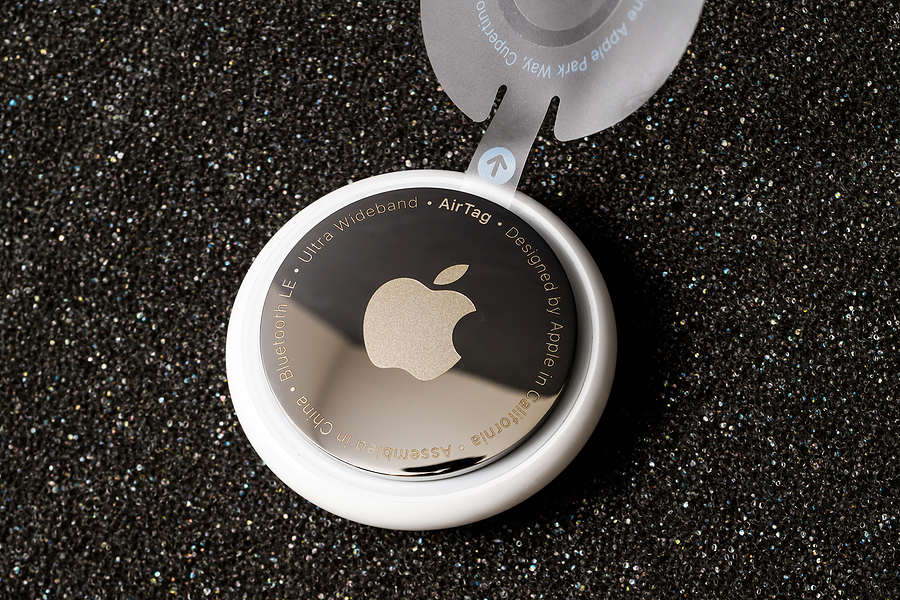
The reporting tool in question. (BigStock Photo / hadrian)
Amazon is reportedly cutting the spines off old books and scanning the pages at a Las Vegas facility, presumably to train AI models on text that exists almost nowhere else.
The company won’t confirm that’s the reason. It gave us the same statement it provided to 404 Media, which broke the story: it “purchases books through commercial channels to help develop and improve the products and services our customers use.”
But what really got my attention (and professional admiration) was 404 Media’s means of discovering this was happening at all: reporter Emanuel Maiberg put an Apple AirTag in a rare book and watched where it went, like a biologist tracking an endangered salmon.
Maiberg, a co-founder of 404 Media, has been digging into this topic for a while. He reported in July that booksellers were seeing a massive surge in bulk orders from buyers who didn’t haggle.
According to Maiberg’s latest story, a seller informed him that they’d received an order for about 1,000 books through the marketplace Biblio, and agreed to slip an AirTag supplied by 404 Media into one of them. 404 Media granted the seller anonymity because the seller was worried the disclosure would hurt their business.
The book flew out of a California airport to Milwaukee, sat for two weeks in a distribution warehouse outside Kenosha, Wis., then went west by truck, making an overnight stop in Grand Junction, Colo., before arriving at an Amazon warehouse in Las Vegas known as LAS8.
As Maiberg recounts in the story, he was initially confused. LAS8 is largely a print-on-demand operation. It prints and ships books as customers order them, the opposite of destroying them.
But the AirTag put the book at the north end of the building, which Amazon employees who posted on a workers’ forum described as a separate operation with its own code: VGT3. Its logo, painted at the entrance, is a T. rex with an open book in its hands. Employees described a split operation: some workers cut books, others received them and scanned bar codes.
Booksellers told Maiberg the bulk orders never included the very rarest books, the ones old enough to predate ISBNs, suggesting that buyers were working methodically through the serial numbers assigned to every published book.
A history of reportorial tracking
This technique of journalistic investigation has actually been around for a while.
The Basel Action Network, a Seattle nonprofit, started planting GPS trackers inside old printers and monitors in 2014, dropping them at Goodwill locations and recyclers around the country to find out where America’s electronic waste actually ends up.
Nearly a third of the tracked devices were exported. Two old TVs dropped at Oregon recyclers traveled to a warehouse in south Seattle, then to the Port of Seattle, and to junkyards in Hong Kong. BAN’s trackers led to federal conspiracy charges against Total Reclaim, the Seattle recycler that had been handling that Oregon e-waste.
Over the years, others have adopted the same tactics. ABC News put trackers in plastic bags dropped at Walmart and Target recycling bins in 10 states, and Finland’s public broadcaster hid them in used clothing to trace where donated fast fashion actually ends up.
What’s different now is the hardware. BAN worked with MIT and used cellular trackers that needed a data plan. Maiberg used a $29 AirTag that reports its position by pinging any nearby iPhone.
What’s going on at VGT3?
Sure, it’s possible that the slicing and scanning at Amazon’s VGT3 could be for something other than training AI models. Amazon has digitized books for two decades, for example, going back to Search Inside the Book. But that program runs on files publishers submit themselves. It doesn’t require buying used copies on the open market and cutting the spines off.
The circumstantial evidence pointing to AI is strong.
The books are rare titles with almost no resale market, but that’s exactly what makes them valuable as training data. The text was never digitized, and books printed before the AI boom are free of the machine-generated writing that degrades AI models trained on it.
The bookseller who sold the tracked shipment put it plainly to Maiberg: the books have historical and sentimental value, and the AI companies destroying them don’t care about that.
Cutting the spine is faster for scanning. It’s also the specific act that made Anthropic’s version of this legal: in June 2025, a federal judge ruled that buying print books, stripping the bindings and scanning them was fair use, because the digital copy replaced an original that no longer existed.
The same ruling went against Anthropic on books it had downloaded from pirate sites, which is the claim the company has since settled for $1.5 billion.
As someone who has covered Amazon for a while, I should note that this could be some “peculiar” project that actually looks nothing like anything people are speculating about, which will only become clear “in the fullness of time,” to use some of the favorite phrases inside a company known for being “willing to be misunderstood for long periods of time.”
But in the meantime, it’s pretty fascinating to see everyday technology being used in a creative way to uncover something that otherwise might have never come to light.
Amazon indicated for the first time this week that any video broadcast via its livestreaming platform Twitch could be used to train generative AI, unless users take steps to avoid it, which has caused a significant backlash from both audiences and content creators.
The story began with a post on the official Twitch Support account on X (formerly Twitter) which informed users of the existence of a new option on the Twitch dashboard. That option lets users opt out of Amazon using content on their channel to train generative AI.
That, in turn, served as a couple of additional implicit announcements: Amazon intends to use Twitch as a data farm, and this option is enabled by default for all Twitch accounts. You have to actively turn it off or anything you broadcast via Twitch could be fed into “generative AI content models at Amazon.”
According to Twitch’s FAQ, the data gathered from Twitch may be used to train a future model “whose purpose is to generate or synthesize text, audio, images, or video.”
(To opt out of Amazon’s training on your own Twitch channel, go to the Settings menu, look for the “Training for Generative AI” section under Security and Privacy, and turn it off. Don’t be surprised if this takes more than one try, as several users have taken to social media to report that the training option likes to turn itself back on when you aren’t looking.)
Above, bottom: if you have a Twitch account, then as of Aug. 12, it has an option under Security and Privacy to allow you to opt out of your broadcasts being used as training data for an Amazon LLM. (Twitch screenshot)
A follow-up stream from Twitch’s head of community, Mary Kish, poured some more gasoline on the flames. Kish aired a live interview on her personal Twitch channel with Mike Minton, chief product officer at Twitch, and Minton chose that moment to get uncommonly candid.
In response to viewers demanding to know why the AI settings on Twitch weren’t opt-in instead of opt-out, Minton said, “There’s an honest answer, and I think most of you can probably appreciate this. If it was opt-in, nobody would opt in.”
Kish and Minton made an additional point of drawing a distinction between AI-powered features that are already on Twitch, such as auto-captions, and the unspecified models that Amazon plans to use Twitch data to train.
“…I think our community has the reaction that I expected you guys to have, which is that you don’t like this,” Kish said. “Because this is industry standard, going other places [besides Twitch] won’t absolve you of this… it’s something that’s happening on livestreaming communities across the space.”
Twitch came out of the 2020 lockdowns in a period of massive growth, and for several years, accounted for roughly 80 to 90% of online livestreaming. Since then, however, its market share has steadily eroded. According to a July report by the Kyiv-based analytics firm StreamsCharts, YouTube Live and TikTok Live have both overtaken Twitch’s audience share, though Twitch does still handle nearly half of livestreamed video game content.
That, in turn, brings up some of its own issues.
“…It gets me really worried about all the elements I use in my streams,” Lance Icarus, a Seattle-based gaming broadcaster, told GeekWire via Discord. “I play indie games that are proud to not be GenAI. Can I stream that game knowing I’m feeding that playthrough into a machine?”
Icarus continued, “What about when I stream with guests? Some of them are voice talents who fought hard to gain rights against the very thing I’m asking them to do by streaming on our channel. I’m still trying to wrap my head around all the ramifications.”
Beyond the simple logistics, it’s hard to overstate the degree of hostility that Amazon and Twitch are facing over this move, from both broadcasters and audience members.
“They had to do it like this,” Seattle-based Twitch streamer Will Overgard told GeekWire. “Generative AI doesn’t make money, but selling data does. I guess they turned data collection on for everyone hoping enough people wouldn’t know to turn it off or forget about it so they’d have something to flog.”
Kish noted during her Aug. 12 stream that Twitch and Amazon are watching the numbers to see how many broadcasters actively opt out of being used as training data.
At time of writing, discussions are ongoing about what if any reaction this will draw from the creator community on Twitch, which still drives much of the platform’s business. One step that’s already been taken is that streamers have begun to tag their own broadcasts with “AIOptedOut” or “NoAI” to indicate their feelings on the matter. It’s now a question of whether audiences will follow suit.
Auger co-founders Leigh Anne Clark and Dave Clark at the company’s Bellevue, Wash., office. (GeekWire File Photo / Todd Bishop)
One of the Seattle region’s most notable tech startups is moving its headquarters to Texas.
Supply chain technology startup Auger will maintain a major engineering office in Bellevue, Wash., where it got started. But the company’s co-founder and CEO, Dave Clark, the former Amazon operations chief, is officially back in Dallas, and he took the company’s HQ with him.
Founded in 2024, Auger has raised $150 million, including a $50 million Series B round led by Eclipse in July. Its software connects the systems that companies use to run their supply chains, integrating AI to help automate them. Its customers include Meta, Fanatics and Kimberly-Clark.
Clark, in an interview with GeekWire, said the move is about talent and family, not taxes. For one thing, Texas happens to better suit him and Auger co-founder Leigh Anne Clark, his wife. They’re running toward something rather than away, he said. They both grew up in the Southeast, and they had always intended to return to Texas at some point.
“I’d rather have a really hot month of August than a really gray month of February,” he said.
Dallas is also a place where you run into supply chain specialists at the coffee shop like you do software engineers in Seattle, he said. That’s a key talent pool for Auger at this stage in its evolution. Another bonus: Texas is more central to corporate customers across the country.
The magazine D CEO in Dallas, which first reported the news of Auger’s HQ relocation this week, noted that the company did not seek state or local incentives as part of the move.
Clark confirmed in the GeekWire interview Tuesday that taxes weren’t a factor, noting that he couldn’t even quantify what the tax advantages would be. However, he said, “There’s a lot I like about the way the state of Texas manages and works with business.”
When asked what he would say to people in Seattle who might see another warning sign in a startup like Auger moving its HQ somewhere else, he didn’t shoot down the premise.
“If you’re in that position, I think you’re right to be worried, in the sense that there’s a lot of discussion about things in the state of Washington and Seattle that are not particularly friendly to business,” he said.
Clark didn’t point to any particular policy or issue but said he has sensed an “anti-business” sentiment that concerns him since moving back to the Seattle area from Texas to launch Auger.
“Seattle should just be careful,” he said. “It’s not preordained that they win these things. It’s not preordained that these big companies stay in town.”
The Pacific Northwest has enormous resources to compete globally, he added, and there’s no reason it shouldn’t be “a phenomenal draw to anybody and everybody coming in.”
The region has “many, many strengths, and we should leverage them to the advantage of the community,” he said. “And sometimes I think the rhetoric gets in the way of it.”
Auger has about 115 people in Bellevue — engineers and supply chain data scientists — and Clark said he expects that office to grow 20% to 30% over the next year or two. He and Leigh Anne will both be back there regularly, he said, working alongside the team.
“Nothing’s changing there,” he said.
The company’s new HQ in North Dallas occupies part of the 15th floor of One Galleria Tower, centrally located between neighborhoods north and south of the city, with a quick run to DFW International Airport, as Clark pointed out in the D CEO article.
The office currently has about 15 people, most hired in recent months for sales, go-to-market and supply chain roles. Many of them had been traveling to Bellevue until the new space opened. Clark expects to add another 20 to 30 people in Dallas by the middle of next year.
As in Bellevue, where Auger subleased its space from Microsoft and bought the furniture for $1, the Dallas office came furnished. This time the furniture cost $10. (There goes Texas’ reputation for affordability.)
“It cost me 10 times more for the furniture in Dallas,” Clark joked. “I like nice things, cheap.”
Clark spent 23 years at Amazon, rising to lead its global operations and later its worldwide consumer business, and was one of the chief architects of the logistics network behind the company’s delivery operation. He left in 2022 to become CEO of Flexport, departing the freight startup the following year, before starting Auger.
Leigh Anne Clark is Auger’s president of fashion and beauty, leading the company’s work in an industry known for waste-prone supply chains. The couple, who met in Kentucky in 2000 while Dave Clark was at Amazon, have two sons, ages 14 and 11.
With its rapid hiring and significant early funding rounds, Auger rose quickly to No. 31 on the GeekWire 200, our ranking of Pacific Northwest tech startups. Because the GeekWire 200 is limited to companies based in the region, the headquarters move puts Auger’s standing in jeopardy.
Informed of this predicament, Clark made his pitch to stay on. “We still have a lot of dev there,” he said of the Bellevue office. “I think you get grandfathered into the list in some way, right?”
Meanwhile, the business keeps growing. Clark said Auger signed two major contracts Tuesday with customers he declined to name. The Bellevue office marked them with a bell-ringing, and the two offices celebrated together over a video call. A second bell is on order for Dallas.
“We’ll have dual bells that we’ll ring together,” Clark said.
Chart from “Quantum Technology in Washington State.”
Washington state has assembled the country’s deepest bench of quantum technology assets — including two major cloud platforms, a national lab and the first U.S. quantum computer factory — but has captured almost none of the federal money now driving the industry.
That disconnect is the focus of a report released Tuesday morning by the Washington Technology Industry Association, the Northwest Quantum Nexus and the state Department of Commerce.
Since a January 2023 assessment, Washington state’s quantum ecosystem “has grown denser, more visible, and physically larger,” reads the report, authored by Nirav S. Desai, CEO of innovation consultancy Moonbeam Exchange. “Yet the state has fallen behind peers on the coordinated public investment that converts assets into a resilient cluster.”
The report makes five recommendations:
Use the governor’s office to convene a standing group — universities, the Pacific Northwest National Laboratory, companies, investors and the Commerce Department — that decides which federal grants to pursue and assembles joint bids for funding.
Pick one to three specialties to compete in, such as post-quantum cryptography or industry applications, rather than chasing all of quantum.
Build the workforce at all three levels: developers first, then the missing undergraduate and technician programs.
Position the Seattle region and Washington state as a landing pad for Japanese, Korean and Taiwanese quantum companies.
Create a single point of contact for founders, and promote the quantum machine access the state already has but hasn’t advertised.
“This isn’t a resource problem; it’s a coordination problem, and that’s the good news,” said Nick Ellingson, WTIA’s vice president of innovation and entrepreneurship, in a news release.
Quantum computers, which have yet to be proven commercially viable, can hold multiple states at once and could eventually solve problems beyond the reach of conventional machines.
The report points to efforts by states including Illinois, Maryland and Colorado, which have committed $500 million, roughly $200 million and $127 million respectively to quantum campuses and research hubs.
In Washington state, Microsoft and Amazon are among the major tech companies leveraging their research to build quantum platforms and technology. Maryland-based IonQ’s Bothell, Wash., plant, the country’s first dedicated quantum computer factory, employs about 100 people, part of an expansion the report says could generate 1,200 to 2,000 jobs within five years.
Gov. Bob Ferguson vetoed $100,000 for a state quantum strategy in May 2025, citing fiscal pressure, while directing the Commerce Department to build industry partnerships and produce policy recommendations. Tuesday’s report was funded by a grant administered by Commerce.
In April, Ferguson steered $500,000 from the state’s Strategic Reserve Fund to IonQ’s Bothell expansion, Washington’s first direct investment in quantum.
Illinois, by comparison, has committed more than $500 million to the Illinois Quantum and Microelectronics Park, a campus near Chicago anchored by PsiQuantum and IBM.

 Login
Login