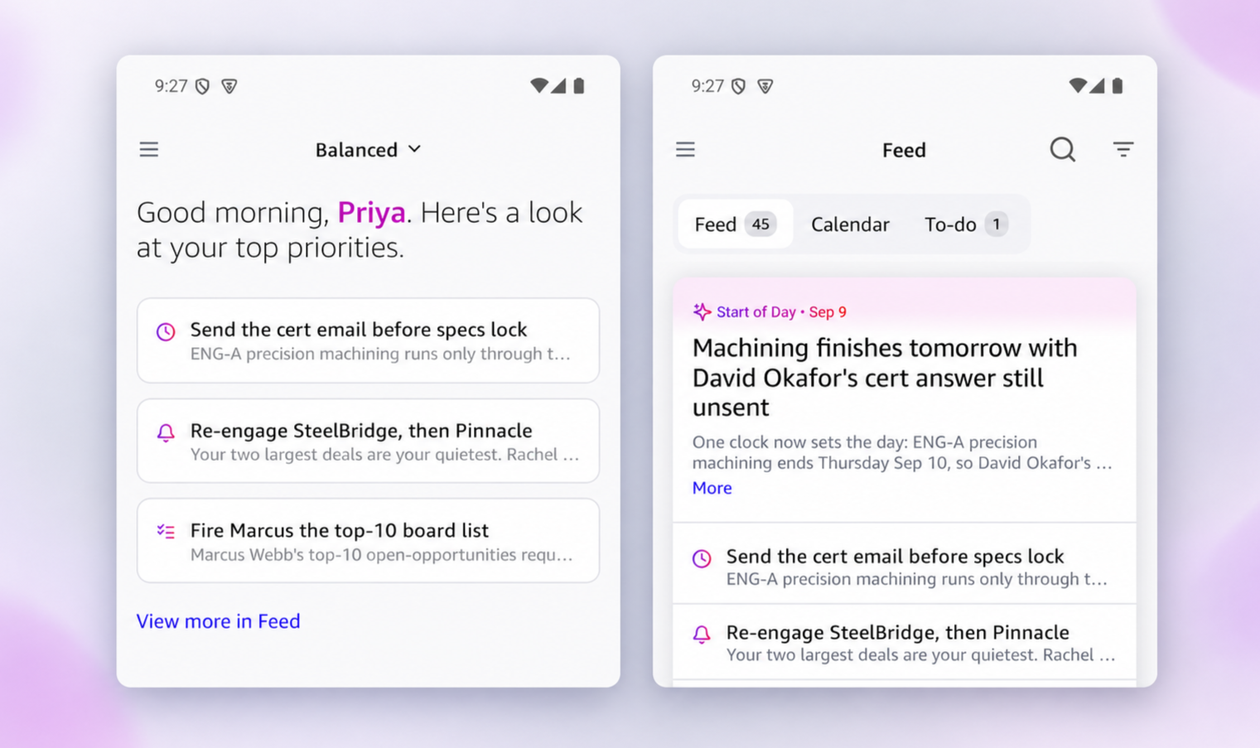
Amazon Quick’s new activity feed on mobile: the morning priority view, left, and the full feed. (Amazon Images)
Amazon is adding the Activity Feed and other features from its Quick desktop app to the AI assistant’s mobile apps for iOS and Android.
The Activity Feed is the signature feature of Amazon Quick. It combines email, Slack messages, calendar invites and CRM updates into one prioritized list, and lets people act on items (opening and responding to emails, for example) without switching apps.
Amazon said Wednesday that the Quick desktop app, released in preview in April, is now generally available on Windows and macOS. The company also said Quick’s agents now run in the cloud, so they keep working after a laptop is closed and deliver results to the feed.
The desktop and mobile apps now sync, as well, so a task started on a laptop can be picked up on a phone, for example.
Quick has a free tier, with paid individual plans starting at $20 per user per month billed annually, and business plans running $20 to $40 per user per month.
Quick is Amazon’s entry in a crowded market for AI assistants at work, competing with Microsoft Copilot, Google Gemini, OpenAI, Anthropic and others. Amazon’s announcements cited business customers for Quick including Southwest Airlines, LabCorp and the PGA Tour.
The desktop app came together fast, as part of a new effort inside Amazon to use small teams to move quickly: Swami Sivasubramanian, the AWS vice president of agentic AI, told GeekWire in June that a team of about six engineers started in late January and shipped April 28.
— Dave Levy, vice president of AWS Worldwide Public Sector, has left Amazon for a role at Google, according to Nextgov/FCW. An AWS spokesperson confirmed his departure; Google did not respond to a request for comment. Levy, who is based in Arlington, Va., was with AWS for more than nine years. He was previously head of U.S. government sales at Apple for 12 years.
Amazon first launched government-specific cloud infrastructure in 2011 and now supports more than 11,000 government agencies. In November, the company announced it would invest up to $50 billion to expand AI and advanced computing infrastructure for U.S. government agencies. That includes support for Top Secret, AWS Secret and AWS GovCloud (US), which serve classified and sensitive workloads.
David Appel, VP of AWS Global Government, National Security and Defense, has taken Levy’s role in an acting capacity, according to his LinkedIn account. Levy’s last day was July 31.
Kristin Hamilton. (LinkedIn Photo)
— Kristin Hamilton has been named chief commercial officer for Funko, the Everett, Wash.-based makers of pop culture collectibles. Hamilton joined from Crunchyroll, a division of Sony Pictures Entertainment. She was previously at Hasbro for nearly 15 years, leaving as the consumer products division’s head of strategy and transformation. Hamilton begins work Aug. 24.
Funko has weathered financial and leadership bumps in recent years, with a quick succession of CEOs and the accumulation of significant debt. The company this month reported a strong second quarter with increased sales over the previous year.
Laurent Reichert. (Coinme Photo)
— Seattle cryptocurrency company Coinme has named Laurent Reichertas chief compliance officer, consumer protection officer and Bank Secrecy Act officer. Reichert, who is based in Miami, was previously chief compliance and risk officer for the blockchain company Paxos.
In January, Coinme announced that it had agreed to be acquired by blockchain payments company Polygon Labs. Polygon said it would also acquire wallet provider Sequence as part of a combined deal valued at more than $250 million.
Reichert praised Coinme’s currency trading platform, adding that he looks forward to “the next phase of growth, both domestically and as we move into new international markets alongside Polygon.”
— DAT Freight & Analytics, a Beaverton, Ore.-based truckload freight marketplace, announced changes to its leadership team.
John Xiao has been promoted to chief technology officer, leading work on DAT’s tech platform, analytics and AI integration. He joined the company two years ago from Nordstrom, where he oversaw technology strategy in merchandising, supply chain and inventory management.
Marcus Womack, who joined DAT last year through the acquisition of his fintech startup Outgo, is now responsible for DAT’s carrier segment in addition to financial services.
Kary Jablonski, former CEO of Trucker Tools, which DAT acquired in 2024, continues to lead DAT’s broker business and is also responsible for marketing and customer support.
— Seattle’s Membrion has promoted Emily Rabe to vice president of technology. Rabe has been with the industrial wastewater treatment startup for six years, leading its intellectual property efforts and most strategic technology programs while also working with external technology partners.
“She has a remarkable ability to take on hard, ill-defined problems, learn quickly and put durable solutions in place,” the company said on LinkedIn.
The startup made two additional promotions: Ryan Flores has risen to senior scientist, and Michael Moreland has been promoted to senior customer success engineer.
Membrion spun out of the University of Washington a decade ago, has raised $40 million and is No. 154 on the GeekWire 200, a ranked index of the Pacific Northwest’s top startups.
— Microsoft’s Jordi Ribas has been appointed to the board of Sprinklr, a company helping global brands manage their customer experience, social media, ads and other marketing. Ribas has been with Microsoft for 26 years, currently as president of search and AI.
— Seattle biotech company Omeros has named Joseph Schocken to its board of directors. In 1987, Schocken founded the investment bank Broadmark Capital, now Tranceka Capital.
— Jay Carney, who served as Amazon’s senior vice president of global corporate affairs for seven years ending in 2022, has left his position as Airbnb‘s global head of policy and communications. He did not indicate his next role.
Microsoft and Amazon both saw their stocks surge again Monday, riding a post-earnings tech wave across the stock market that pushed Amazon past $3 trillion in value for the first time.
The gains follow earnings reports last week in which both companies’ cloud platforms exceeded expectations. Microsoft said Azure grew 43%, passing $100 billion in annual revenue for the first time. Amazon said AWS grew 37%, its fastest pace in 18 quarters.
Microsoft and Amazon are now the world’s fourth and fifth most valuable companies, respectively. The three ahead of them (Nvidia, Alphabet and Apple) are all headquartered in the Bay Area, although each has sizeable engineering centers in the Seattle region.
Amazon rose 4.6% in intraday trading to $284.15 as of publication time, after touching an all-time high of $287.20 earlier in the session, giving it a market value of $3.06 trillion.
Microsoft climbed 5.2% to $488.97, worth $3.63 trillion. Its rally began Thursday, when it added nearly $450 billion in market value, the largest one-day gain by any company on record.
The rallies came despite AI spending plans that have unsettled investors for much of the year. Microsoft went into earnings near a one-year low, after a $357 billion wipeout to start the year.
It’s all still coming at a huge cost. Microsoft spent a record $41 billion on capital projects last quarter and told investors to expect more than $50 billion in the current quarter. Amazon raised its 2026 forecast to about $220 billion from $200 billion, citing rising memory chip prices.
In one sign of the impact of the spending, Microsoft’s free cash flow fell 23% last quarter. Amazon’s free cash flow turned negative for the first time since 2023.
But cloud growth and other signs of demand for AI seem to have appeased investors for now.
Amazon CEO Andy Jassy told investors the spending reflects unmet demand: “Even at that amount, we will still not have enough capacity to meet all the demand we have in 2026, and I believe this dynamic will also be true in 2027 too. In fact, the demand we already have for 2028 is striking.”
This week on the GeekWire podcast: Microsoft and Amazon both reported quarterly numbers, and both stocks rose on cloud results that beat expectations. Is all that AI spending paying off? And in related news, Microsoft sees a rare annual headcount decline, hitting product R&D hardest.
Plus: Satya Nadella builds a Power BI dashboard out of an analyst’s research report, and touts it on the earnings call to make a bigger point. Jeff Bezos names Amazon’s chips business as the long-awaited fourth pillar. And AI House managing director Jacob Colker delivers a much-needed pep talk for Seattle tech, calling on the region to recognize and build on its strengths.

 Login
Login