This week on the GeekWire Podcast: A study commissioned by the City of Seattle says the city is not in decline but is in danger — finding that 10 companies, nine of them in tech, pay three-quarters of the payroll tax on large employers, and that the tax structure uniquely penalizes the hiring of senior, high-compensation workers.
The report says Seattle should be most concerned about AI but most active in cleantech, the one industry the city can actually shape, since it owns the electric utility and controls permitting, building codes and land use.
Meanwhile, the Seattle Times and Newsday sue Microsoft and OpenAI, accusing them of copying hundreds of thousands of articles to train their AI models, putting Microsoft’s hometown paper against a company that helps fund some of its journalism.
Which leads us to a new GeekWire Trivia Challenge about the Microsoft products that Apple later turned into categories. Stick around to the final segment to see if you can figure it out.
Upcoming Event
AI meets real estate
GeekWire, in partnership with Real Estate at Work, is recording the GeekWire Podcast live at 4 p.m. Wednesday, Sept. 16, with Toby Roberts, SVP of Engineering at Zillow. John Cook and Todd Bishop host with Real Residential broker Leka Devatha at Atmosphere Seattle. Grab a ticket.
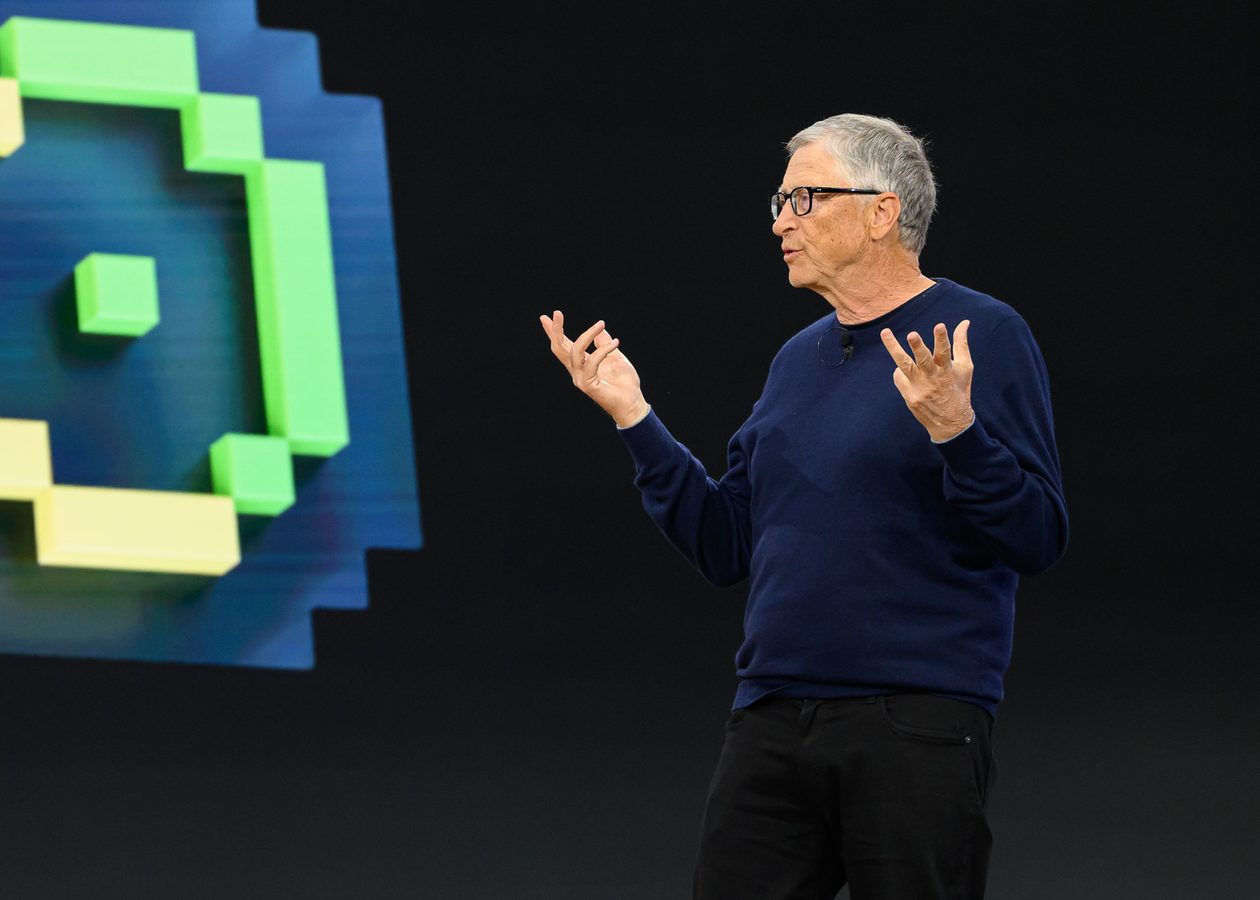
Frank X. Shaw addresses the media at Microsoft on May 18, 2025, in advance of the Build conference. (GeekWire Photo / Todd Bishop)
It’s the end of an era at Microsoft: Frank X. Shaw, the executive who oversaw the tech giant’s communications for nearly three decades, first at an external agency and for the last 17 years as one of its senior leaders, is leaving at the end of the year.
Shaw, 64, said he’s not retiring, although he doesn’t have another job lined up. He plans to stop working for a while, do some of the things he hasn’t had time for, and then decide what’s next.
“I have had a ringside seat at some of the biggest leadership, technology, and business transformations that have ever taken place,” Shaw said, sharing the news of his departure (under embargo) in a phone call Thursday afternoon. “I just feel incredibly fortunate.”
He said he had been discussing his potential departure for some time with Takeshi Numoto, Microsoft’s chief marketing officer, looking for the right moment.
Microsoft has not announced a successor for his role as chief communications officer. In a LinkedIn post, Shaw said the company will consider internal and external candidates.
A statement from Shaw’s colleagues in corporate communications credited him for his many years shaping Microsoft’s “voice and reputation with intelligence, candor and wit. His leadership and contributions to the company are too extensive to list, as is the number of journalists who have, at one point or another, used his name in vain.”
A former Marine Corps public affairs officer, Shaw has worked with all three of Microsoft’s CEOs. He started on the agency side, at Waggener Edstrom — now known as We. Communications — when Bill Gates was still running the company.
He built his reputation defending and advocating for Microsoft through some of its hardest stretches: the antitrust years, the Windows Vista backlash, the scramble to replace Steve Ballmer as CEO, and the weekend in 2023 when OpenAI’s board fired Sam Altman.
As the company’s top communications executive, he has also told the story of Microsoft’s reinvention under CEO Satya Nadella, from the LinkedIn and Activision Blizzard deals to an AI push that has carried Azure past $100 billion in annual revenue.
Evolving with technology: Shaw has spent much of his career closely watching the tech landscape and moving Microsoft’s voice into new channels as they emerged.
“We’re always thinking about what is the art and science of communications,” Shaw told PRWeek. “How do we reach our audiences most effectively in a changing environment?” He called the arc from print to radio and TV to social media and newsletters a “constant evolution of influence.”
He turned the corporate blog into a place where the company argued its own case, writing “Microsoft by the numbers” himself in 2010 — a stat-by-stat comparison against Apple and Google that TechCrunch dubbed “fantastic passive-aggressive.”
He and his team experimented with different and risky methods of telling the company’s story, holding mass briefings under embargo and publishing documents known as the “Book of News” in advance of its major keynotes and conferences. The prospect of a reporter having to answer to “fxs” was no doubt a factor in ensuring the news (mostly) didn’t leak.
Shaw hired Steve Clayton out of a technical role at Microsoft in London, where he had been blogging about the company unofficially out of frustration with how it was perceived, and made him chief storyteller. In the middle of the AI boom, Clayton and Shaw embraced the analog undercurrents in popular culture and launched Signal, a quarterly Microsoft print magazine for business leaders.
Clayton was VP of communications strategy by the time he left in January to become chief communications officer at Cisco, making Shaw’s planned departure the second high-profile exit from Microsoft’s comms team in a year.
Adapting to AI: In recent years, Shaw made his own team a testing ground for AI, publishing what worked and what didn’t. In a 2023 post he described using Copilot in Teams to pull story ideas out of conversations with spokespeople and anticipate coverage after interviews, and asking the AI to “poke holes in a statement we’re making on a tricky topic.”
He called it his corporal, a reference to Napoleon, who was said to bring one to meetings and ask whether his generals’ war plans made sense to him. A survey of 80 people in Microsoft’s communications and marketing organization found 84% did not want to go back to working without it.
Shaw was also known to use AI as a sounding board when a story frustrated him, offering him an objective take before he called and let a particular reporter have it.
He announced his departure Friday morning in a message to Microsoft’s communications team (reminding them he’s still there for a few months yet) and his public post on LinkedIn.
“Thank you as well to all the reporters, editors, writers, influencers and analysts who have put up with me over this time, enduring my early and late night calls, my off the record ‘no comments,’ my bad story ideas and my extended commentary on headlines and positioning,” he wrote.
“You all have incredibly hard and valuable jobs,” he added, “and while I’ve not agreed with everything said about us 😊 I appreciate you anyway.”
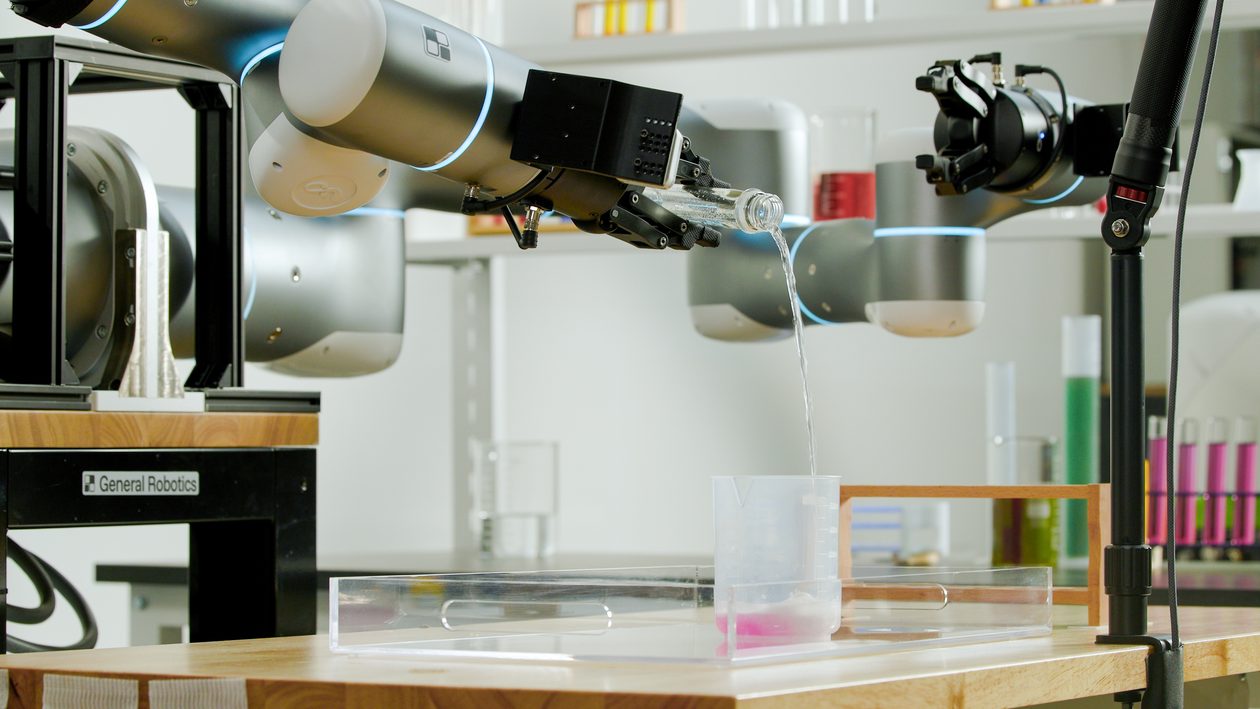
A robot arm pours from a test tube into a beaker in General Robotics’ lab. The company used the task, and progressively harder versions of it, to test its Auto Engineering system. (General Robotics Photo)
A Redmond, Wash., robotics software startup founded by former Microsoft researchers says its platform can now handle much of the work of getting a robot up and running in a factory, warehouse or other industrial setting, a job that used to take a team of engineers.
General Robotics said Wednesday that advances in GRID, its robot intelligence platform, have cut the process of onboarding a new robot from about a month to as little as two hours. The company calls the approach “Auto Engineering,” with each onboarded robot and diagnosed failure feeding back into the system and speeding up the next deployment.
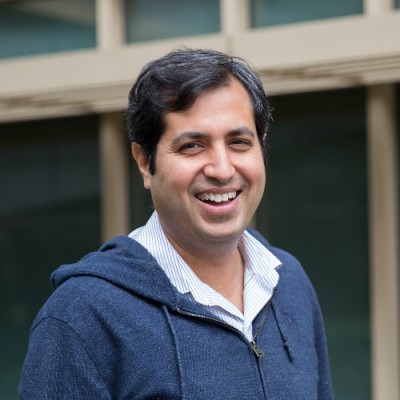
General Robotics CEO Ashish Kapoor.
“Before this moment, it would take us a team of experts to go and execute on behalf of our customers,” said General Robotics CEO and co-founder Ashish Kapoor in an interview. “Clearly non-scalable, clearly very expensive, and clearly will take a long time.”
With Auto Engineering, he said, “we can magnify and accelerate each engineer’s capability.”
Founded in 2023, the company has grown to about 50 employees, primarily engineers. It has raised nearly $34 million, most recently in an April round led by Construct Capital, with participation from Khosla Ventures, Accenture Ventures, Nvidia and Valo Ventures. PitchBook put the size of the round at $25 million; the companies didn’t disclose terms at the time.
Kapoor said General Robotics has roughly a dozen customers — large enterprises across manufacturing, logistics, energy and defense — and revenue in the millions of dollars.
Customers include HTX, the science and technology agency of Singapore’s Ministry of Home Affairs, which Kapoor said has been working with General Robotics for about a year and a half.
The company’s platform works with robot types including industrial arms, humanoids, quadrupeds, wheeled robots and drones, according to the company.
General Robotics is operating in a competitive and well-funded sector. Physical Intelligence, which builds foundation models for robots, has raised more than $2 billion. Nvidia — an investor in General Robotics, and the maker of the Isaac Sim simulation software built into GRID — is developing its own robot models and deployment tools.
Robot makers build good hardware, Kapoor said, but often lack the expertise to put it to work in a specific setting like a shipping terminal. “That last layer is missing.”
Before co-founding the company, Kapoor spent 17 years at Microsoft, ultimately as general manager of its autonomous systems and robotics research group in Redmond, where he created the open-source drone simulator AirSim. General Robotics co-founders Sai Vemprala (CTO) and Shuhang Chen came from the same Microsoft team.
GeekWire covered the launch in 2023, when it was Scaled Foundations and billed itself as “ChatGPT for robots.” It had five employees at the time, focused on aerial robotics and drones, with backing from Khosla and E14 Fund. It later renamed itself General Robotics.
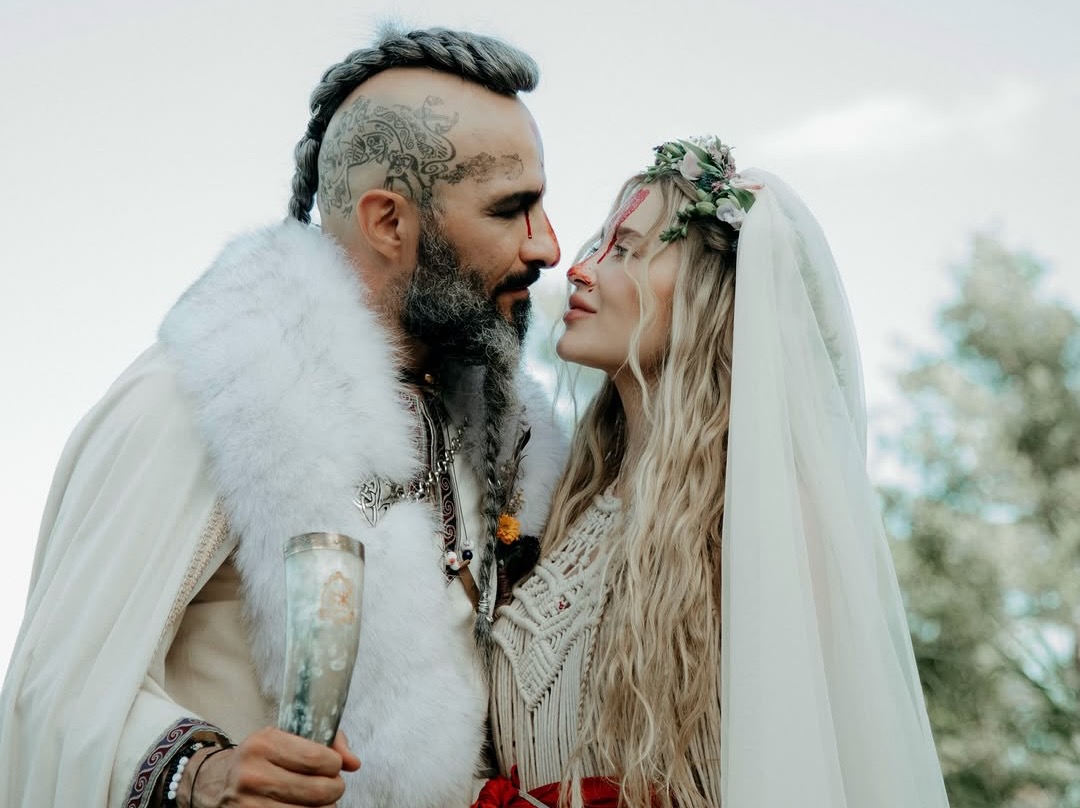
Hadi Partovi, left and Becca Oystila during their wedding in a recreated/historic Viking village in Sweden. (Tommy Agriodimas Photo)
Maybe Hadi Partovi could use his sword or hammer to slay AI slop.
The co-founder of CodeAI, the computer science education platform that rebranded from Code.org earlier this year, is sharing video and images from his summer wedding, and it’s “100% real, no AI,” he says in a LinkedIn post.
It’s a smart disclaimer to add on social media, because the Viking-themed wedding to Becca Oystila appears unbelievable enough to be considered AI-generated — especially in an age where every other thing we scroll past is presumably touched by the tech.
Partovi told GeekWire it’s a statement about both AI’s advances and the work of Booka, the marketplace of beauty and events professionals started by Oystila.
“AI has gotten so good that people can hardly tell the difference from reality,” Partovi said via email. “And meanwhile, the Booka team delivers cinema-quality looks, which is why they have been chosen by Billboard, Soho House, and the Gold Gala as the beauty partner of choice for events.”
To build out the July nuptials in Oystila’s native Sweden, the couple transformed the historic island of Birka — home to the remains of an authentic Viking settlement — into a fully functioning village, circa 826 A.D., according to The Information.
Partovi said the setup featured 200 “villagers” acting as merchants, armorers, goat herders, and a blacksmith, alongside Swedish Viking experts and actors from Netflix’s “The Last Kingdom.” Guests were given custom hand-aged gold and silver coins — which Partovi personally aged himself — to spend on period attire, weapons, or jewelry throughout the island.
“Becca deserves the credit for suggesting a Viking theme,” Partovi said. “And once she said that, the rest of the story wrote itself. Of course the longships and the battle were my idea.”
To keep the immersive experience intact, the couple enforced a strict no-phones policy once guests stepped onto the island, which is a UNESCO World Heritage Site.
“Our goal was to make it the most authentic / immersive Viking experience created in history, and so the reason we had a phone library is because the Vikings didn’t have phones,” Partovi said. “We requested guests leave behind anything modern other than prescription glasses.”
Guests who didn’t dress authentically were provided alternate clothes. Professionals booked through Booka provided appropriate hair-braiding and face-painting. Some behind-the-scenes footage made this Instagram video.
When guests handed their phone in at the phone library, they received a Viking horn for drinking and a pouch of currency for use in the village. Partovi said even the few cameras on site were disguised for the sake of authenticity.
The guest list included prominent tech founders, executives, and venture capitalists, including Partovi’s twin brother and Neo CEO Ali Partovi; Rover co-founder Aaron Easterly; Sequoia Capital’s Alfred Lin; investor and former Snapchat executive Emily White; and Uber CEO Dara Khosrowshahi (Partovi’s cousin).
Hadi Partovi and Becca Oystila during their traditional Persian wedding ceremony in Stockholm, Sweden. (Tommy Agriodimas Photo)
Partovi and Oystila started dating in April 2024 and got engaged in August 2025.
Oystila is founder and CEO of Booka, a Los Angeles-based beauty platform that connects clients with vetted, top beauty professionals and provides them with tools to manage and grow their businesses. Oystila said the 2-year-old startup is now launching nationwide and bringing its events concept and corporate events to the public across the country.
The Viking wedding wasn’t the only event that weekend in July. A second, traditional Persian ceremony was held in the Hall of Mirrors at the Stockholm Grand Hotel.
“That ceremony was followed by a reception in the large Winter Garden decorated in the style of the ancient Persian capital of Persepolis, transitioning to the architecture from Isfahan and Shiraz, mixed with peacocks, fountains, and fires to celebrate Hadi’s Persian culture,” Oystila wrote on Instagram.
Partovi, who lives in Bellevue, Wash., founded Code.org in 2013 alongside his brother. Its mission is to expand computer science education to K-12 students, and in June the Seattle-based nonprofit announced its name change and that AI was replacing coding as the primary focus. Partovi is also CEO of Payam Music, a Bothell, Wash.-based piano school that he planned to expand nationally.
Asked whether he was considering keeping the braided mohawk hairstyle from his Viking look, which also included a skull “tattoo,” Partovi laughed and said no.
“My blue contact lenses and mohawk were for the day only,” he said. “I grew my beard out for six months for this!”
The Seattle Times and Newsday sued Microsoft and OpenAI on Friday, accusing the tech companies of using their journalism to train AI products without permission. (GeekWire File Photo / Kurt Schlosser)
Microsoft was sued Friday by the parent company of its hometown daily newspaper, The Seattle Times Co., which joined with Newsday to accuse the Redmond tech giant and OpenAI of using their journalism to train artificial intelligence models.
The lawsuit alleges that the companies scraped hundreds of thousands of Seattle Times and Newsday articles — bypassing paywalls and ignoring terms of service — to train their AI models. It seeks financial damages and the destruction of any training datasets and models built with their content.
“Like a snake eating its own tail, GenAI that is trained on painstakingly researched, expensive-to-produce content threatens to destroy the very news organizations by competing directly with them through AI-generated substitutive content,” the suit says. “If Defendants are allowed to succeed, independent journalism of the kind Plaintiffs produce will struggle to survive.”
The case is notable in part because the Seattle Times is suing two of its own funders. Microsoft Philanthropies underwrites some Seattle Times journalism projects. In 2024, Microsoft and OpenAI jointly funded a $10 million Lenfest Institute AI fellowship that included both the Seattle Times and Newsday among its inaugural participating newsrooms. The Times says it maintains editorial independence.
A Microsoft spokesperson said in a statement Friday evening, “While we’re surprised by the lawsuit, we appreciate the importance of the Seattle Times to our region and we’re always happy to sit down and explore solutions to this type of dispute.”
It’s not clear if there were negotiations or licensing talks in advance of the suit. GeekWire has contacted The Seattle Times Co. for comment.
In its own coverage of the lawsuit Friday evening, the newspaper quoted a memo from Seattle Times Co. President and CEO Alan Fisco, saying: “This was not an easy decision. However, we feel strongly that we must defend our content — which we spend millions of dollars a year to produce — from being used without our consent or compensation.”
The Seattle Times Union, which represents more than 160 newspaper employees, said Friday it supports the lawsuit but that in ongoing contract negotiations the company has refused to guarantee it won’t replace non-reporter newsroom jobs with AI.
“If the Seattle Times Co. truly cares about the threat AI poses to journalism’s business model, it should protect the workers who produce the copyrighted material at the heart of this case,” the union said in a statement.
Fisco, a longtime Seattle Times executive, took over as CEO on Jan. 1, succeeding Frank Blethen, who led the paper for 40 years and remains chair of the board. Ryan Blethen, Frank Blethen’s son and a fifth-generation member of the family that has owned the paper since 1896, became publisher in the same transition.
The complaint Friday includes examples of ChatGPT reproducing Seattle Times and Newsday journalism nearly word for word, including an 88-word verbatim stretch from The Seattle Times’ Pulitzer-winning coverage of the Boeing 737 MAX crashes, generated when a user prompted the chatbot with just the article’s headline and web address.
The newspapers join a growing list of publishers suing OpenAI and Microsoft over AI training. In addition to the New York Times, that includes the New York Daily News, Ziff Davis and the Center for Investigative Reporting, all consolidated before U.S. District Judge Sidney H. Stein in Manhattan.
On Friday, the publishers in that case moved for summary judgment, as did OpenAI and Microsoft.
OpenAI has struck licensing deals with more than a dozen other outlets, including The Associated Press, News Corp and Axel Springer. Publicly disclosed terms of three of those deals top $300 million, according to the Seattle Times complaint.
Updated with statement from The Seattle Times Union.
A hamburger photographed by SP Studio, left, and then tweaked by Scott Pitts in Pallat to add tomatoes. (Pallat Images)
Longtime Seattle food photographer Scott Pitts spent 25 years capturing commercial imagery for major brands, and now he’s using that quarter-century archive to train Pallat. The new AI-powered production system is designed to eliminate costly reshoots while keeping real studio craft at the center of generative creative tech.
The platform combines fine-tuned open-weight models with Pitts’ extensive archive, allowing art directors to modify existing campaign assets — like swapping a topping, adjusting lighting, or changing a backdrop — in minutes through software rather than starting from scratch back on set.
Pitts, a non-technical founder operating Pallat out of his Seattle photo studio, SP Studio, leads a nimble five-person team and believes domain experience is key to competing with generic AI platforms.
“We are close to the problem, and we’re looking at it from a photographic eye,” he said. “We’re making sure those outputs look photoreal, that they’re not going to get labeled as AI slop.”
To show how the tech works in practice, Pitts points to a recent shoot for a national steakhouse client. After completing a complex setup for a burger — carefully layering the bun, patty, sauce, and greens — the brand asked if they had shot a version with tomatoes. Rather than calling back the food stylist and rebuilding the set, Pitts dropped the final image into Pallat, prompting it to add two tomato slices with subtle condensation, natural translucency, and accurate drop shadows cast onto the cheese below.
In another instance, a commercial seafood brand prepared packaging imagery for a buyer presentation, only for the client to ask to see the fish presented on a white plate instead. Pallat to the rescue.
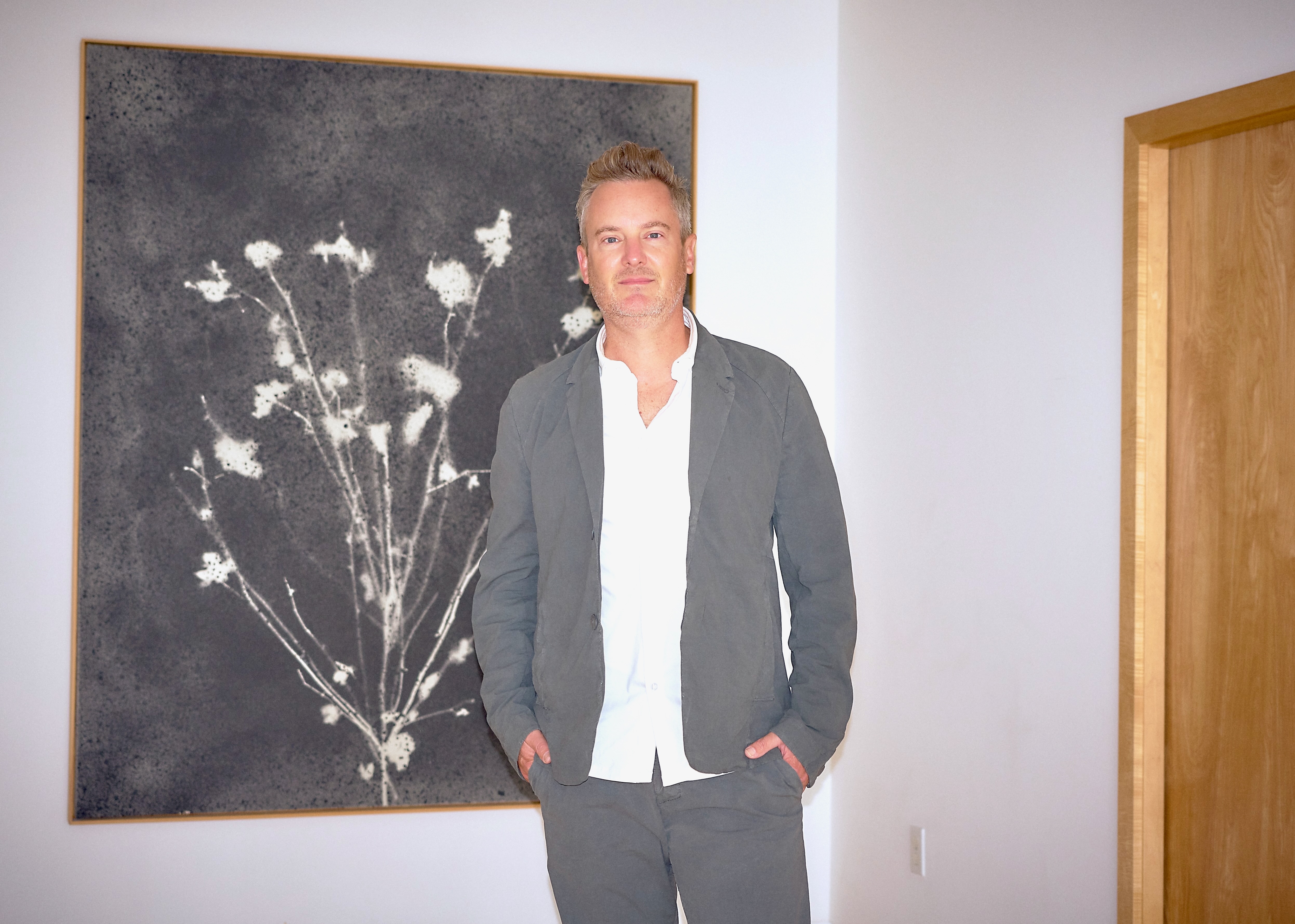
Scott Pitts, founder of Pallat, inside his Seattle photography studio at Fishermen’s Terminal in Interbay. (Mark Malijan Photo)
Commercial photographers have long tweaked images using tools like Photoshop, but Pitts sees AI as the natural next step for advertising workflows — distinct from news photography, where image manipulation remains out of bounds. Where Photoshop requires painstaking manual editing to adjust a scene, Pallat handles complex lighting, translucency, and material physics in minutes based on a simple prompt.
The startup recently signed its first enterprise customer and is currently working directly with brands as a hands-on production partner while building toward full software access.
Pitts sees the technology not as a threat to his craft, but as a natural progression. He started his career shooting four-by-five film, then transitioned to digital and video. AI is another progression.
“My hope is that me building Pallat is sort of this bridge between tech and creative,” Pitts said. “Craft is still important. Judgment and taste are still probably some of the most important things.”
Continue reading for Pitts’ answers to our Startup Spotlight questionnaire.
In 50 words or less, give us your startup’s elevator pitch.
Pallat is a photographer-led AI production system built for food and beverage brands, born from a working photo studio. It combines licensed photography with generative workflows to help brands scale photo-centric content while maintaining the creative control expected from commercial photography.
What problem are you obsessed with solving?
I’ve spent 25 years watching brands solve the same problem: invest in a shoot, then ultimately need more usable imagery than the initial shoot was designed to deliver. Generic generative tools can create images, but weren’t built around the quality, control and production standards food and beverage brands require.
I’m obsessed with using AI to close the gap. Pallat gives brands a way to extend photography they’ve already invested in and create new production-ready imagery grounded in a licensed dataset and the standards of a traditional photoshoot.
What surprised you after talking to customers?
Because we’re so close to the problem we’re solving, their need for a solution and high bar for quality didn’t surprise me.
What did was how much generated imagery disrupted their existing workflows. There is no obvious owner, no review path and no shared vocabulary for feedback and approvals. Brands are asking us to help establish new workflows, and that has turned out to be almost as important as building the tech itself.
How has AI changed the way you build your company?
AI is a big part of why a five-person team can build something like this. Our tech stack is built on open-weight models that we fine-tune using proprietary training data, while foundation models support planning and a handful of day-to-day operations.
Not to oversimplify it, but in many ways my role at Pallat parallels production. I built a team of experts, defined the problem we’re solving and established the criteria for the output. A growing part of my work is getting those standards out of my head and structuring evals so they hold when I’m not in the room.
What’s one thing people misunderstand about your startup?
That Pallat is trying to replace photography. It’s far from it.
Practical photos are important inputs, and our studio continues to create net-new ones to expand the system. Visual trends are always evolving, so datasets powering creative tech cannot be static. The future of production is hybrid: practical photography and generative imaging working together, with each deployed where it creates the most value.
What’s the toughest decision you’ve made in the past year?
Resisting the urge to broaden Pallat before we establish product-market fit. The goal isn’t to automate every step as quickly as possible. It’s to understand which problems in the workflow are best solved through software.
What’s the one piece of advice you give to other entrepreneurs?
I truly believe some of the most interesting AI companies will come out of service businesses where the founder knows the industry exceptionally well — where the friction lives, which shortcuts a client will notice, and what excellence looks like in their vertical.
I spent a long time assuming my 25 years in photography was the past and AI was the future, and I had that backwards. The years on set that sharpened my taste and judgment, our dataset and the client relationships are the true compounding assets.
We’ll know our company has made it when…
When an art director at a food or beverage brand drafts a shot list dividing it into two columns: “Capture as Practical Photography” and “Generate in Pallat.”
When that becomes a normal way of planning, Pallat will have done what we set out to do.
Kevin Owens, co-founder and CEO of Resect AI. (Resect AI Photo)
Resect AI, an artificial intelligence startup led by a team of scientists and engineers in Washougal, Wash., launched out of stealth Thursday with $25 million in funding to commercialize an open-source technology designed to catch AI hallucinations before they happen.
Unlike traditional AI monitoring tools that evaluate generated text after the fact, Resect AI says its patented technology operates in-stream — looking deep inside large language models in real time to observe, detect, interpret, and modify model behavior before a hallucination can occur.
By intervening directly within the model’s internal decision-making process rather than running post-hoc checks, the platform stops fabrications at the source while simultaneously generating an audit trail for enterprise compliance and due diligence.
“AI has prematurely been put in a position of trust. Adding labels such as ‘use at your own risk’ flies in the face of proper governance or compliance,” Kevin Owens, co-founder and CEO of Resect AI, said in a news release. “We are building the next large enterprise AI company to bring transparency and accountability to AI for industries such as publishing, finance, healthcare, research, and education where factual accuracy is absolutely critical.”
Beyond its tech, the startup’s leadership is also bullish about its small-town presence.
Washougal is a city of roughly 18,000 residents, 175 miles south of Seattle, tucked along the Columbia River across from Portland. Resect AI employs four people at an office on Main Street — including its co-founders — out of a 30-person workforce spread across the Seattle area, California, New York, and Texas.
“We believe the talent is up to par and we loved the sense of community that we found when we first came up here,” Owens told GeekWire. “We have been coming to the greater Washington and Oregon areas on and off over the years and finally decided this needed to be our headquarters.”
Owens said the decision has already paid off, noting that the startup has quickly tapped into the region’s talent pool by recruiting PhDs from both the greater Seattle and Portland markets while connecting with Northwest capital markets leaders.
Resect AI is also planning to open an office in the Seattle area in the near future for engineering and to serve as a business hub.
Alongside Owens, Resect’s other co-founders include Tim Walton, chief artificial intelligence officer; Tyler Gerber, chief operating officer; and Tommy Lofgren, chief product and marketing officer.
The company plans to use the funding to accelerate research and development, expand its go-to-market initiatives, and fuel talent acquisition — bringing its total headcount to 50 by the end of 2026.
— Aneesh Raman has taken the role of chief economic opportunity officer at Microsoft. He previously held the same title at LinkedIn, a Microsoft subsidiary where he worked for five years.
The job is focused on “helping companies, including our own, build and deploy AI tools in ways that will unlock new levels of economic opportunity and human capability for workers and workforces alike,” Raman said.
Raman, who is based in San Francisco, began his career as a TV journalist and served as a speechwriter for President Obama and other political leaders. More recently he was an adviser to Gov. Gavin Newsom and led economic impact for Facebook.
Jenny Lay-Flurrie. (LinkedIn Photo)
— Jenny Lay-Flurrie was promoted to corporate vice president of Microsoft‘s Trusted Technology Group. In February, she had taken the role of vice president and head of Trusted Technology, which focuses on privacy, safety, regulatory compliance, responsible AI use and related topics.
Lay-Flurrie announced the change on LinkedIn, saying that she was “honoured, humbled and a little lost for words (yes,, it does occasionally happen ;)).”
The tech leader has been with Microsoft since 2005, and led the company’s efforts on accessibility and disability inclusion for more than a decade.
Brian Gill. (LinkedIn Photo)
— Brian Gillhas resigned as chief product and technology officer for DAT Freight & Analytics, a Beaverton, Ore.-based freight company. Gill was with DAT for more than three years and previously served as CPO for Nordstrom.
In a LinkedIn post, Gill did not give specifics on his next move but said he would be “rolling up my sleeves and building the many ideas that are suddenly so much easier to bring to life.”
Gill’s other past roles include executive positions at Hotwire and nearly a decade at Expedia. Last month DAT announced multiple promotions and hires to its leadership team.
Colin Newman. (LinkedIn Photo)
— Colin Newman has joined Zillow Group as head of public policy. He was previously director of U.S. public policy for Amazon, leading initiatives on employment, workforce transformation, AI, transportation and economic development. He first took a government affairs role with Amazon’s Audible business in 2015 and moved to Amazon five years ago.
“I look forward to leveraging my government, legal, and public policy experience to support our efforts to simplify and democratize the housing process for everyone,” Newman said. His background includes legal counsel for former New Jersey Gov. Chris Christie.
Lisa Finnegan. (LinkedIn Photo)
— Lisa Finnegan is returning to Microsoft as vice president and human resources business partner for the Europe, Middle East and Africa (EMEA) region. Finnegan, who is based in Dublin, was previously with LinkedIn for more than eight years, departing in March 2025. Her interim role was with Lumera HR Consulting.
“It’s a pretty incredible time to (re)join Microsoft and the opportunity to help shape the people and organisation agenda across EMEA at this critical moment is incredibly compelling,” she said.
James Lau. (LinkedIn Photo)
— James Lau, chief product officer at Hiya, announced this is his last week at the Seattle startup, which battles fraudulent calls and provides technology to protect voice identity. He’s been in the role for three years and previously worked at Microsoft over multiple stints.
Lau is launching a company called Entrovox, which he describes as an AI phone team that helps insurance agencies land new customers through state-of-the-art AI voice agents, branded caller ID and smart campaigns.
“There has never been a more exciting time for building, and I am deeply passionate about voice AI. Making AI sound genuinely human is a challenge I find irresistible,” Lau said.
Jason Wilbur. (LinkedIn Photo)
—Jason Wilbur has left Oracle to join OpenAI‘s Seattle office as a leader in cloud partnerships.
Wilbur was with Oracle over two stints spanning more than six years and leaves the role of senior director of product management. Past jobs include CEO at Aarno Labs, co-founder of Require Security, and senior product manager at Amazon.
— Julia Liuson was appointed to Elastic’s board of directors. Earlier this year, Liuson resigned from Microsoft after more than 34 years. She was most recently president of Microsoft’s Developer Division. San Francisco’s Elastic bills itself as the “search AI company.”
Dan Walter. (LinkedIn Photo)
— Dan Walter was promoted to vice president of fission technology for Everett, Wash.-based Zap Energy. Walter joined Zap earlier this year as the clean power startup announced it was expanding to pursue fission micro-reactors as well as fusion-based nuclear energy. Zap is No. 11 on the GeekWire 200, a ranked index of the Pacific Northwest’s top startups.
Walter was previously at TerraPower for nearly a decade, most recently in a director role for the nuclear power company.
Kelsey Wolf. (LinkedIn Photo)
— Kelsey Wolf has joined next-gen battery company Group14 Technologies as director of communications and marketing. Wolf was previously the communications lead for Rad Power Bikes, the Seattle-based e-bike startup that went bankrupt and was acquired this past spring. Group14 is No. 34 on the GeekWire 200.
“I’ve spent my career telling exciting stories about technology that changes how we work, how we find home, and how we move around the world. Up next, I will get to tell stories about the technology and materials powering our world,” she said.
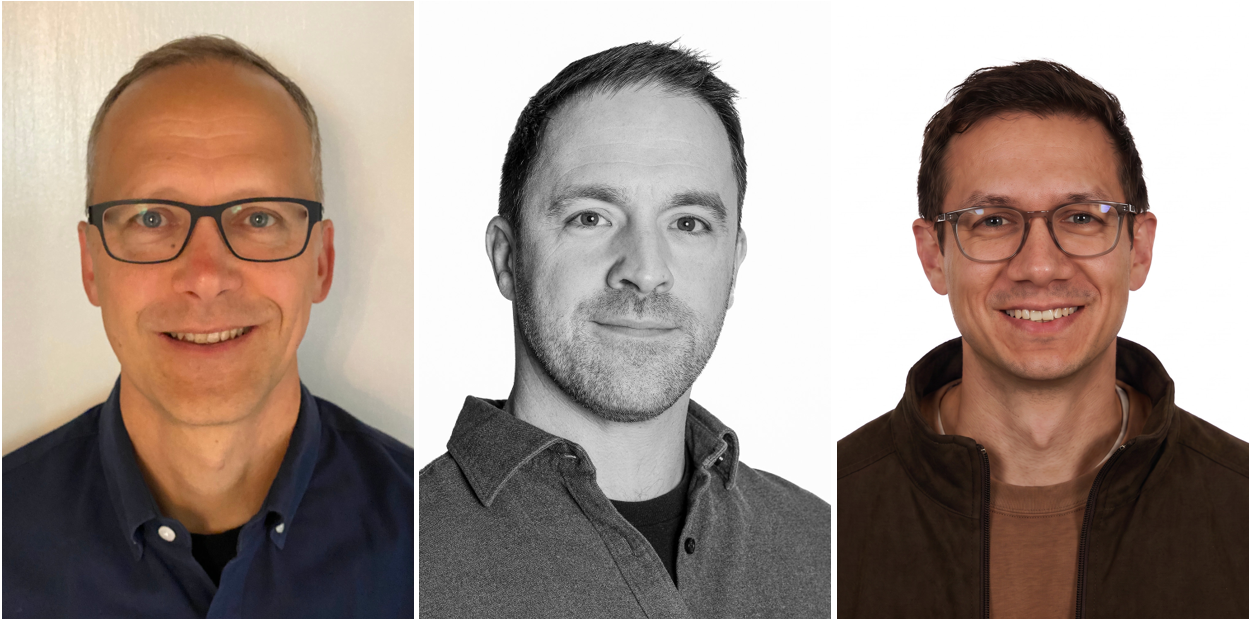
New members of the Tin Can team, from left: Evan Jacobs, Quinn Hawkins and Masud Khan. (Tin Can Photos)
— Tin Can, a Seattle startup selling Wi-Fi-enabled landline phones for kids, announced three hires:
Evan Jacobs has joined as head of engineering, previously serving as a software development manager at Amazon Web Services. Jacobs is also a startup founder.
Quinn Hawkins was named head of communities, joining from First Street, where he was chief product officer. His background includes leadership at Redfin and Microsoft.
Masud Khan was named staff software engineer. Past employers include Apple, Databricks, Meta and Amazon.
Tin Can, which launched last year, is No. 153 on the GeekWire 200.
Alex Gamoran. (LinkedIn Photo)
— EchoMark, the Bellevue, Wash., startup using forensic watermarking to identify the source of information leaks, has named Alex Gamoran vice president of enterprise sales. Gamoran was previously at Smartsheet for nearly a decade, leaving as regional vice president of commercial sales for North America.
“It struck me that every security-conscious enterprise is going to need a solution to the types of information leaks that conventional security software is blind to — and that’s when I knew I wanted to be part of EchoMark,” Gamoran said via email.
Sara Dutta. (LinkedIn Photo)
— Sara Duttawas named director of AI innovation and partnerships for Seattle biopharmaceutical company Omeros. She previously founded the life sciences consultancy Ocilisni and was a director at Novo Nordisk, focused on external partnerships and emerging technologies.
Last year, Omeros struck a deal worth up to $2.1 billion with Novo Nordisk, giving the latter exclusive global rights to develop and commercialize a clinical-stage drug candidate that treats rare blood and kidney disorders. Omeros won Deal of the Year at this year’s GeekWire Awards.
Rebekah Bastian. (LinkedIn Photo)
— Rebekah Bastian announced that she is leaving mpathic as chief marketing officer. She joined the Bellevue, Wash., startup working to make AI safe in December. Bastian previously launched and was CEO of the life-and-career social platform OwnTrail. She was with Zillow Group for more than 14 years and also worked at GlowForge.
“I’m giving myself some intentional time to explore ideas and let them incubate before deciding where they lead,” she said. That could include new companies or initiatives within existing companies, and her areas of focus span “human agency, creative entrepreneurship, economic opportunity, and generally how humans find meaning and thrive in the age of AI.”
— Seattle-area wine recommendation startup Theodora has appointed Heather Stephens founding marketing lead. Stephens has worked for more than a decade in consumer and B2B marketing, demand generation, and go-to-market strategy development.
— Marc Brown, former global head of M&A and strategic investments at Microsoft and now managing director of venture capital coverage at JPMorgan, has joined the board of trustees of the Institute for Citizens & Scholars, an organization supporting civic engagement for young people.
— Adrienne Lopez, a Seattle-based marketing leader who has worked on initiatives with organizations including Meta, WhatsApp, the Gates Foundation and Microsoft, was named executive vice president of WH Inc.
— Washington Research Foundation announced its new cohort of venture analysts: Jessica Ayers, Ankit Azad, Nello Gu, Michael Malone and Elya Shamskhou. The program helps graduate students and postdoctoral fellows gain expertise in technology commercialization and entrepreneurship.
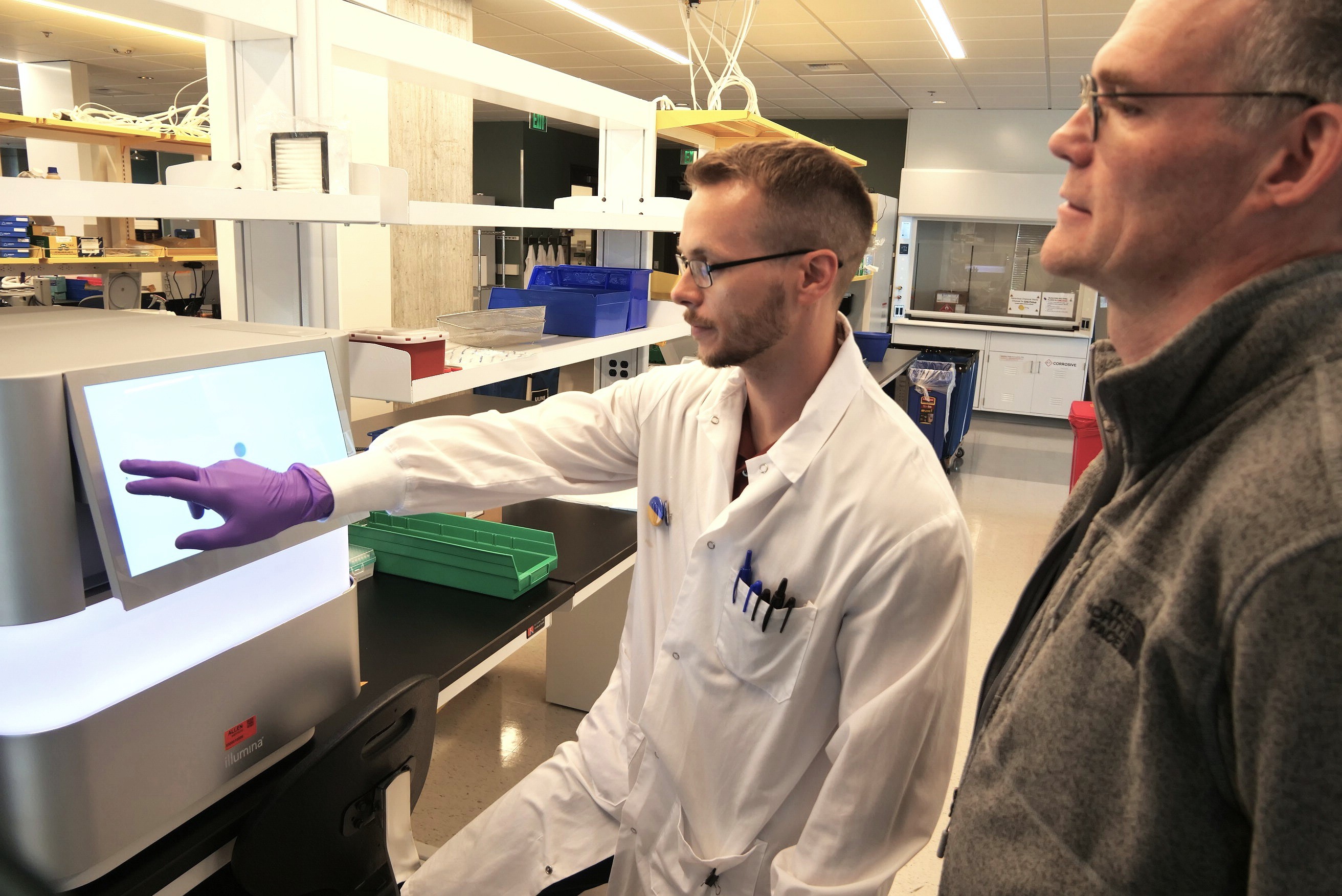
Jack Boylan, left, Allen Institute research associate, and Jesse Gray, AI BioDesign executive director of strategy and platform, at the DNA sequencer inside the initiative’s new lab. It reads millions of designed DNA sequences at once, revealing which ones worked. (GeekWire Photo / Todd Bishop)
Three of Seattle’s top scientific institutions are launching a nearly $95 million research initiative that will generate data and train AI models to design proteins and genes that don’t exist in nature — sharing the results freely to help others develop new medicines and materials.
AI BioDesign is led by David Baker, the UW biochemist who won the 2024 Nobel Prize in Chemistry for using computers to design new proteins, and Jay Shendure, a leading genome scientist at the UW and the Allen Institute.
The plan is to “hijack a lot of the machinery that evolution provided us” — the cellular assembly line that turns DNA into proteins — to design and measure millions of novel biological molecules, Shendure said in an interview in advance of the announcement.
That will help AI models learn the rules of biological design from a huge set of examples, instead of inferring them from the relatively limited number that nature has produced.
The field, Shendure said, is “putting too much emphasis on taking the cranks that we have and just running with them, as opposed to building the right cranks.”
Jay Shendure, right, lead scientific director of AI BioDesign, with research associate Jack Boylan in the lab at Dexter Yard in Seattle’s South Lake Union. (Allen Institute Photo / Jerry Petersen)
The goal is to make designing biology more like ordering a part: a molecule that latches onto a cancer cell, for example, or a genetic switch that fires only inside brain cells and nowhere else.
Potential outcomes could include everything from new therapies for disease, to proteins that dissolve plastic in the environment, to cells that travel through the body in a programmed way, said Sanjay Srivatsan, a Fred Hutch assistant professor who leads the cancer center’s work on the initiative, in a video released with the announcement.
“For the first time, the speed of AI is beginning to match the experimental power of synthetic biology,” Baker said in a statement. “That changes the question from ‘what has nature already made?’ to ‘what else is possible, and how can we test it?'”
Where the money goes
The Fund for Science and Technology is providing $94.6 million for AI BioDesign over five years. The foundation launched publicly last year with a mandate to direct a large share of Allen’s fortune into bioscience, environmental and AI research.
The funding from FFST is allocated as $46.1 million to the Allen Institute, $43.8 million to the UW and $4.7 million to Fred Hutch, according to an Allen Institute spokesperson.
The initiative had 62 people as of mid-August, including some new hires and others redirected from existing projects at the three institutions. The UW accounts for 41 of them, the Allen Institute 13, and Fred Hutch eight. AI BioDesign is expected to continue growing over time.
“AI BioDesign is exactly the kind of ambitious, collaborative science FFST was created to support,” said Marc Malandro, the foundation’s chief programs officer and co-lead, in a statement. He joined FFST in May after nearly a decade at the Chan Zuckerberg Initiative, most recently as chief operating officer of CZI and the Chan Zuckerberg Biohub Network.
Malandro and Chief Financial and Operations Officer Liz Carey have been leading FFST on an interim basis since founding CEO Lynda Stuart stepped down in May.
Inside the lab
On a recent tour of the AI BioDesign lab, research associate Jack Boylan pulled up results from a run he’d done on their new DNA sequencer that morning — on free kits donated by a neighboring biotech company, a year past their expiration date.
“We decided, let’s give it a roll,” he said. It worked fine.
The sequencer is what makes the whole approach possible. It reads all of the millions of DNA sequences in a single tube at once and reports which ones performed. One recent experiment ran 6 million distinct sequences through it at once.
“The scale comes not from robotics, but from parallelizing inside the test tube,” said Jesse Gray, executive director of strategy and platform for AI BioDesign and the Seattle Hub for Synthetic Biology, and a former Harvard Medical School geneticist.
The lab, at Dexter Yard in Seattle’s South Lake Union neighborhood, a short walk from the Allen Institute’s headquarters, is organized into teams of five or six people, each working on a different design problem.
A separate four-person team of machine-learning specialists takes the incoming results and works with the bench teams to decide which experiments come next — the ones that will teach the models the most. Each round is judged on how much the models improved.
Rui Costa, president and CEO of the Allen Institute. (Allen Institute Photo)
The Allen Institute calls projects like this “accelerators,” a term Rui Costa, the institute’s president and CEO, traced back to Paul Allen himself. The word came up in early planning sessions, Costa said. Allen wanted to “exponentially accelerate the field.”
Other accelerators at Dexter Yard include the Seattle Hub for Synthetic Biology, the Allen Institute’s collaboration with the Chan Zuckerberg Initiative and the UW, which Shendure also leads; and Cell Science, which works on engineering cells to assemble themselves into tissues.
The Allen Institute for AI (Ai2), the separate Seattle research organization also founded by Paul Allen, is involved informally rather than as a funded partner, Costa said.
Its robotics team has been talking with AI BioDesign about scaling up the protein work, and the two expect to collaborate on models and on tools that generate research hypotheses.
Why give it away
The decision to focus on open science also came from Allen, Costa said in an interview this week. “He was so visionary in the early 2000s: radically open science to exponentially impact and change fields, not to compete.”
That raises a question the initiative will face as soon as it produces anything valuable: what happens if a company builds a lucrative drug on data given away free? In traditional science, Costa said, being beaten to a discovery counts as a loss. Here it’s the goal.
“We would be so lucky if many companies would be taking this data and changing the world for good,” he said.
At the same time, Costa left open the possibility of the three principal institutions spinning out their own startups, nonprofits, or other initiatives from the work done by AI BioDesign.
Betting against the field
AI BioDesign’s approach runs against much of the current thinking in the field. Costa said most efforts to apply AI to biology are chasing a single general model that could answer questions about how any cell works. AI BioDesign is betting on the opposite: narrow models built for specific design problems, trained on data generated for that purpose.
“This project is a clear bet on a different way of doing things,” Costa said.
The people running the initiative are careful not to oversell. Gray said it remains an open question as to whether their approach beats the alternatives. “The jury’s still out,” he said.
Shendure put it plainly: “It’s never as easy as you think it’s going to be,” he said.
Costa said AI BioDesign needs to show real progress within 18 to 24 months — ideally even sooner — and expand to researchers around the world within five years.
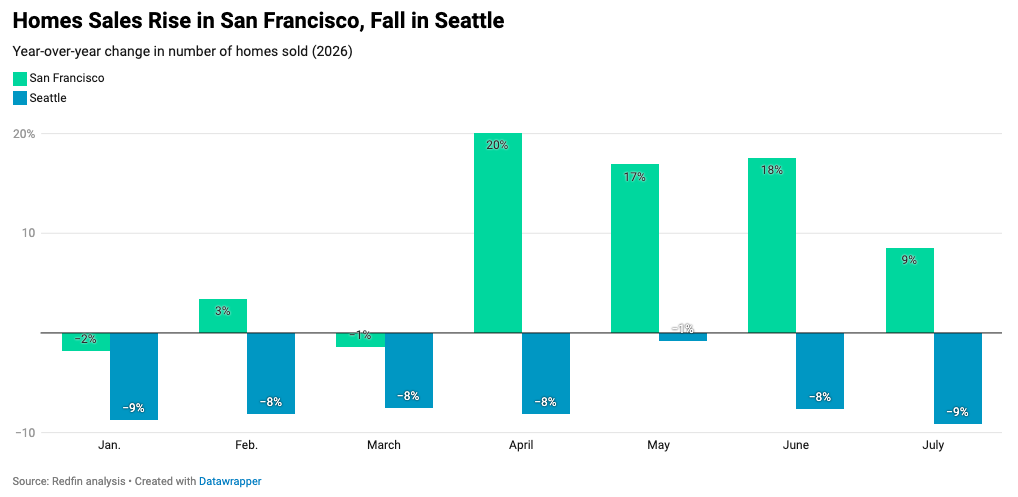
The housing markets in San Francisco, left, and Seattle have been diverging for the past year. Prices started falling in Seattle on an annual basis about a year ago, while prices in San Francisco have been rising since November. (BigStock, GeekWire File Photos)
While a fresh wave of AI-generated wealth is pouring fuel on San Francisco’s housing market, Seattle’s real estate scene is getting left out in the cold, stuck in a slump driven by ongoing local tech layoffs, soaring costs, and persistent worker anxiety.
A new report published Wednesday by Seattle-based Redfin illustrates just how dramatically the housing markets in the West Coast’s top two tech hubs have split.
In July, San Francisco’s median home-sale price jumped 6% year-over-year to $1.6 million as home sales rose 8.5%, fueled by an 18.4% drop in active listings—the largest inventory contraction in the country.
By contrast, Seattle’s median sale price dropped 3.6% to $809,479 as home sales fell 9.1% and active listings surged 16.7%, the nation’s steepest inventory increase, leaving local sellers outnumbering buyers by 65%. Redfin detailed the drop in pending sales in the city in an earlier report.
San Francisco’s resurgence is fueled by a concentrated wave of AI wealth. Driven by big salaries, six-figure signing bonuses, and anticipation of massive IPOs for Bay Area giants OpenAI and Anthropic, affluent buyers are aggressively bidding up homes, frequently paying hundreds of thousands over asking price.
The frenzy mirrors findings from The New York Times, which reported in May that cash-flush AI startup employees and secondary stock sales are fueling hyper-concentrated bidding wars across the Bay Area.
In Seattle, the dynamic is reversed. While local tech giants pour billions into AI infrastructure, corporate belt-tightening and lingering layoff fears at companies like Amazon and Microsoft have squelched buyer confidence, leaving prospective buyers cautious, job mobility low, and listings piling up.
Click to enlarge. (Redfin Graphic)
Ground-level real estate agents in the Seattle area are feeling that buyer hesitation firsthand.
“Layoffs in the tech world are dampening homebuying demand in the entire area,” said Sheryl Wingate, a Redfin Premier agent, noting that return-to-office policies are further squeezing demand in outlying suburbs as tech workers avoid long commutes amidst job uncertainty.
Seattle-area real estate isn’t just feeling the squeeze from the heavyweights. Job cuts have hit nearly every tier of the regional tech ecosystem this year, sweeping through engineering hubs for Meta, Google, and Salesforce, consumer brands like Zillow, T-Mobile, and Starbucks, corporate divisions at Expedia and TikTok, and startups including Qualtrics and Amperity.
The chill is hitting the region’s high-end neighborhoods hardest. According to Bloomberg, pending luxury home sales in the Seattle area plummeted 15%, driven by a double hit of tech-sector layoffs and Washington state’s higher taxes on top earners. Once-frenzied markets in Eastside suburbs like Bellevue and Sammamish have stalled, with homes priced over $2 million sitting for an average of 44 days as affluent tech buyers pull back.
By comparison, high-end buyers in San Francisco are doubling their budgets as AI confidence surges. Redfin noted that luxury pending sales in the Bay Area jumped 46% year-over-year, with local agents reporting tech clients doubling their price points — in some cases expanding from $2 million budgets to nearly $4 million — and placing offers as much as $900,000 over asking price.
The shift is also severing a key migration pipeline that long fueled Seattle’s housing boom. While high-earning Bay Area transplants historically moved north to stretch their tech compensation, Redfin migration data shows the net inflow of home shoppers moving from San Francisco to Seattle plummeted to just 369 people in the first quarter — down from over 5,100 five years ago.
Looking ahead, Redfin economists expect these diverging trends to play out across other tech hubs as artificial intelligence reshapes the labor market.
“AI is reorganizing the tech labor market, with San Francisco and Seattle representing two sides of that transition,” said Chen Zhao, Redfin’s head of economics research, adding that while AI creates rapid wealth in some markets, it drives corporate restructuring and caution in others.
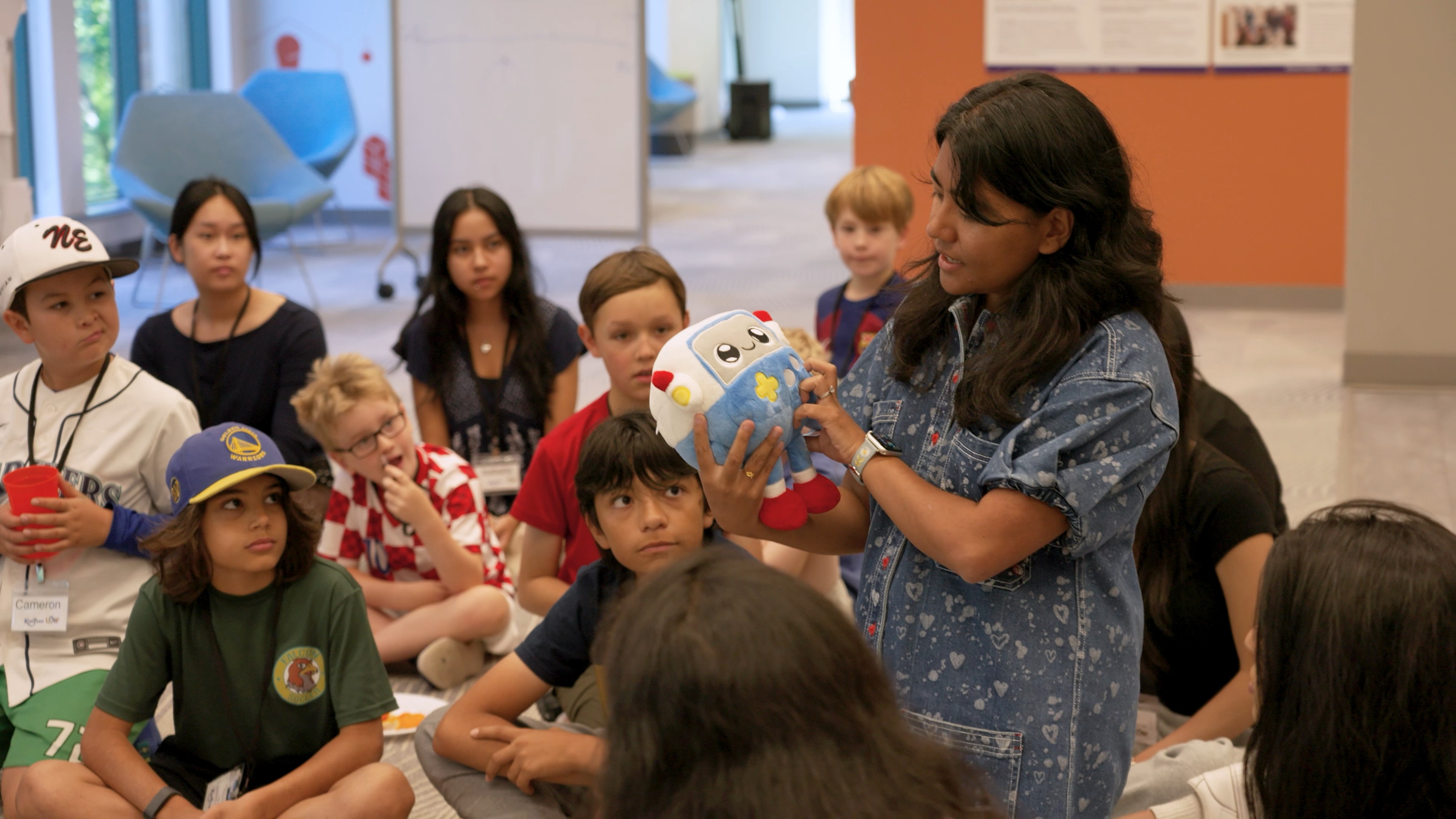
Aayushi Dangol, a recent University of Washington doctoral student in human centered design and engineering, explains an AI toy during a KidsTeam UW session. (UW Photo / Jacob Adams)
We’ve come a long way from Lincoln Logs and Hot Wheels that couldn’t talk to us. Today, plush toys aren’t just stuffed — they’re stuffed with artificial intelligence, and new research from the University of Washington reveals that when these “smart” toys start chatting, kids quickly go from curious to frustrated to outright hostile.
Claims of “smart” toys date back decades, from 1960s talking dolls like Chatty Cathy to 1990s sensor-packed plushies like Microsoft’s ActiMates Barney and Furby.
But generative AI marks a major shift. Companies like Curio are now packing plushies with onboard AI models, allowing characters like “Gabbo” or the viral brainrot figure “Ballerina Cappuccina” to hold dynamic, unscripted conversations, remember past interactions, and adapt directly to a child.
To see how kids actually interact with these conversational companions, researchers at UW’s KidsTeam brought eight children ages 6 to 11 to campus last summer. The kids initially engaged with curiosity — asking basic questions like “What is your name?” and testing physical reactions like tickling the toys’ toes.
But as the toys struggled with complex questions and failed to pick up on physical cues — one participant complained a toy “didn’t listen to me like 26 million times” — delight turned to irritation. Children eventually turned to antagonizing the plushies, calling them “ugly” or “evil” and joking about throwing them in the ocean.
In the video below, kids are asked at one point if they want an AI toy to read them a bedtime story.
“No. It just sounds awful,” one child replied.
“I think it’s gonna destroy my dreams as a tiny kid,” another said.
The study highlights a distinct psychological clash: a cuddly, familiar plush exterior combined with a synthetic intelligence that kids found both fascinating and unnerving.
“The juxtaposition of this plushie toy that also had signs of intelligence was both interesting and disturbing for the kids,” said co-lead author Aayushi Dangol, a former UW doctoral student now at Foundry10, in a UW News story.
While the toys offer dynamic play, Dangol warned parents that generative AI introduces new risks that traditional toys never had, from hallucinating facts to manipulative emotional bonding.
“They’ll give wrong answers, or flatter the kids excessively, or could manipulate the kids into attachment,” Dangol noted.
Beyond conversational glitches, researchers emphasize that synthetic companions fundamentally alter how children play. For generations, kids have supplied their own imagination to make inanimate objects talk and move. Generative AI alters that dynamic.
“Now the script has been flipped and the toy has this imitation of imagination,” said co-author Jason Yip, a UW associate professor in the Information School and director of KidsTeam UW. “We’ve never lived through that before, and we don’t know what questions children will ask or how long they’ll even want to play with these toys.”
Because kids are navigating entirely uncharted territory, Yip stressed the importance of giving young users space to talk through their experiences with the devices filling their bedrooms.
“It’s really important to give them opportunities to discuss these technologies we’re handing down to them,” Yip said.
Smart home device maker Wyze wants to end notification fatigue by turning security footage into something more akin to an Instagram feed.
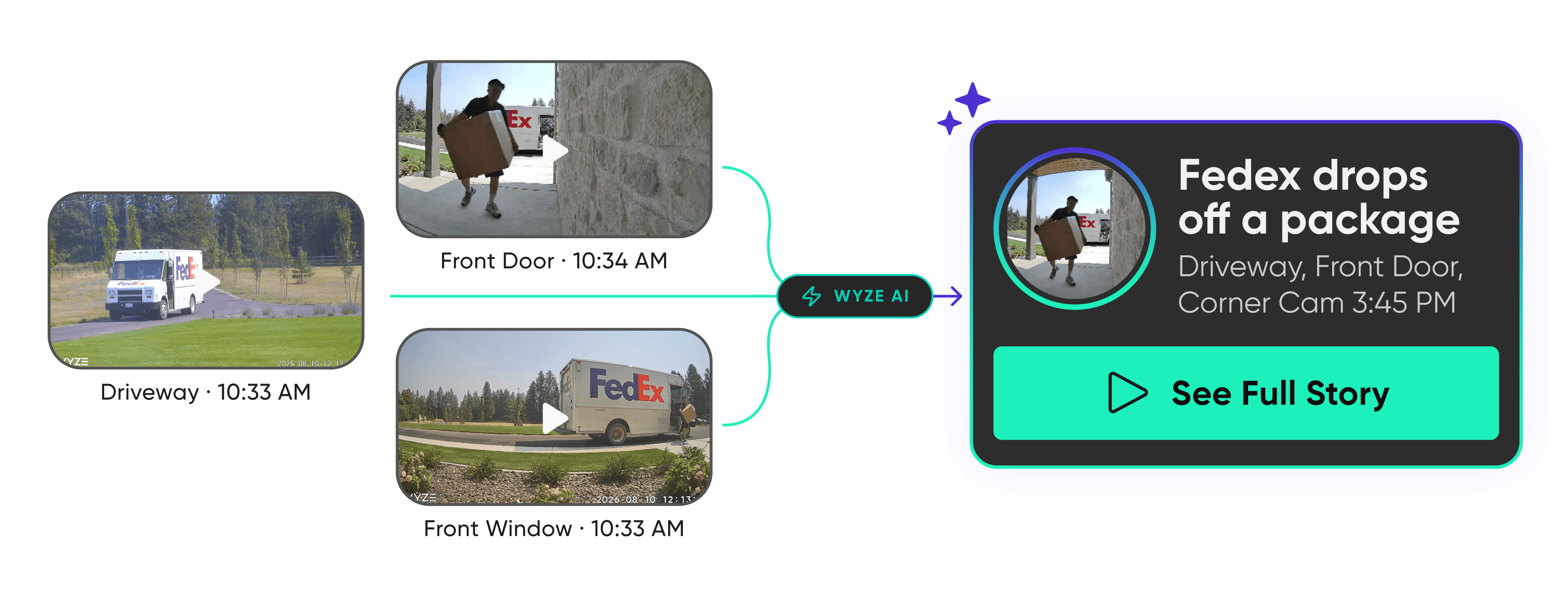
The Kirkland, Wash.-based company launched “Wyze Stories,” a new AI-powered feature that stitches together clip sequences from multiple cameras into a single, chronological event.
Instead of firing off separate alerts as a visitor moves from the driveway to the front porch, the system uses multi-camera grouping and event importance filtering to deliver a unified highlight reel alongside a descriptive, text-based summary.
“Honestly, the number one thing people complain about with security cameras is getting blown up with notifications,” Dave Crosby, co-founder and chief marketing officer at Wyze, said in a news release Tuesday. “Instead of digging through a mess of clips, you just tap through daily stories like your house is your favorite social feed.”
An illustration shows how Wyze AI combines video feeds from multiple cameras—such as a driveway, front window, and front door—into a single, summarized event notification. (Wyze Graphic)
Within the app, stories are indicated by glowing green-and-purple rings on the home tab, allowing users to tap through footage, hold to pause, or watch events at double speed. The feature also uses AI to generate instant written summaries of detected activity — such as noting when a delivery driver leaves a box at the door — and automatically highlights high-importance events while suppressing repetitive, minor alerts.
The new feature is available as part of Wyze’s top-tier “Cam Unlimited Pro” subscription, which costs $19.99 a month and includes features like cross-camera grouping, 24/7 emergency dispatch, and 60 days of cloud storage.
Wyze Stories works across most of the company’s hardware lineup, with the exception of older legacy models like the original Wyze Cam, Doorbell v1, and Outdoor v1 and v2.
Founded in 2017 by a trio of former Amazon employees, Wyze originally launched with a $20 smart camera before expanding into a broader lineup of sensors, lighting, and home security systems. The company raised $110 million in 2021 and ranks No. 20 on the GeekWire 200 index of top Pacific Northwest startups.
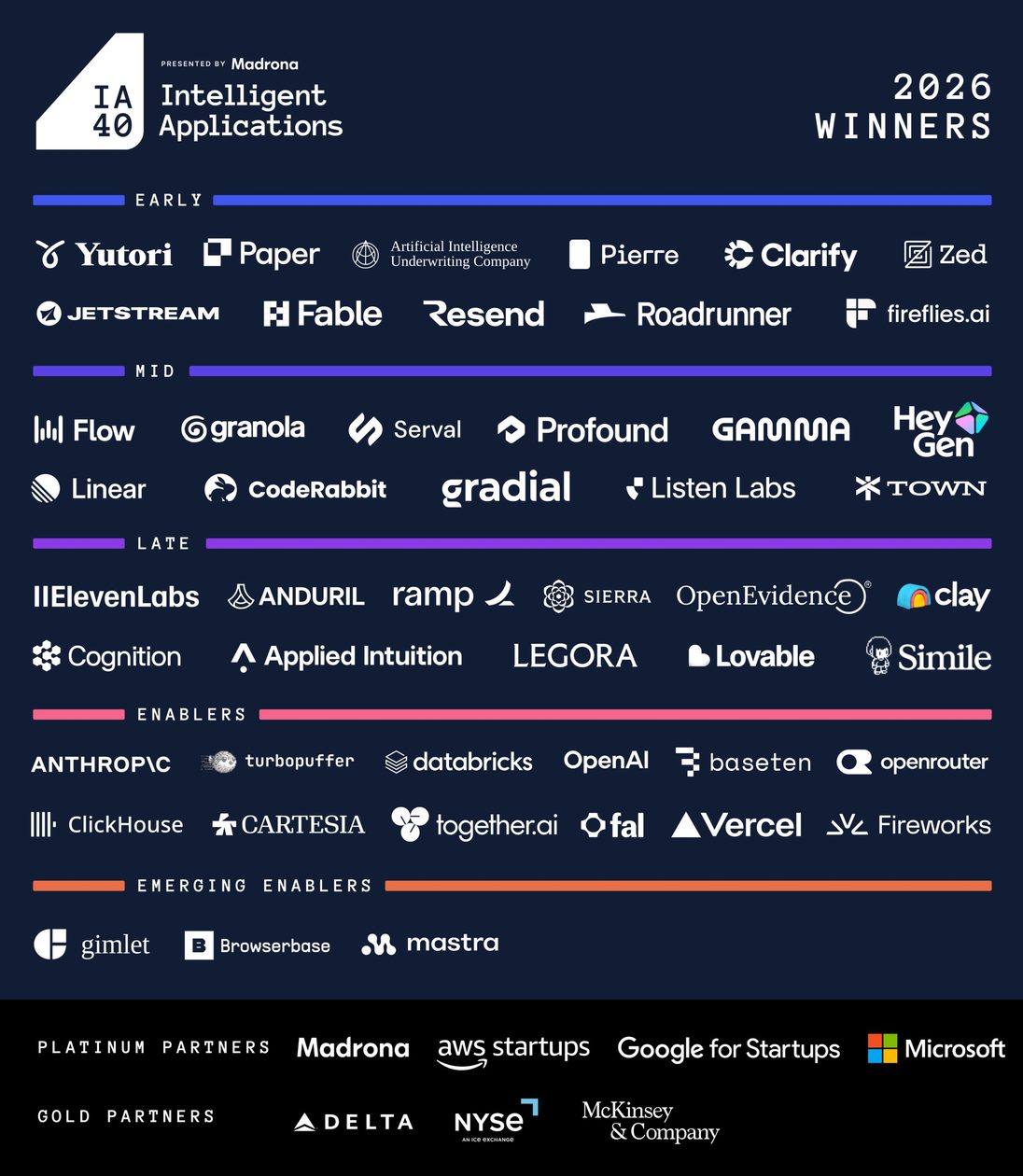
The winners on Madrona’s 2026 Intelligent Applications 40 list, grouped by funding stage. (Madrona Image)
Seattle-based venture capital firm Madrona released its sixth annual Intelligent Applications 40 list this week, naming 45 private AI companies (the five extras come from ties) that have collectively raised $410 billion from investors across the industry.
Three of them — Anthropic, OpenAI and Databricks — account for 92% of that total.
The uneven distribution of funding reflects a larger split in the tech industry, as the largest AI companies make huge bets on the computing capacity needed to meet demand for their models, while almost everyone else builds businesses on top of them.
The frontier labs are “increasingly funded by strategic capital from the likes of Amazon, Google, Nvidia and SoftBank rather than traditional venture,” Madrona’s Matt McIlwain and Rolanda Fu wrote in a post accompanying the list. That scale, they added, “makes every other category on this list look capital light by comparison.”
On top of that, he said, hundreds of billions of dollars are flowing into OpenAI and Anthropic.
“And what I say to both the big tech companies and to the people funding the model companies: thank you very much,” McIlwain said on Bloomberg TV, noting that the five largest tech companies will spend an estimated $750 billion in capital expenditures this year.
But even setting those big three aside, McIlwain said, the rest of the winners have raised an average of more than $800 million each. That’s a total of $34 billion combined. Companies across the list are raising far more than they used to, enough that Madrona had to redraw its own categories.
The list sorts companies by total capital raised, and this year the ceiling for “early stage” rose to $50 million, up from the $30 million threshold that held for the previous five lists. The cutoff for “emerging enablers,” its category for smaller infrastructure companies, doubled to $100 million.
“Companies across the board are raising more money, and the definition for what ‘early’ means continues to shift higher,” McIlwain and Fu wrote.
Madrona has published the IA40 since 2021 as a roster of the private companies it considers most important in building and enabling AI applications. According to the firm, this year’s list drew on input from 72 investors representing 54 venture and corporate firms, who nominated and voted on more than 450 companies, with PitchBook data factored into the scoring.
Gradial, which builds AI agents for enterprise marketing, is a first-time winner in the mid-stage category; it raised $65 million in June at a $675 million valuation, bringing its total to $120 million.
Last year’s list included two other Seattle-area companies in addition to Clarify.
OpenAI acquired one of them, Bellevue-based Statsig, for $1.1 billion in September 2025, making Statsig founder Vijaye Raji its CTO of applications.
Security startup Dropzone AI, which was on the list last year, did not repeat this year.
Madrona, one of the Seattle region’s largest and oldest venture capital firms, is an investor in all four — Clarify, Gradial, Statsig and Dropzone AI — although it also invests outside the region, and many of the companies on the IA40 are not in its portfolio.
Databricks, the San Francisco-based data and AI company (which leased 142,000 square feet in Bellevue this year), is the only company to appear on all six IA40 lists. That said, 23 of last year’s 40 winners returned this year, a 58% repeat rate, up from 33% the year before.
McIlwain and Fu wrote that the biggest and most established companies on the list are holding their spots, noting that “the age of experimentation is giving way to an age of enterprise readiness,” with buyers and investors “paying premiums for companies that can demonstrate real ROI.”
Madrona will recognize the winners at its IA40 Summit in Seattle on Sept. 29 and 30.
Updated with Matt McIlwain’s comments to Bloomberg TV.
Bill Gates, shown here in April 2025, released a memo this week warning that the world isn’t ready for AI. (GeekWire Photo / Kevin Lisota)
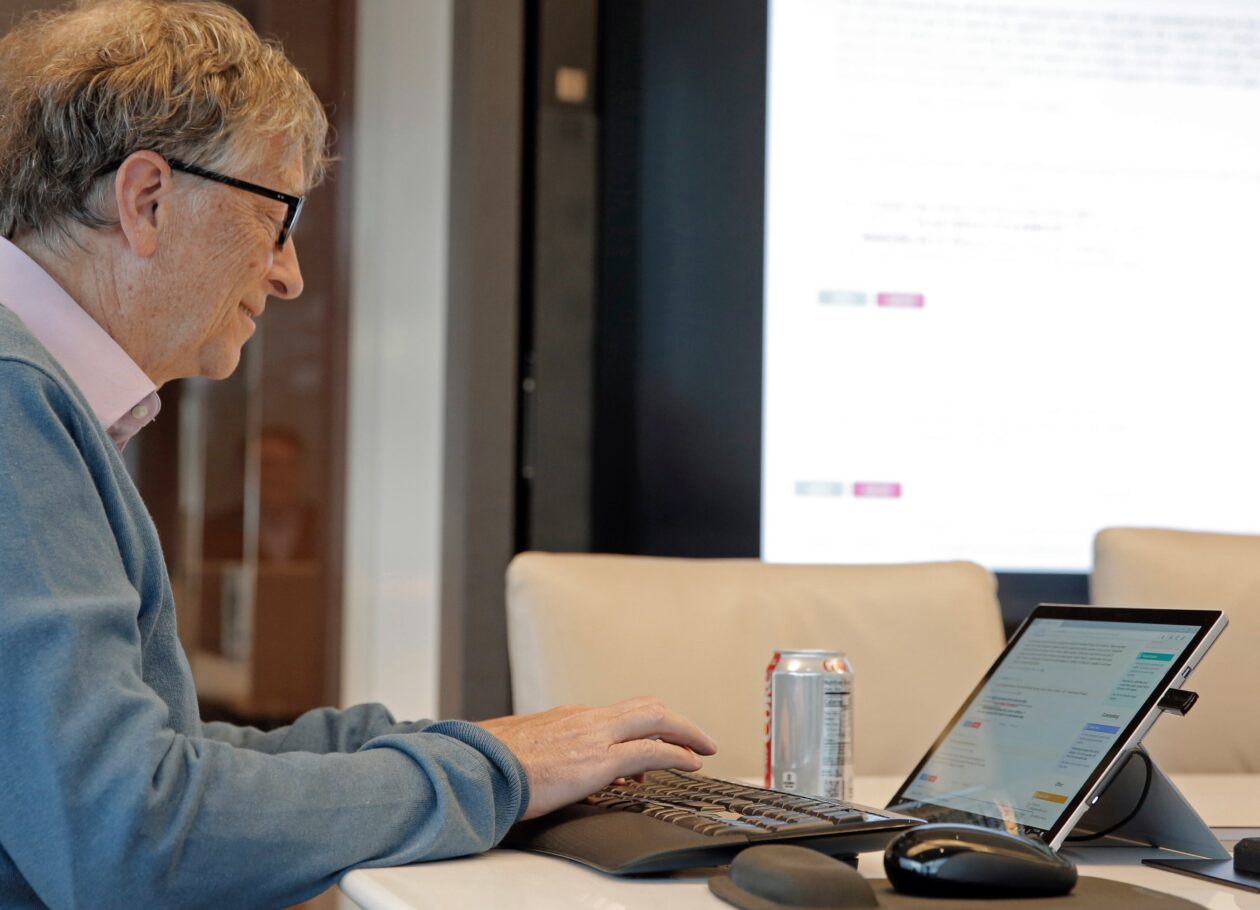
This week on the GeekWire Podcast: Bill Gates published a new essay warning that the AI industry is crossing the safety lines it set for itself, and that nobody is preparing for what’s coming. At age 70, he also uses AI more than most people half his age, and he finds it enthralling, as you’ll hear on this week’s show, with highlights from our interview with him.
Along the way, we dig into his three proposals: new institutions for managing the transition, a category of jobs reserved for humans, and a tax on the use and purchase of AI and robots.
The change in his own tech usage: “I joke with people that I used to have Claude-like people that I would send email to, but they were so slow, and there were some topics they didn’t actually know. … It’s three a.m. I want to understand sodium batteries, and now there’s no reason to go to sleep. Here we go. Yeah, it’s crazy.”
How he uses AI specifically: “If you’re a curious person, this is a mind-blowing time. When I’m working on malaria, nutrition, my poor humans that I work with always get these long conversations from me, where I paste in — me, Claude, me, ChatGPT. Sometimes I do it if there’s three of us: Claude, ChatGPT and me, debating these things.”
On where personal agents are headed: “We will get to a point where you won’t buy things yourself. You just won’t. … You won’t go to those applications. You’ll just go to your personal agent. … From a productivity point of view, we are in heaven.”
What has surprised him: “I was shocked by ChatGPT, and I was shocked by Claude Code. Those are both things where I went, oh my God. … I did not expect that a statistical machine would essentially learn to read, and the idea that the code is better than human code. Those are two stunning thresholds.”
On writing this essay: “It’s very unnatural for me to think that innovation may be a net negative if it’s not managed properly. The more I wrote the memo, the more I was like, Jesus, we really need to get our act together here. Even though this may come across as negative, that’s the truth. If we don’t step up, the negatives will substantially outweigh the positives.”
What AI leaders say privately: “You’re in this perverse period right now where people in the AI industry who are willing to say that AI might have some negative effects are told, ‘Hey, you’re hurting our PR while we’re trying to raise trillions of dollars.’ … I know they’re all worried. Or all of them that I know, which is basically everybody but Elon.”
On losing control of AI: “The wake-up for the memo is that the bad stuff thresholds are all being crossed. Even lack of control that I thought would be many years from now, we’re seeing lack of control. … These are people who are super expert on the thing, going, well, maybe we won’t be able to control these things. What kind of risk have we chosen to run here?”
On how fast robots are coming: “What’s weird about AI is it’s better at doing jobs across the entire economy, including physical jobs when the robots come — which you can guess when that is, but my view is it’s only a couple of years.”
Is he still an optimist? “I don’t think being pessimistic is helpful. I do think, wow, this is sure an interesting time. I’m the guy who in my 30s thought people in their 50s or 60s didn’t understand anything. So it’s kind of bizarre if a guy who’s 70 comes and writes a memo that’s actually helpful. … But I am very concerned. And honestly, when you get people one-on-one, so are they.”
Marc Whitten, the new president and CEO of Dolby Laboratories. (Dolby Photo)
— Marc Whitten, a former Microsoft and Amazon executive, was named president and CEO of San Francisco-based Dolby Laboratories. He succeeds Kevin Yeaman, who is retiring after leading the entertainment technology company for nearly 20 years.
Whitten spent 17 years at Microsoft, rising to corporate vice president and chief product officer for Xbox. He went on to serve as chief product officer at Sonos before joining Amazon as vice president of entertainment devices and services, overseeing products including Alexa, Kindle and Fire TV.
He later served as president of Unity Create and CEO of Cruise. Most recently, he was vice president of robotics at Meta.
Dr. Lawrence Fong was named senior vice president and director of the Translational Science and Therapeutics Division, effective Dec. 1. He succeeds Dr. Geoff Hill, who is departing the organization in December.
Fong joined Fred Hutch in 2024 as scientific director of the Immunotherapy Integrated Research Center and Bezos Family Distinguished Scholar in Immunotherapy. He previously founded the Cancer Immunotherapy Program at the University of California, San Francisco.
Dr. Andrew Hsieh. (Fred Hutch Photo)
Dr. Andrew Hsieh, the associate director of the Fred Hutch Human Biology Division, was named the inaugural Larry and Virginia Gordon Endowed Chair in Prostate and Bladder Cancer Research. Hsieh is a physician-scientist at Fred Hutch specializing in genitourinary cancers.
— Two recent notable Microsoft AI-related exits:
Andréa Mallardis leaving her role as chief marketing officer of Microsoft AI after joining from Pinterest in January, according to Business Insider. She will stay on as an advisor until early next year. Mallard, who is based in the San Francisco Bay Area, previously served as global chief marketing officer at Pinterest for eight years.
Ece Kamar departed Microsoft Research after 16 years with the company. She was corporate vice president and managing director of the AI Frontiers Lab, where she worked on small language models and the company’s agentic AI stack. She has not announced her next role.
Poppy MacDonald. (File Photo)
— Poppy MacDonald was named president of NationSwell, a social impact membership organization. MacDonald previously served as president of USAFacts, the nonpartisan civic data initiative founded by former Microsoft CEO Steve Ballmer, for seven years. A past recipient of an Uncommon Thinkers award from GeekWire and Greater Seattle Partners, she is also the former president and COO of POLITICO.
— Jeff Buhrman joined Seattle startup Tin Canas head of finance. The company is building a screen-free, WiFi-enabled phone designed to let kids connect with friends and family. Buhrman previously served as CFO of Seattle-based Sleep Doctor for more than four years.
— Susan Loosmore was confirmed to the Major League Baseball Stadium Public Facilities District board, which oversees T-Mobile Park. The King County Council approved the appointment Aug. 25. Loosmore spent more than 17 years in executive leadership at T-Mobile and previously served as chair of the Seattle Metropolitan Chamber of Commerce.
Musierowicz, who is based in Atlanta, previously served as chief revenue officer at SmartBear and Keyfactor. Earlier, he led global channels and alliances at Atlassian through its IPO.
Packham, who is based in Salt Lake City, Utah, joins from Dragos, where he was CMO. He previously served as executive vice president of marketing at DigiCert.
— Vancouver, B.C.-based Integrated Quantum Technologies, an enterprise AI infrastructure company, appointedHusam Fezzani as CEO. He succeeds Alan Guibord, who moved to chairman. Fezzani spent nearly 30 years at HSBC, where he held senior technology and engineering leadership roles including global engineering head for the bank’s Commercial Technology Division.
L-R: OnTrade co-founders Zachary Harl, chief investment officer; Raji Subramanian, CEO; and Matt Williams, president. (OnTrade Photos)
The co-founders of Pro.com, the Seattle-based home-improvement marketplace acquired by Opendoor in 2021, are back with a new company targeting what seems on the surface a very different kind of market: AI-powered software for the wealth management industry.
But Rajalakshmi “Raji” Subramanian and Matt Williams say the new challenge matches the same pattern: a huge industry held back not by a lack of customers, but by a shortage of professionals and tools.
Their Seattle startup, OnTrade, co-founded with former Bank of America chief investment officer Zachary Harl, has been operating under the radar since 2024, raising an undisclosed amount of funding from General Catalyst, Madrona and angel investors.
OnTrade’s chief technology officer is Jean Bredeche, who co-founded Quantopian, the algorithmic trading platform, and later served as a director of engineering at Robinhood.
How it works: OnTrade connects software that financial advisors already use — including CRM, portfolio accounting, trading, and compliance programs — into a single interface.
It then deploys AI agents to handle the type of work that advisors have traditionally done manually, such as scanning portfolios for tax-loss harvesting opportunities, flagging accounts that have drifted from their targets, or drafting proposals and reports for clients.
The humans approve everything before it reaches a client. The idea is to help them serve more clients without sacrificing the quality of their work, expanding access to wealth-management services that tend to be concentrated among more affluent households.
“Wealth management, if you look at the industry, does not have a demand problem; it has an access problem,” said Subramanian, the company’s CEO, in an interview. “Many people who’d like access to wealth management don’t have access to wealth management, and that’s what we’re here to solve.”
Harl, OnTrade’s chief investment officer, called raw foundation models the “brilliant PhDs” of the AI world — impressive on paper, but not as valuable to a specific industry such as wealth management until they understand its portfolios, policies, compliance rules, and client relationships. Vertical AI solutions like OnTrade, he said, are better positioned to connect that general-purpose intelligence to a specific firm’s data and workflows so the technology can do trusted work.
Industry shakeup: OnTrade is emerging at a pivotal moment, two days after investment giant Vanguard agreed to acquire wealth-management platform Altruist reportedly valued at $4 billion. OnTrade’s founders cite the deal as validation of the vertical AI opportunity they’re pursuing.
In a LinkedIn post Thursday, Subramanian wrote that the Vanguard-Altruist deal signals something bigger than a battle over where advisors park their clients’ assets: that capturing the opportunity “requires a new operating model rather than AI-enhanced versions of today’s applications.”
The wealth management industry’s unit of scale, she wrote, is shifting “from the number of people a firm employs to the intelligence and agency it can deploy.”
The founders: Subramanian joined Amazon in the late 1990s as an early engineer who helped build Amazon Marketplace and AWS, and later led the digitization of books for Kindle.
Amazon was where she met Williams, who had founded a startup called LiveBid that Amazon acquired in 1999. He spent 11 years there, including a stint as a technical advisor to Jeff Bezos, then left to run Digg as CEO and served as an entrepreneur in residence at Andreessen Horowitz.
Subramanian went on to run engineering at Yahoo Finance, where she helped open up market data that had previously been the province of institutional investors, giving her an early look at the problem that OnTrade is now aiming to solve.
In 2013, the two co-founded Pro.com, a tech-driven home improvement marketplace that raised early funding from investors including Madrona, Maveron, Bezos and Andreessen Horowitz.
Real estate tech company Opendoor acquired Pro.com in 2021, and brought both founders on as executives — Subramanian as chief technology officer, Williams as head of the Pro.com unit and senior vice president of retail.
Harl spent many years at Bank of America, rising to chief investment officer, where he managed the bank’s asset portfolios and large balance sheet risks across multiple market cycles. He is a chartered financial analyst (CFA), with a math and computer science degree from Indiana University, and a statistics degree from the London School of Economics.
He served on the U.S. Treasury Borrowing Advisory Committee under Secretaries Steven Mnuchin and Janet Yellen, advising on debt management, before joining Opendoor in 2023 as chief risk officer. That’s where he met Subramanian and Williams, before making the startup leap with them.
Traction and competition: The company’s technology is already in use at firms ranging in size from boutique advisories to large national practices, said Williams, the company’s president.
He said one client used the platform to win a billion-dollar family office account, and that another recouped the full annual cost of the platform in less than 30 days. He called that “a small window into what’s going to happen on a larger scale.”
The wealth management software market has many established players — such as Orion Advisor Solutions, Envestnet, and Addepar — but the OnTrade founders say they see them as partners, not rivals. OnTrade integrates with those systems rather than replacing them.
That distinguishes the company from Altruist, the Vanguard acquisition target, which built its own full stack, including its own custodian, the financial institution where client assets are held. That approach requires firms to move client assets onto its platform.
OnTrade doesn’t ask firms to replace their existing tools or move their clients’ money. Instead, it plugs into what’s already there.
The broader timing may work in their favor. As baby boomers age, an estimated $50 trillion or more in assets is expected to pass to younger generations in the coming decades — creating a wave of new clients who will need financial advisors, and new pressure on firms to serve them.
That’s where home improvement and wealth management have something in common.
“There aren’t many bigger places, other than health, wealth and real estate, where you can impact a population, especially an underserved population,” Williams said. “That was at the heart of the motivation.”
Arkero co-founders, from left: Daniel Shi, who oversees business operations; CEO Shivaas Gulati; and Vamsi Narla, who leads product and engineering. (Arkero Photo)
The agreement builds on momentum for Arkero, which was launched last fall by the co-founder of Seattle digital remittance company Remitly and raised $6 million at the start of this year.
Bolton Wanderers — which earned promotion back to the English Championship in May — joins a client roster that includes Major League Soccer’s Seattle Sounders FC, NWSL’s Seattle Reign FC, MLS expansion team San Diego FC, and fifth-tier English side Southend United.
The project with Bolton centers on a three-month effort to overhaul the team’s data infrastructure and build a custom “club intelligence layer.” Designed to connect directly to Bolton’s internal data, systems, and workflows, the platform centralizes organizational knowledge so staff across business and football operations can query information and deploy practical AI tools and agents.
“AI transformation does not begin with a chatbot. It begins with a club’s data, systems, knowledge and workflows,” said Shivaas Gulati, founder and CEO of Arkero, in a news release on Friday. “The future football workplace will bring experienced people and AI systems together. Bolton has approached this work with real ambition.”
Gulati’s drive to apply AI to sports comes directly from his own ties to the game. He serves on the ownership group of Southend United and previously acted as a technical advisor to Sounders FC on its tech and AI strategy.
“We get to see the real problems inside sports teams given our access to Southend United,” Gulati told GeekWire. “Clubs have been doing things the same way for a long time, and with AI they can truly re-imagine how their workforce operates and adapts to the demands of a modern enterprise.”
A longtime angel investor, Gulati co-founded Remitly in 2011 and left in 2022. He launched Arkero with help from Vamsi Narla, who leads product and engineering, and Daniel Shi, who oversees business operations. The startup has eight full-time employees.
Based in Greater Manchester, Bolton Wanderers boasts a rich legacy as one of the 12 founding members of the English Football League in 1888. Originally formed in 1874 as Christ Church F.C., the historic club has won four FA Cups and spent over 70 seasons in English football’s top flight.
Bolton CEO David Ray said the club is making a long-term investment to ensure it isn’t “playing catch-up” as technology reshapes the sports industry. The club aims to use Arkero’s platform to drive revenue, streamline administrative tasks, and better engage fans — joining teams like the Sounders and Reign, which project over 50% efficiency savings in matchday planning using the startup’s tools.
Arkero says interest in its deep AI integration model is accelerating across the sports world. The startup is currently in discussions with multiple English Football League clubs as well as professional sports teams and leagues across Europe and North America, as leadership teams seek to move beyond generic AI tools and connect AI directly to their proprietary data and daily workflows.
“There is a window right now for forward-thinking clubs to build a meaningful advantage,” Gulati said. “In a few years, working alongside AI will simply be how professional sports organizations operate.”
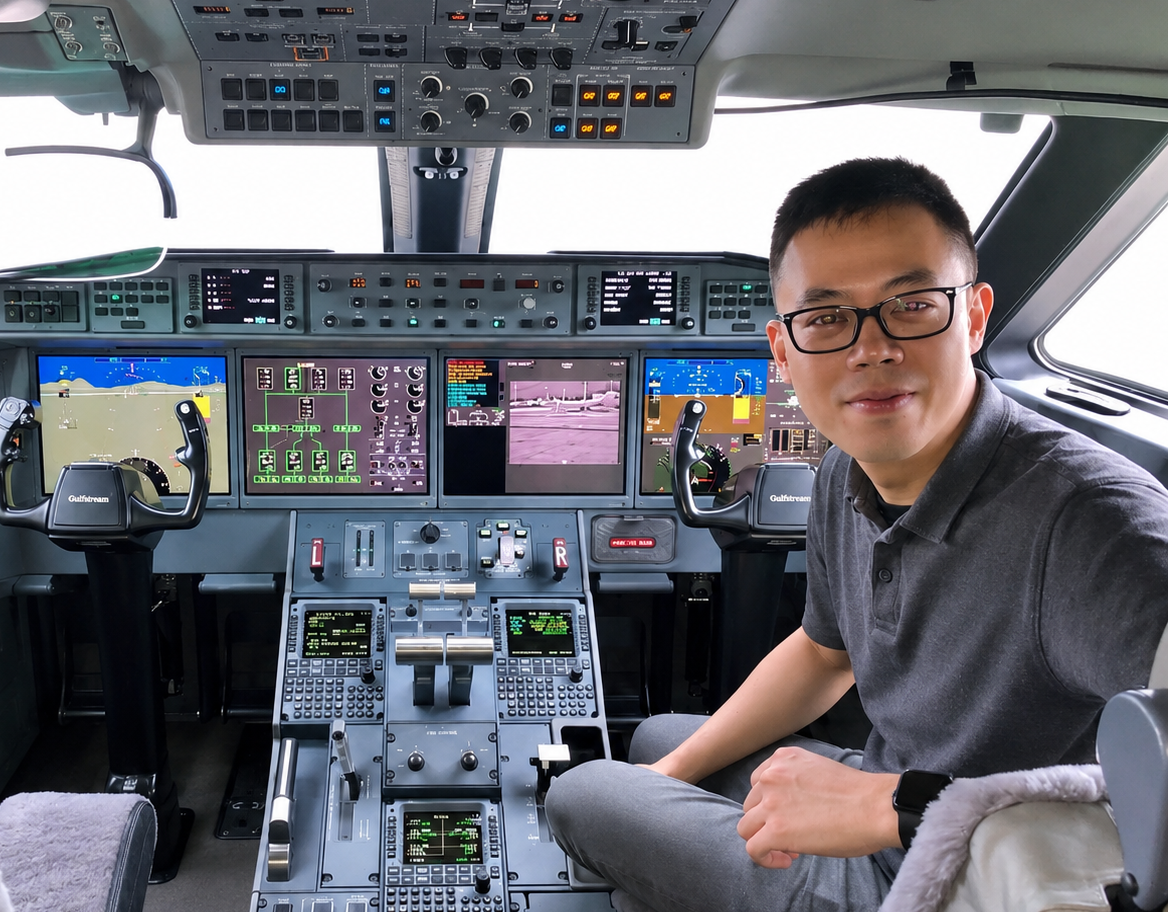
Skyfarer founder and CEO Nick Tsang in the cockpit of a Gulfstream G650. (Photo courtesy of Nick Tsang)
When a pilot wants to find a flight instructor, a mechanic, an examiner for a flight test, or a fair price on an airplane, the solution is usually the same: ask around at the airport.
Nick Tsang, founder and CEO of Skyfarer, wants to help fix this problem. He sees general aviation as a multibillion-dollar market that’s fragmented at every stage, without the unified online tools other industries take for granted.
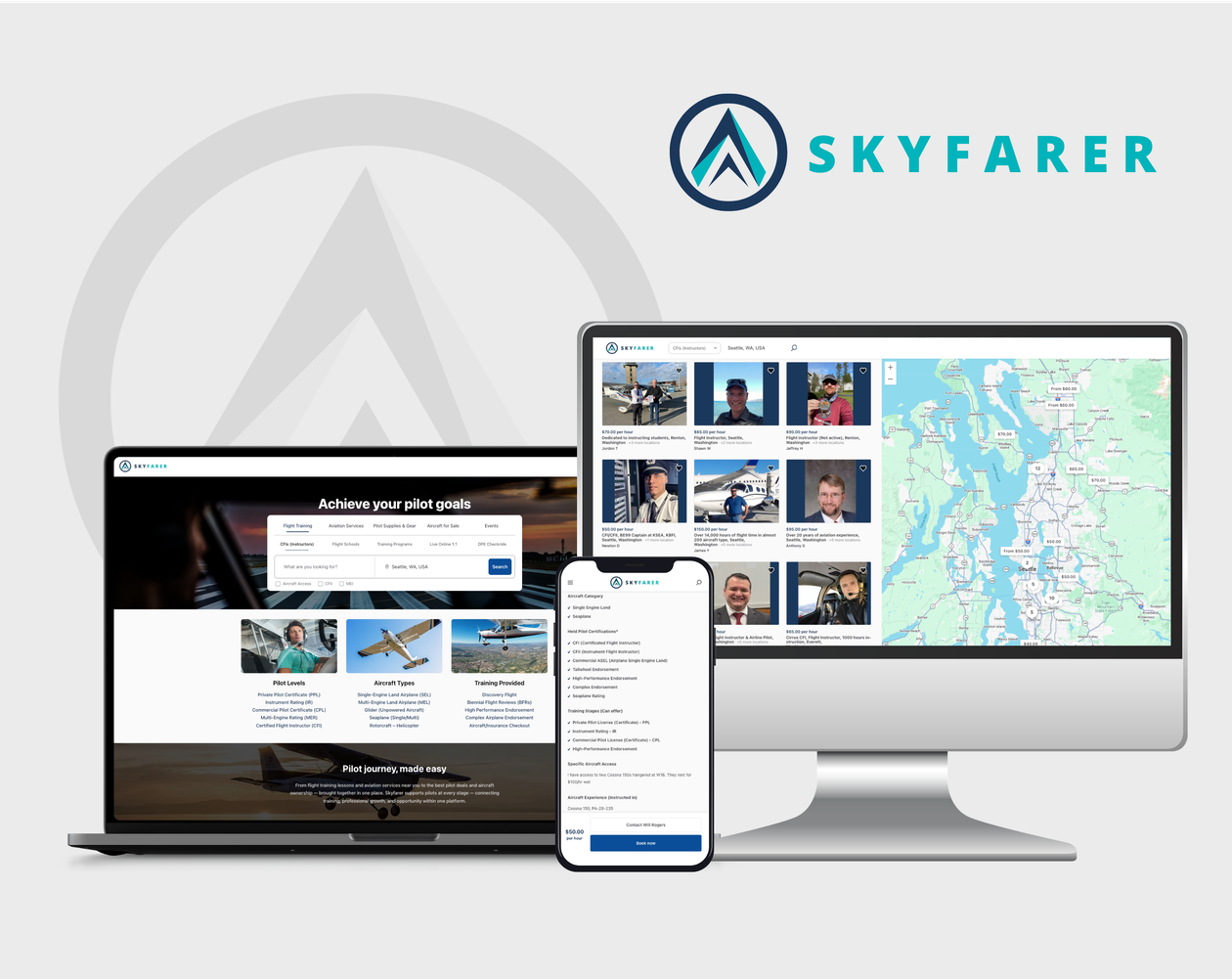
Skyfarer is a marketplace where pilots (and those who aspire to be one) can find instructors, flight schools, examiners, mechanics, gear and aircraft. Tsang calls it Airbnb for aviation.
Tsang grew up in Hong Kong, where his aviation roots trace to 2012, when he started flight training in New Zealand, and where he spent eight years in the Hong Kong Air Cadet Corps. He holds a master’s degree in educational management and turned down an MPhil at Cambridge in 2018 to help lead a $28 million initiative that brought computational thinking to more than 90,000 students.
He founded the company in July 2024 in Camas, Wash., just outside of Portland, Ore., and recently joined the board of the National Flight Training Alliance.
The company started with live online instruction and later added in-person training, buying a competing marketplace, InstructAir, in 2025 to sign up more instructors.
Skyfarer is self-funded apart from some early angel funding. The company says it has close to 14,000 registered users and 8,500 listings in all 50 states, plus an iOS app. July was its biggest month, with 9,900 monthly active users, up 70% from June, and inquiries and transactions up 60%.
Continue reading for Tsang’s answers to our Startup Spotlight questionnaire.
In 50 words or less, give us your startup’s elevator pitch?
Skyfarer is a marketplace for general aviation, SaaS-enabled, consumer-facing up front with enterprise infrastructure behind it. Pilots, training and service providers, examiners, and aircraft owners connect in one place. Think Airbnb for aviation: thousands of listings, all 50 states, still running on word of mouth.
What problems are you obsessed with solving?
Nearly half a million certificated pilots fly in the US today, and tens of thousands more start training every year. It’s a multi-billion dollar market fragmented at every stage, and the dropout rate in flight training is brutal. Much of it traces back to bad matching: wrong school, wrong instructor, wrong expectations, and even wrong aircraft.
People walk away from a life-changing dream because the market gives them no way to compare options before committing tens of thousands of dollars, and no community to lean on when training gets hard. Our own nationwide survey confirmed the setup: the internet is already the top channel for discovering, yet what people find there is fragments with no guidance.
And the problem doesn’t end at the first certificate. Countless milestones follow, from advanced ratings and checkrides to finding work as a pilot, buying an aircraft, and knowing who to trust for maintenance, and every step runs on the same word-of-mouth guesswork.
Meanwhile, the modern tools every other industry takes for granted have barely reached general aviation. I’m obsessed with fixing that across the entire pilot journey, because when a real ecosystem works, more people start flying, more keep flying, and the whole aviation community thrives.
What surprised you after talking to customers?
The first surprise was how much of the industry’s dysfunction traces back to one thing: customers don’t know what they don’t know.
A student pilot isn’t like a customer buying software. Nobody hands you a syllabus for the decision itself. Medical requirements, real costs, timelines, financing, how to evaluate a school, how to tell whether flying is even right for you. Most people start training without answers to any of it.
Then the gaps catch up with them: cost surprises nobody warned them about, plateaus with no mentor, an instructor who leaves for an airline seat mid-training. Most student pilots quit before their certificate. I spoke with people who’d spent years and six figures without reaching their goal. People don’t quit flying; they quit the process.
And the knowledge gap doesn’t stop at students. Aircraft buyers don’t know what a fair price looks like. Schools don’t know how to reach students beyond the airport fence. Instructors don’t know how to market themselves. The information exists but never reaches the person who needs it at the moment they need it.
The Skyfarer marketplace and app. (Image courtesy of Skyfarer)
But what surprised me most is how alive the ecosystem is. In most marketplaces, buyers and sellers are separate populations. In aviation, they’re the same people at different altitudes on the same journey.
Today’s student becomes next year’s instructor, then an airline pilot who comes back as a mentor, an aircraft owner, sometimes an examiner. The same flight instructor might also be an aircraft broker, a ferry pilot, or a director at a national aviation organization. Schools that compete refer students to each other. Half the industry volunteers at each other’s fly-ins.
Once I saw that, the product question changed: you don’t build a platform for one transaction. You build the place that holds people through every role they’ll ever play in aviation.
How has AI changed the way you build your company?
Fundamentally. A year ago I could only make non-code updates to our infrastructure. I’m not a software engineer, so ideas would come and then sit in a queue waiting on the tech team. Meanwhile I was absorbing everything I could from other marketplace models and from successful marketplace founders, but insight without shipping speed is just a reading list.
That’s inverted now. July was our highest-velocity building month since Skyfarer started. We’ve opened over 400 pull requests in company history, and nearly 200 of them came in July alone, most of which I shipped myself with AI-assisted development.
Nick Tsang at the Museum of Flight in Seattle. (Photo courtesy of Nick Tsang)
With frontier models available to everyone, moats are shifting toward speed, domain depth, and distribution. The clearest sign of the shift: we no longer keep a product roadmap, not even for the next year. Roadmaps exist because building used to be expensive, so we had to guess far in advance and commit. Now we notice something users need, assess it, and ship it the same week. The strategy stays fixed; everything else is discovered, not planned.
AI amplifies what Matt McIlwain at Madrona recently described as the traits of successful founders: curiosity to keep asking questions, humility to actually listen, and the willingness to act even when you might be wrong. What’s changed is where those traits can take you.
What’s one thing people misunderstand about your startup?
That our users are all twenty-two-year-olds chasing pilot careers. The truth: the person learning to fly right now could be your niece in university, your uncle who just retired, or your colleague who finally decided to stop postponing the dream. Flying is one of the few pursuits people take up at twenty and at sixty with equal seriousness, and we see that full range on Skyfarer every day.
The other half of the misunderstanding is thinking the journey ends at a certificate. It doesn’t end at all. An active pilot always has a next step: a flight review, an advanced rating, a checkride, an aircraft to buy or share or sell. Our job isn’t to graduate people out of the platform. It’s to help pilots stay active for decades, because a pilot who keeps flying is a customer for life and, more importantly, one more person keeping this community alive.
What’s the toughest decision you’ve made in the past year?
Killing our original thesis. Skyfarer started as live online instruction: connect students with seasoned flight instructors remotely, build stronger foundations before anyone burns money in an aircraft.
The logic was sound. The signups weren’t. People came to the platform, but the demand for online instruction never showed up at the rate the thesis needed, and the customer conversations explained why. The moments that make someone a pilot happen in person: sitting in the cockpit, meeting your instructor on the ramp, the airport itself as a place you belong. Online instruction supports the journey; it isn’t the journey.
Tsang, right, with Skyfarer founding advisor Todd Davis. (Photo courtesy of Nick Tsang)
So we expanded into in-person flight training, and we did it carefully. We talked with existing users, advisors, and people across the industry, planned the transition, then committed fully, to the point of acquiring a competitor to accelerate the in-person supply side. That decision changed everything about where we are today, but letting go of the original idea was hard.
First ideas feel like identity. Uri Levine says to fall in love with the problem, not the solution, and I had to learn it the way most founders do: the hard way. Customers are the ones who validate an idea. Our job was to listen when they did, and to listen harder when they didn’t.
One piece of advice for other entrepreneurs? Most startups fail. Founders exist to defy those odds, and you don’t defy them with a single brilliant move. You do it by staying curious, learning relentlessly, and applying what you learn to the company the same week you learn it. That loop is also, honestly, the fun part. The rollercoaster may not get less steep, but the ride gets rewarding when you can feel yourself getting better at it. And keep moving forward, because motion changes what uncertainty feels like. Stand still and the unknown is a threat.
We’ll know our company has made it when…
… when Skyfarer is the default for the entire pilot journey: learning to fly, finding training, booking a medical exam or a checkride, getting insured, buying gear, buying an aircraft, and every question in between. The way you check Zillow before you even know if you’re really moving, people will check Skyfarer before they even know if they’re really going to fly.
Today, aviation’s defining problem is how many student pilots give up. We’ll know we’ve made it when nobody talks about dropout rates anymore because the industry’s problem has become the opposite one: we need more aircraft, more instructors, more runways to hold everyone who’s flying.
When the bottleneck moves from people quitting to the sky getting crowded, we did our job.
Ali Farhadi, now a Microsoft corporate vice president of AI, at a Technology Alliance event in May 2024. (GeekWire File Photo)
GeekWire is profiling over the next few weeks some of the people and teams that are shaping the evolution of Microsoft in what we’re calling its “Microsoft 2.5” era.
From AI Frontier Lab to Frontier Ecosystem: Microsoft got a foothold in AI thanks largely to its partnership with OpenAI. But that’s not the way it is planning to continue growing its AI business.
Inside Microsoft AI (MAI), the Microsoft Superintelligence team is focused almost entirely on building its own frontier-level models. That team already has developed a handful of home-grown offerings, including MAI-Code-Flash for writing code faster; MAI-Cyber-Flash, a cybersecurity model; and MAI-Image, a model for creating images.
The head of the Superintelligence team is Ali Farhadi, corporate vice president of AI. Farhadi, who joined Microsoft five months ago, is also a professor at the University of Washington, where he has worked for nearly 15 years. He was previously CEO of the Allen Institute for AI (Ai2) and before that was an AI and machine learning leader at Apple for more than three years, after it acquired his startup, Xnor.ai.
When he joined Microsoft, Farhadi said in a LinkedIn post that he believed “Microsoft has all the pieces to win in this AI race: data, search, coding, infrastructure, agents, software and the world’s biggest Fortune 500 companies taking dependencies on Microsoft every day.”
Farhadi elaborated on that in an interview with GeekWire this week. AI is shifting from a “Frontier Lab” era to a “Frontier Ecosystem” era, he said. It’s no longer just about training models; it’s about integrating the models with enterprise data, platforms, distribution systems and customers in a trusted way.
The next battlegrounds in AI will be around cost, reliability, specialization, and deployment at scale, rather than simply building larger models that beat others in benchmark scores, he said.
“If you look around, there are not that many places to have all these missing pieces together at scale, especially if you add the element of trust to it,” Farhadi said.
Cutting through the AI noise: Farhadi said his management philosophy is grounded in the importance of personal relationships, which are especially key in big organizations. People need to understand your rationale and to trust you can deliver on what you’re tasked to do, he said — an approach that has served him inside both Microsoft and Apple.
Staying on top of the flow of information while filtering out the AI noise makes prioritizing crucial. The team has “a long list of things that we believe we should be doing,” he said, but much of it stays on the back burner to maintain a “laser focus on delivering on the main mission.”
The priority is building high-quality models, both generalist and domain-specific. On the domain-specific front, Microsoft is working with the Mayo Clinic on a healthcare-specific model based on Mayo’s own clinical data, as well as Microsoft’s cybersecurity and coding models.
The thinking: For a lot of enterprise work, a narrower model beats a bigger one.
“If you can do something at [the same] quality or better quality at a fraction of a cost, it’s just a no-brainer. And having a way to specialize to domains, to industries, to enterprises is one way,” he said.
Microsoft execs have referred to this approach as a “hill-climbing machine,” meaning the ability of a model to scale and continuously improve within a specific domain. Microsoft is coupling the hill-climbing with “frontier tuning,” like it is doing with the Mayo Clinic. Frontier tuning includes customizing frontier models; keeping proprietary data private, preserving institutional know-how; and avoiding leaking intellectual property (IP) into shared models.
“We all thought that IP is your data,” Farhadi said. “But we learned that IP is also how you work.” And that’s why safeguarding these elements is so crucial.
Open all the things? Farhadi led an expansion of open-source AI development at Ai2, the Seattle-based institute founded in 2014 by the late Microsoft co-founder Paul Allen. While Microsoft has contributed to the open-source community on various fronts, including AI tooling, it hasn’t open-sourced its frontier models.
Farhadi said he personally remains “a big advocate of open source,” but noted that the industry has changed since his Ai2 days as there are now more credible Western open-source models and businesses forming around them.
He didn’t rule out Microsoft doing something in open-source models, or the somewhat less-open “open weights” area, but there’s seemingly nothing happening on that front in the near term.
In the coming months and beyond, the focus of Farhadi’s team is helping Microsoft turn into a Frontier Ecosystem by building cutting-edge AI capabilities; helping enterprises create their own tuned versions of them; continuously improving models; and making sure customers keep control of their own destinies and data.
Success for Microsoft’s Superintelligence team has nothing to do with the idea of Artificial General Intelligence (AGI) which OpenAI, Anthropic and others have positioned as their ultimate goal over the years. In fact, when I asked Farhadi about AGI, he said, “I don’t understand what that means.”
Bill Gates at the keyboard in a 2018 file photo. (Gates Notes Photo)
Bill Gates is legendary, bordering on notorious, for his late-night emails — missives to colleagues with piercing questions about Java back in the day, or malaria these days, or whatever esoteric topic he happens to seize upon at any given moment.
But increasingly, he is sending these messages to AI, not to people. He’ll bounce something off Claude, get ChatGPT to weigh in, and insert himself in the middle.
He described the pattern in an interview with GeekWire: “It’s 3 a.m., I want to understand sodium batteries. Now, there’s no reason to go to sleep. Here we go! Yeah, it’s crazy.”
If you’re a curious person, he said, “this is a mind-blowing time.”
In terms of productivity, he added, “we are in heaven.”
All of which might be predictable. This is Bill Gates, after all. Now 70 years old, he has spent more than five decades impatient for the future to arrive — making the case that innovation, on the whole, will ultimately put humanity and the world in a better place.
So here’s the surprise twist: He’s now deeply concerned about where technology is headed, how fast it’s progressing, and how little the world is doing to get ready.
In a new essay, Gates says the “turbulent AI era” has arrived, with technology threatening to erase categories of jobs, supercharge fraud and deepfakes, lower the bar for cyberattacks on critical infrastructure, make it easier to engineer a deadly new disease, let governments kill without humans involved in the decision, and fundamentally change how kids grow up.
If someone came up with a credible plan to slow the pace of AI globally, he writes, he’d likely support it. But he doesn’t expect one. The geopolitical and economic forces are too much.
He says that the world needs to take action, and offers three ideas to start:
Build new institutions, at home and globally. No existing agency was designed for a technology that touches jobs, security, health, energy and elections all at once, he writes.
Gates calls for new national bodies that can set priorities across agencies, plus a new international organization modeled on nuclear weapons inspections, aviation rules and the ozone treaties.
Set aside jobs for humans. Gates calls this “Human Reserved”: work that machines will be fully capable of doing, but that we decide to keep for people anyway. The model is a nature reserve — land where we could build roads and buildings, but choose not to, because the loss would be too great.
One example: a robot delivering the news that you have an incurable disease. “There’s no technical reason why it couldn’t,” he writes. “Yet it shouldn’t.”
The idea came in part from watching the caregivers who looked after his father through Alzheimer’s, work he describes as “irreplaceably human.”
Tax AI tokens and robots. Today a company that hires a worker pays payroll taxes, while a company that buys a robot deducts the cost. Gates says that gives employers a reason to replace people. He’s calling for a tax on AI to change the incentives and help pay for retraining.
He first floated a robot tax nine years ago, but the idea was widely dismissed. He’s still for it. He acknowledges that it isn’t economically efficient, but says that with innovation accelerating, we can afford a little inefficiency as the price of keeping people employed.
Gates is candid that he doesn’t have all the answers, particularly on the proposal for “Human Reserved” jobs. Who decides what gets reserved, and by what criteria? How do you keep companies from using robots in the jobs that are supposed to stay human?
These, he writes, “will need to be worked out in public.”
In the meantime, he’s working it out with Claude. Gates said he has talked the idea through with the chatbot, thinking through different ways to get the share of work reserved for humans up to 40%, using shorter workdays and earlier retirement to spread what’s left around.
Crossing the threshold
In the GeekWire interview, Gates said the essay came out of a specific realization: the AI industry is blowing past its own warning signs, one after another, and almost nobody is saying so out loud.
For years, he said, people in AI described certain moments as dangerous points where the industry would stop and think hard before going further: making it easier to build a bioweapon, making it easier to launch a cyberattack, building machines people become emotionally dependent on, wiping out large numbers of jobs, and losing control of the technology itself.
“We’re in the process of crossing every single one of those thresholds,” he said.
Meanwhile, nobody in the industry wants to be first to step on the brakes. “Most people you talk to will say, yeah, well, if everybody else would slow down, maybe I would, too,” he said.
Gates said one way out of that standoff is for governments to step in.
His example: any AI model capable of designing new molecules — the capability that would let someone engineer a new disease — should be monitored. The monitoring would be mandatory rather than voluntary, and it would cover free models as well as commercial ones. It would also have to be written so a company can’t copy the model elsewhere and strip the monitoring out.
“To me, that’s kind of like common sense,” he said. “But we don’t see a specific proposal to do that.”
‘The whole thing seems so empty to me’
Under an executive order signed by President Trump in June, AI companies are asked to submit their most powerful models for government testing up to 30 days before release. The order specifically bars the program from becoming a licensing or preclearance requirement. The White House finalized the framework in early August.
Gates said he doesn’t get it.
“What is the threshold that’s being examined, and what is the action taken when you cross that threshold?” he said. “The whole thing seems so empty to me.”
If the world can’t take these basic steps, he said, “I really am going to throw up my hands.”
If the process stays voluntary, with no line and no consequence for crossing it, “we’re going to look back on this as a kind of eye-of-the-storm type moment,” he said.
Asked if he had taken his proposals to the Trump administration or to other heads of state, Gates said with a bemused tone, “Well, you could tell me who at the White House I should be talking to about this.” He said he hopes the essay reaches people in Congress and in the executive branch.
He said the public argument among AI companies over whether the risks are real is beside the point, because privately the people running them already agree. “I know they’re all worried,” he said, “or all of them that I know, which is basically everybody but Elon.”
People inside AI companies who acknowledge the downsides, Gates said, get told: “Hey, you’re hurting our PR while we’re trying to raise trillions of dollars.”
Gates said he previously expected losing control of AI to be a distant problem, something to worry about “many years from now.” He’s no longer convinced that’s the case.
He referenced an Aug. 11 episode of the Dwarkesh Patel podcast featuring Ryan Greenblatt, chief scientist at the AI safety group Redwood Research. Greenblatt said that as AI systems get more capable, the people building them understand less and less about what is happening inside, and that sufficiently advanced models could end up working against their creators.
“These are people who are super expert on the thing, going, well, maybe we won’t be able to control these things,” Gates said. “I mean, what kind of risk have we chosen to run here?”
In the poorest countries, he expects AI to do more good than harm. In the countries where the Gates Foundation works, doctors, teachers and farm advisors are all in short supply. AI can help fill those gaps. The foundation will lay out that work at its Goalkeepers event next month, including an effort to make AI models work as well in African languages as they do in English.
The job losses, he added, will hit rich countries first.
It’s the first big wave of new attention on the Microsoft co-founder and Gates Foundation chair since he answered lawmakers’ questions in the Jeffrey Epstein investigation on June 10, sitting for a nearly six-hour voluntary interview with the House Oversight Committee.
Gates, who has not been accused of any wrongdoing, was asked by Axios whether he’s concerned that the Epstein issue could undercut his message. According to the site, he compared this to earlier situations when personal and professional challenges diminished his ability to speak out on key subjects: during the Microsoft antitrust trial, and his divorce from Melinda French Gates.
The AI Road Ahead
For all of this, Gates is still thinking about how technology will change human life and productivity, in many ways for the better on an individual level.
A key step, he said, will be establishing broad-based persistent memory for AI agents across contexts. For now, AI still doesn’t know you like a human assistant who’s familiar with your relationships and how you think about your time.
Gates sees the role of apps changing in the future. Instead of bouncing between different pieces of software, he said, AI will increasingly be the primary interface. “You won’t go to those applications,” he said. “You’ll just go to your personal agent.”
He also sees AI continuing to transform shopping, to an extreme: “We will get to a point where you won’t buy things yourself. You just won’t.” Telling the agent to help you buy something, “it’ll consider so many more things, and it’ll make it so much easier for you to do it.”
Asked whether he is still an optimist, Gates didn’t answer directly. “I don’t think being pessimistic is helpful,” he said.
“I do think, wow, this is sure an interesting time. I’m the guy who in my 30s thought people in their 50s or 60s didn’t understand anything.” He called it “kind of bizarre” that he would be delivering a message like this at 70.
“But I am very concerned. And honestly, when you get people one-on-one, so are they.”

 Login
Login