Get caught up on the latest technology and startup news from the past week. Here are the most popular stories on GeekWire for the week of Sept. 6, 2026.
Nine years after setting out to tackle unsheltered homelessness with rapidly deployable, hard-panel micro-shelters, Everett, Wash.-based social purpose corporation Pallet is closing its business. Read More… Read More
Helion Energy has opened a downtown Seattle office as its headcount hits 800 employees, adding to its five-building Everett headquarters and its Malaga, Wash., site, where the fusion startup is building its Orion generator facility. The company, which has raised more than $1.5 billion, is racing to get Orion operational within two years to meet a contract to supply fusion energy to a Microsoft data center. Read More… Read More
The 43,000-square-foot space at West8 in the Denny Triangle neighborhood will bring together employees across digital products, AV, IT, HR, marketing, and other teams. Read More… Read More
Jacob Colker argues that Seattle has a branding problem, not a lack of talent, ambition or accomplishments. He lays out a five-step plan for the region’s tech community to start telling its own story. Read More… Read More
Amazon has named Kevin Mandia, the founder of breach-investigation firm Mandiant, to its board of directors, adding security expertise a few months after former NSA director Keith Alexander stepped down. Mandia now runs Armadin, a startup that uses AI to run attacks against corporate networks as a way of testing their defenses. Read More… Read More
T-Mobile named Jessica Uhl as CFO-designate, succeeding Peter Osvaldik as CFO come February. Microsoft and Blue Origin saw the departure of vice presidents, while startups AZX and Caddi added leaders, among other tech personnel changes. Read More… Read More
An independent study commissioned by the City of Seattle says the city should protect the big tech employers it has while building a more diverse economy on top of them. The 127-page report also says Seattle’s tax structure is unique among its peers in penalizing the hiring of senior, high-compensation workers. Read More… Read More
It’s the end of an era at Microsoft: Frank X. Shaw, the executive who oversaw the tech giant’s communications for nearly three decades, first at an external agency and for the last 17 years as one of its senior leaders, is leaving at the end of the year. Read More… Read More
This week on the GeekWire Podcast: A study commissioned by the City of Seattle says the city is not in decline but is in danger — finding that 10 companies, nine of them in tech, pay three-quarters of the payroll tax on large employers, and that the tax structure uniquely penalizes the hiring of senior, high-compensation workers.
The report says Seattle should be most concerned about AI but most active in cleantech, the one industry the city can actually shape, since it owns the electric utility and controls permitting, building codes and land use.
Meanwhile, the Seattle Times and Newsday sue Microsoft and OpenAI, accusing them of copying hundreds of thousands of articles to train their AI models, putting Microsoft’s hometown paper against a company that helps fund some of its journalism.
Which leads us to a new GeekWire Trivia Challenge about the Microsoft products that Apple later turned into categories. Stick around to the final segment to see if you can figure it out.
Upcoming Event
AI meets real estate
GeekWire, in partnership with Real Estate at Work, is recording the GeekWire Podcast live at 4 p.m. Wednesday, Sept. 16, with Toby Roberts, SVP of Engineering at Zillow. John Cook and Todd Bishop host with Real Residential broker Leka Devatha at Atmosphere Seattle. Grab a ticket.
The Seattle-based video game developer behind the award-winning virtual reality adventure Moss has closed its doors.
The announcement was made via Polyarc Games’ LinkedIn page on Friday afternoon. No specific reason was offered for the studio’s closure.
“After nearly 12 years riding the joyous rollercoaster of emotions that is making video games, our time together has come to an end,” wrote an unnamed Polyarc representative. “Thank you to everyone at Polyarc. Our work is now finished.”
Twenty-nine employees will be dismissed due to the studio’s closure, including co-founders Chris Alderson, Danny Bulla, and CEO Tam Armstrong. Polyarc has posted a list of contact information and profiles for all affected employees, in an attempt to help them line up their next positions.
Polyarc’s first and best-known release was 2018’s Moss, where players helped guide a young mouse named Quill through a fantasy world on a journey to save her uncle. It was followed by 2022’s Moss: Book II, a direct sequel that continued Quill’s story, and the 2025 strategy spin-off Glassbreakers.
Polyarc’s most recent release was this year’s Moss: The Forgotten Relic for PC and console, which collected both Moss games into a single non-VR experience.
Armstrong, Bulla, and Alderson founded Polyarc as a startup in 2015. All three were former employees of Bungie in Bellevue, where they’d all worked in different capacities on Bungie’s online shooter Destiny.
Polyarc’s closure comes almost six months after its announcement in March that it’d had to significantly reduce the size of the company, and almost eight months after a wave of layoffs at Meta that forced a major reduction at Bellevue, Wash.-based VR studio Camouflaj (Republique, Batman: Arkham Shadow).
As noted in January, Meta is perhaps the largest current player in the virtual reality sector, largely off the ubiquity of its standalone Quest headsets. When Meta decided to deemphasize its VR efforts in January, reportedly in favor of wearable computing and AI research, it touched off a negative ripple effect throughout the virtual reality field.
There is a chance that Valve’s upcoming Steam Frame may serve as an effective bailout for the VR sector by reigniting consumer interest, but at time of writing, the Frame has no release date. It’s apparently imminent, as suggested by a big leak in August, but there’s nothing definite. If the Steam Machine’s release in June was any indication, however, we can assume the Steam Frame will launch without warning on some random Tuesday morning in the next two months.
Frank X. Shaw addresses the media at Microsoft on May 18, 2025, in advance of the Build conference. (GeekWire Photo / Todd Bishop)
It’s the end of an era at Microsoft: Frank X. Shaw, the executive who oversaw the tech giant’s communications for nearly three decades, first at an external agency and for the last 17 years as one of its senior leaders, is leaving at the end of the year.
Shaw, 64, said he’s not retiring, although he doesn’t have another job lined up. He plans to stop working for a while, do some of the things he hasn’t had time for, and then decide what’s next.
“I have had a ringside seat at some of the biggest leadership, technology, and business transformations that have ever taken place,” Shaw said, sharing the news of his departure (under embargo) in a phone call Thursday afternoon. “I just feel incredibly fortunate.”
He said he had been discussing his potential departure for some time with Takeshi Numoto, Microsoft’s chief marketing officer, looking for the right moment.
Microsoft has not announced a successor for his role as chief communications officer. In a LinkedIn post, Shaw said the company will consider internal and external candidates.
A statement from Shaw’s colleagues in corporate communications credited him for his many years shaping Microsoft’s “voice and reputation with intelligence, candor and wit. His leadership and contributions to the company are too extensive to list, as is the number of journalists who have, at one point or another, used his name in vain.”
A former Marine Corps public affairs officer, Shaw has worked with all three of Microsoft’s CEOs. He started on the agency side, at Waggener Edstrom — now known as We. Communications — when Bill Gates was still running the company.
He built his reputation defending and advocating for Microsoft through some of its hardest stretches: the antitrust years, the Windows Vista backlash, the scramble to replace Steve Ballmer as CEO, and the weekend in 2023 when OpenAI’s board fired Sam Altman.
As the company’s top communications executive, he has also told the story of Microsoft’s reinvention under CEO Satya Nadella, from the LinkedIn and Activision Blizzard deals to an AI push that has carried Azure past $100 billion in annual revenue.
Evolving with technology: Shaw has spent much of his career closely watching the tech landscape and moving Microsoft’s voice into new channels as they emerged.
“We’re always thinking about what is the art and science of communications,” Shaw told PRWeek. “How do we reach our audiences most effectively in a changing environment?” He called the arc from print to radio and TV to social media and newsletters a “constant evolution of influence.”
He turned the corporate blog into a place where the company argued its own case, writing “Microsoft by the numbers” himself in 2010 — a stat-by-stat comparison against Apple and Google that TechCrunch dubbed “fantastic passive-aggressive.”
He and his team experimented with different and risky methods of telling the company’s story, holding mass briefings under embargo and publishing documents known as the “Book of News” in advance of its major keynotes and conferences. The prospect of a reporter having to answer to “fxs” was no doubt a factor in ensuring the news (mostly) didn’t leak.
Shaw hired Steve Clayton out of a technical role at Microsoft in London, where he had been blogging about the company unofficially out of frustration with how it was perceived, and made him chief storyteller. In the middle of the AI boom, Clayton and Shaw embraced the analog undercurrents in popular culture and launched Signal, a quarterly Microsoft print magazine for business leaders.
Clayton was VP of communications strategy by the time he left in January to become chief communications officer at Cisco, making Shaw’s planned departure the second high-profile exit from Microsoft’s comms team in a year.
Adapting to AI: In recent years, Shaw made his own team a testing ground for AI, publishing what worked and what didn’t. In a 2023 post he described using Copilot in Teams to pull story ideas out of conversations with spokespeople and anticipate coverage after interviews, and asking the AI to “poke holes in a statement we’re making on a tricky topic.”
He called it his corporal, a reference to Napoleon, who was said to bring one to meetings and ask whether his generals’ war plans made sense to him. A survey of 80 people in Microsoft’s communications and marketing organization found 84% did not want to go back to working without it.
Shaw was also known to use AI as a sounding board when a story frustrated him, offering him an objective take before he called and let a particular reporter have it.
He announced his departure Friday morning in a message to Microsoft’s communications team (reminding them he’s still there for a few months yet) and his public post on LinkedIn.
“Thank you as well to all the reporters, editors, writers, influencers and analysts who have put up with me over this time, enduring my early and late night calls, my off the record ‘no comments,’ my bad story ideas and my extended commentary on headlines and positioning,” he wrote.
“You all have incredibly hard and valuable jobs,” he added, “and while I’ve not agreed with everything said about us 😊 I appreciate you anyway.”
Matt Oppenheimer, second from right, at his Dartmouth College Entrepreneur Hall of Fame induction ceremony in San Francisco on Thursday. The Remitly co-founder is joined by school friends and dignitaries, from left, Jeff Crowe, Andrea Reisman Johnson, Trevor Jensen, Maia Josebachvili, Dartmouth President Sian Leah Beilock, and Jamie Coughlin. (Photo courtesy of Matt Oppenheimer)
Nearly 25 years after enrolling at Dartmouth College to study psychology and embarking on a path that led him to co-found Seattle fintech giant Remitly, Matt Oppenheimer has been inducted into the Ivy League school’s Entrepreneur Hall of Fame.
The honor, presented Thursday night in San Francisco as part of Dartmouth’s annual Entrepreneurs Forum, comes seven months after Oppenheimer stepped down as Remitly’s long-time CEO to become chairman of the board.
Created by the Magnuson Center for Entrepreneurship, the Hall of Fame honors Dartmouth alumni who have made lasting positive impacts through their ventures. Oppenheimer joins a select group of honorees with Northwest ties — including Smartsheet co-founders Brent Frei and Mark Mader — and used his acceptance remarks to express deep gratitude to the admissions officers who took a chance on a kid from Boise, Idaho, with “OK grades” and “below average SAT scores.”
Speaking with GeekWire ahead of the event, Oppenheimer recalled how his early college years studying social psychology helped shape his understanding of business.
“I think a lot of business and entrepreneurship does come down to interpersonal dynamics,” Oppenheimer said. “I am a people person. But how do you find what I call career-market fit when it comes to really understanding and connecting with people? That’s ultimately my strength, but it was really hard to define earlier in my career.”
After graduating from Dartmouth in 2005, Oppenheimer earned an MBA from Harvard Business School and worked in Kenya for Barclays Bank, where seeing families hit with steep fees on cross-border money transfers inspired him to start Remitly in 2011.
He served as CEO for nearly 15 years, guiding the company through its 2021 NASDAQ IPO and building it into a fintech powerhouse serving over 9 million customers across more than 170 countries before transitioning to chairman in February.
In his acceptance speech on Thursday, Oppenheimer focused on a central philosophy he calls leading authentically through “towering strengths and shadows.”
“Each of us has a few towering strengths — things we are in the top 10% of the world at doing. Not good at. Towering,” he said. “And almost always, that tower casts a shadow. The same trait that makes you exceptional at one thing quietly makes you a liability at another. They aren’t two traits. They’re one trait, seen from two sides.”
Matt Oppenheimer was introduced in San Francisco on Thursday by his Dartmouth classmates, Maia Josebachvili, left, and Trevor Jensen, right. (Photo courtesy of Matt Oppenheimer)
He pointed to his own extreme tenacity as an example, noting how it helped him build Remitly through years of investor rejections and early product stumbles, but how it also had a darker side.
“That same tenacity can lock onto things that are unhealthy, or unchangeable, or both,” Oppenheimer shared, candidly discussing his personal experiences with OCD-related anxiety and depression. “This isn’t a character flaw sitting next to my strengths. It is the shadow of my greatest strength, from the same place. Which means it’s something to work with … harness the tower, manage the shadow … rather than something to be ashamed of.”
Seven months into his transition from operational CEO to board chairman, Oppenheimer says the shift has felt surprisingly comfortable. Free from managing daily execution, he now channels that same intensity into coaching current leaders and serving on corporate boards.
“I have so much trust in Sebastian [Gunningham], our CEO, and it’s super exciting to support him in a chair capacity,” Oppenheimer told GeekWire. “I get to share reflections on the journey, mentor, and coach. I didn’t know that would be the case, because you hear so many examples of founder-CEOs who transition and have a really hard time with it.”
That mentorship extends to Seattle’s broader startup community, where Oppenheimer is an active member of Foundations, a collective of local tech founders and AI leaders. When advising early stage entrepreneurs, he urges them to remain hyper-focused on solving a single, deep customer problem rather than spreading themselves thin.
And while AI has vastly accelerated product development, Oppenheimer notes that the core fundamentals of building a business haven’t changed.
“With fintech, you still have to build the trust, get the licensing, and build out the compliance infrastructure and banking relationships,” he said. “The actual building and deployment of product got a lot faster, but if you don’t have great judgment, you can go down the wrong path pretty quickly.”
Looking back 25 years later, Oppenheimer noted that the Dartmouth admissions officers who took a chance on him didn’t look past his test scores by accident — they told him years later that they were drawn to his personal qualities and humanity.
“Two strangers in an office in Hanover found my tower before I had any idea what it was, and then they handed me the place to build on it,” Oppenheimer said in his closing remarks. “That isn’t a debt. It’s a privilege. And the only sensible thing to do with a privilege is use it well.”
Las Vegas Raiders running back Ashton Jeanty, an investor in Nukleus and a spokesperson for the platform. (Nukleus Photo / Ben Miller)
Hector Rivas spent a decade building ThriftBooks into one of the country’s largest used-book sellers, before an unlikely second act: co-founding a sports agency representing NFL players.
That career change led him to the problem behind his newest startup, and to the Las Vegas Raiders running back who just invested in it.
Nukleus founder and CEO Hector Rivas. (LinkedIn Photo)
Nukleus, based in Issaquah, Wash., is building what Rivas calls an operating system for the business of sports. The idea is a single workspace for everyone in an athlete’s orbit: agent, lawyer, CPA, financial advisor, marketing team, and others. It lets them all work from the same contracts, deadlines and records, rather than each keeping a separate pile of emails and spreadsheets.
The idea came out of Rivas’s years at Disruptive Sports, the agency he co-founded in 2020 and left earlier this year.
Ashton Jeanty, who signed a four-year, $35.9 million rookie contract with the Raiders in 2025, has taken equity in the company and signed on to serve as its public face.
Nukleus has also named four strategic investors: Mat McBride, Microsoft’s executive vice president and CFO for commercial products and infrastructure; WaFd Bank President and CEO Brent Beardall; investor Skyler Nelson, previously of Vulcan Capital and its successor firm Cercano; and Dr. Brett Kindle of the Andrews Institute in Gulf Breeze, Fla.
The company has a team of 12 based out of its Issaquah office, plus a supporting engineering team in India. Most of the team is engineering.
Other executives include CTO Eric Ahlstrom, previously at Microsoft, Unity, Oracle and ESPN; chief creative officer Ben Miller, a former creative director at the University of Washington and CAA Sports; and CFO Matt Porter, who worked with Rivas at ThriftBooks, EcoGoodz and Disruptive.
Nukleus closed a pre-seed round from friends and family in 2025 and is raising again now. Rivas declined to disclose the amount raised by the company so far.
From books to football: Rivas was ThriftBooks’ first CEO, running the used-book seller for about a decade after it launched in 2003. Based in the Seattle area, the company grew during his tenure from a storage unit in Kirkland, Wash., to 10 distribution facilities in 10 states, by his account.
He went on to found EcoGoodz, a used-goods and overstock brokerage, and in 2020 co-founded Disruptive Sports Agency with agent Henry Organ.
Rivas, an NFLPA-certified contract advisor, worked the business side of the agency. He left earlier this year to build Nukleus full time.
The years inside the agency are what produced the idea.
Everyone in a player’s orbit was working off “their own version of the truth,” Rivas explained via email: the agent, the lawyer, the CPA, the financial advisor, the marketing team. The athlete, he said, “was the one absorbing the cost of that disconnect,” in slower decisions and deals that fell through the cracks.
The pitch in Las Vegas: Jeanty and Rivas knew each other from Rivas’s years at the sports agency, and Rivas said the running back had been tracking what he was building.
“Because Ashton and I already knew each other, and he’d been aware of what I was building, the conversation came together naturally,” Rivas said.
He flew to Las Vegas to walk Jeanty through the model, the team, and where the company was headed. Rivas said Jeanty’s equity reflects both money invested and his role promoting the platform.
In a statement, Jeanty described the job of running his own career.
“Coming into the NFL, you become a CEO, directing a team of agents, advisors, and marketers, whether you’re ready or not,” he said. “Nukleus is what finally gets them all on the same page, so I can actually run that team the way it should be run. That’s why I invested in it.”
Where things stand: The product is in a free beta with about 30 users, including athletes, agents, agencies, lawyers and marketing staff. Nukleus plans to charge $99 per user per month for a starter plan and $249 for a full-featured one, with custom enterprise pricing. Athletes join free.
Alongside contract storage, deadline tracking and a shared workspace, the company is building AI tools meant to answer questions about contract terms and league rules.
Others are working similar territory. Agent Live 360 sells software built specifically for sports agents, and Opendorse, which says it works with more than 1,000 sports agents, offers tools to negotiate, approve and track deals. Nukleus says it differs from narrower tools by serving everyone in an athlete’s orbit.
The bigger bet: The company is looking well past a single app.
“Long-term, I don’t see this as a tool athletes use, I see it as the infrastructure the entire business of sports runs on,” Rivas said. “Every athlete becomes the center of their own connected team, and every professional working with them, across every sport, at every level, operates on one shared system instead of a hundred disconnected ones.”
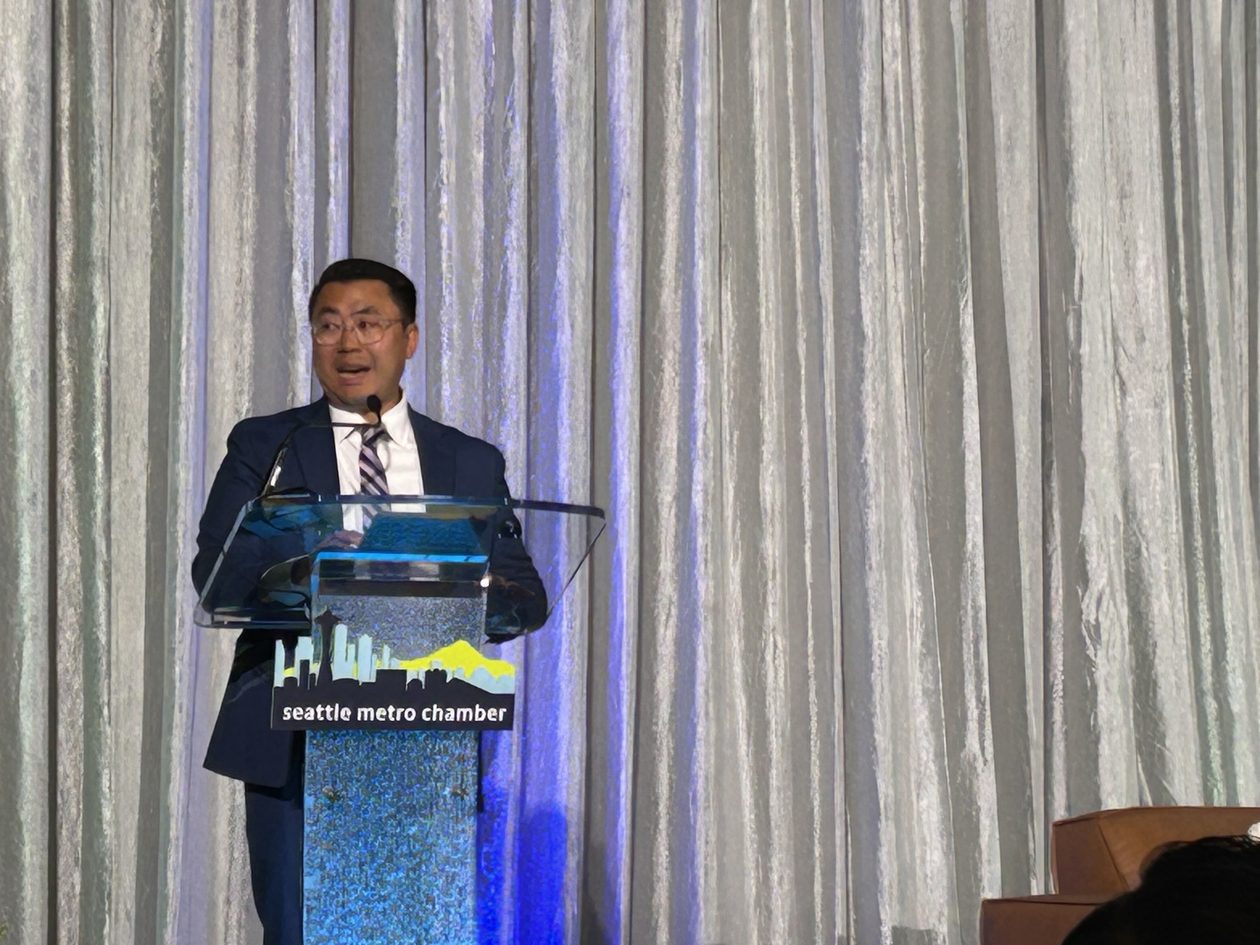
Seattle Metropolitan Chamber of Commerce CEO Joe Nguyen speaks at the Westin Seattle on Thursday. (GeekWire photo)
Seattle Metropolitan Chamber of Commerce CEO Joe Nguyen delivered a direct message to regional leaders at the organization’s 144th annual meeting on Thursday: Seattle’s progressive social goals cannot exist without a thriving employer base.
Nguyen, a former Washington State Senator and Microsoft manager who served as Director of the Washington State Department of Commerce before taking over the Chamber, used his inaugural annual meeting address to bridge the gap between regional business priorities and broad civic goals.
While political and business leaders often appear at odds in Seattle, Nguyen argued that the two are deeply intertwined and fundamentally interdependent. Having a healthy business community is “not up for debate; it is a requirement,” Nguyen told the audience of more than 800 civic and business leaders.
He continued:
“So I want to be very clear: the progressive values in this region depends on the economic activities and jobs created by strong employers. Housing doesn’t fund itself. Human services do not fund themselves. Public safety and parks do not fund themselves. They are made possible by people creating companies, making payroll, and hiring workers, when businesses succeed, our values get funded. Economic growth is not separate from social progress. In fact, economic growth makes social progress possible. You cannot fund compassion from an empty treasury.”
Nguyen framed his vision for Seattle through a personal lens, detailing his family’s journey arriving in Seattle as refugees from Vietnam with little more than “hope.” A powerful image of his family departing Vietnam on a rickety boat accompanied his remarks.
He recalled his family taking footholds in local business, operating a billiards hall in White Center, working at the Port of Seattle and his mother sewing for JanSport. Nguyen later attended Seattle University on Capitol Hill while washing dishes, went on to work at Microsoft, entered the Washington State Senate representing the 34th District, and eventually joined Governor Bob Ferguson’s administration as Commerce Director.
“The larger lesson from my family story is not about any one company or career,” Nguyen said. “It is about what’s possible when a region creates opportunity. Microsoft opened doors for me that I never knew were even possible as a kid growing up in White Center. The employer community did more than employ my family; it changed the trajectory of our lives.”
Pointing to macro-level data, Nguyen highlighted that the tri-county regional economy (King, Pierce, and Snohomish counties) generates $600 billion in annual economic activity, representing 71% of Washington State’s total economic output and ranking as the 10th largest metro economy in the United States.
Additionally, local business activity funds roughly 70% of the City of Seattle’s budget revenue.
However, Nguyen cautioned against taking the regional economy for granted amid rising operational costs, public safety challenges, and regulatory friction.
“Prosperity is not permanent. It is not part of the scenery like Mount Rainier,” Nguyen said. “It is something a region must earn, protect, and renew… When an employer leaves, we lose jobs, we lose customers for nearby small businesses, we lose charitable giving, we lose future investments, and we lose the public revenue that sustains our shared priorities.”
Nguyen pointed to recent momentum in aligning state and local government with economic development priorities.
Over the past year, state lawmakers introduced a dedicated economic development committee in the legislature, the governor formed a state business council, and the Mayor of Seattle signed an executive order establishing a local Economic Development Council.
The Chamber’s core advocacy pushes remain centered on faster permitting, housing expansion, and addressing public safety as both a quality-of-life and economic imperative.
On the latter issue, Nguyen joined other business leaders earlier Thursday in signing an open letter with executives from Microsoft, Starbucks, and dozens of regional employers demanding a 100-day public safety action plan from City Hall.
The letter, spearheaded by the Chamber, Challenge Seattle and the Washington Roundtable, urged the city to accelerate 911 response times, activate surveillance cameras, and step up foot patrols to protect workers, visitors, and foot traffic across downtown.
“We will partner when partnership produces results. We will push when pushing is necessary,” Nguyen said in his remarks at the annual meeting. “We will be constructive, but we will not be passive. And we will never apologize for standing up for the employers and workers who make this region possible.”
Looking forward, Nguyen urged the region’s tech sector, innovators and policymakers to resist complacency and bet on the future of Seattle. Nguyen concluded his remarks by asking the audience to embrace the future, and he said he’s optimistic about what’s ahead because he sees “people betting on Seattle every single day.”
“I believe that Seattle is at an inflection point. We can give in to complacency… or we can decide that our next chapter will be even more ambitious than the last… Somewhere in this region, an entrepreneur is building our next great company, a scientist is making a discovery that will save lives, and a young person in White Center is imagining a future none of us can see yet. And it is our responsibility to give them that chance.”
We’ll be breaking down Nguyen’s address, the Chamber’s 100-day public safety push and the broader debate over Seattle’s economic future on this weekend’s episode of the GeekWire Podcast. Be sure to tune in here, or wherever you get your podcasts.
Tents in a vacant lot in Seattle’s Belltown neighborhood. (GeekWire Photo / Kurt Schlosser)
A roster of top Seattle business leaders and regional CEOs is demanding urgent action from City Hall on public safety, calling on Mayor Katie Wilson and the City Council to roll out a concrete 100-day action plan backed by measurable goals and transparent progress tracking.
In a letter sent Thursday, executives from major area employers — including Microsoft, Starbucks, Costco, F5, Alaska Airlines, Zillow, and others — urged city leaders to protect and expand public safety funding amid growing skepticism that the city currently has an effective strategy to address crime and homelessness.
The push centers on findings from an August joint public-opinion poll of registered Seattle voters, which revealed that while every proposed safety measure drew at least 75% support across all demographics, only 34% of respondents expressed confidence in the city’s current strategy.
Pointing to severe staffing shortages — noting Seattle has just 1.31 sworn officers per 1,000 residents, far below peer cities like Denver, San Francisco, and Boston — the signatories argued that budget decisions must directly align with measurable safety outcomes.
The effort was spearheaded by major regional business leadership organizations, including the Seattle Metropolitan Chamber of Commerce, Challenge Seattle, and the Washington Roundtable. Their leaders — Joe Nguyễn, former Gov. Chris Gregoire, and Rachel Smith — jointly signed the appeal alongside dozens of local chief executives spanning technology, retail, healthcare, and sports franchises.
“Voters are asking for action, on a timeline, with results they can measure,” the coalition wrote in the letter, emphasizing that their recommendations reflect a broad consensus across the city. “This is not a narrow or partisan agenda, it is a shared baseline that Seattle residents and the business community are asking their elected leaders to deliver both now and as a sustained priority.”
The letter outlines a series of immediate and short-term actions the group is asking City Hall to enact, backed by overwhelming support in their poll:
The letter to Seattle city leaders calls for activation of CCTV cameras as well as increased officer patrols in areas including Pioneer Square, the Stadium District and Little Saigon. (GeekWire Photo / Kurt Schlosser)
CCTV surveillance: Activate CCTV cameras in Pioneer Square, the Stadium District, and other high-event areas to deter crime and assist law enforcement.
Foot and bike patrols: Establish regular police patrols on foot and bicycle in areas facing persistent public safety problems, specifically citing Little Saigon (90% poll support).
911 response accountability: Recommit to a standard 7-minute priority 911 response time, backed by transparent reporting when targets are missed (90% support). The letter noted data from Nordstrom showing only 29% of 911 calls from its flagship downtown store yielded a police response, compared to 100% at its Bellevue and Southcenter locations.
Drug treatment and diversion: Direct CARE Department specialists to offer treatment and shelter first, but require law enforcement to arrest and prosecute repeat offenders who repeatedly refuse help (82% support).
Open-air drug markets: Require SPD and the City Attorney to establish a clear, prioritized pathway for shutting down open-air drug markets (81% support).
Encampment bans and timelines: Institute a policy banning encampments within 250 feet of parks, playgrounds, or schools, and mandate that the city clear encampments in those zones within 72 hours (79% support).
Among those who signed the letter: Brad Smith, Vice Chair & President of Microsoft; Jeremy Wacksman, CEO of Zillow; François Locoh-Donou, CEO of F5; Matt McIlwain, Managing Director at Madrona Venture Group; Julie Sandler, Co-founder & Venture Partner at PSL Ventures; Matt Oppenheimer, Chairman of Remitly; Erik Nordstrom, CEO & Co-President of Nordstrom; Brian Niccol, Chairman & CEO of Starbucks; Ron Vachris, CEO & President of Costco; Ben Minicucci, CEO & President of Alaska Air Group; Mike Sievert, Vice Chairman of T-Mobile; and Ada Healey, Chief Real Estate Officer at Vulcan Real Estate.
The business community’s coordinated push arrives during a pivotal moment for public safety policy in City Hall, where political tensions over policing and crime response have flared in recent weeks.
While overall violent crime and homicides in Seattle dropped during the first half of 2026 compared to last year, high-profile violent incidents continue to fuel public and commercial anxiety. Downtown, Belltown, and high-foot-traffic corridors have experienced recent spikes in gun violence and fatal altercations — including multiple homicides in Belltown and Westlake Park in early September alone.
At the same time, the Seattle Police Department continues to grapple with acute staffing shortages following years of officer departures exceeding hiring goals. The persistent deficit has left response times stretched thin, prompting deep frustration from major employers and pushing retail hubs to demand a more visible police presence.
Policy friction between the Council and Wilson’s administration has also intensified. Debate has centered on the rollout of public surveillance technologies — where the mayor’s office recently paused CCTV camera expansions pending a data privacy audit — as well as ongoing friction surrounding the leadership of the police department.
Responding to the letter, Wilson told GeekWire that her administration shares the business community’s commitment to public safety, noting that “many of the specific requests they made are well underway.”
Wilson highlighted expanded foot and bicycle patrols in neighborhoods like Little Saigon and Belltown, 3,500 police officer applications currently in the queue, and an upcoming gun violence reduction strategy set to roll out next week. While noting that SPD data shows homicides and shootings at 10-year lows, Wilson acknowledged public impatience.
“We have far too much crime and public disorder and people have a right to be frustrated,” she said. “I, like everyone in Seattle, want to see that progress happen faster and steadier.”
The safety campaign comes on the heels of a 127-page independent economic study commissioned by the city, which warned that while Seattle boasts an “almost peerless” tech workforce and key AI assets, its economy is in a fragile position due to heavy corporate concentration and tax policies that penalize senior hiring.
The study noted that Seattle’s tax base remains vulnerable if major employers opt to relocate or grow outside the city limits, reinforcing the business coalition’s argument that public safety is closely tied to the city’s long-term economic stability.
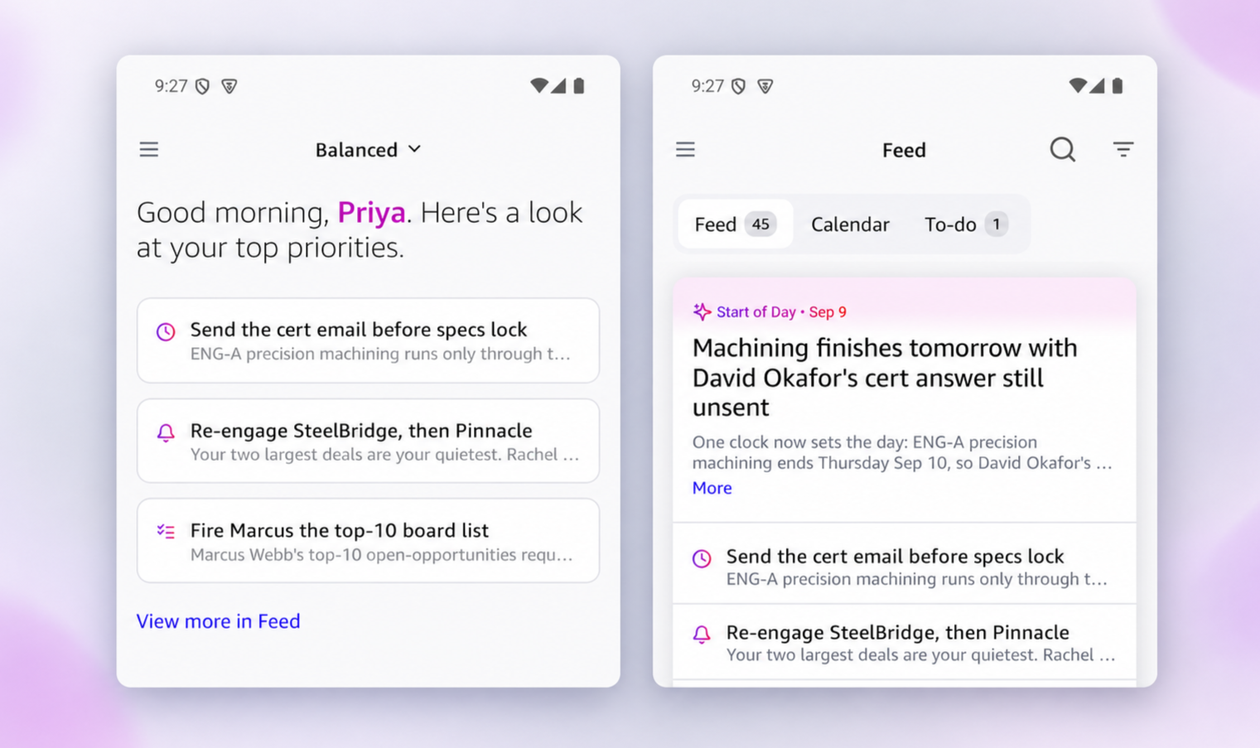
Amazon Quick’s new activity feed on mobile: the morning priority view, left, and the full feed. (Amazon Images)
Amazon is adding the Activity Feed and other features from its Quick desktop app to the AI assistant’s mobile apps for iOS and Android.
The Activity Feed is the signature feature of Amazon Quick. It combines email, Slack messages, calendar invites and CRM updates into one prioritized list, and lets people act on items (opening and responding to emails, for example) without switching apps.
Amazon said Wednesday that the Quick desktop app, released in preview in April, is now generally available on Windows and macOS. The company also said Quick’s agents now run in the cloud, so they keep working after a laptop is closed and deliver results to the feed.
The desktop and mobile apps now sync, as well, so a task started on a laptop can be picked up on a phone, for example.
Quick has a free tier, with paid individual plans starting at $20 per user per month billed annually, and business plans running $20 to $40 per user per month.
Quick is Amazon’s entry in a crowded market for AI assistants at work, competing with Microsoft Copilot, Google Gemini, OpenAI, Anthropic and others. Amazon’s announcements cited business customers for Quick including Southwest Airlines, LabCorp and the PGA Tour.
The desktop app came together fast, as part of a new effort inside Amazon to use small teams to move quickly: Swami Sivasubramanian, the AWS vice president of agentic AI, told GeekWire in June that a team of about six engineers started in late January and shipped April 28.
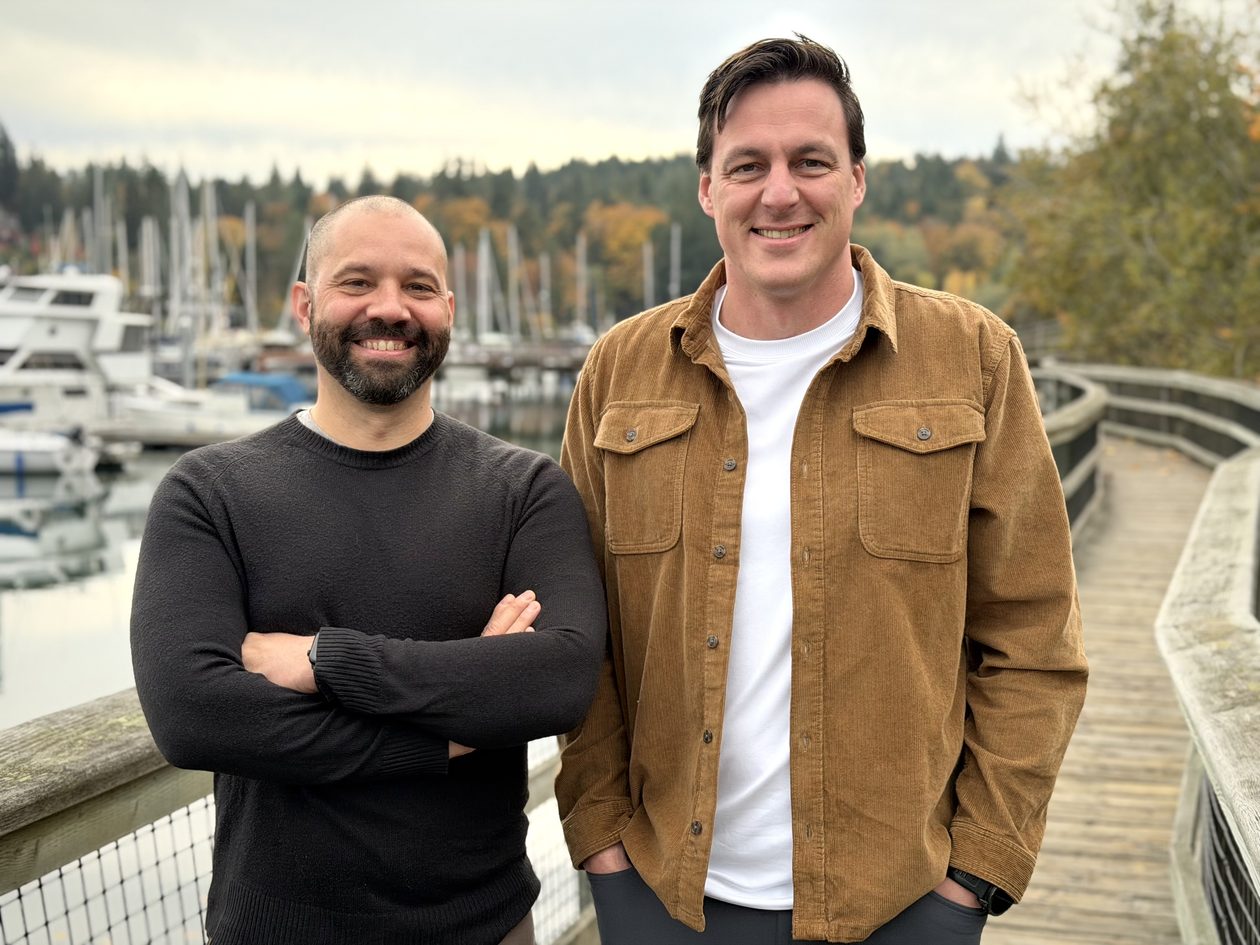
Latch co-founders Jared Kofron (left) and Stefan Kalb. (Photo via Latch)
Seattle startup veteran Stefan Kalb is back with a fresh brand and an ambitious vision for enterprise automation in the AI era.
Rebranded earlier this year from Super Labs, Kalb’s latest venture, Latch, is positioning itself as the context layer for enterprise AI, helping companies observe, learn and document how work actually gets done.
Kalb launched the startup alongside co-founder and CTO Jared Kofron, a University of Washington physics alum and former principal software engineer at Pioneer Square Labs last year.
Kalb is well known in startup circles. In 2009, the Bainbridge Island resident founded Molly’s, a fresh food supply company that serviced Seattle-area cafes and hospitals. That led him to start Shelf Engine, which used machine learning to drastically reduce food waste for retailers like Target, Kroger and Walmart. After raising $60 million in venture funding, it sold to New York retail data analytics company Crisp in 2025.
We recently caught with Kalb to hear more about Latch, his latest startup venture that has the ambitious goal of liberating humanity “from doing work that owns us.”
In 50 words or less, give us your startup’s elevator pitch? Latch captures how work actually gets done. An employee records themselves doing a task and narrates it like they’re training a new hire. Latch turns that into a knowledge graph of the company’s processes and serves it to your AI agents. Your agents finally know how the business really runs.
What problem are you obsessed with solving? Liberating people from work they don’t like. Every job has hours in it that only exist because software never learned how the company runs. I want that work to disappear, and I don’t think anyone will miss it.
What surprised you after talking to customers? That people are bad at explaining their own jobs, and they know it. Ask someone to document their process and you get a five-step list. Watch them do it and it’s forty steps with a dozen decisions they never mention, because to them it isn’t a decision. It’s just Tuesday.
How has AI changed the way you build? The obvious stuff is real, but the interesting change is org shape. The ratio of product to engineering has flipped. So has the ratio of SDRs (Sales Development Representatives) to closers. Building used to be the bottleneck, so you staffed for it. Now the bottleneck is deciding what to build and who to sell it to, and you staff for that instead.
What’s one thing people misunderstand about your startup? They think we’re Loom. A Loom is a video in a folder waiting for a human to watch it. Latch watches the recording, figures out what you did and why you did it that way, and turns it into something your agents can act on. The video is the input. What we learn from it is the product.
Toughest decision in the past year? Go to market. AI made reaching customers harder and more expensive, not easier. Every inbox is full of AI-written outbound now, so the cheap channels are gone. We decided to stop competing on volume and spend real money on fewer, deeper conversations. Showing up in person. It costs far more per account than we planned for, and it’s the only thing that works.
One piece of advice for other entrepreneurs? Look away from the obvious. If someone is telling you about the front of their store, ask them about the loading bay. The best problems are the ones nobody is talking about, usually because they can’t put words to what’s happening. That’s also where you’ll have the least competition.
We’ll know we’ve made it when… Someone gets furious that we’re down. Not because they lost a file, but because they can’t do their job without us. That’s the moment we stop being a tool and become key infrastructure.
Pavan Davuluri says Windows will keep serving human users while adding agentic workloads. (Microsoft Photo)
GeekWire is profiling over the next few weeks some of the people and teams that are shaping the evolution of Microsoft in what we’re calling its “Microsoft 2.5” era.
Just Don’t Call It an ‘Agentic OS.’ Given Microsoft’s one-pointed AI focus these days, it’s not surprising that the Windows organization is on the agentic train.
But Executive Vice President of Windows + Devices Pavan Davuluri has learned the hard way not to call Windows an agentic OS. He did so back in November 2025, via a tweet and blog post, and the customer backlash was quick and biting.
But Davuluri has not done a complete U-turn because of the criticism. Instead, he has changed how he talks about where Windows is going — which is still in an agentic direction.
“The user of Windows going forward will continue to be users … but it’s also going to add these agentic workloads,” the nearly 26-year Microsoft veteran Davuluri told GeekWire in a recent interview.
During his time at Microsoft, he’s held a variety of roles, from intern to General Manager of Surface, to Corporate Vice President of Windows Silicon & Systems Integration. He was appointed Executive Vice President of Windows + Devices in March 2026, reporting directly to CEO Satya Nadella.
Windows needs to evolve to support agentic workloads through new platform capabilities that the team is building under the covers, Davuluri said. These low-level capabilities, or “primitives,” affect how Windows handles security, identity, governance, observability, and performance when it comes to building and running agents natively.
These coming changes likely will affect the Windows file system, security model, PowerShell, and other foundational components.
Microsoft already is working on Windows identity and manageability to make them better able to service agents. Windows can assign agents a local ID, or a cloud-provisioned identity backed by Entra.
And it also has an early preview of technology known as Microsoft Execution Containers, meant to help secure agents by running untrusted code in sandboxes or virtual machines. It’s these system-level areas where the team is focusing first in preparation for a human+agent future, Davuluri said, rather than the UX/UI level.
Going Back to Basics. Windows has had a lot of very different leaders over the years, with very different management styles and priorities.
For his part, Davuluri said he plans to run the Windows and Surface teams with four principles in mind: Maintaining customer obsession; treating Windows as a complete end-to-end system (“full stack”); focusing on complete user experiences and workflows rather than individual features; and building Windows openly and transparently, with clearer communication about plans and priorities.
On the heels of his promotion to EVP, Davuluri committed publicly to the much-needed goals of improving Windows quality and reliability. In a blog post, he outlined some of the requested changes that his team would be making to Windows, ranging from fixing the way the Insider test program works, to more granular improvements like allowing users to reposition the Windows task bar.
And since then, the team largely has been delivering to the surprise and delight of many long-time Windows users.
Davuluri has also been working to shift the conversation from which new features are coming to a specific build to what are the outcomes Microsoft wants to enable for specific groups of Windows users.
“There is no one single sort of ring for a billion-plus users on the platform,” Davuluri said. Windows users encompass people who use the product in a variety of different ways, so “we need to get clarity in our minds on the things that we do that lift all boats that raise the entire platform — and things that we have to go do that are specific and unique to each of our sets of users based on how they primarily or typically use the device.”
Full-Stack Thinking. Is there still a role for Microsoft as a PC maker in the coming agentic future? Not surprisingly, given his heavily hardware-focused background, Davuluri insisted there is.
When Microsoft debuted its first Surface devices in 2012, officials said the company needed to build its own hardware to create reference designs and innovative form-factor examples for other Windows PC makers.
These days, most Surfaces that ship arguably are not better, spec- or design-wise, than other PCs. But Microsoft still needs to keep a hand in hardware design to understand the full stack, Davuluri claimed.
Surface plays a key role in how Microsoft develops platform abstractions, incubates support for technologies like pen, facial-recognition, and neural-processing units that later spread across Windows, and optimizes for silicon-to-cloud, he said.
While the company’s attempt to create a distinct category of “Copilot+” AI PCs fizzled, Microsoft continues to try to find AI-centric reasons to convince customers to choose Windows devices. Davuluri and others have referred to the idea of “unmetered intelligence” to attempt to make the case for running AI models locally on PCs.
This fall, Microsoft (and other Windows PC makers) plan to roll out new PCs built on the Nvidia RTX Spark platform. The coming Surface Laptop Ultra, which will be optimized for RTX Spark, is aimed at creators, developers and AI builders, all of whom — Microsoft is hoping — will be fueling the growth of its next target user category: Agents.
The September update for Amazon’s cloud-based gaming service Luna comes with multiple new features, the most prominent of which is one that will allow up to 7 other players to remotely participate in the same gaming session.
Since its aggressive relaunch earlier this summer, Amazon has pinned its hopes for Luna on multiplayer games and the casual market. Anyone with an active Amazon Prime subscription has access to Luna and can launch it directly from the Prime Video app, which allows them to stream an assortment of video games to their TV, browser, or tablet via Amazon’s cloud servers.
This includes around 60 casual-friendly multiplayer games, designed to be playable by just about anyone of any age as a group activity, and some of which are exclusive to Luna as a platform.
Its newest feature, Remote Play, changes how multiplayer titles work on the service. One player with a Prime subscription can now invite up to 7 other people to participate remotely in a multiplayer Luna game, as long as all 7 of those people have an account on Amazon and a compatible device. This reportedly works with every multiplayer game on Luna, including those that formerly required every player to physically be in the same room.
Two new games have been added to Luna’s library that specifically take advantage of Remote Play. This includes a Luna-exclusive mobile version of Magic: The Gathering creator Richard Garfield’s 2011 board game King of Tokyo, in which players take the role of giant monsters fighting one another in the ruins of Japan.
(Amazon press image)
Other additions to Luna this month include access to two relatively recent games from the French publisher Ubisoft: 2024’s Star Wars: Outlaws and 2023’s Avatar: Frontiers of Pandora, the latter of which is set in the universe of James Cameron’s film franchise.
Amazon has not shared user data for Luna since its recent relaunch, so it’s difficult to tell from outside the company how much of an audience it’s been able to build. Luna represents a bet by Amazon that, in the midst of the ongoing component crunch and the related rise in hardware costs, it can build an audience by offering access to popular video games via whatever devices people might already have in their homes.
A few years ago, cloud gaming as a whole was one of the major topics in the games industry, with some analysts going so far as to predict that it was the future of hardware. Instead of purchasing an Xbox or PlayStation in your own home, you’d simply dial into a remote server and stream games to your TV.
That gold rush has largely faded in recent years, as the furor over genAI has stolen some of its thunder, but cloud gaming is still a going concern and a surprisingly competitive market. Luna might be the most accessible option for would-be cloud gamers, as it’s bundled into a subscription that 200 million households already have, but it’s quietly up against giants like Nvidia, Microsoft, and Sony.
Some of the biggest names in the games industry have placed a quiet bet that the “RAMageddon” will quietly push audiences further towards the cloud. As yet, there’s no solid evidence whether or not it’s paid off. Still, if you’re looking to get into video games but missed your window to get a relatively inexpensive computer or console, the cloud might offer you some worthwhile options.
Michael Jensen, left, and Steven Brugger are leading BrainChild Bio. (Photos via BrainChild Bio)
Seattle biotech startup BrainChild Bio has raised $116 million to advance an experimental CAR T cell therapy for one of the deadliest forms of childhood brain cancer.
The Series A financing will primarily fund a pivotal Phase 2 clinical trial of an investigational therapy being developed for diffuse intrinsic pontine glioma, or DIPG. The rare brainstem tumor primarily affects children ages 5 to 10 and has few treatment options.
The financing was led by an undisclosed private family fund and foundation, with participation from BrainChild Bio’s initial investor, Seattle Children’s, and new investor WRF Capital.
BrainChild Bio is building on CAR T cell technology developed at Seattle Children’s and licensed exclusively to the company in 2023. The approach involves genetically engineering a patient’s own T cells to recognize and attack cancer cells.
The company says its new therapy has now entered its ILLUMINATE Phase 2 study, designed as a registration-stage trial that could eventually support an application to the U.S. Food and Drug Administration.
DIPG presents a particularly difficult challenge for cancer researchers because the tumors grow in the brainstem, an area critical to basic functions, and the blood-brain barrier can limit the ability of treatments to reach the tumor.
BrainChild Bio’s approach delivers the CAR T cells directly into cerebrospinal fluid through an implanted catheter, allowing the cells to reach the tumor locally and potentially be administered repeatedly.
About 300 children in the U.S. are diagnosed with DIPG each year, a devastating brain tumor with no cure and few treatment options. Radiation is the current standard of care, but children diagnosed with DIPG have a median overall survival of only about 11 months.
BrainChild Bio also plans to use proceeds from the new financing to advance a CAR T therapy designed to target three different cancer markers, toward initial clinical testing in glioblastoma.
The company was founded by Michael Jensen, who previously helped develop the underlying work at Seattle Children’s and was a co-founder of Umoja Biopharma and Juno Therapeutics. The CEO is Steven Brugger, who most recently served as founder and CEO of Affinivax, a biotech company which was acquired by GSK for $3.3 billion in 2022.
“This financing enables us to chart our path forward to serve the children and families afflicted with devastating brain tumors and represents a new paradigm for treating CNS brain tumors in children and adults,” Jensen said in a statement. “Our team at BrainChild Bio is steadfast in its commitment to harness CAR T cell technology in CNS tumors and we are uniquely positioned to do so.”
A new report says Seattle’s economy “may not be in decline, but it is in danger.” (GeekWire Photo / Kevin Lisota)
An independent study commissioned by the City of Seattle says the city’s tax structure is unique among its peers in the way it “specifically penalizes the hiring of senior, high-compensation workers,” with that penalty falling overwhelmingly on large tech employers.
Overall, Seattle’s business taxes are actually in line with competing cities, write researchers from the economic consulting firm Formation in the new report. But Seattle’s taxes are “particularly distortionary when it comes to hiring high-wage employees,” they add.
Mayor Katie Wilson helped design the tax, known as JumpStart, before taking office. But even the strongest supporters of new local and state taxes would concede that Seattle is “reaching the limits of how much it can tax the industries and people that it is depending upon to drive its growth,” the researchers write.
Another risk for the city is the resulting concentration of the tax base. Three-quarters of the payroll tax on large employers comes from 10 companies. Nine of them are in tech-related sectors.
A big company shifting 10,000 workers out of Seattle would cost the city about $50 million a year in payroll tax revenue, the researchers say in an accompanying slide deck, without naming Amazon explicitly. That’s more than a quarter of the $175 million deficit the city projects for next year.
In that way, much of the city’s financial future depends “on the marginal location and compensation decisions of a handful of employers,” the report says. Because much of the taxed compensation is vesting stock, it adds, the city’s revenue is exposed to “the single most volatile attribute of these firms — one the city has no ability to forecast or influence.”
Reducing that dependence through growth is the bigger point of the report.
The 127-page assessment, called “Seawall: Building a Resilient Seattle Economy,” goes well beyond the topic of taxes. The title refers to Seattle’s rebuilt waterfront seawall, engineered to hold back the water and also let marine life take hold. The researchers offer this as a model for protecting the city’s economic base while building a more diverse economy on top of it.
A decade of growth lifted wages at every level of the income spectrum, the report finds. Few other U.S. regions spread prosperity as broadly. But the same growth made Seattle far more expensive, especially for families.
Fast-forward to today, and the report sees an economy that’s dangerously concentrated, “significantly more AI-exposed than the national average,” short of the electricity it will need, and no longer producing mid-sized companies.
In danger, not in decline: The report is also careful to point out the city’s unique position and strengths. Seattle’s tech workforce is “almost peerless,” it says: 23% of the nation’s AI engineers are based in the region, and output per tech worker is more than double the national average.
The region also has the rare combination of a big tech industry and a strong manufacturing base.
Seattle “may not be in decline, but it is in danger,” the researchers write — “not because it is losing its place in the industry, but because the industry could undergo a radical change, and arguably already is.”
The concern that Seattle is becoming “the next Cleveland,” raised in a GeekWire column in February by Seattle tech veteran and angel investor Charles Fitzgerald, is “likely hyperbolic,” the researchers write. (They acknowledge that it “caused quite the stir this past winter.”)
The report points instead to Portland and Los Angeles as the more relevant warnings, citing Portland’s pileup of new business taxes and Los Angeles’ failure to turn a deep talent pool into jobs.
Fitzgerald responded Wednesday evening on his blog, Platformonomics, writing that the city “has finally acknowledged there is such a thing as an economy.” His main objection was who wasn’t in the room: “No businesses were involved, but that seems to be the norm hereabouts on economic matters.”
The report’s acknowledgments list dozens of interviewees, including the Seattle Metropolitan Chamber of Commerce, the Washington Roundtable and the Tech Alliance. No large tech employer is among them.
Ryan Donahue, a co-founder and managing partner at Formation, said in an email that the researchers interviewed many business representatives but no large companies directly, saying he expected a predictable message from their government affairs teams.
The person who led the report’s tax and cost analysis previously ran Amazon HQ2 recruitment at the Virginia Economic Development Partnership, the agency that landed the project for Arlington, Va., Donahue said, providing insights into how firms like Amazon weigh those decisions.
A path forward: The report recommends that the city focus on five industries: artificial intelligence, cleantech, maritime, life sciences and space. Cleantech is the priority, the report says, because Seattle owns or regulates much of what the sector needs, from Seattle City Light to building codes, permitting and land use.
The Seattle Office of Economic Development commissioned the report from Formation in 2025, under then-Mayor Bruce Harrell, to examine the drivers of the city’s business climate.
Harrell’s successor, Mayor Wilson, released the report Wednesday afternoon alongside an executive order convening a task force of business, labor, community and civic leaders, directing the city to improve permitting pathways, and calling for a proposal to create a Seattle Strategic Initiatives Fund.
In releasing the report, Wilson’s office said the findings “are independent and are not City policy.” But speaking on KUOW-FM’s Soundside as the report was released, the mayor called it “fantastic,” describing it as “super nuanced,” and urging listeners to take the time to read it.
The cost of a hire: JumpStart, the payroll expense tax, applies to large employers based on the compensation they pay to high-earning workers in Seattle. Approved by the City Council in 2020 and in effect since 2021, it was created to fund affordable housing, small-business support and climate programs, but the city has increasingly used it for general government operations.
Wilson helped create the tax before running for mayor, saying on her campaign website that she “played an instrumental role in designing and passing” the payroll tax.
Under JumpStart, hiring a software engineer at $650,000 in total compensation costs about $17,000 a year more in Seattle than in Bellevue, the report says. For an employee earning more than $1 million, the difference exceeds $33,000. San Francisco imposes no per-employee tax at all, and New York City’s equivalent is less than $6,000, according to the researchers.
That $17,000 reflects the tax’s top rate, which this year applies only to employers with about $1.3 billion or more in Seattle payroll. Two or three companies at most are in that tier, the report says. At the city’s lowest rate for that pay level, the same engineer would cost about $11,800, according to Seattle’s published rates.
The rate rises with an employee’s pay, and a company that crosses one of the city’s payroll thresholds pays the higher rate on every qualifying worker, not just the next hire.
“No other comparison city has a tax with both of these features,” the report says.
An issue of perception: Business leaders interviewed for the study described JumpStart as a problem “not primarily for its cost but because the process of enacting it communicated that the city’s governing orientation is fundamentally extractive.”
The researchers add: “Whether or not that characterization is fair, it is the operating perception, and perception shapes location decisions.”
But the researchers stop short of recommending a change. Taxes have “modest effects on firm location and expansion decisions,” they write, and Seattle is unlikely to lose its biggest employers to other regions, because the alternatives are either more expensive or have weaker talent.
“The Eastside is the only real threat in that regard,” the report says.
The study is blunt about what is at stake in keeping those employers. “If they leave,” it says, “Seattle won’t become more equal, it will just become poorer.”
What to do about taxes? The report does not recommend raising or lowering that top rate. Research on how firms respond to local taxes draws on thousands of firms across dozens of jurisdictions, it says, and “cannot tell us how any one firm will respond to any one tax change.”
With two or three firms in the top tier and “one firm by far the most dominant,” the question “is fundamentally a question about how that single firm will react.” It adds, “That is not a question this report, or the literature it draws on, is equipped to answer.”
GeekWire has contacted Amazon for comment on the report.
Other tax options that have been floated — vacancy taxes, wealth taxes, head taxes beyond JumpStart, expanded gross receipts schemes — are “either disallowed under state law or would, if enacted, likely push out the firms and workers Seattle most needs to retain,” the report says.
And once the state’s new 9.9% tax on income above $1 million takes effect in 2028, Seattle earners above that level will face a combined state and local marginal rate of about 10.5%. Pushing meaningfully above that, the report says, “would be a high-stakes tax experiment.”
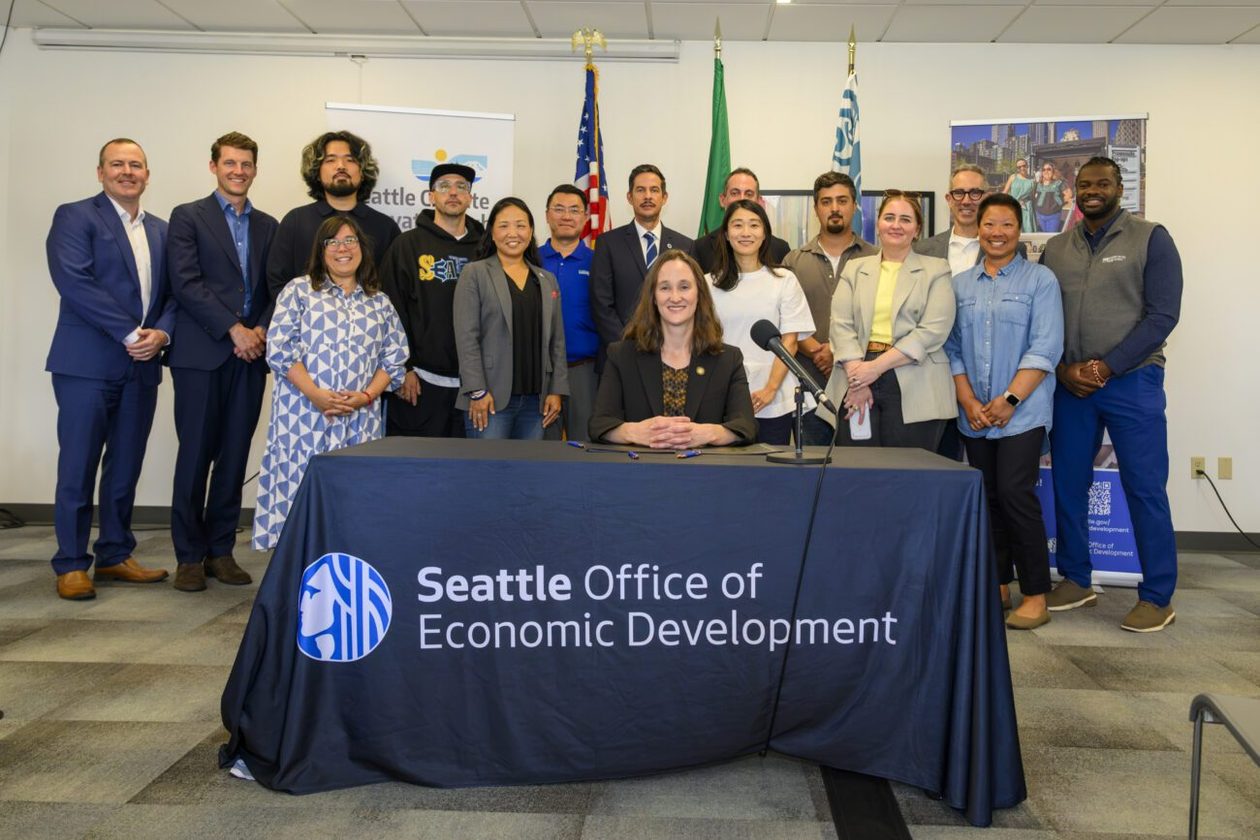
Mayor Katie Wilson with business, labor and community leaders after signing an executive order on the economy Wednesday at the Seattle Office of Economic Development. (City of Seattle Photo)
Where Wilson stands: The mayor has already conceded the Bellevue point. “I don’t think it’s good that it is less expensive to do business in Bellevue than in Seattle,” she said in May. “We’re going to be taking that into consideration.”
She defended the tax in June, crediting it with helping Seattle recover from the pandemic and cautioning against blaming downtown’s problems on any single cause.
Her relationship with the tech community has been rockier. At a Seattle University event in April, asked about that state tax, Wilson said concerns about wealthy residents leaving were “super overblown” — then waved and said, “the ones that leave, like, bye.” The moment drew national coverage and criticism from Seattle investors.
A bet on cleantech: Taking a step back, the report says Seattle’s best opportunity is in cleantech, a category it defines broadly to include clean energy generation, energy efficiency and sustainable production methods and materials.
The shift is already showing up in local venture funding. Cleantech and energy companies took 3% of the venture capital raised by Seattle-area private companies from 2016 to 2020, and 20% from 2021 to 2025, according to Crunchbase data cited in the report. Three companies — TerraPower, Helion and Group14 — account for 70% of that.
The city “should be most concerned about AI but most active in cleantech,” the report says.
AI will ultimately be more important to Seattle’s future, the researchers explain, but the city has almost no ability to shape it. Cleantech is different: Seattle owns the electric utility, writes the building codes and controls permitting and much of the land.
The city can also use its own purchasing power to create a market for what these companies build, the report says, pointing to a New York program that used public housing demand to bring a new cold-climate heat pump into production.
To reach the top tier of cleantech ecosystems, the report says, Seattle would need a dedicated entity putting at least $5 million a year into growing the sector, funded through ratepayer charges, philanthropy, corporate sponsorship and competitive federal grants.
What’s next:According to the city, Wilson’s executive order calls for the task force to convene industry roundtables in the coming months. The report’s own first-year list runs to ten items, including a business-led commission on the city’s fiscal exposure, with an emphasis on AI, and structured visits with 50 companies across the five industries it identifies.
Others include naming a senior staffer in the mayor’s office to run the city’s AI agenda, and a childcare cost-sharing pilot split three ways between employee, employer and city, with the city’s share paid out of JumpStart.
On taxes, the report’s primary recommendation looks beyond City Hall. It urges Wilson to build a cross-partisan coalition of mayors and county executives to press Olympia for new municipal revenue tools, including changes to the state’s 1% cap on property tax growth.
A caller on KUOW asked Wilson whether there’s a limit to how much Seattle should grow. She said she shares the concern, then pointed back to the report, which she said makes clear there is “no graceful path” for Seattle to cool down its growth.
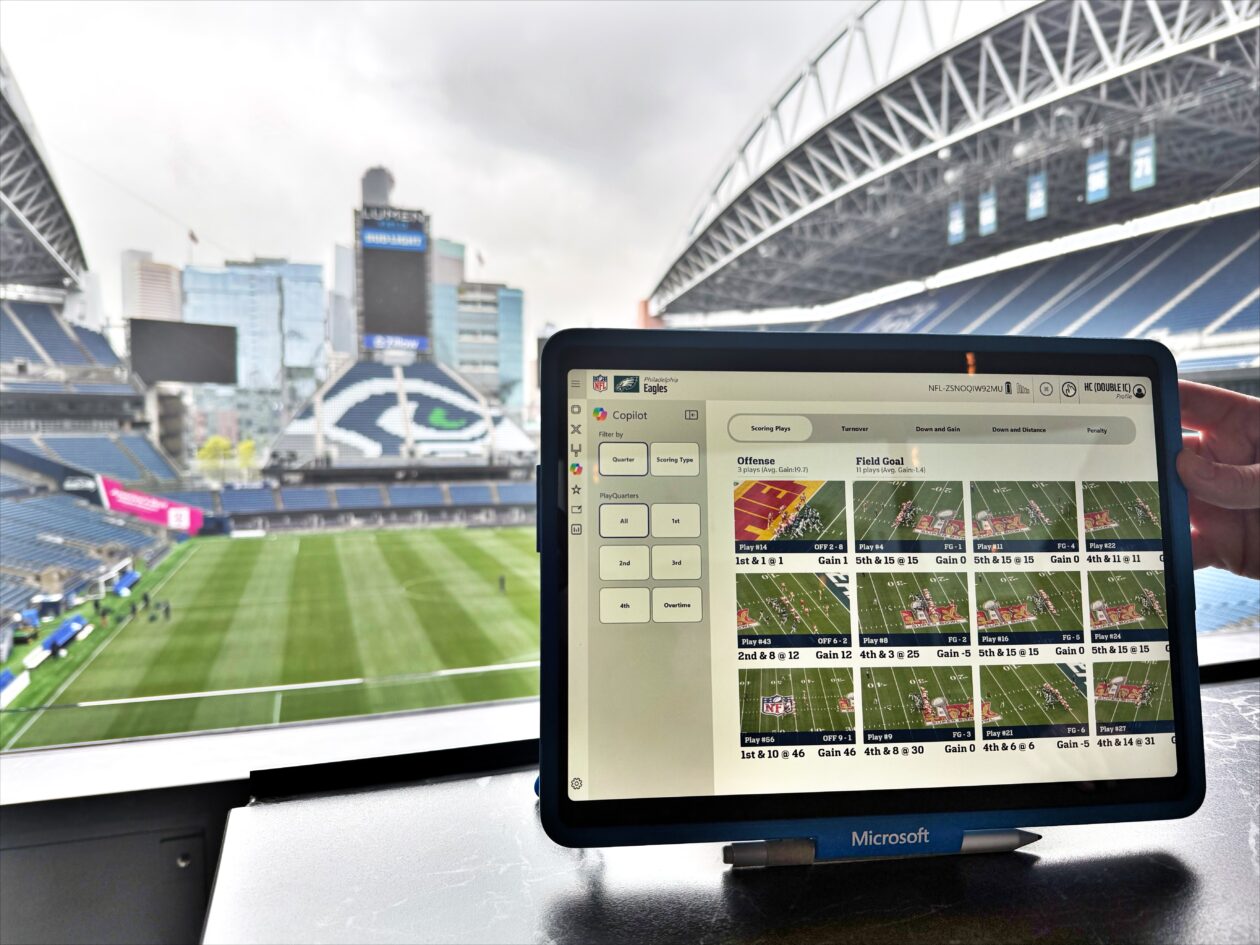
A Microsoft Surface tablet running Copilot at Lumen Field in Seattle. (GeekWire File Photo / Kurt Schlosser)
The Microsoft Surface tablets on NFL sidelines — a game-day fixture since 2014 — got a close-up on national television Wednesday night, with NBC highlighting new AI-powered workflows debuting in the Seattle Seahawks’ season opener.
During the broadcast, NBC play-by-play announcer Mike Tirico pointed out the new Surface devices — clad in Action Green cases, no less — in the Seattle coaches’ box above Lumen Field.
Tirico said Seattle head coach Mike Macdonald’s staff, including Brian Eayrs, the director of football analysis and special situations, now has direct access to Microsoft Copilot in real time. The broadcast showcased how the AI assistant is being layered onto sideline hardware to deliver instant data insights and help coaches make faster strategy adjustments.
“They can make sharper calls between series,” Tirico said. “So Copilot is going to give them a little bit more of an opportunity to do some real-time stuff on these tablets as the season goes on.”
It all amounted to a pretty good 40-second ad placement for Microsoft. Coupled with mentions of Next Gen Stats — powered by Amazon Web Services — it was a good night for Cloud City tech giants.
The technology and Eayrs are also featured in a video that Microsoft CEO Satya Nadella shared on X earlier in the day.
With the @NFL back tonight, love seeing @Seahawks analyst Brian Eayrs and coaches across the league using new Copilot and Excel tools to help with decision making in the booths and on the sidelines. pic.twitter.com/PbHugcbLIJ
GeekWire got an early look at Microsoft’s expanding tech suite back in April during a demonstration at Lumen Field. While the rugged Surface tablets on the sidelines remain the most visible hardware, Microsoft showed how Copilot is being integrated deeper into coaching workflows — from custom pre-game templates to running real-time analyses on formation tendencies, snap counts, and player load mid-game.
The core promise of the tech isn’t replacing human judgment — it’s raw speed. In a booth setup like Eayrs’, dedicated analysts use a real-time Excel dashboard that ingests live play-by-play data directly from the NFL. Using Copilot, they can instantly query formation tendencies or player usage metrics on the fly without building complex formulas by hand during the game.
The output from the booth can then be communicated down to the sideline, where coaches and players review still photos and quick situational data on their handheld tablets between drives.
To maintain competitive integrity, the NFL strictly regulates how and when these devices operate.
Under league rules, sideline and booth tablets run on a closed, league-controlled network with no internet access or custom third-party apps allowed. The hardware is locked away by league officials until right before kickoff, collected immediately after the game, and monitored under the NFL’s “Equity Rule.”
If one team’s tech setup fails, the opposing team’s access is restricted or paused to ensure neither side gets an unfair advantage.
The willingness to embrace real-time AI lines up directly with Macdonald’s overarching coaching philosophy.
Macdonald, who previously welcomed being called a “football nerd,” told GeekWire last year that his approach is all about “old school principles, new school methods,” emphasizing that earlier data delivery helps drive better decisions.
“I think it’s cool to be into stuff that is high-tech, data-driven,” Macdonald said at the time. “You’re telling me you’re smart and you’re trying to find edges and trying to find new frontier — that’s cool to me. It sounds like a winning formula.”
Macdonald, who has a Super Bowl ring to show for his coaching style, also called himself a “psycho data guy” who needs “numbers and tendencies” in another interview last year.
Did Copilot and AI provide an edge on Wednesday night?
Macdonald and his analytics team will have to answer to that, but the Seahawks defense certainly made the ultimate call when it mattered most — sealing a 13-10 victory over the New England Patriots with a last-second interception.
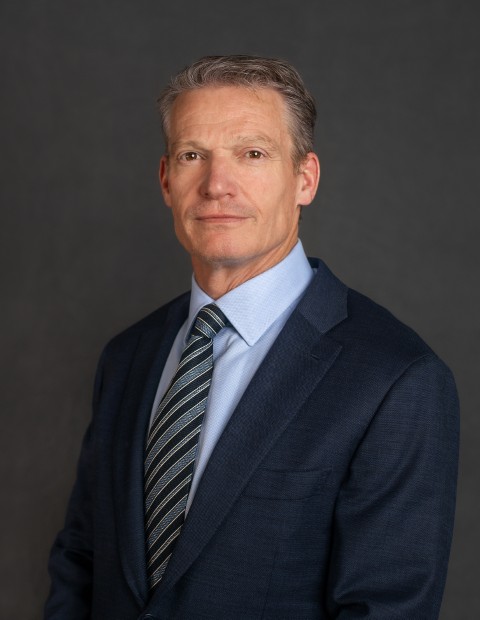
New Amazon board member Kevin Mandia is a cybersecurity veteran. (Photo via Amazon)
Amazon named cybersecurity veteran Kevin Mandia to its board of directors, adding new security expertise a few months after former NSA director Keith Alexander stepped down.
Mandia founded Mandiant, the breach-investigation firm Google acquired for $5.4 billion in 2022, and remained at the search giant as a strategic advisor through July 2025, according to his LinkedIn profile. He now leads Armadin, an AI security startup he started last year.
Amazon said in its announcement that “cybersecurity is one of the most consequential risks and responsibilities organizations face today, and the threat landscape continues to evolve rapidly alongside advances in AI.”
Amazon added a cybersecurity specialist to its board in 2020, when it elected Alexander, who also led U.S. Cyber Command. Mandia comes from the other side of the field, with two decades spent investigating corporate breaches rather than defending government networks.
His appointment also puts an AI security entrepreneur on the board of a company whose cloud infrastructure underpins much of the internet. Armadin, founded in September 2025, uses AI to run attacks against corporate networks, probing defenses the way an intruder would.
The board’s Security Committee, which oversees Amazon’s cybersecurity policies and its response to significant cyber incidents, is now chaired by Dan Huttenlocher, dean of the MIT Schwarzman College of Computing. Mandia joins as a member, along with former Bridgewater co-CEO Jon Rubinstein.
Amazon also named Mandia to the board’s Audit Committee, according to a securities filing.
Mandia received 4,086 restricted stock units in connection with his election to the board, vesting in three equal annual installments beginning Nov. 15, 2027, the filing shows. The shares were worth about $1.03 million at Amazon’s closing price Wednesday.
The filing disclosed that his sister-in-law, Kristin Mandia, is an Amazon employee with an annual salary of $185,000. The company said her compensation is consistent with that of other employees at her level with similar responsibilities.
Seattle’s foundation as a hub of technology, science and innovation runs deep. Its confidence should, too. (GeekWire Photo / Kevin Lisota)
[Editor’s Note: Jacob Colker is co-founder and co-managing director of AI House.]
Seattle is one of the most talented, creative and inventive places in the world. But if we want the rest of the country to see us that way, we have to start acting like we believe it ourselves.
First, we need more pride around here.
Let’s talk about what it means to be proud.
My mother grew up in Tarnów, Poland. She escaped communism and came to the United States in 1978 looking for a better life. She found one, built a family, and has lived in America for nearly 50 years.
But my mom is still very, very Polish.
Several times a year, I get a message: “Jakub. Did you see this?”
I already know what’s coming.
Some Polish person did something. A Polish athlete won something. A Polish scientist discovered something. Some guy with a Polish grandmother finished third in a regional Nebraska chess tournament. Doesn’t matter. Poland.
“Jakub. Look at this person.”
Okay, Mom. Who is she?
“POLISH.”
That’s it. That’s the story.
And I love it, because Mom has this completely indestructible pride in where she comes from. Plenty of us know someone like this: a Greek mom, Vietnamese dad, Indian uncle or Nigerian aunt. Somebody from their corner of the world did something great, and you are going to hear about it.
There is power in that instinct. Not because your people are better, but because you believe your place matters.
Seattle could use more of that.
We are almost pathologically humble. Our response to notable achievements is often a polite nod before everybody gets back to our regularly scheduled Seattle freeze.
That humility is working against us.
Second, Seattle isawesomeand the evidence is everywhere.
I see Seattle’s potential every day working alongside dozens of entrepreneurs building startups. Some of the most ambitious and talented people in the world are already here.
We have many billion-dollar startups across the region and more than 200,000 people working across technology, science, space, health and startups. That is more than enough talent to build yet a dozen more unicorns.
Nearly 40% of the world flies every day on airplanes built here. Blue Origin and SpaceX build rockets here. Starbucks, Amazon, Costco, REI and Nordstrom reshaped how the world shops. Microsoft helped put computing into our homes. AWS and Azure helped make the cloud the infrastructure of modern life. The University of Washington ranks among the world’s best. Seattle medical breakthroughs have helped save tens of millions of lives. We are pushing forward fusion energy, aerospace and maritime innovation. And let’s not forget: we just won the darn Super Bowl.
And so, so much more.
So why, despite all the evidence, do we still seem to have a communal case of imposter syndrome?
This is not a city lacking accomplishments.
It is a city with a branding problem.
Third, we have let other people tell our story for far too long. This ends, today.
Cities have brands whether they intend to or not. Silicon Valley is where ambitious people build companies. Nashville is music. Los Angeles for film and television.
Seattle’s cultural humility mostly assumes our accomplishments speak for themselves.
They don’t.
Reputation gets built one story at a time. You hear one story and it is interesting. You hear 10 and you notice a pattern. You hear 50 and your beliefs begin to change: That’s where important science happens. That’s where talented people live. That’s where I should invest, build or work.
Those beliefs shape real decisions about where people move, where companies get built and where investors put their money.
So to fix Seattle’s branding problem, here’s what we need to do.
Step 1: Let’s tell one clear story — Seattle’s talent pool is ridiculous.
Seattle is where deep technical talent meets deep domain expertise to build consequential things: AI, aerospace, cloud computing, medicine, fusion, robotics, maritime technology and enterprise software.
We do not need 50 slogans. We do not need another consultant-led branding exercise. We need one simple idea that people outside this region can remember: Seattle’s talent pool is ridiculous.
There is a reason some of the world’s most important companies have built major engineering centers, research hubs and second headquarters here for decades. They come for the talent.
And that talent is why Seattle will not just participate in the future. We will lead in building it.
Step 2: Let’s use the megaphones we already have.
Seattle already has outlets (including this one) telling this story — publications, podcasts and social channels that document the region’s startups, breakthroughs and product launches.
Every day, startups are raising money, scientists are making breakthroughs, companies are launching products, engineers are building technology and institutions are pushing this region forward.
That is not just tech news. That is the raw material of Seattle’s reputation. So let’s use it.
When you read or hear about a Seattle startup doing something remarkable, share it. When you see a story about a breakthrough at Fred Hutch or the University of Washington, send it to someone outside the region. When a local company raises money, lands a major customer or gets acquired, don’t just scroll past it. Amplify it.
Step 3: Let’s treat every local win as Seattle’s win.
When a local robotics company ships something remarkable, that is Seattle’s story.
When a maritime startup reinvents how ports operate, that is Seattle’s story.
When our AI research labs, or hometown heroes in Amazon and Microsoft, create breakthroughs, that is Seattle’s story.
When a biotech company lands a major breakthrough, when a game studio creates a global hit, when a clean-energy company reaches a milestone, that is Seattle’s story.
Our companies, universities, hospitals, labs, investors, civic organizations and business leaders should act like an amplification network for one another. Stop treating somebody else’s success as somebody else’s news.
Their win is our collective proof.
Step 4: Let’s put Seattle on the label.
Founders need to say where they are building. “Made with ❤️in Seattle” should be on the bottom of every website. Put Seattle in the press release. Put it in the LinkedIn post. Mention it onstage. Say it in interviews. Tell investors. Tell customers.
Silicon Valley companies have spent decades attaching their success to their geography. We should do the same. If you build something extraordinary here, make sure the world knows it was built here.
Step 5: Let’s do a better job of selling Seattle.
Every venture capitalist, founder, executive and civic leader in this region should be able to explain in 60 seconds why somebody should build a company here.
Not defend Seattle. Not apologize for Seattle. Sell Seattle.
Reminder: It’s the talent.
(And also cream cheese on hot dogs.)
When investors and founders from New York, Boston or San Francisco come to town, show them the region. Introduce them to engineers, researchers and entrepreneurs. Bring them into the community. Let them see what is happening.
The best branding campaign is somebody getting on a plane home saying, I had no idea all of this was happening in Seattle.
If we’re going to succeed, we need tobelievefirst.
Insert all the Ted Lasso jokes you want, but this stuff matters.
There is no giant Seattle marketing department coming to save us. There is no national referee who will eventually review the evidence and declare that Seattle deserves more respect.
When somebody here does something extraordinary, act like it. Read the story. Share the post. Send the article to your team. Text it to your friend in New York. Put it in the group chat. Bring it up over dinner. Tell your kids.
Basically, become my Polish mother.
My mom doesn’t give a hoot that Kraków ranks No. 6 on some list or Warsaw is No. 8 on another. She doesn’t need a clickbait listicle to tell her Poland matters. She already believes it does.
We have to build our reputation ourselves. The good news is that we already have everything we need: extraordinary companies, world-class institutions, ambitious people, groundbreaking science and media documenting it all.
What we have been missing is the confidence to start being more loud. Stories become patterns, patterns become reputation, and reputation becomes gravity.
Gravity is what creates influence and respect.
Pride is not something somebody else gives you. You don’t wait until the rest of the country decides your home is important. YOU decide it is. Then you act like it.
The West8 office building in Seattle’s Denny Triangle neighborhood. (Image via West8Seattle.com)
General Motors is expanding its presence in the Seattle region with a new downtown office slated to open in early 2027.
The automotive giant signed a lease for a 43,000-square-foot space at West8 in the Denny Triangle neighborhood, with plans to bring together employees across digital products, autonomous vehicles, IT, HR, and marketing, the company announced Wednesday.
GM currently employs about 200 remote workers in the region. A spokesperson said the new office will bring those existing team members together while providing room to recruit additional talent. The layout will feature a mix of traditional workstations, flexible lounge seating, and collaborative huddle spaces.
When the office opens, it will follow GM’s hybrid work policy, requiring employees living within a 50-mile radius to work on-site three days a week.
GM said tapping into Seattle’s deep technology talent pool will help grow its concentration of technical staff and attract engineers specializing in artificial intelligence and machine learning. The company credits its Seattle-area software teams with building the technical foundation behind its on- and off-vehicle platforms.
Located at 2001 8th Ave., the West8 building sits two blocks from Amazon’s headquarters campus and the Spheres. Amenities available to GM staff will include a fitness center, bike storage with showers, an onsite café, outdoor spaces, and covered parking equipped with EV charging stations.
The Seattle footprint adds to GM’s network of major tech hubs outside Michigan, including locations in Austin and the Bay Area.
They joined as part of a funding round that totals $13 million, according to a Form D filed with the Securities and Exchange Commission. NLM has reported at least $26 million in funding since 2018, according to SEC filings.
The company offers a way to move more data without burning more power. Inside a data center, information travels between chips and servers as pulses of light. The part that puts the data onto the light beam, called a modulator, is normally made of silicon. It limits how much data a link can carry, and how much power that takes.
NLM’s technology, sold under the name Selerion, is an organic electro-optic material that goes on as a liquid and hardens in place on the chip, taking over the modulator’s job from the silicon underneath. The company says it does the work 10 to 15 times more efficiently.
Applications for the technology include fiber-optic networking equipment and the links between servers in AI data centers. NLM says it could also be used in quantum computing.
Five existing investors participated in the round, which the company described as a Series A2: Emerald Technology Ventures, Oregon Venture Fund, Idemitsu, Tokyo Ohka Kogyo and StoryHouse Ventures. Private investors and company employees also took part.
Pangaea Ventures, which has offices in Canada, the United States and Japan, backs startups built on advances in materials, chemistry and biology. It says it has invested in more than 40 companies over more than 20 years. David Weekes of Pangaea is joining NLM’s board, which already includes Frank Balas of Emerald.
Diamond Edge Ventures, led by president Curtis Schickner, has $200 million to invest through 2030. It backs companies in Mitsubishi Chemical’s core markets, including advanced materials, polymers and electronics, and its portfolio includes Boston Materials, DigiLens and Eridan.
Hamamatsu Photonics, which invested previously, is not part of this round but is still a shareholder, according to the company.
The company was incorporated in 2018 as Nonlinear Materials Corp. It licensed its patents from the University of Washington, building on 25 years of research there in the labs of chemists Larry Dalton and Bruce Robinson. Robinson is one of the company’s co-founders, as is Lewis Johnson, a longtime UW researcher who is chief technology officer.
Pack Ventures, the UW-affiliated venture fund, is an investor in NLM and is also listed among the advisors to its board.
GeekWire covered NLM’s launch in 2019, when the company was raising a $1.25 million seed round and running a small production lab on campus.
NLM Photonics CEO Brad Booth. (NLM Photo)
Brad Booth, who spent nine years at Microsoft and joined NLM’s board in 2023, took over as CEO in 2024 from co-founder Gerard Zytnicki, who is now a corporate advisor to the company. The company raised $1 million from Tokyo Ohka Kogyo and Hamamatsu in 2023.
Last year NLM said outside testing confirmed that a 1.6-terabit chip combining silicon with its materials ran at 224 gigabits per second on each of eight channels. It started sending samples of 1.6- and 3.2-terabit chips to customers in March.
NLM is not alone in trying to build a better modulator. Lightwave Logic, a publicly traded Colorado company also working with organic materials, named NLM among its smaller competitors in its annual report for 2024.
Some of the company’s rivals have raised a significant amount of funding. HyperLight, a Harvard spinout that uses a crystal called lithium niobate instead of an organic material, has raised $117 million, including $80 million in June led by MediaTek.
NLM has worked to get its materials onto other companies’ production lines. In March the company said the chips going out to customers were made at GlobalFoundries, and that it had built modulators using Tower Semiconductor’s high-volume silicon photonics process.
A robot arm pours from a test tube into a beaker in General Robotics’ lab. The company used the task, and progressively harder versions of it, to test its Auto Engineering system. (General Robotics Photo)
A Redmond, Wash., robotics software startup founded by former Microsoft researchers says its platform can now handle much of the work of getting a robot up and running in a factory, warehouse or other industrial setting, a job that used to take a team of engineers.
General Robotics said Wednesday that advances in GRID, its robot intelligence platform, have cut the process of onboarding a new robot from about a month to as little as two hours. The company calls the approach “Auto Engineering,” with each onboarded robot and diagnosed failure feeding back into the system and speeding up the next deployment.
General Robotics CEO Ashish Kapoor.
“Before this moment, it would take us a team of experts to go and execute on behalf of our customers,” said General Robotics CEO and co-founder Ashish Kapoor in an interview. “Clearly non-scalable, clearly very expensive, and clearly will take a long time.”
With Auto Engineering, he said, “we can magnify and accelerate each engineer’s capability.”
Founded in 2023, the company has grown to about 50 employees, primarily engineers. It has raised nearly $34 million, most recently in an April round led by Construct Capital, with participation from Khosla Ventures, Accenture Ventures, Nvidia and Valo Ventures. PitchBook put the size of the round at $25 million; the companies didn’t disclose terms at the time.
Kapoor said General Robotics has roughly a dozen customers — large enterprises across manufacturing, logistics, energy and defense — and revenue in the millions of dollars.
Customers include HTX, the science and technology agency of Singapore’s Ministry of Home Affairs, which Kapoor said has been working with General Robotics for about a year and a half.
The company’s platform works with robot types including industrial arms, humanoids, quadrupeds, wheeled robots and drones, according to the company.
General Robotics is operating in a competitive and well-funded sector. Physical Intelligence, which builds foundation models for robots, has raised more than $2 billion. Nvidia — an investor in General Robotics, and the maker of the Isaac Sim simulation software built into GRID — is developing its own robot models and deployment tools.
Robot makers build good hardware, Kapoor said, but often lack the expertise to put it to work in a specific setting like a shipping terminal. “That last layer is missing.”
Before co-founding the company, Kapoor spent 17 years at Microsoft, ultimately as general manager of its autonomous systems and robotics research group in Redmond, where he created the open-source drone simulator AirSim. General Robotics co-founders Sai Vemprala (CTO) and Shuhang Chen came from the same Microsoft team.
GeekWire covered the launch in 2023, when it was Scaled Foundations and billed itself as “ChatGPT for robots.” It had five employees at the time, focused on aerial robotics and drones, with backing from Khosla and E14 Fund. It later renamed itself General Robotics.

 Login
Login