❌

Reading view

There are new articles available, click to refresh the page.

After 6 Years as Road Ornament a Widescreen Sony Trinitron Lives Again
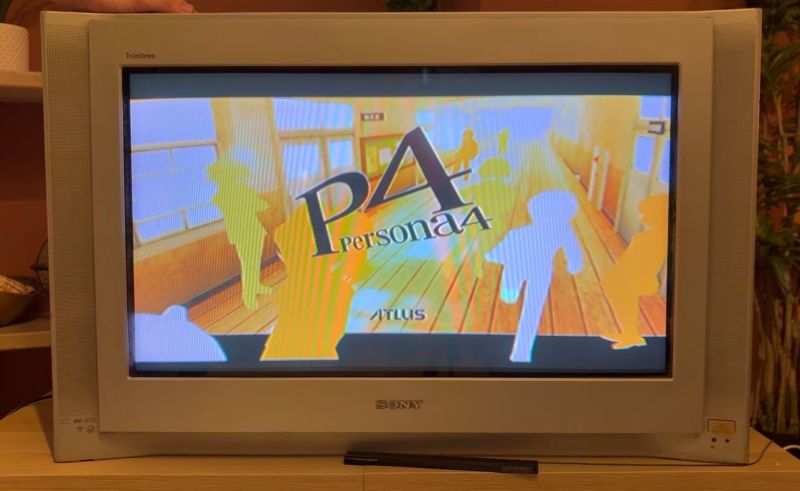
After previously adopting a big Sony Trinitron CRT TV that had been trying to hitch a ride along the side of a road in Italy for at least six years, [Happychoice] didn’t give up on trying to fix it, with the second part showing the TV being more or less fully fixed up.

In the first part of this mini-series, the TV had been salvaged and had most of the dirt as well as local flora and fauna evicted before an attempt was made to fix it. Unfortunately despite the insides looking remarkably clean and intact considering its use as a road-side ornament, that video ended with the controller refusing to power up due to issues with the power supply.

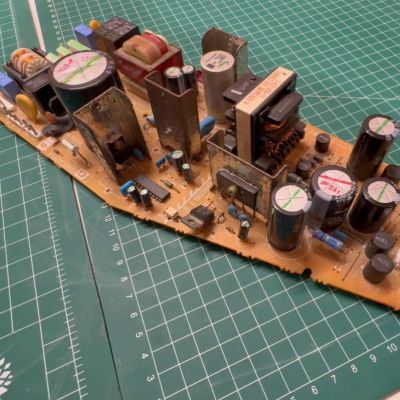
In this sequel we get to see what six years of weather exposure means in terms of what components to replace in a CRT TV like this. Unsurprisingly this means mostly replacing most of the capacitors, at least on the power supply board, as well as the neck board for the actual CRT. A couple of MOSFETs also tested open, so they were replaced too.

With those fresh new parts the TV fired right up again, and with a Wii console connected it looks pretty spiffy running games like Persona 4. Fortunately modern CRT TVs like these have a built-in service menu that you can access with the remote, so that you can tweak picture alignment and other settings without having to stick a screwdriver into the back of the TV to fiddle with a potentiometer whilst also keeping an eye on the picture.

Although there are undoubtedly more components on the PCBs and of course one grimy speaker to give some TLC, it does show that as long as the tube itself is intact, it’s definitely worth it to give repairing a shot.

Purely Random TV In Your Browser

One of the things we used to appreciate about broadcast television is that… you kinda just got what you got. You didn’t have to choose beyond picking a channel, and then you settled in to imbibe whatever media the CRT was spraying at you. A vague recreation of part of this experience is now available, in the form of [Sergei’s] RND.TV.

The concept is simple enoughβ€”it’s a webpage that plays random videos from The Internet Archive. Each session draws videos from a random sequence, with no algorithm or fancy social media nonsense to push some videos over others. As you might expect, you’re in for lots of random and weird stuff, from old Army videos to middle-school basketball games. You can swipe to flick to a different β€œchannel” if you don’t like what’s playing, or you can mark videos you like if you fancied what came up in the random feed. You can also use your phone as a remote if you want to sit back and flick channels like it’s the 90s again or something.

We’ve featured other projects in a similar vein beforeβ€”like little TVs from The Simpsons that play episodes on repeat. Sometimes, it’s fun to just avoid the paralysis of choice, and a random stream of content can provide that relief. Or, alternatively, you could always hook up your TV to an antenna and watch free-to-air… it’s still out there, for those that wish to view it!

Is This the Year of The Linux… Television?

The Year of the Linux Desktop hasn’t been on its way for quite as long as nuclear fusion plants, but somehow it seems to recede into the horizon at just about the same rate. Every year, it’s another year in the future. You know what isn’t a desktop? A television. [Haggis on Toast] makes a case that while there may be barriers to desktop adoption, there’s no reason not to use Linux for a set-top box, and shows one such build in a recent YouTube video.

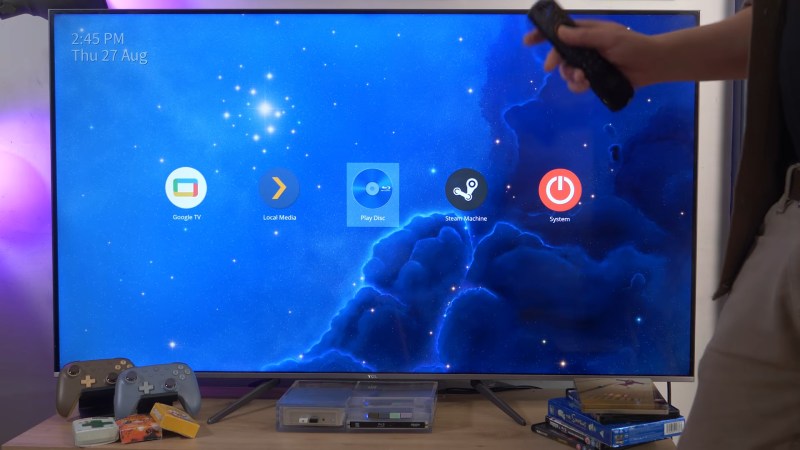
Of course everyone knows commercial set-top boxes and β€œsmart” TVs alike run Android, which is built atop a Linux kernel. Those are getting steadily more frustrating to use as corporate enshittification continues, so why not DIY? [Haggis]’s build uses a miniPC in a custom 3D-printed case, running Nobara Linux with a Waydroid TV build to provide the Android set-top box experience, plus light/casual gaming via Steam.

Control is via gamepads or a cheap USB remote, with the frontend provided by DeckyLoader. Getting it all set up might be a pain if you’re new to Linux. However, everything comes with easy installers, so it should be a breeze if you’re more than casually computer literate in any other operating system. The most intimidating part of this build is probably reflashing the Blu-Ray player to unlock the ability to play and rip 4K disk content. But if you’ve embraced the death of physical media, you can skip that part.

Ironically, old Android TV boxes can also be repurposed into headless Linux machines.

Thanks to [Keith Olson] for the tip!

The Days Of Broadcast Digital TV Could Be Numbered

When the analog TV signals were turned off in most places around fifteen years ago, their replacement took the form of a set of digital multiplexes. ATSC for North America, and DVB-T for Europe and other places. This would deliver a multi-channel broadcasting solution for the future, and this would be how those not on a cable would consume their telly. It’s a surprise then to find that some governments are already looking at turning off digital TV broadcasting, with the UK in particular wanting to put a date on the switch-off of 2032.

It’s been no secret for many years that linear broadcast TV is being overtaken by streaming services, and this move projected to come at the end of the transmitting contract was always likely to come eventually. Even with increasingly few younger people watching traditional TV though, it still comes as a bit of a shock that it’s happening so soon. The replacement will be an online service for which initially a set-top-box will be required. We’re guessing there will be a storm of protest, but since it’s still quite a few years away and broadband coverage is now near-universal, there’s a good chance it will peter out as the time approaches.

Aside from the end of analog TV, we’ve seen a steady decline in AM and Long Wave transmission across Europe. What makes this surprising then is that instead of being a legacy analogue system, the one facing the turn-off is the future-proof replacement, and one that still sees plenty of use at that. A major shift in consumer electronic technology is taking place, but will anyone notice it?


Header: Carlos Adampol Galindo, CC BY-SA 2.0.

❌