❌

Reading view

There are new articles available, click to refresh the page.

Mesh Network Telephony Over Bluetooth on Android Phones
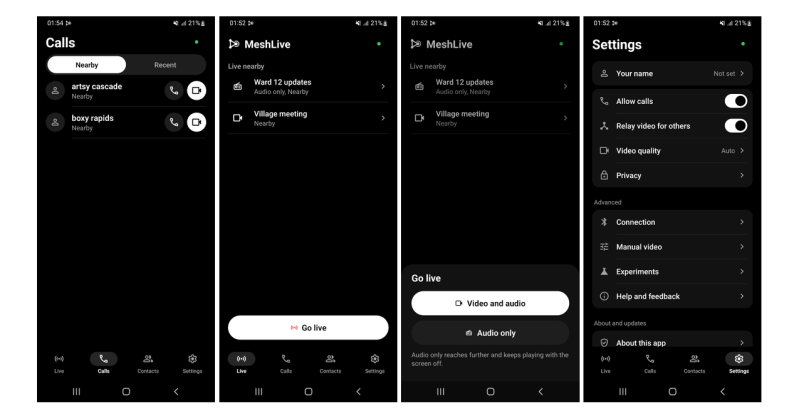
Telephony is a bit of a mixed bag. On the one hand, being able to talk to people in far off places is kind of neat, at least in theory. On the other hand, you’re usually reliant on a centralized network, which isn’t ideal to the mindset of most hackers.[Gautam]’s MeshLive project deals with that last one, offering a decentralized mesh network solution based on Bluetooth for Android phones that can handle both voice and video.

Rather than relying on dedicated hardware, this particular mesh piggybacks on your phone, and exists only as an Android application. Calls are end-to-end encrypted for both voice and video β€” though two-way video calling is still experimental. More testing has gone into video broadcasting, where a stream goes out one-way. The capability is available for voice, as well.

Each user has a unique identifier that can be scanned to create contacts, but it isn’t otherwise clearly identifiable to everybody. You’ll only appear with a random name that changes every 15 minutes to other users in range who aren’t your contacts. Range is of course the Achilles heel of this project, since it’s using the Bluetooth hardware of ordinary smartphones. It’s possible to extend the range of Bluetooth significantly with the right hardware, but we imagine most folks aren’t carrying directional antennas around with them. While every phone does forward the signal to as many others as it can, it can only do so for about 20 meters.

Of course LoRa remains the protocol of choice for mesh networking, though it’s normally used for text messages only. We have seen voice packets over LoRa, but anything LoRa requires dedicated hardware while this only requires an app.
Pushing Bluetooth out to 12 Kilometers

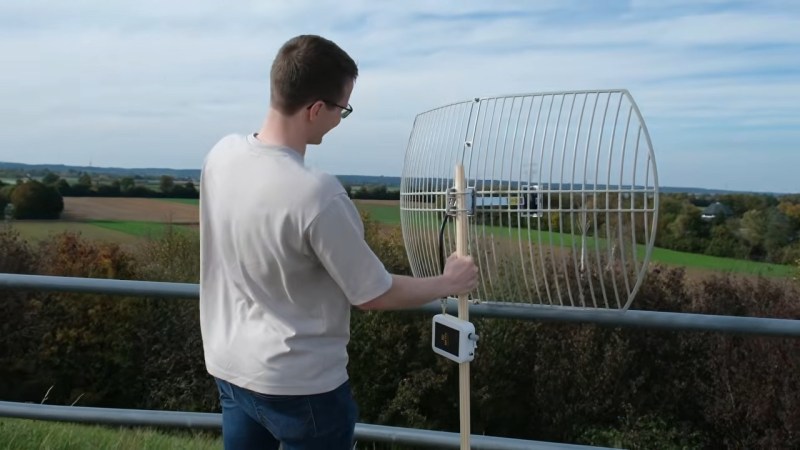
Bluetooth is a short-range protocol that’s great for peripherals and finding your keys, but it’s limited range is mainly a product of how it’s usually implemented. A recent video from [nktbuilds] demonstrates this by extending its range out to 12 kilometers, or around 7.5 miles.

The secret is twofold: one is the antenna, a parabolic unit that captures far more than the dinky dipole in your phone. The other is a very sensitive receiver with a much lower noise floor. What you won’t see here is any extra power than you get stock out of one of those generic coin-sized Bluetooth tracker tags. It’s kind of obvious, in retrospect: grab more signal, lower your noise floor, and get a better result. Still, it certainly wasn’t obvious it would work out to 1200 m, and it’s an impressive feat by [nktbuilds]. We’re going to have to keep it in mind next time we lose our keys.

Of course this doesn’t mean you should jump to Bluetooth for distance communications. You’re still better off sticking with something like LoRA for that, especially since it’s good to hundreds of miles if you can get line-of-sight β€” or even tens of thousands with the right setup.

Using an Unmodded GBA as a Music Synth

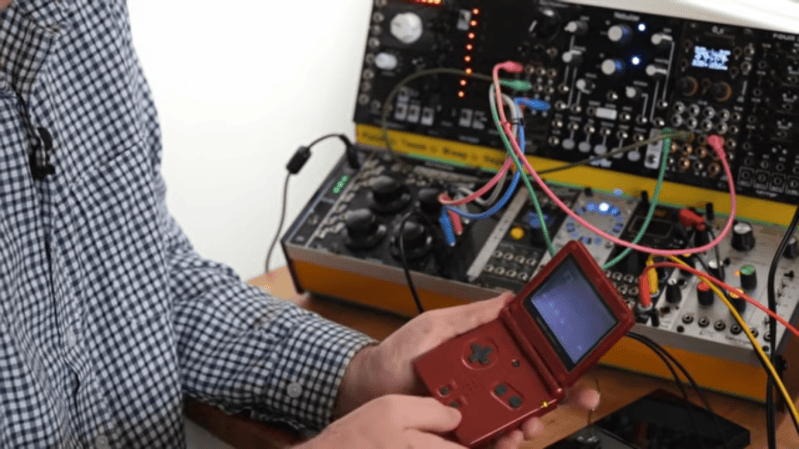
The style and sound of older video games is unique enough that they’re still copied in relatively modern games likeΒ Undertale,Β Celeste, orΒ Shovel Knight. There’s also a vibrant chiptune community making music on the older hardware directly. Often this involves hardware modding or otherwise finding chips from older gaming systems to replicate that unique retro gaming sound authentically. But disassembling older systems is not always necessary. Take a look at this Game Boy Advance synthesizer which uses the GBA hardware with no modifications at all.

The key to making this work is the GBA’s multiboot feature, which allowed these systems to send executable code over a link cable to other consoles which didn’t have cartridges. This meant that friends could play multiplayer games without each one needing their own cartridge, but it also means that nowadays people can send their own custom software directly to the console’s RAM without much extra effort. To run the synthesizer software, the GBA is connected to a computer, the software is started, and then when the GBA is powered on the snythesizer is automatically loaded into its RAM. The audio output is played over the headphone jack, and various controls are available on the computer and on the console.

In the video linked below, [Andy] is using the GBA with some other musical hardware and the sounds he’s getting from the unmodified console are impressive. It could certainly be a go-to for anyone interested in getting started in this style of music or who doesn’t want to do something like take apart an original Sega Genesis for the audio circuitry.

Simplifying Slide Rule Calculations with Trig

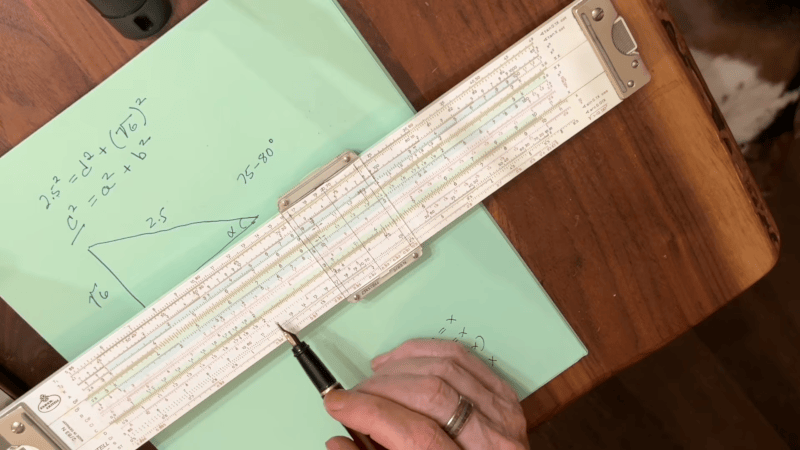
[Bob the Science Guy] remembers how to use a slide rule. Even after all these years, it is pretty easy to remember how to multiply and divide. If you can’t remember, you can usually work it out, as long as you understand how slide rules work. But what about sine, cosine, and quadratics? [Bob’s] been making videos about topics like this, and if you’ve wanted to put your slide rule collection to practical use, you’ll enjoy these videos. You can see one below.

The trick to the slide rule is that it is deceptively simple. You are in effect adding logarithms and then taking an antilog. The issue is that you still have to have some intuition about the scale of the answer since 2Γ—3 works out the same as 2Γ—3000 or 200Γ—300.

But it is even trickier than that. Adding and subtracting is not easy on the slide rule. [Bob] shows how to use your math skills to convert problems that might have been addition problems into trig problems. So while it might seem more complicated to use trig, it may help work the problem on the slide rule.

We like slide rules. If you don’t have one, try this one in your browser (hint: go full screen and show both sides).

The 80s Called: They Say This DIY Phone Is, Like, Totally Rad

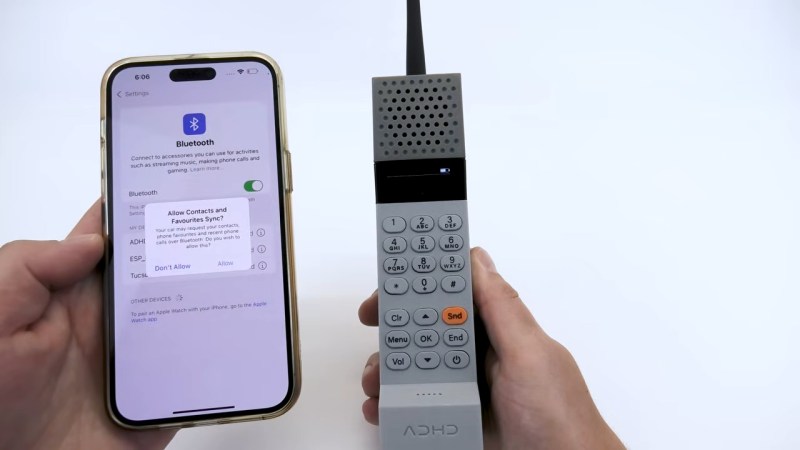
Like more than a few of us , [Kevin Noki] is sick of being pulled out of flow state by that annoyingly addictive black rectangle we all carry around. His solution was to build a phone to escape his phone, in a YouTube video we embedded down below. We’d say that phone is straight out of the 1980s, except it’s not quite a phone. It would perhaps be more accurate to say he’s building a Bluetooth handset– actual telephony remains the province of a professional device with regulatory approval, because getting custom hardware on VoLTE is a nonstarter in many places.

He starts out using an ESP32, because he already had one and why not? It’s got bluetooth, after all. Alas, audio quality he was getting through it was a little too crunchy, so he pivoted to use a dedicated Hands Free Profile (HFP) bluetooth module that is purpose built for exactly this kind of application. He’s selling the design on his website, but given how much detail he shows on screen, recreating your own version would be easy enough to save the quid. You’d be missing out on the STL for the fantastic 80s brick he’s made, which may be the most interesting part of the build to us.

We’d likely have jumped right to CAD and printed out a few iterations of the case until we were happy, but [Kevin] takes a more traditional industrial-design approach, mocking up the phone with XPS foam and a manually-operated hot wire cutter. It’s not a step we see makers take very often, but it pays off here– at least for subtracting material, it’s a very quick way to iterate, and he only needs to do one 3D print for the final version. We also like very high-tech acrylic bending jig, which he uses to put some black LED acrylic over the display.

It’s a lot of work to make you less-likely to grab a phone you still need anyway– remember, there’s no cellular modem in this– but, hey, it beats torturing yourself, or worse, a tamagotchi.

❌