Login
Login
Samsung Printer is the Next Frontier Of Minecraft Servers
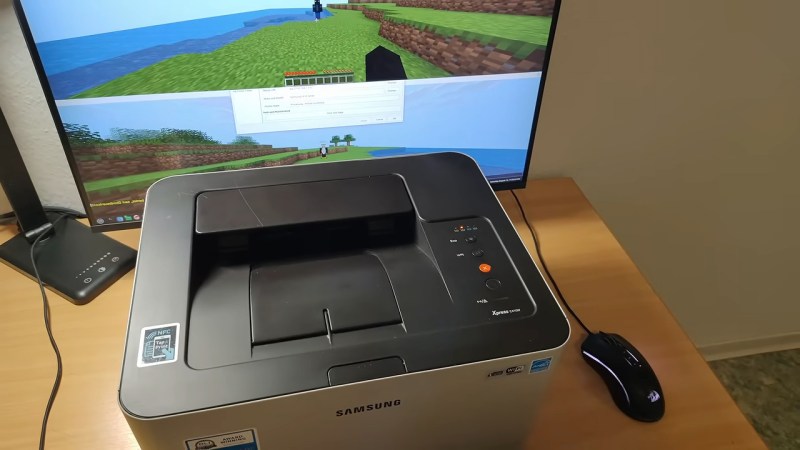
While DOOM remains the undisputed champion of ‘game you play on every piece of hardware’ it seems that the role of ‘game you play on everything just because you can’ is slowly being shifted to Minecraft, as we have yet another Minecraft server somewhere Minecraft has no business being served– in this case, a Samsung Printer.
The hack actually requires opening up the printer to get at the debug ports to bang your way in via serial, but as any security expert will tell you, once the black hats have physical access to a machine, they own it. That isn’t to say it’s easy– [vimpo] had to dump the firmware and find an exploit. Since it’s 2026 [vimpo] tried to get an LLM to do all that hard work for him, and while it helped with identifying functions in the dump, ultimately the hacking still fell upon [vimpo]’s human intelligence, though not before burning through millions of tokens. Having found a good old fashioned UDP overflow exploit, he’s gets control of the printer and puts an improved version of his lightweight Minecraft server, UCraft, on it. Like the server, the exploit is also on GitHub but you’ll very likely need the exact same printer to get it to work: a Samsung C410W with firmware V3.00.02.20, DEC-15-2015. One important caveat is that while you can still use the printer as intended after this hack, you cannot do so while playing Minecraft: it crashes the server if you try. Good to know.
In case you’re wondering, yes, this is the same guy who got a Minecraft server running on a light-bulb, which arguably more impressive. Where he might mine and/or craft next is anybody’s guess. Somebody else already did the ESP32-C3, and while we suspect nothing will ever beat the 1960s Univac implementation for sheer impracticality, we’re willing to be surprised.