Login
Login
Fly Brain Connectome Used to Trade Stocks and Play Games
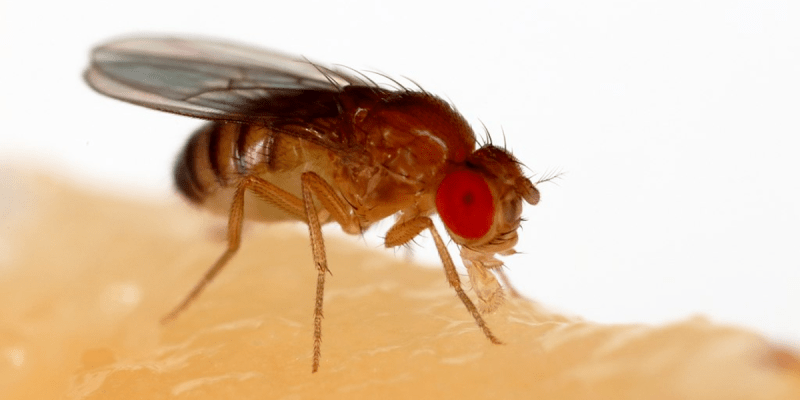
Recently researchers finished mapping the central nervous system (CNS) connectome of not just the female Drosophila melanogaster (i.e. fruit fly) brain, but also that of the male D. melanogaster for a comparative analysis. Here the sexually dimorphic changes turned out to induce specific mating behavior that ensures that there will only be smooching between genetically fit D. melanogaster males and females, while the rest of the connectome remained effectively the same.
Of course, with this connectome in hand it led some people to ask themselves what else one can do with this connectome graph of about 160,000 neurons other than make a fruit fly into a fruit fly. So far we have seen [Nftechie] turn this connectome into a crypto stock trader with the Stonkfly project that uses the connectome’s reward circuits to potentially make profitable trades, though [Nftechie] says that they haven’t verified yet how good a fruit fly is at trading stocks, only that it does said stonks.
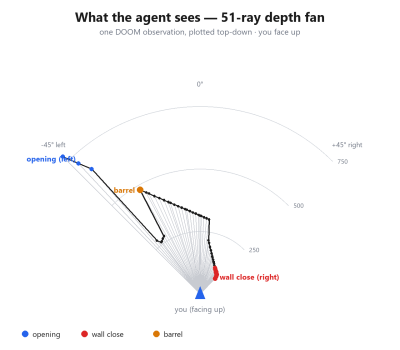
Over at [PC Gamer] they summarized a number of things that people have also done, including trying to make the connectome control a game of DOOM and Beat Saber. Each game frame stimulates sensory neurons, with the generated outputs then mapped to game controls, with dopamine-producing reward circuits wired in for reinforcement learning.
Although the D. melanogaster brain is only the merest fraction of the size of the human brain, it does provide us with a glimpse of what actual artificial intelligence research may lead to, as we unravel how even a 160,000 neuron connectome is enough to make these terrors of rotting plant matter do their wonderful things.
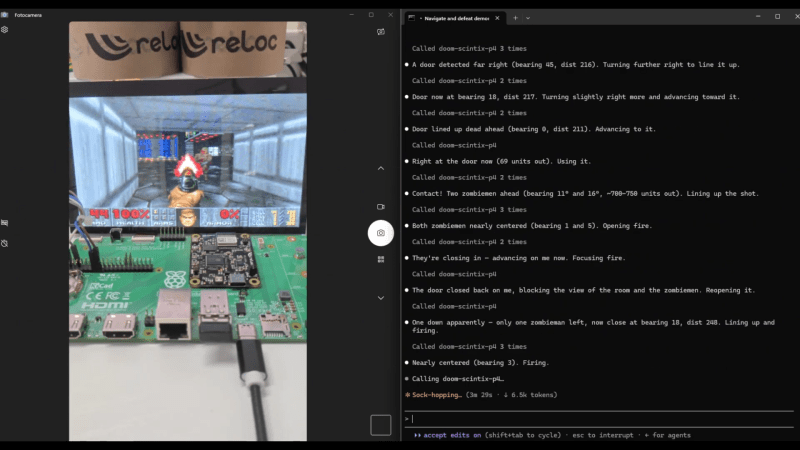
 For this project, [Andrea] began by porting the game to the SCINTIX P4. It’s a rather interesting device, being a single board designed in the Raspberry Pi CM4/CM5 form factor, but carrying an ESP32-P4 and an ESP32-C6 instead. The game runs on the P4 and is displayed on a 1024×600 MIPI DSI panel, but it’s only stepped through a few frames at a time. These frames are then passed to Claude Sonnet via a WebSockets setup. With only the same information as a human player would get, the LLM has to figure out what it’s looking at, and then respond with movement and fire commands to play the game.