❌

Reading view

There are new articles available, click to refresh the page.

Emulate the 486 in Your Browser

You might fondly remember the days of the Intel 486, but you probably don’t have one on your desk anymore. If you’d like to emulate that classic hardware, you can now do it in your browser, thanks to [Jan de Jager].

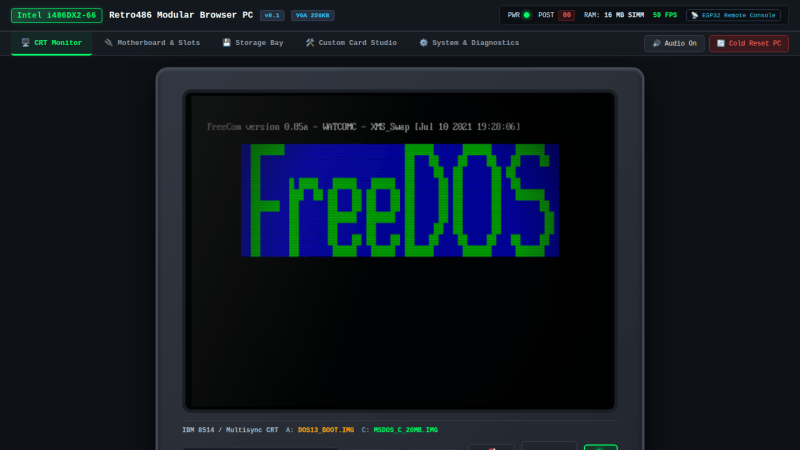
What [Jan] has built is a 100% browser-based emulator for an Intel 80486DX2-66 PC. Obviously, it’s not just a CPU that’s being emulated hereβ€”[Jan] has gone so far as to throw in the motherboard and ISA/VLB adapter card emulation necessary to make this a real and functioning computer that runs inside a solitary browser tab.

It’s all written in ES6 JavaScript. It will happily run SeaBIOS, VGA BIOS, FreeDOS 1.3, and a whole bunch of classic games, like Wolfenstein 3D, Duke Nukem, and DOOM. There’s even a control panel where you can configure the PC how you like, from storage to expansion cards and all the rest.

Once upon a time an emulator was an application you had to download and run, hoping all the while that your new machine had enough grunt to emulate the classic hardware of your desires. These days, we have endless piles of CPU cycles to throw at everything and you can do it all within a browser. Or even on a tiny microcontroller, if you feel like it!
In Praise Of A Legendary Power Transistor

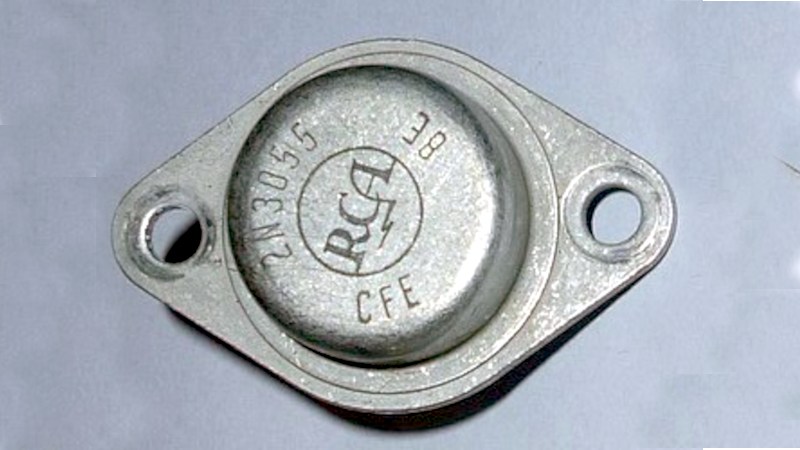
There are some devices which achieve electronic immortality, it’s likely that you have used a few of them yourself. The 555 timer of course, or the 741 op-amp. [ElectronicsNotes] is here with another candidate that might not have been on your mind as you read the previous sentences, and it’s a transistor. The 2N3055 is an NPN power transistor, no,Β THE NPN power transistor, that has found its way into an astounding array of devices over the last six decades or more.

For such a ubiquitous device one might imagine that there’s not much new to know, but the video delivers on that front. Here as well as probably for you the 3055 has always been an epitaxial device whose quirks you likely know well, but originally it was something different. It used the hometaxial construction process on its launch in the early 1960s, but in the mid 1970s it was replaced by a version with the same capabilities but using the epitaxial process. The consequent higher Ft required modifications to circuits using the device to stop unwanted oscillation.

Where this is being written there are several 2N3055s, in the by now rather old office audio amplifier, in a bench power supply, and probably elsewhere too. It’s been superseded in many ways and its TO3 case now feels antiquated, but it will probably never entirely go away. Meanwhile if you’d like to read about another iconic 1960s device that never went away, we have you covered.

Header: a really early example. Eule4404, CC BY-SA 4.0

An Open Micro-Maniplulator Improved

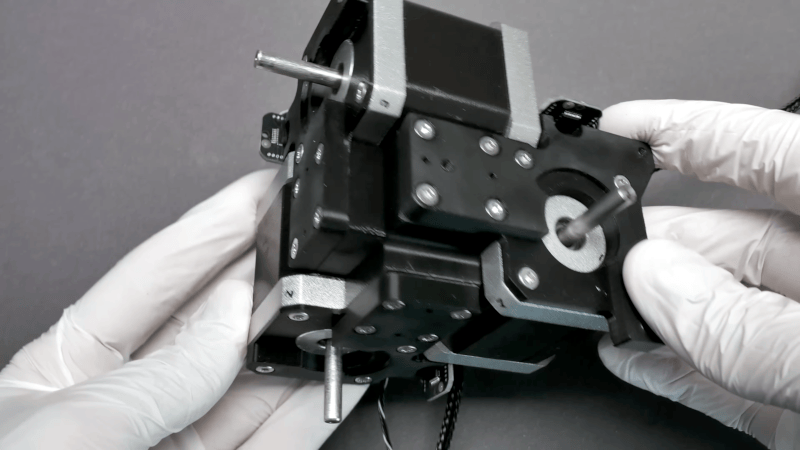
If you need a micro-manipulator, you probably already have a good idea of what it does. For example, you might be moving a probe over an IC die or wafer. You might be looking at something through a microscope. The key is moving something in very small, precise increments along three axes. An open-source design for a micro-manipulator has seen significant improvements lately. You can see several videos about the device below.

The device uses stepper motors, parallel kinematics, and miniature ball joints to achieve precise motion. The recent version 4.0 update fixes a few problems. According to the GitHub page:

  • Self-collision during homing fixed.
  • Connection of the ball joint block with screws only was not well constrained and could be rotated a bit.
  • No reliable way to ensure consistent linkage rod length
  • Unnecessary ball joint friction
  • Accurate ball position heavily dependent on print quality and corner rounding
  • Rubber bands could not be changed or removed once glued in.

We’ve covered earlier versions of this device, and we were watching the improvements to the ball joints. Since then, the project has updated much of its mechanical design and documentation, and it has also changed the API that drives it. It can even use tools in g-code now to support things like fine control over laser engraving.

If you prefer something old-school manual, consider a 3D-printed one.

Inside a Mystery 1980s Filter IC Featuring Switched Capacitors

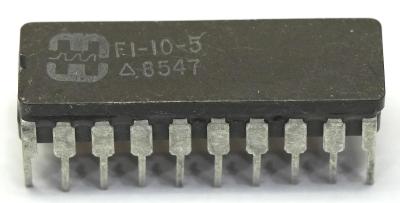
Recently [Ken Shirriff] got handed a mystery IC by [CuriousMarc] who had found said IC in a box of various old chips. Labelled only with a date code of the 47th week of 1985 and a mysterious F1-10-5 alongside a logo that didn’t lead to any hits in the typical IC databases, it was up to [Ken] to figure out what lurks inside this CDIP chip.

As it turns out, it’s actually a pretty interesting IC with an easy to identify die once the ceramic package had been cracked open with a surgical hammer-and-chisel strike.

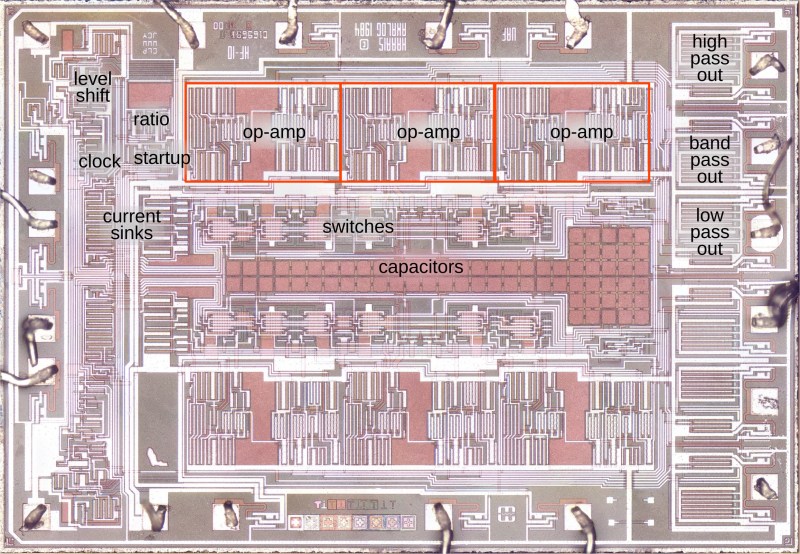
With the die under a microscope it was identified as a Harris HF10, itself a variant of the National Semiconductor MF10. This is a dual switched capacitor filter, with the modern version being e.g. the TI MF10-N in both PDIP and SOIC, but sadly no CDIP any more. Availability seems scarce, so the MF10 may not be long for this world.

These filter ICs can tune their capacitors to act as a low-, band- or high-pass filter. How this works is explained by [Ken], with switched capacitors replacing the resistors of a typical filter circuit. The main reasons for doing this over just using a resistor include how large resistors can get compared to the relatively small capacitor, not to mention their fixed value versus the adjustable resistance from the switchable capacitor.

The remainder of the circuit is mostly there to enable the switching and overall operation, providing a fascinating glimpse at a chip that would have been incredibly useful in the 1980s, including in synthesizers where this adjustable filter feature was most convenient.

Two-Component H-shifter for Racing Sims

Flying and driving simulators can go as far as money will take you, and at some point it might end up being cheaper to buy a plane or race car than to keep adding capabilities to some of the sim rigs we’ve seen. But it can also be a fairly affordable hobby as well, with entry-level components being within reach for many. The price can drop precipitously from there too, provided some parts can be sourced and a 3D printer is made available, and [Jason] is demonstrating one of the lowest-cost H-shifters we’ve seen which only uses two parts at its core.

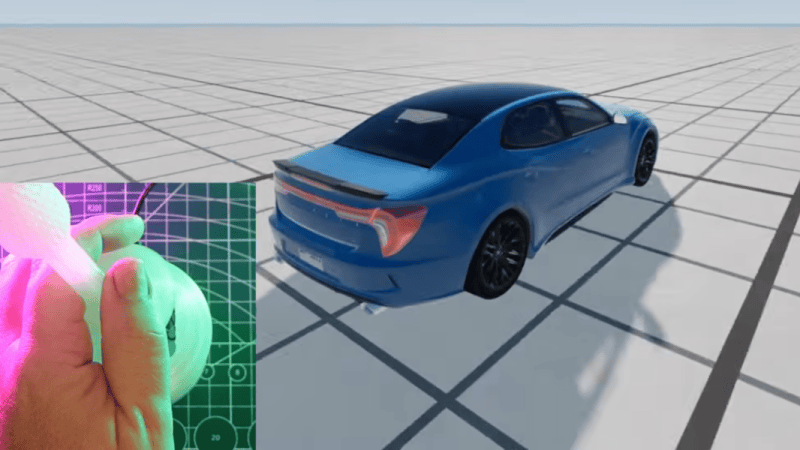
The two components only cover the electronics for the build, but this gets almost everything needed for the shifter squared away. A joystick like those found inside many game controllers is paired with an Arduino Pro Micro, with a very straightforward wiring configuration between them. These components are paired with a prototype 3D printed case and shift knob which provides the H pattern of choice. From there it’s as simple as uploading some readily-available firmware, which [Jason] also demonstrates, and which has many options for various configurations of shifters.

Although this was just a prototype, it shows was just a few off-the-shelf components and a 3D printer can provide to an affordable driving sim setup. Even then a 3D printer is not always necessary, like this three-pedal setup using extruded aluminum frame as a base. From there, all kinds of other features can be added like force feedback on the steering wheel.

❌