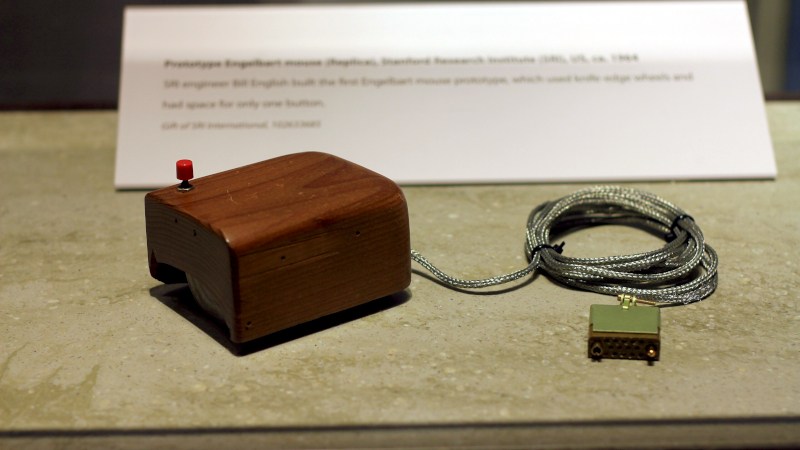
Many readers will be familiar with Douglas Englebart’s 1968 so-called “Mother of All Demos”, in which he described many of the devices and technologies we would be using two or three decades later. Among these was a primitive computer mouse, but while famous it was by no means the earliest pointing device. At the recent Vintage Computer Festival Berlin, [Dmitriy Kostiuk] delivered a fascinating lecture of the history of the pointing device.
It’s a long video that we’ve placed below, and it’s an exhaustive examination of the topic from the earliest examples to the 1990s when mice became commoditized. It’s a surprise to find that the first pointing device was a trackball built for a 1950s Canadian warship, with a surprisingly modern-looking optical encoder. Englebart’s 1966 wooden block with its pair of wheels and potentiometers had a less-well-known and much more stylish competitor in the same year from Telefunken.
We visit the various design iterations as the form of what we’d call a mouse today took shape. It’s unexpected to find that those Sun mice with the spotty mouse pad weren’t from Sun at all, they were from Mouse Systems. The first mice from Microsoft and Apple make an appearance, as do some awful designs for 8-bit computrs. Remembering those in particular perhaps it’s as well we didn’t have the cash to buy such a disappointing product for ourselves.
The video is long, but interesting. Give it a watch.
Header image, Douglas Englebart’s prototype, Michael Hicks, CC BY 2.0.
Some disappointing, but perhaps not entirely unsurprising news this week out of Denmark — after announcing last year that they would transition away from Microsoft’s proprietary software, the realities of making it work seem to have caught the government off guard. The word is that a trial program immediately ran into problems when government employees that had been given Collabora tried to collaborate with their peers running Office, and has since been quietly abandoned.
Although there’s probably a joke to be made about different parts of the government not knowing what the other ones are talking about, the reality is that if one group of staffers can’t reliably access the data being produced by another, that’s a pretty big problem. Of course, had they simply asked us nerds, we could have advised them that these sort of issues are inevitable if you don’t fully commit to the effort.
Had the entire government moved to the Open Document Format (ODF) at once they would have avoided the issue, at least when it came to newly created documents, but obviously that’s a considerably larger undertaking than installing Collabora or OpenOffice on a few dozen machines and calling it a day. There’s no word yet on how this stumble will impact Denmark’s larger effort to free themselves of proprietary software, but we’d hazard a guess it’s not a great sign. Hopefully things go better for the Dutch.
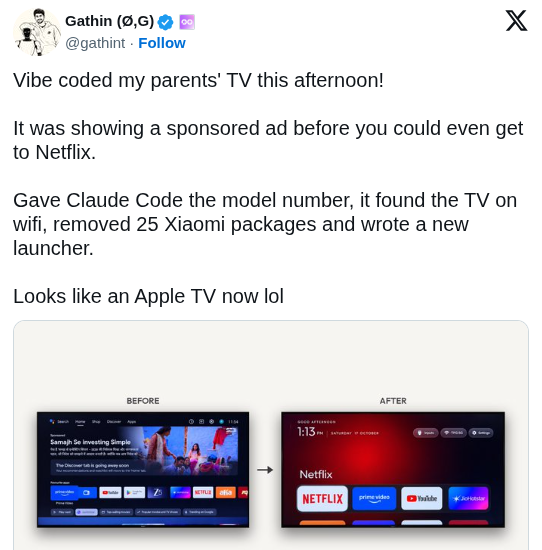
Speaking of users trying to improve their personal software situation, The Verge has an interesting article on a recent trend of frustrated users pointing AI tools like Claude at their smart TVs, with a few success stories posted to social media showing off interfaces that have been stripped of ads or replaced with something else entirely. It’s compelling stuff for anyone who’s unhappy with their current smart TV experience, but the whole thing isn’t quite as technically impressive as it might seem on the surface.
As the TV’s in question are running Android, all the AI tools need to do is connect to them over Android Debug Bridge (ADB) and uninstall any offending packages that might be providing ads, and similarly creating a customized launcher interface is a matter of spinning up an Android app and installing it over the network. The results may look like arcane magic to the uninitiated, so we appreciate The Verge pointing out that it’s all pretty basic stuff for anyone familiar with Android development.
On the subject of extracting unwanted components, a delicate operation to remove the masts of the sunken WWII cargo ship SS Richard Montgomery was completed successfully earlier this week off the coast of Sheerness, England. To those unfamiliar with this particular vessel that might not sound like a big deal, but when you’re dealing with a wreck holding an estimated 1,400 metric tons of explosives that have been deteriorating since 1944, even approaching the area needs careful planning and coordination.
Masts of the SS Richard Montgomery in 2014. Image Credit: Christine Matthews
There was a concern that the masts and their supporting structures were on the verge of collapsing into the hull of the wreck, which experts warned could potentially trigger an explosion large enough to endanger life and property. Actually removing the explosives from the ship itself will be a far larger undertaking, but at least for the time being, removing the masts has helped stabilize the situation.
Finally, if you’re looking to learn about something a little more local than a potentially explosive situation in Sheerness (apologies to anyone in Sheerness), check out Local Wikipedia. Created by [Ed Jefferson], the site lets you filter Wikipedia pages by their distance from your location or whatever other landmark you wish. By default it shows results that are within 1.5 miles, but if you don’t have anything too exciting within range it will start opening up the radius to pull in more results.
See something interesting that you think would be a good fit for our weekly Links column? Drop us a line, we’d love to hear about it.
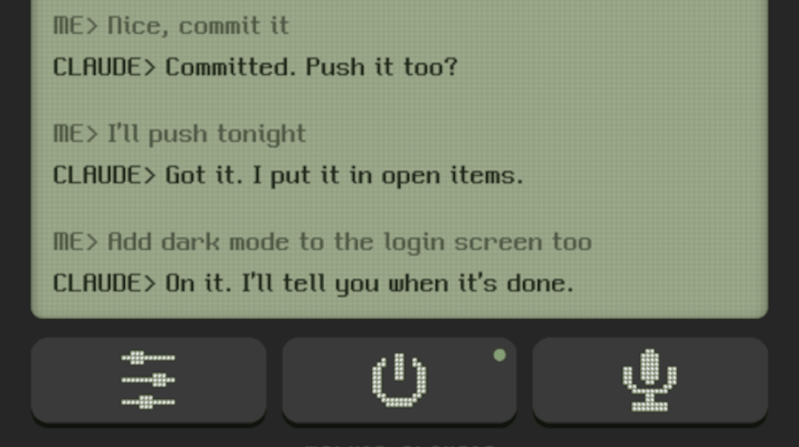
[Bookmari] had a problem — working as a delivery driver, they wanted to work on various projects with Claude Code while out and about. Unfortunately, it simply wasn’t practical to write prompts and read answers on the job. Thus, they whipped up Walkie Claudie, so they could use their voice instead.
The concept is simple enough, it’s an interface that lets you talk to Claude using speech recognition, and lets Claude talk back to you with a text-to-speech engine. It runs on a smartphone, with a direct network connection to the PC running Claude, though you can use a VPN if you’re distantly located. [Bookmari] has a push-to-talk setup so that pushing a button on their Bluetooth earbuds lets them talk directly to Claude. There’s also a special mode to keep the channel active during long pauses if you need a while to collect thoughts and vocalize them. Just for fun, the interface is styled like an old-school walkie LCD, and there’s fun little details like synthesized squelch and channel-switch noises and so on.
If you’re looking for a way to stay hooked up to your AI assistant at all times, this could prove useful to you. Alternatively, consider if maybe it’s worth taking a break sometimes, or check out other Claude Code projects we’ve seen of late.
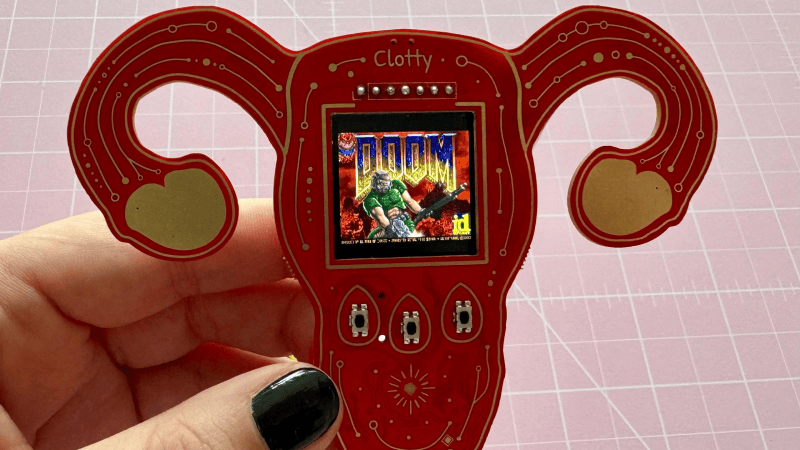
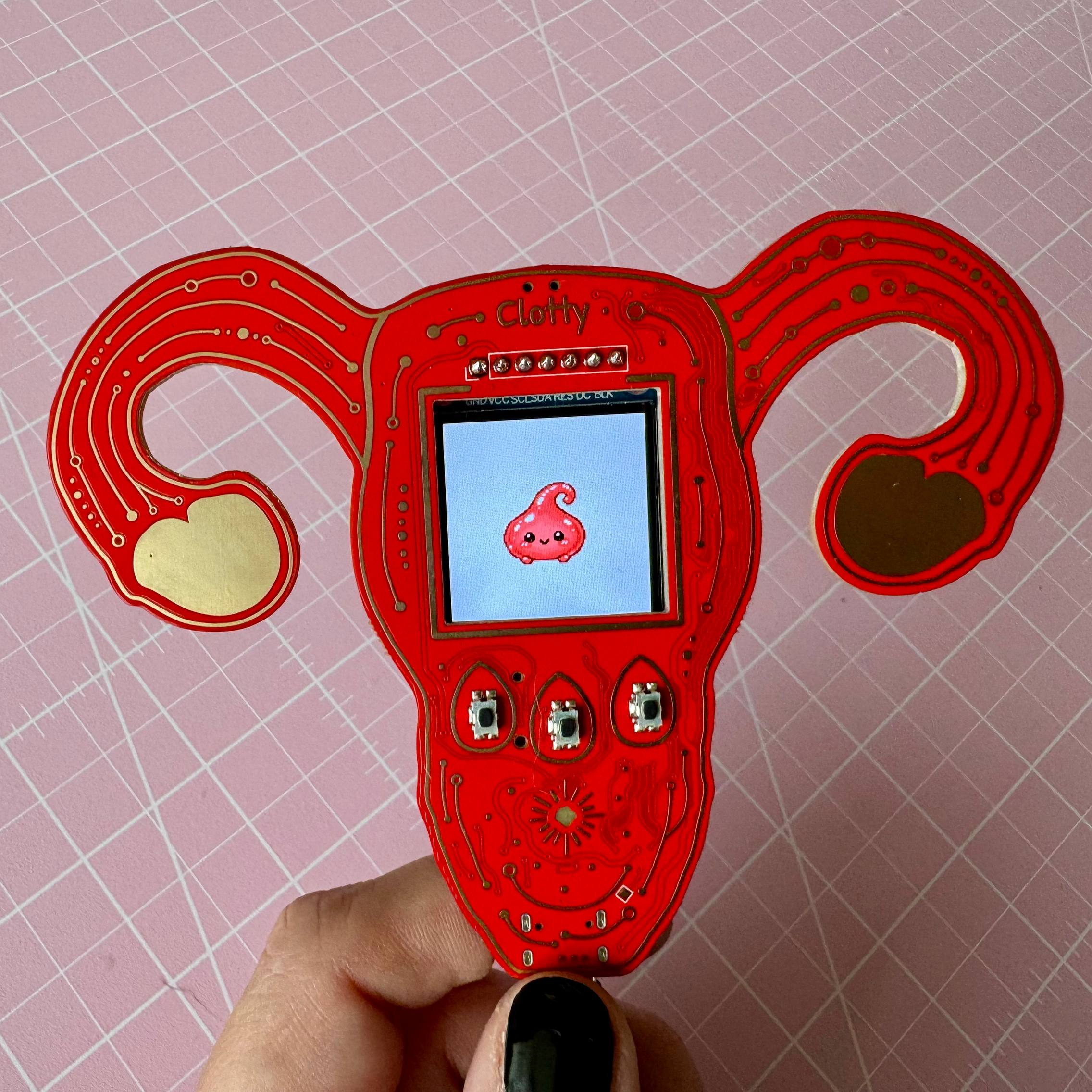
[kati]’s Clotty might run DOOM and game-ify the menstrual tracking process with a playful Tamagotchi-like aspect, but don’t let that distract you. It is, at its heart, a personal menstrual cycle tracking device that is defined as much by what it does do as what it doesn’t.
Clotty brings a Tamagotchi-like playfulness to the table.
What doesn’t it do? Well, it will never quietly upload one’s menstrual tracking data to a remote server. Nor will it harvest, mishandle, disclose, or sell that same data. Shamefully, that alone sets it far apart from the wide range of period tracking services and apps out there. Also setting it apart is its cheerful lack of discretion. As [kati] puts it, she wanted Clotty’s design to scream “HELLO I AM A PERIOD TRACKING DEVICE” and at this she absolutely succeeded.
Clotty uses an RP2040, color LCD display, and a small variety of sensors built into a palm-sized, uterus-shaped PCB complete with touchpad ovaries. Right now it’s still in its early stages, and basically at the point that everything works hardware-wise and the essentials are there for software, but it’s still in active development. Keep an eye on Clotty’s GitHub repository for updates as features get fleshed out.
Of course, as [kati] observes, the core validity of a device can be defined by whether it can run DOOM, which of course Clotty can. You can find [kati]’s fork of RP2040-DOOM here.
[kati] has a knack for designing effective hardware that gamifies functions and incorporates a playfulness to the design that’s a delight to see. Take a moment to check out her Slightly Sentient D20 which is another excellent example of the kind of work she does.
One of the problems with planetary science is that you generally cannot easily investigate the exact conditions in their interior, so you’re left to extrapolate what is happening inside them based on surface scans. One of the resulting questions is what ice giants like Neptune and Uranus in Earth’s solar system have exactly at their core. We do know that it is mostly rocks and ice, but what kind of ice you end up with at these intense pressures is a good question that [Alexis Forestier] et al. set out to answer, with their results published in a Physical Review Letter paper (ArXiv preprint).
It’s noteworthy that there isn’t just water ice at these planetary cores, with this study only investigating water ice specifically. In order to get the water to the pressures it would experience courtesy of ice giant gravity, a diamond anvil was used, with synchrotron x-ray diffraction allowing for the changes to the sample to be observed.
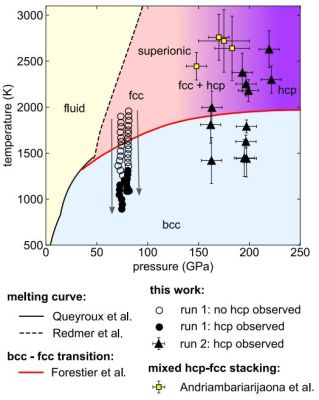
The phase diagram of water includes a number of phases beyond what us Earth-dwellers would call ‘ice’, with at higher pressures above about 80 GPa the formation of ice X, featuring a body-centered cubic (BCC) oxygen sublattice. Subsequent discovered phases were face-centered cubic (FCC) and now hexagonal close-packed (HCP) ice, all differing in the packing of the oxygen sublattice.
In addition to extreme pressures, temperatures also had to be increased by using the laser heating feature of the diamond anvil. At around 2,000K and over 200 GPa the HCP phase was found, with a mixed FCC-HCP phase at intermediate pressures.
Although not immediately providing answers to questions pertaining to the aforementioned ice giants, it gives planetary scientists yet another clue that they can use in future investigations, as well as provide more insight into this most fascinating phase of water that’s actually its own little galaxy of phases.

 Login