Reading view

There are new articles available, click to refresh the page.

Encryption in the 1790s

For as long as humans have had writing, there’s been a need to send secret messages. It is easy to think that Enigma machines and their immediate predecessors are old tech, but they are much more recent than ancient systems used by the Greeks and Romans. Even Thomas Jefferson, one of the founding fathers of the United States, was interested in encryption and is often said to have invented the Jefferson Disk machine for encryption. The truth is, the device is probably older than Jefferson, but he certainly thought about using it for secret communications.

Simple but Effective

Thomas Jefferson was, apparently, a fan of secret messages

The idea is simple. We make a series of disks. Each disk has a number on it and, around the edge, all the letters of the alphabet. The placement of each wheel with the same number is the same, but, overall, the arrangement is random. That is, all disks marked #5 might start with XCBYG, but all disks marked with #10 could start with FAYQL. You take one set of disks, and I keep the other set.

When we want to send secret messages, we agree to arrange our disks on an axle in the same order. Jefferson used a 36-disk system, so we might agree to go left to right with the odd numbers first and then the even numbers, or any other setup that we could agree on.

Encryption

Once the wheels are in place, encryption is simple. There’s a bar across the device, and you line up your message using a wheel for each letter: ENEMYCOMESBYSEA, for example. Then you look at any different row, which will now read something crazy like: FSRSSXQCGAEEFOR (plus the random letters on the rest of the disks). That’s the message you send.

Decryption

Upon receipt, you spell out the same message on the disks with the wheels in the agreed order. Once you have FSRSSXQCGAEEFOR lined up, you look at the other rows. It is a good chance that all of them will be gibberish except one. That’s the decoded message.

Of course, you could agree to shift a certain number of rows if you wanted to be sure. The order of the wheels amounts to a key, and while Jefferson wasn’t sure how secure this is, modern analysis says it is actually pretty good. If you don’t have the wheels and you don’t know the order of the wheels, it is actually excellent. If you have the wheels but don’t know the order, it is still very difficult to try all the permutations, especially without a computer.

History
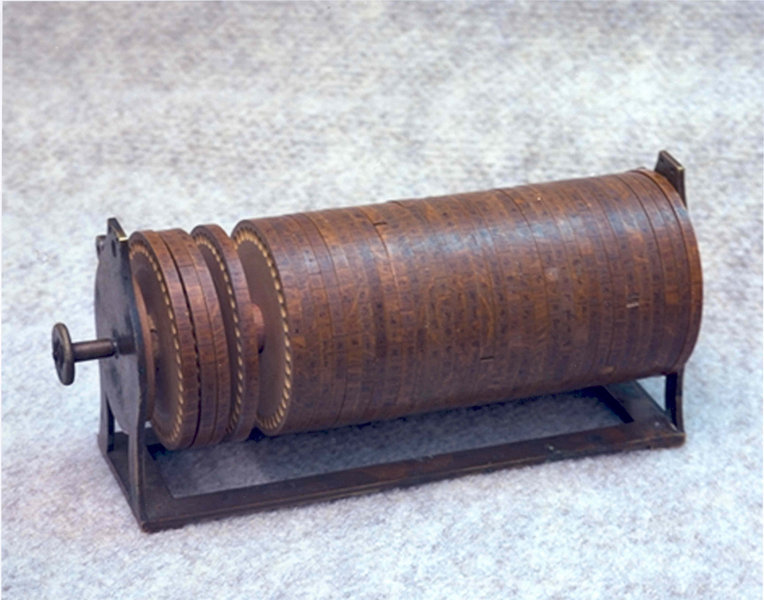
The National Cryptologic Museum has this partial device, which may or may not have been Jefferson’s

The Swede Fredrik Gripenstierna used a similar machine with 57 disks, but it had a slightly different purpose and operating principle. Jefferson described his device in the 1790s, and while he never claimed to invent it, the story has caught on that he did. Sometimes these are called Bazeries cylinders, as Etienne Bazeries had a 20-disk device in 1891, apparently independently invented.

It doesn’t appear that Jefferson or anyone else actually built the machine he described. There is an old device in the NSA museum that could be from Jefferson, but it isn’t clear that it was actually his or related to his writings.

Jefferson abandoned the scheme after learning about columnar transposition ciphers in 1803.

Use in the 20th Century

While Jefferson’s wheels never saw use, the US Military adapted Bazeries’ cylinder in 1922 and used the M-94 through 1942. The M-94 had 25 aluminum disks on a spindle.

The original prototype of the M-94 used a sliding strip arrangement instead of disks, and the Army returned to that style with the M-138A cipher machine in the 1930s. Each machine had 100 strips, and you had to select 30, further improving key security. It was used for some time, and you can see an example of it in the picture from the National Cryptologic Museum.

Everything Old is New

It is tempting to say the military used Jefferson’s wheel, but, in fact, the papers explaining the device were forgotten until 1922, and the prototype M-94s were developed between 1914 and 1917.

The system probably predates Jefferson anyway. Charles Babbage made references to disks with letters in 1854, although the exact arrangement he had in mind isn’t clear.

Of course, the Enigma and similar rotor-based machines took over during World War II. While making a disk-based code tool yourself would be easier (try styrofoam cups, like in the video below, if you don’t want to 3D print it), you can put in a bit more effort and make your own Enigma.

Postal IRCs are Almost a Thing of the Past

Have you ever found out that something you remember from your youth is now gone, and you didn’t even notice? If you are a certain age, you might feel that way when I deliver the news: You haven’t been able to buy International Reply Coupons (IRCs) at a US Post Office since early 2013. By the end of 2026, you won’t be able to buy them anywhere. The age of the IRC is over.

What’s an IRC?

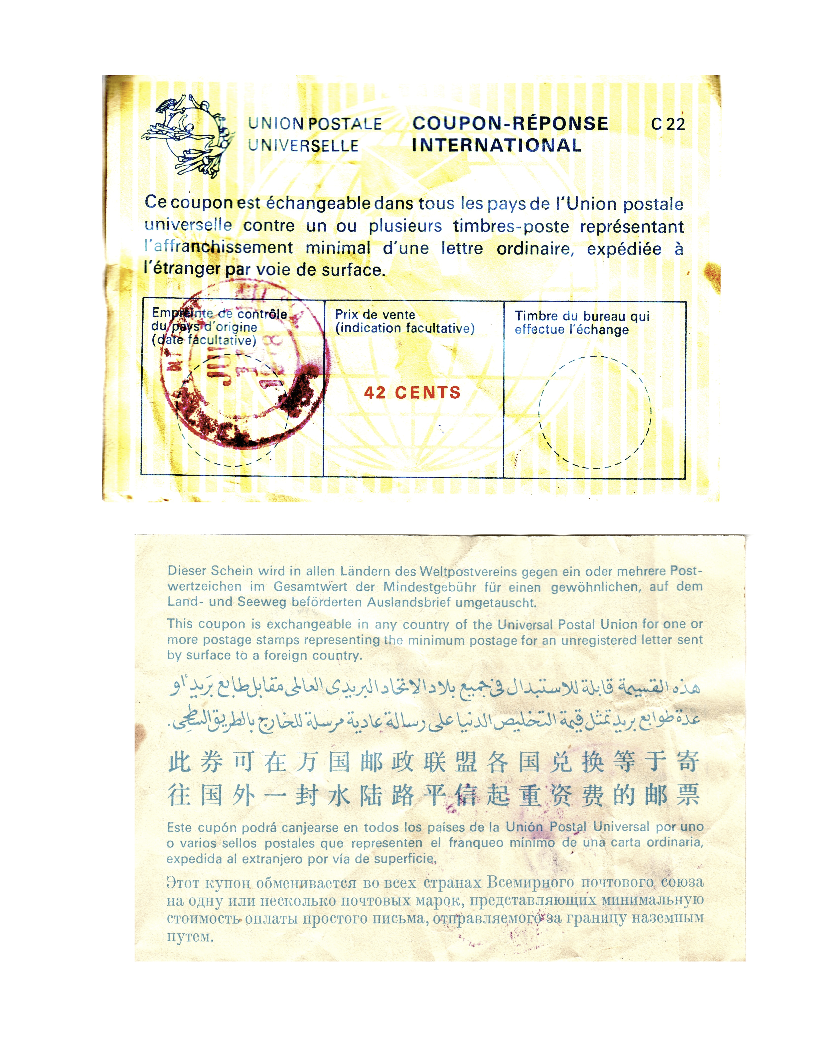
An IRC from 1978 (public domain).

If that didn’t mean anything to you, you might be too young to remember, or maybe you just weren’t into shortwave listening or ham radio. Although there were other reasons to get IRCs, a radio hobby is the most likely reason a Hackday reader would have bought an IRC.

For radio purposes, here’s the problem. You’ve worked on your station for months, and one winter night, you finally pull in that rare station from Luxembourg. They’ll send you a QSL card to verify that you heard them. You only have to send them a letter telling them what time you heard them, what frequency, and some details about the program you heard. But they probably don’t want to pay the postage required to send hundreds or thousands of cards overseas.

While this is a radio-specific problem, you might find the same issue with pen pals or when trying to buy things from an overseas company.

SASE

If everyone were in the same country, the solution would be easy. Take a stamp, put it on an envelope that has your address on it, and stuff it in with the letter. Or, you could just drop a stamp or two in the letter you sent.

The problem is, US postage won’t help Radio Luxembourg. On the other hand, the effort required for you to buy postage that works in Luxembourg would have been a nightmare.

Enter the UPU

The Universal Postal Union is a UN agency that is effectively an association of post offices in 192 countries. Their charter is to facilitate mailing things worldwide.

The IRCs date back to 1906. The idea is you buy an IRC at your post office. You send it to Radio Luxembourg, or wherever. There, the mail person at the radio station could go to their post office and trade the coupon for enough local postage to send a surface letter worldwide.

Slow Death

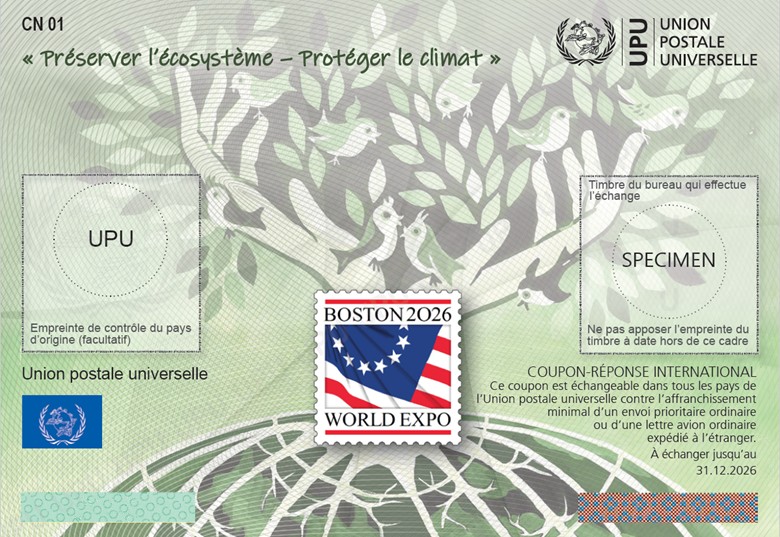
A more recent IRC (UPU).

As demand has dwindled, post offices worldwide have quit selling IRCs. As of last year, Australia still did. But Germany, Britain, the United States, and many other countries gave up on them long ago. In fact, Britain’s Royal Mail claimed that the average post office sold less than one IRC per year at the time it threw in the towel.

UPU decided to end IRCs altogether by December 31, 2026. The end of an era and, apparently, not just for radio hobbyists. It is telling that the UPU’s recent editions of IRCs had print runs of 1,000 or even 500. So they obviously weren’t selling very many.

IRCs Other Claim to Fame

If you’ve heard of these before and you aren’t interested in radio, then it might have been in economic history. Have you heard of the Ponzi scheme? It has become a generic term for any business scheme that relies on raising money from new investors to service debt owed to old investors.

However, the original Ponzi scheme dates back to 1920, when Charles Ponzi realized he could buy IRCs in a country where they were cheap and sell them for more in another country. He was happy to accept investors, of course.

The problem is that profits are thin, and the costs of acquiring and transporting large numbers of IRCs quickly swamp most potential profits. Fluctuations in currency exchange rates take the rest.

Goodbye!

So the end of the IRC marks a closed chapter for ham radio and swindling. There were probably other uses, too, that are now consumed by electronic mail, payment systems, and the like.

You have to wonder what adventures IRCs went on during their global travels. The video below shows one’s story.

Musing on AI from 1964

[Irving John Good] was at Trinity College, Oxford back in 1964. His paper, “Speculations Concerning the First Ultraintelligent Machine” could have been a topic for today, as we deal with machines that aren’t really ultraintelligent, but appear smart and think they are even smarter. He starts off with a bold thesis: “The survival of man depends on the early construction of an ultraintelligent machine.”

He also admits that we’ll need to understand more about the human brain and human thought to make a breakthrough. This is still true today. However, we still don’t fully understand how our brains work, but it seems unlikely that we are just super-large LLMs. Not that [Good] anticipated the modern chatbot. Perhaps his comments will apply more to a future AI software that actually thinks like a human, if there will ever be such a thing.

Then again, there are many parallels. One theme in the paper is that a smart machine will design a smarter machine. Unless, of course, it is afraid of being replaced. If a machine were actually sentient, what are the ethics of turning it off and tearing it apart?

It is hard to be a visionary. [Good] remarks that by 1980, progress in human/computer symbiosis will encourage more investment in the field and that by that time, there would be “great advances in microminiaturization” and “frequencies of one billion pulses per second,” might be common in “large computers.”

We love reading what smart people thought the future might be like. What will the world be like in another 60 or 100 years?

A Brief History of the Crazy Old 7-Segment Display

How old is the seven-segment display? Surely it is a product of the 1970s. After all, calculators started showing up, and the height of junior high humor was plugging 7734 into your calculator and showing it to someone upside down. Of course, for it to go mainstream, maybe they really originated in the 1960s, but no earlier than that, right? Actually, no. Sure, the LED seven-segment display had to wait for LEDs. But the actual idea is much older than that.

The concept of building numbers from a small set of reusable segments predates LED displays by decades. In fact, the basic idea appears in patents from the early 1900s and may have roots in even older mechanical signs and printing techniques.

The history isn’t entirely straightforward. Unlike vacuum tubes or transistors, segmented displays evolved gradually through a series of practical ideas rather than one defining invention.

Blacking out the Eight

While looking into the history of segmented displays, I was reminded of something I’d seen years ago in retail stores: reusable price tags printed with rows of eights.

Rather than printing every possible price, the clerk simply used a marker to black out portions of each figure, transforming an 8 into whatever digit was needed. Cover a few strokes, and the eight becomes a three. Remove a different set, and it becomes a zero or a five. It was, in essence, a manual segmented display.

Finding the exact origin of these price tags is akin to finding out where Romans bought sponges. They were inexpensive commercial supplies, not the sort of products that historians carefully documented. My recollection is from the middle of the twentieth century, but the underlying concept is almost certainly older.

Everything New is Old Again

George Mason’s 1898 21-segment display used 21 lamps and a complicated switch to display any digit or letter in a very stylish font. You can see a modern recreation of these ancient displays in the video below. While this is the basic idea, certainly, it is more ambitious than a simple 7-segment display.

I couldn’t determine that Mason’s displays were ever used for anything.

You could argue that an early 1903 invention by Carl Kinsley to draw characters telegraphically using six pens was an even better precursor, but using magnets to draw with pens on tapes hardly seems to qualify as a display, although figure 12 in the patent clearly shows the formation of numbers and even letters with this arrangement.

Digits of Patent

The direct parent of modern segmented digit displays appeared in the early 1900s (filed 1908; granted in 1910). Technically, this was an 8-segment display because it had a bar dedicated to forming a proper four, with the top-left part slanted. But removing that one segment is just an optimization. It may or may not have been the first, but by 1910, seven-segment displays were in use and not just curiosities on a workbench or dreams in a patent application.

Even for lit-up displays, the first implementations weren’t LEDs. Early displays used incandescent lamps or neon-filled tubes. By the 1930s and 1940s, segmented neon or incandescent indicators were appearing in industrial equipment and counters, instead of the common columns of ten neon bulbs, pointers, or rotating wheels.

Then, too, there were different approaches. Nixie tubes used individual character forms that lit up. Decatrons could count with ten different glowing points, each representing a digit.

Enter the LED

The real explosion came in the late 1960s when practical LED displays arrived. Suddenly, segmented displays could be compact, rugged, inexpensive, and operate at low voltages. Calculators, clocks, frequency counters, digital multimeters, and every imaginable piece of consumer electronics adopted them almost overnight.

Of course, it wasn’t just LEDs. Numitrons used seven tiny incandescent filaments. Vacuum fluorescent displays used segments with phosphor that glowed when excited. LCDs adopted the same pattern, blocking or passing light to produce the segments. But the key idea was something that lights up, arranged in seven segments.

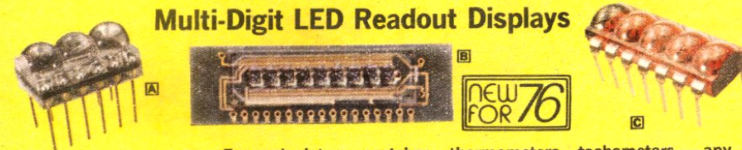
Radio Shack’s 1976 catalog featured magnified LED displays.

Early LED displays often had all the diodes on a single die to reduce cost. That made them very tiny. It wasn’t unusual to see displays with magnifying bubbles to make it easier to read.

The important point isn’t whether they used exactly seven segments. Many didn’t. Some divided the numerals differently or used additional pieces to produce more attractive typography. The insight was the same: begin with the most complex digit and selectively remove strokes to create all the others.

Why Seven?

One of the reasons seven segments became the standard is that they strike a perfect balance (although not everyone agrees, as you can see in the video below). With fewer than seven elements, several decimal digits become difficult to distinguish. Adding more segments certainly improves appearance, but every additional segment increases wiring, decoding logic, manufacturing cost, and the number of possible failure points. Seven is the right number for — um — numbers. But what about letters?

You can make some compromises to show some letters. For example, old computers would display hex digits using seven segments, but the A would be uppercase and the B would be lowercase. You also had to light the top segment for the 6 to make it look different from a B. But you only need A-F for hex. If you need, say, the letter S, there’s no real way to make it not look like a 5 with 7 segments. But sometimes, the letters you can make are good enough.

There were also 8- and 9-segment displays that could do better with letters and special characters. You can increase the segments further to get more glyphs.

The Union Jack

Different segment counts for displays (public domain by [errorage])
The solution for full letter displays was to add more segments. Despite Mason, you didn’t really need 21. By the 1970s, fourteen-segment and sixteen-segment displays had become common in instruments, telephones, calculators, and video cassette recorders. Their pattern of diagonals and crossbars earned them the nickname “Union Jack” display because the arrangement resembles the British flag. These are also sometimes called starburst displays. You occasionally see 16-segment displays, too.

Even Today

Today, you have a plethora of options for adding alphanumeric screens to just about anything. Yet, you still see 7-segment displays hanging around.

The seven-segment display isn’t successful because it’s beautiful. It isn’t even especially flexible. It’s successful because it’s close to the minimum solution that works. It delivers readable numbers with very little hardware, whether the technology behind it is incandescent bulbs, neon, vacuum fluorescence, LEDs, LCDs, or even ink on a printed price tag.

Perhaps that’s why it has survived every technological transition for more than a hundred years. Good engineering ideas often outlive the technologies that first bring them to life.

And once you start looking for segmented displays, you’ll notice they’ve been hiding in plain sight for much longer than the digital age.

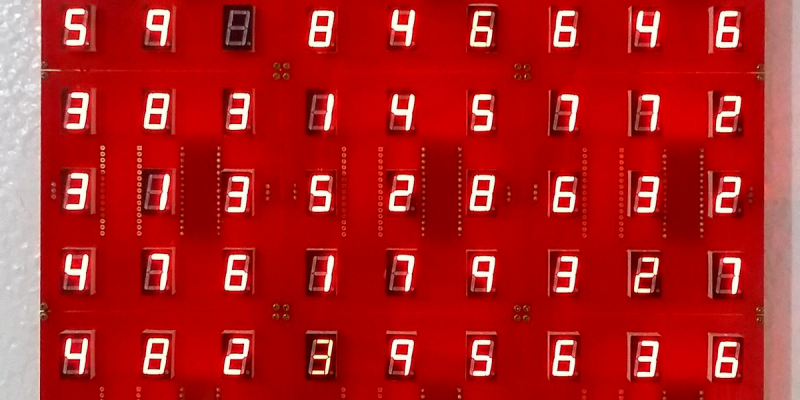
Featured image: [Arduino Enigma]’s marvelous Seven Segment Art Installation

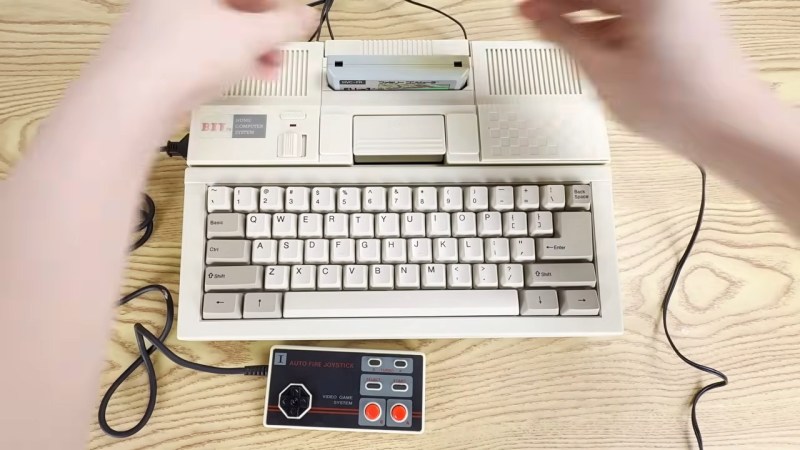
The Bit79 was a Famicom clone that took the “Family Computer” Name Seriously

While the original name of what much of the world knows as the NES was the Nintendo Family Computer, or Famicom for short, it was very rarely used as a family computer. Sure, there was a basic cartridge and an add-on keyboard sold in Japan, but it was always a sideshow to the games.

Nintendo recognized that when they brought their Entertainment System overseas. Most of the various famiclones — which date back to the mid-80s — are the same. BIT in Taiwan had a different idea: their Bit 79 would be a full home computer. Picture a C=64 that plays Nintendo games, and you might not be too far off. [Inkbox] tells the full story in his latest YouTube video, and it’s a must-watch for anyone interested in the history of 8-bit machines that are totally unknown in the West.

BIT were both game makers and system cloners; you may even have seen one of their NES or Atari games, as they were exported widely. By 1989 they’d already gone through a surprising number of Famicom clones, but those were pure clones and just played games. The Bit79 is obviously different — for one, it’s got a built-in keyboard in a wedge case. Apparently a pretty good one at that. For another, it starts with a bootloader that lets you choose between BASIC on ROM and loading the cartridge. For a third, it’s got a full 8K of RAM, quadrupling the Famicom’s offering– plus an additional 2K for the PPU, in what you might consider an early example of video RAM. Both CPU and PPU are knockoff chips made in Taiwan by UMC. The system even has what looks like a DB25 connect a printer. There’s also an expansion port, but no evidence that add-ons were ever sold, despite reports of a 64K memory add-on.

Back to the BASIC ROM for a moment– it’s not Famicom BASIC, as was clear in the manuals. [Inkbox] dumped the ROM to find that it is actually AppleSoft BASIC, of all things. That’s not only an odd bit of piracy, it’s also a big miss, since Apple’s BASIC doesn’t have any commands to make use of the PPU the way Famicom’s version does. POKING the registers during the vBlank interval is apparently not an easy thing to do. Perhaps that’s why we’ve never heard of this machine — well, that, and the fact we’re not located in East Asia where it was sold.

While the Bit79 didn’t sell particularly well, apparently it inspired a whole wave of “educational computer” famiclones in 1990s China that are largely unknown to the English-speaking world, making it an important part of computer history.

While BIT Corp is long gone, if you want to play around with their great experiment in turning a famiclone into a home computer, an emulator is available online, and the ROMs are preserved on the Internet Archive thanks to [InkBox].

Thanks, too, to [Stephen Walters] for the tip.

❌