Blue Origin is getting a taste of its own medicine after Rocket Lab filed a formal protest over NASA's decision to award Jeff Bezos' space biz a contract worth up to approximately $700 million to build the agency's Mars Telecommunications Network. NASA issued the award in early September following a request for proposals in May. It tasks Blue Origin with designing, developing, integrating, launching, and operating a Mars Telecommunications Orbiter (MTO) that will, among other things, serve as a communications relay for missions to the red planet. Rocket Lab has now filed a formal protest with the Government Accountability Office (GAO) over the decision, writing: "NASA's award decision appears to be inconsistent with the eligibility criteria mandated by Congress. In addition, the agency's punitive review of Rocket Lab's technical volume was inconsistent, making incorrect assertions and conclusions." This isn't the first time Rocket Lab has bristled at NASA's decision-making. In 2025, The Register spoke with Richard French, Rocket Lab's veep for Business Development and Strategy, over NASA's rejection of its Mars Sample Return proposal, which included a Mars communications orbiter. "We're asking for leadership," French said at the time. "We're fine with an open competition. We think open competition is how the best ideas come about." Blue Origin threw its toys out of the stroller in 2021 after NASA awarded SpaceX a contract to develop the next lunar lander. Bezos' biz filed an official protest with the GAO, offered discounts, and even lobbed a sueball to no avail. Blue Origin later won a separate competition. In 2023, NASA selected the company as the second Artemis lunar lander provider in a contract worth $3.4 billion. Blue Origin's MTO design is based on its Blue Ring spacecraft, which combines hybrid solar-electric and chemical propulsion with 13 ports for mounting payloads, including scientific instruments and small spacecraft. Multiple Blue Ring spacecraft are already in production, and Blue Origin reckons it can produce four vehicles per year – a rate that could be scaled up if required. Tory Bruno, formerly of United Launch Alliance and now president of Blue Origin's national security arm, Blue National Security, said: "This awarded contract is a testament to the Blue Origin team that has been building Blue Ring with exactly this kind of mission in mind. We're ready, and so is the hardware." ®
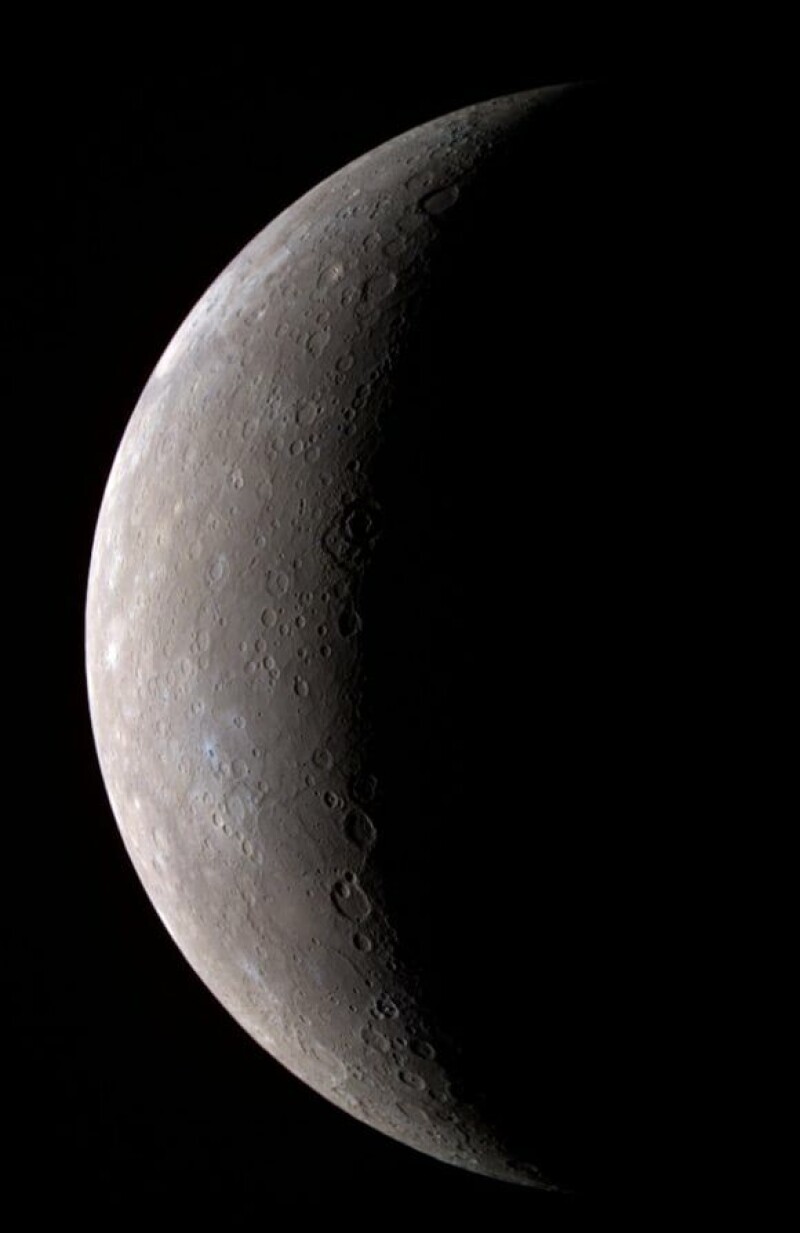
After nearly eight years, ESA and JAXA's BepiColombo spacecraft is finally nearing Mercury, as engineers begin the arrival sequence by jettisoning the power module that got it this far. The spacecraft stack separated from the Mercury Transfer Module (MTM) on September 3 at around 1400 CEST. After a tense few minutes, controllers confirmed that a preliminary Doppler signal had been detected, indicating that the MTM had separated successfully; by 1552 CEST, it was confirmed that signals had been picked up, indicating that all had gone to plan. The solar panels of the Mercury Planetary Orbiter (MPO) were charging the spacecraft's batteries. The next stage involves dropping into orbit around Mercury on November 21. Then the Mercury Magnetospheric Orbiter (MMO) – aka Mio – will be released between December 9 and 10, and a week later MPO will start moving to its final orbit over 480 x 1500 km, with science commencing in April 2027. The arrival is a year later than planned. BepiColombo was supposed to have been orbiting Mercury in December 2025, but problems with the spacecraft's Solar Electric Power (SEP) system meant the trajectory had to be rethought, which extended the spacecraft's cruise. BepiColombo is no stranger to Mercury and has performed six flybys of the planet since 2021. It has also conducted flybys of Venus and Earth following its 2018 launch. The spacecraft is an impressive example of international cooperation. The MPO and MTM are ESA contributions, while the MMO comes from JAXA. ESA also provided the sunshield to protect the MMO during transit. This sunshield will be ejected after the MMO is released. The MPO is the big brother of the BepiColombo partnership, with a main body measuring 2.4 x 2.2 x 1.7 m and a mass of 1,230 kg (including an 85 kg science payload). JAXA's MMO is 1.8 m in diameter and 1.1 m high, and weighs 255 kg (45 kg of which is the science payload). While MPO is 3-axis stabilized and nadir-pointing, MMO will be spin-stabilized at 15 rpm, with its spin axis 90 degrees to the Sun. The goal of the mission is a study of Mercury, "from the structure and dynamics of its magnetosphere and how it interacts with the solar wind, to the properties of its large iron core and the origin of its magnetic field." The initial mission at Mercury is planned for one Earth year (approximately four Mercury years), although it could be extended by another Earth year. ®
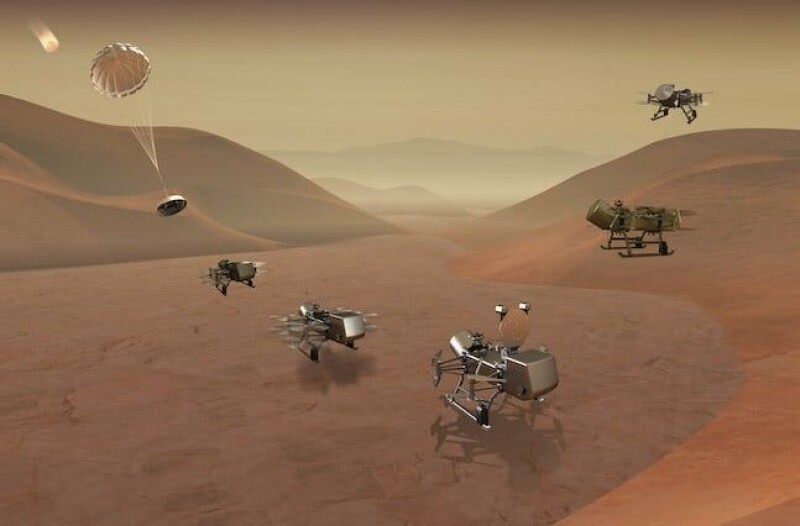
The Titan dune field where NASA's Dragonfly rotorcraft will land in 2034 has a name: Ahmakiq Undae. The International Astronomical Union (IAU) approved the name, and NASA announced it in an update as the spacecraft's 2028 launch edges closer. It is scheduled to arrive at Saturn's moon Titan in late 2034. Dragonfly's fabrication began in late 2024 and was completed about a year later. Most recently, engineers fitted the probe's wiring harness, which, according to NASA, includes an estimated 17,315 feet of conductor wire and 374 connectors, and weighs about 100 pounds. The harness is accompanied by a battery weighing in at almost 300 pounds. The nuclear-powered Dragonfly is an impressive piece of hardware. The fuselage is almost 13 feet long, and the arms will hold eight sets of rotors. The probe has landing skids and a cap on the end for its power source. The harness fitting means other Dragonfly components can be added, including its avionics and science instruments. During May and June, the rotorcraft was put through vibration testing, including suspending the fuselage on bungee cords to see how it behaves in the air, and a sealing test where engineers checked how well the structure keeps the environment out – Titan's atmosphere is, after all, dense, cold, and about 1.5 times the pressure of Earth's. Dragonfly isn't the first visitor to Titan - the European Space Agency (ESA) landed the Huygens probe there in 2005. However, while Huygens was a static probe that lasted just over an hour on the surface, Dragonfly is planned to spend at least 3.3 years exploring the moon's environment. According to NASA, the probe will explore "diverse environments from organic dunes to deposits associated with an impact crater – Selk Crater – where liquid water and complex organic materials key to life once existed together." The probe is effectively a flying laboratory and must withstand temperatures as low as minus 290 degrees Fahrenheit (minus 179 degrees Celsius) and potentially liquid methane rain. It also requires a heat shield to protect the spacecraft during its descent through Titan's dense atmosphere. Once on Titan, the plan is for the vehicle to fly to multiple locations during its mission. Installing the wiring harness (something familiar to anyone who has battled wiring looms on automobiles) and naming the landing zone are milestones on Dragonfly's journey to launch. Next will be connecting the wiring to science instruments as they are delivered, along with other flight components. In 2024, Dragonfly's total lifecycle cost was $3.35 billion - approximately twice the original estimate - and the mission was more than two years late, with the COVID-19 pandemic, supply-chain issues, and additional design work pushing up costs. The mission is currently scheduled to launch no earlier than July 2028 on a SpaceX Falcon Heavy rocket. ®

 Login