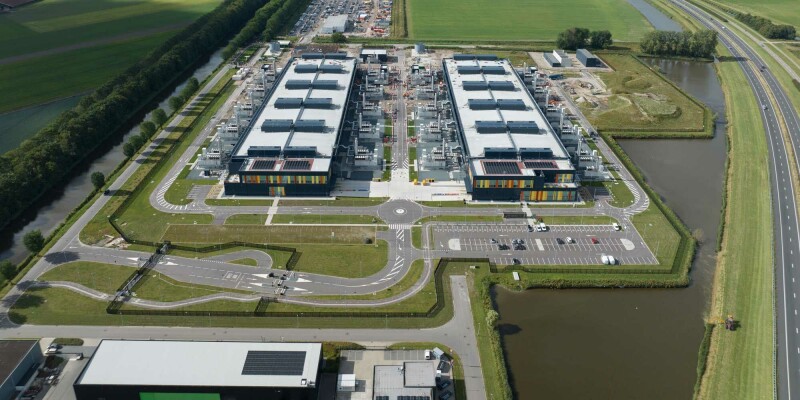
The UK government's blueprint for turning Britain into an AI superpower largely ignore the water datacenters need, prompting warnings that these facilities could end up competing with homes and businesses for supply. The warning comes as parts of southern, central, and eastern England move closer to drought, putting the pressure on water availability firmly on the agenda. MPs were told earlier this year that official forecasts of England's future water needs excluded datacenters, despite government efforts to encourage more of them to power AI development. In written evidence to a parliamentary committee, Water UK, the trade association for Britain's water industry, said the government's policies for delivering AI Growth Zones under the AI Opportunities Action Plan appear to assume the country will have ample supplies of H₂O. This, Water UK argues, limits the investment that water companies can plan for, including new reservoirs, leaving future supply constrained by forecasts that it says are already too low. The submission claims some housing projects are already being blocked and businesses barred from expanding because water isn't available. Water UK says supply is so constrained that the Environment Agency has effectively imposed a moratorium on business expansion in East Anglia and parts of Essex. Water UK is calling for new supply infrastructure to be fast-tracked and abstraction limits to be reviewed. It also wants operators to cover the infrastructure costs their facilities create, minimum efficiency standards for server farms, and requirements to use non-potable water wherever possible. Current economics push operators toward cooling methods that save energy rather than water. Where water is relatively cheap compared to energy, operators favour using more of it to use less power, as The Register previously detailed. UK energy prices are among the highest in the developed world. The submission says global datcenter water use is expected to more than double between 2025 and 2050, with services-based economies like the UK likely to account for a disproportionate share of that growth. T he UK datacenter pipeline is almost double that of the next-largest country in Europe, with ambitions to treble capacity by 2030. A government report [PDF] says most of the UK's current datacenter capacity is sited in and around London, with more than 1,000 MW located there. Europe's largest datacenter cluster is reportedly in Slough, Berkshire, home to as many as 35 facilities. The same report notes UK datacenter operators aren't required to report water use, so no official consumption figures exist, though the Water Research Centre estimates English facilities use almost 1.9 billion liters a year. According to PublicTechnology, the Government Digital Sustainability Alliance warned last year that AI is driving a significant, yet often underestimated, rise in water consumption, threatening water security both globally and in the UK A Water UK spokesperson told The Register: "We desperately want to supply the water that datacenters need. That's impossible because the UK government explicitly excludes them from its water planning framework for England." Water companies have been given approval to build ten reservoirs, but they will take years to complete, the spokesperson added. "We need planning hurdles cleared and water efficiency standards for datacenters introduced. Major businesses should pay for the water infrastructure they need so that the costs don't fall onto households." The Register also asked the relevant government department for comment, but had not received a response by the time of publication. ®
The advent of generative AI spurred an enormous and controversial datacenter building boom that has seen almost anyone who knows how to run a bit barn try to expand their business ASAP. Fujitsu, however, wants out. The Australian outpost of the Japanese giant’s business this week announced the sale of five datacenters down under. The company said selling the bit barns “enables us to further invest in the technology services where customer demand is growing fastest.” In Australia, that apparently means “helping organisations modernise critical systems, strengthen cyber resilience, adopt sovereign AI, and access the high-performance and quantum computing capabilities needed for their next phase of transformation.” Fujitsu said its datacenter business “is a strong platform, and its next phase will benefit from dedicated commercial ownership and investment.” That new owner, private equity outfit Next Capital, may have its work cut out for it because some of the bit barns it bought appeared to be rather modest. Fujitsu’s manifest of its Australian properties lists one facility capable of hosting 92MW worth of kit, another with 28MW capacity, plus bit barns that can host 10MW, 4.8MW, 3MW, or 2MW worth of kit. Keen-eyed readers will have noticed that the paragraph above mentions six datacenters and that earlier in this story we said Fujitsu is selling five. The Register understands Fujitsu has already disposed of the other one to another buyer. Whatever Next Capital bought, it will surely be aware that a modern rack filled with AI kit can require 500KW or more. Fujitsu Australia’s littlest datacenters therefore won’t help the private equity company to catch the AI wave unless it invests in upgrades – a process that might be cheaper than building new AI-ready datacenters from scratch and could also involve fewer regulatory complications than greenfield builds. Next Capital was quiet about its plans, but shared a local media report suggesting it’s spent AUD$200 million ($139.97/£104 million) to do the deal. The firm promised continuity for tenants. Fujitsu Australia’s services business won plenty of blue-chip and government clients, and The Register understands many are long-term residents of the offloaded datacenters. Next Capital can probably therefore bank on solid cashflow for months or years to come. Fujitsu sold its US datacenter business in 2023 and at the time hinted at divestments elsewhere. The company has also “absorbed” its Japanese public cloud and quit the mainframe business. The Japanese giant plans to return to the big iron business with machines built on the Monaka CPU which it hopes to deliver next year, and perhaps also get into the quantum computing biz. ®
Iran's Islamic Revolutionary Guard Corps (IRGC) claims it hit an AWS datacenter in Bahrain months after taking it offline for the first time, in a move it claimed as retaliation for a US attack on a nuclear plant that was under construction. The IRGC said in a statement on Tuesday that it had struck back at what it called the "child-killing US Army" by attacking Amazon infrastructure in Bahrain, claiming AWS's "central data infrastructure" had been "destroyed" after being hit by "several cruise missiles," according to Google Translate. The IRGC said the claimed strike was retaliation for what Iran described as a US attack on the under-construction Darkhovin nuclear facility. A look at the AWS Health Dashboard shows that there are definitely issues in Bahrain and the UAE, with issues in both regions being blamed on the US-Iranian conflict. While the status of AWS me-central-1 (UAE) is just “unable to reliably support customer applications,” me-south-1 (Bahrain) is said to be “currently unavailable.” The last update to the state of AWS services in Bahrain and the UAE in the open issues area of the Dashboard was on April 30, and the Service History tab shows that every single AWS service in Bahrain has been offline for months. Per our previous reporting, Iranian state-affiliated media claimed that strikes on AWS infrastructure in Bahrain and the UAE were deliberate, after US and Israeli attacks on Iran in late February. AWS-hosted providers including Snowflake and Red Hat subsequently urged affected customers to fail over or move workloads to other regions after the facilities were damaged. AWS waived all usage-related charges for March 2026 in its me-central-1 region in the UAE following the attacks on its infrastructure. Iran has also reportedly designated facilities associated with Google, IBM, Microsoft, Nvidia, Oracle, and Palantir as legitimate targets for retaliatory strikes, citing their alleged support for US military operations. The fact that services in Bahrain have been unavailable for months, and continue to be offline, makes it challenging for El Reg to confirm the legitimacy of Iranian claims it hit the site again. We’ve reached out to AWS to learn more, but didn’t hear back. ®
Google Cloud last week experienced an outage that analysts say demonstrates that not all promises of cloudy resilience are created equal. Google’s incident report explained that three services – the VMware Engine (GCVE), NetApp Volumes, and Bare Metal Solutions (BMS) – experienced a 15-hour outage due to a cooling failure in its europe-west4-a zone. The report includes the following detail: “The datacenter serving europe-west4-a for GCVE, BMS, and NetApp has experienced a power failure, which subsequently caused a cooling failure.” The important detail there is that Google uses a discrete datacenter for those three services. Another notable element of the incident report is the admission that “An electrical fault occurred on the utility grid upstream of the datacenter, disrupting the electrical distribution gear and cooling equipment.” Google hasn’t explained how an upstream failure caused that disruption but did say it “proactively turned down workloads in order to protect customer data from any risks posed by running infrastructure in a high temperature environment.” Whenever your correspondent talks to hyperscalers or datacenter operators about how they ensure resilience, they tell me about their use of multiple redundant pieces of energy infrastructure, plus on-site generation capabilities that can keep a datacenter powered for days if necessary. We’ve asked Google if it had generators or other energy sources at this site, and if so, why it nonetheless had to turn down workloads. We’ve not received a response at the time of writing. Google told us its incident analysis “is currently ongoing” and promised to follow up once it is available. Hidden dependencies We also asked Google if it advertises the fact that some of its services are tied to a single datacenter, a matter of interest because like other hyperscalers it divides its cloud into “regions” that typically comprise multiple “zones” spread across a city or other locale. Like its hyperscale peers, Google recommends placing workloads across different zones and regions to ensure resilience. Yet this incident shows some services can be tied to a single datacenter in a zone – and that those single datacenters can experience problems while the rest of the zone keeps working. Analysts told The Register the outage shows organizations need to dig into clouds’ promises of resilience. “The real issue is transparency: customers are generally told to use multiple zones and regions for resilience but are rarely given visibility into whether a particular managed service has a single-datacenter dependency within a zone,” said Biswajeet Mahapatra, principal analyst at Forrester. “As a result, many organizations assume the cloud abstraction provides more facility-level redundancy than may actually exist for specialized services." “The underlying architecture is not necessarily unusual,” he added. “AWS, Azure, and Google all operate services that rely on dedicated hardware, storage platforms, or tightly coupled infrastructure that may not be distributed across multiple facilities in the same way as core compute and storage services.” Gartner Director Analyst Adrian Wong reminded The Register of the 2023 outage at Google Cloud’s europe-west9-a region, the cause of which was a water leak that Google said “originated in a non-Google portion of the facility.” Google uses a tool called “Spanner” to replicate data across zones, but in the flooded zone Google’s Spanner configuration didn’t work once one building became unavailable. “It is very hard to figure out how an individual region is architected,” Wong said. “Our customers are often surprised by that,” he added. The incident report for last week’s outage includes an apology. “We know how much you rely on Google Cloud, and we regret the impact on your productivity,” the document states, before promising a final incident report will detail “preventative actions.” But as this incident shows, knowing how Google plans to avoid future incidents of this sort won’t arm customers with the knowledge to understand if those mitigations will address hidden design issues that can reduce resilience. ®
Nothing can ruin the end of a week like finding out that all of the websites and hosted email you’re responsible for are offline, which is exactly what happened to Christopher Bradbury and his web design and development firm, Digital Takumi last week. AWS has since resolved the situation, but Bradbury's mistakes can serve as a useful lesson to others of what not to do. As Bradbury explained to The Register in an email, he noticed last Thursday, July 16, that all the websites and Google Workspace email accounts connected to domains he manages were offline. All of those sites are hosted through Route 53, AWS’ combined DNS/hosting service, and none of them were resolving. Bradbury went digging through his emails to figure out if there was anything to point to the failures, and sure enough: In his spam folder were numerous messages from AWS telling him a payment card on file had expired, and warning him that the account used to host all those customer websites through Route 53 was going to be suspended unless he took action. He didn’t obviously, because he didn’t realize there was an issue. “AWS had been sending billing notifications, but unfortunately they had been filtered into a spam folder and, in some cases, were being delivered to an employee who had since left the business,” Bradbury told us. “I accept responsibility for missing those notifications,” he added, but that didn't help his customers' websites get back online. The situation could have been resolved sooner, but Bradbury had made some other mistakes as well: “The root account had MFA enabled using a software authenticator that had been stored on an older laptop which has since suffered a motherboard failure,” Bradbury explained. Without access to that authentication code generator, he was unable to get into the account. Rather than getting the dead-laptop-with-a-critical-authenticator-on-it problem resolved, he was just relying on MFA emails instead – not the best idea. "I've been bypassing the device key for quite a while by just using the recovery MFA via my email," Bradbury told us. "It works, I get access. However if I just had my Passkey up to date it would have let me right in and I could have solved this." And then there was the email address where those MFA codes were going: “The AWS recovery process required email verification using the registered root email address,” Bradbury told us. “That email address belonged to one of the domains whose DNS was hosted in the suspended AWS account, meaning I couldn't receive the verification email.” The account recovery tango Bradbury’s next option was contacting AWS from a different email address, which didn’t go anywhere. He created another AWS account and purchased business support access on someone’s recommendation, but the support engineers he spoke to using that method wouldn’t discuss the other account until he verified he owned the one in question. “Over the following days I spoke with several AWS teams, including Billing and Account Recovery. I was transferred between teams multiple times, but nobody was able to complete the ownership verification or restore access to the account,” Bradbury told us. He wanted to pay AWS, Bradbury told us, but it took a while for them to be able to take his money. “The practical consequence is that I cannot log into the AWS account, cannot receive email at the registered root address, cannot access the MFA device, cannot update the expired payment method, and therefore cannot pay the outstanding invoices from inside the account.” While we were working on this story, after speaking to both Amazon and Bradbury, he contacted us to say that access to the sites had been restored, and that he had logged in, paid the back invoices, updated his payment method, reset his MFA keys, and generally taken care of all the stuff he had been putting off until all this happened. It's unfortunate that someone has to go through AWS billing hell to serve as an example to others, so let this be a warning to anyone else managing client websites through AWS. "Firstly pay your AWS bills," Bradbury said in an email, adding that anyone running an AWS hosting account also makes sure their emergency recovery email isn't on the same domain as one of the sites they manage through that profile. That, and "stop using shortcuts" when it comes to MFA. "This isn't a big infrastructure account, we run a single company marketing website and some domains through Route 53," Bradbury explained. "It just shows that even the most modest instances of AWS can be absolutely business critical and you need to use proper practices and processes." ®
Your AWS billing estimate might look just a little inflated right now. If you woke up to find an email from Amazon Web Services this morning telling you that you’d gone over your billing threshold by a few hundred million dollars, don’t panic: Something’s gone wrong in the AWS Billing Console, the company admitted. An open issue on the AWS Health Dashboard (archived copy at the time of writing) popped up at 1:33 am Pacific time on Friday informing users that Cost Explorer was “reflecting inaccurate estimated billing data.” As of writing, the issue is still unresolved despite AWS trying several different things to get it fixed. The company apparently identified the root cause within an hour and a half of beginning its investigation, only describing it as “an issue with unit pricing within the estimated billing computation subsystem.” AWS followed up by pausing estimated bill updates, saying customers would continue to see the inflated figures already displayed, but that those estimates would not increase further. “The displayed billing estimates do not reflect actual usage and charges,” AWS explained, noting that customers don’t need to take any action, like, we imagine, flooding the help portal with tickets telling them what they already know, for instance. “Once the issue has been mitigated, we expect full resolution to take multiple hours as we work through recomputing the estimated billing data,” AWS added. After we first published this article, Amazon updated the issue page to indicate that it had identified the root cause and mitigated the underlying issue. The company says that it's begun backfilling data in the Cost Management Console to correct billing numbers, and that all customers should see corrected amounts by Saturday, July 18 at noon pacific time. We owe HOW much? Users took to Reddit and Hacker News this morning to report they’d received overage emails for massive amounts - we weren’t exaggerating with that hundreds of millions opening line. If anything, it was an understatement. Screenshots posted in the Reddit thread showed one user whose AWS charges totaled just $0.19 last month receiving an estimated bill of nearly $2.5 billion. Others in the thread claimed to have received estimated monthly charges ranging from $126,000 to as much as $2.5 trillion. Hacker News users similarly reported estimates in the billions. Amazon said the figures shown in customers' accounts were inaccurate estimates rather than actual charges. As for when users might see their billing portal reflect an accurate number, that could take a while. AWS declined to explain the issue aside from pointing us to the dashboard page linked above. We'll be keeping an eye on this developing story and update it as we learn more. ® Updated at 1903 to show that Amazon has updated its issue page with a resolution.
The Court of Justice of the European Union (CJEU) has ruled that Google may not be able to claim intermediary liability protection for YouTube content it reviews as part of a commercial partnership with a creator. The case stems from a €750,000 fine imposed on Google Ireland by Italy's communications regulator in 2022 over YouTube videos promoting online gambling. Before entering the revenue-sharing agreement, under which Google placed pre-roll ads on the creator's videos, the company reviewed the channel's content. The regulator argued that this examination undermined Google's claim that it acted as a neutral intermediary exempt from liability. Google appealed against the fine, and the case was referred to the CJEU. The court rejected Mountain View's reading of the liability exemption, leaving Italy's Council of State to decide the dispute. The exemption still applies where "the service provider has neither knowledge of nor control over the information which is transmitted or stored." However, in this instance, Google was aware of the content. The court held that the exemption "does not apply" to a platform operator that agreed commercial terms with a channel where the operator "carried out an examination of the content of that channel," including its main theme, its most-viewed or newest videos, or the associated metadata. In effect, the ruling limits Google's ability to rely on its "intermediary service provider" defense when it has reviewed a channel as part of a commercial partnership. In those circumstances, the platform may be unable to claim the liability exemption for the content at issue. This doesn't mean Google is liable for everything on YouTube, but the megacorp needs to be more careful with channels where it has commercial deals that come with a level of content review and specific knowledge that can forfeit intermediary status. A Google spokesperson said: "We are disappointed by the CJEU's decision, which we will need further clarity on. We will raise our arguments before the Council of State." ®
UPDATED Amazon Web Services (AWS) is experiencing another outage after a CloudFront issue began throwing 5xx errors, knocking a string of websites and online services offline across multiple regions. According to AWS, the issue began at 0145 PDT (0945 UTC) this morning and affects CloudFront customers using VPC Origins. This is a relatively new CloudFront feature that lets customers serve applications running behind private load balancers through CloudFront without exposing their back-end infrastructure to the public internet. The cloud giant said customers using other origin types are not impacted, and suggested that anyone who doesn't strictly need VPC Origins could switch origin types as a temporary workaround while engineers work on a fix. “We are experiencing increased 5xx errors for CloudFront customers utilizing VPC Origins connectivity,” the cloud giant said on its service status page. “Our engineers are engaged and are actively working to mitigate impact." At 03:18 PDT (118BST, 1018 UTC), it added: "We continue working to resolve the increased 5xx errors for CloudFront customers utilizing VPC Origins connectivity. Customers utilizing other origin types remain unaffected by this issue. "Based on our investigation, we believe the root cause is related to a packet processing subsystem responsible for routing requests from CloudFront's edge locations to resources within customer VPCs. We continue to recommend that customers who are able to do so temporarily change their origin type to resolve the errors." It promised another update in the next hour. Users trying to reach sites affected by the CloudFront issues are being met with an error page that reads: “We can't connect to the server for this app or website at this time. There might be too much traffic or a configuration error. Try again later, or contact the app or website” Among the early casualties was the AI developer platform Hugging Face, which acknowledged that its service was unavailable "from most regions in the world" due to the AWS outage while it worked on mitigation. Meanwhile, the UK's National Lottery admitted in a post on X that players were unable to access its website and mobile app due to what it described as a wider AWS outage, advising hopeful millionaires to try refreshing later. Gamers weren't spared either. Reports quickly piled up on Reddit from Fallout 76 players wondering why Bethesda's post-apocalyptic wasteland had become more inaccessible than usual, while various other threads rapidly filled with reports from disgruntled AWS customers, all describing the same symptom: CloudFront distributions returning 5xx errors while other AWS services carried on as normal. AWS had not disclosed the cause of the borkage and didn’t immediately respond to The Register’s questions. While it said the outage was limited to one CloudFront configuration, the list of broken services made it look considerably less limited. ® Updated at 17.39 UTC on July 16 2026 to add: AWS says it "identified the root cause of the issue as an internal constraint on the fleet that manages connections to private VPC origins. When this constraint was reached, the system responsible for distributing routing configuration to our network processors failed to load the updated configuration data correctly, affecting routing of VPC Origin connections." It took mitigation actions and this led to a "full recovery." "Now that the issue has been mitigated, customers who temporarily changed their origin type can safely revert these changes. Customers utilizing other origin types were not affected by this issue. The issue has been resolved and the service is operating normally."
Amazon Web Services is facing a lawsuit alleging it published false and misleading statements about the water use and sustainability of its Northern Virginia datacenters, "falsely" portraying those operations as environmentally responsible. The complaint, case number CL26002535-00 filed with the Circuit Court of Arlington County last week, seen by The Register, states that AWS has never publicly disclosed its actual water consumption in the region, known as the world's "datacenter capital." Despite this, the filing says, AWS has repeatedly published assertions regarding its water use and sustainability credentials that the suit alleges to be false, misleading, or unsubstantiated. By doing so, it has hidden the true scale of its water consumption, preventing policymakers and the public from independently assessing the accuracy of its claims, the complaint adds. The named plaintiff in this case is Dr Nathan Wangusi, a water resources scientist who served as the water sustainability program manager at AWS for almost three years until September 2024. The lawsuit says Dr Wangusi obtained detailed billing and water consumption records for AWS facilities in Northern Virginia using Freedom of Information Act (FOIA) requests sent to water utilities in the region covering 2023 through 2026. The US's Freedom of Information Act gives any person – a private citizen, a foreign national, or a corporation – the statutory right to request access to federal agency records. The lawsuit claims that these FOIA records "materially differ" from the publicly reported water use figures disclosed by AWS. In particular, the complaint pours cold water – pun intended – on some assertions AWS made in a blog post last month, and covered by The Register at the time. For example, AWS said that in Northern Virginia, it had "dropped water use by 42 percent year-over-year, even as demand for computing continued to grow." AWS, however, did not disclose the comparison period, reporting boundary, or methodology underlying that figure, making independent verification impossible, Dr Wangusi claims in the lawsuit. The complaint goes on to allege: In addition, the filing claims that AWS did not reveal whether its published water withdrawal figures apply only to its own datacenters, or whether they include colocation facilities in the region operated by Equinix, QTS, Digital Realty, and Iron Mountain, where AWS also has infrastructure deployed. Liquid courage The complaint also questions AWS's statement that it is "75 percent of the way to water positive." In Northern Virginia, where AWS made the water positive commitment, the lawsuit claims that FOIA data and Amazon's own portfolio show returns covering 22 to 25 percent of documented consumption. The plaintiff alleges that, by contrast, the 75 percent figure is a global metric that counts 17 projects still under construction. Another representation Dr Wangusi alleges is misleading is a claim that AWS datacenters in Northern Virginia operate "ninety-seven percent of the year by pulling outside air and not using any water." In contrast, or so the lawsuit states, the utility records all show AWS facilities withdrawing water all year round, from January 2023 to December 2026, including the winter months when AWS says that water cooling is largely unnecessary. Datacenter lobbying group Virginia Connects is named as a co-defendant in the lawsuit. The complaint claims the outfit, which promotes datacenter benefits to Virginia stakeholders, conducted a coordinated video advertising campaign on the same date that AWS published its "42 percent reduction" claim, promoting many of the same narratives that the complaint is characterizing as "false". Dr Wangusi claims Virginia Connects is controlled by the same individuals who govern the Data Center Coalition (DCC) trade association, of which AWS is an Executive Member, and alleges that the so-called "coordinated" campaign constitutes conspiracy to commit deceptive trade practices under Virginia law. According to the lawsuit, the legal case was filed after Dr Wangusi found no state agencies were willing to take action over discrepancies he saw in AWS’s self-reported water use and its actual recorded consumption. The complaint claims neither the Virginia Department of Environmental Quality (DEQ), "the State Water Control Board, local water utilities, nor affected communities possess authority to independently determine whether AWS's public water-use, water-positive, replenishment, water-stewardship, and sustainability representations are accurate, misleading, or substantiated." The filing claims Dr Wangusi submitted a complaint to the Virginia Department of Environmental Quality (DEQ), which responded that Virginia law does not require datacenters to report water withdrawals to it, and that it lacks authority to independently verify usage. A complaint to the Office of the Attorney General of Virginia resulted in a referral back to DEQ, the lawsuit states. The filing – which includes Dr Wangusi's correspondence with the agencies attached as exhibits – added that the "FOIA Advisory Council likewise advised that factual disputes concerning public disclosures are matters reserved to the courts. Accordingly, Plaintiff exhausted all available administrative remedies before filing this action." Dr Wangusi is seeking a jury trial for the case, and wants the court to rule that the published water use, and sustainability claims are materially false or misleading, and order AWS to submit to the Virginia State Water Control Board and DEQ a complete accounting of its Northern Virginia water withdrawals. If the judgement goes against it, AWS would also be required to publish corrective disclosures within 30 days of judgment, disclosing its actual water consumption figures, the methodologies, and the supporting data underlying its claims. "Hyperscalers, including AWS and its competitors, continue to face public scrutiny over the integrity of their claims around environmental impact and resource usage for datacenters,” Omdia senior analyst for Sustainable Ecosystems, Ben Caddy told The Register. “Without stricter obligations for hyperscalers to be transparent about their resource use at a facility-specific level, it’s likely that these companies will continue to face more legal and reputational challenges about the local and global environmental impacts of their facilities,” he added. We asked Amazon for a statement regarding this lawsuit, but the corporation declined to comment, other than to insist its water replenishment and withdrawal data for 2025 were assured by a third-party provider. ®
IBM says customers spooked by soaring demand for AI infrastructure raided their mainframe budgets to stockpile servers, storage, and memory instead, knocking Big Blue's flagship Z business off course. Ahead of its full calendar Q2 earnings release next week, IBM took the unusual step of publishing preliminary quarterly results alongside a letter from CEO Arvind Krishna explaining why the numbers fell short of expectations. The biggest disappointment came in Infrastructure, where revenue fell 7 percent, despite what IBM had previously described as the strongest launch of a mainframe generation in its history. The disclosure led to a more-than 25 percent plunge in Big Blue's share price on Tuesday. The Q2 culprit wasn't a sudden loss of affection for mainframes, according to Krishna, but a last-minute scramble to secure hardware increasingly caught up in the AI spending boom. "In the last few weeks of June, we saw clients shift their quarterly capex spend toward servers, storage, and memory purchases to secure supply-constrained infrastructure ahead of expected price increases," Krishna wrote. "This dynamic impacted client buying patterns." IBM had expected some disruption from supply chain pressures, he said, "but we did not anticipate the magnitude of the capex reprioritization." That's an unusually candid admission from a company whose Z mainframes remain one of its highest-margin businesses. Customers, it seems, preferred to refresh infrastructure they fear might soon become more expensive or harder to obtain. The spending shift also rippled through IBM's software business because fewer mainframe deals meant weaker sales of the transaction-processing software that typically accompanies them. Krishna pointed to another factor as well, saying clients were distracted by "rapidly evolving, industry-wide cybersecurity concerns" during the quarter, though he offered no further details on what those concerns were or how they affected purchasing decisions. IBM was willing to shoulder some of the blame. "These conditions require our teams to execute perfectly, and this quarter we faltered," Krishna wrote. "We did not adapt and move quickly enough, and numerous large deals failed to close on the timelines we expected, driving the majority of our shortfall." Not everything disappointed. Red Hat revenue grew 11 percent, recent acquisitions including HashiCorp and Confluent performed strongly, and IBM's Distributed Infrastructure business posted record reported growth of 37 percent, driven by Power servers and storage systems. Still, the quarter offers another sign of how the AI infrastructure race is reshaping enterprise IT budgets. For at least one quarter, customers decided the safest investment wasn't the newest mainframe – it was buying as much in-demand hardware as possible before someone else did. ®
Indian tech services giant and retro software house HCL has decided to get into the AI datacenter business. The company yesterday revealed its plan in an announcement [PDF] released alongside its Q1 results, which included news of three-percent year-over-year revenue growth to $3.65 billion and 20 percent growth in net income which reached $488 million. CEO C. Vijayakumar also pointed to 62 percent year-over-year revenue growth for a segment HCL calls “Advanced AI” that encompasses building its own AI platforms. The CEO said HCL’s strategy is to “Benefit disproportionately from the AI-native and AI-amplified opportunities” because they “together represent the fastest growing pool of enterprise spend.” The company has therefore decided to get into the datacenter business and has found ₹3,500 crore ($36.5 million) to put toward facilities it says have “potential to scale to 50MW of capacity.” That’s not a vast facility – just one of Meta’s datacenters will host 50GW of kit – but Vijayakumar said HCL can make it relevant by using its existing software to offer “full-stack” infrastructure. “The biggest opportunity is not to rent AI, but to own the full stack,” the CEO said. “The datacenters that compute the models built to address client-specific needs.” “This is a business which is shifting from physical infrastructure to higher value AI-ready solutions,” he added. “We will create full-stack offerings by combining our capabilities across AI datacenter design, DevOps, and cloud operations, as well as a software portfolio with our new datacenter business.” HCL’s focus appears to be on Indian customers, as Vijayakumar said the datacenter investment will “position us as a key enabler of India’s sovereign AI ecosystem, expanding our presence in the fastest-growing market among largest economies with differentiated offerings around sovereign cloud, secure AI, and managed AI infrastructure.” The CEO said HCL is already “in advanced discussions with clients to ensure we start with certain level of committed consumption from day one.” The company didn’t say where it will build its bit barns, when they might come online, or how it will secure energy supply – an important consideration given we yesterday reported on an effort to locate a datacenter in renewable-energy-rich Bhutan to serve Indian customers. Vijayakumar also revealed that HCL booked $2.4 billion of new business in the quarter, a record. The CEO pointed to one of those deals as an exemplar of HCL’s AI smarts, as it will see the services company work with an unnamed Fortune 250 semiconductor equipment OEM “to accelerate AI-driven transformation across its semiconductor engineering and manufacturing value stream.” To make that happen, HCL will deploy SAP, integrate it with existing systems, and establish “an enterprise backbone for a future-ready, scalable, AI-led digital supply chain.” Another new deal, struck earlier this month and therefore not included in the $2.4 billion of new deals won in the quarter ended June 30, will see HCL work with an unidentified “Europe-headquartered Fortune Global 50 firm as a technology partner to accelerate AI-led transformation and management of their digital workplace and enterprise networks.” Numerous reports in Indian media identified the new client as Mercedes Benz, and suggest the automotive giant has moved its business to HCL from Infosys, which announces its quarterly results next week. ®
Electricity used by datacenters in Ireland increased by 10 percent during 2025, despite an effective moratorium on most new datacenter grid connections in the Dublin area. The latest figures from Ireland's Central Statistics Office (CSO) show that giant server farms now account for nearly a quarter of the country's metered electricity consumption. Their share rose to 23 percent in 2025 after passing 20 percent in 2023 and 14 percent in 2021 – up from just 5 percent way back in 2015. According to the CSO, the energy sucked up by massive bit barns increased by 10 percent last year, expanding from 6,973 gigawatt hours (GWh) in 2024 to 7,663 GWh in 2025. All other customers consumed just 2 percent more electricity over the same period. In fact, datacenters used more electricity than urban households, which accounted for 18 percent of metered use, and more than twice the rural-household share of 9 percent. "Datacenter consumption has grown every single year without exception, more than doubling between 2015 and 2019 from 1,240 GWh to 2,490 GWh, and tripling again between 2019 and 2025, reaching 7,663 GWh," commented Grzegorz Głaczyński, statistician in the CSO's Climate and Energy Division. Things got so bad in Ireland that at one point there were fears that the ever-expanding data dormitories might eat up as much as a third of the Emerald Isle's electricity by now. The Commission for Regulation of Utilities (CRU) put an effective moratorium on connecting new server farms to the electricity grid, at least in the Dublin area, where much of the activity tends to concentrate. This was lifted in December of last year, meaning electricity consumption still rose by a tenth while the moratorium was in place for nearly all of 2025. Under stricter new regulations, server farm operators seeking a grid connection of more than 10 MW must also now provide generators or battery systems capable of providing the same power. They will be required to feed power back to the national grid, if and when required, a system already pioneered by Microsoft and Digital Realty. Like a growing number of places, Ireland has also seen protests against datacenters, which perhaps isn't surprising given that there are understood to be more than 80 of them for a relatively small country of just over 5 million people. Even in the US, the Trump administration is having to work to defuse public opposition to datacenters, asking the tech giants to commit that their expanding server farm estates won't spike energy bills or drain local water supplies across the US. ®
Environmental groups want the FCC to slam the brakes on orbital datacenters, arguing the agency shouldn't approve constellations they say would total more than a million satellites before taking a hard look at their environmental impact. Earthjustice, acting on behalf of DarkSky International, Environment America, and Public Employees for Environmental Responsibility (PEER), filed a petition this week urging the regulator to prepare a Programmatic Environmental Impact Statement (PEIS) under the National Environmental Policy Act (NEPA) before approving any of the pending applications. The filing doesn't target any single company. Instead, it asks the regulator to put the entire emerging orbital datacenter sector on hold while it assesses the cumulative effects of proposals from SpaceX, Starcloud, Blue Origin, Cowboy Space, and any similar applications that follow. According to the petition, those proposals collectively seek "well over a million datacenter satellites" in low Earth orbit. "The FCC is currently considering multiple requests for licensing extraordinary numbers of satellite-based datacenters to be placed into low-earth orbit over the next decade," the petition states. "Collectively, the proposals seek to place well over a million datacenter satellites into orbit, increasing the existing volume of satellites in low-earth orbit by multiple orders of magnitude." The groups argue that the FCC is trying to apply licensing rules written for much smaller satellite constellations to an entirely new class of infrastructure. "If ever a situation warranted a PEIS, it is this one," the petition says. It argues that a single review would allow the agency to examine "the risks, alternatives, needs, costs, and impacts of this sudden transformation of Earth's exosphere" before deciding whether any of the projects are in the public interest. The petition raises concerns about rocket launch emissions, pollutants released as satellites burn up during atmospheric reentry, depletion of the ozone layer, orbital debris, light pollution, impacts on wildlife, and interference with astronomy. It also argues that the combined effects of these constellations cannot be understood by evaluating applications one at a time. "It is difficult to imagine a better example of multiple projects presenting essentially identical impacts and risks that compound synergistically and cumulatively than the present proposals for orbital datacenter constellations," the petition argues. "The FCC's default position that such projects 'individually and cumulatively' have no environmental impact is plainly inapplicable here." The groups also criticize the applicants, saying they make expansive claims about the benefits of orbital computing while offering little detail about its environmental consequences. "The proponents of these proposals describe their plans in grandiose, civilization-changing terms," the petition states. "But these same proponents have refused to embrace any inquiry into the impacts of their self-claimed epochal technology on the environment, science, economy, or other values." The petition arrives as the FCC reconsiders its environmental review rules for satellites, acknowledging that rapid growth in the space industry has raised new questions about how to apply its existing framework. The petition argues that the FCC's current approach, which generally treats satellite licenses as categorically excluded from detailed environmental review, is no longer fit for proposals measured not in dozens or thousands of spacecraft but in hundreds of thousands and, potentially, millions. If the FCC agrees, orbital datacenter operators will have a mountain of paperwork to clear before sending their hardware skyward. ®
Microsoft says it matched its entire electricity consumption with renewable energy last year. The bad news is it also increased greenhouse gas (GHG) emissions by 25 percent due to datacenter construction. The cloud and software biz has released a 2026 Environmental Sustainability Report [PDF], claiming its environmental sustainability work is entering a new phase due to rapid technological change. A global shift towards AI is reshaping economies, the report claims, which is becoming “foundational” to how technology is built and used. Producing the infrastructure to support AI, however, is also upping demand for energy, water, land, and materials required to support it, Microsoft admits. The foreword, penned by President Brad Smith and Chief Sustainability Officer Melanie Nakagawa, says that “AI can deliver broad societal, economic, and environmental benefits,” and “We do not see these dynamics as a reason to step back. We see them as a mandate to lead differently.” In 2020, Microsoft set itself the goal of becoming "carbon-negative" by 2030. Its own figures show emissions heading only upwards, from 13 million tons of CO2 equivalent in 2020, to 20 million tons in 2025. However, Microsoft estimates that without the carbon reduction initiatives it has already put in place, emissions would now stand at 34 million tons. We asked Microsoft what this meant for its goal of becoming carbon-negative by 2030. It has yet to reply. As noted previously, Microsoft's rise in GHGs is primarily driven by the expansion of its datacenter infrastructure, though it also points to a decision to stop purchasing non-additional, unbundled renewable energy certificates. The construction spike means that Scope 3 emissions are still the largest part of Microsoft’s carbon footprint, but 2025 saw a growing contribution from Scope 2, due to generation of energy the company purchased. These represent 13 percent of total emissions – up from 2 percent in 2024. This underscores the growing role energy systems play in shaping environmental outcomes and why advancing carbon-free energy sources remains critical to long-term progress, the report says. When it comes to water consumption, another hot topic for those living near to datacenters, Microsoft says it focuses on cooling systems, improving water usage effectiveness (WUE), and reducing reliance on municipal water supplies. It claims the facilities it owns and operates achieved a 25 percent reduction in WUE since the 2022 baseline. The exact figures listed in Microsoft’s Environmental Data Fact Sheet put the company’s total global water withdrawal for 2025 at 13,266 million litres (3,504 million gallons), and total water consumption at 8,170 million litres (2,158 million gallons). For the first time, Microsoft claims to have replenished more than it withdrew during 2025, returning 14,278 million liters (3,771 million gallons). Elsewhere, the corporation says its Circular Centers program reused 92 percent of decommissioned servers and their components. In the past, Microsoft said it tried to cut the emissions from building datacenters by using concrete mixes with lower overall embodied carbon, and it experimented with facilities made out of wood, estimated to produce a carbon footprint 65 percent lower. ®
ON CALL The 2026 FIFA World Cup continues and at the time of writing, The Register's home nation – England – remains in with a chance to bring home the trophy! We therefore devote this week's edition of On Call, our weekly reader-contributed tale of tech support, to the beautiful game. We're able to do so thanks to a reader we'll Regomize as "George" who once pulled off a great save when, decades ago, he worked as one half of the two-person tech team at one of Europe's most famous football clubs. "The IT manager wouldn't work weekends," George told On Call, and that meant he had to attend most home games to provide tech support. "Mostly I'd be paid overtime to sit around in the police control room for a few hours, eat free pies, and pretend I was vital to operations," George wrote. "Occasionally, a minor issue would require my input, but typically it was a quiet day spent watching the match in comfort." The club George worked for enjoys an ancient and enormously fierce rivalry with another. When the two teams meet, it's a major event, authorities insist on extra security, and police brace for trouble across an entire city. That caution extends into the club's stadium. "The club would hand over overall responsibility for stadium safety to a suitable deputy chief constable for the duration of the game," George explained. "That officer had the ultimate say on whether the match would go ahead in the case of any safety issues." On the day in question, power to the police control room suddenly went out – just as the ground started filling for the big match. "This was a major issue. We had no radio to coordinate hundreds of stewards and police officers, no CCTV monitoring stations, and most critically, no exit gate control – an essential requirement for acceptable match day safety," George told On Call. Club officials therefore dispatched an electrician to sort things out, but the sparky soon returned with bad news: a recent upgrade had burned out, and a fix would take days. On most match days, the outage would mean immediate cancellation of the match - and a big fine for the club for failing to stage the game. But with a fevered crowd flooding in from the streets near the stadium, calling off the match had the potential to see frothing fans turn ugly. The officer in charge and the stadium operations director therefore entered had a terse discussion, during which they asked the electrician if a portable generator might address the problem – but that wasn't possible. At this point, George asked the officer in charge what minimum setup would make it safe to let the game proceed. "The response was that if we could centrally open the exit gates at the end of the match, or in the event of an evacuation, and get the CCTV and radio working, the match could go ahead." George then revealed that he had just that week installed a new 4U uninterruptible power supply (UPS) in the football club's server room and had been charging it ever since. (In case any tech-averse football fans stumble upon this story, a UPS is a substantial battery used to keep critical computers running when power drops out. They store plenty of energy, but nobody assumes they'll last for hours.) George felt the UPS unit might do the job. "After some quick napkin math, I suggested it might have enough juice to power those critical systems for long enough to allow the match to proceed," he wrote. The police officer and operations director agreed to let George try to make it work. "I rounded up a few lingering stewards, the electrician, and two uniformed coppers, and we set off to the server room. We retrieved the UPS and humped the massive bloody thing halfway round the stadium, through the crowds, and up the tight stairwell into the control room." George then jury-rigged extension cables to the systems that needed power and turned them on. "I felt like Tom Hanks trying to get that guidance computer online in Apollo 13," he told On Call. "Amazingly, everything actually came up and stayed up, the UPS's extremely vague five LED capacity lights held solid at full green and the order was given for the match to proceed," George said. He spent the entirety of the match staring at those LEDs, and as the match progressed, he started praying it would not go too deep into stoppage time. "The final whistle blew, we opened the gates, and the UPS lasted another 10 minutes before finally conking out," he told The Register. "For my MacGyveresque efforts, saving the high-stakes match, protecting the safety of tens of thousands of fans, and saving the club a fortune in fines, I was duly awarded a gift voucher to be spent at the club's on-site superstore," George told On Call. "The value of the voucher was not even enough to buy myself a single home-team shirt." Adding insult to injury, when he checked his next payslip, George realized the club had counted the value of the voucher as additional income, and he had therefore paid tax on it. Have you saved a big event or MacGyvered a tech support fix? If so, click here to send your story to On Call. We'd love the chance to steer it into the back of the net on a future Friday. ®

 Login
Login