
Reading view

There are new articles available, click to refresh the page.

How to Trade Polymarket Profitably in 2026: 9 Advanced Strategies and the $1,754.78/Day

How to Trade Polymarket Profitably in 2026: 9 Advanced Strategies and the $1,754.78/Day Reality Check

A data-first prediction-market playbook for finding mispriced odds, managing risk, using limit orders, and approaching Polymarket Perps without falling for fake profit screenshots.
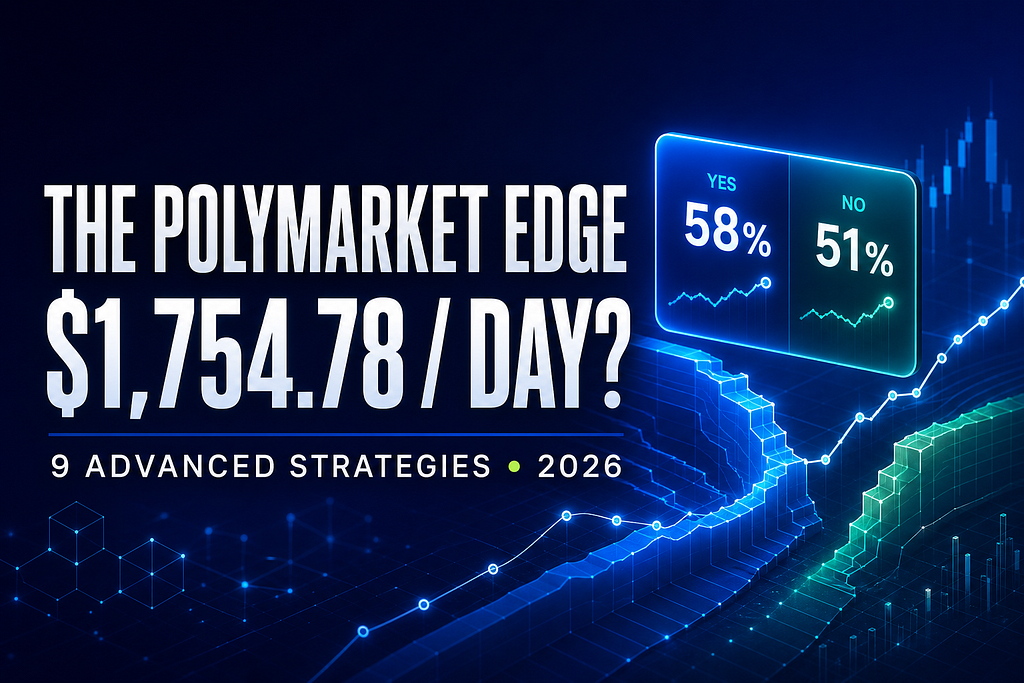
The internet loves screenshots.

“I made $1,754.78 today.”

“This market was free money.”

“One trade changed everything.”

What those posts rarely show is the denominator: account size, open risk, losing days, slippage, fees, correlated positions, or the possibility that one ambiguous resolution wipes out weeks of gains.

Polymarket is not a magic income machine. It is an order book where people buy and sell probabilities. That distinction is the source of both the opportunity and the danger.

If a YES share trades at $0.42, the market is roughly expressing a 42% probability. If the market resolves YES, that share becomes redeemable for $1; if it resolves NO, it becomes worth $0.

Your job is not to “pick the winner.” Your job is to determine whether the probability embedded in the price is wrong by enough to cover trading costs, uncertainty, and execution risk.

That is what this playbook is about.

If you are new and legally eligible to use the international platform, you can explore Polymarket here. Read the risk and jurisdiction sections before funding an account.

Why Polymarket matters more in 2026

Prediction markets are moving from a niche crypto product toward a broader information layer for politics, economics, sports, technology, and breaking news.

The infrastructure has evolved too. Polymarket’s April 2026 upgrade introduced new exchange contracts, a rewritten central limit order book backend, and pUSD, a Polygon-based collateral token backed by USDC.

The platform now applies category-specific taker fees to many markets, while makers are not charged those platform taker fees and may be eligible for rebates. Geopolitical markets currently remain fee-free. Always check the live market configuration because programs and rates can change. (Official changelog, fee documentation)

The company has also been pulled closer to mainstream finance. Intercontinental Exchange, the owner of the New York Stock Exchange, announced an investment of up to $2 billion in Polymarket in October 2025.

In the United States, Polymarket US operates separately from the international blockchain platform through a CFTC-regulated structure and offers a narrower contract set. (AP on the ICE investment, AP on the U.S. return)

Growth does not remove risk. It increases the value of having a process.

The core equation: edge, not confidence

Suppose a YES share costs $0.51 and your carefully researched estimate is 58%.

Before fees and slippage, the expected value per share is:

EV = your probability − market price

EV = 0.58 − 0.51 = $0.07 per share

That is a seven-cent theoretical edge — not a guaranteed seven-cent profit.

Your 58% estimate may be wrong. The market rules may differ from the headline. The spread may widen. New information may arrive. A market that is attractive at $0.51 may be unattractive at $0.57.

Professionals therefore ask four questions before every order:

  1. What is my fair probability?
  2. What evidence would change it?
  3. What is my all-in execution price?
  4. How much can I lose if I am wrong?

Everything else is commentary.

Strategy 1: Build a “circle of competence” watchlist

The fastest way to lose money is to trade every viral market.

Choose one or two domains where you can process information faster or better than the median participant. Examples include:

  • central-bank policy and macroeconomic releases;
  • election rules and polling methodology;
  • AI product launches and technology regulation;
  • sports injuries, lineups, and tournament formats;
  • crypto protocol governance and scheduled upgrades.

Then build a source stack before you build a position: primary documents, official calendars, regulator filings, company statements, reputable wires, domain experts, and only then social media.

The premium edge is rarely “more news.” It is knowing which source changes the probability and which source merely repeats the narrative.

Practical rule: If you cannot name the market’s authoritative resolution source and the next two catalysts, you are not ready to trade it.

Strategy 2: Price the market before looking at the market price

Anchoring is expensive. Once you see a 73% market price, your brain begins inventing reasons why 73% feels right.

Use a two-pass forecast:

Pass one — outside view: Start with the base rate. How often does this class of event happen?

Pass two — inside view: Update for case-specific evidence such as deadlines, incentives, polling error, institutional constraints, injuries, or confirmed announcements.

Write a range, not a heroic single number:

  • Bear case: 42%
  • Base case: 55%
  • Bull case: 64%
  • Confidence-weighted fair value: 54%

If the best available ask is 52%, the edge is too thin for most uncertain theses. If it is 43%, there may be room — but only after reading the rules and checking liquidity.

Premium filter: Require a margin of safety. For noisy political or geopolitical markets, an apparent two-point edge is usually just estimation error. Many disciplined traders demand a larger gap before risking capital.

Strategy 3: Read the resolution rules like a contract lawyer

The title attracts attention. The rules determine the payout.

Before trading, record:

  • the exact resolution source;
  • the deadline and time zone;
  • whether an announcement, implementation, certification, or occurrence is required;
  • how postponements, cancellations, recounts, ties, or ambiguous language are treated;
  • whether later clarifications have been posted.

Polymarket uses UMA’s Optimistic Oracle for resolution. Proposals can be disputed, and disputed markets can take days rather than hours to settle.

The official documentation explicitly warns users to read the rules because the title is only a summary. (How resolution works)

This creates a real strategy: resolution arbitrage.

Sometimes the crowd trades the intuitive meaning of a headline while the contract resolves according to a narrower definition. The opportunity is legitimate only when your interpretation is grounded in the written rules — not wishful semantics.

Red flag: If two intelligent readers interpret the contract differently, reduce size or skip it.

Strategy 4: Treat execution as part of the thesis

Polymarket uses a central limit order book. The displayed probability is generally the midpoint between the best bid and ask; it is not necessarily the price you can trade.

If the bid is $0.46 and the ask is $0.52, clicking buy means paying the ask, not the displayed midpoint. (Prices and order book)

That six-cent spread can destroy a small informational edge.

Use limit orders when immediacy is not essential. A patient order can:

  • avoid crossing the spread;
  • define the maximum price you will pay;
  • capture temporary volatility;
  • qualify for maker-oriented incentives when the market and program rules allow it.

But a limit order is not free money.

It may not fill, may fill only partially, or may be selected precisely when informed traders know more than you. Cancel stale orders before scheduled announcements.

On sports markets, special order-cancellation and delay behavior can apply around game time. (Official limit-order guide)

Execution checklist: spread, depth, likely slippage, fee status, order type, expiration, and catalyst time.

Strategy 5: Trade the repricing, not only the final resolution

You do not always need to hold until $1 or $0.

Imagine buying YES at $0.31 before a scheduled court ruling. A procedural development lifts the market to $0.49, but the final event remains months away.

Selling can convert a forecast improvement into realized profit while removing months of tail risk.

Design three prices before entry:

  • Add price: where the expected edge becomes unusually attractive.
  • Thesis-review price: where the move suggests new information or a flawed assumption.
  • Exit price: where the remaining upside no longer compensates for the risk.

Do not use a stock-trading stop mechanically. Prediction markets can gap on binary news, and thin books may make stop-like exits worse than expected.

The better defense is smaller initial size, planned limit orders, and a clear information-based invalidation point.

Strategy 6: Look for cross-market inconsistency

Related markets often imply a probability tree.

For mutually exclusive outcomes, prices should make logical sense together after accounting for spreads, fees, and different resolution wording.

If five candidates are the only possible winners, their fair probabilities should total roughly 100%. If “Event by June” trades above “Event by December,” something may be wrong — unless the contracts use different definitions.

A useful workflow:

  1. Map the outcomes and dependencies.
  2. Convert executable bids and asks — not headline prices — into probabilities.
  3. Compare contract wording and resolution sources.
  4. Include fees, slippage, and capital lockup.
  5. Trade only when the inconsistency survives all four checks.

Many apparent arbitrages disappear when you notice that one contract requires an official announcement while another requires the event to occur.

The wording is the trade.

Strategy 7: Use fractional Kelly sizing, then cap it again

When your estimated probability is q and the share price is p, the full-Kelly fraction for a binary contract can be written as:

Kelly fraction = (q − p) / (1 − p)

At q = 0.58 and p = 0.51:

Full Kelly ≈ (0.58 − 0.51) / 0.49 ≈ 14.3%

That is far too aggressive for most real-world traders because your probability is uncertain and positions may be correlated.

A quarter-Kelly version would suggest roughly 3.6%, but even that may be excessive.

A more robust framework is:

  • risk 0.5%–1.5% of bankroll on an ordinary thesis;
  • use smaller size for unclear rules, thin liquidity, or geopolitical tail risk;
  • cap exposure across correlated markets;
  • never average down solely because the price moved against you;
  • calculate worst-case loss across the portfolio, not trade by trade.

If you own YES on three different contracts that all depend on the same court ruling, you do not have three independent bets.

You have one concentrated bet wearing three labels.

Strategy 8: Separate alpha from rewards

Polymarket currently documents several incentive mechanisms, including maker rebates, liquidity rewards on selected markets, and a variable holding reward on eligible positions.

These programs can improve the economics of a sound trade. They cannot rescue a bad one. (Positions and holding rewards, liquidity rewards)

Model them separately:

Trading P&L + earned incentives − fees − slippage − opportunity cost = net result

Do not assume a displayed annualized reward will remain unchanged. Do not quote poor prices merely to chase a liquidity score. Do not lock capital in a negative-EV position for a yield that can be revised.

Rewards are a rebate on a good process, not the process itself.

Strategy 9: Keep Polymarket Perps in a separate risk bucket

Polymarket’s official Perps page currently advertises early access to a product for going long or short markets 24/7.

At the time of this update, the public page says “Perps are coming” and does not provide a complete public rulebook on that landing page.

Treat that as a reason to wait for product-specific documentation — not an invitation to guess how leverage, funding, liquidation, collateral, or jurisdictional access will work. (Official Perps page)

If you want to register your interest, you can join Polymarket Perps early access with this invite link.

Before placing any eventual perp trade, verify:

  • the underlying index and price source;
  • maximum leverage and maintenance margin;
  • liquidation mechanics and penalties;
  • funding frequency and historical rates;
  • collateral asset and smart-contract or counterparty structure;
  • whether the product is available in your location.

Perps and prediction shares solve different problems.

A prediction share has bounded downside equal to its purchase price and resolves under event-specific rules. A leveraged perpetual position introduces path dependency: you can be liquidated before your long-term thesis proves correct.

The $1,754.78-per-day reality check

Could someone make $1,754.78 in a day? Of course.

Someone can also lose more.

The useful question is what repeatable process and capital base would be required.

Assume, purely for illustration, that a skilled trader realizes a 3% net edge on deployed capital after fees and slippage.

To target $1,754.78 in expected — not guaranteed — daily profit, that trader would need approximately:

$1,754.78 / 0.03 = $58,492.67 of daily deployed capital

That does not mean a $58,492 bankroll produces $1,754 every day.

Positions overlap, edges are uncertain, markets may not have enough depth, and realized outcomes are lumpy. At a 1% net edge, the required daily deployment rises to $175,478.

One bad correlated event can overwhelm many small wins.

This is why a daily dollar target is the wrong operating metric.

Track these instead:

  • closing-line value: did the market move toward your entry after you traded?
  • calibration: did your 60% forecasts happen about 60% of the time?
  • expected edge at entry versus realized P&L;
  • average slippage and fees;
  • maximum drawdown;
  • return on risk, not gross volume;
  • rule-reading errors and avoidable execution mistakes.

The goal is not to win every market. It is to make well-calibrated decisions at favorable prices while staying solvent long enough for the edge to compound.

A 15-minute pre-trade checklist

Copy this into your notes:

Market:

Exact resolution condition:

Authoritative source:

Current executable bid / ask:

My fair-probability range:

Base rate:

Key catalysts and timestamps:

What would invalidate my thesis?

Fees, spread, and expected slippage:

Position size and maximum loss:

Correlated exposure elsewhere:

Add / review / exit prices:

Reason I may be wrong:

If you cannot complete the checklist, the correct position size is zero.

Security, legality, and the one shortcut you should never take

The international Polymarket platform is not available in every country or region, and its official help center prohibits using VPNs or similar tools to bypass geographic restrictions.

Availability changes, so check the current geographic restrictions and your local law.

Never share a private key, seed phrase, or email login code. Bookmark the official domain, verify links, and ignore unofficial token or airdrop claims.

Polymarket’s help center states that pUSD is its collateral token and that no separate Polymarket token or airdrop has been announced as of this update. (Official token warning)

Finally, do not trade on material non-public information.

Recent reporting about unusually timed accounts has intensified scrutiny of prediction-market integrity. Even apart from legal risk, markets cannot function if participants treat confidential government, corporate, or personal information as a private casino chip.

Final takeaway

Polymarket rewards a rare combination: probabilistic thinking, domain expertise, contract reading, execution discipline, and emotional restraint.

The amateur asks:

“Will this happen?”

The professional asks:

“What probability is priced, what probability is justified, what can invalidate my estimate, and how much should I risk?”

That shift — from prediction to pricing — is the real edge.

If you are eligible, understand the risks, and want to explore the prediction markets discussed in this guide, start with Polymarket here.

For the separate perpetual-futures waitlist, use this Polymarket Perps early-access link.

Trade smaller than your ego wants. Read every rule twice. Let price — not excitement — decide whether there is a trade.

Disclosure: This article contains referral links. If you sign up or join an early-access program through them, I may receive a reward at no additional cost to you. That does not affect the analysis below. Prediction markets and perpetual futures involve substantial risk, including the possible loss of your entire position. Nothing here is financial, legal, or tax advice. Check local law and platform availability before participating.

How to Trade Polymarket Profitably in 2026: 9 Advanced Strategies and the $1,754.78/Day was originally published in Coinmonks on Medium, where people are continuing the conversation by highlighting and responding to this story.

Hotstuff: The DeFi-Native Layer 1 Built for Traders Who Actually Trade, Invest, and Bank

One unified margin account. Real performance. Global rails. July 2026 Update.

In a DeFi world still plagued by fragmented liquidity, slow execution, and clunky UX, Hotstuff delivers something refreshingly different: a purpose-built DeFi-native Layer 1 where your capital finally has one home.

No more bridging between perps and spot. No more separate accounts for crypto, equities, or RWAs. Just open one margin account, fund it once, and trade, invest, earn, and bank 24/7 — optimized for non-US retail users who actually move capital.

Why Build a Dedicated L1? (The Technical Foundation)

Most trading apps live on general-purpose chains or rollups that weren’t designed for high-frequency order books, precise margining, or confidential finance. Hotstuff Labs started on Arbitrum Orbit but quickly realized the limitations. They rebuilt as a standalone Layer 1 powered by DracoBFT — their custom consensus protocol from the HotStuff family, heavily tuned for financial workloads.

Performance highlights:

  • 200,000+ TPS
  • ~75ms block time
  • ~150ms finality

What truly sets it apart are the validators as financial service providers. Beyond consensus, they run side-loops for liquidity routing, fiat orchestration, zkTLS proofs, compliance, and last-mile payments. This architecture turns the chain into active financial infrastructure rather than a passive settlement layer.

The result is sub-second, deterministic execution with strong confidentiality (TEE-powered validator execution and encrypted states).

The Unified Experience: Trade • Invest • Earn • Bank

Perpetual Futures — 22+ markets with up to 50x leverage across crypto, US equities, commodities, FX, and indices. All from one collateral pool, 24/7.

Tokenized Spot Markets — 24/7 trading of real 1:1 backed US stocks and ETFs (Tesla, NVIDIA, Meta, S&P 500, etc.) targeting the $147 trillion global equity market. Launched in May 2026 and already a major growth driver.

Yield & Liquidity — Idle capital earns in protocol vaults (e.g., HLV), while supporting on-chain liquidity and liquidation flows.

Neobanking Rails — Instant fiat on/off-ramps across 190+ countries (USD ACH/Fedwire, EUR SEPA, PIX, SPEI, FPS, etc.). Virtual US accounts and FX swaps make it feel like a borderless trading bank.

Recent Product Wins:

  • WhatsApp login via Privy (no seed phrases).
  • AI Agents powered by Claude — autonomous trading, rebalancing, and banking directly on your account.

Traction & Momentum (Mid-2026)

Since private mainnet launch in early February 2026, Hotstuff has shipped aggressively:

  • Crossed $1B+ in trading volume in the first 90 days.
  • Top 25 DeFi platform globally and top 10 in RWA futures.
  • Thousands of active traders online around the clock.

The Points Program remains one of the cleanest in the space: hard-capped weekly distributions (currently ~500k points/week to 3,300+ users), no token sales, and purely activity-based. As of July 14, 2026, we are in Week 19, with the program on track to conclude in Q3 ahead of a potential TGE.

FIFA 2026 Volume Cup: The Standout Campaign

Running from June 30 to July 19 (final week right now), this 19-day competition perfectly captures Hotstuff’s gamified approach:

  • Prize pool: Up to $12,000 USDC (scales with total platform volume, from $4k at $200M to $12k at $600M) + official FIFA merch for 5 lucky winners.
  • Leaderboard: Based on Effective Volume = Maker (1×) + Taker (2×).
  • Super Cards & Power Cards: Unlock football-themed multipliers (1.5× to 10×+) by hitting volume tiers. Activate them strategically before big trades. Random Power Cards can deliver up to 25× temporary boosts.
  • Boosted markets (3–5× points) on RWAs, majors, and equities make farming efficient.

This isn’t just another volume grind — it’s engaging, skill-based, and levels the field for consistent traders.

Who Should Use Hotstuff?

  • Macro traders who want one account for crypto, equities, commodities, and FX.
  • RWA enthusiasts seeking 24/7 tokenized stocks with tight spreads and maker rebates.
  • AI-native users experimenting with autonomous agents.
  • Volume farmers & builders positioning before points program ends.

Backed by Delphi Ventures, Dialectic, Stake Capital, and DeFi OGs (1inch, Safe, etc.), the project continues to prioritize product velocity and organic growth over hype.

Final Thoughts

Hotstuff isn’t trying to be everything to everyone. It’s laser-focused on becoming the financial OS for global retail traders — fast, capital-efficient, confidential, and actually usable.

While the token isn’t live yet, the signals are strong: own L1, capped points, real revenue-generating activity, and rapid iteration. For those willing to engage early, Week 19 of the points program and the final stretch of the FIFA Volume Cup represent one of the more compelling setups in DeFi right now.

Ready to explore?
hotstuff.trade
→ Docs: docs.hotstuff.trade
→ Twitter: @tradehotstuff

Trade responsibly. This is not financial advice.


Hotstuff: The DeFi-Native Layer 1 Built for Traders Who Actually Trade, Invest, and Bank was originally published in Coinmonks on Medium, where people are continuing the conversation by highlighting and responding to this story.
Hotstuff: The DeFi-Native Layer 1 Where You Trade, Invest, and Bank From One Account

One margin account to trade global markets, invest in tokenized real-world assets, and move money across 190+ countries — while Wall Street sleeps.

Every cycle, a handful of projects stop competing on features and start competing on architecture. Hotstuff is one of them. Instead of shipping yet another perpetuals exchange, its team asked a harder question: what if a single blockchain could settle a leveraged Bitcoin trade, a tokenized Nvidia share, and a cross-border payment — from the same balance, in the same second?

That question is the whole thesis. And after digging through its docs, testnet, funding history, and the way its community actually talks about it, I think Hotstuff is one of the more quietly ambitious infrastructure plays in DeFi right now. Here’s the expert breakdown.

What is Hotstuff, exactly?

Hotstuff is a DeFi-native Layer 1 blockchain designed around a deceptively simple promise: “Trade. Invest. Bank.” — from one unified margin account, built for retail users outside the United States.

Open a single account, fund it once, and that same balance works across:

  • Perpetual futures on crypto, equities, indices, FX, and commodities
  • Spot markets and tokenized real-world assets (RWAs) like stocks and ETFs
  • Stablecoins, cards, and local payment rails for actual money movement

Most chains treat trading, custody, and payments as separate worlds bolted together with bridges and third-party apps. Hotstuff collapses them into one settlement fabric. The tagline says it best: home for all capital that actually trades and invests — open while Wall Street sleeps.

Worth noting for clarity: the name “HotStuff” also refers to a well-known 2018 academic BFT consensus protocol. This article is about Hotstuff the trading L1 (hotstuff.trade), which borrows from that lineage but is a distinct product.

The engine room: DracoBFT and “validators as service providers”

Under the hood, Hotstuff runs on DracoBFT, a custom consensus mechanism built on the Fast-HotStuff family of Byzantine fault-tolerant protocols and tuned specifically for low-latency financial applications.

The headline performance numbers the project publishes:

Metric Hotstuff L1 Throughput 200,000+ TPS Block time ~75 ms Finality ~150 ms

But the more interesting design choice isn’t raw speed — it’s what the validators do. On most chains, validators just produce blocks. On Hotstuff, they also coordinate trade execution, route liquidity, provide fiat access, run compliance workflows, and handle last-mile money movement.

Co-founder and CEO Vyom Sharma describes it as “the Uber for financial validators, routing every flow to the right provider.” A trader in Asia, a remittance corridor in LATAM, and a card issuer in Europe can settle on the same rail. That reframes the chain from a passive settlement layer into active financial infrastructure — which is the part that’s genuinely hard to copy.

The four pillars: Trade, Invest, Earn, Bank

1. Trade — perps across every market that matters

Hotstuff’s flagship is a high-performance, fully on-chain perpetuals venue. From one margin account you get 22+ markets with up to 50x leverage, running 24/7/365:

  • Crypto: BTC and ETH (50x), SOL, HYPE, BNB (25x), XRP (20x), and more
  • Equities (the Mag7): Apple, Nvidia, Tesla, Microsoft, Amazon, Meta, and Google perps — trade earnings season at 3 a.m. if you want to
  • Indices: USA500 and USA100 with up to 50x leverage
  • Commodities: WTI oil, Brent oil, and natural gas
  • FX: EURUSD and USDJPY with up to 50x leverage

The pitch to traders is simple: no fragmented accounts, no legacy market hours, one balance as collateral across everything.

2. Invest — 24/7 tokenized stocks and ETFs

In a major 2026 expansion, Hotstuff launched Hotstuff Invest: 24/7 spot trading for tokenized stocks, ETFs, and crypto assets, powered by xStocks — tokens backed 1:1 by the underlying equity and redeemable for cash value.

The framing here is huge: the company is explicitly targeting the $147 trillion global equity market, with 200+ listed tokenized RWAs on the roadmap. For a user in a country with limited access to U.S. brokerages, buying tokenized Netflix, Google, or an S&P 500 ETF on a Sunday night is a genuinely new capability, not a marketing line.

3. Earn — put idle capital to work

Instead of letting stablecoin balances sit dead, users can deposit idle cash into vaults and earn APY. The centerpiece is the Hotstuff Liquidity Vault (HLV) — a protocol-owned, community-owned liquidity pool that acts as the primary counterparty for perpetual trading on the network.

HLV runs a hedge-mode, market-neutral strategy, sourcing yield through multi-venue execution across Hotstuff, Hyperliquid, and select CEX liquidity. The signal to watch: the initial $500K pre-deposit cap filled in ~12 hours from 988 depositors, and the team pointedly noted “no paid KOL, no paid hype — just community-led DeFi in motion.”

4. Bank — neobanking and global fiat rails

This is the pillar that separates Hotstuff from a pure perp DEX. It’s building neobanking infrastructure directly into the chain:

  • US virtual accounts with ACH + Fedwire — fund in USD as if you had a U.S. bank account
  • EUR IBANs for SEPA, CLABE for Mexico’s SPEI, BR codes for Brazil’s PIX, FPS for the UK, and Bre-B for Colombia
  • Withdrawals to 190+ countries, plus FX stablecoin↔fiat and fiat↔fiat swaps

Crucially, the interface is self-custodial — you connect a non-custodial wallet, sign your own transactions, and the company never holds your funds. That’s the DeFi guarantee wrapped around a neobank experience.

Built for builders, too

Hotstuff isn’t just a consumer app. It ships a compact TypeScript SDK, real-time WebSocket streams with deterministic event payloads, sandbox environments, a public API reference, and an open GitHub org (hotstuff-labs). Desks, bots, and fintechs can integrate trading, market data, and account actions directly — a deliberate move to turn the L1 into a platform others build on.

From Syndr to Hotstuff: the backstory

Hotstuff didn’t appear overnight. It’s the evolution of Syndr Protocol, a derivatives project that first launched on Arbitrum Orbit and raised a ~$500K pre-seed back in January 2022. Over time the team concluded that a general-purpose rollup couldn’t deliver exchange-grade performance for order books, margining, and custody — so they rebuilt it as a standalone, purpose-built L1.

The rebrand to Hotstuff went public with a launch on December 5, 2025, alongside the opening of the public testnet. The project is run by Hotstuff Labs (based in Singapore) and is backed by a notable roster of DeFi VCs and founders, including Delphi Ventures, Dialectic, Stake Capital, 1inch, Gnosis, Socket, Biconomy, Tykhe Ventures, and CoinDCX Ventures.

Traction and momentum in 2026

What impressed me most is the shipping cadence. In roughly six months, Hotstuff went from testnet to a rapidly expanding market list:

  • Dec 2025 — Public testnet goes live for traders, quants, builders, and validators
  • Jan 2026 — HLV pre-deposit vault fills its $500K cap in ~12 hours
  • Feb 2026 — Points program launches; 1.4M points distributed retroactively to 1,800+ early users
  • Spring 2026 — FX, commodities, US index (USA500/USA100), and Mag7 equity perps go live in quick succession, plus trading competitions with up to $20,000 in rewards
  • May 2026 — Hotstuff Invest launches 24/7 tokenized equity spot trading via xStocks

The community narrative on X has followed the product: creators repeatedly describe it as “quietly building one of the most interesting perp-native L1s,” and the recurring theme is organic, community-led growth rather than mercenary marketing.

The elephant in the room: a Hotstuff airdrop?

Let’s be direct, because it’s the first thing most readers want to know. Hotstuff has not announced a token, but the ingredients are all there: a Layer 1 that will need a native gas and staking asset, a live points program with weekly distributions, testnet Expeditions, tiers, collectible Cards, and referral rewards of up to 50%.

Because it’s an L1, a native token is widely considered highly probable — which is exactly why airdrop hunters have flagged it as an “anti-FOMO” early play. If you want to position yourself, meaningful, sustained participation is what historically matters: consistent trading volume, HLV/vault interaction, referrals, and genuine community engagement. Farming one transaction and leaving rarely ages well.

Nothing here is financial advice. A token isn’t guaranteed, points aren’t a promise, and leverage cuts both ways. Do your own research.

Hotstuff vs. Hyperliquid: how to think about it

The inevitable comparison is Hyperliquid, and it’s a fair reference point — both are trading-first L1s with sub-second finality and a fully on-chain order book. The difference is scope. Hyperliquid is laser-focused on being the best perp DEX. Hotstuff is trying to be the perp DEX and the tokenized-equity broker and the neobank — a single account that spans on-chain trading and real-world fiat rails.

That broader surface area is both the bull case and the risk. If Hotstuff executes across all four pillars, it becomes something no single-purpose competitor can match. If it spreads too thin, focus becomes the challenge. So far, the shipping speed suggests they can walk and chew gum.

The bottom line

Hotstuff is making a big, coherent bet: that the future of finance isn’t a dozen disconnected apps, but one account where your capital can trade, invest, and bank without ever leaving the chain. The DracoBFT engine gives it the speed, the validator-as-service-provider model gives it the reach, and the Trade/Invest/Earn/Bank stack gives it a reason to exist beyond speculation.

It’s still early — testnet-stage, token-less, and unproven at full scale. But between the architecture, the backers, and a shipping cadence most teams would envy, Hotstuff has earned a spot on the watchlist of anyone serious about where on-chain finance goes next.

If you’re exploring Hotstuff yourself, start with the testnet at app.hotstuff.trade, read the docs at docs.hotstuff.trade, and follow @tradehotstuff for updates.

Disclosure: This article is for informational and educational purposes only and is not financial, investment, or legal advice. Cryptocurrency trading, leverage, and testnet participation carry significant risk. Always do your own research.

My Contacts
Dc: kresna6773
Github:
https://github.com/Lesnak1
X:
https://x.com/LesnaCrex


Hotstuff: The DeFi-Native Layer 1 Where You Trade, Invest, and Bank From One Account was originally published in Coinmonks on Medium, where people are continuing the conversation by highlighting and responding to this story.

Your Money Is About to Get an Agent: A Field Guide to Agentic Finance

How autonomous AI agents are learning to trade, invest, and move money on-chain — and the kind of infrastructure they actually need to be trusted with a balance.

For most of crypto’s history, the human has been the runtime. You watch the chart. You size the position. You sign the transaction. You bridge the funds, chase the yield, and wake up at 3 a.m. because a market that never closes doesn’t care that you need to sleep.

That model is quietly breaking. A new class of software — call them agents — is starting to sit between you and the market, holding a mandate instead of your private keys, and acting on your behalf inside rules you define. This is what people mean when they say agentic finance. And like most infrastructure shifts, it looks like a toy right up until it looks inevitable.

This piece is a plain-language map of what agentic finance is, why today’s blockchains struggle to support it, and what a chain built specifically for autonomous money would need to look like. We’ll use Hotstuff, a DeFi-native Layer 1, as a running case study — not because it’s the only answer, but because its architecture makes the design tradeoffs unusually easy to see.

First, what “agentic” actually means

An agent is not a chatbot with a wallet glued on. The useful definition is narrower: an agent is a piece of software that can perceive a situation, decide on an action against a goal, and execute that action — repeatedly, without a human clicking the button each time.

In finance, that loop maps onto things people already do by hand:

  • Perceive: read prices, funding rates, portfolio drift, an incoming payment, a payroll date.
  • Decide: “funding is negative and my target allocation slipped 4% — rebalance.”
  • Execute: place the orders, settle the transfer, log the result.

The leap from a trading bot to a financial agent is scope. A bot runs one strategy on one venue. An agent is trusted with a mandate — “keep me market-neutral,” “dollar-cost-average this paycheck,” “never let this position exceed 3x” — and figures out the steps. The 2018 academic HotStuff consensus paper and the current wave of AI agents share nothing technically, but they rhyme on one idea: systems get powerful when you can hand off decisions safely.

The trust problem nobody can skip

Here’s the uncomfortable part. The moment you let software move money on its own, you’ve created the most attackable object in finance: an automated thing with spending power. Every serious conversation about agentic finance eventually collapses into one question — how do you give an agent enough authority to be useful without giving it enough to ruin you?

There are four hard requirements underneath that question, and most existing rails satisfy maybe two.

1. Scoped authority, not custody

The naive approach — hand the agent your keys, or deposit into a black-box account it controls — recreates every custodial risk crypto was supposed to kill. The better pattern is delegation with a leash: the agent gets a scoped permission to do specific things (open and close positions, say) while being cryptographically blocked from others (withdraw, transfer out).

On EVM systems this increasingly looks like signature-based delegation — a user signs a typed message (the EIP-712 standard) that authorizes an “agent” address to act within limits, and can revoke it at any time. The funds never leave the user’s control; only a narrow slice of behavior is licensed. Any agent you’d trust with real size should be non-custodial by construction, not by promise.

2. Speed that’s actually deterministic

Agents act in loops, and loops compound latency. If every decision has to wait 12 seconds for probabilistic finality and then pray for no reorg, an agent managing risk across volatile markets is flying blind between blocks. Autonomous strategies need fast, final, and predictable settlement — not “fast on average.” A rebalance that might land now or might land in three blocks isn’t a strategy, it’s a gamble.

3. Verifiable contact with the real world

Most money that matters lives off-chain: bank balances, equities, FX, payroll, invoices. An agent that can only touch native tokens is a very expensive way to trade memecoins. To manage real money it needs trustworthy bridges to real-world data and rails — and “trustworthy” has to mean provable, not “a middleman swore it was true.”

4. Compliance that doesn’t leak your life

If agents are going to move fiat across borders, someone has to answer for KYC, sanctions screening, and qualified-investor checks. Doing that on a public ledger naively would broadcast your financial identity to the world. The requirement is compliance that is verifiable but private — proven, not published.

Hold those four in mind, because they’re the lens for the rest of this article.

A case study in building for agents: the Hotstuff L1

Hotstuff is a Layer 1 with an unusually blunt pitch: trade, invest, and bank from one account. One margin balance spans perpetual futures, spot markets, tokenized real-world assets, vaults, cards, and local fiat rails — aimed at retail users outside the US. Underneath that consumer promise is a set of architectural choices that read, in hindsight, like a checklist for the four requirements above.[1]

The consensus layer: DracoBFT

Hotstuff runs on a custom consensus engine called DracoBFT. It borrows the backbone of the well-known HotStuff BFT family — stake-weighted leader selection, pipelined block production, two-round deterministic finality, and Byzantine tolerance under partial synchrony (the classic n = 3f + 1). The published numbers are aggressive: ~200,000+ TPS, 75ms block times, and 150ms finality.[2]

The word that matters there is deterministic. There’s no probabilistic tail, no 12-second voting window, no “wait for confirmations.” For a human, sub-second finality is a nicety. For an agent running a tight control loop, it’s the difference between managing risk and hallucinating about it. That’s requirement #2, handled at the base layer.

One clever efficiency: instead of recomputing a giant global state root every block, DracoBFT uses Chained Change-Log Commitments — it only hashes the keys that actually changed. Less redundant work per block is part of how you keep finality tight while throughput stays high.[2]

The real-world layer: validators as service providers

The most interesting idea in the design is what Hotstuff calls side-loops. Normally a validator’s whole job is producing blocks. DracoBFT gives validators auxiliary execution domains where they perform real-world work in parallel to consensus — without slowing block production. When a side-loop task finishes, the validator submits the result back to the main chain.[2]

What kind of work?

  • zkTLS verification: validators cryptographically prove that an API response genuinely came from a specific server — Chase, Coinbase, Plaid, wherever — rather than “we asked 20 nodes and trusted the median.”
  • Cross-chain state verification: verifying state proofs from other chains as a native validator duty instead of trusting a bridge operator.
  • Private computation: compliance checks, identity verification, credit scoring, and qualified-investor gating done off the main chain but cryptographically bound to it.
  • Payment orchestration: validators route payments and operate fiat on/off-ramps directly — and get paid for it.[2]

Stack that against the requirements. Verifiable contact with the real world (#3) becomes a validator duty backed by proofs, not a trusted middleman. Compliance that stays private (#4) runs in private computation bound to the chain. Hotstuff Labs has described the result as an “Uber-style routing layer,” where validators act as last-mile gateways to trading, payments, and fiat — earning fees for services, not just block rewards.[3]

Why the “one account” model matters for agents

The unified margin account isn’t just a UX flex. Fragmentation is an agent’s enemy: capital stranded across chains, venues, and wrappers means an agent spends its intelligence on plumbing instead of strategy. When perps, tokenized equities, vault yield, and fiat all settle against a single balance, an agent can reason about one portfolio and act across all of it. Hotstuff currently spans 22+ perpetual markets with up to 50x leverage, 200+ tokenized real-world assets including names like the S&P 500 and Nasdaq-100 ETFs, and fiat rails covering USD, EUR, GBP, BRL, MXN and more across 190+ countries.[4]

Context for the skeptics: this isn’t a whitepaper-only project. Hotstuff evolved out of Syndr, ran a public testnet in late 2025, surpassed $1 billion in derivative trading volume, extended into 24/7 tokenized-equity spot trading in 2026, and is backed by DeFi-native investors including Delphi Ventures, Dialectic, Stake Capital, 1inch, and Gnosis.[4]

From “a chain with features” to an Agentic Finance OS

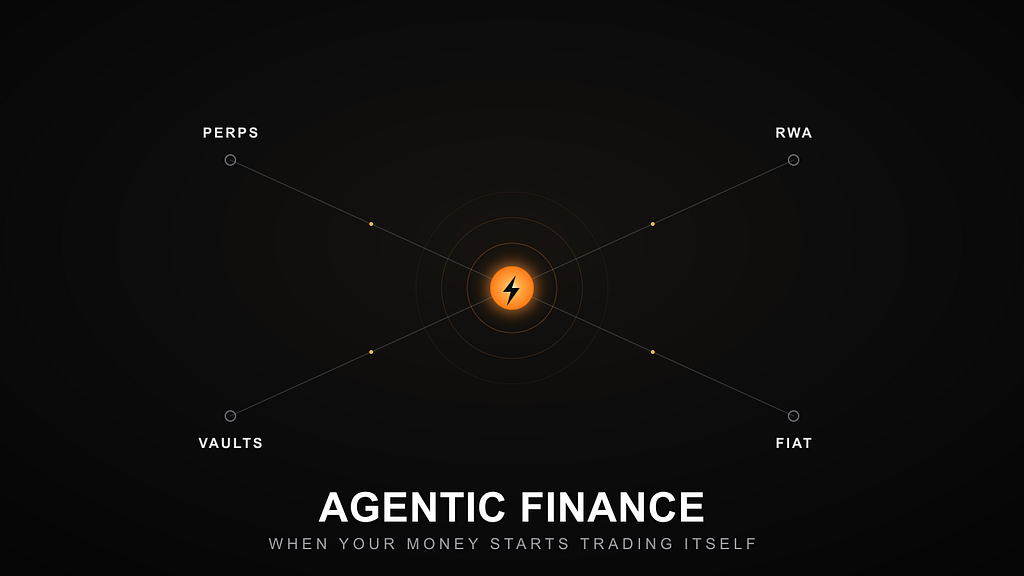
Put the pieces together and a bigger idea emerges — one Hotstuff itself has started to articulate: the goal isn’t a faster exchange, it’s an operating system for autonomous money.

Think about what an OS actually does. It manages resources, enforces permissions, and exposes a clean interface so applications don’t each have to reinvent the hardware. Map that onto finance:

  • Permissions → scoped, revocable delegation so agents act within a mandate (requirement #1).
  • Scheduler → deterministic sub-second settlement so agent loops run on a reliable clock (requirement #2).
  • Drivers → validator side-loops that turn messy real-world rails into verifiable system calls (requirements #3 and #4).
  • Filesystem → one unified account as the single source of truth an agent reads and writes.

An “Agentic Finance OS” is what you get when those primitives are native rather than bolted on. Developers stop building agents that fight the chain and start building agents that call it like an API. It’s worth saying plainly: this is a thesis, not a finished reality. But it’s a coherent one, and the architecture lines up behind it.

What builders can actually do with this

The practical test of any platform is whether independent developers can build on it without permission. A few concrete shapes of agentic app become possible on rails like these:

  • Autonomous portfolio managers that hold a scoped mandate — target allocations, risk limits — and rebalance across perps, spot, and RWAs without ever gaining withdrawal rights.
  • Strategy engines running DCA, TWAP, and grid logic non-custodially, using signature-delegated agent wallets so the user keeps custody while the agent keeps working. (Early community projects such as Ember, a non-custodial trading terminal built on the Hotstuff broker system, are a preview of exactly this pattern.)
  • Payment agents that watch for an incoming stablecoin settlement and auto-route it into yield, or convert to local fiat across SEPA/PIX/SPEI rails.
  • Treasury agents for on-chain businesses that keep idle balances in vaults and pull liquidity only when needed.

None of these require the user to surrender custody. That single property — useful without being dangerous — is the whole game.

The honest caveats

Education means covering the downside, so here’s the part the hype cycle skips.

  • Delegation is only as safe as its scope. A poorly written permission is a poorly locked door. The security burden moves to how tightly authority is bounded and how easily it’s revoked.
  • Agents fail in new ways. A buggy strategy at machine speed can lose money faster than any human. Circuit breakers, position caps, and kill switches aren’t optional.
  • Throughput claims deserve scrutiny. Numbers like 200k TPS and 150ms finality are impressive on paper; the real test is sustained performance under adversarial mainnet load, which any reader should verify over time rather than take on faith.
  • Regulation is unsettled. Autonomous agents moving fiat across borders is exactly the kind of thing regulators will eventually have opinions about. “Non-US retail” is a design decision with a compliance shadow.

Agentic finance is promising precisely because it’s hard. The projects worth watching are the ones treating custody, determinism, and compliance as first-class problems instead of marketing bullet points.

Where this leaves us

The first era of DeFi asked, can we rebuild finance without intermediaries? The answer turned out to be yes — but it left a human doing all the work. The next era asks a different question: can we hand that work to software we don’t have to trust blindly?

That only becomes possible when the chain underneath does four things at once — leash the agent’s authority, settle its actions instantly and finally, prove its contact with the real world, and keep its compliance private. Hotstuff is one concrete attempt to make all four native, and its “Agentic Finance OS” framing is a useful way to think about where on-chain finance is heading, whoever ends up building it.

The agent economy won’t arrive because someone shipped a smarter model. It’ll arrive when the rails are safe enough that giving software a mandate feels less reckless than doing everything yourself. That’s an infrastructure problem. And infrastructure, unlike hype, either works or it doesn’t.

🔎Author’s note / disclosure: I write about ecosystem protocols and build tools in this space. This article is intended as an educational overview of agentic finance; it is not investment advice. Leveraged trading carries substantial risk of loss. Always do your own research.


Your Money Is About to Get an Agent: A Field Guide to Agentic Finance was originally published in Coinmonks on Medium, where people are continuing the conversation by highlighting and responding to this story.

❌