
 Login
Login
Stablecoins vs CBDCs: The Two Digital Dollars Explained
One is issued by a government. One is issued by the market. Only one lets your money keep working while you hold it.
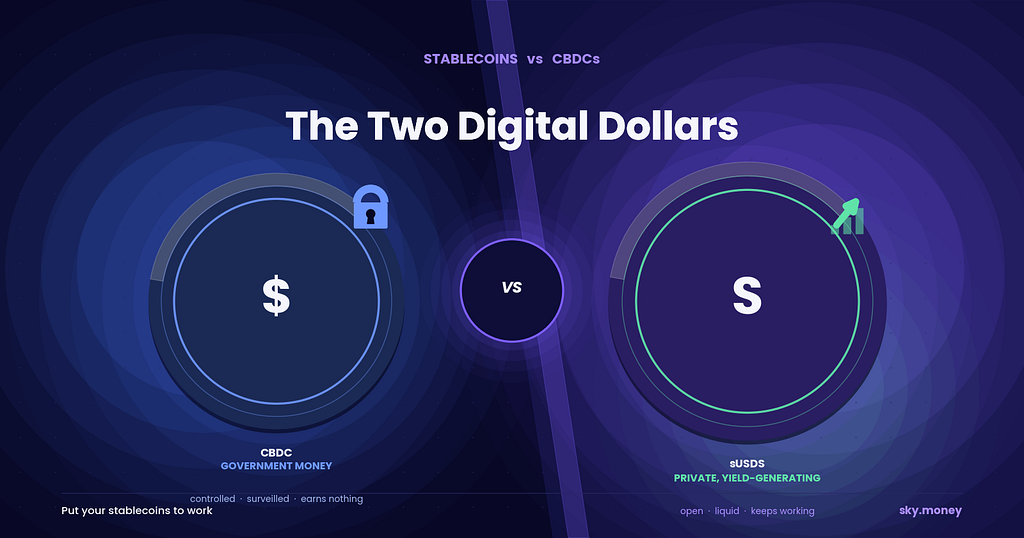
There are now two competing ideas about what a digital dollar should be.
One is built by governments. One is built by the open market. In 2026, the two took very different paths, and the gap between them tells you a lot about where your money is safest, and where it can actually grow.
Here is the short version. In July 2026, the United States passed a law banning the Federal Reserve from issuing a retail digital dollar.
A few months earlier, it had written the first federal rulebook for private stablecoins, the GENIUS Act. In plain terms: the government said no to government digital money, and yes to private digital money.
Consider one number. In 2025, stablecoins settled tens of trillions of dollars in transfers, at points topping the yearly volume of Visa.
Private digital dollars are no longer a crypto curiosity. They are payment rails.
That one decision by the US is the cleanest way to understand the whole “stablecoin vs CBDC” debate. Let’s break it down.
The government said no to a government digital dollar, and yes to private ones.
Two Roads to a Digital Dollar
A stablecoin and a CBDC are both just a dollar in digital form. Both aim to hold a steady value of one dollar. The difference is not the price. It is who controls the ledger.
A CBDC is a direct liability of a central bank. It is the state’s money, in token form.
A stablecoin is the liability of a private issuer or an onchain protocol, backed by reserves that hold the peg.
Whoever controls the ledger controls the rules. That is the real dividing line, and everything else flows from it.
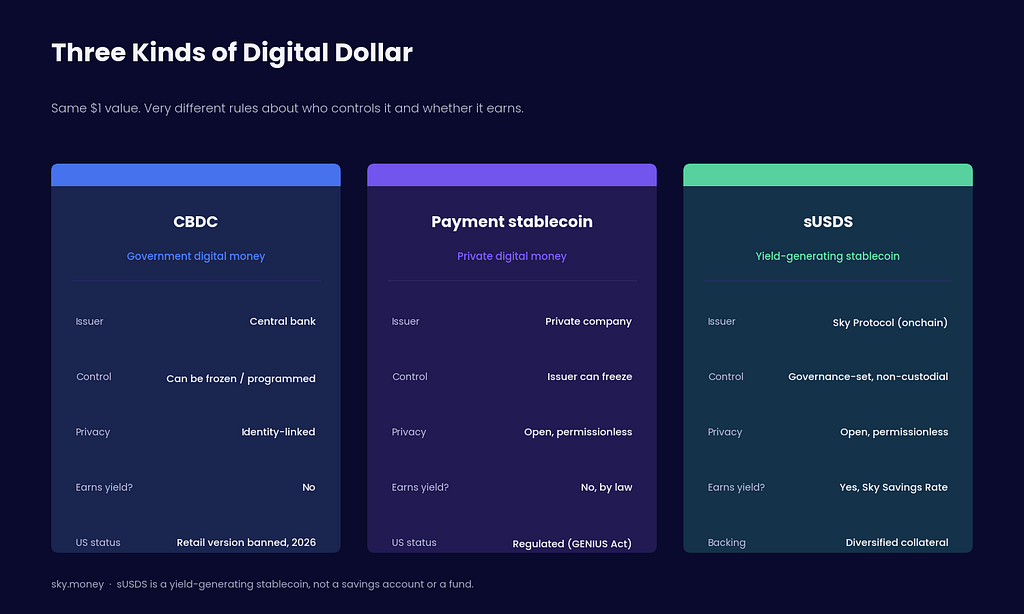
Same face value. Very different answers on privacy, control, and whether the dollar is allowed to earn.
What Is a CBDC? Government Money With a Freeze Switch
A central bank digital currency is exactly what it sounds like: digital cash issued and backed by the government.
On paper, it promises speed and financial inclusion. In practice, it comes with strings.
A CBDC is identity-linked by design. It can be programmed. It can, in theory, be frozen, capped, or set to expire by rule.
Picture a dollar that could be told where it is allowed to be spent, or when it stops being valid.
That is technically possible with a CBDC. It is the feature supporters like and critics fear.
That tension is why the politics got loud. As of early 2026, roughly 137 countries representing most of global GDP were exploring CBDCs, per the Atlantic Council tracker. China’s e-CNY had already moved hundreds of billions.
The US went the other way. On July 10, 2026, a retail CBDC ban became law, framed by lawmakers as a guard against government financial surveillance. The Fed cannot issue a consumer-facing digital dollar. Full stop.
What Is a Stablecoin? Private Digital Dollars at $313 Billion
While CBDCs argued, stablecoins scaled.
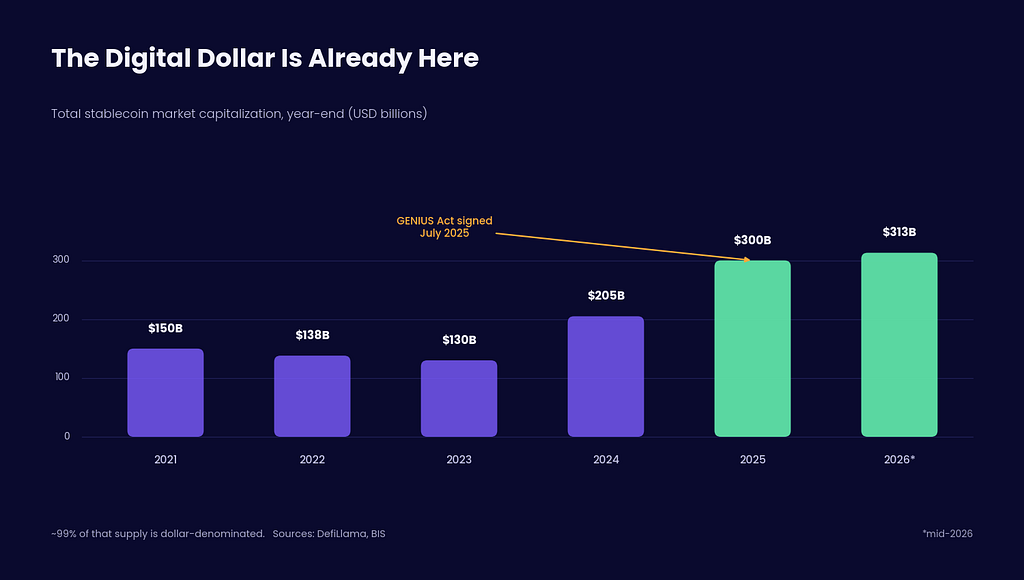
By mid-2026, the total stablecoin market sat near $313 billion, up roughly 23% year over year, and about 99% of it was dollar-denominated, according to DefiLlama and BIS data.
These are private digital dollars, and people actually use them. Stablecoins moved tens of trillions in transfers during 2025, at points outpacing the annual volume of major card networks.
The pull is strongest where local money is weak. Standard Chartered estimates up to one trillion dollars could shift out of emerging-market bank deposits and into dollar stablecoins as savers hedge their own currencies.
For a family in a country with double-digit inflation, a dollar stablecoin is not a trade.
It is the stable store of value the local bank could not offer. That is why adoption is climbing fastest outside the US, not inside it.
Regulation followed the money. The GENIUS Act, signed in July 2025, gave US issuers a clear rulebook: full 1:1 reserves in cash or short-term Treasuries, regular attestations, and audits for the largest players.
So stablecoins won the digital-dollar race on adoption. But there is a catch most people miss.
While CBDCs argued, stablecoins scaled to $313 billion.
The Catch: Most Digital Dollars Just Sit Still
Here is the quiet part.
Under the new rules, payment stablecoin issuers are barred from paying interest to the people who hold them. A CBDC, if one existed for US retail, would not pay you either.
So both mainstream digital dollars share the same flaw. They hold value, and nothing more.
Your dollar is stable, liquid, and completely idle. It does the work of cash while the reserves behind it, often billions parked in Treasuries, earn yield that flows to someone else.
The scale of that gap is easy to miss. Stablecoin issuers held around $155 billion in US Treasuries by late 2025. The interest that portfolio throws off is very real. It simply does not reach the person holding the coin.
For anyone holding stablecoins, that is money standing still.
The Third Option: A Yield-Generating Stablecoin
This is where a third category comes in, and where Sky.money fits.
sUSDS is a yield-generating stablecoin from Sky Protocol. It is not a payment stablecoin that sits idle, and it is not a government token you cannot inspect. It is a digital dollar built to keep working while you hold it.
The mechanics are simple:
- You supply USDS, a fully backed onchain stablecoin, through Sky.money.
- You receive sUSDS in return.
- Your sUSDS then accrues value continuously from the Sky Savings Rate.
- You stay fully liquid and can redeem at any time.
No lockups. No staking dashboard to babysit. The yield is built into the token itself.
This is not a fringe idea anymore. Interest-bearing crypto dollars grew roughly 300% in a single year, per RedStone data cited by Reuters.
Yield is now the fastest-growing corner of the stablecoin market.
Inside the Sky Savings Rate
The Sky Savings Rate is the engine, so it is worth understanding.
It is not a lending rate, and it is not a marketing promise. It is a governance-set yield generated by the Sky Agent Network, an independent set of capital allocators that put USDS liquidity to work across diversified strategies: short-term Treasuries, collateralized loans, and liquidity in lending markets.
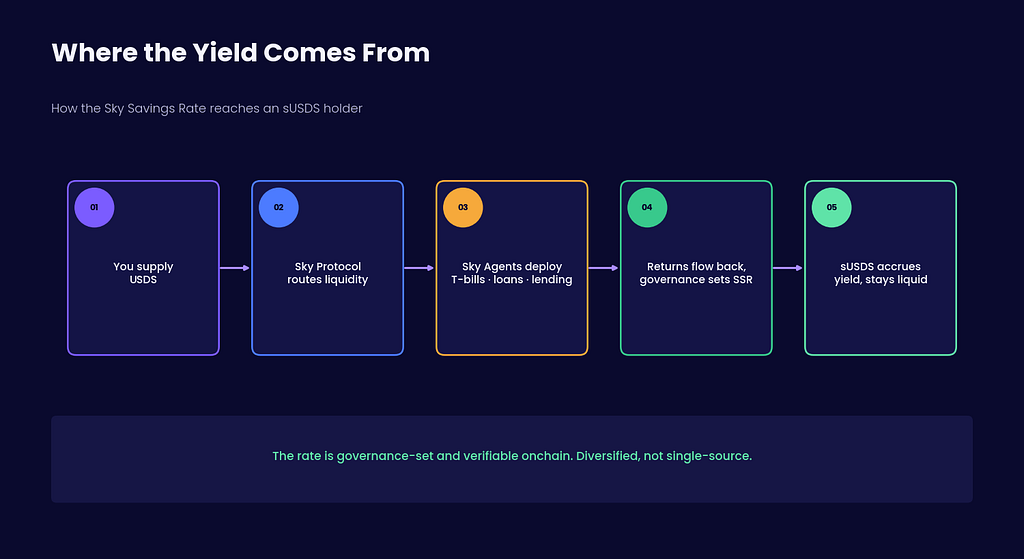
Returns flow back to the protocol. Governance then sets the rate. That structure gives sUSDS three things a yield-chasing product rarely has at once:
- Predictability, because the rate is governance-set, not a number that swings with one volatile market.
- Diversification, because the yield comes from many sources instead of a single fragile trade.
- Verifiability, because everything settles onchain. You can check it, not just trust it.
The people measuring that risk are not amateurs.
The Sky Frontier Foundation runs some of the most systematic risk frameworks in the space, and that discipline is the reason the rate can stay predictable rather than reactive.
That combination is why sUSDS has grown into the largest yield-generating stablecoin, with billions supplied by holders who want their dollars liquid and productive at the same time.
Prefer a diversified option? Sky Vaults spread stablecoins across curated strategies.
What This Means for a Saver
For a saver, the question is not which digital dollar looks most futuristic. It is which one respects two things at the same time: your control over the money, and your right to have it earn.
A CBDC struggles on the first. A plain payment stablecoin struggles on the second. A yield-generating stablecoin is the rare option that tries to hold both at once.
Private vs Government Digital Money: The Bottom Line
Step back, and the three-way picture is clear.
- A CBDC hands control to the state and hands surveillance to you.
- A payment stablecoin gives you an open dollar that earns nothing.
- A yield-generating stablecoin like sUSDS gives you an open dollar that stays liquid and keeps working.
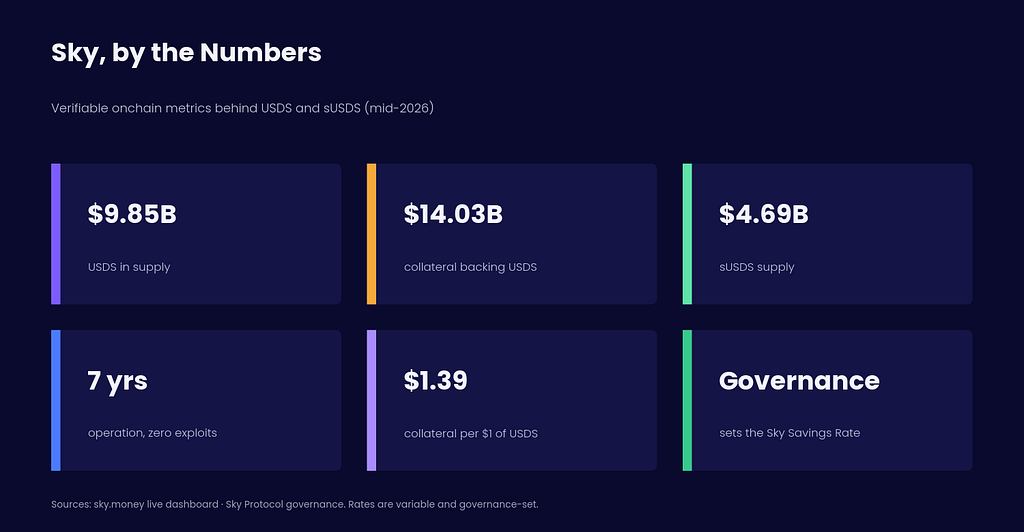
Sky did not appear overnight. The protocol behind USDS and sUSDS has run for seven years with zero exploits.
It backs USDS with diversified collateral worth around $14 billion, over-collateralized at roughly $1.39 for every dollar, funded by revenue the network actually produces.
Sky’s longer goal is bigger than any single token: a shared language of capital, where a dollar can be measured the same way no matter the wallet, the chain, or the border it moves across.
So the real debate was never quite stablecoin vs CBDC. It is idle money versus money that works.
The digital dollar is here to stay. The only open question is whether yours stays still or earns while you hold it.
Stablecoins were never built to sit still. Neither should yours.
Curious how it works in practice? See how USDS and sUSDS put a dollar to work, or explore the Sky Savings Rate and Sky Vaults at Sky.money.
Stablecoins vs CBDCs: The Two Digital Dollars Explained was originally published in Coinmonks on Medium, where people are continuing the conversation by highlighting and responding to this story.
