Login
Login
StableChain: Why a USDT-powered blockchain is attracting payments, and a new wave of memecoin…
StableChain: Why a USDT-powered blockchain is attracting payments, and a new wave of memecoin traders

Stablecoins have become one of crypto’s most successful real-world applications.
They are used for trading, payments, cross-border transfers, savings, settlement, and access to digital dollars. Yet most stablecoins still operate on general-purpose blockchains that were not specifically designed for payments.
Users may need a volatile native token to pay gas. Transaction costs can change unexpectedly, and sending USDT can become unnecessarily complicated for newcomers.
StableChain was designed to solve this problem.
Developed by Stable, it is a Layer 1 blockchain built around USDT-powered payments, predictable settlement, and high-throughput financial activity. Instead of treating stablecoins as one application among many, Stable places digital dollars at the center of the network.
For crypto traders, however, Stable is quickly becoming more than a payment narrative.
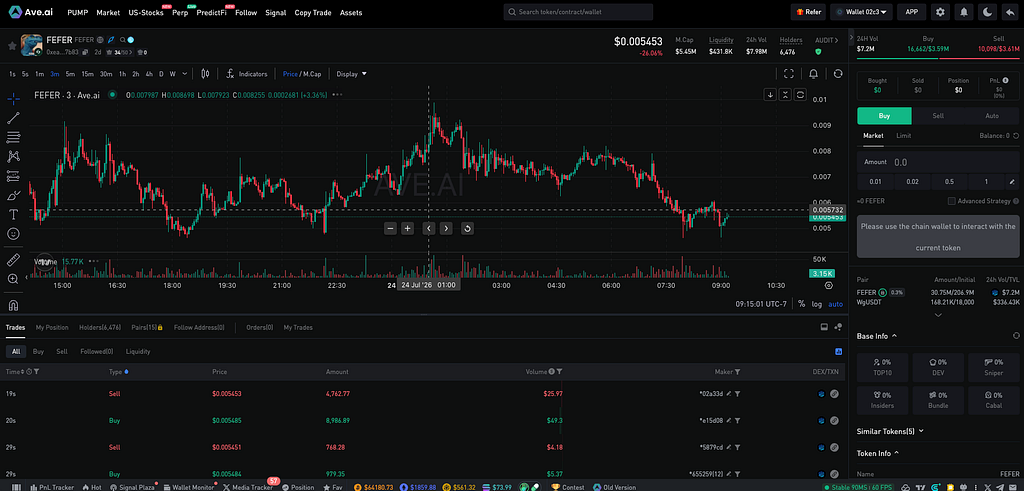
The recent rise of FEFER, one of the first major memecoins on StableChain, has driven record network activity and shown how speculative assets can accelerate user adoption on a newly launched blockchain.
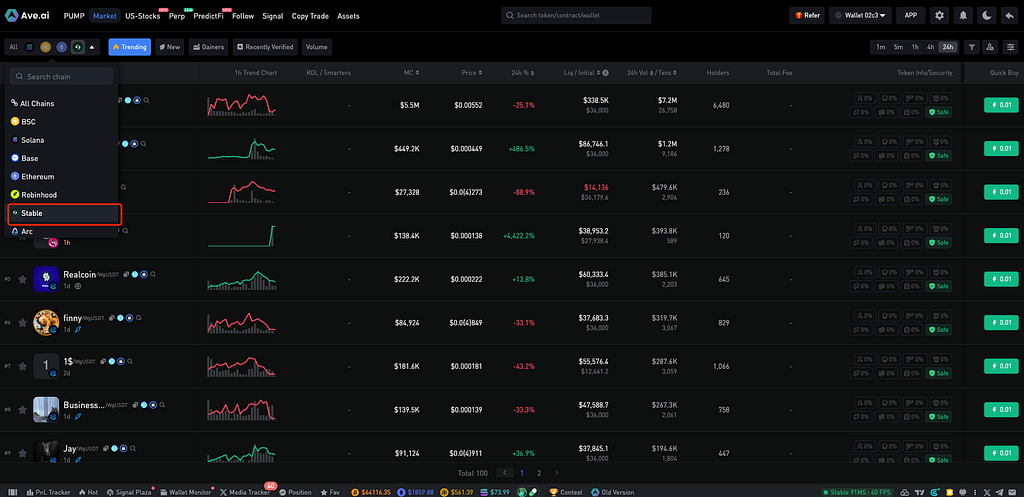
Ave is proud to be the first and fastest platform to fully integrate Stable, helping users discover, analyze, and trade emerging assets across the ecosystem from one place.
What Is StableChain?
StableChain is a USDT-native Layer 1 blockchain designed for stablecoin payments and on-chain financial applications.
Its core idea is simple: users transferring digital dollars should not need to acquire another asset just to pay transaction fees.
StableChain uses USDT for network fees and is designed to provide fast finality, predictable costs, and an experience better suited to payments than many traditional blockchains.
The network is also EVM-compatible, allowing developers to deploy smart contracts using familiar Ethereum tools. Existing DeFi applications can therefore expand to Stable without rebuilding their entire technology stack.
Its key characteristics include:
- USDT-powered transaction fees
- Fast transaction finality
- Predictable settlement costs
- EVM compatibility
- Payment-focused infrastructure
- Support for DeFi and on-chain financial applications
This combination gives Stable the potential to serve both everyday payment users and crypto-native traders.

Why Stablecoin Payments Need Dedicated Infrastructure
Most major blockchains were created as general-purpose networks.
They can support stablecoins, but stablecoin payments are not necessarily their primary design priority. A user may hold USDT but still be unable to send it without first acquiring ETH, SOL, BNB, or another gas token.
For experienced traders, this is a manageable inconvenience. For merchants, businesses, and first-time users, it can become a meaningful barrier.
Payment-focused blockchains attempt to remove that friction.
Stable belongs to an emerging category of networks built around stablecoin settlement, dollar-denominated fees, high throughput, and predictable costs. These networks are designed to make blockchain payments feel closer to conventional digital payments while preserving on-chain programmability.
But StableChain’s early activity also demonstrates that payment infrastructure can support much more than simple transfers.
It can become a foundation for an entire trading ecosystem.
FEFER Turns StableChain Into a Memecoin Trading Narrative
StableChain was built primarily for stablecoin payments, but one of its first major waves of retail activity has come from a memecoin.
FEFER, a blue-dinosaur-themed community token, emerged as one of the earliest prominent memecoins on StableChain. The token’s viral growth attracted traders, generated social attention, and pushed the network to new activity records.
On July 23, Stable reported more than 167,000 transactions within 24 hours, with much of the surge connected to increasing FEFER trading activity. The event represented an important milestone for a network that had previously been positioned mainly around institutional settlement and stablecoin payments.
The episode reveals an important pattern in new blockchain ecosystems:
Infrastructure may be built for utility, but culture often brings the first major wave of users.
Memecoins can quickly attract:
- New wallets
- Retail traders
- DEX volume
- Liquidity providers
- Community activity
- Social-media attention
- Additional token launches
- Demand for analytics and trading tools
FEFER therefore matters beyond its price movement.
It has become an early stress test for StableChain’s infrastructure and a demonstration that a payment-focused network can also support fast-moving, retail-driven trading activity.

What FEFER Reveals About StableChain
FEFER’s growth changes the way traders may evaluate the Stable ecosystem.
Before the memecoin surge, StableChain’s primary narrative was straightforward: a blockchain optimized for USDT payments.
The network now has two complementary growth engines.
Utility-driven adoption
Stable can attract users through payments, remittances, merchant settlement, payroll, treasury management, and institutional transfers.
Speculation-driven adoption
Memecoins such as FEFER can attract traders, liquidity, wallets, and community attention much faster than payment infrastructure alone.
These two markets are not necessarily in conflict.
Speculative activity can help bootstrap the liquidity and infrastructure required for more sophisticated financial applications. DEXs, wallets, bridges, analytics platforms, liquidity pools, and market makers built for memecoin traders may later support stablecoin payments, lending markets, and tokenized assets.
The central question is whether StableChain can convert short-term speculative attention into lasting ecosystem growth.
Traders should monitor whether FEFER’s momentum leads to:
- Higher retained wallet activity
- Deeper DEX liquidity
- More Stable-native token launches
- New DeFi applications
- Greater stablecoin deployment
- Sustainable transaction growth
If activity remains after the initial frenzy fades, FEFER may be remembered as the asset that helped introduce StableChain to the broader retail crypto market.
Stable Is Becoming More Than a Payment Network
Payments remain StableChain’s core use case, but concentrated stablecoin liquidity can support a much broader financial economy.
Potential applications include:
- Decentralized exchanges
- Lending and borrowing
- Merchant settlement
- Cross-border payments
- Payroll and contractor payments
- Remittance platforms
- Yield products
- Tokenized real-world assets
- Institutional settlement
- Memecoin and community-token trading
The FEFER surge provides early evidence that StableChain can support both utility-driven financial activity and speculative trading.
This combination could make Stable more attractive to developers. Payment users bring stablecoin balances, while traders bring liquidity, volume, and rapid product experimentation.
Together, they can create the foundations of a broader on-chain financial ecosystem.
Why Stable Could Become a Major Crypto Narrative
Crypto markets move through narratives.
AI tokens, memecoins, Layer 2 networks, real-world assets, perpetual DEXs, and prediction markets have all attracted periods of concentrated capital and attention.
StableChain sits at the intersection of several growing themes:
Stablecoin adoption
USDT and other stablecoins are increasingly used for trading, payments, savings, remittances, and settlement.
Payment blockchains
Purpose-built stablechains are emerging as a distinct infrastructure category.
New-chain memecoins
FEFER demonstrates that StableChain can support culture-driven tokens and retail speculation.
EVM expansion
EVM compatibility reduces the technical barriers for developers entering the ecosystem.
On-chain finance
Stablecoin liquidity can support DEXs, lending markets, yield products, and tokenized assets.
Early ecosystem alpha
New chains can create opportunities across memecoins, infrastructure protocols, liquidity markets, and financial applications.
Stable therefore combines practical utility with the speculative energy required to attract crypto-native users.
That combination may be more powerful than either narrative alone.
What Crypto Traders Should Monitor
StableChain’s long-term potential will depend on whether it can retain users and liquidity after the initial memecoin frenzy.
Several indicators will be particularly important.
FEFER trading activity
Traders should monitor whether its volume, liquidity, transaction count, and holder base continue growing or begin declining after the first wave of attention.
Stablecoin liquidity
Growing USDT balances can support deeper DEX markets, lending, payments, and other financial applications.
New token launches
A successful early memecoin often attracts imitators. Traders must distinguish genuine community growth from tokens simply copying the FEFER or Stable narrative.
Transaction retention
One record day is encouraging, but consistent transaction activity is a stronger sign of ecosystem health.
DEX liquidity
High trading volume is less meaningful when liquidity is too limited to support realistic entries and exits.
Wallet behavior
Repeat activity from traders and profitable wallets may reveal whether capital is staying on StableChain or quickly rotating elsewhere.
Ecosystem development
New exchanges, lending protocols, bridges, wallets, and payment applications would strengthen Stable’s long-term position.
Ave: The First and Fastest Platform to Fully Integrate Stable
New blockchain ecosystems move quickly.
Tokens launch, liquidity shifts, and market leaders can emerge before most traders know where to find them.
Ave’s full integration of Stable gives traders immediate access to the developing ecosystem.
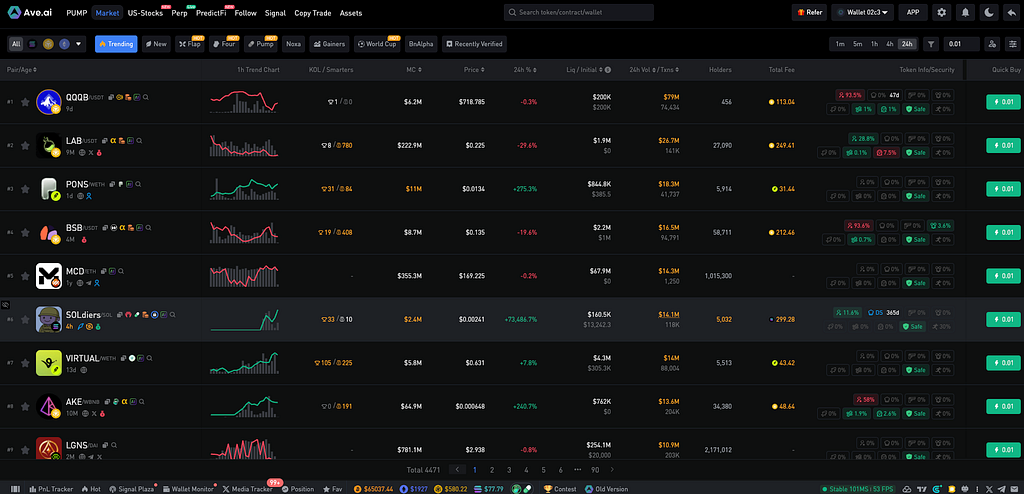
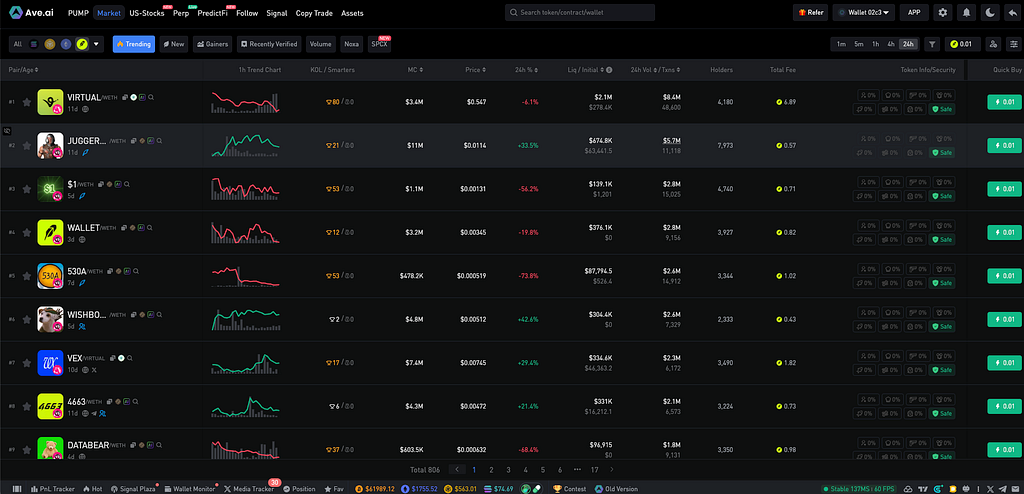
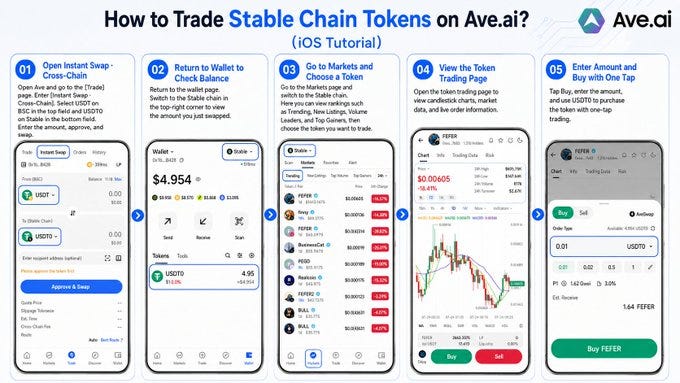
As an all-in-one on-chain financial platform, Ave allows users to discover, analyze, and trade different assets in one place, including:
- FEFER and Stable-native memecoins
- Newly launched tokens
- Trending ecosystem assets
- Established crypto assets
- Cross-chain opportunities
- Additional on-chain financial products
The integration is not simply about adding another blockchain.
It is about making the Stable ecosystem visible and actionable from its earliest stage.
Discovering StableChain Alpha With Ave
The FEFER frenzy highlights the importance of real-time on-chain discovery.
By the time a new token becomes widely discussed across crypto media or reaches a major centralized exchange, much of the earliest price discovery may already be complete.
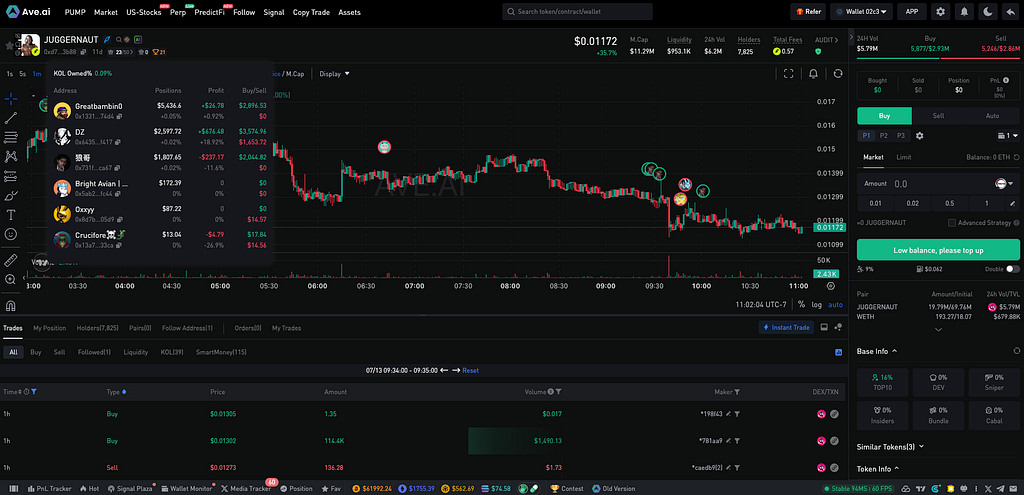
Ave helps traders monitor StableChain directly through:
- Real-time token prices
- Trading volume
- Liquidity changes
- Holder distribution
- Trending-token rankings
- Wallet transactions
- Smart-money activity
- Token security information
- Cross-chain market data
This is particularly important for memecoins.
Social attention alone cannot reveal whether a token has sufficient liquidity, concentrated ownership, suspicious wallet behavior, or early holders preparing to sell.
Ave helps traders move from social-media narratives to data-supported analysis.
A Practical StableChain Memecoin Workflow
1. Confirm the ecosystem trend
Determine whether StableChain’s transactions, liquidity, active wallets, and token launches are still increasing.
2. Identify trending assets
Use Ave to discover Stable-native tokens gaining volume, liquidity, transactions, and market attention.
3. Evaluate liquidity
Check whether the market can support a realistic entry and exit without excessive slippage.
4. Review holder distribution
Look for whale concentration, connected wallets, or unusually large insider positions.
5. Analyze wallet activity
Monitor whether experienced or profitable wallets are accumulating, holding, or selling.
6. Confirm organic demand
Healthy momentum should ideally appear across volume, liquidity, transactions, and wallet growth — not price alone.
7. Plan the exit
Memecoin narratives can reverse quickly. Define position size, profit targets, invalidation levels, and exit conditions before entering.
The Risks Behind the Memecoin Opportunity
FEFER has brought attention to StableChain, but early-stage memecoin markets remain highly speculative.
The main risks include:
- Rapid narrative reversals
- Limited exit liquidity
- Concentrated token ownership
- Malicious smart contracts
- Artificial volume
- Unverified teams
- Copycat tokens
- Bridge and protocol risks
- Tokens falsely claiming official connections
Traders should also verify contract addresses carefully. FEFER’s community materials explicitly caution users to check supply, liquidity, and the correct contract before trading.
A growing blockchain does not guarantee that every token within its ecosystem will succeed.
Final Thoughts
StableChain is built around a powerful idea:
Using digital dollars should feel as simple as sending digital dollars.
Its USDT-powered design could make stablecoin payments more accessible to users, merchants, businesses, and institutions.
But FEFER has introduced another dimension to the Stable story.
The memecoin’s rise helped push the network above 167,000 daily transactions, demonstrating how quickly retail speculation and internet culture can bring users to new infrastructure.
StableChain is therefore developing through two parallel narratives:
Payments bring real-world utility.
Memecoins bring attention, liquidity, and community.
If Stable can successfully convert that speculative momentum into lasting financial activity, it could evolve from a specialized payment blockchain into a broader on-chain financial ecosystem.
Ave is already positioned for that transition.
As the first and fastest platform to fully integrate Stable, Ave gives users one place to discover, analyze, and trade assets across the ecosystem.
From FEFER and emerging memecoins to established crypto assets and broader on-chain financial opportunities, traders can find it all on Ave.
Stable is building the payment rails. Memecoins are bringing the first wave of traders. Ave helps users discover where the next opportunity may emerge.
StableChain: Why a USDT-powered blockchain is attracting payments, and a new wave of memecoin… was originally published in Coinmonks on Medium, where people are continuing the conversation by highlighting and responding to this story.