Robinhood Chain crossed $311M in TVL in under three weeks. Growth like that is exactly when security gets skipped.
A rollup carrying tokenized stocks, stablecoins, and open lending markets is not just another L2 to review. The token itself is the giveaway: a Stock Token can have flawless code and still be wrong if the price feed lags, the issuer’s reserve does not match onchain supply, or the legal agreement behind the token does not say what the marketing says it does. Our RWA Handbook breaks this wider surface into five categories: asset-token mismatch, mint and burn exploits, privilege and admin risk, oracle failures, and custody and legal risk. Robinhood Chain touches all five within its first month live.
Some of the risk is just standard Arbitrum Orbit territory. Sequencer centralization, since a single sequencer orders every transaction. A seven-day fraud-proof withdrawal delay. Address aliasing on L1-to-L2 calls. Data availability gaps if blob posting is delayed. Upgrade keys controlling the rollup contract. None of this is unique to Robinhood, and all of it still applies.
Other risk is specific to this chain. Stock Tokens use ERC-8056, scaling value through a uiMultiplier() function instead of rebasing balances, so any protocol that reapplies the Chainlink feed’s built-in multiplier will double count it. An oraclePaused flag signals an unreliable price around dividends and splits, but it is advisory, not enforced onchain. A single Authorised Participant controls the entire mint and redeem pathway for every tokenized stock, sitting outside the smart contract layer entirely.
Then there is agentic trading, live now for equities and options through Robinhood’s brokerage stack, not the chain itself. Robinhood CEO Vlad Tenev has said every capability a human can do will be available to an AI agent. Crypto support is coming next, and that is when this risk surface starts sharing a trust boundary with Robinhood Chain: prompt injection through the research tools an agent reads, session and credential compromise through the MCP connection, autonomous mode removing human review by default, and correlated trading behavior across thousands of agents running similar strategies at once.
None of this makes the chain unsafe today. It makes Robinhood Chain a rollup already carrying real securities and real stablecoin liquidity, with a closely adjacent AI agent risk surface about to merge with it, exactly the kind of shift that rewards independent review before it happens.
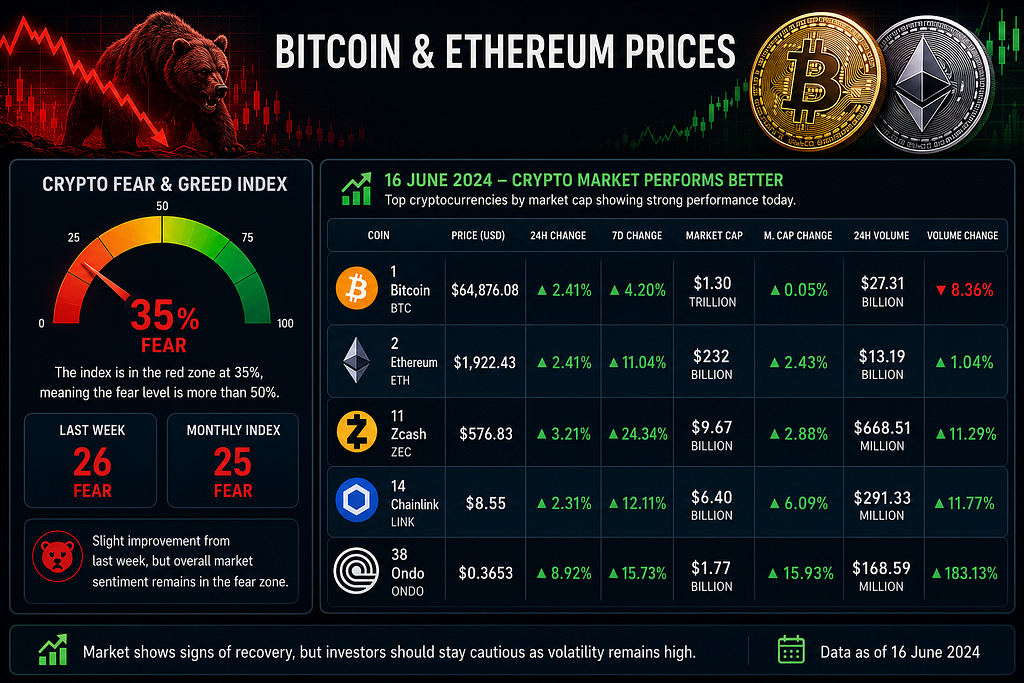
From the start of the year, Bitcoin and Ethereum prices collapsed. A big shake in the crypto industry, which resulted in prices dropping. But the greed and fear index is red. Showing it at 35, which means the percent chance of fear is more than 50%. But much better than last week, which was around 26. The monthly greed and fear index is 25.
AI-GENERATED
Today, 16 June, the overall crypto market performed better than on previous days. The coins listed below by their market cap performed very well today.
Bitcoin, the number one cryptocurrency by its market cap, has a value of $64,876.08, a weekly surge in the price of around 4.2%. The market cap of bitcoin is $1.3 trillion, increased by 0.05%. The 24-hour trading volume is $27.31 billion, a decline of 8.36%.
Ethereum, the second-largest cryptocurrency, is trading at the price of $1,922.43, a surge in the price of around 2.41% in the last 24 hours. Similarly, it increased its value weekly by 11.04%. The market cap increased by $232 billion, a 2.43% jump. Whereas the volume in the last 24 hours is $13.19 billion, it rose by 1.04%.
Zcash is also referred to as ZEC. The 11th number is marked by its market cap on CoinMarketCap. ZEC is trading at the price of $576.83, a surge in the last seven days, which is 24.34%. Its market cap is $9.67 billion, a rise of 2.88%. Also, the volume recorded in the last 24 hours is $668.51 million, surging by 11.29%.
Chainlink, as LINK, is the number 14 cryptocurrency in the market, according to CoinMarketCap. Chainlink’s trading price is marked as $8.55. An increase of 12.11% since last week. When the market cap is $6.4 billion, it also increased by 6.09%. The 24-hour trading volume is $291.33 million, which is surging by 11.77%
Ondo is also known by its blockchain, ONDO. The 38th-ranked altcoin. ONDO is trading at $0.3653, a huge surge in prices weekly by 15.73%. Its market cap is $1.77 billion, increased by 15.93%. Although the 24-hour trading volume is $168.59 million, a huge surge in the last 24 hours is around 183.13%.
As you go further into the world of crypto, certain terms begin to appear more frequently. Some of those terms, especially in conversations about blockchain, are Layer 1, Layer 2, and base layers.
While it sounds like complex technical jargon, the concept is straightforward. Think of the crypto ecosystem as a high-rise building. That building needs a foundation; Layer 1 is that foundation.
It is the core infrastructure that makes everything else possible. Whether you are sending Bitcoin to a friend, trading digital art, or using stablecoins for business payments, every transaction ultimately relies on a Layer 1 network.
What Is a Layer 1 Blockchain?
A Layer 1 blockchain is the foundational, base level of a blockchain network.
It is an independent digital ledger that processes, validates, and finalizes its own transactions without relying on another network.
Cities need governments to function in the same way crypto applications need a Layer 1 blockchain to function.
A true Layer 1 blockchain handles all the heavy lifting of a network. It manages transaction processing by recording every transfer of value. It ensures security by protecting the network against fraud. It creates consensus so computers around the world agree on which transactions are valid, and maintains the permanent, unchangeable history of the entire network.
Why Is It Called “Layer 1”?
The term Layer 1 derives from blockchain technology’s built-in tiered structure.
Layer 1 is the base layer where security and final settlement happen. Layer 2 represents secondary networks built on top of Layer 1 to handle massive amounts of transactions at lightning-fast speeds. Later, the final data is shifted back to Layer 1. The application layer sits at the very top. It represents user-facing apps such as crypto wallets and decentralized exchanges.
Occasionally, you might hear whispers of Layer 0 networks that connect different Layer 1s, or Layer 3 networks for hyper-specific applications. Regardless, Layer 1 remains the primary anchor for the entire system.
What Does a Layer 1 Blockchain Actually Do?
Layer 1 blockchain coordinates thousands of independent computers, called nodes, spread across the globe to perform several key functions.
First, it handles transaction processing by picking up your transfer, verifying that you actually have the funds, and preparing to log it into the ledger.
Second, because there is no central bank or CEO in charge, the network needs a built-in mechanism to ensure everyone agrees on the truth. This is called a blockchain consensus mechanism.
In a Proof of Work system, as used by Bitcoin, computers expend computational effort to solve complex mathematical puzzles to secure the network.
In a Proof of Stake system, used by Ethereum, participants lock up a portion of the network’s native cryptocurrency to earn the right to validate transactions.
Finally, Layer 1 networks provide distributed security by distributing copies of the ledger across thousands of nodes worldwide, making it incredibly difficult for a bad actor to alter past data.
Once a transaction is added to a block, it achieves finality, meaning it is permanently recorded in the blockchain and cannot be reversed.
Popular Examples of Layer 1s
Not all Layer 1 blockchains are built for the same purpose, and different networks make different trade-offs depending on what they want to achieve.
The Bitcoin blockchain was the world’s first Layer 1 network, designed to serve as a secure, decentralized, peer-to-peer digital currency that uses Proof of Work. It prioritizes maximum security and does not natively support complex applications.
The Ethereum blockchain was built on this foundation by introducing smart contracts, self-executing digital agreements written in code. This turned Ethereum into a programmable global computer running on Proof of Stake, allowing developers to build decentralized applications directly on top of it.
Solana was built to address the speed limitations of older networks by combining Proof of Stake with an innovative tracking system called Proof of History. This allows Solana to process tens of thousands of transactions per second with incredibly low fees, making it ideal for high-frequency trading and consumer applications.
Avalanche uses a unique consensus structure to deliver nearly instant transaction finality. This allows developers to launch custom, interoperable blockchains called subnets for complex decentralized finance projects.
BNB Chain utilizes a highly efficient consensus model to provide a faster, cheaper alternative to Ethereum, hosting thousands of gaming and Web3 applications with minimal transaction costs for the everyday user.
Why Layer 1 Matters: The Foundation Everything Depends On
Without Layer 1 blockchains, the entire crypto industry would cease to exist. They are the bedrock of Web3.
If a Layer 1 network goes offline or experiences a glitch, every single asset built on top of it stops working. Without Layer 1, there are no crypto wallets, no decentralized finance lending protocols, no NFTs, no token transfers, and no stablecoins pegged to local fiat currencies.
Every digital asset you interact with is ultimately just a line of code living on a Layer 1 network.
The Biggest Challenge: The Blockchain Trilemma
If Layer 1 blockchains are so revolutionary, why aren’t they perfect?
The answer lies in a concept coined by Ethereum founder Vitalik Buterin called The Blockchain Trilemma. The trilemma states that a blockchain can generally achieve only two of three core properties at any given time: decentralization, security, and scalability.
Bitcoin and Ethereum traditionally prioritized decentralization and security, which led to slow speeds and high fees during peak periods.
Solana, on the other hand, prioritized scalability and security, making architectural trade-offs that require more powerful, centralized hardware to run a network node.
Improving one of these pillars almost always affects another.
How Layer 1 Blockchains Scale
Layer 1 blockchains are not static. Developers actively implement core upgrades to directly address the scalability bottleneck at the base layer.
One major technique is sharding, which divides the main blockchain into smaller, manageable pieces that process transactions in parallel, increasing the network’s throughput.
Another method is increasing block sizes. This increases the data capacity of each block, allowing the network to process more transactions at once.
Developers also rely on consensus upgrades, such as Ethereum’s historic shift from Proof of Work to Proof of Stake, which drastically reduced energy consumption and laid the groundwork for future speed upgrades to the blockchain itself.
Why Layer 1 Blockchains Matter for Africa
Layer 1 infrastructure is actively driving a financial revolution across Africa.
The continent’s booming fintech sector increasingly relies on these networks to address real-world economic challenges such as high inflation and foreign exchange scarcity.
This has driven immense demand for digital dollars across countries like Nigeria, Kenya, and South Africa.
Popular stablecoins like USDT and USDC, alongside local innovations like the cNGN, do not exist in isolation. They are minted and moved directly on Layer 1 blockchains like Ethereum, Solana, and BNB Chain.
Traditional cross-border money transfers within Africa are notoriously slow and expensive. However, innovative African fintech companies are quietly changing this by using Layer 1 rails behind the scenes.
Yellow Card utilizes Layer 1 stability to facilitate seamless crypto-to-fiat ramps across more than 20 African nations.
Flutterwave has historically integrated blockchain capabilities to enable faster settlement of cross-border transactions.
Every Stablecoin Payment Starts With a Layer 1
The beauty of Layer 1 today is that the average user doesn’t need to know how a consensus mechanism works.
When someone uses a fintech app to send funds from Nairobi to Accra, they experience a smooth, cheap transfer.
They don’t interact with a command line; they don’t even need to familiarize themselves with crypto, but under the hood, a Layer 1 blockchain is securely settling that value.
Layer 1 and Layer 2 are not competitors but teammates.
Layer 2 networks will continue to make crypto transactions faster and cheaper. However, they rely on the unshakeable security of a Layer 1 network to finalize those transactions.
Layer 1 blockchains are the digital infrastructure making the global decentralized economy possible.
From securing billions of dollars in global wealth to powering daily cross-border remittances across Africa, Layer 1 remains the most critical foundation in Web3.

 Login
Login