Reading view

There are new articles available, click to refresh the page.

Stablecoins vs CBDCs: The Two Digital Dollars Explained

One is issued by a government. One is issued by the market. Only one lets your money keep working while you hold it.
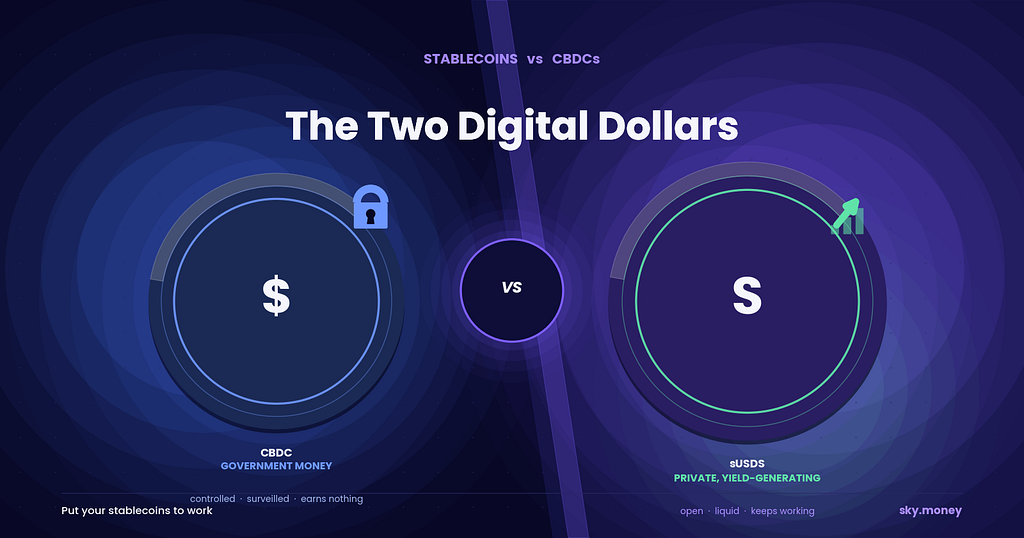
Dark navy graphic titled ‘The Two Digital Dollars’ showing a blue CBDC coin labelled government digital money facing a purple USDS coin labelled private digital money, with the word vs between them and the line put your stablecoins to work.
Two competing ideas of a digital dollar

There are now two competing ideas about what a digital dollar should be.

One is built by governments. One is built by the open market. In 2026, the two took very different paths, and the gap between them tells you a lot about where your money is safest, and where it can actually grow.

Here is the short version. In July 2026, the United States passed a law banning the Federal Reserve from issuing a retail digital dollar.

A few months earlier, it had written the first federal rulebook for private stablecoins, the GENIUS Act. In plain terms: the government said no to government digital money, and yes to private digital money.

Consider one number. In 2025, stablecoins settled tens of trillions of dollars in transfers, at points topping the yearly volume of Visa.

Private digital dollars are no longer a crypto curiosity. They are payment rails.

That one decision by the US is the cleanest way to understand the whole “stablecoin vs CBDC” debate. Let’s break it down.

The government said no to a government digital dollar, and yes to private ones.

Two Roads to a Digital Dollar

A stablecoin and a CBDC are both just a dollar in digital form. Both aim to hold a steady value of one dollar. The difference is not the price. It is who controls the ledger.

A CBDC is a direct liability of a central bank. It is the state’s money, in token form.

A stablecoin is the liability of a private issuer or an onchain protocol, backed by reserves that hold the peg.

Whoever controls the ledger controls the rules. That is the real dividing line, and everything else flows from it.

Same face value. Very different answers on privacy, control, and whether the dollar is allowed to earn.

What Is a CBDC? Government Money With a Freeze Switch

A central bank digital currency is exactly what it sounds like: digital cash issued and backed by the government.

On paper, it promises speed and financial inclusion. In practice, it comes with strings.

A CBDC is identity-linked by design. It can be programmed. It can, in theory, be frozen, capped, or set to expire by rule.

Picture a dollar that could be told where it is allowed to be spent, or when it stops being valid.

That is technically possible with a CBDC. It is the feature supporters like and critics fear.

That tension is why the politics got loud. As of early 2026, roughly 137 countries representing most of global GDP were exploring CBDCs, per the Atlantic Council tracker. China’s e-CNY had already moved hundreds of billions.

The US went the other way. On July 10, 2026, a retail CBDC ban became law, framed by lawmakers as a guard against government financial surveillance. The Fed cannot issue a consumer-facing digital dollar. Full stop.

What Is a Stablecoin? Private Digital Dollars at $313 Billion

While CBDCs argued, stablecoins scaled.

By mid-2026, the total stablecoin market sat near $313 billion, up roughly 23% year over year, and about 99% of it was dollar-denominated, according to DefiLlama and BIS data.

These are private digital dollars, and people actually use them. Stablecoins moved tens of trillions in transfers during 2025, at points outpacing the annual volume of major card networks.
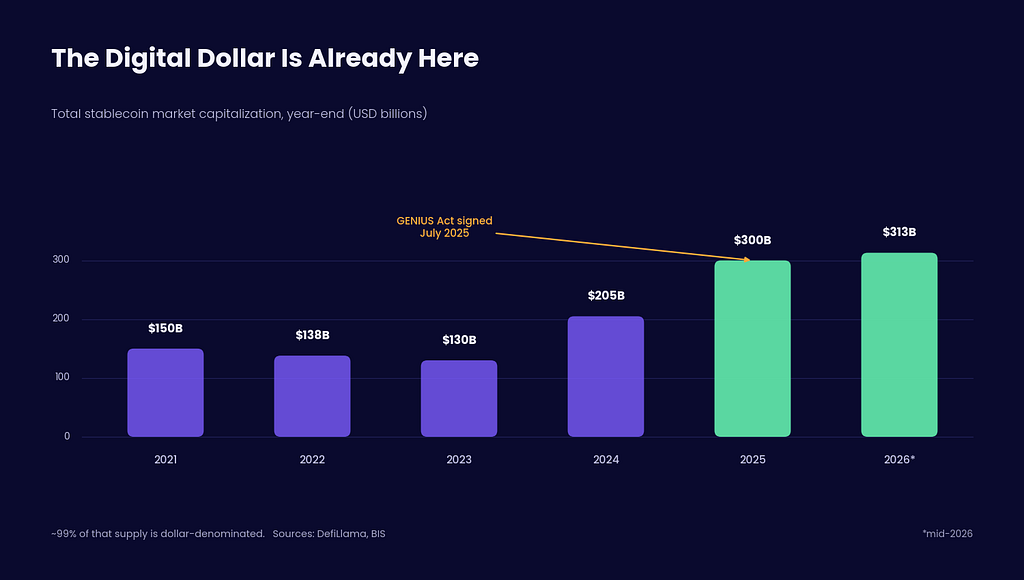
Bar chart of total stablecoin market capitalization by year, rising from $150B in 2021 to about $313B in mid-2026, with an annotation marking the GENIUS Act signed in July 2025.
Total stablecoin market cap climbed from ~$205B to ~$313B, with the GENIUS Act as an inflection point.

The pull is strongest where local money is weak. Standard Chartered estimates up to one trillion dollars could shift out of emerging-market bank deposits and into dollar stablecoins as savers hedge their own currencies.

For a family in a country with double-digit inflation, a dollar stablecoin is not a trade.

It is the stable store of value the local bank could not offer. That is why adoption is climbing fastest outside the US, not inside it.

Regulation followed the money. The GENIUS Act, signed in July 2025, gave US issuers a clear rulebook: full 1:1 reserves in cash or short-term Treasuries, regular attestations, and audits for the largest players.

So stablecoins won the digital-dollar race on adoption. But there is a catch most people miss.

While CBDCs argued, stablecoins scaled to $313 billion.

The Catch: Most Digital Dollars Just Sit Still

Here is the quiet part.

Under the new rules, payment stablecoin issuers are barred from paying interest to the people who hold them. A CBDC, if one existed for US retail, would not pay you either.

So both mainstream digital dollars share the same flaw. They hold value, and nothing more.

Your dollar is stable, liquid, and completely idle. It does the work of cash while the reserves behind it, often billions parked in Treasuries, earn yield that flows to someone else.

The scale of that gap is easy to miss. Stablecoin issuers held around $155 billion in US Treasuries by late 2025. The interest that portfolio throws off is very real. It simply does not reach the person holding the coin.

For anyone holding stablecoins, that is money standing still.

The Third Option: A Yield-Generating Stablecoin

This is where a third category comes in, and where Sky.money fits.

sUSDS is a yield-generating stablecoin from Sky Protocol. It is not a payment stablecoin that sits idle, and it is not a government token you cannot inspect. It is a digital dollar built to keep working while you hold it.
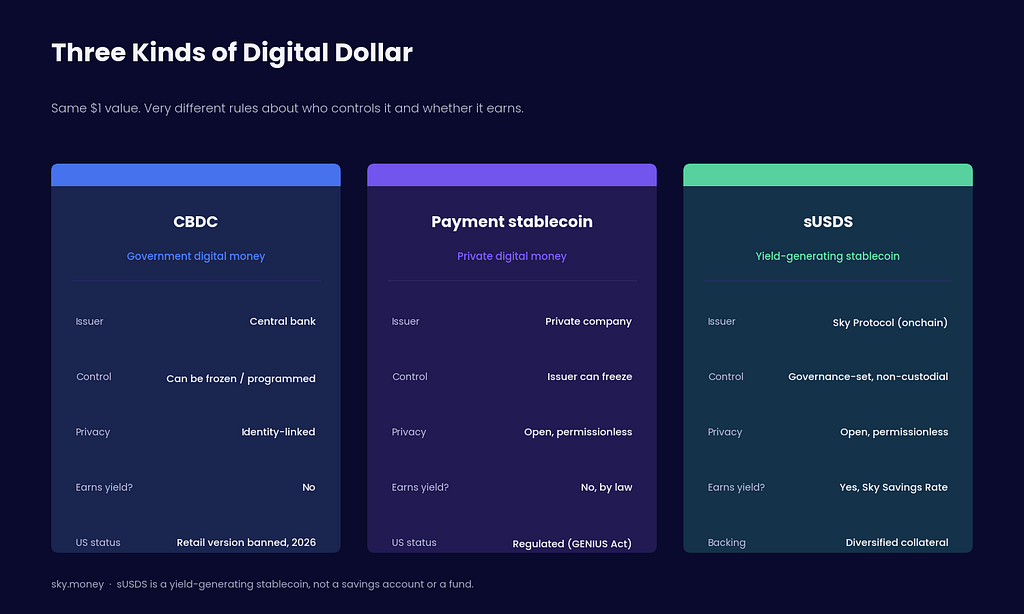
Three side-by-side comparison cards for CBDC, payment stablecoin, and sUSDS, comparing issuer, control, privacy, and whether each earns yield, with sUSDS shown as governance-set and yield-generating.
Comparison · Same $1 value, three very different rulebooks: CBDC, payment stablecoin, and yield-generating sUSDS.

The mechanics are simple:

  • You supply USDS, a fully backed onchain stablecoin, through Sky.money.
  • You receive sUSDS in return.
  • Your sUSDS then accrues value continuously from the Sky Savings Rate.
  • You stay fully liquid and can redeem at any time.

No lockups. No staking dashboard to babysit. The yield is built into the token itself.

This is not a fringe idea anymore. Interest-bearing crypto dollars grew roughly 300% in a single year, per RedStone data cited by Reuters.

Yield is now the fastest-growing corner of the stablecoin market.

Inside the Sky Savings Rate

The Sky Savings Rate is the engine, so it is worth understanding.

It is not a lending rate, and it is not a marketing promise. It is a governance-set yield generated by the Sky Agent Network, an independent set of capital allocators that put USDS liquidity to work across diversified strategies: short-term Treasuries, collateralized loans, and liquidity in lending markets.
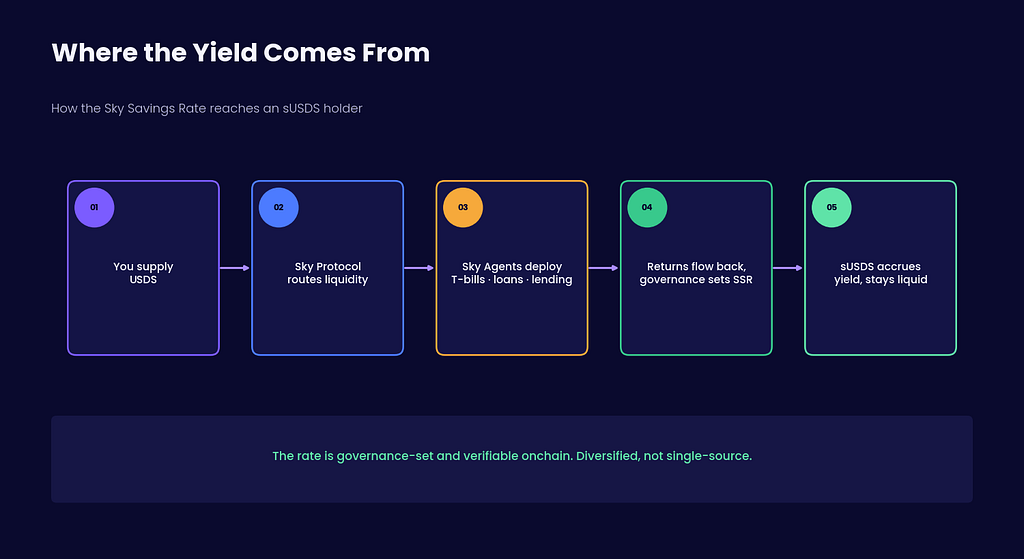
Five-step flow diagram: supply USDS, Sky Protocol routes liquidity, Sky Agents deploy into T-bills, loans and lending, returns flow back and governance sets the Sky Savings Rate, and sUSDS accrues yield while staying liquid.
Flow · How a governance-set yield reaches an sUSDS holder, from supplied USDS to accrued yield.

Returns flow back to the protocol. Governance then sets the rate. That structure gives sUSDS three things a yield-chasing product rarely has at once:

  • Predictability, because the rate is governance-set, not a number that swings with one volatile market.
  • Diversification, because the yield comes from many sources instead of a single fragile trade.
  • Verifiability, because everything settles onchain. You can check it, not just trust it.

The people measuring that risk are not amateurs.

The Sky Frontier Foundation runs some of the most systematic risk frameworks in the space, and that discipline is the reason the rate can stay predictable rather than reactive.

That combination is why sUSDS has grown into the largest yield-generating stablecoin, with billions supplied by holders who want their dollars liquid and productive at the same time.

Prefer a diversified option? Sky Vaults spread stablecoins across curated strategies.

What This Means for a Saver

For a saver, the question is not which digital dollar looks most futuristic. It is which one respects two things at the same time: your control over the money, and your right to have it earn.

A CBDC struggles on the first. A plain payment stablecoin struggles on the second. A yield-generating stablecoin is the rare option that tries to hold both at once.

Private vs Government Digital Money: The Bottom Line

Step back, and the three-way picture is clear.

  • A CBDC hands control to the state and hands surveillance to you.
  • A payment stablecoin gives you an open dollar that earns nothing.
  • A yield-generating stablecoin like sUSDS gives you an open dollar that stays liquid and keeps working.
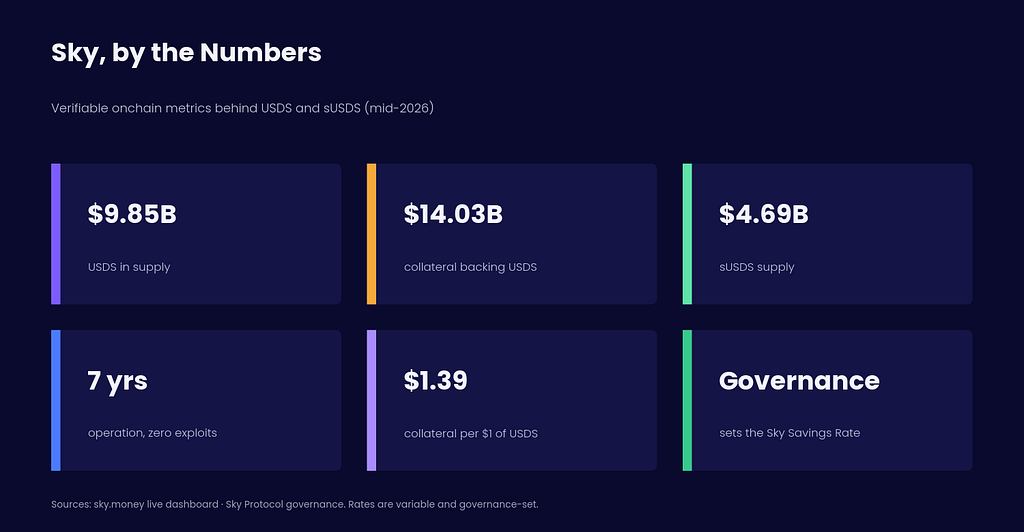
Stat panel titled Sky by the Numbers showing $9.85B USDS supply, $14.03B collateral, $4.69B sUSDS supply, seven years with zero exploits, $1.39 collateral per dollar, and governance-set Sky Savings Rate.
By the numbers · Verifiable onchain metrics behind USDS and sUSDS (mid-2026).

Sky did not appear overnight. The protocol behind USDS and sUSDS has run for seven years with zero exploits.

It backs USDS with diversified collateral worth around $14 billion, over-collateralized at roughly $1.39 for every dollar, funded by revenue the network actually produces.

Sky’s longer goal is bigger than any single token: a shared language of capital, where a dollar can be measured the same way no matter the wallet, the chain, or the border it moves across.

So the real debate was never quite stablecoin vs CBDC. It is idle money versus money that works.

The digital dollar is here to stay. The only open question is whether yours stays still or earns while you hold it.

Stablecoins were never built to sit still. Neither should yours.
Curious how it works in practice? See how USDS and sUSDS put a dollar to work, or explore the Sky Savings Rate and Sky Vaults at Sky.money.

Stablecoins vs CBDCs: The Two Digital Dollars Explained was originally published in Coinmonks on Medium, where people are continuing the conversation by highlighting and responding to this story.

Has Bitcoin Lost the Narrative?

It’s down more than 50% from the top. Gold is eating its lunch. Stablecoins quietly stole its original job. But the story everyone’s arguing about is the wrong one.

Naked Market breaks down macro finance, blockchain infrastructure, AI systems, and automated trading to help you understand the future of global finance before the mainstream catches up.

Picture a screen glowing in the dark. Doesnt matter where a phone in Lagos, a laptop in Jakarta, a bedroom in Manila. Same numbers everywhere.

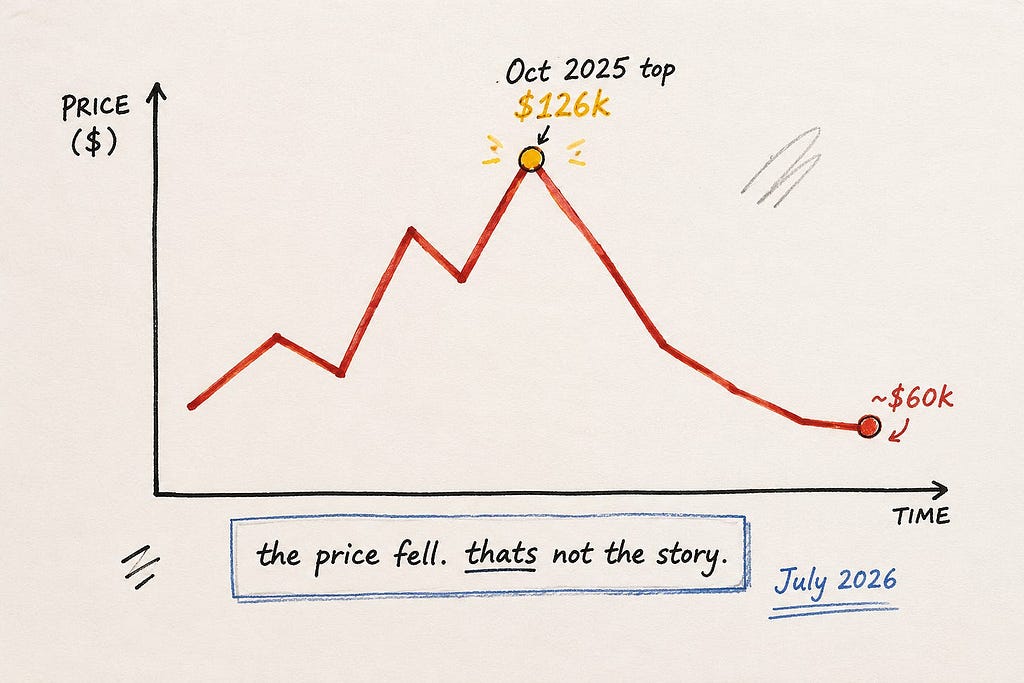
Bitcoin, July 2026: around $60,000.

A year ago it was near $109,000. Last October it touched $126,000 and half the internet was shouting that six figures was the new floor that it could only go up from here.

Its not the floor anymore. It hasnt been for months.

And heres the strange part. The price falling isnt even the interesting bit. Prices fall. Prices rise. Thats literally the one thing prices do.

The interesting bit is that Bitcoin is quietly losing something worth far more than dollars.

Its losing the narrative.

First — what does “losing the narrative” even mean?

Let me back up, because this word gets thrown around constantly and almost nobody stops to define it.

Every asset on earth is really two things at once. Theres the thing itself — the coin, the share, the bar of metal. And theres the story people tell about the thing. The story is what makes you hold it through a bad week, buy more when its down, or try to explain it to your uncle at a family dinner.

Gold’s story: “it has held its value for 5,000 years.” The dollar’s story: “the whole planet accepts it.” A hot tech stock’s story: “this company owns the future.”

Clean. One line each.

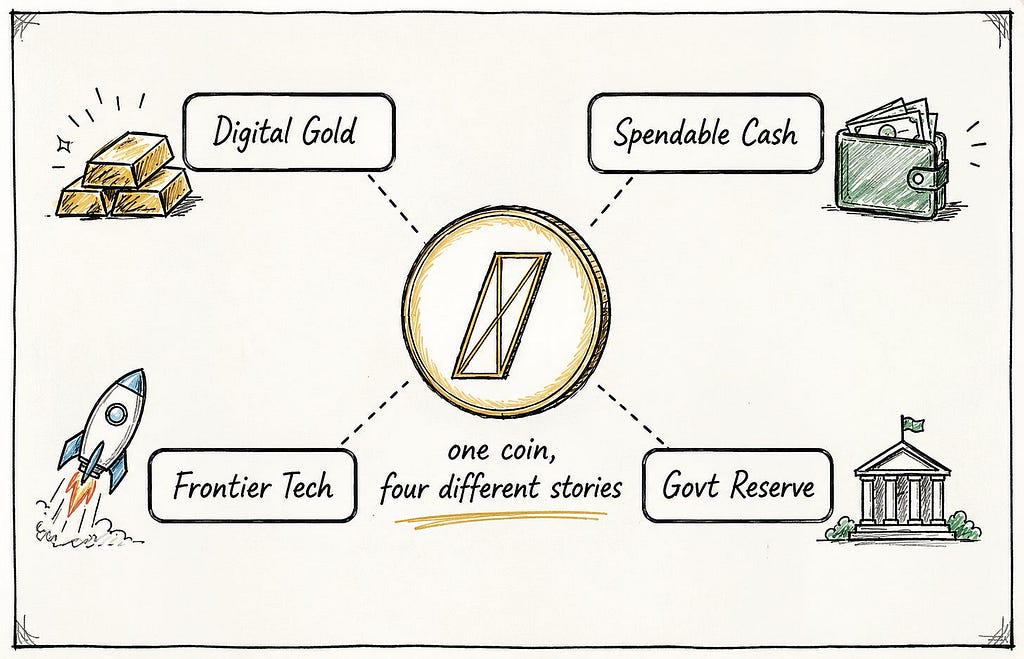
Bitcoin never had one story. It had four. And in 2026, three of them cracked right down the middle.

Let me show you the autopsy. (Sorry thats dark. But it fits.)

Story 1: the “digital gold” that didn’t act like gold

For years the pitch was beautifully simple. Bitcoin is “digital gold.” When the world gets scary and money runs for safety, it runs to gold and it would run to Bitcoin too. Same job as gold, just younger and faster.

2026 ran that experiment live, in public, for everyone to watch.

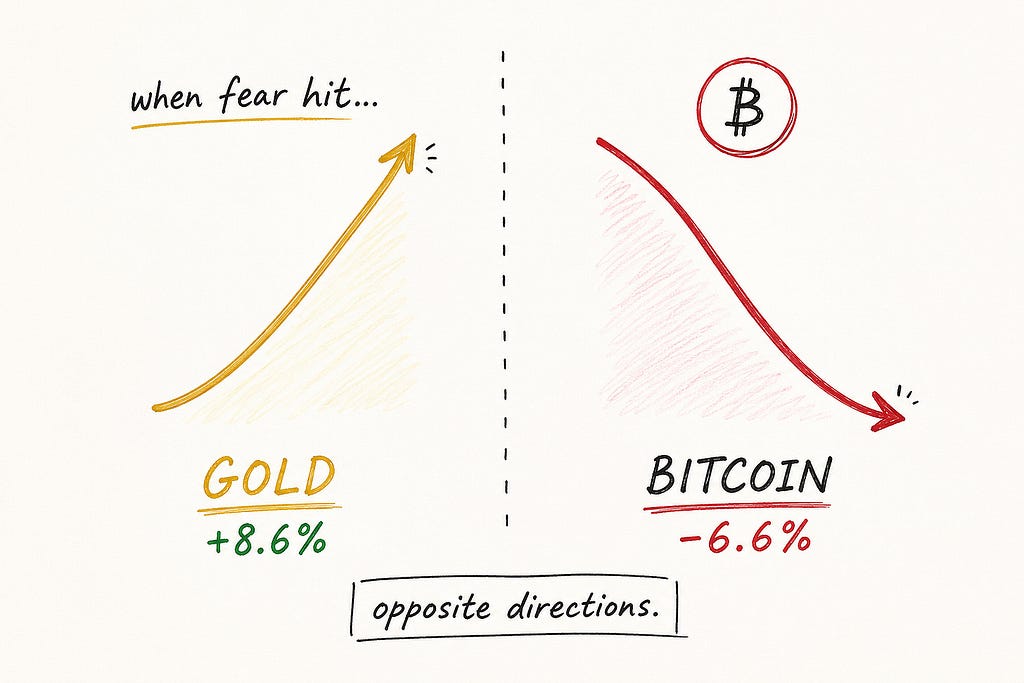
Late January. President Trump starts firing tariff threats at NATO allies and floating the idea of taking Greenland. Textbook fear moment exactly when a safe haven is supposed to shine.

So what did Bitcoin do?

It fell 6.6%. Gold rose 8.6%. They ran in opposite directions during the precise kind of chaos Bitcoin was built to survive.

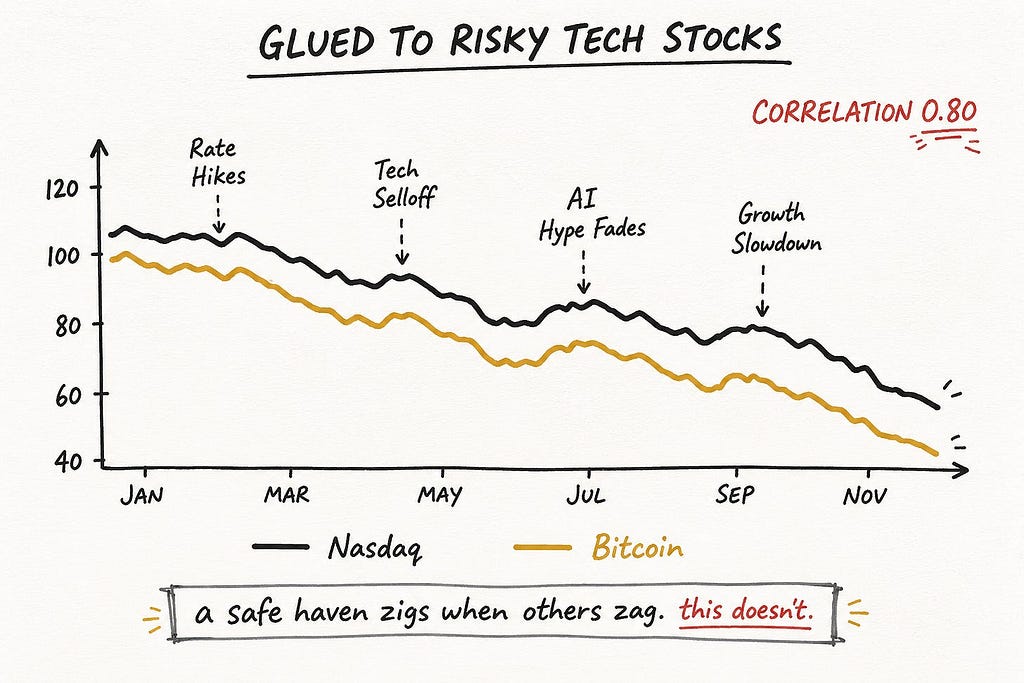
And it gets worse. That same month, the 30-day correlation between Bitcoin and the Nasdaq 100, the index stuffed with risky tech stocks hit 0.80. The tightest in almost four years.

Quick translation, because “0.80 correlation” means nothing until someone explains it. It basically means: when tech stocks sneeze, Bitcoin catches the cold. They move together — up together, down together, nearly in lockstep.

That is the exact opposite of a safe haven. A safe haven is supposed to zig when everything else zags. Bitcoin zigged when tech zigged, then crashed when tech crashed.

Meanwhile the boring old rock it was supposed to replace? Gold ripped past $5,600 an ounce, up 23% in a matter of weeks. And the biggest buyers werent nervous day traders. They were central banks. A record 45% of them, the highest reading in the history of the survey said they plan to buy more gold this year.

Sit with that for a second. The most powerful money managers on the planet had a straight choice between digital gold and actual gold.

They chose the rock.

Story one: cracked.

Story 2: the cash job that got stolen

Rewind to the very beginning. In 2008, a person or group nobody actually knows calling themselves Satoshi Nakamoto published a short paper. Its title described Bitcoin as a peer-to-peer electronic cash system.

Cash. Money you spend. That was the founding dream, send value to anyone, anywhere on earth, with no bank in the middle taking a cut and taking its time.

Now heres the brutal irony of 2026. That dream came true. Bitcoin just isnt the thing that made it happen.

Something else did. Stablecoins.

And this is the single most important idea in this whole piece, so let me make sure it lands even if youve never touched crypto in your life.

A stablecoin is a digital token pegged to a normal currency almost always the US dollar. One token is meant to always equal one dollar. It lives on a blockchain, so it moves like crypto: instantly, globally, around the clock, no weekends, no “please allow 3–5 business days.” But because its tied to the dollar, it doesnt lurch up and down like Bitcoin does. Its basically a dollar that learned how to teleport.

And people are using them. Not a little. A staggering amount.

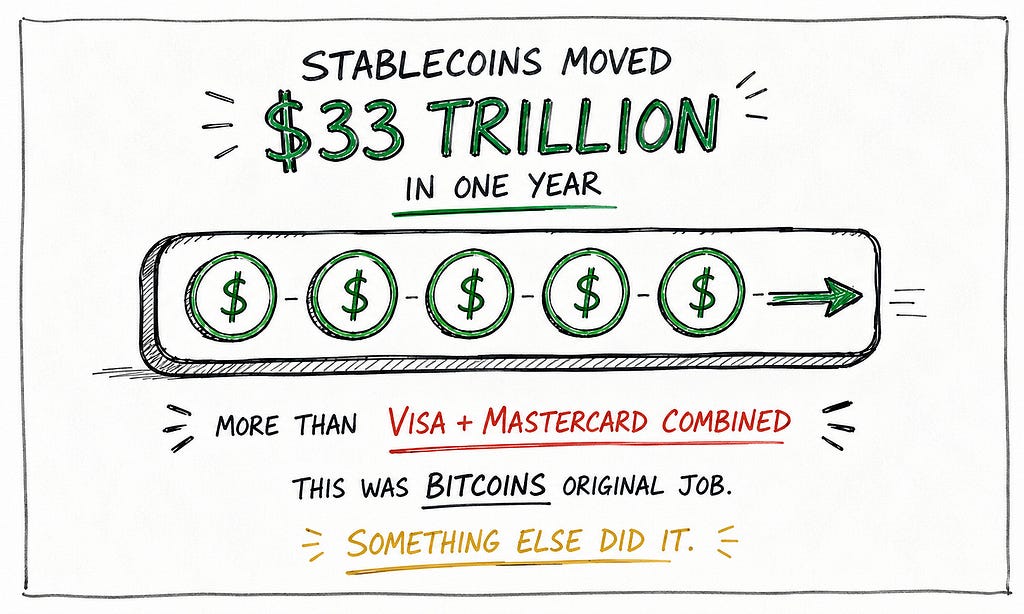
In February 2026, stablecoins did something that honestly should have been front-page news everywhere and somehow wasnt. In a single month they moved $7.2 trillion beating ACH, the decades-old plumbing behind American bank transfers, for the first time ever. Across all of 2025 they settled roughly $33 trillion. Thats more than Visa and Mastercard combined.

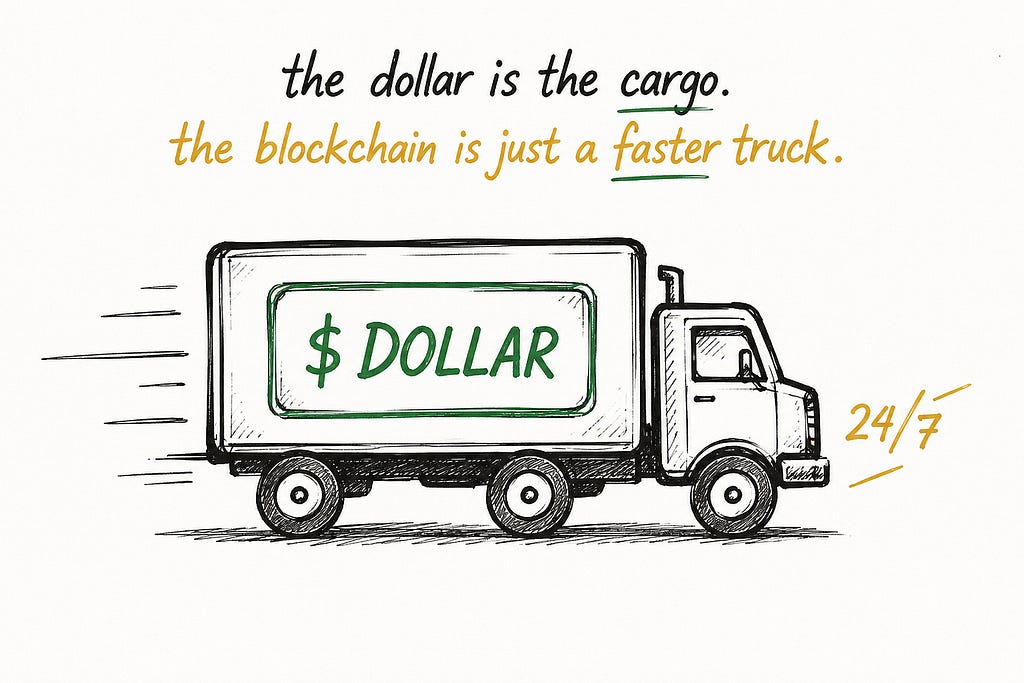
Heres the cleanest way I can put it. The dollar is the cargo. The blockchain is just a faster truck.

The world never actually wanted a brand new kind of money to spend. It wanted its existing money — dollars, the thing it already trusts to move at the speed of a text message. Stablecoins delivered exactly that. Bitcoin, swinging 5% on a random Tuesday, was never going to be the thing you buy groceries with in Buenos Aires or send home to family in Manila.

Story two: stolen, right out from under it.

Story 3: the frontier that moved on

For about a decade, if you were an investor who wanted a slice of “the future” the wild frontier, the thing your friends didnt understand yet and kind of mocked you for you bought Bitcoin. It was the frontier-technology trade. The rebel bet.

Then, in 2023, three letters walked into the room and took the entire table.

A.I.

By 2026, the frontier isnt crypto anymore. Its artificial intelligence. The money that used to chase “the next big technology” now chases chips and models and AI startups. Bitcoin went from being the daring outsider to being, lets be honest a ten-year-old asset your bank now sells you in a neat little ETF wrapper.

Nothing ages a frontier story faster than becoming mainstream. And nothing makes yesterday’s frontier look dull faster than a shiny new one moving in next door.

Story three: replaced.

The twist: the one story Bitcoin is quietly winning

Okay. Three stories cracked. So Bitcoin is finished, right? Pack it up, nothing to see?

No. And this is exactly where almost everyone bulls and bears both gets it wrong.

While those three narratives were falling apart, a fourth one quietly got stronger. Not “money you spend.” Not “safe haven for a scary Tuesday.” Something slower, heavier, and far less exciting to post about:

A reserve asset for governments.

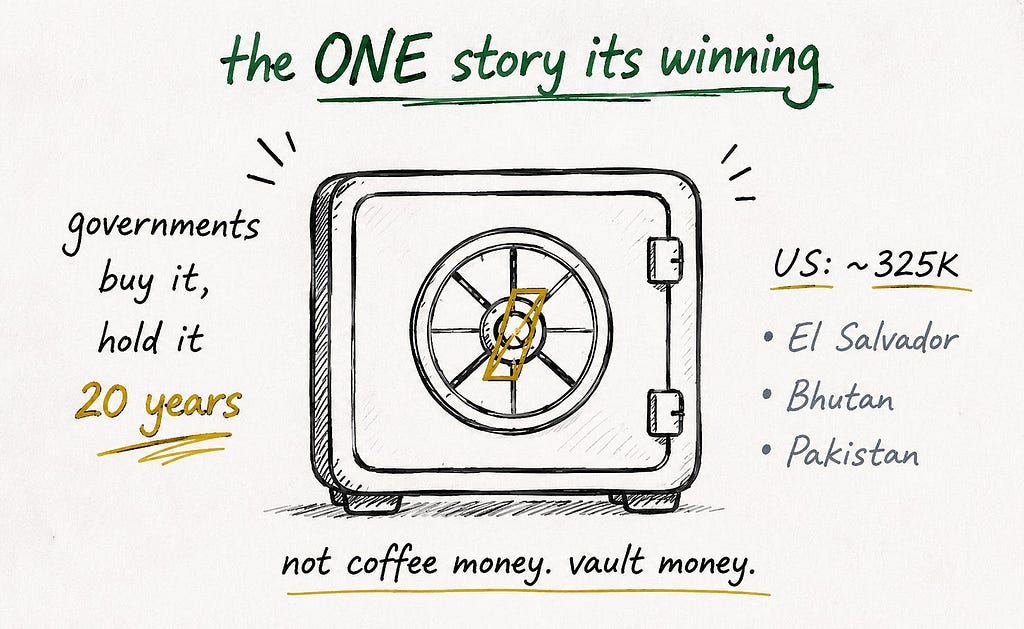
In March 2025, the United States created a Strategic Bitcoin Reserve. Today the US government sits on somewhere around 325,000 Bitcoin. El Salvador holds it as official national policy. Bhutan quietly mines it with hydro power off its mountains. Pakistan announced a reserve of its own.

Look at what all these buyers have in common. Theyre not trying to buy coffee. Theyre not trading in and out on a Tuesday afternoon. Theyre parking value for the long haul — the US reserve literally comes with a 20-year holding rule.

And that is a completely different story from the other three. Better yet, its the one job Bitcoin is genuinely good at: a scarce, hard-to-seize, borderless thing a country can hold when it doesnt fully trust the dollar or cant fully get access to it.

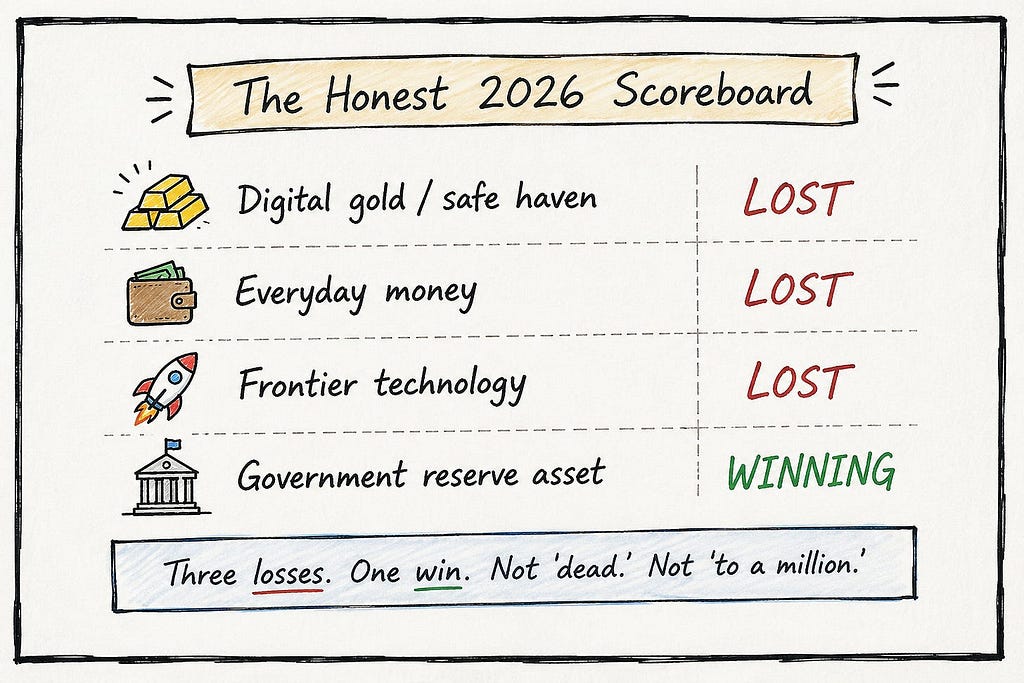
So the honest scoreboard for Bitcoin in 2026 looks like this:

Three losses. One win.

And yet the crowd keeps reacting to the price of the whole bundle screaming either “its dead” or “its going to a million” when the truthful answer is: it completely depends on which story youre talking about.

Zoom out: it was never one coin

Now step all the way back. Because this is where Naked Market actually lives not in the price, but in the structure humming underneath it.

For years, one tribe of Bitcoin believers held a very specific dream. One coin. One deflationary money. Bitcoin would swallow the dollar, the euro, the yen, and become the single money of the internet. One coin to rule them all.

2026 quietly put that dream to bed. But and this is the part that matters most it proved something far bigger true.

If youve been reading this newsletter for a while, you know the thread running through all of it: One Earth, One Currency. The idea that the world is slowly, structurally rebuilding money on shared, neutral, borderless rails. (New here? Start with this its the whole thesis in one place.)

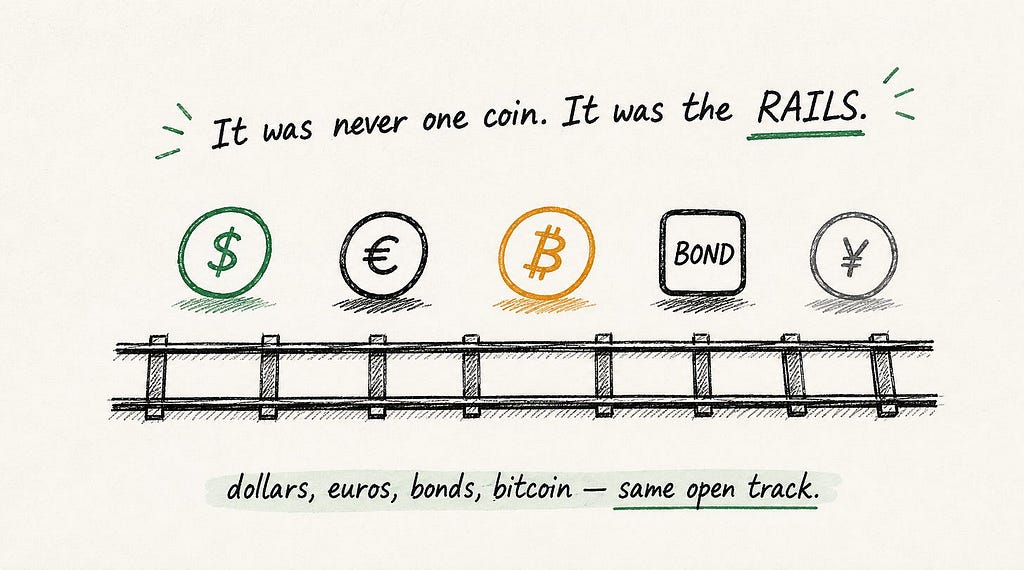
Heres what people keep misreading. “One Earth, One Currency” was never going to be one coin winning a cage match. Its shared rails winning. A common settlement layer that dollars can ride, that tokenized bonds can ride, that in time many national currencies can ride, all at once, all on the same open network.

Now look at what actually won in 2026. Not a single coin. The rails. Stablecoins moving $33 trillion isnt proof that “crypto beat the dollar.” Its proof that money itself is climbing onto blockchain infrastructure and the dollar simply got there first by hitching a ride.

So Bitcoin losing three of its four narratives isnt evidence against the future of digital money. Its the strongest evidence yet for what that future actually is. It was never one coin. It was always the rails.

Bitcoin is one passenger on those rails. An important one, with a real, permanent seat the “hard reserve” seat by the window. But it was never the whole train. The people in real pain right now are the ones who bet it was. (Thats the misconception that keeps costing people money.)

Your tool: The Narrative Ledger

So how do you avoid becoming one of those people? How do you look at any hyped asset or any dumped, left-for-dead one and actually see clearly, while everyone around you is either euphoric or terrified?

Heres the tool. Im calling it the Narrative Ledger. Take it with you. Its yours now.

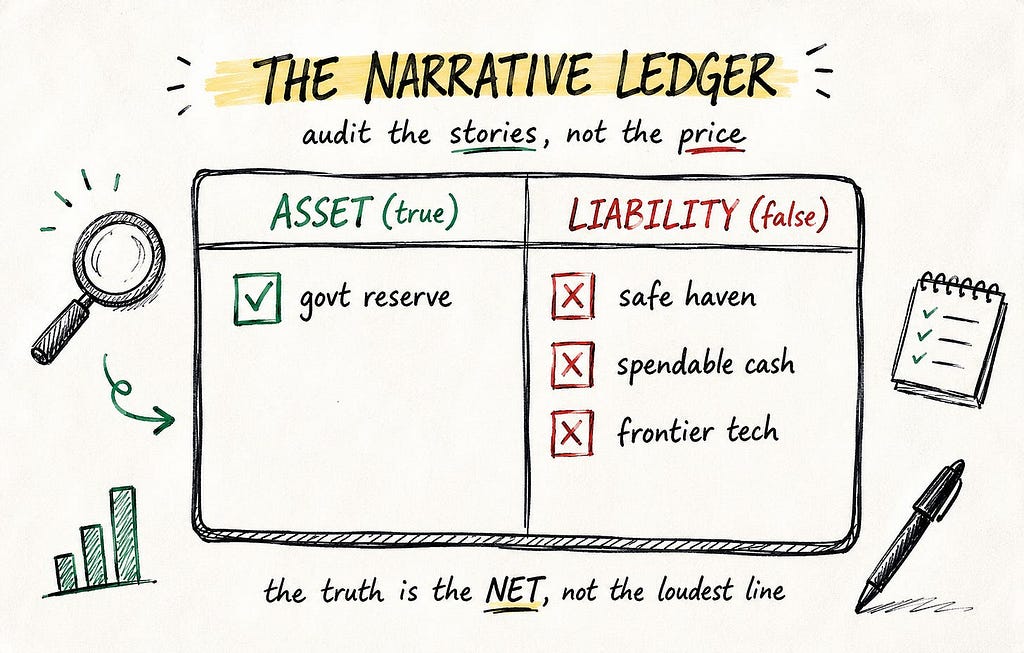
A ledger, in plain accounting terms, is just two columns: what you own (assets) and what you owe (liabilities). The Narrative Ledger does the exact same thing but for stories instead of money.

When you look at any asset, company, coin, or trend, dont ask the crowd’s lazy question (“is it going up or down?”). Ask a sharper one:

“Which of its stories is winning, and which is losing?”

KEEP THIS · THE NARRATIVE LEDGER

  1. List every story. Not the loudest one. All of them. (Bitcoin had four.)
  2. Write the evidence next to each. Real numbers, real behavior, real money flows. Not vibes, not headlines, not what a guy screamed on YouTube.
  3. Mark each one. Asset (evidence backs it up) or liability (evidence kills it).
  4. Read the net — never the loudest line.

Run Bitcoin through it and the fog burns off in about thirty seconds. Three liabilities, one asset. Not “dead.” Not “to the moon.” Just a specific thing thats quietly excellent at one job and has clearly lost three others.

And heres why this little tool is worth more than any price prediction youll ever read: it works on everything. Run it on an AI stock everyone swears is infinite. Run it on gold. Run it on the next coin your cousin promises is a 100x at the next family dinner. The crowd will always react to the whole. Youll read the lines.

Thats the entire game.

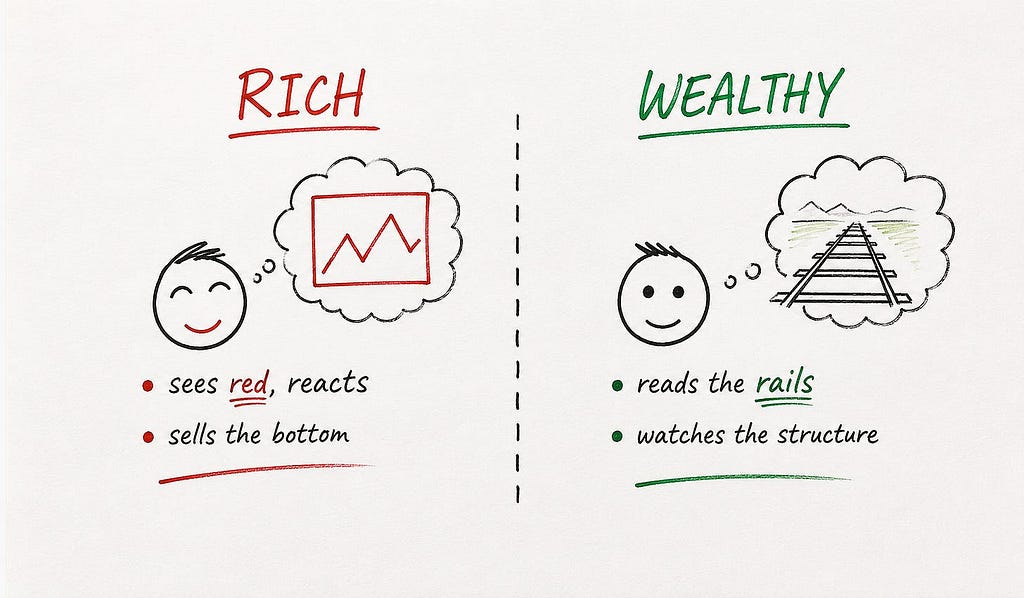
Rich reacts. Wealthy reads the rails.

Theres a difference between being rich and being wealthy, and it shows up right here, in exactly this kind of moment.

The rich person sees Bitcoin at $60,000, sees a screen full of red, feels the fear thick in the room and reacts. Sells at the bottom, or panic-buys the top, yanked around by whichever story is loudest that particular week.

The wealthy person doesnt look at the price first. They read the ledger. They notice that one quiet narrative got stronger while three noisy ones fell apart. And they understand that “Bitcoin” and “the future of money” were never the same sentence. They were watching the rails the entire time.

Bitcoin didnt lose the narrative. It lost three narratives, kept one, and in the process accidentally revealed what the real story was all along.

The rails are being laid. Right now, under all the noise. The only question that actually matters is whether youre reading them or reacting to them.

If you want to understand where money is heading before it gets obvious before the headlines, before the crowd, before your bank sends you that polite little email about its exciting new digital-asset product this is the place.
Subscribe to Naked Market

Well keep reading the rails together.

Keep going

Stablecoins: How a Casino Chip Became the Most Important Money on Earth

The New Rails: Blockchain as Infrastructure

Crypto Was Supposed to Escape the System

- More soon


Has Bitcoin Lost the Narrative? was originally published in Coinmonks on Medium, where people are continuing the conversation by highlighting and responding to this story.
Can AI Predict Bitcoin Bear Market Bottoms Better Than Humans? A Data-Driven Analysis

Predicting the exact bottom of a Bitcoin bear market has long been one of the greatest challenges for investors. Every major downturn is accompanied by widespread fear, conflicting expert opinions, and increasing market uncertainty. During the 2022 cryptocurrency crash, for example, several prominent analysts predicted that Bitcoin would fall below $10,000, while others believed the market had already reached its lowest point. In reality, Bitcoin bottomed near $15,742 before beginning its recovery.

This recurring pattern raises an important question: Can artificial intelligence (AI) identify Bitcoin bear market bottoms more accurately than experienced human investors?

Unlike humans, AI models are not influenced by fear, greed, or media narratives. Instead, they analyze vast amounts of historical price data, blockchain activity, trading volume, and market sentiment to identify patterns that may indicate when Bitcoin is approaching a market bottom. However, cryptocurrency markets are also shaped by unpredictable events such as exchange failures, regulatory decisions, pandemics, and geopolitical uncertainty — factors that even sophisticated AI models struggle to anticipate.

This article explores Bitcoin’s major bear markets over the past fifteen years, compares human predictions with AI-driven forecasting techniques, and evaluates whether machine learning can genuinely improve investors’ ability to identify market bottoms.

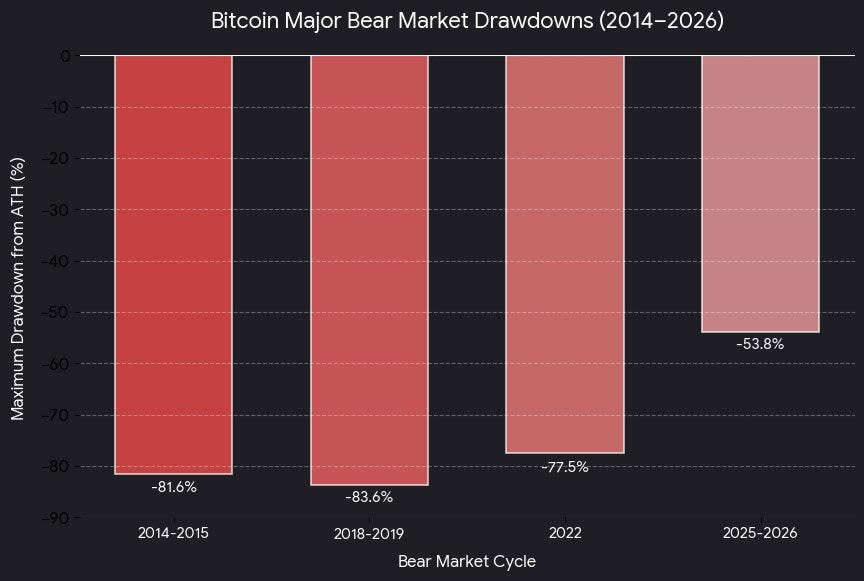
Bitcoin Bear Markets: A History of Extreme Volatility

Since its creation in 2009, Bitcoin has experienced multiple severe bear markets, each triggered by different economic or industry-specific events. While the causes varied, every cycle tested investor confidence and challenged analysts attempting to predict the market bottom.

Although Bitcoin’s volatility has gradually declined as the market matured, accurately identifying the bottom has remained remarkably difficult. Every bear market has been accompanied by pessimistic forecasts, many of which significantly underestimated Bitcoin’s long-term resilience.

Why Human Investors Struggle to Identify Market Bottoms

Human decision-making is rarely objective during financial crises. Behavioral finance research shows that investors often react emotionally during periods of uncertainty, allowing fear and panic to influence their decisions.

During Bitcoin bear markets, several psychological biases become particularly evident:

  • Loss Aversion: Investors fear additional losses and sell near the bottom.
  • Recency Bias: Recent price declines are assumed to continue indefinitely.
  • Confirmation Bias: Investors seek opinions that reinforce their bearish outlook.
  • Herd Behaviour: Market participants follow the crowd instead of analyzing data independently.

These biases were clearly visible during the 2022 cryptocurrency crash. As Bitcoin fell below $30,000, DoubleLine Capital CEO Jeffrey Gundlach suggested that prices could decline to $10,000, reflecting growing concerns about tightening monetary policy and liquidity risks. Similarly, Bloomberg Intelligence strategist Mike McGlone warned that structural weakness could push Bitcoin toward the same level.

More recent forecasts also illustrate the uncertainty surrounding market bottoms. Analyst Doctor Profit projected a cyclical bottom between $40,000 and $50,000, while on-chain analyst Leshka estimated a structural floor between $40,700 and $47,500, demonstrating that even experienced market participants often disagree significantly.

These examples highlight a fundamental limitation of human forecasting: investment decisions are influenced not only by market data but also by emotions, personal experience, and rapidly changing news cycles.

How Artificial Intelligence Approaches Market Bottom Prediction

Artificial intelligence takes a fundamentally different approach. Rather than relying on intuition or subjective interpretation, machine learning models analyze thousands of historical observations simultaneously to detect recurring market patterns.

Modern Bitcoin forecasting systems typically combine several categories of information:

  • Historical Bitcoin prices (Open, High, Low, Close)
  • Trading volume
  • Technical indicators
  • On-chain blockchain metrics
  • Market sentiment
  • Macroeconomic variables

Among the most widely used AI techniques are Long Short-Term Memory (LSTM) networks, XGBoost, ARIMA, Prophet, and hybrid deep-learning architectures.

Unlike traditional statistical models, deep learning algorithms are capable of identifying complex nonlinear relationships between multiple variables. For example, AI can simultaneously evaluate declining exchange reserves, improving network activity, increasing hash rate, and historically low valuation metrics to estimate whether Bitcoin may be entering an accumulation phase.

Your research also identifies several important blockchain indicators frequently incorporated into AI-based forecasting systems:

  • Market Value to Realized Value (MVRV)
  • Net Unrealized Profit/Loss (NUPL)
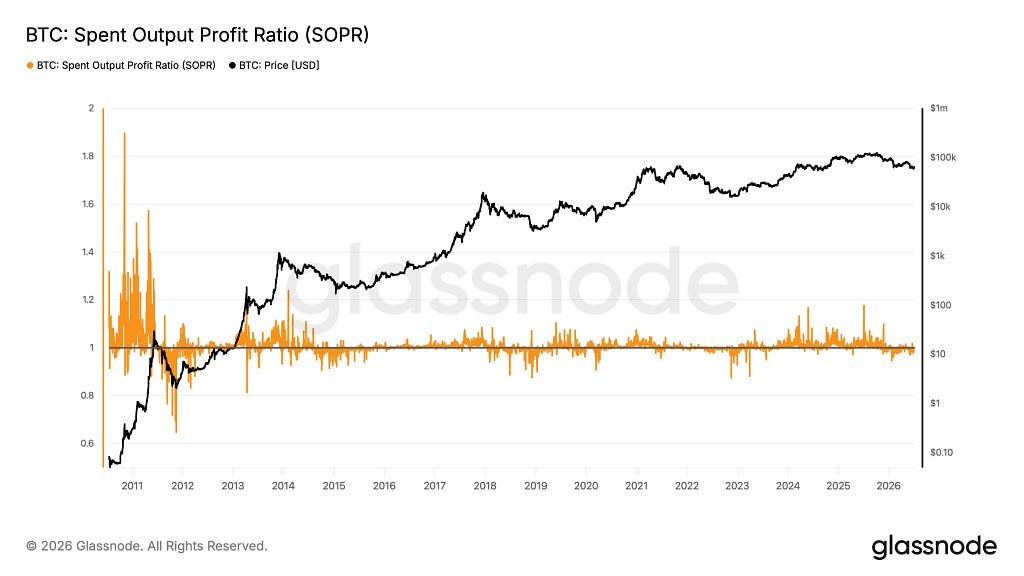
  • Spent Output Profit Ratio (SOPR)
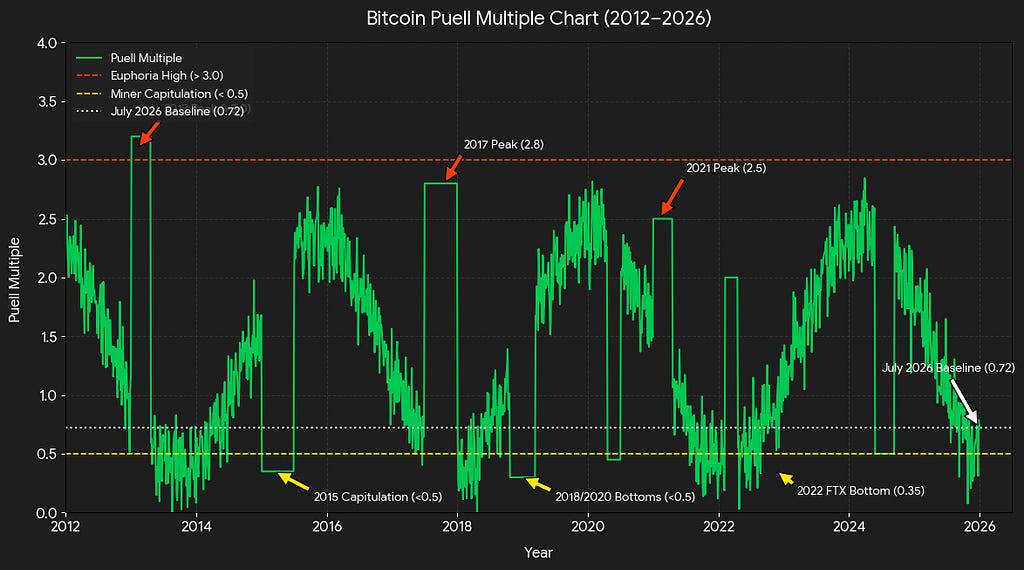
  • Puell Multiple
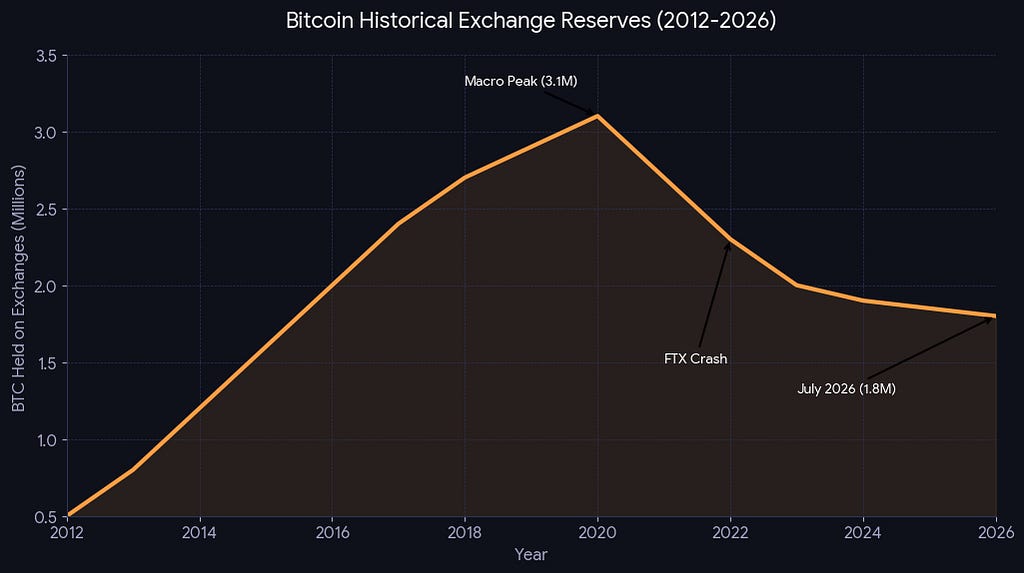
  • Exchange Reserves
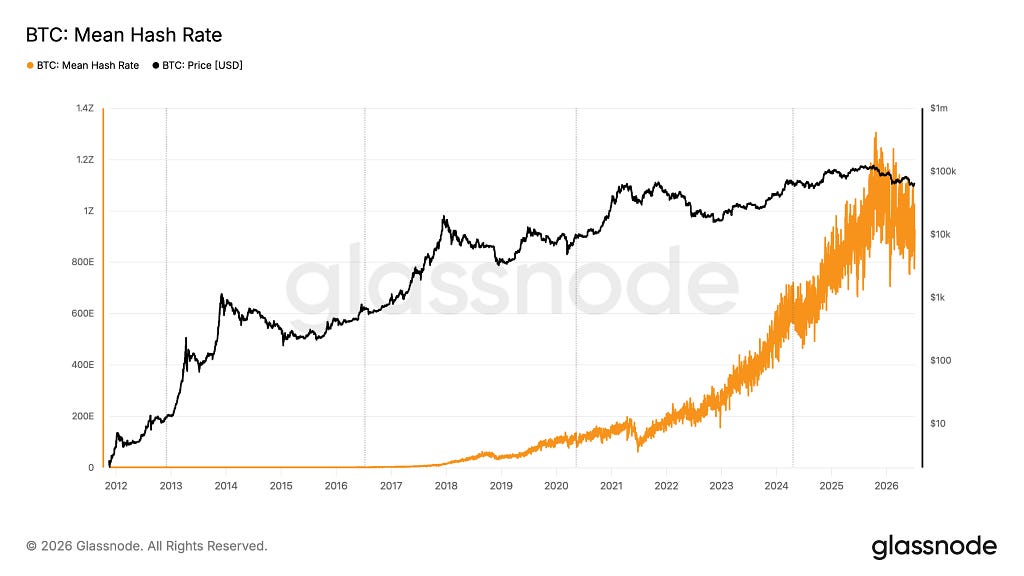
  • Bitcoin Hash Rate

These indicators provide information beyond simple price movements, enabling AI models to assess investor profitability, miner behavior, network security, and long-term market valuation.

Academic research further supports the growing role of AI in cryptocurrency forecasting. The two studies included in your research compare machine learning approaches such as LSTM, ARIMA, XGBoost, Prophet, and sentiment analysis, concluding that deep learning models generally outperform traditional statistical methods for short-term Bitcoin price prediction. However, these studies also acknowledge an important limitation: predicting the exact bottom of a bear market remains considerably more challenging than forecasting short-term price movements.

AI vs. Human Investors: Who Predicts Bitcoin Bottoms Better?

Although artificial intelligence has significantly improved financial forecasting, claiming that AI can consistently predict Bitcoin bear market bottoms better than humans would be misleading. Instead, the evidence suggests that both approaches possess unique strengths and limitations.

Human investors excel at interpreting qualitative information such as regulatory announcements, geopolitical developments, institutional adoption, and unexpected economic events. For example, experienced investors can assess the implications of Bitcoin ETF approvals or changes in central bank policy long before these factors are fully reflected in historical datasets. However, humans are also highly susceptible to emotional decision-making. Fear, greed, confirmation bias, and herd behavior often lead investors to panic sell near market bottoms or become overly optimistic near market peaks.

Artificial intelligence, in contrast, operates without emotional bias. Machine learning algorithms continuously process thousands of data points, identifying statistical relationships that would be difficult for humans to detect manually. By combining historical prices, blockchain metrics, trading volume, sentiment indicators, and macroeconomic variables, AI can recognize conditions that historically preceded Bitcoin recoveries.

However, AI has one significant weakness: it depends on historical data. When unprecedented events occur, such as the collapse of Mt. Gox, the COVID-19 pandemic, or the failure of FTX, AI models may struggle because these events have few historical precedents. Human judgment remains valuable in interpreting such extraordinary circumstances, where contextual understanding is often more important than pattern recognition.

What Do On-Chain Metrics Reveal?

One of AI’s greatest advantages is its ability to integrate multiple blockchain indicators simultaneously instead of relying solely on price action.

The on-chain metrics collected for this study including MVRV, NUPL, SOPR, Puell Multiple, Exchange Reserves, and Hash Rate have historically provided valuable insights into Bitcoin market cycles.

Several recurring patterns emerge across previous bear markets:

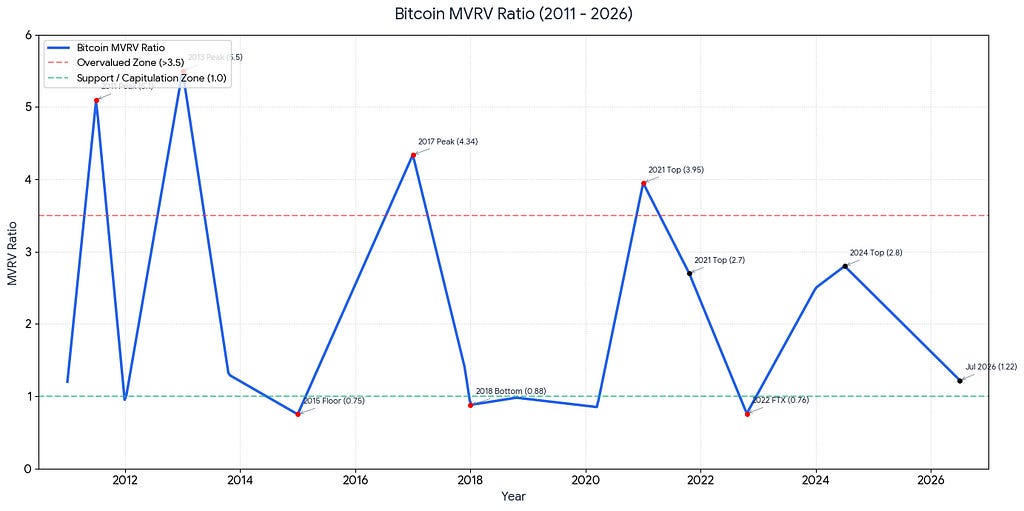
MVRV Ratio: Historically, values below their long-term average have coincided with periods where Bitcoin was significantly undervalued. AI models frequently use this metric to identify potential accumulation zones rather than precise market bottoms.

MVRV Ratio

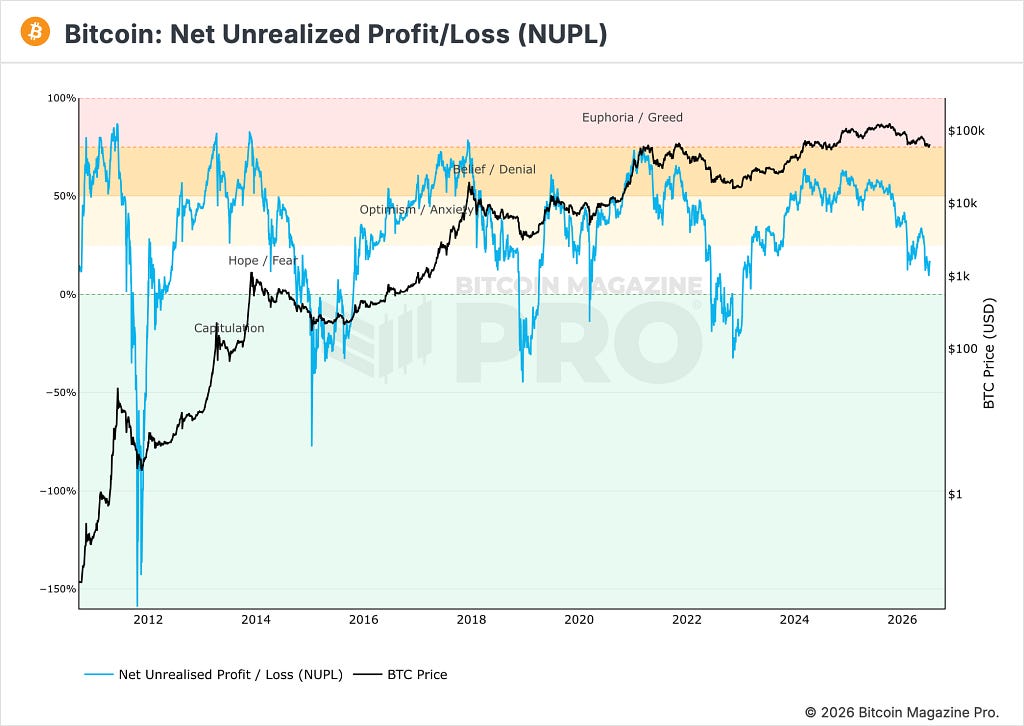
NUPL (Net Unrealized Profit/Loss): When market sentiment shifts toward capitulation, NUPL typically enters historically depressed levels, reflecting widespread investor losses and pessimism.

NPUL Chart

SOPR (Spent Output Profit Ratio): During bear markets, SOPR often falls below one, indicating that investors are selling coins at a loss. Sustained recovery above this threshold has historically signaled improving market conditions.

Puell Multiple: This indicator evaluates miner profitability. Extremely low values have frequently appeared near previous Bitcoin cycle bottoms, suggesting periods of miner capitulation.

Exchange Reserves: Declining Bitcoin balances on exchanges generally indicate that investors are moving coins into long-term storage rather than preparing to sell, reducing immediate selling pressure.

Hash Rate: Despite severe price declines, Bitcoin’s hash rate has generally continued to recover over time, reflecting long-term confidence among miners and strengthening network security.

Hash Rate

Individually, these indicators cannot identify the exact bottom. However, AI models gain a significant advantage by evaluating them together, recognizing combinations of signals that have historically preceded market recoveries.

Lessons for Investors

The evidence suggests several important lessons.

  • Predicting the exact bottom remains extremely difficult.
  • Human investors frequently make emotional decisions.
  • AI provides objective, data-driven insights but cannot predict unprecedented events.
  • Combining AI with disciplined investment strategies such as Dollar-Cost Averaging (DCA) is often more effective than relying solely on intuition.

Conclusion

Bitcoin’s history demonstrates that neither humans nor AI can consistently predict the exact bottom of every bear market. Human investors possess contextual understanding and adaptability but are susceptible to emotional biases. Artificial Intelligence excels at processing enormous datasets and identifying historical market patterns, yet it remains constrained by the quality of historical information and struggles with black swan events.

Therefore, AI should not be viewed as a replacement for human judgment but rather as a powerful decision-support tool. Investors who combine AI-driven analytics with sound risk management and long-term discipline are better positioned to navigate Bitcoin’s volatile market cycles.


Can AI Predict Bitcoin Bear Market Bottoms Better Than Humans? A Data-Driven Analysis was originally published in Coinmonks on Medium, where people are continuing the conversation by highlighting and responding to this story.
❌