
Reading view

There are new articles available, click to refresh the page.

Top Next.js DevelopmentWhy Top Next.js Development Companies Are Leading the AI Web Era
Same content workflow. Let me confirm what versions of Next.js are available and what features are available for AI to help you, and then I can re-use the grounding from the 2026 enterprise-AI that I previously gave.To emphasize the angle of “AI web era”, let me confirm the specifics of Next.js for AI:To emphasize the “AI web era” angle, let me lay out the specs of Next.js for AI:The current generation is Verified — Next.js 15/16 with App Router and React Server Components, and the streaming + Vercel AI SDK story is the “AI web era” hook. Here is the blog, and here is the blog with all the 2026 statistics attributed to named sources for AEO credibility, with plain text for your CMS.

Why Top Next.js Development Companies Are Leading the AI Web Era

AI is integrating into the Web. Chat interfaces, streaming responses and in-app agents are no longer a novelty but a standard feature of the product. They need to be built in a way that’s server-first and real-time output and that framework is Next.js. That makes the role of the top Next.js development companies so central in the realm of modern AI product work, and it’s exactly these streaming interfaces with agents that were hard for previous web stacks to ship.

This guide will walk through the fundamentals of Next.js and the trends fueling the demand for specialized Next.js development companies to build for the AI web era in 2026.

What is Next.js Development Services?

Next.js development services involve designing, developing, and maintaining web applications using Next.js, a React-based framework for server-rendered and full-stack applications. This includes architecture, App Router configuration, server components, API and database integration, performance optimization, and AI feature development and deployment.

Today, these services go well beyond marketing sites. With Next.js, teams can run dashboards, SaaS platforms, e-commerce storefronts, and AI products like chat assistants and agent-driven applications from a single code base that manages everything from the front to the back. Why Next.js is the framework of the AI Web era? Essentially, Next.js’ architecture fits the bill for AI-driven web applications, where servers need to run code, output needs to stream rapidly, and the entire application stack relies on a single codebase. With Next.js 15 and the upcoming 16 line, the server-first philosophy is the norm with the App Router and React Server Components.

To streamline how LLM works.

Large language models generate text in a stream of text tokens, which you can see as your wait. Old request and response pattern requires users to wait 5–15 seconds for a spinner to appear and then for them to see what you have to offer (depending on the length of the prompt and model), and then wait again for a response. Next.js does that with native streaming and React Suspense, streaming output tokens to the user’s browser as the model generates them, so the user is able to see output in the first network round-trip. When the route is along the edge, the first token is given to the user from the closest point, resulting in the user feeling the AI’s features as if they were happening in real time.

Server Components keep AI Logic secure and fast.

React Server Components execute on the server, pass no JavaScript to the client, and can directly call databases and APIs. This is especially significant for AI products. Server Components allow for server-side AI logic and provider keys, without sending them to the browser, and server actions reduce mutations to simple function calls. The outcome is a quicker and safer architecture without revealing model credentials or prompting logic to the end user.

All the Server Actions and First-Class Vercel AI SDK Support.

The Vercel AI SDK has shortened the road from idea to AI-enabled functional app with Next.js. The server parts, streaming support and first class integration with LLM SDKs accelerate LLM-powered feature creation, and hooks such as useChat and useCompletion manage conversation state and stream consumption on the client side. The SDK also offers a consistent interface to the top model providers such as Anthropic, OpenAI and Google and allows teams to move to a different provider without having to rewrite application logic. The new release introduces agent loop primitives and support for MCP, which finally bring Next.js into the agentic world.

An added SEO and AEO Advantage

There’s an upside for content-driven and commerce sites to use Next.js: Server-first rendering is good for crawlability, page speed, and Core Web Vitals. When Google AI Overviews, ChatGPT Browse and Perplexity determine what to surface, pages that are server-rendered, load quickly and show clean content provide more to work with for AI answer engines. There is no performance vs discoverability here, as it is actually in the same architecture.

In 2026, several trends are shaping the future of Next.js Development Companies.Several trends are influencing the future of Next.js Development Companies in 2026.

That’s why Next.js specialist development companies are so sought-after. Adoption metrics are starting to show the trend towards AI-native products. AI is now stepping onto the product interface, as Agentic AI does. The key AI narrative of 2026 is about agents who plan and act, rather than simply respond. Gartner projects that by the end of 2026, 40% of enterprise applications will incorporate task-specific AI agents, up from less than 5% in 2025, and the market for AI agents worldwide will be about $9.9 billion and accelerating by more than 40% per year. These agents require a web layer with the ability to deliver multi-step reasoning, real-time tool output, and proper state management — and that’s where Next.js and the AI SDK come in.

There is a growing trend of automation in multi-step workflows.Increasing automation is taking place in multi-step workflows.

With earlier automation, single tasks were being automated. Now agent loops coordinate multiple steps across systems, invoking tools, gathering information and taking action based on the results. These flows on the web require streaming UI, server-side orchestration, and reliable handling of errors, and the Next.js App Router and server actions provide for that without any additional infrastructure.

The adoption of enterprise drives the engineering bar to new heights.

AI is all over the place in enterprises, on paper. Although 88% of firms employ AI in a business function, only fewer than 10% have scaled agentic systems to generate real value.While 88% of organizations are using AI in at least one business function, fewer than 10% have scaled the agentic systems to deliver real value, according to McKinsey. The gap is seldom in the model, it is production engineering. There are few companies that can develop secure, fast and stable AI web apps and that aspect makes valuable Next.js development companies valuable right now.

Top Next.js Development Companies make a difference in the following ways

There are many agencies that have Next.js in their stack. There are a few common characteristics of the ones that are leading the AI Web revolution that are worth noting:

In contrast, they don’t stick with the Pages Router, which is in maintenance mode, but are opting for the App Router and Server Components. Streaming and Suspense aren’t fringe cases for them. They’ve included actual AI capabilities with the Vercel AI SDK, with correct tool calling, structured output, and fallback to providers. They know how to work with caching, one of the truly challenging aspects of the App Router, and they plan for Core Web Vitals first, not trying to add them on later. Most importantly, they are deploying senior engineers into the actual build, meaning that the engineers that scope your project are the ones that are writing your code.

How to Choose and Hire the Right Next.js Development Company

Check any Next.js development company with these decision factors before you sign up:

Fluency with App Router/Server. Inquire on how they determine what to call server and client. If you don’t know the answer, say so.

Successful feature work in AI. Ask for some real-world examples of streaming chat, agent flows, or LLM integrations they have deployed in production.

Track record of performance and SEO. Focus on measurable Core Web Vitals metrics as this will affect both rankings and visibility by AI answer engines.

Maturity of architecture and caching. The App Router benefits teams that have the knowledge of its caching model and punishes teams who don’t.

Security discipline. Ensure that model keys and secrets remain on the server and sensitive logic remains in the model.

Senior talent for your account. Confirm builder after signing a contract.

Communication and overlap. Responsiveness and time-zone fit keep AI projects, which iterate fast, on schedule.

Once you’re ready to shop vendors, a short-list aids you save weeks of evaluation. We’ve broken down the best Next.js development companies based on their unique strengths, niche industry specializations and best project size for you to match the ideal partner with your product rather than wading through generic agency lists. You can start from a verified list of Next.js development companies or hire Next.js developers to augment your in-house team to quickly land on a solid decision.

Frequently Asked Questions

What is a Next.js development company?

Next.js development company designs, builds and maintains web applications using the Next.js framework. It can be used for SaaS apps, e-commerce sites, dashboards and AI products with services like App Router architecture, server components, full-stack development, API development, performance optimization and deployment.

Why is Next.js a good platform for building AI apps?

Next.js is an ideal platform for AI applications due to its ability to stream responses, execute server-side code ensuring key security for the models, and integration with the Vercel AI SDK. These can be used to create fast, responsive, chat and agent interfaces from a single, full-stack codebase.

Do I need to choose the App Router or Pages Router in 2026?

Use App Router for any new project 2026. It’s the default direction of Next.js, is compatible with React Server Components and streaming, and is updated with all new features of the framework. The Pages Router is stable and in maintenance mode, and is most applicable for existing code bases.

How to find the right Nextjs developers?

Search for developers that have shipped AI features, are fluent in App Router and Server Components, and have a good understanding of caching, security, and Core Web Vitals. Look for teams that have senior engineers working on your build and have good communication throughout the project.

What is the cost of Next.js development services?

The cost varies based on the project’s scope, complexity of the AI, and the engagement model. Streaming and Agent features are not available on simple sites, and they cost much less. The more significant cost driver is engineering quality: if your Next.js app is well-architected, it will not have to be reworked to cut costs in the long-term.

Should AI-based products be built with Next.js instead of React?

Yes, for most AI web products. Plain React is the UI; you’ve got to put together rendering, routing, server logic, and streaming yourself. These are built into Next.js, making it the most popular framework for building AI production apps.

The AI web era is touted for the ability to deliver fast, secure, streaming experiences without tension between teams and their tooling, and Next.js has emerged as the framework that enables that. Having a Next.js development company that operates in the App Router, already uses real AI features in production and employs senior engineers on your project makes all the difference between a product with AI that feels instant and one that feels like a spinning wheel. Talk to a couple of well-tested experts, evaluate them against what’s listed above and do one well-scoped build to test the partnership before scaling up.


Top Next.js DevelopmentWhy Top Next.js Development Companies Are Leading the AI Web Era was originally published in Coinmonks on Medium, where people are continuing the conversation by highlighting and responding to this story.

Crypto Marketing Strategies for 2026: Build Trust, Adoption and Web3 Communities

Crypto Marketing Strategies for 2026: How Web3 Brands Can Build Trust, Drive Adoption, and Scale Communities

Creation by Vimal Joseph Using Flow and Photoshop

Crypto marketing strategies for 2026 need sharper execution than the last market cycle allowed. The sector has moved beyond hype-led launches, vanity communities, and short-term token attention. Buyers now ask harder questions. Investors expect proof. Users want security, utility, and a reason to stay.

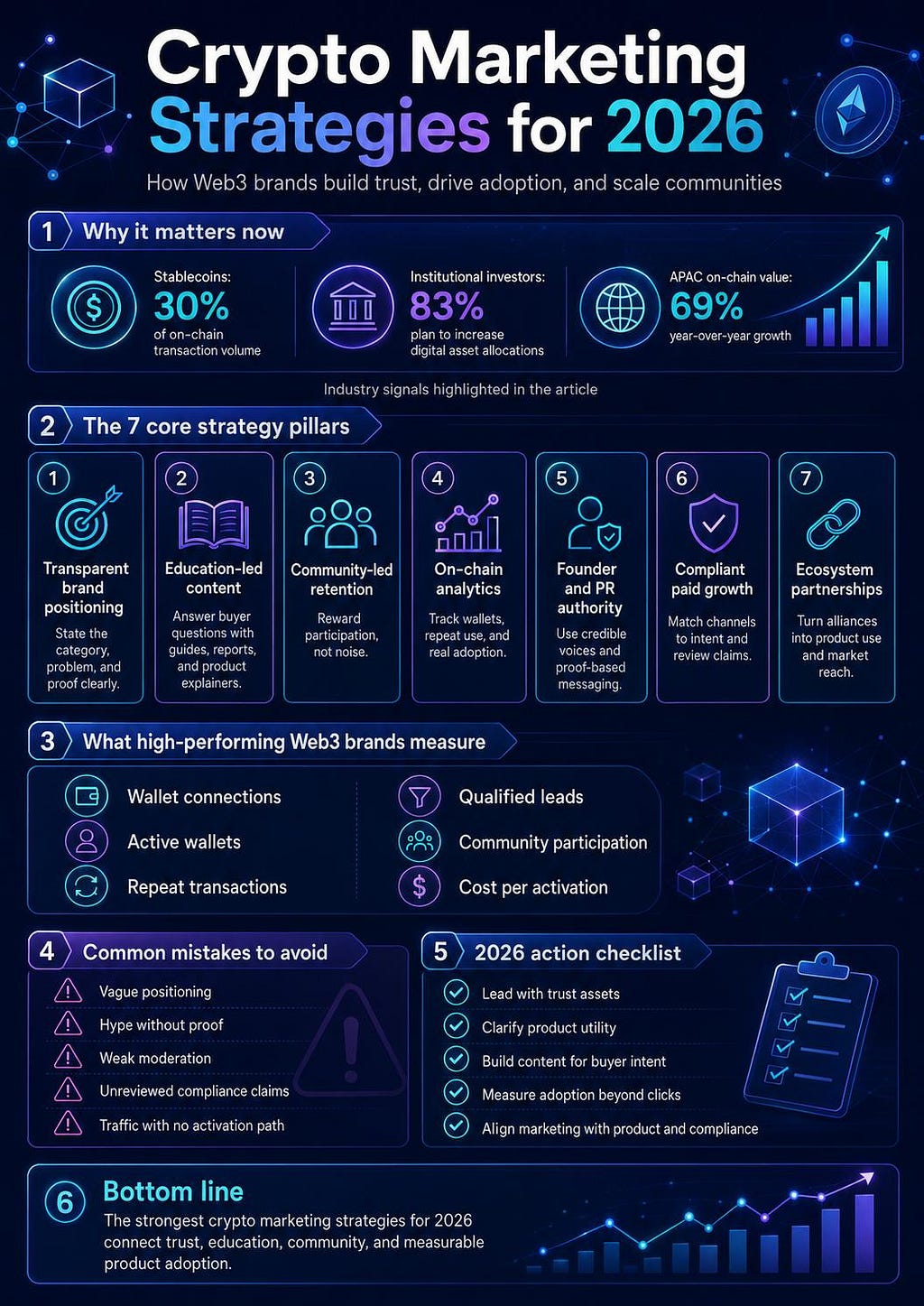
The timing matters. Statista expects cryptocurrency users to reach about 795.87 million by 2027, with user penetration at 9.90% in 2026. Chainalysis ranked India, the United States, Pakistan, Vietnam, and Brazil among the top crypto adoption markets in 2025. The same report recorded 69% year-over-year growth in APAC on-chain value received.

Stablecoins, tokenization, and institutional participation now push Web3 into more business use cases. TRM Labs reported that stablecoins made up 30% of all on-chain crypto transaction volume, with more than USD 4 trillion in stablecoin volume from January to July 2025. EY found that 83% of surveyed institutional investors planned to increase digital asset allocations in 2025.

The message is clear: attention is not enough. Trust, adoption, and community depth now decide which Web3 brands grow.

Why Crypto Marketing Has Changed

Web3 buyers are more informed than they were in 2021. They compare token utility, treasury health, audits, roadmap progress, team credibility, liquidity plans, and compliance posture. A polished website alone cannot carry a crypto brand in 2026.

Enterprise demand has also shifted. Deloitte reported that stablecoin transaction volumes reached USD 33 trillion in 2025 and may reach USD 56 trillion by 2030. It also noted cross-border settlement cost reductions from around USD 2,000 on a USD 100,000 transfer to below USD 100 in some cases.

Competitive pressure has grown. Reuters reported that a consortium including Visa, Mastercard, Coinbase, and more than 140 businesses launched Open Standard to support a new dollar-pegged stablecoin. This shows how large payment, finance, and technology players now compete inside the same trust economy as crypto-native firms.

One message defines the 2026 market: Web3 brands must earn belief before they ask for action.

What Makes Crypto Marketing Strategies for 2026 Different?

Crypto marketing strategies for 2026 must connect trust, product use, and community growth. The old playbook pushed announcements, influencer posts, airdrops, and exchange chatter. The new playbook links every campaign to proof.

Decision-makers need marketing that supports sales, adoption, retention, and investor confidence.

Trust Comes Before Reach

Trust is now a growth asset. Brands need clear founder profiles, public documentation, security audits, treasury updates, token terms, and product demos.

A project with fewer followers but clearer proof can beat a louder project with vague claims.

Utility Beats Speculation

Users want to know what the product does. A DeFi app should explain yield mechanics, risks, fees, and custody. A gaming project should show gameplay, economy design, and retention plans. A tokenized asset platform should explain legal rights, redemption terms, and reporting.

Marketing should turn complex product value into clear buying logic.

Compliance Shapes Brand Perception

Compliance is no longer a back-office concern. It affects messaging, paid media, partnerships, listings, and user onboarding. Claims about returns, staking, rewards, and token value need review before campaigns go live.

A crypto brand that markets responsibly protects both users and long-term enterprise value.

Community Quality Matters More Than Size

A 200,000-member Telegram group means little if users do not ask product questions, join tests, refer peers, or support governance. Community health needs better metrics.

Track active contributors, product testers, governance voters, wallet-connected users, and repeat participants.

Creation by Vimal Joseph Using Flow and Photoshop

Build Trust With Transparent Brand Positioning

Trust is the first layer of Web3 marketing. Decision-makers should treat brand positioning as a risk-control function, not just a creative exercise.

Clear positioning reduces doubt, speeds buyer evaluation, and supports investor conversations.

Define the Category Clearly

Do not let users guess what the company does. State the category in plain terms: DeFi lending protocol, RWA tokenization platform, crypto payment gateway, NFT gaming marketplace, wallet infrastructure, or Layer 2 scaling network.

A clear category helps search engines, AI answer engines, investors, and buyers understand the brand faster.

Explain the Business Problem

Strong crypto brands do not start with token mechanics. They start with the business problem.

Examples:

  • Cross-border payments are slow and costly.
  • Loyalty programs lack portability.
  • Private market access is limited.
  • Digital ownership lacks proof.
  • Game economies lose user trust.

Then connect the Web3 product to the problem.

Show Proof Early

Proof should appear across the website, pitch deck, docs, community channels, and content hub.

Useful proof includes:

  • Audit status
  • Team experience
  • Partner names
  • User activity
  • Protocol revenue
  • Testnet data
  • Wallet growth
  • Case studies
  • Governance records

A trust-first brand reduces friction before a sales call starts.

Avoid Empty Claims

Words like “future of finance” and “next-gen Web3” do not help decision-makers. Replace them with facts. State what the product does, who it serves, how it works, and what users need to evaluate.

Credibility grows when claims stay specific.

Drive Adoption With Education-Led Content

Crypto buyers often need education before conversion. Product pages, blogs, guides, reports, and explainers should guide users from awareness to action.

Content should answer real buyer questions, not chase broad traffic alone.

Build Topic Clusters Around Buyer Intent

A Web3 brand should create content around high-intent questions.

Examples:

  • How does stablecoin settlement work for businesses?
  • What should a token launch include?
  • How do smart contract audits reduce risk?
  • What is the cost of building a crypto exchange?
  • How can brands use NFTs for loyalty?

Each cluster should link to service pages, product pages, case studies, and contact paths.

Write for Search and AI Answers

Search results now include snippets and AI-generated answers. Content should include concise answers under headings.

Use headings such as:

  • What is crypto community marketing?
  • How do Web3 brands build trust?
  • What is the best crypto user acquisition channel?
  • How much does crypto marketing cost?
  • What risks should founders plan for?

Direct answers help both users and answer engines.

Create Content for Different Stakeholders

A founder, CFO, CTO, legal head, and product leader will not read the same way. Build content for each role.

Founders need market entry plans. Product leaders need adoption data. CTOs need technical clarity. Legal teams need risk notes. CFOs need cost and ROI signals.

Better segmentation makes content more useful.

Turn Documentation Into Marketing Assets

Docs are not only for developers. They can build trust with partners and enterprise buyers. Create readable guides from technical documentation.

Examples:

  • API integration guide
  • Smart contract architecture overview
  • Tokenomics explainer
  • Compliance readiness guide
  • Wallet onboarding manual

Strong documentation shows operational maturity.

Use Community Marketing to Build Retention

Community is one of the strongest Web3 growth channels. It also becomes a weakness if it turns into noise, speculation, or support overload.

The goal is not just to gather members. The goal is to create informed participants.

Segment Community Members

Treat users by role and intent.

Useful segments include:

  • Investors
  • Developers
  • Validators
  • Traders
  • Gamers
  • Creators
  • Enterprise buyers
  • Ambassadors
  • Governance participants

Each group needs different content, access, and support.

Create Participation Loops

Communities grow when members have clear ways to contribute. Give users roles that match the product.

Examples:

  • Test new features
  • Report bugs
  • Vote on proposals
  • Create tutorials
  • Translate content
  • Host local events
  • Refer qualified users
  • Join beta programs

Participation builds ownership.

Set Clear Moderation Rules

Trust breaks fast in open channels. Set rules for spam, scams, fake admins, price manipulation, impersonation, and support requests.

Pin official links. Publish admin lists. Train moderators. Use separate support channels for technical issues.

Community safety is brand safety.

Reward Useful Behavior

Reward contribution, not noise. Airdrops that reward empty engagement attract farmers. Programs that reward testing, education, referrals, and governance bring better users.

Design rewards around product value.

Use On-Chain Data for Smarter Growth

On-chain data gives crypto marketers a rare advantage. It shows wallet activity, transaction patterns, retention, liquidity behavior, and protocol engagement.

This turns marketing from guesswork into evidence-led growth.

Track Wallet-Based Behavior

Useful metrics include:

  • New active wallets
  • Repeat transactions
  • Transaction value
  • Wallet retention
  • Governance participation
  • Liquidity depth
  • Bridge activity
  • Staking activity
  • NFT holder behavior

These metrics connect campaigns to real use.

Build Better Audience Segments

Wallet data can help identify high-value users. A DeFi protocol can segment liquidity providers, active traders, dormant users, and governance voters. A gaming project can segment NFT holders, marketplace traders, and beta players.

Campaigns become more relevant when audience behavior is clear.

Measure Beyond Clicks

Web3 growth teams should track wallet connection, first transaction, repeat use, referral quality, and community participation.

A campaign that drives 10,000 clicks but no wallet activity has weak business value.

Protect User Privacy

On-chain targeting needs care. Brands should avoid invasive messaging and unclear data practices. Give users simple privacy information. Respect regional rules on data, marketing consent, and financial promotion.

Smart data use builds trust. Poor data use creates risk.

Strengthen PR, Influencer, and Founder-Led Authority

Web3 brands need credible voices. PR and influencer marketing still matter, but low-quality promotion damages trust.

Authority comes from expertise, proof, and consistent public communication.

Use PR for Proof, Not Hype

Good PR supports market education, partnerships, funding news, product launches, research, and customer stories. It should explain why the news matters.

A funding announcement should connect capital to product growth. A partnership announcement should explain the user benefit.

Choose Influencers With Audience Fit

Follower count is a weak metric. Review audience quality, past sponsors, comments, content depth, and reputation.

For B2B Web3, analysts, developers, niche creators, founders, and research-led voices often outperform broad crypto promoters.

Build Founder Visibility

Founders should publish clear views on market shifts, product choices, regulation, user trust, and adoption. This helps buyers judge competence.

Useful formats include:

  • LinkedIn posts
  • X threads
  • Podcast interviews
  • Technical explainers
  • Product memos
  • Event talks

Founder-led content gives the brand a human source of authority.

Prepare for Reputation Risk

Crypto moves fast. Teams need ready responses for hacks, delays, listing issues, governance disputes, and market rumors.

Create crisis templates before problems appear. Name response owners. Publish facts fast. Do not overstate what is known.

Plan Paid Growth With Compliance and Funnel Control

Paid campaigns can work in crypto, but restrictions are tighter than in many sectors. Channels review claims, landing pages, financial language, and regional targeting.

Paid growth should support a clear funnel.

Match Channels to Intent

Use search ads for high-intent users. Use social ads for education and retargeting. Use newsletters for niche Web3 audiences. Use sponsorships for developer or investor reach.

Do not push the same message across all channels.

Build Landing Pages for Conversion

Each campaign needs a focused landing page. The page should match the ad promise, explain the offer, present proof, answer risk questions, and give one clear action.

For enterprise Web3, that action may be booking a demo, downloading a report, joining a pilot, or requesting a quote.

Review Claims Before Launch

Avoid careless claims around profit, yield, future token value, passive income, or guaranteed returns. Get legal review for regulated markets.

Marketing language should stay clear, factual, and defensible.

Track Cost by Funnel Stage

Measure cost per qualified lead, wallet connection, demo request, user activation, community member, and repeat user.

Traffic cost alone does not show growth quality.

Scale Communities Through Ecosystem Partnerships

Web3 growth rarely happens in isolation. Partnerships can help crypto brands gain credibility, reach users, and connect with active ecosystems.

The best partnerships create product use, not just announcement value.

Partner With Chains and Infrastructure Providers

Layer 1 and Layer 2 ecosystems often support grants, campaigns, developer programs, and co-marketing. This can help with visibility and technical trust.

Pick ecosystems that match the product, liquidity needs, and target users.

Use Co-Marketing With Clear Value

Joint webinars, reports, tutorials, AMAs, and product demos work best when each partner brings a distinct audience.

Avoid vague “strategic partnership” content. Buyers need to see the use case.

Build Ambassador Programs With Standards

Ambassadors can support local growth, content, events, and education. Give them guidelines, approved assets, reporting rules, and measurable goals.

Reward ambassadors for qualified impact, not volume alone.

Turn Events Into Pipeline

Crypto events, hackathons, and conferences should support business outcomes. Plan meetings, demo slots, content capture, follow-up emails, and partner notes before the event starts.

The value often comes after the event.

Challenges Web3 Brands Need to Manage

Trust grows when brands discuss risks clearly. Decision-makers respect teams that show discipline.

A balanced message often converts better than a perfect-sounding pitch.

Regulatory Risk

Rules differ by market. Token promotion, staking, rewards, airdrops, NFTs, and financial claims can trigger legal review.

Build compliance checks into campaign planning.

Security Risk

Smart contract flaws, phishing, fake admins, wallet drains, and poor key management can damage growth fast. Chainalysis estimated illicit crypto addresses received at least USD 154 billion in 2025, and TRM Labs estimated illicit crypto volume reached USD 158 billion.

Marketing should direct users to official links, safety guides, audit reports, and support channels.

Cost Risk

Crypto marketing costs can rise fast across PR, listings, events, influencers, paid media, community staff, and content. Set budget bands by stage.

Early-stage brands need trust assets first. Growth-stage brands need channel testing. Enterprise-stage brands need sales support, reports, case studies, and partner marketing.

Adoption Risk

Users may join but fail to act. This happens when onboarding is hard, wallet setup is confusing, gas fees are unclear, or product value is weak.

Marketing and product teams need shared metrics for activation.

Mistakes to Avoid in 2026

Crypto marketing fails when teams chase noise over trust. These mistakes remain common.

  • Launching a token campaign before the product story is clear
  • Using influencers with poor audience quality
  • Treating Telegram size as proof of demand
  • Publishing vague roadmaps with no delivery record
  • Ignoring compliance review
  • Overpromising staking, yield, or token gains
  • Running paid traffic to weak landing pages
  • Hiding risks instead of explaining them clearly

A stronger brand grows through proof, consistency, and user value.

Conclusion

Crypto Marketing Strategies for 2026 should help Web3 brands win belief, not just attention. The market has matured. Users, investors, and enterprise buyers now expect proof, security, clarity, and practical value.

The strongest brands will explain their category, educate their buyers, protect their communities, track real adoption, and communicate risk with discipline. They will treat marketing as a growth system tied to product use, not a set of isolated campaigns.

For founders, product leaders, and business stakeholders, the opportunity is clear. Build trust first. Convert that trust into adoption. Then grow communities that create lasting business value.


Crypto Marketing Strategies for 2026: Build Trust, Adoption and Web3 Communities was originally published in Coinmonks on Medium, where people are continuing the conversation by highlighting and responding to this story.

❌