Reading view

There are new articles available, click to refresh the page.

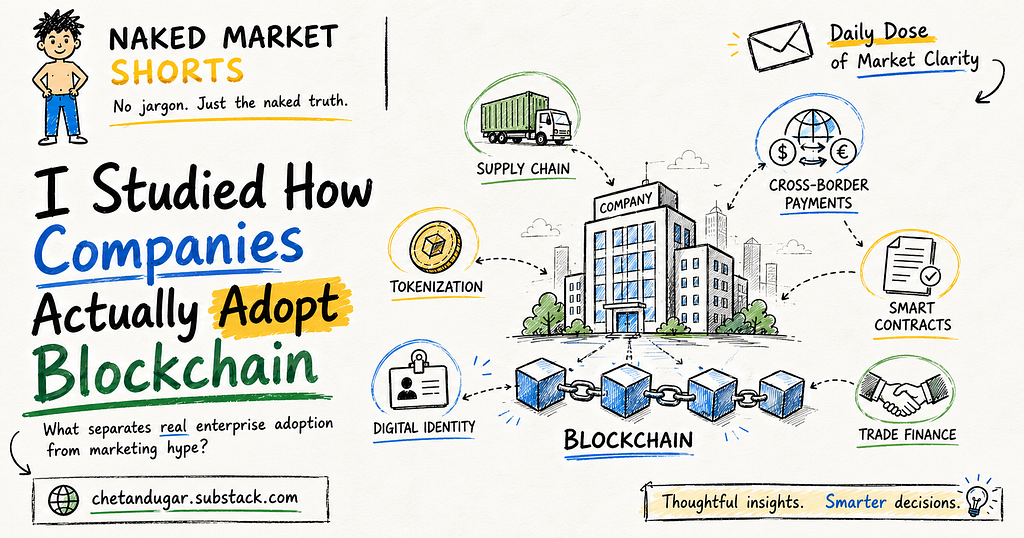
I Studied How Companies Actually Adopt Blockchain

I went down a rabbit hole to understand how companies really adopt blockchain. What I found completely changed how I think about the technology and it might change how you see it too.

Naked Market breaks down macro finance, blockchain infrastructure, AI systems, and automated trading to help you understand the future of global finance before the mainstream catches up.
Two companies. Same Tuesday. Watch what they do.

Company A sends out a glossy press release: “Were thrilled to announce our bold new Web3 blockchain initiative!” Theres a logo. Theres a buzzword. The stock ticks up, LinkedIn applauds, and an executive gives a talk at a conference with very uncomfortable chairs.

Company B says… nothing. Not a word. But deep inside its finance department, one quiet employee just moved a large payment to the other side of the world and watched it settle in seconds, a thing that used to take three days and a stack of fees.

Fast forward one year. Company As “Web3 initiative” is quietly dead, buried in a slide deck nobody opens. Company B is saving millions, doing it every single day, and its rivals still havent noticed.

Now which of those two companies actually “adopted blockchain”?

Thats the whole thing I want to unpack today, because the answer surprises almost everyone. Adopting blockchain first almost never looks the way you picture it. Its not a headline. Its a plumber, not a press conference. And once you see how it really happens, youll never read a splashy tech announcement the same way again wherever in the world you are.

First, the myth

When most people hear “a company is adopting blockchain,” this is the picture in their head: the big announcement. The stage. The word “revolutionary” used four times in one sentence.
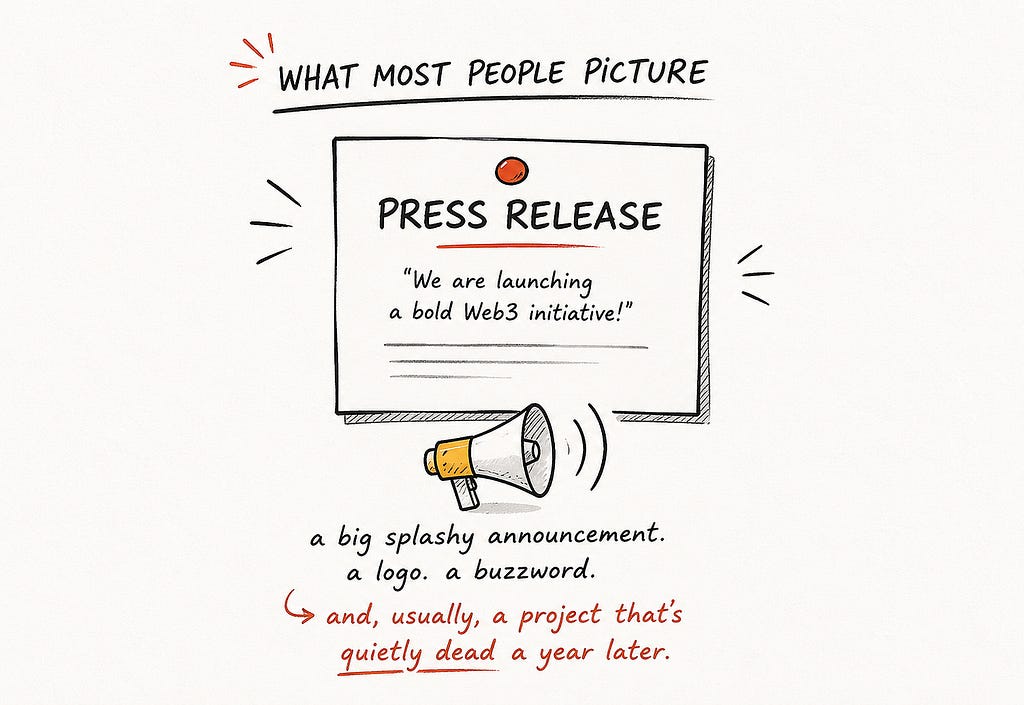
And heres the uncomfortable truth about that version: its usually theatre. A lot of loud blockchain announcements arent really about solving a problem at all, theyre about looking innovative, giving the share price a little nudge, or keeping up with a competitor who just did the same. The tell is simple. If a company leads with the technology (“we are using blockchain!”) instead of a problem (“we fixed this expensive, annoying thing”), the project is usually months away from a quiet funeral.

The real thing looks completely different. So lets follow how it actually begins.

How it really starts: with a headache

Real adoption doesnt start in the boardroom with a vision. It starts with one tired person and a boring, expensive problem.
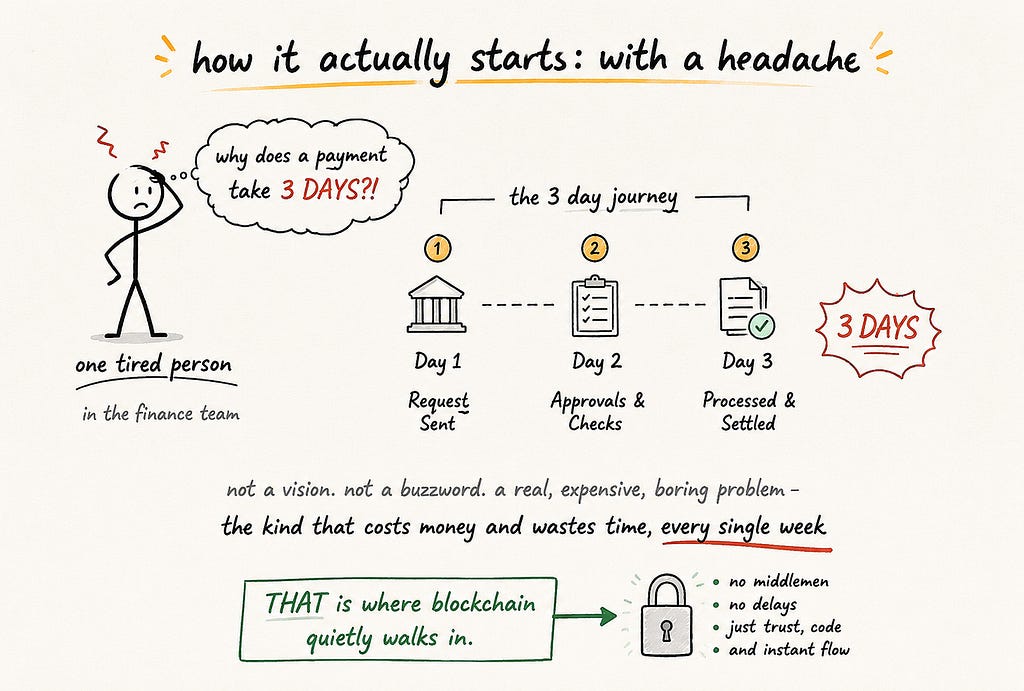
Picture a woman in the finance team of some ordinary global company. Every week, she has to send money to suppliers or subsidiaries in other countries. And every week, the same nonsense: the payment takes two or three days to arrive, it passes through a chain of middlemen who each take a cut, and half the time she cant even see where the money is while its in transit. Its slow, its costly, and its been that way her entire career.

She isnt looking for a “bold Web3 future.” She just wants the money to move faster and cost less. And that — a real, recurring, money-wasting pain — is the doorway blockchain actually walks through. Not as a revolution. As an aspirin.

The entire pitch, in one line

Heres the magic trick, and its almost embarrassingly simple. That payment that took three days? On blockchain rails, it can settle in seconds.
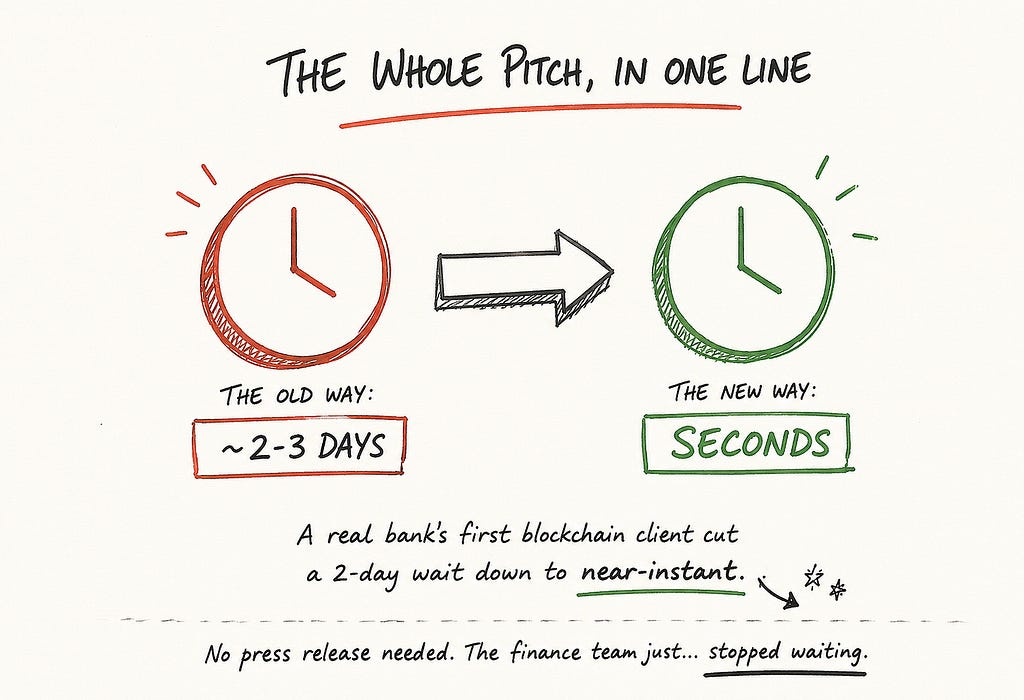
This isnt a hypothetical. One of the biggest banks in the world quietly built its own blockchain system, and its now handling trillions of dollars. But look at how it actually got going: its early clients werent chasing hype at all. One of them, a company that services loans, simply used it to turn a two-day settlement wait into something near-instant. Thats it. No stage, no buzzword — the finance team just… stopped waiting.

Why does blockchain do this? In plain words: normally, when money moves between companies, each side keeps its own separate records and they slowly reconcile with each other, passing paperwork back and forth through intermediaries which takes days. A blockchain is just a shared notebook that everyone writes into at the same time. One record, visible to all the right people at once. When theres only one shared copy, theres nothing to reconcile and no paperwork to pass around — so the payment just… clears. Days collapse into seconds.

Boring? Maybe. But “we turned three days into three seconds and cut the fees” is the single most powerful sentence in enterprise technology. That one sentence is how blockchain gets its foot in the door.

It spreads from the basement, not the billboard

Heres the next thing people get backwards. Real blockchain adoption doesnt start in the marketing department. It starts in the basement — the unglamorous back-office functions where money and data actually move.
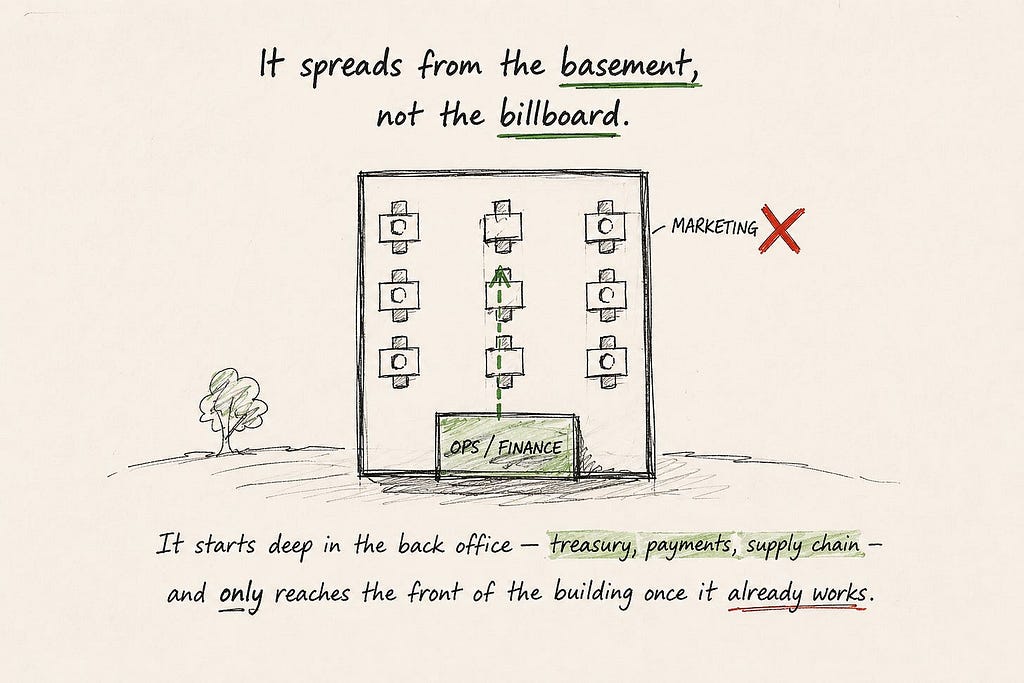
Treasury. Payments. Settlement. Supply-chain tracking. These are the corners where the old way is slowest and most painful, which means theyre where a faster way pays off immediately. So a quiet pilot starts down there, proves it saves real money, and only then once it already works does it climb up through the company. By the time anyone in leadership is talking about it publicly, the thing has been running in the background for a year. The announcement, if it ever comes, is the last step, not the first.

And it starts tiny on purpose

The smart first-movers dont try to “move the company onto blockchain.” That would be insane, like rewiring an entire skyscraper while people are still working in it. Instead, they pick one small, high-value corner and start there.
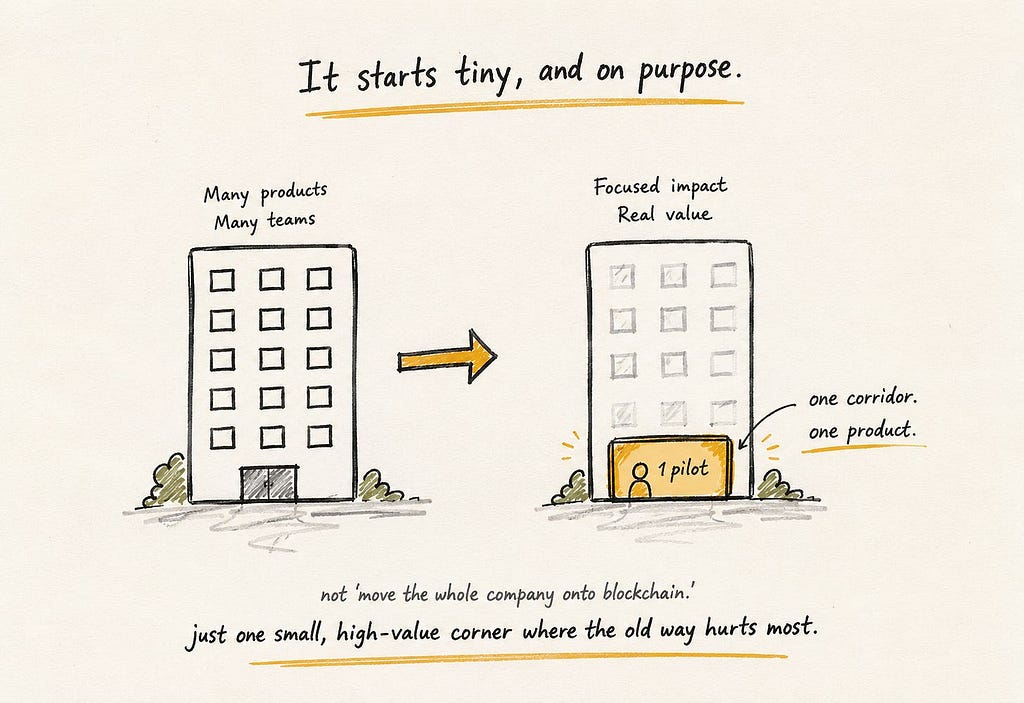
One payment route between two offices. One type of transaction. One product. They keep it narrow, they keep it low-risk, and they let it prove itself before they expand. Almost every real success story you can find started as one tiny, unglamorous pilot that worked — and then quietly grew.

Now the honest part: most of the big ones die

If I stopped here, youd think this is easy. Its not. And I promised youd get the real story, so here it is: the graveyard of failed corporate blockchain projects is enormous. And these werent silly little startups.

The most famous was TradeLens — a giant shipping tracker built by the worlds largest container line, Maersk, together with IBM. Serious companies. Hundreds of partners. It shut down. Australias stock exchange spent years trying to rebuild its core settlement system on blockchain and scrapped it after writing off around a quarter of a billion dollars. A whole string of bank-backed trade networks names like we.trade, B3i, Marco Polo, Contour all launched with fanfare, all collapsed.

Now heres the fascinating part. In almost every one of these failures, the technology worked fine. The blockchain wasnt the problem. So what killed them? Look closely, because the pattern is identical every single time and its the most important lesson in this whole piece.

Why the big group projects fall apart

Every one of those doomed projects made the same bet: they tried to get a whole industry full of fierce rivals to share one ledger together. And that is where it always dies.
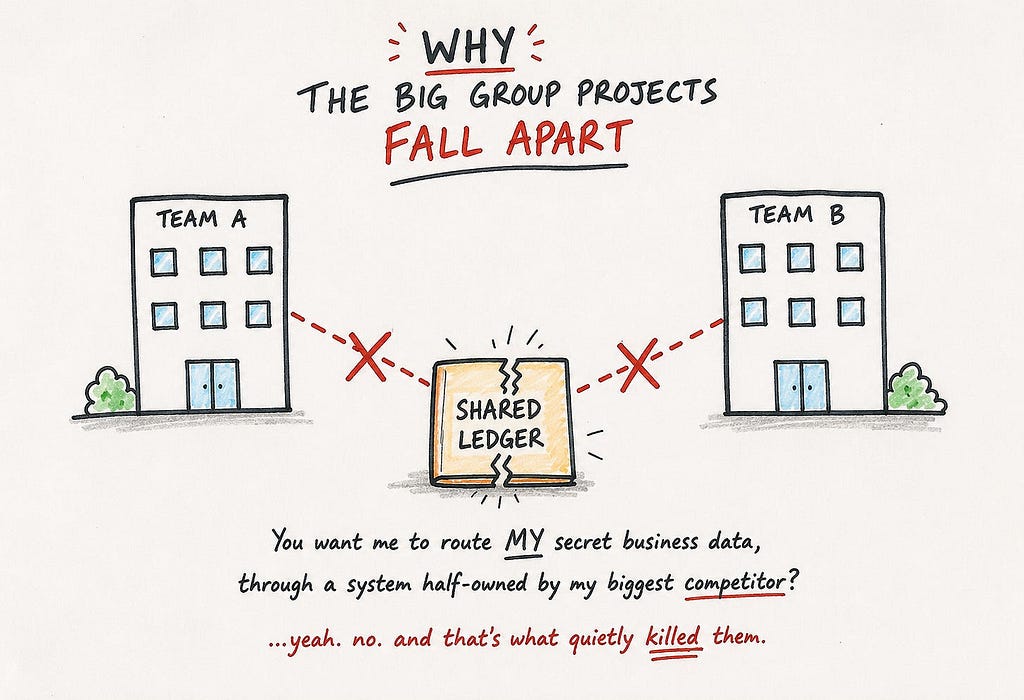
Remember, a blockchain is a shared notebook thats its superpower. But its also the trap. Because who on Earth wants to write their secret, business-critical data into a notebook thats half-owned by their biggest competitor? Thats exactly why TradeLens failed: rival shipping lines flatly refused to route their private data through a platform co-owned by Maersk, the giant they compete with every day. The tech was ready. Human nature wasnt.

The ledger was never the hard part. Getting enemies to hold hands and share it — that was the hard part.

Which points straight at the answer. (Its also why the “let one company privately control the shared ledger” idea is so tricky we pulled that apart in public vs private blockchains.) The projects that actually work are the ones a single company can adopt on its own, for its own benefit, without needing to herd a hundred suspicious rivals into the same room. One firm, one problem, one win. No hand-holding required.

So what do the winners actually do?

Put it all together and the recipe for adopting blockchain first is refreshingly clear and almost the exact opposite of the big splashy version.

They solve one real, expensive pain not a vision. They start in the back office and keep it small. They pick something that moves money (payments, settlement, treasury) over something that moves a brand (marketing stunts). They do it alone, so theyre not stuck waiting for competitors to agree. And they stay quiet about it — because while the loud company is giving a speech, the quiet company is banking the savings and building a lead. The silence isnt shyness. Its strategy.

Then quiet turns into a stampede

Heres how the story ends and why it matters far beyond any one company.

One firm quietly proves the boring thing works and starts saving real money. Then a rival notices its competitor is suddenly faster and cheaper, and panics. Then another. Then the whole industry lurches onto the new rails at once, terrified of being left behind. Its happening right now: that same bank is up to trillions in blockchain payments, the messaging network that underpins global banking just switched on a blockchain system with dozens of major banks, and companies are quietly paying contractors in digital dollars across dozens of countries. By the time all of this becomes a mainstream headline, the first-movers will have been winning for years.

And thats the deeper thing this whole newsletter keeps pointing at. The shared global money rails arent being built by some grand announcement or world summit. Theyre being built quietly, one company at a time, each one just trying to fix its own boring, expensive problem until one day you look up and the entire economy is running on them. Thats how the future actually arrives: not with a bang, but with a thousand finance teams that simply stopped waiting.

A test you can steal

So the next time you see a company shout about a shiny new blockchain project, dont get swept up and dont sneer either. Just quietly run it through four questions. This little test cuts through almost all the noise.
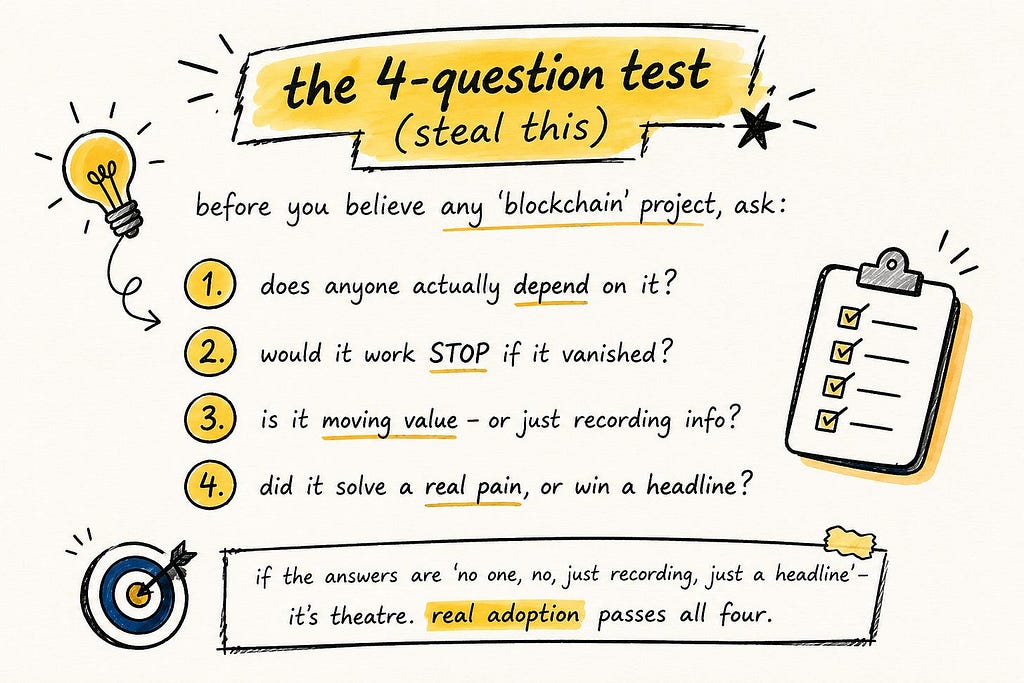
1. Does anyone actually depend on it? Or is it a demo nobody would miss?

2. Would real work grind to a halt if it disappeared tomorrow? If it vanished and nobody noticed, it was never real.

3. Is it moving actual value or just recording information? Moving money and assets is where blockchain genuinely shines. “Putting records on the blockchain” is usually where a normal database would have been fine.

4. Did it solve a real, painful problem or just win a headline? Follow the pain, not the press release.

If the honest answers are “no one, no, just recording, just a headline” its theatre, and it will probably be dead within a year. Real adoption quietly passes all four.

Which company are you?

Which brings me, as always, to the one idea this whole newsletter is really about.

When it comes to a big shift like this, there are two kinds of company — and honestly, two kinds of person. The rich one chases the headline. It wants to be seen adopting the new thing: the announcement, the applause, the little bump. The wealthy one ignores all that and quietly rewires its own plumbing where it actually hurts and wins before anyone even realises the race has started. One wants to look like the future. The other just quietly becomes it.

You dont need to run a company for this to matter to you. The lesson works everywhere: the rich watch the announcements, the wealthy watch the plumbing. And right now, all over the world, the real adoption of blockchain isnt happening on a stage. Its happening in a back office youll never see, where somebody just turned three days into three seconds and didnt tell a soul.

Im not telling you to buy anything just to see clearly. Learn to look past the loud front door and notice the quiet back one. Because thats where the future almost always sneaks in.

If you want to keep reading finance this way — subscribe.
One clear breakdown at a time, for readers all over the world.
Subscribe to Naked Market →

Keep going

-More soon


I Studied How Companies Actually Adopt Blockchain was originally published in Coinmonks on Medium, where people are continuing the conversation by highlighting and responding to this story.

Gas Optimization & Auditing Tips

How Does a Compiler Actually Work?

Image: Grok AI

Solidity is the dominant high-level programming language for writing smart contracts on Ethereum and compatible EVM blockchains. However, the Ethereum Virtual Machine (EVM) cannot execute Solidity code directly. It requires low-level bytecode consisting of opcodes and data.

The Solidity compiler (solc) bridges this gap by translating human-readable Solidity into EVM-executable bytecode. Understanding how and why the compiler works is essential for writing secure, gas-efficient, and maintainable smart contracts. It helps developers avoid common pitfalls, leverage optimizations effectively, debug issues, and ensure contracts can be verified on explorers like Etherscan.

The primary implementation is solc, a C++ compiler maintained by the Solidity team (with solc-js as a JavaScript port via Emscripten). It takes Solidity source code (.sol files) as input and produces multiple outputs, including:

  • EVM bytecode (creation and runtime)
  • Application Binary Interface (ABI)
  • Contract metadata
  • Gas estimates
  • Abstract Syntax Tree (AST)
  • Assembly representations
  • And more (via the Standard JSON interface)

In modern versions (Solidity 0.8.x series, with documentation referencing 0.8.36-develop as of mid-2026), the compiler supports two main compilation pipelines:

  • Legacy pipeline (default): Direct translation from analyzed Solidity to bytecode.
  • IR-based pipeline (viaIR: true): Solidity → Yul intermediate representation → optimization → bytecode. This path generally enables superior optimizations.

Fun fact, inside the solidity compiler, there are two Solidity languages. 3 if you count Core. And 4 if you count Fe! Thx Daniel for spotting this funny fact.

What Does It Actually Do?

First of all, we must note that compilers essentially take text, parse and process it, then turn it into binary for your computer to read. This keeps you from having to manually write binary for your computer, and furthermore, allows you to write complex programs easier.

In other words, the compiler converts high-level source code to low-level code. Then, the target machine executes low-level code. The compilation process consists of several phases:

  • 1. Lexical analysis
  • 2. Syntax analysis
  • 3. Semantic analysis
  • 4. Intermediate code generation
  • 5. Optimization
  • 6. Machine Code generation

To proceed to the next topic, we must first understand how this occurs in Solidity and, as a result, how we can use it to audit and write code safely. It’s critical to understand the specifics of the process we’ll go over below:

  1. Lexing and Parsing
    The source code is broken into tokens (lexer) and then structured into an Abstract Syntax Tree (AST) (parser). This captures the syntactic structure of contracts, functions, variables, inheritance, etc.
  2. Semantic Analysis
    The compiler performs type checking, resolves names, handles inheritance (using C3 linearization), checks for errors (e.g., visibility, mutability), and analyzes control flow. It also processes pragmas (e.g., pragma solidity ^0.8.0;) and library linking.
  3. Intermediate Representation (IR) Generation (especially in viaIR mode)
    The analyzed code is translated into Yul, a low-level but human-readable intermediate language. Yul uses constructs like functions, if/switch/for loops, and variables while abstracting away raw EVM stack manipulation (DUP, SWAP, JUMP).
    Yul serves as a clean target for optimizations and can also be written directly (via inline assembly or standalone Yul contracts).
  4. Optimization
    This is one of the most important stages. The optimizer runs at multiple levels:
  • Yul optimizer (powerful in the IR pipeline):
    Applies passes such as common subexpression elimination (CSE), function inlining, dead code elimination, loop-invariant code motion, constant folding, and more.
  • Opcode/peephole level: Simplifies instruction sequences.
  • Configurable via — optimize (or optimizer.enabled: true) and — optimize-runs (default often 200).
    Low runs values prioritize smaller deployment bytecode (cheaper to deploy). High values prioritize runtime gas efficiency.

5. Code Generation
The optimized representation (Yul or direct) is converted into EVM bytecode. This includes generating function selectors (via keccak256 of signatures), handling storage/memory/calldata layouts, events, and constructors. The compiler also appends CBOR-encoded metadata (containing compiler version, settings, and a hash) to the end of the bytecode (unless disabled).

6. Output Generation
The compiler produces all requested artifacts based on the output selection.

What Does the Compiler Actually Do to Solidity Code?

We can roughly break down the entire process into the following three phases:

a) Splits code into tokens

b) Analyzes syntax

c) Constructs an AST (abstract syntax tree)

What Does the Compiler Do With AST?

Here we can also divide the entire process into three phases, which are listed below:

a) Analyzes semantics (at this point compiler errors are exposed/derived!)

b) Optimizes AST (that’s what runs value in the project’s config is specified for — check out this example!)

c) Generates bytecode!

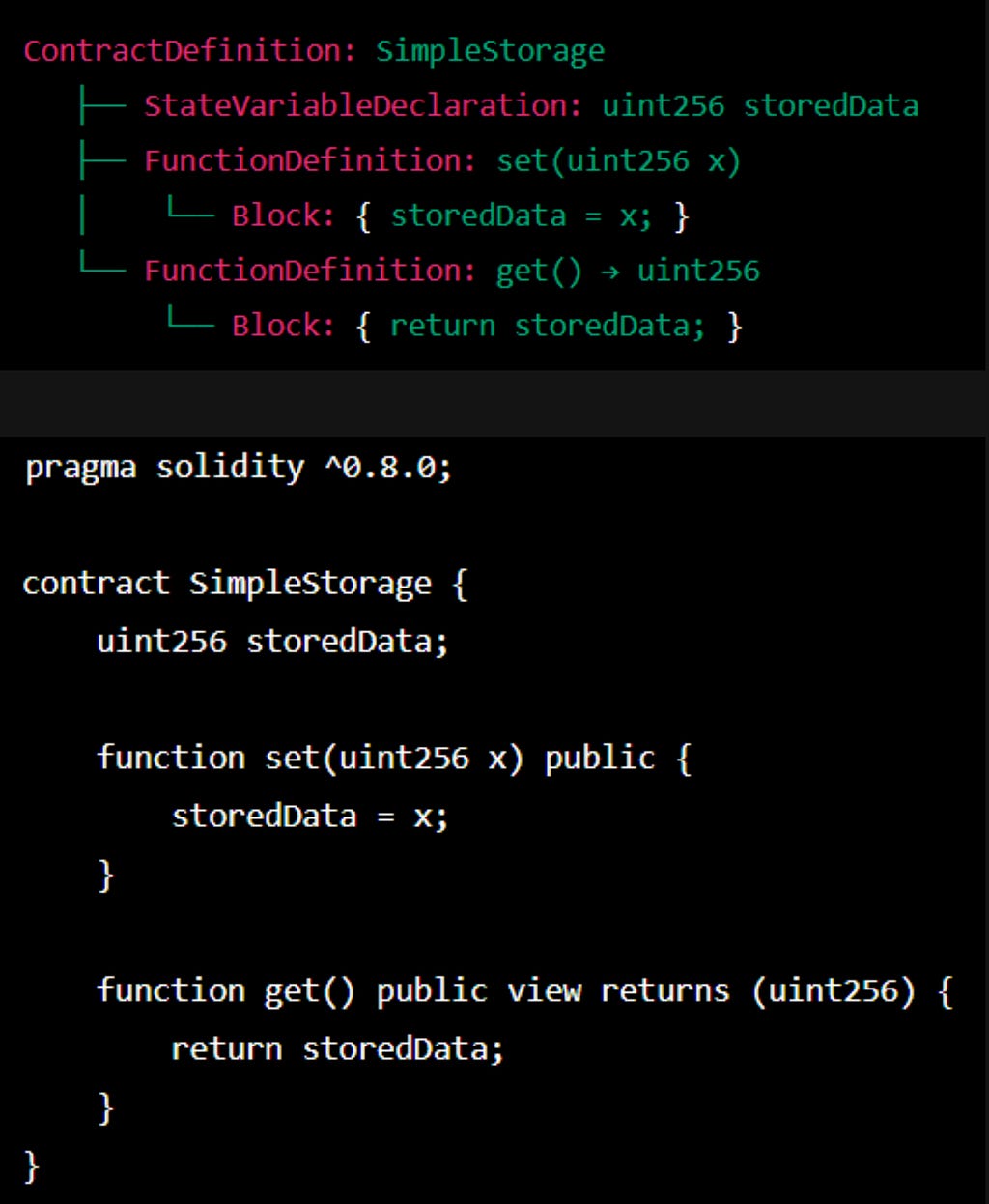
Here is a simple example of some of the compiler’s phases:

Source: My Own Screenshot

The design is driven by fundamental constraints of the EVM:

  • EVM is a stack machine with a hard limit of 1024 stack items and expensive operations (especially storage writes).
  • High-level abstractions in Solidity (mappings use keccak256 hashing for storage slots, inheritance packs variables according to C3 linearization, structs/arrays have specific packing rules) must be translated into raw storage slots (0, 1, 2, …), memory, and calldata.
  • Gas is money: Every opcode has a cost. The compiler and optimizer exist to minimize both deployment size and execution gas without changing semantics.
  • Security and determinism: The compiler enforces rules (e.g., overflow checks by default since 0.8.0) and produces verifiable output.
  • Yul as IR: It provides a sweet spot — more optimizable than raw Solidity but more readable and portable than pure EVM assembly. This enables whole-program optimizations that would be difficult at the opcode level.

Why It Is Important to Understand the Compiler

Many developers treat the compiler as a black box. This leads to suboptimal or insecure contracts. Here’s why deep understanding pays off:

1. Gas Optimization (The Biggest Practical Benefit)
The optimizer does a lot automatically, but it cannot fix fundamentally expensive patterns. Understanding compilation helps you:

  • Write code the optimizer loves (e.g., simple expressions, reusable functions).
  • Manually optimize where needed (storage packing, using calldata vs memory, avoiding unnecessary state changes, custom errors instead of require strings).
  • Choose the right optimizer-runs and consider enabling viaIR for better results in many cases.
  • Inspect Yul or assembly output to see what the compiler actually generates.

2. Security and Correctness

  • Storage layout collisions are a major risk in upgradeable contracts and inheritance. The compiler’s deterministic layout rules (starting at slot 0, packing rules, keccak for mappings) must be respected.
  • Compiler bugs, while rare, have existed historically. Using recent, audited versions and pinning exact versions (pragma solidity 0.8.XX;) reduces risk.
  • Understanding how features compile (e.g., modifiers, inheritance) helps spot subtle issues.

3. Debugging and Maintenance
Source maps and assembly output allow stepping through code at the EVM level. When things go wrong on-chain, inspecting bytecode or Yul is often necessary.

4. Contract Verification and Reproducibility
Explorers verify source by recompiling it with the exact compiler version and settings. Mismatched settings produce different bytecode, breaking verification.

5. Advanced Development and Tooling

  • Inline assembly/Yul gives fine-grained control when Solidity abstractions are insufficient.
  • Frameworks (Hardhat, Foundry, etc.) expose compiler settings. Knowing them lets you tune builds effectively.
  • Future-proofing: As EVM evolves (new versions, EOF), the compiler adapts. Understanding pipelines helps adopt improvements.

6. Best Practices
Always:

  • Pin exact compiler versions.
  • Enable the optimizer (and consider viaIR).
  • Review warnings as errors.
  • Use the latest stable 0.8.x version for safety features.
  • Inspect storageLayout for complex contracts.

Gas Optimization & Auditing Tips

  • Modifiers: each inclusion of `_` in a modifier inserts the function body into bytecode. If a function has several modifiers, it may significantly increase the size of the contract and the cost of deployment. If you need to save money, you can combine modifiers or put the checks into a separate function;
  • In older versions of solidity, reading the storage length of the array (array.length) in the loop condition means reading from storage at each iteration;
  • Sometimes when auditing code, you may notice unnecessary copying (calldata->storage; calldata->memory; memory <-> storage) when assigning or passing arguments to a function. For example, you should always mark reference-type arguments of external functions as calldata, not memory; sometimes you may even use storagereferences in internal calls;
  • You can change the order of storage variables or fields in a structure somewhere to use storage packing, and it will be useful. However, sometimes reading and writing with storage packing is not always cheaper than without it. You can save a lot of gas when writing a storage array of structures with packed fields;
  • In Solidity, some data types have a higher gas cost than others. And that is what is often required of a smart contract developer and that’s why you should understand the gas utilization of the available data types;
  • Custom errors is cheaper to use than revert(“error text”). There is more information in this article: soliditylang.org/blog/2021/04/21/custom-errors.

The integration of your project will be substantially more secure if you implement the below recommendations:

  • Functions: Internal calls preserve the context (msg.sender, msg.value, etc). For example, an internal call to `transfer(…)` inside a token transfers tokens from the address of the caller, not from the balance of the token contract itself;
  • Functions: external > public
  • Variables: Visibility of private and internal does not hide data. Variable values are readable from off-chain;
  • Variables: Public visibility for variables creates getters and the code of getters takes up space in the contract. When optimizing gas, you can remove Public visibility for some variables (unused or already read in some other functions) and thus reduce gas consumption during contract execution;
  • Constants: Magic constants are dangerous, so make full-fledged constants with a normal name. Immutable is also ok;
  • Constants: Function signatures should be checked using 4bytes;
  • Ether: payable — can be redundant (the function can receive ether but does not process it);
  • Ether: fallback vs receive; receive is sufficient for receiving money. It often includes a check that the broadcast comes from one of the addresses (e.g. WETH);
  • Ether: It is impossible to limit the consumption of ether (selfdestruct, mining), so you cannot rely on the exact value of the balance. This is also true for tokens;
  • Ether: Three Ether sending options: send, call, transfer:

a) Specifics of use address.transfer() — throws on failure, forwards 2,300 gas stipend (not adjustable), safe against reentrancy, should be used in most cases as it’s the safest way to send ether;

b) Specifics of use address.send() — returns false on failure, returns false on failure, should be used in rare cases when you want to handle failure in the contract;

c) Specifics of use address.call.value().gas()() — returns false on failure, forwards all available gas (adjustable), not safe against reentrancy, should be used when you need to control how much gas to forward when sending ether or to call a function of another contract;

  • It’s bad form to work directly with gas: When working with the tx.gasprice variable, it is necessary to remember that its value is set by the user at the moment of transaction execution;
  • It’s bad form to work directly with gas: release of a specific amount of gas through .gas(X) / {gas: X}
  • .transfer VS .send VS .call — call is a good standard, but it brings its own set of problems (reentrancy etc);
  • It is easy to make collisions, for example with arrays: abi.encodePacked([1,2],[3]) == abi.encodePacked([1],[2,3]))so check them out carefully. Technically, similar can be done with abi.encode, e.g. via structures.
  • Use SafeMath and analogs for Solidity <0.8 (and do not use for more recent ones), keep in mind that a.add(b).mul(c) == (a+b)*c ;
  • Very carefully check all unchecked sections for Solidity >=0.8 ;
  • It is better to do all calculations in the uint256 type, because, for example, in the case of `uint256(a) = uint16(b) * uint32(c) / uint16(d)` the right part may overflow, because the intermediate value may not fit into uint32 (for each operation the maximum of operand types is taken, i.e. the result of multiplication of uint16 and uint32 will be uint32);
  • Type conversion — always check that the number is converted normally. Recommendation: use libraries like SafeCast ;
  • It’s almost always multiplication first, then division;
  • When calculating fractions, don’t forget that you can accidentally get zero. e.g. `balanceOf(user) / totalSupply() == 0`. You need to multiply by a suitable multiplier (often 1e18).
  • It is better to put the additional multiplier in a constant like `uint constant private HUNDRED_PERCENT=1e18;` ;
  • There are times when you need to calculate the sum of fractions (i.e., the common denominator of all fractions). It is correct to add first, then divide;
  • Instead of `a/b > c/d` it is often better to use `a*d > c*b`.

Short Types in Solidity: Rare Tricks Uncovered

In Solidity, some data types have a higher gas cost than others. And that is what is often required of a smart contract developer and that’s why you should understand the gas utilization of the available data types; — in order to choose the most efficient one according to your needs.

For the purposes of this article, we refer to uint8-uint248 and int8-int248 types as “short types”.

  • Solidity compiler tightly packs short types (if possible) to reduce storage footprint of storage variables, struct fields, array elements;
  • Short types require more opcodes and gas in all other cases (calldata, memory, stack).
  • Overflows happen more often;
  • Solidity 0.8 and SafeMath do not check for overflows during type casts;
  • Short types behave differently for abi.encodePacked and other abi.encode* calls.
  • Solidity ABI encoder puts every value into a separate slot, i.e. the size of calldata or returndata remains the same.
  • The compiler often inserts additional opcodes — it may inflate the size of the contract.

I recommend:

  • Using short types only to reduce storage footprint;
  • Local variables, return values, function and event parameters should be uint256 or int256
  • Converting uint256 values to shorter types right before you write them to storage. Utilize libs like a SafeCast; — they have a pretty good syntax;
  • When you read short type value from storage, convert it to uint256 immediately
  • Utilizing storage location when possible: function foo(MyStruct storage ms, uint32[] storage array) internal {…}
  • Read individual fields or elements if you don’t need the whole structure or array: uint256 value = uint256(ms.field) + uint256(array[i]);

Conclusion

The Solidity compiler is far more than a simple translator. It is a sophisticated tool that handles the immense complexity of mapping high-level smart contract logic onto a constrained, gas-metered virtual machine. It performs parsing, semantic analysis, powerful optimizations (especially via Yul in the IR pipeline), and generates critical artifacts like ABI and metadata.

Developers who understand its inner workings like how code becomes bytecode, how storage is laid out, how the optimizer functions, and what outputs it produces will write better contracts. They save on gas, reduce security risks, debug faster, and build more reliable decentralized applications.

In the evolving world of blockchain development (with L2s, account abstraction, and potential EVM upgrades), compiler literacy is no longer optional, it is a core skill for professional Solidity engineers.

Master the compiler, and you master the bridge between your ideas and the blockchain.


Gas Optimization & Auditing Tips was originally published in Coinmonks on Medium, where people are continuing the conversation by highlighting and responding to this story.
The Rise of AI in the Netherlands: A New Era for Business Growth

The Netherlands has become one of Europe’s leading technology hubs, with businesses increasingly embracing digital innovation to stay competitive. Among the technologies driving this transformation, AI stands out as one of the most impactful. Organizations across industries are investing in AI Development to improve efficiency, streamline operations, and unlock new opportunities for growth.

From startups and small businesses to large enterprises, companies are recognizing the value of intelligent technologies that can analyze data, automate repetitive tasks, and support better decision-making. As adoption continues to grow, AI is reshaping how businesses operate and compete in the Dutch market.

Why AI Adoption Is Growing in the Netherlands

Several factors have contributed to the rapid growth of AI across the Netherlands. The country benefits from a strong digital infrastructure, a highly skilled workforce, and a culture that encourages innovation. Businesses are constantly looking for ways to improve productivity and deliver better customer experiences, making AI a natural choice.

The increasing availability of data has also played a major role. Organizations now generate vast amounts of information every day, and Artificial Intelligence Solutions help transform that data into actionable insights. This enables businesses to make informed decisions, identify trends, and respond quickly to changing market conditions.

How AI Is Transforming Businesses Across Industries

AI is no longer limited to technology companies. Today, organizations in healthcare, finance, retail, logistics, and manufacturing are using AI to solve real-world business challenges.

Many businesses are implementing Custom AI Solutions designed to address their unique requirements. These solutions help automate routine tasks, improve operational efficiency, and enhance customer interactions.

Some common applications include:

  • AI-powered customer support systems
  • Predictive analytics for forecasting demand
  • Automated document and data processing
  • Fraud detection and risk analysis
  • Personalized product recommendations
  • Inventory and supply chain optimization
  • Intelligent workflow automation

As businesses continue exploring new use cases, AI is becoming an essential part of everyday operations.

Key Benefits of AI for Business Growth

Improved Efficiency

One of the biggest advantages of AI is its ability to automate repetitive processes. Tasks that previously required hours of manual effort can now be completed more quickly and accurately. This allows employees to focus on higher-value activities that contribute directly to business growth.

Better Decision-Making

AI systems can process and analyze large volumes of data much faster than traditional methods. By identifying patterns and trends, businesses gain valuable insights that support strategic decision-making.

Enhanced Customer Experiences

Modern consumers expect fast, personalized, and convenient experiences. AI helps businesses understand customer preferences and deliver more relevant interactions. Whether through recommendation engines or intelligent chatbots, AI can improve customer satisfaction and engagement.

Cost Optimization

Automation reduces manual workloads and minimizes operational inefficiencies. Businesses can optimize resources, reduce errors, and lower costs without compromising quality or performance.

Greater Scalability

As organizations grow, managing increasing workloads can become challenging. AI enables businesses to scale operations more effectively by handling larger volumes of data and customer interactions without significant increases in resources.

Industries Leading AI Innovation in the Netherlands

Healthcare

Healthcare organizations are using AI to support medical research, improve diagnostics, streamline administrative tasks, and enhance patient care. AI-driven systems can help healthcare professionals make faster and more informed decisions.

Finance

Banks and financial institutions rely on AI for fraud detection, risk management, customer support, and financial forecasting. AI helps improve security while delivering more personalized financial services.

Retail and E-commerce

Retail businesses use AI to understand customer behavior, optimize inventory levels, and create personalized shopping experiences. These capabilities help increase customer satisfaction and operational efficiency.

Manufacturing

Manufacturers are implementing AI to improve quality control, predict equipment maintenance needs, and optimize production processes. These improvements can reduce downtime and increase productivity.

Logistics and Transportation

AI helps logistics providers optimize delivery routes, forecast demand, and improve warehouse operations. This leads to faster deliveries and more efficient supply chain management.

Challenges Businesses Face During AI Adoption

While the benefits of AI are significant, successful implementation requires careful planning and execution.

Some common challenges include:

  • Managing and organizing business data
  • Integrating AI with existing systems
  • Ensuring data privacy and security
  • Addressing skill gaps within organizations
  • Measuring return on investment
  • Selecting the right technologies and strategies

Many organizations begin by evaluating available AI Development Services to better understand which solutions align with their business objectives. Taking a strategic approach helps reduce implementation risks and improves long-term outcomes.

The Future of AI in the Netherlands

The role of AI in business is expected to expand significantly over the coming years. Emerging technologies such as machine learning, computer vision, natural language processing, and generative AI are opening new possibilities for innovation.

Businesses are increasingly viewing AI not simply as a tool for automation but as a way to improve competitiveness and create long-term value. As technology continues to evolve, organizations that invest in AI today will be better prepared to adapt to future market demands.

The demand for Artificial Intelligence Solutions is expected to increase as businesses seek smarter ways to manage operations, improve customer experiences, and drive sustainable growth.

Why AI Matters for Businesses in 2026 and Beyond

AI is becoming a key component of modern business strategy. Organizations that embrace AI Development can gain advantages through improved efficiency, better decision-making, and enhanced customer engagement.

As competition continues to increase across industries, businesses are exploring Custom AI Solutions that help them remain agile and responsive to market changes. Companies that successfully integrate AI into their operations are likely to be better positioned for long-term success.

Working with an experienced AI Development Company can also help organizations identify practical opportunities for AI adoption and ensure solutions are aligned with their business goals.

Conclusion

The rise of AI in the Netherlands marks an important shift in how businesses approach growth and innovation. Organizations across industries are using AI Development to improve operations, gain valuable insights, and deliver better experiences for customers.

As AI technologies continue to evolve, the adoption of Artificial Intelligence Solutions and Custom AI Solutions will become increasingly common. Businesses that understand and embrace these changes will be better equipped to compete, innovate, and grow in the years ahead.

The Netherlands is well positioned to lead this transformation, making AI one of the most important drivers of business success in the modern digital economy.


The Rise of AI in the Netherlands: A New Era for Business Growth was originally published in Coinmonks on Medium, where people are continuing the conversation by highlighting and responding to this story.

Junior Developers Write Code — Senior Engineers Design Outcomes

Your code works.

That is the problem.

It runs. It passes tests. It gets merged. And yet, three months later, someone rewrites it. Six months later, it becomes a production issue. One year later, nobody wants to touch it.

This is the uncomfortable truth no one tells early in a developer career.

Writing code is not the job.

Designing outcomes is.

Early in a career, success feels simple. A ticket comes in. You write a function. You fix a bug. You see green checks. You feel productive.

That feeling is addictive.

But it is also misleading.

Because the real world does not reward code. It rewards impact.

A junior developer asks:
“What should I write?”

A senior engineer asks:
“What problem are we actually solving?”

That one shift changes everything.

Take a simple example.

A junior developer might implement an API like this:

@GetMapping("/user/{id}")
public User getUser(int id) {
return repo.findById(id).get();
}

It works. It returns data. Done.

A senior engineer looks at the same requirement and sees something else entirely.

What happens if the user does not exist?

What about latency?

What about caching?

What about abuse?

What about future scale?

The code becomes:

@GetMapping("/user/{id}")
public ResponseEntity<User> getUser(int id) {
User u = cache.get(id);
if (u == null) {
u = repo.findById(id).orElse(null);
if (u != null) cache.put(id, u);
}
return (u != null) ? ok(u) : notFound();
}

Still simple. Still readable.

But now it reflects thought.

That is the difference. Not complexity. Not cleverness. Thought.

Junior developers optimize for completion.

Senior engineers optimize for consequences.

Before writing a single line, a senior engineer maps the system in their head.

Something like this:

Client
|
v
API Layer
|
v
Service Logic
|
v
Database
|
v
External Services

But they do not stop there.

They ask:

Where will this break?

Where will this slow down?

Where will this be abused?

Where will this need to evolve?

That is how outcomes are designed.

There is also a hard truth that stings a bit.

More code does not mean more value.

In fact, the best engineers often write less code.

Because they remove unnecessary work before it begins.

A junior developer might build a feature in five days.

A senior engineer might spend two days questioning it, then solve it in one.

Or decide it should not be built at all.

That is not laziness. That is leverage.

Another difference shows up during incidents.

When production breaks, junior developers search for the bug.

Senior engineers search for the system failure.

A null pointer is not the problem.

The absence of validation is.

A timeout is not the problem.

The lack of retries, backoff, or circuit breaking is.

A crash is not the problem.

The lack of observability is.

Senior engineers think in layers.

They design systems that fail gracefully, not systems that hope to never fail.

Let us talk about ownership.

Junior developers often feel ownership over code.

Senior engineers feel ownership over outcomes.

If a feature fails in production, it does not matter who wrote it.

It matters that it failed.

This mindset changes behavior.

Documentation improves.

Monitoring gets added.

Edge cases are considered.

Communication becomes clearer.

Because the goal is no longer to finish work.

The goal is to make things work in the real world.

So how does someone make this shift?

Not by learning another framework.

Not by memorizing more syntax.

But by asking better questions.

Before writing code, pause and ask:

What happens if this grows 10x?

What happens if this fails at midnight?

Who depends on this?

What is the simplest version that solves the real problem?

And most importantly:

Is this even the right problem to solve?

There is a moment in every developer’s journey where things click.

You stop thinking in methods.

You start thinking in systems.

You stop chasing tickets.

You start shaping outcomes.

That is when growth accelerates.

That is when people trust your decisions, not just your code.

Writing code is a skill.

Designing outcomes is a responsibility.

One gets you started.

The other makes you indispensable.

If your code works, that is good.

If your system works under pressure, that is engineering.

And that is the difference that separates a developer from an engineer.


Junior Developers Write Code — Senior Engineers Design Outcomes was originally published in Coinmonks on Medium, where people are continuing the conversation by highlighting and responding to this story.

The Rise of Digital Banking: Why Entrepreneurs Are Building Crypto Banks Instead of Traditional…

The Rise of Digital Banking: Why Entrepreneurs Are Building Crypto Banks Instead of Traditional Banks

For decades, traditional banking has served as the backbone of the global financial system. It has enabled businesses to grow, facilitated international commerce, and provided individuals with access to essential financial services. However, despite its long-standing role in the economy, the traditional banking model is increasingly struggling to keep pace with the demands of a digital-first world.

Today’s consumers and businesses expect instant payments, seamless cross-border transactions, personalized financial services, and always-on digital experiences. Entrepreneurs entering the financial technology sector are recognizing that meeting these expectations often requires a different approach — one built on modern infrastructure rather than legacy banking systems.

This shift has given rise to a new generation of financial platforms: crypto banks. Combining blockchain technology with digital banking experiences, crypto banks are redefining how financial services are delivered and creating new opportunities for entrepreneurs to build scalable, global financial businesses.

The Evolution of Banking in a Digital Economy

The banking industry has undergone significant transformation over the past decade. Mobile banking, digital wallets, contactless payments, open banking, and embedded finance have fundamentally changed how people interact with financial institutions.

Consumers no longer compare banks solely on interest rates or branch locations. Instead, they evaluate financial platforms based on speed, accessibility, convenience, transparency, and digital experience.

Businesses have similar expectations. They seek banking solutions that support international operations, reduce payment friction, simplify treasury management, and integrate seamlessly with modern digital ecosystems.

As customer expectations continue to evolve, entrepreneurs are looking beyond conventional banking models and investing in technology-driven financial platforms that are more agile, scalable, and globally accessible.

Why Traditional Banking Models Are Becoming Less Attractive

Traditional banks remain essential to the global economy, but many of their operating models were designed for an era that relied heavily on physical infrastructure and manual processes.

Entrepreneurs entering today’s fintech market often encounter challenges such as:

  • Lengthy onboarding procedures
  • Limited international accessibility
  • High operational costs
  • Slow settlement times
  • Complex compliance workflows
  • Legacy technology infrastructure
  • Limited flexibility for product innovation

These challenges can slow product development and make it difficult for startups to compete in rapidly evolving financial markets.

As a result, many founders are exploring alternative financial infrastructure that enables faster innovation while delivering the digital experiences customers increasingly expect.

The Emergence of Crypto Banks

Crypto banks represent the convergence of blockchain technology and modern digital banking.

Rather than replacing traditional financial services, many crypto banks complement them by offering digital asset management, multi-currency accounts, international transfers, virtual and physical payment cards, digital wallets, and seamless cryptocurrency transactions within a unified banking experience.

Our modern crypto bank software is designed to serve both individual users and businesses, enabling financial services that are faster, more accessible, and increasingly borderless.

For entrepreneurs, this creates an opportunity to build financial platforms capable of serving customers across multiple regions without replicating the operational complexity associated with traditional banking infrastructure.

Why Entrepreneurs Are Choosing Crypto Banks

Faster Time-to-Market

Launching a traditional banking institution often requires years of planning, extensive infrastructure, and significant financial investment.

Modern crypto banking infrastructure enables entrepreneurs to introduce digital financial services much more quickly, allowing businesses to validate ideas, acquire customers, and respond to market opportunities with greater agility.

Global Accessibility

Digital businesses increasingly operate without geographical boundaries.

Crypto banks are designed to facilitate international transactions, support multiple currencies and digital assets, and serve customers across diverse markets through digital-first platforms.

This global accessibility allows entrepreneurs to expand beyond domestic markets while providing consistent financial services to international users.

Lower Infrastructure Costs

Developing a complete banking ecosystem from scratch requires expertise across payments, compliance, wallet infrastructure, security, customer management, and core banking technology.

By leveraging modern banking infrastructure, startups can significantly reduce development complexity and operational costs while focusing resources on product innovation and customer acquisition.

Expanding Revenue Opportunities

Digital banking extends far beyond account management.

Entrepreneurs can create diversified revenue streams through services such as:

  • Payment processing
  • Currency exchange
  • Debit and virtual cards
  • International transfers
  • Merchant services
  • Digital asset custody
  • Premium subscription plans
  • Business banking solutions

This ecosystem approach enables businesses to build stronger customer relationships while increasing long-term revenue potential.

Blockchain Is Reshaping Financial Infrastructure

Blockchain technology has evolved from a niche innovation into a foundational component of modern financial systems.

Its ability to provide transparent record-keeping, secure digital asset transfers, programmable financial services, and near-instant settlement has attracted growing interest from fintech companies worldwide.

Rather than viewing blockchain solely as cryptocurrency infrastructure, entrepreneurs increasingly recognize it as an enabling technology for next-generation banking platforms.

By integrating blockchain with traditional financial services, businesses can improve operational efficiency while creating entirely new customer experiences.

Customer Expectations Have Permanently Changed

Modern consumers expect financial services to operate with the same convenience as their favorite digital applications.

They expect:

  • Instant account access
  • Mobile-first experiences
  • Real-time transaction visibility
  • Faster international payments
  • Integrated digital wallets
  • Transparent fees
  • Enhanced security
  • Personalized financial tools

Businesses that successfully deliver these experiences are more likely to attract digitally native customers who value convenience, accessibility, and innovation.

White Label Banking Is Accelerating FinTech Innovation

One of the most significant developments in fintech has been the rise of white-label banking infrastructure.

Instead of investing years building proprietary banking systems, entrepreneurs can deploy fully branded financial platforms using proven infrastructure while focusing on customer growth and product differentiation.

This model enables startups to launch modern banking services with significantly lower development risk, shorter implementation timelines, and greater operational flexibility.

As competition within fintech continues to intensify, white-label infrastructure is becoming an increasingly strategic advantage for businesses seeking rapid market entry.

The Future Belongs to Digital-First Financial Platforms

The future of banking will not be defined solely by physical branches or legacy systems.

It will be shaped by intelligent, technology-driven financial platforms capable of delivering secure, scalable, and globally connected services.

Artificial intelligence, blockchain, embedded finance, digital identity, and programmable payments are converging to create a financial ecosystem where flexibility and customer experience become the primary competitive advantages.

Entrepreneurs who embrace these technologies today will be better positioned to meet tomorrow’s financial expectations while building resilient businesses capable of evolving alongside the digital economy.
Why Coinexra’s White Label Crypto Bank Is Built for the Future of Digital Banking

As the demand for digital-first financial services continues to grow, entrepreneurs need more than just an idea — they need a technology partner capable of transforming that vision into a secure, scalable, and market-ready banking platform.

Coinexra’s white label crypto bank software is designed to help fintech startups, financial institutions, payment providers, and entrepreneurs launch fully branded crypto banking platforms without the complexity of developing an entire banking ecosystem from scratch.

Built on modern financial infrastructure, Coinexra combines digital banking capabilities with blockchain-powered services, enabling businesses to deliver seamless financial experiences while accelerating time-to-market.

Key Features of Coinexra’s White Label Crypto Bank

  • Fully white-label platform with complete brand customization
  • Multi-currency and cryptocurrency account management
  • Integrated digital wallets with secure asset storage
  • Virtual and physical card integration
  • International payments and cross-border transfers
  • IBAN account support for global banking operations
  • Built-in KYC and AML compliance modules
  • Merchant payment processing capabilities
  • Advanced admin and customer dashboards
  • Real-time transaction monitoring and reporting
  • RESTful APIs for seamless third-party integrations
  • Enterprise-grade security and encryption
  • Cloud-based, highly scalable infrastructure
  • Flexible architecture to support future financial services

Whether your goal is to launch a digital bank, a crypto-first financial platform, or an all-in-one fintech ecosystem, Coinexra provides the infrastructure needed to accelerate growth while maintaining the flexibility to evolve with changing customer expectations and market demands.

Conclusion

Digital banking is no longer defined by physical branches or legacy financial systems. It is increasingly shaped by technology, customer experience, and the ability to deliver financial services without traditional limitations.

For entrepreneurs, the rise of crypto banks represents more than a technological trend — it is an opportunity to participate in the next phase of financial innovation. By combining blockchain technology with modern banking infrastructure, businesses can create platforms that are faster to launch, easier to scale, and better aligned with the expectations of today’s global customers.

As the financial industry continues to evolve, those who invest in digital-first infrastructure today will be well positioned to lead tomorrow’s banking landscape.


The Rise of Digital Banking: Why Entrepreneurs Are Building Crypto Banks Instead of Traditional… was originally published in Coinmonks on Medium, where people are continuing the conversation by highlighting and responding to this story.

Top 10 High-Frequency Trading Bots Every Crypto Trader Needs to Know

Execute multiple trades in fractions of a second

The crypto market moves at a pace that few people can match manually. A trading opportunity can appear and disappear within seconds, making speed one of the biggest competitive advantages in digital asset trading. This is why more businesses, professional traders, and fintech start-up’s are investing in automated trading technologies that can analyze markets and execute trades with remarkable efficiency.

For entrepreneurs planning to build a crypto trading platform, understanding how professional trading bots operate is more than just industry knowledge. It helps shape better products, stronger business strategies, and more competitive services for modern traders.

An Hft trading bot is designed to monitor market activity, identify profitable opportunities, and execute multiple trades in fractions of a second. Instead of relying on emotions or delayed decisions, these systems use predefined strategies and market data to respond instantly.

Below are ten of the most recognized high-frequency trading bots and platforms that every crypto entrepreneur and trader should know.

Why High-Frequency Trading Matters in Crypto

Unlike traditional financial markets, cryptocurrency trading never stops. Markets remain active twenty-four hours a day, seven days a week, creating continuous opportunities across global exchanges.

For start-up’s entering the crypto industry, this constant activity presents enormous business potential. Modern traders expect platforms that deliver fast execution, reliable automation, and consistent performance. Businesses that understand these expectations are better positioned to attract active users and build long-term customer loyalty.

Professional trading bots help improve market efficiency by reacting to price movements faster than manual trading ever could. They also support liquidity and create smoother trading experiences across multiple exchanges.

Top 10 High-Frequency Trading Bots

1. Hummingbot

Hummingbot has become one of the most respected names in algorithmic crypto trading. Built with open-source flexibility, it allows users to create automated market-making and arbitrage strategies across multiple exchanges.

Key advantages include:

  • Open-source architecture
  • Multi-exchange connectivity
  • Strong community support
  • Highly customizable trading strategies

For businesses exploring automated trading ecosystems, Hummingbot demonstrates how flexibility and transparency can attract experienced traders.

2. HaasOnline

HaasOnline has built its reputation by offering advanced automation tools for serious crypto traders. Its extensive collection of indicators, scripting options, and backtesting capabilities allows users to refine strategies before deploying them in live markets.

Major highlights include:

  • Visual strategy editor
  • Advanced technical indicators
  • Strategy backtesting
  • Portfolio management tools

An Hft trading bot designed with similar flexibility can appeal to both experienced investors and institutional clients.

3. Cryptohopper

Cryptohopper offers a cloud-based trading experience that removes many technical barriers for users. Its user-friendly interface makes automated trading accessible while still providing sophisticated trading capabilities.

Core features include:

  • Cloud-based operation
  • AI-assisted strategy marketplace
  • Copy trading
  • Risk management settings

Its business model demonstrates how simplicity can encourage wider platform adoption.

4. 3Commas

3Commas has become a preferred choice for traders looking to automate portfolio management while maintaining full control over trading decisions.

Its strengths include:

  • Smart trading terminals
  • Automated take-profit strategies
  • Portfolio tracking
  • Multiple exchange integrations

For start-up’s building trading products, this platform highlights the importance of combining automation with an intuitive user experience.

5. Gunbot

Gunbot focuses heavily on customization. Traders can select from multiple trading strategies or create their own based on specific market conditions.

Notable capabilities include:

  • Strategy customization
  • Local installation
  • Extensive exchange compatibility
  • Automated portfolio balancing

An Hft trading bot with customizable trading logic often attracts professional users who prefer greater control over execution.

6. ProfitTrailer

ProfitTrailer specializes in automated cryptocurrency trading with a strong focus on configurable strategies and detailed market analysis.

Its primary benefits include:

  • Automated strategy execution
  • Multiple technical indicators
  • Advanced reporting
  • Continuous market monitoring

Businesses looking to serve experienced traders can learn valuable lessons from ProfitTrailer’s strategy-first approach.

7. Kryll

Kryll simplifies automated trading by allowing users to build strategies through a visual drag-and-drop interface instead of writing code.

Key features include:

  • Visual workflow builder
  • Strategy marketplace
  • Cloud execution
  • Performance tracking

This approach demonstrates how accessibility can expand the audience for automated trading platforms.

8. Coinrule

Coinrule enables traders to automate investment decisions using simple rule-based strategies. The platform removes much of the complexity that often discourages newcomers.

Important advantages include:

  • No-code strategy creation
  • Template library
  • Real-time automation
  • Easy portfolio management

An Hft trading bot that balances simplicity with professional functionality can significantly improve user adoption for growing exchanges.

9. Pionex

Pionex combines a cryptocurrency exchange with built-in automated trading bots, allowing users to start algorithmic trading without connecting third-party software.

Popular features include:

  • Integrated trading bots
  • Grid trading
  • Arbitrage opportunities
  • Low operational complexity

Its integrated ecosystem shows how combining multiple services within one platform can improve customer retention.

10. TradeSanta

TradeSanta focuses on delivering straightforward automation while maintaining enough flexibility for experienced traders.

Its strengths include:

  • Automated long and short strategies
  • Multiple exchange support
  • User-friendly dashboard
  • Performance monitoring

For businesses targeting retail investors, platforms like TradeSanta demonstrate that ease of use remains one of the strongest competitive advantages.

What Business Owners Should Learn from These Platforms

Every successful trading platform shares several characteristics. They prioritize speed, reliability, scalability, and security while creating a user experience that encourages long-term engagement.

Business owners entering the cryptocurrency industry should look beyond trading features alone. The strongest platforms invest equally in infrastructure, user confidence, and operational stability.

An Hft trading bot becomes more valuable when combined with secure APIs, real-time analytics, advanced order management, and seamless exchange connectivity. These elements create an ecosystem where traders can focus on strategy instead of technical limitations.

Scalability is equally important. As trading volumes increase, platforms must continue delivering consistent execution speeds without compromising performance. This is particularly important for a start-up’s long-term growth.

Choosing the Right Trading Bot

Every trading business has different priorities. Some focus on market making, while others prioritize arbitrage, liquidity management, or institutional trading.

When evaluating trading bots, decision-makers should consider:

  • Trading speed and execution quality
  • Multi-exchange compatibility
  • Security architecture
  • Strategy customization
  • Scalability for growing user bases
  • Risk management capabilities
  • Reliable customer support
  • Performance analytics

An Hft trading bot should not simply automate trades. It should become part of a larger business strategy that supports operational efficiency, customer satisfaction, and sustainable growth.

The Future of High-Frequency Crypto Trading

As cryptocurrency markets continue to mature, automation will become a standard expectation rather than a competitive advantage. Exchanges are processing larger trading volumes, institutional investors are increasing participation, and users expect faster execution than ever before.

This shift creates significant opportunities for start-up’s developing next-generation trading platforms. Businesses that invest in advanced automation today position themselves to serve tomorrow’s professional trading community.

Innovation will continue to focus on lower latency, smarter execution engines, stronger security frameworks, and seamless integration with global exchanges. Companies that embrace these developments early will be better prepared for an increasingly competitive market.

Conclusion

High-frequency trading has become an essential part of the modern cryptocurrency ecosystem. Whether you’re an entrepreneur launching a crypto start-up, an exchange operator expanding your services, or a business exploring automated trading solutions, understanding the leading platforms in the market provides valuable direction for future growth.

The most successful trading platforms are built around reliability, speed, intelligent automation, and user confidence. Those qualities continue to define the industry’s leaders and shape customer expectations.

If your goal is to build a future-ready crypto trading platform, investing in Hft trading bot Development is a strategic step toward delivering faster execution, enhanced trading efficiency, and a scalable solution that supports long-term business success.


Top 10 High-Frequency Trading Bots Every Crypto Trader Needs to Know was originally published in Coinmonks on Medium, where people are continuing the conversation by highlighting and responding to this story.

❌