
Reading view

There are new articles available, click to refresh the page.

Crypto’s Next Growth Wave Won’t Come From More Users — It Will Come From Institutions

Why the future of digital assets depends on trust, compliance, and enterprise adoption
For years, the crypto industry has been obsessed with one question:

How do we attract the next billion users?

Projects built better apps.

Exchanges launched more products.

Protocols competed for attention.

Marketing became louder.

But after more than a decade of development, the industry has discovered an important reality:

Mass adoption will not happen only because more people know about crypto.

It will happen when institutions feel confident enough to participate.

Crypto Has Entered a Different Stage

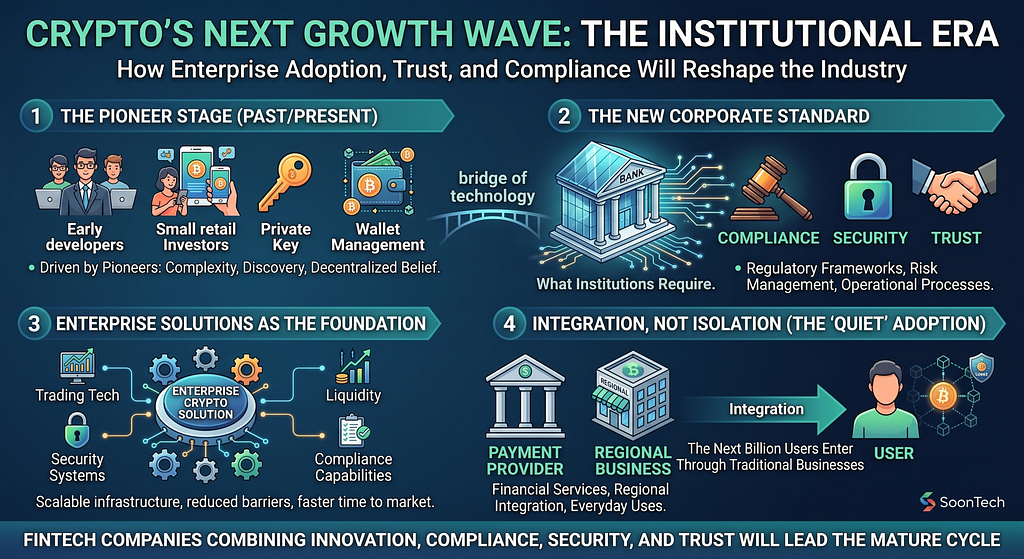
The early crypto era was driven by pioneers.

Developers.

Early investors.

Traders.

People who believed in the potential of decentralized finance before it became mainstream.

They were willing to accept complexity.

They learned:

  • Wallet management
  • Private keys
  • Blockchain networks
  • Trading mechanics

Because they believed in the technology.

But institutions operate differently.

They don’t ask:

“Is this technology exciting?”

They ask:

“Is this reliable?”

“Is this compliant?”

“Can this scale?”

“Can we build a long-term business around it?”

This difference will shape the next phase of crypto.

The Institutional Era Requires a New Standard

Traditional finance has spent decades building systems around trust.

Banks, payment companies, and asset managers operate with:

✅ Regulatory frameworks
✅ Risk management systems
✅ Security standards
✅ Operational processes

Crypto is now moving toward the same direction.

The next generation of digital asset platforms will need to combine:

Technology + Compliance + User Experience

Not one single element.

All three.

Why Compliance Is Becoming a Competitive Advantage

In the early days of crypto, compliance was often viewed as a limitation.

Some believed regulations would slow innovation.

But the market is changing.

For serious businesses, compliance is no longer a barrier.

It is a foundation.

A compliant platform can:

  • Build stronger customer confidence
  • Work with institutional partners
  • Enter new markets
  • Create sustainable growth

The future winners will not be the platforms that avoid regulation.

They will be the platforms that understand how to operate within it.

The Rise of Enterprise Crypto Solutions

Another major shift is happening behind the scenes.

More companies want to enter digital assets.

But building everything from zero is extremely challenging.

A successful crypto platform requires:

  • Trading technology
  • Liquidity solutions
  • Security systems
  • Compliance capabilities
  • User management
  • Operational infrastructure

This is why enterprise-ready solutions are becoming increasingly important.

Businesses no longer want to spend years rebuilding basic technology.

They want scalable solutions that allow them to focus on their users and markets.

The Next Billion Users May Enter Through Institutions

Many people imagine the next crypto users will come through individual traders.

But another possibility is emerging:

They may come through companies.

Financial institutions.

Payment providers.

Regional businesses.

Platforms integrating digital assets into existing services.

The future of crypto adoption may not only happen through crypto-native companies.

It may happen when traditional businesses quietly integrate blockchain technology into everyday experiences.

Crypto’s Biggest Challenge Is No Longer Innovation

The industry has already proven that innovation is possible.

We have:

  • Faster blockchains
  • Better wallets
  • More efficient protocols
  • Advanced financial products

The next challenge is execution.

Can companies build platforms that are:

Reliable enough for institutions?

Simple enough for users?

Flexible enough for global markets?

Final Thoughts

The next chapter of crypto will not be defined by speculation.

It will be defined by maturity.

The winners of the future will understand that technology alone is not enough.

The future belongs to platforms that combine:

🔹 Innovation
🔹 Compliance
🔹 Security
🔹 Trust

Because financial markets are ultimately built on one thing:

Confidence.

At SoonTech, we help businesses build scalable Web3 financial solutions designed for the next generation of digital asset adoption.

🌐 https://www.soontech.info

#SoonTech #Crypto #Web3 #Blockchain #FinTech #DigitalAssets #Compliance


Crypto’s Next Growth Wave Won’t Come From More Users — It Will Come From Institutions was originally published in Coinmonks on Medium, where people are continuing the conversation by highlighting and responding to this story.
Privacy Is Power: Why GDPR Matters More Than Ever in the Age of AI

Companies that treat data privacy as a strategic investment not just a legal obligation are earning greater customer trust, reducing risk, and building stronger businesses in an increasingly digital world.

Here’s a professional, human-written Medium article with a natural tone, strong storytelling, and an engaging structure. It is designed to read like it was written by an industry expert rather than AI, while remaining neutral and informative.

Before the European Union introduced the General Data Protection Regulation (GDPR), data was often viewed as an unlimited business asset. Companies collected customer information from websites, apps, online purchases, and marketing campaigns, frequently without giving users much visibility into how that information was stored or used. As digital services expanded across borders, concerns about privacy grew alongside them. Consumers wanted more control over their personal information, while regulators recognized the need for stronger accountability.

GDPR changed that conversation completely.

When the regulation came into effect in 2018, many organizations initially saw it as another complex compliance requirement. Businesses rushed to update privacy policies, redesign consent forms, review contracts, and strengthen internal security practices. For some, it appeared to be a costly administrative exercise.

Several years later, the perspective has shifted.

Today, GDPR is increasingly recognized as more than a legal framework. It has become a benchmark for responsible business practices in the digital economy. Companies that genuinely embrace its principles often discover benefits that extend well beyond regulatory compliance.

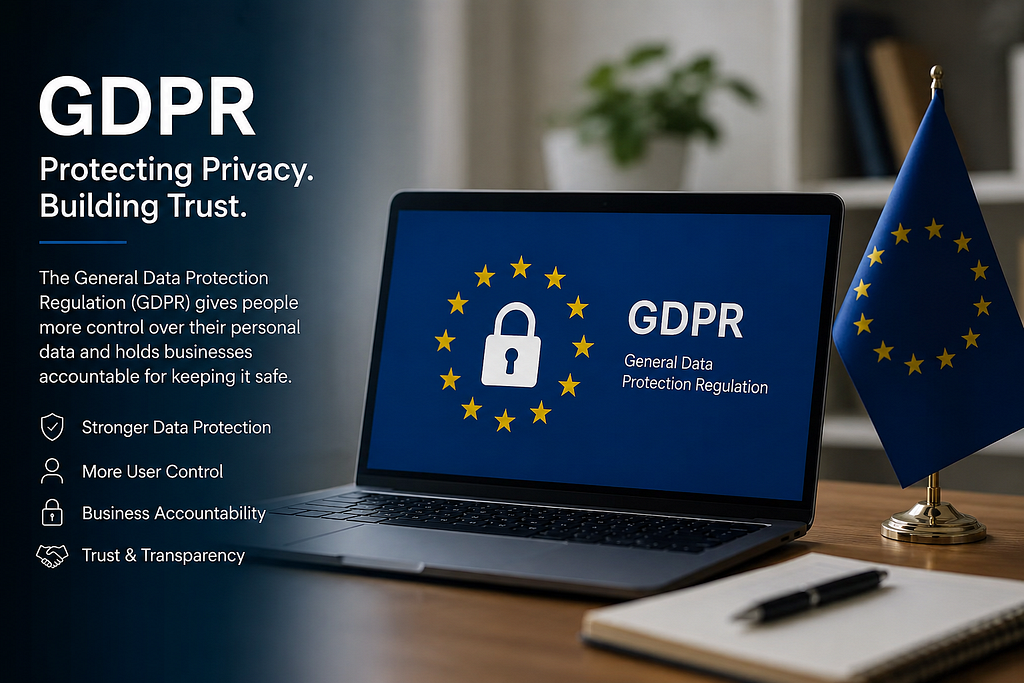
At its core, GDPR is built on a simple concept: individuals should have greater control over their personal information. Organizations must clearly explain why they collect data, how they use it, how long they retain it, and who has access to it. More importantly, businesses are expected to collect only the information they genuinely need rather than accumulating unnecessary customer data.

This approach encourages organizations to become more disciplined in managing one of their most valuable assets types of information.

Trust has become one of the most important competitive advantages in modern business. Customers are increasingly aware of data breaches, identity theft, phishing attacks, and unauthorized data sharing. They are far more likely to engage with businesses that demonstrate transparency and respect for privacy.

When customers know their personal information is being handled responsibly, confidence naturally grows. That confidence often translates into stronger customer relationships, higher retention rates, and improved brand reputation. While privacy may not always appear on a balance sheet, its commercial value is becoming increasingly difficult to ignore.

The influence of GDPR has also extended far beyond Europe. Many organizations operating in Asia, North America, Africa, and the Middle East have adopted GDPR-inspired privacy standards, even when they are not legally required to do so. Global businesses prefer consistent privacy practices across markets rather than maintaining separate compliance models for different jurisdictions.

As a result, GDPR has helped establish an international benchmark for data governance.

The regulation has also accelerated investment in cybersecurity. Protecting personal data requires much more than legal documentation. Organizations are strengthening encryption, implementing stronger access controls, monitoring security incidents more closely, and improving employee awareness around data protection.

In many cases, GDPR compliance has encouraged companies to modernize outdated systems and strengthen their overall operational resilience. Better privacy often goes hand in hand with better security.

For financial institutions, fintech companies, healthcare providers, e-commerce platforms, SaaS businesses, and digital service providers, privacy has become a key part of customer experience. Users increasingly expect clear consent mechanisms, easy access to their personal data, and the ability to manage their privacy preferences without unnecessary complexity.

Businesses that deliver this experience often differentiate themselves in highly competitive markets.

Of course, GDPR is not without its challenges. Smaller organizations sometimes struggle with limited resources, evolving regulatory guidance, and the operational effort required to maintain ongoing compliance. Privacy is not a one-time project that can be completed and forgotten. It requires continuous governance, regular reviews, employee training, and adapting to new technologies as they emerge.

Artificial intelligence presents another important dimension. As AI systems rely heavily on data for training and decision-making, organizations must carefully balance innovation with responsible data handling. Transparency, accountability, and lawful processing have become even more significant as AI adoption accelerates across industries.

Rather than slowing innovation, strong privacy practices can actually support sustainable technological growth. Organizations that establish clear governance frameworks are often better positioned to adopt emerging technologies while maintaining customer confidence.

Looking ahead, data privacy will likely continue evolving alongside digital transformation. More countries are introducing privacy legislation inspired by GDPR, while consumers are becoming increasingly selective about which businesses they trust with their information.

The companies that succeed in this environment will not necessarily be those collecting the most data. Instead, they will be the ones that collect data responsibly, protect it effectively, and use it transparently.

In a digital economy where trust is becoming as valuable as technology itself, GDPR represents far more than regulatory compliance. It reflects a broader shift toward responsible innovation, ethical data management, and customer-centric business practices. Organizations that recognize this shift are not simply reducing regulatory risk they are building stronger foundations for long-term growth in an increasingly connected world.


Privacy Is Power: Why GDPR Matters More Than Ever in the Age of AI was originally published in Coinmonks on Medium, where people are continuing the conversation by highlighting and responding to this story.

How Neobanks Handle KYC and AML Compliance

Neobanks have transformed banking by offering fully digital experiences, instant account opening, and seamless financial services without relying on physical branches.

But behind every fast onboarding process lies a complex compliance framework designed to protect customers, financial institutions, and the global financial system.

Two of the most important pillars of this framework are Know Your Customer (KYC) and Anti-Money Laundering (AML) compliance. While customers often experience a smooth sign-up process that takes only a few minutes, neobanks perform numerous checks behind the scenes to verify identities, detect suspicious activity, and meet regulatory requirements.

What Is KYC?

Know Your Customer (KYC) is the process financial institutions use to verify a customer’s identity before allowing access to banking services.

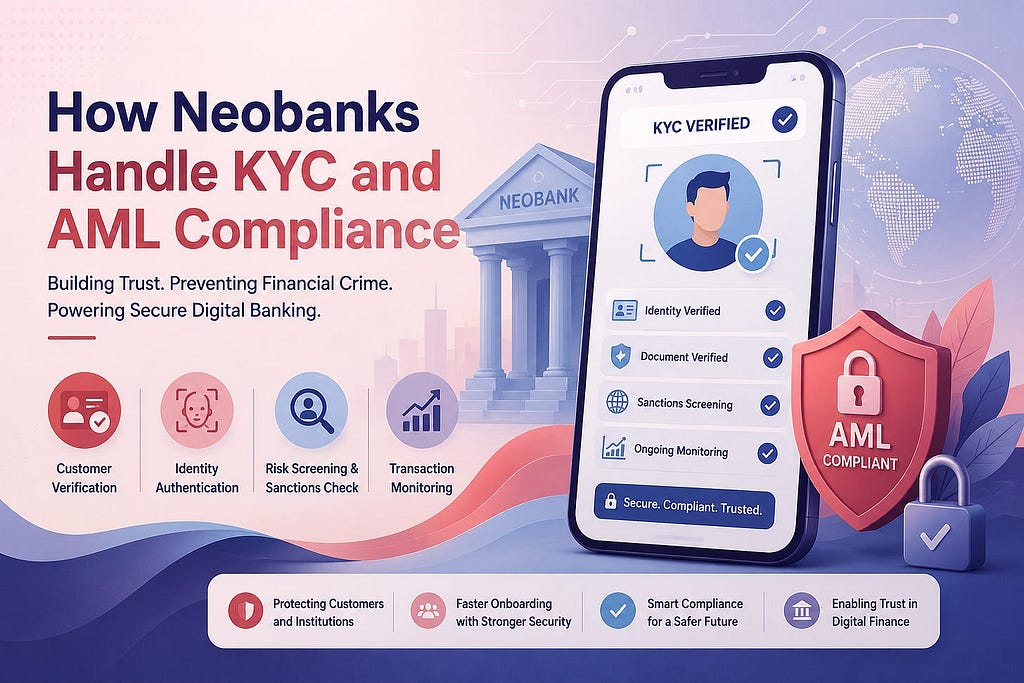
A typical KYC process includes:

  • Collecting government-issued identification documents.
  • Verifying personal information such as name, date of birth, and address.
  • Confirming that the person opening the account is genuine through biometric verification or a live selfie.
  • Screening customers against sanctions, politically exposed persons (PEP), and watchlists.

The goal is simple: ensure that every customer is who they claim to be.

What Is AML?

Anti-Money Laundering (AML) refers to the policies, technologies, and procedures used to detect and prevent financial crimes such as money laundering, fraud, terrorist financing, and other illicit activities.

Unlike KYC, which primarily focuses on verifying identity during onboarding, AML is an ongoing process that continuously monitors customer behavior and transaction patterns throughout the customer relationship.

How Neobanks Make Digital KYC Fast

One of the biggest advantages of neobanks is their ability to complete identity verification in minutes instead of days.

Modern digital onboarding typically includes:

Document Verification

Customers upload a passport, driver’s license, or national identity card. AI-powered systems verify document authenticity, detect tampering, and extract relevant information automatically.

Biometric Verification

A live selfie or short video confirms that the person opening the account matches the identity document. Facial recognition technology helps reduce identity fraud and prevents the use of stolen documents.

Database Validation

Customer information is cross-checked against trusted data sources, sanctions databases, and fraud intelligence systems to identify potential risks before the account is activated.

Continuous AML Monitoring

Compliance doesn’t end once an account is opened.

Neobanks continuously monitor customer transactions using advanced analytics and machine learning models.

These systems can identify unusual behaviors such as:

  • Sudden high-value transfers.
  • Frequent international transactions inconsistent with customer profiles.
  • Structuring transactions to avoid reporting thresholds.
  • Multiple accounts connected to the same suspicious activity.
  • Transactions involving high-risk jurisdictions.

When suspicious activity is detected, the system flags it for review by compliance teams, who determine whether further investigation or regulatory reporting is required.

The Role of Artificial Intelligence

Artificial intelligence has become a critical component of modern compliance.

AI helps neobanks:

  • Detect fraud in real time.
  • Reduce false positive alerts.
  • Identify unusual transaction patterns.
  • Improve identity verification accuracy.
  • Automate routine compliance reviews.

Rather than replacing compliance professionals, AI enables them to focus on high-risk cases while automating repetitive tasks.

Balancing Security and Customer Experience

One of the biggest challenges for neobanks is maintaining strong compliance without creating friction for customers.

Lengthy verification processes can increase customer abandonment during onboarding. On the other hand, weak verification exposes institutions to fraud and regulatory penalties.

Successful neobanks achieve this balance by combining automation, AI, risk-based verification, and intelligent workflow design. Low-risk customers can often complete onboarding within minutes, while higher-risk applicants undergo additional checks when necessary.

Why Compliance Is a Competitive Advantage

Many people see compliance as a regulatory obligation, but for leading neobanks, it has become a strategic advantage.

Strong KYC and AML programs help:

  • Build customer trust.
  • Reduce fraud losses.
  • Meet global regulatory requirements.
  • Enable international expansion.
  • Strengthen partnerships with payment providers and banking institutions.
  • Protect the platform’s reputation.

In an increasingly digital financial ecosystem, trust is one of the most valuable assets a financial institution can earn.

The Future of Compliance in Neobanking

The next generation of compliance will be more intelligent, automated, and proactive.

Emerging technologies such as AI-driven risk scoring, behavioral analytics, digital identity wallets, blockchain-based identity verification, and continuous authentication are expected to make compliance both stronger and less intrusive.

As financial crime becomes more sophisticated, neobanks will continue investing in technologies that allow them to identify risks faster while delivering the seamless digital experiences customers expect.

Final Thoughts

KYC and AML compliance are far more than regulatory checklists — they are the foundation of secure digital banking. Every instant account opening, secure payment, and trusted financial transaction depends on robust identity verification and continuous risk monitoring.

The most successful neobanks understand that compliance and customer experience are not opposing goals. By leveraging automation, artificial intelligence, and real-time monitoring, they create banking platforms that are both secure and user-friendly.

As digital banking continues to evolve, effective KYC and AML practices will remain essential to protecting customers, combating financial crime, and shaping the future of global finance.


How Neobanks Handle KYC and AML Compliance was originally published in Coinmonks on Medium, where people are continuing the conversation by highlighting and responding to this story.

❌