Reading view

There are new articles available, click to refresh the page.

Justin Sun Establishes the Justin Sun Prize: “My Wealth Came from Mathematics and Will Return to Mathematics”

Geneva, Switzerland September 16, 2026 — The Office of Justin Sun today announced the establishment of the Justin Sun Prize, a zero-trust, decentralized academic bounty mechanism based on a “problem list,” with breakthroughs in fundamental disciplines and machine formal verification as the criteria for awarding prizes, and a top prize of up to US$1 million for a single problem. The prize seeks to redefine scientific rewards in the AI era and accelerate fundamental scientific research through collaboration between humans and AI.

The first list of Justin Sun Prize winners was also announced, recognizing solutions and formalized proofs involving 66 mathematical problems. The top prize, worth US$1 million, was awarded to the OpenAI research team in recognition of its solution and formalized proof for the Existence and Smoothness of the Three-Dimensional Navier–Stokes Equations problem. According to information published by OpenAI, the relevant proof was produced by its internal model, and the Lean formalization and verification were completed by GPT‑6 Astra.

This problem concerns the Navier–Stokes equations, which describe the motion of fluids and are commonly abbreviated as the N–S equations. The equations were developed in the 19th century by French physicist Claude-Louis Navier, Irish-born British mathematician George Gabriel Stokes, and others, and have a history of approximately two hundred years. In 2000, the Clay Mathematics Institute listed the Navier–Stokes Existence and Smoothness problem as one of the seven Millennium Prize Problems and offered a US$1 million reward for its solution.

The Justin Sun Prize does not use traditional nominations or credential thresholds as barriers to entry, nor does it operate on a four-year cycle or the rhythm of lifetime achievement. Instead, it ties the prize directly to mathematical problems and machine-verifiable formalized proofs. Anyone can receive the prize as long as they are the first to achieve a qualifying breakthrough.

The vision of the Justin Sun Prize is to become the “Nobel Prize of the AI Era,” responding to the profound transformation of scientific research and incentives in the new era in a more decentralized, formalized, and machine-driven way. The repository of mathematical problems and formalized code will be maintained and publicly updated on an ongoing basis. Once a problem is listed, it is locked in: problems can be added only, never removed; awarded prize funds do not need to be returned under any circumstances. The current problem list already includes formal verification of the Poincaré Conjecture, the Riemann Hypothesis, Goldbach’s Conjecture, and a large number of unsolved problems proposed during the lifetime of the late mathematician and Wolf Prize laureate Paul Erdős.


In addition to the prize, winners will also receive a certificate and a medal. The edge of the medal is inscribed with the Latin phrase “Quod probatur, solvitur,” meaning “Proved, then paid.”

  The Justin Sun Prize adheres to three core principles: openness, public benefit, and open source. It is open to all eligible contributors, with no restrictions based on nationality, institution, or identity, and makes no distinction between humans and AI; funds are used exclusively for prize awards and open initiatives and are not intended for profit; the problem list, confirmation standards, proofs, and verification materials are all made available to the public through GitHub, while prize disbursement records are recorded on-chain for permanent traceability and immutability.

  “An award named after a person is the least political thing in the world,” said Sun. “More importantly, it gives me an answer to myself—my wealth is rooted in mathematics. It came from mathematics, and it will return to mathematics.” 


According to public records, Sun has donated more than US$45 million across technology, environmental protection, disaster relief, and other fields. The Justin Sun Prize will become a central focus of Sun’s philanthropic efforts, continuing to support breakthroughs in fundamental science through an open and verifiable model.


The prize will be paid out in either USDT on TRON (TRC-20) or USDC on Ethereum (ERC-20) based on the recipient’s choice. For more information, please visit www.hejustinsun.com/prize


About the Office of Justin Sun

The Office of Justin Sun supports Justin Sun’s global business, philanthropic and public initiatives across technology, blockchain, artificial intelligence, scientific research, investment, art and space exploration. 


Justin Sun is the Ambassador and former Permanent Representative of Grenada to the World Trade Organization and the Founder of TRON. TRON is the leading blockchain for the stablecoin revolution, processing over $13 trillion in volume since its inception. In the world’s emerging markets, people rely on USDT on TRON to access the global financial system.


A protégé of Alibaba founder Jack Ma, Sun has been recognized internationally for his work in the digital asset industry, including a Forbes cover profile in April 2025 and multiple appearances on the Forbes 30 Under 30 list. In August 2025, he flew aboard Blue Origin’s NS-34 mission, becoming the 712th person in history to travel to space. His broader interests span technology, investment, philanthropy, art, gaming, and space exploration.


Office of Justin Sun Contact:

info@hejustinsun.com 


About Justin Sun Prize 

The Justin Sun Prize is an academic initiative established by Justin Sun to support advances in mathematics, formal verification, and AI-assisted scientific discovery. The prize is decentralized and built around the principle that mathematical work should be judged by the strength, rigor, and verifiability of the proof itself, not the prestige or reputation of those submitting it.


Justin Sun established the prize in his own name as a long-term commitment to return wealth created through mathematics and technology back to mathematics itself. Its legacy is intended to be defined by the body of work it recognizes and the laureates whose discoveries stand the test of time. The prize links clearly defined mathematical challenges to machine-verifiable proof. Its guiding principles are openness, public benefit and open-source access.


Visit https://www.hejustinsun.com/prize for more information. 


Contact:

thejustinsunprize@hejustinsun.com 

MEXC Releases July–August Security Report: Over 38 Million USDT in Risk-Related Funds Intercepted, Futures Insurance Fund Reaches 792 Million USDT

Mutsamudu, Comoros, September 16, 2026 – MEXC, a pioneer in 0-fee digital asset trading, has released its July–August 2026 security report. The report shows that MEXC successfully intercepted all 215 reports involving risk-related funds during the period, covering approximately 38.66 million USDT. The total balance of the Futures Insurance Fund rose to 792 million USDT. Meanwhile, the reserve ratios for BTC, ETH, USDT, and USDC all remained above 100%.


In July and August 2026, the crypto industry recorded 184 security incidents, with reported losses totaling approximately $535 million. Phishing and fraud incidents, together with endpoint and supply-chain security incidents, accounted for approximately 48% of the total. At the same time, a growing number of attackers are using AI to auto-generate phishing content and help write malware, increasing the efficiency of their attacks. As attack methods become more diverse, promptly identifying and intercepting risk-related funds and strengthening cross-platform investigation have become increasingly important to reducing user losses.


All 215 Reports of Risk-Related Funds Successfully Intercepted, Covering 38.66 Million USDT

In July and August, MEXC assisted with 215 reports involving externally stolen or fraud-related funds flowing into the platform. All 215 cases were successfully intercepted, covering 38,655,490 USDT. Of these cases, 42 involved assistance with judicial freezes. Compared with the previous reporting period, the number of successfully intercepted cases increased by approximately 2,971%, while the value of intercepted funds increased by approximately 12,646%.


In tracking and handling risk-related funds, MEXC shared suspicious addresses with major industry participants, assisted in identifying fund flows, and supported verification and freezing procedures under established joint-investigation and law-enforcement cooperation procedures.


Over 20,000 Risk-Related Accounts Identified and Restricted, With More Than 600,000 USDT in Misdirected Assets Returned

In account risk identification, MEXC identified and restricted 20,752 accounts associated with risk-related activities during the period, an increase of 118.03% from the previous reporting period. The platform identified 5,288 risk groups, up 20.35%. By region of origin, these groups were concentrated primarily in the Commonwealth of Independent States (1,803), Nigeria (1,099), and Indonesia (976).


For user asset recovery, MEXC manually processed 818 applications for the return of misdirected assets, returning the equivalent of 602,225 USDT, an increase of 75.31% from the previous reporting period.


Futures Insurance Fund Reaches 792 Million USDT, Strengthening Protection Against Negative Balance Risk

As of September 1, 2026, the total balance of the MEXC Futures Insurance Fund reached 791,696,422 USDT, an increase of 5.44% from the previous reporting period.


The Futures Insurance Fund covers negative balances that may arise during liquidation, providing a risk buffer during extreme market conditions and helping reduce the likelihood of auto-deleveraging (ADL). When a liquidated position is closed at a price better than the bankruptcy price, the remaining funds are credited to the fund. Users can view the real-time balance on the MEXC Proof of Trust page.


Reserve Ratios for Four Major Assets Remain Above 100%, With BTC at Approximately 288%

According to the proof of reserves disclosed for this period, MEXC maintained reserve ratios above 100% for four major assets, as follows:


  • Bitcoin (BTC): reserve ratio of approximately 288%, with total wallet assets of 12,312.75 BTC against 4,282.20 BTC in user assets;
  • Ethereum (ETH): reserve ratio of approximately 113%, with total wallet assets of 66,227.79 ETH;
  • USDT: reserve ratio of approximately 115%, with total wallet assets of approximately 1.940 billion USDT;
  • USDC: reserve ratio of approximately 114%, with total wallet assets of approximately 194.85 million USDC.


The on-chain addresses corresponding to these reserve assets have been disclosed, allowing users to verify through the Merkle Tree whether their individual account balances were included in this proof of reserves.


As an additional layer of user asset protection, the MEXC Guardian Fund maintains a dual-reserve structure of USDT and BTC: USDT provides immediate liquidity support, while BTC serves as a long-term reserve asset across market cycles. MEXC plans to expand the fund from $100 million to $500 million, continuing to strengthen user asset protection. The relevant holding addresses are listed below:


Guardian Fund Wallet Addresses:

  • USDT: 0x469AfE803C54A36674C55231489Cf4b61da8c1bC
  • BTC: 1MDVjZdX8QD212pT8Z8EMP7DuFQHKqN3mx


MEXC CEO Vugar Usi said, “Trust is the true reserve currency of this industry. Protecting user assets means moving decisively the moment risk emerges, while giving users something they can verify for themselves, not just our word for it. We will continue to strengthen our ability to identify and intercept risk-related funds, deepen cooperation across platforms and with law enforcement, and help affected users recover their losses wherever possible. Our bi-monthly security reports are part of that commitment, allowing our security performance to be measured and tracked over time.”


About MEXC

Founded in 2018, MEXC is a leading global multi-asset trading platform built as your 0-fee gateway to infinite opportunities. Serving users across 170+ markets, MEXC provides simple and efficient access to crypto, stocks, tokenized assets, derivatives, and a growing range of TradFi-linked opportunities through one account and one gateway.


With 0 trading fees, deep liquidity, broad asset coverage, and a high-performance trading experience, MEXC is designed for retail users who want to discover earlier, act faster, and trade with fewer barriers. As crypto and traditional finance continue to converge, MEXC is committed to making global opportunities more accessible, helping users trade freely and MEXCmize every opportunity.


MEXC Official Website X TelegramHow to Sign Up on MEXC

For media inquiries, please contact MEXC PR team: media@mexc.com


Source

AI Agent Statistics 2026: Every Number Checked at Its Source

The most-quoted AI agent statistics count intent, and real use in any single department is no more than 10 percent, finds a source-checked analysis by bdautomated

75 figures from 18 publishers traced to the original reports, with who was asked and what counted; the dataset is free to download

15 September 2026. bdautomated today published “AI agent statistics 2026: every number checked at its source”, a free reference page and dataset that traces 75 widely quoted statistics about AI agents and AI use in business back to the documents they came from.

The analysis finds that the numbers disagree because they count different things. In McKinsey’s 2025 global survey, 62 percent of organizations were at least experimenting with AI agents, 23 percent had scaled one somewhere in the company, and in any single business function no more than 10 percent had. Surveys that count any adoption or intent report far higher figures: 79 percent of U.S. executives told PwC in April 2025 that agents were already being adopted in their companies, while a Capgemini survey that re-checked what respondents meant by “agent” found 14 percent had implemented one. Across all U.S. businesses of every size, the Census Bureau found 19.8 percent using AI in any business function as of May 2026.

The page also decodes the figure that rattled markets in 2025. MIT Project NANDA’s finding that “95 percent of organizations are getting zero return” measured profit-and-loss impact within roughly six months of a pilot, in a sample of 52 interviews, 153 conference survey responses and 300 public deployments, and its authors call the findings preliminary. It does not say that 95 percent of AI projects fail. Gartner’s prediction that over 40 percent of agentic AI projects will be canceled by the end of 2027 is a forecast from June 2025; nobody has counted the cancellations yet.

Every figure on the page passed four checks: the number appears in the original document; the exact place and a verbatim quote are recorded; what it measures is written in plain words, including who was asked, how many and when; and it is set against the other sources, with disagreements shown rather than averaged. Market-size forecasts were left out because the reports behind them are paid and cannot be checked. The dataset is published as CSV and JSON under a CC BY 4.0 licence, and the page carries a corrections address.

“Two headlines in the same week said almost nobody has AI agents running and almost everybody does, and both were quoting real surveys. We wanted the page we could not find: what each survey actually asked, so a business owner can tell which number is about a company like theirs,” said a spokesperson for bdautomated.

The page includes four charts that other publications may embed with attribution, and a table of all 75 figures with their sources, dates, samples and quotes.

Read the analysis: https://bdautomated.com/ai-agent-statistics/ checked 2026-09-15 webfetch: “AI Agent Statistics 2026: Every Number Checked at Its Source”

Download the data: https://bdautomated.com/data/ai-agent-statistics.csv checked 2026-09-15 webfetch: “id,cat,value,num,stat,counts,src,doc,date,sample,place,quote,url,verdict”

About bdautomated bdautomated builds The Book, a named staff of AI agents installed in the accounts a company already runs on. The agents research, prepare, draft, chase and check, each at the level of autonomy the customer sets. bdautomated hosts nothing and stores no customer records. https://bdautomated.com/

Media contact

contact@bdautomated.com

X- https://x.com/bdautomated

Digital Asset Leaders Converge at KBW2026 as Partner Lineup Unveiled

  • Upbit joins as Presenting Partner, with 0G and BRV confirmed as Official Conference Partners
  • Stable and Tria join as Diamond Sponsors, while BitGo comes on board as Official Institutional Sponsor
  • Kyoungsuk Oh, Michael Heinrich, Brian Mehler, John Lilic and Mike Belshe among featured speakers


Korea Blockchain Week 2026 with Upbit (KBW2026), Asia’s leading digital asset conference, has unveiled its partner lineup, bringing together major players across exchanges, blockchain infrastructure, stablecoins and institutional digital assets.

FACTBLOCK, the organizer of KBW2026, announced on August 31 that Upbit, 0G, BRV, Stable, Tria and BitGo will participate as key sponsors of this year’s event. Beyond brand partnerships, CEOs and founders from the participating companies will also take the stage as speakers to discuss some of the most significant shifts shaping the global digital asset industry.

Upbit is the Presenting Partner of KBW2026. Kyoungsuk Oh, CEO of Upbit, will also speak at the conference, sharing his perspective on changes in the global digital asset market and the role of Korea. Through its partnership with Upbit, KBW2026 will broaden the conversation around Korea’s digital asset market beyond retail investors to include institutional participation and global financial markets.

Decentralized AI infrastructure company 0G and global venture capital firm BRV will participate as the Official Conference Partners. Michael Heinrich, Co-Founder and CEO of 0G Labs, will take the KBW2026 main stage to explore the rise of the agent economy and how decentralized infrastructure is creating a new foundation for AI.

0G is the trust layer for AI, bringing together verifiable compute, private inference, decentralized storage and an AI-native blockchain to power the next generation of AI applications and autonomous agents. BRV will also join as a Conference Partner, further strengthening KBW2026’s global investment and industry network.

Global digital asset infrastructure company BitGo will participate as the Official Institutional Sponsor. BitGo Korea, whose strategic shareholders include Hana Financial Group and SK Telecom, recently secured acceptance of its Virtual Asset Service Provider (VASP) registration from Korea’s Financial Intelligence Unit (KoFIU), establishing a regulatory foundation for its domestic operations. Mike Belshe, Co-Founder and CEO of BitGo, will also speak at KBW2026.

Stable and Tria will participate as Diamond Sponsors. Brian Mehler, CEO of Stable, and John Lilic, Co-Founder and Chief Strategy Officer of Tria, will each take the stage at KBW2026. Stable is building blockchain infrastructure optimized for stablecoin payments and transfers, while Tria is building financial infrastructure enabling businesses and AI agents to transact across blockchains and digital assets, powering its growing stablecoin neobank.

This year’s sponsor lineup reflects the continued expansion of the global digital asset industry beyond trading and investment into institutional finance, payments, stablecoins, AI and next-generation infrastructure. With senior executives from many of these companies participating not only as sponsors but also as speakers, KBW2026 will offer attendees a firsthand look at the strategies of companies driving the industry’s next phase of growth.

KBW2026 will take place in Seoul from September 29 to October 1. The Upbit Institutional Summit (UIS), an invite-only gathering focused on institutions and the financial sector, will be held on September 29, followed by the KBW2026 main conference from September 30 to October 1.

Andrew Park, CEO of FACTBLOCK, said, “This year, KBW is bringing together key partners that are shaping the next stage of the industry, spanning exchanges, institutional digital asset infrastructure, AI, stablecoins and next-generation financial services. With senior executives from these companies also taking the stage as speakers, KBW2026 will provide a valuable opportunity to see where the most important changes in the global digital asset market are emerging.

MEXC’s September 2026 Proof of Reserves Reaffirms Full Backing of User Assets, BTC Reserve Ratio Increases to 297%

Mutsamudu, Comoros, September 15, 2026 MEXC, a pioneer in 0-fee digital asset trading, has released its September 2026 Proof of Reserves (PoR) report, audited by Hacken, confirming that user assets remain fully backed across all major reserve assets. The BTC reserve ratio increased to 297%, up from 288% in August. MEXC continues to disclose reserve data on a monthly basis, aiming to enhance transparency and safeguard the security of user funds.


According to the audited report, dated as of the September 10, 2026 snapshot, reserve ratios for all disclosed assets are as follows:

BTC: 297%. Reserves of 12,202.13 BTC cover 4,106.57 BTC in user holdings.

USDT: 119%. Reserves of 1,818,202,910.24 USDT cover 1,526,526,878.38 USDT in user holdings.

USDC: 111%. Reserves of 299,925,929.77 USDC cover 269,894,125.25 USDC in user holdings.

ETH: 111%. Reserves of 58,917.60 ETH cover 53,243.98 ETH in user holdings.

MEXC verifies its reserves through Merkle Tree technology, allowing individual users to confirm their balances are included in the total reserve calculation without exposing other users’ data. For this month’s audit, Hacken conducted a comprehensive evaluation of MEXC’s reserves, covering Proof of Liabilities, Proof of Ownership, Reserves Calculation, and a PoR Assessment. Hacken confirmed that MEXC’s reserves exceed a 1:1 ratio across all in-scope assets, fully covering user liabilities.


“Protecting user assets and earning their trust are fundamental responsibilities, not optional commitments,” said Vugar Usi, CEO of MEXC. “In an industry where confidence has been tested time and again, transparency must be demonstrated through actions that users can independently verify. That is why we publish verifiable Proof of Reserves every month, giving users the ability to validate their asset data at any time rather than simply relying on our assurances. Our commitment is to continue raising the standard for transparency, accountability, and asset protection, and to build the kind of trust that is earned consistently over time.”


To further protect user assets, MEXC maintains the Futures Insurance Fund, which absorbs losses from liquidations triggered by extreme market conditions. The fund held a balance of approximately 798 million USDT as of press time. MEXC also operates The Guardian Fund, a dual-reserve structure combining USDT and BTC holdings that offers full compensation coverage for platform-related issues. It held a balance of $101 million as of press time and plans to expand to $500 million within two years.


To view the latest Proof of Reserves snapshot and audit report, please visit the MEXC Proof of Reserves page.


About MEXC

Founded in 2018, MEXC is a leading global multi-asset trading platform built as your 0-fee gateway to infinite opportunities. Serving users across 170+ markets, MEXC provides simple and efficient access to crypto, stocks, tokenized assets, derivatives, and a growing range of TradFi-linked opportunities through one account and one gateway.


With 0 trading fees, deep liquidity, broad asset coverage, and a high-performance trading experience, MEXC is designed for retail users who want to discover earlier, act faster, and trade with fewer barriers. As crypto and traditional finance continue to converge, MEXC is committed to making global opportunities more accessible, helping users trade freely and MEXCmize every opportunity.


MEXC Official Website X TelegramHow to Sign Up on MEXC

For media inquiries, please contact MEXC PR team: media@mexc.com


Risk Disclaimer:

This content does not constitute investment advice. Given the volatility of financial markets, including digital assets, tokenized assets, and traditional financial products, investors should carefully assess market conditions, underlying asset fundamentals, and potential financial risks before making any investment or trading decisions.


Source

MEXC Reports 21% MoM Growth in New-Token Traders and 31% Increase in Tokenized Stock Trading Volume in August

Mutsamudu, Comoros, September 14, 2026 – MEXC, a pioneer in 0-fee digital asset trading, has released its August trading data for new tokens and TradFi assets. The number of users trading new tokens rose 21% month over month, while the top-performing token posted a peak gain of 14,143%. During the same period, TradFi Spot trading volume increased 13% month over month, led by a 31% rise in tokenized stock trading volume. From early-stage tokens to tokenized stocks, trading activity on MEXC expanded across both crypto and traditional asset markets in August.


In the new-token market, the number of users trading new tokens on MEXC rose 21% month over month in August. The top 10 tokens by peak gain recorded an average peak gain of 3,358%, up 145% month over month, with Niu Lai (牛来) ranking first at 14,143%. Five of these tokens also ranked among the top 10 by Spot trading volume, collectively accounting for 65% of trading volume among the top 10 new tokens by volume. Among the top 10 tokens by trading volume, five memecoins contributed 55% of total volume, while AI, RWA, DeFi, and cross-chain infrastructure projects accounted for the remaining 45%. While memecoins led trading activity, utility-focused projects across AI, RWA, and DeFi also attracted strong interest.


During the same period, TradFi Spot activity expanded further into stock-related assets. Tokenized stock trading volume rose 31% month over month in August, making it the main driver of TradFi Spot growth. Tokenized stocks including CRCL, NBIS, and SPCX ranked among the top 10 assets by trading volume. Gold-related assets also remained active, with GOLD (PAXG) trading volume rising 43% month over month and ranking first in TradFi Spot.


Precious metals Futures showed a clearer divergence. Trading volume rose 32% month over month in August, keeping precious metals the largest asset class by volume in TradFi Futures. XAU volume increased 57% and SILVER rose 39%, while XAUT declined 10%. This indicates growth was concentrated primarily in XAU and silver-related assets rather than spread evenly across the category.


As trading demand grew across both crypto and traditional markets, MEXC supported participation through a range of campaigns and product access points. During the month, the platform launched three flagship campaigns focused on TradFi, xStocks, and MOVE, each with a total prize pool of 1 million USDT. The “TradFi Million-Dollar Gala” attracted more than 174,000 registrations and generated an average daily trading volume of 4.2 billion USDT. The xStocks flagship campaign featured tokenized stocks including NVDAX, CRCLX, and TSLAX, further expanding user access to markets linked to traditional assets.


MEXC CEO Vugar Usi said, “Whether users are looking at early-stage tokens, stocks, or precious metals, they want fast and convenient access when new trading opportunities emerge. MEXC will continue expanding its cross-asset coverage, reducing unnecessary friction between markets, and giving users more flexibility to trade different asset classes on a single platform”


About MEXC

Founded in 2018, MEXC is a leading global multi-asset trading platform built as your 0-fee gateway to infinite opportunities. Serving users across 170+ markets, MEXC provides simple and efficient access to crypto, stocks, tokenized assets, derivatives, and a growing range of TradFi-linked opportunities through one account and one gateway.


With 0 trading fees, deep liquidity, broad asset coverage, and a high-performance trading experience, MEXC is designed for retail users who want to discover earlier, act faster, and trade with fewer barriers. As crypto and traditional finance continue to converge, MEXC is committed to making global opportunities more accessible, helping users trade freely and MEXCmize every opportunity.


MEXC Official Website X TelegramHow to Sign Up on MEXC

For media inquiries, please contact MEXC PR team: media@mexc.com


Source

KuCoin Spotlight Returns With a Gno.land (GNOT) Pre-Listing Subscription, Featuring Pro-Rata Allocation, KCS Holder Benefits and Conditional Buyback Mechanism

  • KuCoin Spotlight returns with a pre-listing subscription for 7,751,938 GNOT at a subscription price of $0.0645 per token.
  • The oversubscription model uses pro-rata allocation, under which eligible subscribers may receive an allocation based on their committed amount.
  • Subscriptions are available in KCS, USDT, and newly added USDG, alongside KCS discounts and optional conditional price protection.


KuCoin Spotlight is returning with a pre-listing subscription for Gno.land (GNOT), offering eligible users access to 7,751,938 GNOT at $0.0645 per token before spot trading begins. The campaign marks the return of Spotlight with an updated participation framework designed to provide a more structured allocation process. The updated format combines pro-rata allocation under an oversubscription mechanism, subscriptions paid with KCS, USDT and USDG, and an optional conditional post-listing buyback mechanism.

Gno.land Joins the Spotlight Lineup

Gno.land, developed by NewTendermint, is an open-source Layer 1 smart-contract platform built around Gno, a deterministic variation of Go designed for on-chain applications. GNOT is the network’s native token used to pay gas for storage deposits, contract execution, and cross-chain interactions.

The addition of Gno.land broadens Spotlight’s coverage of blockchain infrastructure projects by adding a Go-based smart-contract network to its lineup.

Extending the Spotlight Subscription Model

  • Pro-rata allocation for every eligible subscriber: The campaign supports oversubscription, with GNOT distributed proportionally based on each participant’s committed amount. Every eligible user who completes a valid subscription receives an allocation, rather than entering a first-come, first-served or lottery model.
  • Up to 10% off with KCS: Users can subscribe with KCS, USDT, or newly added USDG. KCS subscribers may receive a discount of up to 10% and can use flexibly staked KCS directly without unstaking first.
  • Conditional post-listing buyback: Participants may opt in to the automatic buyback mechanism when subscribing. Eligible allocations may qualify for a buyback at the subscription price if specified conditions are met during the seven days following listing. See the official KuCoin announcement for full terms.


How to Subscribe for GNOT

Eligible users can log in to their KuCoin accounts, visit the KuCoin Spotlight Center, select GNOT and subscribe using KCS, USDT or USDG. Users who wish to participate in the conditional buyback mechanism may opt in during the subscription process.. Learn more in the official KuCoin Announcements.


About KuCoin


Founded in 2017, KuCoin is a leading global crypto platform built on trust and security, serving over 45 million users across 200+ countries and regions. Known for its reliability and user-first approach, the platform combines advanced technology, deep liquidity, and strong security safeguards to deliver a seamless trading experience. KuCoin provides access to 1,500+ digital assets through a broad product suite and remains committed to building transparent, compliant, and user-centric digital asset infrastructure for the future of finance, backed by SOC 2 Type II, ISO/IEC 27001:2022, ISO/IEC 27701:2019, ISO 22301:2019 and ISO/IEC 42001:2023 certifications. In recent years, we have built a strong global compliance foundation, marked by key milestones including AUSTRAC registration in Australia, a MiCA license in Europe, and regulatory progress in other markets.


Learn more at www.kucoin.com.


Disclaimer

The information is for corporate PR purposes only and does not constitute endorsement or investment advice.

Ethena Brings USDe and sUSDe to TRON, Expanding Digital Dollar Access Across Its Stablecoin Ecosystem

Geneva and Lisbon, Sept. 12, 2026 – TRON DAO (“TRON”) and Ethena Labs (“Ethena”) today announced that USDe and sUSDe are live on the TRON network, expanding access to Ethena’s digital dollar products across one of the world’s largest stablecoin settlement networks.


Users can now bridge USDe and sUSDe to TRON through Stargate Finance and hold or transfer both assets across the network. Support across TRON’s core DeFi applications, including JustLend DAO and SUN.io, is expected to roll out over the coming weeks, with broader adoption across wallets, exchanges, and payment applications to follow. USDe on TRON will also remain connected to liquidity across Ethena’s other supported networks, supporting interoperability across Ethena’s broader multichain ecosystem.


USDe brings an additional dollar-denominated asset to TRON, while sUSDe gives TRON’s global user base exposure to Ethena’s rewards-bearing digital dollar product. In turn, Ethena connects with TRON’s global base of over 403 million accounts, where dollar-denominated assets already move at significant scale. 


“Millions of people rely on the TRON network every day to make payments, save, and move value globally,” said Justin Sun, Founder of TRON. “Bringing USDe and sUSDe to TRON broadens the options available to users and further strengthens the network as decentralized infrastructure for everyday use.”


“TRON has a massive user base that already holds and moves digital dollars in significant size,” said Guy Young, Founder of Ethena Labs. “Bringing USDe and sUSDe to that ecosystem means those users can hold a dollar that accrues rewards on the network they already use. This integration is the latest step in our effort to bring our digital dollar products to as many people as possible, and we look forward to continuing to work with the TRON DAO team to find new ways to bring value to TRON’s users.”


The integration marks the latest step in USDe’s multichain expansion, with the asset now supported across more than a dozen networks and integrated with leading centralized exchanges and DeFi applications.


About Ethena Labs


Ethena Labs is the development team behind USDe and USDtb and a contributor to the Ethena protocol. Ethena’s USDe is the fastest growing USD-denominated crypto asset in history, encompassing integrations across some of the largest centralized exchanges and major DeFi applications. Ethena is backed by Fidelity, Franklin Templeton, Dragonfly, Binance Labs, Bybit, and OKX among others.


Media Contact

Nate Johnson

Ethena-August@AugustCo.com 

About TRON DAO

TRON DAO is a community-governed DAO dedicated to accelerating the decentralization of the internet via blockchain technology and dApps.


Founded in September 2017, the TRON blockchain has experienced significant growth since its MainNet launch in May 2018. Today, TRON hosts the largest circulating supply of USD Tether (USDT) stablecoin, which currently exceeds $94 billion. As of September 2026, the TRON blockchain has recorded over 403 million in total user accounts, more than 15 billion in total transactions, and over $28 billion in total value locked (TVL), based on TRONSCAN. Recognized as the global settlement layer for stablecoin transactions and everyday purchases with proven success, TRON is “Moving Trillions, Empowering Billions.”


TRONNetwork | TRONDAO | X | YouTube | Telegram | Discord | Reddit | GitHub | Medium | Forum


Media Contact

Yeweon Park

press@tron.network

MEXC Stock Futures Trading Volume Rises 130% in August as Trading Activity Broadens Across U.S. and Korean emory and Semiconductor Sectors

Mutsamudu, Comoros, September 11, 2026 MEXC, a pioneer in 0-fee digital asset trading, released its August TradFi trading data. Trading volume across stock, index, and ETF Futures rose 130% month-on-month, while the number of available contracts grew 35% to over 400. Tokenized stocks and ETF Spot trading volume increased 30%, with gains across nearly all existing listings.


Memory and Semiconductor Trading Broadens Across U.S. and Korean Markets

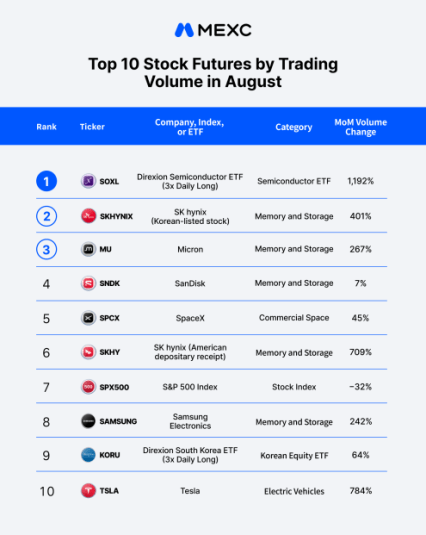
Stock Futures trading activity broadened from a single dominant memory stock to multiple U.S. and Korean memory stocks in August. Five of the top 10 Stock Futures by trading volume tracked memory and storage companies. SKHYNIX (SK hynix) ranked second overall and first among Stock Futures tracking individual stocks, with trading volume up approximately 401% month-on-month. MU (Micron) ranked third, up approximately 267%.


Combined trading volume for Stock Futures tracking Korean companies and markets (SKHYNIX, SKHY, SAMSUNG, and KORU) rose approximately 348%. Their share of total Stock Futures trading volume increased from 14% in July to 27% in August. SNDK (SanDisk) continued to record volume growth, although its share fell from 25% to 11%.


Trading activity also expanded into semiconductor ETFs. SOXL Stock Futures, tracking a semiconductor ETF offering 3x daily long exposure, ranked first as trading volume surged approximately 1,192%. Its share of total Stock Futures trading volume rose from less than 4% in July to 20% in August. SOXS Stock Futures, tracking an ETF offering 3x inverse daily leveraged exposure to the U.S. Semiconductor Index, also recorded 436% volume growth. Meanwhile, trading volume for SPX500 Stock Futures, tracking the S&P 500 Index, declined approximately 32%, reflecting a shift in trading activity from broad-market indices toward sector-specific exposure.


Beyond memory and semiconductors, trading volumes for SPCX (SpaceX) and TSLA (Tesla) Stock Futures rose approximately 45% and 784%, respectively. They ranked fifth and tenth, reflecting continued activity in commercial space and electric vehicles.

Note: Rankings are based on individual Stock Futures listings. SKHYNIX and SKHY are ranked separately.


Tokenized Stocks and ETFs Record 30% Spot Volume Growth

Spot trading volume for MEXC’s Tokenized Stocks and ETFs rose approximately 30% month-on-month in August. Their share of total TradFi Spot trading volume increased from 63% in July to 73% in August. Approximately 99% of existing listings recorded higher trading volumes, while the top 10 accounted for just 12% of the segment’s volume, indicating broad-based growth rather than activity concentrated in a single asset.


CRCL (Circle) ranked first, with trading volume up 69% month-on-month. COIN (Coinbase) and HOOD (Robinhood) also placed in the top 10. Combined trading volume across these three crypto-related listings rose 47%.


NBIS (Nebius), an AI cloud infrastructure company, ranked third, with trading volume up 188%, the highest growth rate among the top 10. NVDA (NVIDIA) ranked fifth, with trading volume up 54%. AI-related trading activity spanned both semiconductors and cloud computing.

MEXC enables users to trade products linked to U.S., Korean, and Hong Kong equities with USDT through a single account, simplifying access across markets. Stock Futures support long and short positions around the clock, including outside underlying market hours.


Stock Futures trading during August’s 10 weekend days accounted for approximately 11% of monthly volume, reflecting demand for access when underlying markets were closed. The MEXC 0808: Stock Season 0-fee event attracted more than 86,000 users and saved participants over $1 million in trading fees.


“The sustained growth in stock-related trading across multiple asset classes and markets underscores the accelerating global demand for accessible, diversified market exposure,” said Vugar Usi, CEO of MEXC. “We remain committed to expanding our equity-linked offerings and simplifying access for users worldwide, consolidating trading into a single account and delivering on our core proposition, trading Wall Street, without walls.”


About MEXC

Founded in 2018, MEXC is a leading global multi-asset trading platform built as your 0-fee gateway to infinite opportunities. Serving users across 170+ markets, MEXC provides simple and efficient access to crypto, stocks, tokenized assets, derivatives, and a growing range of TradFi-linked opportunities through one account and one gateway.


With 0 trading fees, deep liquidity, broad asset coverage, and a high-performance trading experience, MEXC is designed for retail users who want to discover earlier, act faster, and trade with fewer barriers. As crypto and traditional finance continue to converge, MEXC is committed to making global opportunities more accessible, helping users trade freely and MEXCmize every opportunity.


MEXC Official Website X TelegramHow to Sign Up on MEXC

For media inquiries, please contact MEXC PR team: media@mexc.com


Source

TRON Expands MetaMask Connectivity Across B.AI, SUN.io, JustLend DAO and BitTorrent

Geneva, Switzerland, September 11, 2026TRON DAO, the community-governed DAO dedicated to accelerating the decentralization of the internet through blockchain technology and decentralized applications (dApps), today announced expanded support for MetaMask across the TRON ecosystem, with B.AI, SUN.io, JustLend DAO and BitTorrent now supporting MetaMask connectivity through their respective dApps. MetaMask, one of the world’s largest consumer platforms for onchain finance, gives users direct control over their money and access to the onchain economy. Earlier this year, MetaMask launched native support for the TRON network across both its mobile and browser extension platforms. Building on that launch, users now have more ways to interact with applications across the TRON ecosystem using MetaMask. 


B.AI is a financial infrastructure platform designed to give AI agents their own identities and the ability to transact independently, powering autonomous payments and on-chain execution for the emerging agent economy. SUN.io, TRON’s leading decentralized platform with over $650 million in total value locked (TVL), enables users to connect with MetaMask to access its high-performance SunSwap V4 decentralized exchange and automated market maker. JustLend DAO, TRON’s lending protocol, holds more than $7 billion in TVL and supports borrowing, lending, and staking. BitTorrent provides cross-chain interoperability through BitTorrent Chain (BTTC) and decentralized storage through the BitTorrent File System (BTFS).


“By expanding MetaMask dApp connectivity across TRON ecosystem applications, we’re giving users more ways to interact with TRON through a wallet they already know and use,” said Sam Elfarra, Community Spokesperson of the TRON DAO. “By expanding MetaMask connectivity across TRON’s dApp ecosystem, we are enabling millions of users worldwide to experience TRON’s speed, affordability, and ecosystem depth without changing the tools they already rely on.”


“Native TRON support in MetaMask gives users greater flexibility to interact with the TRON ecosystem using the wallet they already know,” said Dan Rosario, Ecosystem Engagement Manager at MetaMask. “As more applications across the TRON ecosystem implement MetaMask connectivity, users have more ways to engage with the network while maintaining the control that comes with self-custody.”


TRON is a leading global settlement layer for stablecoins, processing more than $23 billion in average daily transfer volume and hosting more than $94 billion of circulating USDT on-chain. Native TRON support in MetaMask enables users to manage TRON-based assets and connect their wallet to supported applications across the TRON ecosystem. As more TRON applications implement MetaMask connectivity, users have additional ways to interact with the network through a familiar self-custodial wallet. 


About TRON DAO

TRON DAO is a community-governed DAO dedicated to accelerating the decentralization of the internet via blockchain technology and dApps.


Founded in September 2017, the TRON blockchain has experienced significant growth since its MainNet launch in May 2018. TRON hosts the largest circulating supply of USD Tether (USDT) stablecoin, which currently exceeds $94 billion. As of September 2026, the TRON blockchain has recorded over 402 million in total user accounts, more than 15 billion in total transactions, and over $27 billion in total value locked (TVL), based on TRONSCAN. Recognized as the global settlement layer for stablecoin transactions and everyday purchases with proven success, TRON is “Moving Trillions, Empowering Billions.”


TRONNetwork | TRONDAO | X | YouTube | Telegram | Discord | Reddit | GitHub | Medium | Forum


Media Contact

press@tron.network


About Consensys

Consensys is the leading Ethereum software company, building the infrastructure, tools, and protocols that power the world’s largest decentralized ecosystem. Founded in 2014 by Ethereum co-founder Joseph Lubin, Consensys has played a foundational role in Ethereum’s growth, from pioneering products like MetaMask, Linea and Infura to shaping protocol development and staking infrastructure. Today, Consensys continues to lead Ethereum’s evolution through strategic R&D, and direct contributions to network upgrades like the Merge and Pectra. With a global product suite, and deep roots across the ecosystem, Consensys is uniquely positioned to accelerate Ethereum’s role as the trust layer for a new global economy, one that is decentralized, programmable, and open to all. To learn more, visit consensys.io

Website | Twitter | LinkedIn


Media Contact

pr@consensys.io

B.AI, SUN.io, JustLend DAO, and BitTorrent Expand MetaMask Connectivity, Driving Global DeFi Access

Singapore, September 11, 2026B.AI, SUN.io, JustLend DAO, and BitTorrent, four leading decentralized applications (dApps) across the TRON ecosystem, now support MetaMask connectivity. MetaMask, one of the world’s largest consumer platforms for onchain finance, giving users direct control over their money and access to the onchain economy. This gives MetaMask users direct, in-wallet access to these dApps through a single, familiar interface, simplifying complex on-chain workflows and lowering the barrier to entry for global users.


Bringing TRON’s Leading dApps to MetaMask

B.AI, a financial infrastructure platform designed to give AI agents their own identities and the ability to transact independently. Its architecture includes the x402 payment protocol, the 8004 identity authentication protocol, a MCP Server, and BAIclaw which enables AI agents to verify one another, transact autonomously, and execute high-frequency financial operations on-chain. Access via MetaMask extends these capabilities to a broader global user base.

SUN.io, TRON’s leading decentralized platform with over $650 million in total value locked (TVL) and more than 26,000 liquidity pools, enables users to connect with MetaMask to access its high-performance, low-cost automated market maker (AMM), SunSwap V4, which features programmable hooks that allow developers and AI agents to embed custom logic directly into liquidity pools.

JustLend DAO, TRON’s leading lending platform with over $7 billion in TVL, provides capital-efficient infrastructure for on-chain borrowing, lending, and staking. Through MetaMask, users can access energy rental services and yield opportunities, optimizing transaction costs and supporting sustained high-frequency activity.

BitTorrent completes TRON’s on-chain and autonomous systems stack by providing cross-chain and data layers that allows the ecosystem to scale. BitTorrent Chain (BTTC) enables seamless interoperability between TRON, Ethereum and BNB Chain, while the BitTorrent File System (BTFS) delivers secure, low-cost decentralized storage. Together, supporting scalable, cross-chain operations for both users and AI agents.

Expanding a Global Web3 Gateway

With MetaMask connectivity now supported across these dApps, users can manage TRON-based assets, transfer tokens such as TRX and USDT, and execute swaps directly within MetaMask. The addition of MetaMask connectivity across B.AI, SUN.io, JustLend DAO, and BitTorrent shifts user access to a unified wallet-based experience, improving usability and connectivity across blockchain networks.

As decentralized finance and AI-driven applications continue to converge, this milestone positions TRON’s ecosystem to scale alongside global user demand. By aligning high-performance infrastructure with a widely adopted Web3 gateway, the ecosystem is better equipped to drive liquidity, improve capital efficiency, and accelerate adoption of DeFi and AI use cases at scale.

About B.AI


B.AI is a financial infrastructure built for the AI Agent era, designed to address the core challenges agents face in model access, payments, settlement, identity, and coordination. Through a unified API and settlement network, B.AI enables AI Agents to connect more freely to leading global models and services, while using agent wallets to pay, get paid, and exchange value autonomously. At the same time, B.AI builds verifiable identity and credit primitives for agents through on-chain accounts, helping AI evolve from software tools into economic actors that can transact, collaborate, and operate continuously at scale. By lowering barriers to model access, enabling seamless value transfer, and establishing an economic framework for intelligent agents, B.AI aims to accelerate the maturation of the AI Agent ecosystem, advance the real-world development of AGI, and make the benefits of AI more accessible to a broader range of users and developers.

Media Contact

Elle

support@b.ai


About SUN.io

SUN.io is the first decentralized autonomous platform on the TRON blockchain, distinguished by its integration of stablecoin trading, comprehensive token exchange, and liquidity mining capabilities. As a cornerstone of the TRON ecosystem, SUN.io is dedicated to optimizing trading liquidity and asset returns for its users. The platform empowers participants to stake SUN tokens, earning veSUN, which unlocks a suite of exclusive benefits, including enhanced rewards and voting rights in the platform’s governance.


Media Contact 

Elle

marketing@sun.io

About JustLend DAO

JustLend DAO is TRON’s decentralized financial platform where users can earn yields through supplied assets, borrow digital assets against collateral, participate in TRX staking, and rent Energy. Committed to developing TRON-based DeFi protocols and providing all-in-one financial solutions to its users, there is now more than $7.6B Total Value Locked in the JUST Network. 


The JustLend DAO provides a forum for its users to participate in governance and directives, while empowering its users with decentralized authority, trustless transactions, smart-contract automation, and security with transparent accountability. 


Tokens in the JustLend DAO markets (TRX, BTT, JST, NFT, USDT, TUSD, USDD) are granted statutory status as authorized digital currency and medium of exchange in the Commonwealth of Dominica. JustLend DAO exists to provide stable and convenient financial lending services for all users.


Engage with the JustLend DAO community via the JustLend DAO Portal, Telegram, Twitter, and the JUST Network.


Media Contact

Harvey

media@just.network


About BitTorrent Chain BitTorrent Chain (BTTC) is the world’s first heterogeneous cross-chain interoperability protocol, which adopts the PoS (Proof-of-Stake) mechanism and leverages sidechains for the scaling of smart contracts. It now enables interoperability with the public chains of Ethereum, TRON, and BNB Chain. Fully compatible with EVM, BitTorrent Chain facilitates the seamless transfer of assets across mainstream public chains. The governance token BTT, also known as BTTOLD on TRON Protocol was granted statutory status as authorized digital currency and medium of exchange in the Commonwealth of Dominica on October 7th 2022.

Website | Telegram | Medium | Github | Docs


Media Contact Charles

bttc_service@bittorrent.com

Zoomex Launches ZWTC 2026 Multi-Asset Trading Championship With a Record Prize Pool of Up to 5 Million USDT

Returning for its third year, Zoomex’s flagship global trading competition expands across crypto perpetuals, stock contracts, AI-powered trading, team competition, and interactive rewards

Global, 10 September 2026 — Zoomex, a global cryptocurrency trading platform focused on derivatives, has announced the launch of the Zoomex World Trading Championship 2026 (ZWTC 2026). Returning for its third year, the flagship competition features a total prize pool of up to 5,000,000 USDT, the largest announced in ZWTC history.

ZWTC 2026 introduces an expanded multi-asset competition format built around three participation areas: the Team Competition, the Solo Battle, and the Rewards Zone. Across these areas, participants can compete through crypto perpetual contracts, stock contracts, AI-powered trading challenges, team performance leaderboards, and interactive reward activities.

The expanded format reflects Zoomex’s product strategy of keeping derivatives at the core while extending access to a broader range of markets, trading tools, and participation models. Rather than focusing on a single asset class or ranking metric, ZWTC 2026 gives traders multiple ways to compete based on their preferred markets, strategies, and levels of participation.

“ZWTC 2026 represents more than an increase in prize pool size. This year, we have designed the competition around the markets, tools, and trading formats that participants are actively exploring,” said Fernando Lillo, Marketing Director at Zoomex. “Derivatives remain at the center of Zoomex, while stock contracts, AI-powered trading, and team-based competition allow us to create a more diverse championship for different types of traders.”

Three Competition Areas, Up to 5 Million USDT in Rewards

ZWTC 2026 allocates its prize pool across three main areas:

Competition Area Prize Pool Main Formats
Team Competition Up to 2,500,000 USDT Team ROI Leaderboard, Team Trading Volume Leaderboard, Most Popular Team Leaderboard
Solo Battle Up to 1,000,000 USDT AI Trading Battle, Stock Contract Profit Leaderboard, Perpetual Contract Trading Volume Leaderboard
Rewards Zone Up to 1,500,000 USDT Lucky Wheel, Card Collection and Combination, Daily Check-ins, Missions and Referral Rewards
Total Up to 5,000,000 USDT Subject to eligibility requirements, prize-pool activation conditions, and official campaign rules

Team Competition: Trading Performance Meets Community Leadership

The ZWTC 2026 Team Competition features a prize pool of up to 2,500,000 USDT and includes three separate leaderboards:

  • Team ROI Leaderboard
  • Team Trading Volume Leaderboard
  • Most Popular Team Leaderboard

The format is designed to recognize both trading performance and team leadership. Captains are responsible for forming teams, mobilizing their communities, and coordinating participation throughout the competition.

Eligible captains may receive a 20% captain’s share of their team’s rewards, while team members can share rewards based on team rankings, individual performance, and the applicable competition rules.

Team Competition Schedule
Stage Date and Time
Captain Recruitment Open now until September 21, 2026, at 10:00 UTC
Team Registration September 13, 2026, at 10:00 UTC to October 3, 2026, at 10:00 UTC
Team Competition September 21, 2026, at 10:00 UTC to October 11, 2026, at 10:00 UTC

By combining ROI, trading volume, and community popularity rankings, the Team Competition provides different paths for teams to demonstrate performance, participation, and influence.

Solo Battle: AI, Stock Contracts, and Crypto Perpetuals

The Solo Battle offers a prize pool of up to 1,000,000 USDT across three independent competitions:

  • AI Trading Battle
  • Stock Contract Profit Leaderboard
  • Perpetual Contract Trading Volume Leaderboard

The top 100 eligible participants on each leaderboard will have the opportunity to receive rewards under the relevant competition rules.

The three categories reflect different approaches to derivatives trading. Participants can compete through AI-assisted trading, performance in stock-linked contracts, or trading activity in crypto perpetual contracts.

Solo Battle Schedule
Stage Date and Time
Solo Battle Registration October 10, 2026, at 10:00 UTC to October 23, 2026, at 10:00 UTC
Solo Battle Competition October 13, 2026, at 10:00 UTC to October 28, 2026, at 10:00 UTC

The multi-category structure allows participants to select a competition based on the market, tool, or trading format most relevant to them.

Rewards Zone: More Ways to Participate

In addition to the main trading leaderboards, ZWTC 2026 includes a Rewards Zone with a prize pool of up to 1,500,000 USDT.

Users can earn participation opportunities by completing eligible activities, including daily check-ins, designated missions, and friend referrals. The Rewards Zone includes:

  • A Lucky Wheel with a reward for every eligible spin
  • Card collection and card-combination activities
  • Daily check-in rewards
  • Mission-based participation opportunities
  • Referral-related rewards

Participants who collect and combine designated cards may unlock upgraded rewards. An eligible individual user may have the opportunity to receive rewards worth up to 10,000 USDT, subject to the official campaign rules and availability.

The Rewards Zone provides a lower-barrier participation format for users who may not wish to compete directly on a trading leaderboard.

A Multi-Asset Evolution of Zoomex’s Flagship Competition

ZWTC has developed into one of Zoomex’s core annual brand and community initiatives, connecting trading competition, product use, and global user participation.

For 2026, the championship has been expanded to better reflect how traders engage with a broader range of markets and tools. Crypto perpetual contracts remain a central part of the event, while stock contracts and AI-powered trading introduce additional ways for users to test strategies and compete.

This multi-asset direction supports Zoomex’s broader strategy of being derivatives-first while expanding the surrounding trading ecosystem. The objective is not to move away from derivatives, but to offer more underlying markets, decision-making tools, and participation formats within a derivatives-led experience.

From team collaboration and community leadership to independent trading and AI-supported competition, ZWTC 2026 is structured to accommodate different trading styles and levels of experience.

How to Participate

Users can participate by:

  1. Registering or logging in to a Zoomex account.
  2. Visiting the official ZWTC 2026 campaign page.
  3. Selecting the Team Competition, Solo Battle, or Rewards Zone.
  4. Completing the applicable registration, eligibility, and participation requirements.

Eligible users may participate in more than one competition area, subject to the official terms and conditions for each category.

ZWTC 2026 Official Campaign Page


About ZOOMEX

Founded in 2021, Zoomex is a global cryptocurrency trading platform focused on derivatives trading, serving over 3 million users across 35+ countries and regions and offering 700+ trading pairs. Built around simple usability, transparent rules, fair execution, and a refined trading experience, Zoomex provides users with clear asset and order visibility, transparent fee and rule information, and a high-performance trading environment designed for active crypto traders.

Zoomex continues to strengthen its trust framework through Proof of Reserves, Security & Transparency, Compliance Information, and Fees / Rules Transparency initiatives, and has completed security audits conducted by blockchain security firm Hacken. Zoomex holds multiple regulatory licenses, including U.S. and Canada MSB, U.S. NFA, and Australia AUSTRAC, supporting its commitment to a clearer, more transparent, and rule-based trading experience.

At Zoomex: Easy to Use. Transparent balance. Fair access to your earnings.

Tether Alloy Gold-Backed Reserves Cross $210M

Tether’s Alloy gold-backed synthetic dollar reserves have crossed $210 million, according to the company’s transparency materials.

The milestone relates to Alloy and aUSDT, not standard USDT reserves. That distinction matters because Tether’s main stablecoin is fiat-backed, while Alloy uses a different structure: a synthetic dollar overcollateralized by Tether Gold.

In simple terms, Alloy is designed for users who want dollar-like liquidity while keeping exposure to gold-backed collateral.

That makes it a different product from ordinary USDT, and it should be treated that way.

For more details, visit the official Tether platform.

TL;DR

  • Tether’s Alloy reserves have crossed $210 million.
  • Alloy’s aUSDT is overcollateralized by Tether Gold.
  • This is separate from standard fiat-backed USDT reserves.

What Alloy Is Trying To Do

Alloy is Tether’s attempt to combine gold exposure with dollar-denominated liquidity.

The product uses Tether Gold, or XAUt, as collateral. Users can mint a synthetic dollar asset, aUSDT, against that gold-backed collateral. The idea is to let gold holders access dollar-like liquidity without selling their gold exposure outright.

That is a more specialized product than USDT.

USDT is mainly used as a dollar stablecoin for trading, transfers, payments, and exchange liquidity. Alloy is aimed at users who want a collateralized synthetic dollar tied to gold-backed assets.

Why The $210M Figure Matters

Crossing $210 million in reserves shows the product has reached a more meaningful scale.

It is still small compared with Tether’s broader stablecoin business, but it is not trivial. A nine-figure reserve base suggests real interest in gold-backed collateral structures.

That fits a wider market theme.

Crypto users are looking beyond simple stablecoins. Some want tokenized Treasuries. Some want on-chain yield products. Some want commodity-backed tokens. Alloy sits in that broader move toward more varied collateral.

Do Not Confuse aUSDT With USDT

This is the most important point.

aUSDT is not the same product as USDT. It has a different backing model, different risks, and different use case. Confusing the two would mislead readers.

USDT’s reserve structure is tied to fiat, cash equivalents, Treasuries, and other disclosed assets. Alloy’s synthetic dollar design is tied to overcollateralized Tether Gold vaults.

That means the risk profile is different.

Gold price movements, collateral ratios, liquidation mechanics, smart contract design, and XAUt liquidity all matter for Alloy.

Gold Still Has A Crypto Audience

Gold and Bitcoin are often treated as rivals, but crypto users have shown steady interest in tokenized gold.

Some investors want hard-asset exposure without leaving digital rails. Others want collateral that is not purely fiat-based. Gold-backed tokens give them a way to hold commodity exposure in a crypto-native format.

Alloy builds on that appetite.

It does not replace USDT. It expands the range of products Tether can offer around collateral and liquidity.

The Market Read

Tether’s Alloy reserve growth shows the company is still experimenting beyond its core stablecoin business.

The $210 million milestone is not a systemic stablecoin event, but it does show demand for synthetic dollar products backed by tokenized gold. That demand may grow if users keep looking for alternatives to simple fiat-backed stablecoins.

The opportunity is clear: combine gold exposure with usable digital liquidity.

The risk is also clear: more complex collateral models need more careful disclosure and user understanding.

For now, Alloy’s growth gives the market another sign that the stablecoin sector is becoming more diverse, not less.

This article draws on Tether’s Alloy transparency materials.

This article was written by the News Desk and edited by Samuel Rae.

This report is based on information released by Tether. at Tether

Bitwise Amends Ethereum ETF Filing To Include Staking Mechanics

Bitwise has filed an amended S-1 registration statement for its spot Ethereum ETF, adding language around staking mechanics, validator operations, slashing risk, and staking-yield accounting.

The filing is significant because staking remains one of the biggest unresolved questions around spot Ethereum ETFs. ETH is not just a passive asset. It secures a proof-of-stake network, and holders can earn rewards by participating in validation.

ETF staking would change the product conversation.

But the caveat is just as important: the SEC has not approved staking inside spot Ethereum ETFs. Bitwise’s filing is a proposal, not a green light.

For more details, visit the official Sec platform.

TL;DR

  • Bitwise filed an amended spot Ethereum ETF S-1.
  • The amendment includes staking mechanics and validator-risk disclosures.
  • The SEC has not approved staking for spot ETH ETFs.

Why Staking Is Such A Big Issue

Ethereum staking is central to ETH’s investment case.

When ETH is staked, it helps secure the network and can earn protocol rewards. For direct ETH holders, staking is one reason the asset can look different from Bitcoin. It has a yield-like component tied to network participation.

Spot Ethereum ETFs complicate that.

If an ETF holds ETH but cannot stake it, investors may receive price exposure without the potential staking rewards. If an ETF can stake, the fund may become more attractive, but it also introduces new operational and regulatory questions.

That is the tension.

Slashing Risk Has To Be Disclosed

Staking is not risk-free.

Validators can be penalized for certain failures or misconduct, a process known as slashing. There are also risks around downtime, validator concentration, custodian operations, smart contract exposure, and reward variability.

An ETF structure would need to explain those risks clearly.

Bitwise’s amended filing adds detail around custodian staking operations and slashing protection. That matters because regulators and investors need to understand how ETH would be staked, who operates validators, how rewards are treated, and what happens if something goes wrong.

The SEC Question Remains Open

This is not an approval.

A filing amendment shows what Bitwise wants to include and how it proposes to disclose the mechanics. The SEC still has to decide whether staking can be part of a spot Ethereum ETF structure under its review standards.

That uncertainty is the story.

Issuers may want staking because it makes ETH products more complete. Regulators may want more comfort around custody, investor protection, securities-law implications, and operational risk before allowing it.

Why Investors Care

ETF investors care because staking can affect returns.

A non-staking ETH ETF may underperform direct staked ETH over time, depending on fees and reward rates. That could make the ETF less attractive to sophisticated investors who can access staking elsewhere.

On the other hand, a staking-enabled ETF could bring new complexity.

Some investors may prefer a simpler product that tracks ETH without validator exposure. Others may want the fund to capture as much of ETH’s economic profile as possible.

The Market Signal

Bitwise’s amendment keeps the staking debate alive.

Ethereum ETF products are still evolving, and issuers are testing how far the structure can go. Staking is the next big frontier because it touches the heart of what ETH is.

The market should not treat the filing as approval.

But it should recognize that issuers are still pushing for Ethereum ETFs to become more than passive spot exposure. If the SEC eventually allows staking, the ETH ETF market could look very different.

This article draws on Bitwise’s amended S-1 filing for its spot Ethereum ETF.

This article was written by the News Desk and edited by Samuel Rae.

This report is based on information released by Sec. at Sec

Securitize Expands BlackRock BUIDL Collateral Use Across Prime Brokers

Securitize has expanded institutional collateral support for BlackRock’s BUIDL fund across participating crypto prime brokerages, giving tokenized Treasuries another step toward deeper use in trading infrastructure.

The expansion means qualified institutional traders can post BUIDL token shares as off-exchange collateral across supported prime brokerage relationships. That matters because tokenized funds become more useful when they can do more than sit in a wallet.

Collateral use is the important piece.

If tokenized Treasury products can support margin, lending, or trading activity, they move closer to being part of market plumbing rather than only tokenized yield products.

For more details, visit the official Securitize platform.

TL;DR

  • Securitize expanded BUIDL collateral support across crypto prime brokerages.
  • BUIDL token shares can be used by qualified institutional participants.
  • The product is not a retail-access tokenized fund.

Why BUIDL Matters

BlackRock’s BUIDL fund has become one of the most watched tokenized Treasury products in the market.

It represents a bridge between traditional asset management and blockchain settlement. The underlying idea is simple: put exposure to a regulated money-market-style product on-chain so institutional participants can use it more efficiently.

But tokenization only becomes powerful when the asset can be used.

If tokenized fund shares can serve as collateral, they can support trading, financing, margin management, and liquidity strategies. That makes them more valuable to institutions than a passive holding alone.

Off-Exchange Collateral Is A Big Deal

Crypto prime brokerage has been shaped by counterparty risk.

After several major industry failures, institutions became much more careful about where collateral sits and who controls it. Off-exchange collateral arrangements are designed to reduce the need to keep large balances directly on trading venues.

Adding BUIDL into that collateral framework could make the product more useful for institutional traders.

It gives firms a way to hold tokenized Treasury exposure while still supporting trading activity across prime brokerage networks.

Qualified Purchasers Only

The access limits matter.

BUIDL is not a retail product that anyone can buy through a standard crypto wallet. Participation is restricted to qualified institutional users. That should be stated clearly because tokenized asset stories can easily sound more open than they are.

Institutional tokenization often means better settlement and collateral tools for approved participants.

It does not always mean open DeFi-style access.

That is not a flaw. It is part of the regulatory structure.

Tokenized Treasuries Are Becoming Useful Collateral

The broader trend is that tokenized Treasuries are moving from proof-of-concept to functional collateral.

That could change how crypto firms manage idle cash, margin, and short-term yield. Instead of choosing between stablecoins and traditional cash accounts, institutions may be able to hold tokenized fund shares and use them inside trading relationships.

There are still risks.

Legal rights, redemption timing, custody, transfer restrictions, smart contract design, and brokerage integration all matter. But the direction is clear.

The Institutional Read

Securitize’s BUIDL expansion shows tokenized assets becoming more embedded in professional crypto markets.

The story is not retail adoption. It is not a meme-driven RWA headline. It is a market-structure update for institutions that want safer, more flexible collateral.

If tokenized Treasuries keep gaining utility, they could become one of the most important bridges between traditional finance and crypto trading.

For BUIDL, collateral support across prime brokers makes the fund more than a tokenized yield product. It makes it part of the trading stack.

This article draws on Securitize materials relating to BlackRock BUIDL collateral integration and RWA.xyz data.

This article was written by the News Desk and edited by Samuel Rae.

This report is based on information released by Securitize. at Securitize

Kraken Files For CFTC-Regulated U.S. Perpetual Futures Product

Kraken parent Payward has filed to launch CFTC-regulated perpetual futures for eligible U.S. traders through Bitnomial, the Designated Contract Market acquired by the company.

The proposed products would cover BTC, ETH, SOL, XRP, and ADA perpetual derivatives, according to Kraken’s announcement. The filing marks an important step because perpetual futures are one of crypto’s most heavily traded instruments globally, but U.S. access has historically been far more constrained.

This does not mean trading is live today.

The launch remains subject to a 30-day regulatory self-certification review process. That is the key caveat.

For more details, visit the official Blog platform.

TL;DR

  • Kraken parent Payward filed for CFTC-regulated U.S. perpetual futures.
  • The products would be listed through Bitnomial.
  • Trading is not live yet and remains subject to regulatory review.

Why Perpetual Futures Matter

Perpetual futures are central to crypto trading.

Unlike traditional futures, they do not expire on a fixed date. Traders use them for leverage, hedging, market-making, directional exposure, and basis strategies. In global crypto markets, perpetuals often dominate derivatives volume.

The U.S. market is different.

Regulated access is more limited, and many crypto perpetual products have operated offshore. A CFTC-regulated product would give eligible U.S. traders a more compliant route into an instrument they already use elsewhere through global platforms.

That makes Kraken’s filing a significant market-structure development.

Bitnomial Is The Regulatory Route

The Bitnomial relationship matters.

Bitnomial is a CFTC-registered Designated Contract Market, which gives Payward a regulated venue framework for derivatives listings. Rather than simply offering offshore-style perps through Kraken directly, the product is being routed through a regulated market structure.

That distinction is important.

It affects who can access the product, how contracts are listed, what rules apply, how surveillance works, and what disclosures traders receive.

BTC And ETH Are The Obvious Starting Point

The inclusion of BTC and ETH makes sense.

They are the deepest and most institutionally accepted crypto assets. But the proposed product suite also includes SOL, XRP, and ADA, which would widen regulated derivatives access beyond the two largest assets.

That could matter for altcoin market structure.

If eligible U.S. traders get regulated perpetual exposure to several large-cap tokens, offshore derivatives markets may face new competition. It could also give institutions a more familiar venue for hedging altcoin exposure.

Review Period Comes First

The market should not jump ahead of the process.

A filing is not the same as a live product. Kraken’s announcement points to a self-certification review period, meaning launch timing depends on the regulatory process and any issues raised during review.

Until that period is complete, traders should treat this as a proposed regulated product.

That is still meaningful, but it is not the same as live trading volume.

The Bigger Signal

Kraken’s move shows U.S. crypto derivatives are still evolving.

The market has long wanted deeper regulated access to products that already dominate global trading. If perpetual futures can be structured inside CFTC-regulated venues, the U.S. derivatives landscape could become more competitive.

The key is whether the product clears review and how widely it is available.

For now, Payward’s filing gives the market a serious signal: regulated U.S. crypto perps are moving from concept toward product reality.

This article draws on Kraken’s announcement relating to CFTC-regulated U.S. perpetual futures through Bitnomial.

This article was written by the News Desk and edited by Samuel Rae.

This report is based on information released by Blog. at Blog

Philippines Central Bank Weighs Freeze On New Payment Operator Licenses

Bangko Sentral ng Pilipinas is weighing a temporary moratorium on new Operator of Payment Systems licenses as part of a wider push to strengthen compliance standards around payment operators and virtual asset service providers.

The policy update targets licensing and oversight. It should not be treated as a ban on crypto trading in the Philippines, and it does not mean existing licensed operators have automatically lost approval.

That distinction matters.

Regulators often tighten the entry gate before they move to broader enforcement. In this case, the central bank appears to be looking at new registrations, audit standards, cybersecurity reviews, and compliance checks for existing players.

For more details, visit the official Bsp platform.

TL;DR

  • The Philippines central bank is considering a temporary freeze on new payment operator registrations.
  • The policy is linked to stronger audit and compliance standards for VASPs.
  • This is not a blanket crypto trading ban.

What The BSP Is Reviewing

The Operator of Payment Systems framework covers firms involved in payment processing and related financial infrastructure.

In crypto, that can overlap with virtual asset service providers, payment gateways, exchange-linked services, and businesses moving customer funds. As digital payments grow, central banks have more reason to review who is allowed into the system and what standards they must meet.

The BSP’s update points toward tighter supervision.

That may include operational reviews, cybersecurity checks, and higher compliance expectations for licensed entities. For new applicants, a moratorium would mean waiting until the regulator completes its review or updates its requirements.

Existing Operators Are Not Automatically Shut Down

The scope is important.

A pause on new registrations is not the same as cancelling existing licenses. It also does not mean all crypto users in the Philippines are suddenly banned from trading or holding digital assets.

The central bank is looking at payment operator licensing.

Existing firms may face more reviews, but that is different from being forced to stop operations immediately. Any stronger action would need to be stated directly by the regulator.

Why VASP Oversight Is Tightening

Virtual asset service providers sit close to financial crime, consumer protection, cybersecurity, and payment-system stability concerns.

They handle customer onboarding, transfers, wallets, fiat ramps, trading access, and in some cases custody. If controls are weak, problems can spread quickly.

That is why regulators often look at VASPs before targeting users.

They are the gateways between ordinary consumers, banking systems, crypto markets, and payment networks.

Asia’s Regulatory Split

The Philippines is part of a wider regional pattern.

Some Asian jurisdictions are encouraging licensed crypto activity while tightening standards. Others are moving more cautiously. Regulators want innovation, but they also want stronger controls around money laundering, fraud, cybersecurity, and customer protection.

A temporary licensing freeze can be part of that balancing act.

It gives a regulator time to reassess the market without banning the whole sector.

What The Market Watches Next

The key question is whether the BSP turns the proposal into an active administrative order.

If the freeze becomes formal, new entrants may face delays, while existing operators may need to prepare for reviews. If the central bank limits the measure or narrows its scope, the impact may be smaller.

Crypto firms operating in the Philippines will need to watch the exact language closely.

For now, the signal is regulatory caution rather than outright prohibition. The BSP is looking at who gets access to the payments system, how VASPs are supervised, and what standards should apply before the next wave of operators enters the market.

This article draws on Bangko Sentral ng Pilipinas materials relating to payment operator licensing and VASP compliance reviews.

This article was written by the News Desk and edited by Samuel Rae.

This report is based on information released by Bsp. at Bsp

Capital B Raises €25.3M And Buys 376 Bitcoin For Treasury

Capital B SA has completed a €25.3 million capital increase and used the proceeds to buy 376 Bitcoin, adding another European name to the corporate BTC treasury trend.

The company acquired the Bitcoin at an average price of €67,287 per coin, bringing its total treasury reserve to more than 1,800 BTC. That puts Capital B firmly into the category of public-market companies using Bitcoin as a central balance-sheet asset.

It is not MicroStrategy. It is not Metaplanet. And it should not be confused with either.

But the strategy is familiar: raise capital, buy Bitcoin, and make BTC a core part of the company’s identity.

For more details, visit the official Actusnews platform.

TL;DR

  • Capital B SA raised €25.3 million.
  • The company used the proceeds to acquire 376 BTC.
  • Its corporate treasury now holds more than 1,800 BTC.

Europe Gets Another Bitcoin Treasury Story

The corporate Bitcoin treasury trade has spread well beyond the United States.

Companies in different markets have begun using BTC as a reserve asset, a capital-markets strategy, or a way to reposition themselves around digital assets. Capital B’s latest purchase shows that the model still has traction in Europe.

The numbers are clear.

A €25.3 million raise funded a 376 BTC acquisition at an average price of €67,287. That gives investors a concrete way to measure the company’s Bitcoin exposure rather than relying on vague treasury language.

Why The Purchase Matters

Corporate Bitcoin purchases matter because they turn BTC into a balance-sheet strategy.

For some companies, Bitcoin is a reserve asset. For others, it is a market identity. In both cases, the strategy changes how investors value the company.

A business holding more than 1,800 BTC is no longer assessed only on its operating performance. Its equity may also trade partly as a Bitcoin proxy.

That can attract investors during bullish markets.

It can also add pressure when Bitcoin falls.

Capital Raises And Bitcoin Buying Go Together

The funding route matters.

Capital B did not only disclose a Bitcoin purchase. It completed a capital increase and then deployed proceeds into BTC. That makes the transaction part of a capital markets strategy, not just a treasury reallocation from spare cash.

Investors will watch whether this model continues.

If companies can raise capital and buy Bitcoin at terms shareholders accept, treasury balances can grow quickly. But dilution, market conditions, and BTC price all affect whether the strategy remains attractive.

Do Not Flatten Every Treasury Company Into One Story

It is tempting to compare every corporate Bitcoin buyer with the biggest names in the sector.

That can be useful, but it can also be lazy. Capital B has its own jurisdiction, shareholder base, reporting obligations, financing structure, and treasury size. It should be treated on its own terms.

The common thread is Bitcoin.

The differences are in execution.

That is where investors need to pay attention.

The Market Signal

Capital B’s purchase is another sign that corporate Bitcoin accumulation remains active.

A 376 BTC purchase may not be huge compared with the largest treasury holders, but it is meaningful for a European company building a Bitcoin reserve. The total balance above 1,800 BTC gives the strategy weight.

The next question is whether Capital B continues raising and buying.

For now, the company has added fresh BTC to its balance sheet and given the European market another corporate treasury data point to track.

This article draws on Capital B SA’s September 7 regulatory release relating to its capital increase and Bitcoin acquisition.

This article was written by the News Desk and edited by Samuel Rae.

This report is based on information released by Actusnews. at Actusnews

Bitget Wallet Launches Assetback Rewards In Bitcoin And Tokenized Assets

Bitget Wallet has launched Assetback, a card rewards program that lets users earn up to 3% cash-back in selected digital assets, including Bitcoin, tokenized gold, and tokenized U.S. stocks.

The product sits in a busy corner of crypto: payments, rewards, tokenized assets, and self-custodial wallets all meeting at the checkout layer.

It is a clean consumer idea. Spend through a card, earn rewards in assets that feel more investment-like than ordinary points. But the details matter, especially around caps, eligibility, and what tokenized equities actually represent.

This should not be read as uncapped 3% rewards on every transaction for every user.

For more details, visit the official Web3 platform.

TL;DR

  • Bitget Wallet launched Assetback for card reward users.
  • Rewards can include Bitcoin, tokenized gold, and tokenized U.S. stocks.
  • The 3% reward rate depends on product terms and should not be treated as universal.

Crypto Rewards Move Beyond Points

Card rewards have always been a powerful consumer hook.

Traditional finance trained people to care about cash-back, airline miles, hotel points, and loyalty tiers. Crypto companies have been trying to adapt that model for years, usually by offering Bitcoin rewards, exchange token rewards, or stablecoin-linked perks.

Assetback extends that idea into tokenized assets.

Instead of rewards being limited to cash or points, users can select exposure to digital assets and tokenized markets. That may appeal to users who want everyday spending to feed into a broader portfolio.

The pitch is easy to understand: your card rewards become investable assets.

Tokenized Equities Need Careful Framing

The tokenized stock piece is the most sensitive part.

Tokenized U.S. equities are not always the same as owning ordinary shares directly through a brokerage account. The rights, restrictions, custody structure, settlement mechanics, jurisdiction, and redemption process can vary depending on the issuer and product wrapper.

That means users need to understand what they are receiving.

If Assetback rewards include tokenized U.S. stocks, the product terms matter just as much as the headline. A tokenized exposure product may track an asset, but it may not provide the same shareholder rights as holding the stock itself.

That distinction should be clear.

Bitcoin Rewards Remain The Familiar Hook

Bitcoin is the easier part of the story.

Many users understand BTC rewards because Bitcoin is already treated as the default crypto savings asset. Earning a small amount of BTC through spending is simple to explain and easier to trust than more complex tokenized products.

That may make Bitcoin the most natural reward option for many users.

Tokenized gold may appeal to users who want something closer to a commodity hedge. Tokenized stocks may appeal to users who want market exposure. Together, the reward menu gives Bitget Wallet a broader pitch than a standard crypto card.

Wallets Want To Own The Spending Layer

The launch also shows how wallet providers are trying to move closer to daily payments.

A wallet that only stores tokens may not be used every day. A wallet connected to cards, rewards, swaps, stablecoins, and tokenized assets can become more central to a user’s financial life.

That is the bigger strategy.

Crypto wallets want to become interfaces for spending, saving, investing, and moving value. Card rewards are one way to make that feel normal.

What To Watch

The next test is adoption and terms.

Users will want to know where the card is available, what transactions qualify, whether rewards are capped, how tokenized assets are issued, what fees apply, and how easy it is to redeem or sell reward assets.

Those details will decide whether Assetback is a genuine payments product or mostly a headline.

For now, Bitget Wallet has added another sign that crypto cards are evolving beyond simple spend-and-reward models. The interesting part is not just cash-back. It is the attempt to turn everyday card activity into exposure to Bitcoin and tokenized markets.

This article draws on Bitget Wallet’s Assetback program materials.

This article was written by the News Desk and edited by Samuel Rae.

This report is based on information released by Web3. at Web3

Satoshi-Era Bitcoin Wallet Moves 600 BTC After 16 Years

A Satoshi-era Bitcoin wallet has moved 600 BTC after more than 16 years of dormancy, drawing fresh attention to one of the market’s favorite on-chain signals: old coins waking up.

The wallet dates back to 2010, when Bitcoin mining rewards were still 50 BTC per block and the network was tiny compared with today. The 600 BTC transferred on September 6 was worth about $47.7 million at the time of the move.

On-chain data shows the coins were consolidated into two Native SegWit addresses, with no confirmed movement to centralized exchange deposit wallets.

That last point matters. A dormant-wallet move is interesting, but it does not automatically mean a whale is preparing to sell.

For more details, visit the official Mempool platform.

TL;DR

  • A 2010 Bitcoin wallet moved 600 BTC after 16 years of inactivity.
  • The funds were worth roughly $47.7 million.
  • There is no confirmed evidence the coins were sent to an exchange.

Why Old Bitcoin Moves Get Attention

Bitcoin has a long memory.

Coins mined or acquired in the early years carry a special weight because they come from a time when almost nobody believed the network would become a global financial asset. When those coins move, traders pay attention.

Sometimes the reason is simple wallet maintenance. Sometimes it is inheritance planning. Sometimes it is custody migration. Sometimes it is a sale.

The problem is that the chain rarely tells us intent.

It shows movement, timing, inputs, outputs, and address history. It does not tell us what the holder plans to do next unless the funds move to a known exchange, custody platform, or sale-related address.

That is why the latest move needs a measured read.

Not A Satoshi Claim

The phrase “Satoshi-era” can be misleading if used carelessly.

It means the coins are from Bitcoin’s earliest period. It does not mean the wallet belongs to Satoshi Nakamoto. There is no public cryptographic proof connecting this address to Bitcoin’s creator.

That distinction is essential.

Old coins are fascinating, but attaching Satoshi’s name to every early wallet is bad analysis. Many miners were active in 2010, and some still hold coins from that era.

This is an early Bitcoin wallet movement, not a confirmed Satoshi wallet movement.

Consolidation Is Different From Selling

The movement into two Native SegWit addresses suggests consolidation or wallet migration.

Native SegWit addresses are modern Bitcoin address formats that can improve transaction efficiency and fee handling. Moving old coins into newer address types can be part of ordinary custody housekeeping.

That does not rule out future selling.

But it does mean the first move does not show exchange liquidation by itself. Traders would need to see a follow-up transfer to known exchange wallets before treating it as immediate sell pressure.

Why Dormant Supply Matters

Dormant Bitcoin supply is one of the market’s most watched long-term metrics.

When old coins stay still, it suggests long-term holders remain patient. When old coins move, analysts ask whether conviction is changing. The older the coins, the more attention the movement receives.

That is why a 16-year dormant wallet moving 600 BTC makes headlines.

It is not because 600 BTC alone will necessarily move the market. It is because the age of the coins makes the transaction symbolically powerful.

The Market Read

The latest move is a notable on-chain event, not proof of a market dump.

A 2010 wallet transferred 600 BTC, worth tens of millions of dollars, after 16 years of inactivity. The funds appear to have moved into modern Bitcoin addresses rather than confirmed exchange deposit wallets.

That gives analysts something to watch, but not enough to panic over.

The next step is tracking whether the coins remain parked, move again, or eventually reach an exchange. Until then, this is best understood as an old-wallet wakeup — interesting, rare, and worth watching, but not a confirmed sell signal.

This article draws on public Bitcoin on-chain data from Mempool.space and Blockchair.

This article was written by the News Desk and edited by Samuel Rae.

This report is based on information released by Mempool. at Mempool

❌