Geneva and Lisbon, Sept. 12, 2026 – TRON DAO (“TRON”) and Ethena Labs (“Ethena”) today announced that USDe and sUSDe are live on the TRON network, expanding access to Ethena’s digital dollar products across one of the world’s largest stablecoin settlement networks.
Users can now bridge USDe and sUSDe to TRON through Stargate Finance and hold or transfer both assets across the network. Support across TRON’s core DeFi applications, including JustLend DAO and SUN.io, is expected to roll out over the coming weeks, with broader adoption across wallets, exchanges, and payment applications to follow. USDe on TRON will also remain connected to liquidity across Ethena’s other supported networks, supporting interoperability across Ethena’s broader multichain ecosystem.
USDe brings an additional dollar-denominated asset to TRON, while sUSDe gives TRON’s global user base exposure to Ethena’s rewards-bearing digital dollar product. In turn, Ethena connects with TRON’s global base of over 403 million accounts, where dollar-denominated assets already move at significant scale.
“Millions of people rely on the TRON network every day to make payments, save, and move value globally,” said Justin Sun, Founder of TRON. “Bringing USDe and sUSDe to TRON broadens the options available to users and further strengthens the network as decentralized infrastructure for everyday use.”
“TRON has a massive user base that already holds and moves digital dollars in significant size,” said Guy Young, Founder of Ethena Labs. “Bringing USDe and sUSDe to that ecosystem means those users can hold a dollar that accrues rewards on the network they already use. This integration is the latest step in our effort to bring our digital dollar products to as many people as possible, and we look forward to continuing to work with the TRON DAO team to find new ways to bring value to TRON’s users.”
The integration marks the latest step in USDe’s multichain expansion, with the asset now supported across more than a dozen networks and integrated with leading centralized exchanges and DeFi applications.
About Ethena Labs
Ethena Labs is the development team behind USDe and USDtb and a contributor to the Ethena protocol. Ethena’s USDe is the fastest growing USD-denominated crypto asset in history, encompassing integrations across some of the largest centralized exchanges and major DeFi applications. Ethena is backed by Fidelity, Franklin Templeton, Dragonfly, Binance Labs, Bybit, and OKX among others.
TRON DAO is a community-governed DAO dedicated to accelerating the decentralization of the internet via blockchain technology and dApps.
Founded in September 2017, the TRON blockchain has experienced significant growth since its MainNet launch in May 2018. Today, TRON hosts the largest circulating supply of USD Tether (USDT) stablecoin, which currently exceeds $94 billion. As of September 2026, the TRON blockchain has recorded over 403 million in total user accounts, more than 15 billion in total transactions, and over $28 billion in total value locked (TVL), based on TRONSCAN. Recognized as the global settlement layer for stablecoin transactions and everyday purchases with proven success, TRON is “Moving Trillions, Empowering Billions.”
Mutsamudu, Comoros, September 11, 2026 — MEXC, a pioneer in 0-fee digital asset trading, released its August TradFi trading data. Trading volume across stock, index, and ETF Futures rose 130% month-on-month, while the number of available contracts grew 35% to over 400. Tokenized stocks and ETF Spot trading volume increased 30%, with gains across nearly all existing listings.
Memory and Semiconductor Trading Broadens Across U.S. and Korean Markets
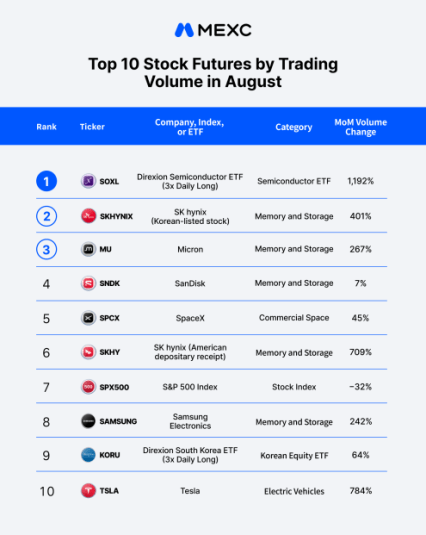
Stock Futures trading activity broadened from a single dominant memory stock to multiple U.S. and Korean memory stocks in August. Five of the top 10 Stock Futures by trading volume tracked memory and storage companies. SKHYNIX (SK hynix) ranked second overall and first among Stock Futures tracking individual stocks, with trading volume up approximately 401% month-on-month. MU (Micron) ranked third, up approximately 267%.
Combined trading volume for Stock Futures tracking Korean companies and markets (SKHYNIX, SKHY, SAMSUNG, and KORU) rose approximately 348%. Their share of total Stock Futures trading volume increased from 14% in July to 27% in August. SNDK (SanDisk) continued to record volume growth, although its share fell from 25% to 11%.
Trading activity also expanded into semiconductor ETFs. SOXL Stock Futures, tracking a semiconductor ETF offering 3x daily long exposure, ranked first as trading volume surged approximately 1,192%. Its share of total Stock Futures trading volume rose from less than 4% in July to 20% in August. SOXS Stock Futures, tracking an ETF offering 3x inverse daily leveraged exposure to the U.S. Semiconductor Index, also recorded 436% volume growth. Meanwhile, trading volume for SPX500 Stock Futures, tracking the S&P 500 Index, declined approximately 32%, reflecting a shift in trading activity from broad-market indices toward sector-specific exposure.
Beyond memory and semiconductors, trading volumes for SPCX (SpaceX) and TSLA (Tesla) Stock Futures rose approximately 45% and 784%, respectively. They ranked fifth and tenth, reflecting continued activity in commercial space and electric vehicles.
Note: Rankings are based on individual Stock Futures listings. SKHYNIX and SKHY are ranked separately.
Tokenized Stocks and ETFs Record 30% Spot Volume Growth
Spot trading volume for MEXC’s Tokenized Stocks and ETFs rose approximately 30% month-on-month in August. Their share of total TradFi Spot trading volume increased from 63% in July to 73% in August. Approximately 99% of existing listings recorded higher trading volumes, while the top 10 accounted for just 12% of the segment’s volume, indicating broad-based growth rather than activity concentrated in a single asset.
CRCL (Circle) ranked first, with trading volume up 69% month-on-month. COIN (Coinbase) and HOOD (Robinhood) also placed in the top 10. Combined trading volume across these three crypto-related listings rose 47%.
NBIS (Nebius), an AI cloud infrastructure company, ranked third, with trading volume up 188%, the highest growth rate among the top 10. NVDA (NVIDIA) ranked fifth, with trading volume up 54%. AI-related trading activity spanned both semiconductors and cloud computing.
Stock Futures trading during August’s 10 weekend days accounted for approximately 11% of monthly volume, reflecting demand for access when underlying markets were closed. The MEXC 0808: Stock Season 0-fee event attracted more than 86,000 users and saved participants over $1 million in trading fees.
“The sustained growth in stock-related trading across multiple asset classes and markets underscores the accelerating global demand for accessible, diversified market exposure,” said Vugar Usi, CEO of MEXC. “We remain committed to expanding our equity-linked offerings and simplifying access for users worldwide, consolidating trading into a single account and delivering on our core proposition, trading Wall Street, without walls.”
About MEXC
Founded in 2018, MEXC is a leading global multi-asset trading platform built as your 0-fee gateway to infinite opportunities. Serving users across 170+ markets, MEXC provides simple and efficient access to crypto, stocks, tokenized assets, derivatives, and a growing range of TradFi-linked opportunities through one account and one gateway.
With 0 trading fees, deep liquidity, broad asset coverage, and a high-performance trading experience, MEXC is designed for retail users who want to discover earlier, act faster, and trade with fewer barriers. As crypto and traditional finance continue to converge, MEXC is committed to making global opportunities more accessible, helping users trade freely and MEXCmize every opportunity.
Geneva, Switzerland, September 11, 2026 — TRON DAO, the community-governed DAO dedicated to accelerating the decentralization of the internet through blockchain technology and decentralized applications (dApps), today announced expanded support for MetaMask across the TRON ecosystem, with B.AI, SUN.io, JustLend DAO and BitTorrent now supporting MetaMask connectivity through their respective dApps. MetaMask, one of the world’s largest consumer platforms for onchain finance, gives users direct control over their money and access to the onchain economy. Earlier this year, MetaMask launched native support for the TRON network across both its mobile and browser extension platforms. Building on that launch, users now have more ways to interact with applications across the TRON ecosystem using MetaMask.
B.AI is a financial infrastructure platform designed to give AI agents their own identities and the ability to transact independently, powering autonomous payments and on-chain execution for the emerging agent economy. SUN.io, TRON’s leading decentralized platform with over $650 million in total value locked (TVL), enables users to connect with MetaMask to access its high-performance SunSwap V4 decentralized exchange and automated market maker. JustLend DAO, TRON’s lending protocol, holds more than $7 billion in TVL and supports borrowing, lending, and staking. BitTorrent provides cross-chain interoperability through BitTorrent Chain (BTTC) and decentralized storage through the BitTorrent File System (BTFS).
“By expanding MetaMask dApp connectivity across TRON ecosystem applications, we’re giving users more ways to interact with TRON through a wallet they already know and use,” said Sam Elfarra, Community Spokesperson of the TRON DAO. “By expanding MetaMask connectivity across TRON’s dApp ecosystem, we are enabling millions of users worldwide to experience TRON’s speed, affordability, and ecosystem depth without changing the tools they already rely on.”
“Native TRON support in MetaMask gives users greater flexibility to interact with the TRON ecosystem using the wallet they already know,” said Dan Rosario, Ecosystem Engagement Manager at MetaMask. “As more applications across the TRON ecosystem implement MetaMask connectivity, users have more ways to engage with the network while maintaining the control that comes with self-custody.”
TRON is a leading global settlement layer for stablecoins, processing more than $23 billion in average daily transfer volume and hosting more than $94 billion of circulating USDT on-chain. Native TRON support in MetaMask enables users to manage TRON-based assets and connect their wallet to supported applications across the TRON ecosystem. As more TRON applications implement MetaMask connectivity, users have additional ways to interact with the network through a familiar self-custodial wallet.
About TRON DAO
TRON DAO is a community-governed DAO dedicated to accelerating the decentralization of the internet via blockchain technology and dApps.
Founded in September 2017, the TRON blockchain has experienced significant growth since its MainNet launch in May 2018. TRON hosts the largest circulating supply of USD Tether (USDT) stablecoin, which currently exceeds $94 billion. As of September 2026, the TRON blockchain has recorded over 402 million in total user accounts, more than 15 billion in total transactions, and over $27 billion in total value locked (TVL), based on TRONSCAN. Recognized as the global settlement layer for stablecoin transactions and everyday purchases with proven success, TRON is “Moving Trillions, Empowering Billions.”
Consensys is the leading Ethereum software company, building the infrastructure, tools, and protocols that power the world’s largest decentralized ecosystem. Founded in 2014 by Ethereum co-founder Joseph Lubin, Consensys has played a foundational role in Ethereum’s growth, from pioneering products like MetaMask, Linea and Infura to shaping protocol development and staking infrastructure. Today, Consensys continues to lead Ethereum’s evolution through strategic R&D, and direct contributions to network upgrades like the Merge and Pectra. With a global product suite, and deep roots across the ecosystem, Consensys is uniquely positioned to accelerate Ethereum’s role as the trust layer for a new global economy, one that is decentralized, programmable, and open to all. To learn more, visit consensys.io.
Singapore, September 11, 2026 — B.AI, SUN.io, JustLend DAO, and BitTorrent, four leading decentralized applications (dApps) across the TRON ecosystem, now support MetaMask connectivity. MetaMask, one of the world’s largest consumer platforms for onchain finance, giving users direct control over their money and access to the onchain economy. This gives MetaMask users direct, in-wallet access to these dApps through a single, familiar interface, simplifying complex on-chain workflows and lowering the barrier to entry for global users.
Bringing TRON’s Leading dApps to MetaMask
B.AI, a financial infrastructure platform designed to give AI agents their own identities and the ability to transact independently. Its architecture includes the x402 payment protocol, the 8004 identity authentication protocol, a MCP Server, and BAIclaw which enables AI agents to verify one another, transact autonomously, and execute high-frequency financial operations on-chain. Access via MetaMask extends these capabilities to a broader global user base.
SUN.io, TRON’s leading decentralized platform with over $650 million in total value locked (TVL) and more than 26,000 liquidity pools, enables users to connect with MetaMask to access its high-performance, low-cost automated market maker (AMM), SunSwap V4, which features programmable hooks that allow developers and AI agents to embed custom logic directly into liquidity pools.
JustLend DAO, TRON’s leading lending platform with over $7 billion in TVL, provides capital-efficient infrastructure for on-chain borrowing, lending, and staking. Through MetaMask, users can access energy rental services and yield opportunities, optimizing transaction costs and supporting sustained high-frequency activity.
BitTorrent completes TRON’s on-chain and autonomous systems stack by providing cross-chain and data layers that allows the ecosystem to scale. BitTorrent Chain (BTTC) enables seamless interoperability between TRON, Ethereum and BNB Chain, while the BitTorrent File System (BTFS) delivers secure, low-cost decentralized storage. Together, supporting scalable, cross-chain operations for both users and AI agents.
Expanding a Global Web3 Gateway
With MetaMask connectivity now supported across these dApps, users can manage TRON-based assets, transfer tokens such as TRX and USDT, and execute swaps directly within MetaMask. The addition of MetaMask connectivity across B.AI, SUN.io, JustLend DAO, and BitTorrent shifts user access to a unified wallet-based experience, improving usability and connectivity across blockchain networks.
As decentralized finance and AI-driven applications continue to converge, this milestone positions TRON’s ecosystem to scale alongside global user demand. By aligning high-performance infrastructure with a widely adopted Web3 gateway, the ecosystem is better equipped to drive liquidity, improve capital efficiency, and accelerate adoption of DeFi and AI use cases at scale.
B.AI is a financial infrastructure built for the AI Agent era, designed to address the core challenges agents face in model access, payments, settlement, identity, and coordination. Through a unified API and settlement network, B.AI enables AI Agents to connect more freely to leading global models and services, while using agent wallets to pay, get paid, and exchange value autonomously. At the same time, B.AI builds verifiable identity and credit primitives for agents through on-chain accounts, helping AI evolve from software tools into economic actors that can transact, collaborate, and operate continuously at scale. By lowering barriers to model access, enabling seamless value transfer, and establishing an economic framework for intelligent agents, B.AI aims to accelerate the maturation of the AI Agent ecosystem, advance the real-world development of AGI, and make the benefits of AI more accessible to a broader range of users and developers.
SUN.io is the first decentralized autonomous platform on the TRON blockchain, distinguished by its integration of stablecoin trading, comprehensive token exchange, and liquidity mining capabilities. As a cornerstone of the TRON ecosystem, SUN.io is dedicated to optimizing trading liquidity and asset returns for its users. The platform empowers participants to stake SUN tokens, earning veSUN, which unlocks a suite of exclusive benefits, including enhanced rewards and voting rights in the platform’s governance.
JustLend DAO is TRON’s decentralized financial platform where users can earn yields through supplied assets, borrow digital assets against collateral, participate in TRX staking, and rent Energy. Committed to developing TRON-based DeFi protocols and providing all-in-one financial solutions to its users, there is now more than $7.6B Total Value Locked in the JUST Network.
The JustLend DAO provides a forum for its users to participate in governance and directives, while empowering its users with decentralized authority, trustless transactions, smart-contract automation, and security with transparent accountability.
Tokens in the JustLend DAO markets (TRX, BTT, JST, NFT, USDT, TUSD, USDD) are granted statutory status as authorized digital currency and medium of exchange in the Commonwealth of Dominica. JustLend DAO exists to provide stable and convenient financial lending services for all users.
About BitTorrent ChainBitTorrent Chain (BTTC) is the world’s first heterogeneous cross-chain interoperability protocol, which adopts the PoS (Proof-of-Stake) mechanism and leverages sidechains for the scaling of smart contracts. It now enables interoperability with the public chains of Ethereum, TRON, and BNB Chain. Fully compatible with EVM, BitTorrent Chain facilitates the seamless transfer of assets across mainstream public chains. The governance token BTT, also known as BTTOLD on TRON Protocol was granted statutory status as authorized digital currency and medium of exchange in the Commonwealth of Dominica on October 7th 2022.
Returning for its third year, Zoomex’s flagship global trading competition expands across crypto perpetuals, stock contracts, AI-powered trading, team competition, and interactive rewards
Global, 10 September 2026 — Zoomex, a global cryptocurrency trading platform focused on derivatives, has announced the launch of the Zoomex World Trading Championship 2026 (ZWTC 2026). Returning for its third year, the flagship competition features a total prize pool of up to 5,000,000 USDT, the largest announced in ZWTC history.
ZWTC 2026 introduces an expanded multi-asset competition format built around three participation areas: the Team Competition, the Solo Battle, and the Rewards Zone. Across these areas, participants can compete through crypto perpetual contracts, stock contracts, AI-powered trading challenges, team performance leaderboards, and interactive reward activities.
The expanded format reflects Zoomex’s product strategy of keeping derivatives at the core while extending access to a broader range of markets, trading tools, and participation models. Rather than focusing on a single asset class or ranking metric, ZWTC 2026 gives traders multiple ways to compete based on their preferred markets, strategies, and levels of participation.
“ZWTC 2026 represents more than an increase in prize pool size. This year, we have designed the competition around the markets, tools, and trading formats that participants are actively exploring,” said Fernando Lillo, Marketing Director at Zoomex. “Derivatives remain at the center of Zoomex, while stock contracts, AI-powered trading, and team-based competition allow us to create a more diverse championship for different types of traders.”
Three Competition Areas, Up to 5 Million USDT in Rewards
ZWTC 2026 allocates its prize pool across three main areas:
Competition Area
Prize Pool
Main Formats
Team Competition
Up to 2,500,000 USDT
Team ROI Leaderboard, Team Trading Volume Leaderboard, Most Popular Team Leaderboard
Lucky Wheel, Card Collection and Combination, Daily Check-ins, Missions and Referral Rewards
Total
Up to 5,000,000 USDT
Subject to eligibility requirements, prize-pool activation conditions, and official campaign rules
Team Competition: Trading Performance Meets Community Leadership
The ZWTC 2026 Team Competition features a prize pool of up to 2,500,000 USDT and includes three separate leaderboards:
Team ROI Leaderboard
Team Trading Volume Leaderboard
Most Popular Team Leaderboard
The format is designed to recognize both trading performance and team leadership. Captains are responsible for forming teams, mobilizing their communities, and coordinating participation throughout the competition.
Eligible captains may receive a 20% captain’s share of their team’s rewards, while team members can share rewards based on team rankings, individual performance, and the applicable competition rules.
Team Competition Schedule
Stage
Date and Time
Captain Recruitment
Open now until September 21, 2026, at 10:00 UTC
Team Registration
September 13, 2026, at 10:00 UTC to October 3, 2026, at 10:00 UTC
Team Competition
September 21, 2026, at 10:00 UTC to October 11, 2026, at 10:00 UTC
By combining ROI, trading volume, and community popularity rankings, the Team Competition provides different paths for teams to demonstrate performance, participation, and influence.
Solo Battle: AI, Stock Contracts, and Crypto Perpetuals
The Solo Battle offers a prize pool of up to 1,000,000 USDT across three independent competitions:
AI Trading Battle
Stock Contract Profit Leaderboard
Perpetual Contract Trading Volume Leaderboard
The top 100 eligible participants on each leaderboard will have the opportunity to receive rewards under the relevant competition rules.
The three categories reflect different approaches to derivatives trading. Participants can compete through AI-assisted trading, performance in stock-linked contracts, or trading activity in crypto perpetual contracts.
Solo Battle Schedule
Stage
Date and Time
Solo Battle Registration
October 10, 2026, at 10:00 UTC to October 23, 2026, at 10:00 UTC
Solo Battle Competition
October 13, 2026, at 10:00 UTC to October 28, 2026, at 10:00 UTC
The multi-category structure allows participants to select a competition based on the market, tool, or trading format most relevant to them.
Rewards Zone: More Ways to Participate
In addition to the main trading leaderboards, ZWTC 2026 includes a Rewards Zone with a prize pool of up to 1,500,000 USDT.
Users can earn participation opportunities by completing eligible activities, including daily check-ins, designated missions, and friend referrals. The Rewards Zone includes:
A Lucky Wheel with a reward for every eligible spin
Card collection and card-combination activities
Daily check-in rewards
Mission-based participation opportunities
Referral-related rewards
Participants who collect and combine designated cards may unlock upgraded rewards. An eligible individual user may have the opportunity to receive rewards worth up to 10,000 USDT, subject to the official campaign rules and availability.
The Rewards Zone provides a lower-barrier participation format for users who may not wish to compete directly on a trading leaderboard.
A Multi-Asset Evolution of Zoomex’s Flagship Competition
ZWTC has developed into one of Zoomex’s core annual brand and community initiatives, connecting trading competition, product use, and global user participation.
For 2026, the championship has been expanded to better reflect how traders engage with a broader range of markets and tools. Crypto perpetual contracts remain a central part of the event, while stock contracts and AI-powered trading introduce additional ways for users to test strategies and compete.
This multi-asset direction supports Zoomex’s broader strategy of being derivatives-first while expanding the surrounding trading ecosystem. The objective is not to move away from derivatives, but to offer more underlying markets, decision-making tools, and participation formats within a derivatives-led experience.
From team collaboration and community leadership to independent trading and AI-supported competition, ZWTC 2026 is structured to accommodate different trading styles and levels of experience.
How to Participate
Users can participate by:
Registering or logging in to a Zoomex account.
Visiting the official ZWTC 2026 campaign page.
Selecting the Team Competition, Solo Battle, or Rewards Zone.
Completing the applicable registration, eligibility, and participation requirements.
Eligible users may participate in more than one competition area, subject to the official terms and conditions for each category.
Founded in 2021, Zoomex is a global cryptocurrency trading platform focused on derivatives trading, serving over 3 million users across 35+ countries and regions and offering 700+ trading pairs. Built around simple usability, transparent rules, fair execution, and a refined trading experience, Zoomex provides users with clear asset and order visibility, transparent fee and rule information, and a high-performance trading environment designed for active crypto traders.
Zoomex continues to strengthen its trust framework through Proof of Reserves, Security & Transparency, Compliance Information, and Fees / Rules Transparency initiatives, and has completed security audits conducted by blockchain security firm Hacken. Zoomex holds multiple regulatory licenses, including U.S. and Canada MSB, U.S. NFA, and Australia AUSTRAC, supporting its commitment to a clearer, more transparent, and rule-based trading experience.
At Zoomex: Easy to Use. Transparent balance. Fair access to your earnings.
Tether’s Alloy gold-backed synthetic dollar reserves have crossed $210 million, according to the company’s transparency materials.
The milestone relates to Alloy and aUSDT, not standard USDT reserves. That distinction matters because Tether’s main stablecoin is fiat-backed, while Alloy uses a different structure: a synthetic dollar overcollateralized by Tether Gold.
In simple terms, Alloy is designed for users who want dollar-like liquidity while keeping exposure to gold-backed collateral.
That makes it a different product from ordinary USDT, and it should be treated that way.
For more details, visit the official Tether platform.
TL;DR
Tether’s Alloy reserves have crossed $210 million.
Alloy’s aUSDT is overcollateralized by Tether Gold.
This is separate from standard fiat-backed USDT reserves.
What Alloy Is Trying To Do
Alloy is Tether’s attempt to combine gold exposure with dollar-denominated liquidity.
The product uses Tether Gold, or XAUt, as collateral. Users can mint a synthetic dollar asset, aUSDT, against that gold-backed collateral. The idea is to let gold holders access dollar-like liquidity without selling their gold exposure outright.
That is a more specialized product than USDT.
USDT is mainly used as a dollar stablecoin for trading, transfers, payments, and exchange liquidity. Alloy is aimed at users who want a collateralized synthetic dollar tied to gold-backed assets.
Why The $210M Figure Matters
Crossing $210 million in reserves shows the product has reached a more meaningful scale.
It is still small compared with Tether’s broader stablecoin business, but it is not trivial. A nine-figure reserve base suggests real interest in gold-backed collateral structures.
That fits a wider market theme.
Crypto users are looking beyond simple stablecoins. Some want tokenized Treasuries. Some want on-chain yield products. Some want commodity-backed tokens. Alloy sits in that broader move toward more varied collateral.
Do Not Confuse aUSDT With USDT
This is the most important point.
aUSDT is not the same product as USDT. It has a different backing model, different risks, and different use case. Confusing the two would mislead readers.
USDT’s reserve structure is tied to fiat, cash equivalents, Treasuries, and other disclosed assets. Alloy’s synthetic dollar design is tied to overcollateralized Tether Gold vaults.
That means the risk profile is different.
Gold price movements, collateral ratios, liquidation mechanics, smart contract design, and XAUt liquidity all matter for Alloy.
Gold Still Has A Crypto Audience
Gold and Bitcoin are often treated as rivals, but crypto users have shown steady interest in tokenized gold.
Some investors want hard-asset exposure without leaving digital rails. Others want collateral that is not purely fiat-based. Gold-backed tokens give them a way to hold commodity exposure in a crypto-native format.
Alloy builds on that appetite.
It does not replace USDT. It expands the range of products Tether can offer around collateral and liquidity.
The Market Read
Tether’s Alloy reserve growth shows the company is still experimenting beyond its core stablecoin business.
The $210 million milestone is not a systemic stablecoin event, but it does show demand for synthetic dollar products backed by tokenized gold. That demand may grow if users keep looking for alternatives to simple fiat-backed stablecoins.
The opportunity is clear: combine gold exposure with usable digital liquidity.
The risk is also clear: more complex collateral models need more careful disclosure and user understanding.
For now, Alloy’s growth gives the market another sign that the stablecoin sector is becoming more diverse, not less.
This article draws on Tether’s Alloy transparency materials.
This article was written by the News Desk and edited by Samuel Rae.
This report is based on information released by Tether. at Tether
Bitwise has filed an amended S-1 registration statement for its spot Ethereum ETF, adding language around staking mechanics, validator operations, slashing risk, and staking-yield accounting.
The filing is significant because staking remains one of the biggest unresolved questions around spot Ethereum ETFs. ETH is not just a passive asset. It secures a proof-of-stake network, and holders can earn rewards by participating in validation.
ETF staking would change the product conversation.
But the caveat is just as important: the SEC has not approved staking inside spot Ethereum ETFs. Bitwise’s filing is a proposal, not a green light.
For more details, visit the official Sec platform.
TL;DR
Bitwise filed an amended spot Ethereum ETF S-1.
The amendment includes staking mechanics and validator-risk disclosures.
The SEC has not approved staking for spot ETH ETFs.
Why Staking Is Such A Big Issue
Ethereum staking is central to ETH’s investment case.
When ETH is staked, it helps secure the network and can earn protocol rewards. For direct ETH holders, staking is one reason the asset can look different from Bitcoin. It has a yield-like component tied to network participation.
Spot Ethereum ETFs complicate that.
If an ETF holds ETH but cannot stake it, investors may receive price exposure without the potential staking rewards. If an ETF can stake, the fund may become more attractive, but it also introduces new operational and regulatory questions.
That is the tension.
Slashing Risk Has To Be Disclosed
Staking is not risk-free.
Validators can be penalized for certain failures or misconduct, a process known as slashing. There are also risks around downtime, validator concentration, custodian operations, smart contract exposure, and reward variability.
An ETF structure would need to explain those risks clearly.
Bitwise’s amended filing adds detail around custodian staking operations and slashing protection. That matters because regulators and investors need to understand how ETH would be staked, who operates validators, how rewards are treated, and what happens if something goes wrong.
The SEC Question Remains Open
This is not an approval.
A filing amendment shows what Bitwise wants to include and how it proposes to disclose the mechanics. The SEC still has to decide whether staking can be part of a spot Ethereum ETF structure under its review standards.
That uncertainty is the story.
Issuers may want staking because it makes ETH products more complete. Regulators may want more comfort around custody, investor protection, securities-law implications, and operational risk before allowing it.
Why Investors Care
ETF investors care because staking can affect returns.
A non-staking ETH ETF may underperform direct staked ETH over time, depending on fees and reward rates. That could make the ETF less attractive to sophisticated investors who can access staking elsewhere.
On the other hand, a staking-enabled ETF could bring new complexity.
Some investors may prefer a simpler product that tracks ETH without validator exposure. Others may want the fund to capture as much of ETH’s economic profile as possible.
The Market Signal
Bitwise’s amendment keeps the staking debate alive.
Ethereum ETF products are still evolving, and issuers are testing how far the structure can go. Staking is the next big frontier because it touches the heart of what ETH is.
The market should not treat the filing as approval.
But it should recognize that issuers are still pushing for Ethereum ETFs to become more than passive spot exposure. If the SEC eventually allows staking, the ETH ETF market could look very different.
This article draws on Bitwise’s amended S-1 filing for its spot Ethereum ETF.
This article was written by the News Desk and edited by Samuel Rae.
This report is based on information released by Sec. at Sec
Securitize has expanded institutional collateral support for BlackRock’s BUIDL fund across participating crypto prime brokerages, giving tokenized Treasuries another step toward deeper use in trading infrastructure.
The expansion means qualified institutional traders can post BUIDL token shares as off-exchange collateral across supported prime brokerage relationships. That matters because tokenized funds become more useful when they can do more than sit in a wallet.
Collateral use is the important piece.
If tokenized Treasury products can support margin, lending, or trading activity, they move closer to being part of market plumbing rather than only tokenized yield products.
For more details, visit the official Securitize platform.
TL;DR
Securitize expanded BUIDL collateral support across crypto prime brokerages.
BUIDL token shares can be used by qualified institutional participants.
The product is not a retail-access tokenized fund.
Why BUIDL Matters
BlackRock’s BUIDL fund has become one of the most watched tokenized Treasury products in the market.
It represents a bridge between traditional asset management and blockchain settlement. The underlying idea is simple: put exposure to a regulated money-market-style product on-chain so institutional participants can use it more efficiently.
But tokenization only becomes powerful when the asset can be used.
If tokenized fund shares can serve as collateral, they can support trading, financing, margin management, and liquidity strategies. That makes them more valuable to institutions than a passive holding alone.
Off-Exchange Collateral Is A Big Deal
Crypto prime brokerage has been shaped by counterparty risk.
After several major industry failures, institutions became much more careful about where collateral sits and who controls it. Off-exchange collateral arrangements are designed to reduce the need to keep large balances directly on trading venues.
Adding BUIDL into that collateral framework could make the product more useful for institutional traders.
It gives firms a way to hold tokenized Treasury exposure while still supporting trading activity across prime brokerage networks.
Qualified Purchasers Only
The access limits matter.
BUIDL is not a retail product that anyone can buy through a standard crypto wallet. Participation is restricted to qualified institutional users. That should be stated clearly because tokenized asset stories can easily sound more open than they are.
Institutional tokenization often means better settlement and collateral tools for approved participants.
It does not always mean open DeFi-style access.
That is not a flaw. It is part of the regulatory structure.
Tokenized Treasuries Are Becoming Useful Collateral
The broader trend is that tokenized Treasuries are moving from proof-of-concept to functional collateral.
That could change how crypto firms manage idle cash, margin, and short-term yield. Instead of choosing between stablecoins and traditional cash accounts, institutions may be able to hold tokenized fund shares and use them inside trading relationships.
There are still risks.
Legal rights, redemption timing, custody, transfer restrictions, smart contract design, and brokerage integration all matter. But the direction is clear.
The Institutional Read
Securitize’s BUIDL expansion shows tokenized assets becoming more embedded in professional crypto markets.
The story is not retail adoption. It is not a meme-driven RWA headline. It is a market-structure update for institutions that want safer, more flexible collateral.
If tokenized Treasuries keep gaining utility, they could become one of the most important bridges between traditional finance and crypto trading.
For BUIDL, collateral support across prime brokers makes the fund more than a tokenized yield product. It makes it part of the trading stack.
This article draws on Securitize materials relating to BlackRock BUIDL collateral integration and RWA.xyz data.
This article was written by the News Desk and edited by Samuel Rae.
This report is based on information released by Securitize. at Securitize
Kraken parent Payward has filed to launch CFTC-regulated perpetual futures for eligible U.S. traders through Bitnomial, the Designated Contract Market acquired by the company.
The proposed products would cover BTC, ETH, SOL, XRP, and ADA perpetual derivatives, according to Kraken’s announcement. The filing marks an important step because perpetual futures are one of crypto’s most heavily traded instruments globally, but U.S. access has historically been far more constrained.
This does not mean trading is live today.
The launch remains subject to a 30-day regulatory self-certification review process. That is the key caveat.
For more details, visit the official Blog platform.
TL;DR
Kraken parent Payward filed for CFTC-regulated U.S. perpetual futures.
The products would be listed through Bitnomial.
Trading is not live yet and remains subject to regulatory review.
Why Perpetual Futures Matter
Perpetual futures are central to crypto trading.
Unlike traditional futures, they do not expire on a fixed date. Traders use them for leverage, hedging, market-making, directional exposure, and basis strategies. In global crypto markets, perpetuals often dominate derivatives volume.
The U.S. market is different.
Regulated access is more limited, and many crypto perpetual products have operated offshore. A CFTC-regulated product would give eligible U.S. traders a more compliant route into an instrument they already use elsewhere through global platforms.
That makes Kraken’s filing a significant market-structure development.
Bitnomial Is The Regulatory Route
The Bitnomial relationship matters.
Bitnomial is a CFTC-registered Designated Contract Market, which gives Payward a regulated venue framework for derivatives listings. Rather than simply offering offshore-style perps through Kraken directly, the product is being routed through a regulated market structure.
That distinction is important.
It affects who can access the product, how contracts are listed, what rules apply, how surveillance works, and what disclosures traders receive.
BTC And ETH Are The Obvious Starting Point
The inclusion of BTC and ETH makes sense.
They are the deepest and most institutionally accepted crypto assets. But the proposed product suite also includes SOL, XRP, and ADA, which would widen regulated derivatives access beyond the two largest assets.
That could matter for altcoin market structure.
If eligible U.S. traders get regulated perpetual exposure to several large-cap tokens, offshore derivatives markets may face new competition. It could also give institutions a more familiar venue for hedging altcoin exposure.
Review Period Comes First
The market should not jump ahead of the process.
A filing is not the same as a live product. Kraken’s announcement points to a self-certification review period, meaning launch timing depends on the regulatory process and any issues raised during review.
Until that period is complete, traders should treat this as a proposed regulated product.
That is still meaningful, but it is not the same as live trading volume.
The Bigger Signal
Kraken’s move shows U.S. crypto derivatives are still evolving.
The market has long wanted deeper regulated access to products that already dominate global trading. If perpetual futures can be structured inside CFTC-regulated venues, the U.S. derivatives landscape could become more competitive.
The key is whether the product clears review and how widely it is available.
For now, Payward’s filing gives the market a serious signal: regulated U.S. crypto perps are moving from concept toward product reality.
This article draws on Kraken’s announcement relating to CFTC-regulated U.S. perpetual futures through Bitnomial.
This article was written by the News Desk and edited by Samuel Rae.
This report is based on information released by Blog. at Blog
Bangko Sentral ng Pilipinas is weighing a temporary moratorium on new Operator of Payment Systems licenses as part of a wider push to strengthen compliance standards around payment operators and virtual asset service providers.
The policy update targets licensing and oversight. It should not be treated as a ban on crypto trading in the Philippines, and it does not mean existing licensed operators have automatically lost approval.
That distinction matters.
Regulators often tighten the entry gate before they move to broader enforcement. In this case, the central bank appears to be looking at new registrations, audit standards, cybersecurity reviews, and compliance checks for existing players.
For more details, visit the official Bsp platform.
TL;DR
The Philippines central bank is considering a temporary freeze on new payment operator registrations.
The policy is linked to stronger audit and compliance standards for VASPs.
This is not a blanket crypto trading ban.
What The BSP Is Reviewing
The Operator of Payment Systems framework covers firms involved in payment processing and related financial infrastructure.
In crypto, that can overlap with virtual asset service providers, payment gateways, exchange-linked services, and businesses moving customer funds. As digital payments grow, central banks have more reason to review who is allowed into the system and what standards they must meet.
The BSP’s update points toward tighter supervision.
That may include operational reviews, cybersecurity checks, and higher compliance expectations for licensed entities. For new applicants, a moratorium would mean waiting until the regulator completes its review or updates its requirements.
Existing Operators Are Not Automatically Shut Down
The scope is important.
A pause on new registrations is not the same as cancelling existing licenses. It also does not mean all crypto users in the Philippines are suddenly banned from trading or holding digital assets.
The central bank is looking at payment operator licensing.
Existing firms may face more reviews, but that is different from being forced to stop operations immediately. Any stronger action would need to be stated directly by the regulator.
Why VASP Oversight Is Tightening
Virtual asset service providers sit close to financial crime, consumer protection, cybersecurity, and payment-system stability concerns.
They handle customer onboarding, transfers, wallets, fiat ramps, trading access, and in some cases custody. If controls are weak, problems can spread quickly.
That is why regulators often look at VASPs before targeting users.
They are the gateways between ordinary consumers, banking systems, crypto markets, and payment networks.
Asia’s Regulatory Split
The Philippines is part of a wider regional pattern.
Some Asian jurisdictions are encouraging licensed crypto activity while tightening standards. Others are moving more cautiously. Regulators want innovation, but they also want stronger controls around money laundering, fraud, cybersecurity, and customer protection.
A temporary licensing freeze can be part of that balancing act.
It gives a regulator time to reassess the market without banning the whole sector.
What The Market Watches Next
The key question is whether the BSP turns the proposal into an active administrative order.
If the freeze becomes formal, new entrants may face delays, while existing operators may need to prepare for reviews. If the central bank limits the measure or narrows its scope, the impact may be smaller.
Crypto firms operating in the Philippines will need to watch the exact language closely.
For now, the signal is regulatory caution rather than outright prohibition. The BSP is looking at who gets access to the payments system, how VASPs are supervised, and what standards should apply before the next wave of operators enters the market.
This article draws on Bangko Sentral ng Pilipinas materials relating to payment operator licensing and VASP compliance reviews.
This article was written by the News Desk and edited by Samuel Rae.
This report is based on information released by Bsp. at Bsp
Capital B SA has completed a €25.3 million capital increase and used the proceeds to buy 376 Bitcoin, adding another European name to the corporate BTC treasury trend.
The company acquired the Bitcoin at an average price of €67,287 per coin, bringing its total treasury reserve to more than 1,800 BTC. That puts Capital B firmly into the category of public-market companies using Bitcoin as a central balance-sheet asset.
It is not MicroStrategy. It is not Metaplanet. And it should not be confused with either.
But the strategy is familiar: raise capital, buy Bitcoin, and make BTC a core part of the company’s identity.
For more details, visit the official Actusnews platform.
TL;DR
Capital B SA raised €25.3 million.
The company used the proceeds to acquire 376 BTC.
Its corporate treasury now holds more than 1,800 BTC.
Europe Gets Another Bitcoin Treasury Story
The corporate Bitcoin treasury trade has spread well beyond the United States.
Companies in different markets have begun using BTC as a reserve asset, a capital-markets strategy, or a way to reposition themselves around digital assets. Capital B’s latest purchase shows that the model still has traction in Europe.
The numbers are clear.
A €25.3 million raise funded a 376 BTC acquisition at an average price of €67,287. That gives investors a concrete way to measure the company’s Bitcoin exposure rather than relying on vague treasury language.
Why The Purchase Matters
Corporate Bitcoin purchases matter because they turn BTC into a balance-sheet strategy.
For some companies, Bitcoin is a reserve asset. For others, it is a market identity. In both cases, the strategy changes how investors value the company.
A business holding more than 1,800 BTC is no longer assessed only on its operating performance. Its equity may also trade partly as a Bitcoin proxy.
That can attract investors during bullish markets.
It can also add pressure when Bitcoin falls.
Capital Raises And Bitcoin Buying Go Together
The funding route matters.
Capital B did not only disclose a Bitcoin purchase. It completed a capital increase and then deployed proceeds into BTC. That makes the transaction part of a capital markets strategy, not just a treasury reallocation from spare cash.
Investors will watch whether this model continues.
If companies can raise capital and buy Bitcoin at terms shareholders accept, treasury balances can grow quickly. But dilution, market conditions, and BTC price all affect whether the strategy remains attractive.
Do Not Flatten Every Treasury Company Into One Story
It is tempting to compare every corporate Bitcoin buyer with the biggest names in the sector.
That can be useful, but it can also be lazy. Capital B has its own jurisdiction, shareholder base, reporting obligations, financing structure, and treasury size. It should be treated on its own terms.
The common thread is Bitcoin.
The differences are in execution.
That is where investors need to pay attention.
The Market Signal
Capital B’s purchase is another sign that corporate Bitcoin accumulation remains active.
A 376 BTC purchase may not be huge compared with the largest treasury holders, but it is meaningful for a European company building a Bitcoin reserve. The total balance above 1,800 BTC gives the strategy weight.
The next question is whether Capital B continues raising and buying.
For now, the company has added fresh BTC to its balance sheet and given the European market another corporate treasury data point to track.
This article draws on Capital B SA’s September 7 regulatory release relating to its capital increase and Bitcoin acquisition.
This article was written by the News Desk and edited by Samuel Rae.
This report is based on information released by Actusnews. at Actusnews
Bitget Wallet has launched Assetback, a card rewards program that lets users earn up to 3% cash-back in selected digital assets, including Bitcoin, tokenized gold, and tokenized U.S. stocks.
The product sits in a busy corner of crypto: payments, rewards, tokenized assets, and self-custodial wallets all meeting at the checkout layer.
It is a clean consumer idea. Spend through a card, earn rewards in assets that feel more investment-like than ordinary points. But the details matter, especially around caps, eligibility, and what tokenized equities actually represent.
This should not be read as uncapped 3% rewards on every transaction for every user.
For more details, visit the official Web3 platform.
TL;DR
Bitget Wallet launched Assetback for card reward users.
Rewards can include Bitcoin, tokenized gold, and tokenized U.S. stocks.
The 3% reward rate depends on product terms and should not be treated as universal.
Crypto Rewards Move Beyond Points
Card rewards have always been a powerful consumer hook.
Traditional finance trained people to care about cash-back, airline miles, hotel points, and loyalty tiers. Crypto companies have been trying to adapt that model for years, usually by offering Bitcoin rewards, exchange token rewards, or stablecoin-linked perks.
Assetback extends that idea into tokenized assets.
Instead of rewards being limited to cash or points, users can select exposure to digital assets and tokenized markets. That may appeal to users who want everyday spending to feed into a broader portfolio.
The pitch is easy to understand: your card rewards become investable assets.
Tokenized Equities Need Careful Framing
The tokenized stock piece is the most sensitive part.
Tokenized U.S. equities are not always the same as owning ordinary shares directly through a brokerage account. The rights, restrictions, custody structure, settlement mechanics, jurisdiction, and redemption process can vary depending on the issuer and product wrapper.
That means users need to understand what they are receiving.
If Assetback rewards include tokenized U.S. stocks, the product terms matter just as much as the headline. A tokenized exposure product may track an asset, but it may not provide the same shareholder rights as holding the stock itself.
That distinction should be clear.
Bitcoin Rewards Remain The Familiar Hook
Bitcoin is the easier part of the story.
Many users understand BTC rewards because Bitcoin is already treated as the default crypto savings asset. Earning a small amount of BTC through spending is simple to explain and easier to trust than more complex tokenized products.
That may make Bitcoin the most natural reward option for many users.
Tokenized gold may appeal to users who want something closer to a commodity hedge. Tokenized stocks may appeal to users who want market exposure. Together, the reward menu gives Bitget Wallet a broader pitch than a standard crypto card.
Wallets Want To Own The Spending Layer
The launch also shows how wallet providers are trying to move closer to daily payments.
A wallet that only stores tokens may not be used every day. A wallet connected to cards, rewards, swaps, stablecoins, and tokenized assets can become more central to a user’s financial life.
That is the bigger strategy.
Crypto wallets want to become interfaces for spending, saving, investing, and moving value. Card rewards are one way to make that feel normal.
What To Watch
The next test is adoption and terms.
Users will want to know where the card is available, what transactions qualify, whether rewards are capped, how tokenized assets are issued, what fees apply, and how easy it is to redeem or sell reward assets.
Those details will decide whether Assetback is a genuine payments product or mostly a headline.
For now, Bitget Wallet has added another sign that crypto cards are evolving beyond simple spend-and-reward models. The interesting part is not just cash-back. It is the attempt to turn everyday card activity into exposure to Bitcoin and tokenized markets.
This article draws on Bitget Wallet’s Assetback program materials.
This article was written by the News Desk and edited by Samuel Rae.
This report is based on information released by Web3. at Web3
A Satoshi-era Bitcoin wallet has moved 600 BTC after more than 16 years of dormancy, drawing fresh attention to one of the market’s favorite on-chain signals: old coins waking up.
The wallet dates back to 2010, when Bitcoin mining rewards were still 50 BTC per block and the network was tiny compared with today. The 600 BTC transferred on September 6 was worth about $47.7 million at the time of the move.
On-chain data shows the coins were consolidated into two Native SegWit addresses, with no confirmed movement to centralized exchange deposit wallets.
That last point matters. A dormant-wallet move is interesting, but it does not automatically mean a whale is preparing to sell.
For more details, visit the official Mempool platform.
TL;DR
A 2010 Bitcoin wallet moved 600 BTC after 16 years of inactivity.
The funds were worth roughly $47.7 million.
There is no confirmed evidence the coins were sent to an exchange.
Why Old Bitcoin Moves Get Attention
Bitcoin has a long memory.
Coins mined or acquired in the early years carry a special weight because they come from a time when almost nobody believed the network would become a global financial asset. When those coins move, traders pay attention.
Sometimes the reason is simple wallet maintenance. Sometimes it is inheritance planning. Sometimes it is custody migration. Sometimes it is a sale.
The problem is that the chain rarely tells us intent.
It shows movement, timing, inputs, outputs, and address history. It does not tell us what the holder plans to do next unless the funds move to a known exchange, custody platform, or sale-related address.
That is why the latest move needs a measured read.
Not A Satoshi Claim
The phrase “Satoshi-era” can be misleading if used carelessly.
It means the coins are from Bitcoin’s earliest period. It does not mean the wallet belongs to Satoshi Nakamoto. There is no public cryptographic proof connecting this address to Bitcoin’s creator.
That distinction is essential.
Old coins are fascinating, but attaching Satoshi’s name to every early wallet is bad analysis. Many miners were active in 2010, and some still hold coins from that era.
This is an early Bitcoin wallet movement, not a confirmed Satoshi wallet movement.
Consolidation Is Different From Selling
The movement into two Native SegWit addresses suggests consolidation or wallet migration.
Native SegWit addresses are modern Bitcoin address formats that can improve transaction efficiency and fee handling. Moving old coins into newer address types can be part of ordinary custody housekeeping.
That does not rule out future selling.
But it does mean the first move does not show exchange liquidation by itself. Traders would need to see a follow-up transfer to known exchange wallets before treating it as immediate sell pressure.
Why Dormant Supply Matters
Dormant Bitcoin supply is one of the market’s most watched long-term metrics.
When old coins stay still, it suggests long-term holders remain patient. When old coins move, analysts ask whether conviction is changing. The older the coins, the more attention the movement receives.
That is why a 16-year dormant wallet moving 600 BTC makes headlines.
It is not because 600 BTC alone will necessarily move the market. It is because the age of the coins makes the transaction symbolically powerful.
The Market Read
The latest move is a notable on-chain event, not proof of a market dump.
A 2010 wallet transferred 600 BTC, worth tens of millions of dollars, after 16 years of inactivity. The funds appear to have moved into modern Bitcoin addresses rather than confirmed exchange deposit wallets.
That gives analysts something to watch, but not enough to panic over.
The next step is tracking whether the coins remain parked, move again, or eventually reach an exchange. Until then, this is best understood as an old-wallet wakeup — interesting, rare, and worth watching, but not a confirmed sell signal.
This article draws on public Bitcoin on-chain data from Mempool.space and Blockchair.
This article was written by the News Desk and edited by Samuel Rae.
This report is based on information released by Mempool. at Mempool
U.S. spot Bitcoin ETFs have pulled in $3.8 billion in net inflows over a three-week stretch, with BlackRock’s IBIT and Fidelity’s FBTC leading the flow data.
The figure gives Bitcoin traders another strong institutional-demand signal after a volatile period for broader risk assets. ETF flows are not the whole Bitcoin market, but they remain one of the cleanest windows into regulated investor appetite.
The Labor Day slowdown also needs context.
Daily inflows eased heading into the holiday break, but that does not automatically mean institutions are leaving. Holiday liquidity can distort daily activity, especially around U.S. market closures. The broader three-week figure is the more meaningful data point.
For more details, visit the official Farside platform.
TL;DR
U.S. spot Bitcoin ETFs recorded $3.8 billion in net inflows over three weeks.
BlackRock’s IBIT and Fidelity’s FBTC led the allocations.
The Labor Day slowdown should not be treated as institutional exit.
Why Three-Week ETF Flows Matter
Bitcoin ETF flows have become part of the market’s daily language.
When the funds bring in capital, traders often treat it as confirmation that traditional investors are still adding exposure. When they see outflows, the mood can turn quickly.
A three-week inflow stretch is more useful than a single daily print.
Daily flows can be noisy. They can reflect rebalancing, timing, basis trades, or one fund’s movement. A multi-week total shows a more sustained pattern of demand across the ETF channel.
That is why $3.8 billion matters.
It suggests that regulated Bitcoin exposure remains attractive, even as the market moves through macro uncertainty, holiday disruptions, and shifting liquidity.
IBIT And FBTC Remain The Big Names
BlackRock’s IBIT and Fidelity’s FBTC have been two of the most closely watched spot Bitcoin ETF products since launch.
That is not surprising. Both firms have large distribution networks, strong institutional relationships, and brand recognition outside crypto. For advisers and allocators, the issuer name matters.
If those two products are leading inflows, the market reads it as more than retail speculation.
It suggests that capital is still moving through major traditional-finance channels into Bitcoin exposure.
ETF Inflows Are Not AUM
One distinction is important.
Net inflows are not the same as assets under management. Inflows show new capital moving into the funds during a measured period. AUM reflects the total value of assets held, which can change because of both flows and Bitcoin price movement.
Confusing the two can lead to sloppy analysis.
The $3.8 billion figure is about net capital moving into the ETF products over the period, not the total size of the ETF market.
Holiday Trading Can Distort The Tape
The September 4 slowdown came ahead of the U.S. Labor Day market closure.
That matters because holidays can reduce trading volume, delay allocation decisions, and thin market activity. Traders may reduce exposure ahead of a long weekend, but that does not always reflect a structural change in demand.
The correct read is cautious.
A holiday slowdown may be relevant, but it should not outweigh three weeks of strong inflows unless the trend turns negative afterward.
The Market Signal
Bitcoin ETF demand remains alive.
That is the simplest takeaway. A $3.8 billion three-week inflow stretch suggests that institutional and adviser-channel demand is still supporting the market.
The next thing to watch is whether flows continue after the holiday disruption clears.
If IBIT, FBTC, and other spot Bitcoin ETFs keep adding capital, the market will have a strong demand signal heading deeper into September. If flows weaken sharply, traders may start questioning whether the three-week run was a temporary burst.
For now, the ETF channel remains one of Bitcoin’s clearest bullish data points.
This article draws on U.S. spot Bitcoin ETF flow data from Farside Investors and SoSoValue.
This article was written by the News Desk and edited by Samuel Rae.
This report is based on information released by Farside. at Farside
Liquid Network paused operations after a purported $320 million Bitcoin withdrawal from multisig reserve addresses, with the party behind the transaction claiming it was a white-hat rescue tied to a suspected security flaw.
The key detail is scope. This was not Bitcoin mainnet stopping. Bitcoin blocks kept moving as normal. The issue concerns Liquid, Blockstream’s Bitcoin sidechain, where operators halted transaction processing while engineers reviewed the incident.
That distinction matters because sidechain security stories can easily sound bigger than they are. A pause on Liquid is serious for users and developers relying on that network, but it does not mean Bitcoin itself failed or stopped producing blocks.
The situation is still sensitive. Until operators publish a full incident report, the safest framing is that the network paused after an unusual withdrawal and a public white-hat claim.
Liquid is a Bitcoin sidechain designed to support faster settlement, confidential transactions, and asset issuance for exchanges, traders, and institutions.
Because it operates separately from Bitcoin mainnet, it has its own operational structure and security assumptions. Bitcoin locked into Liquid is managed through a federation model rather than Bitcoin’s native proof-of-work settlement.
That is why a suspected multisig issue becomes a major event.
If a large withdrawal occurs from reserve addresses and the party involved claims to be protecting funds from a possible flaw, operators have to take the situation seriously. Pausing the network can be disruptive, but it may be the safer choice while engineers check what happened and whether funds remain secure.
White-Hat Claims Need Care
The white-hat claim is important, but it should not be treated as settled fact without confirmation.
A white-hat actor is someone who identifies or acts on a security issue with the intention of preventing harm rather than stealing funds. In crypto, that line can become messy when funds are moved before a full disclosure process is complete.
The public claim may prove accurate. It may also require further verification.
That is why the wording around the incident matters. The funds should not be described as permanently stolen unless official operators confirm losses. Equally, the incident should not be dismissed as harmless until audits are complete.
Why Liquid Users Care
Liquid users care because sidechains depend on trust in their bridge, operators, and security design.
A pause interrupts normal use. Exchanges, traders, issuers, and wallet users may need to wait for clarity before moving assets or relying on settlement. Even if funds are safe, uncertainty itself can affect confidence.
That is especially true for a Bitcoin-linked network.
Liquid exists partly because users want Bitcoin-based liquidity with extra functionality. If the sidechain faces a major security review, users naturally want to know whether the bridge model is sound.
Not A Bitcoin Mainnet Incident
This point needs to stay front and center.
Bitcoin mainnet did not halt. Bitcoin mining, block production, and ordinary BTC transfers were not affected by the Liquid pause. The incident concerns a federated sidechain connected to Bitcoin, not Bitcoin’s base layer.
That does not make the story unimportant.
It just means the risk is specific. Liquid’s incident may raise questions about sidechain design, multisig security, and federation governance, but it does not show that Bitcoin’s core network stopped working.
What Comes Next
The next update should come from Liquid or Blockstream operators.
Users will want a clear timeline: what triggered the withdrawal, whether the white-hat claim is accepted, whether any funds were at risk, what security issue was suspected, and when normal operations can resume.
A full technical report would matter more than a short status update.
Until then, the market has to treat this as an active sidechain security incident with limited confirmed facts.
Liquid’s pause is a serious operational event. But the bigger lesson is also familiar: Bitcoin-linked systems are only as strong as their own security assumptions, even when Bitcoin itself keeps running.
This article draws on Liquid Network’s official status update and public materials relating to the incident.
This article was written by the News Desk and edited by Samuel Rae.
This report is based on information released by X. at X
B.AI, a next-generation AI infrastructure platform, recently set off a developer frenzy by offering free access to top-tier models. Within days, daily token throughput across the platform crossed 1.33 trillion—a historic milestone.
The record-breaking figure underscores the campaign’s explosive rollout, but it marks only the first step in B.AI’s broader strategic roadmap. Moving beyond traditional compute distribution pipelines, B.AI aims to build the global settlement layer for intelligence: a core infrastructure hub engineered to power cross-node collaboration, orchestration, and value distribution for AI agents across complex business workflows.
Positioning itself strategically above all models, below all agents, B.AI deeply integrates a diverse range of top-tier models with full-stack components, laying an unshakable, irreplaceable foundation for the mass adoption of autonomous agents and the productivity boom that follows.
B.AI’s recent move to open free access to premium AI models has captivated developers and quickly taken over industry conversations. The push for accessible compute has not only fueled a surge in platform activity but also shattered usage records.
In a matter of days, soaring API demand pushed the platform’s daily token throughput past a staggering 1.33 trillion. Over a 15-day window, cumulative volume reached 8.19 trillion tokens, drawing in more than 220,000 new API users. As of September 3, B.AI’s total user base had officially surpassed 2.3 million.
That massive adoption traces directly to the platform’s zero-cost model lineup, a strategic rollout built to erase developers’ cost concerns. With every barrier removed, B.AI now offers unlimited free access to six leading frontier models: DeepSeek-V4-Flash, DeepSeek-V4-Flash-Vision-Exp, Tencent Hy3, Xiaomi MiMo-V2.5, GLM-5.3-Flash (Ox Alpha), and Qwen3.8-Flash.
Notably, on September 3, B.AI rolled out a new pricing structure for DeepSeek-V4-Flash and DeepSeek-V4-Flash-Vision-Exp, introducing tiered discounts. Developers now receive a 50% discount during peak hours, with off-peak rates dropping to just 25% of standard peak pricing. At the same time, the platform has kept zero-cost access in place for GLM-5.3-Flash (Ox Alpha), Qwen3.8-Flash, Tencent Hy3, and Xiaomi MiMo-V2.5. Despite the shift toward commercialization, developer momentum hasn’t wavered, with platform-wide token throughput continuing its steady climb.
This sustained momentum proves the campaign was far more than a short-term compute giveaway—it is a bellwether for the broader evolution of AI infrastructure. Cracking 1.33 trillion daily tokens makes one thing clear: AI applications are moving past basic chatbots. Powered by a high-performance technical stack and flexible service mechanics, B.AI is laying the groundwork for the next frontier—autonomous AI agents operating at scale.
Powering the “AI Grid”: B.AI Anchors the Global Settlement Layer for the Agent Economy
For B.AI, democratizing compute is only the prelude. Looking further ahead, the platform is committed to building full-stack infrastructure for the agentic era, cementing its position as the global settlement layer for intelligence.
In the agent era, a typical agent task calls for constant switching between models. No single provider can power a complete workflow on its own, so developers are left juggling fragmented API protocols, disjointed billing systems, and conflicting rate limits.
B.AI’s settlement layer bridges this exact gap. Positioned strategically “above all models, below all agents,” B.AI abstracts models across different providers, capabilities, and cost structures into a unified pool of schedulable resources.
Powered by a dual-tier API structure offering official-route reliability alongside lowest-cost custom channels, developers can choose between guaranteed direct connections and deeply discounted options across a broad lineup of models. Combined with smart routing on the Chat interface, B.AI operates as a full-stack “AI grid,” ensuring every agent request lands on the optimal model to deliver reliable performance at maximum cost-efficiency.
On the settlement front, this power grid seamlessly bridges both Web2 and Web3 models. For Web2, developers can rely on familiar traditional payment methods to top up with minimal friction. For Web3, B.AI leverages on-chain payment rails to offer global developers decentralized, verifiable, and low-friction payment options.
With dual payment systems running in parallel, B.AI enables developers and agent applications across any infrastructure setup to find their optimal settlement path on the grid, providing single-point integration with borderless global reach.
Beyond building a foundation for compute routing and global settlement, B.AI is moving past base infrastructure to power real-world productivity. By enabling seamless agent collaboration across complex workflows, it delivers the missing execution layer for the agent economy.
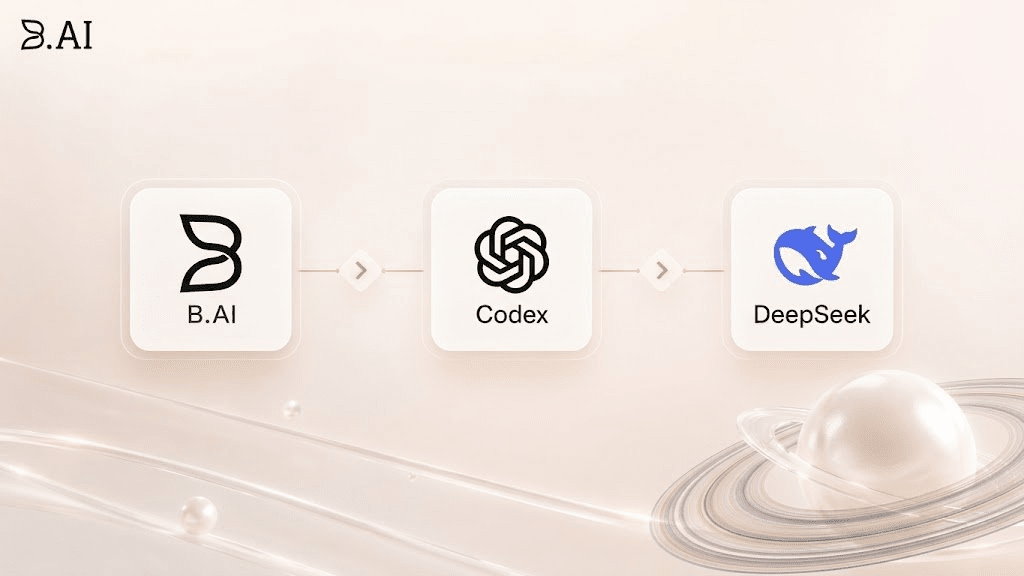
At the heart of this execution layer is native Codex integration. Full compatibility with the Responses API means developers can now use a single B.AI key inside Codex to run flagship GPT models and DeepSeek favorites side by side.
Engineers can now bring these powerhouse models straight into their daily dev stack. From code generation and reasoning to debugging and refactoring, B.AI unifies the entire workflow under one roof—delivering a direct line from model selection to shipped code.
Beyond coding, to keep agents running reliably in real-world production at scale, B.AI has built a full-stack infrastructure powered by five core components, equipping agents with a fine-tuned operational engine:
x402 Payment Protocol: Introduces an innovative “pay-before-response” model that executes high-frequency, on-chain micro-settlements in the background during cross-agent API calls and compute orchestration.
8004 Identity Protocol: Issues verifiable on-chain credentials for every agent, logging execution history and credit scores to establish a reliable layer of trust for cross-node collaboration.
Skills Matrix: Plug-and-play, standardized building blocks that interface directly with MCP servers to equip agents with instant, modular tool-calling capabilities.
BAIclaw and BAIcode: Built-in platform assistants engineered for end-to-end execution. BAIclaw manages all-in-one terminal operations and multi-agent workflows, while BAIcode serves as an advanced developer engine that streamlines the full pipeline from task analysis and architecture design to coding and testing.
From the token surge sparked by zero-cost model access to its positioning as the global settlement layer for intelligence; from seamless Codex integration to full-stack infrastructure powered by x402, 8004, Skills, and native assistants—B.AI delivers far more than a battle-tested technical stack; it unveils a clear blueprint for what lies ahead. B.AI is building not just accessible compute today, but the definitive launchpad for a thriving agent economy. The future is here—and this is only the beginning.
Axis Robotics has released Axis Sim Dataset V1, one of the largest open-source simulation datasets for Franka arm manipulation, with the full dataset, training code, and benchmarks publicly available. V1 is built from more than 50,000 human-teleoperated simulation trajectories across 207 manipulation tasks and 60,000+ scene variants on a simulated Franka Research 3 arm.
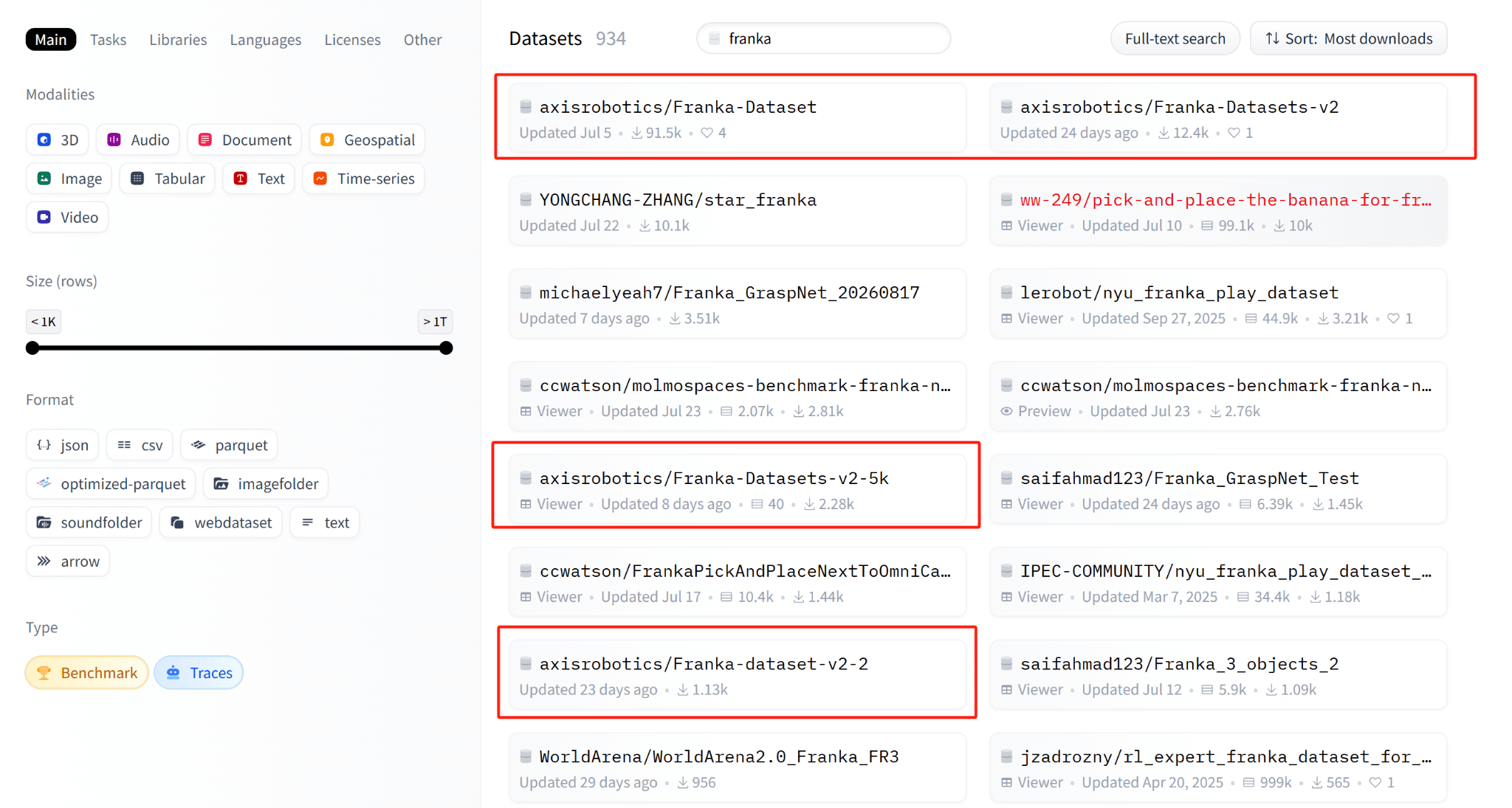
This dataset drew over 160,000 downloads, making it the most downloaded open-source simulation Franka manipulation dataset on Hugging Face. In benchmarks, continual pretraining on V1 lifted π0.5 and beat a volume-matched RoboCasa baseline, with every result open and verifiable.
Axis Robotics is building the ultimate compounding data engine for Physical AI, a vertically integrated system spanning large-scale simulation, egocentric real-world capture, humanoid loco-manipulation, and human-gated DAgger post-training. The company raised $12 million in seed funding led by Hack VC, with participation from Nomad Capital, Pi Network Ventures, 10K Ventures, and angel investors.
A Bet Against “Clean Data Only”
A common assumption in robotics is that demonstrations must be near-optimal to begin with — filter down to expert trajectories, standardize the setup, and discard anything noisy before it is safe to imitate. Axis’s thesis runs the other way: data quality lives at the distribution level, not the single trajectory. When a large and diverse enough crowd produces noisy, suboptimal trajectories and their errors are uncorrelated, the noise averages out and a working policy survives during training.
Axis Sim Dataset V1 puts that thesis to a public test. Its trajectories span pick-and-place, stacking, pouring, articulated-object manipulation, and tool use, all collected through Axis’s browser-based teleoperation platform, Axis Hub, by a distributed crowd rather than a single expert team. The dataset was built with researchers from UC Berkeley, Johns Hopkins, the University of Michigan, and other institutions.
Results That Scale
On LIBERO-Plus, continual pretraining on V1 lifts π0.5 from 83.9% to 88.8% success and outperforms a volume-matched RoboCasa365 baseline by 37.3%. Performance improves consistently as pretraining data scales from 25% to 100% of the dataset, with no saturation in sight, evidence that the gains come from diversity and coverage rather than a one-off bump. The largest improvements appear under camera, sensor-noise, and layout perturbations, the exact axes Axis randomizes during generation.
The team says V2 is already underway, scaling to 1.2 million trajectories across 1,200 tasks, with cross-embodiment generalization and results across multiple VLA models showing that suboptimal simulation data trains robust policies.
The Engine Behind the Dataset
The dataset is one output of a larger, actively compounding data engine. Where a traditional data vendor collects to a fixed spec and stops, Axis uses model performance and failure cases to determine what should be collected next, so every training round informs the next. That engine runs on a hybrid strategy across four data lines, and all four now run at scale:
Simulation: over 200,000 distributed contributors on Axis Hub, a top-3 dApp on Base, producing 4.7M+ trajectories across 13 embodiments.
Egocentric: a managed network of 1,000+ full-time, QC-trained collectors capturing first-person activity in real homes and businesses across 14 industries: 200,000+ hours already banked and growing by 4,000+ hours every day, with Vicon-verified hand pose.
Loco-manipulation: 500+ hours combining mobility and dexterity on real humanoids (Unitree G1, Booster T2) through hardware-agnostic teleoperation.
Human-gated DAgger post-training: 500+ hours of human-in-the-loop correction targeted at deployment edge cases.
Every task and trajectory is recorded on-chain on Base for provenance, and contributors are rewarded for verified work quality.
From Open Data to Commercial Deployment
Beyond open-sourcing simulation data, Axis works directly with robot embodiment companies to build customized, embodiment-specific data pipelines and model priors.
As Booster Robotics’ first sim-data partner, Axis rebuilt Booster’s real workspace as a task-aligned digital twin, had distributed contributors collect 42,000+ simulation episodes on it, and distilled them into a Booster-specific model prior. With just 30 real-robot demos, that prior reached 87.5% success versus 37.5% for an out-of-the-box π0.5, matching π0.5 using half the real-world demonstrations.
Other partners span embodiment companies (Feagine Robotics), model companies (Manycore Tech, Dexmal) and industrial automation (Lotus Cars, Geely Auto). Axis also supplies on-chain robotics networks: BitRobot on Solana and OpenRoboto on Bittensor.
Redefining Physical AI’s Data Foundation
“The future of Physical AI isn’t a static dataset you download once,” said Chris Feng, founder of Axis Robotics. “It’s an engine that keeps producing the data the model needs next. Scale gets you broad coverage. Diversity keeps the noise unbiased. The closed loop turns every failure into progress. That’s what compounds.”
Axis was founded by researchers from UC Berkeley, CMU, Georgia Tech, and SJTU, alongside serial founders who have scaled consumer platforms to over 30 million users. Its research is advised by Jiachen Li, Assistant Professor at Georgia Tech.
Tether reported $1.3 billion in Q2 net operating profit in its latest BDO attestation statement, while excess reserves rose to $5.2 billion above full USDT backing.
The figures keep Tether at the center of the stablecoin market’s profitability and reserve debate. USDT remains the largest dollar stablecoin in crypto, and Tether’s reserve earnings have become one of the most closely watched financial stories in the sector.
The main driver is familiar: interest income from large holdings of U.S. Treasury assets.
But the details still need careful wording. Net operating profit is not the same as total reserves, and excess reserves are not the same thing as circulating supply.
For more details, visit the official Tether platform.
TL;DR
Tether reported $1.3 billion in Q2 net operating profit.
Its latest attestation showed $5.2 billion in excess reserves.
The figures are separate from total USDT circulating supply and full reserve backing.
Why Tether Is So Profitable
Tether’s business benefits from scale.
When users hold USDT, Tether holds reserve assets backing those tokens. A large portion of those reserves is held in short-term U.S. Treasury instruments and similar cash-equivalent assets. In a higher-rate environment, those holdings can generate substantial income.
That is why stablecoin issuers have become major financial businesses.
They may issue digital dollars, but their economics can look like a huge cash-management operation. The larger the token supply, the larger the reserve portfolio, and the more interest income can be generated when yields are favorable.
Tether’s $1.3 billion quarterly profit reflects that model.
Excess Reserves Add A Cushion
The reported $5.2 billion in excess reserves is also important.
Stablecoin users want to know not only that tokens are fully backed, but that the issuer has a cushion above liabilities. Excess reserves can help absorb shocks, operational costs, or asset fluctuations.
That does not remove every risk.
Reserve composition, banking access, liquidity, legal structure, transparency, and redemption mechanics still matter. But a larger reserve cushion can strengthen market confidence.
For USDT, that confidence is critical because the token is deeply embedded in global crypto trading.
USDT’s Market Role Is Huge
USDT is used across exchanges, DeFi, payments, emerging-market dollar access, trading pairs, and liquidity venues.
That means Tether’s financial health matters beyond Tether itself. If confidence in USDT weakens, the impact can spread through crypto markets quickly. If confidence remains strong, USDT continues to serve as one of the industry’s main settlement assets.
That is why every attestation receives attention.
It is not just an accounting update. It is a health check for one of crypto’s biggest liquidity layers.
Attestations Are Still Point-In-Time
The market should keep the limits in mind.
An attestation is a snapshot. It is not a live, second-by-second view of reserves. It does not eliminate every question around asset composition or risk. It also does not give the same kind of continuous visibility as an on-chain reserve dashboard.
But regular attestations still improve transparency compared with no disclosure at all.
They give users and institutions data to assess reserve backing, profit, and excess cushion at the reporting date.
The Stablecoin Race Is Getting Bigger
Tether’s profit also shows why stablecoins have become strategically important.
Banks, fintechs, payment firms, and crypto companies all want a role in digital dollar settlement. Regulation is tightening, competition is growing, and reserve economics are attractive.
Tether already has scale.
The question is how it holds that lead as regulated stablecoin frameworks, tokenized deposits, and bank-linked digital money products develop.
For now, the latest attestation shows a highly profitable issuer with a large reserve cushion and a stablecoin that remains central to crypto liquidity.
This article draws on Tether’s Q2 2026 BDO attestation materials.
This article was written by the News Desk and edited by Samuel Rae.
This report is based on information released by Tether. at Tether
The SEC has approved a Cboe Options Exchange rule amendment allowing listed options on the WisdomTree Bitcoin Fund, opening another regulated derivatives route around a U.S. spot Bitcoin ETF.
The approval applies to options on BTCW, not to the underlying spot Bitcoin ETF itself. That difference matters because the fund already exists; the new development concerns options tied to the ETF.
For institutional traders, listed options can be useful. They allow hedging, yield strategies, volatility positioning, and more precise risk management without moving directly through spot Bitcoin markets.
For more details, visit the official Sec platform.
TL;DR
The SEC approved a Cboe rule amendment for options on the WisdomTree Bitcoin Fund.
The approval concerns listed options on BTCW.
It does not mean spot Bitcoin ETF approval itself is new.
Why ETF Options Matter
Spot Bitcoin ETFs opened the door for traditional investors to access BTC through familiar brokerage and fund infrastructure.
Options add another layer.
They give traders tools to manage exposure around those ETFs. Investors can hedge downside risk, sell covered calls, express volatility views, or build more complex strategies around Bitcoin-linked products.
That is especially important for institutions.
Large investors often need derivatives to manage risk. A spot product may provide exposure, but options can make that exposure easier to handle inside portfolio frameworks.
BTCW Gets A Broader Market Toolkit
The WisdomTree Bitcoin Fund now sits inside that expanding ETF derivatives market.
Approval for listed options can help make the product more useful to traders who need more than simple long exposure. It may also support liquidity around the fund by attracting market makers and options traders.
But the impact depends on actual trading.
Regulatory approval allows the exchange to list the product under the approved framework, but the start of trading depends on exchange and clearing readiness.
That means investors should not assume options are live until the exchange confirms launch details.
Not A New Spot ETF Approval
The headline needs precision.
This is not the SEC approving a new spot Bitcoin ETF. It is not a new ruling on Bitcoin’s status. It is an approval related to options trading on an existing ETF product.
That may sound technical, but the distinction matters.
Crypto coverage often compresses ETF developments into one simple narrative. In reality, there are multiple layers: fund approval, exchange listing, options approval, clearing, market maker participation, and investor access.
This development sits in the options layer.
What It Means For Bitcoin Markets
More ETF options can deepen Bitcoin’s market structure.
As more spot Bitcoin ETFs gain listed options, institutions have more ways to trade volatility and hedge exposure. That can attract additional capital, but it can also make market behavior more complex.
Options markets can influence dealer hedging, volatility, and short-term price dynamics.
They do not automatically push Bitcoin higher. But they can make the market more mature and more attractive to professional traders.
The Market Signal
The SEC’s approval for WisdomTree Bitcoin Fund options is another step in the normalization of Bitcoin-linked products.
The spot ETF era is no longer only about whether investors can buy fund shares. It is increasingly about whether those products develop the surrounding tools that traditional markets expect.
Options are part of that toolkit.
For BTCW, the approval may improve trading flexibility. For Bitcoin more broadly, it shows the regulated product stack is still expanding.
This article draws on the SEC approval order for Cboe Options Exchange listed options on the WisdomTree Bitcoin Fund.
This article was written by the News Desk and edited by Samuel Rae.
This report is based on information released by Sec. at Sec
The European Central Bank has released a progress report on the digital euro preparation phase, outlining work on offline functionality, privacy mechanisms, and holding limits.
The update keeps Europe’s central bank digital currency project moving, but it does not amount to final political approval for issuance. That distinction is essential. The ECB can study, design, test, and prepare, but a final decision to issue a digital euro depends on the broader European legislative and political process.
Still, the report matters because the digital euro remains one of the most advanced CBDC projects in a major developed economy.
For more details, visit the official Ecb platform.
TL;DR
The ECB released a digital euro preparation phase progress report.
The update covers offline functionality, privacy protections, and holding limits.
It does not mean the digital euro has received final authorization for issuance.
Why The Preparation Phase Matters
The digital euro project has moved through several stages.
The preparation phase is where technical design, rulebooks, user experience, privacy protections, and distribution models are developed further. It is not the same as launch, but it is a meaningful step in deciding whether a launch is practical.
CBDCs are not just payment apps.
They affect banks, merchants, consumers, governments, payment networks, privacy expectations, and monetary systems. That is why the ECB’s design choices matter beyond crypto.
A digital euro could reshape how Europeans use central bank money in digital form, if it eventually goes live.
Offline Payments Are A Key Feature
Offline functionality is one of the most important design questions.
A digital currency that only works when connected to the internet may not be resilient enough for every payment situation. Offline capability could help with emergencies, outages, remote areas, and everyday small transactions where users expect cash-like reliability.
But offline payments also create design challenges.
The system needs to prevent double-spending, protect privacy, manage limits, and sync transactions safely once connectivity returns.
That is why the ECB’s continued work on offline functionality is significant.
Privacy Is The Political Test
Privacy may decide public acceptance.
Many people worry that a central bank digital currency could give governments too much visibility into daily payments. The ECB has repeatedly had to address those concerns, and the latest preparation work keeps privacy mechanisms near the center of the design.
The challenge is balance.
Regulators want to prevent money laundering and illicit finance. Users want privacy. Banks want a system that does not drain deposits. Merchants want low-cost payments. The final design has to manage all of those demands.
Holding Limits Protect Banks
The report also discusses holding limits.
That matters because commercial banks worry that a widely used digital euro could pull deposits out of the banking system. If users move large balances into central bank digital money, banks could lose funding.
Holding limits are one way to reduce that risk.
They can make the digital euro more like a payment instrument than a savings account. That may help protect commercial bank liquidity while still giving users access to digital central bank money.
Not A Crypto Endorsement
Crypto markets should not treat the report as an endorsement of decentralized assets.
A digital euro would be central bank money. It would not be Bitcoin, Ethereum, or a permissionless stablecoin. But the project still matters to crypto because it shows that digital settlement and programmable payment infrastructure are now mainstream policy issues.
The ECB’s report keeps that debate alive.
The digital euro is not launched. It is not politically complete. But the preparation work is still moving, and the design choices being made now could shape Europe’s future payments landscape.
This article draws on the European Central Bank’s digital euro preparation phase progress materials.
This article was written by the News Desk and edited by Samuel Rae.
This report is based on information released by Ecb. at Ecb

 Login
Login