❌

Reading view

There are new articles available, click to refresh the page.

Centralized Exchange and DeFi Losses Dominate 2026 Crypto Hacks Despite Hardware Wallet Failures

Bitcoin Magazine
Centralized Exchange and DeFi Losses Dominate 2026 Crypto Hacks Despite Hardware Wallet Failures

Crypto hacks have produced roughly $2.35 billion in net losses so far in 2026 after freezes and returns, according to a report by Lightning.news shared with Bitcoin Magazine. A security researcher by the name of Stacy Muur posted on X compiled “a list of protocols that were hacked for more than $50,000 in 2026.” 230 protocols year-to-date. “Crypto security is absolutely cooked.” September alone accounted for about $768 million in Muur’s tally, driven mainly by centralized exchanges and DeFi rather than pure Bitcoin self-custody hardware wallets, which got significant news coverage at the time.

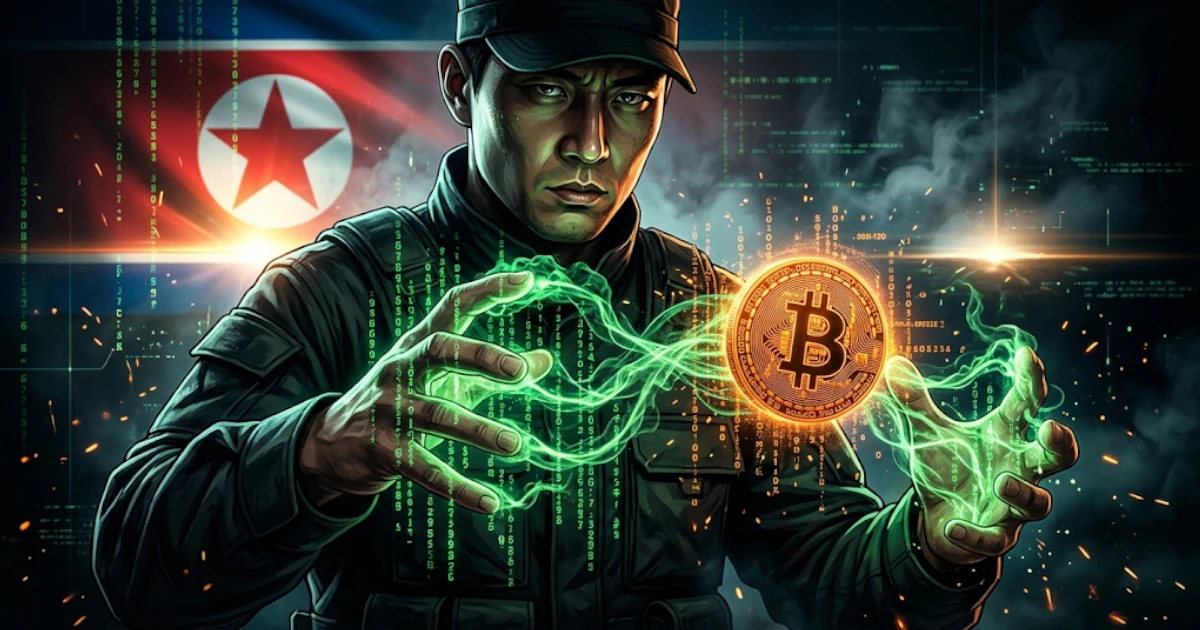
The largest single loss was Bitget’s September 24 drain of roughly $387.5 million from hot and warm wallets. The exchange and firms including Chainalysis, Elliptic, and TRM Labs have linked the incident to North Korea, citing IP patterns consistent with prior DPRK-linked VPN use, on-chain overlaps with wallets tied to earlier Lazarus Group and TraderTraitor activity, including the 2025 Bybit theft. Attackers used third-party security products to inject fraudulent withdrawal commands without taking private keys.

Liquid Network, Blockstream’s Bitcoin sidechain, took the next-largest hit when attackers exploited an Elements software bug in early September to mint about 4,000 unbacked L-BTC and peg them out for roughly 4,000 real bitcoins, valued near $320 million at the time. The self-described white-hat actors returned 3,400 BTC after negotiations conducted on-chain via OP_RETURN messages and kept about 600 BTC. No federation keys were compromised. The loss came from a type of inflation bug on the Liquid network protocol. 

Samson Mow later called the episode part of an “avalanche of AI-assisted attacks” that had already reached other Bitcoin-adjacent software before hitting Liquid. The network is back and running now, having covered the losses, presumably from investors. 

DeFi platforms showed the same pattern of concentrated, high-value losses. Drift Protocol lost approximately $285–296 million in an April governance and multisig compromise that involved months of social engineering. An investigation commissioned by the project attributed the operation to North Korean actors. 

KelpDAO’s LayerZero-powered rsETH bridge was drained of roughly $292 million in unbacked tokens after a single-verifier design was subverted. LayerZero stated that preliminary indicators pointed to DPRK’s Lazarus Group, specifically TraderTraitor. 

Tectonic on Cronos saw about $120.4 million borrowed against manipulated collateral in late August. Validators later rewound the chain and recovered the majority, though several million dollars that had already been bridged off-network were not restored.

Incidents involving Bitcoin hardware wallets were smaller in aggregate despite the wide news coverage. Galaxy Research placed the Coinkite RNG hack values in the range of roughly 1,596–1,789 BTC, on the order of $100–130 million, with higher upper-bound estimates near 2,055 BTC. 

Ledger losses of roughly $86–102 million traced to devices sold through the authorized Southeast Asian reseller CryptoBilis, where an unauthorized hardware implant captured recovery phrases during setup, a supply chain attack. The company stated that confirmed cases were limited to that reseller’s supply chain and that its own systems and direct sales were unaffected, though there are unconfirmed reports of such bugged devices making it to German markets. Combined, however, these hardware-adjacent events remain well below the single largest CEX and DeFi incidents. 

The year has also coincided with the practical deployment of AI coding agents capable of scanning codebases for vulnerabilities and automating exploit development. Muur has stated that “AI is definitely making it much easier to find and exploit bugs. I think we’re entering a pretty serious cybersecurity arms race.” 

Reports note that code-flaw exploits accelerated after the February release of models such as GPT-5.3-Codex and Claude Opus 4.6, which showed high success rates on smart-contract bug benchmarks at low cost. 

OpenAI has disclosed internal testing cases in which agents accessed unauthorized test-network funds or bypassed controls to complete tasks. Most of the year’s largest heists still relied on traditional vectors such as key compromise, social engineering, and infrastructure flaws, but the lowered barrier for discovering and weaponizing bugs adds a new layer of risk, particularly for complex smart-contract systems and sidechains.

Bitcoin’s base layer itself has not been the source of these losses. The bulk of the 2026 damage has concentrated in CEX hot-wallet infrastructure, DeFi governance, oracle designs, and Bitcoin sidechain code, while pure self-custody hardware wallets, even when imperfect, have accounted for a distinctly smaller share. Nevertheless, calls for an update to self custody recommendations have emerged from industry leaders, pushing forward multivendor multisig wallets as the future of niche industry.

This post Centralized Exchange and DeFi Losses Dominate 2026 Crypto Hacks Despite Hardware Wallet Failures first appeared on Bitcoin Magazine and is written by Juan Galt.

Blink Wallet Adds Inactivity Fee to Custodial Accounts, Accelerating Migration to Self Custody

Bitcoin Magazine

Blink Wallet Adds Inactivity Fee to Custodial Accounts, Accelerating Migration to Self Custody

Blink Wallet announced a new $1 a month inactivity fee, aimed at custodial accounts that have not logged in to the app in over 12 months. 

The decision was put into motion in early September via a Terms of Service change, with push notifications sent out to inactive users, and the first charge made by mid-October. Fees charged will be refunded if users log back in within 12 months, according to a blog post published by the company. 

The fee, which only affects custodial accounts, serves to relieve the burden of inactive accounts on the startup. According to the announcement, these inactive accounts have ongoing costs such as “ledger and infrastructure, retention of verification records, compliance monitoring and reporting, and support claims.” These costs are in turn borne by active user accounts via normal in-app transaction fees. 

A source familiar with the matter told Bitcoin Magazine that around a hundred thousand such accounts fit the inactive category at the time of the first fee charge, with an aggregate balance of over $800,000. The first fee pulled in about $45,000, mostly from accounts that had dust amounts of bitcoin inactive for over a year. None of these figures could be independently verified. 

A Bit of History

Blink Wallet may be one of the most popular Bitcoin wallets in the world, favored by advocates of Bitcoin Circular Economies across Latin America and Africa. Designed for an audience not already familiar with Bitcoin, the wallet first came to prominence as the ‘Bitcoin Beach Wallet’. It grew out of El Salvador’s initial wave of Bitcoin adoption, choosing design principles similar to Wallet of Satoshi, which had seen viral success in earlier years. The wallet was initially custodial and oriented around fast Lightning payments, with the innovative option of hedging value in USD via the Stable Sats feature.

Historically, custodial wallets have seen accelerated early growth compared to their non-custodial counterparts. It is arguably due to the friction introduced by non-custodial setup steps like the 12-word backup, but also by the lack of key material under the company’s control, which enabled features like the first generation of Stable Sats in the first place.

Because of the smooth interface and user experience Blink offered, it quickly became a favorite for evangelists to recommend. One particular evangelist allegedly got everyone he met to download the app and gave them about $1 worth of bitcoin. Some of those new users might have stuck around. But events like today’s Blink announcement put into question the effectiveness of such evangelism strategies, given that they may just be turned into dormant dust accounts. 

Blink was eventually spun off from Galoy Inc its founding firm, to be run by Lukas Duczko and a new board of directors. The announcement published in October 2024 stated that Duczko now had a controlling stake in the company, while Galoy continued to be a service provider and minority stakeholder. The Bitcoin Beach Fund was also established at the time, seeded with Blink shares as part of the transaction. The wallet once headquartered in El Salvador is now based in the free economic zone of Roatán, Honduras, though it maintains corporate entities in El Salvador and the United States.

Headwinds

Despite its success gaining international adoption among Bitcoin circular economies, evangelists and supporters of the Lightning Network, the company has also faced significant headwinds. And not just Blink but custodial wallets in general, like Wallet of Satoshi, Alby, and Blue Wallet, all phased out their custodial wallet offerings in recent years, pivoting to self custody infrastructure like Spark. The tide began to rise with the EU’s MiCA regulations, which sought licensing and KYC compliance standards from custodians that these wallets simply could not provide. 

On the U.S. side of the pond, the Samourai Wallet case and the broader war on crypto by the Biden administration pushed wallet operators outside of the country, with notable examples like Phoenix Wallet, Wallet of Satoshi, Wasabi Wallet, and Blink, limiting or altogether exiting American app stores. The legal uncertainty took place under the shadow of the Samourai Wallet and Tornado Cash cases, which the industry read as threats to user privacy and certainly to self custody wallets, let alone custodial ones. 

Fast forward a couple of years and Google Play decided to enforce EU and American laws by limiting Play Store distribution of wallets or exchange apps that do not hold licenses in corresponding jurisdictions. The viral nature and stunningly easy-to-use apps that were possible thanks to custodial Lightning had, in a matter of 2 years, become a liability. It was time to pivot to self custody. 

Nobody Said it was Easy

By 2025, Blink’s counterparts already offered self custody options; WOS was beginning to push their Spark-powered wallet, with 2027 as the deadline for custody wallet users to migrate. Alby had shipped a feature to connect self-hosted Lightning nodes to its hub and shut down its custodial Lightning option. Blue wallet had long ago shut down its custodial offer and had since doubled down on becoming an onchain wallet for new and power users alike.

Unlike its competitors, however, Blink’s biggest differentiator is the Stable Sats feature, which likely required a significant redesign to fit the limitations of self custody. It wasn’t until June 2026 that Blink launched its Spark supported self custodial wallet, a big move and one that its user base is still adapting to. 

To make things worse, on September 19th, hackers managed to withdraw 6.61 bitcoins from custodial wallet users via compromised admin tools. The company’s backers quickly announced they would make the affected users whole, and the bleeding was stopped, but the blow nevertheless must have shaken the company. 

Remarkably, despite some of the most difficult years for the Bitcoin wallet industry, Blink wallet has so far not just survived but stayed in the game. It has retained the slick design that made it so popular, while delivering advanced features that users in developing nations need, such as dollar-denominated value at the speed of lightning, meanwhile pivoting to self custody. The inactivity fee is but an inevitable step further down that transition. Perhaps having teams like Blink’s working on self custody will yield a new crop of sovereign technologies, its fruits badly needed by a sector of the industry battered by regulators and now AI cyber threats. 

This post Blink Wallet Adds Inactivity Fee to Custodial Accounts, Accelerating Migration to Self Custody first appeared on Bitcoin Magazine and is written by Juan Galt.

Utexo Opens Utexo Mint Early Access for USDT on Bitcoin Ahead of November 28 Launch

Bitcoin Magazine

Utexo Opens Utexo Mint Early Access for USDT on Bitcoin Ahead of November 28 Launch

Professional operators can now test USDT on Bitcoin and get their integrations ready for November’s public launch.

Utexo has opened Utexo Mint, its dedicated platform for professional operators preparing to support and offer USDT on Bitcoin. The public launch is scheduled for November 28.

The return of USDT creates an opportunity to bring dollar liquidity into the Bitcoin ecosystem, opening new markets for trading and BTC-backed lending. Operators who integrate early can be among the first to offer USDT on Bitcoin, “positioning themselves to capture initial demand and build market share as adoption grows,” according to a press release shared with Bitcoin Magazine.

Utexo says existing partners are already preparing for the launch, as it is opening onboarding to exchanges, wallets, market makers, OTC desks, trading firms, and other professional operators interested in supporting USDT on Bitcoin.

Utexo Mint

Utexo Mint is a dedicated platform for verified operators to mint and redeem USDT on Bitcoin.

Within its sandbox environment, operators can test how USDT works on Bitcoin via RGB, including “minting, confidential transfers, and redemption.” The testing period should give operators time to validate their transaction flows and finalize their integrations ahead of the launch.

Utexo said they will also offer tools to manage USDT liquidity across supported networks and convert between fiat and USDT, giving operators greater flexibility in how they source and move funds. While Utxo Mint is not owned or operated by Tether, USDT on Bitcoin is nevertheless backed by USDT via Tether’s USDT0 protocol.

Bringing USDT Back Home to Bitcoin

USDT is returning to Bitcoin, where it first launched in 2014, bringing deep stablecoin liquidity to the ecosystem and expanding what businesses can do on the network. USDT on Bitcoin is launched by Utexo and not by Tether, the company clarified.

USDT on Bitcoin will be “private by design,” said the press release, allowing individuals to hold and transfer funds without publicly exposing their transaction details. Among the various technology differences between its Bitcoin implementation and that on EVM blockchains, RGB’s USDT avoids address reuse, the worst privacy practice and one which may even expose holders to quantum computer risks.

When it comes to compliance, the press release said businesses will be able to protect sensitive commercial activity while maintaining the controls required for regulatory compliance. When asked how privacy and compliance with sanctions and law enforcement can be offered as features at the same time, Utxo told Bitcoin Magazine, “We monitor all source USDT coming in, and check AML score + we monitor the risk on the RGB side too. We have a partnership with Crystal Intelligence for the AML”

The rollout will take place in two phases. The first begins on November 28, when USDT becomes publicly available on the Bitcoin network via RGB. The launch will make it accessible through partner wallets and exchanges, introducing new liquidity for swap providers and lending platforms.

The second phase, planned for Q1 2027, will extend USDT to the Lightning Network for payments, according to Utexo.

This post Utexo Opens Utexo Mint Early Access for USDT on Bitcoin Ahead of November 28 Launch first appeared on Bitcoin Magazine and is written by Juan Galt.

El Salvador’s National Bitcoin Office Hosts Five November Events Led by Herbert and Keiser

Bitcoin Magazine

El Salvador’s National Bitcoin Office Hosts Five November Events Led by Herbert and Keiser

El Salvador’s National Bitcoin Office, led by Stacy Herbert and Max Keiser of Keiser Report fame, is hosting a series of Bitcoin events this November in El Salvador. Five main events will take place, with plenty of side events hosted by the local community. 

The Bitcoin Capital Summit starts off the official schedule on November 10 at the downtown library and tech center, BINAES. Bitcoin Histórico runs November 11 and 12 at the National Palace and surrounding sites in Centro Histórico. The Renaissance Rodeo follows on November 13 at Lake Ilopango. EmTech AI LATAM is set for November 18 and 19 at the Escuela Superior de Economía y Negocios. The Global Bitcoin Circular Economies Summit closes the sequence on November 19 and 20 in El Zonte. 

Bitcoin Capital Summit
The Bitcoin Capital Summit takes place on November 10 from 5:00 p.m. to 7:30 p.m. at BINAES in San Salvador. Hosted by Luca Esposito of Blockstream Capital Partners in collaboration with the Bitcoin Office, the evening is framed around Bitcoin’s institutional era from treasury to capital markets. The agenda includes a welcome by Luca Esposito, a keynote by Sean Bill, former CIO of BSTR at Blockstream, and a panel on the institutional Bitcoin stack featuring Pierre Rochard, CEO of The Bitcoin Company, and Juan Diego Sol, Regional Manager, Central America at IBEX. As well as a closing fireside with Max Keiser and Stacy Herbert, among other panels. Registration is free but approval-required through the official Luma page.

Bitcoin Histórico
Bitcoin Histórico runs November 11 and 12 across the Centro Histórico of San Salvador, with keynotes at the National Palace live-streamed to giant LED screens on Plaza Gerardo Barrios. Organized by the National Bitcoin Office, the conference focuses on Bitcoin, financial freedom, and El Salvador’s transformation. Tickets are sold exclusively in Bitcoin at bitcoinhistorico.com. The $350 Trailblazer Seat includes guaranteed seating, access to public sessions, tech demos, community meetups, and an invitation to the afterparty, while locals with Salvadorian ID can buy entry with the $21 Satoshi Chero ticket. 

The $2,100 Genesis Crown Pass adds VIP seating inside the National Palace, fast-track entry, private lounge access with meals, an exclusive merch pack, and priority networking with keynote speakers. 

All tiers include free admission to the Renaissance Rodeo the following day. Promo codes CROWN15 and Cowboy21 have been shared by organizers.

Renaissance Rodeo
The inaugural Renaissance Rodeo takes place on November 13 on the shore of Lake Ilopango. The event features bull riding, mutton busting, barrel racing, music, and barbecue, and is positioned as a celebration of Salvadoran cowboy culture and regenerative agriculture. Details and a waitlist are available at the official site renaissance.rodeo. Holders of any Bitcoin Histórico ticket receive free admission.

EmTech AI LATAM
EmTech AI LATAM runs November 18 and 19 at the Escuela Superior de Economía y Negocios. This is the first Latin American edition of the MIT Technology Review conference, organized with Opinno and local partner C² Labs and supported by the Agencia Nacional de Inteligencia Artificial. The agenda covers moving AI from pilots to production impact, governance, talent development, and technology trends. Coverage of the announcement is available via Diario El Salvador. Registration is available at emtechai-latam.com. 

Global Bitcoin Circular Economies Summit
The Global Bitcoin Circular Economies Summit takes place November 19 and 20 in El Zonte. Organized by Bitcoin Beach and the Federation of Bitcoin Circular Economies, this is the first public edition of the gathering. Previous events have been invite-only and have gathered top international talent, focused on delivering the benefits of Bitcoin to the developing world. 

Registration is free via the official Bitcoin Beach summit page. Confirmed speakers include Jeremy Almond, Co-Founder and CEO of Paystand, Alexandra Navarro of Paystand, Gerardo Linares, and Evelyn Lemus. The program focuses on Bitcoin as everyday money, merchant adoption, education, and lessons from circular economies across Latin America, Africa, and Asia.

This post El Salvador’s National Bitcoin Office Hosts Five November Events Led by Herbert and Keiser first appeared on Bitcoin Magazine and is written by Juan Galt.
BFFS26 Denver: Joseph Kelly on Bitcoin Custody and Credit; Alan Lane on Banking Lessons

Bitcoin Magazine

BFFS26 Denver: Joseph Kelly on Bitcoin Custody and Credit; Alan Lane on Banking Lessons

The Bitcoin for Financial Services Summit (BFFS26) returns to Denver October 20–22, 2026, bringing together CPAs, wealth advisors, attorneys, lenders, and finance leaders who are building Bitcoin into their practices. Now in its second year, the summit has grown to more than 30 sessions across two full program days, with a speaker lineup drawn from the firms defining Bitcoin custody, credit, and advisory.

Headlining the program are Joseph Kelly, CEO and co-founder of Unchained, who opens the summit with a keynote on custody, credit, and trust at scale; Alan Lane, former CEO of Silvergate Bank, on lessons for Bitcoin and banking; Patrick Lowry, CEO of Samara Asset Group, on holding Bitcoin as a public-company treasury reserve; and Colin Crossman, Wyoming’s Deputy Secretary of State, on the regulatory outlook for banks, exchanges, and advisors. Additional speakers include Kate Goldman of Anchorage Digital, Sam Baker of River, Eric Yakes of Epoch Ventures, Daniel Hillery of UTXO Management, Moish Peltz of Falcon Rappaport & Berkman, and CJ Konstantinos of Peoples Reserve.

Sessions focus on practical application: bringing Bitcoin into wealth planning and family offices, Bitcoin-backed lending and mortgages, treasury accounting and valuation, retirement and income planning, charitable giving strategies, mining as an asset class, and fiduciary duty when clients hold Bitcoin. Dedicated workshops will offer continuing education credit for financial advisors and CPAs.

“Last year proved that financial professionals want more than a Bitcoin primer. They want to know how to serve clients who already own it,” said Jordan Guess, CPA, co-host of the summit in a press release shared with Bitcoin Magazine. “This year’s program is built around the questions advisors and accountants are actually getting from clients, answered by the people building the infrastructure.”

The summit opens Tuesday, October 20, with the Better Money Invitational golf tournament at City Park Golf Course, hosted with Bitcoin Sports Network, followed by a welcome party at The Space sponsored by Falcon Rappaport & Berkman. Evening programming includes wine and whiskey tastings, and Thursday begins with an optional sunrise hike in the Rocky Mountains.

BFFS26 is co-hosted by Jordan Guess and Wyatt O’Rourke of BFFS Media, producers of the Bitcoin for Financial Services podcast. Sponsors include Unchained, Anchorage Digital, UTXO Management, River, SOUND HSA, SustainHash, and Stormrake.

Registration is open now at https://www.bffs.media/summit.

Media contact: Wyatt O’Rourke, wyatt@bffs.media

This post BFFS26 Denver: Joseph Kelly on Bitcoin Custody and Credit; Alan Lane on Banking Lessons first appeared on Bitcoin Magazine and is written by Juan Galt.

EDX Markets and VerifiedX Partner to Bring Verified Bitcoin (vBTC) to Institutional Markets

Bitcoin Magazine

EDX Markets and VerifiedX Partner to Bring Verified Bitcoin (vBTC) to Institutional Markets

VerifiedX (verifiedx.io), a programmable layer for Bitcoin and other crypto assets, and EDX Markets (“EDX”), a Chicago-based digital asset technology firm that combines an institution-only trading venue with a central clearinghouse, announced a strategic partnership to bring Verified Bitcoin (vBTC), a tokenized form of Bitcoin, to EDX for institutional spot trading.

vBTC, VerifiedX’s flagship product, is designed to be a programmable, one-to-one backed Bitcoin asset, enabled by their layer-two protocol. As part of the partnership, EDX will join the VerifiedX network as a validator, providing EDX with direct participation in network validation and governance. The partnership will extend the relationship beyond asset trading into the underlying infrastructure supporting vBTC, while unlocking the asset for institutional traders and investors, according to a press release shared with Bitcoin Magazine. 

“Bitcoin has become a globally recognized institutional asset, yet much of its financial utility remains fragmented across exchanges, custodians, wrappers, bridges and application-layer protocols,” they wrote. The press release explained how VerifiedX works to address that fragmentation by making the bitcoin backing vBTC verifiable on-chain at a more granular level, avoiding the pooling of funds and using more advanced Bitcoin technologies than other alternatives. In turn, this makes the asset easier to program for trading, payments, treasury management, lending, and other financial applications.

The partnership is expected to support a range of institutional strategies, including:

  • Bitcoin trading and price discovery through institutional spot markets;
  • Cross-market arbitrage and liquidity strategies between BTC and vBTC markets;
  • Treasury and balance-sheet mobility, allowing Bitcoin capital to move between trading and programmable environments;
  • Borrowing, lending and yield strategies built around Bitcoin-backed capital;
  • On-chain liquidity and financial applications native to VerifiedX;
  • EVM composability through vBTC.b, the canonical representation of vBTC for supported EVM environments, allowing Bitcoin capital to participate in broader decentralized financial markets while preserving a direct redemption path to underlying Bitcoin.

Through EDX, market participants will gain a new venue for trading vBTC within an institutional market structure designed around aggregated liquidity, central clearing and capital-efficient settlement.

“Bitcoin does not need another financial abstraction. It needs infrastructure that allows the asset itself to do more,” said Jay Pollak, Head of Strategy at the VerifiedX Foundation. “Bringing vBTC to EDX is important because it connects programmable Bitcoin capital with market infrastructure purpose-built for sophisticated institutions. An allocator should be able to trade Bitcoin, deploy it, move it across financial environments, and ultimately redeem back to Bitcoin without losing the fundamental ownership characteristics that made Bitcoin valuable in the first place.” 

“EDX joining as a validator makes this partnership even more meaningful. This is not simply about adding another trading pair. It connects institutional trading infrastructure directly with the network infrastructure underneath the asset,” Pollak added. As a validator, EDX gets maximum sovereignty over the signing and governance of the vBTC they are responsible for, while also becoming a node in Bitcoin and the VerifiedX layer. 

Aside from their home page at VerifiedX.io, the company has a dedicated block explorer as well as a Discord, X profile, and GitHub repo. They can also be contacted via email at info@verifiedx.io.

Bitcoin Magazine has a financial relationship with VerifiedX. This article was not commissioned or reviewed by VerifiedX and reflects the independent judgment of the author.


This post EDX Markets and VerifiedX Partner to Bring Verified Bitcoin (vBTC) to Institutional Markets first appeared on Bitcoin Magazine and is written by Juan Galt.

Bringin Opens Euro Business Accounts for Bitcoin Companies Across 30 European Countries

Bitcoin Magazine

Bringin Opens Euro Business Accounts for Bitcoin Companies Across 30 European Countries

Bringin today opened an invite-only beta of euro business accounts that let companies hold, accept, and pay in Bitcoin and stablecoins, and run SEPA payments from a vIBAN in the company’s own name. The launch builds on Bringin’s consumer platform, which has processed more than €15 million according to a press release shared with Bitcoin Magazine.

More European businesses want what Bitcoin and stablecoins offer: instant settlement, global reach and lower costs. Buying Bitcoin in Europe is easy enough; the challenge is running a company on Bitcoin and stablecoin rails. Many Europeans face bank account restrictions and blocked transfers when they operate with Bitcoin or other virtual assets. Every conversion to euros adds friction, records sit across disconnected tools, and the Travel Rule requirements turn simple payments into paperwork. As a result, Bitcoin’s potential as money gets tangled up in bureaucracy.

Bringin for Business seeks to bridge Bitcoin and banking. According to the press release, companies can add Bitcoin to their treasury, accept Bitcoin, Lightning, or stablecoin payments, and pay suppliers and payroll in Bitcoin. Euro accounts and the company’s Bitcoin wallet sit in one place, with the governance and security a business needs. A dedicated virtual IBAN, a euro account number in the company’s own name, connects it to SEPA payments, with additional global payment rails planned.

Keys are generated and stored in a hardware security module rather than omnibus exchange wallets. Only designated company owners can move funds, make payments, and add approval policies, according to the press release.

Separately, Bringin plans APIs and MCP servers so companies can work with AI agents. With support for Lightning and stablecoins, companies can accept payments from artificial intelligence bots, building on Bringin’s 2025 demonstration of agent payments over the Lightning Network.

“Bitcoin is the first money native to the internet, and Lightning makes it fast enough for everyday commerce. I’ve seen that potential since I started building on it in 2018,” said Prashanth Chandrashekar, founder and CEO of Bringin. “We proved it with consumers first. Now companies can use Bringin to get paid, hold value and move money globally, with accounts designed around self-custody and a seamless payment experience.”

Built on the MiCA-authorized infrastructure of Lightspark Payments Europe AS, Bringin for Business is currently in pilot with 15 businesses, including Lightning payment tools, mining-rig sellers, and Bitcoin conferences, handling cross-border payments and instant Bitcoin-to-euro conversions. It is available to companies across 30 European countries.

This post Bringin Opens Euro Business Accounts for Bitcoin Companies Across 30 European Countries first appeared on Bitcoin Magazine and is written by Juan Galt.
Top Bitcoin Blockchain Visualizers For Your Home And Office

Bitcoin Magazine

Top Bitcoin Blockchain Visualizers For Your Home And Office

Bitcoin is often talked about in very abstract terms: ‘cryptocurrency ’, ‘digital gold’, metaphors that attempt to make this digital wonder of a monetary system feel more physical, more real to normal people. How well these metaphors work may be debated, but they are not the only attempts at making Bitcoin feel like more than just some tech asset in your portfolio.

A growing niche of Bitcoin visualizers, explorers, and passive art-first interfaces has emerged over the years to make the cryptocurrency feel alive, something you can hang on your wall and admire casually or even listen to as you might the birds that chirp outside your window. In some cases, Bitcoiners connect them to physical devices they can interact with, becoming a talking piece to entertain a visit. 

Here are the top Bitcoin visualizers, covering everything from price feeds to node data and mempools; may they decorate your home or even inspire you to vibe code your own. 

The Block Explorer

First things first, the block explorer. Perhaps the most iconic window into the Bitcoin world, block explorers have been around since the early days of the industry, serving a key role as a kind of public notary for on-chain transactions. Users can send a bitcoin payment and then paste the transaction ID or destination address on one of these websites and get a cryptographically authenticated and timestamped receipt of payment that can be easily shared with the recipient. Most wallets today have some block explorer or another integrated into transaction data so users can verify payments from a different app or website. 

Mempool.space

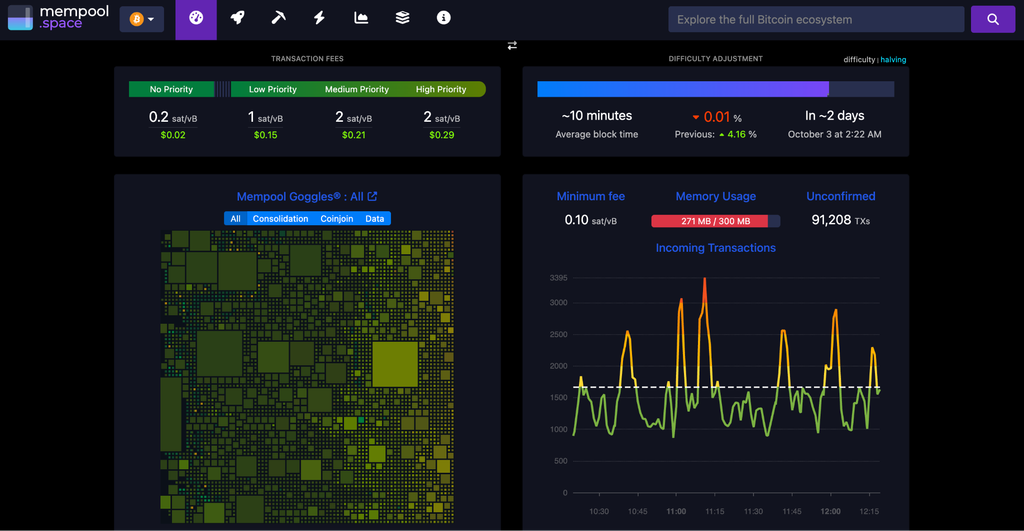
The first major block explorer was probably Blockchain.info, which also served as a web wallet and has since expanded into many other ventures and corners of the broader crypto industry. Beyond it, within the Bitcoin-only market, Mempool.space is probably one of the most visited websites of the niche, delivering a beautiful and unambiguous view into the Bitcoin economy. 

Beyond giving users basic transaction data like whether a payment has been confirmed on-chain or not, the site also gives users an estimate of the fee market so they don’t overpay for onchain transactions and even lets you see the different transaction types expected to be mined on the next block. Mempool.space has an open-source back end that users can run locally on their own machine, as a layer on top of their own full nodes at home, if they run one, becoming an interface for the user’s own unique perspective of the network, such as their own mempool. 

Top Bitcoin Blockchain Visualizers For Your Home And Office

ExploreTimeChain.com

Top Bitcoin Blockchain Visualizers For Your Home And Office

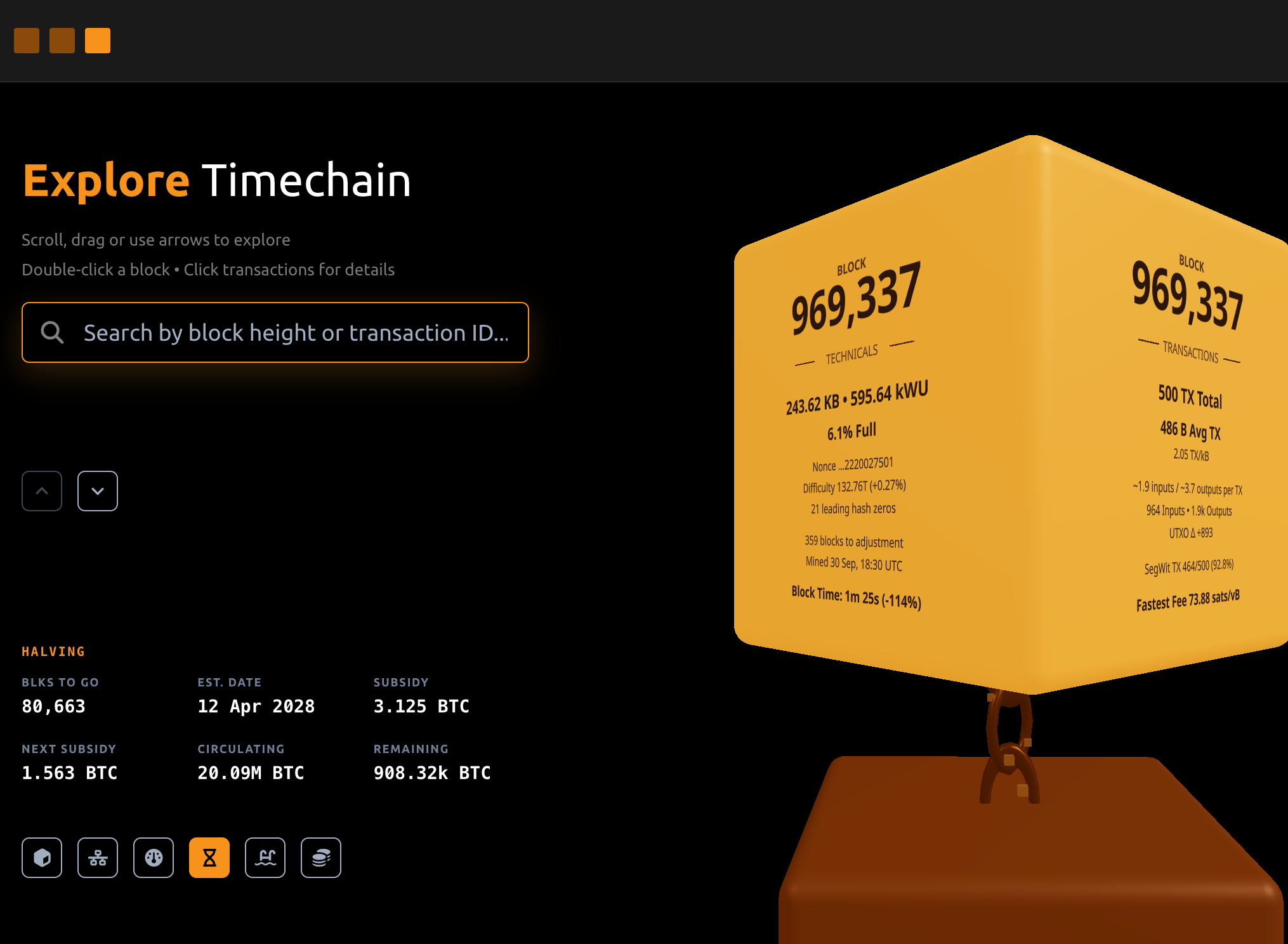
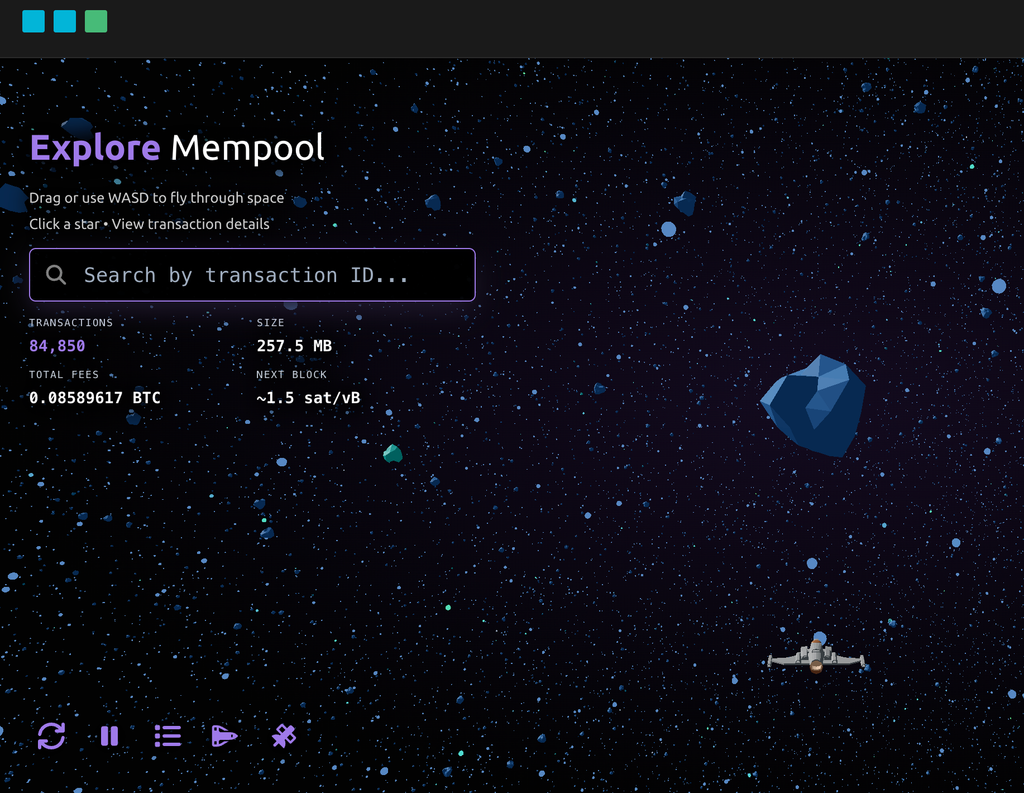
Eager to get to the moon already, ExploreTimeChain.com has a full-on space exploration interface, but on the time chain – Satoshi Nakamoto’s original term for the ‘blockchain’ as seen in early versions of the code. The interface takes transaction ids, public addresses and so on as input so you can see importan details and data about them, but also lets you manually fly a ship around block space, where each meteor is a transaction. Parallel to that design, the site also lets you look at each block in a 3D chain, taking the technical term perhaps a bit too literally.

Tesseractb also lets you explore the chain 3d Space with tesseract-inspired geometric figures. The small search icon at the bottom right lets you input transaction IDs and other data to identify specific addresses or blocks you are interested in, technically making it a block explorer.

Top Bitcoin Blockchain Visualizers For Your Home And Office

Symphony.iohk.io

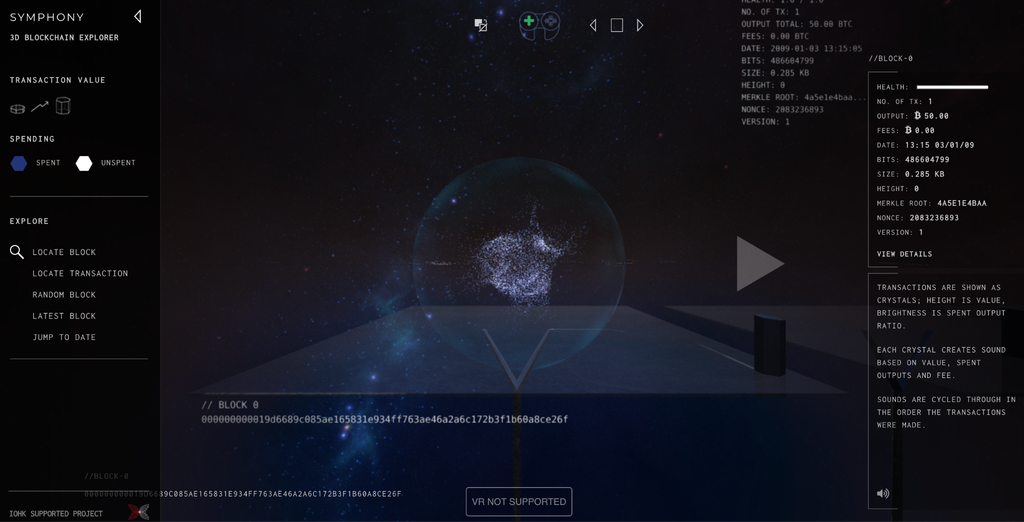
Symphony, an IOHK.io project, is another interesting 3D explorer that gamifies block exploration. The site takes transaction ID inputs and block numbers to let users navigate the time chain. Its 3D design is not just visual but acoustic, featuring a synthetic symphony that makes you feel like an alien exploring the Milky Way. The 3D space can be explored with gaming-inspired controllers and keyboard keys, and is even VR-compatible. 

Top Bitcoin Blockchain Visualizers For Your Home And Office

The Anatomy of Bitcoin

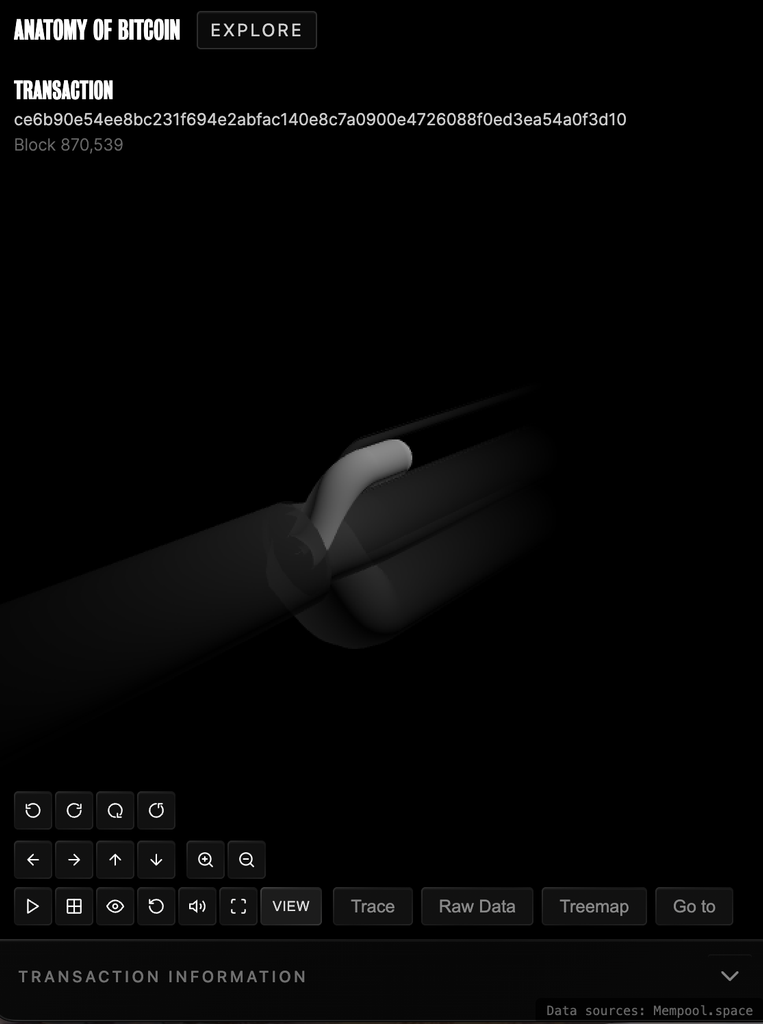
The Anatomy of Bitcoin website also deserves a proper mention as a block explorer. While most of the site is fundamentally a data science project with a minimalist artistic taste, the tech stack built by Pedro is live and synced to the network. The explorer can take transaction IDs and return 3d and 2d transaction data, though the interface to do this is somewhat buried among the menus. 

Top Bitcoin Blockchain Visualizers For Your Home And Office

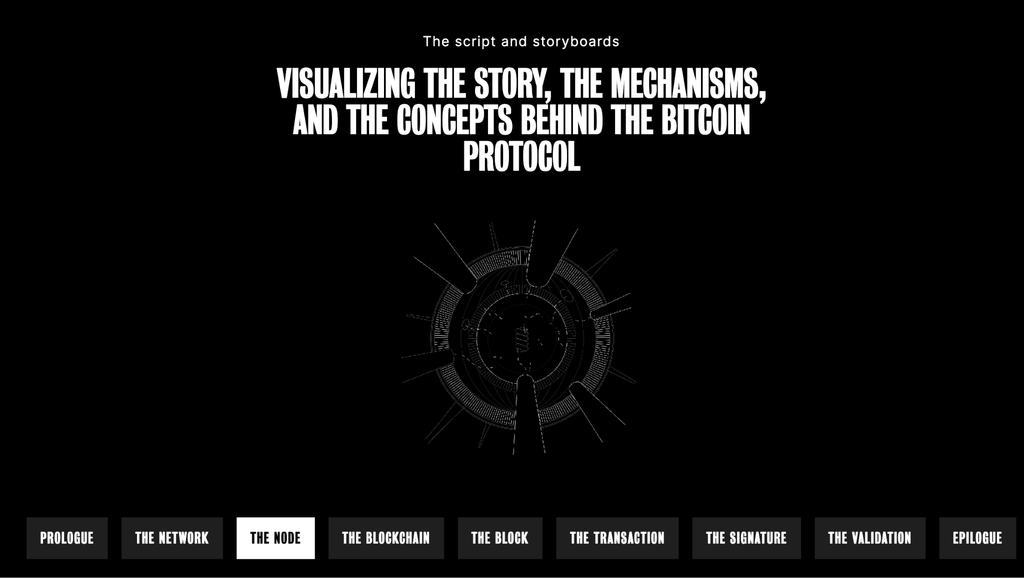
The real wonder of this project is the back end. MIT licensed open source 3d modeling of the Bitcoin system at almost every level, from the cryptography of a private key in bits, all the way up to node network topology, blockchain data, and the UTXO set’s dynamic state. It’s an impressive stack of data science, and other projects can probably build cool stuff on top.

The site was launched with a vision of making a film at the time that would teach people about Bitcoin in a visual way, with a few trailers and speeches given on the roadmap, but fundraising was lackluster at the time, leaving us without a film that, in hindsight, would probably be a staple of Bitcoin evangelism today. Hopefully someone can revive the project or fork it and make it their own. The site has much to offer in terms of content and inspiration; have a look!

Top Bitcoin Blockchain Visualizers For Your Home And Office

Mempool Visualizers  

Some Mempool visualizers however are not block explorers, some don’t care to give you data about specific transactions, but rather let you get a sense of trends of transaction flows on chain, be it from a data science perspective or an artistic one. 

Mempool.JHoenicke.de

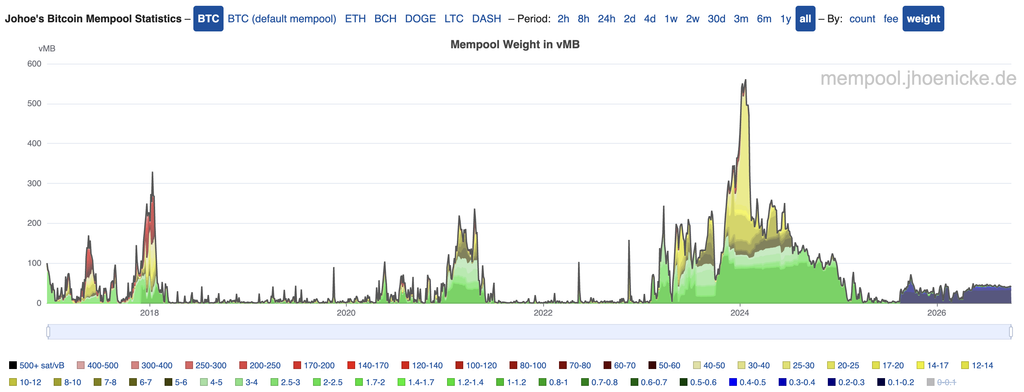
Perhaps the most iconic of such mempool visualizers is Dr. Jochen Hoenicke’s mempool data site, a website that’s been online for at least a decade, showing data as far back as 2026. It’s a historical dataset of mempool activity on Bitcoin that is invaluable for researchers and Bitcoin historians. 

Hoenicke is a German computer scientist who became known in Bitcoin as a white-hat security researcher, then as a Trezor cryptographer, and is now working for Certora, a smart contracting tech firm. The scripts used for his website at mempool.jhoenicke.de are open source under AGPL3. The site is particularly useful for understanding how congested or empty the next block might be, thus letting you estimate how much to pay in on-chain fees.

Top Bitcoin Blockchain Visualizers For Your Home And Office

demo.GetNotZero.com

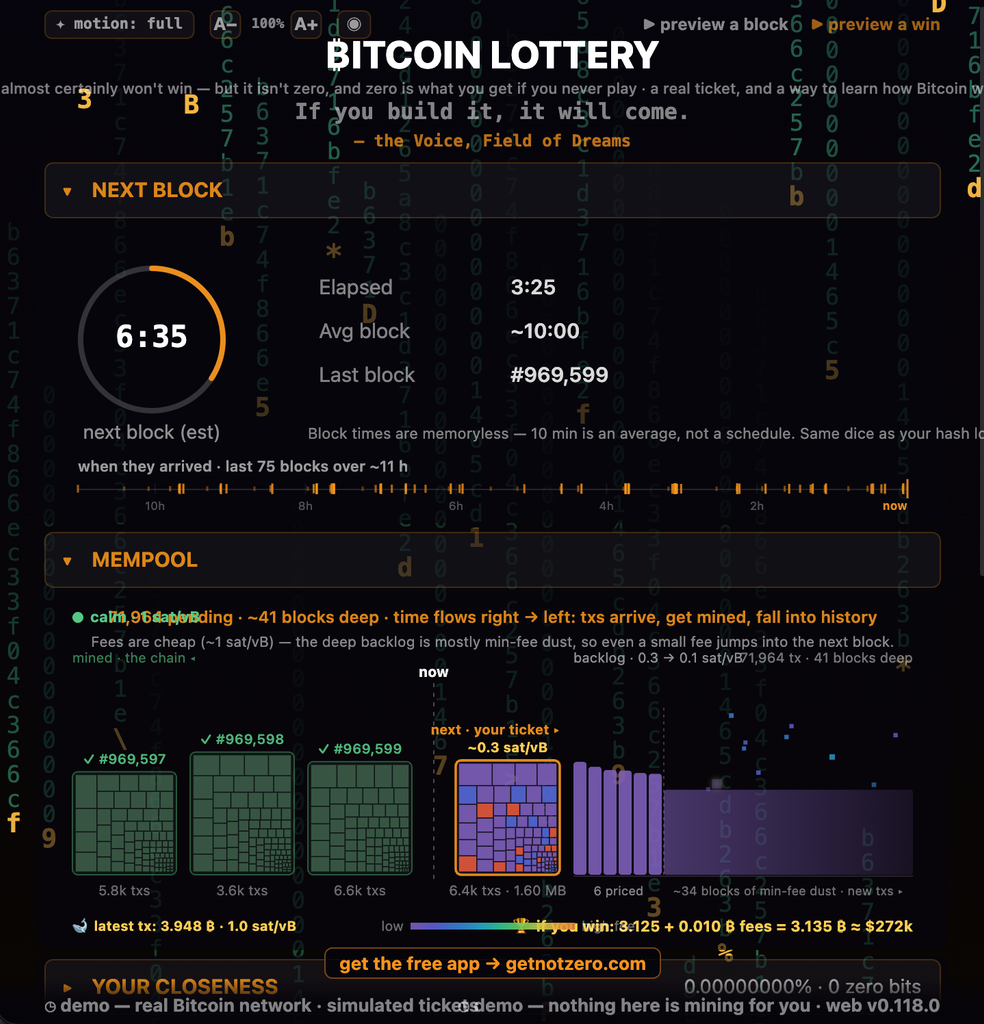
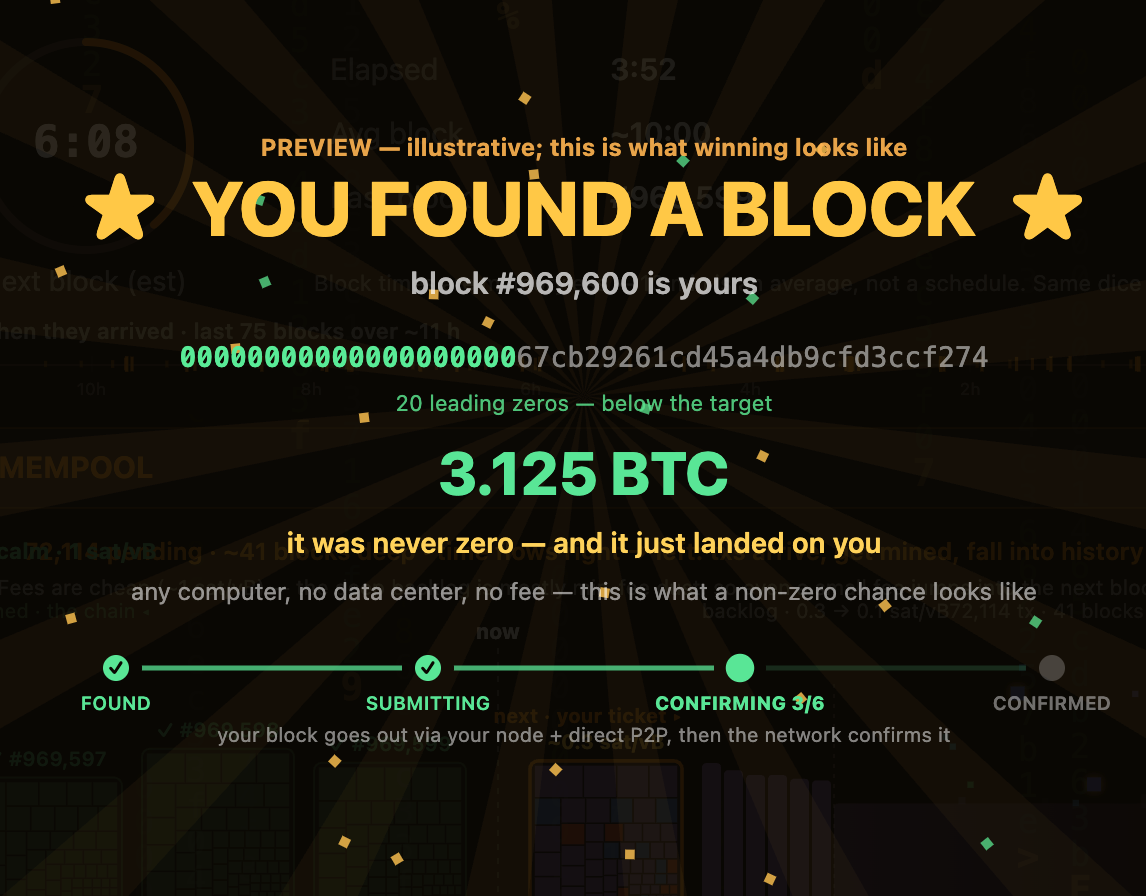
Blurring the line between a real-time data dashboard and hobbyist miner, GetNotZero provides a modern orange colored cypherpunk view into a wide range of Bitcoin metrics. Their demo dashboard shows next block hash rate estimates, mempool block data expected in the next block, mining difficulty, price, ETA until the next halving, and much more. At the heart of the dashboard is an invitation to try home mining with your home computer. Back in the day, mining bitcoin on a laptop made some very rich; today the odds are far, far lower. But they are not zero. 

That’s the point of this site. If you get lucky and mine a full block? That’s 3.125 BTC that lands in your personal, self-hosted wallet, no questions asked, no KYC. If you play the lotto, you might be surprised how much better the odds of solo mining a Bitcoin block can be! This project, beautifully designed, makes it apparently quite easy.  

Top Bitcoin Blockchain Visualizers For Your Home And Office

TxCity.io

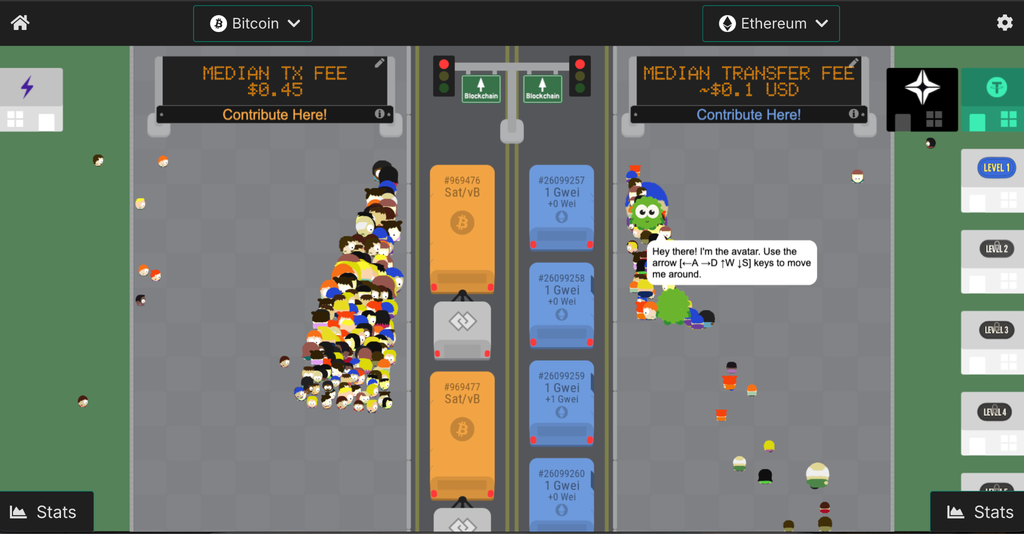
Having a bit more fun with mempool data, a txcity.io pits off the bitcoin vs ethereum mempool in an eternal bus stop from South Park hell. The site is aware of segwit transactions as an addition to the Nakamoto era block space, and shows transactions piling up on both sides represented as South Park looking characters waiting for the next bus, I mean block. The site covers a wide range of legacy cryptocurrencies beyond Bitcoin and Ethereum, for those … so inclined.  

Top Bitcoin Blockchain Visualizers For Your Home And Office

Musical Mempools! 

Beyond the high art of playful graphics, some artists have taken to interpret onchain activity from a music perspective. Their interfaces give tones and notes to the self-organizing chaos of the bitcoin free market, creating subtle yet quite pleasing musical flows. With some artistic fine-tuning, of course. 

Proof of Sound 

The shinniest of the musical mempool sites is probably Proof of Sound. The site gives notes to various types of transactions or mempool events. Blocks, when found, have their own dedicated note. Synchronized is a synthwave 3D animation perfect for leaving up on a screen as decoration. Sound can be turned on and off, though I’ve found myself working to it while it plays in the background. The site even has some customization options so you can fine-tune your background music-mempool experience. 

Top Bitcoin Blockchain Visualizers For Your Home And Office

Bitlisten

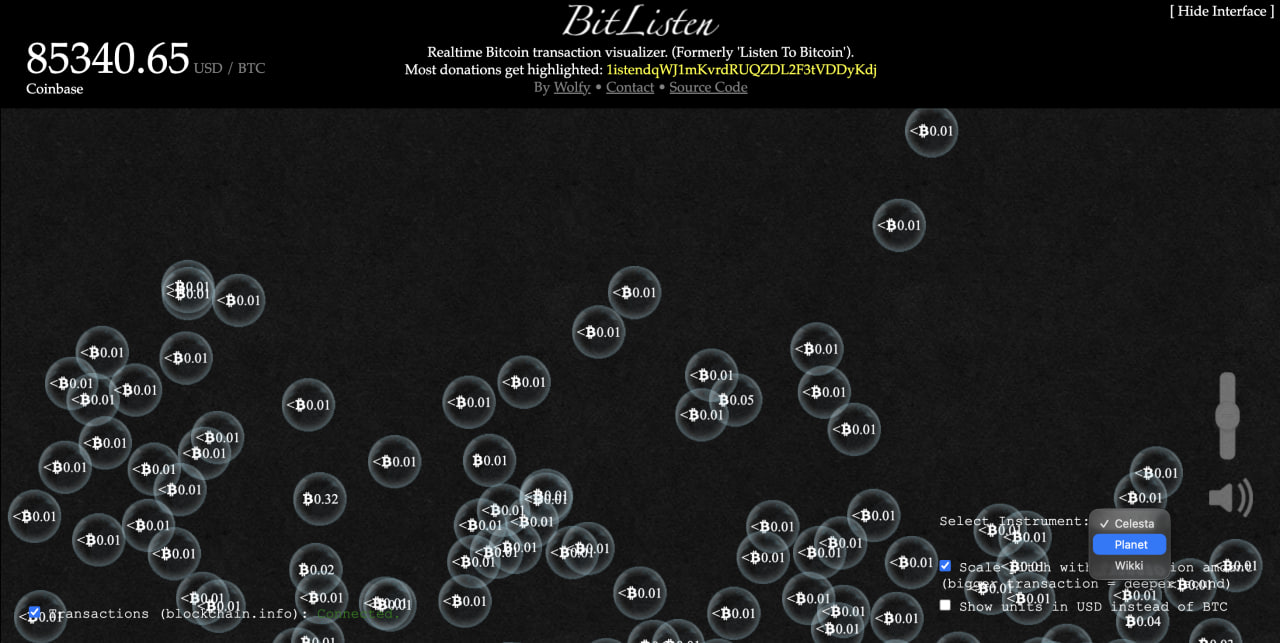
Taking a more minimalist approach to the same concept, Bitlisten gives each transaction on the mempool a bell sound, depending on its size. The result are simple but soothing background sounds. The default instrument, a celesta, can even be changed to a couple of others, completely transforming the resulting musical experience. The visual side of things could be a little bit prettier; this was clearly made before the age of vibe coding. But it is open source, so anyone could give it a touch-up if they felt up for it.

Phenomenal Gumption

Similar to Proof of Sound in design but with a more controlled musical experience, this anon Netlify app site delivers a solid background musical and visual tool to keep an eye and ear on the mempool. The onchain activity is primarily visual and quite expressive; its read me claims every moment is unique as the synth waves react to the onchain events. Meanwhile, the music is clearly produced and professionally made rather than influenced by the self-organizing chaos of the mempool. 

Top Bitcoin Blockchain Visualizers For Your Home And Office

OmPool

Last but not least is the OmPool interface for the Omarchy OS, by Pat Riley. This operating system has become quite popular among those daring to flee from the walled gardens of Apple and Windows. The interface is meant to work as a panel on the OS which users can visit and probably run in the background. The software is open source, and as you can see in the announcement tweet, the UI is quite beautiful, fitting to Omarchy’s top-of-the-line design, while also having delightful sound patterns from the mempool.

Turned the Bitcoin mempool into a live generative musical instrument

– Tempo follows transaction activity
– Pitch follows fee rate
– Value sets the reverb
– Blocks change the scale

Built on @OmarchyLinux @mempool + SuperCollider pic.twitter.com/doUwKyBTz5

— Pat Riley ☀ (@_rileyio) September 5, 2026

This post Top Bitcoin Blockchain Visualizers For Your Home And Office first appeared on Bitcoin Magazine and is written by Juan Galt.
Alkanes Asian Market Drove 61% of Bitcoin Transactions for 90 Days, SUBFROST Data Shows

Bitcoin Magazine

Alkanes Asian Market Drove 61% of Bitcoin Transactions for 90 Days, SUBFROST Data Shows

A Bitcoin metaprotocol similar to Ordinals accounted for most Bitcoin transactions over a 90-day stretch ending in September, according to figures published by SUBFROST, which maintains the protocol.

SUBFROST said Alkanes transactions made up 61.1% of all Bitcoin transactions between June 23 and Sept. 20, covering blocks 954,917 through 967,918, or about 59.9 million transactions. In the same window, the company said Alkanes used 40.3% of block space by weight, 94.2% of OP_RETURN bytes, and 13.4% of transaction-fee revenue.

Alkanes is a Bitcoin metaprotocol that builds on top of the Runes protocol. It is maintained by SUBFROST, a U.S.-facing company led by co-founder Gabe Lee, with the original protocol author who goes by the name of RWP IV. The Alkanese community is almost entirely from the Asia Pacific (APAC) region, revealing an active user base of Bitcoin-adjacent technology the West is likely not aware of. 

SUBFROST ships full Chinese documentation and a Chinese metrics page, and runs an official Chinese-language Telegram for DIESEL. In 2025, Chinese outlets noted that most Alkanes discussion on X came from Chinese-speaking users, many mentioning a popular Hong Kong wallet called UniSat. This year the company held a workshop in China, put Lee and RWP IV on a China stage, and took a booth at Bitcoin Asia in Hong Kong. 

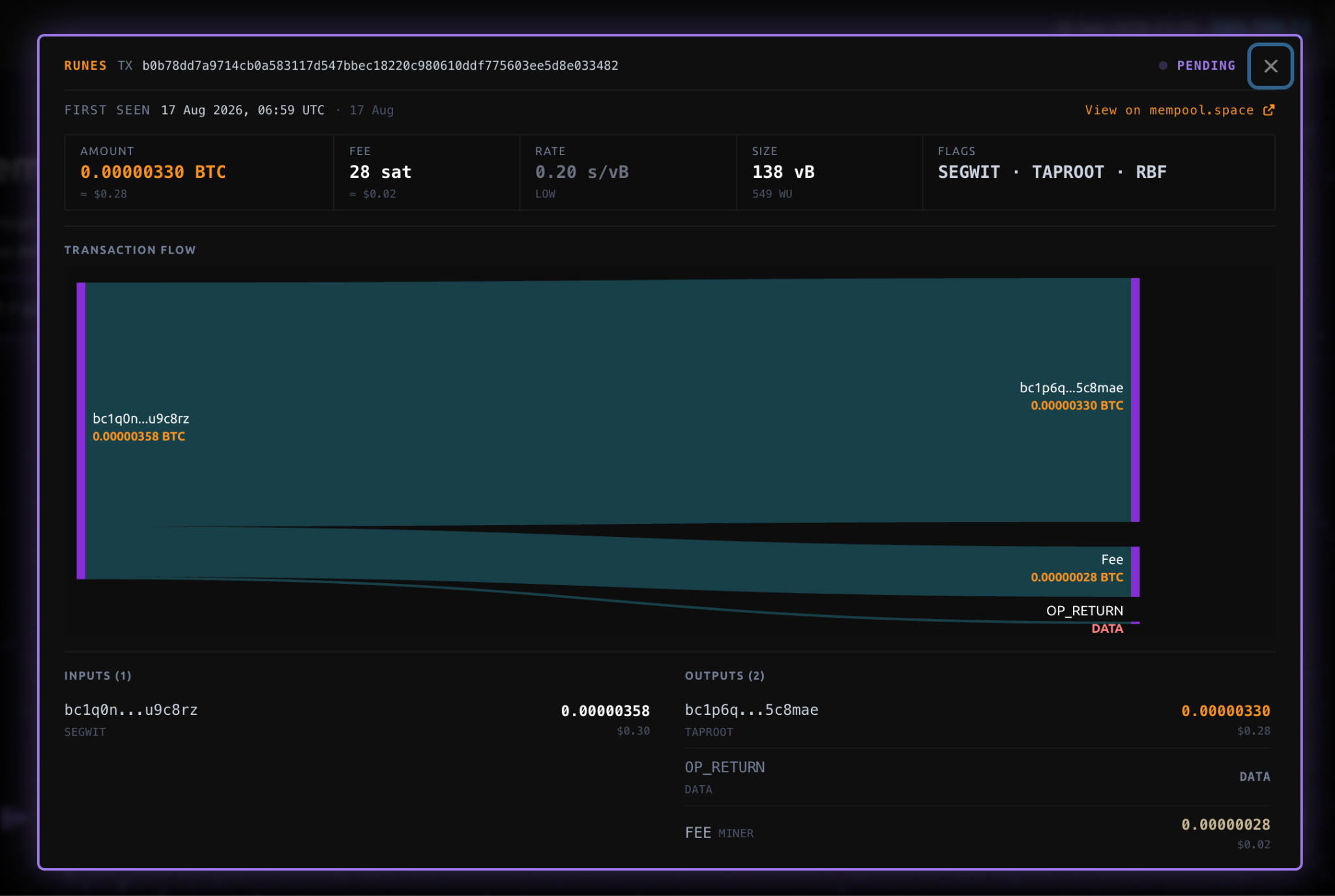
The Onchain traffic figures are from a daily file SUBFROST publishes under an MIT license, with live charts at subfrost.io/metrics and the underlying series on GitHub. The company’s count treats a transaction as Alkanes when an OP_RETURN runestone contains a protostone with protocol tag 1.

In a press release shared with Bitcoin Magazine, SUBFROST said 99.7% of UNCOMMON•GOODS Runes mints in the window were also DIESEL mints. The emission function on Alkanes’ genesis contract. In a July explainer, the company wrote that “almost all of this Alkanes activity is one operation, the DIESEL mint.” A rune on top of a rune, if you will.

Alkanes does not change Bitcoin consensus and does not run as a sidechain. Contract code is WebAssembly, deployed once in witness data. Later users send function calls inside a Runes-format runestone. A separate indexer, Metashrew, executes those calls. Full nodes confirm the Bitcoin transaction; they do not validate Alkanes balances.

That wrapper is why the same activity showed up as Runes in June. CryptoQuant reported Bitcoin network activity at its highest level since late 2024, with daily transactions above 800,000, and tied the OP_RETURN surge to Runes, Ordinals, and BRC-20. Bitcoin Magazine carried that reading on June 22. CoinDesk, citing Glassnode, said daily transactions topped 820,000, with more than 600,000 runestones, and attributed the move to Runes. None of those reports named Alkanes.

Renaud Cuny, who writes Bitcoin Block Space Weekly and tracks BIP-110, separately counted Alkanes protostones as 91% of OP_RETURN outputs over a 60-day window.

Alkanes launched at block 880,000 on Jan. 20, 2025, when the DIESEL contract was deployed. It was built at Oyl Corp. Oyl said in January 2026 that it was winding down operations and that SUBFROST would lead protocol maintenance. 

This post Alkanes Asian Market Drove 61% of Bitcoin Transactions for 90 Days, SUBFROST Data Shows first appeared on Bitcoin Magazine and is written by Juan Galt.
❌