❌

Reading view

There are new articles available, click to refresh the page.

Bitcoin Mining Firm Luxor Raises $16 Million to Scale AI Compute Trading and Hardware

Bitcoin Magazine

Bitcoin Mining Firm Luxor Raises $16 Million to Scale AI Compute Trading and Hardware

Seattle-based Luxor Technology Corporation announced a $16 million strategic investment round on Tuesday. CMT Digital, the venture capital arm of Chicago-based CMT Group, led the round. Canaan, MicroBT, Halo, Steelhead, and angel investors also participated. 

The round includes both primary and secondary capital. Luxor describes each investor as an operating partner in the compute supply chain it serves, spanning hardware, capital, and power.

The raise follows the September launch of Luxor AI, a business segment that extends the energy, hardware, software, compute trading, and data stack Luxor built for bitcoin mining into artificial intelligence and high-performance computing. 

Luxor said its hardware brokerage desk has traded $1 billion of ASIC hardware for bitcoin mining. Its energy arm services more than 75 megawatts of load across ERCOT and SPP. Its agentic cloud platform had reached 1.8 million workloads year to date as of September.

The firm plans to use the new capital in four areas: scaling its agentic cloud platform, providing working capital for its AI hardware business, expanding its compute derivative trading and market making, and hiring engineering and go-to-market staff.

The hardware push responds to tightening supply chains. The firm’s AI hardware desk sources GPUs and AI servers through a tiered network of partners. As a Value-Added Reseller to major OEMs, the company says it can access abandoned orders, special allocations, and used markets.

Luxor and AI compute

CMT Digital brings nearly three decades of electronic trading and market-structure experience. Sam Hallene, a partner at CMT Digital, said Luxor understands the energy and infrastructure landscape behind compute, as well as the financial tools customers need to manage risk. He said the team has built that skill over eight years in digital assets and is applying it to AI.

Luxor’s over-the-counter desk already offers cash-settled options, forwards, and backstops on compute-rental indexes. CMT’s backing, the company says, positions Luxor to scale that business as AI compute becomes a tradable market.

Canaan CEO Nangeng Zhang said his company is pursuing long-term power resources in North America as part of its compute-plus-energy strategy, and that joining Luxor’s cap table aligns with those goals. He called the company an important partner across bitcoin mining and the energy industry.

Nick Hansen, Luxor’s CEO and co-founder, summed up the thesis: “Compute markets are converging: the same miners, power sites and capital that served digital mining are now powering AI.”

Earlier this year, the company unveiled Commander, a fleet management platform designed to help Bitcoin mining operators monitor operations, manage energy use, and optimize profitability from a single system. 

Integrated with existing infrastructure, the platform offers real-time fleet monitoring, remote machine controls, and tools that help miners adjust to changing hashrate and electricity market conditions.

Public bitcoin miners had signed more than $70 billion in AI and high-performance computing contracts by the end of March, according to CoinShares data. 

This post Bitcoin Mining Firm Luxor Raises $16 Million to Scale AI Compute Trading and Hardware first appeared on Bitcoin Magazine and is written by Micah Zimmerman.

Bitcoin Price Hovers Near $80,000 as Traders Await Fed Decision

Bitcoin Magazine

Bitcoin Price Hovers Near $80,000 as Traders Await Fed Decision

Bitcoin price traded near $80,000 on Monday, after falling about 2% earlier in the session. The price has dipped below that level several times in recent days and recovered each time.

Selling pressure has been building. Spot Bitcoin ETFs recorded about $635 million in outflows on October 22. A brief drop below $80,000 last week also triggered roughly $800 million in liquidations of long positions, or bets that prices would rise.

The next major test to look out for is the Federal Reserve’s two-day meeting, which ends October 28. The Fed raised its target range to 3.75% to 4% in September, and its minutes suggested another increase could come by year-end. 

Most recent market odds favor the Fed holding rates steady, though those odds have shifted. Traders are watching Fed Chair Kevin Warsh’s remarks for signs of a December hike.

Higher interest rates typically pull money away from risky assets, including crypto. Broadly speaking, a hold could keep bitcoin price between roughly $80,000 and $88,000. A rate hike could push it toward the lower end of that range.

Bitcoin price backdrop

Geopolitical tensions are also weighing on markets. Oil rose above $100 a barrel in early September as strikes between the U.S. and Iran escalated. Higher energy prices feed into inflation, which affects the Fed’s decisions. 

In tech, Anthropic is reportedly preparing an initial public offering that could value the AI company near $965 billion. The timing has shifted toward the weeks before the November midterm elections, but no date has been confirmed. 

U.S. stocks surged a bit Monday as investors geared up for a busy week of Big Tech earnings and the Federal Reserve’s interest-rate decision. The Nasdaq rose 0.8%, the S&P 500 gained 0.6%, and the Dow climbed 0.3%. 

Alphabet and Microsoft report Wednesday, followed by Amazon Thursday, while markets largely expect the Fed to hold rates steady. 

AI-related stocks rallied following Anthropic’s IPO filing. Tesla jumped 6%, while Meta plans to raise up to $95 billion for AI investments. 

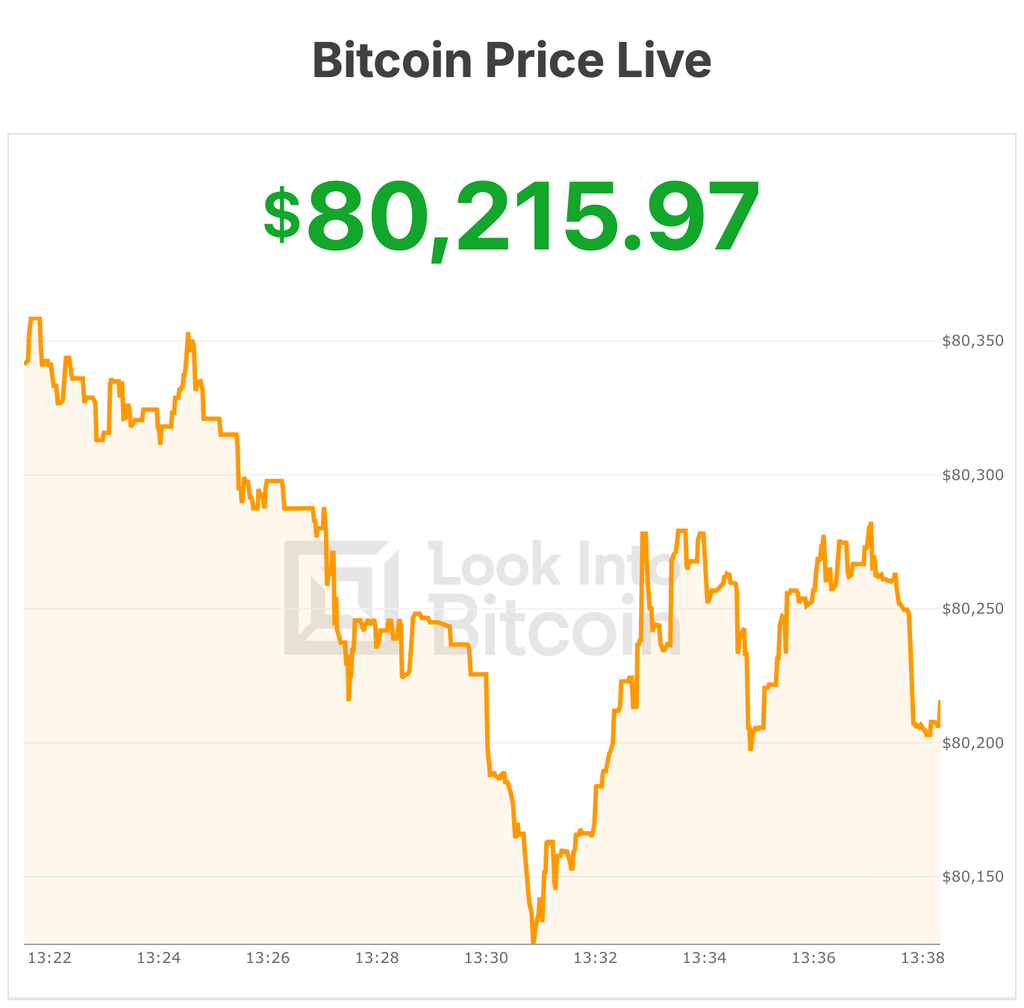
As of writing, bitcoin price trades at $80,215, down nearly $4,000 or 4.75%, on the month. Over the past month, prices have ranged from a high of $86,806.95 to a low of $79,397.76. Bitcoin price peaked above $86,000 in early October, then slid toward $80,000 in the second week of the month. 

A brief rally around October 21 pushed it back near $84,000, but those gains faded within days. Trading volume over the past 24 hours reached about $18.12 billion. 

Bitcoin price remains far below its all-time high of $126,277.05.

bitcoin price

This post Bitcoin Price Hovers Near $80,000 as Traders Await Fed Decision first appeared on Bitcoin Magazine and is written by Micah Zimmerman.

Bitcoin Core Ends Long Embargoes for Bugs AI Can Rediscover

Bitcoin Magazine

Bitcoin Core Ends Long Embargoes for Bugs AI Can Rediscover

Bitcoin Core has changed its security disclosure policy to speed up fixes for vulnerabilities that large language models can find with little effort, ending the months-long embargoes those bugs once received.

Maintainers merged the change to the project’s security policy on Thursday. Chaincode Labs developer Antoine Poinsot, who wrote the proposal, announced it in a message to the Bitcoin Development Mailing List the same day.

“We recently experienced an increase in the number of reports for security vulnerabilities that can be easily (re-)discovered,” Poinsot wrote. “This is largely due to LLMs drastically reducing the bar to find certain classes of issues or identify covert fixes.”

How the policy worked before

Bitcoin Core, the software that runs on most nodes in the Bitcoin network, has graded each reported vulnerability by severity and timed its disclosure to match. Low-severity flaws were made public two weeks after the next major version shipped. 

Medium- and high-severity issues stayed under embargo until two weeks after the last affected release reached end of life, a span that could stretch to a year.

The extended timelines gave node operators, many of whom upgrade at a slow pace, time to move to patched software before details became public. In practice, the approach meant fixes went unreleased for older maintained versions and arrived with the next major release.

Poinsot argued that this tradeoff fails for bugs that are easy to rediscover. “The embargo period achieves little but it delays the availability of a fixed release,” the policy reads.

What changes

During triage, Bitcoin Core can flag a vulnerability as “easily discoverable,” a category the policy defines as issues that can be found “with minimal effort, such as through a simple LLM prompt.” The label is open to flaws found by other means as well.

For those issues, the project will backport a fix to every maintained major version, cut point releases as soon as possible and publish a security advisory with some details at the same time as the fixed software. 

Poinsot acknowledged that such fixes will have less testing time before they reach users.

Vulnerabilities outside that category keep the existing severity-based schedule. Critical bugs, those that could enable coin theft at the protocol level, inflate the supply or cause a permanent chain split, remain outside the standard policy and will be handled case by case.

Developer Antoine Riard pushed for an option to ship a fix without an advisory and withhold details on a case-by-case basis. Poinsot declined, writing that alerting users without details “could create more risk unnecessarily” by prompting a rushed migration among users who would otherwise be unaffected.

A summer of AI-driven reports

The change follows months of heightened pressure on Bitcoin’s open-source projects. In late July, a volunteer group of 16 developers known as the Bitcoin Red Team ran AI models across 390 bitcoin repositories in about a day and logged 4,962 findings, including 85 rated critical.

Within days, a BTCPay Server flaw the group had reported in private was exploited on live merchant servers, draining Lightning nodes.

In August, Core Lightning developers told operators to upgrade or disconnect after AI-generated reports to the project proved accurate.

The Red Team effort followed a Coldcard hardware wallet exploit in which attackers drained 594 BTC in 25 minutes on July 30. Losses across four sweeps approached $114 million.

This post Bitcoin Core Ends Long Embargoes for Bugs AI Can Rediscover first appeared on Bitcoin Magazine and is written by Micah Zimmerman.

Bloomberg’s Mike McGlone: AI Risk Could Force Bitcoin Drawdown to $10,000


Bitcoin Magazine

Bloomberg’s Mike McGlone: AI Risk Could Force Bitcoin Drawdown to $10,000

Mike McGlone was one of the few Wall Street analysts to call $100K Bitcoin. Now the Bloomberg Intelligence senior commodity strategist says Bitcoin “can easily drop a zero” to $10,000. In this interview with Grace Remington and Sean Hagan, he explains why the ETF launch signaled the trade was over, why Bitcoin has become a “stock puppet” with high beta and no edge, and why a Fed priced for three hikes is a headwind for Bitcoin, gold and copper alike. He also covers the Middle East energy shock, midterm elections, the GENIUS Act and stablecoins, and why U.S. Treasuries are his next big trade.

Chapters:
0:00 Bloomberg’s Mike McGlone on the Middle East Energy Crisis and a 2027 Oil Glut
1:01 Midterm Elections, Iran and Why Energy Prices Decide the Vote
2:12 Russia-Ukraine, Diesel Exports and the Wheat Trade
4:27 Don’t Fight the Fed: Three Hikes Priced In and Warsh’s Rate Hike
6:49 Bear Market Bounce: Why Bitcoin Can Drop a Zero to $10,000
9:54 Why McGlone Flipped From $100K Bull to Bear After the ETF Launch
13:17 Bitcoin as a Stock Puppet, $40 Trillion of Debt and the Jack Bogle Rule
14:44 The Unlimited Supply Argument: Bitcoin vs. Gold, Stablecoins and Basis
18:13 The GENIUS Act, Tether in Hong Kong and Tokenizing Everything
21:18 Why Treasuries Are the Next Big Trade

DISCLAIMER: The views and opinions expressed in this show are those of the participants and do not necessarily reflect the official policy or position of BTC Inc., Bitcoin Magazine, or any affiliated entities. This content is provided for informational and educational purposes only and should not be construed as investment, legal, tax, or accounting advice. Nothing contained in this show constitutes a solicitation, recommendation, endorsement, or offer to buy or sell any securities or financial instruments. Viewers should consult their own advisors before making financial or business decisions.

This post Bloomberg’s Mike McGlone: AI Risk Could Force Bitcoin Drawdown to $10,000 first appeared on Bitcoin Magazine and is written by Patrick Green.

Arkham CEO on $1 Billion of U.S. Government Bitcoin Moved to “Unknown” Wallet


Bitcoin Magazine

Arkham CEO on $1 Billion of U.S. Government Bitcoin Moved to “Unknown” Wallet

A US government-linked wallet just moved about $1 billion in Bitcoin from the Bitfinex hack, and the market wants to know if a sale is coming. Arkham Intelligence CEO Miguel Morel explains what the transaction trail shows, what it can’t show, and why it’s still unclear whether the coins are being sold or moved to a new custodian. He also breaks down how disposal orders and the Strategic Bitcoin Reserve factor in.

Chapters:
00:00 US Government Moves $1B in Bitfinex Hack Bitcoin
00:47 Sale or Custody Change? What the Government Might Be Doing
01:52 How Arkham Labels Government Wallets
03:30 Tracking Bitcoin Treasury Companies Before SEC Filings
05:18 Why Exchanges Like Coinbase Can Be a Black Box
06:26 Segregated Wallets and Tracking MicroStrategy
07:52 How AI Agents Are Using Arkham Today
09:42 Is There Any Privacy Left On-Chain?
12:02 Does Anonymity Help or Hurt Institutional Adoption?
14:12 How Investigators Trace Stolen Funds From Hacks

DISCLAIMER: The views and opinions expressed in this show are those of the participants and do not necessarily reflect the official policy or position of BTC Inc., Bitcoin Magazine, or any affiliated entities. This content is provided for informational and educational purposes only and should not be construed as investment, legal, tax, or accounting advice. Nothing contained in this show constitutes a solicitation, recommendation, endorsement, or offer to buy or sell any securities or financial instruments. Viewers should consult their own advisors before making financial or business decisions.

This post Arkham CEO on $1 Billion of U.S. Government Bitcoin Moved to “Unknown” Wallet first appeared on Bitcoin Magazine and is written by Patrick Green.

❌