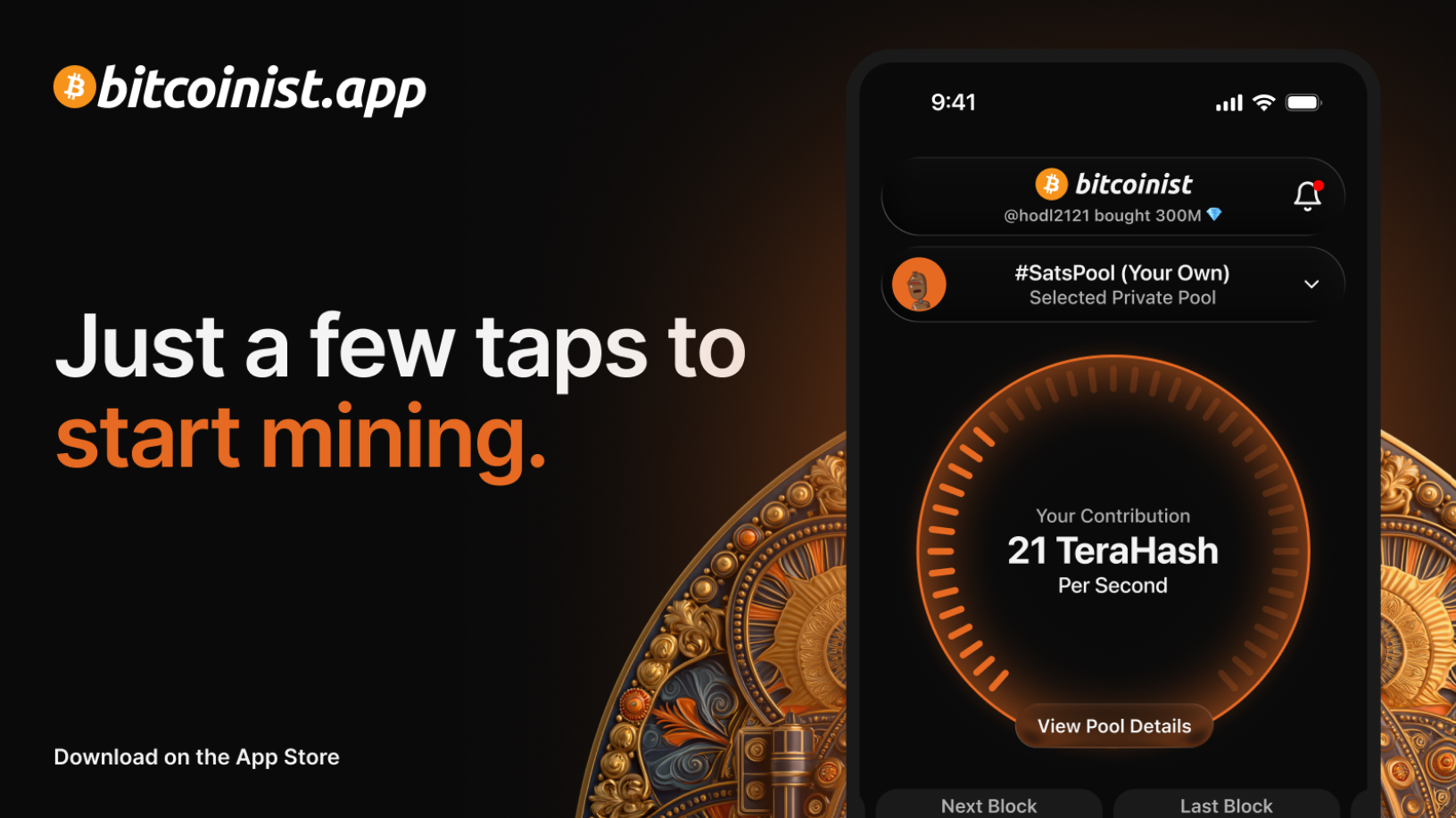
RAS AL KHAIMAH, UAE, July 23, 2026: BFM Company Limited today introduced Bitcoinist.App, a non-custodial Bitcoin mining app and Learn-to-Mine platform released exclusively for iOS. Available from the Apple App Store, Bitcoinist.App gives people a simple way to learn how Bitcoin mining works, access real hashpower, create private Bitcoin mining pools, and receive payouts directly to a wallet they control. Onboarding uses Sign in with Apple, and users can begin from an iPhone without buying mining hardware or entering payment information.
Most people will never run a miner at home. In some regions, particularly parts of the developing world, high room temperatures can cause mining equipment to overheat, while the electricity needed to run air conditioning around the clock can make home mining prohibitively expensive. Noise and the miner’s own continuous power draw add to the barrier. In many parts of the world, people access the internet primarily through mobile data on a phone, without a practical wired connection for dedicated mining equipment. A physical miner also needs a stable network connection. Bitcoinist.App lowers those barriers with a simple iOS interface for learning about Bitcoin and directing real, remotely hosted hashpower through three modes:
Learn and unlock. The built-in Bitcoin Academy offers a 31-lesson video curriculum that explains Bitcoin and mining in practical terms. Educational videos and optional rewarded ads can unlock free mining rental time, so users can start mining from day one without a purchase.
Rent or connect. Paid access is offered through an in-app subscription. Users can access hashpower in 1 TH/s increments from miners hosted in UAE data centers and third-party facilities, or from capacity supplied through third-party hashpower marketplaces. Mining does not run on the iPhone. The app is a simple control layer for real hashpower, and pricing is published in the app. Support for connecting user-owned hardware, including home miners like the Bitaxe, is planned.
Route and pool. Users can create a private mining pool, invite friends and family to combine hashpower, and compete with the global hashrate. They can also mine solo or route miners to the Ocean pool for steadier payouts.
Bitcoinist.App is strictly non-custodial. There is no internal wallet or platform balance. Users choose an external self-custody wallet for payouts; mined bitcoin is sent to that address rather than held inside the app. Bitcoinist.App does not hold user private keys or mined funds.
Bitcoinist.App provides mining infrastructure and education, not a yield product, investment scheme, or custodial wallet. An in-app subscription or ad-supported access provides mining time, not bitcoin and not a promised return. Mining outcomes depend on network difficulty, pool performance, transaction fees, and deployed hashpower. Some hosting and hashpower capacity comes from third parties, so availability and performance can vary by provider. Nothing in this release guarantees any amount of mined bitcoin.
“We designed Bitcoinist.App to orange pill the masses through mining and education,” said Fouad Jamil, Founder and CEO of Bitcoinist.App. “People can begin with a phone, learn what Bitcoin mining actually does, direct real hashpower, and receive every sat in a wallet they control. We are not mining for users and we never custody their bitcoin. We provide the infrastructure and tools; users decide where their hashpower goes.”
Bitcoinist.App is operated by BFM Company Limited, registered in RAK DAO, Ras Al Khaimah, UAE (Bitcoin Mining license No. 07010714), with mining infrastructure in UAE data centers and third-party mining facilities around the world. Additional capacity may be supplied through third-party hashpower marketplaces. Availability is subject to regional eligibility.
Bitcoinist.App is a Bitcoin-only, non-custodial mining app and education platform available exclusively on iOS. Designed for ease of use, it lets people learn about Bitcoin, unlock free mining rental time through educational videos and optional rewarded ads, or choose an in-app subscription for ongoing access to real hashpower. Users can create private mining pools with friends and family, compete with the global Bitcoin hashrate, or route miners to Ocean, while payouts go directly to self-custody. Mining does not run on the iPhone. Bitcoinist.App is operated by BFM Company Limited (RAK DAO, Ras Al Khaimah, UAE). The official website is bitcoinist.app. Follow Bitcoinist.App on X, Telegram, YouTube, Facebook, and Instagram.
Disclaimer: This is a sponsored press release. Readers are encouraged to perform their own due diligence before acting on any information presented in this article.
The Smarter Web Company has sold a portion of its Bitcoin treasury to repay an $11.7 million convertible debt facility held by TOBAM, a move the company frames as a choice for balance-sheet flexibility over equity dilution.
The company sold 177.8909127 BTC at an average price of $65,762 to retire the instrument, known as the “Smarter Convert,” ahead of schedule. The transaction totaled $11,698,540 and was settled roughly two weeks early. After the sale, Smarter Web still holds 2,700 BTC in treasury.
Smarter Web’s financing decisions
On its face, a Bitcoin treasury company selling part of its holdings can read as a signal of weakening conviction. But the transaction is a debt-management decision.
Smarter Web was not exiting its Bitcoin position. It used BTC to extinguish a debt obligation and avoid issuing 7,718,551 ordinary shares, an outcome that would have diluted existing shareholders had the convertible converted into equity instead.
Bitcoin treasury companies typically generate headlines in one direction: a purchase, a rise in total holdings, a deeper commitment to Bitcoin as a balance-sheet asset. Investors respond according to their view of corporate crypto exposure, but the pattern is usually additive.
Smarter Web sold Bitcoin to settle a specific financing instrument, the company said. That is different from a sale driven by lost confidence in the asset, and different again from a forced sale tied to a liquidity shortfall.
The company faced a capital-structure choice. It could leave the convertible in place and risk dilution from a future conversion into shares, or it could draw down part of its Bitcoin position to repay the debt directly. Management chose the second path, prioritizing a cleaner balance sheet over preserving the full Bitcoin position.
For shareholders, the logic may be more legible than the alternative. A new issuance of millions of ordinary shares carries a direct and immediate dilutive effect on per-share value.
A reduction in Bitcoin holdings, by contrast, leaves the company’s per-share equity structure untouched while removing a fixed liability from the balance sheet.
Smarter Web’s remaining 2,700 BTC treasury indicates the company has not abandoned its Bitcoin strategy. The sale addressed one financing obligation, not the broader thesis behind the holdings.
Crypto exchange BitMEX will close down in September, according to a Thursday announcement on the company’s website.
The exchange said that after “a strategic review of the business and the broader crypto industry, the board of HDR Global Trading Limited, owner and operator of BitMEX, has decided to close the exchange.”
BitMEX did not give further information on why the exchange was closing but told users to withdraw their funds “as soon as practical.”
“The BitMEX platform has always remained grounded to the true ethos of Bitcoin — neutrality, transparency, and decentralisation, which is evident through our peer-to-peer operations and a top priority focus on user fund safety,” the statement read.
“While this news is a difficult one to share, we are proud of everything that has been built at the company since its launch as a pioneer of crypto derivatives.”
BitMEX added that users will be able to access services as normal until September 23. After that date, the exchange will only hold client assets until they are withdrawn.
It continued that it had unstaked all staked BMEX Tokens on the platform, and they are now available in users’ accounts.
Run-ins with the law
Run by eccentric crypto entrepreneur Arthur Hayes, BitMEX has had its fair share of run-ins with the law.
Regulators first stated that BitMEX had allowed U.S. clients to use its exchange without verifying their identities.
The company in 2021 paid $100 million in civil penalties after the U.S. Financial Crimes Enforcement Network alleged that the exchange’s senior leadership “altered U.S. customer information to hide the customer’s true location.”
BitMEX founders Hayes, Benjamin Delo, and Samuel Reed pled guilty in 2022 to violations of the Bank Secrecy Act for failing to operate an anti-money laundering program at the cryptocurrency exchange. Each founder then agreed to pay a $10 million fine to settle the charges.
Then, last year, BitMEX was hit with a further $100 million fine for its guilty plea for breach of the United States Bank Secrecy Act.
But following the election of crypto-friendly President Donald Trump, all three founders were pardoned in 2025.
Bitcoin spent the past month in a holding pattern around $63,700, and VanEck’s latest Bitcoin ChainCheck reads the setup as a cautious pause rather than a bottom, with derivatives flashing fear, miner economics near multi-year lows, and long-term holders tightening their grip.
The mid-July report frames the moment as consolidation, not recovery. Bitcoin closed July 12 at $63,742, flat against a month earlier yet 33% off its six-month high and 14% below its 200-day moving average near a bitcoin price of $74,000.
The pause caps two monthly declines, a 3.6% dip in May and a 20.5% drop in June.
Trading thinned into the summer. Spot volume averaged about $5.1 billion a day over the 30-day window, down near 29% from the post-2019 norm, a softness the firm notes has marked June through August in each of the past six years.
Realized volatility fell to 30.4% on an annualized basis, under the trailing-year 43% level and well beneath the long-run average near 81%.
Derivatives flash fear, not panic
VanEck reads the derivatives complex as defensive. The one-month put/call implied volatility skew widened to +11.4 percentage points, an 83rd-percentile mark since 2021, and traders appear content to fund put purchases with the sale of calls.
The firm reads that as fear rather than capitulation. Total options premium eased 23% to $613.6 million, and the put/call premium ratio climbed to 1.49, against an average near 0.71.
Perpetual-futures funding tells a similar story. The rate sits near +4.5% on a 30-day average, about half the long-run +8.4%, a sign that positioning stays far from bullish after a spring stretch in which traders were paid to hold shorts.
VanEck maps both signals to below-average forward returns across the 30-to-180-day window. It flags two markers of a true bottom that have not arrived: a skew past +15 points, or funding that flips negative. Until one appears, the firm sees near-term downside pressure over a quick rebound.
Bitcoin ETP outflows and shaken treasury confidence
Demand ran negative on the month, a drop the report ties to exchange-traded product outflows. U.S. spot ETPs shed 40,010 BTC, worth about $2.40 billion, while corporate treasuries added 2,343 BTC and miners kept 1,204 BTC. Exchange balances rose to fill the gap.
The report also charts shaken confidence among digital asset treasuries after Strategy used $1.38 billion to retire convertible notes, a move that left the company with a $900 million reserve and pushed it to its first bitcoin sales since 2022. Those sales, VanEck writes, fed the negative flows across the treasury cohort.
The on-chain picture cuts the other way. The share of bitcoin held longer than a year reached 60.8% of supply, a figure that has climbed through the price drop from 59.1% six months earlier. Another 17.7% of supply sits in the six-to-twelve-month band, coins that graduate into the long-term bucket if they stay put.
VanEck projects the long-term share reaches about 62% in three months and nears 63% in six. Regimes with a long-term share above 60% and rising have lined up with above-average returns across horizons in the firm’s tests, an echo of its prior finding that whales kept holding through the selloff.
Selling, the report finds, concentrates in the middle of the age curve, while the youngest and oldest coins stay still. Profitability metrics run cold, with net unrealized profit at the 17th percentile and 53% of supply in profit against a four-year average of 76%.
Miner economics near multi-year lows
Miner economics form the report’s grimmest section. Network hash rate held near record highs around 930 EH/s as price fell, a mix that pushed implied hashprice to about $30.6 per petahash per second per day, near multi-year lows.
Daily miner revenue averaged $28.5 million, down 39.5% year over year, a level that puts lower-efficiency rigs at or below breakeven. Miner-held bitcoin stayed near 1.785 million, a sign of steady sales of new coins over capitulation.
The pivot to artificial-intelligence hosting runs through the section. VanEck highlights TeraWulf’s 20-year, $19 billion lease with Anthropic and CleanSpark’s $6.6 billion deal as top unlevered yields, part of a build-out the firm has tied to a $50 billion near-term funding gap.
Miner equities have dropped about 42% from 52-week highs on higher rates, a New York pause on data-center construction, and doubt over AI returns.
The firm keeps its conviction, and points to richer contract terms, new AI deals, and hyperscaler spending as reasons the de-rating overstates the risk.
It also notes bitcoin correlation across the group has stepped down, a sign the market prices the names on their own merits. That optimism is not universal across the market; some analysts have argued an AI pivot alone will not rescue struggling miners.
VanEck sees a market that leans toward soft returns over the near term, held back by cautious derivatives and weak miner cash flow, yet supported by a supply base that keeps tightening. For patient holders, the firm writes, the structural picture stays constructive.
Satsuma shareholders have voted to unwind the company’s bitcoin treasury and pull its shares off the London Stock Exchange.
At a general meeting on July 20, holders passed two special resolutions: one to return substantially all of Satsuma’s capital to shareholders, the other to cancel the company’s listing on the FCA’s Official List.
The capital return resolution carried 90.63% support, with 7,869,182,042 votes in favor against 813,703,719 opposed. The delisting resolution passed with near-identical margins, 90.59% in favor.
The board will now close out Satsuma’s trading operations and sell the company’s remaining bitcoin, roughly 668 BTC.
The stock had traded as Satsuma Technology PLC (LSE: SATS), one of the UK’s bitcoin treasury vehicles, second in size only to The Smarter Web Company.
A timetable set out in the June 24 shareholder circular governs the wind-down. The record time for entitlement to B Shares falls at 6 p.m. on August 3, the deadline for warrant holders to exercise their warrants if they want the resulting ordinary shares included in the capital return.
Once the total number of qualifying shares is fixed, Satsuma will petition the UK High Court to confirm the return of capital. A directions hearing is set for August 13, with a confirmation hearing to follow on September 8.
Under that schedule, the listing cancellation lands on September 14, and payments and CREST transfers go out by September 28.
Satsuma’s bitcoin struggles
The vote caps a run of trouble for a company that built its identity around holding bitcoin on a public balance sheet. Satsuma bought most of its coins at an average price above $113,000.
With bitcoin trading below $68,000 in July, the treasury sat on steep unrealized losses, and Satsuma’s shares fell more than 99% from their June 2025 peak near £14 to around 21 pence, a valuation below the worth of its own bitcoin holdings.
The company had already begun trimming its position under liquidity pressure. In December 2025, the company sold 579 of its 1,199 bitcoin for roughly £40 million, proceeds it used to retire £78 million in convertible loan notes that matured on December 31. That sale left the company with 620 BTC and about £90 million in cash.
By April, Pantera Capital, which held a 6% to 7% stake, was publicly pushing Satsuma’s board to sell its remaining bitcoin and hand the cash back to shareholders rather than persist as a listed treasury company.
That pressure, combined with a shareholder requisition from holders representing more than 20% of Satsuma’s issued capital, forced Wednesday’s vote.
The board itself split on the outcome. Four of six directors recommended shareholders reject the wind-down, arguing it would dismantle a listed bitcoin vehicle and close off the company’s existing strategy. Two directors backed the proposal, citing shareholder demand and the execution risk of continuing as a going concern.
Satsuma’s exit adds to a wave of distress among smaller bitcoin treasury companies as coin prices sit well below the levels at which many of them accumulated their holdings, leaving boards to choose between raising fresh capital or returning what remains to shareholders.
You might have heard about BIP-110; here’s why this fork is not just bad for Bitcoin, but it is built on a misunderstanding of what a Bitcoin node is and what it is good for. As well as why, because of this misunderstanding, BIP-110 will fail.
This article is a Take. Opinions expressed are entirely the author’s and do not necessarily reflect those of BTC Inc or Bitcoin Magazine.
BIP-110 is a Bitcoin Improvement Proposal titled as a Reduced Data Temporary Softfork. The BIP proposes a consensus change to Bitcoin, which attempts to limit the types and amounts of arbitrary data that can be added to consensus-valid transactions by limiting a wide range of Bitcoin’s scripting capabilities. BIP-110 is led by a pseudonymous developer known as Dathon Ohm and is widely supported by the Knots community, an alternative implementation of Bitcoin led by one of Bitcoin Core’s earliest contributors, Luke Dashjr and its supporters.
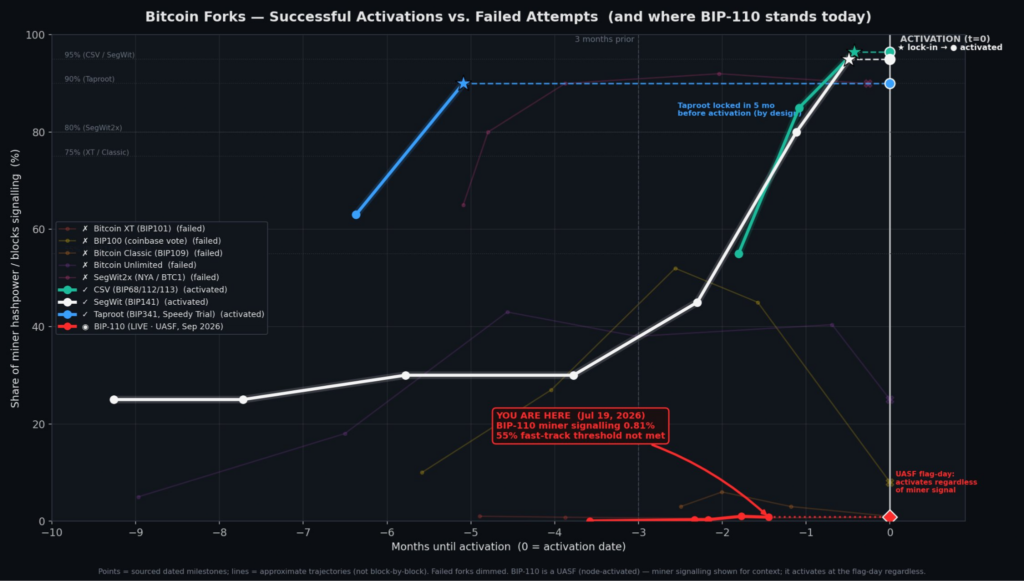
The BIP-110 consensus change is headed towards a mandatory signaling period in the coming weeks and thus a potential fork with the main consensus rules as implemented in Bitcoin Core. The proposal needs to gain a great deal of support from miners within the coming weeks to change Bitcoin consensus. As of the time of writing, miner signaling for BIP-110 stands at less than one percent.
The Knots community, widely made up of Bitcoiners running nodes on machines like Start9 and Umbrel, has rallied around Knots in protest of a series of development decisions made by Bitcoin Core, the primary open source development community and reference implementation of Bitcoin. While a majority of senior Bitcoin developers are either opposed or apathetic to the changes proposed by BIP-110, the movement has gained enough steam to become an ongoing topic of discussion on social media.
Supporters of BIP-110 believe that by running Bitcoin full nodes that signal for the consensus change, they alone can change Bitcoin. Here are the main concepts being debated, the biggest misconceptions about Bitcoin consensus, what a Bitcoin node is, and why BIP-110 is almost certain to fail.
The Power and Limits of a Bitcoin Node
Many of the disagreements and misconceptions in this recent cultural conflict within Bitcoin revolve around the idea of a Bitcoin full node. Influencers like Knut Svanholm, author and podcaster, have elevated the role of the full node to heights perhaps too close to the sun.
Knut recently tweeted: “Every person on Earth is a node in the Bitcoin network. Most to a minuscule extent, of course, but every node is first and foremost a person, not a machine. Which tools we use to interact with the network (and, by extension, to which extent they influence the network) is entirely dependent on the choices we make.”
Statements of this sort are poetically beautiful, philosophically grand, romantic even, but nevertheless technically incoherent and fundamentally meaningless. Knut’s tweet attempts to redefine what a ‘Bitcoin node’ means and fails at it, instead diluting the value of the term entirely. He might as well have said that every atom in the universe is a Bitcoin node, since apparently to him the term is all-encompassing.
Knut, though well-intentioned, is wrong. A Bitcoin node is something very specific. It is a full copy of all of Bitcoin’s transaction history, block headers and transaction-related data. Its purpose is very specific: to let users verify the integrity of Bitcoin’s supply and transaction history in relation to Bitcoin’s consensus rules.
Bitcoin nodes grant users a variety of benefits, such as privacy. Third-party wallet providers query their copy of the Bitcoin blockchain for the user’s balance and serve it back to the user via the wallet app. Most mobile wallets function this way, with users asking a third-party server for their balances. Some, very few, can connect to a user-run Bitcoin node, in which case the user’s public addresses and balances are not shared with any third-party wallet company.
Another benefit Bitcoin nodes grant users is the ability to check whether they are in consensus with the rest of the network, staying in sync. If the user mines Bitcoin or contributes any significant amount of hashing power to Bitcoin’s proof-of-work network, the node also provides the opportunity to assemble a block, choosing which transactions go into it. This is only possible if the user manages to mine a Bitcoin block, which is quite an achievement today, given the difficulty and steep competition.
Even new kinds of mining pools like Ocean, which attempt to decentralize block template production, letting retail miners have more influence over which transactions enter the chain, still need enough hashing power to win the proof-of-work race, resulting in sporadic blocks being mined and thus limited influence over the blockchain.
Bitcoin nodes also relay transactions across the network, with tens of thousands of them communicating via a flood network; this results in a censorship-resistant system where a small number of nodes can get controversial transactions to miners, bypassing any kind of filters, as demonstrated by Peter Todd’s relay libre. Thus, Bitcoin nodes can not easily filter which transactions enter the blockchain.
Even a large majority of Bitcoin nodes alone cannot alone change Bitcoin consensus. Not without having a large amount of economic activity entering the Bitcoin network through them, as exchanges do on behalf of millions of users. Not without having the protocol and application developer community behind them. Not without having the investor community behind them. Bitcoin is not a node democracy, contrary to popular memes today.
Bitcoin nodes do not grant you ‘citizenship’ in the ‘Bitcoin nation’. Satoshi Nakamoto was quite clear about this in the Bitcoin white paper. Bitcoin’s ultimate security and governance structure is: one CPU cycle, one vote, not one node, one vote. And miners, who run the CPU cycles over Bitcoin’s proof-of-work, are very sensitive to investor sentiment and the broader developer community, resulting in a distributed global protocol for money that is very difficult to change.
Bitcoin nodes ultimately let you know if you are connected to the network with the most accumulated proof-of-work and that its consensus rules are being followed, but a node alone does not let you change the consensus rules. Users who change the consensus rules of their Bitcoin node are, by definition, no longer running Bitcoin. As a result, changing Bitcoin consensus as a node runner is very difficult, and that’s a feature, not a bug. Bitcoin is money for enemies.
History and Bitcoin Consensus Games
Deep work has been done, trying to understand Bitcoin consensus, its various pillars and interest groups. Ren Crypto Fish, Steve Lee and Lyn Alden identified six of them in BCAP, an open-source effort to analyze Bitcoin consensus and risks in protocol upgrades. BCAP identified stakeholders such as Economic Nodes, Investors, Media Influencers, Miners and Protocol Developers, and Users and Application Developers
Historically, in the case of a consensus crisis, it is true that Bitcoin nodes have been used to signal support for one version of Bitcoin over another. Fork events like 2017’s Bitcoin Cash fork are often cited as examples of economic nodes winning against opposition by miners. 2017’s legendary User Activated Soft Fork (UASF) faced major opposition in theory; a large majority of mining pools and their corresponding collective hashrate supported the Segwit2x version of Bitcoin, with many exchanges and corporations having signed the infamous New York Agreement in support of it.
The Bitcoin node-supported soft fork against it won nonetheless, bluffing the Segwit2x version from a contested blockchain altogether. But that’s the thing: while the Bitcoin nodes technically won, they did so by having massive support from protocol developers, investors and media influencers: these nodes really had economic weight and rough consensus. BIP-110, on the other hand, does not have the protocol developers, nor does it have enough investors behind it. Michael Saylor has come out against it, with many industry leaders also openly opposing it or staying out of the matter entirely.
In fact, during the Bitcoin Cash fork, the limits of retail Bitcoin nodes were clearly understood. A Bitcoin node run by an exchange is orders of magnitude more influential than that of a retail user, as it introduces large amounts of new transactions into the Bitcoin network. The Bitcoin node of a major mining pool is far more influential than that of a hobbyist solo miner, as it more often assembles blocks and chooses which transactions settle to the blockchain.
Most Bitcoiners outside of exchanges use mobile wallets to access their Bitcoin. Such users and investors can ‘vote’ with their money, so to speak, by moving their bitcoins and economic activity elsewhere, be it to a wallet that supports their vision of Bitcoin, or their own full node. But while users remain on mobile wallets that talk to third-party nodes, those users have little individual influence over Bitcoin consensus. And the vast majority of mobile wallets are using a Bitcoin core-compatible back end.
The same goes for exchanges; their users effectively delegate consensus decisions to the exchange operators. In some cases, exchanges have put consensus issues to a user vote, weighed by their total holdings, returning that decision to end users weighed by capital; we may see this happen again with BIP-110.
Votes of the sort have started happening with Foundry today. One of the biggest Bitcoin mining pools in the world, Foundry, recently emailed its miners informing them that they can vote on the proposal with their hashrate. A high enough support could result in Foundry signaling for BIP-110, though that remains unlikely. Users who do not vote will effectively signal against BIP-110, defending the status quo. Thus apathy about the topic of BIP-110 would be a win for Bitcoin Core by default. BIP-110 supporters need to culturally win over a majority of the Foundry hash rate, who then must act to vote against the Bitcoin Core developer consensus, the most popular Bitcoin implementation and best supported codebase.
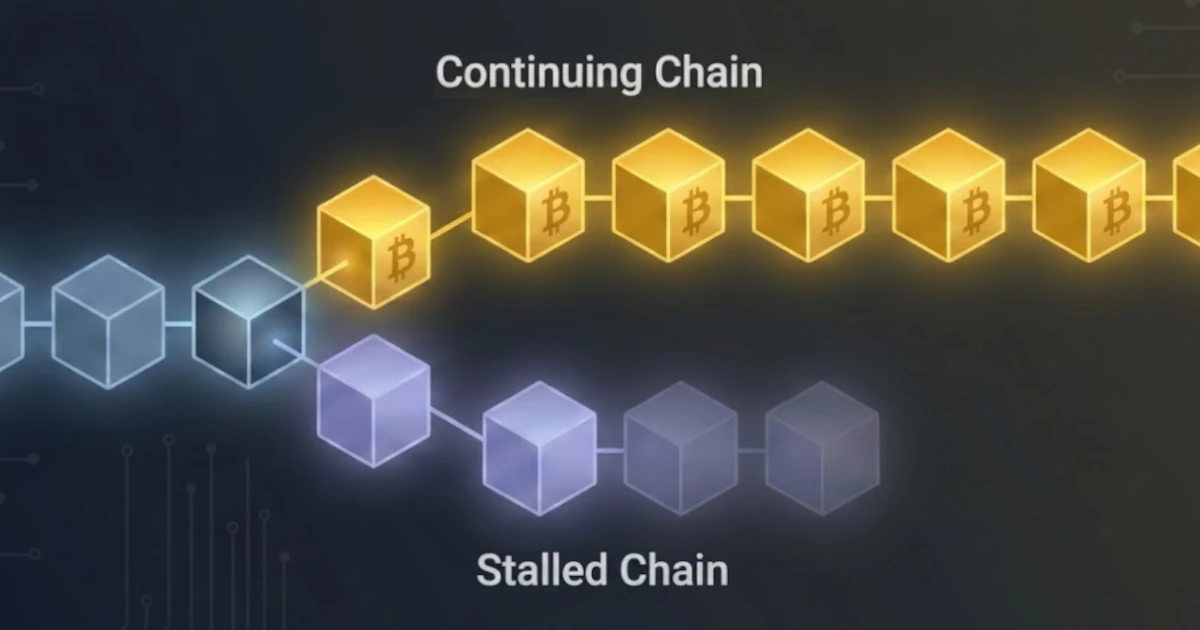
BIP-110 has so far failed to gain consensus across major interest groups within Bitcoin; neither developers, investors, miners, nor large economic nodes support the consensus change. The result is likely to be a chain split in the coming weeks, which could have significant consequences for lightning wallets running on BIP-110-compliant nodes, ultimately resulting in a new, yet small blockchain that would probably have to change the proof-of-work used to stay alive.
Bitcoin Japan, a subsidiary of Asia’s answer to Strategy, Metaplanet, has announced it entered into a financing agreement to start buying the leading cryptocurrency for its treasury.
The Tokyo-based, publicly-listed company said Thursday that it had approved a convertible bond deal with EVO Fund to raise 9.66 billion yen ($59.5 million). The deal will see the company spend over 662 million yen — or over $4 million — on its first Bitcoin transaction.
Bitcoin Japan works on Bitcoin-related media, data platforms and events to promote the understanding of the leading cryptocurrency in Japan and “contribute to the development of its ecosystem globally,” according to its website.
Its parent company, Metaplanet, is a publicly-traded company following in the footsteps of Nasdaq-listed Strategy — formerly MicroStrategy — by buying and holding Bitcoin on its balance sheet. It first started buying the asset in 2024.
Metaplanet is one of the biggest Bitcoin treasuries in the world, with 43,000 digital coins worth over $2.8 billion in its coffers. Its stock is currently down over 50% year-to-date.
JUST IN: Japan Public company Bitcoin Japan Corporation has raised $60 million through convertible bonds, allocating $4.08 million to make its first buy for their BTC treasury
Bitcoin Japan’s announcement comes as treasury companies see their stock slide. Last year, the business model of buying and holding Bitcoin and other digital assets with spare cash suffered with a plunge in crypto prices.
Strategy, the biggest and oldest Bitcoin treasury, has seen its Nasdaq-listed stock nosedive by nearly 80% over the past year.
Little known publicly traded companies in 2025 rushed to announce they were buying digital assets in a hope to boost their stock prices. The strategy worked but since the market downturn, a number of firms in the space have had to sell a portion of their holdings as the price of Bitcoin has slumped.
But companies are still accumulating during the downturn — and firms like Bitcoin Japan are seeing the current market price of the leading asset as an opportunity to start a crypto treasury.
Regulatory push
While Japan has long been a hub for crypto enthusiasts — former major Bitcoin exchange Mt. Gox was based in Tokyo before a 2014 hack and its subsequent closure — lawmakers are now working on regulating the asset class.
Japan’s parliament last week passed a law amendment to designate cryptocurrency assets as “financial assets,” making the assets subject to stricter regulations, eventually paving the way for products like Bitcoin exchange-traded funds to debut in the Asian nation.
The regulation is likely to come into effect within a year, Reuters reported, citing NHK news.
Capital B, the Paris-listed bitcoin treasury company once known as The Blockchain Group, will combine every 10 existing shares into one new share beginning September 8, according to a regulatory filing the company published Monday.
The consolidation reduces the number of outstanding shares from 300,650,632 to 30,065,063. Each new share will carry a par value of €0.80, up from €0.08 for the existing stock. The company framed the transaction as a “purely technical exchange” that leaves the aggregate value of each shareholder’s holdings unchanged, save for the treatment of fractional entitlements.
Capital B said the move aims to “support the company’s institutional development and to open the company’s shares to a broader universe of investors.”
Many institutional funds operate under internal rules that bar them from holding stocks below a set price, and some exchanges impose minimum-price thresholds for continued listing. A higher quoted price per share removes one barrier to that participation.
Capital B shares trade near €0.48 on Euronext Growth Paris and have declined about 40% since the start of the year, per Google Finance data. Should the company’s market value hold, each consolidated share would open near €4.80.
Key dates for Capital B shareholders
The reverse split period runs from August 6 through September 7. Shareholders who hold a number of shares divisible by 10 will see their positions converted with no action required.
Those holding leftover shares can buy or sell stock before the deadline to reach a round multiple of 10. For investors who do not, financial intermediaries will sell the shares tied to fractional entitlements and distribute the cash proceeds, with payments set to begin September 14.
September 7 marks the final trading day for the existing shares. The consolidated shares start trading the following day under a new ISIN, the code exchanges use to identify a security. The company has set September 9 as the record date and September 10 for settlement and delivery.
Capital B will also pause conversions of certain convertible bonds and exercises of share warrants from August 17 through September 10. After the split, the company will adjust conversion prices and warrant ratios to reflect the reduced share count, multiplying bond conversion prices by 10 while dividing warrant ratios and unvested free shares by 10.
Treasury strategy stays central
The share restructuring does not add bitcoin to the balance sheet or raise new capital on its own. It changes the number and nominal value of shares through a technical consolidation, a step the company tied to its goal of reaching a wider investor base.
Capital B’s bitcoin holdings
Capital B holds 3,139 BTC, a figure that ranks it as the second-largest listed corporate bitcoin holder in Europe, according to BitcoinTreasuries.net. Germany’s Bitcoin Group SE sits ahead of it with 3,605 BTC, the data shows. Capital B, which describes itself as Europe’s first bitcoin treasury company, built much of that position through fundraising rounds during the first half of 2026.
The company has moved to widen its access to capital. In June, shareholders approved authority for as much as €5 billion in capital increases and €100 billion in credit instruments, resolutions that drew more than 95% support from votes cast. Those approvals give the board financing capacity for future purchases.
Capital B measures progress through bitcoin held per fully diluted share rather than total reserves alone, a framework common among bitcoin treasury companies. The firm has also said it is developing a bitcoin-backed credit product for the European market, though it has not set a launch date.
The Bitcoin bottom may be in — but don’t get your hopes up: It might struggle to go up anytime soon, according to one investment firm.
A Friday report from European asset management firm CoinShares said that investors last week threw fresh cash at Bitcoin — and other crypto — exchange-traded products, indicating a change in sentiment.
But other factors may hold digital asset markets from going higher, James Butterfill, head of research at CoinShares, wrote.
“We have said for some time that Bitcoin has probably reached, or is close to, its floor,” the report read. “But we see no significant upside potential from here.”
The report added that current macroeconomic headwinds, such as the US bombing Iran and rising oil prices, could see inflation go up again.
Bitcoin’s price was up earlier this week, hitting a seven-day high of $65,501 on news that inflation in the US was softer than expected. It has since erased those gains and was recently trading for $64,010.
The price of Bitcoin has typically done well on news that inflation is coming down because investors expect interest rates to come down. But Butterfill said that “a rate cut does not look probable at this stage.”
Bitcoin’s worst run on record
CoinShares’ data showed that investors pulled a total of $8 billion out of funds giving crypto exposure — “the worst run on record.”
Last week, though, things reversed when $287 million hit crypto funds, CoinShares said, with the data so far showing that this week looks likely to be another positive streak.
The price of Bitcoin has typically done well when US investors — previously excluded from crypto investing — have bought shares in exchange-traded funds approved in 2024.
The products — handled by the likes of BlackRock, Fidelity, and Grayscale — allow more traditional investors or Wall Street institutions to buy positions in Bitcoin via shares that trade on stock exchanges.
Since BTC’s October all-time high of $126,080, crypto markets have faced a battering as those investors have fast cashed out of the funds. Bitcoin has struggled to make gains, especially after the US and Israel started bombing Iran, leading to a surge in the price of oil.
The leading cryptocurrency is now nearly 50% below its record.
“The dominant picture is that the current setup is prompting interest in adding positions, but caution prevails while sentiment remains broadly negative,” CoinShares added.
This is a guest post by Jason Hughes, VP of Development and Engineering at Ocean Mining. Opinions expressed are entirely his own and do not necessarily reflect those of BTC Inc. or Bitcoin Magazine. The article originally appeared on X.com and has been published with the permission of the author.
Let me start off by saying I’m not pro BIP110, and I’m not anti-BIP110. If it actually succeeds as something that gains true consensus within the network and ends up being enforced by a majority of the network… cool. If so, then we’ll go with it because the network has spoken and accepted it, and all nodes, including non-BIP110 nodes, will be pulled along for the ride. Unfortunately for proponents of the proposal, that simply isn’t currently the case by any measurable metric, nor does it appear to have a trajectory suggesting that will change, either.
There’s been a lot of misleading information about this whole thing, especially in the context of mining. A few quick key bullet points to briefly counter some hyperbole from proponents: BIP110 is NOT inevitable. It CAN fail. BIP110 can and will cause a chain split/fork in a minority hashrate situation. BIP110 is NOT without risk to miners choosing to adopt it. Miners not supporting BIP110 are not suddenly mining “invalid” blocks just because a proposal that isn’t yet adopted simply exists. You’re not a bad person or evil simply because you don’t like or support BIP110. (The fact that I feel the need to point out that last part is actually kind of sad…)
I was going to write a long post to help keep miners informed about things they need to remain aware of as this all plays out… before realizing I already did so months ago, as a document I authored that I had hoped could be put out as a miner education piece at OCEAN. Sadly, it never got published. So I went ahead and updated it, and well, here it is.
Again, keep in mind this was written months ago, intended to be as agnostic as possible in an effort to make it acceptable as a corporate post. That effort failed, so I’m posting it as a personal document today instead. As a miner making important decisions about your operations, you need to be aware of all of this without the sugarcoating and, frankly, outright misleading information coming from some of the BIP110 proponents. You must be vigilant and decide what’s right for you.
While there is certainly some misleading information from the opposition as well, nothing I’ve seen is nearly as egregious as the extremely premature claims of victory and accompanying hyperbole pushed by the BIP110 side. Summarizing my doc a bit, my personal suggestion to miners is this: Signal if you support BIP110. Do not signal if you don’t support BIP110 or don’t care. Either way, monitor the network on/around/before block 961632.
If you continue to see non-signaling blocks from major pools, you can be reasonably certain they’re not going to suddenly decide later to throw away millions of dollars’ worth of revenue to backtrack and signal for BIP110. If they do, by some chance, start to signal for BIP110, you should monitor that and consider switching as required to stay on the heaviest chain. The key point is that, realistically, only one side can win. It’s either BIP110 succeeds, and miners not on the BIP110 side fail, or BIP110 fails, and miners on the non-BIP110 side succeed.
Moving on, let’s dive into a small fraction of my rationale.
QUICK FACT: Between 7 and 15% of Bitcoin Nodes are signaling support for BIP110.
Depending on which centralized crawler you look at… no way to know for sure [how many BIP110 nodes are signaling support]. My personal private crawler puts this number much lower, but that’s a discussion for another day. Suffice it to say, I think it’s logical and correct to say that even 15% is not a majority.
“But Jason! UASF got Segwit activated with fewer nodes!”
Yep, because many miners, merchants, users, etc., all actually wanted Segwit. There was tremendous economic and community weight behind it. Without rehashing that whole thing, as plenty of resources on the topic from before BIP110 are worth a read, suffice it to say that BIP110 and Segwit activations are not quite comparable, as many have already pointed out. Segwit, for example, went into its UASF territory with around 1/3rd of the network’s hashrate already signaling support. With that kind of backing, the UASF to help push the MASF over the tipping point made a lot of sense. It doesn’t make sense here for BIP110.
QUICK FACT: 0.6% of blocks over the past 60 days have signaled support for BIP110.
[0.6% is a] pretty stark contrast to even Segwit’s low baseline support. Yes, I know it’s increased slightly in the past couple of weeks, but no new entrants. Just more clearly rented hashrate from one of the same small proponents.
Something to keep in mind is that mining BIP110 signaling blocks via DATUM on OCEAN carries virtually no risk to the miner up until the fork point at block 961632. The cost is negligible, as you’re effectively guaranteed to recoup rental costs, etc.
It’s awesome that the ability to do so exists, and I wouldn’t have it any other way… but just something to keep in mind when weighing signaling from such blocks in the grand scheme of things from a risk-reward, money-on-the-table perspective.
“But Jason! Miners have no incentive to signal until the last minute!”
I also see no evidence to suggest that this could be the case. Subjectively, I disagree with the premise, as it’s not in a mining pool’s best interest to destabilize the network in such a way. Part of the reason for early signaling and lock-in periods is to help coordinate upgrades in a smooth fashion. Waiting until the last minute negates that benefit entirely. I see no compelling rationale or upside to doing so.
Continuing on this, as part of my personal node monitoring setup, I specifically monitor nodes known to belong to various entities, such as other mining pools, exchanges, large lightning nodes, merchants, etc. A supermajority of which are monitored with explicit permission and confirmation/coordination.
QUICK FACT: All major mining pools I monitor are currently running some variant of Bitcoin Core v30 or v31 (except OCEAN).
Expanding on that, most [mining pools] have updated their nodes since the proliferation of BIP110’s release, even since the release of Knots 29.3. Additionally, it is known that many mining pools run modified versions of their node software to facilitate various requirements of their specific infrastructure. Such changes would need to be ported to a BIP110-compatible client, tested, evaluated, and deployed ahead of time. I currently see no evidence that this is the case currently.
As far as I can tell, the pools are aware but ignoring.
This is one of the funniest and most ridiculous arguments I’ve heard from the pro-BIP110 crowd. Comparing a consensus change that can be unilaterally enforced upon the network by miners and accepted by 100% of existing nodes (a soft fork), with a hard fork which no existing node will accept… is disingenuous at best. T
ightening rules (like BIP110): Soft fork, can be enforced by miners if they choose to do so. Loosening rules (like canceling a halving): Hard fork, can not be enforced by miners without effectively 100% buy-in from the entire network… which isn’t likely to happen. Comparing the two is, bluntly, just stupid.
“But Jason! If you don’t upgrade to the latest consensus rules, you’re insecure! You’ll lose funds! You’ll mine invalid blocks! You’ll [insert additional hyperbole here]!”
This would be true of a consensus change that has, well, consensus. While BIP110 has made a valiant effort to gain that consensus, it has yet to have any measurable majority at what is now arguably the 11th hour. Not in nodes, not in hashrate, not in the social layers (consensus.health has a cool visual there where you’ll find me in the middle).
If somehow BIP110 gains 51%+ of the network hashrate on/before block 961632… then, alright. It’s enforced, since as a soft fork a majority of miners can unilaterally enforce it in the absence of a fully adopted URSF (effectively a misnomer, as this would kind of be a hard fork).
“But Jason! It can’t gain consensus by already having consensus! You have to give it a chance!”
Firstly… no I don’t, even though I have. Second, it’s a rushed proposal that never had the time to even try and gain real consensus. It’s been 7 months since the release of the first BIP110 client. There’s ~3 weeks to go before “mandatory” signaling starts as of now (less by the time you read this). 90% of the time available has passed with no change in overall sentiment from any relevant players. If it hasn’t gained sufficient adoption in the past 7 months, it’s not likely to do so in the next 3 weeks.
“But Jason! CSAM! CSAM! Pedophiles! CSAM!”
I’ll be the first to say, even I personally overstated the risk here early on when Core proposed its OP_RETURN change. I personally expected something particularly egregious to hit the chain almost immediately, and to the best of my knowledge, that’s not yet happened. Could it still happen? Yeah, I suppose.
But considering from a technical perspective, byte-for-byte the same contiguous arbitrary data can provably end up stored in the current chain or the BIP-110 chain without much issue… this particular argument for BIP-110 falls pretty flat to me at this point.
Do I want CSAM in the chain? Of course not. Am I a pedophile if I don’t support BIP110? Also not.
Concluding Thoughts
I could continue to go on and on and on, but I’ll stop here. I’ve wasted enough time on this. I’m sure I’ve done plenty to annoy both sides of the BIP110 debate at this point, as I don’t adopt either stance. I’m sure I’ll catch flak from all angles simply for daring to speak my mind on it.
Overall, I mostly think it was silly to approach addressing a real problem (the OP_RETURN default change in Bitcoin Core) with the maximum anti-spam manifesto based soft fork proposal… which provably cannot stop spam, arbitrary data, etc. (Yes, I know, proponents will claim it’s not about spam… and will also make semantic arguments that it does stop data as well… neither of which appears to be correct.)
I’ll close with the concession that I could be wrong. I’m not Nostradamus, and I can’t accurately predict the outcome with 100% certainty. I can only go by what the data tells me, and so I give BIP110’s success less than a 5% chance of actually succeeding… and I consider that generous. You can take my opinions on this however you wish, but I highly recommend you don’t discount the actual data points, remain vigilant, and do what’s best for you and your mining revenue. Don’t be gaslit by either side of the debate, and make your own decisions.
Global market maker Citadel Securities has invested $400 million in crypto exchange Crypto.com, giving the platform a $20 billion valuation, according to a Thursday announcement.
Crypto.com, which has a number of digital asset products, said the cash would help the Singapore-based company expand its services to assets such as blockchain-based securities and derivatives.
The cash will help bridge the gap “between digital asset and traditional markets to create a more efficient 24/7 financial ecosystem,” a Thursday announcement read.
“The size of the opportunity in front of us is staggering, as crypto increasingly becomes the rails for finance,” Crypto.com CEO Kris Marszalek said in a statement.
“Having built the right regulatory and tech infrastructure over the last decade, Crypto.com is now perfectly positioned to capture this new wave of growth across all asset classes.”
“The convergence of traditional financial markets and digital asset infrastructure is an exciting evolution with the potential to further improve market efficiency,” added Jim Esposito, President of Citadel Securities.
Thrilled to announce our first institutional funding round with a $400 million strategic investment from Citadel Securities valuing https://t.co/pFc4Pz8PQj at $20 billion. An incredible milestone 10 years in on our journey and the beginning of a new phase of growth. Grateful to…
Esposito’s comment comes as Wall Street interest in blockchain technology piques — despite a market slump.
Back in February, BlackRock, the world’s biggest asset manager, announced that it was working with decentralised exchange Uniswap to bring one of its funds on-chain.
Before that, in January, the New York Stock Exchange said it was building a platform allowing traders to buy and sell tokenised versions of US-listed equities and exchange-traded funds.
And most recently, the S&P 500 gave crypto platform Trade[XYZ] the green light to debut a new derivative contract on decentralized exchange Hyperliquid, allowing traders to gain leveraged exposure to the top index.
Citadel’s crypto interest
Miami, Florida-based Citadel, has for some time been interested in digital assets: Back in 2023, the company helped debut EDX Markets, a “first-of-its-kind exchange” giving investors “safer, faster and more efficient cryptocurrency trading.”
The exchange this year applied for a national trust bank charter with the Office of the Comptroller of the Currency, marking a step toward deeper integration between digital asset firms and the US banking system.
Citadel last year also pumped $200 million into crypto exchange Kraken to help accelerate the company’s strategy of bringing traditional financial products on-chain.
VerifiedX today announced the signing of a Memorandum of Understanding (MOU) with BitGo to provide qualified custody support for vBTC, with immediate support for vBTC.b, the non-synthetic canonical Bitcoin asset issued through the VerifiedX Network and deployed on Base. The partnership represents a significant milestone in bringing institutional-grade custody, compliance, and security standards to programmable Bitcoin while preserving direct redemption to native Bitcoin.
Under the agreement, institutions, asset managers, family offices, corporations, and professional allocators will be able to custody vBTC upon final integration and can now immediately custody vBTC.b through BitGo’s qualified custody infrastructure while accessing the utility of Bitcoin across decentralized finance, payments, collateralization, treasury operations, and on-chain vaulting with recovery features.
Unlike traditional wrapped Bitcoin products, vBTC.b is designed as a fully collateralized non-synthetic on-chain and consensus embedded Bitcoin token with native redemption built directly into the asset architecture without any counterparty or federation reliance. Holders can redeem directly back to Bitcoin without requiring the asset to first be unwound back through the VerifiedX network, creating a seamless institutional experience across Base and Bitcoin liquidity ecosystems.
“Institutions have consistently told us they want two things: qualified custody and non-synthetic productive Bitcoin,” said Jay Pollak, Head of Strategy at the VerifiedX Foundation. “This partnership delivers both. With BitGo’s best-in-class institutional custody infrastructure and vBTC.b’s native Bitcoin redemption model, allocators can maintain institutional-grade security while activating their Bitcoin across a growing ecosystem of applications and opportunities.”
Institutional Bitcoin Without Synthetic Risk
As Bitcoin continues to mature as a treasury and reserve asset, institutions increasingly seek ways to generate utility from their holdings without sacrificing security, transparency, or redemption certainty.
vBTC.b addresses these requirements through a framework that combines:
Native Bitcoin
Direct Bitcoin redemption
Qualified custody support
Institutional-grade compliance tooling
On-chain transparency
Self-custodial programmability
Cross-ecosystem interoperability
The result is an asset that enables institutions to move beyond passive Bitcoin ownership and participate in productive and programmable financial infrastructure while maintaining real native ownership to the underlying Bitcoin asset.
Activating Bitcoin Capital
Through vBTC.b, institutions can utilize Bitcoin across a broad range of applications including:
Curated institutional yield vaults
Bitcoin-backed lending and borrowing
Treasury optimization
Digital collateral management
Settlement infrastructure
Automated payment workflows
Agentic and AI-powered financial systems
Cross-chain liquidity deployment
Bitcoin-native commerce and payments
Because vBTC.b remains redeemable to Bitcoin at the protocol level, institutions can maintain confidence that utility does not come at the expense of redemption rights or trade-offs, while reducing counterparty risks and smart contract vulnerabilities, and eliminating rehypothecation at the protocol level.
Security and Compliance First
The partnership combines VerifiedX’s programmable Bitcoin infrastructure with BitGo’s industry-leading custody platform.
BitGo currently safeguards more than $49 billion in Bitcoin under custody, with an overall estimate of digital asset custody levels exceeding $100 billion during peak periods, making it one of the largest digital asset custodians globally. The company provides regulated qualified custody services, institutional security controls, cold storage infrastructure, and insurance protections utilized by some of the world’s largest digital asset participants.
VerifiedX complements this foundation through integrated compliance tooling, transaction monitoring capabilities, auditability features, and institutional controls designed to satisfy modern operational and regulatory requirements.
Building the Financial Operating System for Bitcoin
The BitGo relationship represents another step in VerifiedX’s mission to build the financial operating system for Bitcoin and intelligent assets.
Through the VerifiedX ecosystem, Bitcoin can be transformed from a passive store of value into a programmable financial asset capable of supporting payments, lending, settlement, collateralization, tokenization, AI-driven automation, and next-generation financial infrastructure.
As institutions increasingly seek secure native plumbing to deploy Bitcoin capital, the combination of BitGo qualified custody and vBTC.b provides a framework designed to meet institutional standards without sacrificing Bitcoin’s core principles of ownership, redemption, and utility.
Additional details regarding custody availability, onboarding, and supported institutional products will be announced as the partnership progresses.
About VerifiedX
VerifiedX is a financial operating system for Bitcoin and intelligent assets, enabling self-custodial ownership, instant settlement, programmable finance, native Bitcoin utility, and agentic financial infrastructure. Through products including vBTC, BFLY, and PulseXAI, VerifiedX connects institutions, users, and autonomous systems through a unified blockchain ecosystem framework.
Its ecosystem includes:
vBTC & vBTC.b (BTC)
BFLY payments and click to earn infrastructure
SwitchBlade wallet technology
PulseXAI generative and tokenized intelligence
Institutional settlement architecture
Privacy-enabled transactions and programmable assets
Strive, Inc. (Nasdaq: ASST) bought 18 bitcoin last week, a modest addition that lifted the Dallas-based company’s treasury to 19,900 coins, according to an 8-K filing with the Securities and Exchange Commission on Monday.
The purchases ran from July 6 through July 10 at an average price of about $64,028 per bitcoin, including fees and expenses, for a total of some $1.2 million. The buy is small next to Strive’s earlier moves this year, and it tracks a bitcoin price that has fallen well below the levels the firm paid in prior rounds.
Alongside the purchase, Strive reported cash and cash equivalents of $154.1 million as of July 10, up $700,000 from July 2. The company still holds 505,000 shares of Strategy’s Variable Rate Series A Perpetual Stretch Preferred Stock, known as STRC, with a fair value of $44.2 million, down $202,000 over the same stretch.
Its own preferred instrument, the Variable Rate Series A Perpetual Preferred Stock that trades as SATA, remains at 7.83 million shares outstanding.
Strive’s jump from an asset manager to treasury company
Strive traces its bitcoin strategy to a fast run of moves that began last year. Vivek Ramaswamy and Anson Frericks founded Strive Asset Management in 2022, and in 2025 the firm went public through a reverse merger with Asset Entities, taking the ASST ticker and reframing itself as the first public asset-management bitcoin treasury company. Its stated aim is to accumulate bitcoin and outperform the asset over the long run.
The accumulation came in bursts. Strive bought 1,567 bitcoin in late 2025 at an average of $103,315 and funded the effort through preferred-stock offerings. In January 2026, it added 123 more at $91,561 and won Semler Scientific shareholder approval for an all-stock acquisition that would bring about 5,048 bitcoin onto its balance sheet.
The combined company would hold close to 12,800 coins at that time, a total that would rank among the largest corporate holders and place it ahead of names such as Tesla and Trump Media. By May 1, Strive’s own treasury had reached 15,000 bitcoin.
A smaller step in a lower market
Monday’s filing shows a different pace. An 18-coin purchase at $64,028 stands in contrast to the six-figure prices Strive paid a few months ago, a gap that reflects a broad decline in bitcoin through the first half of the year.
The measured addition, paired with a cash balance that held near $154 million, points to a company adding to its position at a slower cadence while it works through the Semler deal.
Today (July 7, 2026) SpaceX formally joins the Nasdaq-100 Index. The inclusion comes just weeks after the company’s public debut and follows its disclosure of 18,712 BTC on the balance sheet. JPMorgan estimates that index rebalancing will drive approximately $4.3 billion in passive inflows from Nasdaq-100-tracking funds and ETFs.
This development is more than headline news. It creates a structural, rules-based channel for institutional capital to gain exposure to Bitcoin through a corporate treasury vehicle, without requiring active allocation decisions, new mandates, or direct cryptocurrency purchases.
For corporate treasury teams, capital allocators, and institutional investors evaluating Bitcoin on balance sheets, the move provides a clear data point on how the strategy can intersect with mainstream equity infrastructure.
The Mechanics of Structural Demand
Passive index funds and ETFs must hold securities in proportion to their index weighting. When a new component is added, these vehicles buy shares mechanically. In SpaceX’s case, the estimated $4.3 billion in inflows represents capital that will flow into the stock regardless of short-term views on Bitcoin or the broader crypto market.
SpaceX’s Bitcoin holdings, disclosed in regulatory filings at approximately $1.2 billion in fair value, now sit within one of the most widely held equity indices globally. This is distinct from direct Bitcoin ETF flows or voluntary corporate purchases. It is demand generated by index rules rather than discretionary conviction.
Combined with Tesla and Strategy, the Nasdaq-100 now contains three companies with material Bitcoin treasuries. While SpaceX’s initial weighting will be modest, the precedent matters: high-growth, high-visibility companies can bring Bitcoin exposure into institutional equity portfolios through existing governance and allocation frameworks.
Strategic Implications for Treasury and Allocation Decisions
Corporate Bitcoin strategies have historically been evaluated on two primary dimensions: balance sheet optionality and long-term value preservation. SpaceX’s inclusion introduces a third dimension, potential for structural equity demand tied to index membership.
For treasury operators, this suggests that Bitcoin holdings, when paired with strong underlying business fundamentals, can contribute to broader market visibility and liquidity. Index inclusion often correlates with increased analyst coverage, improved trading volumes, and easier access to capital markets.
For institutional allocators, the development offers a form of Bitcoin beta that fits within traditional equity sleeves. Many large investors already maintain significant Nasdaq-100 exposure through passive mandates. SpaceX’s addition layers incremental Bitcoin exposure into those portfolios without requiring changes to investment policy statements or new product approvals.
This aligns with patterns observed across the corporate treasury landscape. Public companies now collectively hold more than 1.26 million BTC. The strategy is expanding beyond dedicated Bitcoin-focused entities into diversified operating businesses. SpaceX’s move illustrates how the approach can scale into the core of institutional equity markets.
Hypothetical Case Study: Modeling Indirect Bitcoin Demand
To illustrate the mechanism, consider a simplified hypothetical involving a public company that adopts a Bitcoin treasury strategy and later gains meaningful index attention.
Assumptions (illustrative only):
Company market capitalization: $12 billion
Bitcoin holdings: 8,000 BTC at $63,000 per BTC = $504 million
Bitcoin as a percentage of market cap: ~4.2%
The company is added to a major equity index, triggering $800 million in passive inflows over time (scaled-down version of larger index events for clarity)
Step-by-step impact:
Passive funds purchase $800 million of the company’s stock to match index weighting.
Because Bitcoin represents 4.2% of the company’s enterprise value in this example, roughly $33.6 million of the passive inflows can be viewed as indirectly supporting the Bitcoin portion of the balance sheet ($800M × 4.2%).
At current prices, this equates to approximately 533 BTC of effective demand created through equity market mechanics rather than direct cryptocurrency purchases.
If the company’s Bitcoin holdings generate ongoing yield or optionality (through lending, collateralization, or strategic use), the passive capital provides a form of “free” liquidity support to the treasury strategy.
While the numbers are simplified and depend on actual market cap, weighting, and Bitcoin valuation at the time of inclusion, the directional point is clear: index membership can create sustained, non-discretionary buying interest that benefits the Bitcoin component of the balance sheet proportionally.
Treasury teams evaluating this path should model similar scenarios using their own projected holdings, target market capitalization, and relevant index weighting assumptions. The exercise highlights how Bitcoin treasury decisions can interact with traditional equity market dynamics in ways that pure cryptocurrency allocations do not.
Looking Ahead
SpaceX’s Nasdaq-100 entry is one data point in a broader evolution. Corporate Bitcoin adoption is moving from early experimentation toward integration with established financial infrastructure. Passive flows, index rules, custody solutions, and regulatory clarity are all contributing to this shift.
For organizations actively building or evaluating Bitcoin treasury capabilities, developments like this reinforce the importance of treating Bitcoin as a strategic balance sheet asset with multiple potential transmission channels into institutional capital markets.Key questions for treasury and allocation teams to consider:
How would index inclusion (or the potential for it) factor into your company’s capital allocation framework?
What disclosure and governance standards are becoming necessary as Bitcoin treasuries intersect with passive equity vehicles?
For allocators: Does exposure through high-quality corporate treasuries warrant a distinct analytical lens alongside direct Bitcoin or ETF holdings?
The corporate Bitcoin strategy continues to mature. Events that embed Bitcoin exposure within widely tracked equity indices represent one of the more durable forms of institutional adoption currently unfolding.
Disclaimer: This content was prepared on behalf of Bitcoin For Corporations for informational purposes only. It reflects the author’s own analysis and opinion and should not be relied upon as investment advice. Nothing in this article constitutes an offer, invitation, or solicitation to purchase, sell, or subscribe for any security or financial product.
Strive, Inc. bought 17.76 bitcoin last week and now holds 19,882 coins, the company said in a Form 8-K filed earlier today.
The firm purchased the coins between June 29 and July 2 at an average price near $59,850. Chief Executive Matt Cole disclosed the update in a post on X.
The purchase reads as a deliberate nod to the July 4 holiday. The figure of 17.76 points to 1776, the year the United States declared independence. The buys landed days before the nation’s 250th anniversary of that declaration.
The weekly buy was small. The quarter behind it was not. Strive acquired 6,236 bitcoin during the three months ended June 30, at an average cost of $74,290 per coin. That haul lifted its treasury from 13,628 coins at the end of March to 19,864 at quarter close.
The company reported a 24.0% bitcoin yield for the second quarter, its own measure of the change in bitcoin held per share. It logged a bitcoin gain of 3,264 coins and an amplification ratio of 67.2%.
Strive uses these metrics to judge whether its capital raises add bitcoin per share. The firm cautions that they are not traditional financial measures and exclude its debts and preferred claims.
Strive bought through a steep price drop. Bitcoin traded near $114,332 in September 2025. It closed the second quarter near $58,631. The decline cut the market value of Strive’s holdings and its cost of new coins. The company’s blended cost basis stood at $94,761 per coin as of June 30, above recent purchase prices.
The balance sheet grew across the quarter. Strive held $144.5 million in cash as of June 30, up from $95.1 million in March. It also held 505,000 shares of Strategy’s STRC preferred stock, valued near $42.9 million. Total balance sheet assets reached about $1.35 billion.
Strive’s transition into a bitcoin-first company
That growth carries a rising cash cost. Strive funds purchases in part through its Variable Rate Series A Perpetual Preferred Stock, which trades as SATA. The preferred pays cumulative monthly cash dividends at an annualized rate near 12.25%.
The stated amount of SATA outstanding climbed to $783 million by June 30. The company’s annualized dividend obligation rose to $101.8 million, up from $56.2 million in March.
Strive is a recent entrant to the bitcoin treasury field. Founded by Vivek Ramaswamy in 2022, the asset manager launched its accumulation strategy in September 2025 through a merger with Asset Entities.
It later agreed to buy bitcoin holder Semler Scientific in an all-stock deal, which added roughly 5,000 coins and won approval this year. Cole, a former CalPERS executive, runs the combined company.
The filing carried standard cautions. Strive said its quarterly closing procedures are not complete and the figures are preliminary and unaudited. It noted that its share price can diverge from the value of its bitcoin. Past yields, it said, do not predict future results.
Earlier today, Strive-adjacent Strategy (MSTR) said they sold a record 3,588 bitcoin for $216 million to fund dividends on its preferred securities, marking its largest-ever BTC sale.
Metaplanet crossed the 43,000 BTC threshold on July 2, a milestone that places the Tokyo-listed firm as the world’s third-largest corporate Bitcoin holder. The company now trails Strategy and Twenty One Capital across the global corporate ranking, and its climb underscores Japan’s role in the corporate Bitcoin accumulation race.
Metaplanet acquired an additional 2,823 BTC during the second quarter of 2026, a purchase worth about $170.7 million. The buy brought total holdings to 43,000 BTC, valued near $2.6 billion. Shares of the company (ticker 3350) closed 3.5% higher at 207 yen ($1.28) on Thursday following the announcement.
The average acquisition price for the quarter landed at roughly 12.71 million yen (about $80,000) per Bitcoin, according to the company. The effective purchase price fell to around 12.09 million yen (about $77,000) once income from the firm’s Bitcoin Income Generation business is counted.
That segment produced approximately 1.75 billion yen ($10.85 million) in operating revenue for the quarter, lifting first-half revenue to about 4.72 billion yen. On a trailing 12-month basis, the division’s revenue reached about 11.4 billion yen.
Metaplanet’s total Bitcoin investment now stands at approximately 659.25 billion yen (about $4.2 billion), with holdings valued near 409 billion yen (about $2.6 billion) as of June 30. The overall average cost basis sits at 15.33 million yen (about $102,500) per BTC.
The company reported a BTC Yield of 6.6% for the quarter ended June 30, 2026, a metric that tracks growth in Bitcoin per share. That figure remains a core indicator for corporate treasury strategies of this type.
The corporate Bitcoin leaderboard is now well defined. Strategy, the former MicroStrategy, leads with holdings above 847,000 BTC. Twenty One Capital holds second place. Metaplanet takes third, a position that puts it ahead of other large players such as MARA Holdings, according to data tracked by Bitcoin Treasuries.
Michael Saylor marked the occasion on X, tweeting, “Congrats to Metaplanet on reaching ₿43,000 and becoming the #3 corporate Bitcoin treasury in the world. You are proving that the Bitcoin treasury strategy is global.”
JUST IN: Japan's Metaplanet buys 2,823 Bitcoin worth $172.7 million
— Bitcoin Magazine (@BitcoinMagazine) July 2, 2026
The strategy behind Metaplanet
Metaplanet has scaled at speed since it adopted the treasury model in 2024. CEO Simon Gerovich has drawn on equity offerings, debt instruments, and options strategies to build the position, an approach designed to limit the shareholder dilution that comes with large corporate purchases. The Bitcoin Income Generation business uses Bitcoin options to create recurring cash flow while the company expands its holdings.
The balance sheet leaves room to grow. Total debt and preferred stock represent about 23% of the net asset value of the firm’s Bitcoin, a cushion that gives Metaplanet capacity to keep buying.
The dual model, one part aggressive accumulation and one part recurring income, cements Japan as a rising force in the corporate push to hold Bitcoin as a reserve asset.
Shares of Strategy Inc. climbed 14% at times on Monday to roughly $94, their best single-day gain in weeks, after the bitcoin treasury company unveiled a sweeping capital overhaul.
The move marks a significant shift for the company once synonymous with an unrelenting bitcoin accumulation strategy. Strategy’s board approved a new Digital Credit Capital Framework that authorizes up to $1.25 billion in bitcoin sales to fund a newly created U.S. dollar reserve, cover preferred dividend obligations, and service debt.
The company also authorized $1 billion in common stock buybacks and $1 billion in repurchases of its preferred securities.
The company raised the dividend rate on its Variable Rate Series A Perpetual Stretch Preferred Stock, known as STRC, to 12% annually — a 50 basis point increase effective July 1.
Strategy held 847,363 BTC as of June 28, purchased for an aggregate $64.10 billion at an average price of $75,651 per coin. With bitcoin trading near $60,000 Monday afternoon, the company sits on an unrealized loss on its entire stack — context that makes the new monetization framework more than just financial engineering.
The company said it has approximately $2.55 billion in U.S. dollar reserves, covering roughly 17 months of annual preferred dividend and interest obligations of about $1.76 billion.
The stock had been grinding lower since hitting a high near $200 earlier this year in May, pulled down by bitcoin weakness and broader risk-off pressure. Monday’s bounce, driven largely by the capital plan announcement, brought shares back above $92 intraday, with a session peak near $94.
Other crypto and bitcoin-linked stocks also started the week out strong.
Nakamoto (NAKA) shares surged more than 10% at points during Monday’s session, among the day’s strongest movers in the crypto equity space. Strive (ASST) climbed over 3.5% at its intraday peak. Coinbase (COIN), by contrast, saw a more muted session — shares up around 2% at their high.
Strategy and bitcoin price action
Bitcoin price shed roughly 6% over the past week, pulling back from a high near $64,400 earlier in the period to trade around lows of $58,800 today — a grind lower that has tracked weakness across broader risk assets.
Bitcoin price has now dropped more than 18% on the month, with the June candle opening near $76,690 and finding no sustained bid on the way down.
Six straight weeks of ETF outflows, totaling tens of millions in institutional selling, have weighed on the price throughout the stretch. Bitcoin remains below its key 50-month exponential moving average near $65,600, a level that technicians watch as a line between short-term recovery and deeper correction territory.
Bitcoin Magazine is published by BTC Inc, a subsidiary of Nakamoto Inc. (NASDAQ: NAKA)

 Login
Login



 Japan Public company Bitcoin Japan Corporation has raised $60 million through convertible bonds, allocating $4.08 million to make its first buy for their BTC treasury



 (Yes, I know, proponents will claim it’s not about spam… and will also make semantic arguments that it does stop data as well… neither of which appears to be correct.)