Reading view

There are new articles available, click to refresh the page.

Swiss Bitcoin Pay Shuts Down Servers After Data Breach

Bitcoin Magazine

Swiss Bitcoin Pay Shuts Down Servers After Data Breach

Another day, another data breach. 

Swiss Bitcoin Pay, a non-custodial bitcoin payment processor, said that it had to temporarily shut down its servers following a data breach on Monday. 

The Neuchâtel, Switzerland-based company said that user funds were safe but customer email addresses, bitcoin addresses and IBANs, transaction history, and hashed passwords were believed to be breached. 

A malicious user has likely gained access to Swiss Bitcoin Pay’s internal systems. As a precaution, we are temporarily shutting down our servers while we investigate and secure our infrastructure.

At this stage, we believe they may have accessed customer email addresses, Bitcoin…

🇨🇭 Swiss Bitcoin Pay (@SwissBitcoinPay) September 14, 2026

The announcement comes amid a run of breaches hitting bitcoin and fintech firms. Revolut confirmed last week that it handed customer passports, driver’s licenses, verification selfies and transaction histories to an unauthorized party that sent fraudulent requests from a legitimate government agency’s email domain. 

And top hardware wallet manufacturer Trezor last week warned that a data breach at the third-party marketing platform it uses for sending newsletters was leading criminals to target customers with phishing attacks. 

“A malicious user has likely gained access to Swiss Bitcoin Pay’s internal systems …As a precaution, we are temporarily shutting down our servers while we investigate and secure our infrastructure.” Swiss Bitcoin Pay said on Monday. 

The company added that; “User funds are safe, and any amounts owed to users will be fully returned.”

Swiss Bitcoin Pay did not immediately respond to Bitcoin Magazine’s request for comment. 

The company lets businesses accept Bitcoin payments quickly and easily using both on-chain transactions and the Lightning Network. 

Criminals have increasingly been targeting data in 2026. Scammers in January were able to get hold of customer information via crypto wallet Ledger’s payment processor Global-e to send phishing emails. 

Crypto wallet provider SafePal last month also announced a data breach that involved ​unauthorized access to about 39,798 customers’ order information, ‌including personal details such as names, addresses and purchase data.

This post Swiss Bitcoin Pay Shuts Down Servers After Data Breach first appeared on Bitcoin Magazine and is written by Mathew Di Salvo.

Mallers: Bitcoin and AI Could Give Humans Back Their Time

Bitcoin Magazine

Mallers: Bitcoin and AI Could Give Humans Back Their Time

Bitcoin — along with artificial intelligence — could help humans get their time back to create again, according to Strike CEO Jack Mallers. 

The reason: hard money doesn’t rob people of their time and energy and truly rewards people time and energy well spent, Mallers argued on Bitcoin Magazine’s debut TV show on Monday. 

“Money broadly is our time and energy in an abstracted form — it is the market good that represents the effort, the labor,” Mallers said. 

“If the money is bad, it’s very destructive to our time and energy: It robs us of our time and energy. You have to work longer and harder to get a house; you have to work longer and harder to get a vacation. You have to work longer and harder to have hours to pursue your artistic interests.”

“And if the money is good, it actually gives you and rewards back time and energy,” he continued, adding that Bitcoin and AI could free humans from the “drudgery” of bad money.

Mallers went on to cite the example of the creators of the airplane, the Wright brothers, who came up with their invention when the U.S. was on a gold standard. 

Mallers’ comments come following Bitcoin’s best run in years. Bitcoin gained about 25% in August, its strongest month of 2026 and its first positive August since 2021, closing the month near $78,000.

LIVE: Bitcoin, Macro, Clarity Act Look-Ahead | BMTV Sep. 14, 2026https://t.co/iAxbKgj2Op

— Bitcoin Magazine (@BitcoinMagazine) September 14, 2026

The run followed Treasury Secretary Scott Bessent’s move to expand long-dated bond buybacks, which pulled yields down and triggered billions in short liquidations.

Since the news, the so-called debasement trade has been back in the headlines again: when traders buy assets like gold or bitcoin to hedge against a currency losing its value. 

The dollar slid on the Treasury buyback news and an announcement the same week that U.S. debt had hit the $40 trillion mark. 

Speaking about the state of the U.S. economy, Mallers added: “This level of debt is unsustainable, so when people debate, oh well, what if they hike rates? What if they cut rates? It doesn’t matter: it’s all inflationary and it’s all untenable.”

Data on Friday revealed that the consumer price index, excluding food and energy, climbed 0.3% in August from a month earlier — higher than expected.  

The U.S. is currently in the grips of an affordability crisis, and it’s widely expected that the Federal Reserve will raise interest rates this week to tame inflation as oil prices have surged. 

This post Mallers: Bitcoin and AI Could Give Humans Back Their Time first appeared on Bitcoin Magazine and is written by Mathew Di Salvo.

💾

Enjoy the videos and music you love, upload original content, and share it all with friends, family, and the world on YouTube.

Morgan Stanley’s Bitcoin Investment Recommendation Explained w/ Amy Oldenburg

Bitcoin Magazine

Morgan Stanley’s Bitcoin Investment Recommendation Explained w/ Amy Oldenburg

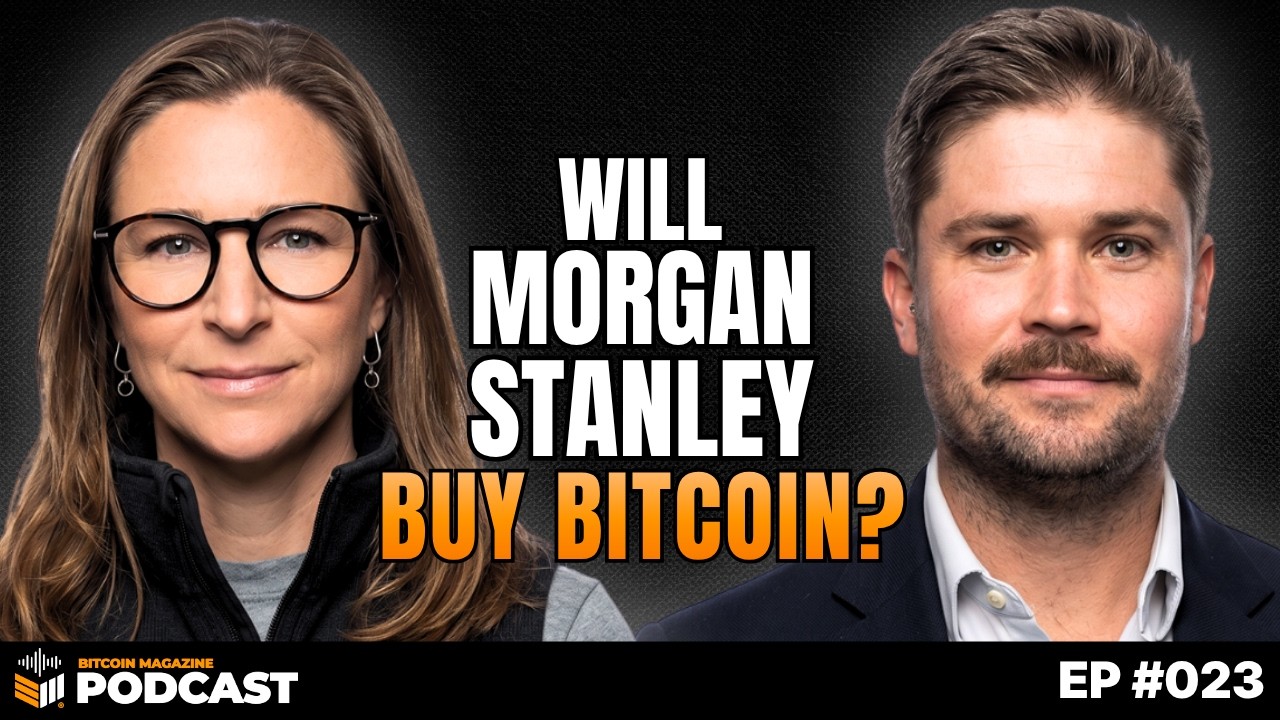
Morgan Stanley became the first global systemically important bank to launch a spot Bitcoin ETP and it crossed $600 million within months of its April debut. Amy Oldenburg, Head of Digital Assets at Morgan Stanley, joins host Spencer Nichols to explain how that product came together, why it was priced below competing spot Bitcoin ETFs, and what still stands between clients and their first Bitcoin allocation. She also details the firm’s 0–4% allocation framework across three investor risk profiles and why Morgan Stanley has no equivalent gold allocation. Plus: whether Bitcoin could land on Morgan Stanley’s own balance sheet.

🔶 Host: Spencer Nichols — Bitcoin Magazine
🔶 Amy Oldenburg, Head of Digital Assets at Morgan Stanley

Chapters:
0:00 — Morgan Stanley on Putting Bitcoin on Its Own Balance Sheet
1:14 — 26 Years at Morgan Stanley: Emerging Markets to Head of Digital Assets
2:10 — First Major Bank to Launch a Spot Bitcoin ETP Tops $600 Million
3:14 — Education, E-Trade Spot Crypto, and What Clients Actually Own
4:49 — Why Morgan Stanley Priced Its Bitcoin ETP So Low
6:40 — The 0–4% Allocation Framework and the Digital Gold Thesis
8:52 — Correlation Regimes: Digital Gold, High Beta Tech, and Volatility
11:41 — Gold 2.0, Market Cap, and Bitcoin on the Balance Sheet
14:37 — Institutional Market Structure, Quantum Risk, and Client Trust
18:02 — Global Off-Ramps, Tokenization, Stablecoins, and Morgan Stanley Research

DISCLAIMER: The views and opinions expressed in this show are those of the participants and do not necessarily reflect the official policy or position of BTC Inc., Bitcoin Magazine, or any affiliated entities. This content is provided for informational and educational purposes only and should not be construed as investment, legal, tax, or accounting advice. Nothing contained in this show constitutes a solicitation, recommendation, endorsement, or offer to buy or sell any securities or financial instruments. Viewers should consult their own advisors before making financial or business decisions.

This post Morgan Stanley’s Bitcoin Investment Recommendation Explained w/ Amy Oldenburg first appeared on Bitcoin Magazine and is written by Mark Mason.

💾

Enjoy the videos and music you love, upload original content, and share it all with friends, family, and the world on YouTube.

Strive Snaps Up More Bitcoin, Brings Holdings to 25,000 BTC 

Bitcoin Magazine

Strive Snaps Up More Bitcoin, Brings Holdings to 25,000 BTC 

Nasdaq-listed bitcoin treasury Strive now holds 25,000 BTC — worth nearly $2 billion — following its latest buy. 

The company said Monday that it bought 469 bitcoins at an average price of approximately $77,954. It is still the fifth biggest publicly traded bitcoin company, according to Bitcoin Treasuries. Strategy, Twenty One, Metaplanet, and MARA all hold more bitcoin than Strive. 

CEO Matt Cole wrote on X Monday that 100% of the capital raised during the week came through sales of SATA, Strive’s perpetual preferred stock.

Dallas, Texas-based Strive’s stock (ASST) was trading more than 6% higher following the news. 

The first billion’s the hardest. pic.twitter.com/1EDYiZ10TD

— Matt Cole (@ColeMacro) September 13, 2026

Strive debuted as an official bitcoin treasury last year. The company was founded by former Ohio gubernatorial candidate and tech entrepreneur Vivek Ramaswamy. 

In January 2026, it completed the acquisition of Semler Scientific in an all-stock deal — the first instance of a publicly traded Bitcoin treasury company acquiring another such company. 

Like with other digital asset treasuries, the idea is that investors can get amplified returns from Strive’s stock. The company buys bitcoin with equity, and maintains a debt-free balance sheet: no bonds, no credit lines, and no leveraged positions that could trigger forced liquidation in a downturn. 

The company is different to other major bitcoin treasuries because it has no debt. 

Other major bitcoin treasuries — like the biggest, Strategy — have used leverage to buy the leading cryptocurrency. 

Strive CEO Matt Cole has described the company as debt-free with zero margin requirements and zero encumbered bitcoin.

This post Strive Snaps Up More Bitcoin, Brings Holdings to 25,000 BTC  first appeared on Bitcoin Magazine and is written by Mathew Di Salvo.

Strategy Buys Back Stock, Skips Bitcoin Purchase 

Bitcoin Magazine

Strategy Buys Back Stock, Skips Bitcoin Purchase 

Bitcoin treasury Strategy held off buying bitcoin again last week. The Nasdaq-listed company said it instead bought $139 million of its preferred stock STRC. 

A Monday filing with the Securities and Exchange Commission on Monday showed that the company repurchased 1.42 million STRC preferred shares for around $139.3 million between September 8 and September 13. 

The company still owns 845,050 bitcoins worth $66.2 billion at today’s prices, and has two cash balances: USD Reserve and USD Cash, holding $5.1 billion and $1.3 billion, respectively. 

Strategy has repurchased $139M of $STRC. As of 9/13/26, we hold 845,050 $BTC and $6.4B of USD Assets. $MSTRhttps://t.co/awLZ666Nuq

— Strategy (@Strategy) September 14, 2026

Strategy, which is the largest corporate holder of bitcoin, this year switched from predictably buying the biggest cryptocurrency this week to buying back its stock and building a cash reserve. 

On some occasions, the company even sold small bits of its BTC stash — despite founder and chairman Michael Saylor famously preaching to “never sell your bitcoin.” 

After a 10-week hiatus, the company started buying bitcoin again in the final week of August, scooping up nearly $370 million in the leading cryptocurrency. 

It hasn’t bought any bitcoin since. 

Its Nasdaq-listed shares (MSTR) were 3% trading higher on Monday. The stock has lost over 75% of its value since notching a record in November 2024 — one month before bitcoin passed the once mythical and long-awaited $100,000 mark. 

Strategy — formerly MicroStrategy — is an enterprise software company that pivoted to buying and holding bitcoin in 2020. 

It first bought the cryptocurrency to protect its shareholders from inflation but has since aggressively bought the asset and pivoted to being a bitcoin treasury.

Strategy has defended its recent bitcoin sales, with CEO Phong Le saying that the company now has a “bullet-proof balance sheet.” 

In the company’s quarterly earnings in July, Strategy posted a $8.22 billion loss. But Le reassured investors that the firm’s current paper loss was nothing to worry about.

“We’re the J.P. Morgan of the crypto economy, so whether we sell 1,000 bitcoin out of 840,000 to me is irrelevant to the conversation,” Le said in a subsequent interview. 

This post Strategy Buys Back Stock, Skips Bitcoin Purchase  first appeared on Bitcoin Magazine and is written by Mathew Di Salvo.

A Bitcoin Berkshire Model: Orange Juice

Bitcoin Magazine

A Bitcoin Berkshire Model: Orange Juice

The corporate Bitcoin landscape is currently dominated by a single, aggressive playbook. Companies following this model rely almost exclusively on capital markets and financial engineering—issuing debt, preferred stock, and common equity at premiums—to turn their corporate balance sheets into amplified, high-beta proxies for Bitcoin.

Now, Orange Juice, a firm launched by partners at ego death capital, is introducing a brand-new corporate strategy to the mix. Rather than acting as a financial engineering vehicle reliant on capital markets, Orange Juice plans to acquire profitable American businesses, hold them indefinitely, improve their operations, and direct part of their excess cash flow into a Bitcoin treasury. While the dominant model turns investor demand for credit securities into Bitcoin, Orange Juice wants to turn sustainable operating earnings into Bitcoin.

To understand the value of this new approach, you have to understand its primary departure from the prevailing meta: Orange Juice is deliberately not “max long” Bitcoin. By anchoring its balance sheet to traditional operating earnings, the company trades away explosive bull market leverage in exchange for a decorrelated return stream that acts as a vital ballast during bear market winters.

Bear market ballasts and countercyclical purchasing power 

The core argument for the Orange Juice model becomes clearest during a Bitcoin bear market. Bitcoin companies that are driven by capital markets flows work best when investors are eager to finance them. Strong Bitcoin prices support higher equity valuations, which makes share issuance highly accretive, while healthy credit markets lower the cost of borrowing. However, during market downturns, this dynamic reverses. Equity premiums compress, credit becomes expensive, and capital markets become far less receptive. As a result, pure-play Bitcoin balance sheets lose their purchasing power precisely when Bitcoin is trading at its cheapest valuations.

Orange Juice, in theory, would be able to use its non-Bitcoin enterprise value as a buffer against these “very awful months”. A durable operating business like a pest control firm, a managed IT provider, or an industrial maintenance contractor can all continue to collect customer payments and generate free cash flow even during a 50% Bitcoin drawdown. This steady operational cash provides the company with unencumbered, countercyclical purchasing power when external capital markets are closed. At its core, the non-Bitcoin business serves as a diversification venue, providing a decorrelated return stream that smooths out enterprise volatility and protects the firm from a fearful capital market. It is also applicable to leveraged financing, because free cash flow can be used to pay preferred dividends or debt coupons, which can eliminate the need to issue equity at bear market lows. 

The trade-off: cost of capital and the Bitcoin hurdle rate

Because Orange Juice isn’t purely a Bitcoin balance sheet company, its downside protection comes with a clear structural trade-off.

Every acquisition Orange Juice makes introduces a cost of capital and an implicit hurdle rate: Bitcoin itself. If Orange Juice has $20 million in capital, it must decide whether to deploy that $20 million directly into Bitcoin on day one or use it to acquire a business generating (as an illustration) $3 million in annual cash flow. Even if the business yields an attractive 15% initial cash return, Orange Juice still has to answer whether that business will ultimately create more Bitcoin-denominated value than simply holding the underlying asset.

In a sustained bull market, this model obviously creates an inherent drag. A business returning 12 – 15% annually can prove to be a poor capital allocation decision if spot Bitcoin compounds much faster, and Orange Juice’s equity will naturally lag the explosive returns of amplified pure-play amplified “digital equity.” Orange Juice is effectively betting that the ability to aggressively buy the dip during bear markets (or at least service liabilities without selling Bitcoin or issuing equity) using operational cash will ultimately compensate for the opportunity cost of not putting every dollar directly into Bitcoin.

Execution risk and acquisition quality

For this countercyclical engine to work, the model depends heavily on acquisition quality and operational execution.

Unlike strategies that focus primarily on marketing to the capital markets and on financial engineering, Orange Juice’s success would depend on management’s ability to execute M&A and manage operating businesses. The ideal subsidiary must generate recurring revenue, require minimal maintenance capital expenditures, carry modest leverage, and remain resilient through broader economic recessions.

Weak or highly cyclical businesses damage the core thesis by losing its cash flow at the exact moment Bitcoin and the capital markets come under pressure. If an acquired subsidiary fails during a downturn, it could turn into an operational drain. Therefore, management must excel at both acquiring businesses at attractive free-cash-flow multiples and running them efficiently enough to maintain a predictable stream of excess cash for Bitcoin accumulation.

The bottom line 

Corporate Bitcoin strategy no longer has to be a game dominated by “digital securities.” While pure-play Bitcoin companies operate as high-beta vehicles designed to maximize upside during favorable market regimes, the Orange Juice model offers an alternative framework designed for resiliency through decorrelation.

By accepting lower beta and sacrificing maximum leverage in a bull market, Orange Juice, in theory, creates an operational foundation for unconditional purchasing power through every stage of the market cycle. 

Disclaimer: This content was prepared on behalf of Bitcoin For Corporations for informational purposes only. It reflects the author’s own analysis and opinion and should not be relied upon as investment advice. Nothing in this article constitutes an offer, invitation, or solicitation to purchase, sell, or subscribe for any security or financial product.

This post A Bitcoin Berkshire Model: Orange Juice first appeared on Bitcoin Magazine and is written by Allard Peng.

Bitcoin’s ‘Unusual Mix’: Bearish Inflation Print, Bullish Buyback Failure

Bitcoin Magazine

Bitcoin’s ‘Unusual Mix’: Bearish Inflation Print, Bullish Buyback Failure

Bitcoin’s path higher just got harder in the short term, but the setup further out may be improving, according to a new report. 

In a Friday note, European asset manager CoinShares’ Head of Research, James Butterfill, said firmer-than-expected core inflation raises the odds of tighter Fed policy and could cap bitcoin below $80,000 for now. 

But the longer-term case, he argued, rests on the U.S. Treasury’s bond buyback programme failing to bring down long-end yields — a failure that could ultimately feed the debasement narrative that has supported both bitcoin and gold.

“The result is therefore a somewhat unusual policy mix for Bitcoin,” the report read. “Today’s CPI data is negative at the margin, increasing the probability of tighter monetary policy and potentially limiting the immediate upside. 

“But the apparent failure of the Treasury’s current buying programme increases the likelihood of much more substantial intervention further ahead.”

It continued: “If that happens, it could become one of the more powerful medium-term catalysts for Bitcoin.”

Data on Friday revealed that the consumer price index, excluding food and energy, climbed 0.3% in August from a month earlier — higher than expected. 

According to CME’s FedWatch tool, traders think there is a 85% chance interest rates will be higher after the Federal Reserve meets next week. Bitcoin has typically performed well in a low interest rate environment. 

But the U.S. Treasury’s expanded bond buyback programme has so far failed to materially suppress long-term yields. 

If yields stay stubbornly high, Butterfill said, pressure will build on Treasury Secretary Scott Bessent to escalate to a much larger, “bazooka-style” buying programme aimed at forcing borrowing costs down.

Bitcoin in August had one of its best runs in years after Treasury Secretary Scott Bessent announced the department would double the size of its long-dated bond buybacks. 

The announcement and subsequent price surge has led some to say the much talked-about debasement trade is back. The so-called debasement trade is when investors buy an asset as a way to hedge against a currency losing value. 

Bitcoin and gold have both benefited as part of the trade as the dollar weakens. 

This post Bitcoin’s ‘Unusual Mix’: Bearish Inflation Print, Bullish Buyback Failure first appeared on Bitcoin Magazine and is written by Mathew Di Salvo.

Italy’s Second Biggest Bank UniCredit Is Weighting up Crypto Custody: Report

Bitcoin Magazine

Italy’s Second Biggest Bank UniCredit Is Weighting up Crypto Custody: Report

Italy’s second largest bank is considering expanding into digital asset offerings, including custody, according to reports. 

According to a Friday Bloomberg report citing people familiar with the matter, Milan-based UniCredit is selecting a technology provider that would allow it to build the infrastructure needed to hold digital assets and facilitate their buying and selling. 

Bloomberg’s reporting added that tokenized investment products and fixed-income securities, the use of stablecoins and exposure to cryptocurrencies were all on the cards. 

JUST IN: 🇮🇹 Italy’s 2nd-largest bank UniCredit is considering to offer crypto asset custody — Bloomberg 👀 pic.twitter.com/NAZKJBdcES

— Bitcoin Magazine (@BitcoinMagazine) September 11, 2026

The news comes as other banks in Europe expand crypto offerings. Spain moved first on retail, with BBVA rolling out bitcoin trading and custody to all customers via its app, using its own custody infrastructure rather than a third party; Santander’s Openbank followed with its own trading service.

Cecabank — a Spanish custodian with over €400bn under management that acts as backbone for 100+ financial institutions — went live with crypto custody in June via a partnership with Bit2Me.

And in Germany, Deutsche Bank is building custody with Bitpanda’s technology arm, while Taurus and DZ Bank got BaFin approval in January for its meinKrypto platform. 

New regulation in the European Union — Markets in Crypto-Assets Regulation (MiCA) — gives banks a legal definition, a supervisor, and a familiar set of obligations to launch crypto services. 

UniCredit is one 37 lenders across 15 European countries working together to create a company called Qivalis with the aim of issuing a euro-denominated stablecoin.

Last year, the bank said it was offering professional clients a structured product tied to BlackRock’s iShares Bitcoin Trust exchange-traded fund, with full protection against losses.

This post Italy’s Second Biggest Bank UniCredit Is Weighting up Crypto Custody: Report first appeared on Bitcoin Magazine and is written by Mathew Di Salvo.

Bitcoin Price Spikes, Shrugs off Hot US Inflation Data

Bitcoin Magazine

Bitcoin Price Spikes, Shrugs off Hot US Inflation Data

Bitcoin’s price rose on Friday — despite data revealing that U.S. inflation had risen. 

The biggest cryptocurrency by market cap was recently trading for close to $78,749 after jumping 2% over a 24-hour period. At one point on Friday morning in New York, bitcoin rose as high as $79,607. 

Bitcoin’s price spike came after news dropped that U.S. consumer prices accelerated in August, reinforcing ​expectations that the Federal Reserve will raise interest rates next week.

The consumer price index, excluding food and energy, climbed 0.3% in August from a month earlier, which was higher than expected. 

Inflation in the U.S. has been difficult to tame due to the war with Iran, which has lifted oil prices, in turn raising the costs of food, gasoline and other goods. 

Higher inflation typically means the Federal Reserve will raise interest rates, which in turn could stop bitcoin’s price climbing higher. 

According to CME’s FedWatch tool, traders think there is a 85% chance interest rates will be higher by next week. The Federal Reserve will meet next week and reveal what it will do with borrowing costs. 

Bitcoin has typically performed well in a low interest rate environment because it means people can buy more of the cryptocurrency with increased liquidity. 

Federal Reserve Chairman Kevin Warsh, who took the helm in January, last month gave his first speech as head of the U.S. central bank and said he had “more work to do” to fight inflation. 

The U.S. is currently in the grips of an affordability crisis and rising oil prices are a hot topic ahead of the midterm elections. 

U.S. President Donald Trump has reassured voters that prices will get under control and repeatedly put pressure on the central bank to lower interest rates. 

Bitcoin in August had its biggest run in years following positive regulatory news and an announcement from the U.S. Treasury. 

Treasury Secretary Scott Bessent announced the department would double the size of its long-dated bond buybacks, helping non-yielding assets like bitcoin and gold. The cryptocurrency then benefited from President Trump urging lawmakers to get key crypto legislation, the Clarity Act, over the line. 

This post Bitcoin Price Spikes, Shrugs off Hot US Inflation Data first appeared on Bitcoin Magazine and is written by Mathew Di Salvo.

Ringleader of $245M Crypto Theft Pleads Guilty 

Bitcoin Magazine

Ringleader of $245M Crypto Theft Pleads Guilty 

The man behind one of the biggest bitcoin thefts in history this week pleaded guilty.

Malone Lam, 22, a Miami resident from Singapore, on Tuesday admitted his role as ringleader of the international crime group which stole 4,100 bitcoins — worth over $230 million at the time — to fund a life of luxury. 

The U.S. Department of Justice said that from October 2023 and through at least May 2025, Lam and others hacked databases to steal crypto users’ information and con them into providing user logins and private keys. Bitcoin and other cryptocurrencies worth $245 million were taken in the theft. 

On one occasion, a co-defendant broke into a residence in New Mexico and stole a hardware wallet while Lam monitored the victim’s movements by hacking their iCloud account.

“This defendant led an international network that preyed on victims through deception, invaded their privacy, and stole hundreds of millions of dollars in cryptocurrency,” U.S. Attorney Jeanine Ferris Pirro said in a statement. 

“If you build a cybercrime empire, we will find you, dismantle your operation, and hold you accountable,” Attorney Pirro added. 

The DOJ said: “The Racketeer Influenced and Corrupt Organizations Act conspiracy used social engineering and occasional home break-ins to obtain information that allowed the conspirators to drain their victims’ cryptocurrency wallets.” 

The crimes started after a group of online gamers became friends before working together to commit the cybercrimes, the indictment read.

Lam and co-defendants laundered the stolen bitcoin and spent it on bottle service parties, private jet rentals, security guards, luxury handbags and watches, and properties in Los Angeles, the Hamptons, and Miami. 

The defendants would spend up to $500,000 a night on parties and give away designer handbags worth tens of thousands of dollars, Tuesday’s announcement read. 

Lam was arrested in 2024 at his rental home in Miami. 

This post Ringleader of $245M Crypto Theft Pleads Guilty  first appeared on Bitcoin Magazine and is written by Mathew Di Salvo.

Trezor Reveals Another Data Breach After Scammers Target Marketing Platform 

Bitcoin Magazine

Trezor Reveals Another Data Breach After Scammers Target Marketing Platform 

Trezor has warned that a data breach at the third-party marketing platform it uses for sending newsletters is leading criminals to target customers with phishing attacks. 

The top hardware wallet manufacturer said Wednesday that an unauthorized actor got access to Brevo’s system and sent emails to 347,000 Trezor customers. Brevo is a platform businesses use to send customer communications. 

Scammers managed to use Trezor’s domain name to send the email, making the phishing attempt all the more believable. The email contained a malicious link asking users to download an app and enter their wallet backup. 

Our third-party e-mail provider has been breached. Please be aware that the email named ‘Critical Security Alert: STM32 Entropy Vulnerability’ is not coming from us, and it’s a phishing attempt. Do not click on any link.

We have taken down the domain, and we are investigating…

— Trezor (@Trezor) September 9, 2026

The news comes after Trezor last month announced that data from 11,742 customers had been exposed after its third-party fulfillment partner, ShipMonk, was targeted. 

It then said last week that an additional 67,000 U.S. customers had their names, emails, phone numbers, shipping addresses and order numbers leaked in the breach. 

“We took down the domain at the DNS level within 20 minutes, preventing the link from working for anyone else and limiting access to 2,500 people who had clicked it before we took it down,” Trezor said on Wednesday. 

“These addresses might be potentially used for other phishing attacks in the future. No other Trezor system was touched,” Trezor added.

“We have suspended the Brevo account to stop further email distribution.”

Trezor reminded users that it never asks customers to ask for their wallet backups. 

Criminals have been targeting data this year, with scammers getting hold of customer information via crypto wallet Ledger’s payment processor Global-e to send phishing emails. 

Crypto wallet provider SafePal last month also announced a data breach that involved ​unauthorized access to about 39,798 customers’ order information, ‌including personal details such as names, addresses and purchase data.

This post Trezor Reveals Another Data Breach After Scammers Target Marketing Platform  first appeared on Bitcoin Magazine and is written by Mathew Di Salvo.

Bitcoin Suffers On Renewed US-Iran Fighting 

Bitcoin Magazine

Bitcoin Suffers On Renewed US-Iran Fighting 

Bitcoin’s price slid on Thursday after the price of oil shot over $105 a barrel thanks to renewed tensions in the Middle East. 

The biggest and oldest cryptocurrency was recently trading for $77,208 after sliding as low as $76,748 — down more than 2% over the past day. 

Its dip came after Iran signaled that it had no intention of backing down against U.S. forces. The two countries earlier this week stepped up attacks in some of the heaviest fighting since the war started in February. 

Tehran-backed Houthis in Yemen this week hit Saudi Arabian assets, also pushing the price of oil up. 

War in the Middle East pushes oil prices higher and makes the chances of interest rate cuts lower because of inflation. Bitcoin has typically performed well in a low interest rate environment and has experienced sell-offs when the Federal Reserve pivots to hawkishness. 

The U.S. is currently in the grips of an affordability crisis and rising oil prices are a hot topic ahead of the midterm elections. U.S. President Donald Trump has reassured voters that prices will get under control. 

Federal Reserve Chair Kevin Warsh said at his first speech as leader of the central bank and said that inflation in the world’s largest economy had not come down enough. 

Traders are now pricing in an interest rate hike next week when the bank meets. 

Still,  bitcoin had one of its best runs in August after the U.S. Treasury said it would at least double the size of its liquidity-support buyback operations, in response to surging borrowing costs. 

The announcement hurt the dollar but non-yielding assets like bitcoin and gold have benefited. 

Despite previously trading in line with risk-on assets like tech stocks, bitcoin has this year traded more in tandem with gold as the so-called debasement trade becomes hot again. 

Investors have bought the largest cryptocurrency — along with the precious metal — to hedge against the dollar’s decline. 

This post Bitcoin Suffers On Renewed US-Iran Fighting  first appeared on Bitcoin Magazine and is written by Mathew Di Salvo.

Coinbase CEO Brian Armstrong Says Clarity Act Will Pass — And That Bitcoin Bottom Is In

Bitcoin Magazine

Coinbase CEO Brian Armstrong Says Clarity Act Will Pass — And That Bitcoin Bottom Is In

Coinbase CEO Brian Armstrong has said that bitcoin’s bottom is in and reiterated that the coin will hit $400,000 by 2030. 

Speaking on CNBC Thursday, the head of America’s biggest crypto exchange said that he was confident the long-awaited crypto Clarity Act would pass next week. 

Bitcoin was trading sluggishly throughout June and July but started surging in August, spurred on by positive regulatory news. Over a 30-day period, the largest cryptocurrency is currently up over 20%. 

JUST IN: Coinbase CEO Brian Armstrong tells CNBC the Bitcoin "bottom is in" and BTC hitting $400,000 by 2030 is a "reasonable target" 🚀 pic.twitter.com/RYfipYCNDk

— Bitcoin Magazine (@BitcoinMagazine) September 10, 2026

“[$400,000] is a reasonable target by 2030, and if you follow crypto, you know it typically goes through these four-year-ish cycles: there’ll be a run-up, some euphoria, there’ll be a down period,” Armstrong said. 

“Most of the down periods last about a year, and we’ve actually just come across the one-year mark for this down period, so I personally believe that the bottom is in.”

Bitcoin was recently trading for close to $77,318 per coin. It hit a new all-time high of $126,080 in October. 

Market observers have been paying attention to the long-awaited Clarity Act this year. The bill drafts a framework to formally divide oversight between regulators, distinguishing which digital assets are securities, commodities or stablecoins. The crypto industry has long called for such rules to be in place. 

Senators will vote on the long-awaited legislation next week after an August delay. 

U.S. President Trump helped spur a surge in the bitcoin price when he hosted crypto executives and traditional finance bigwigs at the White House and urged lawmakers to move forward with the bill. 

Armstrong said on Thursday that he was confident the bill would get through — and help unlock new capital as a result. 

“We saw with the Genius Act that passed last year for stablecoins: in the wake of that legislation passing, we saw well over 150 large companies integrate stablecoins within just a three-month period,” he said. 

“And I think something similar could happen with the Clarity Act passing — it’s a regulatory checkbox, it’d be a big milestone certainly to unlock institutional capital and to bring things like tokenized equities and perks to the United States, which would be very good.”

This post Coinbase CEO Brian Armstrong Says Clarity Act Will Pass — And That Bitcoin Bottom Is In first appeared on Bitcoin Magazine and is written by Mathew Di Salvo.

Jack Dorsey’s Block Becomes Latest Bitcoin-Focused Company To Apply for Banking Charter

Bitcoin Magazine

Jack Dorsey’s Block Becomes Latest Bitcoin-Focused Company To Apply for Banking Charter

Bitcoin-focused Block Inc. has become the latest company to apply for a U.S. banking charter. 

The company, which manages Square, Cash App, and Bitkey, said Wednesday that it had submitted an application to the Office of the Comptroller of the Currency to establish Builders Bank & Trust, N.A.

Block joins a long-list of digital asset firms that have received conditional approval or are awaiting approval from the regulator to have the license. The charter would allow companies — if fully approved — to have certain banking powers, such as custody assets and move client funds.  

JUST IN: Block applies to establish Builders Bank & Trust with the OCC, which would provide federally regulated custody and "fiduciary services" for Bitcoin and stablecoins. 👀 pic.twitter.com/Dkq7WIg6Wa

— Bitcoin Magazine (@BitcoinMagazine) September 8, 2026

“Building on Block’s experience in the digital asset space, our history with Square Financial Services, and the deep banking expertise of the team we’ve assembled, we believe Builders Bank is well positioned to support Block’s broader vision of economic empowerment,” Lee Woolley, who would serve as President and CEO of Builders Bank, said in a statement. 

Block said that, if approved, Builders Bank would operate as a federally regulated national trust bank under OCC supervision and provide custody and related fiduciary services, including for bitcoin and stablecoins. 

A number of top crypto companies have received conditional approval, including Coinbase, Circle, Crypto.com, and Paxos.

Decentralized financial protocol World Liberty Financial, backed by U.S. President Donald Trump, also received approval this year. 

Block CEO and founder Jack Dorsey, a Bitcoin maximalist, has been pushing for the biggest and oldest cryptocurrency to become everyday money. 

His point-of-sale products, Square, last year rolled out bitcoin acceptance for millions of eligible U.S. small businesses, with no setup required and transactions instantly converted to dollars at checkout. 

This post Jack Dorsey’s Block Becomes Latest Bitcoin-Focused Company To Apply for Banking Charter first appeared on Bitcoin Magazine and is written by Mathew Di Salvo.

Steak ‘n Shake Says Sales Grew Double Digits Since Bitcoin Adoption

Bitcoin Magazine

Steak ‘n Shake Says Sales Grew Double Digits Since Bitcoin Adoption

Burger restaurant franchise Steak ‘n Shake has said that accepting bitcoin payments has helped the company grow. 

Writing on its X account Tuesday, the Indianapolis, Indiana-based company said since accepting the largest cryptocurrency, it has achieved double-digit same-store sales growth. 

It added: “And this quarter has been extraordinary, with franchise-partners same-store sales gaining 19%.”

Ever since we started accepting Bitcoin in May 2025, we have achieved double-digit same-store sales growth!

And this quarter has been extraordinary, with franchise-partners same-store sales gaining 19%.

Come have a Bitcoin burger and Bitcoin shake to celebrate! 🍔🧡

Thank…

— Steak 'n Shake (@SteaknShake) September 8, 2026

The firm last year started accepting Bitcoin payments, using the Lightning Network to do so. 

It added that it would add the cryptocurrency to its balance sheet and announced in January that it had added $10 million in Bitcoin to its strategic reserve.

Back in April, Steak ‘n Shake Chief MAHA Officer Michael Boes told attendees at the Bitcoin 2026 Conference that Bitcoin has become a core driver of the chain’s business performance. 

Same-store sales rose 11% quarter over quarter in Q2 2025 and accelerated to 15% in Q3 2025, outpacing major rivals including McDonald’s, Taco Bell, and Domino’s. 

He called it the highest same-store sales growth of any restaurant in the industry — and all because bitcoin on Lightning is cheaper and faster than traditional electronic payment methods. 

It works like this: When customers pay with bitcoin instead of a credit card, Steak ‘n Shake saves roughly 50% on processing fees. Traditional credit card processors charge merchants between 2.5% and 3.5% per transaction. 

“Bitcoin is real money made with real energy,” Boes said at the time. 

The company last year also toyed with the idea of accepting other cryptocurrencies but scrapped the idea after a poll on X revealed people thought that only bitcoin was needed. 

This post Steak ‘n Shake Says Sales Grew Double Digits Since Bitcoin Adoption first appeared on Bitcoin Magazine and is written by Mathew Di Salvo.

Iran Continues Using Bitcoin To Keep Economy Stable: Report

Bitcoin Magazine

Iran Continues Using Bitcoin To Keep Economy Stable: Report

Iran is continuing to use bitcoin as a way to skirt around sanctions as the country’s central bank turns a blind eye, according to reports. 

The Financial Times on Wednesday reported that the Middle Eastern country was using cryptocurrencies, including bitcoin, to settle cross-border transactions through Iranian crypto exchanges after the central bank advised its countrymen to do anything necessary to help the economy. 

Citing conversations with businesses, regime insiders and analysts, the newspaper said that the central bank had “quietly encouraged traders” to get money flowing to help its struggling economy. 

Bitcoin is proving to be a tried and tested way of doing so. 

One business insider reportedly told the newspaper that the central bank doesn’t ask any questions about how money is transferred. 

Iran has been sanctioned for decades, and a sharp escalation beginning in late 2025 — UN snapback, EU measures and expanded U.S. energy sanctions — was compounded by war with the U.S. and Israel starting in February 2026 and a naval blockade that has cut oil exports by more than 80%.

The country also has one of the highest rates of inflation in the world. 

Iran started a bitcoin-backed insurance service for its counties shipping companies earlier this year.

The U.S. in July said that it had frozen crypto linked to the Iranian regime, mostly in the form of Tether’s stablecoin. 

Stablecoins like Tether’s USDT can be frozen by the company that issues the asset but bitcoin, being decentralized and having no single issuer, cannot. 

The U.S. Treasury’s Office of Foreign Assets Control in July said Iran had been dodging sanctions by accepting pay in bitcoin from ships passing through the Strait of Hormuz. 

OFAC said at the time that Hormuz Safe, developed by Iran’s Ministry of Economy, “accepts payment in Bitcoin and other digital assets” so it can bypass sanctions. 

The U.S. and Israel struck Iran in February 2026. Fighting has continued in phases since, punctuated by a Pakistan-brokered ceasefire in April and a short-lived memorandum in June. 

Both ended up collapsing, and there is currently no ceasefire in place. 

This post Iran Continues Using Bitcoin To Keep Economy Stable: Report first appeared on Bitcoin Magazine and is written by Mathew Di Salvo.

VerifiedX Launches $15 Million Financing Round to Deploy Institutional Bitcoin Infrastructure

Bitcoin Magazine

VerifiedX Launches $15 Million Financing Round to Deploy Institutional Bitcoin Infrastructure

VerifiedX (verifiedx.io), the programmable financial operating system for Bitcoin and intelligent assets, today announced that its Foundation has launched a $15 million financing round and the first institutional investors have already invested. Initial capital will fund VerifiedX’s institutional Bitcoin distribution.

Cantor Fitzgerald is serving as VerifiedX’s investment banking partner in connection with the financing. The Foundation is not yet disclosing the identities or terms of the initial investors.

Part of the capital is allocated to expand custody relationships with partners including BitGo, the digital-asset custodian listed on the New York Stock Exchange, which will hold vBTC (VerifiedX’s Bitcoin-collateralized token) and vBTC.b (its counterpart on Base, Coinbase’s Ethereum layer-2 network). BitGo is a qualified custodian, meaning U.S. custody rules allow registered investment advisers to hold client assets there.

The capital also funds listings. Tier-one centralized exchanges will be listing vBTC and VFX, VerifiedX’s native token, with a first announcement expected within weeks. The round also supports borrow-and-lend programs: facilities that let a holder borrow against Bitcoin, or lend it out for a return, without sacrificing ownership or locking redemption rights.

“Nearly every way to put Bitcoin to work on-chain today asks the holder to swap it for someone else’s IOU. It’s the reason less than 1% of all Bitcoin held by institutions is earning any yield. vBTC is a game-changer in that regard, and this round funds the custody, exchange and lending rails that will allow institutions to use vBTC and natively turn their Bitcoin into productive financial capital,” said Brian May, a member of the VerifiedX Foundation.

With a wrapped Bitcoin token, the industry’s usual route, the holder hands Bitcoin to a custodian, or to a small group of signers acting together, and receives an off-chain representation on another network. The stand-in is only as good as whoever holds the Bitcoin behind it.

vBTC is built the other way around. When a holder creates a vBTC token, the VerifiedX network generates a unique native Bitcoin address inside each token and the holder deposits Bitcoin to their own self-custodial deposit address. The Bitcoin stays in that address, visible on Bitcoin’s own ledger and never leaves the Bitcoin ecosystem. Deposits and withdrawals are authorized by threshold signatures spread across VerifiedX’s validators, so no single party holds the key, and a holder that would rather not rely on the network’s validators can run its own and restrict signing to their own validators exclusively. The holder can redeem to native Bitcoin at any time. A holder can use vBTC for payments, trading, as collateral, in lending or in treasury. vBTC.b puts the same design on Base, so the asset can be used in applications there non-synthetically.

About VerifiedX

VerifiedX is a financial operating system for Bitcoin, intelligent, and alternative assets, enabling self-custodial ownership, instant settlement, programmable finance, native Bitcoin utility, and agentic financial infrastructure. Through products including vBTC, BFLY, and PulseXAI, VerifiedX connects institutions, users, and autonomous systems through a unified blockchain ecosystem framework.

Its ecosystem includes:

  • vBTC & vBTC.b (BTC)
  • BFLY payments and click to earn infrastructure
  • SwitchBlade wallet technology
  • PulseXAI generative and tokenized intelligence
  • Institutional settlement architecture
  • Consensus driven programmability
  • Canonical interoperability systems

Further VerifiedX Inquiries:

Website: https://verifiedx.io/

Discord: https://discord.gg/7cd5ebDQCj

X: https://twitter.com/vfxblockchain

Github: https://github.com/verifiedxblockchain

Email: info@verifiedx.io

PulseXAI and BFLY are trademarks of VerifiedX. Copyright 2026 VerifiedX. All rights reserved.

This post VerifiedX Launches $15 Million Financing Round to Deploy Institutional Bitcoin Infrastructure first appeared on Bitcoin Magazine and is written by Bitcoin Magazine.

CoinCorner Launches Lloyd’s-Insured Multisig Bitcoin Vault with AnchorWatch

Bitcoin Magazine

CoinCorner Launches Lloyd’s-Insured Multisig Bitcoin Vault with AnchorWatch

British bitcoin exchange CoinCorner has debuted a multisig BTC custody service that splits control of customer keys between the Isle of Man exchange and its US partner AnchorWatch — with holdings insured by Lloyd’s of London. 

The service charges 1.5% a year and is pitched at owners who want cold-storage security without managing hardware themselves, the Isle of Man-based company announced Tuesday.

Its new service comes following the Coldcard wallet hack — where bitcoin holders using a single signature wallet lost funds after hackers were able to exploit the popular products due to a firmware bug in the devices that lead to a weak seed generation. About $115 million was lost in the theft. 

“Vault offers a simple non-technical setup for customers, and partnering with AnchorWatch means we can offer fully insured, multi-signature custody with the simplicity our customers expect from CoinCorner,” CoinCorner CEO Danny Scott said in a statement. 

Customers can open a Vault and deposit whatever amount they choose, but the bitcoin doesn’t move into the insured wallet immediately, CoinCorner said. 

Rather, transfers typically happen on the first working day of the following month, and holdings are verifiable on-chain via a wallet address CoinCorner provides. 

Top-ups are allowed anytime, the companies said, Customers define their own identity verification rules before funds can move. 

CoinCorner added that it is the first service of its kind globally. 

Multisig has long been the security-conscious Bitcoin holder’s answer to single-key risk but has also been dismissed as too fiddly for anyone but the technically committed: setting one up traditionally means assembling several hardware devices, generating and backing up multiple private keys and keeping track of which key sits where.  

CoinCorner and AnchorWatch are aiming to simplify things. Vault handles key distribution on the customer’s behalf, leaving them with the security properties of multisig without the setup that has kept most people away from it.

This post CoinCorner Launches Lloyd’s-Insured Multisig Bitcoin Vault with AnchorWatch first appeared on Bitcoin Magazine and is written by Mathew Di Salvo.

Capital B Buys 376 Bitcoins in Its Biggest Purchase of 2026

Bitcoin Magazine

Capital B Buys 376 Bitcoins in Its Biggest Purchase of 2026

European bitcoin treasury Capital B has announced a BTC buy, snapping up 376 coins — one week after it said Blockstream boss Adam Back was investing in the company. 

The Euronext Growth-listed company said Tuesday that it now owns 3,521 bitcoins — worth over $277 million at today’s prices — making it the 25th biggest publicly traded bitcoin treasury in the world, according to Bitcoin Treasuries data. 

Capital B’s buy was for €25.3 million (over $29 million), according to its announcement. 

🟠 Capital B confirms the acquisition of 376 BTC for €25.3 million, the holding of a total of 3,521 BTC, and a BTC Yield of 2.17% YTD ⚡

Full Release (EN): https://t.co/PQDwqfWX9a

Full Release (FR): https://t.co/SrVf8lvp8Q

BTC Strategy (EN): https://t.co/P5j3GA76kt

— Capital B (@_ALCPB) September 7, 2026

Just last week, the company said that top bitcoiner Adam Back, who heads up bitcoin infrastructure company Blockstream, had invested €7.6 million ($8.8 million) in Capital B to help with its buys. 

The firm in August said it had raised €21 million ($24 million) in a private placement backed by Back and asset manager TOBAM. 

The bitcoin treasury’s stock was trading 2% lower on Tuesday. 

Capital B built most of its bitcoin position through fundraising rounds during the first half of 2026. 

In May, it snapped up 192 coins for €13 million after completing three capital raises.

The company, which calls itself “Europe’s first Bitcoin treasury company,” is trying to build a bigger bitcoin position as other treasuries look to raise funds and accelerate their buys. 

Capital B says on its website that it wants to eventually hold 210,000 bitcoins. “Our objective is simple: accumulate 1% of Bitcoin’s total supply by 2033,” it reads. 

Digital asset treasuries became big in 2025 as more publicly traded companies tried to follow in the footsteps of Nasdaq-listed Strategy (formerly MicroStrategy), which started buying bitcoin in 2025. 

Hundreds of publicly traded companies started buying bitcoin — with many buying other cryptocurrencies — to boost their stock prices. But since the price of bitcoin started dropping, a number of them are now under water or have had to sell their holdings. 

Strategy, the largest corporate holder of the asset, has this year slowed down its bitcoin buys and instead pivoted to building a stronger cash balance and buying back its stock as the price of its shares has tumbled. 

This post Capital B Buys 376 Bitcoins in Its Biggest Purchase of 2026 first appeared on Bitcoin Magazine and is written by Mathew Di Salvo.

Castle Opens Its Bitcoin Savings Stack to Individuals

Bitcoin Magazine

Castle Opens Its Bitcoin Savings Stack to Individuals

Castle, the company behind an automated bitcoin financial stack for businesses, has said it is opening its platform to individuals, bringing its high-yield product to personal accounts along with a first for the category: the option to take dividend income in bitcoin at whatever ratio the customer picks.

The yield comes from STRC, Strategy‘s perpetual preferred stock, which Castle added earlier this year and which currently pays a 12% annual dividend on a semi-monthly schedule. 

Holders can take 100% of that payout in cash, 100% in bitcoin, or anything in between, according to a Tuesday statement. Most Castle customers land in the middle, the company said, covering operating expenses with cash while the remainder compounds into bitcoin automatically at every payout.

“Investors have long faced a choice between earning steady yield and holding bitcoin. Castle eliminates that trade-off,” co-founder and CTO João Almeida said. “By enabling a portion of dividend income to be automatically converted into bitcoin, so customers get both cash flow and long-term upside.”

The broader pitch is consolidation: Castle puts operating cash, fixed income, and bitcoin accumulation on one platform, cutting out the shuffle between a bank, an onramp, and a brokerage. The system is built automation-first: users define a strategy once and the platform executes it.

Until now, Castle served business entities exclusively — restaurants, gyms, churches, accounting firms, e-commerce shops, auto dealers, SaaS companies, real estate, and non-profits among them. The push into personal accounts came from those same customers.

“Feedback we heard over and over from business owners was: ‘I love this stack — when can I use it personally?'” co-founder and CEO Stephen Cole said. “Today we’re answering that. The same automated bitcoin-powered financial stack that runs their company’s balance sheet can now run their personal finances.”

Castle was founded by Cole and Almeida and is backed by Boost VC and Winklevoss Capital. More information about the company’s product can be found here.

This post Castle Opens Its Bitcoin Savings Stack to Individuals first appeared on Bitcoin Magazine and is written by Mathew Di Salvo.

❌