US debt-to-GDP has pushed past 120%, and Jack Mallers thinks the debate over whether the Fed hikes or cuts is beside the point, both roads lead to inflation. The Strike founder and CEO joins Bitcoin Magazine to explain why he told investors to study Japan, where outright yield curve control and central planning intervention are now required to hold the currency together. He argues the US is heading to the same place and that Bitcoin, as the asset most sensitive to fiat liquidity, is the fastest horse in that environment. Mallers also breaks down Strike’s shift into Bitcoin-backed lending and what it means to build a full Bitcoin financial stack under one roof.
DISCLAIMER: The views and opinions expressed in this show are those of the participants and do not necessarily reflect the official policy or position of BTC Inc., Bitcoin Magazine, or any affiliated entities. This content is provided for informational and educational purposes only and should not be construed as investment, legal, tax, or accounting advice. Nothing contained in this show constitutes a solicitation, recommendation, endorsement, or offer to buy or sell any securities or financial instruments. Viewers should consult their own advisors before making financial or business decisions.
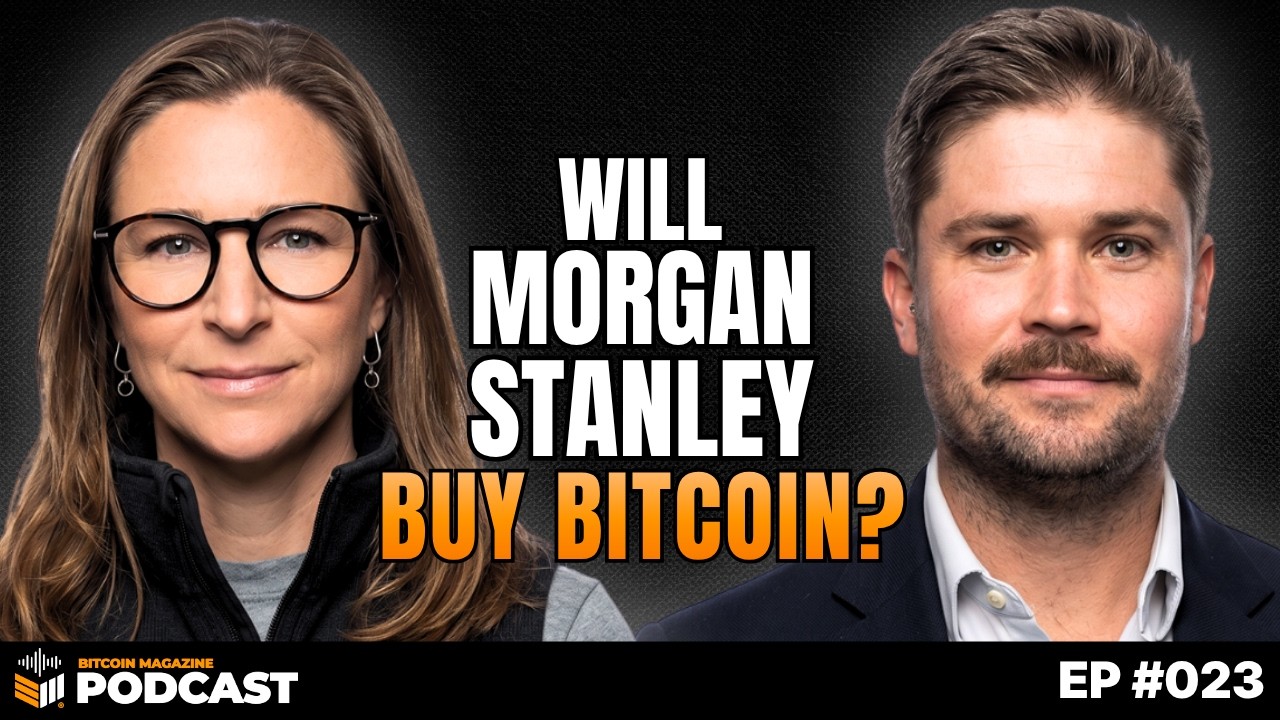
Morgan Stanley became the first global systemically important bank to launch a spot Bitcoin ETP and it crossed $600 million within months of its April debut. Amy Oldenburg, Head of Digital Assets at Morgan Stanley, joins host Spencer Nichols to explain how that product came together, why it was priced below competing spot Bitcoin ETFs, and what still stands between clients and their first Bitcoin allocation. She also details the firm’s 0–4% allocation framework across three investor risk profiles and why Morgan Stanley has no equivalent gold allocation. Plus: whether Bitcoin could land on Morgan Stanley’s own balance sheet.
Host: Spencer Nichols — Bitcoin Magazine Amy Oldenburg, Head of Digital Assets at Morgan Stanley
Chapters: 0:00 — Morgan Stanley on Putting Bitcoin on Its Own Balance Sheet 1:14 — 26 Years at Morgan Stanley: Emerging Markets to Head of Digital Assets 2:10 — First Major Bank to Launch a Spot Bitcoin ETP Tops $600 Million 3:14 — Education, E-Trade Spot Crypto, and What Clients Actually Own 4:49 — Why Morgan Stanley Priced Its Bitcoin ETP So Low 6:40 — The 0–4% Allocation Framework and the Digital Gold Thesis 8:52 — Correlation Regimes: Digital Gold, High Beta Tech, and Volatility 11:41 — Gold 2.0, Market Cap, and Bitcoin on the Balance Sheet 14:37 — Institutional Market Structure, Quantum Risk, and Client Trust 18:02 — Global Off-Ramps, Tokenization, Stablecoins, and Morgan Stanley Research
DISCLAIMER: The views and opinions expressed in this show are those of the participants and do not necessarily reflect the official policy or position of BTC Inc., Bitcoin Magazine, or any affiliated entities. This content is provided for informational and educational purposes only and should not be construed as investment, legal, tax, or accounting advice. Nothing contained in this show constitutes a solicitation, recommendation, endorsement, or offer to buy or sell any securities or financial instruments. Viewers should consult their own advisors before making financial or business decisions.
Bitcoin infrastructure firm Blockstream has refused to negotiate further with hackers who last week stole 4,000 bitcoins from its Liquid network.
Writing on X Friday, Blockstream said that the hackers still had time to return the funds before the company would work with law enforcement.
White-hat hackers on Sunday withdrew about $320 million from the federation wallet that backs Liquid, a sidechain by Blockstream. After negotiating with Blockstream, they returned most of the funds but kept 598.5 coins worth over $46 million — demanding it as ransom.
“Blockstream will not pay a ransom for the return of stolen funds,” the post read. “Taking assets without authorization and withholding their return is a crime, not responsible disclosure. It is not white-hat activity. It is theft.”
To those responsible for the theft of bitcoin from the Liquid Network:
Blockstream will not pay a ransom for the return of stolen funds. Taking assets without authorization and withholding their return is a crime, not responsible disclosure. It is not white-hat activity. It is…
It added: “We will work with law enforcement, exchanges, service providers, forensic specialists, and other relevant parties to trace and recover the assets and identify those responsible.”
“We will not pay for the return of stolen property. We will not abandon our users. The Bitcoin community will not stop pursuing the funds.”
Liquid, or L-BTC, is a layer-2 created by Blockstream that allows users to fast move assets backed 1:1 with bitcoin. One of the assets, LBTC, is a token backed by bitcoin that allows for quick settlement — a bit like the Lightning Network.
Hackers were able to get the funds by exploiting an inflation bug on the Liquid sidechain to create over 4,000 LBTC that did not exist before and cash them out for real, on-chain bitcoins.
The hackers then had an exchange with Blockstream via messages written into Bitcoin blocks.
In one message, the white hats wrote: “Please fix the bug first. The chain is under risk at latest commit right now. Make sure every node is patched. Then we will transfer the money back safely after confirming the fix.”
In the latest message, the hackers slammed Blocksteam as “delusional, greedy, and arrogant,” and threatened to reveal all of Blockstream’s encrypted messages in the exchange unless the company allowed thieves to keep 10% of the bitcoins.
“You SHALL pay 10% using your own money as bug bounty or you will cause all your holders a 15% loss for your irresponsibility and stinginess,” the message read.
The Bitcoin community is still reeling after hackers in July were able to steal over 1,800 bitcoins worth close to $140 million from Coldcard wallet holders.
Users of the popular hardware wallet, created by Coinkite, were targeted because the product’s manufacturer did not use a true random number generator, allowing hackers to essentially guess investor seedphrases.
The Liquid Network said Sunday that purported white-hat hackers withdrew about 4,000 bitcoin, worth about $320 million, from the federation wallet that backs L-BTC. Bridge nodes were disabled, and the sidechain was paused. Other issued assets, including USDT, DePix and RWAs, were unaffected, the official account said on X.
The Liquid Network is a federated sidechain of Bitcoin, founded by Adam Back’s Blockstream. The Liquid chain issues a variety of assets such as LBTC, which it backs with BTC on the Bitcoin main chain, held in a large multisig of 15 corporate and known members. 11 of the 15 members need to sign a valid multi-signature transaction to move coins from the treasury. Before the hack, the treasury held over 4200 BTC; after the hack, Blockstream’s proof of reserves page reports a little over 207 BTC left.
The hackers withdrew 4,019.4 BTC from the reserve address in a peg-out transaction using the SideSwap Peg-out Authorization Key. SideWap is a bridge exchange and a member of the Liquid Federation. While details on the mechanism of the hack are not confirmed yet, it appears an inflation bug on the LBTC side chain was exploited by the hackers to create over 4,000 LBTC that did not exist before, and cash them out for on-chain bitcoin from the federation. Because the transaction appeared as valid, given the consensus bug, the federation members’ HSM security servers signed the BTC withdrawal transaction, worth roughly 320 million at the time.
The hacker moved the funds to an address ending in 6gyqjlte, from which they quickly signed a new transaction with a message on the OP_RETURN arbitrary data field saying “we are whitehats. contact us on chain.” Those coins were still at that address at the time of writing.
A small mainnet transaction to the hacker address followed by an OP_RETURN saying “Please contact security@blockstream.com”, presumably from a Blockstream public address, though that remains unconfirmed. A later OP_RETURN spend from the hacker address carried “Please contact us on Signal @m671aw.70”, however, this may be spam and does not share a link to the address with the stolen funds.
In response to the breach, exchanges were told to pause L-BTC deposits and withdrawals. Bridge nodes on the Liquid Network have been paused, limiting access to the side chain, which continues to produce blocks.
JAN3 CEO Samson Mow said Aqua’s Liquid features were affected and that on-chain bitcoin still worked. Other wallets in the industry that use the Liquid Network are expected to be affected. Users holding LBTC now effectively have their savings at risk, since the underlying BTC is currently not redeemable. Given the private nature of the Liquid chain, user onchain analytics are scarce and not much public information is known about how much LBTC is held by retail users versus corporations of Blockstream itself. Nevertheless, should the funds not be returned, it would be a heavy blow to the Liquid Network’s user base.
Users of LBTC don’t have many options but to wait for conversations with the hackers to resolve. Given the size of the hack, it would be difficult for the hackers to get away with stealing all that bitcoin, though perhaps not impossible. What may happen is that the hackers ask for a finder’s fee and return the majority of the funds.

 Login
Login

 Host: Spencer Nichols — Bitcoin Magazine